

SIST EN IEC 55016-1-1:2019
(Main)Specification for radio disturbance and immunity measuring apparatus and methods - Part 1-1: Radio disturbance and immunity measuring apparatus - Measuring apparatus
General Information
- Abstract
This part of CISPR 16 specifies the characteristics and performance of equipment for the
measurement of radio disturbance in the frequency range 9 kHz to 18 GHz. In addition,
requirements are provided for specialized equipment for discontinuous disturbance
measurements.
NOTE In accordance with IEC Guide 107, CISPR 16-1-1 is a basic electromagnetic compatibility (EMC) standard
for use by product committees of the IEC. As stated in Guide 107, product committees are responsible for
determining the applicability of a basic EMC standard. CISPR and its subcommittee are prepared to co-operate
with product committees in the evaluation of the value of particular EMC tests for specific products.
The specifications in this document apply to electromagnetic interference (EMI) receivers and
spectrum analyzers. The term “measuring receiver” used in this document refers to both EMI
receivers and spectrum analyzers (see also 3.7). The calibration requirements for measuring
receivers are detailed in Annex J.
Further guidance on the use of spectrum analyzers can be found in Annex B of any one of the
following documents: CISPR 16-2-1:2014, CISPR 16-2-2:2010, or CISPR 16-2-3: 2016.
- Status
- Published
- Publication Date
- 19-Aug-2019
- Technical Committee
- EMC - Electromagnetic compatibility
- Current Stage
- 6060 - National Implementation/Publication (Adopted Project)
- Start Date
- 25-Jul-2019
- Due Date
- 29-Sep-2019
- Completion Date
- 20-Aug-2019


Overview
SIST EN IEC 55016-1-1:2019 is a foundational European and International Standard for electromagnetic compatibility (EMC), specifically addressing the specification for radio disturbance and immunity measuring apparatus and methods. Part 1-1 of this standard outlines the detailed requirements for measuring apparatus used to quantify radio disturbances (also known as RF interference) and immunity across a variety of electronic and electrical equipment. Developed by CLC (CENELEC) based on CISPR 16-1-1:2019, this standard harmonizes EMC measurement across industries, supporting product compliance to regulatory and market requirements.
Key Topics
- Radio Disturbance Measurement: Defines requirements for receivers and analyzers used to measure unwanted RF emissions from equipment.
- Immunity Measurement: Addresses apparatus to verify the ability of equipment to withstand electromagnetic interference.
- Measuring Receivers: Specifies core performance aspects such as input impedance, amplitude accuracy, bandwidth, frequency tuning tolerance, and sensitivity.
- Detector Types: Covers quasi-peak, peak, average, and RMS-average detectors for a frequency range spanning from 9 kHz up to 18 GHz.
- Discontinuous Disturbance Analyzers (DDAs): Requirements for analyzers commonly used for testing impulsive interference, e.g., “clicks,” especially relevant for household appliances and industrial devices.
- Calibration and Verification: Includes guidelines for calibration, verification, and compliance testing methods.
- Integration with FFT-Based Instruments: Recognizes advances in measurement technology, allowing the use of FFT-based receivers with built-in analyzers.
- Receiver Noise and Intermodulation: Specifies allowable noise levels and limitations for internally-generated spurious responses.
- Update and Alignment: This edition rearranges and updates previous editions to unify definitions and methods, ensuring ease of use and consistency.
Applications
SIST EN IEC 55016-1-1:2019 plays a critical role for laboratories, product manufacturers, and certification bodies involved in:
- EMC Compliance Testing: Enables manufacturers to assess and verify their products meet regulatory requirements for electromagnetic emissions and immunity.
- Quality Assurance: Ensures consistency and accuracy of EMC measurements used during product development or certification.
- Type Approval & Market Access: Facilitates acceptance of products in the European Union (aligned with RED and EMC Directives) and international markets by ensuring harmonized measurement apparatus.
- Product Categories: Used in testing industrial, scientific, medical, consumer electronics, automotive, and information technology products.
- Conformance Assessment: Provides clear procedures and apparatus requirements for both emission and immunity testing, reducing ambiguity in test setups and results interpretation.
Related Standards
SIST EN IEC 55016-1-1:2019 is closely associated with other key EMC standards, including:
- CISPR 16 Series: International series specifying methodologies and apparatus for EMC testing.
- EN 55011 / CISPR 11: For industrial, scientific, and medical equipment - emissions limits and methods.
- EN 55014-1 / CISPR 14-1: For household appliances and similar apparatus - emission requirements.
- EN 55032 / CISPR 32: For multimedia equipment - emission requirements.
- EN 55025 / CISPR 25: For vehicle components - radio disturbance characteristics.
- EN 55016-2 Series: Methods of measurement for both conducted and radiated disturbances.
- EN IEC 60050-161: International Electrotechnical Vocabulary for electromagnetic compatibility.
Practical Value
Implementing SIST EN IEC 55016-1-1:2019 ensures that measuring apparatus used in EMC testing is accurate, reliable, and up to date with current technological advancements. Adoption of this standard supports global trading by harmonizing EMC test methodologies and minimizing the risk of market rejection due to non-standardized measurements. For laboratories and manufacturers, compliance with SIST EN IEC 55016-1-1:2019 is essential for maintaining quality, demonstrating due diligence, and keeping pace with regulatory and technological developments in EMC.
For keywords: electromagnetic compatibility, EMC, radio disturbance measurement, immunity testing, CISPR 16, radio frequency interference, compliance testing, EMC measuring apparatus.
Relations
- Effective Date
- 01-Sep-2019
- Effective Date
- 01-Sep-2019
- Effective Date
- 01-Sep-2019
- Effective Date
- 09-Feb-2026
- Effective Date
- 03-Feb-2026
- Effective Date
- 03-Feb-2026
- Effective Date
- 03-Feb-2026
- Effective Date
- 03-Feb-2026
- Effective Date
- 03-Feb-2026
- Effective Date
- 03-Feb-2026
- Effective Date
- 03-Feb-2026
- Effective Date
- 03-Feb-2026
- Effective Date
- 05-May-2026
- Effective Date
- 24-Mar-2026
- Effective Date
- 09-Feb-2026
Get Certified
Connect with accredited certification bodies for this standard

ANCE
Mexican certification and testing association.

BSMI (Bureau of Standards, Metrology and Inspection)
Taiwan's standards and inspection authority.

Intertek Slovenia
Intertek testing, inspection, and certification services in Slovenia.
Sponsored listings
Frequently Asked Questions
SIST EN IEC 55016-1-1:2019 is a standard published by the Slovenian Institute for Standardization (SIST). Its full title is "Specification for radio disturbance and immunity measuring apparatus and methods - Part 1-1: Radio disturbance and immunity measuring apparatus - Measuring apparatus". This standard covers: This part of CISPR 16 specifies the characteristics and performance of equipment for the measurement of radio disturbance in the frequency range 9 kHz to 18 GHz. In addition, requirements are provided for specialized equipment for discontinuous disturbance measurements. NOTE In accordance with IEC Guide 107, CISPR 16-1-1 is a basic electromagnetic compatibility (EMC) standard for use by product committees of the IEC. As stated in Guide 107, product committees are responsible for determining the applicability of a basic EMC standard. CISPR and its subcommittee are prepared to co-operate with product committees in the evaluation of the value of particular EMC tests for specific products. The specifications in this document apply to electromagnetic interference (EMI) receivers and spectrum analyzers. The term “measuring receiver” used in this document refers to both EMI receivers and spectrum analyzers (see also 3.7). The calibration requirements for measuring receivers are detailed in Annex J. Further guidance on the use of spectrum analyzers can be found in Annex B of any one of the following documents: CISPR 16-2-1:2014, CISPR 16-2-2:2010, or CISPR 16-2-3: 2016.
This part of CISPR 16 specifies the characteristics and performance of equipment for the measurement of radio disturbance in the frequency range 9 kHz to 18 GHz. In addition, requirements are provided for specialized equipment for discontinuous disturbance measurements. NOTE In accordance with IEC Guide 107, CISPR 16-1-1 is a basic electromagnetic compatibility (EMC) standard for use by product committees of the IEC. As stated in Guide 107, product committees are responsible for determining the applicability of a basic EMC standard. CISPR and its subcommittee are prepared to co-operate with product committees in the evaluation of the value of particular EMC tests for specific products. The specifications in this document apply to electromagnetic interference (EMI) receivers and spectrum analyzers. The term “measuring receiver” used in this document refers to both EMI receivers and spectrum analyzers (see also 3.7). The calibration requirements for measuring receivers are detailed in Annex J. Further guidance on the use of spectrum analyzers can be found in Annex B of any one of the following documents: CISPR 16-2-1:2014, CISPR 16-2-2:2010, or CISPR 16-2-3: 2016.
SIST EN IEC 55016-1-1:2019 is classified under the following ICS (International Classification for Standards) categories: 17.220.20 - Measurement of electrical and magnetic quantities; 33.100.20 - Immunity. The ICS classification helps identify the subject area and facilitates finding related standards.
SIST EN IEC 55016-1-1:2019 has the following relationships with other standards: It is inter standard links to SIST EN 55016-1-1:2010/A1:2010, SIST EN 55016-1-1:2010/A2:2014, SIST EN 55016-1-1:2010, SIST EN 13589:2004, SIST EN 55011:2016/A2:2021, SIST EN 55016-2-3:2017, SIST EN 55016-2-1:2014, SIST EN 55011:2016/A1:2017, SIST EN 55014-1:2017, SIST EN 55011:2016, SIST EN 55016-2-1:2014/A1:2018, SIST EN 55016-2-2:2011, SIST EN IEC 61000-6-3:2026, SIST EN IEC 61400-40:2026, SIST EN 15194:2017+A1:2023. Understanding these relationships helps ensure you are using the most current and applicable version of the standard.
SIST EN IEC 55016-1-1:2019 is associated with the following European legislation: EU Directives/Regulations: 2014/30/EU. When a standard is cited in the Official Journal of the European Union, products manufactured in conformity with it benefit from a presumption of conformity with the essential requirements of the corresponding EU directive or regulation.
SIST EN IEC 55016-1-1:2019 is available in PDF format for immediate download after purchase. The document can be added to your cart and obtained through the secure checkout process. Digital delivery ensures instant access to the complete standard document.
Standards Content (Sample)
SLOVENSKI STANDARD
01-september-2019
Nadomešča:
SIST EN 55016-1-1:2010
SIST EN 55016-1-1:2010/A1:2010
SIST EN 55016-1-1:2010/A2:2014
Specifikacija merilnih naprav in metod za merjenje radijskih motenj in odpornosti -
1-1. del: Merilne naprave za merjenje radijskih motenj in odpornosti - Merilne
naprave
Specification for radio disturbance and immunity measuring apparatus and methods -
Part 1-1: Radio disturbance and immunity measuring apparatus - Measuring apparatus
Anforderungen an Geräte und Einrichtungen sowie Festlegung der Verfahren zur
Messung der hochfrequenten Störaussendung (Funkstörungen) und Störfestigkeit - Teil
1-1: Geräte und Einrichtungen zur Messung der hochfrequenten Störaussendung
(Funkstörungen) und Störfestigkeit - Messgeräte
Spécifications des méthodes et des appareils de mesure des perturbations
radioélectriques et de l'immunité aux perturbations radioélectriques - Partie 1-1:
Appareils de mesure des perturbations radioélectriques et de l'immunité aux
perturbations radioélectriques - Appareils de mesure
Ta slovenski standard je istoveten z: EN IEC 55016-1-1:2019
ICS:
17.220.20 Merjenje električnih in Measurement of electrical
magnetnih veličin and magnetic quantities
33.100.20 Imunost Immunity
2003-01.Slovenski inštitut za standardizacijo. Razmnoževanje celote ali delov tega standarda ni dovoljeno.
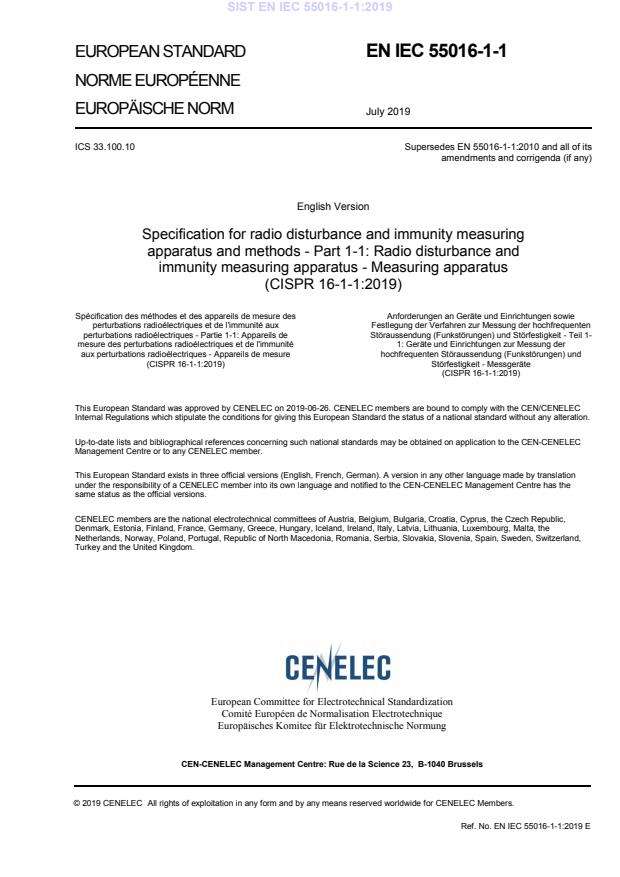
EUROPEAN STANDARD EN IEC 55016-1-1
NORME EUROPÉENNE
EUROPÄISCHE NORM
July 2019
ICS 33.100.10 Supersedes EN 55016-1-1:2010 and all of its
amendments and corrigenda (if any)
English Version
Specification for radio disturbance and immunity measuring
apparatus and methods - Part 1-1: Radio disturbance and
immunity measuring apparatus - Measuring apparatus
(CISPR 16-1-1:2019)
Spécification des méthodes et des appareils de mesure des Anforderungen an Geräte und Einrichtungen sowie
perturbations radioélectriques et de l'immunité aux Festlegung der Verfahren zur Messung der hochfrequenten
perturbations radioélectriques - Partie 1-1: Appareils de Störaussendung (Funkstörungen) und Störfestigkeit - Teil 1-
mesure des perturbations radioélectriques et de l'immunité 1: Geräte und Einrichtungen zur Messung der
aux perturbations radioélectriques - Appareils de mesure hochfrequenten Störaussendung (Funkstörungen) und
(CISPR 16-1-1:2019) Störfestigkeit - Messgeräte
(CISPR 16-1-1:2019)
This European Standard was approved by CENELEC on 2019-06-26. CENELEC members are bound to comply with the CEN/CENELEC
Internal Regulations which stipulate the conditions for giving this European Standard the status of a national standard without any alteration.
Up-to-date lists and bibliographical references concerning such national standards may be obtained on application to the CEN-CENELEC
Management Centre or to any CENELEC member.
This European Standard exists in three official versions (English, French, German). A version in any other language made by translation
under the responsibility of a CENELEC member into its own language and notified to the CEN-CENELEC Management Centre has the
same status as the official versions.
CENELEC members are the national electrotechnical committees of Austria, Belgium, Bulgaria, Croatia, Cyprus, the Czech Republic,
Denmark, Estonia, Finland, France, Germany, Greece, Hungary, Iceland, Ireland, Italy, Latvia, Lithuania, Luxembourg, Malta, the
Netherlands, Norway, Poland, Portugal, Republic of North Macedonia, Romania, Serbia, Slovakia, Slovenia, Spain, Sweden, Switzerland,
Turkey and the United Kingdom.
European Committee for Electrotechnical Standardization
Comité Européen de Normalisation Electrotechnique
Europäisches Komitee für Elektrotechnische Normung
CEN-CENELEC Management Centre: Rue de la Science 23, B-1040 Brussels
© 2019 CENELEC All rights of exploitation in any form and by any means reserved worldwide for CENELEC Members.
Ref. No. EN IEC 55016-1-1:2019 E
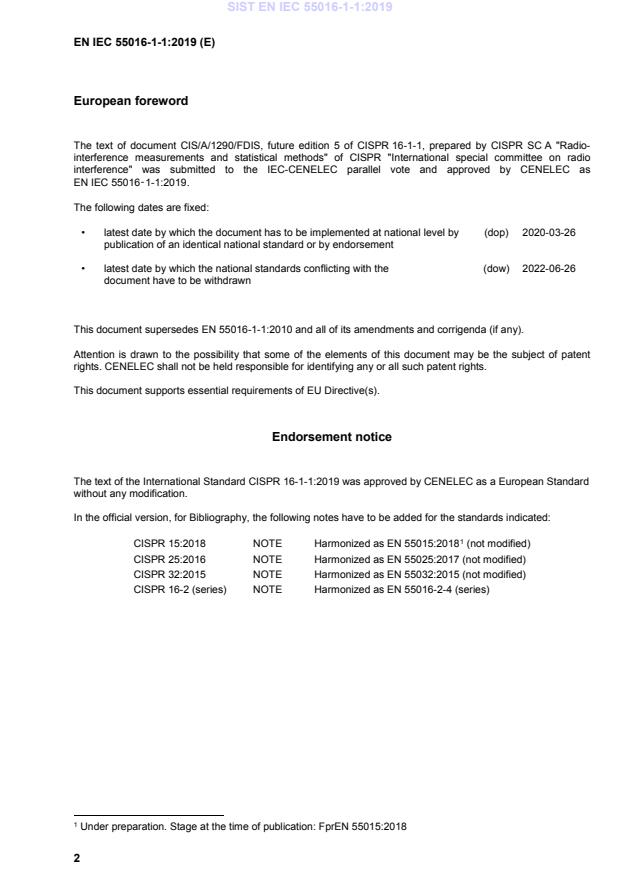
European foreword
The text of document CIS/A/1290/FDIS, future edition 5 of CISPR 16-1-1, prepared by CISPR SC A "Radio-
interference measurements and statistical methods" of CISPR "International special committee on radio
interference" was submitted to the IEC-CENELEC parallel vote and approved by CENELEC as
EN IEC 55016‑1-1:2019.
The following dates are fixed:
• latest date by which the document has to be implemented at national level by (dop) 2020-03-26
publication of an identical national standard or by endorsement
• latest date by which the national standards conflicting with the (dow) 2022-06-26
document have to be withdrawn
This document supersedes EN 55016-1-1:2010 and all of its amendments and corrigenda (if any).
Attention is drawn to the possibility that some of the elements of this document may be the subject of patent
rights. CENELEC shall not be held responsible for identifying any or all such patent rights.
This document supports essential requirements of EU Directive(s).
Endorsement notice
The text of the International Standard CISPR 16-1-1:2019 was approved by CENELEC as a European Standard
without any modification.
In the official version, for Bibliography, the following notes have to be added for the standards indicated:
CISPR 15:2018 NOTE Harmonized as EN 55015:2018 (not modified)
CISPR 25:2016 NOTE Harmonized as EN 55025:2017 (not modified)
CISPR 32:2015 NOTE Harmonized as EN 55032:2015 (not modified)
CISPR 16-2 (series) NOTE Harmonized as EN 55016-2-4 (series)
Under preparation. Stage at the time of publication: FprEN 55015:2018
Annex ZA
(normative)
Normative references to international publications
with their corresponding European publications
The following documents are referred to in the text in such a way that some or all of their content constitutes
requirements of this document. For dated references, only the edition cited applies. For undated references, the
latest edition of the referenced document (including any amendments) applies.
NOTE 1 Where an International Publication has been modified by common modifications, indicated by (mod), the relevant EN/HD applies.
NOTE 2 Up-to-date information on the latest versions of the European Standards listed in this annex is available here: www.cenelec.eu.
Publication Year Title EN/HD Year
CISPR 11 (mod) 2015 Industrial, scientific and medical EN 55011 2016
equipment - Radio-frequency disturbance
characteristics - Limits and methods of
measurement
+ A1 2016 + A1 2017
+ A2 2019 - -
CISPR 14-1 2016 Electromagnetic compatibility - EN 55014-1 2017
Requirements for household appliances,
electric tools and similar apparatus - Part
1: Emission
CISPR 16-2-1 2014 Specification for radio disturbance and EN 55016-2-1 2014
immunity measuring apparatus and
methods - Part 2-1: Methods of
measurement of disturbances and
immunity - Conducted disturbance
measurements
CISPR 16-2-2 2010 Specification for radio disturbance and EN 55016-2-2 2011
immunity measuring apparatus and
methods - Part 2-2: Methods of
measurement of disturbances and
immunity - Measurement of disturbance
power
CISPR 16-2-3 - Specification for radio disturbance and EN 55016-2-3 -
immunity measuring apparatus and
methods - Part 2-3: Methods of
measurement of disturbances and
immunity - Radiated disturbance
measurements
CISPR/TR 16-3:2010 2010 Specification for radio disturbance and - -
immunity measuring apparatus and
methods - Part 3: CISPR technical reports
+ A1 2012 - -
+ A2 2015 - -
IEC 60050-161 1990 I nternational Electrotechnical Vocabulary. - -
Chapter 161: Electromagnetic
compatibility
CISPR 16-1-1 ®
Edition 5.0 2019-05
INTERNATIONAL
STANDARD
NORME
INTERNATIONALE
colour
inside
INTERNATIONAL SPECIAL COMMITTEE ON RADIO INTERFERENCE
COMITÉ INTERNATIONAL SPÉCIAL DES PERTURBATIONS RADIOÉLECTRIQUES
BASIC EMC PUBLICATION
PUBLICATION FONDAMENTALE EN CEM
Specification for radio disturbance and immunity measuring apparatus and
methods –
Part 1-1: Radio disturbance and immunity measuring apparatus – Measuring
apparatus
Spécifications des méthodes et des appareils de mesure des perturbations
radioélectriques et de l'immunité aux perturbations radioélectriques –
Partie 1-1: Appareils de mesure des perturbations radioélectriques et de
l’immunité aux perturbations radioélectriques – Appareils de mesure
INTERNATIONAL
ELECTROTECHNICAL
COMMISSION
COMMISSION
ELECTROTECHNIQUE
INTERNATIONALE
ICS 33.100.10 ISBN 978-2-8322-6918-3
– 2 – CISPR 16-1-1:2019 © IEC 2019
CONTENTS
FOREWORD . 7
INTRODUCTION . 10
1 Scope . 11
2 Normative references . 11
3 Terms and definitions . 12
4 Fundamental characteristics of a measuring receiver. 16
4.1 General . 16
4.2 Input impedance . 17
4.3 Sine-wave voltage tolerance . 17
4.4 Overall pass-band selectivity . 17
4.5 Bandwidth . 19
4.6 Frequency tuning tolerance . 20
4.7 Intermediate frequency rejection ratio . 20
4.8 Image frequency rejection ratio . 20
4.9 Other spurious responses . 20
4.10 Limitation of intermodulation effects . 21
4.11 Limitations of receiver noise and internally-generated spurious signals . 22
4.11.1 Random noise . 22
4.11.2 Continuous wave . 22
4.12 Limitation of radio-frequency emissions from the measuring receiver . 22
4.12.1 Conducted emissions. 22
4.12.2 Radiated emissions . 22
4.13 Facilities for connection to a discontinuous disturbance analyzer . 23
5 Quasi-peak measuring receivers for the frequency range 9 kHz to 1 000 MHz . 23
5.1 General . 23
5.2 Response to pulses . 23
5.2.1 Amplitude relationship (absolute calibration) . 23
5.2.2 Variation with repetition frequency (relative calibration) . 23
6 Measuring receivers with peak detector for the frequency range 9 kHz to 18 GHz . 27
6.1 General . 27
6.2 Charge and discharge time constants ratio . 27
6.3 Overload factor . 28
6.4 Response to pulses . 28
7 Measuring receivers with average detector for the frequency range 9 kHz to
18 GHz . 28
7.1 General . 28
7.2 Overload factor . 29
7.3 Response to pulses . 29
7.3.1 Amplitude relationship . 29
7.3.2 Variation with repetition frequency . 30
7.3.3 Response to intermittent, unsteady and drifting narrowband
disturbances . 30
8 Measuring receivers with RMS-average detector for the frequency range 9 kHz to
18 GHz . 32
8.1 General . 32
8.2 Overload factor . 32
CISPR 16-1-1:2019 © IEC 2019 – 3 –
8.3 Response to pulses . 32
8.3.1 Construction details . 32
8.3.2 Amplitude relationship . 33
8.3.3 Variation with repetition frequency . 33
8.3.4 Response to intermittent, unsteady and drifting narrowband
disturbances . 34
9 Measuring receivers for the frequency range 1 GHz to 18 GHz with amplitude
probability distribution (APD) measuring function . 34
10 Discontinuous disturbance analyzers . 35
10.1 General . 35
10.2 Fundamental characteristics . 36
10.3 Test method for the validation of the performance check for the click
analyzer . 43
10.3.1 Basic requirements . 43
10.3.2 Additional requirements . 44
Annex A (normative) Determination of response to repeated pulses of quasi-peak and
RMS-average measuring receivers (see 3.6, 5.2.2, 8.2 and 8.3) . 45
A.1 General . 45
A.2 Response of the pre-detector stages . 45
A.3 Response of the quasi-peak detector to the output of preceding stages . 47
A.3.1 General . 47
A.3.2 Response of the indicating instrument to the signal from the detector . 48
A.4 Response of the RMS detector to the output voltage of preceding stages . 49
A.4.1 Output voltage and amplitude relationship . 49
A.4.2 Calculation of overload factor . 50
A.5 Relationship between the indication of the RMS meter and the quasi-peak
meter . 50
Annex B (normative) Determination of pulse generator spectrum (See 5.2, 6.4, 7.2, 8.3) . 52
B.1 Pulse generator . 52
B.1.1 General . 52
B.1.2 The spectrum of the generated pulses . 52
B.2 General method of measurement . 52
Annex C (normative) Accurate measurements of the output of nanosecond pulse
generators (see 5.2, 6.4, 7.2, 8.3) . 54
C.1 Measurement of impulse area (A ) . 54
imp
C.1.1 General . 54
C.1.2 Area method . 54
C.1.3 Standard transmission line method . 54
C.1.4 Harmonic measurement . 55
C.1.5 Energy method . 55
C.2 Pulse generator spectrum . 55
Annex D (normative) Influence of the quasi-peak measuring receiver characteristics
on its pulse response (see 5.2.2) . 56
Annex E (normative) Response of average and peak measuring receivers (see 4.5) . 57
E.1 Response of pre-detector stages . 57
E.2 Overload factor . 57
E.3 Relationship between the indication of an average and a quasi-peak
measuring receiver . 58
E.4 Peak measuring receivers . 59
– 4 – CISPR 16-1-1:2019 © IEC 2019
E.5 Relationship between indication of a peak and a quasi-peak measuring
receiver . 59
E.6 Test of measuring receiver response above 1 GHz to pulses . 60
E.7 Measurement of the impulse bandwidth of a measuring receiver . 62
E.7.1 General . 62
E.7.2 Method 1: Measurement by comparison of the responses of B to two
imp
pulses with identical amplitude and width with low and high pulse
repetition frequencies (PRF) . 62
E.7.3 Method 2: Measurement by comparison of the response of B to an
imp
impulsive signal with the response of a narrow bandwidth to the same
signal . 64
E.7.4 Method 3: Integration of the normalized linear selectivity function . 64
Annex F (normative) Performance check of the exceptions from the definitions of a
click according to 5.4.3 of CISPR 14–1:2016 . 66
Annex G (informative) Rationale for the specifications of the APD measuring function . 73
Annex H (informative) Characteristics of a quasi-peak measuring receiver. 76
Annex I (informative) Example of EMI receiver and swept spectrum analyzer
architecture. 77
Annex J (normative) Requirements when using an external preamplifier with a
measuring receiver . 79
J.1 General . 79
J.2 Considerations for optimum emission measurement system design . 79
J.3 Linearity specifications and precautions in measurement . 82
J.4 Detecting the overload of an external preamplifier in a wideband FFT-based
measuring system . 89
Annex K (normative) Calibration requirements for measuring receivers . 90
K.1 General . 90
K.2 Calibration and verification. 90
K.3 Calibration and verification specifics . 90
K.4 Measuring receiver specifics . 91
K.4.1 General . 91
K.4.2 Demonstration of compliance with CISPR 16-1-1 . 92
K.5 Partial calibration of measuring receivers . 92
K.6 Determination of compliance of a measuring receiver with applicable
specifications . 93
Annex L (normative) Verification of the RF pulse amplitude (See 7.3.1, 8.3.2) . 94
Bibliography . 95
Figure 1 – Limits of overall selectivity – Pass-band (Band A) . 18
Figure 2 – Limits of overall selectivity – Pass-band (Band B) . 18
Figure 3 – Limits of overall selectivity – Pass-band (Bands C and D) . 19
Figure 4 – Limits for the overall selectivity – Pass-band (Band E) . 19
Figure 5 – Arrangement for testing intermodulation effects . 22
Figure 6 – Pulse response curve (Band A) . 24
Figure 7 – Pulse response curve (Band B) . 25
Figure 8 – Pulse response curve (Bands C and D) . 25
Figure 9 – Theoretical pulse response curve of quasi-peak detector receivers and
average detector receiver . 26
Figure 10 – Block diagram of an average detector . 31
CISPR 16-1-1:2019 © IEC 2019 – 5 –
Figure 11 – Screenshot showing the response of the meter-simulating network to an
intermittent narrowband signal . 31
Figure 12 – Example of a disturbance analyzer . 38
Figure 13 – Graphical presentation of test signals used in the test of the analyzer for
the performance checks against the definition of a click according to Table 14 . 39
Figure E.1 – Correction factor for estimating the ratio B /B for other tuned circuits . 58
imp 6
Figure E.2 – Pulse rectification coefficient P . 60
Figure E.3 – Example (spectrum screenshot) of a pulse-modulated signal with a pulse
width of 200 ns . 61
Figure E.4 – Pulse-modulated RF signal applied to a measuring receiver . 63
Figure E.5 – Filtering with a B much smaller than the PRF . 63
imp
Figure E.6 – Filtering with a B much wider than the PRF . 63
imp
Figure E.7 – Calculation of the impulse bandwidth . 64
Figure E.8 – Example of a normalized linear selectivity function . 65
Figure F.1 – Graphical presentation of the test signals used for the performance
checks of the analyzer with the additional requirements according to Table F.1 . 72
Figure G.1 – Block diagram of APD measurement circuit without A/D converter . 74
Figure G.2 – Block diagram of APD measurement circuit with A/D converter . 74
Figure G.3 – Example of display of APD measurement results versus equipment-
under-test (EUT) state . 75
Figure I.1 – Example of block diagram of an EMI receiver consisting of a swept
spectrum analyzer with added preselector, preamplifier and quasi-peak/average
detector . 77
Figure J.1 – Receiver with preamplifier . 81
Figure J.2 – Example of the transfer function of an amplifier . 83
Figure J.3 – Response of the amplifier of Figure J.2 for a sinusoidal signal . 83
Figure J.4 – Response of the amplifier of Figure J.2 for an impulse . 83
Figure J.5 – Deviation from linear gain for an unmodulated sine-wave (example) . 84
Figure J.6 – Deviation from linear gain for a broadband impulsive signal as measured
with the quasi-peak detector (example) . 85
Figure J.7 – Screenshot of a band-stop filter test for a preamplifier at around 818 MHz . 86
Figure J.8 – Band-stop filter test result with the measuring receiver at 818 MHz . 86
Figure J.9 – Band-stop filter test results for the same 10 dB preamplifier but a different
receiver with preselection (black) and without preselection (blue) . 87
Figure J.10 – Band-stop filter test results for the same 10 dB preamplifier but with the
receiver of Figure J.9 with preselection (black) and without preselection (green) . 87
Figure J.11 – Weighting functions of the various CISPR detectors with a noise curve to
illustrate the remaining operating ranges for broadband impulsive signals (example) . 88
Figure K.1 – Compliance determination process with application of measurement
uncertainty . 93
Table 1 – VSWR requirements for receiver input impedance . 17
Table 2 – Combined selectivity of CISPR measuring receiver and high-pass filter . 17
Table 3 – Bandwidth requirements for measuring receivers . 20
Table 4 – Bandwidth characteristics for intermodulation test of quasi-peak measuring
receivers . 21
Table 5 – Test pulse characteristics for quasi-peak measuring receivers . 23
– 6 – CISPR 16-1-1:2019 © IEC 2019
Table 6 – Pulse response of quasi-peak measuring receivers . 27
Table 7 – Relative pulse response of peak and quasi-peak measuring receivers for the
same bandwidth (frequency range 9 kHz to 1 000 MHz) . 28
Table 8 – Specification of pulse-modulated carrier (e.m.f.) . 30
Table 9 – Maximum reading of average measuring receivers for a pulse-modulated
sine-wave input in comparison with the response to a continuous sine-wave having
the same amplitude. 31
Table 10 – Minimum pulse repetition rate without overload . 32
Table 11 – Specification of pulse-modulated carrier (e.m.f.) for testing RMS-average
detectors . 33
Table 12 – Pulse response of the RMS-average measuring receiver . 34
Table 13 – Maximum reading of RMS-average measuring receivers for a pulse-
modulated sine-wave input in comparison with the response to a continuous sine-wave
having the same amplitude . 34
Table 14 – Disturbance analyzer performance test – Test signals used for the check
against the definition of a click . 40
Table E.1 – B and A values for a peak measuring receiver . 60
imp imp
Table E.2 – Carrier level for pulse-modulated signal of 1,4 nVs . 61
Table F.1 – Disturbance analyzer test signals . 67
Table H.1 – Characteristics of quasi-peak measuring receivers . 76
Table J.1 – Examples of preamplifier and measuring receiver data and resulting
system noise figures . 82
Table K.1 – Verification parameter summary . 92
CISPR 16-1-1:2019 © IEC 2019 – 7 –
INTERNATIONAL ELECTROTECHNICAL COMMISSION
INTERNATIONAL SPECIAL COMMITTEE ON RADIO INTERFERENCE
____________
SPECIFICATION FOR RADIO DISTURBANCE AND IMMUNITY
MEASURING APPARATUS AND METHODS –
Part 1-1: Radio disturbance and immunity measuring apparatus –
Measuring apparatus
FOREWORD
1) The International Electrotechnical Commission (IEC) is a worldwide organization for standardization comprising
all national electrotechnical committees (IEC National Committees). The object of IEC is to promote
international co-operation on all questions concerning standardization in the electrical and electronic fields. To
this end and in addition to other activities, IEC publishes International Standards, Technical Specifications,
Technical Reports, Publicly Available Specifications (PAS) and Guides (hereafter referred to as “IEC
Publication(s)”). Their preparation is entrusted to technical committees; any IEC National Committee interested
in the subject dealt with may participate in this preparatory work. International, governmental and non-
governmental organizations liaising with the IEC also participate in this preparation. IEC collaborates closely
with the International Organization for Standardization (ISO) in accordance with conditions determined by
agreement between the two organizations.
2) The formal decisions or agreements of IEC on technical matters express, as nearly as possible, an international
consensus of opinion on the relevant subjects since each technical committee has representation from all
interested IEC National Committees.
3) IEC Publications have the form of recommendations for international use and are accepted by IEC National
Committees in that sense. While all reasonable efforts are made to ensure that the technical content of IEC
Publications is accurate, IEC cannot be held responsible for the way in which they are used or for any
misinterpretation by any end user.
4) In order to promote international uniformity, IEC National Committees undertake to apply IEC Publications
transparently to the maximum extent possible in their national and regional publications. Any divergence
between any IEC Publication and the corresponding national or regional publication shall be clearly indicated in
the latter.
5) IEC itself does not provide any attestation of conformity. Independent certification bodies provide conformity
assessment services and, in some areas, access to IEC marks of conformity. IEC is not responsible for any
services carried out by independent certification bodies.
6) All users should ensure that they have the latest edition of this publication.
7) No liability shall attach to IEC or its directors, employees, servants or agents including individual experts and
members of its technical committees and IEC National Committees for any personal injury, property damage or
other damage of any nature whatsoever, whether direct or indirect, or for costs (including legal fees) and
expenses arising out of the publication, use of, or reliance upon, this IEC Publication or any other IEC
Publications.
8) Attention is drawn to the Normative references cited in this publication. Use of the referenced publications is
indispensable for the correct application of this publication.
9) Attention is drawn to the possibility that some of the elements of this IEC Publication may be the subject of
patent rights. IEC shall not be held responsible for identifying any or all such patent rights.
International Standard CISPR 16-1-1 has been prepared by CISPR subcommittee A: Radio-
interference measurements and statistical methods.
This fifth edition cancels and replaces the fourth edition published in 2015. This edition
constitutes a technical revision.
This edition includes the following significant technical changes with respect to the previous
edition:
a) Reorganization of the document structure to remove common elements of receiver
performance from Clauses 4, 5, 6, and 7 and create a new clause that applies across all of
these clauses. Key common parameters include:
– 8 – CISPR 16-1-1:2019 © IEC 2019
1) Input impedance
2) CW amplitude accuracy
3) Limitations of intermodulation effects
4) Limitation of receiver noise and internally generated spurious signals
b) Rewording of Subclause B.1.1 for the purpose of correcting existing errors
c) Amendments to Subclause 7.5.2 to modify the definition of the test signal to be used for
calibrating and verifying the required RMS-average detector response to pulses of the
receiver. This section will include a note requiring that the amplitude of the pulsed signal
be verified prior to the calibration, and will include several verification methods.
d) Amendments to Subclause 6.5.2 to modify the definition of the test signal to be used for
calibrating and verifying the required average detector response to pulses. The purpose of
this proposed change is the alignment of the test signal type with that of the newly
proposed signal used to verify the RMS-average detector, allowing the use of a pulsed RF
signal. This section will include a note requiring that the amplitude of the pulsed signal be
verified prior to the calibration and will include several verification methods.
e) Implementation and use of Gaussian filters
f) Amendments to Clause 9 on discontinuous disturbance analyzers (DDAs) to allow the use
of measuring receivers with built-in DDAs, to clarify which signal is used for click time
parameter determination and to allow the use of FFT-based measuring instruments with
internal DDAs.
g) Amendments to Subclauses 4.2, 5.2, 6.2 and 7.2 to remove the mention of a symmetric
input for measuring receivers.
h) Deletion of Subclause 4.8.1 “Screening Effectiveness”.
i) add a frequency accuracy specification to the proposed reorganized clause mentioned in
a) above.
j) Amend Subclause 6.5.3 to adjust the allowable tolerance for the variation with repetition
frequency for the linear average detector.
k) Add interpretation information to Clause K.4 based on CISPR-A-1188-INF.
l) Indicate that the 31,6 Hz pulse repetition frequency for the RMS-Average test requirement
for Bands C and D in Table 15 is optional. For the RMS-Average overload requirement in
Table 13, change the minimum pulse repetition frequency to 100 Hz and the associated
Peak to RMS-Average ratio to 30,6 dB.
m) Improve the phrasing used for the tolerance statements in Subclauses 4.4.1, 5.5, 6.5.2,
6.5.3, 6.5.4 and 7.5.2.
n) Remove a note from Clause E1.
o) Add a reference for FFT-based discontinuous disturbance analyzers
It has the status of a basic EMC publication in accordance with IEC Guide 107,
Electromagnetic compatibility – Guide to the drafting of electromagnetic compatibility
publications.
The text of this International Standard is based on the following documents:
FDIS Report on voting
CIS/A/1290/FDIS CIS/A/1295/RVD
Full information on the voting for the approval of this International Standard can be found in
the report on voting indicated in the above table.
This document has been drafted in accordance with the ISO/IEC Directives, Part 2.
CISPR 16-1-1:2019 © IEC 2019 – 9 –
A list of all parts in the CISPR 16 series, published under the general title Specification for
radio disturbance and immunity measuring apparatus and methods, can be found on the IEC
website.
The committee has decided that the contents of this document will remain unchanged until the
stability date indicated on the IEC website under "http://webstore.iec.ch" in the data related to
the specific document. At this date, the document will be
• reconfirmed,
• withdrawn,
• replaced by a revised edition, or
• amended.
IMPORTANT – The 'colour inside' logo on the cover page of this publication indicates
that it contains colours which are considered to be useful for the correct
understanding of its contents. Users should therefore print this document using a
colour printer.
– 10 – CISPR 16-1-1:2019 © IEC 2019
INTRODUCTION
The CISPR 16 series, published under the general title Specification for radio disturbance and
immunity measuring apparatus and methods, is comprised of the following sets of documents:
• CISPR 16-1 – six parts covering measurement instrumentation specifications;
• CISPR 16-2 – five parts covering methods of measurement;
• CISPR TR 16-3 – a single publication containing various technical reports (TRs) with
further information and background on CISPR and radio disturbances in general;
• CISPR 16-4 – five parts covering uncertainties, statistics and limit modelling.
CISPR 16-1 consists of the following parts, under the general title Specification for radio
disturbance and immunity measuring apparatus and methods – Radio disturbance and
immunity measuring apparatus:
– Part 1-1: Measuring apparatus
– Part 1-2: Coupling devices for conducted disturbance measurements
– Part 1-3: Ancillary equipment – Disturbance power
– Part 1-4: Antennas and test sites for radiated disturbance measurements
– Part 1-5: Antenna calibration sites and reference test sites for 5 MHz to 18 GHz
– Part 1-6: EMC antenna calibration
The International Electrotechnical Commission (IEC) draws attention to the fact that it is
claimed that compliance with this document may involve the use of a patent concerning the
measuring receiver with RMS-average detector (patent no DE 10126830) given in Clause 7.
IEC takes no position concerning the evidence, validity and scope of this patent right.
The holder of this patent right has assured the IEC that he/she is willing to negotiate licences
either free of charge or under reasonable and non-discriminatory terms and conditions with
applicants throughout the world. In this respect, the statement of the holder of this patent right
is registered with IEC. Information may be obtained from:
Rohde & Schwarz GmbH & Co. KG
Muehldorfstrasse 15
81671 Muenchen
Germany
Attention is drawn to the possibility that some of the elements of this document may be the
subject of patent rights other than those identified above. IEC shall not be held responsible for
identifying any or all such patent rights.
ISO (www.iso.org/patents) and IEC (http://patents.iec.ch) maintain on-line data bases of
patents relevant to their standards. Users are encouraged to consult the data bases for the
most up to date information concerning patents.
CISPR 16-1-1:2019 © IEC 2019 – 11 –
SPECIFICATION FOR RADIO DISTURBANCE AND IMMUNITY
MEASURING APPARATUS AND METHODS –
Part 1-1: Radio disturbance and immunity measuring apparatus –
Measuring apparatus
1 Scope
This part of CISPR 16 specifies the characteristics and performance of equipment for the
measurement of radio disturbance in the frequency range 9 kHz to 18 GHz. In addition,
requirements are provided for specialized equipment for discontinuous disturbance
measurements.
NOTE In
...