

SIST EN 2957:2020
(Main)Aerospace series - Method of preparation of forged samples
General Information
- Abstract
This document defines the requirements for the preparation of forged test samples.
Unless otherwise specified on the drawing, order, or inspection schedule, this document shall be applied when referenced in the relevant EN material standard or EN technical specification.
This document applies to round products of ≥ 20 mm diameters or other shapes of equivalent cross-section.
- Status
- Published
- Publication Date
- 20-Nov-2019
- Technical Committee
- I13 - Imaginarni 13
- Current Stage
- 6060 - National Implementation/Publication (Adopted Project)
- Start Date
- 04-Oct-2019
- Due Date
- 09-Dec-2019
- Completion Date
- 21-Nov-2019

Overview
SIST EN 2957:2020 is a European Standard published by CEN that specifies the method of preparation for forged test samples within the aerospace industry. It defines detailed requirements applicable primarily to round products with diameters of 20 mm or greater, as well as other shapes with equivalent cross-sectional areas. This standard ensures consistency and reliability in the production and testing of forged aerospace materials to meet stringent safety and quality criteria.
The standard is mandatory when referenced by relevant EN material standards or technical specifications, providing foundational guidelines for manufacturers and purchasers in aerospace sectors to agree upon sample preparation and testing procedures.
Key Topics
Scope and Applicability
SIST EN 2957:2020 applies to forged sample preparation for aerospace materials, focusing on round bars ≥ 20 mm in diameter or equivalent cross-sections. It is invoked by material-specific EN standards unless otherwise specified.Definitions
- Blank: A sample cut from the forging stock.
- Pancake: A sample obtained by upsetting (compressing) a blank.
Blank Removal Method
The location and size of blanks are agreed between purchaser and manufacturer unless otherwise indicated in technical specifications. The blank’s dimensions and forms are standardized based on forging stock diameter or cross-section to ensure representative sampling.Forging Conditions
The forging temperature and heating regimen must be agreed upon, with blanks maintained at the target temperature for at least 30 minutes prior to forging. Final forging operations are preferably completed in one heat cycle. Pancake thickness should be one-third the original blank thickness.Use of Pancakes
Pancakes serve multiple purposes in aerospace forging:- To assess forgeability of the material.
- To evaluate structural characteristics against material standards or orders.
- To provide specific locations for sampling mechanical test pieces such as impact or toughness tests, as indicated in the standard’s schematic figures.
Applications
SIST EN 2957:2020 is vital for aerospace manufacturers, quality assurance engineers, and material testing laboratories focused on structural components. It supports:
- Quality Control of Forgings: Establishing consistent sampling from forgings to verify mechanical properties and structural integrity.
- Material Certification: Assuring aerospace components meet EN material standards through standardized test samples.
- Process Optimization: Refining forging procedures and temperatures to produce reliable test pancakes representative of final products.
- Compliance and Traceability: Providing documented, standardized methods and dimensions that align with European aerospace regulations and quality assurance mandates.
Using this standard helps aerospace organizations reduce variability in testing samples, thereby improving reliability of mechanical tests and forging assessments critical to aviation safety and performance.
Related Standards
SIST EN 2957:2020 functions in conjunction with other EN material standards and technical specifications relevant to aerospace forgings, including but not limited to:
- EN material standards that reference forged products and specify mechanical testing requirements.
- Aerospace series standards developed by ASD-STAN (Aerospace and Defence Industries Association of Europe - Standardization).
- ISO and IEC terminology databases for harmonized definitions related to forged materials and testing.
Manufacturers and users of SIST EN 2957:2020 are advised to consult specific EN material standards applicable to their forged components for comprehensive requirements on testing and processing, ensuring full compliance with aerospace industry regulations.
Keywords: SIST EN 2957:2020, aerospace forging, forged samples preparation, aerospace standards, forged test samples, pancake sample, forging conditions, aerospace material testing, European aerospace standards, forged components quality control
Relations
- Effective Date
- 28-Jan-2026
- Effective Date
- 28-Jan-2026
- Effective Date
- 28-Jan-2026
- Effective Date
- 28-Jan-2026
Get Certified
Connect with accredited certification bodies for this standard

BUREAU VERITAS Certification Germany
Bureau Veritas certification in Germany.

Element Materials Technology
Materials testing and product certification.

AQMS Ltd.
AQMS provides ISO certification to SMEs across the UK.
Sponsored listings
Frequently Asked Questions
SIST EN 2957:2020 is a standard published by the Slovenian Institute for Standardization (SIST). Its full title is "Aerospace series - Method of preparation of forged samples". This standard covers: This document defines the requirements for the preparation of forged test samples. Unless otherwise specified on the drawing, order, or inspection schedule, this document shall be applied when referenced in the relevant EN material standard or EN technical specification. This document applies to round products of ≥ 20 mm diameters or other shapes of equivalent cross-section.
This document defines the requirements for the preparation of forged test samples. Unless otherwise specified on the drawing, order, or inspection schedule, this document shall be applied when referenced in the relevant EN material standard or EN technical specification. This document applies to round products of ≥ 20 mm diameters or other shapes of equivalent cross-section.
SIST EN 2957:2020 is classified under the following ICS (International Classification for Standards) categories: 49.025.99 - Other materials. The ICS classification helps identify the subject area and facilitates finding related standards.
SIST EN 2957:2020 has the following relationships with other standards: It is inter standard links to SIST EN 4245:2020, SIST EN 3364:2023, SIST EN 4264:2020, SIST EN 4800-005:2025. Understanding these relationships helps ensure you are using the most current and applicable version of the standard.
SIST EN 2957:2020 is available in PDF format for immediate download after purchase. The document can be added to your cart and obtained through the secure checkout process. Digital delivery ensures instant access to the complete standard document.
Standards Content (Sample)
SLOVENSKI STANDARD
01-januar-2020
Aeronavtika - Metoda priprave kovanih vzorcev
Aerospace series - Method of preparation of forged samples
Luft- und Raumfahrt - Verfahren zur Herstellung von Schmiedeproben
Série aérospatiale - Méthode pour la préparation d'échantillons forgés
Ta slovenski standard je istoveten z: EN 2957:2019
ICS:
49.025.99 Drugi materiali Other materials
2003-01.Slovenski inštitut za standardizacijo. Razmnoževanje celote ali delov tega standarda ni dovoljeno.
EN 2957
EUROPEAN STANDARD
NORME EUROPÉENNE
September 2019
EUROPÄISCHE NORM
ICS 49.025.99
English Version
Aerospace series - Method of preparation of forged
samples
Série aérospatiale - Méthode pour la préparation Luft- und Raumfahrt - Verfahren zur Herstellung von
d'échantillons forgés Schmiedeproben
This European Standard was approved by CEN on 6 January 2019.
CEN members are bound to comply with the CEN/CENELEC Internal Regulations which stipulate the conditions for giving this
European Standard the status of a national standard without any alteration. Up-to-date lists and bibliographical references
concerning such national standards may be obtained on application to the CEN-CENELEC Management Centre or to any CEN
member.
This European Standard exists in three official versions (English, French, German). A version in any other language made by
translation under the responsibility of a CEN member into its own language and notified to the CEN-CENELEC Management
Centre has the same status as the official versions.
CEN members are the national standards bodies of Austria, Belgium, Bulgaria, Croatia, Cyprus, Czech Republic, Denmark, Estonia,
Finland, France, Germany, Greece, Hungary, Iceland, Ireland, Italy, Latvia, Lithuania, Luxembourg, Malta, Netherlands, Norway,
Poland, Portugal, Republic of North Macedonia, Romania, Serbia, Slovakia, Slovenia, Spain, Sweden, Switzerland, Turkey and
United Kingdom.
EUROPEAN COMMITTEE FOR STANDARDIZATION
COMITÉ EUROPÉEN DE NORMALISATION
EUROPÄISCHES KOMITEE FÜR NORMUNG
CEN-CENELEC Management Centre: Rue de la Science 23, B-1040 Brussels
© 2019 CEN All rights of exploitation in any form and by any means reserved Ref. No. EN 2957:2019 E
worldwide for CEN national Members.
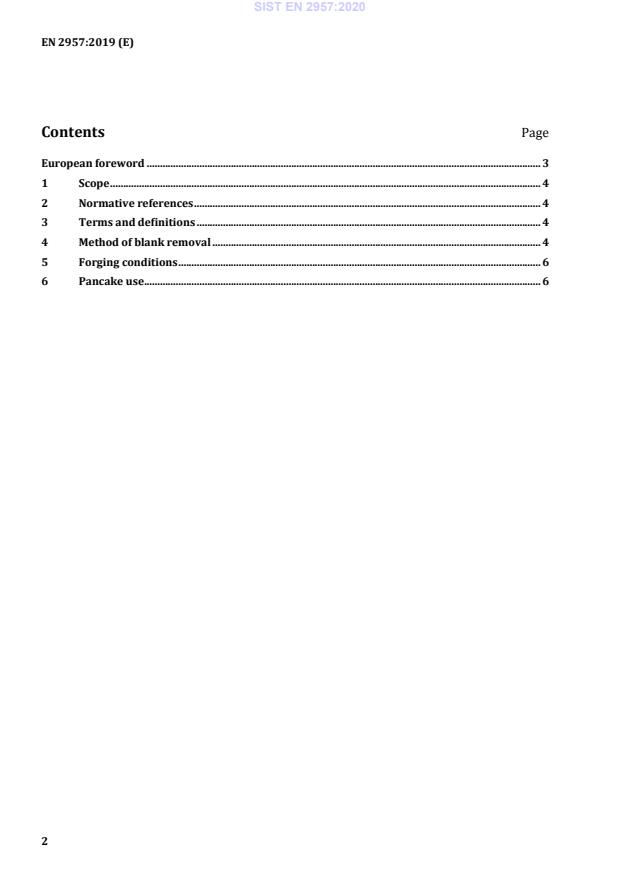
Contents Page
European foreword . 3
1 Scope . 4
2 Normative references . 4
3 Terms and definitions . 4
4 Method of blank removal . 4
5 Forging conditions . 6
6 Pancake use . 6
European foreword
This document (EN 2957:2019) has been prepared by the Aerospace and Defence Industries Association
of Europe - Standardization (ASD-STAN).
After enquiries and votes carried out in accordance with the rules of this Association, this Standard has
received the approval of the National Associations and the Official Services of the member countries of
ASD, prior to its presentation to CEN.
This European Standard shall be given the status of a national standard, either by publication of an
identical text or by endorsement, at the latest by March 2020, and conflicting national standards shall be
withdrawn at the latest by March 2020.
Attention is drawn to the possibility that some of the elements of this document may be the subject of
patent rights. CEN shall not be held respo
...