

SIST EN 303 402 V2.1.1:2017
(Main)Maritime mobile transmitters and receivers for use in the MF and HF bands - Harmonised Standard covering the essential requirements of articles 3.2 and 3.3(g) of Directive 2014/53/EU
General Information
- Abstract
The present document specifies technical characteristics and methods of measurements for radio transmitters and
receivers, for use on vessels, operating in either the Medium Frequency (MF) only or in the Medium and High
Frequency (MF/HF) bands allocated in the International Telecommunications Union (ITU) Radio Regulations [i.9], to
the Maritime Mobile Service (MMS).
The present document refers to equipment for one or more of the following:
- Single SideBand (SSB) modulation for telephony transmission and reception (J3E);
- Frequency Shift Keying (FSK) or SSB modulation of a keyed sub-carrier to transmit and receive Digital
Selective Calling (DSC) signals.
The present document also refers to radio equipment with either an integrated or external DSC controller.
The requirements in the present document are applicable to receivers for operating on all frequencies in the bands
1 606,5 kHz to 4 000 kHz or 1 606,5 kHz to 27,5 MHz as allocated in the ITU Radio Regulations [i.9], to the MMS.
Other spot frequency receivers should meet all the requirements of the present document and other relevant standards as
applicable for the frequencies and modes provided.
If the equipment, or parts of it, are designed in such a manner that they can be used for other categories of maritime
radiocommunication (e.g. Morse telegraphy or NBDP - ETSI ETS 300 067 [i.4]), those parts of the equipment should
fulfil the relevant requirements of the appropriate standards for the service(s) in question e.g. ETSI ETS 300 067 [i.4].
The present document covers the essential requirements of article 3.2 and article 3.3(g) of Directive 2014/53/EU [i.1]
under the conditions identified in annex A.
- Status
- Published
- Public Enquiry End Date
- 24-Apr-2017
- Publication Date
- 28-May-2017
- Technical Committee
- MOC - Mobile Communications
- Current Stage
- 6060 - National Implementation/Publication (Adopted Project)
- Start Date
- 15-May-2017
- Due Date
- 20-Jul-2017
- Completion Date
- 29-May-2017
Buy Documents
ETSI EN 303 402 V2.1.0 (2017-01) - Maritime mobile transmitters and receivers for use in the MF and HF bands; Harmonised Standard covering the essential requirements of articles 3.2 and 3.3(g) of Directive 2014/53/EU
ETSI EN 303 402 V2.1.1 (2017-05) - Maritime mobile transmitters and receivers for use in the MF and HF bands; Harmonised Standard covering the essential requirements of articles 3.2 and 3.3(g) of Directive 2014/53/EU

Overview
SIST EN 303 402 V2.1.1:2017 is a harmonised standard addressing the technical requirements for maritime mobile transmitters and receivers intended for use in the Medium Frequency (MF) and High Frequency (HF) bands. This Slovenian standard, which aligns with ETSI EN 303 402 V2.1.1, ensures compliance with articles 3.2 and 3.3(g) of the Radio Equipment Directive 2014/53/EU. The standard applies to shipborne radio equipment using frequencies allocated to the Maritime Mobile Service (MMS) as specified by the International Telecommunication Union (ITU) Radio Regulations.
Equipment covered by this standard supports:
- Single SideBand (SSB) modulation for voice transmissions (telephony)
- Digital Selective Calling (DSC) using Frequency Shift Keying (FSK) or SSB modulation of a sub-carrier
- Integration with internal or external DSC controllers
The document defines technical characteristics, measurement methods, and essential requirements that contribute to interoperability, safety, and legal compliance in maritime radio communications.
Key Topics
- Frequency Bands: Focuses on MF (1 606.5 kHz to 4 000 kHz) and HF (1 606.5 kHz to 27.5 MHz) bands assigned to maritime use.
- Distress and Safety Functions: Ensures the reliability of distress frequencies and functions in emergencies, including operational readiness and controls for distress signals.
- Emission Classes: Covers J3E (SSB telephony) and F1B (DSC) emission types, supporting both analogue and digital communication.
- Labelling and Controls: Specifies requirements for equipment labels, user controls, indicators, and protection against misuse or mishandling.
- Environmental and Electrical Testing: Includes requirements for performance under various environmental conditions such as temperature extremes, vibration, damp, corrosion, and power source variations.
- Receiver and Transmitter Performance: Outlines limits for spurious emissions, frequency accuracy, sensitivity, selectivity, intermodulation, and audio characteristics.
- Interoperability: Mandates compatibility with other maritime radiocommunication services where equipment is designed for multi-service use.
Applications
The standard is crucial for:
- Vessel Operators and Shipowners: Ensures onboard communications are safe, effective, and compliant with EU regulations, supporting emergency communications and operational radio traffic.
- Radio Equipment Manufacturers: Provides a framework for designing and testing shipborne MF/HF transmitters and receivers, ensuring products meet legal and safety requirements for CE marking in Europe.
- Maritime Safety Authorities: Assists in approving and inspecting radio installations on ships under national and international safety regulations.
- Integrators and Service Providers: Guides the integration of compliant MF/HF radio and DSC systems into broader ship navigation and control electronics (Navigacijska in krmilna oprema).
MF and HF radio equipment built to this standard supports long-range distress calling, routine communications, and integration with digital safety services both on coastal and ocean-going vessels.
Related Standards
To ensure comprehensive compliance and interoperability, consider the following related standards:
- ETSI EN 300 338 series - Standards for DSC on MF, HF, and VHF bands
- ETSI ETS 300 067 - NBDP (narrow-band direct-printing telegraphy) for maritime use
- IEC 60945 - General requirements for marine navigation and radiocommunication equipment (environmental conditions)
- ITU Radio Regulations - Frequency allocations and operational practices for the Maritime Mobile Service
- Directive 2014/53/EU (RED) - Radio Equipment Directive guiding essential requirements for all radio equipment within the EU
SIST EN 303 402 V2.1.1:2017 is essential for anyone involved in maritime mobile radio, offering a clear baseline for regulatory compliance, safety, and technological reliability in MF/HF shipboard communications.
Buy Documents
ETSI EN 303 402 V2.1.0 (2017-01) - Maritime mobile transmitters and receivers for use in the MF and HF bands; Harmonised Standard covering the essential requirements of articles 3.2 and 3.3(g) of Directive 2014/53/EU
ETSI EN 303 402 V2.1.1 (2017-05) - Maritime mobile transmitters and receivers for use in the MF and HF bands; Harmonised Standard covering the essential requirements of articles 3.2 and 3.3(g) of Directive 2014/53/EU
Get Certified
Connect with accredited certification bodies for this standard

DNV
DNV is an independent assurance and risk management provider.

Lloyd's Register
Lloyd's Register is a global professional services organisation specialising in engineering and technology.

FSC International
Forest Stewardship Council certification.
Sponsored listings
Frequently Asked Questions
SIST EN 303 402 V2.1.1:2017 is a standard published by the Slovenian Institute for Standardization (SIST). Its full title is "Maritime mobile transmitters and receivers for use in the MF and HF bands - Harmonised Standard covering the essential requirements of articles 3.2 and 3.3(g) of Directive 2014/53/EU". This standard covers: The present document specifies technical characteristics and methods of measurements for radio transmitters and receivers, for use on vessels, operating in either the Medium Frequency (MF) only or in the Medium and High Frequency (MF/HF) bands allocated in the International Telecommunications Union (ITU) Radio Regulations [i.9], to the Maritime Mobile Service (MMS). The present document refers to equipment for one or more of the following: - Single SideBand (SSB) modulation for telephony transmission and reception (J3E); - Frequency Shift Keying (FSK) or SSB modulation of a keyed sub-carrier to transmit and receive Digital Selective Calling (DSC) signals. The present document also refers to radio equipment with either an integrated or external DSC controller. The requirements in the present document are applicable to receivers for operating on all frequencies in the bands 1 606,5 kHz to 4 000 kHz or 1 606,5 kHz to 27,5 MHz as allocated in the ITU Radio Regulations [i.9], to the MMS. Other spot frequency receivers should meet all the requirements of the present document and other relevant standards as applicable for the frequencies and modes provided. If the equipment, or parts of it, are designed in such a manner that they can be used for other categories of maritime radiocommunication (e.g. Morse telegraphy or NBDP - ETSI ETS 300 067 [i.4]), those parts of the equipment should fulfil the relevant requirements of the appropriate standards for the service(s) in question e.g. ETSI ETS 300 067 [i.4]. The present document covers the essential requirements of article 3.2 and article 3.3(g) of Directive 2014/53/EU [i.1] under the conditions identified in annex A.
The present document specifies technical characteristics and methods of measurements for radio transmitters and receivers, for use on vessels, operating in either the Medium Frequency (MF) only or in the Medium and High Frequency (MF/HF) bands allocated in the International Telecommunications Union (ITU) Radio Regulations [i.9], to the Maritime Mobile Service (MMS). The present document refers to equipment for one or more of the following: - Single SideBand (SSB) modulation for telephony transmission and reception (J3E); - Frequency Shift Keying (FSK) or SSB modulation of a keyed sub-carrier to transmit and receive Digital Selective Calling (DSC) signals. The present document also refers to radio equipment with either an integrated or external DSC controller. The requirements in the present document are applicable to receivers for operating on all frequencies in the bands 1 606,5 kHz to 4 000 kHz or 1 606,5 kHz to 27,5 MHz as allocated in the ITU Radio Regulations [i.9], to the MMS. Other spot frequency receivers should meet all the requirements of the present document and other relevant standards as applicable for the frequencies and modes provided. If the equipment, or parts of it, are designed in such a manner that they can be used for other categories of maritime radiocommunication (e.g. Morse telegraphy or NBDP - ETSI ETS 300 067 [i.4]), those parts of the equipment should fulfil the relevant requirements of the appropriate standards for the service(s) in question e.g. ETSI ETS 300 067 [i.4]. The present document covers the essential requirements of article 3.2 and article 3.3(g) of Directive 2014/53/EU [i.1] under the conditions identified in annex A.
SIST EN 303 402 V2.1.1:2017 is classified under the following ICS (International Classification for Standards) categories: 33.060.20 - Receiving and transmitting equipment; 47.020.70 - Navigation and control equipment. The ICS classification helps identify the subject area and facilitates finding related standards.
SIST EN 303 402 V2.1.1:2017 is available in PDF format for immediate download after purchase. The document can be added to your cart and obtained through the secure checkout process. Digital delivery ensures instant access to the complete standard document.
Standards Content (Sample)
Draft ETSI EN 303 402 V2.1.0 (2017-01)
HARMONISED EUROPEAN STANDARD
Maritime mobile transmitters and receivers
for use in the MF and HF bands;
Harmonised Standard covering the essential requirements
of articles 3.2 and 3.3(g) of Directive 2014/53/EU
2 Draft ETSI EN 303 402 V2.1.0 (2017-01)
Reference
DEN/ERM-TG26-520
Keywords
harmonised standard, maritime, radio, regulation,
telephony
ETSI
650 Route des Lucioles
F-06921 Sophia Antipolis Cedex - FRANCE
Tel.: +33 4 92 94 42 00 Fax: +33 4 93 65 47 16
Siret N° 348 623 562 00017 - NAF 742 C
Association à but non lucratif enregistrée à la
Sous-Préfecture de Grasse (06) N° 7803/88
Important notice
The present document can be downloaded from:
http://www.etsi.org/standards-search
The present document may be made available in electronic versions and/or in print. The content of any electronic and/or
print versions of the present document shall not be modified without the prior written authorization of ETSI. In case of any
existing or perceived difference in contents between such versions and/or in print, the only prevailing document is the
print of the Portable Document Format (PDF) version kept on a specific network drive within ETSI Secretariat.
Users of the present document should be aware that the document may be subject to revision or change of status.
Information on the current status of this and other ETSI documents is available at
https://portal.etsi.org/TB/ETSIDeliverableStatus.aspx
If you find errors in the present document, please send your comment to one of the following services:
https://portal.etsi.org/People/CommiteeSupportStaff.aspx
Copyright Notification
No part may be reproduced or utilized in any form or by any means, electronic or mechanical, including photocopying
and microfilm except as authorized by written permission of ETSI.
The content of the PDF version shall not be modified without the written authorization of ETSI.
The copyright and the foregoing restriction extend to reproduction in all media.
© European Telecommunications Standards Institute 2017.
All rights reserved.
TM TM TM
DECT , PLUGTESTS , UMTS and the ETSI logo are Trade Marks of ETSI registered for the benefit of its Members.
TM
3GPP and LTE™ are Trade Marks of ETSI registered for the benefit of its Members and
of the 3GPP Organizational Partners.
GSM® and the GSM logo are Trade Marks registered and owned by the GSM Association.
ETSI
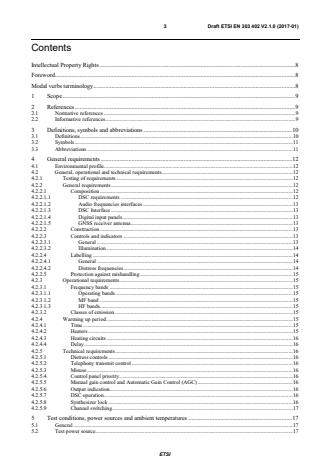
3 Draft ETSI EN 303 402 V2.1.0 (2017-01)
Contents
Intellectual Property Rights . 8
Foreword . 8
Modal verbs terminology . 8
1 Scope . 9
2 References . 9
2.1 Normative references . 9
2.2 Informative references . 9
3 Definitions, symbols and abbreviations . 10
3.1 Definitions . 10
3.2 Symbols . 11
3.3 Abbreviations . 11
4 General requirements . 12
4.1 Environmental profile . 12
4.2 General, operational and technical requirements . 12
4.2.1 Testing of requirements . 12
4.2.2 General requirements . 12
4.2.2.1 Composition . 12
4.2.2.1.1 DSC requirements . 12
4.2.2.1.2 Audio frequencies interfaces . 13
4.2.2.1.3 DSC Interface . 13
4.2.2.1.4 Digital input panels . 13
4.2.2.1.5 GNSS receiver antenna . 13
4.2.2.2 Construction . 13
4.2.2.3 Controls and indicators . 13
4.2.2.3.1 General . 13
4.2.2.3.2 Illumination . 14
4.2.2.4 Labelling . 14
4.2.2.4.1 General . 14
4.2.2.4.2 Distress frequencies . 14
4.2.2.5 Protection against mishandling . 15
4.2.3 Operational requirements . 15
4.2.3.1 Frequency bands . 15
4.2.3.1.1 Operating bands . 15
4.2.3.1.2 MF band . 15
4.2.3.1.3 HF bands. 15
4.2.3.2 Classes of emission . 15
4.2.4 Warming up period . 15
4.2.4.1 Time . 15
4.2.4.2 Heaters . 15
4.2.4.3 Heating circuits . 16
4.2.4.4 Delay . 16
4.2.5 Technical requirements . 16
4.2.5.1 Distress controls . 16
4.2.5.2 Telephony transmit control . 16
4.2.5.3 Misuse . 16
4.2.5.4 Control panel priority . 16
4.2.5.5 Manual gain control and Automatic Gain Control (AGC) . 16
4.2.5.6 Output indication . 16
4.2.5.7 DSC operation . 16
4.2.5.8 Synthesizer lock . 16
4.2.5.9 Channel switching . 17
5 Test conditions, power sources and ambient temperatures . 17
5.1 General . 17
5.2 Test power source . 17
ETSI
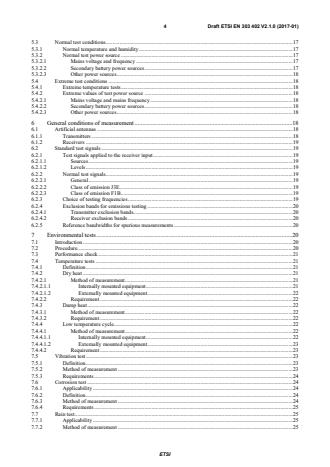
4 Draft ETSI EN 303 402 V2.1.0 (2017-01)
5.3 Normal test conditions . 17
5.3.1 Normal temperature and humidity . 17
5.3.2 Normal test power source . 17
5.3.2.1 Mains voltage and frequency . 17
5.3.2.2 Secondary battery power sources . 17
5.3.2.3 Other power sources . 18
5.4 Extreme test conditions . 18
5.4.1 Extreme temperature tests . 18
5.4.2 Extreme values of test power source . 18
5.4.2.1 Mains voltage and mains frequency . 18
5.4.2.2 Secondary battery power sources . 18
5.4.2.3 Other power sources . 18
6 General conditions of measurement . 18
6.1 Artificial antennas . 18
6.1.1 Transmitters . 18
6.1.2 Receivers . 19
6.2 Standard test signals . 19
6.2.1 Test signals applied to the receiver input . 19
6.2.1.1 Sources . 19
6.2.1.2 Levels . 19
6.2.2 Normal test signals. 19
6.2.2.1 General . 19
6.2.2.2 Class of emission J3E. 19
6.2.2.3 Class of emission F1B . 19
6.2.3 Choice of testing frequencies . 19
6.2.4 Exclusion bands for emissions testing . 20
6.2.4.1 Transmitter exclusion bands. 20
6.2.4.2 Receiver exclusion bands . 20
6.2.5 Reference bandwidths for spurious measurements . 20
7 Environmental tests . 20
7.1 Introduction . 20
7.2 Procedure . 20
7.3 Performance check . 21
7.4 Temperature tests . 21
7.4.1 Definition . 21
7.4.2 Dry heat . 21
7.4.2.1 Method of measurement . 21
7.4.2.1.1 Internally mounted equipment . 21
7.4.2.1.2 Externally mounted equipment . 22
7.4.2.2 Requirement . 22
7.4.3 Damp heat . 22
7.4.3.1 Method of measurement . 22
7.4.3.2 Requirement . 22
7.4.4 Low temperature cycle . 22
7.4.4.1 Method of measurement . 22
7.4.4.1.1 Internally mounted equipment . 22
7.4.4.1.2 Externally mounted equipment . 23
7.4.4.2 Requirement . 23
7.5 Vibration test . 23
7.5.1 Definition . 23
7.5.2 Method of measurement . 23
7.5.3 Requirements . 24
7.6 Corrosion test . 24
7.6.1 Applicability . 24
7.6.2 Definition . 24
7.6.3 Method of measurement . 24
7.6.4 Requirements . 25
7.7 Rain test . 25
7.7.1 Applicability . 25
7.7.2 Method of measurement . 25
ETSI
5 Draft ETSI EN 303 402 V2.1.0 (2017-01)
7.7.3 Requirements . 25
8 Transmitter . 26
8.1 Frequency error . 26
8.1.1 Definition . 26
8.1.2 Method of measurement . 26
8.1.3 Limit . 26
8.2 Output power and intermodulation products . 26
8.2.1 Definition . 26
8.2.2 Method of measurement . 27
8.2.3 Limits . 27
8.2.3.1 Output power in the range 1 606,5 kHz to 4 000 kHz for all modulation modes . 27
8.2.3.2 Output power in the range 4 MHz to 27,5 MHz for all modulation modes. 27
8.2.3.3 Intermodulation products for SSB telephony modes . 27
8.2.3.4 Difference of power of B-state frequency and Y-state frequency . 28
8.2.3.5 Output spectrum . 28
8.3 Power of out-of-band emissions of SSB telephony . 28
8.3.1 Definition . 28
8.3.2 Method of measurement . 28
8.3.3 Limits . 29
8.4 Power of conducted spurious emissions of SSB telephony . 29
8.4.1 Definition . 29
8.4.2 Method of measurement . 29
8.4.3 Limits . 29
8.5 Carrier suppression . 29
8.5.1 Definition . 29
8.5.2 Method of measurement . 30
8.5.3 Limit . 30
8.6 Unwanted frequency modulation . 30
8.6.1 Definition . 30
8.6.2 Method of measurement . 30
8.6.3 Limit . 30
8.7 Sensitivity of the microphone and the 600 Ω line inputs for SSB telephony . 30
8.7.1 Definition . 30
8.7.2 Method of measurement . 31
8.7.3 Limit . 31
8.8 Automatic level control and/or limiter for SSB telephony . 31
8.8.1 Definition . 31
8.8.2 Method of measurement . 31
8.8.3 Limit . 32
8.9 Audio frequency response of SSB telephony . 32
8.9.1 Definition . 32
8.9.2 Method of measurement . 32
8.9.3 Limit . 32
8.10 Residual hum and noise power for telephony. 33
8.10.1 Definition . 33
8.10.2 Method of measurement . 33
8.10.3 Limit . 33
8.11 Residual frequency modulation on DSC . 34
8.11.1 Definition . 34
8.11.2 Method of measurement . 34
8.11.3 Limit . 34
8.12 Continuous operation on telephony . 34
8.12.1 Definition . 34
8.12.2 Method of measurement . 34
8.12.3 Limits . 34
8.13 Protection of transmitter . 34
8.13.1 Definition . 34
8.13.2 Method of measurement . 35
8.13.3 Requirements . 35
8.14 Transmitter radiated spurious emissions . 35
8.14.1 Definition . 35
ETSI
6 Draft ETSI EN 303 402 V2.1.0 (2017-01)
8.14.2 Method of measurement . 35
8.14.3 Limits . 36
9 Receiver . 36
9.1 Receiver spurious emissions. 36
9.1.1 Definition . 36
9.1.2 Method of measurement . 36
9.1.2.1 Conducted antenna port measurement . 36
9.1.2.2 Radiated measurement . 36
9.1.3 Limits . 37
9.2 Maximum usable sensitivity . 37
9.2.1 Definition . 37
9.2.2 Method of measurement . 37
9.2.3 Limits . 38
9.3 Adjacent signal selectivity . 38
9.3.1 Definition . 38
9.3.2 Method of measurement . 38
9.3.3 Limits . 39
9.4 Blocking or desensitization . 39
9.4.1 Definition . 39
9.4.2 Method of measurement . 39
9.4.3 Limits . 40
9.5 Intermodulation response . 40
9.5.1 Definition . 40
9.5.2 Method of measurement . 40
9.5.2.1 Class of emission J3E. 40
9.5.2.2 Class of emission F1B analogue . 40
9.5.2.3 Class of Emission F1B digital . 41
9.5.3 Limits . 41
9.6 Spurious response rejection ratio . 41
9.6.1 Definition . 41
9.6.2 Method of measurement . 41
9.6.3 Limits . 42
9.7 Receiver frequency error . 43
9.7.1 Definition . 43
9.7.2 Method of measurement . 43
9.7.3 Limit . 43
9.8 Unwanted frequency modulation . 43
9.8.1 Definition . 43
9.8.2 Method of measurement . 43
9.8.3 Limit . 44
9.9 Pass band . 44
9.9.1 Definition . 44
9.9.2 Method of measurement . 44
9.9.3 Limits . 44
9.10 Reciprocal mixing . 44
9.10.1 Definition . 44
9.10.2 Method of measurement . 44
9.10.3 Limit . 45
9.11 Harmonic content in output . 45
9.11.1 Definition . 45
9.11.2 Method of measurement . 45
9.11.3 Limits . 45
9.12 Audio frequency intermodulation . 45
9.12.1 Definition . 45
9.12.2 Method of measurement . 45
9.12.3 Limit . 45
9.13 Internally generated spurious signals . 46
9.13.1 Definition . 46
9.13.2 Method of measurement . 46
9.13.3 Limits . 46
9.14 AGC efficiency . 46
ETSI
7 Draft ETSI EN 303 402 V2.1.0 (2017-01)
9.14.1 Definition . 46
9.14.2 Method of measurement . 46
9.14.2.1 General . 46
9.14.2.2 Settings . 46
9.14.2.3 Increase in Signal-to-Noise Ratio (SNR) . 46
9.14.3 Limits . 46
9.15 AGC time constants (attack and recovery time) . 47
9.15.1 Definition . 47
9.15.2 Method of measurement . 47
9.15.3 Limits . 47
9.16 Protection of input circuits . 47
9.16.1 Definition . 47
9.16.2 Method of measurement . 47
9.16.3 Requirement . 47
10 Testing for compliance with technical requirements . 48
10.1 Environmental conditions for testing . 48
10.2 Interpretation of the measurement results . 48
Annex A (informative): Relationship between the present document and the essential
requirements of Directive 2014/53/EU . 49
Annex B (informative): Bibliography . 51
Annex C (informative): Change history . 52
History . 53
ETSI
8 Draft ETSI EN 303 402 V2.1.0 (2017-01)
Intellectual Property Rights
IPRs essential or potentially essential to the present document may have been declared to ETSI. The information
pertaining to these essential IPRs, if any, is publicly available for ETSI members and
...
HARMONISED EUROPEAN STANDARD
Maritime mobile transmitters and receivers
for use in the MF and HF bands;
Harmonised Standard covering the essential requirements
of articles 3.2 and 3.3(g) of Directive 2014/53/EU
2 ETSI EN 303 402 V2.1.1 (2017-05)
Reference
DEN/ERM-TG26-520
Keywords
harmonised standard, maritime, radio, regulation,
telephony
ETSI
650 Route des Lucioles
F-06921 Sophia Antipolis Cedex - FRANCE
Tel.: +33 4 92 94 42 00 Fax: +33 4 93 65 47 16
Siret N° 348 623 562 00017 - NAF 742 C
Association à but non lucratif enregistrée à la
Sous-Préfecture de Grasse (06) N° 7803/88
Important notice
The present document can be downloaded from:
http://www.etsi.org/standards-search
The present document may be made available in electronic versions and/or in print. The content of any electronic and/or
print versions of the present document shall not be modified without the prior written authorization of ETSI. In case of any
existing or perceived difference in contents between such versions and/or in print, the only prevailing document is the
print of the Portable Document Format (PDF) version kept on a specific network drive within ETSI Secretariat.
Users of the present document should be aware that the document may be subject to revision or change of status.
Information on the current status of this and other ETSI documents is available at
https://portal.etsi.org/TB/ETSIDeliverableStatus.aspx
If you find errors in the present document, please send your comment to one of the following services:
https://portal.etsi.org/People/CommiteeSupportStaff.aspx
Copyright Notification
No part may be reproduced or utilized in any form or by any means, electronic or mechanical, including photocopying
and microfilm except as authorized by written permission of ETSI.
The content of the PDF version shall not be modified without the written authorization of ETSI.
The copyright and the foregoing restriction extend to reproduction in all media.
© European Telecommunications Standards Institute 2017.
All rights reserved.
TM TM TM
DECT , PLUGTESTS , UMTS and the ETSI logo are Trade Marks of ETSI registered for the benefit of its Members.
TM
3GPP and LTE™ are Trade Marks of ETSI registered for the benefit of its Members and
of the 3GPP Organizational Partners.
oneM2M logo is protected for the benefit of its Members
GSM® and the GSM logo are Trade Marks registered and owned by the GSM Association.
ETSI
3 ETSI EN 303 402 V2.1.1 (2017-05)
Contents
Intellectual Property Rights . 8
Foreword . 8
Modal verbs terminology . 8
1 Scope . 9
2 References . 9
2.1 Normative references . 9
2.2 Informative references . 9
3 Definitions, symbols and abbreviations . 10
3.1 Definitions . 10
3.2 Symbols . 11
3.3 Abbreviations . 11
4 General requirements . 12
4.1 Environmental profile . 12
4.2 General, operational and technical requirements . 12
4.2.1 Testing of requirements . 12
4.2.2 General requirements . 12
4.2.2.1 Composition . 12
4.2.2.1.1 DSC requirements . 12
4.2.2.1.2 Audio frequencies interfaces . 13
4.2.2.1.3 DSC Interface . 13
4.2.2.1.4 Digital input panels . 13
4.2.2.1.5 GNSS receiver antenna . 13
4.2.2.2 Construction . 13
4.2.2.3 Controls and indicators . 13
4.2.2.3.1 General . 13
4.2.2.3.2 Illumination . 14
4.2.2.4 Labelling . 14
4.2.2.4.1 General . 14
4.2.2.4.2 Distress frequencies . 14
4.2.2.5 Protection against mishandling . 15
4.2.3 Operational requirements . 15
4.2.3.1 Frequency bands . 15
4.2.3.1.1 Operating bands . 15
4.2.3.1.2 MF band . 15
4.2.3.1.3 HF bands. 15
4.2.3.2 Classes of emission . 15
4.2.4 Warming up period . 15
4.2.4.1 Time . 15
4.2.4.2 Heaters . 15
4.2.4.3 Heating circuits . 16
4.2.4.4 Delay . 16
4.2.5 Technical requirements . 16
4.2.5.1 Distress controls . 16
4.2.5.2 Telephony transmit control . 16
4.2.5.3 Misuse . 16
4.2.5.4 Control panel priority . 16
4.2.5.5 Manual gain control and Automatic Gain Control (AGC) . 16
4.2.5.6 Output indication . 16
4.2.5.7 DSC operation . 16
4.2.5.8 Synthesizer lock . 16
4.2.5.9 Channel switching . 17
5 Test conditions, power sources and ambient temperatures . 17
5.1 General . 17
5.2 Test power source . 17
ETSI
4 ETSI EN 303 402 V2.1.1 (2017-05)
5.3 Normal test conditions . 17
5.3.1 Normal temperature and humidity . 17
5.3.2 Normal test power source . 17
5.3.2.1 Mains voltage and frequency . 17
5.3.2.2 Secondary battery power sources . 17
5.3.2.3 Other power sources . 18
5.4 Extreme test conditions . 18
5.4.1 Extreme temperature tests . 18
5.4.2 Extreme values of test power source . 18
5.4.2.1 Mains voltage and mains frequency . 18
5.4.2.2 Secondary battery power sources . 18
5.4.2.3 Other power sources . 18
6 General conditions of measurement . 18
6.1 Artificial antennas . 18
6.1.1 Transmitters . 18
6.1.2 Receivers . 19
6.2 Standard test signals . 19
6.2.1 Test signals applied to the receiver input . 19
6.2.1.1 Sources . 19
6.2.1.2 Levels . 19
6.2.2 Normal test signals. 19
6.2.2.1 General . 19
6.2.2.2 Class of emission J3E. 19
6.2.2.3 Class of emission F1B . 19
6.2.3 Choice of testing frequencies . 19
6.2.4 Exclusion bands for emissions testing . 20
6.2.4.1 Transmitter exclusion bands. 20
6.2.4.2 Receiver exclusion bands . 20
6.2.5 Reference bandwidths for spurious measurements . 20
7 Environmental tests . 20
7.1 Introduction . 20
7.2 Procedure . 20
7.3 Performance check . 21
7.4 Temperature tests . 21
7.4.1 Definition . 21
7.4.2 Dry heat . 21
7.4.2.1 Method of measurement . 21
7.4.2.1.1 Internally mounted equipment . 21
7.4.2.1.2 Externally mounted equipment . 22
7.4.2.2 Requirement . 22
7.4.3 Damp heat . 22
7.4.3.1 Method of measurement . 22
7.4.3.2 Requirement . 22
7.4.4 Low temperature cycle . 22
7.4.4.1 Method of measurement . 22
7.4.4.1.1 Internally mounted equipment . 22
7.4.4.1.2 Externally mounted equipment . 23
7.4.4.2 Requirement . 23
7.5 Vibration test . 23
7.5.1 Definition . 23
7.5.2 Method of measurement . 23
7.5.3 Requirements . 24
7.6 Corrosion test . 24
7.6.1 Applicability . 24
7.6.2 Definition . 24
7.6.3 Method of measurement . 24
7.6.4 Requirements . 25
7.7 Rain test . 25
7.7.1 Applicability . 25
7.7.2 Method of measurement . 25
ETSI
5 ETSI EN 303 402 V2.1.1 (2017-05)
7.7.3 Requirements . 25
8 Transmitter . 26
8.1 Frequency error . 26
8.1.1 Definition . 26
8.1.2 Method of measurement . 26
8.1.3 Limit . 26
8.2 Output power and intermodulation products . 26
8.2.1 Definition . 26
8.2.2 Method of measurement . 27
8.2.3 Limits . 27
8.2.3.1 Output power in the range 1 606,5 kHz to 4 000 kHz for all modulation modes . 27
8.2.3.2 Output power in the range 4 MHz to 27,5 MHz for all modulation modes. 27
8.2.3.3 Intermodulation products for SSB telephony modes . 27
8.2.3.4 Difference of power of B-state frequency and Y-state frequency . 28
8.2.3.5 Output spectrum . 28
8.3 Power of out-of-band emissions of SSB telephony . 28
8.3.1 Definition . 28
8.3.2 Method of measurement . 28
8.3.3 Limits . 29
8.4 Power of conducted spurious emissions of SSB telephony . 29
8.4.1 Definition . 29
8.4.2 Method of measurement . 29
8.4.3 Limits . 29
8.5 Carrier suppression . 29
8.5.1 Definition . 29
8.5.2 Method of measurement . 30
8.5.3 Limit . 30
8.6 Unwanted frequency modulation . 30
8.6.1 Definition . 30
8.6.2 Method of measurement . 30
8.6.3 Limit . 30
8.7 Sensitivity of the microphone and the 600 Ω line inputs for SSB telephony . 30
8.7.1 Definition . 30
8.7.2 Method of measurement . 31
8.7.3 Limit . 31
8.8 Automatic level control and/or limiter for SSB telephony . 31
8.8.1 Definition . 31
8.8.2 Method of measurement . 31
8.8.3 Limit . 32
8.9 Audio frequency response of SSB telephony . 32
8.9.1 Definition . 32
8.9.2 Method of measurement . 32
8.9.3 Limit . 32
8.10 Residual hum and noise power for telephony. 33
8.10.1 Definition . 33
8.10.2 Method of measurement . 33
8.10.3 Limit . 33
8.11 Residual frequency modulation on DSC . 34
8.11.1 Definition . 34
8.11.2 Method of measurement . 34
8.11.3 Limit . 34
8.12 Continuous operation on telephony . 34
8.12.1 Definition . 34
8.12.2 Method of measurement . 34
8.12.3 Limits . 34
8.13 Protection of transmitter . 34
8.13.1 Definition . 34
8.13.2 Method of measurement . 35
8.13.3 Requirements . 35
8.14 Transmitter radiated spurious emissions . 35
8.14.1 Definition . 35
ETSI
6 ETSI EN 303 402 V2.1.1 (2017-05)
8.14.2 Method of measurement . 35
8.14.3 Limits . 36
9 Receiver . 36
9.1 Receiver spurious emissions. 36
9.1.1 Definition . 36
9.1.2 Method of measurement . 36
9.1.2.1 Conducted antenna port measurement . 36
9.1.2.2 Radiated measurement . 36
9.1.3 Limits . 37
9.2 Maximum usable sensitivity . 37
9.2.1 Definition . 37
9.2.2 Method of measurement . 37
9.2.3 Limits . 38
9.3 Adjacent signal selectivity . 38
9.3.1 Definition . 38
9.3.2 Method of measurement . 38
9.3.3 Limits . 39
9.4 Blocking or desensitization . 39
9.4.1 Definition . 39
9.4.2 Method of measurement . 39
9.4.3 Limits . 40
9.5 Intermodulation response . 40
9.5.1 Definition . 40
9.5.2 Method of measurement . 40
9.5.2.1 Class of emission J3E. 40
9.5.2.2 Class of emission F1B analogue . 40
9.5.2.3 Class of Emission F1B digital . 41
9.5.3 Limits . 41
9.6 Spurious response rejection ratio . 41
9.6.1 Definition . 41
9.6.2 Method of measurement . 41
9.6.3 Limits . 42
9.7 Receiver frequency error . 43
9.7.1 Definition . 43
9.7.2 Method of measurement . 43
9.7.3 Limit . 43
9.8 Unwanted frequency modulation . 43
9.8.1 Definition . 43
9.8.2 Method of measurement . 43
9.8.3 Limit . 44
9.9 Pass band . 44
9.9.1 Definition . 44
9.9.2 Method of measurement . 44
9.9.3 Limits . 44
9.10 Reciprocal mixing . 44
9.10.1 Definition . 44
9.10.2 Method of measurement . 44
9.10.3 Limit . 45
9.11 Harmonic content in output . 45
9.11.1 Definition . 45
9.11.2 Method of measurement . 45
9.11.3 Limits . 45
9.12 Audio frequency intermodulation . 45
9.12.1 Definition . 45
9.12.2 Method of measurement . 45
9.12.3 Limit . 45
9.13 Internally generated spurious signals . 46
9.13.1 Definition . 46
9.13.2 Method of measurement . 46
9.13.3 Limits . 46
9.14 AGC efficiency . 46
ETSI
7 ETSI EN 303 402 V2.1.1 (2017-05)
9.14.1 Definition . 46
9.14.2 Method of measurement . 46
9.14.2.1 General . 46
9.14.2.2 Settings . 46
9.14.2.3 Increase in Signal-to-Noise Ratio (SNR) . 46
9.14.3 Limits . 46
9.15 AGC time constants (attack and recovery time) . 47
9.15.1 Definition . 47
9.15.2 Method of measurement . 47
9.15.3 Limits . 47
9.16 Protection of input circuits . 47
9.16.1 Definition . 47
9.16.2 Method of measurement . 47
9.16.3 Requirement . 47
10 Testing for compliance with technical requirements . 48
10.1 Environmental conditions for testing . 48
10.2 Interpretation of the measurement results . 48
Annex A (informative): Relationship between the present document and the essential
requirements of Directive 2014/53/EU . 49
Annex B (informative): Bibliography . 51
Annex C (informative): Change history . 52
History . 53
ETSI
8 ETSI EN 303 402 V2.1.1 (2017-05)
Intellectual Property Rights
IPRs essential or potentially essential to the present document may have been declared to ETSI. The information
pertaining to these essential IPRs, if any, is publicly available for ETSI me
...
2003-01.Slovenski inštitut za standardizacijo. Razmnoževanje celote ali delov tega standarda ni dovoljeno.Maritime mobile transmitters and receivers for use in the MF and HF bands - Harmonised Standard covering the essential requirements of articles 3.2 and 3.3(g) of Directive 2014/53/EU47.020.70Navigacijska in krmilna opremaNavigation and control equipment33.060.20Sprejemna in oddajna opremaReceiving and transmitting equipmentICS:Ta slovenski standard je istoveten z:ETSI EN 303 402 V2.1.1 (2017-05)SIST EN 303 402 V2.1.1:2017en01-julij-2017SIST EN 303 402 V2.1.1:2017SLOVENSKI
STANDARD
Harmonised Standard covering the essential requirements of articles 3.2 and 3.3(g) of Directive 2014/53/EU
HARMONISED EUROPEAN STANDARD SIST EN 303 402 V2.1.1:2017
ETSI ETSI EN 303 402 V2.1.1 (2017-05) 2
Reference DEN/ERM-TG26-520 Keywords harmonised standard, maritime, radio, regulation, telephony ETSI 650 Route des Lucioles F-06921 Sophia Antipolis Cedex - FRANCE
Tel.: +33 4 92 94 42 00
Fax: +33 4 93 65 47 16
Siret N° 348 623 562 00017 - NAF 742 C Association à but non lucratif enregistrée à la Sous-Préfecture de Grasse (06) N° 7803/88
Important notice The present document can be downloaded from: http://www.etsi.org/standards-search The present document may be made available in electronic versions and/or in print. The content of any electronic and/or print versions of the present document shall not be modified without the prior written authorization of ETSI. In case of any existing or perceived difference in contents between such versions and/or in print, the only prevailing document is the print of the Portable Document Format (PDF) version kept on a specific network drive within ETSI Secretariat. Users of the present document should be aware that the document may be subject to revision or change of status. Information on the current status of this and other ETSI documents is available at https://portal.etsi.org/TB/ETSIDeliverableStatus.aspx If you find errors in the present document, please send your comment to one of the following services: https://portal.etsi.org/People/CommiteeSupportStaff.aspx Copyright Notification No part may be reproduced or utilized in any form or by any means, electronic or mechanical, including photocopying and microfilm except as authorized by written permission of ETSI. The content of the PDF version shall not be modified without the written authorization of ETSI. The copyright and the foregoing restriction extend to reproduction in all media.
© European Telecommunications Standards Institute 2017. All rights reserved.
DECTTM, PLUGTESTSTM, UMTSTM and the ETSI logo are Trade Marks of ETSI registered for the benefit of its Members. 3GPPTM and LTE™ are Trade Marks of ETSI registered for the benefit of its Members and of the 3GPP Organizational Partners. oneM2M logo is protected for the benefit of its Members GSM® and the GSM logo are Trade Marks registered and owned by the GSM Association. SIST EN 303 402 V2.1.1:2017
ETSI ETSI EN 303 402 V2.1.1 (2017-05) 3 Contents Intellectual Property Rights . 8 Foreword . 8 Modal verbs terminology . 8 1 Scope . 9 2 References . 9 2.1 Normative references . 9 2.2 Informative references . 9 3 Definitions, symbols and abbreviations . 10 3.1 Definitions . 10 3.2 Symbols . 11 3.3 Abbreviations . 11 4 General requirements . 12 4.1 Environmental profile . 12 4.2 General, operational and technical requirements . 12 4.2.1 Testing of requirements . 12 4.2.2 General requirements . 12 4.2.2.1 Composition . 12 4.2.2.1.1 DSC requirements . 12 4.2.2.1.2 Audio frequencies interfaces . 13 4.2.2.1.3 DSC Interface . 13 4.2.2.1.4 Digital input panels . 13 4.2.2.1.5 GNSS receiver antenna . 13 4.2.2.2 Construction . 13 4.2.2.3 Controls and indicators . 13 4.2.2.3.1 General . 13 4.2.2.3.2 Illumination . 14 4.2.2.4 Labelling . 14 4.2.2.4.1 General . 14 4.2.2.4.2 Distress frequencies . 14 4.2.2.5 Protection against mishandling . 15 4.2.3 Operational requirements . 15 4.2.3.1 Frequency bands . 15 4.2.3.1.1 Operating bands . 15 4.2.3.1.2 MF band . 15 4.2.3.1.3 HF bands. 15 4.2.3.2 Classes of emission . 15 4.2.4 Warming up period . 15 4.2.4.1 Time . 15 4.2.4.2 Heaters . 15 4.2.4.3 Heating circuits . 16 4.2.4.4 Delay . 16 4.2.5 Technical requirements . 16 4.2.5.1 Distress controls . 16 4.2.5.2 Telephony transmit control . 16 4.2.5.3 Misuse . 16 4.2.5.4 Control panel priority . 16 4.2.5.5 Manual gain control and Automatic Gain Control (AGC) . 16 4.2.5.6 Output indication . 16 4.2.5.7 DSC operation . 16 4.2.5.8 Synthesizer lock . 16 4.2.5.9 Channel switching . 17 5 Test conditions, power sources and ambient temperatures . 17 5.1 General . 17 5.2 Test power source . 17 SIST EN 303 402 V2.1.1:2017
ETSI ETSI EN 303 402 V2.1.1 (2017-05) 4 5.3 Normal test conditions . 17 5.3.1 Normal temperature and humidity . 17 5.3.2 Normal test power source . 17 5.3.2.1 Mains voltage and frequency . 17 5.3.2.2 Secondary battery power sources . 17 5.3.2.3 Other power sources . 18 5.4 Extreme test conditions . 18 5.4.1 Extreme temperature tests . 18 5.4.2 Extreme values of test power source . 18 5.4.2.1 Mains voltage and mains frequency . 18 5.4.2.2 Secondary battery power sources . 18 5.4.2.3 Other power sources . 18 6 General conditions of measurement . 18 6.1 Artificial antennas . 18 6.1.1 Transmitters . 18 6.1.2 Receivers . 19 6.2 Standard test signals . 19 6.2.1 Test signals applied to the receiver input . 19 6.2.1.1 Sources . 19 6.2.1.2 Levels . 19 6.2.2 Normal test signals. 19 6.2.2.1 General . 19 6.2.2.2 Class of emission J3E. 19 6.2.2.3 Class of emission F1B . 19 6.2.3 Choice of testing frequencies . 19 6.2.4 Exclusion bands for emissions testing . 20 6.2.4.1 Transmitter exclusion bands. 20 6.2.4.2 Receiver exclusion bands . 20 6.2.5 Reference bandwidths for spurious measurements . 20 7 Environmental tests . 20 7.1 Introduction . 20 7.2 Procedure . 20 7.3 Performance check . 21 7.4 Temperature tests . 21 7.4.1 Definition . 21 7.4.2 Dry heat . 21 7.4.2.1 Method of measurement . 21 7.4.2.1.1 Internally mounted equipment . 21 7.4.2.1.2 Externally mounted equipment . 22 7.4.2.2 Requirement . 22 7.4.3 Damp heat . 22 7.4.3.1 Method of measurement . 22 7.4.3.2 Requirement . 22 7.4.4 Low temperature cycle . 22 7.4.4.1 Method of measurement . 22 7.4.4.1.1 Internally mounted equipment . 22 7.4.4.1.2 Externally mounted equipment . 23 7.4.4.2 Requirement . 23 7.5 Vibration test . 23 7.5.1 Definition . 23 7.5.2 Method of measurement . 23 7.5.3 Requirements . 24 7.6 Corrosion test . 24 7.6.1 Applicability . 24 7.6.2 Definition . 24 7.6.3 Method of measurement . 24 7.6.4 Requirements . 25 7.7 Rain test . 25 7.7.1 Applicability . 25 7.7.2 Method of measurement . 25 SIST EN 303 402 V2.1.1:2017
ETSI ETSI EN 303 402 V2.1.1 (2017-05) 5 7.7.3 Requirements . 25 8 Transmitter . 26 8.1 Frequency error . 26 8.1.1 Definition . 26 8.1.2 Method of measurement . 26 8.1.3 Limit . 26 8.2 Output power and intermodulation products . 26 8.2.1 Definition . 26 8.2.2 Method of measurement . 27 8.2.3 Limits . 27 8.2.3.1 Output power in the range 1 606,5 kHz to 4 000 kHz for all modulation modes . 27 8.2.3.2 Output power in the range 4 MHz to 27,5 MHz for all modulation modes. 27 8.2.3.3 Intermodulation products for SSB telephony modes . 27 8.2.3.4 Difference of power of B-state frequency and Y-state frequency . 28 8.2.3.5 Output spectrum . 28 8.3 Power of out-of-band emissions of SSB telephony . 28 8.3.1 Definition . 28 8.3.2 Method of measurement . 28 8.3.3 Limits . 29 8.4 Power of conducted spurious emissions of SSB telephony . 29 8.4.1 Definition . 29 8.4.2 Method of measurement . 29 8.4.3 Limits . 29 8.5 Carrier suppression . 29 8.5.1 Definition . 29 8.5.2 Method of measurement . 30 8.5.3 Limit . 30 8.6 Unwanted frequency modulation . 30 8.6.1 Definition . 30 8.6.2 Method of measurement . 30 8.6.3 Limit . 30 8.7 Sensitivity of the microphone and the 600 Ω line inputs for SSB telephony . 30 8.7.1 Definition . 30 8.7.2 Method of measurement . 31 8.7.3 Limit . 31 8.8 Automatic level control and/or limiter for SSB telephony . 31 8.8.1 Definition . 31 8.8.2 Method of measurement . 31 8.8.3 Limit . 32 8.9 Audio frequency response of SSB telephony . 32 8.9.1 Definition . 32 8.9.2 Method of measurement . 32 8.9.3 Limit . 32 8.10 Residual hum and noise power for telephony. 33 8.10.1 Definition . 33 8.10.2 Method of measurement . 33 8.10.3 Limit . 33 8.11 Residual frequency modulation on DSC . 34 8.11.1 Definition . 34 8.11.2 Method of measurement . 34 8.11.3 Limit . 34 8.12 Continuous operation on telephony . 34 8.12.1 Definition . 34 8.12.2 Method of measurement . 34 8.12.3 Limits . 34 8.13 Protection of transmitter . 34 8.13.1 Definition . 34 8.13.2 Method of measurement . 35 8.13.3 Requirements . 35 8.14 Transmitter radiated spurious emissions . 35 8.14.1 Definition . 35 SIST EN 303 402 V2.1.1:2017
ETSI ETSI EN 303 402 V2.1.1 (2017-05) 6 8.14.2 Method of measurement . 35 8.14.3 Limits . 36 9 Receiver . 36 9.1 Receiver spurious emissions. 36 9.1.1 Definition . 36 9.1.2 Method of measurement . 36 9.1.2.1 Conducted antenna port measurement . 36 9.1.2.2 Radiated measurement . 36 9.1.3 Limits . 37 9.2 Maximum usable sensitivity . 37 9.2.1 Definition . 37 9.2.2 Method of measurement . 37 9.2.3 Limits . 38 9.3 Adjacent signal selectivity . 38 9.3.1 Definition . 38 9.3.2 Method of measurement . 38 9.3.3 Limits . 39 9.4 Blocking or desensitization . 39 9.4.1 Definition . 39 9.4.2 Method of measurement . 39 9.4.3 Limits . 40 9.5 Intermodulation response . 40 9.5.1 Definition . 40 9.5.2 Method of measurement . 40 9.5.2.1 Class of emission J3E. 40 9.5.2.2 Class of emission F1B analogue . 40 9.5.2.3 Class of Emission F1B digital . 41 9.5.3 Limits . 41 9.6 Spurious response rejection ratio . 41 9.6.1 Definition . 41 9.6.2 Method of measurement . 41 9.6.3 Limits . 42 9.7 Receiver frequency error . 43 9.7.1 Definition . 43 9.7.2 Method of measurement . 43 9.7.3 Limit . 43 9.8 Unwanted frequency modulation . 43 9.8.1 Definition . 43 9.8.2 Method of measurement . 43 9.8.3 Limit . 44 9.9 Pass band . 44 9.9.1 Definition . 44 9.9.2 Method of measurement . 44 9.9.3 Limits . 44 9.10 Reciprocal mixing . 44 9.10.1 Definition . 44 9.10.2 Method of measurement . 44 9.10.3 Limit . 45 9.11 Harmonic content in output . 45 9.11.1 Definition . 45 9.11.2 Method of measurement . 45 9.11.3 Limits . 45 9.12 Audio frequency intermodulation . 45 9.12.1 Definition . 45 9.12.2 Method of measurement . 45 9.12.3 Limit . 45 9.13 Internally generated spurious signals . 46 9.13.1 Definition . 46 9.13.2 Method of measurement . 46 9.13.3 Limits . 46 9.14 AGC efficiency . 46 SIST EN 303 402 V2.1.1:2017
ETSI ETSI EN 303 402 V2.1.1 (2017-05) 7 9.14.1 Definition . 46 9.14.2 Method of measurement . 46 9.14.2.1 General . 46 9.14.2.2 Settings . 46 9.14.2.3 Increase in Signal-to-Noise Ratio (SNR) . 46 9.14.3 Limits . 46 9.15 AGC time constants (attack and recovery time) . 47 9.15.1 Definition . 47 9.15.2 Method of measurement . 47 9.15.3 Limits . 47 9.16 Protection of input circuits . 47 9.16.1 Definition . 47 9.16.2 Method of measurement . 47 9.16.3 Requirement . 47 10 Testing for compliance with technical requirements . 48 10.1 Environmental conditions for testing . 48 10.2 Interpretation of the measurement results . 48 Annex A (informative): Relationship between the present document and the essential requirements of Directive 2014/53/EU . 49 Annex B (informative): Bibliography . 51 Annex C (informative): Change history . 52 History . 53
ETSI ETSI EN 303 402 V2.1.1 (2017-05) 8 Intellectual Property Rights IPRs essential or potentially essential to the present document may have been declared to ETSI. The
...