

kSIST prES 203 156 V1.1.1:2014
(Main)Environmental Engineering (EE) - Thermal Management requirements for outdoor enclosures
General Information
- Abstract
Write a thermal management standard for outdoor enclosure defined in EN 301 169-1, The idea is, that depending on the cooling solution adopted, to define: Cooling capacitance for cabinets depending on cabinet dimension Cabinet dissipation class Maximum acceptable Delta T between ambient temperature and inside temperature Preferable air flow On this way will be more easy define the responsability of equipment manufactures, cabinet manufactures and integrators.
- Status
- Not Published
- Technical Committee
- SPN - Services and Protocols for Networks
- Current Stage
- 5020 - Formal vote (FV) (Adopted Project)
- Start Date
- 29-Jul-2013
- Due Date
- 16-Sep-2013
- Completion Date
- 28-Aug-2013
Buy Documents

ETSI ES 203 156 V1.0.0 (2013-07) - Environmental Engineering (EE); Thermal Management requirements for outdoor enclosures

ETSI ES 203 156 V1.1.1 (2013-09) - Environmental Engineering (EE); Thermal Management requirements for outdoor enclosures
Overview
kSIST prES 203 156 V1.1.1:2014 sets out the environmental engineering requirements for thermal management of outdoor enclosures, as referenced in EN 301 169-1. This thermal management standard provides a unified approach to assess, specify, and optimize cooling solutions-ensuring reliable operation of telecommunication and IT equipment used in wireline and wireless access networks. By standardizing thermal characteristics such as cooling capacity, maximum acceptable temperature difference (Delta T), and air flow guidelines, the document clarifies roles and responsibilities for equipment manufacturers, cabinet suppliers, and system integrators.
Key Topics
- Cooling Capacity Standardization: Defines a clear method for calculating the cooling performance (K) of outdoor enclosures, dependent on cabinet size, heat load (Q), and the temperature gradient between internal and external environments.
- Maximum Acceptable Delta T: Specifies the highest allowable temperature difference between outdoor ambient air and the inlet air inside the enclosure, recommending values (such as ≤10°C) for maintaining optimal equipment life and functionality.
- Air Flow Requirements: Sets preferred air flow paths in cabinets and matches them with equipment ventilation designs. This enables more effective and predictable cooling, reducing hotspots and improving efficiency.
- Environmental Class Alignment: Guides the selection of equipment based on climate class (referencing EN 300 019-1-3, EN 300 019-1-4) and the corresponding enclosure configuration, whether using free cooling, heat exchangers, or air conditioning.
- Manufacturer Data Provision: Details the critical thermal, airflow, and mechanical data to be supplied by outdoor enclosure manufacturers, enabling integration with third-party equipment and reliable thermal modeling.
Applications
This standard is essential in several scenarios:
- Telecommunications Infrastructure: Ensures stability and efficient operation of electronics installed in diverse and harsh outdoor environments by maintaining controlled internal cabinet micro-climates.
- Network Equipment Integration: Simplifies the integration of equipment from different vendors into a single, weather-protected enclosure without risking thermal incompatibilities.
- Equipment Procurement and Specification: Provides clear criteria for selecting and specifying enclosures based on required cooling performance, physical dimensions, and anticipated heat load.
- Thermal Design Optimization: Assists system integrators and engineers in predicting thermal behavior and in designing enclosures equipped with features like fans, filters, and various cooling units (door-mounted, roof-mounted, side-mounted TCU).
- Responsibility Definition: Clarifies deliverables among cabinet manufacturers, component suppliers, and integrators, reducing integration issues and technical disputes.
Related Standards
When applying kSIST prES 203 156, reference to the following related standards is recommended:
- EN 301 169-1 & EN 301 169-2: Engineering requirements for outdoor enclosures, both equipped and unequipped.
- EN 300 019-1-4 & EN 300 019-1-3: Environmental conditions and test classifications for telecommunication equipment at outdoor and protected sites.
- EN 300 119-5: Thermal management guidelines for equipment practice.
- EN 60950-1 & EN 60950-22: Safety requirements for ICT and outdoor installations.
- EN 300 386, EN 301 489-1: Electromagnetic compatibility (EMC) standards.
- EN 300 753: Acoustic noise limits for telecommunications equipment.
- IEC 61969-3: Climatic and mechanical specifications for outdoor electronic equipment enclosures.
Practical Value
Adoption of this standard results in:
- Streamlined design and procurement processes for outdoor enclosures.
- Increased reliability and longevity of telecommunication and IT systems in varying climates.
- Reduced risks of overheating, system failure, and maintenance costs.
- Consistent integration of new equipment into existing infrastructure by relying on standardized thermal data and performance benchmarks.
Keywords: thermal management, outdoor enclosures, cooling capacity, Delta T, air flow, environmental engineering, telecommunications, enclosure standards, SIST, cabinet integration, equipment protection, heat management.
Buy Documents
ETSI ES 203 156 V1.0.0 (2013-07) - Environmental Engineering (EE); Thermal Management requirements for outdoor enclosures
ETSI ES 203 156 V1.1.1 (2013-09) - Environmental Engineering (EE); Thermal Management requirements for outdoor enclosures
Get Certified
Connect with accredited certification bodies for this standard

IMP NDT d.o.o.
Non-destructive testing services. Radiography, ultrasonic, magnetic particle, penetrant, visual inspection.
Inštitut za kovinske materiale in tehnologije
Institute of Metals and Technology. Materials testing, metallurgical analysis, NDT.
Q Techna d.o.o.
NDT and quality assurance specialist. 30+ years experience. NDT personnel certification per ISO 9712, nuclear and thermal power plant inspections, QA/
Sponsored listings
Frequently Asked Questions
kSIST prES 203 156 V1.1.1:2014 is a standard published by the Slovenian Institute for Standardization (SIST). Its full title is "Environmental Engineering (EE) - Thermal Management requirements for outdoor enclosures". This standard covers: Write a thermal management standard for outdoor enclosure defined in EN 301 169-1, The idea is, that depending on the cooling solution adopted, to define: Cooling capacitance for cabinets depending on cabinet dimension Cabinet dissipation class Maximum acceptable Delta T between ambient temperature and inside temperature Preferable air flow On this way will be more easy define the responsability of equipment manufactures, cabinet manufactures and integrators.
Write a thermal management standard for outdoor enclosure defined in EN 301 169-1, The idea is, that depending on the cooling solution adopted, to define: Cooling capacitance for cabinets depending on cabinet dimension Cabinet dissipation class Maximum acceptable Delta T between ambient temperature and inside temperature Preferable air flow On this way will be more easy define the responsability of equipment manufactures, cabinet manufactures and integrators.
kSIST prES 203 156 V1.1.1:2014 is classified under the following ICS (International Classification for Standards) categories: 19.040 - Environmental testing. The ICS classification helps identify the subject area and facilitates finding related standards.
kSIST prES 203 156 V1.1.1:2014 is available in PDF format for immediate download after purchase. The document can be added to your cart and obtained through the secure checkout process. Digital delivery ensures instant access to the complete standard document.
Standards Content (Sample)
Final draft ETSI ES 203 156 V1.0.0 (2013-07)
ETSI Standard
Environment Engineering (EE);
Thermal Management requirements for outdoor enclosures
2 Final draft ETSI ES 203 156 V1.0.0 (2013-07)
Reference
DES/EE-01027
Keywords
air flow, cooling capacity, environment,
management, outdoor enclosure, thermal
ETSI
650 Route des Lucioles
F-06921 Sophia Antipolis Cedex - FRANCE
Tel.: +33 4 92 94 42 00 Fax: +33 4 93 65 47 16
Siret N° 348 623 562 00017 - NAF 742 C
Association à but non lucratif enregistrée à la
Sous-Préfecture de Grasse (06) N° 7803/88
Important notice
Individual copies of the present document can be downloaded from:
http://www.etsi.org
The present document may be made available in more than one electronic version or in print. In any case of existing or
perceived difference in contents between such versions, the reference version is the Portable Document Format (PDF).
In case of dispute, the reference shall be the printing on ETSI printers of the PDF version kept on a specific network drive
within ETSI Secretariat.
Users of the present document should be aware that the document may be subject to revision or change of status.
Information on the current status of this and other ETSI documents is available at
http://portal.etsi.org/tb/status/status.asp
If you find errors in the present document, please send your comment to one of the following services:
http://portal.etsi.org/chaircor/ETSI_support.asp
Copyright Notification
No part may be reproduced except as authorized by written permission.
The copyright and the foregoing restriction extend to reproduction in all media.
© European Telecommunications Standards Institute 2013.
All rights reserved.
TM TM TM
DECT , PLUGTESTS , UMTS and the ETSI logo are Trade Marks of ETSI registered for the benefit of its Members.
TM
3GPP and LTE™ are Trade Marks of ETSI registered for the benefit of its Members and
of the 3GPP Organizational Partners.
GSM® and the GSM logo are Trade Marks registered and owned by the GSM Association.
ETSI
3 Final draft ETSI ES 203 156 V1.0.0 (2013-07)
Contents
Intellectual Property Rights . 5
Foreword . 5
Introduction . 5
1 Scope . 6
2 References . 6
2.1 Normative references . 6
2.2 Informative references . 6
3 Definitions, symbols and abbreviations . 7
3.1 Definitions . 7
3.2 Symbols . 8
3.3 Abbreviations . 8
4 General requirements . 8
4.1 Thermal performance of outdoor enclosures . 8
4.2 Environmental class requirements for equipment installed in outdoor enclosures . 8
4.2.1 Free cooling cabinet . 8
4.2.2 Heat exchanger cabinet . 8
4.2.3 Air conditioning cabinet . 9
5 Thermal management . 9
5.1 Standardized definition of cooling capacity . 9
5.2 Maximum acceptable delta T . 10
5.3 The preferable rule for air flow . 10
5.3.1 Air flow paths of outdoor enclosures . 10
5.3.2 Preferable rule for air flow path match . 11
5.3.2.1 Door-mounted TCU . 11
5.3.2.2 Roof -mounted TCU . 12
5.3.2.3 Side-mounted TCU . 13
Annex A (normative): Thermal characterization data of outdoor enclosures to be provided
by the manufacturer . 14
A.1 General identification . 14
A.1.1 Identification . 14
A.1.2 Physical geometry . 14
A.2 Additional data for outdoor enclosures . 14
A.2.1 Mechanical characteristics of outdoor enclosures . 15
A.2.2 Fan/Fan tray. 15
A.2.3 Air filter of outdoor enclosures . 15
A.2.4 Airflow paths . 16
A.2.5 Cooling capacity . 16
Annex B (informative): Ambient temperature measurement point . 17
B.1 measurement point requirement . 17
Annex C (informative): Solar radiation. 18
Annex D (informative): Requirements for safety and EMC . 19
D.1 Requirements for safety. 19
D.2 Requirements for EMC . 19
D.3 Acoustic Noise Level requirement . 19
ETSI
4 Final draft ETSI ES 203 156 V1.0.0 (2013-07)
Annex E (informative): Cabinet performance parameters . 20
Annex F (informative): Bibliography . 21
History . 22
ETSI
5 Final draft ETSI ES 203 156 V1.0.0 (2013-07)
Intellectual Property Rights
IPRs essential or potentially essential to the present document may have been declared to ETSI. The information
pertaining to these essential IPRs, if any, is publicly available for ETSI members and non-members, and can be found
in ETSI SR 000 314: "Intellectual Property Rights (IPRs); Essential, or potentially Essential, IPRs notified to ETSI in
respect of ETSI standards", which is available from the ETSI Secretariat. Latest updates are available on the ETSI Web
server (http://ipr.etsi.org).
Pursuant to the ETSI IPR Policy, no investigation, including IPR searches, has been carried out by ETSI. No guarantee
can be given as to the existence of other IPRs not referenced in ETSI SR 000 314 (or the updates on the ETSI Web
server) which are, or may be, or may become, essential to the present document.
Foreword
This final draft ETSI Standard (ES) has been produced by ETSI Technical Committee Environmental Engineering (EE),
and is now submitted for the ETSI standards Membership Approval Procedure.
Introduction
Outdoor enclosure suppliers are trying to overcome their thermal issues in different solutions being developed. When
different equipments and outdoor enclosures from various suppliers are integrated, they can have a detrimental effect on
each other. The present document specifies the thermal management requirements for outdoor enclosures (defined in
EN 301 169-1 [i.4] and EN 301 169-2 [i.5]) to prevent outdoor enclosures having a detrimental thermal influence on
equipments inside.
ETSI
6 Final draft ETSI ES 203 156 V1.0.0 (2013-07)
1 Scope
The present document describes the thermal management requirements for outdoor enclosures defined in
EN 301 169-1 [i.4] and EN 301 169-2 [i.5]. These thermal management requirements to be defined include:
• a standardized definition of cooling capacity for outdoor enclosures;
• a maximum acceptable delta T between ambient temperature and inside temperature;
• the preferable rule for air flow inside outdoor enclosures;
• the environment class for equipment to be installed in outdoor enclosures.
Not all these requirement are applicable to outdoor enclosures defined in EN 301 169-1 [i.4] and EN 301 169-2 [i.5];
maximum acceptable delta T for equipment in line with EN 301 169-1 [i.4] should be considered as a guide to
developer.
The purpose of the present document is to make it more easy to define the responsibility of equipment manufacturers,
cabinet manufacturers and integrators.
The present document applies for those empty outdoor enclosures supplied for housing telecommunication equipment
of wireline and wireless access network and other information technology equipment.
EMC, safety and acoustic noise requirements are not parts of this document. Guidance on these aspects are contained in
annex D.
2 References
References are either specific (identified by date of publication and/or edition number or version number) or
non-specific. For specific references, only the cited version applies. For non-specific references, the latest version of the
reference document (including any amendments) applies.
Referenced documents which are not found to be publicly available in the expected location might be found at
http://docbox.etsi.org/Reference.
NOTE: While any hyperlinks included in this clause were valid at the time of publication, ETSI cannot guarantee
their long term validity.
2.1 Normative references
The following referenced documents are necessary for the application of the present document.
[1] ETSI EN 300 019-1-4: "Environmental Engineering (EE); Environmental conditions and
environmental tests for telecommunications equipment; Part 1-4: Classification of environmental
conditions; Stationary use at non-weatherprotected locations".
[2] ETSI EN 300 019-1-3: "Environmental Engineering (EE); Environmental conditions and
environmental tests for telecommunications equipment; Part 1-3: Classification of environmental
conditions; Stationary use at weatherprotected locations".
2.2 Informative references
The following referenced documents are not necessary for the application of the present document but they assist the
user with regard to a particular subject area.
[i.1] ETSI EN 300 386: "Electromagnetic compatibility and Radio spectrum Matters
(ERM);Telecommunication network equipment; ElectroMagnetic Compatibility (EMC)
requirements".
ETSI
7 Final draft ETSI ES 203 156 V1.0.0 (2013-07)
[i.2] ETSI EN 301 489-1: "Electromagnetic compatibility and Radio spectrum Matters (ERM);
ElectroMagnetic Compatibility (EMC) standard for radio equipment and services;
Part 1: Common technical requirements".
[i.3] IEC 61969-3: " Mechanical structures for electronic equipment - Outdoor enclosures -
Part 3: Sectional specification - Climatic, mechanical tests and safety aspects for cabinets and
cases".
[i.4] ETSI EN 301 169-1: "Equipment practice; Engineering requirements for outdoor enclosures;
Part 1: Equipped enclosures".
[i.5] ETSI EN 301 169-2: "Equipment practice; Engineering requirements for outdoor enclosures;
Part 2: Unequipped enclosures".
[i.6] ETSI EN 300 119-5: "Environmental Engineering (EE); European telecommunication standard for
equipment practice; Part 5: Thermal management".
[i.7] CENELEC EN 60950-1: "Information technology equipment - Safety - Part 1: General
requirements".
[i.8] CENELEC EN 60950-22: "Information technology equipment - Safety - Part 22: Equipment
installed outdoors".
[i.9] ETSI EN 300 753: "Environmental Engineering (EE); Acoustic noise emitted by
telecommunications equipment".
[i.10] ETSI EN 300 019-2-4: "Environmental Engineering (EE); Environmental conditions and
environmental tests for telecommunications equipment; Part 2-4: Specification of environmental
tests; Stationary use at non-weatherprotected locations".
[i.11] ETSI TR 101 576: "Environmental Engineering (EE); Recommendation for the applicability of
environmental classes in outdoor cabinet environment".
3 Definitions, symbols and abbreviations
3.1 Definitions
For the purposes of the present document, the following terms and definitions apply:
air conditioning: cooling technology where an operating refrigerator system is used for cooling the internal air of the
enclosure
ambient: spatial maximal temperature of the air entering the rack/cabinet
cabinet: free-standing and self-supporting enclosure for housing electrical and/or electronics equipment, usually fitted
with doors and/or side panels which may or may not be removable
free cooling: cooling technology in which the external air is directly used for the inside heat removal; also called direct
free cooling
heat exchanger: cooling technology in which the inside heat removal is provided (actively with fans or passively
without fans) without directly use of outside air but using an exchange between two fluids (e.g. air to air or water to air)
integrator: end user/operator of telecommunication or IT equipment or their agent
NOTE: For example an equipment manufacturer could be an operator's agent.
micro-climate: conditions found within the rack/cabinet creating a local ambient for the subrack
outdoor enclosures: enclosure exposed for the outdoor environment, for stationary use at non-weatherprotected
locations, for the protection of electronic equipment installed inside against outdoor environmental conditions
(IEC 61969-3 [i.3]).
ETSI
8 Final draft ETSI ES 203 156 V1.0.0 (2013-07)
outdoor location: location for equipment where protection from the weather and other outdoor influences provided by
a building or other structure is limited or non-existent
3.2 Symbols
For the purposes of the present document, the following symbols apply:
K cooling capacity of outdoor enclosure [W/°C]
Q heat dissipation from equipment inside cabinet [W]
T surrounding ambient temperature [°C] in which the outdoor enclosure is positioned
ambient
T temperature of air at the equipment inlet inside the cabinet [°C]
inlet
△T temperature difference between T and T [°C]
inlet ambient
3.3 Abbreviations
For the purposes of the present document, the following abbreviations apply:
COP Coefficient Of Performance
ICT Information and Communication Technology
TCU Temperature Control Unit (for example, fresh air cooling , heat- exchanger, air-conditioner)
4 General requirements
4.1 Thermal performance of outdoor enclosures
The supplier of outdoor enclosures shall design the cabinet so that the product fulfils the outdoor environment as
detailed in EN 300 019-1-4 [1], class 4.1. And under this environment class, the cabinet can ensure the equipments
whose environment class is defined in clause 4.2 othe present document to work in appropriate micro-climate.
To enable the operators/integrators to predict the thermal performance of outdoor enclosures and to decide the
equipment configuration inside, The supplier of outdoor enclosures should provide the relevant thermal characteristics
detailed in annex A of the present document.
4.2 Environmental class requirements for equipment installed in
outdoor enclosures
Possible use of environmental class for equipment installed in outdoor enclosures is discussed in TR 101 576 [i.11].
The outdoor enclosure provides a weather protected environment for the inside equipment. For effective cooling, the
equipment inlet air temperature, using some cooling technologies, is higher than the outdoor air temperature.
In the following is considered that the outdoor enclosure is required to meet EN 300 019-1-4 [1], class 4.1 with
temperature range from -33 °C to +40 °C; in this case the climatic conditions for the equipment inside the outdoor
cabinet shall be those defined in the following clauses.
4.2.1 Free cooling cabinet
• Climatic conditions in line with Class 3.3 (see EN 300 019-1-3 [2]).
4.2.2 Heat exchanger cabinet
• Climatic conditions in line with Class 3.3 (see EN 300 019-1-3 [2]).
ETSI
9 Final draft ETSI ES 203 156 V1.0.0 (
...
ETSI ES 203 156 V1.1.1 (2013-09)
ETSI Standard
Environmental Engineering (EE);
Thermal Management requirements for outdoor enclosures
2 ETSI ES 203 156 V1.1.1 (2013-09)
Reference
DES/EE-01027
Keywords
air flow, cooling capacity, environment,
management, outdoor enclosure, thermal
ETSI
650 Route des Lucioles
F-06921 Sophia Antipolis Cedex - FRANCE
Tel.: +33 4 92 94 42 00 Fax: +33 4 93 65 47 16
Siret N° 348 623 562 00017 - NAF 742 C
Association à but non lucratif enregistrée à la
Sous-Préfecture de Grasse (06) N° 7803/88
Important notice
Individual copies of the present document can be downloaded from:
http://www.etsi.org
The present document may be made available in more than one electronic version or in print. In any case of existing or
perceived difference in contents between such versions, the reference version is the Portable Document Format (PDF).
In case of dispute, the reference shall be the printing on ETSI printers of the PDF version kept on a specific network drive
within ETSI Secretariat.
Users of the present document should be aware that the document may be subject to revision or change of status.
Information on the current status of this and other ETSI documents is available at
http://portal.etsi.org/tb/status/status.asp
If you find errors in the present document, please send your comment to one of the following services:
http://portal.etsi.org/chaircor/ETSI_support.asp
Copyright Notification
No part may be reproduced except as authorized by written permission.
The copyright and the foregoing restriction extend to reproduction in all media.
© European Telecommunications Standards Institute 2013.
All rights reserved.
TM TM TM
DECT , PLUGTESTS , UMTS and the ETSI logo are Trade Marks of ETSI registered for the benefit of its Members.
TM
3GPP and LTE™ are Trade Marks of ETSI registered for the benefit of its Members and
of the 3GPP Organizational Partners.
GSM® and the GSM logo are Trade Marks registered and owned by the GSM Association.
ETSI
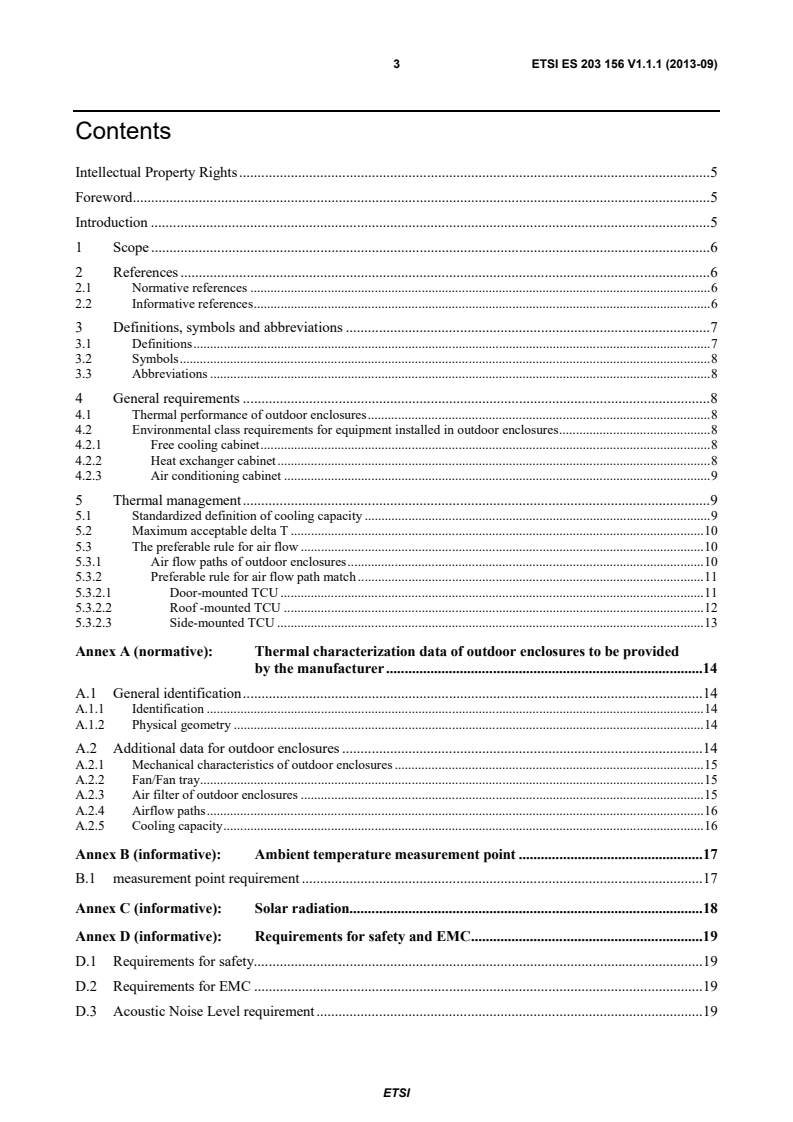
3 ETSI ES 203 156 V1.1.1 (2013-09)
Contents
Intellectual Property Rights . 5
Foreword . 5
Introduction . 5
1 Scope . 6
2 References . 6
2.1 Normative references . 6
2.2 Informative references . 6
3 Definitions, symbols and abbreviations . 7
3.1 Definitions . 7
3.2 Symbols . 8
3.3 Abbreviations . 8
4 General requirements . 8
4.1 Thermal performance of outdoor enclosures . 8
4.2 Environmental class requirements for equipment installed in outdoor enclosures . 8
4.2.1 Free cooling cabinet . 8
4.2.2 Heat exchanger cabinet . 8
4.2.3 Air conditioning cabinet . 9
5 Thermal management . 9
5.1 Standardized definition of cooling capacity . 9
5.2 Maximum acceptable delta T . 10
5.3 The preferable rule for air flow . 10
5.3.1 Air flow paths of outdoor enclosures . 10
5.3.2 Preferable rule for air flow path match . 11
5.3.2.1 Door-mounted TCU . 11
5.3.2.2 Roof -mounted TCU . 12
5.3.2.3 Side-mounted TCU . 13
Annex A (normative): Thermal characterization data of outdoor enclosures to be provided
by the manufacturer . 14
A.1 General identification . 14
A.1.1 Identification . 14
A.1.2 Physical geometry . 14
A.2 Additional data for outdoor enclosures . 14
A.2.1 Mechanical characteristics of outdoor enclosures . 15
A.2.2 Fan/Fan tray. 15
A.2.3 Air filter of outdoor enclosures . 15
A.2.4 Airflow paths . 16
A.2.5 Cooling capacity . 16
Annex B (informative): Ambient temperature measurement point . 17
B.1 measurement point requirement . 17
Annex C (informative): Solar radiation. 18
Annex D (informative): Requirements for safety and EMC . 19
D.1 Requirements for safety. 19
D.2 Requirements for EMC . 19
D.3 Acoustic Noise Level requirement . 19
ETSI
4 ETSI ES 203 156 V1.1.1 (2013-09)
Annex E (informative): Cabinet performance parameters . 20
Annex F (informative): Bibliography . 21
History . 22
ETSI
5 ETSI ES 203 156 V1.1.1 (2013-09)
Intellectual Property Rights
IPRs essential or potentially essential to the present document may have been declared to ETSI. The information
pertaining to these essential IPRs, if any, is publicly available for ETSI members and non-members, and can be found
in ETSI SR 000 314: "Intellectual Property Rights (IPRs); Essential, or potentially Essential, IPRs notified to ETSI in
respect of ETSI standards", which is available from the ETSI Secretariat. Latest updates are available on the ETSI Web
server (http://ipr.etsi.org).
Pursuant to the ETSI IPR Policy, no investigation, including IPR searches, has been carried out by ETSI. No guarantee
can be given as to the existence of other IPRs not referenced in ETSI SR 000 314 (or the updates on the ETSI Web
server) which are, or may be, or may become, essential to the present document.
Foreword
This ETSI Standard (ES) has been produced by ETSI Technical Committee Environmental Engineering (EE).
Introduction
Outdoor enclosure suppliers are trying to overcome their thermal issues in different solutions being developed. When
different equipments and outdoor enclosures from various suppliers are integrated, they can have a detrimental effect on
each other. The present document specifies the thermal management requirements for outdoor enclosures (defined in
EN 301 169-1 [i.4] and EN 301 169-2 [i.5]) to prevent outdoor enclosures having a detrimental thermal influence on
equipments inside.
ETSI
6 ETSI ES 203 156 V1.1.1 (2013-09)
1 Scope
The present document describes the thermal management requirements for outdoor enclosures defined in
EN 301 169-1 [i.4] and EN 301 169-2 [i.5]. These thermal management requirements to be defined include:
• a standardized definition of cooling capacity for outdoor enclosures;
• a maximum acceptable delta T between ambient temperature and inside temperature;
• the preferable rule for air flow inside outdoor enclosures;
• the environment class for equipment to be installed in outdoor enclosures.
Not all these requirement are applicable to outdoor enclosures defined in EN 301 169-1 [i.4] and EN 301 169-2 [i.5];
maximum acceptable delta T for equipment in line with EN 301 169-1 [i.4] should be considered as a guide to
developer.
The purpose of the present document is to make it more easy to define the responsibility of equipment manufacturers,
cabinet manufacturers and integrators.
The present document applies for those empty outdoor enclosures supplied for housing telecommunication equipment
of wireline and wireless access network and other information technology equipment.
EMC, safety and acoustic noise requirements are not parts of the present document. Guidance on these aspects are
contained in annex D.
2 References
References are either specific (identified by date of publication and/or edition number or version number) or
non-specific. For specific references, only the cited version applies. For non-specific references, the latest version of the
reference document (including any amendments) applies.
Referenced documents which are not found to be publicly available in the expected location might be found at
http://docbox.etsi.org/Reference.
NOTE: While any hyperlinks included in this clause were valid at the time of publication, ETSI cannot guarantee
their long term validity.
2.1 Normative references
The following referenced documents are necessary for the application of the present document.
[1] ETSI EN 300 019-1-4: "Environmental Engineering (EE); Environmental conditions and
environmental tests for telecommunications equipment; Part 1-4: Classification of environmental
conditions; Stationary use at non-weatherprotected locations".
[2] ETSI EN 300 019-1-3: "Environmental Engineering (EE); Environmental conditions and
environmental tests for telecommunications equipment; Part 1-3: Classification of environmental
conditions; Stationary use at weatherprotected locations".
2.2 Informative references
The following referenced documents are not necessary for the application of the present document but they assist the
user with regard to a particular subject area.
[i.1] ETSI EN 300 386: "Electromagnetic compatibility and Radio spectrum Matters
(ERM);Telecommunication network equipment; ElectroMagnetic Compatibility (EMC)
requirements".
ETSI
7 ETSI ES 203 156 V1.1.1 (2013-09)
[i.2] ETSI EN 301 489-1: "Electromagnetic compatibility and Radio spectrum Matters (ERM);
ElectroMagnetic Compatibility (EMC) standard for radio equipment and services;
Part 1: Common technical requirements".
[i.3] IEC 61969-3: "Mechanical structures for electronic equipment - Outdoor enclosures -
Part 3: Sectional specification - Climatic, mechanical tests and safety aspects for cabinets and
cases".
[i.4] ETSI EN 301 169-1: "Equipment practice; Engineering requirements for outdoor enclosures;
Part 1: Equipped enclosures".
[i.5] ETSI EN 301 169-2: "Equipment practice; Engineering requirements for outdoor enclosures;
Part 2: Unequipped enclosures".
[i.6] ETSI EN 300 119-5: "Environmental Engineering (EE); European telecommunication standard for
equipment practice; Part 5: Thermal management".
[i.7] CENELEC EN 60950-1: "Information technology equipment - Safety - Part 1: General
requirements".
[i.8] CENELEC EN 60950-22: "Information technology equipment - Safety - Part 22: Equipment
installed outdoors".
[i.9] ETSI EN 300 753: "Environmental Engineering (EE); Acoustic noise emitted by
telecommunications equipment".
[i.10] ETSI EN 300 019-2-4: "Environmental Engineering (EE); Environmental conditions and
environmental tests for telecommunications equipment; Part 2-4: Specification of environmental
tests; Stationary use at non-weatherprotected locations".
[i.11] ETSI TR 101 576: "Environmental Engineering (EE); Recommendation for the applicability of
environmental classes in outdoor cabinet environment".
3 Definitions, symbols and abbreviations
3.1 Definitions
For the purposes of the present document, the following terms and definitions apply:
air conditioning: cooling technology where an operating refrigerator system is used for cooling the internal air of the
enclosure
ambient: spatial maximal temperature of the air entering the rack/cabinet
cabinet: free-standing and self-supporting enclosure for housing electrical and/or electronics equipment, usually fitted
with doors and/or side panels which may or may not be removable
free cooling: cooling technology in which the external air is directly used for the inside heat removal; also called direct
free cooling
heat exchanger: cooling technology in which the inside heat removal is provided (actively with fans or passively
without fans) without directly use of outside air but using an exchange between two fluids (e.g. air to air or water to air)
integrator: end user/operator of telecommunication or IT equipment or their agent
NOTE: For example an equipment manufacturer could be an operator's agent.
micro-climate: conditions found within the rack/cabinet creating a local ambient for the subrack
outdoor enclosures: enclosure exposed for the outdoor environment, for stationary use at non-weatherprotected
locations, for the protection of electronic equipment installed inside against outdoor environmental conditions
(IEC 61969-3 [i.3])
ETSI
8 ETSI ES 203 156 V1.1.1 (2013-09)
outdoor location: location for equipment where protection from the weather and other outdoor influences provided by
a building or other structure is limited or non-existent
3.2 Symbols
For the purposes of the present document, the following symbols apply:
K cooling capacity of outdoor enclosure [W/°C]
Q heat dissipation from equipment inside cabinet [W]
T surrounding ambient temperature [°C] in which the outdoor enclosure is positioned
ambient
T temperature of air at the equipment inlet inside the cabinet [°C]
inlet
△T temperature difference between T and T [°C]
inlet ambient
3.3 Abbreviations
For the purposes of the present document, the following abbreviations apply:
COP Coefficient Of Performance
ICT Information and Communication Technology
TCU Temperature Control Unit (for example, fresh air cooling , heat- exchanger, air-conditioner)
4 General requirements
4.1 Thermal performance of outdoor enclosures
The supplier of outdoor enclosures shall design the cabinet so that the product fulfils the outdoor environment as
detailed in EN 300 019-1-4 [1], class 4.1. And under this environment class, the cabinet can ensure the equipments
whose environment class is defined in clause 4.2 of the present document to work in appropriate micro-climate.
To enable the operators/integrators to predict the thermal performance of outdoor enclosures and to decide the
equipment configuration inside, The supplier of outdoor enclosures should provide the relevant thermal characteristics
detailed in annex A of the present document.
4.2 Environmental class requirements for equipment installed in
outdoor enclosures
Possible use of environmental class for equipment installed in outdoor enclosures is discussed in TR 101 576 [i.11].
The outdoor enclosure provides a weather protected environment for the inside equipment. For effective cooling, the
equipment inlet air temperature, using some cooling technologies, is higher than the outdoor air temperature.
In the following is considered that the outdoor enclosure is required to meet EN 300 019-1-4 [1], class 4.1 with
temperature range from -33 °C to +40 °C; in this case the climatic conditions for the equipment inside the outdoor
cabinet shall be those defined in the following clauses.
4.2.1 Free cooling cabinet
• Climatic conditions in line with Class 3.3 (see EN 300 019-1-3 [2]).
4.2.2 Heat exchanger cabinet
• Climatic conditions in line with Class 3.3 (see EN 300 019-1-3 [2]).
ETSI
9 ETSI ES 203 156 V1.1.1 (2013-09)
4.2.3 Air conditionin
...