

oSIST prEN 12457-4:2026
(Main)Granular waste materials, sludges, soil, soil-like materials and sediments - Leaching - Compliance test for leaching - Part 4: One-stage batch test a liquid-to-solid ratio of 10L/kg for materials with particle size below 10 mm (with or without size reduction)
General Information
- Abstract
This document in the series specifies a compliance test providing information on leaching of granular waste materials, sludges, soil, soil-like materials and sediments under the experimental conditions specified hereafter, and particularly a liquid to solid ratio of 10 L/kg dry matter. It applies to materials which have a particle size below 10 mm without or with size reduction.
This document has been developed to investigate the leaching of inorganic and non-volatile organic substances from granular waste materials, sludges, soil, soil-like materials and sediments. It does not take into account the consequences of microbiological processes in organic degradable materials.
The test procedure specified in this document produces an eluate which is subsequently characterized physically and chemically according to appropriate standard methods. This document includes two different procedures for eluate preparation prior to analysis, one procedure for non-volatile organic substances, inorganic substances and DOC and one for inorganic substances and DOC. When assessing only the leaching of inorganic substances and DOC, certain precautions needed when assessing the leaching of organic substances can in some cases be omitted.
This procedure cannot be applied to materials with a water content or such a water affinity that a good mixing of the solid with the predetermined quantity of liquid is not achievable.
This procedure does not apply to materials reacting with the leachant, leading, for example, to excessive gas emission, a solidifying effect or an excessive heat release. In that case, the material can be wetted prior to carrying out the leaching test.
This test cannot be used alone to determine the leaching behaviour of granular waste materials, sludges, soil, soil-like materials and sediments, as specified in EN 12920.
This document does not address issues related to health and safety.
- Status
- Not Published
- Public Enquiry End Date
- 02-Aug-2026
- Technical Committee
- KAT - Soil quality
- Current Stage
- 4020 - Public enquire (PE) (Adopted Project)
- Start Date
- 04-Jun-2026
- Due Date
- 22-Oct-2026
- Completion Date
- 24-Sep-2026
- Directive
- 99/31/EC - Landfill of waste
Overview
oSIST prEN 12457-4:2026:2026 is a draft European Standard developed by CEN that specifies a compliance leaching test for granular waste materials, sludges, soils, soil-like materials, and sediments. The standard outlines a one-stage batch test with a liquid-to-solid (L/S) ratio of 10 L/kg, applicable to samples with a particle size below 10 mm, with or without size reduction. The primary goal of this test is to assess the leaching of inorganic and non-volatile organic substances under controlled laboratory conditions, providing valuable information for regulatory compliance, waste management, land reuse, and environmental risk assessment.
Key Topics
- Liquid-to-Solid Ratio: The procedure uses a fixed L/S ratio of 10 L/kg dry matter, providing standardized conditions for extraction and comparison.
- Sample Requirements: Materials tested must have a particle size of less than 10 mm, and may require size reduction. Both natural and treated samples are covered.
- Leaching Procedure: The standard utilizes a one-stage batch process, where the sample is mixed with water under specific agitation conditions to produce an eluate.
- Eluate Analysis: The eluate is analyzed for physical and chemical properties using recognized standard methods. The document defines two procedures for preparation depending on the substance being assessed.
- Scope Limitations: The procedure excludes materials with excessive water content, water affinity, or those that react vigorously with the leaching solution, such as through significant gas emission or heat generation. It is not suitable for highly reactive or monolithic wastes.
- Focus of Analysis: The test targets the leaching of inorganic and non-volatile organic substances. It does not account for microbiological processes in biodegradable organic materials.
- Compliance Assessment: This batch leaching test is designed for determining compliance with regulatory thresholds for leached substances and does not provide a complete characterization of leaching behavior as covered in EN 12920.
Applications
oSIST prEN 12457-4:2026 has broad applications in the environmental and waste management sectors, including:
- Waste Acceptance Testing: Used by disposal facilities and regulatory authorities to verify compliance of granular waste, sludge, soils, and sediments prior to landfilling or reuse.
- Soil and Sediment Assessment: Supports the evaluation of contaminated sites, brownfield redevelopment, and land management decisions by providing standardized leaching data.
- Environmental Risk Assessment: Supplies critical data for estimating the release of hazardous substances into groundwater and surface water, supporting impact assessments and pollution control.
- Comparative Analysis: Enables consistent comparison of materials across sites and over time, supporting quality control and due diligence in waste processing.
- Regulatory Compliance: Assists in meeting EU and national environmental regulations by providing an accepted method for demonstrating material conformity.
Related Standards
Several other standards are closely linked to oSIST prEN 12457-4:2026 and offer complementary procedures or broader context:
- EN 12457-1: One-stage batch test at a liquid-to-solid ratio of 2 L/kg for materials with particle size below 4 mm.
- EN 12457-2: One-stage batch test at a liquid-to-solid ratio of 10 L/kg for materials with particle size below 4 mm.
- EN 12457-3: Two-stage batch test at liquid-to-solid ratios of 2 L/kg and 8 L/kg for materials with particle size below 4 mm.
- EN 12920: Methodology for the determination of the leaching behaviour of waste under specified conditions, used for basic characterization.
- EN ISO 11465: Determination of dry residue or water content and calculation of the dry matter fraction.
- EN 15002: Guidance on sample preparation for laboratory analysis.
Conclusion
oSIST prEN 12457-4:2026 is an essential reference for professionals involved in waste management, site remediation, environmental monitoring, and regulatory compliance. By providing a robust, standardized method for assessing the leaching potential of granular wastes and related materials, it supports environmentally responsible decision-making and compliance with evolving legislative requirements across Europe. For optimal results, this standard should be used alongside related testing protocols and within the context of comprehensive environmental management strategies.
Relations
- Effective Date
- 01-Jul-2026
Get Certified
Connect with accredited certification bodies for this standard

CIS Institut d.o.o.
Personal Protective Equipment (PPE) certification body. Notified Body NB-2890 for EU Regulation 2016/425 PPE.

Kiwa BDA Testing
Building and construction product certification.
Kmetijski inštitut Slovenije
Agricultural Institute of Slovenia. Soil testing, plant health, agricultural product analysis.
Sponsored listings
Frequently Asked Questions
oSIST prEN 12457-4:2026 is a draft published by the Slovenian Institute for Standardization (SIST). Its full title is "Granular waste materials, sludges, soil, soil-like materials and sediments - Leaching - Compliance test for leaching - Part 4: One-stage batch test a liquid-to-solid ratio of 10L/kg for materials with particle size below 10 mm (with or without size reduction)". This standard covers: This document in the series specifies a compliance test providing information on leaching of granular waste materials, sludges, soil, soil-like materials and sediments under the experimental conditions specified hereafter, and particularly a liquid to solid ratio of 10 L/kg dry matter. It applies to materials which have a particle size below 10 mm without or with size reduction. This document has been developed to investigate the leaching of inorganic and non-volatile organic substances from granular waste materials, sludges, soil, soil-like materials and sediments. It does not take into account the consequences of microbiological processes in organic degradable materials. The test procedure specified in this document produces an eluate which is subsequently characterized physically and chemically according to appropriate standard methods. This document includes two different procedures for eluate preparation prior to analysis, one procedure for non-volatile organic substances, inorganic substances and DOC and one for inorganic substances and DOC. When assessing only the leaching of inorganic substances and DOC, certain precautions needed when assessing the leaching of organic substances can in some cases be omitted. This procedure cannot be applied to materials with a water content or such a water affinity that a good mixing of the solid with the predetermined quantity of liquid is not achievable. This procedure does not apply to materials reacting with the leachant, leading, for example, to excessive gas emission, a solidifying effect or an excessive heat release. In that case, the material can be wetted prior to carrying out the leaching test. This test cannot be used alone to determine the leaching behaviour of granular waste materials, sludges, soil, soil-like materials and sediments, as specified in EN 12920. This document does not address issues related to health and safety.
This document in the series specifies a compliance test providing information on leaching of granular waste materials, sludges, soil, soil-like materials and sediments under the experimental conditions specified hereafter, and particularly a liquid to solid ratio of 10 L/kg dry matter. It applies to materials which have a particle size below 10 mm without or with size reduction. This document has been developed to investigate the leaching of inorganic and non-volatile organic substances from granular waste materials, sludges, soil, soil-like materials and sediments. It does not take into account the consequences of microbiological processes in organic degradable materials. The test procedure specified in this document produces an eluate which is subsequently characterized physically and chemically according to appropriate standard methods. This document includes two different procedures for eluate preparation prior to analysis, one procedure for non-volatile organic substances, inorganic substances and DOC and one for inorganic substances and DOC. When assessing only the leaching of inorganic substances and DOC, certain precautions needed when assessing the leaching of organic substances can in some cases be omitted. This procedure cannot be applied to materials with a water content or such a water affinity that a good mixing of the solid with the predetermined quantity of liquid is not achievable. This procedure does not apply to materials reacting with the leachant, leading, for example, to excessive gas emission, a solidifying effect or an excessive heat release. In that case, the material can be wetted prior to carrying out the leaching test. This test cannot be used alone to determine the leaching behaviour of granular waste materials, sludges, soil, soil-like materials and sediments, as specified in EN 12920. This document does not address issues related to health and safety.
oSIST prEN 12457-4:2026 is classified under the following ICS (International Classification for Standards) categories: 13.030.10 - Solid wastes; 13.030.20 - Liquid wastes. Sludge. The ICS classification helps identify the subject area and facilitates finding related standards.
oSIST prEN 12457-4:2026 has the following relationships with other standards: It is inter standard links to SIST EN 12457-4:2004. Understanding these relationships helps ensure you are using the most current and applicable version of the standard.
oSIST prEN 12457-4:2026 is associated with the following European legislation: EU Directives/Regulations: 99/31/EC. When a standard is cited in the Official Journal of the European Union, products manufactured in conformity with it benefit from a presumption of conformity with the essential requirements of the corresponding EU directive or regulation.
oSIST prEN 12457-4:2026 is available in PDF format for immediate download after purchase. The document can be added to your cart and obtained through the secure checkout process. Digital delivery ensures instant access to the complete standard document.
Standards Content (Sample)
SLOVENSKI STANDARD
01-julij-2026
Granulirani odpadki, blato, tla, tlom podobni materiali in sedimenti - Izluževanje -
Preskus skladnosti za izluževanje - 4. del: Enostopenjski šaržni preskus pri
razmerju tekoče/trdno 10 l/kg za materiale z velikostjo delcev pod 10 mm (brez
drobljenja ali z njim)
Granular waste materials, sludges, soil, soil-like materials and sediments - Leaching -
Compliance test for leaching - Part 4: One-stage batch test a liquid-to-solid ratio of
10L/kg for materials with particle size below 10 mm (with or without size reduction)
Charakterisierung von Abfällen - Auslaugung - Übereinstimmungsuntersuchung für die
Auslaugung von körnigen Abfällen und Schlämmen - Teil 4: Einstufiges
Schüttelverfahren mit einem Flüssigkeits-/Feststoffverhältnis von 10 l/kg für Materialen
mit einer Korngröße unter 10 mm (ohne oder mit Korngrößereduzierung)
Caractérisation des déchets - Lixiviation - Essai de conformté pour la lixiviation des
déchets fragmentés et des boues - Partie 4: Essai en bâchée unique avec un rapport
liquide/solide de 10 l/kg et une granularité inférieure à 10 mm (sans ou avec réduction de
la granularité)
Ta slovenski standard je istoveten z: prEN 12457-4
ICS:
13.030.10 Trdni odpadki Solid wastes
13.030.20 Tekoči odpadki. Blato Liquid wastes. Sludge
2003-01.Slovenski inštitut za standardizacijo. Razmnoževanje celote ali delov tega standarda ni dovoljeno.
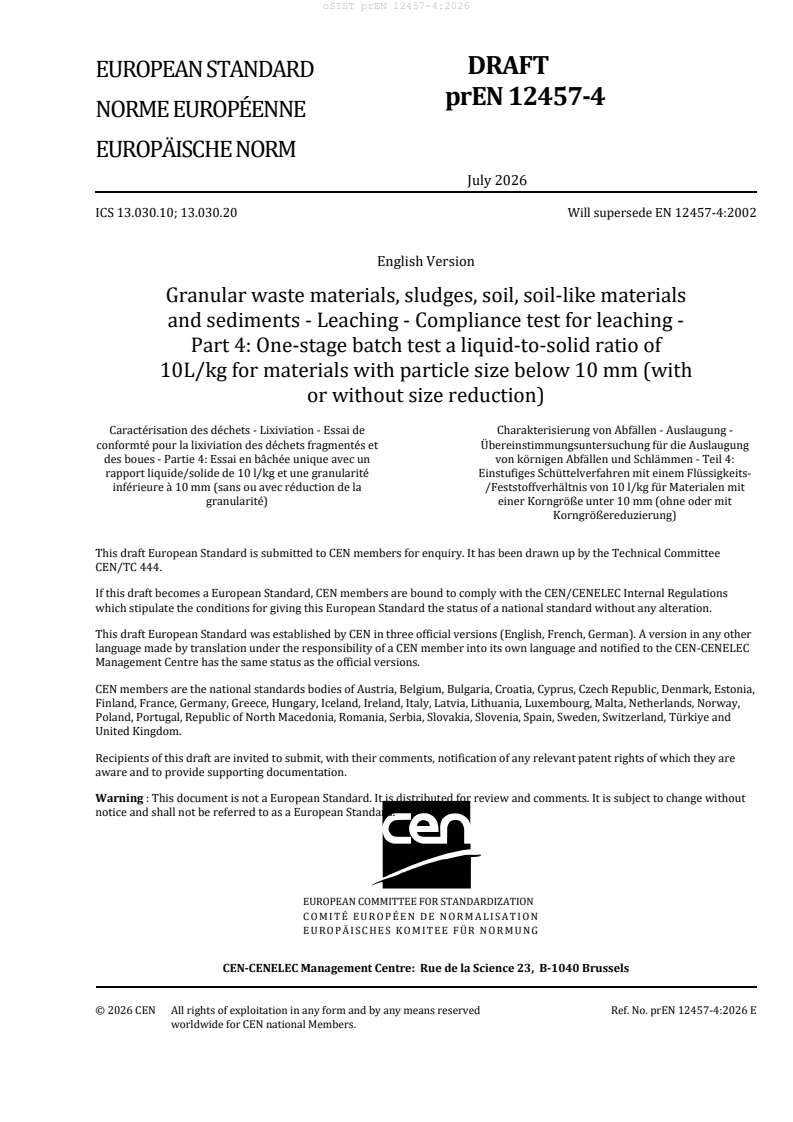
DRAFT
EUROPEAN STANDARD
NORME EUROPÉENNE
EUROPÄISCHE NORM
July 2026
ICS 13.030.10; 13.030.20 Will supersede EN 12457-4:2002
English Version
Granular waste materials, sludges, soil, soil-like materials
and sediments - Leaching - Compliance test for leaching -
Part 4: One-stage batch test a liquid-to-solid ratio of
10L/kg for materials with particle size below 10 mm (with
or without size reduction)
Caractérisation des déchets - Lixiviation - Essai de Charakterisierung von Abfällen - Auslaugung -
conformté pour la lixiviation des déchets fragmentés et Übereinstimmungsuntersuchung für die Auslaugung
des boues - Partie 4: Essai en bâchée unique avec un von körnigen Abfällen und Schlämmen - Teil 4:
rapport liquide/solide de 10 l/kg et une granularité Einstufiges Schüttelverfahren mit einem Flüssigkeits-
inférieure à 10 mm (sans ou avec réduction de la /Feststoffverhältnis von 10 l/kg für Materialen mit
granularité) einer Korngröße unter 10 mm (ohne oder mit
Korngrößereduzierung)
This draft European Standard is submitted to CEN members for enquiry. It has been drawn up by the Technical Committee
CEN/TC 444.
If this draft becomes a European Standard, CEN members are bound to comply with the CEN/CENELEC Internal Regulations
which stipulate the conditions for giving this European Standard the status of a national standard without any alteration.
This draft European Standard was established by CEN in three official versions (English, French, German). A version in any other
language made by translation under the responsibility of a CEN member into its own language and notified to the CEN-CENELEC
Management Centre has the same status as the official versions.
CEN members are the national standards bodies of Austria, Belgium, Bulgaria, Croatia, Cyprus, Czech Republic, Denmark, Estonia,
Finland, France, Germany, Greece, Hungary, Iceland, Ireland, Italy, Latvia, Lithuania, Luxembourg, Malta, Netherlands, Norway,
Poland, Portugal, Republic of North Macedonia, Romania, Serbia, Slovakia, Slovenia, Spain, Sweden, Switzerland, Türkiye and
United Kingdom.
Recipients of this draft are invited to submit, with their comments, notification of any relevant patent rights of which they are
aware and to provide supporting documentation.
Warning : This document is not a European Standard. It is distributed for review and comments. It is subject to change without
notice and shall not be referred to as a European Standard.
EUROPEAN COMMITTEE FOR STANDARDIZATION
COMITÉ EUROPÉEN DE NORMALISATION
EUROPÄISCHES KOMITEE FÜR NORMUNG
CEN-CENELEC Management Centre: Rue de la Science 23, B-1040 Brussels
© 2026 CEN All rights of exploitation in any form and by any means reserved Ref. No. prEN 12457-4:2026 E
worldwide for CEN national Members.
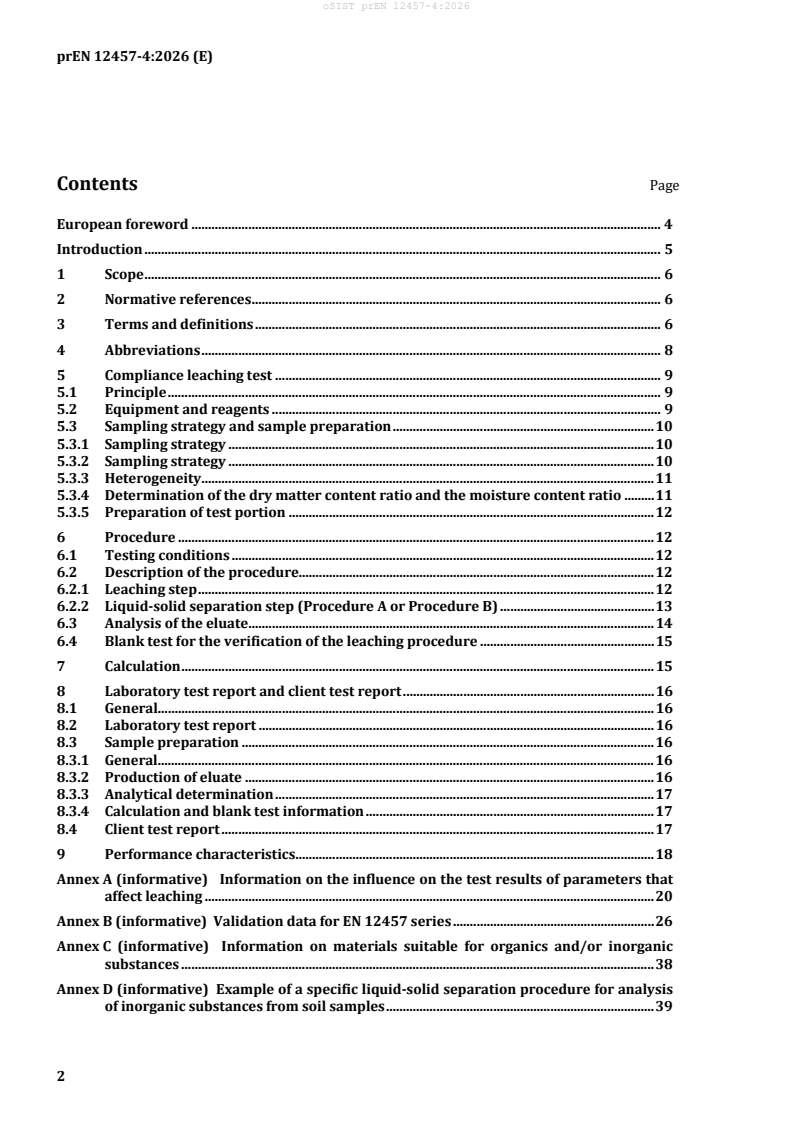
Contents Page
European foreword . 4
Introduction . 5
1 Scope . 6
2 Normative references . 6
3 Terms and definitions . 6
4 Abbreviations . 8
5 Compliance leaching test . 9
5.1 Principle . 9
5.2 Equipment and reagents . 9
5.3 Sampling strategy and sample preparation . 10
5.3.1 Sampling strategy . 10
5.3.2 Sampling strategy . 10
5.3.3 Heterogeneity . 11
5.3.4 Determination of the dry matter content ratio and the moisture content ratio . 11
5.3.5 Preparation of test portion . 12
6 Procedure . 12
6.1 Testing conditions . 12
6.2 Description of the procedure. 12
6.2.1 Leaching step . 12
6.2.2 Liquid-solid separation step (Procedure A or Procedure B) . 13
6.3 Analysis of the eluate . 14
6.4 Blank test for the verification of the leaching procedure . 15
7 Calculation . 15
8 Laboratory test report and client test report . 16
8.1 General. 16
8.2 Laboratory test report . 16
8.3 Sample preparation . 16
8.3.1 General. 16
8.3.2 Production of eluate . 16
8.3.3 Analytical determination . 17
8.3.4 Calculation and blank test information . 17
8.4 Client test report . 17
9 Performance characteristics. 18
Annex A (informative) Information on the influence on the test results of parameters that
affect leaching . 20
Annex B (informative) Validation data for EN 12457 series . 26
Annex C (informative) Information on materials suitable for organics and/or inorganic
substances . 38
Annex D (informative) Example of a specific liquid-solid separation procedure for analysis
of inorganic substances from soil samples . 39
Annex E (informative) Test for determining whether waste is in the liquid state . 41
Annex F (informative) Calculation of centrifugation duration depending on centrifugation
speed and rotor dimensions . 42
Bibliography . 44
European foreword
This document (prEN 12457-4:2026) has been prepared by CEN/TC 444, “Environmental
characterization of solid matrices”, the secretariat of which is held by NEN.
This document is currently submitted to the CEN Enquiry.
This document will supersede EN 12457-4:2002.
In comparison with the previous edition, the following technical modifications have been made:
EN 12457-4:2002:
— This document has been updated and elaborated on the basis of EN 12457-2:2002 and extended to
address the leaching of non-volatile organic substances. Validation data are derived from the original
validation results for EN 12457-2:2002, validation data for corresponding fractions of EPA 1316 and
validation results for inorganic and organic substances originating from DIN 19529. This document
has been developed primarily to support the requirements for compliance testing within the EU and
EFTA countries.
Introduction
In the different European countries, tests have been developed to characterize and assess the substances
which can be leached from granular waste materials, sludges, soil, soil-like materials and sediments. The
release of soluble substances upon contact with water is regarded as a main mechanism of release which
results in a potential risk to the environment during the reuse or disposal of soil, soil-like materials,
sediments, granular waste materials and sludges. The intent of these tests is to identify the leaching
properties of these materials. The complexity of the leaching process makes simplifications necessary.
Not all of the relevant aspects of leaching behaviour can be addressed in one document. Tests to
characterize waste materials and their behaviour can generally be divided into three categories:
a) “Basic Characterisation” tests are used to obtain information on the short and long term leaching
behaviour and characteristics properties of waste materials, sludges, soil, soil-like materials and
sediments. Liquid/solid (L/S) ratios, leachant composition, factors controlling leachability such as
pH, redox potential, complexing capacity and physical parameters are addressed in these tests;
b) “Compliance” tests are used to determine whether the granular waste materials, sludges, soil, soil-
like materials and sediments comply with specific reference values. The tests focus on key variables
and leaching behaviour identified by basic characterization tests;
c) “On-site verification” tests are used as a rapid check to confirm that the granular waste materials,
sludges, soil, soil-like materials and sediments are the same as that which has been subjected to the
compliance test(s).
The procedure described in this document falls in category 2: compliance tests.
This document constitutes one of the four compliance leaching test procedures described below. The four
European Standards are based on different liquid to solid (L/S) ratios and different particle sizes because
these parameters, among others, play an important role in the leaching process:
— EN 12457-1, One stage batch test at a liquid to solid ratio of 2 l/kg for materials with high solid
content and with particle size below 4 mm (without or with size reduction).
— EN 12457-2, One stage batch test at a liquid to solid ratio of 10 l/kg for materials with particle size
below 4 mm (without or with size reduction).
— EN 12457-3, Two stage batch test at a liquid to solid ratio of 2 l/kg and 8 l/kg for materials with high
solid content and with particle size below 4 mm (without or with size reduction).
— EN 12457-4, One stage batch test at a liquid to solid ratio of 10 l/kg for materials with particle size
below 10 mm (without or with size reduction).
Each part specifies a distinct procedure. The specific features of each part are described in the scope and
principle of each part. For given granular waste materials, sludges, soil, soil-like materials and sediments
the results might be different for the different procedures. The choice of the procedure depends on the
degree and type of information required for compliance testing. This choice is made by the organization
establishing the compliance requirements.
Annexes A to F give background information on leaching, intercomparison validation results, guidance
on materials suitable for inorganic substances, organic substances and PFAS, an example of reporting,
and guidance on specific procedures and their limitations.
This document specifies a compliance test. For basic characterization, a methodology for the
determination of the leaching behaviour of waste has been developed within CEN/TC 292 (now CEN/TC
444) and formulated in EN 12920, Methodology for the determination of the leaching behaviour of waste
under specified conditions.
1 Scope
This document in the series specifies a compliance test providing information on leaching of granular
waste materials, sludges, soil, soil-like materials and sediments under the experimental conditions
specified hereafter, and particularly a liquid to solid ratio of 10 L/kg dry matter. It applies to materials
which have a particle size below 10 mm without or with size reduction.
This document has been developed to investigate the leaching of inorganic and non-volatile organic
substances from granular waste materials, sludges, soil, soil-like materials and sediments. It does not take
into account the consequences of microbiological processes in organic degradable materials.
The test procedure specified in this document produces an eluate which is subsequently characterized
physically and chemically according to appropriate standard methods. This document includes two
different procedures for eluate preparation prior to analysis, one procedure for non-volatile organic
substances, inorganic substances and DOC and one for inorganic substances and DOC. When assessing
only the leaching of inorganic substances and DOC, certain precautions needed when assessing the
leaching of organic substances can in some cases be omitted.
This procedure cannot be applied to materials with a water content or such a water affinity that a good
mixing of the solid with the predetermined quantity of liquid is not achievable.
This procedure does not apply to materials reacting with the leachant, leading, for example, to excessive
gas emission, a solidifying effect or an excessive heat release. In that case, the material can be wetted
prior to carrying out the leaching test.
This test cannot be used alone to determine the leaching behaviour of granular waste materials, sludges,
soil, soil-like materials and sediments, as specified in EN 12920.
This document does not address issues related to health and safety.
2 Normative references
The following documents are referred to in the text in such a way that some or all of their content
constitutes requirements of this document. For dated references, only the edition cited applies. For
undated references, the latest edition of the referenced document (including any amendments) applies.
EN ISO 11465:2025, Sludge and solid environmental matrices - Determination of dry residue or water
content and calculation of the dry matter fraction on a mass basis (ISO 11465:2025)
3 Terms and definitions
For the purposes of this document, the following terms and definitions apply.
ISO and IEC maintain terminology databases for use in standardization at the following addresses:
— ISO Online browsing platform: available at https://www.iso.org/obp/
— IEC Electropedia: available at https://www.electropedia.org/
3.1
leaching test
test during which a material is put into contact with a leachant and some substances of the material are
extracted
3.2
leachant
liquid used in a leaching test
Note 1 to entry For the purpose of this document, the leachant is water as specified in 5.2.15
3.3
eluate
solution recovered from a leaching test
3.4
single batch leaching test
leaching test in which a fixed amount of material is leached in one step with a fixed amount of leachant
3.5
serial batch leaching test
leaching test for two or more subsequent extractions of the same portion of material with a fresh amount
of leachant in each extraction
3.6
liquid to solid ratio
(L/S)
ratio between the total amount of liquid (L in litres), which in a leaching test is in contact with the waste,
and the dry mass of the sample (S in kg of dry matter) abbreviated L/S and expressed in L/kg
3.7
liquid waste
waste that completely flows out of a calibrated opening, down to the upper level of the opening within a
limited period of time less than 8 hours (See Annex E, informative)
3.8
sludge
mixture of liquid and solids separated from various types of liquids as a result of natural or artificial
processes
Note 1 to entry In the field of water treatment, the prevailing standards (EN 1085 and EN 12880) use the word
water instead of the word liquid.
3.9
monolithic waste
material which has certain minimum dimensions and physical and mechanical properties that ensure its
integrity over a certain period of time
3.10
granular waste
waste that is neither monolithic, liquid, gas nor sludge
3.11
dry matter content ratio
DR
ratio expressed in percent between the mass of the dry residue, determined according to
EN ISO 11465:2025 for sludge, treated biowaste, soil and waste, and the corresponding raw mass
3.12
moisture content ratio
MC
ratio expressed in percent between the mass of water contained in the material and the mass of the dry
residue
Note 1 to entry The basis for the calculation of the moisture content is the mass of the dry residue in this document.
It is to be noted that in the context of environmental assessment, the water content is generally calculated on the
basis of the raw mass.
3.13
laboratory sample
sample or sub-sample(s) sent to or received by the laboratory
Note 1 to entry When the laboratory sample is further prepared (reduced) by subdividing, mixing, grinding or by
combinations of these operations, the result is the test sample. When no preparation of the laboratory sample is
required, the laboratory sample is the test sample. A test portion is removed from the test sample for the performance
of the test or for analysis. The laboratory sample is the final sample from the point of view of sample collection, but
it is the initial sample from the point of view of the laboratory. See EN 15002: 2015.
Note 2 to entry Several laboratory samples can be prepared and sent to different laboratories or to the same
laboratory for different purposes. When sent to the same laboratory, the set is generally considered as a single
laboratory sample and is documented as a single sample.
[SOURCE: IUPAC]
3.14
test sample
sample, prepared from the laboratory sample, from which test portions are removed for testing or for
analysis
[SOURCE: IUPAC]
3.15
test portion
amount or volume of the test sample taken for analysis, usually of known weight or volume
[SOURCE: IUPAC]
4 Abbreviations
DOC dissolved organic carbon
FEP fluorinated ethylene propylene
PA polyamide
PAH polycyclic aromatic hydrocarbon
PCB polychlorinated biphenyl
PE polyethylene
PFAS per- and polyfluoroalkyl substances
PFA perfluoroalkoxy alkanes
PP polypropylene
PTFE polytetrafluorethylene
PCTFE polychlorotrifluoroethylene
HDPE high density polyethylene
5 Compliance leaching test
5.1 Principle
The sample material, which originally or after pre-treatment has a particle size at least below 4 mm as
defined in Clause 4.3.2, is brought into contact with water (Clause 5.2.15) under defined conditions. The
test equipment material is selected to ensure that it does not interfere with the leaching of the substances
to be assessed. This document is based on the assumption that equilibrium or near-equilibrium is
achieved between the liquid and solid phases during the test duration (see Clause 6.2.1). The eluate is
separated from the solid residue either by centrifugation (Procedure A for measurement of non-volatile
organic substances or both organic substances and inorganic substances) or by filtration (Procedure B
for inorganic substances and DOC). The properties of the eluate are measured using methods developed
for water analysis adapted to meet criteria for analysis of eluates (see CEN/TR 16192:2020).
After the test the leaching conditions in terms of pH, conductivity, turbidity and optionally redox potential
dictated by the waste are recorded.
NOTE These parameters often control the leaching behaviour of wastes and are therefore important for
checking the leaching test.
5.2 Equipment and reagents
5.2.1 Containers of inert material that does not interfere with the substances to be measured in
accordance with EN ISO 5667-3. Rinsing is compulsory. Further information for materials suitable for
organics and/or inorganics can be found in Annex C [Table C.1].
The volume of 1 l is selected in combination with the mass M of 90 g as specified in Clause 4.3.4 in order
D
to minimize head space. In case of material with low density, deviation from this requirement is necessary
while still attempting to minimize headspace. This deviation shall be documented in the test report.
5.2.2 An end-over-end tumbler (5 rpm - 10 rpm) or roller-table inducing eccentric rotation of the bottle
at about 10 rpm.
NOTE An eccentric roller-table ensures movement of solid through the leachant in two directions providing
the same type of contact as an end-over-end tumbler. Roller tables without additional eccentric movement and
horizontal shakers are not considered to provide equivalent agitation modus compared to the end-over-end
tumbler.
5.2.3 Filtering apparatus, either a vacuum filtration device (between 30 kPa and 70 kPa) (300 – 700
mbar) or a high-pressure filtration apparatus (<0,5 MPa) (5 bar). Rinsing is compulsory.
NOTE A water ejection pump generally operates in the vicinity of 50 kPa.
When volatile components (e.g. mercury) are to be analysed, vacuum filtration shall not be used.
5.2.4 Pre-rinsed or similarly clean 0,45 μm membrane filters for filtration (e.g. rinsed with 0,1 mol/l
HNO as described in 4.2.16 and water as described in 5.2.15).
Depending on the test requirements, PTFE filter material can be required. Filter made of PTFE are
hydrophobic. Before filtration of eluate, they should be wetted using ethanol or methanol provided it
doesn't influence the results of analysis.
5.2.5 Crushing equipment: jaw crusher or cutting device.
NOTE Due to crushing, contamination of the sample can occur to an extent which affects the leaching of some
substances of concern e.g. cobalt and tungsten from tungsten carbide equipment or chromium, nickel and
molybdenum from stainless steel equipment.
5.2.6 Sieving equipment with sieves of 10 mm nominal screen size.
NOTE Due to sieving, contamination of the sample can occur to an extent which affects the leaching of some
substances of concern, e.g. cobalt and tungsten from tungsten carbide equipment or chromium, nickel and
molybdenum from stainless steel equipment.
5.2.7 A centrifuge, operating at 20 000 g to 30 000 g using centrifuge tubes of PFA (perfluoroalkoxy
alkane), fluorinated ethylene propylene (FEP) or tubes of an alternative material which is inert with
regard to the substances to be assessed (see Annex C) and suitable for high-speed centrifugation.
NOTE Potential sorption of hydrophobic organic substances to the centrifuge tubes can be tested in
preliminary experiments.
Alternatively, if a high-speed centrifuge is not available, a centrifuge operating at 2 000 g to 3 000 g may
be used in combination with increased centrifugation time.
Cooling shall be applied if needed to maintain a temperature of 19 °C – 25 °C.
5.2.8 A device for measuring electrical conductivity.
5.2.9 A pH-meter according to EN 16192.
5.2.10 Two thermometers for air and leachant temperature measurement.
5.2.11 A redox potential meter (optional).
5.2.12 A balance with accuracy of at least 0,1 g.
5.2.13 Measuring cylinders for volume determination with 1 % accuracy.
5.2.14 A sample splitter or utensils for cone and quartering for sub-sampling of test samples (optional).
5.2.15 Distilled water, demineralized water, de-ionized water or water of equivalent purity
(5 < pH < 7,5) with a conductivity < 0,5 mS/m.
5.2.16 Nitric acid (HNO ) 0,1 mol/l (analytical grade).
5.3 Sampling strategy and sample preparation
5.3.1 Sampling strategy
Obtain a laboratory sample of at least 2 kg of the material. Use a sample splitter (5.2.14) or apply coning
and quartering to split the sample into representative sub-samples according to EN 15002).
Depending on the maximum grain size, the splitting can require size reduction of coarser particles to
comply with the rules of sampling.
In some cases, especially for soil and sediments, a laboratory sample of less than 2 kg may be received by
the laboratory e.g. due to limited availability of the material to be tested, provided the material is not too
heterogeneous. For other types of solids, a larger sample size shall be required if necessary to take the
relationship between maximum particle size and minimum sample volume into account.
5.3.2 Sampling strategy
The tests shall be made on material with a grain size of at least 95 % (mass) less than 10 mm. Therefore,
the laboratory sample shall be sieved (Clause 5.2.6). If oversized material exceeds 5 % (mass) the entire
oversized fraction shall be crushed with a crushing equipment (Clause 5.2.5). On no account shall the
material be finely ground. Non-crushable material (e.g. metallic parts such as nuts, bolts, scrap) in the
sample shall be separated and the weight and nature of the material shall be recorded. The method of
size-reduction applied shall be documented and recorded in the test report. Irrespective of any necessary
size reduction, the separate fractions with the exception of the non-crushable material and the material
that may be used according to note under Clause 6.4, shall be mixed to constitute the test sample. If the
laboratory sample cannot be crushed or sieved because of its moisture content, it is allowed, only in this
case, to dry the laboratory sample. The drying temperature shall not exceed 40 C.
NOTE 1 Fibrous materials and plastics can often be size-reduced after cryogenic treatment.
NOTE 2 Be aware that any drying step can change other properties than the water content of the waste.
In order to minimize a possible contamination during sieving, fragmentation and splitting, it is
recommended, before preparing the test sample, to process a portion of the laboratory sample through
the devices for sieving, fragmentation, splitting, and to discard such material thereafter. This
recommendation does not cover the possible contamination described in the notes under Clause 5.2.5
and Clause 5.2.6.
NOTE 3 Important differences can occur in the leaching test results for a given material depending on the
crushing procedure and the waste material being crushed. Particle size related differences can be made evident by
determining the particle size distribution. Please note that in the case of very narrow size distribution, such
differences in the leaching result might be enhanced especially in the upper part of the size range. As an example:
crushing creates new surfaces, which, when exposed, can lead to a change in leaching properties.
5.3.3 Heterogeneity
Some materials prove to be inherently heterogeneous, which means that in spite of all reasonable
preparatory steps, the within-laboratory variability extends well beyond the specified performance as
indicated in the standard. In a single step test, this aspect cannot be identified.
NOTE Carrying out a duplicate or triplicate test for such potentially heterogeneous materials will provide
insight in the level of inherent heterogeneity. As a guide: when the within-laboratory variability exceeds about two
times the within-laboratory variability as specified in the document (RSDr > 20 %), the material can be considered
heterogeneous.
A list of examples of materials known to exhibit this type of characteristic can provide the basis to make
the decision to test in duplicate, triplicate or other type of decision (see Annex A).
5.3.4 Determination of the dry matter content ratio and the moisture content ratio
The whole test sample, complying with the size criterion in 5.3.2, shall not be further dried. The mass of
the dry residue shall be determined at 105 °C ± 3 °C according to EN ISO 11465. This determination shall
be made in parallel on a test portion different from the test portion for leaching. The dry matter content
ratio is calculated as follows:
DR = 100 × M /M (1)
D W
where
DR is the dry matter content ratio (%)
M is the mass of the dried test portion (kg)
D
M is the mass of undried test portion (kg)
w
The moisture content ratio (MC in %) is calculated as follows:
MC = 100 × (M - M )/M (2)
W D D
NOTE The basis for the calculation of the moisture content is the mass of the dry residue in this document, as
specified in EN ISO 11465 (for the determination of the water content of soil). Please note that in the context of
environmental assessment, the water content is often calculated on the basis of the raw mass.
5.3.5 Preparation of test portion
Prepare from the test sample a test portion with a total mass M (measured with an accuracy of 0,1 g)
W
containing 0,090 kg ± 0,005 kg of dry mass (M ). Use a sample splitter (5.2.14) or apply coning and
D
quartering to split the sample.
M = 100 × M /DR (3)
W D
where
DR is the dry matter content ratio (%)
M is the mass of the dried test portion (kg)
D
M is the mass of undried test portion (kg)
w
In view of the minimum requirements of sample volume for analytical purposes, it may be necessary to
use a larger test portion size and a correspondingly larger volume of leachant. This deviation shall be
documented in the test report.
6 Procedure
6.1 Testing conditions
The compliance test for leaching shall be carried out at room temperature (19 – 25 °C).
Select the appropriate materials for equipment to be used according to the substances to be assessed (see
Annex C).
6.2 Description of the procedure
6.2.1 Leaching step
— Place the test portion with the total mass M corresponding to 0,090 kg ± 0,005 kg of dry mass M
w D
in a one-litre bottle (Clause 5.2.1).
If a larger eluate volume is required for analytical purposes, use a correspondingly larger sample mass
and leachant volume (or perform more than one test in parallel and combine the eluates). Select the bottle
such that the headspace in the bottle is not more that 10 %–20 % of the bottle volume.
— Add an amount of leachant (L, see 5.2.15) establishing a liquid to solid ratio (L/S) = 10 l/kg ± 2 %
during the extraction. Care should be taken to obtain good mixing of solid and liquid (see 5.2.2) .
L = (10 – MC/100) × M (4)
D
where
L is the volume of leachant used (in litres)
M is the dry mass of the test portion (in kg);
D
MC is the moisture content ratio (in %).
— Place the capped bottle in an agitation device (5.2.2) and rotate it at 5 to 10 rpm for 24 h ± 0,5 h
NOTE As an alternative if you are only measuring PFAS, 6h can be adopted instead of 24h when it can be
demonstrated that degradation or other processes do not limit the release. In this case, a record on the report is
necessary.
— During the extraction care should be taken to prevent settlement of solids in the bottle.
— Excessive abrasion leading to significant particle size reduction shall be avoided.
NOTE Some wastes generate gas when they are wetted. Examples are waste incineration fly ash and sand
blasting waste which can contain metallic particles. If gas emission occurs, careful opening of the bottle a few times
during the leaching can prevent too high pressure.
6.2.2 Liquid-solid separation step (Procedure A or Procedure B)
For organic substances and/or inorganic substances, select Procedure A
For inorganic substances and DOC only, Procedure B is applicable.
Procedure A
Procedure A shall be used when organic substances are to be analysed or when both organic and
inorganic substances are to be analysed.
Dissolved Organic Carbon (DOC) is conventionally defined as the amount of organic carbon based
compounds that pass a 0.45 µm filter (EN 1484, Clause 3.4), whereas particles > 0.45 μm are
distinguished as particulate organic carbon (POC) in water. Therefore, procedure A is not directly
applicable for the measurement of DOC. An eluate obtained by procedure A requires an additional
0.45 µm filtration (e.g. using a syringe filter) for DOC measurement. An eluate obtained by procedure B
fulfils the requirement already.
NOTE 1 Information on DOC concentration in the eluate is relevant both for release of inorganic substances as
well as for organic substances.
Allow the suspended solids to settle for at least 15 min and maximum 2 h.
Under certain circumstances, particularly for alkaline eluates, it is recommended to measure the pH of
the raw eluate prior to centrifugation, since this operation may change the pH.
Transfer the supernatant to centrifuge tubes (5.2.7). The centrifugation containers shall be chosen so as
not to adsorb (or release) analytes (see Annex C).
There are two options for centrifugation:
1) Centrifuge the eluate for 30 min at 20 000g using a high-speed centrifuge (5.2.7, see also Annex F).
2) Centrifuge the eluate for 5 h at 2 000g using a lower-speed centrifuge (5.2.7).
Cooling shall be applied to maintain the temperature at (19 – 25) °C.
NOTE 2 Based on Stoke’s law, the results of both centrifugation methods are expected to be comparable. Other
alternative combinations of centrifugation acceleration and time can be applied given comparable conditions are
calculated related to the specification of the rotor. For more guidance, see Annex F).
Gentle braking of the centrifuge shall be applied in order to avoid resuspension. The deceleration time
shall not exceed 20 min.
As the aim of the eluate analysis is to determine the dissolved substances in the aqueous phase, any
floating organic phase or particles shall not be used for the subsequent analysis. In this case, a pressure
filtration using a glass fibre microfilter without binder with an average separation efficiency ≤ 0.7 µm can
be applied. Rinsing the filter with water or another solvent after filtration is not permitted. The presence
of an organic phase before liquid-solid separation step shall be documented in the test report.
NOTE 3 When a separate organic phase occurs, this can lead to measured values far above the theoretical
solubility if the phase is included in the analysis sample.
After centrifugation, the eluate shall be transferred immediately to an appropriate container for
measurement of pH and redox potentialand stored for subsequent chemical analysis. In general, this
eluate can be used for both analyses of inorganic and organic substances.
Measure the volume of centrifuged eluate or the aliquot used, VE.
Measure immediately electrical conductivity (in mS/m), turbidity, DOC and pH of the eluate.
Measurement of redox potential (Eh in mV) is highly recommended.
In case of measurement of organic substances, lower centrifugation intensities (g × t) are allowed if a
turbidity < 20 FNU is achieved. If a turbidity < 20 FNU is not achieved after applying the maximum
duration of centrifugation, the sample can be measured without further treatment. The centrifugation
conditions and turbidity shall be recorded in the test report.
NOTE 4 If a coloured solution remains after particle separation, the turbidity measurement can give a false
positive response due to non-particle related scattering and absorption of light.
Procedure B
Procedure B is applicable when only inorganic substances and DOC are to be analysed.
— Allow the suspended solids to settle for at least 15 min and maximum 2 h.
Under certain circumstances, particularly for alkaline eluates, it is recommended to measure the pH of
the raw eluate prior to centrifugation, since this operation may change the pH.
— Filter the quantity of the eluate required over a 0,45 µm membrane filter (5.2.4) using a vacuum or
pressure filtration device (5.2.3). Rinsing of the filter by addition of extra water or another solvent is
not allowed after filtration.
When volatile inorganic substances (e.g. mercury) have to be analysed, vacuum filtration shall not be
used. Pressure filtration apparatus (5.2.3) or centrifugation (Procedure A) shall be used.
When filtration as specified above is not possible in less than one hour with an eluate flow rate of at least
30ml/cm /hour, a liquid-solid separation procedure, specific for the considered case, shall be applied
and reported in detail in the test report. A recommended procedure is given in Annex D. The specific
procedure shall not include the use of additives.
NOTE 3 Such specific liquid-solid separation procedure can include settling, pre-filtration on coarser filter,
centrifugation (e.g. at 2 000 g, see Annex F), filtration on large area membrane filter, filtration at high pressure,
filtration at increasing high pressure following a first period without pressure, etc.
Measure immediately conductivity (in mS/m), temperature and pH. Optional measurement of turbidity,
redox potential (Eh in mV) and DOC is highly recommended.
NOTE 4 Information on DOC concentration in the eluate is relevant both for release of inorganic substances, as well
as for organic substances.
6.3 Analysis of the eluate
6.3.1 Divide the eluate into an appropriate number of sub-samples for different chemical analyses and
store them according to the requirements in ISO 5667-3.
6.3.2 Determine the concentrations of substances of interest using the methods of eluate analysis
(CEN/TR 16192 for inorganic substances and appropriate standards for organic substances).
NOTE 1 The pH, EC, DOC, redox measurements and turbidity can be used for verification purposes in case
measurements deviate from the expected release behaviour. This will provide the user with option to accept the
results, verify deviations from normal or take corrective measures based on an understanding of the cause of the
deviation. See Annex A.
NOTE 2 DOC can be of relevance when a material contains elevated levels of organic matter, from which DOC can
be mobilized through degradation or by chemical dissolution at higher pH (pH > 9). DOC is mobilised at high pH and
is capable of mobilizing metals and organic substances well beyond its solubility limitation under the common
alkaline conditions.
In cases where high contents of dissolved solids (conductivity > 75 mS/cm) are leached, acidification of
the eluates can lead to precipitation of salts. This can be avoided by diluting such samples 5 to 10 times
prior to acidification. This additional dilution shall be taken into account in the calculations. A quantity of
the undiluted sample will have to be acidified and retained in case the 5 to 10 dilution takes the sample
below the detection limit for some determinants. Such procedure shall be documented in the test report.
6.4 Blank test for the verification of the leaching procedure
Blank tests shall be carried out without including the solid sample. A 0,95 l volume of leachant is
submitted to the leaching and analysis procedure, except the sieving step, the fragmentation step and the
splitting step.
The eluate of this blank test shall fulfil the following minimum requirements: in the eluate of the blank
test, the concentration of each considered element shall be less than 20 % of the concentration
determined in the eluate of the tested waste or less than 20 % of the concentration in the eluate of a limit
value to which the measurement result is to be compared. The elements to be considered are all the
elements which are to be determined in the eluate of the tested waste.
If the above requirements are not fulfilled, it is necessary to reduce the contamination.
The blank test results shall not be subtracted from the results of the waste leaching test.
7 Calculation
The analysis of the eluate(s) produced by the leaching test provides the concentrations of the substances
in the eluate(s), expressed in mg/l. The final results are expressed as the amount of substance leached
relative to the total mass of the sample, in mg/kg of dry matter.
Calculate the quantity of a substance leached from the material
...