


kSIST FprEN IEC 61267:2025
(Main)Medical diagnostic x-ray equipment - Radiation conditions for use in the determination of characteristics
Medical diagnostic x-ray equipment - Radiation conditions for use in the determination of characteristics
IEC 61267:2025 applies to test procedures which, for the determination of characteristics of systems or components of medical diagnostic X-ray equipment, require well-defined X-ray radiation conditions. This document deals with methods for generating X-ray radiation conditions which can be used under test conditions typically found in test laboratories or in manufacturing facilities for the determination of characteristics of medical diagnostic X-ray equipment.
IEC 61267:2025 cancels and replaces the second edition published 2005. This edition constitutes a technical revision. This edition includes the following significant technical changes with respect to the previous edition:
a) removing former Annex C “Measurement of the practical peak voltage”;
b) inserting informative “Tabulated values for the squared signal-to-noise ratio per air kerma (SNR2in)” and normative “Additional X-ray radiation conditions as used in mammography and determination of the corresponding nominal aluminium half-value layers”;
c) revision of X-ray radiation conditions;
d) new method for verification of X-ray radiation conditions;
e) change of term definitions.
Medizinische diagnostische Röntgeneinrichtung - Bestrahlungsbedingungen zur Bestimmung von Kenngrößen
Equipement de diagnostic médical à rayonnement x - Conditions de rayonnement pour utilisation dans la détermination des caractéristiques
L'IEC 61267:2025 s'applique aux procédures d'essais qui, pour la détermination des caractéristiques des systèmes ou des composants des équipements à rayonnement X de diagnostic médical, nécessitent des conditions de rayonnement X bien définies.
Le présent document traite des méthodes de génération de conditions de rayonnement X qui peuvent être utilisées dans les conditions d'essais généralement rencontrées dans les laboratoires d'essai ou dans les installations de fabrication pour la détermination des caractéristiques des équipements à rayonnement X de diagnostic médical.
L'IEC 61267:2025 annule et remplace la deuxième édition parue en 2005. Cette édition constitue une révision technique.
Cette édition inclut les modifications techniques majeures suivantes par rapport à l'édition précédente:
a) suppression de l'ancienne Annexe C "Mesure de la tension de crête pratique";
b) insertion d'une Annexe C informative "Valeurs compilées du rapport signal sur bruit au carré par kerma dans l'air (SNRin2 )" et d'une Annexe D normative "Conditions du rayonnement X supplémentaires utilisées en mammographie et détermination des couches de demi-atténuation en aluminium nominales correspondantes";
c) révision des conditions de rayonnement X;
d) nouvelle méthode de vérification des conditions de rayonnement X;
e) modification des définitions des termes.
Medicinska diagnostična rentgenska oprema - Sevalni pogoji pri ugotavljanju karakteristik
General Information
Relations
Standards Content (Sample)
SLOVENSKI STANDARD
oSIST prEN IEC 61267:2024
01-december-2024
Medicinska diagnostična rentgenska oprema - Sevalni pogoji pri ugotavljanju
karakteristik
Medical diagnostic x-ray equipment - Radiation conditions for use in the determination of
characteristics
Medizinische diagnostische Röntgeneinrichtung - Bestrahlungsbedingungen zur
Bestimmung von Kenngrößen
Equipement de diagnostic médical à rayonnement x - Conditions de rayonnement pour
utilisation dans la détermination des caractéristiques
Ta slovenski standard je istoveten z: prEN IEC 61267:2024
ICS:
11.040.50 Radiografska oprema Radiographic equipment
oSIST prEN IEC 61267:2024 en
2003-01.Slovenski inštitut za standardizacijo. Razmnoževanje celote ali delov tega standarda ni dovoljeno.
oSIST prEN IEC 61267:2024
Export made on 2024-10-10 Not to be - 1 - DRAFT
used for official purposes © IEC 2024
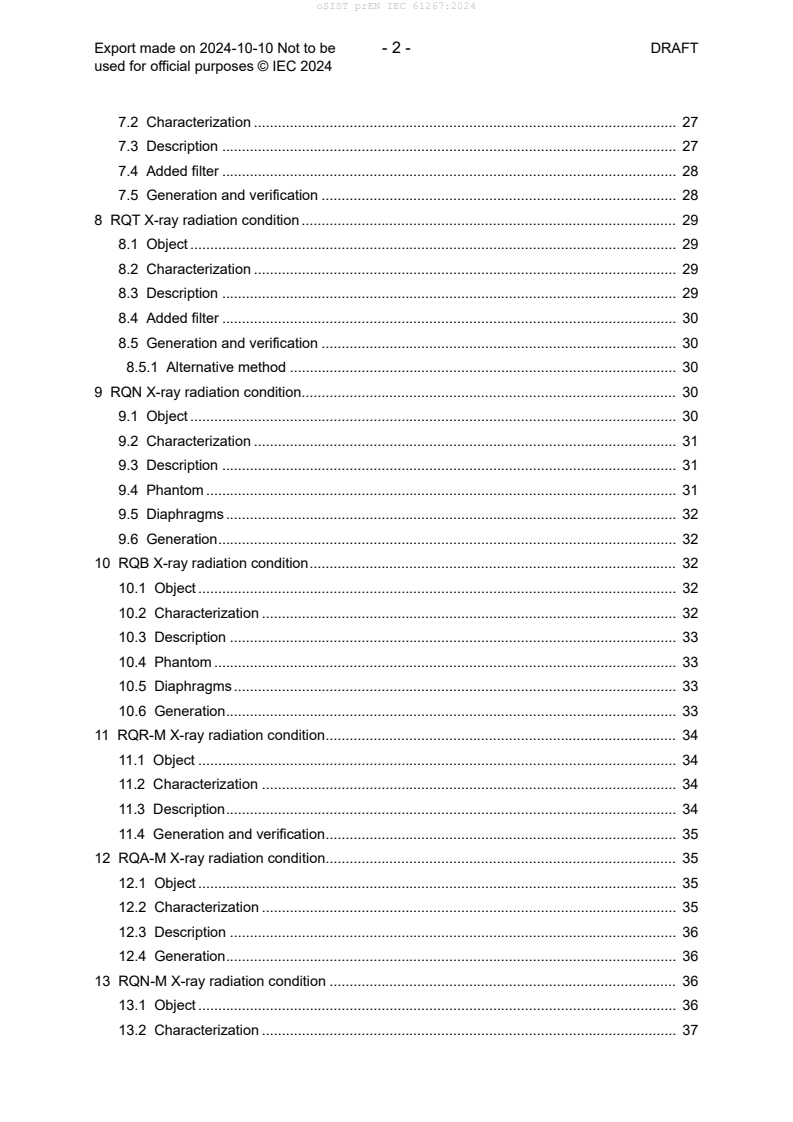
CONTENTS
FOREWORD . 5
INTRODUCTION. 8
1 Scope and object. 10
2 Normative references. 13
3 Terms and definitions . 13
3.1 Terms defined in this document. 13
3.2 Terms defined in other documents . 15
4 Common aspects - Adjustment procedures . 20
4.1 Radiation detector . 20
4.2 X-ray tube voltage adjustment. 21
4.3 Percentage ripple of the X-ray tube voltage. 21
4.4 Anode material . 21
5 RQR X-ray radiation conditions. 21
5.1 Object . 21
5.2 Characterization . 21
5.3 Description . 22
5.4 Additional filtration . 22
5.5 Test equipment . 23
5.5.1 X-ray tube voltage measuring device. 23
5.5.2 Auxiliary filter . 23
5.5.3 Attenuation layers. 23
5.5.4 Diaphragm. 24
5.5.5 Radiation detector . 24
5.6 Generation and verification . 24
5.6.1 Geometry. 24
5.6.2 RQR X-ray radiation condition. 24
5.6.3 Series of RQR X-ray radiation condition . 24
6 RQA X-ray radiation condition. 25
6.1 Object . 25
6.2 Characterization . 25
6.3 Description . 25
6.4 Added filter . 26
6.5 Generation and verification . 27
6.5.1 Alternative method . 27
7 RQC X-ray radiation condition. 27
7.1 Object . 27
oSIST prEN IEC 61267:2024
Export made on 2024-10-10 Not to be - 2 - DRAFT
used for official purposes © IEC 2024
7.2 Characterization . 27
7.3 Description . 27
7.4 Added filter . 28
7.5 Generation and verification . 28
8 RQT X-ray radiation condition . 29
8.1 Object . 29
8.2 Characterization . 29
8.3 Description . 29
8.4 Added filter . 30
8.5 Generation and verification . 30
8.5.1 Alternative method . 30
9 RQN X-ray radiation condition. 30
9.1 Object . 30
9.2 Characterization . 31
9.3 Description . 31
9.4 Phantom . 31
9.5 Diaphragms . 32
9.6 Generation. 32
10 RQB X-ray radiation condition. 32
10.1 Object . 32
10.2 Characterization . 32
10.3 Description . 33
10.4 Phantom . 33
10.5 Diaphragms . 33
10.6 Generation. 33
11 RQR-M X-ray radiation condition. 34
11.1 Object . 34
11.2 Characterization . 34
11.3 Description. 34
11.4 Generation and verification. 35
12 RQA-M X-ray radiation condition. 35
12.1 Object . 35
12.2 Characterization . 35
12.3 Description . 36
12.4 Generation. 36
13 RQN-M X-ray radiation condition . 36
13.1 Object . 36
13.2 Characterization . 37
oSIST prEN IEC 61267:2024
Export made on 2024-10-10 Not to be - 3 - DRAFT
used for official purposes © IEC 2024
13.3 Description . 37
13.4 Phantom . 37
13.5 Diaphragms . 38
13.6 Generation. 38
14 RQB-M X-ray radiation condition. 38
14.1 Object . 38
14.2 Characterization . 38
14.3 Description . 39
14.4 Phantom . 39
14.5 Diaphragm. 40
14.6 Generation. 40
Annex A Measuring arrangements(normative) . 41
Annex B Determination of the amount of additional filtration(informative) . 44
Annex C Tabulated values for the squared signal-to-noise ratio per air kerma ( )
(informative) . 46
Annex D
Additional X-ray radiation condition as used in mammography and determination of the
corresponding nominal aluminium half-value layers
(normative) . 47
D.1 Object . 47
D.2 Characterization. 47
D.3 Description. 47
D.4 Generation and verification. 48
D.4.1 Verification of half-value layer. 48
Annex E Overview of X-ray radiation condition(informative). 49
Bibliography. 50
Figure A.1 - Measuring arrangement for achieving RQR 2 to RQR 10 X-ray radiation condition
................................................................................................................................................. 41
Figure A.2 - Measuring arrangement for achieving RQA 2 to RQA 10 X-ray radiation condition
................................................................................................................................................. 41
Figure A.3 - Measuring arrangement for achieving RQN 2 to RQN 10 X-ray radiation condition
................................................................................................................................................. 41
Figure A.4 - Measuring arrangement for achieving RQB 2 to RQB 10 X-ray radiation condition
................................................................................................................................................. 42
Figure A.5 - Measuring arrangement for achieving RQN-M X-ray radiation condition. 42
Figure A.6 - Measuring arrangement for achieving RQB-M X-ray radiation condition. 43
Figure B.1
- Determination of additional filtration required for adjusting the total filtration to the prescribed
value (see 5.4). The numbers near the rectangular template indicate the corresponding
distance on the x and y axes.
................................................................................................................................................. 44
oSIST prEN IEC 61267:2024
Export made on 2024-10-10 Not to be - 4 - DRAFT
used for official purposes © IEC 2024
Table 1 - Parameters for RQR 2 to RQR 10 X-ray radiation condition. 22
Table 2 - Parameters for RQA 2 to RQA 10 X-ray radiation condition. 26
Table 3 - Parameters for RQC 3, RQC 5 and RQC 8 X-ray radiation condition. 28
Table 4 - Parameters for RQT 8, RQT 9 and RQT 10 X-ray radiation condition . 29
Table 5 - Parameters for RQR-M 1 to RQR-M 4 X-ray radiation condition . 35
Table 6 - Parameters for RQA-M 1 to RQA-M 4 X-ray radiation condition. 36
Table 7 - Parameters for RQN-M 1 to RQN-M 4 X-ray radiation condition . 37
Table 8 - Parameters for RQB-M 1 to RQB-M 4 X-ray radiation condition. 39
Table C.1 - values for the X-ray radiation conditions RQA . 46
oSIST prEN IEC 61267:2024
Export made on 2024-10-10 Not to be - 5 - DRAFT
used for official purposes © IEC 2024
INTERNATIONAL ELECTROTECHNICAL COMMISSION
____________
MEDICAL DIAGNOSTIC X-RAY EQUIPMENT - RADIATION CONDITIONS
FOR USE IN THE DETERMINATION OF CHARACTERISTICS –
FOREWORD
1) The International Electrotechnical Commission (IEC) is a worldwide organization for
standardization comprising all national electrotechnical committees (IEC National Committees).
The object of IEC is to promote international co-operation on all questions concerning
standardization in the electrical and electronic fields. To this end and in addition to other
activities, IEC publishes International Standards, Technical Specifications, Technical Reports,
Publicly Available Specifications (PAS) and Guides (hereafter referred to as “IEC
Publication(s)”). Their preparation is entrusted to technical committees; any IEC National
Committee interested in the subject dealt with may participate in this preparatory work.
International, governmental and non-governmental organizations liaising with the IEC also
participate in this preparation. IEC collaborates closely with the International Organization for
Standardization (ISO) in accordance with conditions determined by agreement between the
two organizations.
2) The formal decisions or agreements of IEC on technical matters express, as nearly as
possible, an international consensus of opinion on the relevant subjects since each technical
committee has representation from all interested IEC National Committees.
3) IEC Publications have the form of recommendations for international use and are accepted
by IEC National Committees in that sense. While all reasonable efforts are made to ensure that
the technical content of IEC Publications is accurate, IEC cannot be held responsible for the
way in which they are used or for any misinterpretation by any end user.
4) In order to promote international uniformity, IEC National Committees undertake to apply
IEC Publications transparently to the maximum extent possible in their national and regional
publications. Any divergence between any IEC Publication and the corresponding national or
regional publication shall be clearly indicated in the latter.
5) IEC itself does not provide any attestation of conformity. Independent certification bodies
provide conformity assessment services and, in some areas, access to IEC marks of
conformity. IEC is not responsible for any services carried out by independent certification
bodies.
6) All users should ensure that they have the latest edition of this publication.
7) No liability shall attach to IEC or its directors, employees, servants or agents including
individual experts and members of its technical committees and IEC National Committees for
any personal injury, property damage or other damage of any nature whatsoever, whether
direct or indirect, or for costs (including legal fees) and expenses arising out of the publication,
use of, or reliance upon, this IEC Publication or any other IEC Publications.
8) Attention is drawn to the Normative references cited in this publication. Use of the
referenced publications is indispensable for the correct application of this publication.
oSIST prEN IEC 61267:2024
Export made on 2024-10-10 Not to be - 6 - DRAFT
used for official purposes © IEC 2024
9) IEC draws attention to the possibility that the implementation of this document may involve
the use of (a) patent(s). IEC takes no position concerning the evidence, validity or applicability
of any claimed patent rights in respect thereof. As of the date of publication of this document,
IEC [had/had not] received notice of (a) patent(s), which may be required to implement this
document. However, implementers are cautioned that this may not represent the latest
information, which may be obtained from the patent database available at https://
patents.iec.ch. IEC shall not be held responsible for identifying any or all such patent rights.
IEC 61267 has been prepared by subcommittee 62C: Equipment for radiotherapy, nuclear
medicine and radiation dosimetry, of IEC technical committee 62: Medical equipment, software,
and systems. It is an International Standard.
This third edition cancels and replaces the second edition published in 2005. This edition
constitutes a technical revision.
This edition includes the following significant technical changes with respect to the previous
edition:
a) removing former Annex C “Measurement of the practical peak voltage”;
b) inserting of an informative Annex B “Tabulated values for the squared signal-to-noise ratio
per air kerma ( )” and a normative Annex C “Additional X-ray radiation
conditions as used in mammography and determination of the corresponding nominal first
and second aluminium half-value layers”;
c) revision of X-ray radiation conditions;
d) new method for verification of X-ray radiation conditions;
e) change of term definitions.
The text of this International Standard is based on the following documents:
Draft Report on voting
XX/XX/FDIS XX/XX/RVD
Full information on the voting for its approval can be found in the report on voting indicated in
the above table.
The language used for the development of this International Standard is English.
In this standard, the following print types are used:
• requirements proper: roman type;
• test specifications: italic type;
• notes and explanatory matter: small roman type.
This document was drafted in accordance with ISO/IEC Directives, Part 2, and developed in
accordance with ISO/IEC Directives, Part 1 and ISO/IEC Directives, IEC Supplement, available
at ww.iec.ch/members_experts/refdocs. The main document types developed by IEC are
described in greater detail at www.iec.ch/publications.
The committee has decided that the contents of this document will remain unchanged until the
stability date indicated on the IEC website under webstore.iec.ch in the data related to the
specific document. At this date, the document will be
• reconfirmed,
oSIST prEN IEC 61267:2024
Export made on 2024-10-10 Not to be - 7 - DRAFT
used for official purposes © IEC 2024
• withdrawn, or
• revised.
oSIST prEN IEC 61267:2024
Export made on 2024-10-10 Not to be - 8 - DRAFT
used for official purposes © IEC 2024
INTRODUCTION
To establish characteristics, aspects or properties of (associated equipment (3.2.9) ) or to have
available radiation beam (3.2.32) for physical and medical investigations, sets of well-defined
X-ray radiation condition (3.1.6) can offer an important tool in many situations.
From a regulation and standardization point of view there is a need:
• to have available well-defined X-ray radiation condition (3.1.6) that can be used
internationally to specify standards of operation of X-ray equipment (3.2.46) ;
• to provide a basis for the harmonization of existing national standards;
• to provide uniform sets of X-ray radiation condition (3.1.6) (a dictionary of X-ray radiation
condition (3.1.6) ) to describe and judge the performance of X-ray equipment for the
benefit of manufacturer (3.2.22) , user (3.2.45) , patient (3.2.25) and health protection
authorities;
• to solve communication problems between manufacturer (3.2.22) , user (3.2.45) and
regulatory authorities, stemming from a lack of internationally accepted definitions and
test methods.
From an application point of view, commonly accepted sets of X-ray radiation condition (3.1.6)
would in general find use in:
• quality control (3.2.29) tests by manufacturer (3.2.22) ;
• installation and acceptance test (3.2.1) ;
• calibration of test instrumentation;
• type approval tests (where required);
• inspection and tests by regulatory authorities and testing institutes;
• physical and medical studies in physical laboratories and medical facilities;
• determination of characteristics of associated equipment (3.2.9) .
Standardized X-ray radiation condition (3.1.6) can benefit a range of potential user (3.2.45) ,
such as:
• manufacturer (3.2.22) of X-ray equipment (3.2.46) ;
• manufacturer (3.2.22) of X-ray test instrumentation;
• research laboratories;
• testing institutes;
• user (3.2.45) ;
• government regulatory authorities;
• service organizations;
• standardization organizations.
oSIST prEN IEC 61267:2024
Export made on 2024-10-10 Not to be - 9 - DRAFT
used for official purposes © IEC 2024
In the development of the second edition of this standard, efforts were made to set up
procedures that give a high degree of equivalence of X-ray radiation condition (3.1.6) realized
on different X-ray machines. The procedure by which the X-ray radiation condition (3.1.6) are
realized consists of setting the X-ray tube voltage (3.1.8) to the prescribed value and
determining the amount of additional filtration (3.2.5) needed to produce the required half-value
layer (3.2.18) and homogeneity coefficient. The nature of this process implies that there is a
certain maximum inherent filtration (3.2.20) beyond which a given X-ray tube (3.2.52) assembly
may no longer be used to produce a given X-ray radiation condition. In order not to exclude
what are considered as standard X-ray tube (3.2.52) assemblies, the half-value layer (3.2.18)
have been chosen in such a way that it is possible to establish all X-ray radiation condition
(3.1.6) in this standard with an X-ray tube (3.2.52) assembly with a permanent filtration of 2,5
mm Al and with anode angles down to 9°.
The procedure to be followed for producing the X-ray radiation condition (3.1.6) of the RQR
series does require a certain amount of additional effort. In contrast to this, the procedure for
the heavily filtered X-ray radiation condition (3.1.6) was simplified. The great advantage of the
method lies in a much higher degree of equivalence of a given X-ray radiation condition (3.1.6)
with X-ray tube (3.2.52) assemblies having different inherent filtration (3.2.20) .
The second edition of this standard included the X-ray radiation condition (3.1.6) RQR-M and
RQA-M which were considered as being representative for mammography beams. However,
since the publication of the second edition in 2005 many additional X-ray radiation condition
(3.1.6) have emerged. Due to the large number of this X-ray radiation condition (3.1.6) in
mammography, it is impractical to list their nominal first aluminium half-value layer (3.2.18) .
This third edition of this standard introduces a systematic procedure for the characterization
and description of X-ray radiation condition (3.1.6) for these additional X-ray radiation condition
(3.1.6) , as well as a method for the verification of the associated half-value layer (3.2.18) .
oSIST prEN IEC 61267:2024
Export made on 2024-10-10 Not to be - 10 - DRAFT
used for official purposes © IEC 2024
MEDICAL DIAGNOSTIC X-RAY EQUIPMENT - RADIATION CONDITIONS
FOR USE IN THE DETERMINATION OF CHARACTERISTICS –
1 Scope and object
This International Standard applies to test procedures which, for the determination of
characteristics of systems or components of medical diagnostic X-ray equipment (3.2.46) ,
require well-defined X-ray radiation condition (3.1.6) .
Except for mammography, this standard does not apply to conditions where discontinuities in
radiation absorption of elements are deliberately used to modify properties of the radiation
beam (3.2.32) (for example by rare earth filters).
X-ray radiation condition (3.1.6) for screen-film sensitometry are not covered in this standard.
NOTE: Screen-film sensitometry is the subject of the ISO 9236 series.
This standard deals with methods for generating X-ray beams characterized by X-ray radiation
conditions which can be used under test conditions typically found in test laboratories or in
manufacturing facilities for the determination of characteristics of medical diagnostic X-ray
equipment (3.2.46) .
Examples of such are X-ray beams emerging through the filtration from an X-ray source
assembly (3.2.51) whereby the radiation field (3.2.34) includes only an insignificant amount of
scattered radiation (3.2.38) . X-ray radiation condition (3.1.6) can also represent the more
general case, where scattered radiation (3.2.38) emerges from an exit surface (3.1.4) of a
patient (3.2.25) or a phantom (3.2.27) .
The attempt to define an X-ray radiation condition (3.1.6) just by means of the X-ray tube
voltage (3.1.8) , the first and possibly the second half-value layer (3.2.18) is a compromise
between the mutually conflicting requirements of avoiding excessive efforts for establishing a
X-ray radiation condition (3.1.6) and of the complete absence of any ambiguity in the definition
of a X-ray radiation condition (3.1.6) . Due to differences in the design and the age of X-ray
tube (3.2.52) in terms of anode angle, anode roughening and inherent filtration (3.2.20) , two X-
ray radiation condition (3.1.6) produced at a given X-ray tube voltage (3.1.8) having the same
first half-value layer (3.2.18) can still have quite different spectral distributions. Given the
inherent ambiguity in the characterization of X-ray radiation condition (3.1.6) , it is essential
that further tolerances introduced by allowing certain ranges of values, e.g. for X-ray tube
voltage (3.1.8) and first half-value layer (3.2.18) , must be sufficiently small not to jeopardise
the underlying objective of this standard. This standard is to ensure that measurements of the
properties of medical diagnostic equipment should produce consistent results if X-ray radiation
condition (3.1.6) in compliance with this standard are used.
oSIST prEN IEC 61267:2024
Export made on 2024-10-10 Not to be - 11 - DRAFT
used for official purposes © IEC 2024
To achieve this objective, certain degrees of freedom in the way in which an X-ray radiation
condition (3.1.6) could be established in the framework of the first edition of this standard had
been removed in the second edition. The essential restriction introduced in the second edition
was that the X-ray tube voltage (3.1.8) is measured and set to its prescribed value. The second
step was to attempt to establish the prescribed first half-value layer (3.2.18) by adding into the
beam the necessary amount of additional filtration (3.2.5) . If the inherent filtration (3.2.20)
provided by the X-ray tube (3.2.52) assembly alone is so strong that the half-value layer
(3.2.18) of the radiation beam (3.2.32) emerging from the X-ray tube (3.2.52) assembly as
such is larger than that to be established, the X-ray tube (3.2.52) assembly used is not suited
for producing the desired X-ray radiation condition (3.1.6) . This may occur if the anode angle
of the X-ray tube (3.2.52) assembly is too small and/or in the case of excessive anode
roughening due to tube ageing. In the framework of what is physically feasible, differences in
tube design and ageing are considered by adding or removing the appropriate amount of
additional filtration (3.2.5) .
In the approach outlined in the two preceding paragraphs the X-ray tube voltage (3.1.8) plays a
decisive role. It is therefore essential that the prescribed X-ray tube voltage (3.1.8) is chosen
irrespective of the type of high voltage generator connected to the X-ray tube (3.2.52) . The
way in which this is realized in this standard is by measuring the X-ray tube voltage (3.1.8) in
terms of the practical peak voltage. This quantity is a weighted mean of all values of the X-ray
tube voltage (3.1.8) occurring during an exposure. The weighting is done in such a way that
identical values of the practical peak voltage give identical values of the low-level contrast on a
radiograph irrespective of the waveform supplied by the generator.
This standard describes both X-ray radiation condition (3.1.6) , which to a good approximation
are free of scattered radiation (3.2.38) (RQR, RQA, RQC, RQT, RQR-M and RQA-M) and, for
patient (3.2.25) simulation, X-ray radiation condition (3.1.6) containing scattered radiation
(3.2.38) (RQN, RQB, RQN-M and RQB-M). It is crucial to be aware that in the presence of
scattered radiation (3.2.38) the characteristics of X-radiation in terms of fractions of air kerma
(3.2.7) associated with the primary radiation (3.2.28) and the scattered radiation (3.2.38)
depend on the position and nature of any added filter (3.2.4) or phantom (3.2.27) . It is
therefore obvious that air kerma (3.2.7) measurements in such radiation beam (3.2.32) need
careful consideration.
Clause 5 to Clause 9 deal with X-ray radiation condition (3.1.6) which are essentially free of
scattered radiation (3.2.38) . Due to the spatial homogeneity of the corresponding X-ray
radiation condition (3.1.6) , the application distance (3.1.1) does not influence the linked X-ray
radiation condition (3.1.6) to a significant extent.
• Clause 5 deals with X-ray radiation condition (3.1.6) for the radiation beam (3.2.32)
emerging from the X-ray source assembly (3.2.51) . Such X-ray radiation condition (3.1.6)
can be used for determining attenuation (3.2.11) properties of associated equipment
(3.2.9) .
• Clause 6 deals with X-ray radiation condition (3.1.6) for the radiation beam (3.2.32)
emerging from an irradiated object that simulates a patient (3.2.25) under the conditions
that:
◦ the contribution of scattered radiation (3.2.38) in the radiation beam (3.2.32) is not
significant;
◦ exact simulation of the spectral distribution of the radiation beam (3.2.32) emerging
from the patient (3.2.25) is not a prerequisite.
oSIST prEN IEC 61267:2024
Export made on 2024-10-10 Not to be - 12 - DRAFT
used for official purposes © IEC 2024
• Clause 7 and Clause 8 deal with X-ray radiation condition (3.1.6) from those dealt with in
Clause 6 in view of special applications like automatic exposure and automatic exposure
rate control systems and computed tomography. The radiation transmitted through the
irradiated object has properties similar to those of the radiation transmitted through a
patient (3.2.25) under the conditions that:
◦ the contribution of scattered radiation (3.2.38) in the radiation beam (3.2.32) is not
significant;
◦ exact simulation of the spectral distribution of the radiation beam (3.2.32) emerging
from the patient (3.2.25) is not a prerequisite.
• Clause 9 and Clause 10 deal with X-ray radiation condition (3.1.6) where scattered
radiation (3.2.38) is taken into account. This is done either by limiting the amount of
scattered radiation (3.2.38) by appropriate means and/or providing additional information.
• Clause 9 deals with measuring arrangements primarily intended in combination with X-ray
radiation conditions RQB of Clause 10 to be used for those measurements where the
contribution of scattered radiation (3.2.38) to the detected signal is minimal and is known
as narrow beam condition (3.2.23) .
• Clause 10 deals with X-ray radiation condition (3.1.6) to be used for measurements where
the contribution of scattered radiation (3.2.38) to the detected signal is significant and is
known as broad beam condition (3.2.13) .
For the X-ray radiation condition (3.1.6) specified in Clause 5 to Clause 10 it is assumed that
an X-ray tube (3.2.52) is available with an anode angle of not less than about 9°. For X-ray
tube (3.2.52) with smaller anode angles it may not be possible to realize some or all X-ray
radiation condition (3.1.6) of Clause 5. If some or all X-ray radiation condition (3.1.6) of the
RQR series cannot be realized with a given X-ray tube (3.2.52) due to a too strong inherent
filtration (3.2.20) , some special provisions have been made to establish nevertheless the more
heavily filtered X-ray radiation condition (3.1.6) in Clause 6 and Clause 8 which are in principle
based on the X-ray radiation condition (3.1.6) of the RQR series.
In order to make allowance for the use of X-ray tube (3.2.52) with anode angles down to 9°,
the half-value layer (3.2.18) of X-ray radiation condition (3.1.6) RQR 4 to RQR 10 have been
increased with respect to the values specified in the first edition of this standard (1994).
Clause 11 to Clause 14 deal with X-ray radiation condition (3.1.6) applicable to mammography.
• Clause 11 deals with X-ray radiation condition (3.1.6) for the radiation beam (3.2.32)
emerging from the X-ray tube (3.2.52) assembly. Such X-ray radiation condition (3.1.6)
can be used for determining attenuation (3.2.11) properties of associated equipment
(3.2.9) .
• Clause 12 deals with X-ray radiation condition (3.1.6) transmitted through an irradiated
object that simulates a patient (3.2.25) under the conditions that:
◦ the contribution of scattered radiation (3.2.38) in the radiation beam (3.2.32) is not
significant;
◦ exact simulation of the spectral distribution of the radiation beam (3.2.32) emerging
from the patient (3.2.25) is not a prerequisite.
• Clause 13 deals with X-ray radiation condition (3.1.6) to be used for studies in
mammography under narrow beam condition (3.2.23) . These X-ray radiation condition
(3.1.6) are achieved by applying a special tissue-equivalent phantom (3.2.27) .
• Clause 14 deals with X-ray radiation condition (3.1.6) to be used for studies in
mammography under broad beam condition (3.2.13) . These X-ray radiation condition
(3.1.6) are achieved by applying a special tissue-equivalent phantom (3.2.27) .
oSIST prEN IEC 61267:2024
Export made on 2024-10-10 Not to be - 13 - DRAFT
used for official purposes © IEC 2024
The test instrumentation as required in this standard partly comprises specific components or a
series of equivalent components out of which the most suitable should be chosen in order to
provide test conditions required to achieve prescribed test parameters. However, these
provisions in terms of hardware may not be available at user (3.2.45) facilities. As an example,
clinical mammography units are not suited for producing the X-ray radiation condition (3.1.6) in
Clause 11 to Clause 14 without modification. In order to adapt them the patient support
(3.2.24) needs to be removed to allow for the measurement geometry required by this
standard.
2 Normative references
The following documents are referred to in the text in such a way that some or all of their
content constitutes requirements of this document. For dated references, only the edition cited
applies. For undated references, the latest edition of the referenced document (including any
amendments) applies.
IEC 61674, Medical electrical equipment - Dosimeters with ionization chambers and/or semi-
conductor detectors as used in X-ray diagnostic imaging
IEC 61676, Medical electrical equipment - Dosimetric instruments used for non-invasive
measurement of X-ray tube voltage in diagnostic radiology
3 Terms and definitions
For the purposes of this document, the terms and definitions given in IEC 61674 and IEC
61676 and the following definitions apply.
ISO and IEC maintain terminology databases for use in standardization at the following
addresses:
• IEC Electropedia: available at https://www.electropedia.org/
• ISO Online browsing platform: available at https://www.iso.org/obp
3.1 Terms defined in this document
3.1.1
application distance
distance from the effective focal spot to the application plane
3.1.2
application plane
plane perpendicular to the central beam axis, where the X-ray radiation condition is defined
3.1.3
central beam axis
line from the focal spot through the centre of the diaphragm
3.1.4
exit surface
plane or curved surface through which the radiation beam emerges from
an irradiated object
oSIST prEN IEC 61267:2024
Export made on 2024-10-10 Not to be - 14 - DRAFT
used for official purposes © IEC 2024
3.1.5
homogeneity coefficient
ratio of first to second half-value layer
Note 1 to entry: The first HVL gives the thickness of a specified material which reduces the air kerma rate
to half the value without this material; the second HVL gives the additional thickness to reduce the air
kerma rate to a quarter.
3.1.6
X-ray radiation condition
selection of the following parameters to achieve specific X-ray beam characteristics:
• the material of the emitting target (3.2.42) ;
• the X-ray tube voltage;
• a specific total filtration (3.2.44) consisting of that of
• the X-ray tube (3.2.52) assembly and
• additional filtration;
• the first half-value layer (3.2.18) ;
• homogeneity coefficient;
• application distance;
• properties of diaphragm (3.2.14) ;
• properties of a phantom (3.2.27) used.
Note 1 to entry: in the scope of this standard the additional filtration is a result of added filters, phantoms
and a monitor chamber.
3.1.7
reference point
point of a radiation detector which, during the calibration of the detector, is brought to
coincidence with the point at which the conventional true value is specified
[SOURCE: IEC 61674:1997, 3.17, modified]
3.1.8
X-ray tube voltage
potential difference applied to an X-ray tube between the anode and the cathode. The unit of
this quantity is the volt (V)
Note 1 to entry: The X-ray tube voltage may vary as a function of time. The practical peak voltage is a
weighted value of the X-ray tube voltage over a time period.
[SOURCE: ]
3.1.9
reference direction
specified direction to which characteristics such as target angle, radiation field and
specifications with respect to the imaging quality of the radiation source are referenced
oSIST prEN IEC 61267:2024
Export made on 2024-10-10 Not to be - 15 - DRAFT
used for official purposes © IEC 2024
3.2 Terms defined in other documents
3.2.1
acceptance test
[SOURCE: IEC 61223-1:1993, 3.2.4]
3.2.2
accessory
[SOURCE: IEC TR 60788, rm-83-06]
3.2.3
accompanying documents
[SOURCE: IEC TR 60788, rm-82-01]
3.2.4
added filter
[SOURCE: IEC TR 60788, rm-35-02]
3.2.5
additional filtration
[SOURCE: IEC 60601-1-3:2008]
3.2.6
air kerma rate
[SOURCE: IEC TR 60788, rm-13-54]
3.2.7
air kerma
[SOURCE: IEC TR 60788, rm-13-11]
3.2.8
anti-scatter grid
[SOURCE: IEC TR 60788, rm-32-06]
3.2.9
associated equipment
oSIST prEN IEC 61267:2024
Export made on 2024-10-10 Not to be - 16 - DRAFT
used for official purposes © IEC 2024
[SOURCE: IEC TR 60788, rm-30-01]
3.2.10
attenuation coefficient
[SOURCE: IEC TR 60788, rm-13-39]
3.2.11
attenuation
[SOURCE: IEC TR 60788, rm-12-08]
3.2.12
automatic exposure control
[SOURCE: IEC TR 60788, rm-36-46]
3.2.13
broad beam condition
[SOURCE: IEC TR 60788, rm-37-25]
3.2.14
diaphragm
[SOURCE: IEC TR 60788, rm-37-29]
3.2.15
effective focal spot
[SOURCE: IEC TR 60788, rm-20-13]
3.2.16
entrance surface
[SOURCE: IEC TR 60788, rm-37-17]
3.2.17
focal spot
[SOURCE: IEC TR 60788, rm-20-13s]
3.2.18
half-value layer
oSIST prEN IEC 61267:2024
Export made on 2024-10-10 Not to be - 17 - DRAFT
used for official purposes © IEC 2024
[SOURCE: IEC TR 60788, rm-13-42]
3.2.19
indicated value
[SOURCE: IEC TR 60788, rm-73-10]
3.2.20
inherent filtration
[SOURCE: IEC TR 60788, rm-13-46]
3.2.21
ionization chamber
[SOURCE: IEC TR 60788, rm-51-03]
3.2.22
manufacturer
[SOURCE: IEC TR 60788, rm-85-03]
3.2.23
narrow beam condition
[SOURCE: IEC TR 60788, rm-37-23]
3.2.24
patient support
[SOURCE: IEC TR 60788, rm-30-02]
3.2.25
patient
[SOURCE: IEC TR 60788, rm-62-03]
3.2.26
percentage ripple
[SOURCE: IEC TR 60788, rm-36-17]
3.2.27
phantom
oSIST prEN IEC 61267:2024
Export made on 2024-10-10 Not to be - 18 - DRAFT
used for official purposes © IEC 2024
[SOURCE: IEC TR 60788, rm-54-01]
3.2.28
primary radiation
[SOURCE: IEC TR 60788, rm-11-06]
3.2.29
quality control
[SOURCE: IEC 61223-1:1993, 3.2.3]
3.2.30
...
Questions, Comments and Discussion
Ask us and Technical Secretary will try to provide an answer. You can facilitate discussion about the standard in here.