

SIST EN 300 472 V1.4.1:2017
(Main)Digital Video Broadcasting (DVB) - Specification for conveying ITU-R System B Teletext in DVB bitstreams
General Information
- Abstract
The present document specifies the method by which ITU-R System B Teletext (Recommendation ITU-R BT.653 [3]),
also known as EBU Teletext (see ETSI EN 300 706 [4]), may be carried in DVB bitstreams. This transport mechanism
is intended to satisfy the following requirements:
• to support the transcoding of the Teletext data into the Vertical Blanking Interval (VBI) of analogue video.
The transcoded signal should be compatible with existing TV receivers with Teletext decoders;
• the maximum data rate for each Teletext service is equivalent to 16 lines per field so that the service is always
suitable for transcoding into the VBI;
• the transmission mechanism should be capable of transmitting subtitles with accurate timing with respect to
the video (i.e. to within or near frame accuracy).
A more general data transport mechanism for conveying new types of data services is outside the scope of the present
document, but the transport syntax specified here can also be adapted for other data.
- Status
- Published
- Public Enquiry End Date
- 31-Mar-2017
- Publication Date
- 14-May-2017
- Technical Committee
- MOC - Mobile Communications
- Current Stage
- 6060 - National Implementation/Publication (Adopted Project)
- Start Date
- 18-Apr-2017
- Due Date
- 23-Jun-2017
- Completion Date
- 15-May-2017
- Mandate
- T-304
Buy Documents

ETSI EN 300 472 V1.4.1 (2017-01) - Digital Video Broadcasting (DVB); Specification for conveying ITU-R System B Teletext in DVB bitstreams
ETSI EN 300 472 V1.4.1 (2017-04) - Digital Video Broadcasting (DVB); Specification for conveying ITU-R System B Teletext in DVB bitstreams

Overview
SIST EN 300 472 V1.4.1:2017 is a European and Slovenian standard developed by SIST, adopting ETSI EN 300 472 V1.4.1. This standard defines the method for conveying ITU-R System B Teletext (commonly known as EBU Teletext) within Digital Video Broadcasting (DVB) bitstreams. The main objective is to ensure that Teletext services can be efficiently and reliably carried over digital TV broadcasts in a way that allows for subsequent transcoding into the Vertical Blanking Interval (VBI) of analogue signals, maintaining backward compatibility with existing TV receivers with Teletext decoding capability.
This specification addresses requirements for the smooth migration from analogue to digital broadcasting infrastructures, notably for the transmission of Teletext content and subtitles with accurate synchronization to video streams.
Key Topics
Mapping Teletext Data into DVB Streams
- Defines how Teletext data (in accordance with ITU-R BT.653) is encapsulated and identified in DVB MPEG-2 Transport Streams.
- Details on the use of Packetized Elementary Streams (PES) and correct packetization and signaling.
Backward Compatibility
- Ensures transported Teletext can be transcoded into VBI for existing analogue receivers.
- Maintains the Teletext data rate of up to 16 lines per field, matching analogue system capacities.
Precise Subtitle Timing
- Mechanisms for transmitting subtitle data within DVB bitstreams with timing accuracy to within or near a video frame, ensuring viewer experience equivalency with analogue transmissions.
Teletext Decoder Model
- Introduction of a conceptual buffer and decoder model to guide implementers in maintaining delivery accuracy and transition reliability for Teletext data.
Syntax and Semantics
- Specifies required syntax for teletext descriptors, packet formats, and signaling values to ensure interoperability in DVB systems.
Applications
Broadcast Television
- Enables broadcasters and network operators to deliver legacy Teletext services-including news, weather, and subtitles-over digital terrestrial, cable, and satellite platforms, preserving accessibility and regulatory compliance.
Transcoding and Simulcast
- Facilitates the conversion of digital Teletext services back into traditional VBI format, enabling seamless operation of mixed analogue-digital TV environments during transition phases.
Consumer Electronics
- Provides TV receiver manufacturers with a standardized method for Teletext decoding over DVB, ensuring compatibility and consistent user experience regardless of delivery platform.
Subtitles and Accessibility
- Ensures that subtitle services delivered as Teletext data are synchronized with the video stream, contributing to the accessibility of content for hearing-impaired viewers.
Related Standards
- ETSI EN 300 468: Defines the specification for Service Information (SI) in DVB systems, including how Teletext streams are described and identified.
- ETSI EN 300 706: Enhanced Teletext specification, which builds upon EBU Teletext standards for additional features.
- ISO/IEC 13818-1 (MPEG-2 Systems): Establishes the foundational transport stream structure used for carrying video, audio, and data-including Teletext-in DVB.
- ITU-R BT.653: The base international recommendation detailing Teletext System B, serving as the fundamental Teletext data structure.
Practical Value
SIST EN 300 472 V1.4.1:2017 is essential for all stakeholders involved in digital video broadcasting and TV receiver manufacturing. It guarantees the continued availability of Teletext services as broadcasting transitions from analogue to digital. By providing technical interoperability and clear signaling requirements, this standard supports regulatory obligations, enhances content accessibility, and fosters a smooth transition for broadcasters and consumers in the evolving digital landscape.
Keywords: DVB, Teletext, ITU-R System B, EBU Teletext, MPEG-2, digital video broadcasting, subtitles, VBI, broadcasting standard, accessibility, service information, television standardization.
Buy Documents
ETSI EN 300 472 V1.4.1 (2017-01) - Digital Video Broadcasting (DVB); Specification for conveying ITU-R System B Teletext in DVB bitstreams
ETSI EN 300 472 V1.4.1 (2017-04) - Digital Video Broadcasting (DVB); Specification for conveying ITU-R System B Teletext in DVB bitstreams
Get Certified
Connect with accredited certification bodies for this standard

ANCE
Mexican certification and testing association.

Intertek Slovenia
Intertek testing, inspection, and certification services in Slovenia.

LNE (Laboratoire National de Métrologie et d'Essais)
French national laboratory for metrology and testing.
Sponsored listings
Frequently Asked Questions
SIST EN 300 472 V1.4.1:2017 is a standard published by the Slovenian Institute for Standardization (SIST). Its full title is "Digital Video Broadcasting (DVB) - Specification for conveying ITU-R System B Teletext in DVB bitstreams". This standard covers: The present document specifies the method by which ITU-R System B Teletext (Recommendation ITU-R BT.653 [3]), also known as EBU Teletext (see ETSI EN 300 706 [4]), may be carried in DVB bitstreams. This transport mechanism is intended to satisfy the following requirements: • to support the transcoding of the Teletext data into the Vertical Blanking Interval (VBI) of analogue video. The transcoded signal should be compatible with existing TV receivers with Teletext decoders; • the maximum data rate for each Teletext service is equivalent to 16 lines per field so that the service is always suitable for transcoding into the VBI; • the transmission mechanism should be capable of transmitting subtitles with accurate timing with respect to the video (i.e. to within or near frame accuracy). A more general data transport mechanism for conveying new types of data services is outside the scope of the present document, but the transport syntax specified here can also be adapted for other data.
The present document specifies the method by which ITU-R System B Teletext (Recommendation ITU-R BT.653 [3]), also known as EBU Teletext (see ETSI EN 300 706 [4]), may be carried in DVB bitstreams. This transport mechanism is intended to satisfy the following requirements: • to support the transcoding of the Teletext data into the Vertical Blanking Interval (VBI) of analogue video. The transcoded signal should be compatible with existing TV receivers with Teletext decoders; • the maximum data rate for each Teletext service is equivalent to 16 lines per field so that the service is always suitable for transcoding into the VBI; • the transmission mechanism should be capable of transmitting subtitles with accurate timing with respect to the video (i.e. to within or near frame accuracy). A more general data transport mechanism for conveying new types of data services is outside the scope of the present document, but the transport syntax specified here can also be adapted for other data.
SIST EN 300 472 V1.4.1:2017 is classified under the following ICS (International Classification for Standards) categories: 33.170 - Television and radio broadcasting. The ICS classification helps identify the subject area and facilitates finding related standards.
SIST EN 300 472 V1.4.1:2017 is associated with the following European legislation: Standardization Mandates: T-304. When a standard is cited in the Official Journal of the European Union, products manufactured in conformity with it benefit from a presumption of conformity with the essential requirements of the corresponding EU directive or regulation.
SIST EN 300 472 V1.4.1:2017 is available in PDF format for immediate download after purchase. The document can be added to your cart and obtained through the secure checkout process. Digital delivery ensures instant access to the complete standard document.
Standards Content (Sample)
Draft ETSI EN 300 472 V1.4.1 (2017-01)
EUROPEAN STANDARD
Digital Video Broadcasting (DVB);
Specification for conveying ITU-R System B Teletext
in DVB bitstreams
2 Draft ETSI EN 300 472 V1.4.1 (2017-01)
Reference
REN/JTC-DVB-365
Keywords
broadcasting, digital, DVB, MPEG, teletext, TV,
video
ETSI
650 Route des Lucioles
F-06921 Sophia Antipolis Cedex - FRANCE
Tel.: +33 4 92 94 42 00 Fax: +33 4 93 65 47 16
Siret N° 348 623 562 00017 - NAF 742 C
Association à but non lucratif enregistrée à la
Sous-Préfecture de Grasse (06) N° 7803/88
Important notice
The present document can be downloaded from:
http://www.etsi.org/standards-search
The present document may be made available in electronic versions and/or in print. The content of any electronic and/or
print versions of the present document shall not be modified without the prior written authorization of ETSI. In case of any
existing or perceived difference in contents between such versions and/or in print, the only prevailing document is the
print of the Portable Document Format (PDF) version kept on a specific network drive within ETSI Secretariat.
Users of the present document should be aware that the document may be subject to revision or change of status.
Information on the current status of this and other ETSI documents is available at
https://portal.etsi.org/TB/ETSIDeliverableStatus.aspx
If you find errors in the present document, please send your comment to one of the following services:
https://portal.etsi.org/People/CommiteeSupportStaff.aspx
Copyright Notification
No part may be reproduced or utilized in any form or by any means, electronic or mechanical, including photocopying
and microfilm except as authorized by written permission of ETSI.
The content of the PDF version shall not be modified without the written authorization of ETSI.
The copyright and the foregoing restriction extend to reproduction in all media.
© European Telecommunications Standards Institute 2017.
© European Broadcasting Union 2017.
All rights reserved.
TM TM TM
DECT , PLUGTESTS , UMTS and the ETSI logo are Trade Marks of ETSI registered for the benefit of its Members.
TM
3GPP and LTE™ are Trade Marks of ETSI registered for the benefit of its Members and
of the 3GPP Organizational Partners.
GSM® and the GSM logo are Trade Marks registered and owned by the GSM Association.
ETSI
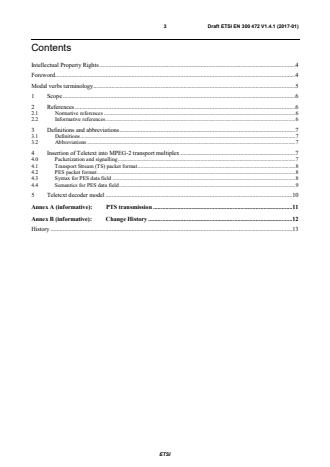
3 Draft ETSI EN 300 472 V1.4.1 (2017-01)
Contents
Intellectual Property Rights . 4
Foreword . 4
Modal verbs terminology . 5
1 Scope . 6
2 References . 6
2.1 Normative references . 6
2.2 Informative references . 6
3 Definitions and abbreviations . 7
3.1 Definitions . 7
3.2 Abbreviations . 7
4 Insertion of Teletext into MPEG-2 transport multiplex . 7
4.0 Packetization and signalling . 7
4.1 Transport Stream (TS) packet format . 8
4.2 PES packet format . 8
4.3 Syntax for PES data field . 8
4.4 Semantics for PES data field . 9
5 Teletext decoder model . 10
Annex A (informative): PTS transmission . 11
Annex B (informative): Change History . 12
History . 13
ETSI
4 Draft ETSI EN 300 472 V1.4.1 (2017-01)
Intellectual Property Rights
IPRs essential or potentially essential to the present document may have been declared to ETSI. The information
pertaining to these essential IPRs, if any, is publicly available for ETSI members and non-members, and can be found
in ETSI SR 000 314: "Intellectual Property Rights (IPRs); Essential, or potentially Essential, IPRs notified to ETSI in
respect of ETSI standards", which is available from the ETSI Secretariat. Latest updates are available on the ETSI Web
server (https://ipr.etsi.org/).
Pursuant to the ETSI IPR Policy, no investigation, including IPR searches, has been carried out by ETSI. No guarantee
can be given as to the existence of other IPRs not referenced in ETSI SR 000 314 (or the updates on the ETSI Web
server) which are, or may be, or may become, essential to the present document.
Foreword
This draft European Standard (EN) has been produced by Joint Technical Committee (JTC) Broadcast of the European
Broadcasting Union (EBU), Comité Européen de Normalisation ELECtrotechnique (CENELEC) and the European
Telecommunications Standards Institute (ETSI), and is now submitted for the combined Public Enquiry and Vote phase
of the ETSI standards EN Approval Procedure.
NOTE: The EBU/ETSI JTC Broadcast was established in 1990 to co-ordinate the drafting of standards in the
specific field of broadcasting and related fields. Since 1995 the JTC Broadcast became a tripartite body
by including in the Memorandum of Understanding also CENELEC, which is responsible for the
standardization of radio and television receivers. The EBU is a professional association of broadcasting
organizations whose work includes the co-ordination of its members' activities in the technical, legal,
programme-making and programme-exchange domains. The EBU has active members in about
60 countries in the European broadcasting area; its headquarters is in Geneva.
European Broadcasting Union
CH-1218 GRAND SACONNEX (Geneva)
Switzerland
Tel: +41 22 717 21 11
Fax: +41 22 717 24 81
The Digital Video Broadcasting Project (DVB) is an industry-led consortium of broadcasters, manufacturers, network
operators, software developers, regulatory bodies, content owners and others committed to designing global standards
for the delivery of digital television and data services. DVB fosters market driven solutions that meet the needs and
economic circumstances of broadcast industry stakeholders and consumers. DVB standards cover all aspects of digital
television from transmission through interfacing, conditional access and interactivity for digital video, audio and data.
The consortium came together in 1993 to provide global standardisation, interoperability and future proof
specifications.
Proposed national transposition dates
Date of latest announcement of this EN (doa): 3 months after ETSI publication
Date of latest publication of new National Standard
or endorsement of this EN (dop/e): 6 months after doa
Date of withdrawal of any conflicting National Standard (dow): 6 months after doa
ETSI
5 Draft ETSI EN 300 472 V1.4.1 (2017-01)
Modal verbs terminology
In the present document "shall", "shall not", "should", "should not", "may", "need not", "will", "will not", "can" and
"cannot" are to be interpreted as described in clause 3.2 of the ETSI Drafting Rules (Verbal forms for the expression of
provisions).
"must" and "must not" are NOT allowed in ETSI deliverables except when used in direct citation.
ETSI
6 Draft ETSI EN 300 472 V1.4.1 (2017-01)
1 Scope
The present document specifies the method by which ITU-R System B Teletext (Recommendation ITU-R BT.653 [3]),
also known as EBU Teletext (see ETSI EN 300 706 [4]), may be carried in DVB bitstreams. This transport mechanism
is intended to satisfy the following requirements:
• to support the transcoding of the Teletext data into the Vertical Blanking Interval (VBI) of analogue video.
The transcoded signal should be compatible with existing TV receivers with Teletext decoders;
• the maximum data rate for each Teletext service is equivalent to 16 lines per field so that the service is always
suitable for transcoding into the VBI;
• the transmission mechanism should be capable of transmitting subtitles with accurate timing with respect to
the video (i.e. to within or near frame accuracy).
A more general data transport mechanism for conveying new types of data services is outside the scope of the present
document, but the transport syntax specified here can also be adapted for other data.
2 References
2.1 Normative references
References are either specific (identified by date of publication and/or edition number or version number) or
non-specific. For specific references, only the cited version applies. For non-specific references, the latest version of the
referenced document (including any amendments) applies.
Referenced documents which are not found to be publicly available in the expected location might be found at
https://docbox.etsi.org/Reference/.
NOTE: While any hyperlinks included in this clause were valid at the time of publication, ETSI cannot guarantee
their long term validity.
The following referenced documents are necessary for the application of the present document.
[1] ISO/IEC 13818-1: "Information technology -- Generic coding of moving pictures and associated
audio information -- Part 1: Systems".
[2] ETSI EN 300 468: "Digital Video Broadcasting (DVB); Specification for Service Information (SI)
in DVB systems".
[3] Recommendation ITU-R BT.653: "Teletext systems".
[4] ETSI EN 300 706: "Enhanced Teletext specification".
2.2 Informative references
References are either specific (identified by date of publication and/or edition number or version number) or
non-specific. For specific references, only the cited version applies. For non-specific references, the latest version of the
referenced document (including any amendments) applies.
NOTE: While any hyperlinks included in this clause were valid at the time of publication, ETSI cannot guarantee
their long term validity.
The following referenced documents are not necessary for the application of the present document but they assist the
user with regard to a
...
EUROPEAN STANDARD
Digital Video Broadcasting (DVB);
Specification for conveying ITU-R System B Teletext
in DVB bitstreams
2 ETSI EN 300 472 V1.4.1 (2017-04)
Reference
REN/JTC-DVB-365
Keywords
broadcasting, digital, DVB, MPEG, teletext, TV,
video
ETSI
650 Route des Lucioles
F-06921 Sophia Antipolis Cedex - FRANCE
Tel.: +33 4 92 94 42 00 Fax: +33 4 93 65 47 16
Siret N° 348 623 562 00017 - NAF 742 C
Association à but non lucratif enregistrée à la
Sous-Préfecture de Grasse (06) N° 7803/88
Important notice
The present document can be downloaded from:
http://www.etsi.org/standards-search
The present document may be made available in electronic versions and/or in print. The content of any electronic and/or
print versions of the present document shall not be modified without the prior written authorization of ETSI. In case of any
existing or perceived difference in contents between such versions and/or in print, the only prevailing document is the
print of the Portable Document Format (PDF) version kept on a specific network drive within ETSI Secretariat.
Users of the present document should be aware that the document may be subject to revision or change of status.
Information on the current status of this and other ETSI documents is available at
https://portal.etsi.org/TB/ETSIDeliverableStatus.aspx
If you find errors in the present document, please send your comment to one of the following services:
https://portal.etsi.org/People/CommiteeSupportStaff.aspx
Copyright Notification
No part may be reproduced or utilized in any form or by any means, electronic or mechanical, including photocopying and
microfilm except as authorized by written permission of ETSI.
The content of the PDF version shall not be modified without the written authorization of ETSI.
The copyright and the foregoing restriction extend to reproduction in all media.
© European Telecommunications Standards Institute 2017.
© European Broadcasting Union 2017.
All rights reserved.
TM TM TM
DECT , PLUGTESTS , UMTS and the ETSI logo are Trade Marks of ETSI registered for the benefit of its Members.
TM
3GPP and LTE™ are Trade Marks of ETSI registered for the benefit of its Members and
of the 3GPP Organizational Partners.
GSM® and the GSM logo are Trade Marks registered and owned by the GSM Association.
ETSI
3 ETSI EN 300 472 V1.4.1 (2017-04)
Contents
Intellectual Property Rights . 4
Foreword . 4
Modal verbs terminology . 5
1 Scope . 6
2 References . 6
2.1 Normative references . 6
2.2 Informative references . 6
3 Definitions and abbreviations . 7
3.1 Definitions . 7
3.2 Abbreviations . 7
4 Insertion of Teletext into MPEG-2 transport multiplex . 7
4.0 Packetization and signalling . 7
4.1 Transport Stream (TS) packet format . 8
4.2 PES packet format . 8
4.3 Syntax for PES data field . 8
4.4 Semantics for PES data field . 9
5 Teletext decoder model . 10
Annex A (informative): PTS transmission . 11
Annex B (informative): Change history . 12
History . 13
ETSI
4 ETSI EN 300 472 V1.4.1 (2017-04)
Intellectual Property Rights
IPRs essential or potentially essential to the present document may have been declared to ETSI. The information
pertaining to these essential IPRs, if any, is publicly available for ETSI members and non-members, and can be found
in ETSI SR 000 314: "Intellectual Property Rights (IPRs); Essential, or potentially Essential, IPRs notified to ETSI in
respect of ETSI standards", which is available from the ETSI Secretariat. Latest updates are available on the ETSI Web
server (https://ipr.etsi.org/).
Pursuant to the ETSI IPR Policy, no investigation, including IPR searches, has been carried out by ETSI. No guarantee
can be given as to the existence of other IPRs not referenced in ETSI SR 000 314 (or the updates on the ETSI Web
server) which are, or may be, or may become, essential to the present document.
Foreword
This European Standard (EN) has been produced by Joint Technical Committee (JTC) Broadcast of the European
Broadcasting Union (EBU), Comité Européen de Normalisation ELECtrotechnique (CENELEC) and the European
Telecommunications Standards Institute (ETSI).
NOTE: The EBU/ETSI JTC Broadcast was established in 1990 to co-ordinate the drafting of standards in the
specific field of broadcasting and related fields. Since 1995 the JTC Broadcast became a tripartite body
by including in the Memorandum of Understanding also CENELEC, which is responsible for the
standardization of radio and television receivers. The EBU is a professional association of broadcasting
organizations whose work includes the co-ordination of its members' activities in the technical, legal,
programme-making and programme-exchange domains. The EBU has active members in about
60 countries in the European broadcasting area; its headquarters is in Geneva.
European Broadcasting Union
CH-1218 GRAND SACONNEX (Geneva)
Switzerland
Tel: +41 22 717 21 11
Fax: +41 22 717 24 81
The Digital Video Broadcasting Project (DVB) is an industry-led consortium of broadcasters, manufacturers, network
operators, software developers, regulatory bodies, content owners and others committed to designing global standards
for the delivery of digital television and data services. DVB fosters market driven solutions that meet the needs and
economic circumstances of broadcast industry stakeholders and consumers. DVB standards cover all aspects of digital
television from transmission through interfacing, conditional access and interactivity for digital video, audio and data.
The consortium came together in 1993 to provide global standardisation, interoperability and future proof
specifications.
National transposition dates
Date of adoption of this EN: 5 April 2017
Date of latest announcement of this EN (doa): 31 July 2017
Date of latest publication of new National Standard
or endorsement of this EN (dop/e): 31 January 2018
Date of withdrawal of any conflicting National Standard (dow): 31 January 2018
ETSI
5 ETSI EN 300 472 V1.4.1 (2017-04)
Modal verbs terminology
In the present document "shall", "shall not", "should", "should not", "may", "need not", "will", "will not", "can" and
"cannot" are to be interpreted as described in clause 3.2 of the ETSI Drafting Rules (Verbal forms for the expression of
provisions).
"must" and "must not" are NOT allowed in ETSI deliverables except when used in direct citation.
ETSI
6 ETSI EN 300 472 V1.4.1 (2017-04)
1 Scope
The present document specifies the method by which ITU-R System B Teletext (Recommendation ITU-R BT.653 [3]),
also known as EBU Teletext (see ETSI EN 300 706 [4]), may be carried in DVB bitstreams. This transport mechanism
is intended to satisfy the following requirements:
• to support the transcoding of the Teletext data into the Vertical Blanking Interval (VBI) of analogue video.
The transcoded signal should be compatible with existing TV receivers with Teletext decoders;
• the maximum data rate for each Teletext service is equivalent to 16 lines per field so that the service is always
suitable for transcoding into the VBI;
• the transmission mechanism should be capable of transmitting subtitles with accurate timing with respect to
the video (i.e. to within or near frame accuracy).
A more general data transport mechanism for conveying new types of data services is outside the scope of the present
document, but the transport syntax specified here can also be adapted for other data.
2 References
2.1 Normative references
References are either specific (identified by date of publication and/or edition number or version number) or
non-specific. For specific references, only the cited version applies. For non-specific references, the latest version of the
referenced document (including any amendments) applies.
Referenced documents which are not found to be publicly available in the expected location might be found at
https://docbox.etsi.org/Reference/.
NOTE: While any hyperlinks included in this clause were valid at the time of publication, ETSI cannot guarantee
their long term validity.
The following referenced documents are necessary for the application of the present document.
[1] ISO/IEC 13818-1: "Information technology -- Generic coding of moving pictures and associated
audio information -- Part 1: Systems".
[2] ETSI EN 300 468: "Digital Video Broadcasting (DVB); Specification for Service Information (SI)
in DVB systems".
[3] Recommendation ITU-R BT.653: "Teletext systems".
[4] ETSI EN 300 706: "Enhanced Teletext specification".
2.2 Informative references
References are either specific (identified by date of publication and/or edition number or version number) or
non-specific. For specific references, only the cited version applies. For non-specific references, the latest version of the
referenced document (including any amendments) applies.
NOTE: While any hyperlinks included in this clause were valid at the time of publication, ETSI cannot guarantee
their long term validity.
The following referenced documents are not necessary for the application of the present document but they assist the
user with regard to a particular subject area.
[i.1] ISO/IEC 13818-2: "Information techn
...
2003-01.Slovenski inštitut za standardizacijo. Razmnoževanje celote ali delov tega standarda ni dovoljeno.Digitalna videoradiodifuzija (DVB) - Specifikacija za prenos teleteksta po standardu ITU-R sistem B v bitnih tokih digitalne videoradiodifuzijeDigital Video Broadcasting (DVB) - Specification for conveying ITU-R System B Teletext in DVB bitstreams33.170Televizijska in radijska difuzijaTelevision and radio broadcastingICS:Ta slovenski standard je istoveten z:ETSI EN 300 472 V1.4.1 (2017-04)SIST EN 300 472 V1.4.1:2017en01-junij-2017SIST EN 300 472 V1.4.1:2017SLOVENSKI
STANDARD
EUROPEAN STANDARD SIST EN 300 472 V1.4.1:2017
ETSI ETSI EN 300 472 V1.4.1 (2017-04) 2
Reference REN/JTC-DVB-365 Keywords broadcasting, digital, DVB, MPEG, teletext, TV, video ETSI 650 Route des Lucioles F-06921 Sophia Antipolis Cedex - FRANCE
Tel.: +33 4 92 94 42 00
Fax: +33 4 93 65 47 16
Siret N° 348 623 562 00017 - NAF 742 C Association à but non lucratif enregistrée à la Sous-Préfecture de Grasse (06) N° 7803/88
Important notice The present document can be downloaded from: http://www.etsi.org/standards-search The present document may be made available in electronic versions and/or in print. The content of any electronic and/or print versions of the present document shall not be modified without the prior written authorization of ETSI. In case of any existing or perceived difference in contents between such versions and/or in print, the only prevailing document is the print of the Portable Document Format (PDF) version kept on a specific network drive within ETSI Secretariat. Users of the present document should be aware that the document may be subject to revision or change of status. Information on the current status of this and other ETSI documents is available at https://portal.etsi.org/TB/ETSIDeliverableStatus.aspx If you find errors in the present document, please send your comment to one of the following services: https://portal.etsi.org/People/CommiteeSupportStaff.aspx Copyright Notification No part may be reproduced or utilized in any form or by any means, electronic or mechanical, including photocopying and microfilm except as authorized by written permission of ETSI. The content of the PDF version shall not be modified without the written authorization of ETSI. The copyright and the foregoing restriction extend to reproduction in all media.
© European Telecommunications Standards Institute 2017. © European Broadcasting Union 2017. All rights reserved.
DECTTM, PLUGTESTSTM, UMTSTM and the ETSI logo are Trade Marks of ETSI registered for the benefit of its Members. 3GPPTM and LTE™ are Trade Marks of ETSI registered for the benefit of its Members and of the 3GPP Organizational Partners. GSM® and the GSM logo are Trade Marks registered and owned by the GSM Association. SIST EN 300 472 V1.4.1:2017
ETSI ETSI EN 300 472 V1.4.1 (2017-04) 3 Contents Intellectual Property Rights . 4 Foreword . 4 Modal verbs terminology . 5 1 Scope . 6 2 References . 6 2.1 Normative references . 6 2.2 Informative references . 6 3 Definitions and abbreviations . 7 3.1 Definitions . 7 3.2 Abbreviations . 7 4 Insertion of Teletext into MPEG-2 transport multiplex . 7 4.0 Packetization and signalling . 7 4.1 Transport Stream (TS) packet format . 8 4.2 PES packet format . 8 4.3 Syntax for PES data field . 8 4.4 Semantics for PES data field . 9 5 Teletext decoder model . 10 Annex A (informative): PTS transmission . 11 Annex B (informative): Change history . 12 History . 13
ETSI ETSI EN 300 472 V1.4.1 (2017-04) 4 Intellectual Property Rights IPRs essential or potentially essential to the present document may have been declared to ETSI. The information pertaining to these essential IPRs, if any, is publicly available for ETSI members and non-members, and can be found in ETSI SR 000 314: "Intellectual Property Rights (IPRs); Essential, or potentially Essential, IPRs notified to ETSI in respect of ETSI standards", which is available from the ETSI Secretariat. Latest updates are available on the ETSI Web server (https://ipr.etsi.org/). Pursuant to the ETSI IPR Policy, no investigation, including IPR searches, has been carried out by ETSI. No guarantee can be given as to the existence of other IPRs not referenced in ETSI SR 000 314 (or the updates on the ETSI Web server) which are, or may be, or may become, essential to the present document. Foreword This European Standard (EN) has been produced by Joint Technical Committee (JTC) Broadcast of the European Broadcasting Union (EBU), Comité Européen de Normalisation ELECtrotechnique (CENELEC) and the European Telecommunications Standards Institute (ETSI). NOTE: The EBU/ETSI JTC Broadcast was established in 1990 to co-ordinate the drafting of standards in the specific field of broadcasting and related fields. Since 1995 the JTC Broadcast became a tripartite body by including in the Memorandum of Understanding also CENELEC, which is responsible for the standardization of radio and television receivers. The EBU is a professional association of broadcasting organizations whose work includes the co-ordination of its members' activities in the technical, legal, programme-making and programme-exchange domains. The EBU has active members in about 60 countries in the European broadcasting area; its headquarters is in Geneva. European Broadcasting Union CH-1218 GRAND SACONNEX (Geneva) Switzerland Tel: +41 22 717 21 11 Fax: +41 22 717 24 81 The Digital Video Broadcasting Project (DVB) is an industry-led consortium of broadcasters, manufacturers, network operators, software developers, regulatory bodies, content owners and others committed to designing global standards for the delivery of digital television and data services. DVB fosters market driven solutions that meet the needs and economic circumstances of broadcast industry stakeholders and consumers. DVB standards cover all aspects of digital television from transmission through interfacing, conditional access and interactivity for digital video, audio and data. The consortium came together in 1993 to provide global standardisation, interoperability and future proof specifications.
National transposition dates Date of adoption of this EN: 5 April 2017 Date of latest announcement of this EN (doa): 31 July 2017 Date of latest publication of new National Standard or endorsement of this EN (dop/e):
31 January 2018 Date of withdrawal of any conflicting National Standard (dow): 31 January 2018
ETSI ETSI EN 300 472 V1.4.1 (2017-04) 5 Modal verbs terminology In the present document "shall", "shall not", "should", "should not", "may", "need not", "will", "will not", "can" and "cannot" are to be interpreted as described in clause 3.2 of the ETSI Drafting Rules (Verbal forms for the expression of provisions). "must" and "must not" are NOT allowed in ETSI deliverables except when used in direct citation.
ETSI ETSI EN 300 472 V1.4.1 (2017-04) 6 1 Scope The present document specifies the method by which ITU-R System B Teletext (Recommendation ITU-R BT.653 [3]), also known as EBU Teletext (see ETSI EN 300 706 [4]), may be carried in DVB bitstreams. This transport mechanism is intended to satisfy the following requirements: • to support the transcoding of the Teletext data into the Vertical Blanking Interval (VBI) of analogue video. The transcoded signal should be compatible with existing TV receivers with Teletext decoders; • the maximum data rate for each Teletext service is equivalent to 16 lines per field so that the service is always suitable for transcoding into the VBI; • the transmission mechanism should be capable of transmitting subtitles with accurate timing with respect to the video (i.e. to within or near frame accuracy). A more general data transport mechanism for conveying new types of data services is outside the scope of the present document, but the transport syntax specified here can also be adapted for other data. 2 References 2.1 Normative references References are either specific (identified by date of publication and/or edition number or version number) or non-specific. For specific references, only the cited version applies. For non-specific references, the latest version of the referenced document (including any amendments) applies. Referenced documents which are not found to be publicly available in the expected location might be found at https://docbox.etsi.org/Reference/. NOTE: While any hyperlinks included in this clause were valid at the time of publication, ETSI cannot guarantee their long term validity. The following referenced documents are necessary for the application of the present document. [1] ISO/IEC 13818-1: "Information technology -- Generic coding of moving pictures and associated audio information -- Part 1: Systems". [2] ETSI EN 300 468: "Digital Video Broadcasting (DVB); Specification for Service Information (SI) in DVB systems". [3] Recommendation ITU-R BT.653: "Teletext systems". [4] ETSI EN 300 706: "Enhanced Teletext specification". 2.2 Informative references References are either specific (identified by date of publication and/or edition number or version number) or non-specific. For specific references, only the cited version applies. For non-specific references, the latest version of the refe
...