

SIST EN 303 204-2 V 1.1.1:2014
(Main)Electromagnetic compatibility and Radio spectrum Matters (ERM) - Network Based Short Range Devices (SRD) - Radio equipment to be used in the 870 MHz to 876 MHz frequency range with power levels ranging up to 500 mW - Part 2: Harmonized EN covering the essential requirements of article 3.2 of the R&TTE Directive
General Information
- Abstract
To produce a Harmonised Standard, taking into account the ongoing ECC Report 200 and ECC Report 189, to support Network Based SRDs within the 870 -876 MHz frequency range, such as Metropolitan Machine Mesh (M3M e.g. TR 103 055) and Smart Metering/Smart Grid (e.g. TR 102 886) - TS 102 887 could also of relevance. It is noted that these SRD equipment will be class 2 to ensure the best spectrum efficiency whilst protecting the primary service operating in some countries.
- Status
- Published
- Public Enquiry End Date
- 30-Sep-2014
- Publication Date
- 12-Nov-2014
- Technical Committee
- MOC - Mobile Communications
- Current Stage
- 6060 - National Implementation/Publication (Adopted Project)
- Start Date
- 04-Nov-2014
- Due Date
- 09-Jan-2015
- Completion Date
- 13-Nov-2014
Buy Documents
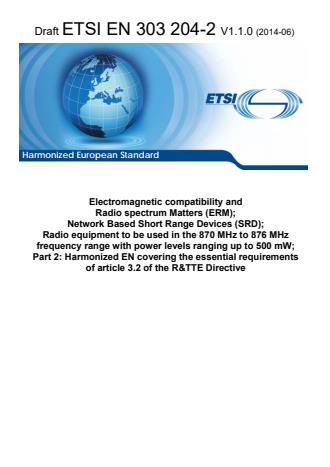
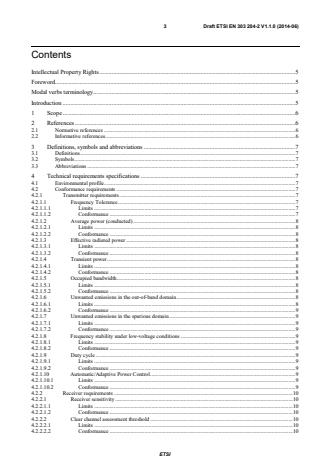
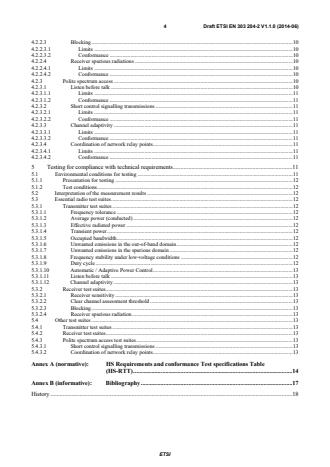
ETSI EN 303 204-2 V1.1.0 (2014-06) - Electromagnetic compatibility and Radio spectrum Matters (ERM); Network Based Short Range Devices (SRD); Radio equipment to be used in the 870 MHz to 876 MHz frequency range with power levels ranging up to 500 mW; Part 2: Harmonized EN covering the essential requirements of article 3.2 of the R&TTE Directive
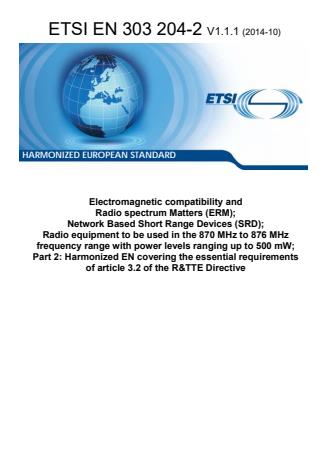
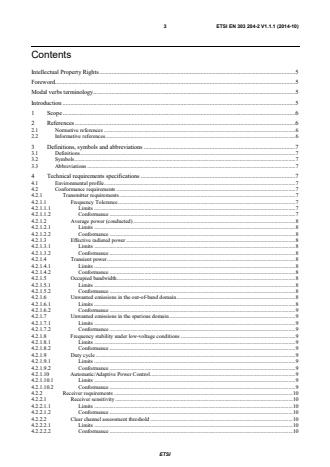
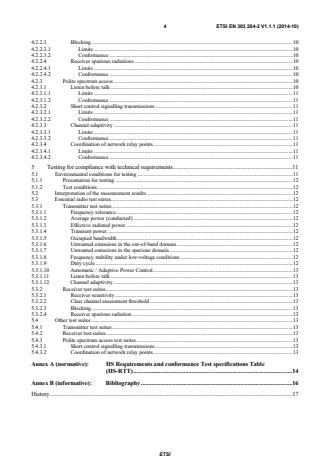
ETSI EN 303 204-2 V1.1.1 (2014-10) - Electromagnetic compatibility and Radio spectrum Matters (ERM); Network Based Short Range Devices (SRD); Radio equipment to be used in the 870 MHz to 876 MHz frequency range with power levels ranging up to 500 mW; Part 2: Harmonized EN covering the essential requirements of article 3.2 of the R&TTE Directive

Overview
SIST EN 303 204-2 V 1.1.1:2014 specifies essential requirements for electromagnetic compatibility and efficient spectrum use for network-based short range devices (SRDs) using radio equipment in the 870 MHz to 876 MHz frequency range, with power levels up to 500 mW. This standard forms part of the European regulatory framework supporting the R&TTE Directive (Directive 1999/5/EC), focusing on radio equipment’s use of the radio spectrum to avoid harmful interference while ensuring reliable operation in smart metering, smart grid, and machine-to-machine (M2M) networks.
Published by SIST, this harmonized European Standard supports the deployment of Metropolitan Machine Mesh (M3M) networks, advanced smart utility meters, and other network-based SRDs under class 2 equipment classification, promoting spectrum efficiency while protecting primary licensed services.
Key Topics
Equipment Scope
- Applies to network-based SRDs operating in the 870 MHz to 876 MHz band
- Covers both end devices and network relay points that support networked operation
- Designed for devices that form intercommunicating mesh or star networks
Regulatory Context
- Harmonized to comply with Article 3.2 of the R&TTE Directive
- Addresses essential requirements for spectrum use and avoidance of interference
Technical Requirements
- Frequency tolerance and stability for reliable operation
- Power limitations (up to 500 mW), covering average and radiated power
- Control of unwanted emissions (out-of-band and spurious)
- Receiver sensitivity, blocking, and spurious radiation
- Polite spectrum access techniques, such as listen-before-talk and channel adaptivity
- Duty cycle limitations and adaptive/automatic power control
- Specific test suites for transmitters and receivers to verify compliance
Applications
This standard is pivotal for manufacturers, integrators, and deployers in:
Smart Metering and Smart Grid
- Ensures reliable, interference-free communication between utility meters, sensors, and control equipment
- Critical for automated meter reading, demand response, and grid monitoring solutions
Metropolitan Machine Mesh Networks (M3M)
- Supports urban IoT and industrial M2M applications requiring robust and scalable wireless infrastructure
Building and Home Automation
- Enables secure, efficient connectivity for building management systems, alarm monitoring, and access control
Telemetry and Remote Monitoring
- Facilitates resource-efficient data collection across distributed sensor networks
Compliance with SIST EN 303 204-2 V 1.1.1:2014 helps ensure interoperability, regulatory acceptance, and reliable radio spectrum usage for network-based SRDs across Europe.
Related Standards
EN 303 204-1
Technical characteristics and test methods for SRDs in the 870 MHz to 876 MHz frequency range. SIST EN 303 204-2 serves as the harmonized standard for essential requirements, while Part 1 discusses test procedures.R&TTE Directive (1999/5/EC)
European regulatory directive governing the placing of radio and telecommunications equipment on the market.ETSI TR 103 055 & TR 102 886
Technical references supporting M3M and smart metering applications.TS 102 887
Reference for other relevant technical specifications regarding smart metering and SRD network interoperability.
By aligning with SIST EN 303 204-2, stakeholders can optimize their SRD deployments for compliance, performance, and future-proof operation within the harmonized European spectrum landscape.
Buy Documents
ETSI EN 303 204-2 V1.1.0 (2014-06) - Electromagnetic compatibility and Radio spectrum Matters (ERM); Network Based Short Range Devices (SRD); Radio equipment to be used in the 870 MHz to 876 MHz frequency range with power levels ranging up to 500 mW; Part 2: Harmonized EN covering the essential requirements of article 3.2 of the R&TTE Directive
ETSI EN 303 204-2 V1.1.1 (2014-10) - Electromagnetic compatibility and Radio spectrum Matters (ERM); Network Based Short Range Devices (SRD); Radio equipment to be used in the 870 MHz to 876 MHz frequency range with power levels ranging up to 500 mW; Part 2: Harmonized EN covering the essential requirements of article 3.2 of the R&TTE Directive
Get Certified
Connect with accredited certification bodies for this standard

ANCE
Mexican certification and testing association.

Intertek Slovenia
Intertek testing, inspection, and certification services in Slovenia.

LNE (Laboratoire National de Métrologie et d'Essais)
French national laboratory for metrology and testing.
Sponsored listings
Frequently Asked Questions
SIST EN 303 204-2 V 1.1.1:2014 is a standard published by the Slovenian Institute for Standardization (SIST). Its full title is "Electromagnetic compatibility and Radio spectrum Matters (ERM) - Network Based Short Range Devices (SRD) - Radio equipment to be used in the 870 MHz to 876 MHz frequency range with power levels ranging up to 500 mW - Part 2: Harmonized EN covering the essential requirements of article 3.2 of the R&TTE Directive". This standard covers: To produce a Harmonised Standard, taking into account the ongoing ECC Report 200 and ECC Report 189, to support Network Based SRDs within the 870 -876 MHz frequency range, such as Metropolitan Machine Mesh (M3M e.g. TR 103 055) and Smart Metering/Smart Grid (e.g. TR 102 886) - TS 102 887 could also of relevance. It is noted that these SRD equipment will be class 2 to ensure the best spectrum efficiency whilst protecting the primary service operating in some countries.
To produce a Harmonised Standard, taking into account the ongoing ECC Report 200 and ECC Report 189, to support Network Based SRDs within the 870 -876 MHz frequency range, such as Metropolitan Machine Mesh (M3M e.g. TR 103 055) and Smart Metering/Smart Grid (e.g. TR 102 886) - TS 102 887 could also of relevance. It is noted that these SRD equipment will be class 2 to ensure the best spectrum efficiency whilst protecting the primary service operating in some countries.
SIST EN 303 204-2 V 1.1.1:2014 is classified under the following ICS (International Classification for Standards) categories: 33.060.20 - Receiving and transmitting equipment; 33.100.01 - Electromagnetic compatibility in general. The ICS classification helps identify the subject area and facilitates finding related standards.
SIST EN 303 204-2 V 1.1.1:2014 is associated with the following European legislation: EU Directives/Regulations: 1999/5/EC; Standardization Mandates: M/284, M/441. When a standard is cited in the Official Journal of the European Union, products manufactured in conformity with it benefit from a presumption of conformity with the essential requirements of the corresponding EU directive or regulation.
SIST EN 303 204-2 V 1.1.1:2014 is available in PDF format for immediate download after purchase. The document can be added to your cart and obtained through the secure checkout process. Digital delivery ensures instant access to the complete standard document.
Standards Content (Sample)
Draft ETSI EN 303 204-2 V1.1.0 (2014-06)
Harmonized European Standard
Electromagnetic compatibility and
Radio spectrum Matters (ERM);
Network Based Short Range Devices (SRD);
Radio equipment to be used in the 870 MHz to 876 MHz
frequency range with power levels ranging up to 500 mW;
Part 2: Harmonized EN covering the essential requirements
of article 3.2 of the R&TTE Directive
2 Draft ETSI EN 303 204-2 V1.1.0 (2014-06)
Reference
DEN/ERM-TG28-504
Keywords
radio, regulation, SRD
ETSI
650 Route des Lucioles
F-06921 Sophia Antipolis Cedex - FRANCE
Tel.: +33 4 92 94 42 00 Fax: +33 4 93 65 47 16
Siret N° 348 623 562 00017 - NAF 742 C
Association à but non lucratif enregistrée à la
Sous-Préfecture de Grasse (06) N° 7803/88
Important notice
The present document can be downloaded from:
http://www.etsi.org
The present document may be made available in electronic versions and/or in print. The content of any electronic and/or
print versions of the present document shall not be modified without the prior written authorization of ETSI. In case of any
existing or perceived difference in contents between such versions and/or in print, the only prevailing document is the
print of the Portable Document Format (PDF) version kept on a specific network drive within ETSI Secretariat.
Users of the present document should be aware that the document may be subject to revision or change of status.
Information on the current status of this and other ETSI documents is available at
http://portal.etsi.org/tb/status/status.asp
If you find errors in the present document, please send your comment to one of the following services:
http://portal.etsi.org/chaircor/ETSI_support.asp
Copyright Notification
No part may be reproduced or utilized in any form or by any means, electronic or mechanical, including photocopying
and microfilm except as authorized by written permission of ETSI.
The content of the PDF version shall not be modified without the written authorization of ETSI.
The copyright and the foregoing restriction extend to reproduction in all media.
© European Telecommunications Standards Institute 2014.
All rights reserved.
TM TM TM
DECT , PLUGTESTS , UMTS and the ETSI logo are Trade Marks of ETSI registered for the benefit of its Members.
TM
3GPP and LTE™ are Trade Marks of ETSI registered for the benefit of its Members and
of the 3GPP Organizational Partners.
GSM® and the GSM logo are Trade Marks registered and owned by the GSM Association.
ETSI
3 Draft ETSI EN 303 204-2 V1.1.0 (2014-06)
Contents
Intellectual Property Rights . 5
Foreword . 5
Modal verbs terminology . 5
Introduction . 5
1 Scope . 6
2 References . 6
2.1 Normative references . 6
2.2 Informative references . 6
3 Definitions, symbols and abbreviations . 7
3.1 Definitions . 7
3.2 Symbols . 7
3.3 Abbreviations . 7
4 Technical requirements specifications . 7
4.1 Environmental profile . 7
4.2 Conformance requirements . 7
4.2.1 Transmitter requirements . 7
4.2.1.1 Frequency Tolerance . 7
4.2.1.1.1 Limits . 7
4.2.1.1.2 Conformance . 7
4.2.1.2 Average power (conducted) . 8
4.2.1.2.1 Limits . 8
4.2.1.2.2 Conformance . 8
4.2.1.3 Effective radiated power . 8
4.2.1.3.1 Limits . 8
4.2.1.3.2 Conformance . 8
4.2.1.4 Transient power . 8
4.2.1.4.1 Limits . 8
4.2.1.4.2 Conformance . 8
4.2.1.5 Occupied bandwidth. 8
4.2.1.5.1 Limits . 8
4.2.1.5.2 Conformance . 8
4.2.1.6 Unwanted emissions in the out-of-band domain . 8
4.2.1.6.1 Limits . 8
4.2.1.6.2 Conformance . 9
4.2.1.7 Unwanted emissions in the spurious domain . 9
4.2.1.7.1 Limits . 9
4.2.1.7.2 Conformance . 9
4.2.1.8 Frequency stability under low-voltage conditions . 9
4.2.1.8.1 Limits . 9
4.2.1.8.2 Conformance . 9
4.2.1.9 Duty cycle . 9
4.2.1.9.1 Limits . 9
4.2.1.9.2 Conformance . 9
4.2.1.10 Automatic/Adaptive Power Control . 9
4.2.1.10.1 Limits . 9
4.2.1.10.2 Conformance . 9
4.2.2 Receiver requirements . 10
4.2.2.1 Receiver sensitivity . 10
4.2.2.1.1 Limits . 10
4.2.2.1.2 Conformance . 10
4.2.2.2 Clear channel assessment threshold . 10
4.2.2.2.1 Limits . 10
4.2.2.2.2 Conformance . 10
ETSI
4 Draft ETSI EN 303 204-2 V1.1.0 (2014-06)
4.2.2.3 Blocking . 10
4.2.2.3.1 Limits . 10
4.2.2.3.2 Conformance . 10
4.2.2.4 Receiver spurious radiations . 10
4.2.2.4.1 Limits . 10
4.2.2.4.2 Conformance . 10
4.2.3 Polite spectrum access . 10
4.2.3.1 Listen before talk . 10
4.2.3.1.1 Limits . 11
4.2.3.1.2 Conformance . 11
4.2.3.2 Short control signalling transmissions . 11
4.2.3.2.1 Limits . 11
4.2.3.2.2 Conformance . 11
4.2.3.3 Channel adaptivity . 11
4.2.3.3.1 Limits . 11
4.2.3.3.2 Conformance . 11
4.2.3.4 Coordination of network relay points . 11
4.2.3.4.1 Limits . 11
4.2.3.4.2 Conformance . 11
5 Testing for compliance with technical requirements . 11
5.1 Environmental conditions for testing . 11
5.1.1 Presentation for testing . 12
5.1.2 Test conditions . 12
5.2 Interpretation of the measurement results . 12
5.3 Essential radio test suites . 12
5.3.1 Transmitter test suites . 12
5.3.1.1 Frequency tolerance . 12
5.3.1.2 Average power (conducted) . 12
5.3.1.3 Effective radiated power . 12
5.3.1.4 Transient power . 12
5.3.1.5 Occupied bandwidth. 12
5.3.1.6 Unwanted emissions in the out-of-band domain . 12
5.3.1.7 Unwanted emissions in the spurious domain . 12
5.3.1.8 Frequency stability under low-voltage conditions . 12
5.3.1.9 Duty cycle . 12
5.3.1.10 Automatic / Adaptive Power Control . 13
5.3.1.11 Listen before talk . 13
5.3.1.12 Channel adaptivity . 13
5.3.2 Receiver test suites. 13
5.3.2.1 Receiver sensitivity . 13
5.3.2.2 Clear channel assessment threshold . 13
5.3.2.3 Blocking . 13
5.3.2.4 Receiver spurious radiation . 13
5.4 Other test suites . 13
5.4.1 Transmitter test suites . 13
5.4.2 Receiver test suites. 13
5.4.3 Polite spectrum access test suites . 13
5.4.3.1 Short control signalling transmissions . 13
5.4.3.2 Coordination of network relay points . 13
Annex A (normative): HS Requirements and conformance Test specifications Table
(HS-RTT) . 14
Annex B (informative): Bibliography . 17
History . 18
ETSI
5 Draft ETSI EN 303 204-2 V1.1.0 (2014-06)
Intellectual Property Rights
IPRs essential or potentially essential to the present document may have been declared to ETSI. The information
pertaining to these essential IPRs, if any, is publicly available for ETSI members and non-members, and can be found
in ETSI SR 000 314: "Intellectual Property Rights (IPRs); Essential, or potentially Essential, IPRs notified to ETSI in
respect of ETSI standards", which is available from the ETSI Secretariat. Latest updates are available on the ETSI Web
server (http://ipr.etsi.org).
Pursuant to the ETSI IPR Policy, no investigation, including IPR searches, has been carried out by ETSI. No guarantee
can be given as to the existence of other IPRs not referenced in ETSI SR 000 314 (or the updates on the ETSI Web
server) which are, or may be, or may become, essential to the present document.
Foreword
This draft Harmonized European Standard (EN) has been produced by ETSI Technical Committee Electromagnetic
compatibility and Radio spectrum Matters (ERM), and is now submitted for the combined Public Enquiry and Vote
phase of the ETSI standards EN Approval Procedure.
The present document has been produced by ETSI in response to mandates M/284 and M/441 issued from the European
Commission under Directive 98/34/EC [i.2] as amended by Directive 98/48/EC [i.3].
The title and reference to the present document are intended to be included in the publication in the Official Journal of
the European Union of titles and references of Harmonized Standard under the Directive 1999/5/EC [i.1].
See article 5.1 of Directive 1999/5/EC [i.1] for information on presumption of conformity and Harmonized Standards or
parts thereof the references of which have been published in the Official Journal of the European Union.
The requirements relevant to Directive 1999/5/EC [i.1] are summarized in annex A.
The present document is part 2 of a multi-part deliverable. Full details of the entire series can be found in part 1 [1].
Proposed national transposition dates
Date of latest announcement of this EN (doa): 3 months after ETSI publication
Date of latest publication of new National Standard
or endorsement of this EN (dop/e): 6 months after doa
Date of withdrawal of any conflicting National Standard (dow): 18 months after doa
Modal verbs terminology
In the present document "shall", "shall not", "should", "should not", "may", "may not", "need", "need not", "will",
"will not", "can" and "cannot" are to be interpreted as described in clause 3.2 of the ETSI Drafting Rules (Verbal forms
for the expression of provisions).
"must" and "must not" are NOT allowed in ETSI deliverables except when used in direct citation.
Introduction
The present document is part of a set of standards developed by ETSI and is designed to fit in a modular structure to
cover all radio and telecommunications terminal equipment within the scope of the Radio Equipment Directive [i.1].
The modular structure is shown in EG 201 399 [i.4].
ETSI
6 Draft ETSI EN 303 204
...
HARMONIZED EUROPEAN STANDARD
Electromagnetic compatibility and
Radio spectrum Matters (ERM);
Network Based Short Range Devices (SRD);
Radio equipment to be used in the 870 MHz to 876 MHz
frequency range with power levels ranging up to 500 mW;
Part 2: Harmonized EN covering the essential requirements
of article 3.2 of the R&TTE Directive
2 ETSI EN 303 204-2 V1.1.1 (2014-10)
Reference
DEN/ERM-TG28-504
Keywords
radio, regulation, SRD
ETSI
650 Route des Lucioles
F-06921 Sophia Antipolis Cedex - FRANCE
Tel.: +33 4 92 94 42 00 Fax: +33 4 93 65 47 16
Siret N° 348 623 562 00017 - NAF 742 C
Association à but non lucratif enregistrée à la
Sous-Préfecture de Grasse (06) N° 7803/88
Important notice
The present document can be downloaded from:
http://www.etsi.org
The present document may be made available in electronic versions and/or in print. The content of any electronic and/or
print versions of the present document shall not be modified without the prior written authorization of ETSI. In case of any
existing or perceived difference in contents between such versions and/or in print, the only prevailing document is the
print of the Portable Document Format (PDF) version kept on a specific network drive within ETSI Secretariat.
Users of the present document should be aware that the document may be subject to revision or change of status.
Information on the current status of this and other ETSI documents is available at
http://portal.etsi.org/tb/status/status.asp
If you find errors in the present document, please send your comment to one of the following services:
http://portal.etsi.org/chaircor/ETSI_support.asp
Copyright Notification
No part may be reproduced or utilized in any form or by any means, electronic or mechanical, including photocopying
and microfilm except as authorized by written permission of ETSI.
The content of the PDF version shall not be modified without the written authorization of ETSI.
The copyright and the foregoing restriction extend to reproduction in all media.
© European Telecommunications Standards Institute 2014.
All rights reserved.
TM TM TM
DECT , PLUGTESTS , UMTS and the ETSI logo are Trade Marks of ETSI registered for the benefit of its Members.
TM
3GPP and LTE™ are Trade Marks of ETSI registered for the benefit of its Members and
of the 3GPP Organizational Partners.
GSM® and the GSM logo are Trade Marks registered and owned by the GSM Association.
ETSI
3 ETSI EN 303 204-2 V1.1.1 (2014-10)
Contents
Intellectual Property Rights . 5
Foreword . 5
Modal verbs terminology . 5
Introduction . 5
1 Scope . 6
2 References . 6
2.1 Normative references . 6
2.2 Informative references . 6
3 Definitions, symbols and abbreviations . 7
3.1 Definitions . 7
3.2 Symbols . 7
3.3 Abbreviations . 7
4 Technical requirements specifications . 7
4.1 Environmental profile . 7
4.2 Conformance requirements . 7
4.2.1 Transmitter requirements . 7
4.2.1.1 Frequency Tolerance . 7
4.2.1.1.1 Limits . 7
4.2.1.1.2 Conformance . 7
4.2.1.2 Average power (conducted) . 8
4.2.1.2.1 Limits . 8
4.2.1.2.2 Conformance . 8
4.2.1.3 Effective radiated power . 8
4.2.1.3.1 Limits . 8
4.2.1.3.2 Conformance . 8
4.2.1.4 Transient power . 8
4.2.1.4.1 Limits . 8
4.2.1.4.2 Conformance . 8
4.2.1.5 Occupied bandwidth. 8
4.2.1.5.1 Limits . 8
4.2.1.5.2 Conformance . 8
4.2.1.6 Unwanted emissions in the out-of-band domain . 8
4.2.1.6.1 Limits . 8
4.2.1.6.2 Conformance . 9
4.2.1.7 Unwanted emissions in the spurious domain . 9
4.2.1.7.1 Limits . 9
4.2.1.7.2 Conformance . 9
4.2.1.8 Frequency stability under low-voltage conditions . 9
4.2.1.8.1 Limits . 9
4.2.1.8.2 Conformance . 9
4.2.1.9 Duty cycle . 9
4.2.1.9.1 Limits . 9
4.2.1.9.2 Conformance . 9
4.2.1.10 Automatic/Adaptive Power Control . 9
4.2.1.10.1 Limits . 9
4.2.1.10.2 Conformance . 9
4.2.2 Receiver requirements . 10
4.2.2.1 Receiver sensitivity . 10
4.2.2.1.1 Limits . 10
4.2.2.1.2 Conformance . 10
4.2.2.2 Clear channel assessment threshold . 10
4.2.2.2.1 Limits . 10
4.2.2.2.2 Conformance . 10
ETSI
4 ETSI EN 303 204-2 V1.1.1 (2014-10)
4.2.2.3 Blocking . 10
4.2.2.3.1 Limits . 10
4.2.2.3.2 Conformance . 10
4.2.2.4 Receiver spurious radiations . 10
4.2.2.4.1 Limits . 10
4.2.2.4.2 Conformance . 10
4.2.3 Polite spectrum access . 10
4.2.3.1 Listen before talk . 10
4.2.3.1.1 Limits . 11
4.2.3.1.2 Conformance . 11
4.2.3.2 Short control signalling transmissions . 11
4.2.3.2.1 Limits . 11
4.2.3.2.2 Conformance . 11
4.2.3.3 Channel adaptivity . 11
4.2.3.3.1 Limits . 11
4.2.3.3.2 Conformance . 11
4.2.3.4 Coordination of network relay points . 11
4.2.3.4.1 Limits . 11
4.2.3.4.2 Conformance . 11
5 Testing for compliance with technical requirements . 11
5.1 Environmental conditions for testing . 11
5.1.1 Presentation for testing . 12
5.1.2 Test conditions . 12
5.2 Interpretation of the measurement results . 12
5.3 Essential radio test suites . 12
5.3.1 Transmitter test suites . 12
5.3.1.1 Frequency tolerance . 12
5.3.1.2 Average power (conducted) . 12
5.3.1.3 Effective radiated power . 12
5.3.1.4 Transient power . 12
5.3.1.5 Occupied bandwidth. 12
5.3.1.6 Unwanted emissions in the out-of-band domain . 12
5.3.1.7 Unwanted emissions in the spurious domain . 12
5.3.1.8 Frequency stability under low-voltage conditions . 12
5.3.1.9 Duty cycle . 12
5.3.1.10 Automatic / Adaptive Power Control . 13
5.3.1.11 Listen before talk . 13
5.3.1.12 Channel adaptivity . 13
5.3.2 Receiver test suites. 13
5.3.2.1 Receiver sensitivity . 13
5.3.2.2 Clear channel assessment threshold . 13
5.3.2.3 Blocking . 13
5.3.2.4 Receiver spurious radiation . 13
5.4 Other test suites . 13
5.4.1 Transmitter test suites . 13
5.4.2 Receiver test suites. 13
5.4.3 Polite spectrum access test suites . 13
5.4.3.1 Short control signalling transmissions . 13
5.4.3.2 Coordination of network relay points . 13
Annex A (normative): HS Requirements and conformance Test specifications Table
(HS-RTT) . 14
Annex B (informative): Bibliography . 16
History . 17
ETSI
5 ETSI EN 303 204-2 V1.1.1 (2014-10)
Intellectual Property Rights
IPRs essential or potentially essential to the present document may have been declared to ETSI. The information
pertaining to these essential IPRs, if any, is publicly available for ETSI members and non-members, and can be found
in ETSI SR 000 314: "Intellectual Property Rights (IPRs); Essential, or potentially Essential, IPRs notified to ETSI in
respect of ETSI standards", which is available from the ETSI Secretariat. Latest updates are available on the ETSI Web
server (http://ipr.etsi.org).
Pursuant to the ETSI IPR Policy, no investigation, including IPR searches, has been carried out by ETSI. No guarantee
can be given as to the existence of other IPRs not referenced in ETSI SR 000 314 (or the updates on the ETSI Web
server) which are, or may be, or may become, essential to the present document.
Foreword
This Harmonized European Standard (EN) has been produced by ETSI Technical Committee Electromagnetic
compatibility and Radio spectrum Matters (ERM).
The present document has been produced by ETSI in response to mandates M/284 and M/441 issued from the European
Commission under Directive 98/34/EC [i.2] as amended by Directive 98/48/EC [i.3].
The title and reference to the present document are intended to be included in the publication in the Official Journal of
the European Union of titles and references of Harmonized Standard under the Directive 1999/5/EC [i.1].
See article 5.1 of Directive 1999/5/EC [i.1] for information on presumption of conformity and Harmonized Standards or
parts thereof the references of which have been published in the Official Journal of the European Union.
The requirements relevant to Directive 1999/5/EC [i.1] are summarized in annex A.
The present document is part 2 of a multi-part deliverable. Full details of the entire series can be found in part 1 [1].
National transposition dates
Date of adoption of this EN: 17 October 2014
Date of latest announcement of this EN (doa): 31 January 2015
Date of latest publication of new National Standard
or endorsement of this EN (dop/e): 31 July 2015
Date of withdrawal of any conflicting National Standard (dow): 31 July 2016
Modal verbs terminology
In the present document "shall", "shall not", "should", "should not", "may", "may not", "need", "need not", "will",
"will not", "can" and "cannot" are to be interpreted as described in clause 3.2 of the ETSI Drafting Rules (Verbal forms
for the expression of provisions).
"must" and "must not" are NOT allowed in ETSI deliverables except when used in direct citation.
Introduction
The present document is part of a set of standards developed by ETSI and is designed to fit in a modular structure to
cover all radio and telecommunications terminal equipment within the scope of the Radio Equipment Directive [i.1].
The modular structure is shown in EG 201 399 [i.4].
ETSI
6 ETSI EN 303 204-2 V1.1.1 (2014-10)
1 Scope
The present document applies to the following following radio equipment types:
1) Network Based SRDs which are SRDs intended to operate in a
...
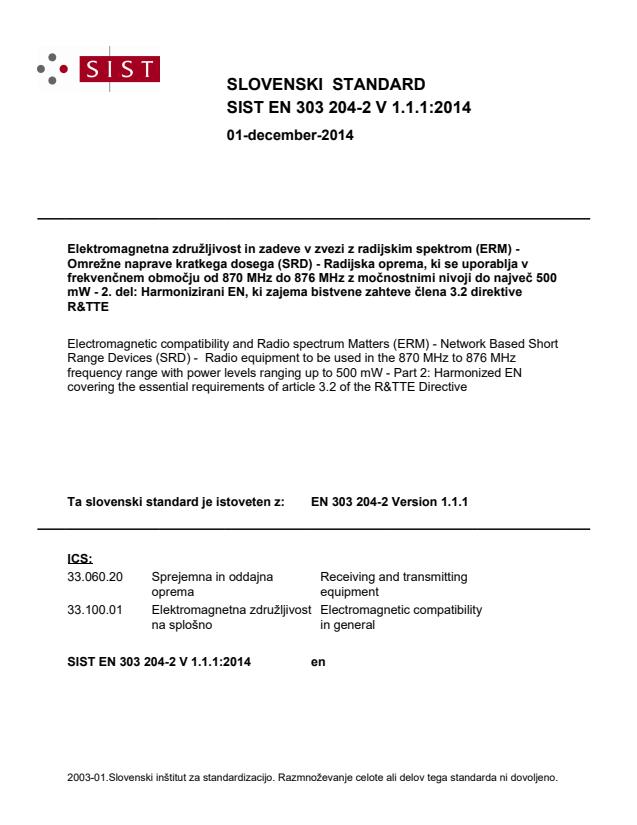
2003-01.Slovenski inštitut za standardizacijo. Razmnoževanje celote ali delov tega standarda ni dovoljeno.577(Electromagnetic compatibility and Radio spectrum Matters (ERM) - Network Based Short Range Devices (SRD) -
Radio equipment to be used in the 870 MHz to 876 MHz frequency range with power levels ranging up to 500 mW - Part 2: Harmonized EN covering the essential requirements of article 3.2 of the R&TTE Directive33.100.01Elektromagnetna združljivost na splošnoElectromagnetic compatibility in general33.060.20Sprejemna in oddajna opremaReceiving and transmitting equipmentICS:Ta slovenski standard je istoveten z:EN 303 204-2 Version 1.1.1SIST EN 303 204-2 V 1.1.1:2014en01-december-2014SIST EN 303 204-2 V 1.1.1:2014SLOVENSKI
STANDARD
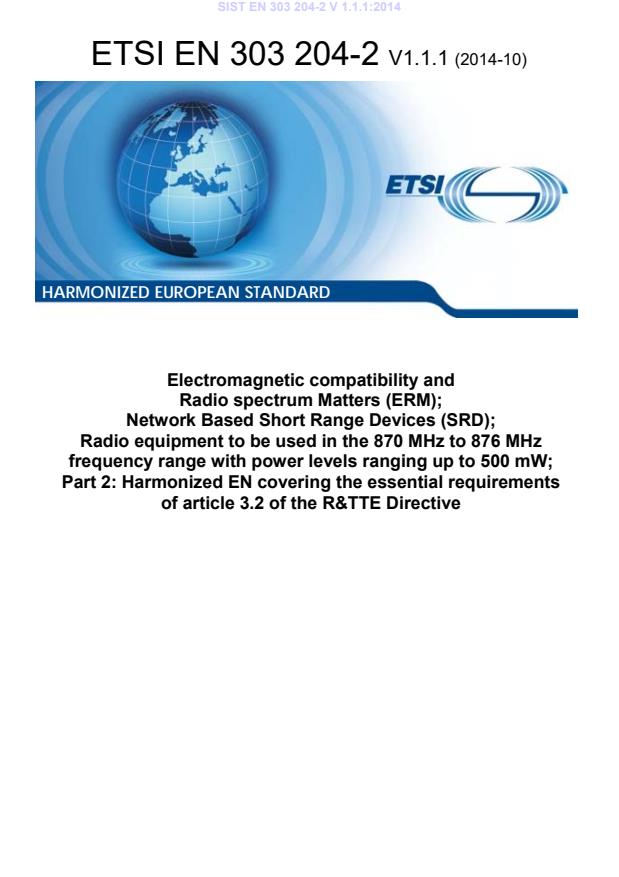
HARMONIZED EUROPEAN STANDARD SIST EN 303 204-2 V 1.1.1:2014
ETSI ETSI EN 303 204-2 V1.1.1 (2014-10) 2
Reference DEN/ERM-TG28-504 Keywords radio, regulation, SRD ETSI 650 Route des Lucioles F-06921 Sophia Antipolis Cedex - FRANCE
Tel.: +33 4 92 94 42 00
Fax: +33 4 93 65 47 16
Siret N° 348 623 562 00017 - NAF 742 C Association à but non lucratif enregistrée à la Sous-Préfecture de Grasse (06) N° 7803/88
Important notice The present document can be downloaded from: http://www.etsi.org The present document may be made available in electronic versions and/or in print. The content of any electronic and/or print versions of the present document shall not be modified without the prior written authorization of ETSI. In case of any existing or perceived difference in contents between such versions and/or in print, the only prevailing document is the print of the Portable Document Format (PDF) version kept on a specific network drive within ETSI Secretariat. Users of the present document should be aware that the document may be subject to revision or change of status. Information on the current status of this and other ETSI documents is available at http://portal.etsi.org/tb/status/status.asp If you find errors in the present document, please send your comment to one of the following services: http://portal.etsi.org/chaircor/ETSI_support.asp Copyright Notification No part may be reproduced or utilized in any form or by any means, electronic or mechanical, including photocopying and microfilm except as authorized by written permission of ETSI. The content of the PDF version shall not be modified without the written authorization of ETSI. The copyright and the foregoing restriction extend to reproduction in all media.
© European Telecommunications Standards Institute 2014. All rights reserved.
DECTTM, PLUGTESTSTM, UMTSTM and the ETSI logo are Trade Marks of ETSI registered for the benefit of its Members. 3GPPTM and LTE™ are Trade Marks of ETSI registered for the benefit of its Members and of the 3GPP Organizational Partners. GSM® and the GSM logo are Trade Marks registered and owned by the GSM Association. SIST EN 303 204-2 V 1.1.1:2014
ETSI ETSI EN 303 204-2 V1.1.1 (2014-10) 3 Contents Intellectual Property Rights . 5 Foreword . 5 Modal verbs terminology . 5 Introduction . 5 1 Scope . 6 2 References . 6 2.1 Normative references . 6 2.2 Informative references . 6 3 Definitions, symbols and abbreviations . 7 3.1 Definitions . 7 3.2 Symbols . 7 3.3 Abbreviations . 7 4 Technical requirements specifications . 7 4.1 Environmental profile . 7 4.2 Conformance requirements . 7 4.2.1 Transmitter requirements . 7 4.2.1.1 Frequency Tolerance . 7 4.2.1.1.1 Limits . 7 4.2.1.1.2 Conformance . 7 4.2.1.2 Average power (conducted) . 8 4.2.1.2.1 Limits . 8 4.2.1.2.2 Conformance . 8 4.2.1.3 Effective radiated power . 8 4.2.1.3.1 Limits . 8 4.2.1.3.2 Conformance . 8 4.2.1.4 Transient power . 8 4.2.1.4.1 Limits . 8 4.2.1.4.2 Conformance . 8 4.2.1.5 Occupied bandwidth. 8 4.2.1.5.1 Limits . 8 4.2.1.5.2 Conformance . 8 4.2.1.6 Unwanted emissions in the out-of-band domain . 8 4.2.1.6.1 Limits . 8 4.2.1.6.2 Conformance . 9 4.2.1.7 Unwanted emissions in the spurious domain . 9 4.2.1.7.1 Limits . 9 4.2.1.7.2 Conformance . 9 4.2.1.8 Frequency stability under low-voltage conditions . 9 4.2.1.8.1 Limits . 9 4.2.1.8.2 Conformance . 9 4.2.1.9 Duty cycle . 9 4.2.1.9.1 Limits . 9 4.2.1.9.2 Conformance . 9 4.2.1.10 Automatic/Adaptive Power Control . 9 4.2.1.10.1 Limits . 9 4.2.1.10.2 Conformance . 9 4.2.2 Receiver requirements . 10 4.2.2.1 Receiver sensitivity . 10 4.2.2.1.1 Limits . 10 4.2.2.1.2 Conformance . 10 4.2.2.2 Clear channel assessment threshold . 10 4.2.2.2.1 Limits . 10 4.2.2.2.2 Conformance . 10 SIST EN 303 204-2 V 1.1.1:2014
ETSI ETSI EN 303 204-2 V1.1.1 (2014-10) 4 4.2.2.3 Blocking . 10 4.2.2.3.1 Limits . 10 4.2.2.3.2 Conformance . 10 4.2.2.4 Receiver spurious radiations . 10 4.2.2.4.1 Limits . 10 4.2.2.4.2 Conformance . 10 4.2.3 Polite spectrum access . 10 4.2.3.1 Listen before talk . 10 4.2.3.1.1 Limits . 11 4.2.3.1.2 Conformance . 11 4.2.3.2 Short control signalling transmissions . 11 4.2.3.2.1 Limits . 11 4.2.3.2.2 Conformance . 11 4.2.3.3 Channel adaptivity . 11 4.2.3.3.1 Limits . 11 4.2.3.3.2 Conformance . 11 4.2.3.4 Coordination of network relay points . 11 4.2.3.4.1 Limits . 11 4.2.3.4.2 Conformance . 11 5 Testing for compliance with technical requirements . 11 5.1 Environmental conditions for testing . 11 5.1.1 Presentation for testing . 12 5.1.2 Test conditions . 12 5.2 Interpretation of the measurement results . 12 5.3 Essential radio test suites . 12 5.3.1 Transmitter test suites . 12 5.3.1.1 Frequency tolerance . 12 5.3.1.2 Average power (conducted) . 12 5.3.1.3 Effective radiated power . 12 5.3.1.4 Transient power . 12 5.3.1.5 Occupied bandwidth. 12 5.3.1.6 Unwanted emissions in the out-of-band domain . 12 5.3.1.7 Unwanted emissions in the spurious domain . 12 5.3.1.8 Frequency stability under low-voltage conditions . 12 5.3.1.9 Duty cycle . 12 5.3.1.10 Automatic / Adaptive Power Control . 13 5.3.1.11 Listen before talk . 13 5.3.1.12 Channel adaptivity . 13 5.3.2 Receiver test suites. 13 5.3.2.1 Receiver sensitivity . 13 5.3.2.2 Clear channel assessment threshold . 13 5.3.2.3 Blocking . 13 5.3.2.4 Receiver spurious radiation . 13 5.4 Other test suites . 13 5.4.1 Transmitter test suites . 13 5.4.2 Receiver test suites. 13 5.4.3 Polite spectrum access test suites . 13 5.4.3.1 Short control signalling transmissions . 13 5.4.3.2 Coordination of network relay points . 13 Annex A (normative): HS Requirements and conformance Test specifications Table (HS-RTT) . 14 Annex B (informative): Bibliography . 16 History . 17
ETSI ETSI EN 303 204-2 V1.1.1 (2014-10) 5 Intellectual Property Rights IPRs essential or potentially essential to the present document may have been declared to ETSI. The information pertaining to these essential IPRs, if any, is publicly available for ETSI members and non-members, and can be found in ETSI SR 000 314: "Intellectual Property Rights (IPRs); Essential, or potentially Essential, IPRs notified to ETSI in respect of ETSI standards", which is available from the ETSI Secretariat. Latest updates are available on the ETSI Web server (http://ipr.etsi.org). Pursuant to the ETSI IPR Policy, no investigation, including IPR searches, has been carried out by ETSI. No guarantee can be given as to the existence of other IPRs not referenced in ETSI SR 000 314 (or the updates on the ETSI Web server) which are, or may be, or may become, essential to the present document. Foreword This Harmonized European Standard (EN) has been produced by ETSI Technical Committee Electromagnetic compatibility and Radio spectrum Matters (ERM). The present document has been produced by ETSI in response to mandates M/284 and M/441 issued from the European Commission under Directive 98/34/EC [i.2] as amended by Directive 98/48/EC [i.3]. The title and reference to the present document are intended to be included in the publication in the Official Journal of the European Union of titles and references of Harmonized Standard under the Directive 1999/5/EC [i.1]. See article 5.1 of Directive 1999/5/EC [i.1] for information on presumption of conformity and Harmonized Standards or parts thereof the references of which have been published in the Official Journal of the European Union. The requirements relevant to Directive 1999/5/EC [i.1] are summarized in annex A. The present document is part 2 of a multi-part deliverable. Full details of the entire series can be found in part 1 [1].
National transposition dates Date of adoption of this EN: 17 October 2014 Date of latest announcement of this EN (doa): 31 January 2015 Date of latest publication of new National Standard or endorsement of this EN (dop/e):
31 July 2015 Date of withdrawal of any conflicting National Standard (dow): 31 July 2016
Modal verbs terminology In the present document "shall", "shall not", "should", "should not", "may", "may not", "need", "need not", "will", "will not", "can" and "cannot" are to be interpreted as described in clause 3.2 of the ETSI Drafting Rules (Verbal forms for the expression of provisions). "must" and "must not" are NOT allowed in ETSI deliverab
...