

SIST EN 2809:2002
(Main)Aerospace series - Nuts, hexagon, slotted / castellated, reduced height, normal across flats, in heat resisting steel, silver plated - Classification: 900 MPa (at ambient temperature) / 650 °C
General Information
- Abstract
This standard specifies the characteristics of hexagonal slotted / castellated nuts, reduced height, normal across flats, in heat resisting steel, silver plated.
Classification: 900 MPa ) / 650 °C )
- Status
- Published
- Publication Date
- 31-Dec-2001
- Technical Committee
- SS SPL - Technical Board for the general field
- Current Stage
- 6060 - National Implementation/Publication (Adopted Project)
- Start Date
- 01-Jan-2002
- Due Date
- 01-Jan-2002
- Completion Date
- 01-Jan-2002

Overview
SIST EN 2809:2002 is a European standard developed by the Slovenian Institute for Standardization (SIST), harmonized with EN 2809:2001. This standard specifies the requirements and characteristics for hexagon, slotted/castellated nuts of reduced height and normal across flats. These nuts are produced from heat resisting steel and silver plated, classified for use at a minimum tensile stress of 900 MPa (at ambient temperature) and up to a service temperature of 650 °C. SIST EN 2809:2002 is part of the aerospace series standards, ensuring high performance and reliability in demanding aerospace applications.
Key Topics
- Hexagon Slotted/Castellated Nuts: Defines form, dimensions, and tolerances for nuts featuring slots for locking mechanisms, typically used with split pins.
- Reduced Height and Normal Width: Specifies geometric parameters for nuts with a lower profile while maintaining standard width across flats.
- Heat Resisting Steel: Outlines use of steels capable of maintaining mechanical properties at elevated temperatures, as required in aerospace applications.
- Silver Plating: Details surface treatment procedures for corrosion resistance and improved performance, referencing standards for electrolytic silver plating.
- Mechanical Classification: Classified for 900 MPa tensile strength at ambient temperature and durability at 650 °C, ensuring suitability in high-stress, high-temperature environments.
- Conformance and Marking: Includes marking, identification, and conformance requirements, referencing procedures for aerospace product tracking and quality assurance.
Applications
SIST EN 2809:2002 nuts are specifically designed for use in the aerospace industry, including:
- Aircraft Assembly: Utilized in the structural and engine components of airplanes, helicopters, and spacecraft where reliability at high temperatures and mechanical loads is essential.
- High-Temperature Environments: Suitable for applications involving exposure to elevated temperatures (up to 650 °C), such as engine assemblies, exhaust systems, and thermal protection systems.
- Critical Fastening Systems: Used in safety-critical joints that require secure locking mechanisms, often in combination with split pins to prevent loosening due to vibration or thermal cycling.
- General Aerospace Equipment: Adopted in other high-performance vehicles and systems where robust, temperature-resistant fasteners are necessary.
These nuts are favored for their high strength, temperature resistance, and ability to maintain integrity in demanding conditions-making them integral to both military and civil aerospace operations.
Related Standards
To ensure comprehensive compliance and interoperability, SIST EN 2809:2002 refers to and should be considered alongside the following standards:
- ISO 5855-2: Aerospace - MJ threads - Limit dimensions for bolts and nuts.
- ISO 8788: Aerospace - Tolerances of form and position for metric nuts.
- ISO 9139: Plain or slotted (castellated) nuts - Procurement specification.
- ISO 9618: Hexagonal, slotted (castellated), reduced height nuts - Dimensions for various strength and temperature classes.
- EN 2000: Quality assurance requirements for aerospace products.
- EN 2367: Aerospace series - Split pins in steel.
- EN 2424: Marking of aerospace products for traceability.
- EN 2786: Electrolytic silver plating of fasteners.
- TR 3823: Materials for plain and slotted hexagonal nuts.
Summary
SIST EN 2809:2002 plays a crucial role in ensuring the safety, quality, and performance of aerospace fasteners. By specifying rigorous requirements for slotted hexagonal nuts made from heat-resisting, silver-plated steel, this standard promotes reliability in aerospace fastening applications where failure is not an option. Adherence to SIST EN 2809:2002 and related standards is essential for manufacturers, suppliers, and users operating within the aerospace sector, ensuring that components meet the stringent demands required for modern air and space vehicles.
Relations
- Effective Date
- 28-Jan-2026
- Effective Date
- 28-Jan-2026
- Effective Date
- 28-Jan-2026
- Effective Date
- 28-Jan-2026
- Effective Date
- 28-Jan-2026
- Effective Date
- 28-Jan-2026
- Effective Date
- 28-Jan-2026
- Effective Date
- 28-Jan-2026
- Effective Date
- 28-Jan-2026
Get Certified
Connect with accredited certification bodies for this standard

BUREAU VERITAS Certification Germany
Bureau Veritas certification in Germany.

Element Materials Technology
Materials testing and product certification.

AQMS Ltd.
AQMS provides ISO certification to SMEs across the UK.
Sponsored listings
Frequently Asked Questions
SIST EN 2809:2002 is a standard published by the Slovenian Institute for Standardization (SIST). Its full title is "Aerospace series - Nuts, hexagon, slotted / castellated, reduced height, normal across flats, in heat resisting steel, silver plated - Classification: 900 MPa (at ambient temperature) / 650 °C". This standard covers: This standard specifies the characteristics of hexagonal slotted / castellated nuts, reduced height, normal across flats, in heat resisting steel, silver plated. Classification: 900 MPa ) / 650 °C )
This standard specifies the characteristics of hexagonal slotted / castellated nuts, reduced height, normal across flats, in heat resisting steel, silver plated. Classification: 900 MPa ) / 650 °C )
SIST EN 2809:2002 is classified under the following ICS (International Classification for Standards) categories: 49.030.30 - Nuts. The ICS classification helps identify the subject area and facilitates finding related standards.
SIST EN 2809:2002 has the following relationships with other standards: It is inter standard links to SIST EN 2424:2008, SIST EN 9100:2018, SIST EN 9133:2018, SIST EN 3727:2009, SIST EN 2944:2001, SIST EN 2367:2001, SIST EN 840-6:2004+A1:2008, SIST EN 2786:2008, SIST EN 4840-101:2018. Understanding these relationships helps ensure you are using the most current and applicable version of the standard.
SIST EN 2809:2002 is available in PDF format for immediate download after purchase. The document can be added to your cart and obtained through the secure checkout process. Digital delivery ensures instant access to the complete standard document.
Standards Content (Sample)
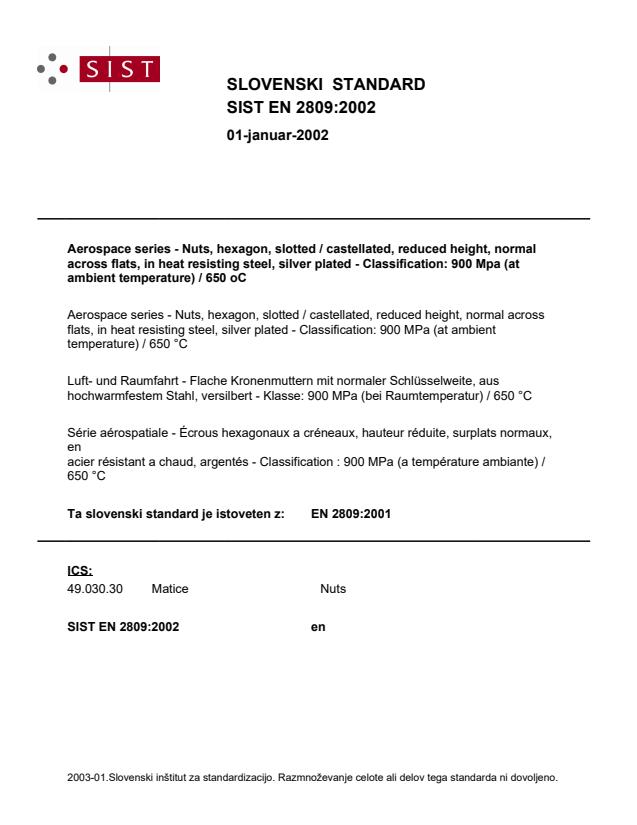
SLOVENSKI STANDARD
01-januar-2002
Aerospace series - Nuts, hexagon, slotted / castellated, reduced height, normal
across flats, in heat resisting steel, silver plated - Classification: 900 Mpa (at
ambient temperature) / 650 oC
Aerospace series - Nuts, hexagon, slotted / castellated, reduced height, normal across
flats, in heat resisting steel, silver plated - Classification: 900 MPa (at ambient
temperature) / 650 °C
Luft- und Raumfahrt - Flache Kronenmuttern mit normaler Schlüsselweite, aus
hochwarmfestem Stahl, versilbert - Klasse: 900 MPa (bei Raumtemperatur) / 650 °C
Série aérospatiale - Écrous hexagonaux a créneaux, hauteur réduite, surplats normaux,
en
acier résistant a chaud, argentés - Classification : 900 MPa (a température ambiante) /
650 °C
Ta slovenski standard je istoveten z: EN 2809:2001
ICS:
49.030.30 Matice Nuts
2003-01.Slovenski inštitut za standardizacijo. Razmnoževanje celote ali delov tega standarda ni dovoljeno.
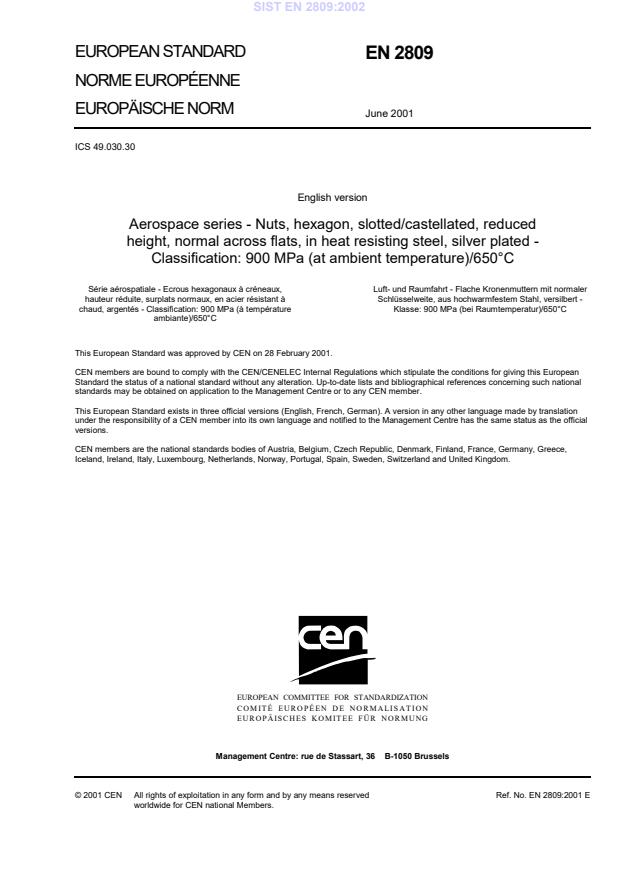
EUROPEAN STANDARD
EN 2809
NORME EUROPÉENNE
EUROPÄISCHE NORM
June 2001
ICS 49.030.30
English version
Aerospace series - Nuts, hexagon, slotted/castellated, reduced
height, normal across flats, in heat resisting steel, silver plated -
Classification: 900 MPa (at ambient temperature)/650°C
Série aérospatiale - Ecrous hexagonaux à créneaux, Luft- und Raumfahrt - Flache Kronenmuttern mit normaler
hauteur réduite, surplats normaux, en acier résistant à Schlüsselweite, aus hochwarmfestem Stahl, versilbert -
chaud, argentés - Classification: 900 MPa (à température Klasse: 900 MPa (bei Raumtemperatur)/650°C
ambiante)/650°C
This European Standard was approved by CEN on 28 February 2001.
CEN members are bound to comply with the CEN/CENELEC Internal Regulations which stipulate the conditions for giving this European
Standard the status of a national standard without any alteration. Up-to-date lists and bibliographical references concerning such national
standards may be obtained on application to the Management Centre or to any CEN member.
This European Standard exists in three official versions (English, French, German). A version in any other language made by translation
under the responsibility of a CEN member into its own language and notified to the Management Centre has the same status as the official
versions.
CEN members are the national standards bodies of Austria, Belgium, Czech Republic, Denmark, Finland, France, Germany, Greece,
Iceland, Ireland, Italy, Luxembourg, Netherlands, Norway, Portugal, Spain, Sweden, Switzerland and United Kingdom.
EUROPEAN COMMITTEE FOR STANDARDIZATION
COMITÉ EUROPÉEN DE NORMALISATION
EUROPÄISCHES KOMITEE FÜR NORMUNG
Management Centre: rue de Stassart, 36 B-1050 Brussels
© 2001 CEN All rights of exploitation in any form and by any means reserved Ref. No. EN 2809:2001 E
worldwide for CEN national Members.
Page 2
Foreword
This European Standard has been prepared by the European Association of Aerospace Manufacturers
(AECMA).
After inquiries and votes carried out in accordance with the rules of this Association, this Standard has
received the approval of the National Associations and the Official Services of the member countries of
AECMA, prior to its presentation to CEN.
This European Standard shall be given the status of a national standard, either by publication of an identical
text or by endorsement, at the latest by December 2001, and conflicting national standards shall be
withdrawn at the latest by December 2001.
According to the CEN/CENELEC Internal Regulations, the national standards organizations of the following
countries are bound to implement this European Standard: Austria, Belgium, Czech Republic, Denmark,
Finland, France, Germany, Greece, Iceland, Ireland, Italy, Luxembourg, Netherlands, Norway, Portugal,
Spain, Sweden, Switzerland and the United Kingdom.
Page 3
1 Scope
This standard specifies the characteristics of hexagonal slotted / castellated nuts, reduced height, normal
across flats, in heat resisting steel, silver plated.
1) 2)
Classification: 900 MPa / 650 °C
2 Normative references
This European Standard incorporates by dated or undated reference provisions from other publications.
These normative references are cited at the appropriate places in the text and the publications are listed
hereafter. For dated references, subsequent amendments to or revisions of any of these publications apply to
this European Standard only when incorporated in it by amendment or revision. For undated references the
l
...