


SIST-TS CLC/TS 50740:2025
(Main)Technical Specification for ground-based feeding systems for dynamic electric road charging infrastructure on road vehicles in operation
Technical Specification for ground-based feeding systems for dynamic electric road charging infrastructure on road vehicles in operation
This document specifies the infrastructure part defined in Figure 1 and Figure A.2 of the conducted ground based feeding systems and their interfaces.
The charging infrastructure can be used for charging all road vehicle types at standstill or in motion.
This document covers the following aspects:
- interaction between the ground based feeding systems and ERS vehicles;
- electrical safety and stray current protection (in case of DC electric traction power supply systems);
- environmental requirements;
- validation requirements.
This document defines the interfaces between:
- the ground based feeding system and the grid;
- the infrastructure of the ground based feeding system and the on-board current collector devices of the vehicles including the specificities according to the different interface types.
This document is not applicable to the on-board part of the conducted ground based feeding systems.
This document is not applicable to motorcycles (including tricycles and quadricycles).
This document is not applicable to vehicles or electric buses with dynamic or static inductive charging systems and related power supplies.
This document is not applicable to vehicles or electric buses with dynamic or static conductive charging systems through overhead lines.
This document does not apply for charging stations with only a plug-in solution.
Technische Spezifikation für bodenseitige Einspeiseanlagen für die dynamische elektrische Straßenladeinfrastruktur für Straßenfahrzeuge in Betrieb
Spécification Technique de l'infrastructure de recharge électrique dynamique des systèmes de recharge sur route par le sol des véhicules routiers.
Tehnična specifikacija za talne napajalne sisteme za dinamično električno cestno infrastrukturo za polnjenje cestnih vozil med obratovanjem
Ta dokument določa del infrastrukture, opredeljen na slikah 1 in A.2, za prevodne talne napajalne sisteme in njihove vmesnike. Polnilno infrastrukturo je mogoče uporabljati za polnjenje vseh vrst cestnih vozil v mirovanju ali med vožnjo. Ta dokument zajema naslednje vidike: – interakcija med talnimi napajalnimi sistemi in vozili, ki uporabljajo električni cestni sistem (ERS); – električna varnost in zaščita pred blodečimi tokovi (v primeru enosmernih napajalnih sistemov električne vleke); – okoljske zahteve; – zahteve za validacijo. Ta dokument opredeljuje vmesnike med: – talnim napajalnim sistemom in omrežjem; – infrastrukturo talnega napajalnega sistema in tokovnimi odjemniki v vozilih, vključno s posebnostmi različnih vrst vmesnikov. Ta dokument se ne uporablja za del prevodnega talnega napajalnega sistema, ki je v vozilu. Ta dokument se ne uporablja za motorna kolesa (vključno s trikolesnimi in štirikolesnimi vozili). Ta dokument se ne uporablja za vozila ali električne avtobuse z dinamičnim ali statično induktivnim sistemom polnjenja in s tem povezanim napajanjem. Ta dokument se ne uporablja za vozila ali električne avtobuse z dinamičnim ali statično prevodnim sistemom polnjenja prek nadzemnih vodov. Ta dokument se ne uporablja za vtične polnilne postaje.
General Information
Standards Content (Sample)
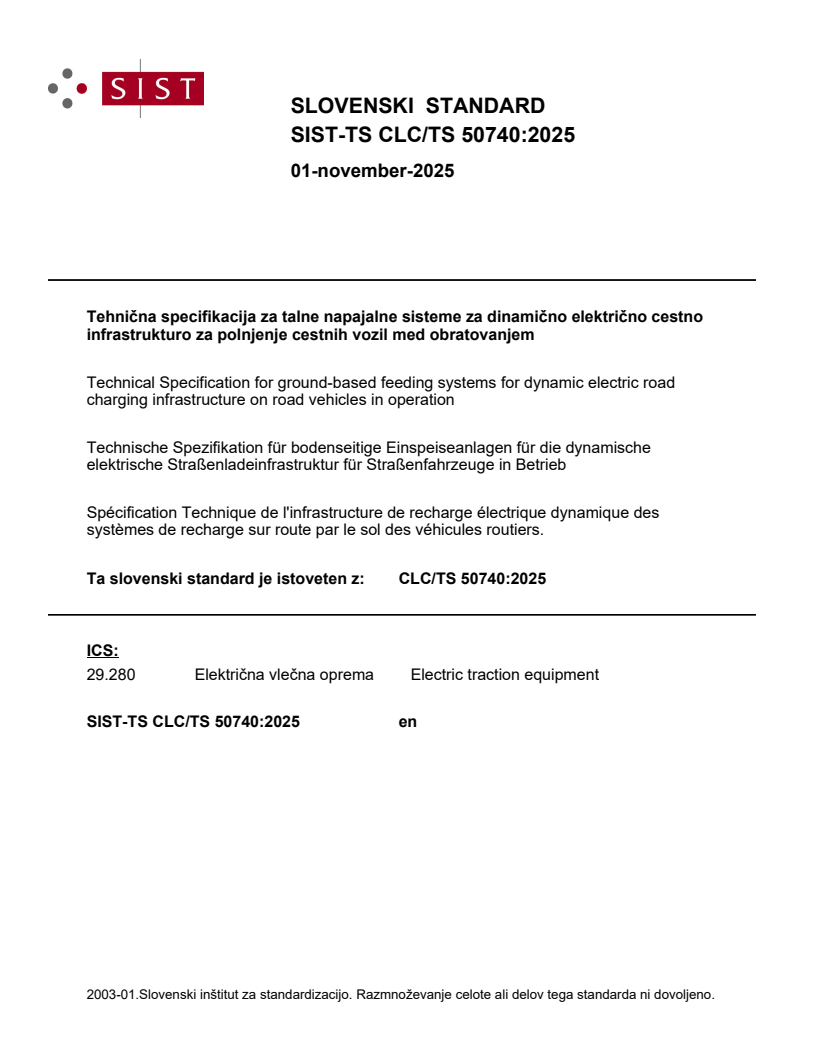
SLOVENSKI STANDARD
01-november-2025
Tehnična specifikacija za talne napajalne sisteme za dinamično električno cestno
infrastrukturo za polnjenje cestnih vozil med obratovanjem
Technical Specification for ground-based feeding systems for dynamic electric road
charging infrastructure on road vehicles in operation
Technische Spezifikation für bodenseitige Einspeiseanlagen für die dynamische
elektrische Straßenladeinfrastruktur für Straßenfahrzeuge in Betrieb
Spécification Technique de l'infrastructure de recharge électrique dynamique des
systèmes de recharge sur route par le sol des véhicules routiers.
Ta slovenski standard je istoveten z: CLC/TS 50740:2025
ICS:
29.280 Električna vlečna oprema Electric traction equipment
2003-01.Slovenski inštitut za standardizacijo. Razmnoževanje celote ali delov tega standarda ni dovoljeno.
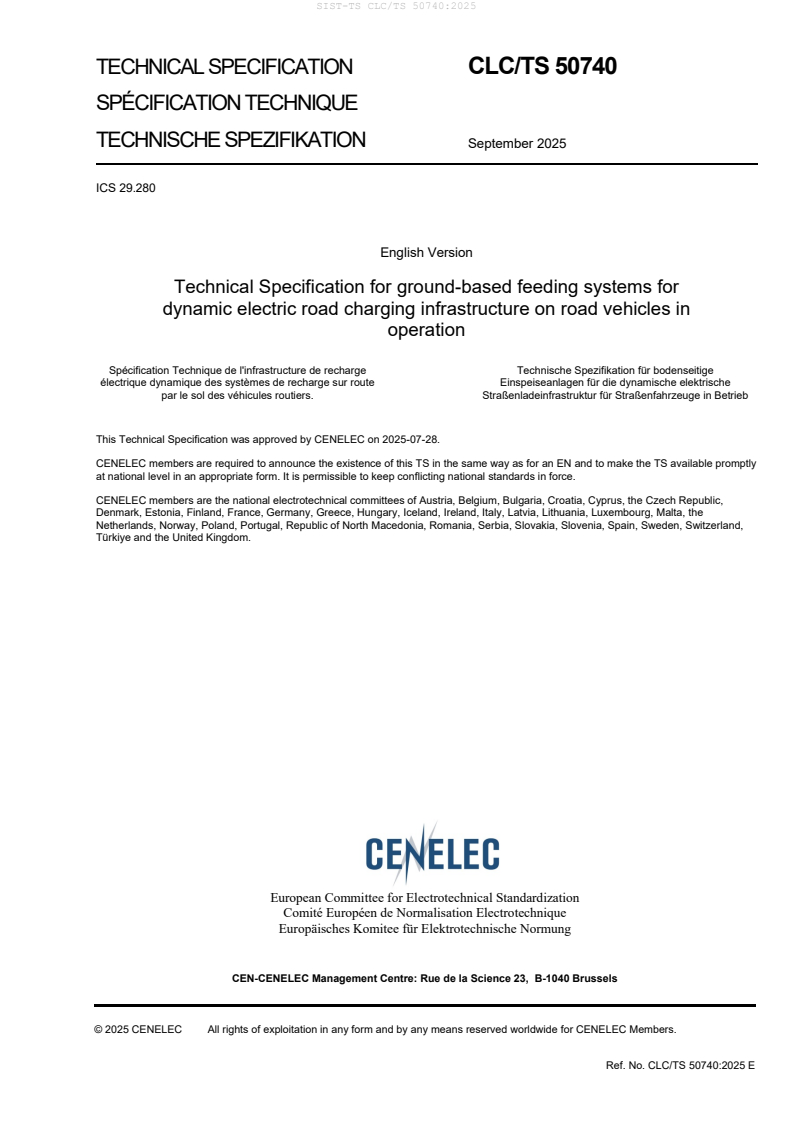
TECHNICAL SPECIFICATION CLC/TS 50740
SPÉCIFICATION TECHNIQUE
TECHNISCHE SPEZIFIKATION September 2025
ICS 29.280
English Version
Technical Specification for ground-based feeding systems for
dynamic electric road charging infrastructure on road vehicles in
operation
Spécification Technique de l'infrastructure de recharge Technische Spezifikation für bodenseitige
électrique dynamique des systèmes de recharge sur route Einspeiseanlagen für die dynamische elektrische
par le sol des véhicules routiers. Straßenladeinfrastruktur für Straßenfahrzeuge in Betrieb
This Technical Specification was approved by CENELEC on 2025-07-28.
CENELEC members are required to announce the existence of this TS in the same way as for an EN and to make the TS available promptly
at national level in an appropriate form. It is permissible to keep conflicting national standards in force.
CENELEC members are the national electrotechnical committees of Austria, Belgium, Bulgaria, Croatia, Cyprus, the Czech Republic,
Denmark, Estonia, Finland, France, Germany, Greece, Hungary, Iceland, Ireland, Italy, Latvia, Lithuania, Luxembourg, Malta, the
Netherlands, Norway, Poland, Portugal, Republic of North Macedonia, Romania, Serbia, Slovakia, Slovenia, Spain, Sweden, Switzerland,
Türkiye and the United Kingdom.
European Committee for Electrotechnical Standardization
Comité Européen de Normalisation Electrotechnique
Europäisches Komitee für Elektrotechnische Normung
CEN-CENELEC Management Centre: Rue de la Science 23, B-1040 Brussels
© 2025 CENELEC All rights of exploitation in any form and by any means reserved worldwide for CENELEC Members.
Ref. No. CLC/TS 50740:2025 E
Contents Page
European foreword . 4
Introduction . 5
1 Scope . 6
2 Normative references . 6
3 Terms and definitions . 7
4 Abbreviations . 9
5 ERS infrastructure . 9
5.1 General . 9
5.2 Common aspects . 10
5.2.1 Feeding track . 10
5.2.2 Feeding track connection ducts . 10
5.2.3 Road circuit breakers . 11
5.2.4 ERS Power Supply Substation . 11
5.2.5 ERS operation and control centre . 11
5.3 Charging infrastructure type A (successive conductor segment) . 11
5.3.1 Feeding track . 11
5.3.2 Road circuit breakers . 12
5.4 Charging infrastructure type B (parallel conductor segment) . 12
6 Interface requirements . 14
6.1 Interface with the grid energy supplier. 14
6.2 Interface with ERS vehicles and their current collector devices . 14
6.3 Interface with road vehicle tyres . 14
6.4 Interface with the road pavement. 15
6.5 Interface with the roadside soil . 15
7 Interaction with ERS vehicles . 15
8 Electrical requirements . 15
9 Safety requirements . 15
10 Environmental requirements . 16
11 Validation and maintenance requirements . 16
11.1 Validation requirements . 16
11.2 Maintenance requirements . 16
Annex A (informative) ERS architecture . 17
A.1 General . 17
A.2 General . 19
A.2.1 Transformer / Rectifier . 19
A.2.2 Main circuit breaker . 19
A.2.3 ERS Main control cubicle . 19
A.2.4 Road circuit breakers . 19
A.2.5 Feeding track . 19
A.3 ERS on-board equipment . 19
Bibliography . 20
Figures
Figure 1 — ERS infrastructure and its environment . 10
Figure 2 — Top view of the feeding track . 12
Figure 3 — Cross section view of the feeding track . 13
Figure 4 — Top view of the feeding track . 13
Figure A.1 — ERS power supply distribution (example) . 17
Figure A.2 — ERS system overall architecture . 18
Tables
Table 1 — Dimensions of the feeding track elements type A . 12
Table 2 — Dimensions of the feeding track elements type B . 14
European foreword
This document (CLC/TS 50740:2025) has been prepared by CLC/TC 9X “Electrical and electronic applications
for railways”.
Attention is drawn to the possibility that some of the elements of this document may be the subject of patent
rights. CENELEC shall not be held responsible for identifying any or all such patent rights.
This document has been prepared under a standardization request addressed to CENELEC by the European
Commission. The Standing Committee of the EFTA States subsequently approves these requests for its
Member States.
Any feedback and questions on this document should be directed to the users’ national committee. A
complete listing of these bodies can be found on the CENELEC website
Introduction
This document is written in the frame of the standardization of one the families of Electric Road Systems that
are developed to reduce carbon dioxide and other emissions caused by road traffic (see description in
Annex A).
This document is limited to the infrastructure part of the conducted ground-based feeding ERS family and
contains requirements for all types of these systems.
The infrastructure of the dynamic electric power supply is in charge, as described in Figure A.2, to transform
the electricity from the grid and to transfer it safely to the road vehicles via metallic segments installed at road
level. The on-board part of the ERS described in Figure A.2 is dealt with in CLC/TS 50717:2022. ERS
solutions for dynamic supply of road vehicles need to be standardized to allow for interoperable, international
vehicle operation.
1 Scope
This document specifies the infrastructure part defined in Figure 1 and Figure A.2 of the conducted ground-
based feeding systems and their interfaces.
The charging infrastructure can be used for charging all road vehicle types at standstill or in motion.
This document covers the following aspects:
— interaction between the ground-based feeding systems and ERS vehicles;
— electrical safety and stray current protection (in case of DC electric traction power supply systems);
— environmental requirements;
— validation requirements.
This document defines the interfaces between:
— the ground-based feeding system and the grid;
— the infrastructure of the ground-based feeding system and the on-board current collector devices of the
vehicles including the specificities according to the different interface types.
This document is not applicable to the on-board part of the conducted ground-based feeding systems.
This document is not applicable to motorcycles (including tricycles and quadricycles).
This document is not applicable to vehicles or electric buses with dynamic or static inductive charging systems
and related power supplies.
This document is not applicable to vehicles or electric buses with dynamic or static conductive charging
systems through overhead lines.
This document does not apply for charging stations with only a plug-in solution.
2 Normative references
The following documents are referred to in the text in such a way that some or all of their content constitutes
requirements of this document. For dated references, only the edition cited applies. For undated references,
the latest edition of the referenced document (including any amendments) applies.
EN 50121-5, Railway applications - Electromagnetic compatibility - Part 5: Emission and immunity of fixed
power supply installations and apparatus
EN 50122-1, Railway applications — Fixed installations — Electrical safety, earthing and the return circuit —
Part 1: Protective provisions against electric shock
EN 50122-2, Railway applications — Fixed installations — Electrical safety, earthing and the return circuit —
Part 2: Provisions against the effects of stray currents caused by d.c. traction systems
EN 50160, Voltage characteristics of electricity supplied by public electricity networks
EN 50163, Railway applications - Supply voltages of traction systems
EN 50328, Railway applications - Fixed installations - Electronic power converters for substations
EN 50329, Railway applications - Fixed installations - Traction transformers
EN 50562, Railway applications - Fixed installations - Process, protective measures and demonstration of
safety for electric traction systems
CLC/TS 50717:2022, Technical Requirements for Current Collectors for ground-level feeding system on road
vehicles in operation
EN IEC 61000 (all parts), Electromagnetic compatibility (EMC) (IEC 61000)
3 Terms and definitions
For the purposes of this document, the following terms and definitions apply.
ISO and IEC maintain terminology databases for use in standardization at the following addresses:
— ISO Online browsing platform: available at https://www.iso.org/obp
— IEC Electropedia: available at https://www.electropedia.org/
3.1
Electric Road System
ERS
system that enables dynamic power transfer to ERS vehicles whilst they are driving
Note 1 to entry: By integrating power transfer technology into existing road infrastructure, an electrified road will be
accessible to both vehicles that use power transmission and other vehicles.
3.2
ERS infrastructure
ERS components installed alongside or at road level to supply the ERS vehicles
3.3
main circuit breaker
electrical safety device that protects an electrical road section
3.4
road circuit breaker
electrical safety device that protect a conductive segment
3.5
main control cubicle
ERS cubicle that controls and monitors the road circuit breakers
3.6
ERS operation and control centre
system that controls and monitors the ERS infrastructure electrical and electronic devices
3.7
road operation and control centre
system that controls and monitors road operation
3.8
Current Collector Device
CCD
retractable mechanical apparatus mounted underneath the vehicle which is intended to collect by contact the
current from conductive segments
Note 1 to entry: CCD is “on” when supplied with extra-low voltage and “off” when it is not supplied
3.9
feeding track
continuous insulated track integrated into the roadway and containing the conductive segments
3.10
electrical section
part of the feeding track that is powered and controlled by a main circuit breaker
3.11
conductive segment
elementary longitudinal element of the feeding track composed of the metallic parts in interface with the CCD
to transfer the current and bring back the return current
3.12
ERS vehicle
standard vehicle which is compatible with ERS
3.13
Low Voltage
LV
voltage normally not exceeding 1 000 V AC or 1 500 V DC
[SOURCE: IEC 60050-195:2021, 195-05-25, modified – “normally” has been added. “a conventionally adopted
limit” has been replaced with “1 000 V AC or 1 500 V DC”. Notes 1 and 2 to entry have been omitted because
the content has been merged in the definition.]
3.14
High Voltage
HV
voltage normally exceeding the conventionally adopted limit for Low Voltage
[SOURCE: IEC 60050-195:2021, 195-05-26, modified – “normally” has been added.]
3.15
DC-
direct current negative
3.16
DC+
direct current positive
3.17
touch voltage
U
te
voltage between conductive parts when touched simultaneously by a person or an animal
Note 1 to entry: The value of the effective touch voltage can be appreciably influenced by the impedance of the person
or the animal in electric contact with these conductive parts.
Note 2 to entry: The conductive path though the body is conventionally from hand to both feet (horizontal distance of
1m) or from hand to hand
[SOURCE: IEC 60050-195:2021, 195-05-11, modified – “human being or livestock” has been replaced with
“person or an animal”. Note 1 to entry has been adapted. Note 2 to entry has been added.]
3.18
leakage current
electric current in an unwanted conductive path under normal operating conditions
[SOURCE: IEC 60050-195:2021, 195-05-15, modified – “operating” has been added.]
3.19
potential barrier
conductive barrier, connected to DC- in the power substation is used to avoid current
leakage outside the ERS feeding track
3.20
DC- segment
negative conductive segment, connected to DC- in the power substation, used to collect the return current
from the vehicle via the CCD
3.21
DC+ segment
positive conductive segment, connected to DC+ in the power substation, used to transfer the current to the
vehicle via the CCD
3.22
grid
medium voltage electrical network
4 Abbreviations
AC Alternative Current
CC Center-to-Center
CCD Current Collector Device
CCR Current Collector Retractable
DC Direct Current
EMC Electro Magnetic Compatibility
ERS Electric Road System
HV High Voltage
LV Low Voltage
5 ERS infrastructure
5.1 Ge
...
Questions, Comments and Discussion
Ask us and Technical Secretary will try to provide an answer. You can facilitate discussion about the standard in here.