

SIST-TS ETSI/TS 102 657 V2.3.1:2024
(Main)Lawful Interception (LI) - Retained data handling - Handover interface for the request and delivery of retained data
General Information
- Abstract
The present document is based on requirements from ETSI TS 102 656 [2].
The present document contains handover requirements and a handover specification for the data that is identified in
national legislations on Retained Data.
The present document considers both the requesting of retained data and the delivery of the results.
The present document defines an electronic interface. An informative annex describes how this interface may be
adapted for manual techniques. Apart from in annex I, the present document does not consider manual techniques.
- Status
- Published
- Publication Date
- 28-May-2024
- Technical Committee
- SPN - Services and Protocols for Networks
- Current Stage
- 6060 - National Implementation/Publication (Adopted Project)
- Start Date
- 24-May-2024
- Due Date
- 29-Jul-2024
- Completion Date
- 29-May-2024

Overview
SIST-TS ETSI/TS 102 657 V2.3.1:2024 is a Slovenian standard developed by SIST, fully aligned with the European ETSI Technical Specification. This standard details the requirements and specifications for handover interfaces used in Lawful Interception (LI), specifically for the request and delivery of retained data. It provides an electronic, standardized approach to facilitate the secure, reliable exchange of retained data, as required by national legislations. The scope follows guidelines from ETSI TS 102 656 and covers both automated and (in an informative annex) manual procedures for submitting and fulfilling data requests.
This standard is vital for communications service providers (CSPs), law enforcement authorities (LEAs), and regulatory bodies, ensuring compliance, interoperability, and data security in lawful interception processes.
Key Topics
- Handover Requirements: Specifies requirements for interfaces between CSPs and authorized organizations concerning the exchange of retained data.
- Interface Specification: Defines the structure and protocol for electronic handover interfaces facilitating both the request for and delivery of retained data.
- Message Flows: Outlines message types, flows, and state diagrams, including handling of responses, cancellations, errors, and multipart deliveries.
- Data Exchange Techniques: Supports practical data transport mechanisms, primarily HTTP and direct TCP, ensuring efficient, secure data exchanges.
- Retained Data Structure: Details on how to structure and format data associated with requests and responses, covering identifiers, timestamps, priorities, and limits.
- Security Measures: Specifies technical safeguards such as connection-level and application-level security, including digital signatures and non-repudiation for robust data protection.
- Service-Specific Details: Provides normative annexes for various telecommunications and internet services, including telephony, messaging, multimedia, and network access.
Applications
This standard finds practical use in environments where compliance with lawful interception and data retention legislation is required:
- Communications Service Providers (CSPs): Ensures CSPs have a compliant and standardized approach to handling lawful requests for retained data, reducing legal and technical risks.
- Law Enforcement Authorities (LEAs): Enables authorized agencies to request data efficiently and securely according to regulatory requirements.
- Technology Vendors: Assists solution providers building systems for LI compliance, supporting integration and interoperability through standardized handover interfaces.
- Regulatory Oversight: Facilitates review and auditing of retained data handling processes, supporting transparent and accountable compliance.
Key benefits include:
- Enhanced interoperability between different network operators and law enforcement systems.
- Improved automation, minimizing procedural errors and delays.
- Strong security features to protect sensitive retained data and maintain chain of custody.
- Support for diverse communication services, reflecting the evolution of telecom and data services.
Related Standards
- ETSI TS 102 656: Baseline specification for retained data handover interfaces, forming the foundation for SIST-TS ETSI/TS 102 657.
- ETSI Lawful Interception Standards: A comprehensive suite addressing related topics such as data retention, interception interfaces, and security.
- National Legislation: Implementations must also refer to specific national laws on retained data, LI, and data privacy.
Other related standards include:
- Data communication networks (ICS 33.040.40)
- Interface and interconnection equipment (ICS 35.200)
Summary
SIST-TS ETSI/TS 102 657 V2.3.1:2024 delivers a vital, robust framework for the lawful, secure, and standardized handling of retained data in electronic communications. By adhering to this standard, organizations achieve regulatory compliance, improved interoperability, and ensured data protection across telecommunications infrastructures. For the latest standard and updates, reference materials are available at the official ETSI and SIST portals.
Get Certified
Connect with accredited certification bodies for this standard

BSI Group
BSI (British Standards Institution) is the business standards company that helps organizations make excellence a habit.

NYCE
Mexican standards and certification body.

ANCE
Mexican certification and testing association.
Sponsored listings
Frequently Asked Questions
SIST-TS ETSI/TS 102 657 V2.3.1:2024 is a standard published by the Slovenian Institute for Standardization (SIST). Its full title is "Lawful Interception (LI) - Retained data handling - Handover interface for the request and delivery of retained data". This standard covers: The present document is based on requirements from ETSI TS 102 656 [2]. The present document contains handover requirements and a handover specification for the data that is identified in national legislations on Retained Data. The present document considers both the requesting of retained data and the delivery of the results. The present document defines an electronic interface. An informative annex describes how this interface may be adapted for manual techniques. Apart from in annex I, the present document does not consider manual techniques.
The present document is based on requirements from ETSI TS 102 656 [2]. The present document contains handover requirements and a handover specification for the data that is identified in national legislations on Retained Data. The present document considers both the requesting of retained data and the delivery of the results. The present document defines an electronic interface. An informative annex describes how this interface may be adapted for manual techniques. Apart from in annex I, the present document does not consider manual techniques.
SIST-TS ETSI/TS 102 657 V2.3.1:2024 is classified under the following ICS (International Classification for Standards) categories: 33.040.40 - Data communication networks; 35.200 - Interface and interconnection equipment. The ICS classification helps identify the subject area and facilitates finding related standards.
SIST-TS ETSI/TS 102 657 V2.3.1:2024 is available in PDF format for immediate download after purchase. The document can be added to your cart and obtained through the secure checkout process. Digital delivery ensures instant access to the complete standard document.
Standards Content (Sample)
TECHNICAL SPECIFICATION
Lawful Interception (LI);
Retained data handling;
Handover interface for the request and
delivery of retained data
2 ETSI TS 102 657 V2.3.1 (2024-03)
Reference
RTS/LI-00256
Keywords
handover, retention
ETSI
650 Route des Lucioles
F-06921 Sophia Antipolis Cedex - FRANCE
Tel.: +33 4 92 94 42 00 Fax: +33 4 93 65 47 16
Siret N° 348 623 562 00017 - APE 7112B
Association à but non lucratif enregistrée à la
Sous-Préfecture de Grasse (06) N° w061004871
Important notice
The present document can be downloaded from:
https://www.etsi.org/standards-search
The present document may be made available in electronic versions and/or in print. The content of any electronic and/or
print versions of the present document shall not be modified without the prior written authorization of ETSI. In case of any
existing or perceived difference in contents between such versions and/or in print, the prevailing version of an ETSI
deliverable is the one made publicly available in PDF format at www.etsi.org/deliver.
Users of the present document should be aware that the document may be subject to revision or change of status.
Information on the current status of this and other ETSI documents is available at
https://portal.etsi.org/TB/ETSIDeliverableStatus.aspx
If you find errors in the present document, please send your comment to one of the following services:
https://portal.etsi.org/People/CommiteeSupportStaff.aspx
If you find a security vulnerability in the present document, please report it through our
Coordinated Vulnerability Disclosure Program:
https://www.etsi.org/standards/coordinated-vulnerability-disclosure
Notice of disclaimer & limitation of liability
The information provided in the present deliverable is directed solely to professionals who have the appropriate degree of
experience to understand and interpret its content in accordance with generally accepted engineering or
other professional standard and applicable regulations.
No recommendation as to products and services or vendors is made or should be implied.
No representation or warranty is made that this deliverable is technically accurate or sufficient or conforms to any law
of merchantability or fitness
and/or governmental rule and/or regulation and further, no representation or warranty is made
for any particular purpose or against infringement of intellectual property rights.
In no event shall ETSI be held liable for loss of profits or any other incidental or consequential damages.
Any software contained in this deliverable is provided "AS IS" with no warranties, express or implied, including but not
limited to, the warranties of merchantability, fitness for a particular purpose and non-infringement of intellectual property
rights and ETSI shall not be held liable in any event for any damages whatsoever (including, without limitation, damages
for loss of profits, business interruption, loss of information, or any other pecuniary loss) arising out of or related to the use
of or inability to use the software.
Copyright Notification
No part may be reproduced or utilized in any form or by any means, electronic or mechanical, including photocopying and
microfilm except as authorized by written permission of ETSI.
The content of the PDF version shall not be modified without the written authorization of ETSI.
The copyright and the foregoing restriction extend to reproduction in all media.
© ETSI 2024.
All rights reserved.
ETSI
3 ETSI TS 102 657 V2.3.1 (2024-03)
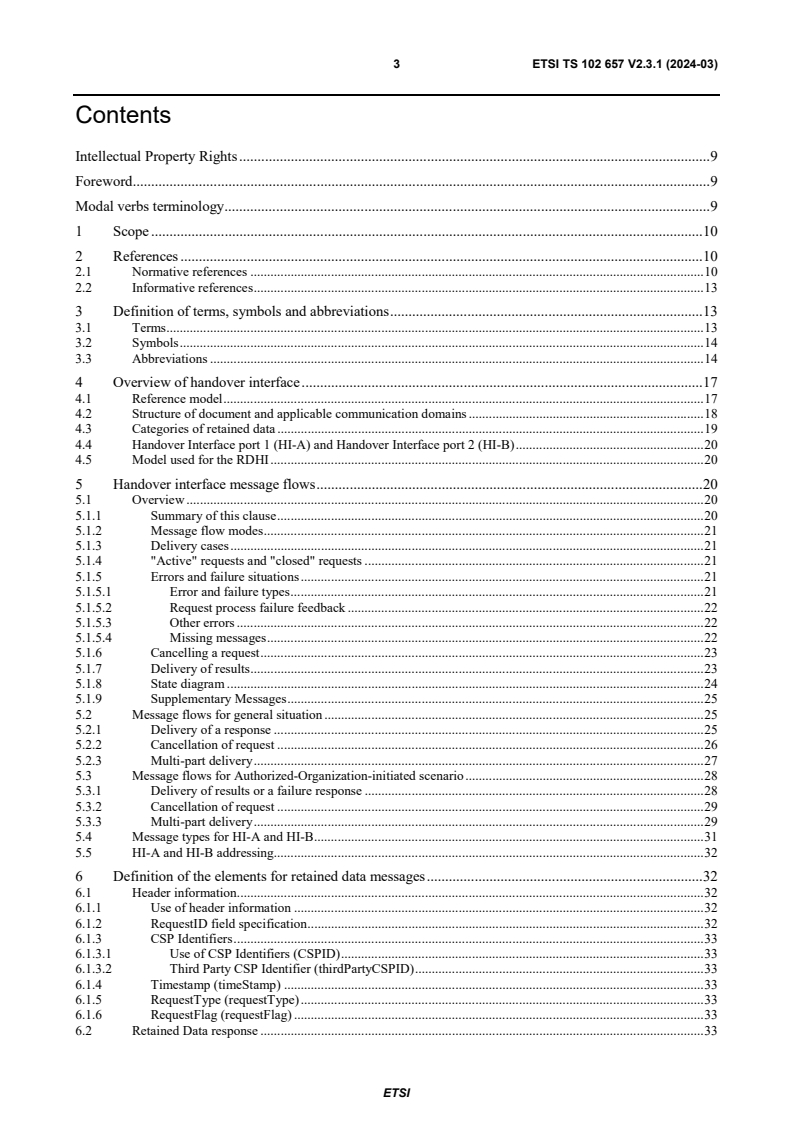
Contents
Intellectual Property Rights . 9
Foreword . 9
Modal verbs terminology . 9
1 Scope . 10
2 References . 10
2.1 Normative references . 10
2.2 Informative references . 13
3 Definition of terms, symbols and abbreviations . 13
3.1 Terms . 13
3.2 Symbols . 14
3.3 Abbreviations . 14
4 Overview of handover interface . 17
4.1 Reference model . 17
4.2 Structure of document and applicable communication domains . 18
4.3 Categories of retained data . 19
4.4 Handover Interface port 1 (HI-A) and Handover Interface port 2 (HI-B) . 20
4.5 Model used for the RDHI . 20
5 Handover interface message flows . 20
5.1 Overview . 20
5.1.1 Summary of this clause . 20
5.1.2 Message flow modes . 21
5.1.3 Delivery cases . 21
5.1.4 "Active" requests and "closed" requests . 21
5.1.5 Errors and failure situations . 21
5.1.5.1 Error and failure types . 21
5.1.5.2 Request process failure feedback . 22
5.1.5.3 Other errors . 22
5.1.5.4 Missing messages . 22
5.1.6 Cancelling a request . 23
5.1.7 Delivery of results . 23
5.1.8 State diagram . 24
5.1.9 Supplementary Messages . 25
5.2 Message flows for general situation . 25
5.2.1 Delivery of a response . 25
5.2.2 Cancellation of request . 26
5.2.3 Multi-part delivery . 27
5.3 Message flows for Authorized-Organization-initiated scenario . 28
5.3.1 Delivery of results or a failure response . 28
5.3.2 Cancellation of request . 29
5.3.3 Multi-part delivery . 29
5.4 Message types for HI-A and HI-B . 31
5.5 HI-A and HI-B addressing. 32
6 Definition of the elements for retained data messages . 32
6.1 Header information. 32
6.1.1 Use of header information . 32
6.1.2 RequestID field specification . 32
6.1.3 CSP Identifiers . 33
6.1.3.1 Use of CSP Identifiers (CSPID) . 33
6.1.3.2 Third Party CSP Identifier (thirdPartyCSPID) . 33
6.1.4 Timestamp (timeStamp) . 33
6.1.5 RequestType (requestType) . 33
6.1.6 RequestFlag (requestFlag) . 33
6.2 Retained Data response . 33
ETSI
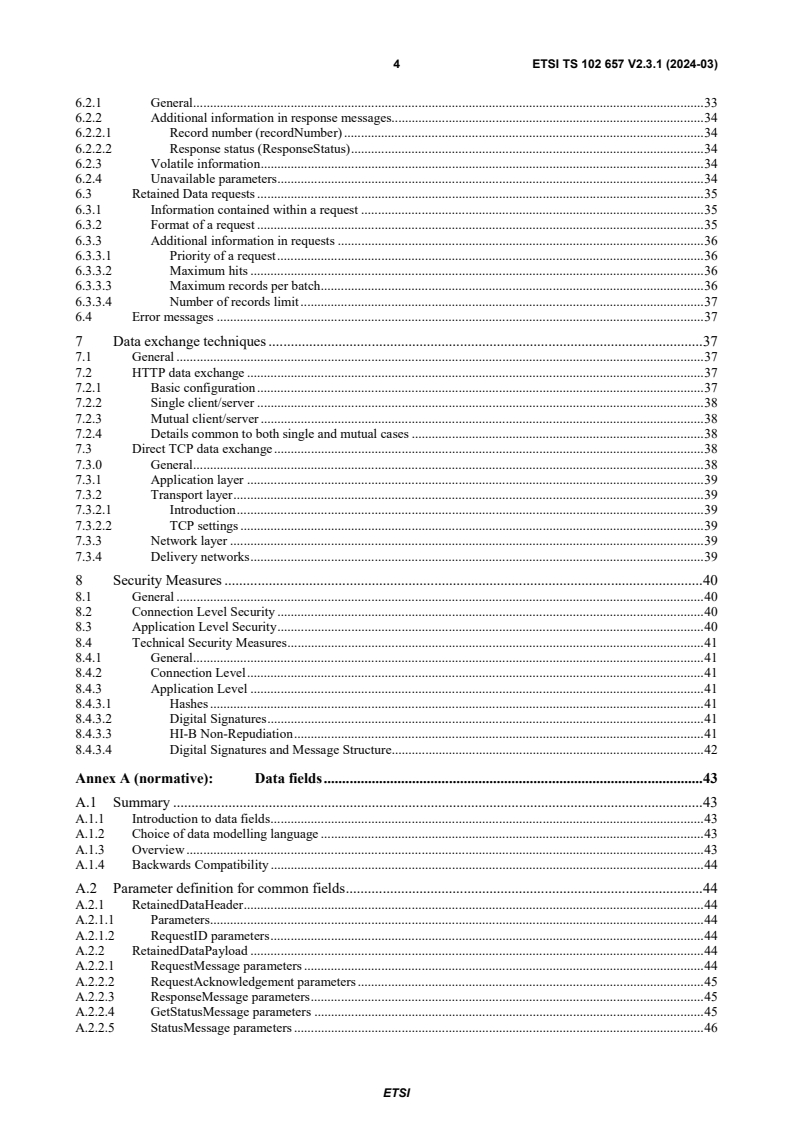
4 ETSI TS 102 657 V2.3.1 (2024-03)
6.2.1 General . 33
6.2.2 Additional information in response messages. 34
6.2.2.1 Record number (recordNumber) . 34
6.2.2.2 Response status (ResponseStatus) . 34
6.2.3 Volatile information . 34
6.2.4 Unavailable parameters . 34
6.3 Retained Data requests . 35
6.3.1 Information contained within a request . 35
6.3.2 Format of a request . 35
6.3.3 Additional information in requests . 36
6.3.3.1 Priority of a request . 36
6.3.3.2 Maximum hits . 36
6.3.3.3 Maximum records per batch . 36
6.3.3.4 Number of records limit . 37
6.4 Error messages . 37
7 Data exchange techniques . 37
7.1 General . 37
7.2 HTTP data exchange . 37
7.2.1 Basic configuration . 37
7.2.2 Single client/server . 38
7.2.3 Mutual client/server . 38
7.2.4 Details common to both single and mutual cases . 38
7.3 Direct TCP data exchange . 38
7.3.0 General . 38
7.3.1 Application layer . 39
7.3.2 Transport layer . 39
7.3.2.1 Introduction . 39
7.3.2.2 TCP settings . 39
7.3.3 Network layer . 39
7.3.4 Delivery networks . 39
8 Security Measures . 40
8.1 General . 40
8.2 Connection Level Security . 40
8.3 Application Level Security . 40
8.4 Technical Security Measures . 41
8.4.1 General . 41
8.4.2 Connection Level . 41
8.4.3 Application Level . 41
8.4.3.1 Hashes . 41
8.4.3.2 Digital Signatures . 41
8.4.3.3 HI-B Non-Repudiation . 41
8.4.3.4 Digital Signatures and Message Structure . 42
Annex A (normative): Data fields . 43
A.1 Summary . 43
A.1.1 Introduction to data fields . 43
A.1.2 Choice of data modelling language . 43
A.1.3 Overview . 43
A.1.4 Backwards Compatibility . 44
A.2 Parameter definition for common fields . 44
A.2.1 RetainedDataHeader . 44
A.2.1.1 Parameters. 44
A.2.1.2 RequestID parameters . 44
A.2.2 RetainedDataPayload . 44
A.2.2.1 RequestMessage parameters . 44
A.2.2.2 RequestAcknowledgement parameters . 45
A.2.2.3 ResponseMessage parameters . 45
A.2.2.4 GetStatusMessage parameters . 45
A.2.2.5 StatusMessage parameters . 46
ETSI
5 ETSI TS 102 657 V2.3.1 (2024-03)
A.2.2.6 ErrorMessage parameters . 46
A.2.3 GenericSubscriberInfo . 46
A.2.3.1 Parameters. 46
A.2.3.2 OrganizationInfo parameters . 46
A.2.3.3 IndividualInfo parameters . 47
A.2.3.4 ContractInformation parameters . 48
A.2.4 PaymentDetails . 48
A.3 ASN.1 definitions . 48
A.3.1 General . 48
A.3.1.1 ASN.1 syntax tree . 48
A.3.1.2 General remarks on ASN.1 . 49
A.3.2 ASN.1 Definitions for message headers . 49
A.3.2.1 Message wrappers . 49
A.3.2.2 Message headers . 49
A.3.3 ASN.1 definitions for common fields. 49
A.3.4 Void . 49
Annex B (normative): Service-specific details for telephony services . 50
B.1 Scope . 50
B.2 Telephony fields . 50
B.2.1 General . 50
B.2.2 Telephony Subscriber . 50
B.2.2.0 General . 50
B.2.2.1 subscriber ID . 50
B.2.2.2 genericSubscriberInfo . 51
B.2.2.3 telephonySubscriberInfo . 51
B.2.2.4 subscribedTelephonyServices . 51
B.2.2.4.1 Description . 51
B.2.3 Telephony Billing Details . 52
B.2.3.0 General . 52
B.2.3.1 BillingRecords . 52
B.2.4 TelephonyServiceUsage . 53
B.2.4.1 Parameters. 53
B.2.4.2 PartyInformation . 53
B.2.4.3 SMSInformation . 54
B.2.4.4 MmsInformation . 54
B.2.5 TelephonyDevice. 55
B.2.5.1 General . 55
B.2.6 TelephonyNetworkElement . 55
B.2.6.1 General . 55
B.2.6.2 Location parameters . 55
B.2.6.2.1 General . 55
B.2.6.2.2 GSM Location Information . 57
B.2.6.2.3 UMTS Location Information . 57
B.2.6.2.4 Extended Location . 57
B.2.6.3 TransmitterDetails parameters . 58
B.2.6.3.1 General . 58
B.3 ASN.1 definitions for telephony . 58
B.4 Void . 58
Annex C (normative): Service-specific details for asynchronous message services . 59
C.1 Scope . 59
C.2 Descriptions . 59
C.2.1 General . 59
C.2.2 MsgSubscriber . 60
C.2.2.0 General . 60
C.2.2.1 MsgSubscriberID . 60
C.2.2.2 MsgStore . 60
ETSI
6 ETSI TS 102 657 V2.3.1 (2024-03)
C.2.2.3 MsgStoreID. 60
C.2.2.4 MsgAddress . 60
C.2.2.5 MsgProviderID . 61
C.2.2.6 MsgForwardingAddresses . 61
C.2.2.7 MsgStoreSubscriberRelatedIDs . 61
C.2.3 MsgServiceUsage . 61
C.2.3.0 General . 61
C.2.3.1 MsgTransmission . 61
C.2.3.2 MsgStoreOperation . 61
C.2.4 MsgBillingDetails parameters . 62
C.2.4.0 General . 62
C.2.4.1 MsgBillingRecords . 62
C.3 ASN.1 definitions for asynchronous message services . 63
C.4 Void . 63
Annex D (normative): Service-specific details for synchronous multi-media services . 64
D.1 Scope . 64
D.2 Multimedia fields . 64
D.2.1 General . 64
D.2.2 Multimedia Subscriber . 64
D.2.2.0 General . 64
D.2.2.1 subscriberID . 65
D.2.2.2 genericSubscriberInfo . 65
D.2.2.3 multimediaSubscriberInfo . 65
D.2.2.4 subscribedMultimediaServices . 65
D.2.2.4.1 Description . 65
D.2.3 MultimediaBillingDetails . 66
D.2.3.1 MultimediaBillingDetails . 66
D.2.3.2 MultimediaBillingAddress . 67
D.2.3.3 MultimediaBillingRecords . 67
D.2.4 Multimedia ServiceUsage . 67
D.2.4.1 Parameters. 67
D.2.4.2 PartyInformation . 68
D.2.4.3 IMSInformation . 69
D.2.4.4 MediaComponents . 69
D.2.5 MultimediaDevice . 70
D.2.5.1 General . 70
D.3 ASN.1 definitions for Multimedia . 70
D.4 Void . 70
Annex E (normative): Service-specific details for network access services . 71
E.1 Scope . 71
E.2 Descriptions . 71
E.2.1 General . 71
E.2.2 NASubscriber . 71
E.2.3 NAServiceSubscription . 72
E.2.4 NAServiceUsage . 72
E.2.5 NADevice . 78
E.2.6 NANwElement . 78
E.2.7 NABillingDetails . 79
E.3 ASN.1 definitions for network access services . 79
E.4 Void . 79
Annex F (informative): Basic set of search routines for Retained Data . 80
F.1 Example set of search routines . 80
ETSI
7 ETSI TS 102 657 V2.3.1 (2024-03)
F.1.1 Overview . 80
F.1.2 Summary of search case . 80
F.1.3 Subscriber records . 80
F.2 Telephony data . 81
F.2.1 Telephony subscriber . 81
F.2.2 Telephony billing details . 81
F.2.3 Telephony service usage . 81
F.2.4 Telephony network element . 82
F.3 Messaging data . 82
F.3.1 Message subscriber. 82
F.3.2 Message service usage . 82
F.4 Network Access data . 83
F.4.1 NA subscriber . 83
F.4.2 NA service usage . 83
Annex G (informative): Examples of search routines . 84
G.1 Introduction . 84
G.2 Example for telephony subscriber query in clause F.2.1 . 84
G.3 Example for telephony service usage query in clause F.2.3 . 85
Annex H (informative): Further information on data categories . 86
H.1 General . 86
H.2 Further information on subscriber data . 86
H.2.1 Subscriber data requests . 86
H.2.2 Generic subscriber data records . 86
H.2.3 Service Specific Subscriber Reply Data . 87
H.3 Further information on usage data . 87
H.3.1 Usage requests . 87
H.3.2 Usage data categories . 88
H.3.3 Usage: Traffic Data (Reply) . 88
H.3.4 Usage: Traffic Data related information (Reply) . 88
H.3.5 Usage: communication independent user activities (Reply) . 88
H.3.6 Usage: network Activity Data (Reply) . 88
H.4 Further information on network element data . 89
H.4.1 Network element requests . 89
H.4.2 Network Configuration Data Reply Data . 89
Annex I (informative): Manual techniques . 90
Annex J (informative): Single versus multi-part deliveries
...
SLOVENSKI STANDARD
01-julij-2024
Zakonito prestrezanje (LI) - Ravnanje z zadržanimi podatki - Izročilni vmesnik za
zahtevo in izročanje zadržanih podatkov
Lawful Interception (LI) - Retained data handling - Handover interface for the request and
delivery of retained data
Ta slovenski standard je istoveten z: ETSI TS 102 657 V2.3.1 (2024-03)
ICS:
33.040.40 Podatkovna komunikacijska Data communication
omrežja networks
35.200 Vmesniška in povezovalna Interface and interconnection
oprema equipment
2003-01.Slovenski inštitut za standardizacijo. Razmnoževanje celote ali delov tega standarda ni dovoljeno.
TECHNICAL SPECIFICATION
Lawful Interception (LI);
Retained data handling;
Handover interface for the request and
delivery of retained data
2 ETSI TS 102 657 V2.3.1 (2024-03)
Reference
RTS/LI-00256
Keywords
handover, retention
ETSI
650 Route des Lucioles
F-06921 Sophia Antipolis Cedex - FRANCE
Tel.: +33 4 92 94 42 00 Fax: +33 4 93 65 47 16
Siret N° 348 623 562 00017 - APE 7112B
Association à but non lucratif enregistrée à la
Sous-Préfecture de Grasse (06) N° w061004871
Important notice
The present document can be downloaded from:
https://www.etsi.org/standards-search
The present document may be made available in electronic versions and/or in print. The content of any electronic and/or
print versions of the present document shall not be modified without the prior written authorization of ETSI. In case of any
existing or perceived difference in contents between such versions and/or in print, the prevailing version of an ETSI
deliverable is the one made publicly available in PDF format at www.etsi.org/deliver.
Users of the present document should be aware that the document may be subject to revision or change of status.
Information on the current status of this and other ETSI documents is available at
https://portal.etsi.org/TB/ETSIDeliverableStatus.aspx
If you find errors in the present document, please send your comment to one of the following services:
https://portal.etsi.org/People/CommiteeSupportStaff.aspx
If you find a security vulnerability in the present document, please report it through our
Coordinated Vulnerability Disclosure Program:
https://www.etsi.org/standards/coordinated-vulnerability-disclosure
Notice of disclaimer & limitation of liability
The information provided in the present deliverable is directed solely to professionals who have the appropriate degree of
experience to understand and interpret its content in accordance with generally accepted engineering or
other professional standard and applicable regulations.
No recommendation as to products and services or vendors is made or should be implied.
No representation or warranty is made that this deliverable is technically accurate or sufficient or conforms to any law
of merchantability or fitness
and/or governmental rule and/or regulation and further, no representation or warranty is made
for any particular purpose or against infringement of intellectual property rights.
In no event shall ETSI be held liable for loss of profits or any other incidental or consequential damages.
Any software contained in this deliverable is provided "AS IS" with no warranties, express or implied, including but not
limited to, the warranties of merchantability, fitness for a particular purpose and non-infringement of intellectual property
rights and ETSI shall not be held liable in any event for any damages whatsoever (including, without limitation, damages
for loss of profits, business interruption, loss of information, or any other pecuniary loss) arising out of or related to the use
of or inability to use the software.
Copyright Notification
No part may be reproduced or utilized in any form or by any means, electronic or mechanical, including photocopying and
microfilm except as authorized by written permission of ETSI.
The content of the PDF version shall not be modified without the written authorization of ETSI.
The copyright and the foregoing restriction extend to reproduction in all media.
© ETSI 2024.
All rights reserved.
ETSI
3 ETSI TS 102 657 V2.3.1 (2024-03)
Contents
Intellectual Property Rights . 9
Foreword . 9
Modal verbs terminology . 9
1 Scope . 10
2 References . 10
2.1 Normative references . 10
2.2 Informative references . 13
3 Definition of terms, symbols and abbreviations . 13
3.1 Terms . 13
3.2 Symbols . 14
3.3 Abbreviations . 14
4 Overview of handover interface . 17
4.1 Reference model . 17
4.2 Structure of document and applicable communication domains . 18
4.3 Categories of retained data . 19
4.4 Handover Interface port 1 (HI-A) and Handover Interface port 2 (HI-B) . 20
4.5 Model used for the RDHI . 20
5 Handover interface message flows . 20
5.1 Overview . 20
5.1.1 Summary of this clause . 20
5.1.2 Message flow modes . 21
5.1.3 Delivery cases . 21
5.1.4 "Active" requests and "closed" requests . 21
5.1.5 Errors and failure situations . 21
5.1.5.1 Error and failure types . 21
5.1.5.2 Request process failure feedback . 22
5.1.5.3 Other errors . 22
5.1.5.4 Missing messages . 22
5.1.6 Cancelling a request . 23
5.1.7 Delivery of results . 23
5.1.8 State diagram . 24
5.1.9 Supplementary Messages . 25
5.2 Message flows for general situation . 25
5.2.1 Delivery of a response . 25
5.2.2 Cancellation of request . 26
5.2.3 Multi-part delivery . 27
5.3 Message flows for Authorized-Organization-initiated scenario . 28
5.3.1 Delivery of results or a failure response . 28
5.3.2 Cancellation of request . 29
5.3.3 Multi-part delivery . 29
5.4 Message types for HI-A and HI-B . 31
5.5 HI-A and HI-B addressing. 32
6 Definition of the elements for retained data messages . 32
6.1 Header information. 32
6.1.1 Use of header information . 32
6.1.2 RequestID field specification . 32
6.1.3 CSP Identifiers . 33
6.1.3.1 Use of CSP Identifiers (CSPID) . 33
6.1.3.2 Third Party CSP Identifier (thirdPartyCSPID) . 33
6.1.4 Timestamp (timeStamp) . 33
6.1.5 RequestType (requestType) . 33
6.1.6 RequestFlag (requestFlag) . 33
6.2 Retained Data response . 33
ETSI
4 ETSI TS 102 657 V2.3.1 (2024-03)
6.2.1 General . 33
6.2.2 Additional information in response messages. 34
6.2.2.1 Record number (recordNumber) . 34
6.2.2.2 Response status (ResponseStatus) . 34
6.2.3 Volatile information . 34
6.2.4 Unavailable parameters . 34
6.3 Retained Data requests . 35
6.3.1 Information contained within a request . 35
6.3.2 Format of a request . 35
6.3.3 Additional information in requests . 36
6.3.3.1 Priority of a request . 36
6.3.3.2 Maximum hits . 36
6.3.3.3 Maximum records per batch . 36
6.3.3.4 Number of records limit . 37
6.4 Error messages . 37
7 Data exchange techniques . 37
7.1 General . 37
7.2 HTTP data exchange . 37
7.2.1 Basic configuration . 37
7.2.2 Single client/server . 38
7.2.3 Mutual client/server . 38
7.2.4 Details common to both single and mutual cases . 38
7.3 Direct TCP data exchange . 38
7.3.0 General . 38
7.3.1 Application layer . 39
7.3.2 Transport layer . 39
7.3.2.1 Introduction . 39
7.3.2.2 TCP settings . 39
7.3.3 Network layer . 39
7.3.4 Delivery networks . 39
8 Security Measures . 40
8.1 General . 40
8.2 Connection Level Security . 40
8.3 Application Level Security . 40
8.4 Technical Security Measures . 41
8.4.1 General . 41
8.4.2 Connection Level . 41
8.4.3 Application Level . 41
8.4.3.1 Hashes . 41
8.4.3.2 Digital Signatures . 41
8.4.3.3 HI-B Non-Repudiation . 41
8.4.3.4 Digital Signatures and Message Structure . 42
Annex A (normative): Data fields . 43
A.1 Summary . 43
A.1.1 Introduction to data fields . 43
A.1.2 Choice of data modelling language . 43
A.1.3 Overview . 43
A.1.4 Backwards Compatibility . 44
A.2 Parameter definition for common fields . 44
A.2.1 RetainedDataHeader . 44
A.2.1.1 Parameters. 44
A.2.1.2 RequestID parameters . 44
A.2.2 RetainedDataPayload . 44
A.2.2.1 RequestMessage parameters . 44
A.2.2.2 RequestAcknowledgement parameters . 45
A.2.2.3 ResponseMessage parameters . 45
A.2.2.4 GetStatusMessage parameters . 45
A.2.2.5 StatusMessage parameters . 46
ETSI
5 ETSI TS 102 657 V2.3.1 (2024-03)
A.2.2.6 ErrorMessage parameters . 46
A.2.3 GenericSubscriberInfo . 46
A.2.3.1 Parameters. 46
A.2.3.2 OrganizationInfo parameters . 46
A.2.3.3 IndividualInfo parameters . 47
A.2.3.4 ContractInformation parameters . 48
A.2.4 PaymentDetails . 48
A.3 ASN.1 definitions . 48
A.3.1 General . 48
A.3.1.1 ASN.1 syntax tree . 48
A.3.1.2 General remarks on ASN.1 . 49
A.3.2 ASN.1 Definitions for message headers . 49
A.3.2.1 Message wrappers . 49
A.3.2.2 Message headers . 49
A.3.3 ASN.1 definitions for common fields. 49
A.3.4 Void . 49
Annex B (normative): Service-specific details for telephony services . 50
B.1 Scope . 50
B.2 Telephony fields . 50
B.2.1 General . 50
B.2.2 Telephony Subscriber . 50
B.2.2.0 General . 50
B.2.2.1 subscriber ID . 50
B.2.2.2 genericSubscriberInfo . 51
B.2.2.3 telephonySubscriberInfo . 51
B.2.2.4 subscribedTelephonyServices . 51
B.2.2.4.1 Description . 51
B.2.3 Telephony Billing Details . 52
B.2.3.0 General . 52
B.2.3.1 BillingRecords . 52
B.2.4 TelephonyServiceUsage . 53
B.2.4.1 Parameters. 53
B.2.4.2 PartyInformation . 53
B.2.4.3 SMSInformation . 54
B.2.4.4 MmsInformation . 54
B.2.5 TelephonyDevice. 55
B.2.5.1 General . 55
B.2.6 TelephonyNetworkElement . 55
B.2.6.1 General . 55
B.2.6.2 Location parameters . 55
B.2.6.2.1 General . 55
B.2.6.2.2 GSM Location Information . 57
B.2.6.2.3 UMTS Location Information . 57
B.2.6.2.4 Extended Location . 57
B.2.6.3 TransmitterDetails parameters . 58
B.2.6.3.1 General . 58
B.3 ASN.1 definitions for telephony . 58
B.4 Void . 58
Annex C (normative): Service-specific details for asynchronous message services . 59
C.1 Scope . 59
C.2 Descriptions . 59
C.2.1 General . 59
C.2.2 MsgSubscriber . 60
C.2.2.0 General . 60
C.2.2.1 MsgSubscriberID . 60
C.2.2.2 MsgStore . 60
ETSI
6 ETSI TS 102 657 V2.3.1 (2024-03)
C.2.2.3 MsgStoreID. 60
C.2.2.4 MsgAddress . 60
C.2.2.5 MsgProviderID . 61
C.2.2.6 MsgForwardingAddresses . 61
C.2.2.7 MsgStoreSubscriberRelatedIDs . 61
C.2.3 MsgServiceUsage . 61
C.2.3.0 General . 61
C.2.3.1 MsgTransmission . 61
C.2.3.2 MsgStoreOperation . 61
C.2.4 MsgBillingDetails parameters . 62
C.2.4.0 General . 62
C.2.4.1 MsgBillingRecords . 62
C.3 ASN.1 definitions for asynchronous message services . 63
C.4 Void . 63
Annex D (normative): Service-specific details for synchronous multi-media services . 64
D.1 Scope . 64
D.2 Multimedia fields . 64
D.2.1 General . 64
D.2.2 Multimedia Subscriber . 64
D.2.2.0 General . 64
D.2.2.1 subscriberID . 65
D.2.2.2 genericSubscriberInfo . 65
D.2.2.3 multimediaSubscriberInfo . 65
D.2.2.4 subscribedMultimediaServices . 65
D.2.2.4.1 Description . 65
D.2.3 MultimediaBillingDetails . 66
D.2.3.1 MultimediaBillingDetails . 66
D.2.3.2 MultimediaBillingAddress . 67
D.2.3.3 MultimediaBillingRecords . 67
D.2.4 Multimedia ServiceUsage . 67
D.2.4.1 Parameters. 67
D.2.4.2 PartyInformation . 68
D.2.4.3 IMSInformation . 69
D.2.4.4 MediaComponents . 69
D.2.5 MultimediaDevice . 70
D.2.5.1 General . 70
D.3 ASN.1 definitions for Multimedia . 70
D.4 Void . 70
Annex E (normative): Service-specific details for network access services . 71
E.1 Scope . 71
E.2 Descriptions . 71
E.2.1 General . 71
E.2.2 NASubscriber . 71
E.2.3 NAServiceSubscription . 72
E.2.4 NAServiceUsage . 72
E.2.5 NADevice . 78
E.2.6 NANwElement . 78
E.2.7 NABillingDetails . 79
E.3 ASN.1 definitions for network access services . 79
E.4 Void . 79
Annex F (informative): Basic set of search routines for Retained Data . 80
F.1 Example set of search routines . 80
ETSI
7 ETSI TS 102 657 V2.3.1 (2024-03)
F.1.1 Overview . 80
F.1.2 Summary of search case . 80
F.1.3 Subscriber records . 80
F.2 Telephony data . 81
F.2.1 Telephony subscriber . 81
F.2.2 Telephony billing details . 81
F.2.3 Telephony service usage . 81
F.2.4 Telephony network element . 82
F.3 Messaging data . 82
F.3.1 Message subscriber. 82
F.3.2 Message service usage . 82
F.4 Network Access data . 83
F.4.1 NA subscriber . 83
F.4.2 NA service usage . 83
Annex G (informative): Examples of search routines . 84
G.1 Introduction . 84
G.2 Example for telephony subscriber query in clause F.2.1 . 84
G.3 Example for telephony service usage query in clause F.2.3 . 85
Annex H (informative): Further information on data categories . 86
H.1 General . 86
H.2 Further information on subscriber data . 86
H.2.1 Subscriber data requests . 86
H.2.2 Generic subscriber data records . 86
H.2.3 Service Specific Subscriber Reply Data . 87
H.3 Further information on usage data . 87
H.3.1 Usage requests . 87
H.3.2 Usage data categories . 88
H.3.3 Usage: Traffic Data (Reply) . 88
H.3.
...