

SIST EN 4128:2026
(Main)Aerospace series - Bolt, normal hexagonal head, coarse tolerance shank, short thread, in heat resisting nickel base alloy, aluminium IVD coated - Classification: 1 250 MPa (at ambient temperature)/425 °C
General Information
- Abstract
This document specifies the characteristics of bolts, normal hexagonal head, coarse tolerance shank, short thread, in heat resisting nickel base alloy, aluminium IVD coated.
Classification: 1 250 MPa/425 °C.
- Status
- Published
- Public Enquiry End Date
- 05-May-2024
- Publication Date
- 15-Mar-2026
- Technical Committee
- I13 - Imaginarni 13
- Current Stage
- 6060 - National Implementation/Publication (Adopted Project)
- Start Date
- 05-Mar-2026
- Due Date
- 10-May-2026
- Completion Date
- 16-Mar-2026

Overview
SIST EN 4128:2026 is a European standard developed by CEN for aerospace bolts featuring a normal hexagonal head, coarse tolerance shank, and short thread. These bolts are manufactured from heat-resisting nickel base alloy and coated with aluminium using the IVD (Ion Vapour Deposition) process. The standard classifies these bolts with a minimum tensile strength of 1,250 MPa at ambient temperature and usability up to 425 °C. SIST EN 4128:2026 supersedes EN 4128:2016, updating references, technical requirements, and quality assurance provisions. This document supports the harmonization of aerospace fastener requirements within the European aerospace industry.
Key Topics
Bolt Characteristics
- Normal hexagonal head for standard wrench compatibility
- Coarse tolerance shank for ease of installation and alignment
- Short thread to optimize shear and tensile performance
- Manufactured from a nickel base alloy for high strength and heat resistance
- Aluminium IVD coating to enhance corrosion protection at elevated temperatures
Classification and Performance
- Strength class: 1,250 MPa minimum tensile strength
- Service temperature: up to 425 °C
- Mechanical properties (tensile, shear, fatigue) are specified for various diameters
Material and Surface Treatment
- Nickel base alloy in accordance with aerospace material standards (e.g., TR 3775 or SAE AMS5662)
- Surface treatment per EN 6118 (aluminium IVD coating) for improved longevity and performance
Quality and Marking
- Manufacturer must have an established aerospace quality management system (EN 9100 or equivalent)
- Marking requirements as per EN 2424 for product traceability
Applications
SIST EN 4128:2026 bolts are designed specifically for demanding aerospace applications where high tensile strength, heat resistance, and corrosion protection are critical. Typical uses include:
Aircraft structures
Fastening components in areas exposed to high loads and elevated temperatures, such as engine mounts, wing assemblies, and airframe connections.Aerospace engines
Suitable for use in high-temperature regions of gas turbine engines, where strength and oxidation resistance are essential.Spacecraft and satellites
Employed in assemblies where extreme environmental durability and mechanical integrity are non-negotiable.Maintenance and repair
Ideal for aerospace maintenance, repair, and overhaul (MRO) operations that demand standardized, certified fasteners.
Related Standards
Users and manufacturers should be aware of several related standards that interface with SIST EN 4128:2026 for aerospace fastener specification and assurance:
- EN 2424: Marking of aerospace products
- EN 6117: Lubrication of fasteners with cetyl alcohol
- EN 6118: Pure aluminium IVD coating for fasteners
- ISO 3193, ISO 3353-1, ISO 5855-2: Dimensional and threading standards for aerospace bolts
- ISO 9154: Procurement specification for heat-resistant nickel-based alloy bolts
- EN 9100: Quality management systems for aviation, space, and defence organizations
- EN 9133: Qualification procedure for aerospace standard products
- SAE AMS5662: Nickel alloy material standard
- TR 3775: Guidance on materials for aerospace bolts and pins
SIST EN 4128:2026 ensures safety, reliability, and performance consistency in aerospace fastener applications across European and global aerospace supply chains. Following this standard enables manufacturers and users to demonstrate compliance with industry best practices and regulatory requirements.
Relations
- Effective Date
- 19-Jan-2023
Get Certified
Connect with accredited certification bodies for this standard

BUREAU VERITAS Certification Germany
Bureau Veritas certification in Germany.

Element Materials Technology
Materials testing and product certification.

AQMS Ltd.
AQMS provides ISO certification to SMEs across the UK.
Sponsored listings
Frequently Asked Questions
SIST EN 4128:2026 is a standard published by the Slovenian Institute for Standardization (SIST). Its full title is "Aerospace series - Bolt, normal hexagonal head, coarse tolerance shank, short thread, in heat resisting nickel base alloy, aluminium IVD coated - Classification: 1 250 MPa (at ambient temperature)/425 °C". This standard covers: This document specifies the characteristics of bolts, normal hexagonal head, coarse tolerance shank, short thread, in heat resisting nickel base alloy, aluminium IVD coated. Classification: 1 250 MPa/425 °C.
This document specifies the characteristics of bolts, normal hexagonal head, coarse tolerance shank, short thread, in heat resisting nickel base alloy, aluminium IVD coated. Classification: 1 250 MPa/425 °C.
SIST EN 4128:2026 is classified under the following ICS (International Classification for Standards) categories: 49.025.20 - Aluminium; 49.030.20 - Bolts, screws, studs. The ICS classification helps identify the subject area and facilitates finding related standards.
SIST EN 4128:2026 has the following relationships with other standards: It is inter standard links to SIST EN 4128:2016. Understanding these relationships helps ensure you are using the most current and applicable version of the standard.
SIST EN 4128:2026 is available in PDF format for immediate download after purchase. The document can be added to your cart and obtained through the secure checkout process. Digital delivery ensures instant access to the complete standard document.
Standards Content (Sample)
SLOVENSKI STANDARD
01-april-2026
Aeronavtika - Sornik, normalna šestroba glava, široka toleranca, kratek navoj, iz
toplotnoodporne zlitine na nikljevi osnovi, prevlečeni z aluminijem IVD -
Klasifikacija: 1250 MPa (pri temperaturi okolice)/425 °C
Aerospace series - Bolt, normal hexagonal head, coarse tolerance shank, short thread,
in heat resisting nickel base alloy, aluminium IVD coated - Classification: 1 250 MPa (at
ambient temperature)/425 °C
Luft- und Raumfahrt - Sechskantschrauben, kurzes Gewinde, aus hochwarmfester
Nickelbasislegierung, Aluminium-IVD-beschichtet - Klasse: 1 250 MPa (bei
Raumtemperatur)/425 °C
Série aérospatiale - Vis à tête hexagonale normale, fût à tolérance large, filetage court,
en alliage résistant à chaud à base de nickel, revêtues aluminium IVD - Classification: 1
250 MPa (à température ambiante)/425 °C
Ta slovenski standard je istoveten z: EN 4128:2026
ICS:
49.025.20 Aluminij Aluminium
49.030.20 Sorniki, vijaki, stebelni vijaki Bolts, screws, studs
2003-01.Slovenski inštitut za standardizacijo. Razmnoževanje celote ali delov tega standarda ni dovoljeno.
EN 4128
EUROPEAN STANDARD
NORME EUROPÉENNE
February 2026
EUROPÄISCHE NORM
ICS 49.030.20 Supersedes EN 4128:2016
English Version
Aerospace series - Bolt, normal hexagonal head, coarse
tolerance shank, short thread, in heat resisting nickel base
alloy, aluminium IVD coated - Classification: 1 250 MPa (at
ambient temperature)/425 °C
Série aérospatiale - Vis à tête hexagonale normale, fût à Luft- und Raumfahrt - Sechskantschraube, kurzes
tolérance large, filetage court, en alliage résistant à Gewinde, aus hochwarmfester Nickelbasislegierung,
chaud base nickel, revêtue d'aluminium IVD - Aluminium-IVD-beschichtet - Klasse: 1 250 MPa (bei
Classification : 1 250 MPa (à température Raumtemperatur)/425 °C
ambiante)/425 °C
This European Standard was approved by CEN on 25 May 2025.
CEN members are bound to comply with the CEN/CENELEC Internal Regulations which stipulate the conditions for giving this
European Standard the status of a national standard without any alteration. Up-to-date lists and bibliographical references
concerning such national standards may be obtained on application to the CEN-CENELEC Management Centre or to any CEN
member.
This European Standard exists in three official versions (English, French, German). A version in any other language made by
translation under the responsibility of a CEN member into its own language and notified to the CEN-CENELEC Management
Centre has the same status as the official versions.
CEN members are the national standards bodies of Austria, Belgium, Bulgaria, Croatia, Cyprus, Czech Republic, Denmark, Estonia,
Finland, France, Germany, Greece, Hungary, Iceland, Ireland, Italy, Latvia, Lithuania, Luxembourg, Malta, Netherlands, Norway,
Poland, Portugal, Republic of North Macedonia, Romania, Serbia, Slovakia, Slovenia, Spain, Sweden, Switzerland, Türkiye and
United Kingdom.
EUROPEAN COMMITTEE FOR STANDARDIZATION
COMITÉ EUROPÉEN DE NORMALISATION
EUROPÄISCHES KOMITEE FÜR NORMUNG
CEN-CENELEC Management Centre: Rue de la Science 23, B-1040 Brussels
© 2026 CEN All rights of exploitation in any form and by any means reserved Ref. No. EN 4128:2026 E
worldwide for CEN national Members.
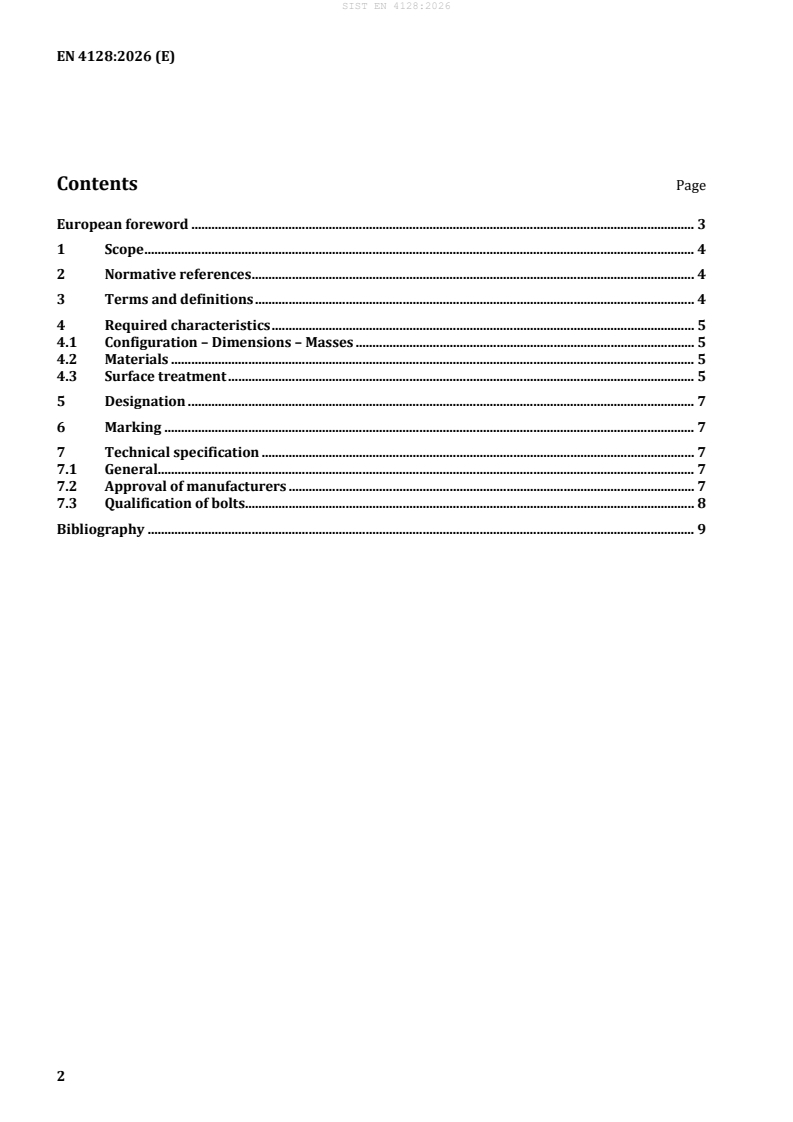
Contents Page
European foreword . 3
1 Scope . 4
2 Normative references . 4
3 Terms and definitions . 4
4 Required characteristics . 5
4.1 Configuration – Dimensions – Masses . 5
4.2 Materials . 5
4.3 Surface treatment . 5
5 Designation . 7
6 Marking . 7
7 Technical specification . 7
7.1 General. 7
7.2 Approval of manufacturers . 7
7.3 Qualification of bolts. 8
Bibliography . 9
European foreword
This document (EN 4128:2026) has been prepared by ASD-STAN.
After enquiries and votes carried out in accordance with the rules of this Association, this document has
received the approval of the National Associations and the Official Services of the member countries of
ASD-STAN, prior to its presentation to CEN.
This European Standard shall be given the status of a national standard, either by publication of an
identical text or by endorsement, at the latest by August 2026, and conflicting national standards shall be
withdrawn at the latest by August 2026.
Attention is drawn to the possibility that some of the elements of this document may be the subject of
patent rights. CEN shall not be held responsible for identifying any or all such patent rights.
This document supersedes EN 4128:2016.
This document includes the following significant technical changes with respect to EN 4128:2016:
— normative references updated;
— Clause 3 “Terms and definitions” added;
— Figure 1, roughness deleted;
— 7.2 and 7.3 revised;
— Bibliography updated.
Any feedback and questions on this document should be directed to the users’ national standards body.
A complete listing of these bodies can be found on the CEN website.
According to the CEN-CENELEC Internal Regulations, the national standards organizations of the
following countries are bound to implement this European Standard: Austria, Belgium, Bulgaria, Croatia,
Cyprus, Czech Republic, Denmark, Estonia, Finland, France, Germany, Greece, Hungary, Iceland, Ireland,
Italy, Latvia, Lithuania, Luxembourg, Malta, Netherlands, Norway, Poland, Portugal, Republic of North
Macedonia, Romania, Serbia, Slovakia, Slovenia, Spain, Sweden, Switzerland, Türkiye and the United
Kingdom.
1 Scope
This document specifies the characteristics of bolts, normal hexagonal head, coarse tolerance shank,
short thread, in heat resisting nickel base alloy, aluminium IVD coated.
1 2
Classification: 1 250 MPa /425 °C .
2 Normative references
The following documents are referred to in the text in such a way that some or all of their content
constitutes requirements of this document. For d
...