

oSIST prEN ISO 7551:2026
(Main)Dentistry - Endodontic absorbent points (ISO/DIS 7551:2026)
General Information
- Abstract
This document specifies the requirements and test methods for sterilized absorbent points used in endodontic procedures. Absorbent points are marketed sterilized or non-sterilized. The requirements apply to absorbent points which have been sterilized once in a manner approved by the manufacturer. This document specifies numerical systems and a colour-coding system for designating the sizes of absorbent points.
Clause 7 specifies the labelling and packaging needed, including the instructions for use. A claim by the manufacturer that the contents of the unopened pack are sterile is the responsibility of the manufacturer (see Table 2). This document does not specify requirements or test methods for sterility.
NOTE 1 Reference to applicable national regulations can be made.
Reference is made to internationally accepted pharmacopoeia.
NOTE 2 National requirements can apply.
Standards on methods of validating sterilization processes are also available: ISO 11137-1, ISO 11137-2 and ISO 11137-3.
- Status
- Not Published
- Public Enquiry End Date
- 30-Jul-2026
- Technical Committee
- VAZ - Healthcare
- Current Stage
- 4020 - Public enquire (PE) (Adopted Project)
- Start Date
- 11-Jun-2026
- Due Date
- 29-Oct-2026
- Completion Date
- 03-Aug-2026

Overview
oSIST prEN ISO 7551:2026 is a draft international standard developed by SIST, focusing on endodontic absorbent points for dental procedures. These absorbent points are critical instruments in endodontics, used to absorb fluids from root canals and sometimes to deliver disinfectant solutions. The standard establishes requirements and test methods for both sterilized and non-sterilized absorbent points, including guidelines for product information, labelling, packaging, and a standardized system for size designation and color-coding.
Key Topics
- Product Requirements: The standard specifies that absorbent points must be uniform and smooth, with no extraneous matter or loose fibers. Minimum length requirements and tolerances for diameters are provided to ensure safety and consistency.
- Sterilization and Use: While both sterilized and non-sterilized products are addressed, the standard assumes that sterilization (when required) is performed according to the manufacturer's approved methods. It does not prescribe sterility validation but references existing standards (ISO 11137-1, -2, -3) for sterilization processes.
- Size Designation and Colour-Coding: A numerical system and color-coding are defined for easy identification of absorbent point sizes. This helps dental professionals to quickly select the correct product.
- Testing Methods: Methods for verifying product characteristics include visual inspection, length and diameter measurement, absorption capacity, and resistance to disintegration.
- Labelling and Packaging: Detailed requirements for labelling and packaging ensure traceability, safe handling, and proper usage. Mandatory information includes manufacturer details, batch numbers, expiry dates, and instructions for use.
Applications
Endodontic absorbent points are essential in a variety of dental treatments, especially root canal therapy. Key applications include:
- Moisture Control: Absorbing fluids from prepared root canals to maintain a dry operative field.
- Disinfectant Delivery: Applying small quantities of disinfectant solutions to canal spaces.
- Compatibility: The standard aligns size and taper designations with other dental instruments and obturation points, supporting interoperability within dental workflows.
- Patient Safety: The use of standardized absorbent points reduces the risks of procedural errors, improving patient outcomes and practice efficiency.
Proper adherence to this standard ensures that endodontic absorbent points are reliable, safe, and effective for dental professionals worldwide.
Related Standards
Several other international standards are referenced or associated with the safe production and validation of dental absorbent points:
- ISO 6877: Dentistry - Root canal obturating points.
- ISO 3630-1: Dentistry - Endodontic instruments - General requirements and test methods.
- ISO 11137-1 / -2 / -3: Sterilization of health care products - Radiation standards applicable for validating sterilization.
- ISO 20417: Medical devices - Information to be supplied by the manufacturer.
- ISO 15223-1: Medical devices - Symbols for labelling.
- ISO 8601-1: Representation of dates and times.
- ISO 7405 and ISO 10993-1: Assessment of biological risks for dental materials.
Adherence to oSIST prEN ISO 7551:2026, alongside these related standards, helps manufacturers and dental professionals ensure compliance, quality assurance, and global acceptance of endodontic absorbent points.
Keywords: endodontic absorbent points, dental materials, ISO 7551:2026, sterilized dental products, dentistry standards, absorbent point size designation, dental instrument color coding, labelling of dental devices, endodontic procedures, dental product packaging.
Relations
- Effective Date
- 15-Oct-2025
Get Certified
Connect with accredited certification bodies for this standard

BSI Group
BSI (British Standards Institution) is the business standards company that helps organizations make excellence a habit.

TÜV Rheinland
TÜV Rheinland is a leading international provider of technical services.

TÜV SÜD
TÜV SÜD is a trusted partner of choice for safety, security and sustainability solutions.
Sponsored listings
Frequently Asked Questions
oSIST prEN ISO 7551:2026 is a draft published by the Slovenian Institute for Standardization (SIST). Its full title is "Dentistry - Endodontic absorbent points (ISO/DIS 7551:2026)". This standard covers: This document specifies the requirements and test methods for sterilized absorbent points used in endodontic procedures. Absorbent points are marketed sterilized or non-sterilized. The requirements apply to absorbent points which have been sterilized once in a manner approved by the manufacturer. This document specifies numerical systems and a colour-coding system for designating the sizes of absorbent points. Clause 7 specifies the labelling and packaging needed, including the instructions for use. A claim by the manufacturer that the contents of the unopened pack are sterile is the responsibility of the manufacturer (see Table 2). This document does not specify requirements or test methods for sterility. NOTE 1 Reference to applicable national regulations can be made. Reference is made to internationally accepted pharmacopoeia. NOTE 2 National requirements can apply. Standards on methods of validating sterilization processes are also available: ISO 11137-1, ISO 11137-2 and ISO 11137-3.
This document specifies the requirements and test methods for sterilized absorbent points used in endodontic procedures. Absorbent points are marketed sterilized or non-sterilized. The requirements apply to absorbent points which have been sterilized once in a manner approved by the manufacturer. This document specifies numerical systems and a colour-coding system for designating the sizes of absorbent points. Clause 7 specifies the labelling and packaging needed, including the instructions for use. A claim by the manufacturer that the contents of the unopened pack are sterile is the responsibility of the manufacturer (see Table 2). This document does not specify requirements or test methods for sterility. NOTE 1 Reference to applicable national regulations can be made. Reference is made to internationally accepted pharmacopoeia. NOTE 2 National requirements can apply. Standards on methods of validating sterilization processes are also available: ISO 11137-1, ISO 11137-2 and ISO 11137-3.
oSIST prEN ISO 7551:2026 is classified under the following ICS (International Classification for Standards) categories: 11.060.10 - Dental materials. The ICS classification helps identify the subject area and facilitates finding related standards.
oSIST prEN ISO 7551:2026 has the following relationships with other standards: It is inter standard links to SIST EN ISO 7551:2023. Understanding these relationships helps ensure you are using the most current and applicable version of the standard.
oSIST prEN ISO 7551:2026 is available in PDF format for immediate download after purchase. The document can be added to your cart and obtained through the secure checkout process. Digital delivery ensures instant access to the complete standard document.
Standards Content (Sample)
SLOVENSKI STANDARD
01-julij-2026
Zobozdravstvo - Endodontska vpojna sredstva (ISO/DIS 7551:2026)
Dentistry - Endodontic absorbent points (ISO/DIS 7551:2026)
Zahnheilkunde - Endodontische absorbierende Spitzen (ISO/DIS 7551:2026)
Médecine bucco-dentaire - Cônes absorbants utilisés en endodontie (ISO/DIS
7551:2026)
Ta slovenski standard je istoveten z: prEN ISO 7551
ICS:
11.060.10 Zobotehnični materiali Dental materials
2003-01.Slovenski inštitut za standardizacijo. Razmnoževanje celote ali delov tega standarda ni dovoljeno.
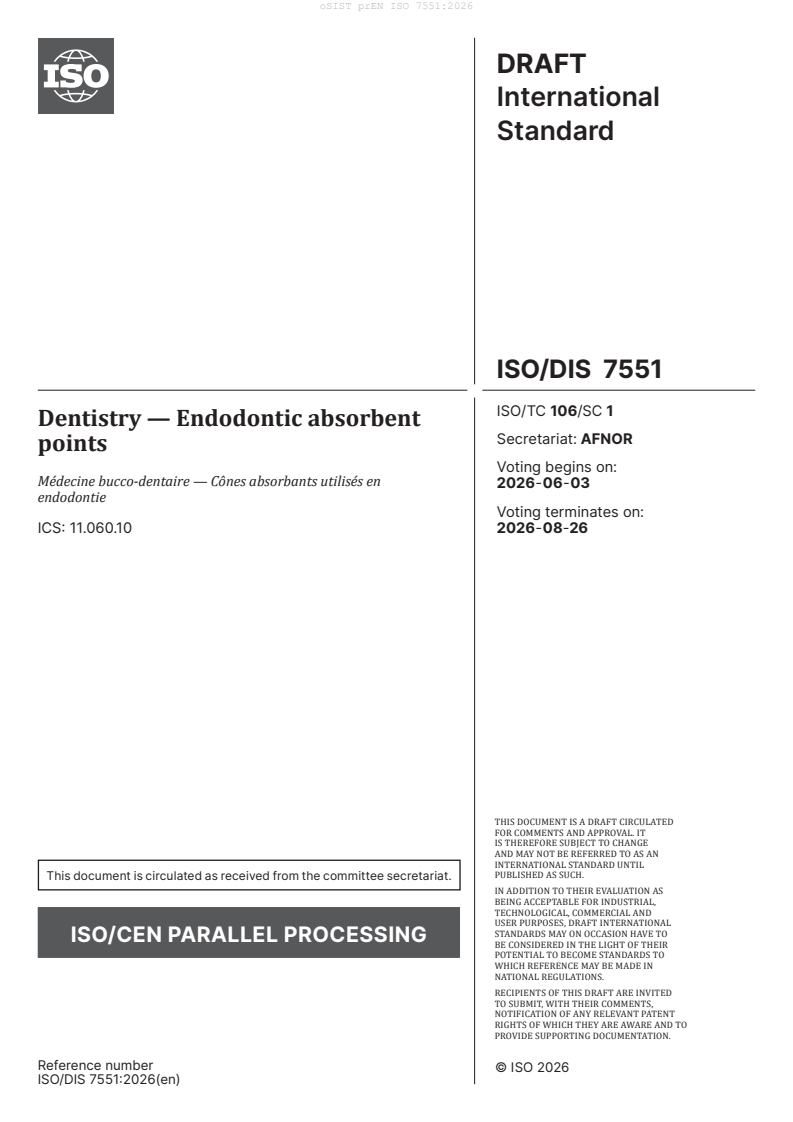
DRAFT
International
Standard
ISO/DIS 7551
ISO/TC 106/SC 1
Dentistry — Endodontic absorbent
Secretariat: AFNOR
points
Voting begins on:
Médecine bucco-dentaire — Cônes absorbants utilisés en
2026-06-03
endodontie
Voting terminates on:
ICS: 11.060.10 2026-08-26
THIS DOCUMENT IS A DRAFT CIRCULATED
FOR COMMENTS AND APPROVAL. IT
IS THEREFORE SUBJECT TO CHANGE
AND MAY NOT BE REFERRED TO AS AN
INTERNATIONAL STANDARD UNTIL
PUBLISHED AS SUCH.
This document is circulated as received from the committee secretariat.
IN ADDITION TO THEIR EVALUATION AS
BEING ACCEPTABLE FOR INDUSTRIAL,
TECHNOLOGICAL, COMMERCIAL AND
USER PURPOSES, DRAFT INTERNATIONAL
STANDARDS MAY ON OCCASION HAVE TO
ISO/CEN PARALLEL PROCESSING
BE CONSIDERED IN THE LIGHT OF THEIR
POTENTIAL TO BECOME STANDARDS TO
WHICH REFERENCE MAY BE MADE IN
NATIONAL REGULATIONS.
RECIPIENTS OF THIS DRAFT ARE INVITED
TO SUBMIT, WITH THEIR COMMENTS,
NOTIFICATION OF ANY RELEVANT PATENT
RIGHTS OF WHICH THEY ARE AWARE AND TO
PROVIDE SUPPORTING DOCUMENTATION.
Reference number
ISO/DIS 7551:2026(en)
DRAFT
ISO/DIS 7551:2026(en)
International
Standard
ISO/DIS 7551
ISO/TC 106/SC 1
Dentistry — Endodontic absorbent
Secretariat: AFNOR
points
Voting begins on:
Médecine bucco-dentaire — Cônes absorbants utilisés en
endodontie
Voting terminates on:
ICS: 11.060.10
THIS DOCUMENT IS A DRAFT CIRCULATED
FOR COMMENTS AND APPROVAL. IT
IS THEREFORE SUBJECT TO CHANGE
AND MAY NOT BE REFERRED TO AS AN
INTERNATIONAL STANDARD UNTIL
PUBLISHED AS SUCH.
This document is circulated as received from the committee secretariat.
IN ADDITION TO THEIR EVALUATION AS
BEING ACCEPTABLE FOR INDUSTRIAL,
© ISO 2026
TECHNOLOGICAL, COMMERCIAL AND
USER PURPOSES, DRAFT INTERNATIONAL
All rights reserved. Unless otherwise specified, or required in the context of its implementation, no part of this publication may
STANDARDS MAY ON OCCASION HAVE TO
ISO/CEN PARALLEL PROCESSING
be reproduced or utilized otherwise in any form or by any means, electronic or mechanical, including photocopying, or posting on
BE CONSIDERED IN THE LIGHT OF THEIR
the internet or an intranet, without prior written permission. Permission can be requested from either ISO at the address below
POTENTIAL TO BECOME STANDARDS TO
WHICH REFERENCE MAY BE MADE IN
or ISO’s member body in the country of the requester.
NATIONAL REGULATIONS.
ISO copyright office
RECIPIENTS OF THIS DRAFT ARE INVITED
CP 401 • Ch. de Blandonnet 8
TO SUBMIT, WITH THEIR COMMENTS,
CH-1214 Vernier, Geneva
NOTIFICATION OF ANY RELEVANT PATENT
Phone: +41 22 749 01 11
RIGHTS OF WHICH THEY ARE AWARE AND TO
PROVIDE SUPPORTING DOCUMENTATION.
Email: copyright@iso.org
Website: www.iso.org
Published in Switzerland Reference number
ISO/DIS 7551:2026(en)
ii
ISO/DIS 7551:2026(en)
Contents Page
Foreword .iv
Introduction .v
1 Scope . 1
2 Normative references . 1
3 Terms and definitions . 1
4 Requirements . 2
4.1 Appearance .2
4.2 Length .2
4.3 General .2
4.4 Nominal size designation tolerances .3
4.5 Tip .5
4.6 Colour-coding .5
4.7 Taper .6
4.8 Absorption .6
4.9 Disintegration .6
5 Procurement of samples . 6
6 Measurement and test methods . 7
6.1 Test conditions .7
6.2 Visual examination .7
6.2.1 Test Method . . .7
6.2.2 Interpretation of results .7
6.3 Length .7
6.3.1 Apparatus .7
6.3.2 Test Method . . .7
6.3.3 Interpretation of results .7
6.4 Taper and nominal size measurements .7
6.4.1 Apparatus .7
6.4.2 Test Method . . .8
6.4.3 Interpretation of results .9
6.5 Absorption .9
6.5.1 Apparatus .9
6.5.2 Material.9
6.5.3 Test method .9
6.5.4 Interpretation of results .9
6.6 Disintegration .9
6.6.1 Apparatus .9
6.6.2 Material.9
6.6.3 Test method .9
6.6.4 Interpretation of results .10
7 Product information . 10
7.1 Marking .10
7.2 Labelling .10
7.3 Packaging .11
7.4 Instructions for use .11
Bibliography .13
iii
ISO/DIS 7551:2026(en)
Foreword
ISO (the International Organization for Standardization) is a worldwide federation of national standards
bodies (ISO member bodies). The work of preparing International Standards is normally carried out through
ISO technical committees. Each member body interested in a subject for which a technical committee
has been established has the right to be represented on that committee. International organizations,
governmental and non-governmental, in liaison with ISO, also take part in the work. ISO collaborates closely
with the International Electrotechnical Commission (IEC) on all matters of electrotechnical standardization.
The procedures used to develop this document and those intended for its further maintenance are described
in the ISO/IEC Directives, Part 1. In particular, the different approval criteria needed for the different types
of ISO document should be noted. This document was drafted in accordance with the editorial rules of the
ISO/IEC Directives, Part 2 (see www.iso.org/directives).
ISO draws attention to the possibility that the implementation of this document may involve the use of (a)
patent(s). ISO takes no position concerning the evidence, validity or applicability of any claimed patent
rights in respect thereof. As of the date of publication of this document, ISO had not received notice of (a)
patent(s) which may be required to implement this document. However, implementers are cautioned that
this may not represent the latest information, which may be obtained from the patent database available at
www.iso.org/patents. ISO shall not be held responsible for identifying any or all such patent rights.
Any trade name used in this document is information given for the convenience of users and does not
constitute an endorsement.
For an explanation of the voluntary nature of standards, the meaning of ISO specific terms and expressions
related to conformity assessment, as well as information about ISO's adherence to the World Trade
Organization (WTO) principles in the Technical Barriers to Trade (TBT), see www.iso.org/iso/foreword.html.
This document was prepared by Technical Committee ISO/TC 106, Dentistry, Subcommittee SC 1, Filling and
restorative materials, in collaboration with the European Committee for Standardization (CEN) Technical
Committee CEN/TC 55, Dentistry, in accordance with the Agreement on technical cooperation between ISO
and CEN (Vienna Agreement).
This second edition cancels and replaces the first edition (ISO 7551:1996), which has been technically
revised.
The main changes are as follows:
— the format has been updated;
— absorbent points other than standard taper absorbent points have been added;
— tables have been updated for the dimensions of greater taper absorbent points;
— the sizes of the absorbent points specified in this document have been aligned with the sizes for obturating
points specified in ISO 6877 and for instruments from the ISO 6360 series;
— the nomenclature of “numbering system” has been changed to “nominal size designation” of the tip;
— Figure 2 has been removed.
Any feedback or questions on this document should be directed to the user’s national standards body. A
complete listing of these bodies can be found at www.iso.org/members.html.
iv
ISO/DIS 7551:2026(en)
Introduction
The following information should be taken into account when using this document: specific qualitative and
quantitative test methods for demonstrating freedom from unacceptable biological risks are not included in
this document but it is recommended that, for the assessment of such biological risks, reference be made to
ISO 7405 and ISO 10993-1.
v
DRAFT International Standard ISO/DIS 7551:2026(en)
Dentistry — Endodontic absorbent points
1 Scope
This document specifies the requirements and test methods for sterilized absorbent points used in
endodontic procedures.
Absorbent points are marketed sterilized or non-sterilized. The requirements apply to absorbent points
which have been sterilized once in a manner approved by the manufacturer. This document specifies
numerical systems and a colour-coding system for designating the sizes of absorbent points.
Clause 7 specifies product information to be provided. A claim by the manufacturer that the contents of the
unopened pack are sterile is the responsibility of the manufacturer (see 7.3). This document does not specify
requirements or test methods for sterility.
NOTE 1 Reference to applicable national regulations can be made.
Reference is made to internationally accepted pharmacopoeia.
NOTE 2 National requirements can apply.
Standards on methods of validating sterilization processes are also available: ISO 11737-1, ISO 11737-2 and
ISO 11737-3.
2 Normative references
There are no normative references in this document.
3 Terms and definitions
For the purposes of this document, the terms and definitions given in ISO 1942, ISO 3630-1 and the following
apply.
ISO and IEC maintain terminology databases for use in standardization at the following addresses:
— ISO Online browsing platform: available at https:// www .iso .org/ obp
— IEC Electropedia: available at https:// www .electropedia .org/
3.1
absorbent point
elongated preformed cone or cylinder of a material suitable for absorption of liquids from a root canal,
having a rounded, conical or blunt tip, and a neck that is tapered or cylindrical, or a combination of both
Note 1 to entry: The absorbent points may be used to apply a small quantity of a liquid disinfectant into the root canal
for a short period.
3.2
nominal size designation
size of the tip, designated as D, measured in hundredths of a millimetre, indicated as “000”
ISO/DIS 7551:2026(en)
3.3
taper
percentage increase in diameter along the length of the absorbent point (3.1) from the tip
EXAMPLE 02 taper represents a 2 % increase in diameter along the length of the absorbent point.
3.4
standard absorbent point
absorbent point (3.1) having a uniform 02 taper (3.3) over the first 16 mm from the tip
3.5
greater taper absorbent point
absorbent point (3.1) having a uniform taper (3.3) greater than 02 over the first 16 mm from the tip
3.6
variable taper absorbent point
absorbent point (3.1) having a taper (3.3) that varies over the first 16 mm from the tip
3.7
auxiliary absorbent point
absorbent point (3.1) excepting standard absorbent point (3.4), greater taper absorbent point (3.5) and variable
taper absorbent point (3.6), not subject to nominal size designation (3.2) requirements
3.8
tip
distal end of an absorbent point (3.1) that is first inserted into a root canal
3.9
neck
portion of an absorbent point (3.1) for grasping while inserting the distal end in the root canal
3.10
unit pack
smallest pack of absorbent points (3.1) distributed, containing one or more sizes of absorbent points
4 Requirements
4.1 Appearance
An absorbent pointshall be smooth and uniform in appearance throughout its length, free from extraneous
matter and fibres projecting from the absorbent point. Test in accordance with 6.2.
4.2 Length
The overall length shall be not less than 28 mm, unless otherwise stated by the manufacturer. If some other
length is stated, the absorbent point shall not be less than the stated length. Test in accordance with 6.3.
4.3 General
The designation for standard absorbent p
...