

SIST EN 301 406-1 V3.2.1:2026
(Main)Digital Enhanced Cordless Telecommunications (DECT) - Harmonised Standard for access to radio spectrum - Part 1: DECT, DECT Evolution and DECT ULE
General Information
- Abstract
The present document specifies technical characteristics and methods of measurements for equipment implementing the Digital Enhanced Cordless Telecommunications (DECT) common interface, as specified in the multi-part technical specification ETSI EN 300 175 including the variants DECT Evolution and DECT ULE (see ETSI EN 300 175-1 [i.3] for an overview). The present document applies to the following equipment types:
a) Fixed Part (FP);
b) Portable Part (PP);
c) Cordless Terminal Adapter (CTA);
d) Wireless Relay Station (WRS) (FP and PP combined);
e) Hybrid Part (HyP) (a PP with capability to act as a FP to provide PP to PP communication).
NOTE: This release of the standard covers the WRS type CRFP, but not the WRS type REP.
The DECT service frequency band for transmitting and receiving for all elements is 1 880 MHz to 1 900 MHz. National regulation can allow additional frequency bands. DECT equipment covered by the present document is operated in accordance with ERC Decision (98)22 [i.20]. Details of the DECT Common Interface may be found in the multi-part deliverable ETSI EN 300 175 (see [1] to [4] and [i.3] to [i.6]). Further details of the DECT system may be found in the ETSI TR 101 178 [i.1]. DECT ULE implements, in addition to the DECT Common Interface, the multi-part ETSI TS 102 939 (see ETSI TS 102 939-1 [i.7] and ETSI TS 102 939-2 [i.8]). The present document contains requirements to demonstrate that radio equipment both effectively uses and supports the efficient use of radio spectrum in order to avoid harmful interference. NOTE: The relationship between the present document and essential requirements of article 3.2 of Directive 2014/53/EU [i.10] is given in annex A.
- Status
- Published
- Public Enquiry End Date
- 31-Mar-2026
- Publication Date
- 20-Aug-2026
- Technical Committee
- MOC - Mobile Communications
- Current Stage
- 6060 - National Implementation/Publication (Adopted Project)
- Start Date
- 10-Aug-2026
- Due Date
- 15-Oct-2026
- Completion Date
- 21-Aug-2026
Buy Documents
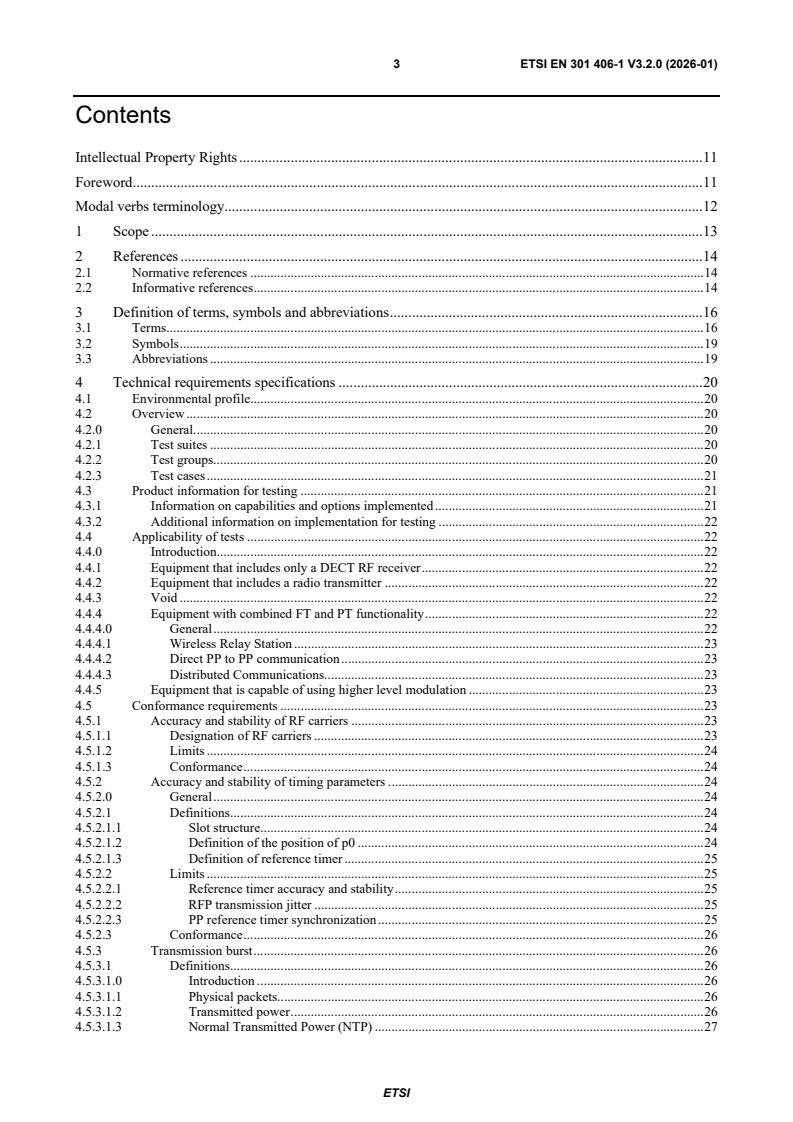
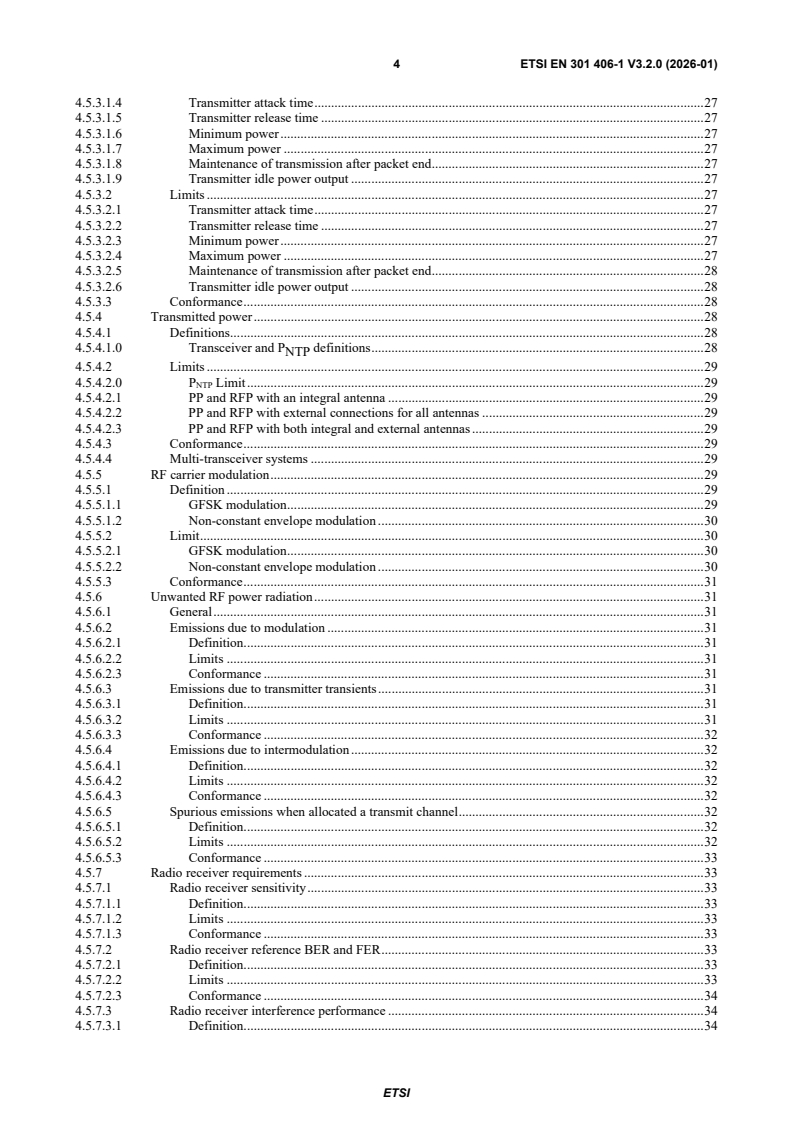
ETSI EN 301 406-1 V3.2.0 (2026-01) - Digital Enhanced Cordless Telecommunications (DECT); Harmonised Standard for access to radio spectrum; Part 1: DECT, DECT Evolution and DECT ULE
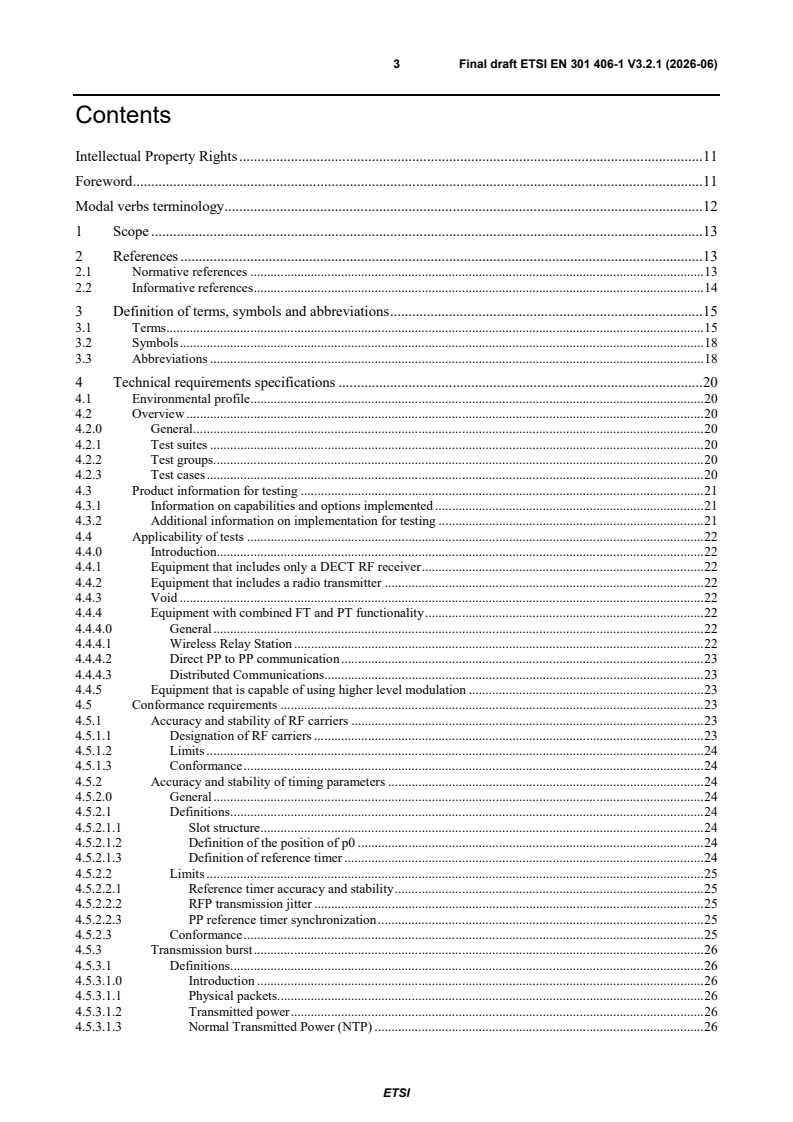
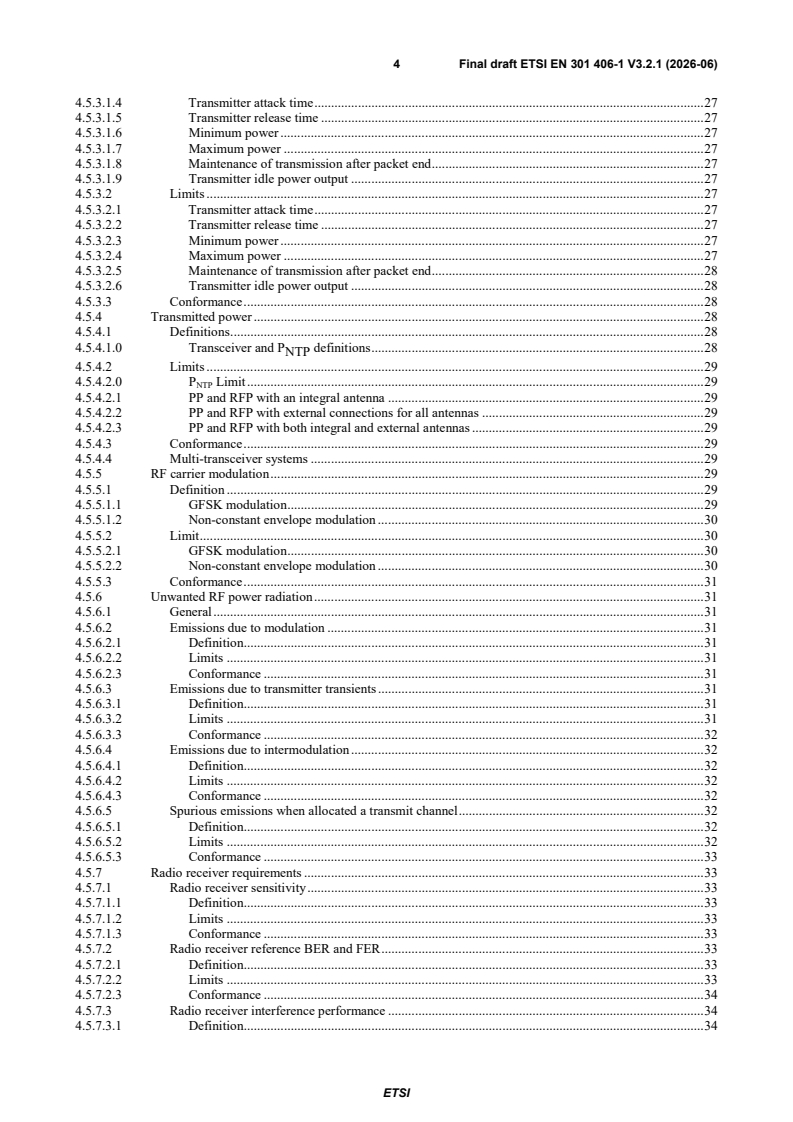
ETSI EN 301 406-1 V3.2.1 (2026-06) - Digital Enhanced Cordless Telecommunications (DECT); Harmonised Standard for access to radio spectrum; Part 1: DECT, DECT Evolution and DECT ULE

Overview
SIST EN 301 406-1 V3.2.1:2026 is a harmonised European standard focused on the technical requirements and test methods for equipment using the Digital Enhanced Cordless Telecommunications (DECT) common interface, including DECT variants such as DECT Evolution and DECT ULE (Ultra Low Energy). Developed by SIST in line with ETSI specifications, this standard defines the essential criteria for fixed and portable DECT parts, cordless adapters, wireless relay stations, and hybrid equipment. The main objective is to ensure efficient access to the radio spectrum, minimize harmful interference, and fully comply with European regulatory requirements.
The standard is crucial for manufacturers and integrators designing compliant DECT systems operating in the 1880 MHz to 1900 MHz frequency band, as referenced in ERC Decision (98)22. National regulations may allow for additional spectrum allocation. This document is necessary for demonstrating compliance with the fundamental requirements of the EU Directive 2014/53/EU regarding radio equipment.
Key Topics
- Radio Spectrum Harmonisation: Outlines the use of the 1880 MHz–1900 MHz band for DECT systems, promoting interoperability and cross-border compatibility across the European Economic Area.
- Equipment Types Covered:
- Fixed Part (FP)
- Portable Part (PP)
- Cordless Terminal Adapter (CTA)
- Wireless Relay Station (WRS)
- Hybrid Part (HyP)
- Compliance and Testing:
- Defines conformance requirements for power output, modulation, receiver sensitivity, carrier stability, unwanted emissions, and channel access procedures.
- Details robust testing methodologies for both conducted and radiated performance, with a focus on real-world environments.
- DECT Variants:
- Coverage for classic DECT, DECT Evolution, and DECT ULE solutions.
- DECT ULE includes additional references to ETSI TS 102 939, enabling ultra-low energy operations suitable for IoT applications.
- Avoiding Interference: Emphasizes technical characteristics and operational behaviors that limit interference risks, ensuring coexistence with other wireless systems.
- Directive Alignment: Maps technical requirements to the essential requirements of Article 3.2 of Directive 2014/53/EU, supporting market access in the EU.
Applications
SIST EN 301 406-1 V3.2.1:2026 is applied throughout the lifecycle of DECT-based radio equipment in diverse sectors:
- Cordless Telephony: Foundational to home and enterprise cordless phones, private branch exchanges (PBXs), and wireless headsets.
- Industrial and Commercial Communication: Supports wireless voice and data solutions within offices, warehouses, hospitals, and factories.
- Smart Home and IoT: DECT ULE enables battery-operated sensors, alarms, and automation devices with long operational life and robust connectivity.
- Wireless Infrastructure: Facilitates the deployment of relay stations and advanced hybrid devices for expanded coverage and enhanced feature sets.
- Regulatory Certification: Serves as a technical baseline for conformity assessment, CE marking, and market approval across Europe.
Related Standards
Professionals implementing SIST EN 301 406-1 V3.2.1:2026 should also consider the following related documents for full ecosystem compliance:
- ETSI EN 300 175 Series: Core specification for the DECT common interface, including detailed protocol and interface definitions.
- ETSI TS 102 939 Series: Defines DECT ULE’s features and system requirements for ultra-low energy devices.
- ERC Decision (98)22: European regulatory policy assigning the 1880–1900 MHz band to DECT.
- Directive 2014/53/EU (RED): EU directive covering radio equipment safety, EMC, and efficient use of radio spectrum.
- ETSI TR 101 178: Technical report providing further insights into DECT system architecture and use cases.
In summary, SIST EN 301 406-1 V3.2.1:2026 acts as the cornerstone for standardized, reliable, and EU-compliant DECT equipment across traditional and emerging wireless applications.
Buy Documents
ETSI EN 301 406-1 V3.2.0 (2026-01) - Digital Enhanced Cordless Telecommunications (DECT); Harmonised Standard for access to radio spectrum; Part 1: DECT, DECT Evolution and DECT ULE
ETSI EN 301 406-1 V3.2.1 (2026-06) - Digital Enhanced Cordless Telecommunications (DECT); Harmonised Standard for access to radio spectrum; Part 1: DECT, DECT Evolution and DECT ULE
Get Certified
Connect with accredited certification bodies for this standard

ANCE
Mexican certification and testing association.

Intertek Slovenia
Intertek testing, inspection, and certification services in Slovenia.

LNE (Laboratoire National de Métrologie et d'Essais)
French national laboratory for metrology and testing.
Sponsored listings
Frequently Asked Questions
SIST EN 301 406-1 V3.2.1:2026 is a standard published by the Slovenian Institute for Standardization (SIST). Its full title is "Digital Enhanced Cordless Telecommunications (DECT) - Harmonised Standard for access to radio spectrum - Part 1: DECT, DECT Evolution and DECT ULE". This standard covers: The present document specifies technical characteristics and methods of measurements for equipment implementing the Digital Enhanced Cordless Telecommunications (DECT) common interface, as specified in the multi-part technical specification ETSI EN 300 175 including the variants DECT Evolution and DECT ULE (see ETSI EN 300 175-1 [i.3] for an overview). The present document applies to the following equipment types: a) Fixed Part (FP); b) Portable Part (PP); c) Cordless Terminal Adapter (CTA); d) Wireless Relay Station (WRS) (FP and PP combined); e) Hybrid Part (HyP) (a PP with capability to act as a FP to provide PP to PP communication). NOTE: This release of the standard covers the WRS type CRFP, but not the WRS type REP. The DECT service frequency band for transmitting and receiving for all elements is 1 880 MHz to 1 900 MHz. National regulation can allow additional frequency bands. DECT equipment covered by the present document is operated in accordance with ERC Decision (98)22 [i.20]. Details of the DECT Common Interface may be found in the multi-part deliverable ETSI EN 300 175 (see [1] to [4] and [i.3] to [i.6]). Further details of the DECT system may be found in the ETSI TR 101 178 [i.1]. DECT ULE implements, in addition to the DECT Common Interface, the multi-part ETSI TS 102 939 (see ETSI TS 102 939-1 [i.7] and ETSI TS 102 939-2 [i.8]). The present document contains requirements to demonstrate that radio equipment both effectively uses and supports the efficient use of radio spectrum in order to avoid harmful interference. NOTE: The relationship between the present document and essential requirements of article 3.2 of Directive 2014/53/EU [i.10] is given in annex A.
The present document specifies technical characteristics and methods of measurements for equipment implementing the Digital Enhanced Cordless Telecommunications (DECT) common interface, as specified in the multi-part technical specification ETSI EN 300 175 including the variants DECT Evolution and DECT ULE (see ETSI EN 300 175-1 [i.3] for an overview). The present document applies to the following equipment types: a) Fixed Part (FP); b) Portable Part (PP); c) Cordless Terminal Adapter (CTA); d) Wireless Relay Station (WRS) (FP and PP combined); e) Hybrid Part (HyP) (a PP with capability to act as a FP to provide PP to PP communication). NOTE: This release of the standard covers the WRS type CRFP, but not the WRS type REP. The DECT service frequency band for transmitting and receiving for all elements is 1 880 MHz to 1 900 MHz. National regulation can allow additional frequency bands. DECT equipment covered by the present document is operated in accordance with ERC Decision (98)22 [i.20]. Details of the DECT Common Interface may be found in the multi-part deliverable ETSI EN 300 175 (see [1] to [4] and [i.3] to [i.6]). Further details of the DECT system may be found in the ETSI TR 101 178 [i.1]. DECT ULE implements, in addition to the DECT Common Interface, the multi-part ETSI TS 102 939 (see ETSI TS 102 939-1 [i.7] and ETSI TS 102 939-2 [i.8]). The present document contains requirements to demonstrate that radio equipment both effectively uses and supports the efficient use of radio spectrum in order to avoid harmful interference. NOTE: The relationship between the present document and essential requirements of article 3.2 of Directive 2014/53/EU [i.10] is given in annex A.
SIST EN 301 406-1 V3.2.1:2026 is classified under the following ICS (International Classification for Standards) categories: 33.070.30 - Digital Enhanced Cordless Telecommunications (DECT). The ICS classification helps identify the subject area and facilitates finding related standards.
SIST EN 301 406-1 V3.2.1:2026 is available in PDF format for immediate download after purchase. The document can be added to your cart and obtained through the secure checkout process. Digital delivery ensures instant access to the complete standard document.
Standards Content (Sample)
ETSI EN 301 406-1 V3.2.0 (2026-01)
HARMONISED EUROPEAN STANDARD
Digital Enhanced Cordless Telecommunications (DECT);
Harmonised Standard for access to radio spectrum;
Part 1: DECT, DECT Evolution and DECT ULE
2 ETSI EN 301 406-1 V3.2.0 (2026-01)
Reference
REN/DECT-00411
Keywords
DECT, digital, generic, radio, regulation, testing
ETSI
650 Route des Lucioles
F-06921 Sophia Antipolis Cedex - FRANCE
Tel.: +33 4 92 94 42 00 Fax: +33 4 93 65 47 16
Siret N° 348 623 562 00017 - APE 7112B
Association à but non lucratif enregistrée à la
Sous-Préfecture de Grasse (06) N° w061004871
Important notice
The present document can be downloaded from the
ETSI Search & Browse Standards application.
The present document may be made available in electronic versions and/or in print. The content of any electronic and/or
print versions of the present document shall not be modified without the prior written authorization of ETSI. In case of any
existing or perceived difference in contents between such versions and/or in print, the prevailing version of an ETSI
deliverable is the one made publicly available in PDF format on ETSI deliver repository.
Users should be aware that the present document may be revised or have its status changed,
this information is available in the Milestones listing.
If you find errors in the present document, please send your comments to
the relevant service listed under Committee Support Staff.
If you find a security vulnerability in the present document, please report it through our
Coordinated Vulnerability Disclosure (CVD) program.
Notice of disclaimer & limitation of liability
The information provided in the present deliverable is directed solely to professionals who have the appropriate degree of
experience to understand and interpret its content in accordance with generally accepted engineering or
other professional standard and applicable regulations.
No recommendation as to products and services or vendors is made or should be implied.
In no event shall ETSI be held liable for loss of profits or any other incidental or consequential damages.
Any software contained in this deliverable is provided "AS IS" with no warranties, express or implied, including but not
limited to, the warranties of merchantability, fitness for a particular purpose and non-infringement of intellectual property
rights and ETSI shall not be held liable in any event for any damages whatsoever (including, without limitation, damages
for loss of profits, business interruption, loss of information, or any other pecuniary loss) arising out of or related to the use
of or inability to use the software.
Copyright Notification
No part may be reproduced or utilized in any form or by any means, electronic or mechanical, including photocopying and
microfilm except as authorized by written permission of ETSI.
The content of the PDF version shall not be modified without the written authorization of ETSI.
The copyright and the foregoing restriction extend to reproduction in all media.
© ETSI 2026.
All rights reserved.
ETSI
3 ETSI EN 301 406-1 V3.2.0 (2026-01)
Contents
Intellectual Property Rights . 11
Foreword . 11
Modal verbs terminology . 12
1 Scope . 13
2 References . 14
2.1 Normative references . 14
2.2 Informative references . 14
3 Definition of terms, symbols and abbreviations . 16
3.1 Terms . 16
3.2 Symbols . 19
3.3 Abbreviations . 19
4 Technical requirements specifications . 20
4.1 Environmental profile . 20
4.2 Overview . 20
4.2.0 General . 20
4.2.1 Test suites . 20
4.2.2 Test groups. 20
4.2.3 Test cases . 21
4.3 Product information for testing . 21
4.3.1 Information on capabilities and options implemented . 21
4.3.2 Additional information on implementation for testing . 22
4.4 Applicability of tests . 22
4.4.0 Introduction. 22
4.4.1 Equipment that includes only a DECT RF receiver . 22
4.4.2 Equipment that includes a radio transmitter . 22
4.4.3 Void . 22
4.4.4 Equipment with combined FT and PT functionality . 22
4.4.4.0 General . 22
4.4.4.1 Wireless Relay Station . 23
4.4.4.2 Direct PP to PP communication . 23
4.4.4.3 Distributed Communications. 23
4.4.5 Equipment that is capable of using higher level modulation . 23
4.5 Conformance requirements . 23
4.5.1 Accuracy and stability of RF carriers . 23
4.5.1.1 Designation of RF carriers . 23
4.5.1.2 Limits . 24
4.5.1.3 Conformance . 24
4.5.2 Accuracy and stability of timing parameters . 24
4.5.2.0 General . 24
4.5.2.1 Definitions . 24
4.5.2.1.1 Slot structure . 24
4.5.2.1.2 Definition of the position of p0 . 24
4.5.2.1.3 Definition of reference timer . 25
4.5.2.2 Limits . 25
4.5.2.2.1 Reference timer accuracy and stability . 25
4.5.2.2.2 RFP transmission jitter . 25
4.5.2.2.3 PP reference timer synchronization . 25
4.5.2.3 Conformance . 26
4.5.3 Transmission burst . 26
4.5.3.1 Definitions . 26
4.5.3.1.0 Introduction . 26
4.5.3.1.1 Physical packets. 26
4.5.3.1.2 Transmitted power . 26
4.5.3.1.3 Normal Transmitted Power (NTP) . 27
ETSI
4 ETSI EN 301 406-1 V3.2.0 (2026-01)
4.5.3.1.4 Transmitter attack time . 27
4.5.3.1.5 Transmitter release time . 27
4.5.3.1.6 Minimum power . 27
4.5.3.1.7 Maximum power . 27
4.5.3.1.8 Maintenance of transmission after packet end . 27
4.5.3.1.9 Transmitter idle power output . 27
4.5.3.2 Limits . 27
4.5.3.2.1 Transmitter attack time . 27
4.5.3.2.2 Transmitter release time . 27
4.5.3.2.3 Minimum power . 27
4.5.3.2.4 Maximum power . 27
4.5.3.2.5 Maintenance of transmission after packet end . 28
4.5.3.2.6 Transmitter idle power output . 28
4.5.3.3 Conformance . 28
4.5.4 Transmitted power . 28
4.5.4.1 Definitions . 28
4.5.4.1.0 Transceiver and P definitions . 28
NTP
4.5.4.2 Limits . 29
4.5.4.2.0 P Limit . 29
NTP
4.5.4.2.1 PP and RFP with an integral antenna . 29
4.5.4.2.2 PP and RFP with external connections for all antennas . 29
4.5.4.2.3 PP and RFP with both integral and external antennas . 29
4.5.4.3 Conformance . 29
4.5.4.4 Multi-transceiver systems . 29
4.5.5 RF carrier modulation . 29
4.5.5.1 Definition . 29
4.5.5.1.1 GFSK modulation . 29
4.5.5.1.2 Non-constant envelope modulation . 30
4.5.5.2 Limit . 30
4.5.5.2.1 GFSK modulation . 30
4.5.5.2.2 Non-constant envelope modulation . 30
4.5.5.3 Conformance . 31
4.5.6 Unwanted RF power radiation . 31
4.5.6.1 General . 31
4.5.6.2 Emissions due to modulation . 31
4.5.6.2.1 Definition. 31
4.5.6.2.2 Limits . 31
4.5.6.2.3 Conformance . 31
4.5.6.3 Emissions due to transmitter transients . 31
4.5.6.3.1 Definition. 31
4.5.6.3.2 Limits . 31
4.5.6.3.3 Conformance . 32
4.5.6.4 Emissions due to intermodulation . 32
4.5.6.4.1 Definition. 32
4.5.6.4.2 Limits . 32
4.5.6.4.3 Conformance . 32
4.5.6.5 Spurious emissions when allocated a transmit channel . 32
4.5.6.5.1 Definition. 32
4.5.6.5.2 Limits . 32
4.5.6.5.3 Conformance . 33
4.5.7 Radio receiver requirements . 33
4.5.7.1 Radio receiver sensitivity . 33
4.5.7.1.1 Definition. 33
4.5.7.1.2 Limits . 33
4.5.7.1.3 Conformance . 33
4.5.7.2 Radio receiver reference BER and FER . 33
4.5.7.2.1 Definition. 33
4.5.7.2.2 Limits . 33
4.5.7.2.3 Conformance . 34
4.5.7.3 Radio receiver interference performance . 34
4.5.7.3.1 Definition. 34
ETSI
5 ETSI EN 301 406-1 V3.2.0 (2026-01)
4.5.7.3.2 Limits . 34
4.5.7.3.3 Conformance . 34
4.5.7.4 Radio receiver blocking case 1: owing to signals occurring at the same time but on other
frequencies . 34
4.5.7.4.1 Definition. 34
4.5.7.4.2 Limits . 34
4.5.7.4.3 Conformance . 35
4.5.7.5 Radio receiver blocking case 2: owing to signals occurring at a different time . 35
4.5.7.5.1 Definition. 35
4.5.7.5.2 Limits . 35
4.5.7.5.3 Conformance . 35
4.5.7.6 Receiver intermodulation performance . 35
4.5.7.6.1 Definition. 35
4.5.7.6.2 Limits . 35
4.5.7.6.3 Conformance . 35
4.5.7.7 Spurious emissions when the PP has no allocated transmit channel . 35
4.5.7.7.1 Definition. 35
4.5.7.7.2 Limits . 35
4.5.7.7.3 Conformance . 36
4.5.8 Channel access . 36
4.5.8.1 Channel selection . 36
4.5.8.2 Channel confirmation . 36
4.5.8.2.1 For the PT . 36
4.5.8.2.2 For the FT . 36
4.5.8.3 Channel release . 37
4.5.8.4 General . 37
4.5.8.5 Channel selection and confirmation for DECT ULE . 37
4.5.8.5.1 General . 37
4.5.8.5.2 For the PT . 37
4.5.8.5.3 For the FT . 37
4.5.9 WRS. 37
4.5.9.0 General requirements . 37
4.5.9.1 PP operation . 38
4.5.9.2 RFP operation . 38
4.5.9.3 Additional requirements . 38
4.5.9.4 Conformance . 39
4.5.10 Direct PP to PP communication . 39
4.5.10.1 General requirements . 39
4.5.10.2 Conformance . 39
4.5.11 Distributed communications . 39
4.5.11.0 General requirements . 39
4.5.11.1 PP operation . 39
4.5.11.2 RFP operation . 39
4.5.11.3 Conformance . 40
4.5.12 Higher level modulation options . 40
4.5.12.0 Requirements . 40
4.5.12.1 Conformance . 40
5 Testing for compliance with technical requirements . 41
5.0 Environmental conditions for testing . 41
5.1 General test requirements . 41
5.1.1 Test philosophy . 41
5.1.1.1 General . 41
5.1.1.2 Lower Tester (LT) . 41
5.1.1.3 Non-signalling test mode . 42
5.1.1.4 Test environment . 43
5.1.1.4.1 General . 43
5.1.1.4.2 Conducted test . 43
5.1.1.4.3 Radiated test . 43
5.1.2 Test site . 43
5.1.2.1 Open air test site . 43
5.1.2.1.1 Description . 43
ETSI
6 ETSI EN 301 406-1 V3.2.0 (2026-01)
5.1.2.2 Anechoic chamber . 44
5.1.2.2.1 General . 44
5.1.3 Standard position . 44
5.1.4 Test antenna of the LT . 44
5.1.5 Substitution antenna . 44
5.1.6 Test fixture . 44
5.1.7 Equipment with a temporary or internal permanent antenna connector. 45
5.1.7.1 General . 45
5.1.7.2 Equipment with a temporary antenna connector . 45
5.1.8 Void . 45
5.1.9 Lower Tester (LT) . 45
5.1.9.1 Description . 45
5.1.9.2 Connections between the EUT and the LT . 46
5.1.9.3 Functions and abilities. 46
5.1.9.4 Signal generation uncertainty . 47
5.1.9.5 Modulated DECT-like carrier . 47
5.1.9.6 CW interferers . 47
5.1.9.7 DECT RF signal . 47
5.1.9.8 Test modulation signals . 47
5.1.10 Upper Tester (UT) . 47
5.1.10.1 Description of the UT. 47
5.1.10.2 The Test Standby Mode (TSM) . 48
5.1.10.3 Test messages . 48
5.1.10.4 Dummy setting when EUT is an RFP and is in Test Standby Mode (TSM) . 48
5.1.11 Description of the lower tester FT and PT . 48
5.1.12 General test methods . 49
5.1.12.1 General . 49
5.1.12.2 Sampling the RF signal . 49
5.1.12.2.1 Introduction . 49
5.1.12.2.2 Sampling method . 49
5.1.12.3 Determining the reference position . 49
5.1.12.3.0 General . 49
5.1.12.3.1 Case 1: EUTs that cannot transmit . 49
5.1.12.3.2 Case 2: EUTs that can transmit . 49
5.1.12.4 Bit Error Ratio (BER) and Frame Error Ratio (FER) measurements . 49
5.1.13 Test setup . 50
5.1.13.1 General . 50
5.1.13.2 Test setup 1 . 50
5.1.13.3 Test setup 2 . 50
5.1.13.4 Test setup 3 . 51
5.1.13.5 Test setup 4 . 51
5.1.14 Test arrangements for intermodulation measurements . 52
5.1.14.1 PT to PT arrangement . 52
5.1.14.2 FT to FT arrangement . 52
5.1.14.3 FT to PT arrangement . 53
5.1.15 Test conditions, power supply and ambient temperatures . 53
5.1.15.1 General . 53
5.1.15.2 Nominal test conditions . 53
5.1.15.3 Extreme test conditions . 54
5.1.15.4 Test power source - general requirements . 55
5.1.15.5 Nominal test power source . 55
5.1.15.5.1 Mains voltage . 55
5.1.15.5.2 Regulated lead acid battery power sources . 55
5.1.15.5.3 Nickel cadmium or nickel metal hydride battery . 55
5.1.15.5.4 Other power sources . 55
5.1.15.6 Extreme test power source . 55
5.1.15.6.1 Mains voltage . 55
5.1.15.6.2 Regulated lead acid battery power sources . 55
5.1.15.6.3 Nickel cadmium or nickel metal hydride battery . 55
5.1.15.6.4 Other power sources . 56
5.2 Interpretation of the measurement results . 56
5.3 Radio test suites . 56
ETSI
7 ETSI EN 301 406-1 V3.2.0 (2026-01)
5.3.1 Accuracy and stability of RF carriers . 56
5.3.1.1 Test environment . 56
5.3.1.2 Method of measurement . 56
5.3.1.3 Verdict criteria when the EUT is an RFP . 57
5.3.1.4 Verdict criteria when the EUT is a PP . 57
5.3.2 Accuracy and stability of timing parameters . 57
5.3.2.1 Measurement of packet timing jitter . 57
5.3.2.1.1 Test environment . 57
5.3.2.1.2 Method of measurement . 57
5.3.2.1.3 Verdict criteria . 58
5.3.2.2 Measurement of the reference timing accuracy of an RFP . 58
5.3.2.2.1 Test environment . 58
5.3.2.2.2 Method of measurement . 58
5.3.2.2.3 Verdict criteria . 58
5.3.2.3 Measurement of packet transmission accuracy of a PP . 59
5.3.2.3.1 Test environment . 59
5.3.2.3.2 Method of measurement . 59
5.3.2.3.3 Verdict criteria . 59
5.3.3 Transmission burst . 60
5.3.3.1 Test environment . 60
5.3.3.2 Method of measurement . 60
5.3.3.3 Verdict criteria . 60
5.3.4 Transmitted power . 61
5.3.4.1 PP and RFP with an integral antenna . 61
5.3.4.1.1 Test environment .
...
Final draft ETSI EN 301 406-1 V3.2.1 (2026-06)
HARMONISED EUROPEAN STANDARD
Digital Enhanced Cordless Telecommunications (DECT);
Harmonised Standard for access to radio spectrum;
Part 1: DECT, DECT Evolution and DECT ULE
2 Final draft ETSI EN 301 406-1 V3.2.1 (2026-06)
Reference
REN/DECT-00411
Keywords
DECT, digital, generic, radio, regulation, testing
ETSI
650 Route des Lucioles
F-06921 Sophia Antipolis Cedex - FRANCE
Tel.: +33 4 92 94 42 00 Fax: +33 4 93 65 47 16
Siret N° 348 623 562 00017 - APE 7112B
Association à but non lucratif enregistrée à la
Sous-Préfecture de Grasse (06) N° w061004871
Important notice
The present document can be downloaded from the
ETSI Search & Browse Standards application.
The present document may be made available in electronic versions and/or in print. The content of any electronic and/or
print versions of the present document shall not be modified without the prior written authorization of ETSI. In case of any
existing or perceived difference in contents between such versions and/or in print, the prevailing version of an ETSI
deliverable is the one made publicly available in PDF format on ETSI deliver repository.
Users should be aware that the present document may be revised or have its status changed,
this information is available in the Milestones listing.
If you find errors in the present document, please send your comments to
the relevant service listed under Committee Support Staff.
If you find a security vulnerability in the present document, please report it through our
Coordinated Vulnerability Disclosure (CVD) program.
Notice of disclaimer & limitation of liability
The information provided in the present deliverable is directed solely to professionals who have the appropriate degree of
experience to understand and interpret its content in accordance with generally accepted engineering or
other professional standard and applicable regulations.
No recommendation as to products and services or vendors is made or should be implied.
In no event shall ETSI be held liable for loss of profits or any other incidental or consequential damages.
Any software contained in this deliverable is provided "AS IS" with no warranties, express or implied, including but not
limited to, the warranties of merchantability, fitness for a particular purpose and non-infringement of intellectual property
rights and ETSI shall not be held liable in any event for any damages whatsoever (including, without limitation, damages
for loss of profits, business interruption, loss of information, or any other pecuniary loss) arising out of or related to the use
of or inability to use the software.
Copyright Notification
No part may be reproduced or utilized in any form or by any means, electronic or mechanical, including photocopying and
microfilm except as authorized by written permission of ETSI.
The content of the PDF version shall not be modified without the written authorization of ETSI.
The copyright and the foregoing restriction extend to reproduction in all media.
© ETSI 2026.
All rights reserved.
ETSI
3 Final draft ETSI EN 301 406-1 V3.2.1 (2026-06)
Contents
Intellectual Property Rights . 11
Foreword . 11
Modal verbs terminology . 12
1 Scope . 13
2 References . 13
2.1 Normative references . 13
2.2 Informative references . 14
3 Definition of terms, symbols and abbreviations . 15
3.1 Terms . 15
3.2 Symbols . 18
3.3 Abbreviations . 18
4 Technical requirements specifications . 20
4.1 Environmental profile . 20
4.2 Overview . 20
4.2.0 General . 20
4.2.1 Test suites . 20
4.2.2 Test groups. 20
4.2.3 Test cases . 20
4.3 Product information for testing . 21
4.3.1 Information on capabilities and options implemented . 21
4.3.2 Additional information on implementation for testing . 21
4.4 Applicability of tests . 22
4.4.0 Introduction. 22
4.4.1 Equipment that includes only a DECT RF receiver . 22
4.4.2 Equipment that includes a radio transmitter . 22
4.4.3 Void . 22
4.4.4 Equipment with combined FT and PT functionality . 22
4.4.4.0 General . 22
4.4.4.1 Wireless Relay Station . 22
4.4.4.2 Direct PP to PP communication . 23
4.4.4.3 Distributed Communications. 23
4.4.5 Equipment that is capable of using higher level modulation . 23
4.5 Conformance requirements . 23
4.5.1 Accuracy and stability of RF carriers . 23
4.5.1.1 Designation of RF carriers . 23
4.5.1.2 Limits . 24
4.5.1.3 Conformance . 24
4.5.2 Accuracy and stability of timing parameters . 24
4.5.2.0 General . 24
4.5.2.1 Definitions . 24
4.5.2.1.1 Slot structure . 24
4.5.2.1.2 Definition of the position of p0 . 24
4.5.2.1.3 Definition of reference timer . 24
4.5.2.2 Limits . 25
4.5.2.2.1 Reference timer accuracy and stability . 25
4.5.2.2.2 RFP transmission jitter . 25
4.5.2.2.3 PP reference timer synchronization . 25
4.5.2.3 Conformance . 25
4.5.3 Transmission burst . 26
4.5.3.1 Definitions . 26
4.5.3.1.0 Introduction . 26
4.5.3.1.1 Physical packets. 26
4.5.3.1.2 Transmitted power . 26
4.5.3.1.3 Normal Transmitted Power (NTP) . 26
ETSI
4 Final draft ETSI EN 301 406-1 V3.2.1 (2026-06)
4.5.3.1.4 Transmitter attack time . 27
4.5.3.1.5 Transmitter release time . 27
4.5.3.1.6 Minimum power . 27
4.5.3.1.7 Maximum power . 27
4.5.3.1.8 Maintenance of transmission after packet end . 27
4.5.3.1.9 Transmitter idle power output . 27
4.5.3.2 Limits . 27
4.5.3.2.1 Transmitter attack time . 27
4.5.3.2.2 Transmitter release time . 27
4.5.3.2.3 Minimum power . 27
4.5.3.2.4 Maximum power . 27
4.5.3.2.5 Maintenance of transmission after packet end . 28
4.5.3.2.6 Transmitter idle power output . 28
4.5.3.3 Conformance . 28
4.5.4 Transmitted power . 28
4.5.4.1 Definitions . 28
4.5.4.1.0 Transceiver and P definitions . 28
NTP
4.5.4.2 Limits . 29
4.5.4.2.0 P Limit . 29
NTP
4.5.4.2.1 PP and RFP with an integral antenna . 29
4.5.4.2.2 PP and RFP with external connections for all antennas . 29
4.5.4.2.3 PP and RFP with both integral and external antennas . 29
4.5.4.3 Conformance . 29
4.5.4.4 Multi-transceiver systems . 29
4.5.5 RF carrier modulation . 29
4.5.5.1 Definition . 29
4.5.5.1.1 GFSK modulation . 29
4.5.5.1.2 Non-constant envelope modulation . 30
4.5.5.2 Limit . 30
4.5.5.2.1 GFSK modulation . 30
4.5.5.2.2 Non-constant envelope modulation . 30
4.5.5.3 Conformance . 31
4.5.6 Unwanted RF power radiation . 31
4.5.6.1 General . 31
4.5.6.2 Emissions due to modulation . 31
4.5.6.2.1 Definition. 31
4.5.6.2.2 Limits . 31
4.5.6.2.3 Conformance . 31
4.5.6.3 Emissions due to transmitter transients . 31
4.5.6.3.1 Definition. 31
4.5.6.3.2 Limits . 31
4.5.6.3.3 Conformance . 32
4.5.6.4 Emissions due to intermodulation . 32
4.5.6.4.1 Definition. 32
4.5.6.4.2 Limits . 32
4.5.6.4.3 Conformance . 32
4.5.6.5 Spurious emissions when allocated a transmit channel . 32
4.5.6.5.1 Definition. 32
4.5.6.5.2 Limits . 32
4.5.6.5.3 Conformance . 33
4.5.7 Radio receiver requirements . 33
4.5.7.1 Radio receiver sensitivity . 33
4.5.7.1.1 Definition. 33
4.5.7.1.2 Limits . 33
4.5.7.1.3 Conformance . 33
4.5.7.2 Radio receiver reference BER and FER . 33
4.5.7.2.1 Definition. 33
4.5.7.2.2 Limits . 33
4.5.7.2.3 Conformance . 34
4.5.7.3 Radio receiver interference performance . 34
4.5.7.3.1 Definition. 34
ETSI
5 Final draft ETSI EN 301 406-1 V3.2.1 (2026-06)
4.5.7.3.2 Limits . 34
4.5.7.3.3 Conformance . 34
4.5.7.4 Radio receiver blocking case 1: owing to signals occurring at the same time but on other
frequencies . 34
4.5.7.4.1 Definition. 34
4.5.7.4.2 Limits . 34
4.5.7.4.3 Conformance . 35
4.5.7.5 Radio receiver blocking case 2: owing to signals occurring at a different time . 35
4.5.7.5.1 Definition. 35
4.5.7.5.2 Limits . 35
4.5.7.5.3 Conformance . 35
4.5.7.6 Receiver intermodulation performance . 35
4.5.7.6.1 Definition. 35
4.5.7.6.2 Limits . 35
4.5.7.6.3 Conformance . 35
4.5.7.7 Spurious emissions when the PP has no allocated transmit channel . 35
4.5.7.7.1 Definition. 35
4.5.7.7.2 Limits . 35
4.5.7.7.3 Conformance . 36
4.5.8 Channel access . 36
4.5.8.1 Channel selection . 36
4.5.8.2 Channel confirmation . 36
4.5.8.2.1 For the PT . 36
4.5.8.2.2 For the FT . 36
4.5.8.3 Channel release . 37
4.5.8.4 General . 37
4.5.8.5 Channel selection and confirmation for DECT ULE . 37
4.5.8.5.1 General . 37
4.5.8.5.2 For the PT . 37
4.5.8.5.3 For the FT . 37
4.5.9 WRS. 37
4.5.9.0 General requirements . 37
4.5.9.1 PP operation . 38
4.5.9.2 RFP operation . 38
4.5.9.3 Additional requirements . 38
4.5.9.4 Conformance . 39
4.5.10 Direct PP to PP communication . 39
4.5.10.1 General requirements . 39
4.5.10.2 Conformance . 39
4.5.11 Distributed communications . 39
4.5.11.0 General requirements . 39
4.5.11.1 PP operation . 39
4.5.11.2 RFP operation . 39
4.5.11.3 Conformance . 40
4.5.12 Higher level modulation options . 40
4.5.12.0 Requirements . 40
4.5.12.1 Conformance . 40
5 Testing for compliance with technical requirements . 41
5.0 Environmental conditions for testing . 41
5.1 General test requirements . 41
5.1.1 Test philosophy . 41
5.1.1.1 General . 41
5.1.1.2 Lower Tester (LT) . 41
5.1.1.3 Non-signalling test mode . 42
5.1.1.4 Test environment . 43
5.1.1.4.1 General . 43
5.1.1.4.2 Conducted test . 43
5.1.1.4.3 Radiated test . 43
5.1.2 Test site . 43
5.1.2.1 Open air test site . 43
5.1.2.1.1 Description . 43
ETSI
6 Final draft ETSI EN 301 406-1 V3.2.1 (2026-06)
5.1.2.2 Anechoic chamber . 44
5.1.2.2.1 General . 44
5.1.3 Standard position . 44
5.1.4 Test antenna of the LT . 44
5.1.5 Substitution antenna . 44
5.1.6 Test fixture . 45
5.1.7 Equipment with a temporary or internal permanent antenna connector. 45
5.1.7.1 General . 45
5.1.7.2 Equipment with a temporary antenna connector . 45
5.1.8 Void . 45
5.1.9 Lower Tester (LT) . 45
5.1.9.1 Description . 45
5.1.9.2 Connections between the EUT and the LT . 46
5.1.9.3 Functions and abilities. 46
5.1.9.4 Signal generation uncertainty . 47
5.1.9.5 Modulated DECT-like carrier . 47
5.1.9.6 CW interferers . 47
5.1.9.7 DECT RF signal . 47
5.1.9.8 Test modulation signals . 47
5.1.10 Upper Tester (UT) . 47
5.1.10.1 Description of the UT. 47
5.1.10.2 The Test Standby Mode (TSM) . 48
5.1.10.3 Test messages . 48
5.1.10.4 Dummy setting when EUT is an RFP and is in Test Standby Mode (TSM) . 48
5.1.11 Description of the lower tester FT and PT . 48
5.1.12 General test methods . 49
5.1.12.1 General . 49
5.1.12.2 Sampling the RF signal . 49
5.1.12.2.1 Introduction . 49
5.1.12.2.2 Sampling method . 49
5.1.12.3 Determining the reference position . 49
5.1.12.3.0 General . 49
5.1.12.3.1 Case 1: EUTs that cannot transmit . 49
5.1.12.3.2 Case 2: EUTs that can transmit . 49
5.1.12.4 Bit Error Ratio (BER) and Frame Error Ratio (FER) measurements . 49
5.1.13 Test setup . 50
5.1.13.1 General . 50
5.1.13.2 Test setup 1 . 50
5.1.13.3 Test setup 2 . 50
5.1.13.4 Test setup 3 . 51
5.1.13.5 Test setup 4 . 51
5.1.14 Test arrangements for intermodulation measurements . 52
5.1.14.1 PT to PT arrangement . 52
5.1.14.2 FT to FT arrangement . 52
5.1.14.3 FT to PT arrangement . 53
5.1.15 Test conditions, power supply and ambient temperatures . 53
5.1.15.1 General . 53
5.1.15.2 Nominal test conditions . 53
5.1.15.3 Extreme test conditions . 54
5.1.15.4 Test power source - general requirements . 55
5.1.15.5 Nominal test power source . 55
5.1.15.5.1 Mains voltage . 55
5.1.15.5.2 Regulated lead acid battery power sources . 55
5.1.15.5.3 Nickel cadmium or nickel metal hydride battery . 55
5.1.15.5.4 Other power sources . 55
5.1.15.6 Extreme test power source . 55
5.1.15.6.1 Mains voltage . 55
5.1.15.6.2 Regulated lead acid battery power sources . 55
5.1.15.6.3 Nickel cadmium or nickel metal hydride battery . 55
5.1.15.6.4 Other power sources . 56
5.2 Interpretation of the measurement results . 56
5.3 Radio test suites . 56
ETSI
7 Final draft ETSI EN 301 406-1 V3.2.1 (2026-06)
5.3.1 Accuracy and stability of RF carriers . 56
5.3.1.1 Test environment . 56
5.3.1.2 Method of measurement . 56
5.3.1.3 Verdict criteria when the EUT is an RFP . 57
5.3.1.4 Verdict criteria when the EUT is a PP . 57
5.3.2 Accuracy and stability of timing parameters . 57
5.3.2.1 Measurement of packet timing jitter . 57
5.3.2.1.1 Test environment . 57
5.3.2.1.2 Method of measurement . 57
5.3.2.1.3 Verdict criteria . 58
5.3.2.2 Measurement of the reference timing accuracy of an RFP . 58
5.3.2.2.1 Test environment . 58
5.3.2.2.2 Method of measurement . 58
5.3.2.2.3 Verdict criteria . 58
5.3.2.3 Measurement of packet transmission accuracy of a PP . 59
5.3.2.3.1 Test environment . 59
5.3.2.3.2 Method of measurement . 59
5.3.2.3.3 Verdict criteria . 59
5.3.3 Transmission burst . 60
5.3.3.1 Test environment . 60
5.3.3.2 Method of measurement . 60
5.3.3.3 Verdict criteria . 60
5.3.4 Transmitted power . 61
5.3.4.1 PP and RFP with an integral antenna . 61
5.3.4.1.1 Test
...
HARMONISED EUROPEAN STANDARD
Digital Enhanced Cordless Telecommunications (DECT);
Harmonised Standard for access to radio spectrum;
Part 1: DECT, DECT Evolution and DECT ULE
2 ETSI EN 301 406-1 V3.2.1 (2026-08)
Reference
REN/DECT-00411
Keywords
DECT, digital, generic, radio, regulation, testing
ETSI
650 Route des Lucioles
F-06921 Sophia Antipolis Cedex - FRANCE
Tel.: +33 4 92 94 42 00 Fax: +33 4 93 65 47 16
Siret N° 348 623 562 00017 - APE 7112B
Association à but non lucratif enregistrée à la
Sous-Préfecture de Grasse (06) N° w061004871
Important notice
The present document can be downloaded from the
ETSI Search & Browse Standards application.
The present document may be made available in electronic versions and/or in print. The content of any electronic and/or
print versions of the present document shall not be modified without the prior written authorization of ETSI. In case of any
existing or perceived difference in contents between such versions and/or in print, the prevailing version of an ETSI
deliverable is the one made publicly available in PDF format on ETSI deliver repository.
Users should be aware that the present document may be revised or have its status changed,
this information is available in the Milestones listing.
If you find errors in the present document, please send your comments to
the relevant service listed under Committee Support Staff.
If you find a security vulnerability in the present document, please report it through our
Coordinated Vulnerability Disclosure (CVD) program.
Notice of disclaimer & limitation of liability
The information provided in the present deliverable is directed solely to professionals who have the appropriate degree of
experience to understand and interpret its content in accordance with generally accepted engineering or
other professional standard and applicable regulations.
No recommendation as to products and services or vendors is made or should be implied.
In no event shall ETSI be held liable for loss of profits or any other incidental or consequential damages.
Any software contained in this deliverable is provided "AS IS" with no warranties, express or implied, including but not
limited to, the warranties of merchantability, fitness for a particular purpose and non-infringement of intellectual property
rights and ETSI shall not be held liable in any event for any damages whatsoever (including, without limitation, damages
for loss of profits, business interruption, loss of information, or any other pecuniary loss) arising out of or related to the use
of or inability to use the software.
Copyright Notification
No part of this document may be reproduced in any form, by any means and in any media, without the prior written
authorization of ETSI and except as expressly permitted below.
By way of exception and when the document is a normative deliverable (European Standard (EN),
Technical Specification (TS), Group Specification (GS) or ETSI Standard (ES)), ETSI authorizes to reproduce
and incorporate into products, services and technical documentation only those extracts (e.g. templates) that are strictly
necessary for the technical implementation of the normative deliverable, to ensure compliance with the latter.
Nothing in this notice shall be construed as limiting any mandatory exceptions to copyright provided by applicable law.
© ETSI 2026.
All rights reserved.
ETSI
3 ETSI EN 301 406-1 V3.2.1 (2026-08)
Contents
Intellectual Property Rights . 11
Foreword . 11
Modal verbs terminology . 12
1 Scope . 13
2 References . 13
2.1 Normative references . 13
2.2 Informative references . 14
3 Definition of terms, symbols and abbreviations . 15
3.1 Terms . 15
3.2 Symbols . 18
3.3 Abbreviations . 18
4 Technical requirements specifications . 20
4.1 Environmental profile . 20
4.2 Overview . 20
4.2.0 General . 20
4.2.1 Test suites . 20
4.2.2 Test groups. 20
4.2.3 Test cases . 20
4.3 Product information for testing . 21
4.3.1 Information on capabilities and options implemented . 21
4.3.2 Additional information on implementation for testing . 21
4.4 Applicability of tests . 22
4.4.0 Introduction. 22
4.4.1 Equipment that includes only a DECT RF receiver . 22
4.4.2 Equipment that includes a radio transmitter . 22
4.4.3 Void . 22
4.4.4 Equipment with combined FT and PT functionality . 22
4.4.4.0 General . 22
4.4.4.1 Wireless Relay Station . 22
4.4.4.2 Direct PP to PP communication . 23
4.4.4.3 Distributed Communications. 23
4.4.5 Equipment that is capable of using higher level modulation . 23
4.5 Conformance requirements . 23
4.5.1 Accuracy and stability of RF carriers . 23
4.5.1.1 Designation of RF carriers . 23
4.5.1.2 Limits . 24
4.5.1.3 Conformance . 24
4.5.2 Accuracy and stability of timing parameters . 24
4.5.2.0 General . 24
4.5.2.1 Definitions . 24
4.5.2.1.1 Slot structure . 24
4.5.2.1.2 Definition of the position of p0 . 24
4.5.2.1.3 Definition of reference timer . 24
4.5.2.2 Limits . 25
4.5.2.2.1 Reference timer accuracy and stability . 25
4.5.2.2.2 RFP transmission jitter . 25
4.5.2.2.3 PP reference timer synchronization . 25
4.5.2.3 Conformance . 25
4.5.3 Transmission burst . 26
4.5.3.1 Definitions . 26
4.5.3.1.0 Introduction . 26
4.5.3.1.1 Physical packets. 26
4.5.3.1.2 Transmitted power . 26
4.5.3.1.3 Normal Transmitted Power (NTP) . 26
ETSI
4 ETSI EN 301 406-1 V3.2.1 (2026-08)
4.5.3.1.4 Transmitter attack time . 27
4.5.3.1.5 Transmitter release time . 27
4.5.3.1.6 Minimum power . 27
4.5.3.1.7 Maximum power . 27
4.5.3.1.8 Maintenance of transmission after packet end . 27
4.5.3.1.9 Transmitter idle power output . 27
4.5.3.2 Limits . 27
4.5.3.2.1 Transmitter attack time . 27
4.5.3.2.2 Transmitter release time . 27
4.5.3.2.3 Minimum power . 27
4.5.3.2.4 Maximum power . 27
4.5.3.2.5 Maintenance of transmission after packet end . 28
4.5.3.2.6 Transmitter idle power output . 28
4.5.3.3 Conformance . 28
4.5.4 Transmitted power . 28
4.5.4.1 Definitions . 28
4.5.4.1.0 Transceiver and P definitions . 28
NTP
4.5.4.2 Limits . 29
4.5.4.2.0 P Limit . 29
NTP
4.5.4.2.1 PP and RFP with an integral antenna . 29
4.5.4.2.2 PP and RFP with external connections for all antennas . 29
4.5.4.2.3 PP and RFP with both integral and external antennas . 29
4.5.4.3 Conformance . 29
4.5.4.4 Multi-transceiver systems . 29
4.5.5 RF carrier modulation . 29
4.5.5.1 Definition . 29
4.5.5.1.1 GFSK modulation . 29
4.5.5.1.2 Non-constant envelope modulation . 30
4.5.5.2 Limit . 30
4.5.5.2.1 GFSK modulation . 30
4.5.5.2.2 Non-constant envelope modulation . 30
4.5.5.3 Conformance . 31
4.5.6 Unwanted RF power radiation . 31
4.5.6.1 General . 31
4.5.6.2 Emissions due to modulation . 31
4.5.6.2.1 Definition. 31
4.5.6.2.2 Limits . 31
4.5.6.2.3 Conformance . 31
4.5.6.3 Emissions due to transmitter transients . 31
4.5.6.3.1 Definition. 31
4.5.6.3.2 Limits . 31
4.5.6.3.3 Conformance . 32
4.5.6.4 Emissions due to intermodulation . 32
4.5.6.4.1 Definition. 32
4.5.6.4.2 Limits . 32
4.5.6.4.3 Conformance . 32
4.5.6.5 Spurious emissions when allocated a transmit channel . 32
4.5.6.5.1 Definition. 32
4.5.6.5.2 Limits . 32
4.5.6.5.3 Conformance . 33
4.5.7 Radio receiver requirements . 33
4.5.7.1 Radio receiver sensitivity . 33
4.5.7.1.1 Definition. 33
4.5.7.1.2 Limits . 33
4.5.7.1.3 Conformance . 33
4.5.7.2 Radio receiver reference BER and FER . 33
4.5.7.2.1 Definition. 33
4.5.7.2.2 Limits . 33
4.5.7.2.3 Conformance . 34
4.5.7.3 Radio receiver interference performance . 34
4.5.7.3.1 Definition. 34
ETSI
5 ETSI EN 301 406-1 V3.2.1 (2026-08)
4.5.7.3.2 Limits . 34
4.5.7.3.3 Conformance . 34
4.5.7.4 Radio receiver blocking case 1: owing to signals occurring at the same time but on other
frequencies . 34
4.5.7.4.1 Definition. 34
4.5.7.4.2 Limits . 34
4.5.7.4.3 Conformance . 35
4.5.7.5 Radio receiver blocking case 2: owing to signals occurring at a different time . 35
4.5.7.5.1 Definition. 35
4.5.7.5.2 Limits . 35
4.5.7.5.3 Conformance . 35
4.5.7.6 Receiver intermodulation performance . 35
4.5.7.6.1 Definition. 35
4.5.7.6.2 Limits . 35
4.5.7.6.3 Conformance . 35
4.5.7.7 Spurious emissions when the PP has no allocated transmit channel . 35
4.5.7.7.1 Definition. 35
4.5.7.7.2 Limits . 35
4.5.7.7.3 Conformance . 36
4.5.8 Channel access . 36
4.5.8.1 Channel selection . 36
4.5.8.2 Channel confirmation . 36
4.5.8.2.1 For the PT . 36
4.5.8.2.2 For the FT . 36
4.5.8.3 Channel release . 37
4.5.8.4 General . 37
4.5.8.5 Channel selection and confirmation for DECT ULE . 37
4.5.8.5.1 General . 37
4.5.8.5.2 For the PT . 37
4.5.8.5.3 For the FT . 37
4.5.9 WRS. 37
4.5.9.0 General requirements . 37
4.5.9.1 PP operation . 38
4.5.9.2 RFP operation . 38
4.5.9.3 Additional requirements . 38
4.5.9.4 Conformance . 39
4.5.10 Direct PP to PP communication . 39
4.5.10.1 General requirements . 39
4.5.10.2 Conformance . 39
4.5.11 Distributed communications . 39
4.5.11.0 General requirements . 39
4.5.11.1 PP operation . 39
4.5.11.2 RFP operation . 39
4.5.11.3 Conformance . 40
4.5.12 Higher level modulation options . 40
4.5.12.0 Requirements . 40
4.5.12.1 Conformance . 40
5 Testing for compliance with technical requirements . 41
5.0 Environmental conditions for testing . 41
5.1 General test requirements . 41
5.1.1 Test philosophy . 41
5.1.1.1 General . 41
5.1.1.2 Lower Tester (LT) . 41
5.1.1.3 Non-signalling test mode . 42
5.1.1.4 Test environment . 43
5.1.1.4.1 General . 43
5.1.1.4.2 Conducted test . 43
5.1.1.4.3 Radiated test . 43
5.1.2 Test site . 43
5.1.2.1 Open air test site . 43
5.1.2.1.1 Description . 43
ETSI
6 ETSI EN 301 406-1 V3.2.1 (2026-08)
5.1.2.2 Anechoic chamber . 44
5.1.2.2.1 General . 44
5.1.3 Standard position . 44
5.1.4 Test antenna of the LT . 44
5.1.5 Substitution antenna . 44
5.1.6 Test fixture . 45
5.1.7 Equipment with a temporary or internal permanent antenna connector. 45
5.1.7.1 General . 45
5.1.7.2 Equipment with a temporary antenna connector . 45
5.1.8 Void . 45
5.1.9 Lower Tester (LT) . 45
5.1.9.1 Description . 45
5.1.9.2 Connections between the EUT and the LT . 46
5.1.9.3 Functions and abilities. 46
5.1.9.4 Signal generation uncertainty . 47
5.1.9.5 Modulated DECT-like carrier . 47
5.1.9.6 CW interferers . 47
5.1.9.7 DECT RF signal . 47
5.1.9.8 Test modulation signals . 47
5.1.10 Upper Tester (UT) . 47
5.1.10.1 Description of the UT. 47
5.1.10.2 The Test Standby Mode (TSM) . 48
5.1.10.3 Test messages . 48
5.1.10.4 Dummy setting when EUT is an RFP and is in Test Standby Mode (TSM) . 48
5.1.11 Description of the lower tester FT and PT . 48
5.1.12 General test methods . 49
5.1.12.1 General . 49
5.1.12.2 Sampling the RF signal . 49
5.1.12.2.1 Introduction . 49
5.1.12.2.2 Sampling method . 49
5.1.12.3 Determining the reference position . 49
5.1.12.3.0 General . 49
5.1.12.3.1 Case 1: EUTs that cannot transmit . 49
5.1.12.3.2 Case 2: EUTs that can transmit . 49
5.1.12.4 Bit Error Ratio (BER) and Frame Error Ratio (FER) measurements . 49
5.1.13 Test setup . 50
5.1.13.1 General . 50
5.1.13.2 Test setup 1 . 50
5.1.13.3 Test setup 2 . 50
5.1.13.4 Test setup 3 . 51
5.1.13.5 Test setup 4 . 51
5.1.14 Test arrangements for intermodulation measurements . 52
5.1.14.1 PT to PT arrangement . 52
5.1.14.2 FT to FT arrangement . 52
5.1.14.3 FT to PT arrangement . 53
5.1.15 Test conditions, power supply and ambient temperatures . 53
5.1.15.1 General . 53
5.1.15.2 Nominal test conditions . 53
5.1.15.3 Extreme test conditions . 54
5.1.15.4 Test power source - general requirements . 55
5.1.15.5 Nominal test power source . 55
5.1.15.5.1 Mains voltage . 55
5.1.15.5.2 Regulated lead acid battery power sources . 55
5.1.15.5.3 Nickel cadmium or nickel metal hydride battery . 55
5.1.15.5.4 Other power sources . 55
5.1.15.6 Extreme test power source . 55
5.1.15.6.1 Mains voltage . 55
5.1.15.6.2 Regulated lead acid battery power sources . 55
5.1.15.6.3 Nickel cadmium or nickel metal hydride battery . 55
5.1.15.6.4 Other power sources . 56
5.2 Interpretation of the measurement results . 56
5.3 Radio test suites . 56
ETSI
7 ETSI EN 301 406-1 V3.2.1 (2026-08)
5.3.1 Accuracy and stability of RF carriers . 56
5.3.1.1 Test environment . 56
5.3.1.2 Method of measurement . 56
5.3.1.3 Verdict criteria when the EUT is an RFP . 57
5.3.1.4 Verdict criteria when the EUT is a PP . 57
5.3.2 Accuracy and stability of timing parameters . 57
5.3.2.1 Measurement of packet timing jitter . 57
5.3.2.1.1 Test environment . 57
5.3.2.1.2 Method of measurement . 57
5.3.2.1.3 Verdict criteria . 58
5.3.2.2 Measurement of the reference timing accuracy of an RFP . 58
5.3.2.2.1 Test environment . 58
5.3.2.2.2 Method of measurement . 58
5.3.2.2.3 Verdict criteria . 58
5.3.2.3 Measurement of packet transmission accuracy of a PP . 59
5.3.2.3.1 Test environment . 59
5.3.2.3.2 Method of measurement . 59
5.3.2.3.3 Verdict criteria . 59
5.3.3 Transmission burst . 60
5.3.3.1 Test environment . 60
5.3.3.2 Method of measurement . 60
5.3.3.3 Verdict criteria . 60
5.3.4 Transmitted power .
...
SLOVENSKI STANDARD
01-oktober-2026
Digitalne izboljšane brezvrvične telekomunikacije (DECT) - Harmonizirani standard
za dostop do radijskega spektra - 1. del: DECT, razvoj DECT in DECT ULE
Digital Enhanced Cordless Telecommunications (DECT) - Harmonised Standard for
access to radio spectrum - Part 1: DECT, DECT Evolution and DECT ULE
Ta slovenski standard je istoveten z: ETSI EN 301 406-1 V3.2.1 (2026-08)
ICS:
33.070.30 Digitalne izboljšane Digital Enhanced Cordless
brezvrvične telekomunikacije Telecommunications (DECT)
(DECT)
2003-01.Slovenski inštitut za standardizacijo. Razmnoževanje celote ali delov tega standarda ni dovoljeno.
HARMONISED EUROPEAN STANDARD
Digital Enhanced Cordless Telecommunications (DECT);
Harmonised Standard for access to radio spectrum;
Part 1: DECT, DECT Evolution and DECT ULE
2 ETSI EN 301 406-1 V3.2.1 (2026-08)
Reference
REN/DECT-00411
Keywords
DECT, digital, generic, radio, regulation, testing
ETSI
650 Route des Lucioles
F-06921 Sophia Antipolis Cedex - FRANCE
Tel.: +33 4 92 94 42 00 Fax: +33 4 93 65 47 16
Siret N° 348 623 562 00017 - APE 7112B
Association à but non lucratif enregistrée à la
Sous-Préfecture de Grasse (06) N° w061004871
Important notice
The present document can be downloaded from the
ETSI Search & Browse Standards application.
The present document may be made available in electronic versions and/or in print. The content of any electronic and/or
print versions of the present document shall not be modified without the prior written authorization of ETSI. In case of any
existing or perceived difference in contents between such versions and/or in print, the prevailing version of an ETSI
deliverable is the one made publicly available in PDF format on ETSI deliver repository.
Users should be aware that the present document may be revised or have its status changed,
this information is available in the Milestones listing.
If you find errors in the present document, please send your comments to
the relevant service listed under Committee Support Staff.
If you find a security vulnerability in the present document, please report it through our
Coordinated Vulnerability Disclosure (CVD) program.
Notice of disclaimer & limitation of liability
The information provided in the present deliverable is directed solely to professionals who have the appropriate degree of
experience to understand and interpret its content in accordance with generally accepted engineering or
other professional standard and applicable regulations.
No recommendation as to products and services or vendors is made or should be implied.
In no event shall ETSI be held liable for loss of profits or any other incidental or consequential damages.
Any software contained in this deliverable is provided "AS IS" with no warranties, express or implied, including but not
limited to, the warranties of merchantability, fitness for a particular purpose and non-infringement of intellectual property
rights and ETSI shall not be held liable in any event for any damages whatsoever (including, without limitation, damages
for loss of profits, business interruption, loss of information, or any other pecuniary loss) arising out of or related to the use
of or inability to use the software.
Copyright Notification
No part of this document may be reproduced in any form, by any means and in any media, without the prior written
authorization of ETSI and except as expressly permitted below.
By way of exception and when the document is a normative deliverable (European Standard (EN),
Technical Specification (TS), Group Specification (GS) or ETSI Standard (ES)), ETSI authorizes to reproduce
and incorporate into products, services and technical documentation only those extracts (e.g. templates) that are strictly
necessary for the technical implementation of the normative deliverable, to ensure compliance with the latter.
Nothing in this notice shall be construed as limiting any mandatory exceptions to copyright provided by applicable law.
© ETSI 2026.
All rights reserved.
ETSI
3 ETSI EN 301 406-1 V3.2.1 (2026-08)
Contents
Intellectual Property Rights . 11
Foreword . 11
Modal verbs terminology . 12
1 Scope . 13
2 References . 13
2.1 Normative references . 13
2.2 Informative references . 14
3 Definition of terms, symbols and abbreviations . 15
3.1 Terms . 15
3.2 Symbols . 18
3.3 Abbreviations . 18
4 Technical requirements specifications . 20
4.1 Environmental profile . 20
4.2 Overview . 20
4.2.0 General . 20
4.2.1 Test suites . 20
4.2.2 Test groups. 20
4.2.3 Test cases . 20
4.3 Product information for testing . 21
4.3.1 Information on capabilities and options implemented . 21
4.3.2 Additional information on implementation for testing . 21
4.4 Applicability of tests . 22
4.4.0 Introduction. 22
4.4.1 Equipment that includes only a DECT RF receiver . 22
4.4.2 Equipment that includes a radio transmitter . 22
4.4.3 Void . 22
4.4.4 Equipment with combined FT and PT functionality . 22
4.4.4.0 General . 22
4.4.4.1 Wireless Relay Station . 22
4.4.4.2 Direct PP to PP communication . 23
4.4.4.3 Distributed Communications. 23
4.4.5 Equipment that is capable of using higher level modulation . 23
4.5 Conformance requirements . 23
4.5.1 Accuracy and stability of RF carriers . 23
4.5.1.1 Designation of RF carriers . 23
4.5.1.2 Limits . 24
4.5.1.3 Conformance . 24
4.5.2 Accuracy and stability of timing parameters . 24
4.5.2.0 General . 24
4.5.2.1 Definitions . 24
4.5.2.1.1 Slot structure . 24
4.5.2.1.2 Definition of the position of p0 . 24
4.5.2.1.3 Definition of reference timer . 24
4.5.2.2 Limits . 25
4.5.2.2.1 Reference timer accuracy and stability . 25
4.5.2.2.2 RFP transmission jitter . 25
4.5.2.2.3 PP reference timer synchronization . 25
4.5.2.3 Conformance . 25
4.5.3 Transmission burst . 26
4.5.3.1 Definitions . 26
4.5.3.1.0 Introduction . 26
4.5.3.1.1 Physical packets. 26
4.5.3.1.2 Transmitted power . 26
4.5.3.1.3 Normal Transmitted Power (NTP) . 26
ETSI
4 ETSI EN 301 406-1 V3.2.1 (2026-08)
4.5.3.1.4 Transmitter attack time . 27
4.5.3.1.5 Transmitter release time . 27
4.5.3.1.6 Minimum power . 27
4.5.3.1.7 Maximum power . 27
4.5.3.1.8 Maintenance of transmission after packet end . 27
4.5.3.1.9 Transmitter idle power output . 27
4.5.3.2 Limits . 27
4.5.3.2.1 Transmitter attack time . 27
4.5.3.2.2 Transmitter release time . 27
4.5.3.2.3 Minimum power . 27
4.5.3.2.4 Maximum power . 27
4.5.3.2.5 Maintenance of transmission after packet end . 28
4.5.3.2.6 Transmitter idle power output . 28
4.5.3.3 Conformance . 28
4.5.4 Transmitted power . 28
4.5.4.1 Definitions . 28
4.5.4.1.0 Transceiver and P definitions . 28
NTP
4.5.4.2 Limits . 29
4.5.4.2.0 P Limit . 29
NTP
4.5.4.2.1 PP and RFP with an integral antenna . 29
4.5.4.2.2 PP and RFP with external connections for all antennas . 29
4.5.4.2.3 PP and RFP with both integral and external antennas . 29
4.5.4.3 Conformance . 29
4.5.4.4 Multi-transceiver systems . 29
4.5.5 RF carrier modulation . 29
4.5.5.1 Definition . 29
4.5.5.1.1 GFSK modulation . 29
4.5.5.1.2 Non-constant envelope modulation . 30
4.5.5.2 Limit . 30
4.5.5.2.1 GFSK modulation . 30
4.5.5.2.2 Non-constant envelope modulation . 30
4.5.5.3 Conformance . 31
4.5.6 Unwanted RF power radiation . 31
4.5.6.1 General . 31
4.5.6.2 Emissions due to modulation . 31
4.5.6.2.1 Definition. 31
4.5.6.2.2 Limits . 31
4.5.6.2.3 Conformance . 31
4.5.6.3 Emissions due to transmitter transients . 31
4.5.6.3.1 Definition. 31
4.5.6.3.2 Limits . 31
4.5.6.3.3 Conformance . 32
4.5.6.4 Emissions due to intermodulation . 32
4.5.6.4.1 Definition. 32
4.5.6.4.2 Limits . 32
4.5.6.4.3 Conformance . 32
4.5.6.5 Spurious emissions when allocated a transmit channel . 32
4.5.6.5.1 Definition. 32
4.5.6.5.2 Limits . 32
4.5.6.5.3 Conformance . 33
4.5.7 Radio receiver requirements . 33
4.5.7.1 Radio receiver sensitivity . 33
4.5.7.1.1 Definition. 33
4.5.7.1.2 Limits . 33
4.5.7.1.3 Conformance . 33
4.5.7.2 Radio receiver reference BER and FER . 33
4.5.7.2.1 Definition. 33
4.5.7.2.2 Limits . 33
4.5.7.2.3 Conformance . 34
4.5.7.3 Radio receiver interference performance . 34
4.5.7.3.1 Definition. 34
ETSI
5 ETSI EN 301 406-1 V3.2.1 (2026-08)
4.5.7.3.2 Limits . 34
4.5.7.3.3 Conformance . 34
4.5.7.4 Radio receiver blocking case 1: owing to signals occurring at the same time but on other
frequencies . 34
4.5.7.4.1 Definition. 34
4.5.7.4.2 Limits . 34
4.5.7.4.3 Conformance . 35
4.5.7.5 Radio receiver blocking case 2: owing to signals occurring at a different time . 35
4.5.7.5.1 Definition. 35
4.5.7.5.2 Limits . 35
4.5.7.5.3 Conformance . 35
4.5.7.6 Receiver intermodulation performance . 35
4.5.7.6.1 Definition. 35
4.5.7.6.2 Limits . 35
4.5.7.6.3 Conformance . 35
4.5.7.7 Spurious emissions when the PP has no allocated transmit channel . 35
4.5.7.7.1 Definition. 35
4.5.7.7.2 Limits . 35
4.5.7.7.3 Conformance . 36
4.5.8 Channel access . 36
4.5.8.1 Channel selection . 36
4.5.8.2 Channel confirmation . 36
4.5.8.2.1 For the PT . 36
4.5.8.2.2 For the FT . 36
4.5.8.3 Channel release . 37
4.5.8.4 General . 37
4.5.8.5 Channel selection and confirmation for DECT ULE . 37
4.5.8.5.1 General . 37
4.5.8.5.2 For the PT . 37
4.5.8.5.3 For the FT . 37
4.5.9 WRS. 37
4.5.9.0 General requirements . 37
4.5.9.1 PP operation . 38
4.5.9.2 RFP operation . 38
4.5.9.3 Additional requirements . 38
4.5.9.4 Conformance . 39
4.5.10 Direct PP to PP communication . 39
4.5.10.1 General requirements . 39
4.5.10.2 Conformance . 39
4.5.11 Distributed communications . 39
4.5.11.0 General requirements . 39
4.5.11.1 PP operation . 39
4.5.11.2 RFP operation . 39
4.5.11.3 Conformance . 40
4.5.12 Higher level modulation options . 40
4.5.12.0 Requirements . 40
4.5.12.1 Conformance . 40
5 Testing for compliance with technical requirements . 41
5.0 Environmental conditions for testing . 41
5.1 General test requirements . 41
5.1.1 Test philosophy . 41
5.1.1.1 General . 41
5.1.1.2 Lower Tester (LT) . 41
5.1.1.3 Non-signalling test mode . 42
5.1.1.4 Test environment . 43
5.1.1.4.1 General . 43
5.1.1.4.2 Conducted test . 43
5.1.1.4.3 Radiated test . 43
5.1.2 Test site . 43
5.1.2.1 Open air test site . 43
5.1.2.1.1 Description . 43
ETSI
6 ETSI EN 301 406-1 V3.2.1 (2026-08)
5.1.2.2 Anechoic chamber . 44
5.1.2.2.1 General . 44
5.1.3 Standard position . 44
5.1.4 Test antenna of the LT . 44
5.1.5 Substitution antenna . 44
5.1.6 Test fixture . 45
5.1.7 Equipment with a temporary or internal permanent antenna connector. 45
5.1.7.1 General . 45
5.1.7.2 Equipment with a temporary antenna connector . 45
5.1.8 Void . 45
5.1.9 Lower Tester (LT) . 45
5.1.9.1 Description . 45
5.1.9.2 Connections between the EUT and the LT . 46
5.1.9.3 Functions and abilities. 46
5.1.9.4 Signal generation uncertainty . 47
5.1.9.5 Modulated DECT-like carrier . 47
5.1.9.6 CW interferers . 47
5.1.9.7 DECT RF signal . 47
5.1.9.8 Test modulation signals . 47
5.1.10 Upper Tester (UT) . 47
5.1.10.1 Description of the UT. 47
5.1.10.2 The Test Standby Mode (TSM) . 48
5.1.10.3 Test messages . 48
5.1.10.4 Dummy setting when EUT is an RFP and is in Test Standby Mode (TSM) . 48
5.1.11 Description of the lower tester FT and PT . 48
5.1.12 General test methods . 49
5.1.12.1 General . 49
5.1.12.2 Sampling the RF signal . 49
5.1.12.2.1 Introduction . 49
5.1.12.2.2 Sampling method . 49
5.1.12.3 Determining the reference position . 49
5.1.12.3.0 General . 49
5.1.12.3.1 Case 1: EUTs that cannot transmit . 49
5.1.12.3.2 Case 2: EUTs that can transmit . 49
5.1.12.4 Bit Error Ratio (BER) and Frame Error Ratio (FER) measurements . 49
5.1.13 Test setup . 50
5.1.13.1 General . 50
5.1.13.2 Test setup 1 . 50
5.1.13.3 Test setup 2 . 50
5.1.13.4 Test setup 3 . 51
5.1.13.5 Test setup 4 . 51
5.1.14 Test arrangements for intermodulation measurements . 52
5.1.14.1 PT to PT arrangement . 52
5.1.14.2 FT to FT arrangement . 52
5.1.14.3 FT to PT arrangement . 53
5.1.15 Test conditions, power supply and ambient temperatures . 53
5.1.15.1 General . 53
5.1.15.2 Nominal test conditions . 53
5.1.15.3 Extreme test conditions . 54
5.1.15.4 Test power source - general requirements . 55
5.1.15.5 Nominal test power source . 55
5.1.15.5.1 Mains voltage . 55
5.1.15.5.2 Regulated lead acid battery power sources . 55
5.1.15.5.3 Nickel cadmium or nickel metal hydride battery . 55
5.1.15.5.4 Other power sources . 55
5.1.15.6 Extreme test power source . 55
5.1.15.6.1 Mains voltage . 55
5.1.15.6.2 Regulated lead acid battery power sources . 55
5.1.15.6.3 Nickel cadmium or nickel metal hydride battery . 55
5.1.15.6.4 Other power sources . 56
5.2 Interpretation of the measurement results . 56
5.3 Radio test suites . 56
ETSI
7 ETSI EN 301 406-1 V3.2.1 (2026-08)
5.3.1 Accuracy and stability of RF carriers . 56
5.3.1.1 Test environment . 56
5.3.1.2 Method of measurement . 56
5.3.1.3 Verdict criteria when the EUT is an RFP . 57
5.3.1.4 Verdict criteria when the EUT is a PP . 57
5.3.2 Accuracy and stability of timing parameters . 57
5.3.2.1 Measurement of packet timing jitter . 57
5.3.2.1.1 Test environment . 57
5.3.2.1.2 Method of measurement . 57
5.3.2.1.3 Verdict criteria . 58
5.3.2.2 Measurement of the reference timing accuracy of an RFP . 58
5.3.2.2.1 Test environment . 58
5.3.2.2.2 Method of measurement . 58
5.3.2.2.3 Verdict criteria . 58
5.3.2.3 Measurement of packet transmission accuracy of a PP . 59
5.3.2.3.1 Test environment .
...