

SIST EN 301 559-2 V1.1.2:2012
(Main)Electromagnetic compatibility and Radio spectrum Matters (ERM) - Short Range Devices (SRD) - Low Power Active Medical Implants (LP-AMI) operating in the frequency range 2 483,5 MHz to 2 500 MHz - Part 2: Harmonized EN covering the essential requirements of article 3.2 of the R&TTE Directive
General Information
- Abstract
The present document covers, for Low Power Active Medical Implants (LP-AMI), and associated Peripherals (LP-AMI-P) used in an Active Medical Implant Communications System (AMICS), the required characteristics considered necessary to efficiently use the available spectrum and serve the interests of patients with implanted devices. The specifications contained in the present document were developed to ensure that the health and safety of the patients that are using this equipment under the direction of medical practitioners is protected. Of particular importance is the inclusion of spectrum monitoring and access requirements designed to significantly reduce any interference potential between AMICS operating in the band or between AMICS and other primary or secondary users of the band. An AIMD is regulated under the AIMD Directive 90/385/EEC [i.3] radio parts contained therein (referred to herein as LP-AMI, and LP-AMI-P for associated peripheral devices) are regulated under the Directive 1999/5/EC [i.1] (R&TTE Directive). It is intended that the present document applies to operation in the band 2 483,5 MHz to 2 500 MHz that devices that can also operate in spectrum outside this band also meet any applicable requirements for operation in such bands. The present document contains the technical characteristics for LP-AMI and associated peripherals radio equipment which is also addressed by CEPT/ERC/REC 70-03 [i.2] and annex 12 band f to that document. It does not necessarily include all the characteristics, which may be required by a user, nor does it necessarily represent the optimum performance achievable. It applies to LP-AMI and LP-AMI_P operating in the band 2 483,5 MHz to 2 500 MHz:
for telecommand and telemetry between LP-AMI and LP-AMI-P;
for telecommand and telemetry between LP-AMI to another LP-AMI;
with or without an integral antenna; and/or
with an antenna connection provided only for the purpose of connecting a dedicated antenna.
The present document contains required characteristics considered necessary for the radio devices used in AMICS to meet in order to efficiently use the available spectrum for the purpose of transferring data that is used in diagnosing and delivering therapies to individuals with various illnesses. Of particular importance is the inclusion of spectrum monitoring and access requirements (listen before talk protocol) designed to significantly reduce any interference
potential between AMICS operating in the band or between an AMICS and the primary users of the band. The present document is a specific product standard applicable to low power transmitters that are part of a system used in the AMICS operating in spectrum within the frequency band 2 483,5 MHz to 2 500 MHz. In addition to the present document, other ENs that specify technical requirements in respect of essential requirements under other parts of article 3 of the R&TTE Directive [i.1] will apply to equipment within the scope of the presentdocument.
- Status
- Published
- Public Enquiry End Date
- 30-Sep-2011
- Publication Date
- 08-Aug-2012
- Technical Committee
- MOC - Mobile Communications
- Current Stage
- 6060 - National Implementation/Publication (Adopted Project)
- Start Date
- 30-Jul-2012
- Due Date
- 04-Oct-2012
- Completion Date
- 09-Aug-2012
Buy Documents
en_30155902v010101c - Electromagnetic compatibility and Radio spectrum Matters (ERM); Short Range Devices (SRD); Low Power Active Medical Implants (LP-AMI) operating in the frequency range 2 483,5 MHz to 2 500 MHz; Part 2: Harmonized EN covering the essential requirements of article 3.2 of the R&TTE Directive
en_30155902v010102p - Electromagnetic compatibility and Radio spectrum Matters (ERM); Short Range Devices (SRD); Low Power Active Medical Implants (LP-AMI) operating in the frequency range 2 483,5 MHz to 2 500 MHz; Part 2: Harmonized EN covering the essential requirements of article 3.2 of the R&TTE Directive
en_30155902v010102v - Electromagnetic compatibility and Radio spectrum Matters (ERM); Short Range Devices (SRD); Low Power Active Medical Implants (LP-AMI) operating in the frequency range 2 483,5 MHz to 2 500 MHz; Part 2: Harmonized EN covering the essential requirements of article 3.2 of the R&TTE Directive

Overview
SIST EN 301 559-2 V1.1.2:2012 is a harmonized European standard specifying essential requirements for low power active medical implants (LP-AMI) and their associated peripherals, operating within the 2 483.5 MHz to 2 500 MHz frequency band. Developed under the direction of SIST and ETSI, this standard ensures electromagnetic compatibility (EMC), efficient use of the radio spectrum, and addresses the needs of patients with active medical implant devices. It directly supports compliance with Article 3.2 of the R&TTE Directive (1999/5/EC), focusing on requirements related to EMC and radio interference.
This standard applies to Active Medical Implant Communications Systems (AMICS), including both implant and peripheral devices, emphasizing patient safety and reliable wireless communication for telemetry and telecommand operations.
Key Topics
- Electromagnetic Compatibility (EMC): Specifies design and technical requirements to prevent harmful interference to and from LP-AMIs.
- Efficient Spectrum Use: Details mechanisms such as spectrum monitoring and access requirements to minimize interference between AMICS and other spectrum users.
- Conformance Testing: Outlines required performance and radio test suites to demonstrate compliance with technical characteristics.
- Telecommand and Telemetry: Applies to communication between implants and peripherals, or between implants, facilitating medical data transfer.
- Antenna Provisions: Covers devices with integral antennas or with dedicated antenna connections.
- Spectrum Access Protocols: Includes protocols such as "listen before talk" (LBT) for interference avoidance within the shared band.
- Interference Reduction: Defines requirements and test procedures to significantly reduce the likelihood of mutual interference.
- Environmental and Safety Considerations: Ensures equipment function and patient safety under prescribed environmental conditions.
Applications
SIST EN 301 559-2 V1.1.2:2012 is fundamental for manufacturers and stakeholders in the medical device industry aiming to:
- Design and manufacture LP-AMI devices (e.g., pacemakers, neurostimulators) and their wireless peripherals meeting European regulatory requirements.
- Demonstrate conformity with the R&TTE Directive for the European market, which is essential for CE marking and market access.
- Develop robust active medical implant communications systems (AMICS) that provide reliable and interference-free wireless connections in hospital or home healthcare environments.
- Implement standardized testing and validation processes for radio and EMC characteristics during product development.
- Facilitate global trade and market acceptance by aligning with recognized standards referenced under the CEPT/ERC/REC 70-03 and the AIMD Directive 90/385/EEC.
Using this standard helps to ensure:
- Patient safety and well-being by securing dependable telemetry and telecommand functions.
- Operational efficiency of medical wireless implants in environments with various radio services.
- Reduced regulatory risks through clear compliance criteria for EMC and radio spectrum use.
Related Standards
- EN 301 559-1: Technical characteristics and test methods for LP-AMI operating in the same frequency range.
- CEPT/ERC/REC 70-03: General regulatory framework for short range devices (SRD) in Europe.
- Directive 1999/5/EC (R&TTE): Lays down the essential requirements for radio equipment and telecommunications terminal equipment in the EU.
- AIMD Directive 90/385/EEC: Covers active implantable medical devices, supporting patient health and safety.
- CISPR 16-2-3: Methods for measuring radio disturbance and immunity.
- ECC Report 149: Compatibility analysis for LP-AMI within the 2 483.5 MHz - 2 500 MHz band.
Adhering to SIST EN 301 559-2 V1.1.2:2012 ensures that active implantable medical devices function efficiently, safely, and within the European regulatory framework, providing confidence to manufacturers, healthcare providers, and patients regarding the reliable use of wireless medical technology.
Buy Documents
en_30155902v010101c - Electromagnetic compatibility and Radio spectrum Matters (ERM); Short Range Devices (SRD); Low Power Active Medical Implants (LP-AMI) operating in the frequency range 2 483,5 MHz to 2 500 MHz; Part 2: Harmonized EN covering the essential requirements of article 3.2 of the R&TTE Directive
en_30155902v010102p - Electromagnetic compatibility and Radio spectrum Matters (ERM); Short Range Devices (SRD); Low Power Active Medical Implants (LP-AMI) operating in the frequency range 2 483,5 MHz to 2 500 MHz; Part 2: Harmonized EN covering the essential requirements of article 3.2 of the R&TTE Directive
en_30155902v010102v - Electromagnetic compatibility and Radio spectrum Matters (ERM); Short Range Devices (SRD); Low Power Active Medical Implants (LP-AMI) operating in the frequency range 2 483,5 MHz to 2 500 MHz; Part 2: Harmonized EN covering the essential requirements of article 3.2 of the R&TTE Directive
Get Certified
Connect with accredited certification bodies for this standard

ANCE
Mexican certification and testing association.

Intertek Slovenia
Intertek testing, inspection, and certification services in Slovenia.

LNE (Laboratoire National de Métrologie et d'Essais)
French national laboratory for metrology and testing.
Sponsored listings
Frequently Asked Questions
SIST EN 301 559-2 V1.1.2:2012 is a standard published by the Slovenian Institute for Standardization (SIST). Its full title is "Electromagnetic compatibility and Radio spectrum Matters (ERM) - Short Range Devices (SRD) - Low Power Active Medical Implants (LP-AMI) operating in the frequency range 2 483,5 MHz to 2 500 MHz - Part 2: Harmonized EN covering the essential requirements of article 3.2 of the R&TTE Directive". This standard covers: The present document covers, for Low Power Active Medical Implants (LP-AMI), and associated Peripherals (LP-AMI-P) used in an Active Medical Implant Communications System (AMICS), the required characteristics considered necessary to efficiently use the available spectrum and serve the interests of patients with implanted devices. The specifications contained in the present document were developed to ensure that the health and safety of the patients that are using this equipment under the direction of medical practitioners is protected. Of particular importance is the inclusion of spectrum monitoring and access requirements designed to significantly reduce any interference potential between AMICS operating in the band or between AMICS and other primary or secondary users of the band. An AIMD is regulated under the AIMD Directive 90/385/EEC [i.3] radio parts contained therein (referred to herein as LP-AMI, and LP-AMI-P for associated peripheral devices) are regulated under the Directive 1999/5/EC [i.1] (R&TTE Directive). It is intended that the present document applies to operation in the band 2 483,5 MHz to 2 500 MHz that devices that can also operate in spectrum outside this band also meet any applicable requirements for operation in such bands. The present document contains the technical characteristics for LP-AMI and associated peripherals radio equipment which is also addressed by CEPT/ERC/REC 70-03 [i.2] and annex 12 band f to that document. It does not necessarily include all the characteristics, which may be required by a user, nor does it necessarily represent the optimum performance achievable. It applies to LP-AMI and LP-AMI_P operating in the band 2 483,5 MHz to 2 500 MHz: for telecommand and telemetry between LP-AMI and LP-AMI-P; for telecommand and telemetry between LP-AMI to another LP-AMI; with or without an integral antenna; and/or with an antenna connection provided only for the purpose of connecting a dedicated antenna. The present document contains required characteristics considered necessary for the radio devices used in AMICS to meet in order to efficiently use the available spectrum for the purpose of transferring data that is used in diagnosing and delivering therapies to individuals with various illnesses. Of particular importance is the inclusion of spectrum monitoring and access requirements (listen before talk protocol) designed to significantly reduce any interference potential between AMICS operating in the band or between an AMICS and the primary users of the band. The present document is a specific product standard applicable to low power transmitters that are part of a system used in the AMICS operating in spectrum within the frequency band 2 483,5 MHz to 2 500 MHz. In addition to the present document, other ENs that specify technical requirements in respect of essential requirements under other parts of article 3 of the R&TTE Directive [i.1] will apply to equipment within the scope of the presentdocument.
The present document covers, for Low Power Active Medical Implants (LP-AMI), and associated Peripherals (LP-AMI-P) used in an Active Medical Implant Communications System (AMICS), the required characteristics considered necessary to efficiently use the available spectrum and serve the interests of patients with implanted devices. The specifications contained in the present document were developed to ensure that the health and safety of the patients that are using this equipment under the direction of medical practitioners is protected. Of particular importance is the inclusion of spectrum monitoring and access requirements designed to significantly reduce any interference potential between AMICS operating in the band or between AMICS and other primary or secondary users of the band. An AIMD is regulated under the AIMD Directive 90/385/EEC [i.3] radio parts contained therein (referred to herein as LP-AMI, and LP-AMI-P for associated peripheral devices) are regulated under the Directive 1999/5/EC [i.1] (R&TTE Directive). It is intended that the present document applies to operation in the band 2 483,5 MHz to 2 500 MHz that devices that can also operate in spectrum outside this band also meet any applicable requirements for operation in such bands. The present document contains the technical characteristics for LP-AMI and associated peripherals radio equipment which is also addressed by CEPT/ERC/REC 70-03 [i.2] and annex 12 band f to that document. It does not necessarily include all the characteristics, which may be required by a user, nor does it necessarily represent the optimum performance achievable. It applies to LP-AMI and LP-AMI_P operating in the band 2 483,5 MHz to 2 500 MHz: for telecommand and telemetry between LP-AMI and LP-AMI-P; for telecommand and telemetry between LP-AMI to another LP-AMI; with or without an integral antenna; and/or with an antenna connection provided only for the purpose of connecting a dedicated antenna. The present document contains required characteristics considered necessary for the radio devices used in AMICS to meet in order to efficiently use the available spectrum for the purpose of transferring data that is used in diagnosing and delivering therapies to individuals with various illnesses. Of particular importance is the inclusion of spectrum monitoring and access requirements (listen before talk protocol) designed to significantly reduce any interference potential between AMICS operating in the band or between an AMICS and the primary users of the band. The present document is a specific product standard applicable to low power transmitters that are part of a system used in the AMICS operating in spectrum within the frequency band 2 483,5 MHz to 2 500 MHz. In addition to the present document, other ENs that specify technical requirements in respect of essential requirements under other parts of article 3 of the R&TTE Directive [i.1] will apply to equipment within the scope of the presentdocument.
SIST EN 301 559-2 V1.1.2:2012 is classified under the following ICS (International Classification for Standards) categories: 33.060.01 - Radiocommunications in general; 33.100.01 - Electromagnetic compatibility in general. The ICS classification helps identify the subject area and facilitates finding related standards.
SIST EN 301 559-2 V1.1.2:2012 is associated with the following European legislation: EU Directives/Regulations: 1999/5/EC. When a standard is cited in the Official Journal of the European Union, products manufactured in conformity with it benefit from a presumption of conformity with the essential requirements of the corresponding EU directive or regulation.
SIST EN 301 559-2 V1.1.2:2012 is available in PDF format for immediate download after purchase. The document can be added to your cart and obtained through the secure checkout process. Digital delivery ensures instant access to the complete standard document.
Standards Content (Sample)
Draft ETSI EN 301 559-2 V1.1.1 (2011-07)
Harmonized European Standard
Electromagnetic compatibility
and Radio spectrum Matters (ERM);
Short Range Devices (SRD);
Low Power Active Medical Implants (LP-AMI)
operating in the frequency range 2 483,5 MHz to 2 500 MHz;
Part 2: Harmonized EN covering the essential requirements
of article 3.2 of the R&TTE Directive
2 Draft ETSI EN 301 559-2 V1.1.1 (2011-07)
Reference
DEN/ERM-TG30-301
Keywords
EMC, health, radio, regulation, SRD, testing
ETSI
650 Route des Lucioles
F-06921 Sophia Antipolis Cedex - FRANCE
Tel.: +33 4 92 94 42 00 Fax: +33 4 93 65 47 16
Siret N° 348 623 562 00017 - NAF 742 C
Association à but non lucratif enregistrée à la
Sous-Préfecture de Grasse (06) N° 7803/88
Important notice
Individual copies of the present document can be downloaded from:
http://www.etsi.org
The present document may be made available in more than one electronic version or in print. In any case of existing or
perceived difference in contents between such versions, the reference version is the Portable Document Format (PDF).
In case of dispute, the reference shall be the printing on ETSI printers of the PDF version kept on a specific network drive
within ETSI Secretariat.
Users of the present document should be aware that the document may be subject to revision or change of status.
Information on the current status of this and other ETSI documents is available at
http://portal.etsi.org/tb/status/status.asp
If you find errors in the present document, please send your comment to one of the following services:
http://portal.etsi.org/chaircor/ETSI_support.asp
Copyright Notification
No part may be reproduced except as authorized by written permission.
The copyright and the foregoing restriction extend to reproduction in all media.
© European Telecommunications Standards Institute 2011.
All rights reserved.
TM TM TM
DECT , PLUGTESTS , UMTS and the ETSI logo are Trade Marks of ETSI registered for the benefit of its Members.
TM
3GPP and LTE™ are Trade Marks of ETSI registered for the benefit of its Members and
of the 3GPP Organizational Partners.
GSM® and the GSM logo are Trade Marks registered and owned by the GSM Association.
ETSI
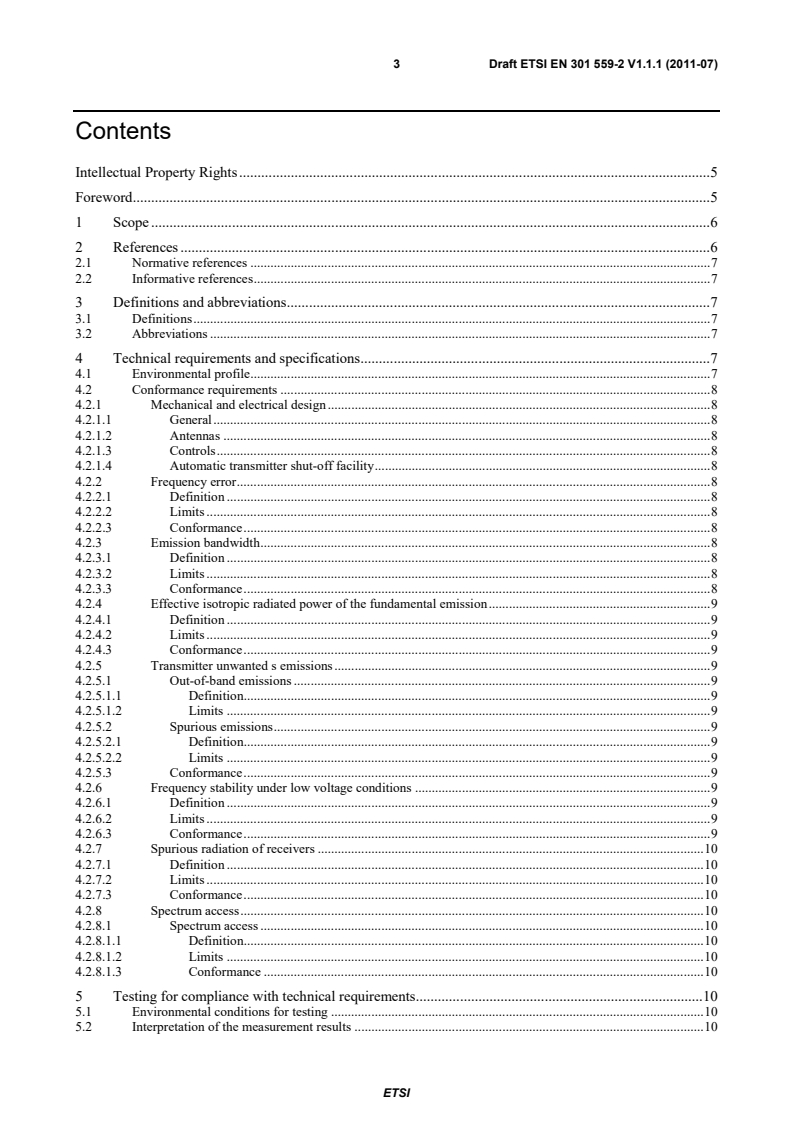
3 Draft ETSI EN 301 559-2 V1.1.1 (2011-07)
Contents
Intellectual Property Rights . 5
Foreword . 5
1 Scope . 6
2 References . 6
2.1 Normative references . 7
2.2 Informative references . 7
3 Definitions and abbreviations . 7
3.1 Definitions . 7
3.2 Abbreviations . 7
4 Technical requirements and specifications . 7
4.1 Environmental profile . 7
4.2 Conformance requirements . 8
4.2.1 Mechanical and electrical design . 8
4.2.1.1 General . 8
4.2.1.2 Antennas . 8
4.2.1.3 Controls . 8
4.2.1.4 Automatic transmitter shut-off facility . 8
4.2.2 Frequency error . 8
4.2.2.1 Definition . 8
4.2.2.2 Limits . 8
4.2.2.3 Conformance . 8
4.2.3 Emission bandwidth . 8
4.2.3.1 Definition . 8
4.2.3.2 Limits . 8
4.2.3.3 Conformance . 8
4.2.4 Effective isotropic radiated power of the fundamental emission . 9
4.2.4.1 Definition . 9
4.2.4.2 Limits . 9
4.2.4.3 Conformance . 9
4.2.5 Transmitter unwanted s emissions . 9
4.2.5.1 Out-of-band emissions . 9
4.2.5.1.1 Definition. 9
4.2.5.1.2 Limits . 9
4.2.5.2 Spurious emissions . 9
4.2.5.2.1 Definition. 9
4.2.5.2.2 Limits . 9
4.2.5.3 Conformance . 9
4.2.6 Frequency stability under low voltage conditions . 9
4.2.6.1 Definition . 9
4.2.6.2 Limits . 9
4.2.6.3 Conformance . 9
4.2.7 Spurious radiation of receivers . 10
4.2.7.1 Definition . 10
4.2.7.2 Limits . 10
4.2.7.3 Conformance . 10
4.2.8 Spectrum access . 10
4.2.8.1 Spectrum access . 10
4.2.8.1.1 Definition. 10
4.2.8.1.2 Limits . 10
4.2.8.1.3 Conformance . 10
5 Testing for compliance with technical requirements . 10
5.1 Environmental conditions for testing . 10
5.2 Interpretation of the measurement results . 10
ETSI
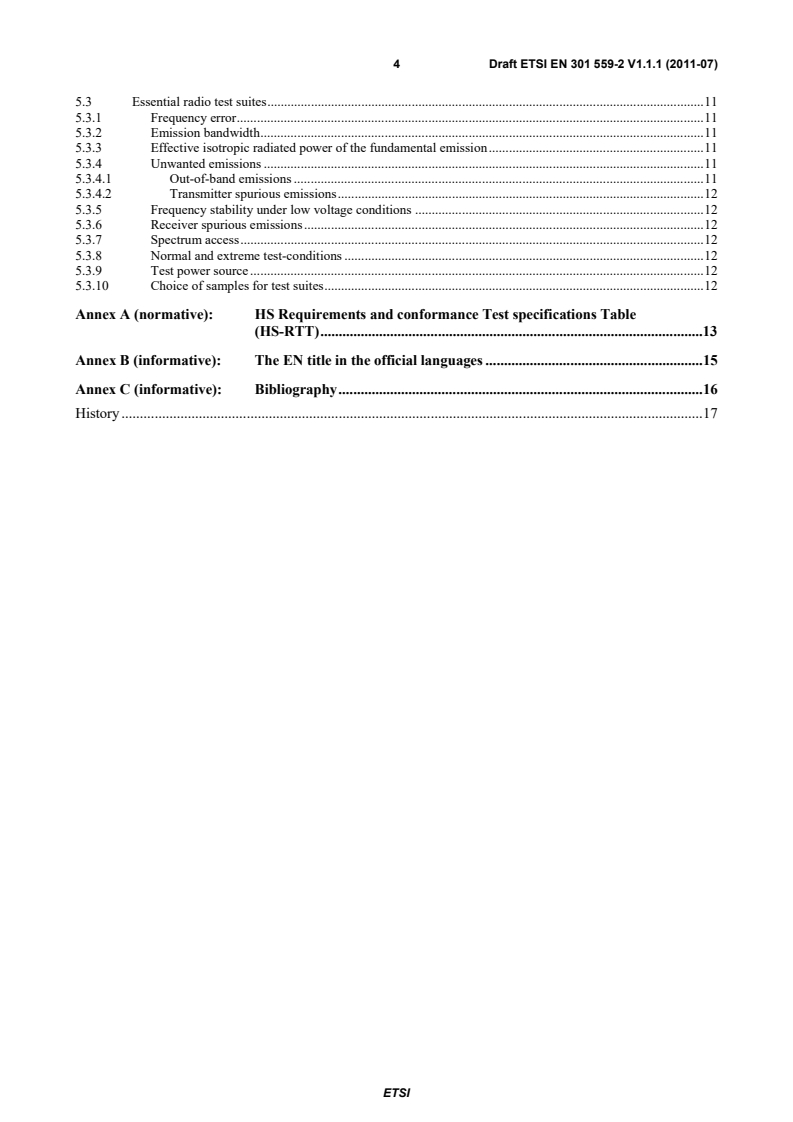
4 Draft ETSI EN 301 559-2 V1.1.1 (2011-07)
5.3 Essential radio test suites . 11
5.3.1 Frequency error . 11
5.3.2 Emission bandwidth . 11
5.3.3 Effective isotropic radiated power of the fundamental emission . 11
5.3.4 Unwanted emissions . 11
5.3.4.1 Out-of-band emissions . 11
5.3.4.2 Transmitter spurious emissions . 12
5.3.5 Frequency stability under low voltage conditions . 12
5.3.6 Receiver spurious emissions . 12
5.3.7 Spectrum access . 12
5.3.8 Normal and extreme test-conditions . 12
5.3.9 Test power source . 12
5.3.10 Choice of samples for test suites . 12
Annex A (normative): HS Requirements and conformance Test specifications Table
(HS-RTT) . 13
Annex B (informative): The EN title in the official languages . 15
Annex C (informative): Bibliography . 16
History . 17
ETSI
5 Draft ETSI EN 301 559-2 V1.1.1 (2011-07)
Intellectual Property Rights
IPRs essential or potentially essential to the present document may have been declared to ETSI. The information
pertaining to these essential IPRs, if any, is publicly available for ETSI members and non-members, and can be found
in ETSI SR 000 314: "Intellectual Property Rights (IPRs); Essential, or potentially Essential, IPRs notified to ETSI in
respect of ETSI standards", which is available from the ETSI Secretariat. Latest updates are available on the ETSI Web
server (http://ipr.etsi.org).
Pursuant to the ETSI IPR Policy, no investigation, including IPR searches, has been carried out by ETSI. No guarantee
can be given as to the existence of other IPRs not referenced in ETSI SR 000 314 (or the updates on the ETSI Web
server) which are, or may be, or may become, essential to the present document.
Foreword
This draft Harmonized European Standard (EN) has been produced by ETSI Technical Committee Electromagnetic
compatibility and Radio spectrum Matters (ERM), and is now submitted for the Public Enquiry phase of the ETSI
standards Two-step Approval Procedure.
The present document has been produced by ETSI in response to a mandate from the European Commission issued
under Directive 98/34/EC [i.5] as amended, laying down a procedure for the provision of information in the field of
technical standards and regulations.
The title and reference to the present document are intended to be included in the publication in the Official Journal of
the European Union of titles and references of Harmonized Standard under the Directive 1999/5/EC [i.1].
See article 5.1 of Directive 1999/5/EC [i.1] for information on presumption of conformity and Harmonised Standards or
parts thereof the references of which have been published in the Official Journal of the European Union.
The requirements relevant to Directive 1999/5/EC [i.1] are summarised in annex A.
For non EU countries the present document may be used for regulatory purposes.
The present document is part 2 of a multi-part deliverable covering Low Power Active Medical Implants (LP-AMI),
Peripherals (LP-AMI-P) operating in the frequency range 2 483,5 MHz to 2 500 MHz as described in the systems
reference document for the equipment, TR 102 655 [i.4].
Part 1: "Technical characteristics and test methods";
Part 2: "Harmonized EN covering the essential requirements of article 3.2 of the R&TTE Directive".
Proposed national transposition dates
Date of latest announcement of this EN (doa): 3 months after ETSI publication
Date of latest publication of new National Standard
or endorsement of this EN (dop/e): 6 months after doa
Date of withdrawal of any conflicting National Standard (dow): 18 months after doa
ETSI
6 Draft ETSI EN 301 559-2 V1.1.1 (2011-07)
1 Scope
The present document covers, for Low Power Active Medical Implants (LP-AMI), and associated Peripherals
(LP-AMI-P) used in an Active Medical Implant Communications System (AMICS), the required characteristics
considered necessary to efficiently use the available spectrum and serve the interests of patients with implanted devices.
The specifications contained in the present document were developed to ensure that the health and safety of the patients
that are using this equipment under the direction of medical practitioners is protected. Of particular importance is the
inclusion of spectrum monitoring and access requirements designed to significantly reduce any interference potential
between AMICS operating in the band or between AMICS and other primary or secondary users of the band. An AIMD
is regulated under the AIMD Directive 90/385/EEC [i.3] radio parts contained therein (referred to herein as LP-AMI,
and LP-AMI-P for associated peripheral devices) are regulated under the Directive 1999/5/EC [i.1] (R&TTE Directive).
It is intended that the present document applies to operation in the band 2 483,5 MHz to 2 500 MHz that devices that
can also operate in spectrum outside this band also meet any applicable requirements for operation in such bands.
The present document contains the technical characteristics for LP-AMI and associated peripherals radio equipment
which is also addressed by CEPT/ERC/REC 70-03 [i.2] and annex 12 band f to that document. It does not necessarily
include all the characteristics, which may be required by a user, nor does it necessarily represent the optimum
performance achievable.
It applies to LP-AMI and LP-AMI_P operating in the band 2 483,5 MHz to 2 500 MHz:
• for telecommand and telemetry between LP-AMI and LP-AMI-P;
• for telecommand and telemetry between LP-AMI to another LP-AMI;
• with or without an integral antenna; and/or
• with an antenna connection provided only for the purpose of connecting a dedicated antenna.
The present document contains required characteristics considered necessary for the radio devices used in AMICS to
meet in order to efficiently use the available spectrum for the purpose of transferring data that is used in diagnosing and
delivering therapies to individuals with various illnesses. Of particular importance is the inclusion of spectrum
monitoring and access requirements (listen before talk protocol) designed to significantly reduce any interference
potential between AMICS operating in the band or between an AMICS and the primary users of the band.
The present document is a specific product standard applicable to low power transmitters that are part of a system used
in the AMICS operating in spectrum within the frequency band 2 483,5 MHz to 2 500 MHz.
In addition to the present document, other ENs that specify technical requirements in respect of essential requirements
under other parts of article 3 of the R&TTE Directive [i.1] will apply to equipment within the scope of the present
document.
2 References
References are either specific (identified by date of publication and/or edition number or version number) or
non-specific. For specific references, only the cited version applies. For non-specific references, the latest version of the
reference document (including any amendm
...
Harmonized European Standard
Electromagnetic compatibility
and Radio spectrum Matters (ERM);
Short Range Devices (SRD);
Low Power Active Medical Implants (LP-AMI)
operating in the frequency range 2 483,5 MHz to 2 500 MHz;
Part 2: Harmonized EN covering the essential requirements
of article 3.2 of the R&TTE Directive
2 ETSI EN 301 559-2 V1.1.2 (2012-06)
Reference
DEN/ERM-TG30-301
Keywords
EMC, health, radio, regulation, SRD, testing
ETSI
650 Route des Lucioles
F-06921 Sophia Antipolis Cedex - FRANCE
Tel.: +33 4 92 94 42 00 Fax: +33 4 93 65 47 16
Siret N° 348 623 562 00017 - NAF 742 C
Association à but non lucratif enregistrée à la
Sous-Préfecture de Grasse (06) N° 7803/88
Important notice
Individual copies of the present document can be downloaded from:
http://www.etsi.org
The present document may be made available in more than one electronic version or in print. In any case of existing or
perceived difference in contents between such versions, the reference version is the Portable Document Format (PDF).
In case of dispute, the reference shall be the printing on ETSI printers of the PDF version kept on a specific network drive
within ETSI Secretariat.
Users of the present document should be aware that the document may be subject to revision or change of status.
Information on the current status of this and other ETSI documents is available at
http://portal.etsi.org/tb/status/status.asp
If you find errors in the present document, please send your comment to one of the following services:
http://portal.etsi.org/chaircor/ETSI_support.asp
Copyright Notification
No part may be reproduced except as authorized by written permission.
The copyright and the foregoing restriction extend to reproduction in all media.
© European Telecommunications Standards Institute 2012.
All rights reserved.
TM TM TM
DECT , PLUGTESTS , UMTS and the ETSI logo are Trade Marks of ETSI registered for the benefit of its Members.
TM
3GPP and LTE™ are Trade Marks of ETSI registered for the benefit of its Members and
of the 3GPP Organizational Partners.
GSM® and the GSM logo are Trade Marks registered and owned by the GSM Association.
ETSI
3 ETSI EN 301 559-2 V1.1.2 (2012-06)
Contents
Intellectual Property Rights . 5
Foreword . 5
1 Scope . 6
2 References . 6
2.1 Normative references . 7
2.2 Informative references . 7
3 Definitions and abbreviations . 7
3.1 Definitions . 7
3.2 Abbreviations . 7
4 Technical requirements and specifications . 7
4.1 Environmental profile . 7
4.2 Conformance requirements . 8
4.2.1 Mechanical and electrical design . 8
4.2.1.1 General . 8
4.2.1.2 Antennas . 8
4.2.1.3 Controls . 8
4.2.1.4 Automatic transmitter shut-off facility . 8
4.2.2 Frequency error . 8
4.2.2.1 Definition . 8
4.2.2.2 Limits . 8
4.2.2.3 Conformance . 8
4.2.3 Emission bandwidth . 8
4.2.3.1 Definition . 8
4.2.3.2 Limits . 8
4.2.3.3 Conformance . 8
4.2.4 Effective isotropic radiated power of the fundamental emission . 9
4.2.4.1 Definition . 9
4.2.4.2 Limits . 9
4.2.4.3 Conformance . 9
4.2.5 Transmitter unwanted s emissions . 9
4.2.5.1 Out-of-band emissions . 9
4.2.5.1.1 Definition. 9
4.2.5.1.2 Limits . 9
4.2.5.2 Spurious emissions . 9
4.2.5.2.1 Definition. 9
4.2.5.2.2 Limits . 9
4.2.5.3 Conformance . 9
4.2.6 Frequency stability under low voltage conditions . 9
4.2.6.1 Definition . 9
4.2.6.2 Limits . 9
4.2.6.3 Conformance . 9
4.2.7 Spurious radiation of receivers . 10
4.2.7.1 Definition . 10
4.2.7.2 Limits . 10
4.2.7.3 Conformance . 10
4.2.8 Spectrum access . 10
4.2.8.1 Spectrum access . 10
4.2.8.1.1 Definition. 10
4.2.8.1.2 Limits . 10
4.2.8.1.3 Conformance . 10
5 Testing for compliance with technical requirements . 10
5.1 Environmental conditions for testing . 10
5.2 Interpretation of the measurement results . 10
ETSI
4 ETSI EN 301 559-2 V1.1.2 (2012-06)
5.3 Essential radio test suites . 11
5.3.1 Frequency error . 11
5.3.2 Emission bandwidth . 11
5.3.3 Effective isotropic radiated power of the fundamental emission . 11
5.3.4 Unwanted emissions . 11
5.3.4.1 Out-of-band emissions . 11
5.3.4.2 Transmitter spurious emissions . 12
5.3.5 Frequency stability under low voltage conditions . 12
5.3.6 Receiver spurious emissions . 12
5.3.7 Spectrum access . 12
5.3.8 Normal and extreme test-conditions . 12
5.3.9 Test power source . 12
5.3.10 Choice of samples for test suites . 12
Annex A (normative): HS Requirements and conformance Test specifications Table
(HS-RTT) . 13
Annex B (informative): Void . 15
Annex C (informative): Bibliography . 16
History . 17
ETSI
5 ETSI EN 301 559-2 V1.1.2 (2012-06)
Intellectual Property Rights
IPRs essential or potentially essential to the present document may have been declared to ETSI. The information
pertaining to these essential IPRs, if any, is publicly available for ETSI members and non-members, and can be found
in ETSI SR 000 314: "Intellectual Property Rights (IPRs); Essential, or potentially Essential, IPRs notified to ETSI in
respect of ETSI standards", which is available from the ETSI Secretariat. Latest updates are available on the ETSI Web
server (http://ipr.etsi.org).
Pursuant to the ETSI IPR Policy, no investigation, including IPR searches, has been carried out by ETSI. No guarantee
can be given as to the existence of other IPRs not referenced in ETSI SR 000 314 (or the updates on the ETSI Web
server) which are, or may be, or may become, essential to the present document.
Foreword
This Harmonized European Standard (EN) has been produced by ETSI Technical Committee Electromagnetic
compatibility and Radio spectrum Matters (ERM).
The present document has been produced by ETSI in response to a mandate from the European Commission issued
under Directive 98/34/EC [i.5] as amended by Directive 98/48/EC [i.6].
The title and reference to the present document are intended to be included in the publication in the Official Journal of
the European Union of titles and references of Harmonized Standard under the Directive 1999/5/EC [i.1].
See article 5.1 of Directive 1999/5/EC [i.1] for information on presumption of conformity and Harmonised Standards or
parts thereof the references of which have been published in the Official Journal of the European Union.
The requirements relevant to Directive 1999/5/EC [i.1] are summarised in annex A.
For non EU countries the present document may be used for regulatory purposes.
The present document is part 2 of a multi-part deliverable covering Low Power Active Medical Implants (LP-AMI),
Peripherals (LP-AMI-P) operating in the frequency range 2 483,5 MHz to 2 500 MHz as described in the systems
reference document for the equipment, TR 102 655 [i.4].
Part 1: "Technical characteristics and test methods";
Part 2: "Harmonized EN covering the essential requirements of article 3.2 of the R&TTE Directive".
National transposition dates
Date of adoption of this EN: 18 June 2012
Date of latest announcement of this EN (doa): 30 September 2012
Date of latest publication of new National Standard
or endorsement of this EN (dop/e): 31 March 2013
Date of withdrawal of any conflicting National Standard (dow): 31 March 2014
ETSI
6 ETSI EN 301 559-2 V1.1.2 (2012-06)
1 Scope
The present document covers, for Low Power Active Medical Implants (LP-AMI), and associated Peripherals
(LP-AMI-P) used in an Active Medical Implant Communications System (AMICS), the required characteristics
considered necessary to efficiently use the available spectrum and serve the interests of patients with implanted devices.
The specifications contained in the present document were developed to ensure that the health and safety of the patients
that are using this equipment under the direction of medical practitioners is protected. Of particular importance is the
inclusion of spectrum monitoring and access requirements designed to significantly reduce any interference potential
between AMICS operating in the band or between AMICS and other primary or secondary users of the band. An AIMD
is regulated under the AIMD Directive 90/385/EEC [i.3] radio parts contained therein (referred to herein as LP-AMI,
and LP-AMI-P for associated peripheral devices) are regulated under the Directive 1999/5/EC [i.1] (R&TTE Directive).
It is intended that the present document applies to operation in the band 2 483,5 MHz to 2 500 MHz that devices that
can also operate in spectrum outside this band also meet any applicable requirements for operation in such bands.
The present document contains the technical characteristics for LP-AMI and associated peripherals radio equipment
which is also addressed by CEPT/ERC/REC 70-03 [i.2] and annex 12 band f to that document. It does not necessarily
include all the characteristics, which may be required by a user, nor does it necessarily represent the optimum
performance achievable.
It applies to LP-AMI and LP-AMI_P operating in the band 2 483,5 MHz to 2 500 MHz:
• for telecommand and telemetry between LP-AMI and LP-AMI-P;
• for telecommand and telemetry between LP-AMI to another LP-AMI;
• with or without an integral antenna; and/or
• with an antenna connection provided only for the purpose of connecting a dedicated antenna.
The present document contains required characteristics considered necessary for the radio devices used in AMICS to
meet in order to efficiently use the available spectrum for the purpose of transferring data that is used in diagnosing and
delivering therapies to individuals with various illnesses. Of particular importance is the inclusion of spectrum
monitoring and access requirements (listen before talk protocol) designed to significantly reduce any interference
potential between AMICS operating in the band or between an AMICS and the primary users of the band.
The present document is a specific product standard applicable to low power transmitters that are part of a system used
in the AMICS operating in spectrum within the frequency band 2 483,5 MHz to 2 500 MHz.
In addition to the present document, other ENs that specify technical requirements in respect of essential requirements
under other parts of article 3 of the R&TTE Directive [i.1] will apply to equipment within the scope of the present
document.
2 References
References are either specific (identified by date of publication and/or edition number or version number) or
non-specific. For specific references, only the cited version applies. For non-specific references, the latest version of the
reference document (including any a
...
Final draft ETSI EN 301 559-2 V1.1.2 (2012-04)
Harmonized European Standard
Electromagnetic compatibility
and Radio spectrum Matters (ERM);
Short Range Devices (SRD);
Low Power Active Medical Implants (LP-AMI)
operating in the frequency range 2 483,5 MHz to 2 500 MHz;
Part 2: Harmonized EN covering the essential requirements
of article 3.2 of the R&TTE Directive
2 Final draft ETSI EN 301 559-2 V1.1.2 (2012-04)
Reference
DEN/ERM-TG30-301
Keywords
EMC, health, radio, regulation, SRD, testing
ETSI
650 Route des Lucioles
F-06921 Sophia Antipolis Cedex - FRANCE
Tel.: +33 4 92 94 42 00 Fax: +33 4 93 65 47 16
Siret N° 348 623 562 00017 - NAF 742 C
Association à but non lucratif enregistrée à la
Sous-Préfecture de Grasse (06) N° 7803/88
Important notice
Individual copies of the present document can be downloaded from:
http://www.etsi.org
The present document may be made available in more than one electronic version or in print. In any case of existing or
perceived difference in contents between such versions, the reference version is the Portable Document Format (PDF).
In case of dispute, the reference shall be the printing on ETSI printers of the PDF version kept on a specific network drive
within ETSI Secretariat.
Users of the present document should be aware that the document may be subject to revision or change of status.
Information on the current status of this and other ETSI documents is available at
http://portal.etsi.org/tb/status/status.asp
If you find errors in the present document, please send your comment to one of the following services:
http://portal.etsi.org/chaircor/ETSI_support.asp
Copyright Notification
No part may be reproduced except as authorized by written permission.
The copyright and the foregoing restriction extend to reproduction in all media.
© European Telecommunications Standards Institute 2012.
All rights reserved.
TM TM TM
DECT , PLUGTESTS , UMTS and the ETSI logo are Trade Marks of ETSI registered for the benefit of its Members.
TM
3GPP and LTE™ are Trade Marks of ETSI registered for the benefit of its Members and
of the 3GPP Organizational Partners.
GSM® and the GSM logo are Trade Marks registered and owned by the GSM Association.
ETSI
3 Final draft ETSI EN 301 559-2 V1.1.2 (2012-04)
Contents
Intellectual Property Rights . 5
Foreword . 5
1 Scope . 6
2 References . 6
2.1 Normative references . 7
2.2 Informative references . 7
3 Definitions and abbreviations . 7
3.1 Definitions . 7
3.2 Abbreviations . 7
4 Technical requirements and specifications . 7
4.1 Environmental profile . 7
4.2 Conformance requirements . 8
4.2.1 Mechanical and electrical design . 8
4.2.1.1 General . 8
4.2.1.2 Antennas . 8
4.2.1.3 Controls . 8
4.2.1.4 Automatic transmitter shut-off facility . 8
4.2.2 Frequency error . 8
4.2.2.1 Definition . 8
4.2.2.2 Limits . 8
4.2.2.3 Conformance . 8
4.2.3 Emission bandwidth . 8
4.2.3.1 Definition . 8
4.2.3.2 Limits . 8
4.2.3.3 Conformance . 8
4.2.4 Effective isotropic radiated power of the fundamental emission . 9
4.2.4.1 Definition . 9
4.2.4.2 Limits . 9
4.2.4.3 Conformance . 9
4.2.5 Transmitter unwanted s emissions . 9
4.2.5.1 Out-of-band emissions . 9
4.2.5.1.1 Definition. 9
4.2.5.1.2 Limits . 9
4.2.5.2 Spurious emissions . 9
4.2.5.2.1 Definition. 9
4.2.5.2.2 Limits . 9
4.2.5.3 Conformance . 9
4.2.6 Frequency stability under low voltage conditions . 9
4.2.6.1 Definition . 9
4.2.6.2 Limits . 9
4.2.6.3 Conformance . 9
4.2.7 Spurious radiation of receivers . 10
4.2.7.1 Definition . 10
4.2.7.2 Limits . 10
4.2.7.3 Conformance . 10
4.2.8 Spectrum access . 10
4.2.8.1 Spectrum access . 10
4.2.8.1.1 Definition. 10
4.2.8.1.2 Limits . 10
4.2.8.1.3 Conformance . 10
5 Testing for compliance with technical requirements . 10
5.1 Environmental conditions for testing . 10
5.2 Interpretation of the measurement results . 10
ETSI
4 Final draft ETSI EN 301 559-2 V1.1.2 (2012-04)
5.3 Essential radio test suites . 11
5.3.1 Frequency error . 11
5.3.2 Emission bandwidth . 11
5.3.3 Effective isotropic radiated power of the fundamental emission . 11
5.3.4 Unwanted emissions . 11
5.3.4.1 Out-of-band emissions . 11
5.3.4.2 Transmitter spurious emissions . 12
5.3.5 Frequency stability under low voltage conditions . 12
5.3.6 Receiver spurious emissions . 12
5.3.7 Spectrum access . 12
5.3.8 Normal and extreme test-conditions . 12
5.3.9 Test power source . 12
5.3.10 Choice of samples for test suites . 12
Annex A (normative): HS Requirements and conformance Test specifications Table
(HS-RTT) . 13
Annex B (informative): Void . 15
Annex C (informative): Bibliography . 16
History . 17
ETSI
5 Final draft ETSI EN 301 559-2 V1.1.2 (2012-04)
Intellectual Property Rights
IPRs essential or potentially essential to the present document may have been declared to ETSI. The information
pertaining to these essential IPRs, if any, is publicly available for ETSI members and non-members, and can be found
in ETSI SR 000 314: "Intellectual Property Rights (IPRs); Essential, or potentially Essential, IPRs notified to ETSI in
respect of ETSI standards", which is available from the ETSI Secretariat. Latest updates are available on the ETSI Web
server (http://ipr.etsi.org).
Pursuant to the ETSI IPR Policy, no investigation, including IPR searches, has been carried out by ETSI. No guarantee
can be given as to the existence of other IPRs not referenced in ETSI SR 000 314 (or the updates on the ETSI Web
server) which are, or may be, or may become, essential to the present document.
Foreword
This final draft Harmonized European Standard (EN) has been produced by ETSI Technical Committee
Electromagnetic compatibility and Radio spectrum Matters (ERM), and is now submitted for the Vote phase of the
ETSI standards Two-step Approval Procedure.
The present document has been produced by ETSI in response to a mandate from the European Commission issued
under Directive 98/34/EC [i.5] as amended by Directive 98/48/EC [i.6].
The title and reference to the present document are intended to be included in the publication in the Official Journal of
the European Union of titles and references of Harmonized Standard under the Directive 1999/5/EC [i.1].
See article 5.1 of Directive 1999/5/EC [i.1] for information on presumption of conformity and Harmonised Standards or
parts thereof the references of which have been published in the Official Journal of the European Union.
The requirements relevant to Directive 1999/5/EC [i.1] are summarised in annex A.
For non EU countries the present document may be used for regulatory purposes.
The present document is part 2 of a multi-part deliverable covering Low Power Active Medical Implants (LP-AMI),
Peripherals (LP-AMI-P) operating in the frequency range 2 483,5 MHz to 2 500 MHz as described in the systems
reference document for the equipment, TR 102 655 [i.4].
Part 1: "Technical characteristics and test methods";
Part 2: "Harmonized EN covering the essential requirements of article 3.2 of the R&TTE Directive".
Proposed national transposition dates
Date of latest announcement of this EN (doa): 3 months after ETSI publication
Date of latest publication of new National Standard
or endorsement of this EN (dop/e): 6 months after doa
Date of withdrawal of any conflicting National Standard (dow): 18 months after doa
ETSI
6 Final draft ETSI EN 301 559-2 V1.1.2 (2012-04)
1 Scope
The present document covers, for Low Power Active Medical Implants (LP-AMI), and associated Peripherals
(LP-AMI-P) used in an Active Medical Implant Communications System (AMICS), the required characteristics
considered necessary to efficiently use the available spectrum and serve the interests of patients with implanted devices.
The specifications contained in the present document were developed to ensure that the health and safety of the patients
that are using this equipment under the direction of medical practitioners is protected. Of particular importance is the
inclusion of spectrum monitoring and access requirements designed to significantly reduce any interference potential
between AMICS operating in the band or between AMICS and other primary or secondary users of the band. An AIMD
is regulated under the AIMD Directive 90/385/EEC [i.3] radio parts contained therein (referred to herein as LP-AMI,
and LP-AMI-P for associated peripheral devices) are regulated under the Directive 1999/5/EC [i.1] (R&TTE Directive).
It is intended that the present document applies to operation in the band 2 483,5 MHz to 2 500 MHz that devices that
can also operate in spectrum outside this band also meet any applicable requirements for operation in such bands.
The present document contains the technical characteristics for LP-AMI and associated peripherals radio equipment
which is also addressed by CEPT/ERC/REC 70-03 [i.2] and annex 12 band f to that document. It does not necessarily
include all the characteristics, which may be required by a user, nor does it necessarily represent the optimum
performance achievable.
It applies to LP-AMI and LP-AMI_P operating in the band 2 483,5 MHz to 2 500 MHz:
• for telecommand and telemetry between LP-AMI and LP-AMI-P;
• for telecommand and telemetry between LP-AMI to another LP-AMI;
• with or without an integral antenna; and/or
• with an antenna connection provided only for the purpose of connecting a dedicated antenna.
The present document contains required characteristics considered necessary for the radio devices used in AMICS to
meet in order to efficiently use the available spectrum for the purpose of transferring data that is used in diagnosing and
delivering therapies to individuals with various illnesses. Of particular importance is the inclusion of spectrum
monitoring and access requirements (listen before talk protocol) designed to significantly reduce any interference
potential between AMICS operating in the band or between an AMICS and the primary users of the band.
The present document is a specific product standard applicable to low power transmitters that are part of a system used
in the AMICS operating in spectrum within the frequency band 2 483,5 MHz to 2 500 MHz.
In addition to the present document, other ENs that specify technical requirements in respect of essential requirements
under other parts of article 3 of the R&TTE Directive [i.1] will apply to equipment within the scope of the present
document.
2 References
References are either specific (identified by date of publication and/or edition number or version number) or
non-specific. For specific references, only the cited version applies. For non-specific references, the latest version of the
refer
...
2003-01.Slovenski inštitut za standardizacijo. Razmnoževanje celote ali delov tega standarda ni dovoljeno.577(Electromagnetic compatibility and Radio spectrum Matters (ERM) - Short Range Devices (SRD) - Low Power Active Medical Implants (LP-AMI) operating in the frequency range 2 483,5 MHz to 2 500 MHz - Part 2: Harmonized EN covering the essential requirements of article 3.2 of the R&TTE Directive33.100.01Elektromagnetna združljivost na splošnoElectromagnetic compatibility in general33.060.01Radijske komunikacije na splošnoRadiocommunications in generalICS:Ta slovenski standard je istoveten z:EN 301 559-2 Version 1.1.2SIST EN 301 559-2 V1.1.2:2012en01-september-2012SIST EN 301 559-2 V1.1.2:2012SLOVENSKI
STANDARD
Harmonized European Standard SIST EN 301 559-2 V1.1.2:2012
ETSI ETSI EN 301 559-2 V1.1.2 (2012-06) 2
Reference DEN/ERM-TG30-301 Keywords EMC, health, radio, regulation, SRD, testing ETSI 650 Route des Lucioles F-06921 Sophia Antipolis Cedex - FRANCE
Tel.: +33 4 92 94 42 00
Fax: +33 4 93 65 47 16
Siret N° 348 623 562 00017 - NAF 742 C Association à but non lucratif enregistrée à la Sous-Préfecture de Grasse (06) N° 7803/88
Important notice Individual copies of the present document can be downloaded from: http://www.etsi.org The present document may be made available in more than one electronic version or in print. In any case of existing or perceived difference in contents between such versions, the reference version is the Portable Document Format (PDF). In case of dispute, the reference shall be the printing on ETSI printers of the PDF version kept on a specific network drive within ETSI Secretariat. Users of the present document should be aware that the document may be subject to revision or change of status. Information on the current status of this and other ETSI documents is available at http://portal.etsi.org/tb/status/status.asp If you find errors in the present document, please send your comment to one of the following services: http://portal.etsi.org/chaircor/ETSI_support.asp Copyright Notification No part may be reproduced except as authorized by written permission. The copyright and the foregoing restriction extend to reproduction in all media.
© European Telecommunications Standards Institute 2012. All rights reserved.
DECTTM, PLUGTESTSTM, UMTSTM and the ETSI logo are Trade Marks of ETSI registered for the benefit of its Members. 3GPPTM and LTE™ are Trade Marks of ETSI registered for the benefit of its Members and of the 3GPP Organizational Partners. GSM® and the GSM logo are Trade Marks registered and owned by the GSM Association. SIST EN 301 559-2 V1.1.2:2012
ETSI ETSI EN 301 559-2 V1.1.2 (2012-06) 3 Contents Intellectual Property Rights . 5 Foreword . 5 1 Scope . 6 2 References . 6 2.1 Normative references . 7 2.2 Informative references . 7 3 Definitions and abbreviations . 7 3.1 Definitions . 7 3.2 Abbreviations . 7 4 Technical requirements and specifications . 7 4.1 Environmental profile . 7 4.2 Conformance requirements . 8 4.2.1 Mechanical and electrical design . 8 4.2.1.1 General . 8 4.2.1.2 Antennas . 8 4.2.1.3 Controls . 8 4.2.1.4 Automatic transmitter shut-off facility . 8 4.2.2 Frequency error . 8 4.2.2.1 Definition . 8 4.2.2.2 Limits . 8 4.2.2.3 Conformance . 8 4.2.3 Emission bandwidth . 8 4.2.3.1 Definition . 8 4.2.3.2 Limits . 8 4.2.3.3 Conformance . 8 4.2.4 Effective isotropic radiated power of the fundamental emission . 9 4.2.4.1 Definition . 9 4.2.4.2 Limits . 9 4.2.4.3 Conformance . 9 4.2.5 Transmitter unwanted s emissions . 9 4.2.5.1 Out-of-band emissions . 9 4.2.5.1.1 Definition. 9 4.2.5.1.2 Limits . 9 4.2.5.2 Spurious emissions . 9 4.2.5.2.1 Definition. 9 4.2.5.2.2 Limits . 9 4.2.5.3 Conformance . 9 4.2.6 Frequency stability under low voltage conditions . 9 4.2.6.1 Definition . 9 4.2.6.2 Limits . 9 4.2.6.3 Conformance . 9 4.2.7 Spurious radiation of receivers . 10 4.2.7.1 Definition . 10 4.2.7.2 Limits . 10 4.2.7.3 Conformance . 10 4.2.8 Spectrum access . 10 4.2.8.1 Spectrum access . 10 4.2.8.1.1 Definition. 10 4.2.8.1.2 Limits . 10 4.2.8.1.3 Conformance . 10 5 Testing for compliance with technical requirements . 10 5.1 Environmental conditions for testing . 10 5.2 Interpretation of the measurement results . 10 SIST EN 301 559-2 V1.1.2:2012
ETSI ETSI EN 301 559-2 V1.1.2 (2012-06) 4 5.3 Essential radio test suites . 11 5.3.1 Frequency error . 11 5.3.2 Emission bandwidth . 11 5.3.3 Effective isotropic radiated power of the fundamental emission . 11 5.3.4 Unwanted emissions . 11 5.3.4.1 Out-of-band emissions . 11 5.3.4.2 Transmitter spurious emissions . 12 5.3.5 Frequency stability under low voltage conditions . 12 5.3.6 Receiver spurious emissions . 12 5.3.7 Spectrum access . 12 5.3.8 Normal and extreme test-conditions . 12 5.3.9 Test power source . 12 5.3.10 Choice of samples for test suites . 12 Annex A (normative): HS Requirements and conformance Test specifications Table (HS-RTT) . 13 Annex B (informative): Void . 15 Annex C (informative): Bibliography . 16 History . 17
ETSI ETSI EN 301 559-2 V1.1.2 (2012-06) 5 Intellectual Property Rights IPRs essential or potentially essential to the present document may have been declared to ETSI. The information pertaining to these essential IPRs, if any, is publicly available for ETSI members and non-members, and can be found in ETSI SR 000 314: "Intellectual Property Rights (IPRs); Essential, or potentially Essential, IPRs notified to ETSI in respect of ETSI standards", which is available from the ETSI Secretariat. Latest updates are available on the ETSI Web server (http://ipr.etsi.org). Pursuant to the ETSI IPR Policy, no investigation, including IPR searches, has been carried out by ETSI. No guarantee can be given as to the existence of other IPRs not referenced in ETSI SR 000 314 (or the updates on the ETSI Web server) which are, or may be, or may become, essential to the present document. Foreword This Harmonized European Standard (EN) has been produced by ETSI Technical Committee Electromagnetic compatibility and Radio spectrum Matters (ERM). The present document has been produced by ETSI in response to a mandate from the European Commission issued under Directive 98/34/EC [i.5] as amended by Directive 98/48/EC [i.6]. The title and reference to the present document are intended to be included in the publication in the Official Journal of the European Union of titles and references of Harmonized Standard under the Directive 1999/5/EC [i.1]. See article 5.1 of Directive 1999/5/EC [i.1] for information on presumption of conformity and Harmonised Standards or parts thereof the references of which have been published in the Official Journal of the European Union. The requirements relevant to Directive 1999/5/EC [i.1] are summarised in annex A. For non EU countries the present document may be used for regulatory purposes. The present document is part 2 of a multi-part deliverable covering Low Power Active Medical Implants (LP-AMI), Peripherals (LP-AMI-P) operating in the frequency range 2 483,5 MHz to 2 500 MHz as described in the systems reference document for the equipment, TR 102 655 [i.4]. Part 1: "Technical characteristics and test methods"; Part 2: "Harmonized EN covering the essential requirements of article 3.2 of the R&TTE Directive".
National transposition dates Date of adoption of this EN: 18 June 2012 Date of latest announcement of this EN (doa): 30 September 2012 Date of latest publication of new National Standard or endorsement of this EN (dop/e):
31 March 2013 Date of withdrawal of any conflicting National Standard (dow): 31 March 2014
ETSI ETSI EN 301 559-2 V1.1.2 (2012-06) 6 1 Scope The present document covers, for Low Power Active Medical Implants (LP-AMI), and associated Peripherals (LP-AMI-P) used in an Active Medical Implant Communications System (AMICS), the required characteristics considered necessary to efficiently use the available spectrum and serve the interests of patients with implanted devices. The specifications contained in the present document were developed to ensure that the health and safety of the patients that are using this equipment under the direction of medical practitioners is protected. Of particular importance is the inclusion of spectrum monitoring and access requirements designed to significantly reduce any interference potential between AMICS operating in the band or between AMICS and other primary or secondary users of the band. An AIMD is regulated under the AIMD Directive 90/385/EEC [i.3] radio parts contained therein (referred to herein as LP-AMI, and LP-AMI-P for associated peripheral devices) are regulated under the Directive 1999/5/EC [i.1] (R&TTE Directive). It is intended that the present document applies to operation in the band 2 483,5 MHz to 2 500 MHz that devices that can also operate in spectrum outside this band also meet any applicable requirements for operation in such bands. The present document contains the technical characteristics for LP-AMI and associated peripherals radio equipment which is also addressed by CEPT/ERC/REC 70-03 [i.2] and annex 12 band f to that document. It does not necessarily include all the characteristics, which may be required by a user, nor does it necessarily represent the optimum performance achievable. It applies to LP-AMI and LP-AMI_P operating in the band 2 483,5 MHz to 2 500 MHz: • for telecommand and telemetry between LP-AMI and LP-AMI-P; • for telecommand and telemetry between LP-AMI to another LP-AMI; • with or without an integral antenna; and/or • with an antenna connection provided only for the purpose of connecting a dedicated antenna. The present document contains required characteristics considered necessary for the radio devices used in AMICS to meet in order to efficiently use the available spectrum for the purpose of transferring data that is used in diagnosing and delivering therapies to individuals with various illnesses. Of particular importance is the inclusion of spectrum monitoring and access requirements (listen before talk protocol) designed to significantly reduce any interference potential between AMICS operating in the band or between an AMICS and the primary users of the band.
The present document is a specific product standard applicable to low power transmitters that are part of a system used in the AMICS operating in spectrum within the frequency band 2 483,5 MHz to 2 500 MHz.
...