


oSIST prEN IEC 62541-13:2024
(Main)OPC Unified Architecture - Part 13: Aggregates
OPC Unified Architecture - Part 13: Aggregates
IEC 62541-13:2025 is available as IEC 62541-13:2025 RLV which contains the International Standard and its Redline version, showing all changes of the technical content compared to the previous edition.
IEC 62541-13:2025 defines the information model associated with Aggregates. Programmatically produced aggregate examples are listed in Annex A. This third edition cancels and replaces the second edition published in 2020. This edition constitutes a technical revision.
This edition includes the following technical changes with respect to the previous edition:
a) Multiple fixes for the computation of aggregates
• The Raw status bit is always set for non-bad StatusCodes for the Start and End aggregates.
• Entries in the Interpolative examples Tables A2.2 Historian1, Historian2, and Historian3 have been changed from Good to Good, Raw status codes when the timestamp matches with the timestamp of the data source.
• Missing tables have been added for DurationInStateZero and DurationInStateNonZero.
• The value of zero has been removed for results with a StatusCode of bad.
• Data Type was listed as "Status Code" when it is "Double" for both Standard Deviation and both Variance Aggregates.
• Rounding Error in TimeAverage and TimeAverage2 have been corrected.
• The status codes have been corrected for the last two intervals and the value has been corrected in the last interval.
• The wording has been changed to be more consistent with the certification testing tool.
• UsedSlopedExtrapolation set to true for Historian2 and all examples locations needed new values or status' are modified.
• Values affected by percent good and percent bad have been updated.
• PercentGood/PercentBad are now accounted for in the calculation.
• TimeAverage uses SlopedInterpolation but the Time aggregate is incorrectly allowed to used Stepped Interpolation.
• Partial bit is now correctly calculated.
• Unclear sentence was removed.
• Examples have been moved to a CSV.
• The value and status code for Historian 3 have been updated.
• TimeAverage2 Historian1 now takes uncertain regions into account when calculating StatusCodes.
• TimeAverage2 Historian2 now takes uncertain regions into account when calculating StatusCodes.
• Total2 Historian1 now takes uncertain regions into account when calculating StatusCodes
• Total2 Historian2 now takes uncertain regions into account when calculating StatusCodes
• Maximum2 Historian1 now takes uncertain regions into account when calculating StatusCodes
• MaximumActualTime2 Historian1 now takes uncertain regions into account when calculating StatusCodes
• Minimum2 Historian1 now takes uncertain regions into account when calculating StatusCodes
• MinimumActualTime2 Historian1 now has the StatusCodes calculated while using the TreatUncertainAsBad flag.
• Range2 Historian1 now looks at TreatUncertainAsBad in the calculation of the StatusCodes.
• Clarifications have been made to the text defining how PercentGood/PercentBad are used. The table values and StatusCodes of the TimeAverage2 and Total2 aggregates have been corrected.
OPC Unified Architecture - Teil 13: Aggregation von Daten
Architecture unifiée OPC - Partie 13: Agrégats
IEC 62541-13:2025 est disponible sous forme de IEC 62541-13:2025 RLV qui contient la Norme internationale et sa version Redline, illustrant les modifications du contenu technique depuis l'édition précédente.
L'IEC 62541-13:2025 définit le modèle d'information associé aux Agrégats. Des exemples d'agrégats produits par programme sont répertoriés à l'Annexe A. Cette troisième édition annule et remplace la deuxième édition parue en 2020. Cette édition constitue une révision technique.
Cette édition inclut les modifications techniques suivantes par rapport à l'édition précédente:
a) corrections multiples pour le calcul des agrégats
• le bit de statut "Raw" est toujours défini pour les StatusCodes autres que "bad" des agrégats de Début et de Fin;
• les entrées des tableaux d'exemples pour "Interpolative" en A2.2 Historique 1, Historique 2 et Historique 3 ont été modifiées pour passer du code de statut "Good" au code de statut "Good, Raw" lorsque l'horodatage correspond à l'horodatage de la source de données;
• des tableaux manquants ont été ajoutés pour DurationInStateZero et DurationInStateNonZero;
• la valeur zéro a été supprimée pour les résultats avec un StatusCode "bad";
• le type de données était indiqué comme étant "Code de statut" alors qu'il est "Double" pour les deux Agrégats d'Écart type et les deux Agrégats de Variance;
• les erreurs d'arrondi dans TimeAverage et TimeAverage2 ont été corrigées;
• les codes de statut ont été corrigés pour les deux derniers intervalles et la valeur a été corrigée dans le dernier intervalle;
• la formulation a été modifiée pour plus de cohérence avec l'outil d'essai de certification;
• UsedSlopedExtrapolation mis à "true" pour Historian2 et tous les emplacements d'exemples nécessitant de nouvelles valeurs ou de nouveaux statuts ont été modifiés,
• les valeurs influencées par PercentGood et PercentBad ont été mises à jour;
• PercentGood/PercentBad sont désormais pris en compte dans le calcul;
• TimeAverage utilise SlopedInterpolation, mais l'agrégat "Time" est autorisé à tort à utiliser SteppedInterpolation;
• le bit Partial est désormais calculé correctement;
• la phrase peu claire a été supprimée;
• les exemples ont été déplacés dans un fichier CSV;
• la valeur et le code de statut d'Historique 3 ont été mis à jour;
• TimeAverage2 (Historique 1) prend désormais en compte les régions incertaines dans le calcul des StatusCodes;
• TimeAverage2 (Historique 2) prend désormais en compte les régions incertaines dans le calcul des StatusCodes;
• Total2 (Historique 1) prend désormais en compte les régions incertaines dans le calcul des StatusCodes;
• Total2 (Historique 2) prend désormais en compte les régions incertaines dans le calcul des StatusCodes;
• Maximum2 (Historique 1) prend désormais en compte les régions incertaines dans le calcul des StatusCodes;
• MaximumActualTime2 (Historique 1) prend désormais en compte les régions incertaines dans le calcul des StatusCodes;
• Minimum2 (Historique 1) prend désormais en compte les régions incertaines dans le calcul des StatusCodes;
• MinimumActualTime2 (Historique 1) présente désormais les StatusCodes calculés en ut
Enotna arhitektura OPC - 13. del: Zborniki
General Information
- Status
- Not Published
- Public Enquiry End Date
- 30-Mar-2024
- Technical Committee
- MOV - Measuring equipment for electromagnetic quantities
- Current Stage
- 4020 - Public enquire (PE) (Adopted Project)
- Start Date
- 30-Jan-2024
- Due Date
- 18-Jun-2024
- Completion Date
- 05-Apr-2024
Relations
- Revises
SIST EN IEC 62541-13:2020 - OPC Unified Architecture - Part 13: Aggregates (IEC 62541-13:2020) - Effective Date
- 07-Feb-2023
Overview
Standard: prEN IEC 62541-13:2024 - OPC Unified Architecture (OPC UA) - Part 13: Aggregates
Organization: CLC / IEC SC 65E
This edition defines the OPC UA information model for Aggregates, specifying how aggregated values (for example averages, totals, minima/maxima, time-based aggregates and quality metrics) are represented, computed and exposed by OPC UA servers. Annex A provides programmatically produced aggregate examples (now distributed as CSV) to support implementation and testing. This edition replaces the previous publication (2020) and constitutes a technical revision with multiple corrections and clarifications to aggregate computations and status handling.
Key topics and requirements
- Aggregate information model: definitions for Aggregate objects including AggregateFunction and AggregateConfiguration types that describe supported aggregate operations and their parameters.
- MonitoredItem AggregateFilter / ReadProcessedDetails: structures and defaults for requesting processed (aggregated) history and monitored data.
- Aggregate data handling & status codes: rules for computing result values and StatusCodes, including operation-level result codes, Aggregate Information Bits (Raw, Partial, etc.) and how uncertain regions affect status calculation.
- Standard aggregate functions: summaries and behavior for aggregates such as TimeAverage, TimeAverage2, Total, Total2, Minimum, Maximum, Range, DurationInStateZero/NonZero, PercentGood/PercentBad, Start/End, Delta, and statistical aggregates (standard deviation/variance).
- Corrections & clarifications in this edition:
- Multiple fixes for aggregate computations and rounding errors.
- PercentGood/PercentBad now accounted for in calculations.
- Raw status bit rules clarified for Start/End aggregates.
- Partial bit calculation corrected; uncertain regions and TreatUncertainAsBad handling clarified for many aggregates.
- Examples updated and moved to CSV; wording aligned with certification testing tool.
Applications
- Implementing OPC UA servers that expose aggregated historical or monitored data (e.g., industrial controllers, process historians and edge gateways).
- Developing client applications and analytics tools that request processed/aggregated data from OPC UA servers (SCADA, MES, IIoT platforms).
- Building and running conformance/certification tests and interoperability checks using the example CSVs and clarified status rules.
- Integrators and system architects defining data aggregation policies, bounding/interpolation behavior and quality handling in automation solutions.
Who should use this standard
- OPC UA server and client product developers
- Industrial automation system integrators
- Historian and analytics software vendors
- Conformance and test laboratories
- Standards and safety engineers defining data quality and processing in manufacturing, utilities and process industries
Related standards
- Other parts of the IEC 62541 (OPC UA) series (addressing security, information model, services, and historical access) provide the broader OPC UA framework within which Part 13 applies.

Frequently Asked Questions
oSIST prEN IEC 62541-13:2024 is a draft published by the Slovenian Institute for Standardization (SIST). Its full title is "OPC Unified Architecture - Part 13: Aggregates". This standard covers: <!-- NEW! -->IEC 62541-13:2025 is available as <a href="https://webstore.iec.ch/publication/110918">IEC 62541-13:2025 RLV</a> which contains the International Standard and its Redline version, showing all changes of the technical content compared to the previous edition.</br></br>IEC 62541-13:2025 defines the information model associated with Aggregates. Programmatically produced aggregate examples are listed in Annex A. This third edition cancels and replaces the second edition published in 2020. This edition constitutes a technical revision. This edition includes the following technical changes with respect to the previous edition: a) Multiple fixes for the computation of aggregates • The Raw status bit is always set for non-bad StatusCodes for the Start and End aggregates. • Entries in the Interpolative examples Tables A2.2 Historian1, Historian2, and Historian3 have been changed from Good to Good, Raw status codes when the timestamp matches with the timestamp of the data source. • Missing tables have been added for DurationInStateZero and DurationInStateNonZero. • The value of zero has been removed for results with a StatusCode of bad. • Data Type was listed as "Status Code" when it is "Double" for both Standard Deviation and both Variance Aggregates. • Rounding Error in TimeAverage and TimeAverage2 have been corrected. • The status codes have been corrected for the last two intervals and the value has been corrected in the last interval. • The wording has been changed to be more consistent with the certification testing tool. • UsedSlopedExtrapolation set to true for Historian2 and all examples locations needed new values or status' are modified. • Values affected by percent good and percent bad have been updated. • PercentGood/PercentBad are now accounted for in the calculation. • TimeAverage uses SlopedInterpolation but the Time aggregate is incorrectly allowed to used Stepped Interpolation. • Partial bit is now correctly calculated. • Unclear sentence was removed. • Examples have been moved to a CSV. • The value and status code for Historian 3 have been updated. • TimeAverage2 Historian1 now takes uncertain regions into account when calculating StatusCodes. • TimeAverage2 Historian2 now takes uncertain regions into account when calculating StatusCodes. • Total2 Historian1 now takes uncertain regions into account when calculating StatusCodes • Total2 Historian2 now takes uncertain regions into account when calculating StatusCodes • Maximum2 Historian1 now takes uncertain regions into account when calculating StatusCodes • MaximumActualTime2 Historian1 now takes uncertain regions into account when calculating StatusCodes • Minimum2 Historian1 now takes uncertain regions into account when calculating StatusCodes • MinimumActualTime2 Historian1 now has the StatusCodes calculated while using the TreatUncertainAsBad flag. • Range2 Historian1 now looks at TreatUncertainAsBad in the calculation of the StatusCodes. • Clarifications have been made to the text defining how PercentGood/PercentBad are used. The table values and StatusCodes of the TimeAverage2 and Total2 aggregates have been corrected.
<!-- NEW! -->IEC 62541-13:2025 is available as <a href="https://webstore.iec.ch/publication/110918">IEC 62541-13:2025 RLV</a> which contains the International Standard and its Redline version, showing all changes of the technical content compared to the previous edition.</br></br>IEC 62541-13:2025 defines the information model associated with Aggregates. Programmatically produced aggregate examples are listed in Annex A. This third edition cancels and replaces the second edition published in 2020. This edition constitutes a technical revision. This edition includes the following technical changes with respect to the previous edition: a) Multiple fixes for the computation of aggregates • The Raw status bit is always set for non-bad StatusCodes for the Start and End aggregates. • Entries in the Interpolative examples Tables A2.2 Historian1, Historian2, and Historian3 have been changed from Good to Good, Raw status codes when the timestamp matches with the timestamp of the data source. • Missing tables have been added for DurationInStateZero and DurationInStateNonZero. • The value of zero has been removed for results with a StatusCode of bad. • Data Type was listed as "Status Code" when it is "Double" for both Standard Deviation and both Variance Aggregates. • Rounding Error in TimeAverage and TimeAverage2 have been corrected. • The status codes have been corrected for the last two intervals and the value has been corrected in the last interval. • The wording has been changed to be more consistent with the certification testing tool. • UsedSlopedExtrapolation set to true for Historian2 and all examples locations needed new values or status' are modified. • Values affected by percent good and percent bad have been updated. • PercentGood/PercentBad are now accounted for in the calculation. • TimeAverage uses SlopedInterpolation but the Time aggregate is incorrectly allowed to used Stepped Interpolation. • Partial bit is now correctly calculated. • Unclear sentence was removed. • Examples have been moved to a CSV. • The value and status code for Historian 3 have been updated. • TimeAverage2 Historian1 now takes uncertain regions into account when calculating StatusCodes. • TimeAverage2 Historian2 now takes uncertain regions into account when calculating StatusCodes. • Total2 Historian1 now takes uncertain regions into account when calculating StatusCodes • Total2 Historian2 now takes uncertain regions into account when calculating StatusCodes • Maximum2 Historian1 now takes uncertain regions into account when calculating StatusCodes • MaximumActualTime2 Historian1 now takes uncertain regions into account when calculating StatusCodes • Minimum2 Historian1 now takes uncertain regions into account when calculating StatusCodes • MinimumActualTime2 Historian1 now has the StatusCodes calculated while using the TreatUncertainAsBad flag. • Range2 Historian1 now looks at TreatUncertainAsBad in the calculation of the StatusCodes. • Clarifications have been made to the text defining how PercentGood/PercentBad are used. The table values and StatusCodes of the TimeAverage2 and Total2 aggregates have been corrected.
oSIST prEN IEC 62541-13:2024 is classified under the following ICS (International Classification for Standards) categories: 25.040.40 - Industrial process measurement and control; 35.100.05 - Multilayer applications; 35.240.50 - IT applications in industry. The ICS classification helps identify the subject area and facilitates finding related standards.
oSIST prEN IEC 62541-13:2024 has the following relationships with other standards: It is inter standard links to SIST EN IEC 62541-13:2020. Understanding these relationships helps ensure you are using the most current and applicable version of the standard.
oSIST prEN IEC 62541-13:2024 is associated with the following European legislation: Standardization Mandates: M/490. When a standard is cited in the Official Journal of the European Union, products manufactured in conformity with it benefit from a presumption of conformity with the essential requirements of the corresponding EU directive or regulation.
oSIST prEN IEC 62541-13:2024 is available in PDF format for immediate download after purchase. The document can be added to your cart and obtained through the secure checkout process. Digital delivery ensures instant access to the complete standard document.
Standards Content (Sample)
SLOVENSKI STANDARD
01-marec-2024
Enotna arhitektura OPC - 13. del: Zborniki
OPC Unified Architecture - Part 13: Aggregates
OPC Unified Architecture - Teil 13: Aggregation von Daten
Architecture unifiée OPC - Partie 13: Agrégats
Ta slovenski standard je istoveten z: prEN IEC 62541-13:2024
ICS:
25.040.40 Merjenje in krmiljenje Industrial process
industrijskih postopkov measurement and control
35.240.50 Uporabniške rešitve IT v IT applications in industry
industriji
2003-01.Slovenski inštitut za standardizacijo. Razmnoževanje celote ali delov tega standarda ni dovoljeno.
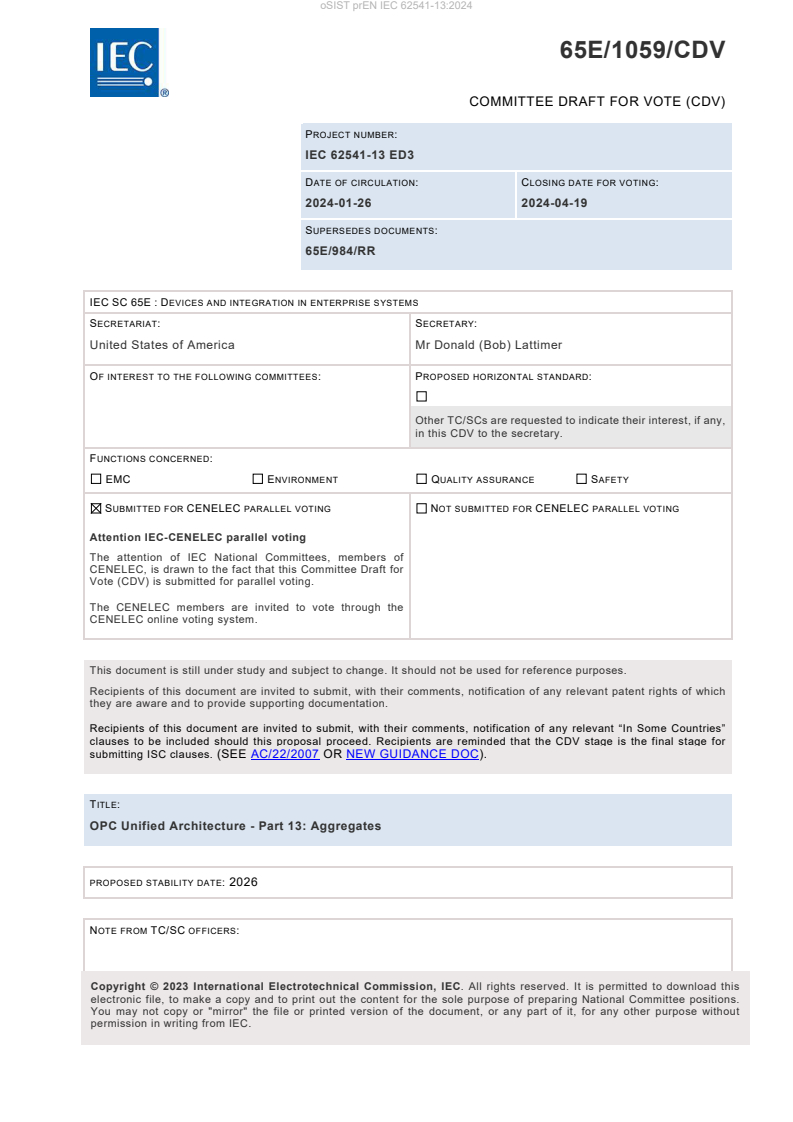
65E/1059/CDV
COMMITTEE DRAFT FOR VOTE (CDV)
PROJECT NUMBER:
IEC 62541-13 ED3
DATE OF CIRCULATION: CLOSING DATE FOR VOTING:
2024-01-26 2024-04-19
SUPERSEDES DOCUMENTS:
65E/984/RR
IEC SC 65E : DEVICES AND INTEGRATION IN ENTERPRISE SYSTEMS
SECRETARIAT: SECRETARY:
United States of America Mr Donald (Bob) Lattimer
OF INTEREST TO THE FOLLOWING COMMITTEES: PROPOSED HORIZONTAL STANDARD:
Other TC/SCs are requested to indicate their interest, if any,
in this CDV to the secretary.
FUNCTIONS CONCERNED:
EMC ENVIRONMENT QUALITY ASSURANCE SAFETY
SUBMITTED FOR CENELEC PARALLEL VOTING NOT SUBMITTED FOR CENELEC PARALLEL VOTING
Attention IEC-CENELEC parallel voting
The attention of IEC National Committees, members of
CENELEC, is drawn to the fact that this Committee Draft for
Vote (CDV) is submitted for parallel voting.
The CENELEC members are invited to vote through the
CENELEC online voting system.
This document is still under study and subject to change. It should not be used for reference purposes.
Recipients of this document are invited to submit, with their comments, notification of any relevant patent rights of which
they are aware and to provide supporting documentation.
Recipients of this document are invited to submit, with their comments, notification of any relevant “In Some Countries”
clauses to be included should this proposal proceed. Recipients are reminded that the CDV stage is the final stage for
submitting ISC clauses. (SEE AC/22/2007 OR NEW GUIDANCE DOC).
TITLE:
OPC Unified Architecture - Part 13: Aggregates
PROPOSED STABILITY DATE: 2026
NOTE FROM TC/SC OFFICERS:
electronic file, to make a copy and to print out the content for the sole purpose of preparing National Committee positions.
You may not copy or "mirror" the file or printed version of the document, or any part of it, for any other purpose without
permission in writing from IEC.
IEC CDV 62541-13 © IEC 2023
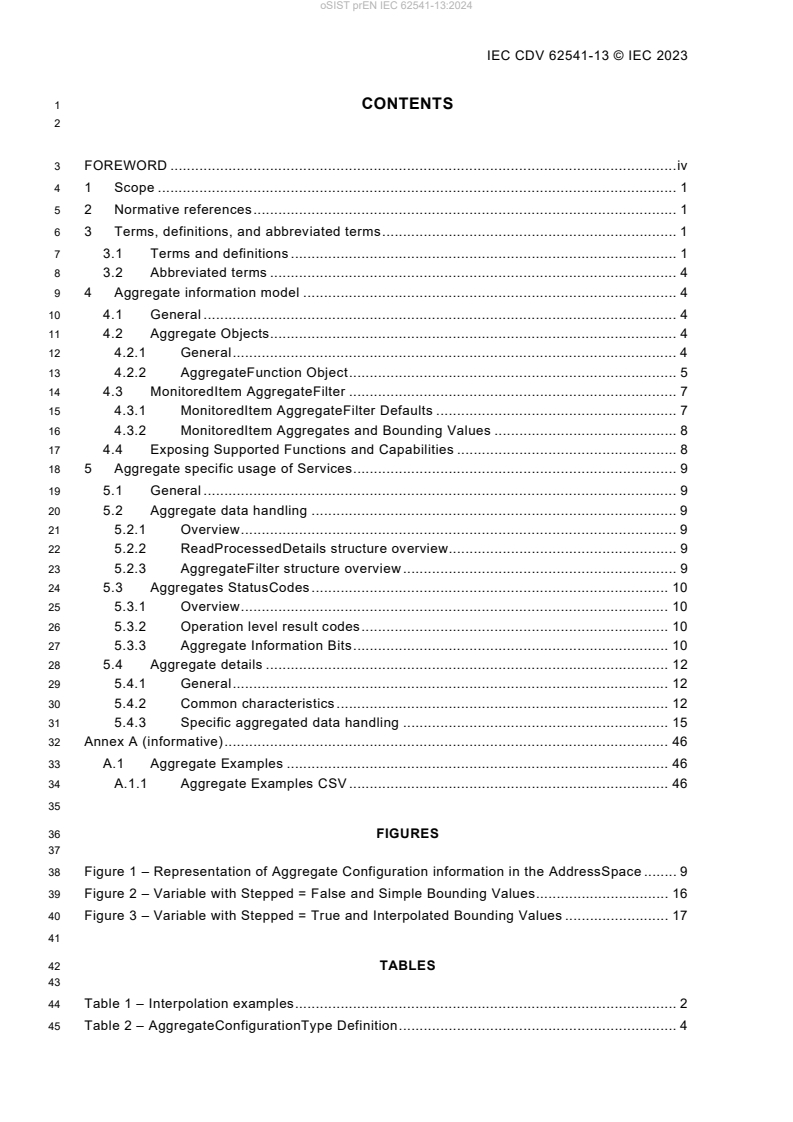
1 CONTENTS
3 FOREWORD . iv
4 1 Scope . 1
5 2 Normative references . 1
6 3 Terms, definitions, and abbreviated terms . 1
7 3.1 Terms and definitions . 1
8 3.2 Abbreviated terms . 4
9 4 Aggregate information model . 4
10 4.1 General . 4
11 4.2 Aggregate Objects . 4
12 4.2.1 General . 4
13 4.2.2 AggregateFunction Object . 5
14 4.3 MonitoredItem AggregateFilter . 7
15 4.3.1 MonitoredItem AggregateFilter Defaults . 7
16 4.3.2 MonitoredItem Aggregates and Bounding Values . 8
17 4.4 Exposing Supported Functions and Capabilities . 8
18 5 Aggregate specific usage of Services . 9
19 5.1 General . 9
20 5.2 Aggregate data handling . 9
21 5.2.1 Overview . 9
22 5.2.2 ReadProcessedDetails structure overview. 9
23 5.2.3 AggregateFilter structure overview . 9
24 5.3 Aggregates StatusCodes . 10
25 5.3.1 Overview . 10
26 5.3.2 Operation level result codes . 10
27 5.3.3 Aggregate Information Bits . 10
28 5.4 Aggregate details . 12
29 5.4.1 General . 12
30 5.4.2 Common characteristics . 12
31 5.4.3 Specific aggregated data handling . 15
32 Annex A (informative) . 46
33 A.1 Aggregate Examples . 46
34 A.1.1 Aggregate Examples CSV . 46
36 FIGURES
38 Figure 1 – Representation of Aggregate Configuration information in the AddressSpace . 9
39 Figure 2 – Variable with Stepped = False and Simple Bounding Values . 16
40 Figure 3 – Variable with Stepped = True and Interpolated Bounding Values . 17
42 TABLES
44 Table 1 – Interpolation examples . 2
45 Table 2 – AggregateConfigurationType Definition . 4
IEC CDV 62541-13 © IEC 2023 ii
46 Table 3 – Aggregate Functions Definition . 5
47 Table 4 – AggregateFunctionType Definition . 6
48 Table 5 – Standard AggregateType Nodes . 7
49 Table 6 – ReadProcessedDetails . 9
50 Table 7 – AggregateFilter structure . 10
51 Table 8 – Bad operation level result codes . 10
52 Table 9 – Uncertain operation level result codes . 10
53 Table 10 – Data location . 11
54 Table 11 – Additional information . 11
55 Table 12 – History Aggregate interval information . 13
56 Table 13 – Standard History Aggregate Data Type information . 14
57 Table 14 – Aggregate table description . 18
58 Table 15 – Interpolative Aggregate summary . 19
59 Table 16 – Average Aggregate summary . 20
60 Table 17 – TimeAverage Aggregate summary . 20
61 Table 18 – TimeAverage2 Aggregate summary . 22
62 Table 19 – Total Aggregate summary . 22
63 Table 20 – Total2 Aggregate summary . 23
64 Table 21 – Minimum Aggregate summary . 24
65 Table 22 – Maximum Aggregate summary . 24
66 Table 23 – MinimumActualTime Aggregate summary . 25
67 Table 24 – MaximumActualTime Aggregate summary . 26
68 Table 25 – Range Aggregate summary . 27
69 Table 26 – Minimum2 Aggregate summary . 28
70 Table 27 – Maximum2 Aggregate summary . 28
71 Table 28 – MinimumActualTime2 Aggregate summary . 29
72 Table 29 – MaximumActualTime2 Aggregate summary . 30
73 Table 30 – Range2 Aggregate summary . 30
74 Table 31 – AnnotationCount Aggregate summary . 31
75 Table 32 – Count Aggregate summary. 32
76 Table 33 – DurationInStateZero Aggregate summary . 32
77 Table 34 – DurationInStateNonZero Aggregate summary . 33
78 Table 35 – NumberOfTransitions Aggregate summary . 34
79 Table 36 – Start Aggregate summary . 35
80 Table 37 – End Aggregate summary . 35
81 Table 38 – Delta Aggregate summary . 36
82 Table 39 – StartBound Aggregate summary . 36
83 Table 40 – EndBound Aggregate summary . 37
84 Table 41 – DeltaBounds Aggregate summary . 37
85 Table 42 – DurationGood Aggregate summary . 38
86 Table 43 – DurationBad Aggregate summary . 39
87 Table 44 – PercentGood Aggregate summary . 40
88 Table 45 – PercentBad Aggregate summary . 40
iii IEC CDV 62541-13 © IEC 2023
89 Table 46 – WorstQuality Aggregate summary . 41
90 Table 47 – WorstQuality2 Aggregate summary . 42
91 Table 48 – StandardDeviationSample Aggregate summary . 42
92 Table 49 – VarianceSample Aggregate summary . 43
93 Table 50 – StandardDeviationPopulation Aggregate summary . 44
94 Table 51 – VariancePopulation Aggregate summary . 44
IEC CDV 62541-13 © IEC 2023 iv
97 INTERNATIONAL ELECTROTECHNICAL COMMISSION
98 ____________
100 OPC UNIFIED ARCHITECTURE –
102 Part 13: Aggregates
104 FOREWORD
105 1) The International Electrotechnical Commission (IEC) is a worldwide organization for standardization comprising all
106 national electrotechnical committees (IEC National Committees). The object of IEC is to promote international co-
107 operation on all questions concerning standardization in the electrical and electronic fields. To this end and in addition to
108 other activities, IEC publishes International Standards, Technical Specifications, Technical Reports, Publicly Available
109 Specifications (PAS) and Guides (hereafter referred to as "IEC Publication(s)"). Their preparation is entrusted to technical
110 committees; any IEC National Committee interested in the subject dealt with may participate in this preparatory work.
111 International, governmental and non-governmental organizations liaising with the IEC also participate in this preparation.
112 IEC collaborates closely with the International Organization for Standardization (ISO) in accordance with conditions
113 determined by agreement between the two organizations.
114 2) The formal decisions or agreements of IEC on technical matters express, as nearly as possible, an international
115 consensus of opinion on the relevant subjects since each technical committee has representation from all interested IEC
116 National Committees.
117 3) IEC Publications have the form of recommendations for international use and are accepted by IEC National Committees
118 in that sense. While all reasonable efforts are made to ensure that the technical content of IEC Publications is accurate,
119 IEC cannot be held responsible for the way in which they are used or for any misinterpretation by any end user.
120 4) In order to promote international uniformity, IEC National Committees undertake to apply IEC Publications transparently
121 to the maximum extent possible in their national and regional publications. Any divergence between any IEC Publication
122 and the corresponding national or regional publication shall be clearly indicated in the latter.
123 5) IEC itself does not provide any attestation of conformity. Independent certification bodies provide conformity assessment
124 services and, in some areas, access to IEC marks of conformity. IEC is not responsible for any services carried out by
125 independent certification bodies.
126 6) All users should ensure that they have the latest edition of this publication.
127 7) No liability shall attach to IEC or its directors, employees, servants or agents including individual experts and members
128 of its technical committees and IEC National Committees for any personal injury, property damage or other damage of
129 any nature whatsoever, whether direct or indirect, or for costs (including legal fees) and expenses arising out of the
130 publication, use of, or reliance upon, this IEC Publication or any other IEC Publications.
131 8) Attention is drawn to the Normative references cited in this publication. Use of the referenced publications is indispensable
132 for the correct application of this publication.
133 9) Attention is drawn to the possibility that some of the elements of this IEC Publication may be the subject of patent rights.
134 IEC shall not be held responsible for identifying any or all such patent rights.
135 International Standard IEC 62541-13 has been prepared by subcommittee 65E: Devices and
136 integration in enterprise systems, of IEC technical committee 65: Industrial-process measurement,
137 control and automation.
138 This fourth edition cancels and replaces the third edition published in 2020. This edition constitutes a
139 technical revision.
140 This edition includes the following technical changes with respect to the previous edition:
141 a) Multiple fixes for the computation of aggregates
142 • The Raw status bit is always be set for non-bad StatusCodes for the Start and End
143 aggregates.
144 • Entries in the Interpolative examples Tables A2.2 Hisotorian1, Historian2, and Historian3
145 have been changed from Good to Good, Raw status codes when the timestamp matches with
146 the timestamp of the data source.
147 • Missing tables were added for DurationInStateZero and DurationInStateNonZero.
148 • The value of zero has been removed for reslts with a StatusCode of bad.
149 • Data Type was listed as "Status Code" when it should be "Double" for both Standard
150 Deviation and both Variance Aggregates.
151 • Rounding Error in TimeAverage and TimeAverage2 have been corrected.
v IEC CDV 62541-13 © IEC 2023
152 • The status codes have been corrected for the last two intervals and the value has been
153 corrected in the last interval.
154 • The wording has been changed to be more consistent with the certification testing tool.
155 • UsedSlopedExtrapolation set to true for Historian2 and all examples locations needed new
156 values or status' are modified.
157 • Values affected by percent good and percent bad have been updated.
158 • PercentGood/PercentBad are now accounted for in the calculation.
159 • TimeAverage must use SlopedInterpolation but the Time aggregate is incorrectly allowed to
160 used Stepped Interpolation.
161 • Partial bit is now correctly calculated.
162 • Unclear sentence was removed.
163 • Examples have been moved to a CSV.
164 • The value and status code for Historian 3 have been updated.
165 • TimeAverage2 Historian1 now takes uncertain regions into account when calculating
166 StatusCodes.
167 • TimeAverage2 Historian2 now takes uncertain regions into account when calculating
168 StatusCodes.
169 • Total2 Historian1 now takes uncertain regions into account when calculating StatusCodes
170 • Total2 Historian2 now takes uncertain regions into account when calculating StatusCodes
171 • Maximum2 Historian1 now takes uncertain regions into account when calculating
172 StatusCodes
173 • MaximumActualTime2 Historian1 now takes uncertain regions into account when calculating
174 StatusCodes
175 • Minimum2 Historian1 now takes uncertain regions into account when calculating
176 StatusCodes
177 • MinimumActualTime2 Historian1 now has the StatusCodes calculated while using the
178 TreatUncertainAsBad flag.
179 • Range2 Historian1 now looks at TreatUncertainAsBad in the calculation of the StatusCodes.
180 • Clarifications were made to the text defining how PercentGood/PercentBad are used. The
181 TimeAverage2 and Total2 aggregets had their table values and StatusCodes corrected.
183 The text of this International Standard is based on the following documents:
CDV Report on voting
65E/XX/CDV 65E/XX/RVC
185 Full information on the voting for the approval of this International Standard can be found in the report
186 on voting indicated in the above table.
187 This document has been drafted in accordance with the ISO/IEC Directives, Part 2.
188 Throughout this document and the other parts of the IEC 62541 series, certain document conventions
189 are used:
190 Italics are used to denote a defined term or definition that appears in the "Terms and definition" clause
191 in one of the parts of the IEC 62541 series.
192 Italics are also used to denote the name of a service input or output parameter or the name of a
193 structure or element of a structure that are usually defined in tables.
194 The italicized terms and names are, with a few exceptions, written in camel-case (the practice of
195 writing compound words or phrases in which the elements are joined without spaces, with each
196 element's initial letter capitalized within the compound). For example, the defined term is
IEC CDV 62541-13 © IEC 2023 vi
197 AddressSpace instead of Address Space. This makes it easier to understand that there is a single
198 definition for AddressSpace, not separate definitions for Address and Space.
199 A list of all parts of the IEC 62541 series, published under the general title OPC Unified Architecture,
200 can be found on the IEC website.
201 The committee has decided that the contents of this document will remain unchanged until the stability
202 date indicated on the IEC website under "http://webstore.iec.ch" in the data related to the specific
203 document. At this date, the document will be
204 • reconfirmed,
205 • withdrawn,
206 • replaced by a revised edition, or
207 • amended.
IMPORTANT – The 'colour inside' logo on the cover page of this publication indicates
that it contains colours which are considered to be useful for the correct understanding
of its contents. Users should therefore print this document using a colour printer.
1 IEC CDV 62541-13 © IEC 2023
210 OPC Unified Architecture Specification
212 Part 13: Aggregates
216 1 Scope
217 This part of IEC 62541 is part of the overall OPC Unified Architecture specification series and
218 defines the information model associated with Aggregates.
219 2 Normative references
220 The following documents, in whole or in part, are normatively referenced in this document and
221 are indispensable for its application. For dated references, only the edition cited applies. For
222 undated references, the latest edition of the referenced document (including any amendments
223 and errata) applies.
224 IEC 62541-1, OPC Unified Architecture - Part 1: Overview and Concepts
225 IEC 62541-3, OPC Unified Architecture - Part 3: Address Space Model
226 IEC 62541-4, OPC Unified Architecture - Part 4: Services
227 IEC 62541-5, OPC Unified Architecture - Part 5: Information Model
228 IEC 62541-8, OPC Unified Architecture - Part 8: Data Access
229 IEC 62541-11, OPC Unified Architecture - Part 11: Historical Access
230 3 Terms, definitions, and abbreviated terms
231 3.1 Terms and definitions
232 For the purposes of this document, the terms and definitions given in IEC 62541-1, IEC 62541-
233 3, IEC 62541-4, and IEC 62541-11 as well as the following apply.
234 3.1.1
235 ProcessingInterval
236 timespan for which derived values are produced based on a specified Aggregate
237 Note 1 to entry: The total time domain specified for ReadProcessed is divided by the ProcessingInterval. For
238 example, performing a 10-minute Average over the time range 12:00 to 12:30 would result in a set of three intervals
239 of ProcessingInterval length, with each interval having a start time of 12:00, 12:10 and 12:20 respectively. The rules
240 used to determine the interval Bounds are discussed in 5.4.2.2.
241 3.1.2
242 Interpolated data
243 data that is calculated from data samples
244 Note 1 to entry: Data samples may be historical data or buffered real time data. An interpolated value is calculated
245 from the data points on either side of the requested timestamp.
246 3.1.3
247 EffectiveEndTime
248 time immediately before endTime
249 Note 1 to entry: All Aggregate calculations include the startTime but exclude the endTime. However, it is sometimes
250 necessary to return an Interpolated End Bound as the value for an Interval with a timestamp that is in the interval.
251 Servers are expected to use the time immediately before endTime where the time resolution of the Server determines
252 the exact value (do not confuse this with hardware or operating system time resolution). For example, if the endTime
253 is 12:01:00, the time resolution is 1 second, then the EffectiveEndTime is 12:00:59. See 5.4.2.4.
254 If time is flowing backwards, Servers are expected to use the time immediately after endTime where the time
255 resolution of the Server determines the exact value.
IEC CDV 62541-13 © IEC 2023 2
256 3.1.4
257 Extrapolated data
258 data constructed from a discrete data set but is outside of the discrete data set
259 Note 1 to entry: It is similar to the process of interpolation, which constructs new points between known points, but
260 its result is subject to greater uncertainty. Extrapolated data is used in cases where the requested time period falls
261 farther into the future than the data available in the underlying system. See example in Table 1.
262 3.1.5
263 SlopedInterpolation
264 simple linear interpolation
265 Note 1 to entry: Compare to curve fitting using linear polynomials. See example in Table 1.
266 3.1.6
267 SteppedInterpolation
268 Interpolation holding the last data point constant or interpolating the value based on a horizontal
269 line fit
270 Note 1 to entry: Consider the following Table 1 of raw and Interpolated/Extrapolated values:
271 Table 1 – Interpolation examples
Timestamp Raw Value Sloped Interpolation Stepped Interpolation
12:00:00 10
12:00:05 15 10
12:00:08 18 10
12:00:10 20
12:00:15 25 20
12:00:20 30
SlopedExtrapolation SteppedExtrapolation
12:00:25 35 30
12:00:27 37 30
273 3.1.7
274 bounding values
275 values at the startTime and endTime needed for Aggregates to compute the result
276 Note 1 to entry: If Raw data does not exist at the startTime and endTime a value shall be estimated. There are two
277 ways to determine Bounding Values for an interval. One way (called Interpolated Bounding Values) uses the first
278 non-Bad data points found before and after the timestamp to estimate the bound. The other (called Simple Bounding
279 Values) uses the data points immediately before and after the boundary timestamps to estimate the bound even if
280 these points are Bad. Subclauses 3.1.8 and 3.1.9 describe the two different approaches in more detail.
281 In all cases the TreatUncertainAsBad (see 4.2.1.2) flag is used to determine whether Uncertain values are Bad or
282 non-Bad.
283 If a Raw value was not found and a non-Bad bounding value exists the Aggregate Bits (see 5.3.3) are set to
284 ‘Interpolated’.
285 When calculating bounding values, the value portion of Raw data that has Bad status is set to null. This means the
286 value portion is not used in any calculation and a null is returned if the raw value is returned. The status portion is
287 determined by the rules specified by the bound or Aggregate.
288 The Interpolated Bounding Values approach (see 3.1.8) is the same as what is used in Classic OPC Historical Data
289 Access (HDA) and is important for applications such as advanced process control where having useful values at all
290 times is important. The Simple Bounding Values approach (see 3.1.9) is new in this standard and is important for
291 applications which shall produce regulatory reports and cannot use estimated values in place of Bad data.
292 3.1.8
293 interpolated bounding values
294 bounding values determined by a calculation using the nearest Good value
295 Note 1 to entry: Interpolated Bounding Values using SlopedInterpolation are calculated as follows:
296 • if a non-Bad Raw value exists at the timestamp then it is the bounding value;
297 • find the first non-Bad Raw value before the timestamp;
298 • find the first non-Bad Raw value after the timestamp;
299 • draw a line between before value and after value;
300 • use point where the line crosses the timestamp as an estimate of the bounding value.
3 IEC CDV 62541-13 © IEC 2023
301 The calculation can be expressed with the following formula:
302 V = (T – T )x( V – V )/( T – T ) + V
bound bound before after before after before before
303 where V is a value at ‘x’ and T is the timestamp associated with V .
x x x
304 If no non-Bad values exist before the timestamp the StatusCode is Bad_NoData. The StatusCode is
305 Uncertain_DataSubNormal if any Bad values exist between the before value and after value. If either the before
306 value or the after value are Uncertain the StatusCode is Uncertain_DataSubNormal. If the after value does not exist
307 the before value shall be extrapolated using SlopedExtrapolation or SteppedExtrapolation.
308 The period of time that is searched to discover the Good values before and after the timestamp is Server dependent,
309 but if a Good value is not found within some reasonable time range then the Server will assume it does not exist.
310 The Server as a minimum should search a time range which is at least the size of the ProcessingInterval.
311 Interpolated Bounding Values using SlopedExtrapolation are calculated as follows:
312 • find the first non-Bad Raw value before timestamp;
313 • find the second non-Bad Raw value before timestamp;
314 • draw a line between these two values;
315 • extend the line to where it crosses the timestamp;
316 • use the point where the line crosses the timestamp as an estimate of the bounding value.
317 The formula is the same as the one used for SlopedInterpolation.
318 The StatusCode is always Uncertain_DataSubNormal. If only one non-Bad raw value can be found before the
319 timestamp then SteppedExtrapolation is used to estimate the bounding value.
320 Interpolated Bounding Values using SteppedInterpolation are calculated as follows:
321 • if a non-Bad Raw value exists at the timestamp then it is the bounding value;
322 • find the first non-Bad Raw value before timestamp;
323 • use the value as an estimate of the bounding value.
324 The StatusCode is Uncertain_DataSubNormal if any Bad values exist between the before value and the timestamp.
325 If no non-Bad Raw data exists before the timestamp then the StatusCode is Bad_NoData. If the value before the
326 timestamp is Uncertain the StatusCode is Uncertain_DataSubNormal. The value after the timestamp is not needed
327 when using SteppedInterpolation; however, if the timestamp is after the end of the data then the bounding value is
328 treated as extrapolated and the StatusCode is Uncertain_DataSubNormal.
329 SteppedExtrapolation is a term that describes SteppedInterpolation when a timestamp is after the last value in the
330 history collection.
331 3.1.9
332 simple bounding values
333 bounding values determined by a calculation using the nearest value
334 Note 1 to entry: Simple Bounding Values using SlopedInterpolation are calculated as follows:
335 • if any Raw value exists at the timestamp then it is the bounding value;
336 • find the first Raw value before timestamp;
337 • find the first Raw value after timestamp;
338 • if the value after the timestamp is Bad then the before value is the bounding value;
339 • draw a line between before value and after value;
340 • use point where the line crosses the timestamp as an estimate of the bounding value.
341 The formula is the same as the one used for SlopedInterpolation in Clause 3.1.5.
342 If a Raw value at the timestamp is Bad the StatusCode is Bad_NoData. If the value before the timestamp is Bad the
343 StatusCode is Bad_NoData. If the value before the timestamp is Uncertain the StatusCode is
344 Uncertain_DataSubNormal. If the value after the timestamp is Bad or Uncertain the StatusCode is
345 Uncertain_DataSubNormal.
346 Simple Bounding Values using SteppedInterpolation are calculated as follows:
347 • if any Raw value exists at the timestamp then it is the bounding value;
348 • find the first Raw value before timestamp;
349 • if the value before timestamp is non-Bad then it is the bounding value.
350 If a Raw value at the timestamp is Bad the StatusCode is Bad_NoData. If the value before the timestamp is Bad the
351 StatusCode is Bad_NoData. If the value before the timestamp is Uncertain the StatusCode is
352 Uncertain_DataSubNormal.
353 If either bounding time of an interval is beyond the last data point then the Server may use extrapolation or return an
354 error. If extrapolation is used by the server the type [SteppedExtrapolation or SloppedExtrapolation] of extrapolation
355 is server specific.
IEC CDV 62541-13 © IEC 2023 4
356 In some Historians, the last Raw value does not necessarily indicate the end of the data. Based on the Historian's
357 knowledge of the data collection mechanism, i.e. frequency of data updates and latency, the Historian may extend
358 the last value to a time known by the Historian to be covered. When calculating Simple Bounding Values the Historian
359 will act as if there is another Raw value at this timestamp.
360 In the same way, if the earliest time of an interval starts before the first data point in history and the latest time is
361 after the first data point in history, then the interval will be treated as if the interval extends from the first data point
362 in history to the latest time of the interval and the StatusCode of the interval will have the Partial bit set (see 5.3.3.2).
363 The period of time that is searched to discover the values before and after the timestamp is Server dependent, but
364 if a value is not found within some reasonable time range then the Server will assume it does not exist. The Server
365 as a minimum should search a time range which is at least the size of the ProcessingInterval.
366 3.2 Abbreviated terms
367 DA Data Access
368 HA Historical Access (access to historical data or events)
369 HDA Historical Data Access
370 UA Unified Architecture
371 4 Aggregate information model
372 4.1 General
373 IEC 62541-3 and IEC 62541-5 standards define the representation of Aggregate historical or
374 buffered real time data in the OPC Unified Architecture. This includes the definition of
375 Aggregates used in processed data retrieval and in historical retrieval. This definition includes
376 both standard Reference types and Object types.
377 4.2 Aggregate Objects
378 4.2.1 General
379 4.2.1.1 Overview
380 OPC UA Servers can support several different functionalities and capabilities. The following
381 standard Objects are used to expose these capabilities in a common fashion, and there are
382 several standard defined concepts that can be extended by vendors.
383 4.2.1.2 AggregateConfigurationType
384 The AggregateConfigurationType defines the general characteristics of a Node that defines the
385 Aggregate configuration of any Variable or Property. AggregateConfiguration Object represents
386 the browse entry point for information on how the Server treats Aggregate specific functionality
387 such as handling Uncertain data. It is formally defined in Table 2.
388 Table 2 – AggregateConfigurationType Definition
Attribute Value
BrowseName AggregateConfigurationType
IsAbstract False
References NodeClass BrowseName DataType TypeDefinition ModellingRule
Subtype of the BaseObjectType defined in IEC 62541-5
HasProperty Variable TreatUncertainAsBad Boolean PropertyType Mandatory
HasProperty Variable PercentDataBad Byte PropertyType Mandatory
HasProperty Variable PercentDataGood Byte PropertyType Mandatory
HasProperty Variable UseSlopedExtrapolation Boolean PropertyType Mandatory
Conformance Units
Aggregate Master Configuration
390 The TreatUncertainAsBad Variable indicates how the Server treats data returned with a
391 StatusCode severity Uncertain with respect to Aggregate calculations. A value of True indicates
392 the Server considers the severity equivalent to Bad, a value of False indicates the Server
393 considers the severity equivalent to Good, unless the Aggregate definition says otherwise. The
394 default value is True. Note that the value is still treated as Uncertain when the StatusCode for
395 the result is calculated.
396 The PercentDataBad Variable indicates the minimum percentage of Bad data in a given interval
397 required for the StatusCode for the given interval for processed data request to be set to Bad.
398 (Uncertain is treated as defined above.) Refer to 5.4.3 for details on using this Variable when
5 IEC CDV 62541-13 © IEC 2023
399 assigning StatusCodes. For details on which Aggregates use the PercentDataBad Variable, see
400 the definition of each Aggregate. The default value is 100.
401 The PercentDataGood Variable indicates the minimum percentage of Good data in a given
402 interval required for the StatusCode for the given interval for the processed data requests to be
403 set to Good. Refer to 5.4.3 for details on using this Variable when assigning StatusCodes. For
404 details on which Aggregates use the PercentDataGood Variable, see the definition of each
405 Aggregate. The default value is 100.
406 The following calculations are used to detemine the StatusCode which will be used to calculate
407 the value of the aggregate. Refer to 5.4.3 for details on using these Variables when assigning
408 StatusCodes. The PercentDataGood and PercentDataBad shall follow the following relationship
409 PercentDataGood ≥ (100 – PercentDataBad). If they are equal the result of the
410 PercentDataGood calculation is used. If the values entered for PercentDataGood and
411 PercentDataBad do not result in a valid calculation (e.g. Bad = 80; Good = 0) the result will
412 have a StatusCode of Bad_AggregateInvalidInputs The StatusCode
413 Bad_AggregateInvalidInputs will be returned if the value of PercentDataGood or
414 PercentDataBad exceed 100.
415 The UseSlopedExtrapolation Variable indicates how the Server interpolates data when no
416 boundary value exists (i.e. extrapolating into the future from the last known value). A value of
417 False indicates that the Server will use a SteppedExtrapolation format, and hold the last known
418 value constant. A value of True indicates the Server will project the value using
419 UseSlopedExtrapolation mode. The default value is False. For SimpleBounds this value is
420 ignored.
421 4.2.2 AggregateFunction Object
422 4.2.2.1 General
423 This Object is used as the browse entry point for information about the Aggregates supported
424 by a Server. The content of this Object is already defined by its type definition. All Instances of
425 the FolderType use the standard BrowseName of ‘AggregateFunctions’. The HasComponent
426 Reference is used to relate a ServerCapabilities Object and/or any
427 HistoryServerCapabilitiesType Object to an AggregateFunction Object. AggregateFunctions is
428 formally defined in Table 3.
429 Table 3 – Aggregate Functions Definition
Attribute Value
BrowseName AggregateFunctions
References Node BrowseName DataType TypeDefinition ModellingR
ule
Class
HasTypeDefinition Object FolderType Defined in IEC 62541-5
Type
Conformance Units
Historical Access Aggregates
431 Each ServerCapabilities and HistoryServerCapabilitiesType Object shall reference an
432 AggregateFunction Object. In addition, each HistoricalConfiguration Object belonging to a
433 HistoricalDataNode may reference an AggregateFunction Object using the HasComponent
434 Reference.
435 4.2.2.2 AggregateFunctionType
436 This ObjectType defines an Aggregate supported by a UA Server. This Object is formally
437 defined in Table 4.
IEC CDV 62541-13 © IEC 2023 6
438 Table 4 – AggregateFunctionType Definition
Attribute Value
BrowseName AggregateFunctionType
IsAbstract False
References Node BrowseName DataType Type Mod.
Class Definition Rule
Subtype of the BaseObjectType defined in IEC 62541-5
Conformance Units
Historical Access Aggregates
440 For the AggregateFunctionType, the Description Attribute (inherited from the Base NodeClass),
441 is mandatory. The Description Attribute provides a localized description of the Aggregate.
442 Table 5 specifies the BrowseName and Description Attributes for the standard Aggregate
443 Objects. The description is the localized “en” text. For other locales it shall be translated.
7 IEC CDV 62541-13 © IEC 2023
444 Table 5 – Standard AggregateType Nodes
BrowseName Description
Interpolation Aggregate
Interpolative At the beginning of each interval, retrieve the calculated value from the data points on either
side of the requested timestamp.
Average Retrieve the average value of the data over the interval.
TimeAverage Retrieve the time weighted average data over the interval using Interpolated Bounding
Values.
TimeAverage2 Retrieve the time weighted average data over the interval using Simple Bounding Values.
Total Retrieve the total (time integral) of the data over the interval using Interpolated Bounding
Values.
Total2 Retrieve the total (time integral) of the data over the interval using Simple Bounding Values.
Minimum Retrieve the minimum raw value in the interval with the timestamp of the start of the interval.
Maximum Retrieve the maximum raw value in the interval with the timestamp of the start of the
interval.
MinimumActualTime Retrieve the minimum value in the interval and the timestamp of the minimum value.
MaximumActualTime Retrieve the maximum value in the interval and the timestamp of the maximum value.
Range Retrieve the difference between the minimum and maximum value over the interval.
Minimum2 Retrieve the minimum value in the interval including the Simple Bounding Values.
Maximum2 Retrieve the maximum value in the interval including the Simple Bounding Values.
MinimumActualTime2 Retrieve the minimum value with the actual timestamp including the Simple Bounding
Values.
MaximumActualTime2 Retrieve the maximum value with the actual timestamp including the Simple Bounding
Values.
Range2 Retrieve the difference between the Minimum2 and Maximum2 value over the interval.
Count Retrieve the number of raw values over the interval.
DurationInStateZero Retrieve the time a Boolean or numeric was in a zero state using Simple Bounding Values.
DurationInStateNonZero Retrieve the time a Boolean or numeric was in a non-zero state using Simple Bounding
Values.
NumberOfTransitions Retrieve the number of changes between zero and non-zero that a Boolean or numeric
value experienced in the interval.
Start Retrieve the value at the beginning of the interval.
End Retrieve the value at the end of the interval.
Delta Retrieve the difference between the Start and End value in the interval.
StartBound Retrieve the value at the beginning of the interval using Simple Bounding Values.
EndBound Retrieve the value at the end of the interval using Simple Bounding Values.
DeltaBounds Retrieve the difference between the StartBound and EndBound value in the interval using
Simple Bounding Va
...
Questions, Comments and Discussion
Ask us and Technical Secretary will try to provide an answer. You can facilitate discussion about the standard in here.
Loading comments...