

oSIST prEN 304 631 V1.0.0:2026
(Main)Cyber Security (CYBER) - CRA - Cybersecurity requirements for smart home general purpose virtual assistants
General Information
- Abstract
DEN/CYBER-EUS-0011
- Status
- Not Published
- Public Enquiry End Date
- 30-Sep-2026
- Technical Committee
- SPN - Services and Protocols for Networks
- Current Stage
- 4020 - Public enquire (PE) (Adopted Project)
- Start Date
- 03-Aug-2026
- Due Date
- 21-Dec-2026

Overview
oSIST prEN 304 631 V1.0.0:2026 is a harmonized European standard developed by SIST and ETSI, focused on establishing comprehensive cybersecurity requirements for smart home general purpose virtual assistants. Smart home virtual assistants are rapidly becoming essential components in intelligent homes and buildings, seamlessly connecting devices and enabling automated control. With increasing connectivity and sensitive personal data handled by these systems, robust cybersecurity in smart home environments is crucial to safeguarding user privacy, system integrity, and service availability.
This standard, developed under the Cyber Resilience Act (CRA) framework (reference DEN/CYBER-EUS-0011), aims to align product development and operation of virtual assistants with essential European cybersecurity principles. It provides clear technical requirements and assessment criteria for manufacturers, service providers, and integrators to ensure secure deployment and trustworthy operation in connected home settings.
Key Topics
oSIST prEN 304 631 V1.0.0:2026 covers a wide range of cybersecurity aspects relevant to virtual assistants in intelligent homes, including:
- Appropriate Level of Cybersecurity: Establishing the baseline and scalable controls relevant to a product’s capabilities and risk profile.
- Product Context and Architecture: Addressing functional roles, data assets, communication types (wired/wireless), and operational environments.
- Secure Default Configuration: Mandating pre-configured security settings such as password complexity, automated security updates, and minimal active interfaces.
- Vulnerabilities Management: Requiring products to have no known exploitable vulnerabilities at launch and secure update processes.
- Authentication and Access Control: Enforcing strong user authentication and least privilege principles to reduce unauthorized access risks.
- Confidentiality, Integrity, and Availability Protections: Ensuring robust encryption, tamper resistance, continuity, and secure communication for sensitive data.
- Data Minimization and Transparency: Limiting the collection and retention of personal data, with clear user information on data processing activities.
- Attack Surface and Exploit Mitigation: Reducing unnecessary features, interfaces, and enforcing secure boot mechanisms.
- Monitoring and Logging: Specifying logging requirements based on risk levels, with user access to privacy-related logs.
- Factory Reset and Data Portability: Facilitating permanent removal of user data and ensuring compliant data management lifecycle.
Each topic is supported by specific, auditable technical requirements and detailed compliance assessment criteria.
Applications
Implementation of oSIST prEN 304 631 V1.0.0:2026 delivers practical value for several stakeholders in the smart home and building market:
- Manufacturers: Assures product security from design to deployment, aligns with EU cybersecurity regulations, and reduces risks of vulnerabilities and exploits in shipped virtual assistants.
- Solution Providers and Integrators: Demonstrates due diligence in supplying or integrating compliant virtual assistant solutions, an increasing requirement in B2B and B2C contexts.
- Homeowners and Users: Offers enhanced trust in device privacy, resilience to cyberattacks, and more transparency and control over personal data.
- Regulators and Auditors: Provides a harmonized and testable benchmark for assessing the security posture of market products and enforcing compliance with the Cyber Resilience Act and related legislative requirements.
- Software Developers: Guides secure development practices for applications and features interacting with smart home virtual assistants.
Related Standards
To ensure comprehensive security and interoperability, oSIST prEN 304 631 V1.0.0:2026 is designed to be consistent with and complement the following standards and frameworks:
- ETSI EN 303 645: Cyber Security for Consumer Internet of Things
- ISO/IEC 27402: Security requirements for smart home devices and systems
- EN ISO/IEC 27001: Information Security Management Systems
- EU Regulation 2024/2847: Essential cybersecurity requirements, referenced in the annex of this standard
Implementing oSIST prEN 304 631 V1.0.0:2026 helps organizations address evolving cybersecurity challenges in smart homes, ensuring compliance and fostering consumer confidence in intelligent building technologies.
Get Certified
Connect with accredited certification bodies for this standard

BSI Group
BSI (British Standards Institution) is the business standards company that helps organizations make excellence a habit.

Bureau Veritas
Bureau Veritas is a world leader in laboratory testing, inspection and certification services.

DNV
DNV is an independent assurance and risk management provider.
Sponsored listings
Frequently Asked Questions
oSIST prEN 304 631 V1.0.0:2026 is a standard published by the Slovenian Institute for Standardization (SIST). Its full title is "Cyber Security (CYBER) - CRA - Cybersecurity requirements for smart home general purpose virtual assistants". This standard covers: DEN/CYBER-EUS-0011
DEN/CYBER-EUS-0011
oSIST prEN 304 631 V1.0.0:2026 is classified under the following ICS (International Classification for Standards) categories: 35.030 - IT Security. The ICS classification helps identify the subject area and facilitates finding related standards.
oSIST prEN 304 631 V1.0.0:2026 is available in PDF format for immediate download after purchase. The document can be added to your cart and obtained through the secure checkout process. Digital delivery ensures instant access to the complete standard document.
Standards Content (Sample)
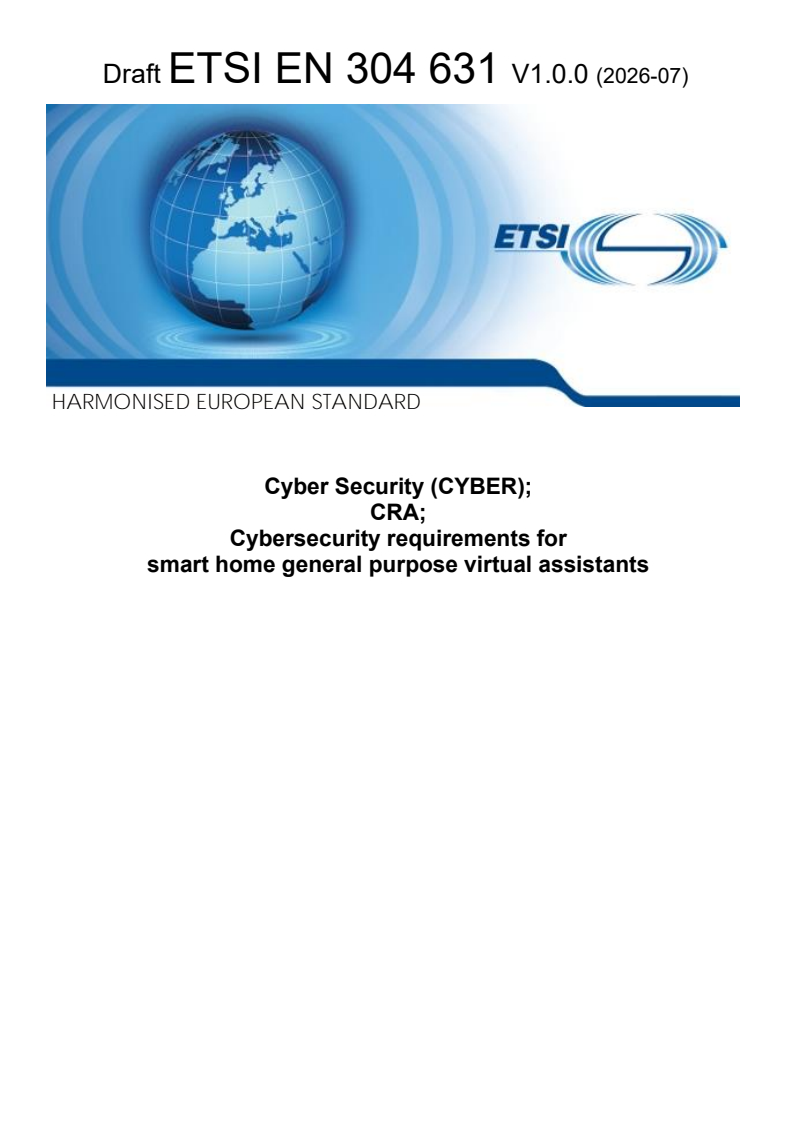
Draft ETSI EN 304 631 V1.0.0 (2026-07)
HARMONISED EUROPEAN STANDARD
Cyber Security (CYBER);
CRA;
Cybersecurity requirements for
smart home general purpose virtual assistants
2 Draft ETSI EN 304 631 V1.0.0 (2026-07)
Reference
DEN/CYBER-EUS-0011
Keywords
CRA, cybersecurity, intelligent homes & buildings
ETSI
650 Route des Lucioles
F-06921 Sophia Antipolis Cedex - FRANCE
Tel.: +33 4 92 94 42 00 Fax: +33 4 93 65 47 16
Siret N° 348 623 562 00017 - APE 7112B
Association à but non lucratif enregistrée à la
Sous-Préfecture de Grasse (06) N° w061004871
Important notice
The present document can be downloaded from the
ETSI Search & Browse Standards application.
The present document may be made available in electronic versions and/or in print. The content of any electronic and/or
print versions of the present document shall not be modified without the prior written authorization of ETSI. In case of any
existing or perceived difference in contents between such versions and/or in print, the prevailing version of an ETSI
deliverable is the one made publicly available in PDF format on ETSI deliver repository.
Users should be aware that the present document may be revised or have its status changed,
this information is available in the Milestones listing.
If you find errors in the present document, please send your comments to
the relevant service listed under Committee Support Staff.
If you find a security vulnerability in the present document, please report it through our
Coordinated Vulnerability Disclosure (CVD) program.
Notice of disclaimer & limitation of liability
The information provided in the present deliverable is directed solely to professionals who have the appropriate degree of
experience to understand and interpret its content in accordance with generally accepted engineering or
other professional standard and applicable regulations.
No recommendation as to products and services or vendors is made or should be implied.
In no event shall ETSI be held liable for loss of profits or any other incidental or consequential damages.
Any software contained in this deliverable is provided "AS IS" with no warranties, express or implied, including but not
limited to, the warranties of merchantability, fitness for a particular purpose and non-infringement of intellectual property
rights and ETSI shall not be held liable in any event for any damages whatsoever (including, without limitation, damages
for loss of profits, business interruption, loss of information, or any other pecuniary loss) arising out of or related to the use
of or inability to use the software.
Copyright Notification
No part of this document may be reproduced in any form, by any means and in any media, without the prior written
authorization of ETSI and except as expressly permitted below.
By way of exception and when the document is a normative deliverable (European Standard (EN),
Technical Specification (TS), Group Specification (GS) or ETSI Standard (ES)), ETSI authorizes to reproduce
and incorporate into products, services and technical documentation only those extracts (e.g. templates) that are strictly
necessary for the technical implementation of the normative deliverable, to ensure compliance with the latter.
Nothing in this notice shall be construed as limiting any mandatory exceptions to copyright provided by applicable law.
© ETSI 2026.
All rights reserved.
ETSI
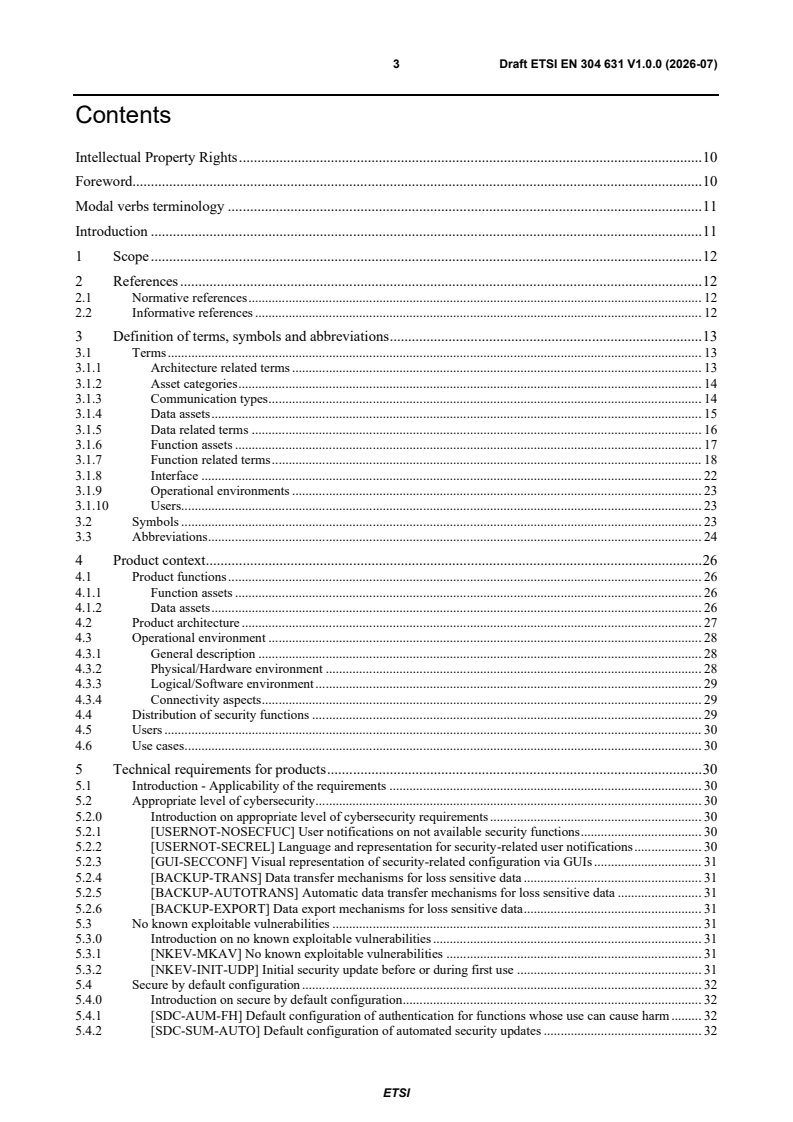
3 Draft ETSI EN 304 631 V1.0.0 (2026-07)
Contents
Intellectual Property Rights . 10
Foreword. 10
Modal verbs terminology . 11
Introduction . 11
1 Scope . 12
2 References . 12
2.1 Normative references . 12
2.2 Informative references . 12
3 Definition of terms, symbols and abbreviations . 13
3.1 Terms . 13
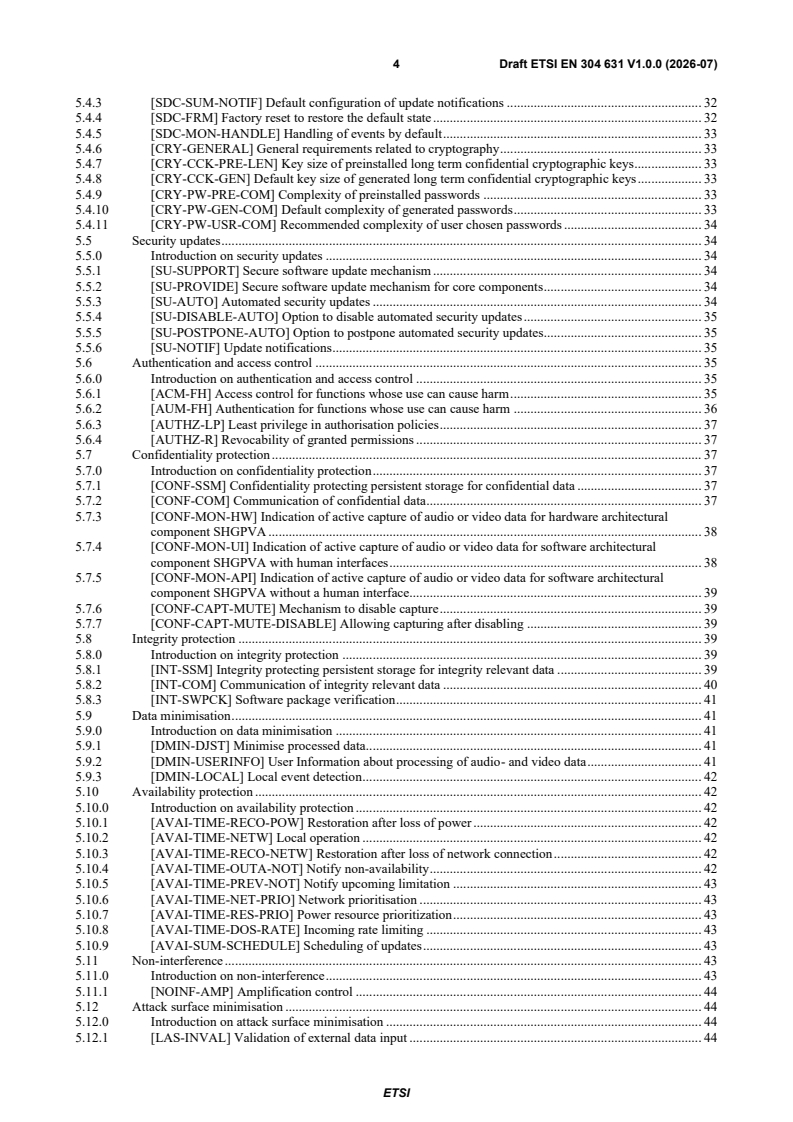
3.1.1 Architecture related terms . 13
3.1.2 Asset categories . 14
3.1.3 Communication types . 14
3.1.4 Data assets . 15
3.1.5 Data related terms . 16
3.1.6 Function assets . 17
3.1.7 Function related terms . 18
3.1.8 Interface . 22
3.1.9 Operational environments . 23
3.1.10 Users. 23
3.2 Symbols . 23
3.3 Abbreviations . 24
4 Product context . 26
4.1 Product functions . 26
4.1.1 Function assets . 26
4.1.2 Data assets . 26
4.2 Product architecture . 27
4.3 Operational environment . 28
4.3.1 General description . 28
4.3.2 Physical/Hardware environment . 28
4.3.3 Logical/Software environment . 29
4.3.4 Connectivity aspects . 29
4.4 Distribution of security functions . 29
4.5 Users . 30
4.6 Use cases . 30
5 Technical requirements for products . 30
5.1 Introduction - Applicability of the requirements . 30
5.2 Appropriate level of cybersecurity . 30
5.2.0 Introduction on appropriate level of cybersecurity requirements . 30
5.2.1 [USERNOT-NOSECFUC] User notifications on not available security functions . 30
5.2.2 [USERNOT-SECREL] Language and representation for security-related user notifications . 30
5.2.3 [GUI-SECCONF] Visual representation of security-related configuration via GUIs . 31
5.2.4 [BACKUP-TRANS] Data transfer mechanisms for loss sensitive data . 31
5.2.5 [BACKUP-AUTOTRANS] Automatic data transfer mechanisms for loss sensitive data . 31
5.2.6 [BACKUP-EXPORT] Data export mechanisms for loss sensitive data . 31
5.3 No known exploitable vulnerabilities . 31
5.3.0 Introduction on no known exploitable vulnerabilities . 31
5.3.1 [NKEV-MKAV] No known exploitable vulnerabilities . 31
5.3.2 [NKEV-INIT-UDP] Initial security update before or during first use . 31
5.4 Secure by default configuration . 32
5.4.0 Introduction on secure by default configuration. 32
5.4.1 [SDC-AUM-FH] Default configuration of authentication for functions whose use can cause harm . 32
5.4.2 [SDC-SUM-AUTO] Default configuration of automated security updates . 32
ETSI
4 Draft ETSI EN 304 631 V1.0.0 (2026-07)
5.4.3 [SDC-SUM-NOTIF] Default configuration of update notifications . 32
5.4.4 [SDC-FRM] Factory reset to restore the default state . 32
5.4.5 [SDC-MON-HANDLE] Handling of events by default . 33
5.4.6 [CRY-GENERAL] General requirements related to cryptography . 33
5.4.7 [CRY-CCK-PRE-LEN] Key size of preinstalled long term confidential cryptographic keys . 33
5.4.8 [CRY-CCK-GEN] Default key size of generated long term confidential cryptographic keys . 33
5.4.9 [CRY-PW-PRE-COM] Complexity of preinstalled passwords . 33
5.4.10 [CRY-PW-GEN-COM] Default complexity of generated passwords . 33
5.4.11 [CRY-PW-USR-COM] Recommended complexity of user chosen passwords . 34
5.5 Security updates . 34
5.5.0 Introduction on security updates . 34
5.5.1 [SU-SUPPORT] Secure software update mechanism . 34
5.5.2 [SU-PROVIDE] Secure software update mechanism for core components . 34
5.5.3 [SU-AUTO] Automated security updates . 34
5.5.4 [SU-DISABLE-AUTO] Option to disable automated security updates . 35
5.5.5 [SU-POSTPONE-AUTO] Option to postpone automated security updates. 35
5.5.6 [SU-NOTIF] Update notifications . 35
5.6 Authentication and access control . 35
5.6.0 Introduction on authentication and access control . 35
5.6.1 [ACM-FH] Access control for functions whose use can cause harm . 35
5.6.2 [AUM-FH] Authentication for functions whose use can cause harm . 36
5.6.3 [AUTHZ-LP] Least privilege in authorisation policies . 37
5.6.4 [AUTHZ-R] Revocability of granted permissions . 37
5.7 Confidentiality protection . 37
5.7.0 Introduction on confidentiality protection . 37
5.7.1 [CONF-SSM] Confidentiality protecting persistent storage for confidential data . 37
5.7.2 [CONF-COM] Communication of confidential data . 37
5.7.3 [CONF-MON-HW] Indication of active capture of audio or video data for hardware architectural
component SHGPVA . 38
5.7.4 [CONF-MON-UI] Indication of active capture of audio or video data for software architectural
component SHGPVA with human interfaces . 38
5.7.5 [CONF-MON-API] Indication of active capture of audio or video data for software architectural
component SHGPVA without a human interface. 39
5.7.6 [CONF-CAPT-MUTE] Mechanism to disable capture . 39
5.7.7 [CONF-CAPT-MUTE-DISABLE] Allowing capturing after disabling . 39
5.8 Integrity protection . 39
5.8.0 Introduction on integrity protection . 39
5.8.1 [INT-SSM] Integrity protecting persistent storage for integrity relevant data . 39
5.8.2 [INT-COM] Communication of integrity relevant data . 40
5.8.3 [INT-SWPCK] Software package verification . 41
5.9 Data minimisation . 41
5.9.0 Introduction on data minimisation . 41
5.9.1 [DMIN-DJST] Minimise processed data. 41
5.9.2 [DMIN-USERINFO] User Information about processing of audio- and video data . 41
5.9.3 [DMIN-LOCAL] Local event detection . 42
5.10 Availability protection . 42
5.10.0 Introduction on availability protection . 42
5.10.1 [AVAI-TIME-RECO-POW] Restoration after loss of power . 42
5.10.2 [AVAI-TIME-NETW] Local operation . 42
5.10.3 [AVAI-TIME-RECO-NETW] Restoration after loss of network connection . 42
5.10.4 [AVAI-TIME-OUTA-NOT] Notify non-availability . 42
5.10.5 [AVAI-TIME-PREV-NOT] Notify upcoming limitation . 43
5.10.6 [AVAI-TIME-NET-PRIO] Network prioritisation . 43
5.10.7 [AVAI-TIME-RES-PRIO] Power resource prioritization . 43
5.10.8 [AVAI-TIME-DOS-RATE] Incoming rate limiting . 43
5.10.9 [AVAI-SUM-SCHEDULE] Scheduling of updates . 43
5.11 Non-interference . 43
5.11.0 Introduction on non-interference . 43
5.11.1 [NOINF-AMP] Amplification control . 44
5.12 Attack surface minimisation . 44
5.12.0 Introduction on attack surface minimisation . 44
5.12.1 [LAS-INVAL] Validation of external data input . 44
ETSI
5 Draft ETSI EN 304 631 V1.0.0 (2026-07)
5.12.2 [LAS-INSAN] Sanitisation of external data input . 44
5.12.3 [LAS-PHY-INF] Only necessary physical interfaces . 44
5.12.4 [LAS-LOGIC-INF] Only necessary logical interfaces active by default . 44
5.12.5 [LAS-APP] Only necessary apps by default . 44
5.12.6 [LAS-SBOOT] Secure boot . 45
5.13 Exploit mitigation . 45
5.13.0 Introduction on exploit mitigation . 45
5.13.1 [PRIV-DATA-HIGH] Privileged access on impact class high data assets . 45
5.13.2 [PRIV-FUNC-HIGH] Privileged access on impact class high function assets . 45
5.14 Monitoring . 45
5.14.0 Introduction on monitoring . 45
5.14.1 [MON-LOW] Events to log for low risk SHGPVA . 46
5.14.2 [MON-MEDIUM] Events to log for medium risk SHGPVA . 46
5.14.3 [MON-HIGH] Events to log for high risk SHGPVA . 46
5.14.4 [MON-HANDLE] Handling of events . 47
5.14.5 [LOG-TIME] Timestamps for logs . 47
5.14.6 [LOG-TIME-HIGH] Real-time timestamps for logs . 47
5.14.7 [LOG-STORE-MEDIUM] Logfile persistence for medium risk SHGPVA . 47
5.14.8 [LOG-STORE-HIGH] Logfile persistence for high risk SHGPVA . 47
5.14.9 [LOG-CONFIG] Configuration of logging mechanisms . 48
5.14.10 [LOG-USER-ACC] User access to logs concerning their privacy . 48
5.15 Factory reset and data portability . 48
5.15.0 Introduction on factory reset and data portability . 48
5.15.1 [DLM-PERM] Permanent removal of user-related data . 48
6 Assessment criteria for compliance with technical requirements . 49
6.1 General . 49
6.2 Appropriate level of cybersecurity . 50
6.2.1 Assessment criteria for [USERNOT-NOSECFUC] . 50
6.2.2 Assessment criteria for [USERNOT-SECREL] . 51
6.2.3 Assessment criteria for [GUI-SECCONF] . 52
6.2.4 Assessment criteria for [BACKUP-TRANS] . 53
6.2.5 Assessment criteria for [BACKUP-AUTOTRANS] . 54
6.2.6 Assessment criteria for [BACKUP-EXPORT]. 56
6.3 No known exploitable vulnerabilities . 57
6.3.1 Assessment criteria for [NKEV-MKAV] . 57
6.3.2 Assessment criteria for [NKEV-INIT-UDP] . 58
6.4 Secure by default configuration . 59
6.4.1 Assessment criteria for [SDC-AUM-FH] . 59
6.4.2 Assessment criteria for [SDC-SUM-AUTO] . 60
6.4.3 Assessment criteria for [SDC-SUM-NOTIF] . 62
6.4.4 Assessment criteria for [SDC-FRM] . 63
6.4.5 Assessment criteria for [SDC-MON-HANDLE] . 64
6.4.6 Assessment criteria for [CRY-GENERAL] . 65
6.4.7 Assessment criteria for [CRY-CCK-PRE-LEN] . 65
6.4.8 Assessment criteria for [CRY-CCK-GEN] . 66
6.4.9 Assessment criteria for [CRY-PW-PRE-COM] . 67
6.4.10 Assessment criteria for [CRY-PW-GEN-COM] . 67
6.4.11 Assessment criteria for [CRY-PW-USR-COM]. 68
6.5 Security updates . 70
6.5.1 Assessment criteria for [SU-SUPPORT]. 70
6.5.2 Assessment criteria for [SU-PROVIDE] . 71
6.5.3 Assessment criteria for [SU-AUTO] . 72
6.5.4 Assessment criteria for [SU-DISABLE-AUTO] . 73
6.5.5 Assessment criteria for [SU-POSTPONE-AUTO]. 74
6.5.6 Assessment criteria for [SU-NOTIF] . 75
6.6 Authentication and access control . 77
6.6.1 Assessment criteria for [ACM-FH] . 77
6.6.2 Assessment criteria for [AUM-FH] . 78
6.6.3 Assessment criteria for [AUTHZ-LP] . 79
6.6.4 Assessment criteria for [AUTHZ-R] . 80
6.7 Confidentiality protection . 81
ETSI
6 Draft ETSI EN 304 631 V1.0.0 (2026-07)
6.7.1 Assessment criteria for [CONF-SSM] . 81
6.7.2 Assessment criteria for [CONF-COM] . 82
6.7.3 Assessment criteria for [CONF-MON-HW] . 83
6.7.4 Assessment criteria for [CONF-MON-UI] . 84
6.7.5 Assessment criteria for [CONF-MON-API] . 85
6.7.6 Assessment criteria for [CONF-CAPT-MUTE] . 87
6.7.7 Assessment criteria for [CONF-CAPT-MUTE-DISABLE] . 88
6.8 Integrity protection . 89
6.8.1 Assessment criteria for [INT-SSM] . 89
6.8.2 Assessment criteria for [INT-COM] . 90
6.8.3 Assessment criteria for [INT-SWPCK] . 91
6.9 Data minimisation . 93
6.9.1 Assessment criteria for [DMIN-DJST] . 93
6.9.2 Assessment criteria for [DMIN-USERINFO] . 93
6.9.3 Assessment criteria for [DMIN-LOCAL] . 94
6.10 Availability protection . 96
6.10.1 Assessment criteria for [AVAI-TIME-RECO-POW] . 96
6.10.2 Assessment criteria for [AVAI-TIME-NETW] . 97
6.10.3 Assessment criteria for [AVAI-TIME-RECO-NETW] . 99
6.10.4 Assessment criteria for [AVAI-TIME-OUTA-NOT] . 100
6.10.5 Assessment criteria for [AVAI-TIME-PREV-NOT] . 102
6.10.6 Assessment criteria for [AVAI-TIME-NET-PRIO] . 103
6.10.7 Assessment criteria for [AVAI-TIME-RES-PRIO] . 104
6.10.8 Assessment criteria for [AVAI-TIME-DOS-RATE] . 106
6.10.9 Assessment criteria for [AVAI-SUM-SCHEDULE] . 107
6.11 Non-interference . 108
6.11.1 Assessment criteria for [NOINF-AMP] . 108
6.12 Attack surface minimisation . 109
6.12.1 Assessment criteria for [LAS-INVAL] . 109
6.12.2 Assessment criteria for [LAS-INSAN] . 110
6.12.3 Assessment criteria for [LAS-PHY-INF] . 111
6.12.4 Assessment criteria for [LAS-LOGIC-INF] . 112
6.12.5 Assessment criteria for [LAS-APP] . 113
6.12.6 Assessment criteria for [LAS-SBOOT]. 114
6.13 Exploit mitigation . 115
6.13.1 Assessment criteria for [PRIV-DATA-HIGH] . 115
6.13.2 Assessment criteria for [PRIV-FUNC-HIGH] . 116
6.14 Monitoring . 117
6.14.1 Assessment criteria for [MON-LOW] . 117
6.14.2 Assessment criteria for [MON-MEDIUM] . 118
6.14.3 Assessment criteria for [MON-HIGH] . 119
6.14.4 Assessment criteria for [MON-HANDLE] . 120
6.14.5 Assessment criteria for [LOG-TIME] . 121
6.14.6 Assessment criteria for [LOG-TIME-HIGH] . 122
6.14.7 Assessment criteria for [LOG-STORE-MEDIUM] . 123
6.14.8 Assessment criteria for [LOG-STORE-HIGH] . 124
6.14.9 Assessment criteria for [LOG-CONFIG] . 125
6.14.10 Assessment criteria for [LOG-USER-ACC] . 126
6.15 Factory reset and data portability . 127
6.15.1 Assessment criteria for [DLM-PERM] . 127
Annex A (informative): Relationship between the present document and the essential
cybersecurity requirements of EU Regulation (EU) 2024/2847 . 130
Annex B (informative): Security analysis. 135
B.1 General . 135
B.2 Assets . 135
B.3 Risk factors . 135
B.4 Assumptions . 135
ETSI
7 Draft ETSI EN 304 631 V1.0.0 (2026-07)
B.5 Threats . 136
B.6 Relationship between the present document and the covered/not covered cybersecurity risks . 137
B.7 Guidance for determining impact classes . 141
B.7.1 General . 141
B.7.2 Confidential data . 141
B.7.3 Loss sensitive data . 141
B.7.4 Time sensitive function . 142
B.7.5 Integrity relevant data and integrity relevant function . 142
Annex C: Void . 144
Annex D (normative): Relationship between specific data and functions assets covered by
the present document to impact classes for generic asset categories . 145
D.1 Data assets . 145
D.2 Function assets . 146
Annex E (normative): Protection measures . 148
E.1 Authentication mechanism strength . 148
E.1.1 [AUM-FH] Authentication for functions whose use can cause harm . 148
E.1.1.1 General . 148
E.1.1.2 [AUM-E-I-Basic] AUTH.Basic inherence based SFA . 148
E.1.1.3 [AUM-E-K-Basic] AUTH.Basic knowledge based SFA . 148
E.1.1.4 [AUM-E-I-Normal] AUTH.Normal inherence based SFA . 148
E.1.1.5 [AUM-E-K-Normal] AUTH.Normal knowledge based SFA . 148
E.1.1.6 [AUM-E-P-Normal] AUTH.Normal possession based SFA . 148
E.1.1.7 [AUM-E-MFA-Normal] AUTH.Normal MFA . 149
E.1.1.8 [AUM-E-I-Enhanced] AUTH.Enhanced inherence based SFA . 149
E.1.1.9 [AUM-E-K-Enhanced] AUTH.Enhanced knowledge based SFA . 149
E.1.1.10 [AUM-E-P-Enhanced] AUTH.Enhanced possession based SFA . 149
E.1.1.11 [AUM-E-MFA-Enhanced] AUTH.Enhanced MFA . 149
E.1.1.12 [AUM-E-I-Strong] AUTH.Strong inherence based SFA . 150
E.1.1.13 [AUM-E-P-Strong] AUTH.Strong possession based SFA . 150
E.1.1.14 [AUM-E-MFA-Strong] AUTH.Strong MFA . 150
E.1.1.15 [AUM-E-Replay] AUTH.Normal, AUTH.Enhanced and AUTH.Strong replay protection . 150
E.1.1.16 [AUM-E-PitM] AUTH.Normal, AUTH.Enhanced and AUTH.Strong person in the middle
protection . 151
E.1.2 Assessment for [AUM-FH] authentication mechanism strength . 151
E.1.2.1 General . 151
E.1.2.2 Assessment criteria for [AUM-E-I-Basic] . 151
E.1.2.3 Assessment criteria for [AUM-E-K-Basic] . 152
E.1.2.4 Assessment criteria for [AUM-E-I-Normal] . 153
E.1.2.5 Assessment criteria for [AUM-E-K-Normal] . 154
E.1.2.6 Assessment criteria for [AUM-E-P-Normal] . 154
E.1.2.7 Assessment criteria for [AUM-E-MFA-Normal] . 156
E.1.2.8 Assessment criteria for [AUM-E-I-Enhanced] . 157
E.1.2.9 Assessment criteria for [AUM-E-K-Enhanced] . 158
E.1.2.10 Assessment criteria for [AUM-E-P-Enhanced] . 159
E.1.2.11 Assessment criteria for [AUM-E-MFA-Enhanced] . 161
E.1.2.12 Assessment criteria for [AUM-E-I-Strong] . 162
E.1.2.13 Assessment criteria for [AUM-E-P-Strong] . 163
E.1.2.14 Assessment criteria for [AUM-E-MFA-Strong]. 164
E.1.2.15 Assessment criteria for [AUM-E-Replay] .
...
SLOVENSKI STANDARD
01-september-2026
Kibernetska varnost (CYBER) - CRA - Zahteve za kibernetsko varnost za virtualne
pomočnike splošnega namena v pametnih domovih
Cyber Security (CYBER) - CRA - Cybersecurity requirements for smart home general
purpose virtual assistants
Ta slovenski standard je istoveten z: ETSI EN 304 631 V1.0.0 (2026-07)
ICS:
35.030 Informacijska varnost IT Security
2003-01.Slovenski inštitut za standardizacijo. Razmnoževanje celote ali delov tega standarda ni dovoljeno.
Draft ETSI EN 304 631 V1.0.0 (2026-07)
HARMONISED EUROPEAN STANDARD
Cyber Security (CYBER);
CRA;
Cybersecurity requirements for
smart home general purpose virtual assistants
2 Draft ETSI EN 304 631 V1.0.0 (2026-07)
Reference
DEN/CYBER-EUS-0011
Keywords
CRA, cybersecurity, intelligent homes & buildings
ETSI
650 Route des Lucioles
F-06921 Sophia Antipolis Cedex - FRANCE
Tel.: +33 4 92 94 42 00 Fax: +33 4 93 65 47 16
Siret N° 348 623 562 00017 - APE 7112B
Association à but non lucratif enregistrée à la
Sous-Préfecture de Grasse (06) N° w061004871
Important notice
The present document can be downloaded from the
ETSI Search & Browse Standards application.
The present document may be made available in electronic versions and/or in print. The content of any electronic and/or
print versions of the present document shall not be modified without the prior written authorization of ETSI. In case of any
existing or perceived difference in contents between such versions and/or in print, the prevailing version of an ETSI
deliverable is the one made publicly available in PDF format on ETSI deliver repository.
Users should be aware that the present document may be revised or have its status changed,
this information is available in the Milestones listing.
If you find errors in the present document, please send your comments to
the relevant service listed under Committee Support Staff.
If you find a security vulnerability in the present document, please report it through our
Coordinated Vulnerability Disclosure (CVD) program.
Notice of disclaimer & limitation of liability
The information provided in the present deliverable is directed solely to professionals who have the appropriate degree of
experience to understand and interpret its content in accordance with generally accepted engineering or
other professional standard and applicable regulations.
No recommendation as to products and services or vendors is made or should be implied.
In no event shall ETSI be held liable for loss of profits or any other incidental or consequential damages.
Any software contained in this deliverable is provided "AS IS" with no warranties, express or implied, including but not
limited to, the warranties of merchantability, fitness for a particular purpose and non-infringement of intellectual property
rights and ETSI shall not be held liable in any event for any damages whatsoever (including, without limitation, damages
for loss of profits, business interruption, loss of information, or any other pecuniary loss) arising out of or related to the use
of or inability to use the software.
Copyright Notification
No part of this document may be reproduced in any form, by any means and in any media, without the prior written
authorization of ETSI and except as expressly permitted below.
By way of exception and when the document is a normative deliverable (European Standard (EN),
Technical Specification (TS), Group Specification (GS) or ETSI Standard (ES)), ETSI authorizes to reproduce
and incorporate into products, services and technical documentation only those extracts (e.g. templates) that are strictly
necessary for the technical implementation of the normative deliverable, to ensure compliance with the latter.
Nothing in this notice shall be construed as limiting any mandatory exceptions to copyright provided by applicable law.
© ETSI 2026.
All rights reserved.
ETSI
3 Draft ETSI EN 304 631 V1.0.0 (2026-07)
Contents
Intellectual Property Rights . 10
Foreword. 10
Modal verbs terminology . 11
Introduction . 11
1 Scope . 12
2 References . 12
2.1 Normative references . 12
2.2 Informative references . 12
3 Definition of terms, symbols and abbreviations . 13
3.1 Terms . 13
3.1.1 Architecture related terms . 13
3.1.2 Asset categories . 14
3.1.3 Communication types . 14
3.1.4 Data assets . 15
3.1.5 Data related terms . 16
3.1.6 Function assets . 17
3.1.7 Function related terms . 18
3.1.8 Interface . 22
3.1.9 Operational environments . 23
3.1.10 Users. 23
3.2 Symbols . 23
3.3 Abbreviations . 24
4 Product context . 26
4.1 Product functions . 26
4.1.1 Function assets . 26
4.1.2 Data assets . 26
4.2 Product architecture . 27
4.3 Operational environment . 28
4.3.1 General description . 28
4.3.2 Physical/Hardware environment . 28
4.3.3 Logical/Software environment . 29
4.3.4 Connectivity aspects . 29
4.4 Distribution of security functions . 29
4.5 Users . 30
4.6 Use cases . 30
5 Technical requirements for products . 30
5.1 Introduction - Applicability of the requirements . 30
5.2 Appropriate level of cybersecurity . 30
5.2.0 Introduction on appropriate level of cybersecurity requirements . 30
5.2.1 [USERNOT-NOSECFUC] User notifications on not available security functions . 30
5.2.2 [USERNOT-SECREL] Language and representation for security-related user notifications . 30
5.2.3 [GUI-SECCONF] Visual representation of security-related configuration via GUIs . 31
5.2.4 [BACKUP-TRANS] Data transfer mechanisms for loss sensitive data . 31
5.2.5 [BACKUP-AUTOTRANS] Automatic data transfer mechanisms for loss sensitive data . 31
5.2.6 [BACKUP-EXPORT] Data export mechanisms for loss sensitive data . 31
5.3 No known exploitable vulnerabilities . 31
5.3.0 Introduction on no known exploitable vulnerabilities . 31
5.3.1 [NKEV-MKAV] No known exploitable vulnerabilities . 31
5.3.2 [NKEV-INIT-UDP] Initial security update before or during first use . 31
5.4 Secure by default configuration . 32
5.4.0 Introduction on secure by default configuration. 32
5.4.1 [SDC-AUM-FH] Default configuration of authentication for functions whose use can cause harm . 32
5.4.2 [SDC-SUM-AUTO] Default configuration of automated security updates . 32
ETSI
4 Draft ETSI EN 304 631 V1.0.0 (2026-07)
5.4.3 [SDC-SUM-NOTIF] Default configuration of update notifications . 32
5.4.4 [SDC-FRM] Factory reset to restore the default state . 32
5.4.5 [SDC-MON-HANDLE] Handling of events by default . 33
5.4.6 [CRY-GENERAL] General requirements related to cryptography . 33
5.4.7 [CRY-CCK-PRE-LEN] Key size of preinstalled long term confidential cryptographic keys . 33
5.4.8 [CRY-CCK-GEN] Default key size of generated long term confidential cryptographic keys . 33
5.4.9 [CRY-PW-PRE-COM] Complexity of preinstalled passwords . 33
5.4.10 [CRY-PW-GEN-COM] Default complexity of generated passwords . 33
5.4.11 [CRY-PW-USR-COM] Recommended complexity of user chosen passwords . 34
5.5 Security updates . 34
5.5.0 Introduction on security updates . 34
5.5.1 [SU-SUPPORT] Secure software update mechanism . 34
5.5.2 [SU-PROVIDE] Secure software update mechanism for core components . 34
5.5.3 [SU-AUTO] Automated security updates . 34
5.5.4 [SU-DISABLE-AUTO] Option to disable automated security updates . 35
5.5.5 [SU-POSTPONE-AUTO] Option to postpone automated security updates. 35
5.5.6 [SU-NOTIF] Update notifications . 35
5.6 Authentication and access control . 35
5.6.0 Introduction on authentication and access control . 35
5.6.1 [ACM-FH] Access control for functions whose use can cause harm . 35
5.6.2 [AUM-FH] Authentication for functions whose use can cause harm . 36
5.6.3 [AUTHZ-LP] Least privilege in authorisation policies . 37
5.6.4 [AUTHZ-R] Revocability of granted permissions . 37
5.7 Confidentiality protection . 37
5.7.0 Introduction on confidentiality protection . 37
5.7.1 [CONF-SSM] Confidentiality protecting persistent storage for confidential data . 37
5.7.2 [CONF-COM] Communication of confidential data . 37
5.7.3 [CONF-MON-HW] Indication of active capture of audio or video data for hardware architectural
component SHGPVA . 38
5.7.4 [CONF-MON-UI] Indication of active capture of audio or video data for software architectural
component SHGPVA with human interfaces . 38
5.7.5 [CONF-MON-API] Indication of active capture of audio or video data for software architectural
component SHGPVA without a human interface. 39
5.7.6 [CONF-CAPT-MUTE] Mechanism to disable capture . 39
5.7.7 [CONF-CAPT-MUTE-DISABLE] Allowing capturing after disabling . 39
5.8 Integrity protection . 39
5.8.0 Introduction on integrity protection . 39
5.8.1 [INT-SSM] Integrity protecting persistent storage for integrity relevant data . 39
5.8.2 [INT-COM] Communication of integrity relevant data . 40
5.8.3 [INT-SWPCK] Software package verification . 41
5.9 Data minimisation . 41
5.9.0 Introduction on data minimisation . 41
5.9.1 [DMIN-DJST] Minimise processed data. 41
5.9.2 [DMIN-USERINFO] User Information about processing of audio- and video data . 41
5.9.3 [DMIN-LOCAL] Local event detection . 42
5.10 Availability protection . 42
5.10.0 Introduction on availability protection . 42
5.10.1 [AVAI-TIME-RECO-POW] Restoration after loss of power . 42
5.10.2 [AVAI-TIME-NETW] Local operation . 42
5.10.3 [AVAI-TIME-RECO-NETW] Restoration after loss of network connection . 42
5.10.4 [AVAI-TIME-OUTA-NOT] Notify non-availability . 42
5.10.5 [AVAI-TIME-PREV-NOT] Notify upcoming limitation . 43
5.10.6 [AVAI-TIME-NET-PRIO] Network prioritisation . 43
5.10.7 [AVAI-TIME-RES-PRIO] Power resource prioritization . 43
5.10.8 [AVAI-TIME-DOS-RATE] Incoming rate limiting . 43
5.10.9 [AVAI-SUM-SCHEDULE] Scheduling of updates . 43
5.11 Non-interference . 43
5.11.0 Introduction on non-interference . 43
5.11.1 [NOINF-AMP] Amplification control . 44
5.12 Attack surface minimisation . 44
5.12.0 Introduction on attack surface minimisation . 44
5.12.1 [LAS-INVAL] Validation of external data input . 44
ETSI
5 Draft ETSI EN 304 631 V1.0.0 (2026-07)
5.12.2 [LAS-INSAN] Sanitisation of external data input . 44
5.12.3 [LAS-PHY-INF] Only necessary physical interfaces . 44
5.12.4 [LAS-LOGIC-INF] Only necessary logical interfaces active by default . 44
5.12.5 [LAS-APP] Only necessary apps by default . 44
5.12.6 [LAS-SBOOT] Secure boot . 45
5.13 Exploit mitigation . 45
5.13.0 Introduction on exploit mitigation . 45
5.13.1 [PRIV-DATA-HIGH] Privileged access on impact class high data assets . 45
5.13.2 [PRIV-FUNC-HIGH] Privileged access on impact class high function assets . 45
5.14 Monitoring . 45
5.14.0 Introduction on monitoring . 45
5.14.1 [MON-LOW] Events to log for low risk SHGPVA . 46
5.14.2 [MON-MEDIUM] Events to log for medium risk SHGPVA . 46
5.14.3 [MON-HIGH] Events to log for high risk SHGPVA . 46
5.14.4 [MON-HANDLE] Handling of events . 47
5.14.5 [LOG-TIME] Timestamps for logs . 47
5.14.6 [LOG-TIME-HIGH] Real-time timestamps for logs . 47
5.14.7 [LOG-STORE-MEDIUM] Logfile persistence for medium risk SHGPVA . 47
5.14.8 [LOG-STORE-HIGH] Logfile persistence for high risk SHGPVA . 47
5.14.9 [LOG-CONFIG] Configuration of logging mechanisms . 48
5.14.10 [LOG-USER-ACC] User access to logs concerning their privacy . 48
5.15 Factory reset and data portability . 48
5.15.0 Introduction on factory reset and data portability . 48
5.15.1 [DLM-PERM] Permanent removal of user-related data . 48
6 Assessment criteria for compliance with technical requirements . 49
6.1 General . 49
6.2 Appropriate level of cybersecurity . 50
6.2.1 Assessment criteria for [USERNOT-NOSECFUC] . 50
6.2.2 Assessment criteria for [USERNOT-SECREL] . 51
6.2.3 Assessment criteria for [GUI-SECCONF] . 52
6.2.4 Assessment criteria for [BACKUP-TRANS] . 53
6.2.5 Assessment criteria for [BACKUP-AUTOTRANS] . 54
6.2.6 Assessment criteria for [BACKUP-EXPORT]. 56
6.3 No known exploitable vulnerabilities . 57
6.3.1 Assessment criteria for [NKEV-MKAV] . 57
6.3.2 Assessment criteria for [NKEV-INIT-UDP] . 58
6.4 Secure by default configuration . 59
6.4.1 Assessment criteria for [SDC-AUM-FH] . 59
6.4.2 Assessment criteria for [SDC-SUM-AUTO] . 60
6.4.3 Assessment criteria for [SDC-SUM-NOTIF] . 62
6.4.4 Assessment criteria for [SDC-FRM] . 63
6.4.5 Assessment criteria for [SDC-MON-HANDLE] . 64
6.4.6 Assessment criteria for [CRY-GENERAL] . 65
6.4.7 Assessment criteria for [CRY-CCK-PRE-LEN] . 65
6.4.8 Assessment criteria for [CRY-CCK-GEN] . 66
6.4.9 Assessment criteria for [CRY-PW-PRE-COM] . 67
6.4.10 Assessment criteria for [CRY-PW-GEN-COM] . 67
6.4.11 Assessment criteria for [CRY-PW-USR-COM]. 68
6.5 Security updates . 70
6.5.1 Assessment criteria for [SU-SUPPORT]. 70
6.5.2 Assessment criteria for [SU-PROVIDE] . 71
6.5.3 Assessment criteria for [SU-AUTO] . 72
6.5.4 Assessment criteria for [SU-DISABLE-AUTO] . 73
6.5.5 Assessment criteria for [SU-POSTPONE-AUTO]. 74
6.5.6 Assessment criteria for [SU-NOTIF] . 75
6.6 Authentication and access control . 77
6.6.1 Assessment criteria for [ACM-FH] . 77
6.6.2 Assessment criteria for [AUM-FH] . 78
6.6.3 Assessment criteria for [AUTHZ-LP] . 79
6.6.4 Assessment criteria for [AUTHZ-R] . 80
6.7 Confidentiality protection . 81
ETSI
6 Draft ETSI EN 304 631 V1.0.0 (2026-07)
6.7.1 Assessment criteria for [CONF-SSM] . 81
6.7.2 Assessment criteria for [CONF-COM] . 82
6.7.3 Assessment criteria for [CONF-MON-HW] . 83
6.7.4 Assessment criteria for [CONF-MON-UI] . 84
6.7.5 Assessment criteria for [CONF-MON-API] . 85
6.7.6 Assessment criteria for [CONF-CAPT-MUTE] . 87
6.7.7 Assessment criteria for [CONF-CAPT-MUTE-DISABLE] . 88
6.8 Integrity protection . 89
6.8.1 Assessment criteria for [INT-SSM] . 89
6.8.2 Assessment criteria for [INT-COM] . 90
6.8.3 Assessment criteria for [INT-SWPCK] . 91
6.9 Data minimisation . 93
6.9.1 Assessment criteria for [DMIN-DJST] . 93
6.9.2 Assessment criteria for [DMIN-USERINFO] . 93
6.9.3 Assessment criteria for [DMIN-LOCAL] . 94
6.10 Availability protection . 96
6.10.1 Assessment criteria for [AVAI-TIME-RECO-POW] . 96
6.10.2 Assessment criteria for [AVAI-TIME-NETW] . 97
6.10.3 Assessment criteria for [AVAI-TIME-RECO-NETW] . 99
6.10.4 Assessment criteria for [AVAI-TIME-OUTA-NOT] . 100
6.10.5 Assessment criteria for [AVAI-TIME-PREV-NOT] . 102
6.10.6 Assessment criteria for [AVAI-TIME-NET-PRIO] . 103
6.10.7 Assessment criteria for [AVAI-TIME-RES-PRIO] . 104
6.10.8 Assessment criteria for [AVAI-TIME-DOS-RATE] . 106
6.10.9 Assessment criteria for [AVAI-SUM-SCHEDULE] . 107
6.11 Non-interference . 108
6.11.1 Assessment criteria for [NOINF-AMP] . 108
6.12 Attack surface minimisation . 109
6.12.1 Assessment criteria for [LAS-INVAL] . 109
6.12.2 Assessment criteria for [LAS-INSAN] . 110
6.12.3 Assessment criteria for [LAS-PHY-INF] . 111
6.12.4 Assessment criteria for [LAS-LOGIC-INF] . 112
6.12.5 Assessment criteria for [LAS-APP] . 113
6.12.6 Assessment criteria for [LAS-SBOOT]. 114
6.13 Exploit mitigation . 115
6.13.1 Assessment criteria for [PRIV-DATA-HIGH] . 115
6.13.2 Assessment criteria for [PRIV-FUNC-HIGH] . 116
6.14 Monitoring . 117
6.14.1 Assessment criteria for [MON-LOW] . 117
6.14.2 Assessment criteria for [MON-MEDIUM] . 118
6.14.3 Assessment criteria for [MON-HIGH] . 119
6.14.4 Assessment criteria for [MON-HANDLE] . 120
6.14.5 Assessment criteria for [LOG-TIME] . 121
6.14.6 Assessment criteria for [LOG-TIME-HIGH] . 122
6.14.7 Assessment criteria for [LOG-STORE-MEDIUM] . 123
6.14.8 Assessment criteria for [LOG-STORE-HIGH] . 124
6.14.9 Assessment criteria for [LOG-CONFIG] . 125
6.14.10 Assessment criteria for [LOG-USER-ACC] . 126
6.15 Factory reset and data portability . 127
6.15.1 Assessment criteria for [DLM-PERM] . 127
Annex A (informative): Relationship between the present document and the essential
cybersecurity requirements of EU Regulation (EU) 2024/2847 . 130
Annex B (informative): Security analysis. 135
B.1 General . 135
B.2 Assets . 135
B.3 Risk factors . 135
B.4 Assumptions . 135
ETSI
7 Draft ETSI EN 304 631 V1.0.0 (2026-07)
B.5 Threats . 136
B.6 Relationship between the present document and the covered/not covered cybersecurity risks . 137
B.7 Guidance for determining impact classes . 141
B.7.1 General . 141
B.7.2 Confidential data . 141
B.7.3 Loss sensitive data . 141
B.7.4 Time sensitive function . 142
B.7.5 Integrity relevant data and integrity relevant function . 142
Annex C: Void . 144
Annex D (normative): Relationship between specific data and functions assets covered by
the present document to impact classes for generic asset categories . 145
D.1 Data assets . 145
D.2 Function assets . 146
Annex E (normative): Protection measures . 148
E.1 Authentication mechanism strength . 148
E.1.1 [AUM-FH] Authentication for functions whose use can cause harm . 148
E.1.1.1 General . 148
E.1.1.2 [AUM-E-I-Basic] AUTH.Basic inherence based SFA . 148
E.1.1.3 [AUM-E-K-Basic] AUTH.Basic knowledge based SFA . 148
E.1.1.4 [AUM-E-I-Normal] AUTH.Normal inherence based SFA . 148
E.1.1.5 [AUM-E-K-Normal] AUTH.Normal knowledge based SFA . 148
E.1.1.6 [AUM-E-P-Normal] AUTH.Normal possession based SFA . 148
E.1.1.7 [AUM-E-MFA-Normal] AUTH.Normal MFA . 149
E.1.1.8 [AUM-E-I-Enhanced] AUTH.Enhanced inherence based SFA . 149
E.1.1.9 [AUM-E-K-Enhanced] AUTH.Enhanced knowledge based SFA . 149
E.1.1.10 [AUM-E-P-Enhanced] AUTH.Enhanced possession based SFA . 149
E.1.1.11 [AUM-E-MFA-Enhanced] AUTH.Enhanced MFA . 149
E.1.1.12 [AUM-E-I-Strong] AUTH.Strong inherence based SFA . 150
E.1.1.13 [AUM-E-P-Strong] AUTH.Strong possession based SFA . 150
E.1.1.14 [AUM-E-MFA-Strong] AUTH.Strong MFA . 150
E.1.1.15 [AUM-E-Replay] AUTH.Normal, AUTH.Enhanced and AUTH.Strong replay protection . 150
E.1.1.16 [AUM-E-PitM] AUTH.Normal, AUTH.Enhanced and AUTH.Strong person in the middle
protection . 151
E.1.2 Assessment for [AUM-FH] authentication mechanism strength . 151
E.1.2.1 General . 151
E.1.2.2 Assessment criteria for [AUM-E-I-Basic] . 151
E.1.2.3 Assessment criteria for [AUM-E-K-Basic] . 152
E.1.2.4 Assessment criteria for [AUM-E-I-Normal] . 153
E.1.2.5 Assessment criteria for [AUM-E-K-Normal] . 154
E.1.2.6 Assessment criteria for [AUM-E-P-Normal] . 154
E.1.2.7 Assessment criteria for [AUM-E-MFA-Normal] . 156
E.1.2.8 Assessment criteria for [AUM-E-I-Enhanced] . 157
E.1.2.9 Assessment criteria for [AUM-E-K-Enha
...