

SIST EN 2681:2005
(Main)Aerospace series - Aluminium alloy AL-P7010- - T74 - Hand and die forgings - a
General Information
- Abstract
This standard specifies the requirements relating to:
Aluminium alloy AL-P7010-
T74
Hand and die forgings
a < 150 mm
for aerospace application.
- Status
- Published
- Publication Date
- 31-Mar-2005
- Technical Committee
- SS SPL - Technical Board for the general field
- Current Stage
- 6060 - National Implementation/Publication (Adopted Project)
- Start Date
- 01-Apr-2005
- Due Date
- 01-Apr-2005
- Completion Date
- 01-Apr-2005

Overview
SIST EN 2681:2005 is a European standard developed by the European Committee for Standardization (CEN) that specifies the technical requirements for aerospace-grade aluminium alloy AL-P7010 in the T74 temper condition, specifically for hand and die forgings with a maximum dimension (a) of 150 mm or less. This standard is essential for manufacturers and suppliers involved in aerospace component production, ensuring materials meet stringent performance, quality, and safety criteria.
The standard falls under the aerospace series material standards and aligns with related documents such as EN 4258 and EN 4400-7, which provide general organizational and technical specifications for metallic materials in aerospace applications. SIST EN 2681:2005 is intended for use within European Union member states and covers chemical composition, mechanical properties, heat treatment, testing, and inspection protocols.
Key Topics
Material Specification
EN 2681 details the chemical composition limits for AL-P7010 aluminium alloy, emphasizing key elements such as silicon, iron, copper, magnesium, zinc, and others, maintaining tight tolerances to ensure consistency and performance.Mechanical Properties
The standard defines mandatory proof stress, tensile strength, and elongation values for different forging dimensions (up to 150 mm) and directions (longitudinal, transverse, short transverse). For example, minimum proof stress values range from 380 MPa to 430 MPa, depending on test direction and size, ensuring high strength for aerospace components.Forging Methods and Dimensions
The alloy is specified for hand and die forging methods, forged from stock conforming to EN 4287. Maximum allowable forging size is 150 mm to maintain material integrity and performance.Heat Treatment
The T74 temper state with precise heating and aging cycles is mandated, including initial solution heat treatment, quenching, and artificial aging stages, which balance strength and corrosion resistance critical for aerospace use.Quality and Testing
Acceptance criteria for electrical conductivity, fracture toughness, stress corrosion resistance, and defect inspections are established. Testing protocols align with aerospace industry requirements detailed in EN 4400-7, ensuring material reliability under severe operating conditions.Delivery and Certification
The standard requires traceability, batch uniformity controls, dimensional inspection, marking, and product qualification procedures agreed upon by manufacturers and purchasers.
Applications
Aerospace Structural Components
Used extensively in aircraft structures where high strength-to-weight ratio aluminium alloys are critical, such as wing spars, fuselage frames, and landing gear parts.Forged Aerospace Parts
Suitable for manufacturing high-performance forgings under 150 mm in size, contributing to precision components with superior mechanical properties.Safety-Critical Aerospace Systems
Optimal for parts subjected to mechanical stresses and corrosion environments, benefiting from the T74 temper's improved resistance to stress corrosion cracking while maintaining strength.Replacement and Maintenance
Used in repair and overhaul cycles given its defined material properties and consistent quality, facilitating component replacement and lifecycle maintenance.
Related Standards
EN 4258 – General organization of aerospace metallic material standardization, providing the framework for EN 2681 and related material standards.
EN 4287 – Specification for AL-P7010 forging stock, defining the raw material from which forgings are produced according to EN 2681.
EN 4400-7 – Technical specification for aluminium and aluminium-magnesium alloy forgings, detailing test methods and acceptance criteria referenced in EN 2681.
EN 4500-2 – Rules for drafting and presenting aerospace metallic material standards, ensuring consistency across documents like EN 2681.
Keywords: SIST EN 2681:2005, aluminium alloy AL-P7010, T74 temper, aerospace forgings, hand forging, die forging, aluminium alloy for aerospace, aluminium forgings standard, aerospace material standards, CEN standards for aerospace, aerospace aluminium specification.
Relations
- Effective Date
- 28-Jan-2026
- Effective Date
- 28-Jan-2026
- Effective Date
- 28-Jan-2026
- Effective Date
- 28-Jan-2026
- Effective Date
- 28-Jan-2026
Get Certified
Connect with accredited certification bodies for this standard

BUREAU VERITAS Certification Germany
Bureau Veritas certification in Germany.

Element Materials Technology
Materials testing and product certification.

AQMS Ltd.
AQMS provides ISO certification to SMEs across the UK.
Sponsored listings
Frequently Asked Questions
SIST EN 2681:2005 is a standard published by the Slovenian Institute for Standardization (SIST). Its full title is "Aerospace series - Aluminium alloy AL-P7010- - T74 - Hand and die forgings - a </= 150 mm". This standard covers: This standard specifies the requirements relating to: Aluminium alloy AL-P7010- T74 Hand and die forgings a < 150 mm for aerospace application.
This standard specifies the requirements relating to: Aluminium alloy AL-P7010- T74 Hand and die forgings a < 150 mm for aerospace application.
SIST EN 2681:2005 is classified under the following ICS (International Classification for Standards) categories: 49.025.20 - Aluminium. The ICS classification helps identify the subject area and facilitates finding related standards.
SIST EN 2681:2005 has the following relationships with other standards: It is inter standard links to SIST EN 4287:2026, SIST EN 4258:2024, SIST EN ISO 10135:2009, SIST EN ISO 1302:2004, SIST EN 6095:2024. Understanding these relationships helps ensure you are using the most current and applicable version of the standard.
SIST EN 2681:2005 is available in PDF format for immediate download after purchase. The document can be added to your cart and obtained through the secure checkout process. Digital delivery ensures instant access to the complete standard document.
Standards Content (Sample)
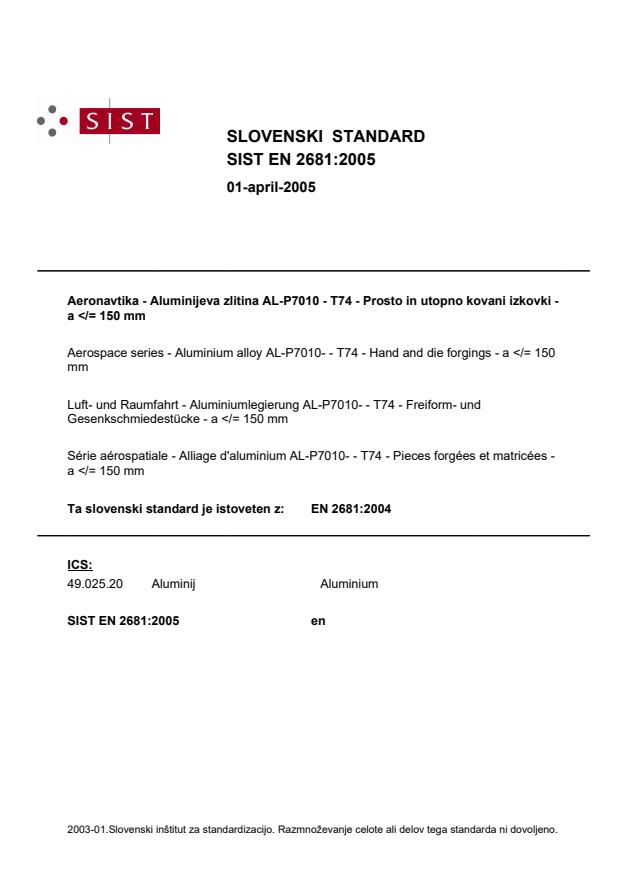
SLOVENSKI STANDARD
01-april-2005
Aeronavtika - Aluminijeva zlitina AL-P7010 - T74 - Prosto in utopno kovani izkovki -
a
Aerospace series - Aluminium alloy AL-P7010- - T74 - Hand and die forgings - a
mm
Luft- und Raumfahrt - Aluminiumlegierung AL-P7010- - T74 - Freiform- und
Gesenkschmiedestücke - a
Série aérospatiale - Alliage d'aluminium AL-P7010- - T74 - Pieces forgées et matricées -
a
Ta slovenski standard je istoveten z: EN 2681:2004
ICS:
49.025.20 Aluminij Aluminium
2003-01.Slovenski inštitut za standardizacijo. Razmnoževanje celote ali delov tega standarda ni dovoljeno.
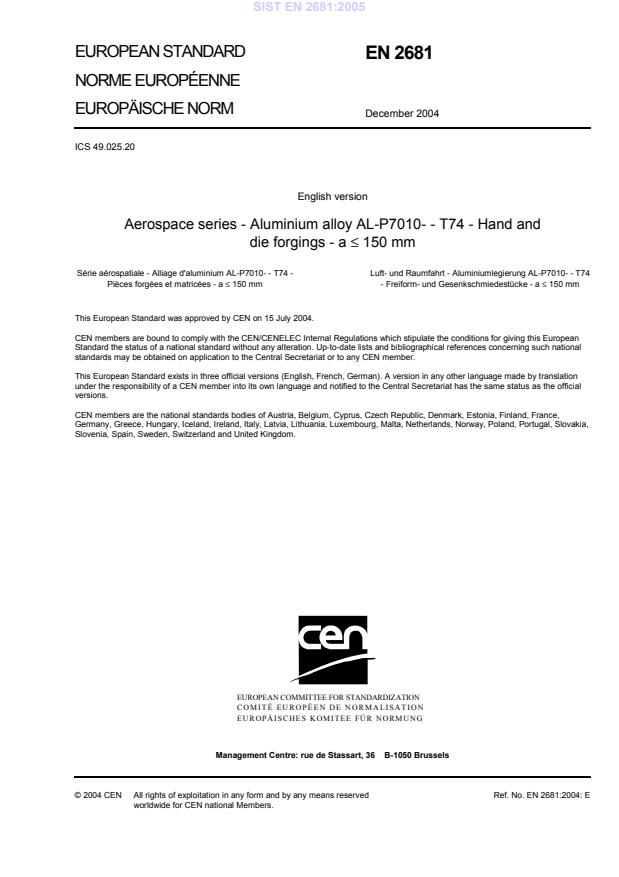
EUROPEAN STANDARD
EN 2681
NORME EUROPÉENNE
EUROPÄISCHE NORM
December 2004
ICS 49.025.20
English version
Aerospace series - Aluminium alloy AL-P7010- - T74 - Hand and
die forgings - a ≤ 150 mm
Série aérospatiale - Alliage d'aluminium AL-P7010- - T74 - Luft- und Raumfahrt - Aluminiumlegierung AL-P7010- - T74
Pièces forgées et matricées - a ≤ 150 mm - Freiform- und Gesenkschmiedestücke - a ≤ 150 mm
This European Standard was approved by CEN on 15 July 2004.
CEN members are bound to comply with the CEN/CENELEC Internal Regulations which stipulate the conditions for giving this European
Standard the status of a national standard without any alteration. Up-to-date lists and bibliographical references concerning such national
standards may be obtained on application to the Central Secretariat or to any CEN member.
This European Standard exists in three official versions (English, French, German). A version in any other language made by translation
under the responsibility of a CEN member into its own language and notified to the Central Secretariat has the same status as the official
versions.
CEN members are the national standards bodies of Austria, Belgium, Cyprus, Czech Republic, Denmark, Estonia, Finland, France,
Germany, Greece, Hungary, Iceland, Ireland, Italy, Latvia, Lithuania, Luxembourg, Malta, Netherlands, Norway, Poland, Portugal, Slovakia,
Slovenia, Spain, Sweden, Switzerland and United Kingdom.
EUROPEAN COMMITTEE FOR STANDARDIZATION
COMITÉ EUROPÉEN DE NORMALISATION
EUROPÄISCHES KOMITEE FÜR NORMUNG
Management Centre: rue de Stassart, 36 B-1050 Brussels
© 2004 CEN All rights of exploitation in any form and by any means reserved Ref. No. EN 2681:2004: E
worldwide for CEN national Members.
Contents Page
Foreword.3
Introduction .4
1 Scope .4
2 Normative references .4
Foreword
This document (EN 2681:2004) has been prepared by the European Association of Aerospace
Manufacturers - Standardization (AECMA-STAN).
After enquiries and votes carried out in accordance with the rules of this Association, this Standard has
received the approval of the National Associations and the Official Services of the member countries of
AECMA, prior to its presentation to CEN.
This European Standard shall be given the status of a national standard, either by publication of an identical
text or by endorsement, at the latest by June 2005, and conflicting national standards shall be withdrawn at
the latest by June 2005.
According to the CEN/CENELEC Internal Regulations, the national standards organizations of the following
countries are bound to implement this European Standard: Austria, Belgium, Cyprus, Czech Republic,
Denmark, Estonia, Finland, France, Germany, Greece, Hungary, Iceland, Ireland, Italy, Latvia, Lithuania,
Luxembourg, Malta, Netherlands, Norway, Poland, Portugal, Slovakia, Slovenia, Spain, Sweden, Switzerland
and the United Kingdom.
Introduction
This standard is part of the series of EN metallic material standards for aerospace applications. The general
organization of this series is described in EN 4258.
This standard has been prepared in accordance with EN 4500-2.
1 Scope
This standard specifies the requirements relating to:
Alumi
...