

oSIST prEN IEC 61010-2-011:2025
(Main)Safety requirements for electrical equipment for measurement, control, and laboratory use - Part 2-011: Particular requirements for refrigerating equipment
General Information
- Abstract
- Status
- Not Published
- Public Enquiry End Date
- 30-Oct-2025
- Technical Committee
- MOV - Measuring equipment for electromagnetic quantities
- Current Stage
- 4020 - Public enquire (PE) (Adopted Project)
- Start Date
- 19-Aug-2025
- Due Date
- 06-Jan-2026
- Completion Date
- 12-Nov-2025

Overview
oSIST prEN IEC 61010-2-011:2025 sets out particular safety requirements for electrical equipment used for measurement, control, and laboratory applications, specifically as they relate to refrigerating equipment. Issued by the European Committee for Electrotechnical Standardization (CLC), this standard supplements the general requirements of IEC 61010-1, focusing on unique hazards associated with refrigerating systems and addressing both design and construction safety needs. The 2025 edition introduces substantial technical revisions including coverage for advanced refrigerant types, enhanced marking, and updated requirements for components, making it crucial for manufacturers, laboratories, and those involved in testing, to ensure compliance and safety.
Key Topics
Scope of Application:
- Applies to electrical equipment equipped with refrigerating systems, including laboratory refrigerators, freezers, display cabinets, and similar devices.
- Covers systems using both non-flammable and flammable refrigerants (with limitations), as well as transcritical CO2 refrigeration systems.
- Includes requirements for related components, assemblies, piping, and ancillary systems.
Safety Considerations:
- Prevention of hazards such as electric shock, mechanical injuries, fire, excessive pressure, and refrigerant leaks.
- Evaluation of risks related to high pressure, temperature extremes, and exposure to refrigerants.
- Guidelines for risk assessment, marking, and documentation to ensure operator and bystander safety.
Updated Requirements:
- Clarifies supplementary requirements for systems exceeding certain flammable charge thresholds.
- Addresses use of other equipment within refrigerated compartments.
- Updated standards for piping joints, cold surface protection, and components exposed to varying temperatures and pressures.
- Annexes for considerations such as leakage, explosion risks, component safety, and refrigerant-specific hazards.
Integration with Other Standards:
- Outlines procedures when refrigerating equipment also includes heating elements or other functional systems, referencing IEC 61010-2-010 (heating systems) and IEC 61010-2-012 (combined and advanced systems).
- Provides cross-references for relevant international and European standards (e.g., ISO 817, EN 378), ensuring comprehensive compliance.
Applications
oSIST prEN IEC 61010-2-011:2025 supports safety and regulatory compliance for:
- Laboratory Equipment Manufacturers: Guides the safe design and manufacture of laboratory refrigerators, freezers, and climate chambers.
- Test & Measurement Instruments: Ensures safe operation in environments requiring precise temperature control.
- Quality and Safety Assessment Bodies: Sets out standardized checks for conformity and performance, critical for certification and market access.
- Research Institutions and Laboratories: Protects personnel and assets by prescribing safe installation and operation practices, particularly where hazardous or flammable refrigerants are present.
- Facility Engineers and Installers: Informs best practices for equipment integration, risk mitigation, and compatibility with both building safety codes and international standards.
By addressing both universal and particular hazards, this standard helps organizations meet stringent legal and safety obligations, reduce incidents, and protect human health and the environment.
Related Standards
- IEC 61010-1: General safety requirements for electrical equipment for measurement, control, and laboratory use.
- IEC 61010-2-010: Particular requirements for heating systems.
- IEC 61010-2-012: Safety requirements for equipment combining heating and refrigerating systems.
- ISO 817: Refrigerants - Designation and safety classification.
- EN 378 series: Refrigerating systems and heat pumps – safety and environmental requirements.
- Relevant IEC 60079 series: Explosive atmospheres.
- ISO 14903: Qualification of tightness for components and joints.
By adhering to oSIST prEN IEC 61010-2-011:2025 and its related standards, stakeholders ensure a robust approach to electrical safety, especially for equipment utilizing refrigerating technology in laboratory and measurement settings.
Relations
- Effective Date
- 20-Feb-2024
- Effective Date
- 20-Feb-2024
Get Certified
Connect with accredited certification bodies for this standard

DNV
DNV is an independent assurance and risk management provider.

Lloyd's Register
Lloyd's Register is a global professional services organisation specialising in engineering and technology.
DNV Energy Systems
Energy and renewable energy certification.
Sponsored listings
Frequently Asked Questions
oSIST prEN IEC 61010-2-011:2025 is a draft published by the Slovenian Institute for Standardization (SIST). Its full title is "Safety requirements for electrical equipment for measurement, control, and laboratory use - Part 2-011: Particular requirements for refrigerating equipment". This standard covers: Safety requirements for electrical equipment for measurement, control, and laboratory use - Part 2-011: Particular requirements for refrigerating equipment
Safety requirements for electrical equipment for measurement, control, and laboratory use - Part 2-011: Particular requirements for refrigerating equipment
oSIST prEN IEC 61010-2-011:2025 is classified under the following ICS (International Classification for Standards) categories: 19.080 - Electrical and electronic testing; 27.200 - Refrigerating technology; 71.040.10 - Chemical laboratories. Laboratory equipment. The ICS classification helps identify the subject area and facilitates finding related standards.
oSIST prEN IEC 61010-2-011:2025 has the following relationships with other standards: It is inter standard links to SIST EN IEC 61010-2-011:2022, SIST EN IEC 61010-2-011:2022/A11:2022. Understanding these relationships helps ensure you are using the most current and applicable version of the standard.
oSIST prEN IEC 61010-2-011:2025 is associated with the following European legislation: EU Directives/Regulations: 2014/35/EU; Standardization Mandates: M/511. When a standard is cited in the Official Journal of the European Union, products manufactured in conformity with it benefit from a presumption of conformity with the essential requirements of the corresponding EU directive or regulation.
oSIST prEN IEC 61010-2-011:2025 is available in PDF format for immediate download after purchase. The document can be added to your cart and obtained through the secure checkout process. Digital delivery ensures instant access to the complete standard document.
Standards Content (Sample)
SLOVENSKI STANDARD
01-oktober-2025
Varnostne zahteve za električno opremo za meritve, nadzor in laboratorijsko
uporabo - 2-011. del: Posebne zahteve za hladilno opremo
Safety requirements for electrical equipment for measurement, control, and laboratory
use - Part 2-011: Particular requirements for refrigerating equipment
Sicherheitsbestimmungen für elektrische Mess-, Steuer-, Regel- und Laborgeräte - Teil 2
-011: Besondere Anforderungen für Kühlgeräte
Exigences de sécurité pour appareils électriques de mesurage, de régulation et de
laboratoire - Partie 2-011: Exigences particulières pour appareils de réfrigération
Ta slovenski standard je istoveten z: prEN IEC 61010-2-011:2025
ICS:
19.080 Električno in elektronsko Electrical and electronic
preskušanje testing
27.200 Hladilna tehnologija Refrigerating technology
71.040.10 Kemijski laboratoriji. Chemical laboratories.
Laboratorijska oprema Laboratory equipment
2003-01.Slovenski inštitut za standardizacijo. Razmnoževanje celote ali delov tega standarda ni dovoljeno.
66/859/CDV
COMMITTEE DRAFT FOR VOTE (CDV)
PROJECT NUMBER:
IEC 61010-2-011 ED3
DATE OF CIRCULATION: CLOSING DATE FOR VOTING:
2025-08-15 2025-11-07
SUPERSEDES DOCUMENTS:
66/846/CD, 66/858/CC
IEC TC 66 : SAFETY OF MEASURING, CONTROL AND LABORATORY EQUIPMENT
SECRETARIAT: SECRETARY:
United Kingdom Ms Stephanie Lavy
OF INTEREST TO THE FOLLOWING COMMITTEES: HORIZONTAL FUNCTION(S):
TC 66 Horizontal Group Safety
ASPECTS CONCERNED:
Safety
SUBMITTED FOR CENELEC PARALLEL VOTING NOT SUBMITTED FOR CENELEC PARALLEL VOTING
Attention IEC-CENELEC parallel voting
The attention of IEC National Committees, members of
CENELEC, is drawn to the fact that this Committee Draft
for Vote (CDV) is submitted for parallel voting.
The CENELEC members are invited to vote through the
CENELEC online voting system.
This document is still under study and subject to change. It should not be used for reference purposes.
Recipients of this document are invited to submit, with their comments, notification of any relevant patent rights of
which they are aware and to provide supporting documentation.
Recipients of this document are invited to submit, with their comments, notification of any relevant “In Some Countries”
clauses to be included should this proposal proceed. Recipients are reminded that the CDV stage is the final stage for
submitting ISC clauses. (SEE AC/22/2007 OR NEW GUIDANCE DOC).
TITLE:
Safety requirements for electrical equipment for measurement, control, and laboratory use - Part 2-
011: Particular requirements for refrigerating equipment
PROPOSED STABILITY DATE: 2030
NOTE FROM TC/SC OFFICERS:
electronic file, to make a copy and to print out the content for the sole purpose of preparing National Committee positions.
You may not copy or "mirror" the file or printed version of the document, or any part of it, for any other purpose without
permission in writing from IEC.
IEC CDV 61010-2-011 © IEC 2025
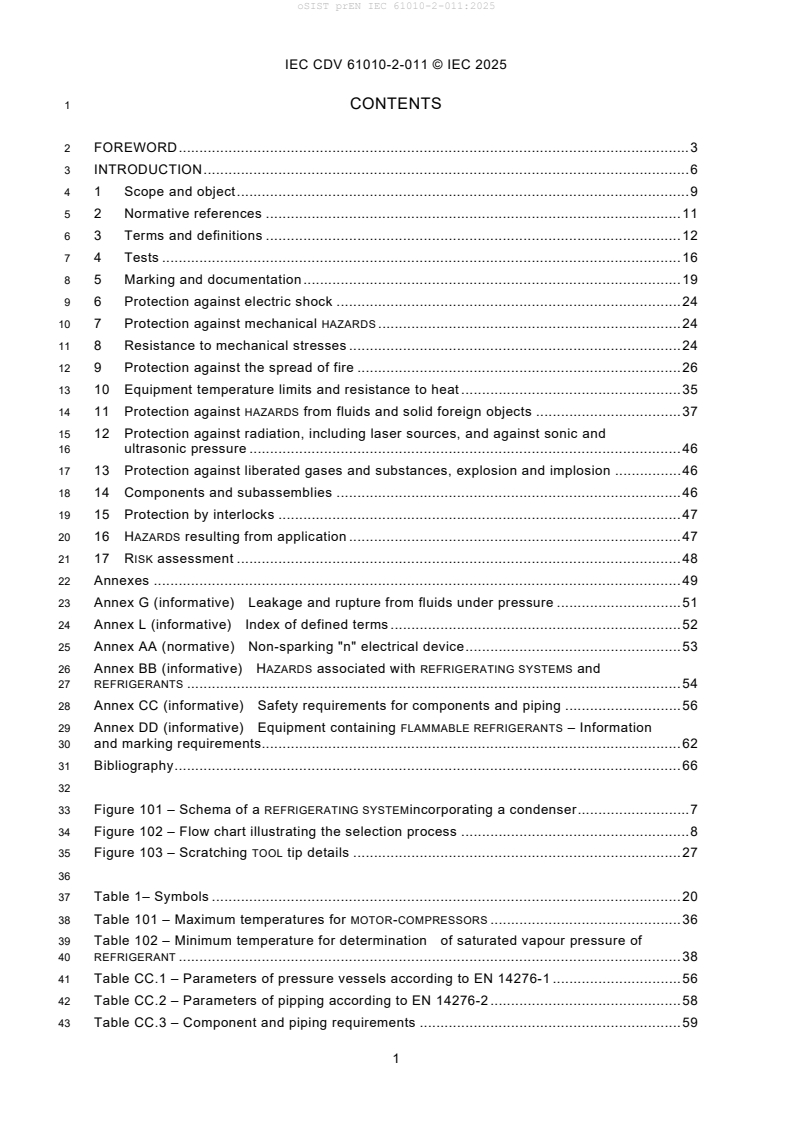
1 CONTENTS
2 FOREWORD . 3
3 INTRODUCTION . 6
4 1 Scope and object . 9
5 2 Normative references . 11
6 3 Terms and definitions . 12
7 4 Tests . 16
8 5 Marking and documentation . 19
9 6 Protection against electric shock . 24
10 7 Protection against mechanical HAZARDS . 24
11 8 Resistance to mechanical stresses . 24
12 9 Protection against the spread of fire . 26
13 10 Equipment temperature limits and resistance to heat . 35
14 11 Protection against HAZARDS from fluids and solid foreign objects . 37
15 12 Protection against radiation, including laser sources, and against sonic and
16 ultrasonic pressure . 46
17 13 Protection against liberated gases and substances, explosion and implosion . 46
18 14 Components and subassemblies . 46
19 15 Protection by interlocks . 47
20 16 HAZARDS resulting from application . 47
21 17 RISK assessment . 48
22 Annexes . 49
23 Annex G (informative) Leakage and rupture from fluids under pressure . 51
24 Annex L (informative) Index of defined terms . 52
25 Annex AA (normative) Non-sparking "n" electrical device . 53
26 Annex BB (informative) HAZARDS associated with REFRIGERATING SYSTEMS and
27 REFRIGERANTS . 54
28 Annex CC (informative) Safety requirements for components and piping . 56
29 Annex DD (informative) Equipment containing FLAMMABLE REFRIGERANTS – Information
30 and marking requirements. 62
31 Bibliography . 66
33 Figure 101 – Schema of a REFRIGERATING SYSTEMincorporating a condenser . 7
34 Figure 102 – Flow chart illustrating the selection process . 8
35 Figure 103 – Scratching TOOL tip details . 27
37 Table 1– Symbols . 20
38 Table 101 – Maximum temperatures for MOTOR-COMPRESSORS . 36
39 Table 102 – Minimum temperature for determination of saturated vapour pressure of
40 REFRIGERANT . 38
41 Table CC.1 – Parameters of pressure vessels according to EN 14276-1 . 56
42 Table CC.2 – Parameters of pipping according to EN 14276-2 . 58
43 Table CC.3 – Component and piping requirements . 59
IEC CDV 61010-2-011 © IEC 2025
44 Table CC.5 – Minimum wall thickness for copper and steel tubing . 61
45 Table DD.1 – Quantity of FLAMMABLEREFRIGERANT per occupied space . 65
IEC CDV 61010-2-011 © IEC 2025
48 INTERNATIONAL ELECTROTECHNICAL COMMISSION
49 ____________
51 SAFETY REQUIREMENTS FOR ELECTRICAL EQUIPMENT
52 FOR MEASUREMENT, CONTROL, AND LABORATORY USE –
54 Part 2-011: Particular requirements for REFRIGERATING EQUIPMENT
56 FOREWORD
57 1) The International Electrotechnical Commission (IEC) is a worldwide organization for standardization comprising
58 all national electrotechnical committees (IEC National Committees). The object of IEC is to promote
59 international co-operation on all questions concerning standardization in the electrical and electronic fields. To
60 this end and in addition to other activities, IEC publishes International Standards, Technical Specifications,
61 Technical Reports, Publicly Available Specifications (PAS) and Guides (hereafter referred to as "IEC
62 Publication(s)"). Their preparation is entrusted to technical committees; any IEC National Committee interested
63 in the subject dealt with may participate in this preparatory work. International, governmental and non-
64 governmental organizations liaising with the IEC also participate in this preparation. IEC collaborates closely
65 with the International Organization for Standardization (ISO) in accordance with conditions determined by
66 agreement between the two organizations.
67 2) The formal decisions or agreements of IEC on technical matters express, as nearly as possible, an international
68 consensus of opinion on the relevant subjects since each technical committee has representation from all
69 interested IEC National Committees.
70 3) IEC Publications have the form of recommendations for international use and are accepted by IEC National
71 Committees in that sense. While all reasonable efforts are made to ensure that the technical content of IEC
72 Publications is accurate, IEC cannot be held responsible for the way in which they are used or for any
73 misinterpretation by any end user.
74 4) In order to promote international uniformity, IEC National Committees undertake to apply IEC Publications
75 transparently to the maximum extent possible in their national and regional publications. Any divergence
76 between any IEC Publication and the corresponding national or regional publication shall be clearly indicated in
77 the latter.
78 5) IEC itself does not provide any attestation of conformity. Independent certification bodies provide conformity
79 assessment services and, in some areas, access to IEC marks of conformity. IEC is not responsible for any
80 services carried out by independent certification bodies.
81 6) All users should ensure that they have the latest edition of this publication.
82 7) No liability shall attach to IEC or its directors, employees, servants or agents including individual experts and
83 members of its technical committees and IEC National Committees for any personal injury, property damage or
84 other damage of any nature whatsoever, whether direct or indirect, or for costs (including legal fees) and
85 expenses arising out of the publication, use of, or reliance upon, this IEC Publication or any other IEC
86 Publications.
87 8) Attention is drawn to the Normative references cited in this publication. Use of the referenced publications is
88 indispensable for the correct application of this publication.
89 9) Attention is drawn to the possibility that some of the elements of this IEC Publication may be the subject of
90 patent rights. IEC shall not be held responsible for identifying any or all such patent rights.
91 International Standard IEC 61010-2-011 has been prepared by IEC technical committee 66:
92 Safety of measuring, control and laboratory equipment.
93 It has the status of a group safety publication in accordance with IEC Guide 104.
94 This third edition cancels and replaces the second edition published in 2019. This edition
95 constitutes atechnical revision.
96 This edition includes the following significant changes from the second edition, as well as
97 numerous other changes.
98 a) adjustment of the scope to include CO2 refrigeration systems including a TRANSCRITICAL
99 REFRIGERATION SYSTEM and the ancillary components and requirements that such a system
100 requires
IEC CDV 61010-2-011 © IEC 2025
101 b) addition of the supplemental requirements if the flammable charge exceeds 150g per
102 stage to a maximum of 13 times the LFL of the flammable refrigerant per stage but still
103 relying on risk mitigation if a leak occurs under single fault conditions.
104 c) addresses the use of other equipment inside the refrigerated compartment.
105 d) updated marking and documentation requirements.
106 e) addition of requirements to prevent back-siphonage into potable water systems for water
107 cooled systems.
108 f) updated requirements for piping joints and fittings (clause 8.1.102).
109 g) Additional requirements for the protection against cold surfaces (clause 10.1.101).
110 h) Update to the requirements for fluidic pressure requirements for an R744 (CO ) system
111 (11.7.101 to 11.7.105.4.4)
112 i) an update to the protective requirements for pressures caused by transport and storage
113 temperatures.
114 j) An update of material requirements for components using for REFRIGERATING
115 SYSTEMS(14.102)
116 k) Update of Annex CC for thesafety requirements of components and piping
117 l) Addition of Annex EE for determining the gas concentration beyond the boundary in a
118 system using a FLAMMABLE REFRIGERANT charge greater than 150g per stage.
119 m) Addition of Annex GG to provide an informative reference for the Globally Harmonized
120 System of Classification and Labelling of Chemicals with respect to refrigerants.
121 n) Update requirements to address the requirements for Stirling Refrigeration Systems
122 The text of this International Standard is based on the following documents:
CDV Report on voting
66/676/CDV 66/683/RVC
124 Full information on the voting for the approval of this International Standard can be found in
125 the report on voting indicated in the above table.
126 This document has been drafted in accordance with the ISO/IEC Directives, Part 2.
127 A list of all parts of the IEC 61010 series, published under the general title Safety
128 requirements for electrical equipment for measurement, control, and laboratory use, can be
129 found on the IEC website.
130 This Part 2-011 is to be used in conjunction with the latest edition of IEC 61010-1. It was
131 established on the basis of the third edition (2010) and its Amendment 1 (2016) and
132 Amendment 2, hereinafter referred to as Part 1.
133 This Part 2-011 supplements or modifies the corresponding clauses in IEC 61010-1 so as to
134 convert that publication into the IEC standard: Particular requirements for REFRIGERATING
135 EQUIPMENT.
136 Where a particular subclause of Part 1 is not mentioned in this Part 2-011, that subclause
137 applies as far as is reasonable. Where this Part 2-011 states "addition", "modification",
138 "replacement", or "deletion", the relevant requirement, test specification, or note in Part 1
139 should be adapted accordingly.
140 In this standard:
141 1) the following print types are used:
142 – requirements and definitions: in roman type;
IEC CDV 61010-2-011 © IEC 2025
143 – NOTES: in smaller roman type;
144 – conformity and tests: in italic type;
145 – terms used throughout this standard which have been defined in Clause 3: SMALL
146 ROMAN CAPITALS.
147 2) subclauses, figures, tables and notes which are additional to those in Part 1 are numbered
148 starting from 101. Additional annexes are lettered starting from AAand additional list items
149 are lettered from aa).
150 The committee has decided that the contents of this documentwill remain unchanged until the
151 stability dateindicated on the IEC website under "http://webstore.iec.ch" in the data related to
152 the specific document. At this date, the documentwill be
153 • reconfirmed,
154 • withdrawn,
155 • replaced by a revised edition, or
156 • amended.
IMPORTANT – The 'colour inside' logo on the cover page of this publication indicates
that it contains colours which are considered to be useful for the correct
understanding of its contents. Users should therefore print this document using a
colour printer.
IEC CDV 61010-2-011 © IEC 2025
160 INTRODUCTION
161 This Part 2-011, along with Part 2-010 and Part 2-012, taken together,address the specific
162 HAZARDS associated with the heating and cooling of materials by equipment andare
163 organizedas follows:
Specifically addresses the HAZARDS associated with equipment
IEC 61010-2-010
incorporating heating systems.
IEC 61010-2-011 Specifically addresses the HAZARDS associated with equipment
incorporating REFRIGERATING SYSTEMS.
HAZARDS associated with equipment
IEC 61010-2-012 Specifically addresses the
incorporating both heating and REFRIGERATING SYSTEMS that interact
with each other such that the combined heating and REFRIGERATING
SYSTEM yield additional or more severe HAZARDS for the two systems
than if treated separately. It also addresses the HAZARDS associated
with the treatment of materials by other factors like irradiation,
excessive humidity, CO and mechanical movement.
165 Guidance for the application of the correct Part 2 standard(s)
166 When the equipment includes only a material heating system, and no REFRIGERATING SYSTEM
167 or other environmental factors apply, then Part 2-010 applies without needing Part 2-011 or
168 Part 2-012. Similarly, when the equipment includes only a REFRIGERATING SYSTEM, and no
169 material heating system or other environmental factors apply, then Part 2-011 applies without
170 needing Part 2-010 or Part 2-012. However, when the equipment incorporates both a material
171 heating system, and a REFRIGERATING SYSTEM or the materials being treated in the intended
172 application introduce significant heat into the REFRIGERATING SYSTEM, a determination
173 shouldbe made as to whether the interaction between the two systems will generate additional
174 or more severe HAZARDS than if the systems were evaluated separately(CONTROLLED
175 TEMPERATURE, see flow chart of Figure 102 for selection process). If the interaction of the
176 heating and cooling functions yields no additional or more severe HAZARDS, then both
177 Part 2-010 and Part 2-011 apply for their respective functions. Conversely, if additional or
178 more severe HAZARDS result from the combining of the heating and cooling functions, or if the
179 equipment incorporates additional material treatment factors,then Part 2-012 applies, but not
180 Part 2-010 or Part 2-011.
181 What HAZARDS are applicable for a REFRIGERATING SYSTEM?
182 The typical HAZARDS for a REFRIGERATING SYSTEM(see Figure 101) consisting of a MOTOR-
183 COMPRESSOR, a condenser, an expansion device and an evaporator include but are not
184 limited to:
185 – The excess of temperature of the low-pressure side (return temperature) to the MOTOR-
186 COMPRESSOR is higher than admissible. A MOTOR-COMPRESSOR incorporates a REFRIGERANT
187 cooled motor, and it should be established that the maximum temperatures of low-
188 pressure sideunder least favourable condition do not exceed the insulation RATINGS within
189 the motor.
190 – Theexcess of pressure of the low-pressureside at the inlet to the MOTOR-COMPRESSOR is
191 higher than admissible. The housing of the MOTOR-COMPRESSORis exposed to this pressure
192 and so the design RATING of the MOTOR-COMPRESSOR housing shouldaccommodate the
193 worst-case pressures whilst providing the correct safety margin for a pressure vessel.
194 – Theexcess of temperature of the high-pressureside to the condenser is higher than
195 admissible. The temperatures of the high-pressure sideunder the most unfavourable
IEC CDV 61010-2-011 © IEC 2025
196 conditions canpresent a temperature HAZARD if the OPERATORis exposed,or an electrical
197 HAZARDif insulation is degraded.
198 – Theexcess of pressure of the high-pressureside to the condenser is higher than
199 admissible. The REFRIGERANT components downstream of the MOTOR-COMPRESSOR up to
200 the expansion device are exposed to this pressure and so the design RATING of these
201 components should accommodate the worst case pressures whilst providing the correct
202 safety margin for a pressure vessel.
203 – Expansion of liquid refrigerant in a closed space without the presence of vapour, caused
204 by a rise in external temperature.
205 – The maximum CONTROLLED TEMPERATURES where the heat is being extracted from, may
206 impact the maximum temperature of the low-pressure side to the MOTOR-COMPRESSOR as
207 well as present a temperature HAZARD if the OPERATORis exposed,or an electrical HAZARDif
208 insulation is degraded. Whether this CONTROLLED TEMPERATURE is derived from an integral
209 heating function of the device or from the heat dissipated from the material being cooled,
210 the impact under worst-case conditions shouldbe evaluated.
211 – The current draw of the equipmentshouldbe established when including the worst-case
212 running conditions of the REFRIGERATING SYSTEM including any defrost cycles that may
213 apply.
214 – The escape of refrigerant causing,for example:asphyxiation, risk of fire or explosion or
215 freezing of skin,depending on the refrigerant released.
216 The worst-case conditions should be determined for the equipment and will include both the
217 least favourableNORMAL USE conditions as well as the most unfavourable testing results under
218 SINGLE FAULT CONDITIONS.
221 Figure 101 – Schema of a REFRIGERATING SYSTEMincorporating a condenser
IEC CDV 61010-2-011 © IEC 2025
222 The selection process is illustrated in the following flow chart (see Figure 102).
224 Figure 102 – Flow chart illustrating the selection process
IEC CDV 61010-2-011 © IEC 2025
225 SAFETY REQUIREMENTS FOR ELECTRICAL EQUIPMENT
226 FOR MEASUREMENT, CONTROL, AND LABORATORY USE –
228 Part 2-011: Particular requirements for REFRIGERATING EQUIPMENT
232 1 Scope and object
233 This clause of Part 1 is applicable, except as follows:
234 1.1.1 Equipment included in scope
235 Replacement:
236 Replace the second paragraph by the following:
237 This Part 2 of IEC 61010 specifies particular safety requirements for the following types
238 a) to c) of electrical equipment and their accessories, wherever they are intended to be used,
239 whenever that equipment incorporates REFRIGERATING SYSTEMSas an integral part of, or
240 separate from, the equipment and the equipment is in direct control of the REFRIGERATING
241 SYSTEM. It also details the requirements for STIRLING REFRIGERATION SYSTEMS.
242 Equipment within the scope of this document employ risk mitigations for the following
243 constructions: CO2 systems, non-flammable refrigerant systems, flammable refrigerant
244 systems with less than 150g and flammable refrigerants less than 13 LFL.
245 Addition:
246 dd) This document addresses all refrigeration systems and their associated components and
247 piping using gaseous or liquid refrigerant or mixtures of refrigerants given in ISO 817.
248 Pressure equipment, assemblies and their components below or equal to the limits set out in
249 points (A) for vessels and (B) for piping respectively shall be designed and manufactured in
250 accordance with the sound engineering practice in this document.
251 Fluids with hazard statement H220 and H221 are considered group 1 fluids, where the
252 maximum allowable temperature is above the flashpoint, and substances and mixtures with a
253 maximum allowable temperature TS which exceeds the flashpoint of the fluid.
254 Fluids contained in group 2 (“non-dangerous fluids”) are fluids with no risk or other risks not
255 quoted above associated with them.
256 A detailed list of can be found in Annex GG of this document.
257 A) Limits for vessels
258 This covers gases, liquefied gases, gases dissolved under pressure, vapours and those
259 liquids whose vapour pressure at the maximum allowable temperature is > 0,5 bar above
260 normal atmospheric pressure (1 013 mbar) within the limits detailed in Table CC.1 of Annex
261 CC of this document.
262 B) Limits for piping
IEC CDV 61010-2-011 © IEC 2025
263 This covers liquids having a vapour pressure at the maximum allowable temperature of ≤ 0,5
264 bar above normal atmospheric pressure (1 013 mbar) within the limitsdetailed in Table CC.2
265 of Annex CC of this document.
266 Addition:
267 Add the following text after the last paragraph:
268 NOTE 101 Examples for REFRIGERATING EQUIPMENT include, but are not limited to, laboratory equipment such as
269 laboratory refrigerators, freezers, refrigerated display cabinets.
270 It is possible that all or part of the equipment falls within the scope of one or more other
271 Part 2 standards of IEC 61010 as well as within the scope of this standard. In that case, the
272 requirements of those other Part 2 standards will also apply. In particular, if equipment is
273 intended to be used as a centrifuge, the requirements of IEC 61010-2-020 apply. However,
274 when the equipment incorporates a refrigerating system and a heating function where the
275 combination of the two introduces additional or more severe HAZARDS than if treated
276 separately, then it is possible that IEC 61010-2-012 is applicable instead of this Part 2-011.
277 See further information in the flow chart (Figure 102) for the selection process and guidance
278 in the Introduction.
279 1.1.2 Equipment excluded from scope
280 Addition:
281 Add the following after d)
282 This document does not apply to:
283 - the evaluation of safety devices or components for pressure
284 - equipment or components exceeding the limits in 1.1.1 as additional requirements
285 apply and national or international legislation may set additional requirements.
286 - Walk-in chambers
287 - Equipment with flammable refrigerants risk mitigation beyond what is covered in this
288 document.
290 1.2 Object
291 1.2.1 Aspects included in scope
292 Replacement:
293 Replace the first paragraph by the following:
294 The object of this document is to ensure that the design and methods of construction of
295 REFRIGERATING EQUIPMENT provide adequate protection for OPERATORS, bystanders, trained
296 service personnel, and the surrounding area against the specific HAZARDS that relate to
297 REFRIGERATING SYSTEMS.
298 Addition:
299 Add the following note after the existing note:
300 NOTE 101 A list of HAZARDStypically associated with REFRIGERATING SYSTEMS and REFRIGERANTS is included in
301 Annex BB.
302 NOTE 102 For the EU, the sealed system components may be considered pressure vessels or piping in
303 accordance with the PRESSURE EQUIPMENT DIRECTIVE (PED) 2014/68/EU. This standard address equipment
304 which is PED category ≤ I and so excluded from the scope of the PED according to Article 4 (3). Refer to Annex CC
305 for guidance on the applicable pressure category for vessels (Annex CC.1) or piping (Annex CC.2).
IEC CDV 61010-2-011 © IEC 2025
306 For the equipment or the components, which are classified higher than category I and operated at this
307 classification level, will have to follow additional requirements (such as EN 378-2, alternative standards are not
308 excluded). These additional requirements are not covered by this standard. However, the basic method applied in
309 this standard is according to the method for complying with such additional requirements.
311 2 Normative references
312 This clause of Part 1 is applicable, except as follows:
313 Addition:
314 Add the following references to the list:
315 IEC 60079-7/AMD1:2017, Explosive atmospheres – Part 7: Equipment protection by increased
316 safety “e”
317 IEC 60079-10-1:2020 Explosive atmospheres – Part 10-1: Classification of areas – Explosive
318 gas atmospheres
319 IEC 60079-15:2017, Explosive atmospheres – Part 15: Equipment protection by type of
320 protection "n"
321 IEC 60079-29-1/AMD1:2020, Explosive atmospheres – Part 29-1: Gas detectors –
322 Performance requirements of detectors for flammable gases
323 IEC 60335-2-34:2024, Household and similar electrical appliances – Safety – Part 2-34:
324 Particular requirements for motor-compressors.
325 IEC 60730-1:2022, Automatic electrical controls– Part 1: General requirements
326 IEC 60730-1/Cor 1:2014, Automatic electrical controls– Part 1: General requirements
327 IEC 60730-1/Amd 1:2015, Automatic electrical controls – Part 1: General requirements
328 IEC 60730-1/Amd 2:2020, Automatic electrical controls– Part 1: General requirements
329 IEC 60730-2-6, Automatic electrical controls – Part 2-6: Particular requirements for automatic
330 pressure sensing controls including mechanical requirements
331 UL 1998 Ed.3:2013,UL Standard for Safety Software in Programmable Components
332 ISO 817:2024, Refrigerants – Designation and safety classification
333 ISO 4126-2:2018, Safety devices for protection against excessive pressure – Bursting disc
334 safety devices
335 ISO 5149-1:2014/AMD1:2015/AMD2:2021, Refrigerating systems and heat pumps – Safety
336 and environmental requirements – Part 1: Definitions, classification and selection criteria
337 ISO 7010,Graphical symbols – Safety colours and safety signs – Registered safety signs
338 EN 378-1:2016, Refrigerating systems and heat pumps – Safety and environmental
339 requirements – Part 1: Basic requirements, definitions, classifications and selection criteria
IEC CDV 61010-2-011 © IEC 2025
340 EN 378-2:2016, Refrigerating systems and heat pumps – Safety and environmental
341 requirements – Part 2: Design, construction, testing, marking and documentation
342 ISO 14903:2017, Refrigerating systems and heat pumps – Qualification of tightness of
343 components and joints
344 3 Terms and definitions
345 This clause of Part 1 is applicable, except as follows:
346 Addition:
347 Add the following new terms and definitions:
348 3.101
349 REFRIGERATING SYSTEM
350 combination of interconnected REFRIGERANT-containing parts constituting one closed circuit in
351 whichthe REFRIGERANT is circulated for the purpose of extracting and delivering heat (i.e.,
352 cooling and heating)
353 [SOURCE: EN 378-1:2020 Terms and definitions, 3.1.1]
354 3.103
355 FLAMMABLE REFRIGERANT
356 REFRIGERANT with a flammability classification of group 2L, 2 or 3 in accordance with
357 ISO 817,or hazard statement codes of H220, H221 in accordance with GHS Classification
358 Note 1 to entry: For REFRIGERANT blends which have more than one flammability classification, either the most
359 unfavourable classification is taken for the purpose of this definition or the blend itself is evaluated for flammability
360 in accordance with ISO 817.
361 Note 2 to entry: GHS, an abbreviation for the Globally Harmonized System of Classification and Labelling of
362 Chemicals. Refer to Annex GG for more information.
363 3.104
364 HPCO
365 HIGH PRESSURE CUT-OUT
366 pressure-actuated device that is designed to stop the operation of the pressure generator
367 Note 1 to entry: This note applies to the French language only.
368 3.105
369 PS
371 Maximum allowable pressure for which the refrigerant containing parts of the equipment can
372 be subjected to in NORMAL USE or SINGLE FAULT CONDITION
373 Note 1 to entry: This note applies to the French language only.
374 Note 2 to entry: PS is the limit which should not be exceeded whether the system is operating or not.
375 [SOURCE: EN 378-1:2016 Terms and definitions, 3.3.2]
376 3.106
377 SOAKED TEMPERATURE CONDITION
378 environmental temperature condition when all the temperatures in the equipment under test
379 (EUT) equal to ±2 °C of the test ambient temperature
380 Note 1 to entry: This note applies to the French language only.
IEC CDV 61010-2-011 © IEC 2025
381 3.107
382 ABNORMAL OPERATION
383 operation of REFRIGERATING EQUIPMENTwith a limited RATED ambient temperature range in
384 ambient temperature conditions outside that limitation but within the temperature limits of
385 1.4.1
386 3.108
387 REFRIGERANT
388 fluid used for heat transfer in a REFRIGERATING SYSTEM, which absorbs heat at a low
389 temperature and a low pressure of the fluid and rejects heat at a higher temperature and a
390 higher pressure of the fluid, usually involving changes of state of the fluid
391 [SOURCE: ISO 5149-1:2014, 3.7.9, modified – The note has been removed.]
392 3.109
393 CONTROLLED TEMPERATURE
394 Temperature acting on the secondary side of a heat exchanger, including the low-pressure side of the equipment,
395 due to heat transfer either by active heating, by the application system or by the equipment under test (EUT) on the
396 secondary side.Note 1 to entry: For heat pump systems, where a four-way valve is used to shift between heating
397 and cooling, the function of the condenser and evaporator is exchanged.
398 3.110
399 LOWER EXPLOSIVE LIMIT / LOWER FLAMMABILITY LIMIT
400 LEL / LFL
401 concentration of flammable gas or vapourin air, below which an explosive gas atmosphere
402 willnot be formed
404 [SOURCE: IEC 60050-426:2008, 426-02-09]
405 3.111
406 MOTOR-COMPRESSOR
407 refrigerating subassembly consisting of the mechanical mechanism of the compressor and the
408 motor, both ofwhich are enclosed in the same sealed housing, with no external shaft seals,
409 and with themotor operating in a REFRIGERANT atmosphere with or without oil
410 Note 1 to entry: The housing may be permanently sealed, such as by welding or brazing (hermetic MOTOR-
411 COMPRESSOR), or may besealed by gasketted joints (semi-hermetic MOTOR-COMPRESSOR). A TERMINAL box, a
412 TERMINAL boxcover, and other electrical components or an electronic control system may be included.
413 [SOURCE: IEC 60335-2-34:2012, 3.101, modified – "appliance" has been replaced by
414 "refrigerating subassembly" and note 2 has been removed.]
415 3.112
416 CONDENSING UNIT
417 specific refrigerating subassembly combination for a given REFRIGERANT, consisting of one or
418 more MOTOR-COMPRESSORS, condensers or gas coolers, liquid receivers (when required) and
419 the regularly furnished accessories
420 [SOURCE: ISO 5149-1:2014, 3.4.5,modified –The definition has been adapted for the specific
421 case of refrigerating equipment.]
422 3.113
423 QUALIFIED PERSON
424 person having the appropriate technical training and experience necessary to be aware of
425 hazards to which he or she is exposed in performing a task and of measures necessary to
426 minimize the danger to themselves or other persons.
427 3.114
IEC CDV 61010-2-011 © IEC 2025
428 GAS COOLER
429 heat exchanger in which, after compression, the refrigerant is cooled down, by transferring
430 heat to an external cooling medium, without changing state
431 NOTE 1: A gas cooler is normally used in aTRANSCRITICAL REFRIGERATION SYSTEM.
433 3.115
434 TRANSCRITICAL REFRIGERATION SYSTEM
435 refrigeration system where the pressure in the high-pressure side is above the pressure
436 where the vapour and liquid stated of the refrigerant can coexist in thermodynamic equilibrium.
437 3.116
PRESSURE RELIEF DEVICE
439 pressure sensing device intended to reduce pressure automatically when pressures within the
440 refrigeration system exceed the setting pressure of the device during abnormal operation.
441 3.117
442 FLASH GAS BYPASS VALVE
443 enables gas from the flash gas tank to be removed for compression typically in a
444 TRANSCRITICAL REFRIGERATION SYSTEM
445 3.118
FLASH GAS TANK
447 provided to separate the vapor and supply liquid to evaporators for expansion typically in a
448 TRANSCRITICAL REFRIGERATION SYSTEM. Once cooled in the gas cooler, refrigerant is throttled to
449 the subcritical region and enters this device.
450 3.119
451 INTERMEDIATE PRESSURE STAGE
452 this applies to carbon dioxide (R-744) transcritical systems, lays between the high side and
453 low side pressure stages and is regulated by a FLASH GAS BYPASS VALVE. This stage may
454 include a FLASH GAS TANK and gas cooler.
455 3.120
PRESSURE REGULATING RELIEF VALVE
457 similar to a pressure relief valve except specifically intended for use with refrigeration
458 systems utilizing carbon dioxide (R-744) as the refrigerant in a secondary loop or cascade
459 system. The pressure relief setting of this valve is always lower than the relief setting of a
460 PRESSURE RELIEF DEVICE. This valve may open and re-close many times during the life of the
461 system.
463 3.121
464 GROUP I EQUIPMENT
465 equipment containing or intended for using with Group I fluids.
466 Note 1 to entry: Group I fluids are dangerous fluids with at least one of the HAZARD statements as defined in
467 AnnexGG.
468 Note 2 to entry: Group I fluids also include substances and mixtures contained or intended for use with the
469 equipment whose maximum permissible temperature is above the FLASH POINT of the fluid.
470 3.122
471 HERMETICALLYSEALED JOINT
472 joint that are made tight by welding, brazing or a similar permanent connection.
473 [SOURCE: ISO 14903:2017, 3.7]
474 3.123
475 HERMETICALLY SEALED COMPONENT
476 component that are made tight by welding, brazing or a similar permanent connection.
477 [SOURCE: ISO 14903:2017, 3.8]
IEC CDV 61010-2-011 © IEC 2025
478 3.124
479 TYPE APPROVEDCOMPONENT
480 componentfor which examination is performed on one or more samples of this component in
481 accordance with a recognized standard for type approval.
482 3.125
483 WELDED JOINT
484 joint obtained by the joining of metal parts in plastic or molten state.
485 [SOURCE: EN 378-1:2016, 3.5.3]
486 3.126
487 BRAZED JOINT
488 joint obtained by the joining of metal parts with alloys which melt at temperatures in general
489 higher than 450°C but less than the melting temperatures of the joined parts.
490 [SOURCE: EN 378-1:2016, 3.5.4]
491 3.127
492 SOLDERED JOINT
493 joint obtained by the joining of metal parts with metallic mixtures or alloys which melt at
494 temperatures in general less than 450°C.
495 [SOURCE: EN 378-1:2016, 3.5.5]
496 3.128
497 3.129 REFRIGERATION EQUIPMENT TYPE A
498 a REFRIGERATION SYSTEM that contains non-flammable, non-toxicREFRIGERANT, not
499 includingCO2 in either a sub-critical or transcritical state.
500 3.130 REFRIGERATION EQUIPMENT TYPE B
501 a REFRIGERATION SYSTEM that contains flammableREFRIGERANT, at a charge <= 150g. A
502 REFRIGERANT leak is considered possible under single fault conditions, but only ignition
503 sources internal to the equipment need to be addressed.
504 3.131 REFRIGERATION EQUIPMENT TYPE C
505 a REFRIGERATION SYSTEM that contains flammableREFRIGERANT, with a charge >150g but <= 13
506 x LFL. A REFRIGERANT leak is considered possible under single fault conditions, but ignition
507 sources both internal to the equipment and the area surrounding the equipment need to be
508 addressed.
509 3.132 REFRIGERATION EQUIPMENT TYPE E
510 a REFRIGERATION SYSTEM that employs CO2REFRIGERANT (R744) in both a sub-critical and
511 transcritical system.
512 3.133 HEAT TRANSFER MEDIUM
513 a fluid used to transfer heat around a system which does not go through a phase change
514 while it is heated or cooled.
516 3.134 STIRLING REFRIGERATION SYSTEMS
517 a hermetic refrigeration system based on the Stirling gas cycle in which the refrigerant is at all
518 times in the gas or vapor phase. The STIRLINGREGERATION SYSTEM may include a thermosiphon
519 containing a different refrigerant in a saturated condition.
IEC CDV 61010-2-011 © IEC 2025
523 4 Tests
524 This clause of Part 1 is applicable, except as follows:
525 4.3.1 Environmental conditions
526 Addition:
527 Add the following text after item d):
528 Since the temperatures, pressures and current draws for aREFRIGERATING SYSTEM are
529 significantly impacted by ambient temperatures in a non-linear way, linear extrapolation of
530 test data is not possible. Therefore, tests to establish temperatures, pressures, and current
531 draws of a REFRIGERATING SYSTEM shall be conducted under the following environmental
532 conditions:
533 aa) an ambient temperature of 40 °C;
534 bb) a relative humidity not exceeding the limits of 1.4.1 d).
535 If the equipment is RATED by the manufacturer to operate in extended environmental
536 conditions as defined by 1.4.2 or a more restricted environment condition for temperature and
537 humidity, then these conditions will define the settings for 4.3.1 aa) or 4.3.1 bb).
538 When the REFRIGERATING SYSTEM is water cooled, the temperature of the water supply shall be
539 the maximum as specified by the manufacturer (see 5.4.3) with the worst case water pressure
540 as specified by the manufacturer.
541 If a restricted environment condition in accordance with 1.4.1,note 2, is employed then the
542 test of 4.4.2.102 applies.
543 4.3.2 State of equipment
544 4.3 Reference test conditions
545 4.3.2.1 General
546 Addition:
547 Add the following text after the first paragraph:
548 When measuring temperatures, pressures and current draws of equipment incorporating a
549 REFRIGERATING SYSTEMthe tests shall be started from a SOAKED TEMPERATURE CONDITION when
550 all pressures have fully equalized. Tests at the extremes of the input voltage(±10 %) shall
551 start under these voltage conditions and achieve a stable state but need not start from a
552 SOAKED TEMPERATURE CONDITION. Safety protective devices shall not operate during this test.
553 Addition:
554 Add the following new subclause:
IEC CDV 61010-2-011 © IEC 2025
558 4.3.2.101REFRIGERATING EQUIPMENT intended to be used with other equipment inside the
559 refrigerated compartment.
560 REFRIGERATED EQUIPMENT TYPE B OR REFRIGERATED EQUIPMENT TYPE Cthat,according to the
561 instructions, may be used with other electrical equipment inside a refrigerated storage
562 compartment are evaluated with such equipment in operation as they would be in normal use.
563 4.4.2 Application of fault conditions
564 4.4.2.10 Cooling
565 Replacement:
566 Replace the text with the following:
567 For cooling not associated with the cooling of the REFRIGERATING SYSTEM:
568 a) air-holes with filters shall be closed;
569 b) forced cooling by motor-driven fans shall be stopped;
570 c) cooling by circulation of water or other cool
...