


oSIST prEN 15273-2:2019
(Main)Railway Applications - Gauges - Part 2: Rolling stock
Railway Applications - Gauges - Part 2: Rolling stock
The gauges and processes included in this standard have been developed for application on mainline railway networks using various track gauges. Other networks such as urban and suburban may apply the gauging rules defined in this standard but are outside of its scope.
For a given defined gauge, the application of the rules contained in EN 15273-2, combined with corresponding parameters and reference profiles given in EN 15273-4, makes it possible to determine the maximum exterior dimensions of a vehicle (maximum vehicle construction gauge) compatible with infrastructure gauges obtained according to rules defined in EN 15273-3.
For absolute and comparative gauging, the application of the rules contained within EN 15273-2, combined with infrastructure data defined in EN 15273-3 in accordance with EN 15273-1 makes it possible to determine the dimensions of a vehicle.
EN 15273-2 is applicable to new vehicle designs, to modifications to existing vehicles and for checking existing vehicles to be used on another route or network.
This European standard contains:
— the rules for rolling stock for all defined gauges;
— the swept envelope calculation process used for defined dynamic gauges, absolute and comparative
methods;
— the list of documents required to assess vehicle conformity to this standard.
NOTE The rules given in this standard are not applicable to the gauges “S” and “T” referred to in clause 4.2.3.1. (7) & (8) for track gauge 1520 mm of the merged TSI Loc and Pass ( Commission Regulation N° 1302/2014 of 18 November 2014).
Bahnanwendungen - Begrenzungslinien - Teil 2: Fahrzeugbegrenzungslinien
Die Begrenzungslinien und Prozesse in diesem Dokument wurden für die Anwendung in Hauptstrecken-Eisenbahnnetzen mit unterschiedlichen Spurweiten entwickelt. Andere Bahnsysteme wie städtische oder Vorortbahnen können die in diesem Dokument aufgeführten Regeln für Begrenzungslinien ebenfalls anwenden, gehören aber nicht zu dessen Anwendungsbereich.
Bei einer gegebenen Begrenzungslinie ermöglicht es die Anwendung der in EN 15273-2 enthaltenen Regeln zusammen mit den entsprechenden Parametern und Bezugslinien in EN 15273-4, die maximalen Außenmaße eines Fahrzeugs (maximale Begrenzungslinie für den Fahrzeugbau) zu bestimmen, die mit den in EN 15273-3 festgelegten Lichtraumprofilen kompatibel sind.
Bei der absoluten und der vergleichenden Rechenmethode ermöglicht es die Anwendung der in EN 15273-2 enthaltenen Regeln zusammen mit den in EN 15273-3 festgelegten Infrastrukturdaten in Übereinstimmung mit EN 15273-1, die Abmessungen eines Fahrzeugs zu bestimmen.
EN 15273-2 gilt für die Planung neuer und modernisierter Fahrzeuge sowie für die Überprüfung von existierenden Fahrzeugen, die auf einer anderen Strecke oder einem anderen Netz zum Einsatz kommen sollen.
Dieses Dokument enthält
— die Fahrzeuge betreffenden Regeln zu allen definierten Begrenzungslinien,
— den Berechnungsprozess für die Hüllkurvengrenzlinie, der für definierte dynamische Begrenzungslinien und die absolute und vergleichende Rechenmethode verwendet wird,
— die Liste der Dokumente, die für die Beurteilung der Fahrzeugkonformität nach dieser Norm erforderlich sind.
ANMERKUNG Die Regeln, die in dieser Norm angegeben werden, gelten nicht für die in 4.2.3.1 in Bezug genommenen Spurweiten „S“ und „T“. (7) und (8) für die Spurweite 1 520 mm der zusammengeführten TSI Loc & Pas (Richtlinie der Kommission Nr. 1302/2014 vom 18. November 2014).
Applications ferroviaires - Gabarits - Partie 2 : Matériel roulant
Les gabarits et processus inclus dans le présent document ont été établis de manière à être appliqués sur les lignes principales des réseaux ferroviaires. Les autres réseaux (urbains et suburbains, par exemple) peuvent utiliser les règles de détermination du gabarit définies dans le présent document, mais n'entrent pas dans son domaine d'application.
Pour un gabarit défini donné, l'application des règles de l'EN 15273-2, combinées aux paramètres et contours de référence de l'EN 15273-4, permet de déterminer les dimensions extérieures maximales d'un véhicule (gabarit maximal de construction du véhicule) compatibles avec les gabarits d'infrastructure obtenus selon les règles définies dans l'EN 15273-3.
Pour les gabarits absolu et comparatif, l'application des règles de l'EN 15273-2, combinées aux données d'infrastructure de l'EN 15273-3 conformément à l'EN 15273-1, permet de déterminer les dimensions d'un véhicule.
L'EN 15273-2 est applicable à la conception de véhicules neufs, aux modifications de véhicules existants et au contrôle des véhicules existants à utiliser sur une autre ligne ou un autre réseau.
Le présent document contient :
— les règles concernant le matériel roulant pour tous les gabarits définis ;
— le procédé de calcul de l'enveloppe balayée employé pour les méthodes des gabarits dynamiques définis, absolu et comparatif ;
— la liste des documents requis pour évaluer la conformité des véhicules à la présente Norme.
NOTE Les règles données dans cette norme ne s’appliquent pas aux gabarits “S” et “T” mentionnés aux points (7) & (8) du paragraphe 4.2.3.1 de la STI Loc & Pass (Règlement UE N° 1302/2014 de la de la commission du 18 Novembre 2014) pour l’écartement de voie de 1 520 mm.
Železniške naprave - Profili - 2. del: Vozna sredstva
General Information
Relations
Standards Content (Sample)
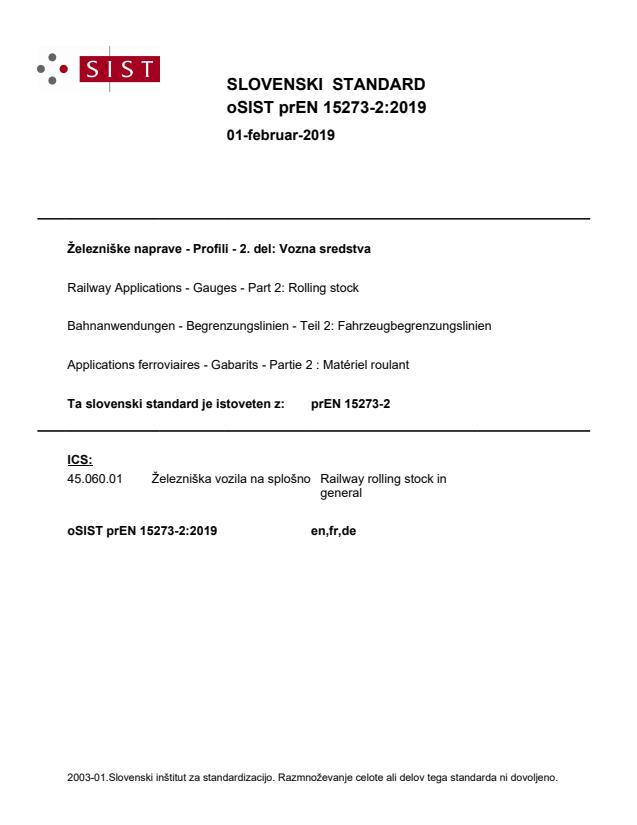
SLOVENSKI STANDARD
01-februar-2019
Železniške naprave - Profili - 2. del: Vozna sredstva
Railway Applications - Gauges - Part 2: Rolling stock
Bahnanwendungen - Begrenzungslinien - Teil 2: Fahrzeugbegrenzungslinien
Applications ferroviaires - Gabarits - Partie 2 : Matériel roulant
Ta slovenski standard je istoveten z: prEN 15273-2
ICS:
45.060.01 Železniška vozila na splošno Railway rolling stock in
general
2003-01.Slovenski inštitut za standardizacijo. Razmnoževanje celote ali delov tega standarda ni dovoljeno.
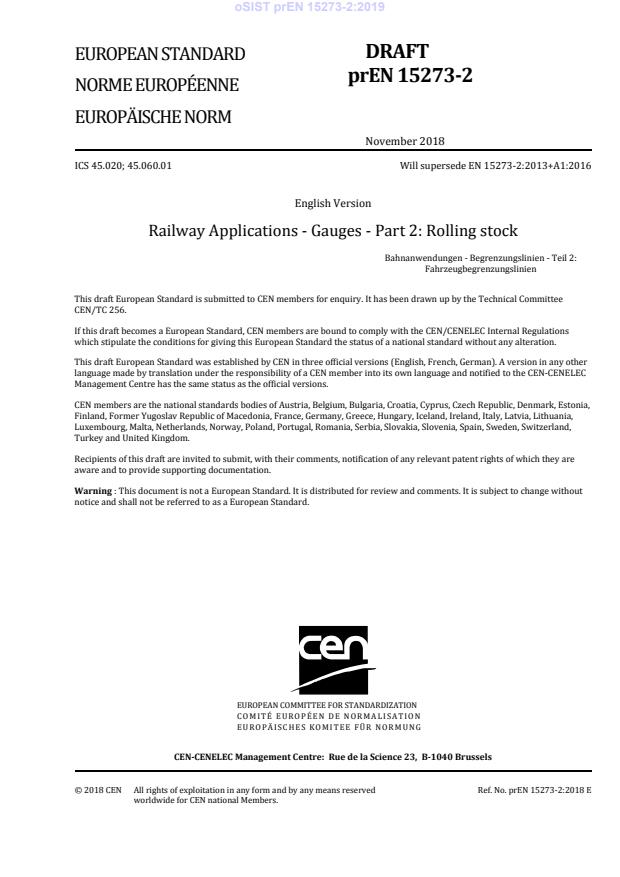
DRAFT
EUROPEAN STANDARD
NORME EUROPÉENNE
EUROPÄISCHE NORM
November 2018
ICS 45.020; 45.060.01 Will supersede EN 15273-2:2013+A1:2016
English Version
Railway Applications - Gauges - Part 2: Rolling stock
Bahnanwendungen - Begrenzungslinien - Teil 2:
Fahrzeugbegrenzungslinien
This draft European Standard is submitted to CEN members for enquiry. It has been drawn up by the Technical Committee
CEN/TC 256.
If this draft becomes a European Standard, CEN members are bound to comply with the CEN/CENELEC Internal Regulations
which stipulate the conditions for giving this European Standard the status of a national standard without any alteration.
This draft European Standard was established by CEN in three official versions (English, French, German). A version in any other
language made by translation under the responsibility of a CEN member into its own language and notified to the CEN-CENELEC
Management Centre has the same status as the official versions.
CEN members are the national standards bodies of Austria, Belgium, Bulgaria, Croatia, Cyprus, Czech Republic, Denmark, Estonia,
Finland, Former Yugoslav Republic of Macedonia, France, Germany, Greece, Hungary, Iceland, Ireland, Italy, Latvia, Lithuania,
Luxembourg, Malta, Netherlands, Norway, Poland, Portugal, Romania, Serbia, Slovakia, Slovenia, Spain, Sweden, Switzerland,
Turkey and United Kingdom.
Recipients of this draft are invited to submit, with their comments, notification of any relevant patent rights of which they are
aware and to provide supporting documentation.
Warning : This document is not a European Standard. It is distributed for review and comments. It is subject to change without
notice and shall not be referred to as a European Standard.
EUROPEAN COMMITTEE FOR STANDARDIZATION
COMITÉ EUROPÉEN DE NORMALISATION
EUROPÄISCHES KOMITEE FÜR NORMUNG
CEN-CENELEC Management Centre: Rue de la Science 23, B-1040 Brussels
© 2018 CEN All rights of exploitation in any form and by any means reserved Ref. No. prEN 15273-2:2018 E
worldwide for CEN national Members.
Contents
Page
European foreword . 8
Introduction . 9
1 Scope . 10
2 Normative references . 10
3 Terms and definitions . 11
4 Symbols and abbreviations . 11
5 Gauges and gauging processes . 11
5.1 All defined gauges . 11
5.2 Defined static and kinematic gauges . 11
5.3 Dynamic methods . 12
5.3.1 General principles . 12
5.3.2 Dynamic method based on defined gauges . 13
5.3.3 Absolute gauging process . 13
5.3.4 Comparative gauging process . 13
Annex A (normative) Defined kinematic gauges — common rules . 14
A.1 General rules . 14
A.1.1 Requirements for use of defined kinematic gauges . 14
A.1.2 Dimensional tolerances on vehicles . 15
A.1.3 Limit of applicability of the present Annex depending on the vehicle configuration . 16
A.1.4 Vehicles with no-coincident bogie centre and rotation point . 17
A.1.5 Bogie classes . 17
A.1.6 Designation of running gears . 17
A.2 Determination of the vehicle heights . 18
A.2.1 General . 18
A.2.2 Determination of the minimum heights above running plane . 18
A.2.3 Determination of maximum heights above running plane . 28
A.3 Determination of the vehicle semi-widths . 30
A.3.1 General . 30
A.3.2 Quasi-static displacements . 31
A.3.3 Lateral reductions – general formulae . 32
A.3.4 Rules for bottom lines of gauge – shunting devices and contact ramps . 36
A.4 Pantograph gauge verification and non-insulated devices on the vehicle’s roof . 40
A.4.1 Pantograph gauge verification . 40
A.4.2 Pantographs in lowered position and non-insulated live parts on vehicle's roof . 41
A.5 Wheel zone . 43
A.6 Specific rules for doors and steps in the open position . 46
A.6.1 General . 46
A.6.2 Access doors . 46
A.6.3 Movable steps . 47
Annex B (normative) Defined kinematic gauges – Passive tilting vehicles and non- tilting
vehicles operating with . 48
B.1 Introduction . 48
B.2 Common rules with Annex A . 48
B.3 Quasi-static displacements for passive tilting vehicles. 49
z
cin
z I I I
B.4 Quasi-static displacements for non-tilting vehicle operating with . 50
p c
cin
B.5 Pantographs independent of the tilting body system or mounted on a non-tilting
I I
vehicle operating with . 50
p c
B.5.1 General . 50
B.5.2 Pantograph located between the end wheelsets or the bogie centres . 52
B.5.3 Pantograph located beyond the end wheelsets or the bogie centres . 52
B.6 Rules about devices on the vehicle’s roof and pantographs in lowered position inside
pantographs reference profile . 53
Annex C (informative) Defined kinematic gauges – Active tilting vehicles and pantograph
associated with a recentering system . 54
C.1 Introduction. 54
C.2 Risk analyses . 54
C.3 Active body tilting method . 55
C.4 Lateral reductions . 55
C.4.1 Basic formulae . 55
C.4.2 Modifications to be made to the formulae for calculating active tilting vehicle . 55
C.4.3 Expression for the values of the lateral clearance when the body is tilted . 56
C.4.4 Quasi-static displacements . 57
z
p
C.4.5 Other associated rules . 58
C.5 Pantographs coupled to the tilting body and/or a pantograph re-centring system . 59
C.5.1 General . 59
C.5.2 Pantographs with counter-rotating system fixed to the tilting body . 59
C.5.3 Pantographs having a re-centring system (non-tilting vehicles - active or passive
tilting systems) . 62
Annex D (normative) Defined kinematic gauge – Graphical method . 65
D.1 General . 65
D.2 Lateral reductions . 65
D.2.1 General . 65
D.2.2 Determination of lateral displacement . 66
Dpl
i ,( R )
D.2.3 Determination of lateral displacement . 74
Dpl
a , ( R )
D.2.4 Quasi-static displacement . 76
z
cin
D.2.5 Determination of lateral reductions . 77
Annex E (normative) Defined kinematic gauges G1, GI1, GI2, G2, GA, GB, GC, GB1, GB2, GI3,
FR 3.3, BE1, BE2, BE3, BE4, PTb, PTb+, PTc, DE1, DE2, DE3, NL1, NL2, GHE16, GEA16,
GEB16, GEC16, GEC14, GEE10, GED10, EBVO1, EBVO2, EBVO3, DK1, GCZ3 . 78
E.1 Defined kinematic gauges using the same common rules . 78
E.2 Gauges for lower part . 79
E.2.1 Common parts . 79
E.2.2 Special rules for bottom lines of lower parts. 80
E.3 Gauges for upper part . 82
E.4 Particular rules . 83
E.4.1 Upper part for German gauges (DE1 or DE2) . 83
E.4.2 Belgium gauges (BE1, BE2, BE3 and BE4) . 83
Annex F (normative) Defined static gauges - common rules . 84
F.1 General rules . 84
F.1.1 General . 84
F.1.2 Limitations for the use of defined defined static gauges . 84
F.1.3 Limit for applicability of present Annex depending on running gear of the vehicle . 84
F.2 Determination of the vehicle heights . 85
F.2.1 Determination of the minimum heights above running plane . 85
F.2.2 Determination of the maximum heights above running plane . 85
F.3 Determination of the vehicle semi-widths . 85
F.3.1 General . 85
F.3.2 Sections located between the end wheelsets or between the bogie centres . 86
F.3.3 Sections located beyond the end wheelsets or beyond the bogie centres . 86
F.3.4 Rules for bottom lines of gauge – use of shunting devices on curved tracks . 86
Annex G (normative) Defined static gauges G1, GI1, GI2, G2, GA, GB, GC, GB1, GB2, GHE16,
GEA16, GEB16, GEC16, GEE10, GED 10 . 87
G.1 Defined static gauges using the same common rules . 87
G.2 Gauges for lower part . 87
G.2.1 Common parts . 87
G.2.2 Special rules for bottom lines of lower parts . 87
G.3 Gauges for upper part . 88
Annex H (normative) Defined static gauges using other rules – UK, FIN1 . 89
H.1 Defined static gauges using other rules . 89
H.2 Defined static gauge UK . 89
H.3 Defined static gauge FIN1 . 89
H.3.1 General . 89
H.3.2 Associated rules . 89
H.3.3 Reduction formulae . 91
H.3.4 Increase in the minimum height of the lower part of the rolling stock able to pass
over marshalling humps and track brakes . 92
H.3.5 Increase in the minimum height of the lower part of the rolling stock not-permitted
to pass over marshalling humps and track brakes . 92
H.3.6 Passage over transitions and humps . 93
H.3.7 Gauge of the vehicle lower step . 93
H.3.8 Gauge of outwards opening doors and of fold-down steps for coaches and motor
vehicles . 94
H.3.9 Pantographs and non-insulated parts . 96
Annex I (informative) Defined kinematic gauges and defined static gauges using common
rules – Common process . 97
I.1 Establishing the formulae to define a maximum construction gauge . 97
I.2 Process for defined kinematic gauge using common rules . 97
I.2.1 Useful elements . 97
I.2.2 Determination of maximum construction gauge heights . 98
I.2.3 Determination of maximum construction gauge semi-widths . 98
I.2.4 Maximum construction gauge . 100
I.3 Process for defined static gauge using common rules . 100
I.3.1 Useful elements . 100
I.3.2 Determination of maximum construction gauge heights . 101
I.3.3 Determination of maximum construction gauge semi-widths . 102
I.3.4 Maximum construction gauge . 102
Annex J (normative) Practice for dynamic gauging by simulation . 104
J.1 Background . 104
J.2 Principles . 104
J.2.1 General . 104
J.2.2 Responsibilities . 105
J.2.3 Computer simulation. 106
J.2.4 Geometric overthrow . 106
J.3 Vehicle simulation model . 106
J.4 Model validation . 107
J.4.1 General . 107
J.4.2 General notes on validation tests . 107
J.4.3 Distribution of static wheel forces . 109
J.4.4 Assessment of displacement characteristics (sway test) . 109
J.4.5 Dynamic performance assessment . 113
J.5 Track data. 114
J.6 Dynamic simulation . 115
J.7 Results processing . 115
J.8 Create swept envelope . 115
Annex K (normative) Defined dynamic gauges – Common rules . 116
K.1 General . 116
K.1.1 Requirements for use of defined dynamic gauges . 116
K.1.2 Dimensional tolerances on vehicles . 116
K.1.3 Limit for applicability depending on vehicle configurations. 116
K.1.4 Classification of running gears . 117
K.1.5 Designation of running gears . 117
K.2 Movement calculation by geometric formulae . 117
K.2.1 General . 117
K.2.2 Calculation of roll movements . 118
K.2.3 Calculation of downward movements . 119
K.2.4 Calculation of upward movements . 123
K.2.5 Calculation of lateral movements . 124
K.2.6 Calculation of pantograph movements . 127
K.2.7 Wheel zone . 128
K.2.8 Specific rules for doors and steps in open position . 128
K.2.9 Swept envelopes . 128
K.3 Movement calculation by simulation . 128
K.3.1 General . 128
K.3.2 To be taken into account . 129
K.3.3 Simulated movements at the datum point . 131
K.3.4 Calculated movements at cross sections . 132
K.3.5 Statistical processing . 132
K.3.6 Influence of parameters not included in the model . 132
K.3.7 Wheel zone . 135
K.3.8 Specific rules for doors and steps in the open position . 135
K.3.9 Vehicle swept envelopes . 135
K.4 Comparison with allowed space . 135
K.5 Input data catalogue (informative) . 136
K.5.1 General . 136
K.5.2 Vehicle data. 136
K.5.3 Track and operational data . 137
K.5.4 Environmental data . 137
Annex L (normative) Defined dynamic gauges SEa, SEc, NO1 . 138
L.1 Defined dynamic gauges - common rules . 138
L.2 Gauges . 138
L.3 Special rules for bottom lines. 138
Annex M (normative) Application of dynamic gauging by simulation and calculation of
swept envelopes for use in absolute and comparative gauging . 141
M.1 Principles . 141
M.2 Provision of data for assessment of compatibility . 141
M.3 Creating a simulation model . 141
M.3.1 Describing vehicle size and shape. 141
M.3.2 Constructing the simulation model . 144
M.4 Model validation . 148
M.5 Selection of track data . 148
M.5.1 General . 148
M.5.2 Track roughness . 148
M.5.3 Track irregularities . 148
M.5.4 Track quality . 149
M.5.5 Track length . 149
M.5.6 Initial run-in length . 149
M.5.7 Initial input . 149
M.6 Simulation methodology . 149
M.6.1 General . 149
M.6.2 Cant, speed and curve radius: general cases . 150
M.6.3 Cant, speed and curve radius: particular cases . 150
M.6.4 Application of cant and curve radius . 150
M.6.5 Side wind loads . 151
M.6.6 Datum positions . 151
M.7 Results processing . 152
M.8 Curving analysis of lateral wheelset movements . 153
M.9 Calculating swept envelopes . 154
M.9.1 General . 154
M.9.2 Input data . 154
M.9.3 Calculation of movements due to suspension flexibility . 156
M.9.4 Calculating lateral wheelset movements . 160
M.9.5 Lateral swept envelope calculation summary . 161
M.9.6 Vertical swept envelope calculation summary . 161
M.9.7 Building the swept envelope . 162
M.10 Data format for rolling stock models used for absolute gauging — RIS-2773-RST . 163
M.10.1 General . 163
M.10.2 General – Presentation of rolling stock specific information . 164
M.10.3 Cross sections – Presentation of rolling stock profile data . 165
M.10.4 Presentation of geometric throw Information . 165
M.10.5 Dynamic conditions – presentation of dynamic simulation results . 166
M.10.6 Presentation of lateral wheelset movements . 167
M.10.7 Rolling stock maintenance and construction tolerances . 167
M.11 Defining profiles for candidate vehicles using absolute and comparative gauging
swept envelopes (informative) . 168
M.11.1 Available methods . 168
M.11.2 Required candidate vehicle data . 168
M.11.3 Defining profiles for candidate vehicles using comparative methodology. 169
M.11.4 Defining profiles for candidate vehicles using route template methodology . 172
M.11.5 Defining profiles for candidate vehicles using base vehicle profile methodology . 175
M.12 Equipment that requires contact or close proximity to infrastructure . 178
M.13 Absolute gauging methodology for pantographs . 179
M.13.1 Background . 179
M.13.2 Pantograph gauges . 179
M.13.3 Comparison of benchmark pantograph sway values . 179
M.13.4 Calculation of pantograph swept envelopes . 180
Annex N (normative) List of documents for rolling stock gauge assessment Applicable for
defined kinematic, static and dynamic gauges . 184
N.1 New vehicle . 184
N.2 Existing vehicle . 184
Annex O (informative) A–deviations . 185
Annex ZA (informative) Relationship between this European Standard and the Essential
Requirements of EU Directive 2008/57/EC aimed to be covered. 187
Bibliography . 189
European foreword
This document (prEN 15273-2:2018) has been prepared by Technical Committee CEN/TC 256 “Railway
applications”, the secretariat of which is held by DIN.
This document is currently submitted to the CEN Enquiry.
This document will supersede EN 15273-2:2013.
This document has been prepared under a standardization request given to CEN by the European
Commission and the European Free Trade Association, and supports essential requirements of
EU Directive 2008/57/EC.
For relationship with EU Directive 2008/57/EC, see informative Annex ZA, which is an integral part of
this document.
This document is one of the series prEN 15273, Railway applications — Gauges as listed below:
prEN 15273-1: Generic explanations and methods of gauging gives the general explanations of
gauging and defines the sharing of the space between rolling stock and infrastructure;
prEN 15273-2: Rolling stock gives the rules for dimensioning vehicles;
prEN 15273-3: Infrastructure gives the rules for positioning the infrastructure;
prEN 15273-4: Catalogue of gauges and associated rules includes a non-exhaustive list of reference
profiles and parameters to be used by infrastructure and rolling stock;
prCEN/TR 15273-5: Background, explanation and worked examples.
Introduction
The aim of this document is to define the rules for the calculation and verification of the dimensions of
rolling stock and infrastructure from a gauging perspective.
This document describes gauging processes taking into account the relative movements between rolling
stock and infrastructure as well as the necessary margins or clearances.
This part of the series EN 15273 covers rolling stock gauges and is used in conjunction with the following
parts:
Part 1: Generic explanations and methods of gauging;
Part 4: Catalogue of gauges and associated rules;
Part 5: Background, explanation and worked examples.
1 Scope
The gauges and processes included in this documenthave been developed for application on mainline
railway networks using various track gauges. Other networks such as urban and suburban may apply the
gauging rules defined in this documentbut are outside of its scope.
For a given defined gauge, the application of the rules contained in EN 15273-2, combined with
corresponding parameters and reference profiles given in EN 15273-4, makes it possible to determine
the maximum exterior dimensions of a vehicle (maximum vehicle construction gauge) compatible with
infrastructure gauges obtained according to rules defined in EN 15273-3.
For absolute and comparative gauging, the application of the rules contained within EN 15273-2,
combined with infrastructure data defined in EN 15273-3 in accordance with EN 15273-1 makes it
possible to determine the dimensions of a vehicle.
EN 15273-2 is applicable to new vehicle designs, to modifications to existing vehicles and for checking
existing vehicles to be used on another route or network.
This document contains
the rules for rolling stock for all defined gauges,
the swept envelope calculation process used for defined dynamic gauges, absolute and comparative
methods,
the list of documents required to assess vehicle conformity to this standard.
NOTE The rules given in this standard are not applicable to the gauges “S” and “T” referred to in 4.2.3.1. (7) & (8)
for track gauge 1 520 mm of the merged TSI Loc and Pass (Commission Regulation N°1302/2014 of
18. November 2014).
2 Normative references
The following documents are referred to in the text in such a way that some or all of their content
constitutes requirements of this document. For dated references, only the edition cited applies. For
undated references, the latest edition of the referenced document (including any amendments) applies.
EN 14363, Railway applications - Testing and Simulation for the acceptance of running characteristics of
railway vehicles - Running Behaviour and stationary tests
prEN 15273-1, Railway applications - Gauges - Part 1: Generic explanations and methods of gauging
prEN 15273-3, Railway applications - Gauges - Part 3: Infrastructure gauge
prEN 15273-4, Railway Applications - Gauges - Part 4: Catalogue of gauges and associated rules
prCEN/TR 15273-5, Railway applications - Gauges - Part 5: Background, explanation and worked examples
EN 15663:2017, Railway applications — Definition of vehicle reference masses
EN 50119, Railway applications - Fixed installations - Electric traction overhead contact lines
EN 50215, Railway applications - Rolling stock - Testing of rolling stock on completion of construction and
before entry into service
...
Questions, Comments and Discussion
Ask us and Technical Secretary will try to provide an answer. You can facilitate discussion about the standard in here.