


SIST EN 301 549 V3.2.1:2021
(Main)Accessibility requirements for ICT products and services
Accessibility requirements for ICT products and services
The present document specifies the functional accessibility requirements applicable to ICT products and services, together with a description of the test procedures and evaluation methodology for each accessibility requirement in a form that is suitable for use in public procurement within Europe. The present document is intended to be used with web based technologies, non-web technologies and hybrids that use both. It covers both software and hardware as well as services. It is intended for use by both providers and procurers, but it is expected that it will also be of use to many others as well.
The relationship between the present document and the essential requirements of Directive 2016/2102 on the accessibility of the websites and mobile applications of public sector bodies [i.28] is given in Annex A.
The present document contains the necessary functional requirements and provides a reference document such that if procedures are followed by different actors, the results of testing are similar and the interpretation of those results is clear. The test descriptions and evaluation methodology included in the present document are elaborated to a level of detail compliant with ISO/IEC 17007:2009 [i.14], so that conformance testing can give conclusive results.
Zahteve za dostopnost izdelkov in storitev IKT
Ta dokument določa zahteve za funkcijsko dostopnost izdelkov in storitev IKT, vključno z opisom preskusnih postopkov in metodologije vrednotenja za vsako zahtevo za dostopnost v obliki, ki bi se lahko uporabila pri javnem naročanju znotraj Evrope. Ta dokument je namenjen uporabi s spletnimi tehnologijami, nespletnimi tehnologijami in hibridi, ki uporabljajo oboje. Zajema tako programsko in strojno opremo kot tudi storitve. Namenjen je uporabi ponudnikom in nabavnikom, vendar se pričakuje, da bo koristen tudi številnim drugim.
Povezava med tem dokumentom in bistvenimi zahtevami iz Direktive 2016/2102 o dostopnosti spletišč in mobilnih aplikacij organov javnega sektorja [i.28] je navedena v dodatku A.
Ta dokument vsebuje potrebne funkcijske zahteve in predstavlja referenčni dokument, tako da so rezultati preskušanja podobni in je razlaga teh rezultatov jasna, tudi če postopke spremljajo različni akterji. Opisi preskusov in metodologija vrednotenja, ki so vključeni v trenutnem dokumentu, so opredeljeni na ravni podrobne skladnosti s standardom ISO/IEC 17007:2009 [i.14], zato da je mogoče s preskušanjem skladnosti zagotoviti prepričljive rezultate.
General Information





Standards Content (Sample)
Draft EN 301 549 V3.2.1 (2020-12)
HARMONISED EUROPEAN STANDARD
Accessibility requirements for ICT products and services
Draft EN 301 549 V3.2.1 (2020-12)
Reference
REN/HF-00301549v321
Keywords
accessibility, HF, ICT, procurement
CEN CENELEC ETSI
Rue de la science, 23 Rue de la science, 23 650 Route des Lucioles
B-1040 Brussels B-1040 Brussels F-06921 Sophia Antipolis Cedex -
- BELGIUM - BELGIUM FRANCE
Tel: + 32 2 550 08 11 Tel.: +32 2 519 68 71 Tel.: +33 4 92 94 42 00
Fax: + 32 2 550 08 19 Fax: +32 2 519 69 19 Fax: +33 4 93 65 47 16
Siret N° 348 623 562 00017 - NAF 742 C
Association à but non lucratif enregistrée à la
Sous-Préfecture de Grasse (06) N° 7803/88
Important notice
Individual copies of the present document can be downloaded from:
ETSI Search & Browse Standards
The present document may be made available in electronic versions and/or in print. The content of any electronic and/or
print versions of the present document shall not be modified without the prior written authorization of ETSI. In case of any
existing or perceived difference in contents between such versions and/or in print, the prevailing version of an ETSI
deliverable is the one made publicly available in PDF format at ETSI Deliverables.
Users of the present document should be aware that the document may be subject to revision or change of status.
Information on the current status of this and other ETSI documents is available at
ETSI deliverable status
If you find errors in the present document, please send your comment to one of the following services:
ETSI Committee Support Staff
Copyright Notification
No part may be reproduced or utilized in any form or by any means, electronic or mechanical, including photocopying and microfilm
except as authorized by written permission of ETSI.
The content of the PDF version shall not be modified without the written authorization of ETSI.
The copyright and the foregoing restriction extend to reproduction in all media.
© European Telecommunications Standards Institute 2020.
© Comité Européen de Normalisation 2020.
© Comité Européen de Normalisation Electrotechnique 2020.
All rights reserved.
DECT™, PLUGTESTS™, UMTS™ and the ETSI logo are trademarks of ETSI registered for the benefit of its Members.
3GPP™ and LTE™ are trademarks of ETSI registered for the benefit of its Members and
of the 3GPP Organizational Partners.
oneM2M™ logo is a trademark of ETSI registered for the benefit of its Members and
of the oneM2M Partners. ®
GSM and the GSM logo are trademarks registered and owned by the GSM Association.
ETSI CEN CENELEC
.
Draft EN 301 549 V3.2.1 (2020-12)
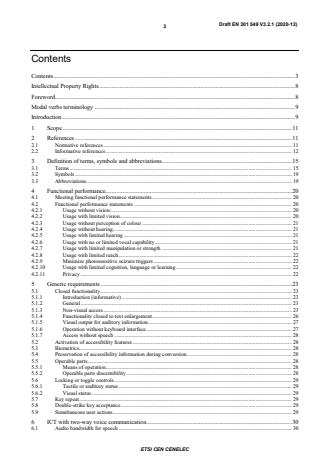
Contents
Contents . 3
Intellectual Property Rights . 8
Foreword. 8
Modal verbs terminology . 9
Introduction . 9
1 Scope . 11
2 References . 11
2.1 Normative references . 11
2.2 Informative references . 12
3 Definition of terms, symbols and abbreviations . 15
3.1 Terms . 15
3.2 Symbols . 19
3.3 Abbreviations . 19
4 Functional performance . 20
4.1 Meeting functional performance statements . 20
4.2 Functional performance statements . 20
4.2.1 Usage without vision . 20
4.2.2 Usage with limited vision . 20
4.2.3 Usage without perception of colour . 21
4.2.4 Usage without hearing . 21
4.2.5 Usage with limited hearing . 21
4.2.6 Usage with no or limited vocal capability . 21
4.2.7 Usage with limited manipulation or strength . 21
4.2.8 Usage with limited reach . 22
4.2.9 Minimize photosensitive seizure triggers . 22
4.2.10 Usage with limited cognition, language or learning . 22
4.2.11 Privacy . 22
5 Generic requirements . 23
5.1 Closed functionality . 23
5.1.1 Introduction (informative) . 23
5.1.2 General . 23
5.1.3 Non-visual access . 23
5.1.4 Functionality closed to text enlargement . 26
5.1.5 Visual output for auditory information. 27
5.1.6 Operation without keyboard interface . 27
5.1.7 Access without speech . 28
5.2 Activation of accessibility features . 28
5.3 Biometrics . 28
5.4 Preservation of accessibility information during conversion . 28
5.5 Operable parts . 28
5.5.1 Means of operation . 28
5.5.2 Operable parts discernibility . 28
5.6 Locking or toggle controls . 29
5.6.1 Tactile or auditory status . 29
5.6.2 Visual status . 29
5.7 Key repeat . 29
5.8 Double-strike key acceptance . 29
5.9 Simultaneous user actions . 29
6 ICT with two-way voice communication . 30
6.1 Audio bandwidth for speech . 30
ETSI CEN CENELEC
Draft EN 301 549 V3.2.1 (2020-12)
6.2 Real-Time Text (RTT) functionality . 30
6.2.1 RTT provision . 30
6.2.2 Display of RTT . 31
6.2.3 Interoperability . 31
6.2.4 RTT responsiveness . 32
6.3 Caller ID . 32
6.4 Alternatives to voice-based services . 32
6.5 Video communication . 33
6.5.1 General (informative) . 33
6.5.2 Resolution . 33
6.5.3 Frame rate . 33
6.5.4 Synchronization between audio and video . 33
6.5.5 Visual indicator of audio with video . 33
6.5.6 Speaker identification with video (sign language) communication. 34
6.6 Alternatives to video-based services . 34
7 ICT with video capabilities . 35
7.1 Caption processing technology . 35
7.1.1 Captioning playback . 35
7.1.2 Captioning synchronization . 35
7.1.3 Preservation of captioning . 35
7.1.4 Captions characteristics . 35
7.1.5 Spoken subtitles . 35
7.2 Audio description technology . 36
7.2.1 Audio description playback . 36
7.2.2 Audio description synchronization . 36
7.2.3 Preservation of audio description . 36
7.3 User controls for captions and audio description . 36
8 Hardware . 37
8.1 General . 37
8.1.1 Generic requirements . 37
8.1.2 Standard connections. 37
8.1.3 Colour. 37
8.2 Hardware products with speech output . 37
8.2.1 Speech volume gain . 37
8.2.2 Magnetic coupling . 37
8.3 Stationary ICT . 38
8.3.0 General . 38
8.3.1 Forward or side reach . 38
8.3.2 Forward reach. 38
8.3.3 Side reach . 41
8.3.4 Clear floor or ground space . 42
8.3.5 Visibility . 43
8.3.6 Installation instructions . 43
8.4 Mechanically operable parts . 44
8.4.1 Numeric keys . 44
8.4.2 Operation of mechanical parts . 44
8.4.3 Keys, tickets and fare cards . 44
8.5 Tactile indication of speech mode . 44
9 Web . 45
9.0 General (informative) . 45
9.1 Perceivable . 45
9.1.1 Text alternatives . 45
9.1.2 Time-based media . 45
9.1.3 Adaptable . 46
9.1.4 Distinguishable . 46
9.2 Operable . 47
9.2.1 Keyboard accessible . 47
9.2.2 Enough time . 48
ETSI CEN CENELEC
Draft EN 301 549 V3.2.1 (2020-12)
9.2.3 Seizures and physical reactions . 48
9.2.4 Navigable . 48
9.2.5 Input modalities . 49
9.3 Understandable . 49
9.3.1 Readable . 49
9.3.2 Predictable . 49
9.3.3 Input assistance . 49
9.4 Robust . 50
9.4.1 Compatible . 50
9.5 WCAG 2.1 AAA Success Criteria . 50
9.6 WCAG conformance requirements . 51
10 Non-web documents . 52
10.0 General (informative) . 52
10.1 Perceivable . 52
10.1.1 Text alternatives . 52
10.1.2 Time-based media . 53
10.1.3 Adaptable . 54
10.1.4 Distinguishable . 54
10.2 Operable . 56
10.2.1 Keyboard accessible . 56
10.2.2 Enough time . 57
10.2.3 Seizures and physical reactions . 58
10.2.4 Navigable . 58
10.2.5 Input modalities . 59
10.3 Understandable . 60
10.3.1 Readable . 60
10.3.2 Predictable . 60
10.3.3 Input assistance . 61
10.4 Robust . 62
10.4.1 Compatible . 62
10.5 Caption positioning . 62
10.6 Audio description timing . 63
11 Software . 64
11.0 General (informative) . 64
11.1 Perceivable . 65
11.1.1 Text alternatives . 65
11.1.2 Time-based media . 65
11.1.3 Adaptable . 67
11.1.4 Distinguishable . 68
11.2 Operable . 70
11.2.1 Keyboard accessible . 70
11.2.2 Enough time . 71
11.2.3 Seizures and physical reactions . 72
11.2.4 Navigable . 72
11.2.5 Input modalities . 73
11.3 Understandable . 74
11.3.1 Readable . 74
11.3.2 Predictable . 75
11.3.3 Input assistance . 76
11.4 Robust . 76
11.4.1 Compatible . 76
11.5 Interoperability with assistive technology . 78
11.5.1 Closed functionality . 78
11.5.2 Accessibility services . 78
11.6 Documented accessibility usage . 81
11.6.1 User control of accessibility features . 81
11.6.2 No disruption of accessibility features . 82
11.7 User preferences . 82
11.8 Authoring tools . 82
ETSI CEN CENELEC
Draft EN 301 549 V3.2.1 (2020-12)
11.8.0 General (informative) . 82
11.8.1 Content technology . 82
11.8.2 Accessible content creation . 82
11.8.3 Preservation of accessibility information in transformations . 82
11.8.4 Repair assistance . 83
11.8.5 Templates . 83
12 Documentation and support services . 84
12.1 Product documentation . 84
12.1.1 Accessibility and compatibility features . 84
12.1.2 Accessible documentation . 84
12.2 Support services . 84
12.2.1 General (informative) . 84
12.2.2 Information on accessibility and compatibility features . 84
12.2.3 Effective communication . 85
12.2.4 Accessible documentation . 85
13 ICT providing relay or emergency service access . 86
13.1 Relay services requirements . 86
13.1.1 General (informative) . 86
13.1.2 Text relay services . 86
13.1.3 Sign relay services . 86
13.1.4 Lip-reading relay services . 86
13.1.5 Captioned telephony services . 86
13.1.6 Speech to speech relay services . 86
13.2 Access to relay services . 86
13.3 Access to emergency services . 87
14 Conformance . 88
Annex A (informative): Relationship between the present document and the essential requirements of
Directive 2016/2102 . 89
Annex B (informative): Relationship between requirements and functional performance statements . 105
B.1 Relationships between clauses 5 to 13 and the functional performance statements . 105
B.2 Interpretation of Table B.2 . 113
B.2.0 General . 113
B.2.1 Example . 113
Annex C (normative): Determination of conformance . 115
C.1 Introduction. 115
C.2 Empty clause . 115
C.3 Empty clause . 115
C.4 Functional performance . 115
C.5 Generic requirements . 115
C.5.1 Closed functionality . 115
C.5.2 Activation of accessibility features . 120
C.5.3 Biometrics . 120
C.5.4 Preservation of accessibility information during conversion . 120
C.5.5 Operable parts . 120
C.5.6 Locking or toggle controls . 121
C.5.7 Key repeat . 121
C.5.8 Double-strike key acceptance . 121
C.5.9 Simultaneous user actions . 122
C.6 ICT with two-way voice communication . 122
C.6.1 Audio bandwidth for speech . 122
C.6.2 Real-Time Text (RTT) functionality . 122
C.6.3 Caller ID . 126
C.6.4 Alternatives to voice-based services . 126
C.6.5 Video communication . 126
C.6.6 Alternatives to video-based services . 127
C.7 ICT with video capabilities . 128
ETSI CEN CENELEC
Draft EN 301 549 V3.2.1 (2020-12)
C.7.1 Caption processing technology . 128
C.7.2 Audio description technology . 129
C.7.3 User controls for captions and audio description . 129
C.8 Hardware . 129
C.8.1 General . 129
C.8.2 Hardware products with speech output . 130
C.8.3 Stationary ICT . 131
C.8.4 Mechanically operable parts . 137
C.8.5 Tactile indication of speech mode . 137
C.9 Web . 138
C.9.0 General (informative) . 138
C.9.1 Perceivable . 138
C.9.2 Operable . 142
C.9.3 Understandable . 145
C.9.4 Robust . 147
C.9.5 WCAG 2.1 AAA Success Criteria (informative) . 147
C.9.6 WCAG 2.1 conformance requirements . 148
C.10 Non-web documents . 148
C.10.0 General (informative) . 148
C.10.1 Perceivable . 148
C.10.2 Operable . 152
C.10.3 Understandable . 155
C.10.4 Robust . 157
C.10.5 Caption positioning . 157
C.10.6 Audio description timing . 157
C.11 Software . 158
C.11.0 General . 158
C.11.1 Perceivable . 158
C.11.2 Operable . 164
C.11.3 Understandable . 168
C.11.4 Robust . 170
C.11.5 Interoperability with assistive technology . 171
C.11.6 Documented accessibility usage . 176
C.11.7 User preferences . 176
C.11.8 Authoring tools. 176
C.12 Documentation and support services .
...
EN 301 549 V3.2.1 (2021-03)
HARMONISED EUROPEAN STANDARD
Accessibility requirements for ICT products and services
EN 301 549 V3.2.1 (2021-03)
Reference
REN/HF-00301549v321
Keywords
accessibility, HF, ICT, procurement
CEN CENELEC ETSI
Rue de la science, 23 Rue de la science, 23 650 Route des Lucioles
B-1040 Brussels B-1040 Brussels F-06921 Sophia Antipolis Cedex -
- BELGIUM - BELGIUM FRANCE
Tel: + 32 2 550 08 11 Tel.: +32 2 519 68 71 Tel.: +33 4 92 94 42 00
Fax: + 32 2 550 08 19 Fax: +32 2 519 69 19 Fax: +33 4 93 65 47 16
Siret N° 348 623 562 00017 - NAF 742 C
Association à but non lucratif enregistrée à la
Sous-Préfecture de Grasse (06) N° 7803/88
Important notice
Individual copies of the present document can be downloaded from:
ETSI Search & Browse Standards
The present document may be made available in electronic versions and/or in print. The content of any electronic and/or
print versions of the present document shall not be modified without the prior written authorization of ETSI. In case of any
existing or perceived difference in contents between such versions and/or in print, the prevailing version of an ETSI
deliverable is the one made publicly available in PDF format at ETSI Deliverables.
Users of the present document should be aware that the document may be subject to revision or change of status.
Information on the current status of this and other ETSI documents is available at
ETSI deliverable status
If you find errors in the present document, please send your comment to one of the following services:
ETSI Committee Support Staff
Copyright Notification
No part may be reproduced or utilized in any form or by any means, electronic or mechanical, including photocopying and microfilm
except as authorized by written permission of ETSI.
The content of the PDF version shall not be modified without the written authorization of ETSI.
The copyright and the foregoing restriction extend to reproduction in all media.
© European Telecommunications Standards Institute 2021.
© Comité Européen de Normalisation 2021.
© Comité Européen de Normalisation Electrotechnique 2021.
All rights reserved.
DECT™, PLUGTESTS™, UMTS™ and the ETSI logo are trademarks of ETSI registered for the benefit of its Members.
3GPP™ and LTE™ are trademarks of ETSI registered for the benefit of its Members and
of the 3GPP Organizational Partners.
oneM2M™ logo is a trademark of ETSI registered for the benefit of its Members and
of the oneM2M Partners. ®
GSM and the GSM logo are trademarks registered and owned by the GSM Association.
ETSI CEN CENELEC
.
EN 301 549 V3.2.1 (2021-03)
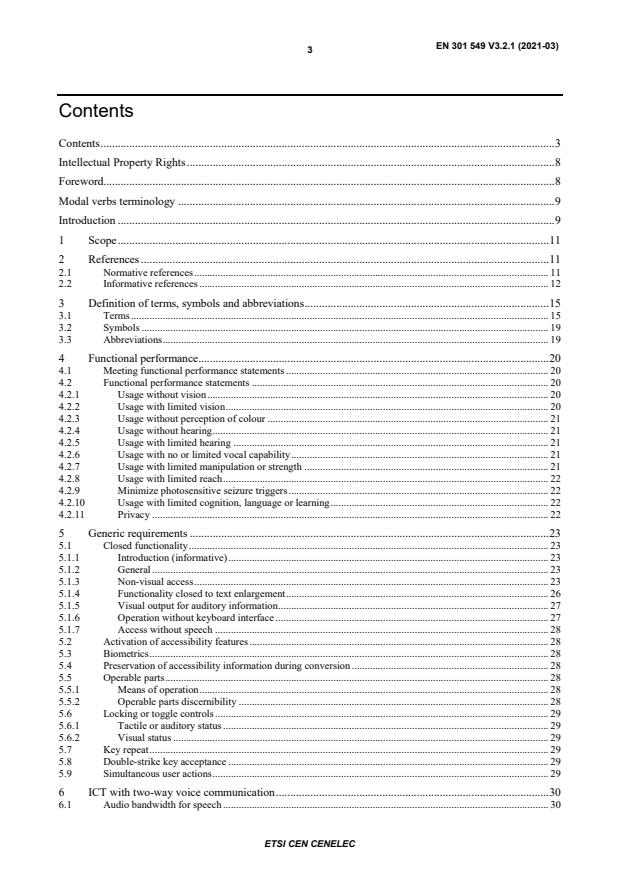
Contents
Contents . 3
Intellectual Property Rights . 8
Foreword. 8
Modal verbs terminology . 9
Introduction . 9
1 Scope . 11
2 References . 11
2.1 Normative references . 11
2.2 Informative references . 12
3 Definition of terms, symbols and abbreviations . 15
3.1 Terms . 15
3.2 Symbols . 19
3.3 Abbreviations . 19
4 Functional performance . 20
4.1 Meeting functional performance statements . 20
4.2 Functional performance statements . 20
4.2.1 Usage without vision . 20
4.2.2 Usage with limited vision . 20
4.2.3 Usage without perception of colour . 21
4.2.4 Usage without hearing . 21
4.2.5 Usage with limited hearing . 21
4.2.6 Usage with no or limited vocal capability . 21
4.2.7 Usage with limited manipulation or strength . 21
4.2.8 Usage with limited reach . 22
4.2.9 Minimize photosensitive seizure triggers . 22
4.2.10 Usage with limited cognition, language or learning . 22
4.2.11 Privacy . 22
5 Generic requirements . 23
5.1 Closed functionality . 23
5.1.1 Introduction (informative) . 23
5.1.2 General . 23
5.1.3 Non-visual access . 23
5.1.4 Functionality closed to text enlargement . 26
5.1.5 Visual output for auditory information. 27
5.1.6 Operation without keyboard interface . 27
5.1.7 Access without speech . 28
5.2 Activation of accessibility features . 28
5.3 Biometrics . 28
5.4 Preservation of accessibility information during conversion . 28
5.5 Operable parts . 28
5.5.1 Means of operation . 28
5.5.2 Operable parts discernibility . 28
5.6 Locking or toggle controls . 29
5.6.1 Tactile or auditory status . 29
5.6.2 Visual status . 29
5.7 Key repeat . 29
5.8 Double-strike key acceptance . 29
5.9 Simultaneous user actions . 29
6 ICT with two-way voice communication . 30
6.1 Audio bandwidth for speech . 30
ETSI CEN CENELEC
EN 301 549 V3.2.1 (2021-03)
6.2 Real-Time Text (RTT) functionality . 30
6.2.1 RTT provision . 30
6.2.2 Display of RTT . 31
6.2.3 Interoperability . 31
6.2.4 RTT responsiveness . 32
6.3 Caller ID . 32
6.4 Alternatives to voice-based services . 32
6.5 Video communication . 33
6.5.1 General (informative) . 33
6.5.2 Resolution . 33
6.5.3 Frame rate . 33
6.5.4 Synchronization between audio and video . 33
6.5.5 Visual indicator of audio with video . 33
6.5.6 Speaker identification with video (sign language) communication. 34
6.6 Alternatives to video-based services . 34
7 ICT with video capabilities . 35
7.1 Caption processing technology . 35
7.1.1 Captioning playback . 35
7.1.2 Captioning synchronization . 35
7.1.3 Preservation of captioning . 35
7.1.4 Captions characteristics . 35
7.1.5 Spoken subtitles . 35
7.2 Audio description technology . 36
7.2.1 Audio description playback . 36
7.2.2 Audio description synchronization . 36
7.2.3 Preservation of audio description . 36
7.3 User controls for captions and audio description . 36
8 Hardware . 37
8.1 General . 37
8.1.1 Generic requirements . 37
8.1.2 Standard connections. 37
8.1.3 Colour. 37
8.2 Hardware products with speech output . 37
8.2.1 Speech volume gain . 37
8.2.2 Magnetic coupling . 37
8.3 Stationary ICT . 38
8.3.0 General . 38
8.3.1 Forward or side reach . 38
8.3.2 Forward reach. 38
8.3.3 Side reach . 41
8.3.4 Clear floor or ground space . 42
8.3.5 Visibility . 43
8.3.6 Installation instructions . 43
8.4 Mechanically operable parts . 44
8.4.1 Numeric keys . 44
8.4.2 Operation of mechanical parts . 44
8.4.3 Keys, tickets and fare cards . 44
8.5 Tactile indication of speech mode . 44
9 Web . 45
9.0 General (informative) . 45
9.1 Perceivable . 45
9.1.1 Text alternatives . 45
9.1.2 Time-based media . 45
9.1.3 Adaptable . 46
9.1.4 Distinguishable . 46
9.2 Operable . 47
9.2.1 Keyboard accessible . 47
9.2.2 Enough time . 48
ETSI CEN CENELEC
EN 301 549 V3.2.1 (2021-03)
9.2.3 Seizures and physical reactions . 48
9.2.4 Navigable . 48
9.2.5 Input modalities . 49
9.3 Understandable . 49
9.3.1 Readable . 49
9.3.2 Predictable . 49
9.3.3 Input assistance . 49
9.4 Robust . 50
9.4.1 Compatible . 50
9.5 WCAG 2.1 AAA Success Criteria . 50
9.6 WCAG conformance requirements . 51
10 Non-web documents . 52
10.0 General (informative) . 52
10.1 Perceivable . 52
10.1.1 Text alternatives . 52
10.1.2 Time-based media . 53
10.1.3 Adaptable . 54
10.1.4 Distinguishable . 54
10.2 Operable . 56
10.2.1 Keyboard accessible . 56
10.2.2 Enough time . 57
10.2.3 Seizures and physical reactions . 58
10.2.4 Navigable . 58
10.2.5 Input modalities . 59
10.3 Understandable . 60
10.3.1 Readable . 60
10.3.2 Predictable . 60
10.3.3 Input assistance . 61
10.4 Robust . 62
10.4.1 Compatible . 62
10.5 Caption positioning . 62
10.6 Audio description timing . 63
11 Software . 64
11.0 General (informative) . 64
11.1 Perceivable . 65
11.1.1 Text alternatives . 65
11.1.2 Time-based media . 65
11.1.3 Adaptable . 67
11.1.4 Distinguishable . 68
11.2 Operable . 70
11.2.1 Keyboard accessible . 70
11.2.2 Enough time . 71
11.2.3 Seizures and physical reactions . 72
11.2.4 Navigable . 72
11.2.5 Input modalities . 73
11.3 Understandable . 74
11.3.1 Readable . 74
11.3.2 Predictable . 75
11.3.3 Input assistance . 76
11.4 Robust . 76
11.4.1 Compatible . 76
11.5 Interoperability with assistive technology . 78
11.5.1 Closed functionality . 78
11.5.2 Accessibility services . 78
11.6 Documented accessibility usage . 81
11.6.1 User control of accessibility features . 81
11.6.2 No disruption of accessibility features . 82
11.7 User preferences . 82
11.8 Authoring tools . 82
ETSI CEN CENELEC
EN 301 549 V3.2.1 (2021-03)
11.8.0 General (informative) . 82
11.8.1 Content technology . 82
11.8.2 Accessible content creation . 82
11.8.3 Preservation of accessibility information in transformations . 82
11.8.4 Repair assistance . 83
11.8.5 Templates . 83
12 Documentation and support services . 84
12.1 Product documentation . 84
12.1.1 Accessibility and compatibility features . 84
12.1.2 Accessible documentation . 84
12.2 Support services . 84
12.2.1 General (informative) . 84
12.2.2 Information on accessibility and compatibility features . 84
12.2.3 Effective communication . 85
12.2.4 Accessible documentation . 85
13 ICT providing relay or emergency service access . 86
13.1 Relay services requirements . 86
13.1.1 General (informative) . 86
13.1.2 Text relay services . 86
13.1.3 Sign relay services . 86
13.1.4 Lip-reading relay services . 86
13.1.5 Captioned telephony services . 86
13.1.6 Speech to speech relay services . 86
13.2 Access to relay services . 86
13.3 Access to emergency services . 87
14 Conformance . 88
Annex A (informative): Relationship between the present document and the essential requirements of
Directive 2016/2102 . 89
Annex B (informative): Relationship between requirements and functional performance statements . 105
B.1 Relationships between clauses 5 to 13 and the functional performance statements . 105
B.2 Interpretation of Table B.2 . 113
B.2.0 General . 113
B.2.1 Example . 113
Annex C (normative): Determination of conformance . 115
C.1 Introduction. 115
C.2 Empty clause . 115
C.3 Empty clause . 115
C.4 Functional performance . 115
C.5 Generic requirements . 115
C.5.1 Closed functionality . 115
C.5.2 Activation of accessibility features . 120
C.5.3 Biometrics . 120
C.5.4 Preservation of accessibility information during conversion . 120
C.5.5 Operable parts . 120
C.5.6 Locking or toggle controls . 121
C.5.7 Key repeat . 121
C.5.8 Double-strike key acceptance . 121
C.5.9 Simultaneous user actions . 122
C.6 ICT with two-way voice communication . 122
C.6.1 Audio bandwidth for speech . 122
C.6.2 Real-Time Text (RTT) functionality . 122
C.6.3 Caller ID . 126
C.6.4 Alternatives to voice-based services . 126
C.6.5 Video communication . 126
C.6.6 Alternatives to video-based services . 127
C.7 ICT with video capabilities . 128
ETSI CEN CENELEC
EN 301 549 V3.2.1 (2021-03)
C.7.1 Caption processing technology . 128
C.7.2 Audio description technology . 129
C.7.3 User controls for captions and audio description . 129
C.8 Hardware . 130
C.8.1 General . 130
C.8.2 Hardware products with speech output . 130
C.8.3 Stationary ICT . 131
C.8.4 Mechanically operable parts . 137
C.8.5 Tactile indication of speech mode . 137
C.9 Web . 138
C.9.0 General (informative) . 138
C.9.1 Perceivable . 138
C.9.2 Operable . 142
C.9.3 Understandable . 145
C.9.4 Robust . 147
C.9.5 WCAG 2.1 AAA Success Criteria (informative) . 147
C.9.6 WCAG 2.1 conformance requirements . 148
C.10 Non-web documents . 148
C.10.0 General (informative) . 148
C.10.1 Perceivable . 148
C.10.2 Operable . 152
C.10.3 Understandable . 155
C.10.4 Robust . 157
C.10.5 Caption positioning . 157
C.10.6 Audio description timing . 157
C.11 Software . 158
C.11.0 General . 158
C.11.1 Perceivable . 158
C.11.2 Operable . 164
C.11.3 Understandable . 168
C.11.4 Robust . 170
C.11.5 Interoperability with assistive technology . 171
C.11.6 Documented accessibility usage . 176
C.11.7 User preferences . 176
C.11.8 Authoring tools. 176
C.12 Documentation and support services .
...
SLOVENSKI STANDARD
01-maj-2021
Zahteve za dostopnost izdelkov in storitev IKT
Accessibility requirements for ICT products and services
Ta slovenski standard je istoveten z: ETSI EN 301 549 V3.2.1 (2021-03)
ICS:
35.020 Informacijska tehnika in Information technology (IT) in
tehnologija na splošno general
2003-01.Slovenski inštitut za standardizacijo. Razmnoževanje celote ali delov tega standarda ni dovoljeno.
EN 301 549 V3.2.1 (2021-03)
HARMONISED EUROPEAN STANDARD
Accessibility requirements for ICT products and services
EN 301 549 V3.2.1 (2021-03)
Reference
REN/HF-00301549v321
Keywords
accessibility, HF, ICT, procurement
CEN CENELEC ETSI
Rue de la science, 23 Rue de la science, 23 650 Route des Lucioles
B-1040 Brussels B-1040 Brussels F-06921 Sophia Antipolis Cedex -
- BELGIUM - BELGIUM FRANCE
Tel: + 32 2 550 08 11 Tel.: +32 2 519 68 71 Tel.: +33 4 92 94 42 00
Fax: + 32 2 550 08 19 Fax: +32 2 519 69 19 Fax: +33 4 93 65 47 16
Siret N° 348 623 562 00017 - NAF 742 C
Association à but non lucratif enregistrée à la
Sous-Préfecture de Grasse (06) N° 7803/88
Important notice
Individual copies of the present document can be downloaded from:
ETSI Search & Browse Standards
The present document may be made available in electronic versions and/or in print. The content of any electronic and/or
print versions of the present document shall not be modified without the prior written authorization of ETSI. In case of any
existing or perceived difference in contents between such versions and/or in print, the prevailing version of an ETSI
deliverable is the one made publicly available in PDF format at ETSI Deliverables.
Users of the present document should be aware that the document may be subject to revision or change of status.
Information on the current status of this and other ETSI documents is available at
ETSI deliverable status
If you find errors in the present document, please send your comment to one of the following services:
ETSI Committee Support Staff
Copyright Notification
No part may be reproduced or utilized in any form or by any means, electronic or mechanical, including photocopying and microfilm
except as authorized by written permission of ETSI.
The content of the PDF version shall not be modified without the written authorization of ETSI.
The copyright and the foregoing restriction extend to reproduction in all media.
© European Telecommunications Standards Institute 2021.
© Comité Européen de Normalisation 2021.
© Comité Européen de Normalisation Electrotechnique 2021.
All rights reserved.
DECT™, PLUGTESTS™, UMTS™ and the ETSI logo are trademarks of ETSI registered for the benefit of its Members.
3GPP™ and LTE™ are trademarks of ETSI registered for the benefit of its Members and
of the 3GPP Organizational Partners.
oneM2M™ logo is a trademark of ETSI registered for the benefit of its Members and
of the oneM2M Partners. ®
GSM and the GSM logo are trademarks registered and owned by the GSM Association.
ETSI CEN CENELEC
.
EN 301 549 V3.2.1 (2021-03)
Contents
Contents . 3
Intellectual Property Rights . 8
Foreword. 8
Modal verbs terminology . 9
Introduction . 9
1 Scope . 11
2 References . 11
2.1 Normative references . 11
2.2 Informative references . 12
3 Definition of terms, symbols and abbreviations . 15
3.1 Terms . 15
3.2 Symbols . 19
3.3 Abbreviations . 19
4 Functional performance . 20
4.1 Meeting functional performance statements . 20
4.2 Functional performance statements . 20
4.2.1 Usage without vision . 20
4.2.2 Usage with limited vision . 20
4.2.3 Usage without perception of colour . 21
4.2.4 Usage without hearing . 21
4.2.5 Usage with limited hearing . 21
4.2.6 Usage with no or limited vocal capability . 21
4.2.7 Usage with limited manipulation or strength . 21
4.2.8 Usage with limited reach . 22
4.2.9 Minimize photosensitive seizure triggers . 22
4.2.10 Usage with limited cognition, language or learning . 22
4.2.11 Privacy . 22
5 Generic requirements . 23
5.1 Closed functionality . 23
5.1.1 Introduction (informative) . 23
5.1.2 General . 23
5.1.3 Non-visual access . 23
5.1.4 Functionality closed to text enlargement . 26
5.1.5 Visual output for auditory information. 27
5.1.6 Operation without keyboard interface . 27
5.1.7 Access without speech . 28
5.2 Activation of accessibility features . 28
5.3 Biometrics . 28
5.4 Preservation of accessibility information during conversion . 28
5.5 Operable parts . 28
5.5.1 Means of operation . 28
5.5.2 Operable parts discernibility . 28
5.6 Locking or toggle controls . 29
5.6.1 Tactile or auditory status . 29
5.6.2 Visual status . 29
5.7 Key repeat . 29
5.8 Double-strike key acceptance . 29
5.9 Simultaneous user actions . 29
6 ICT with two-way voice communication . 30
6.1 Audio bandwidth for speech . 30
ETSI CEN CENELEC
EN 301 549 V3.2.1 (2021-03)
6.2 Real-Time Text (RTT) functionality . 30
6.2.1 RTT provision . 30
6.2.2 Display of RTT . 31
6.2.3 Interoperability . 31
6.2.4 RTT responsiveness . 32
6.3 Caller ID . 32
6.4 Alternatives to voice-based services . 32
6.5 Video communication . 33
6.5.1 General (informative) . 33
6.5.2 Resolution . 33
6.5.3 Frame rate . 33
6.5.4 Synchronization between audio and video . 33
6.5.5 Visual indicator of audio with video . 33
6.5.6 Speaker identification with video (sign language) communication. 34
6.6 Alternatives to video-based services . 34
7 ICT with video capabilities . 35
7.1 Caption processing technology . 35
7.1.1 Captioning playback . 35
7.1.2 Captioning synchronization . 35
7.1.3 Preservation of captioning . 35
7.1.4 Captions characteristics . 35
7.1.5 Spoken subtitles . 35
7.2 Audio description technology . 36
7.2.1 Audio description playback . 36
7.2.2 Audio description synchronization . 36
7.2.3 Preservation of audio description . 36
7.3 User controls for captions and audio description . 36
8 Hardware . 37
8.1 General . 37
8.1.1 Generic requirements . 37
8.1.2 Standard connections. 37
8.1.3 Colour. 37
8.2 Hardware products with speech output . 37
8.2.1 Speech volume gain . 37
8.2.2 Magnetic coupling . 37
8.3 Stationary ICT . 38
8.3.0 General . 38
8.3.1 Forward or side reach . 38
8.3.2 Forward reach. 38
8.3.3 Side reach . 41
8.3.4 Clear floor or ground space . 42
8.3.5 Visibility . 43
8.3.6 Installation instructions . 43
8.4 Mechanically operable parts . 44
8.4.1 Numeric keys . 44
8.4.2 Operation of mechanical parts . 44
8.4.3 Keys, tickets and fare cards . 44
8.5 Tactile indication of speech mode . 44
9 Web . 45
9.0 General (informative) . 45
9.1 Perceivable . 45
9.1.1 Text alternatives . 45
9.1.2 Time-based media . 45
9.1.3 Adaptable . 46
9.1.4 Distinguishable . 46
9.2 Operable . 47
9.2.1 Keyboard accessible . 47
9.2.2 Enough time . 48
ETSI CEN CENELEC
EN 301 549 V3.2.1 (2021-03)
9.2.3 Seizures and physical reactions . 48
9.2.4 Navigable . 48
9.2.5 Input modalities . 49
9.3 Understandable . 49
9.3.1 Readable . 49
9.3.2 Predictable . 49
9.3.3 Input assistance . 49
9.4 Robust . 50
9.4.1 Compatible . 50
9.5 WCAG 2.1 AAA Success Criteria . 50
9.6 WCAG conformance requirements . 51
10 Non-web documents . 52
10.0 General (informative) . 52
10.1 Perceivable . 52
10.1.1 Text alternatives . 52
10.1.2 Time-based media . 53
10.1.3 Adaptable . 54
10.1.4 Distinguishable . 54
10.2 Operable . 56
10.2.1 Keyboard accessible . 56
10.2.2 Enough time . 57
10.2.3 Seizures and physical reactions . 58
10.2.4 Navigable . 58
10.2.5 Input modalities . 59
10.3 Understandable . 60
10.3.1 Readable . 60
10.3.2 Predictable . 60
10.3.3 Input assistance . 61
10.4 Robust . 62
10.4.1 Compatible . 62
10.5 Caption positioning . 62
10.6 Audio description timing . 63
11 Software . 64
11.0 General (informative) . 64
11.1 Perceivable . 65
11.1.1 Text alternatives . 65
11.1.2 Time-based media . 65
11.1.3 Adaptable . 67
11.1.4 Distinguishable . 68
11.2 Operable . 70
11.2.1 Keyboard accessible . 70
11.2.2 Enough time . 71
11.2.3 Seizures and physical reactions . 72
11.2.4 Navigable . 72
11.2.5 Input modalities . 73
11.3 Understandable . 74
11.3.1 Readable . 74
11.3.2 Predictable . 75
11.3.3 Input assistance . 76
11.4 Robust . 76
11.4.1 Compatible . 76
11.5 Interoperability with assistive technology . 78
11.5.1 Closed functionality . 78
11.5.2 Accessibility services . 78
11.6 Documented accessibility usage . 81
11.6.1 User control of accessibility features . 81
11.6.2 No disruption of accessibility features . 82
11.7 User preferences . 82
11.8 Authoring tools . 82
ETSI CEN CENELEC
EN 301 549 V3.2.1 (2021-03)
11.8.0 General (informative) . 82
11.8.1 Content technology . 82
11.8.2 Accessible content creation . 82
11.8.3 Preservation of accessibility information in transformations . 82
11.8.4 Repair assistance . 83
11.8.5 Templates . 83
12 Documentation and support services . 84
12.1 Product documentation . 84
12.1.1 Accessibility and compatibility features . 84
12.1.2 Accessible documentation . 84
12.2 Support services . 84
12.2.1 General (informative) . 84
12.2.2 Information on accessibility and compatibility features . 84
12.2.3 Effective communication . 85
12.2.4 Accessible documentation . 85
13 ICT providing relay or emergency service access . 86
13.1 Relay services requirements . 86
13.1.1 General (informative) . 86
13.1.2 Text relay services . 86
13.1.3 Sign relay services . 86
13.1.4 Lip-reading relay services . 86
13.1.5 Captioned telephony services . 86
13.1.6 Speech to speech relay services . 86
13.2 Access to relay services . 86
13.3 Access to emergency services . 87
14 Conformance . 88
Annex A (informative): Relationship between the present document and the essential requirements of
Directive 2016/2102 . 89
Annex B (informative): Relationship between requirements and functional performance statements . 105
B.1 Relationships between clauses 5 to 13 and the functional performance statements . 105
B.2 Interpretation of Table B.2 . 113
B.2.0 General . 113
B.2.1 Example . 113
Annex C (normative): Determination of conformance . 115
C.1 Introduction. 115
C.2 Empty clause . 115
C.3 Empty clause . 115
C.4 Functional performance . 115
C.5 Generic requirements . 115
C.5.1 Closed functionality . 115
C.5.2 Activation of accessibility features . 120
C.5.3 Biometrics . 120
C.5.4 Preservation of accessibility information during conversion . 120
C.5.5 Operable parts . 120
C.5.6 Locking or toggle controls . 121
C.5.7 Key repeat . 121
C.5.8 Double-strike key acceptance . 121
C.5.9 Simultaneous user actions . 122
C.6 ICT with two-way voice communication . 122
C.6.1 Audio bandwidth for speech . 122
C.6.2 Real-Time Text (RTT) functionality . 122
C.6.3 Caller ID . 126
C.6.4 Alternatives to voice-based services . 126
C.6.5 Video communication . 126
C.6.6 Alternatives to video-based services . 127
C.7 ICT with video capabilities . 128
ETSI CEN CENELEC
EN 301 549 V3.2.1 (2021-03)
C.7.1 Caption processing technology . 128
C.7.2 Audio description technology . 129
C.7.3 User controls for captions and audio description . 129
C.8 Hardware . 130
C.8.1 General . 130
C.8.2 Hardware products with speech output . 130
C.8.3 Stationary ICT . 131
C.8.4 Mechanically operable parts . 137
C.8.5 Tactile indication of speech mode . 137
C.9 Web . 138
C.9.0 General (informative) . 138
C.9.1 Perceivable . 138
C.9.2 Operable . 142
C.9.3 Understandable . 145
C.9.4 Robust . 147
C.9.5 WCAG 2.1 AAA Success Criteria (informative) . 147
C.9.6 WCAG 2.1 conformance requirements . 148
C.10 Non-web documents . 148
C.10.0 General (informative) . 148
C.10.1 Perceivable . 148
C.10.2 Operable . 152
C.10.3 Understandable . 155
C.10.4 Robust . 157
C.10.5 Caption positioning . 157
C.10.6 Audio description timing . 157
C.11 Software . 158
C.11.0 General . 158
C.11.1 Perceivable . 158
C.11.2 Operable . 164
C.11.3 Understandable . 168
C.11.4 Robust .
...
S L O V E N S K I SIST EN 301 549 V3.2.1
S T A N D A R D maj 2021
Zahteve za dostopnost izdelkov in storitev IKT
Accessibility requirements for ICT products and services
Referenčna oznaka
ICS 35.020 SIST EN 301 549 V3.2.1:2021 (sl)
Nadaljevanje na straneh II in III ter od 1 do 215
© 2022-09. Slovenski inštitut za standardizacijo. Razmnoževanje ali kopiranje celote ali delov tega standarda ni dovoljeno.
SIST EN 301 549 V3.2.1 : 2021
NACIONALNI UVOD
Standard SIST EN 301 549 V3.2.1 (sl), Zahteve za dostopnost izdelkov in storitev IKT, 2021, ima status
slovenskega standarda in je istoveten evropskemu standardu ETSI EN 301 549 V3.2.1 (en),
Accessibility requirements for ICT products and services, 2021.
Ta standard nadomešča SIST EN 301 549 V3.1.1:2020.
NACIONALNI PREDGOVOR
Evropski standard ETSI EN 301 549 V3.2.1:2021 sta pripravila tehnični odbor ETSI/TC Človeški
dejavniki (HF) in skupna delovna skupina (JWG) CEN/CENELEC/ETSI E-dostopnost.
Slovenski standard SIST EN 301 549 V3.2.1:2021 je prevod evropskega standarda ETSI EN 301 549
V3.2.1:2021. V primeru spora glede besedila slovenskega prevoda v tem standardu je odločilen izvirni
evropski standard v angleškem jeziku. Slovensko izdajo standarda je potrdil tehnični odbor SIST/TC
SPN Storitve in protokoli v omrežjih.
Odločitev za privzem tega standarda je v maju 2021 sprejel tehnični odbor SIST/TC SPN Storitve in
protokoli v omrežjih.
ZVEZA Z NACIONALNIMI STANDARDI
S privzemom tega evropskega standarda veljajo za omejeni namen referenčnih standardov vsi
standardi, navedeni v izvirniku, razen tistih, ki so že sprejeti v nacionalno standardizacijo:
SIST ETS 300 381 E1:2003 Telefonija za slušno prizadete ljudi – Telefonske slušalke, induktivno
sklopljene s slušnimi pripomočki
SIST ES 202 975 V2.1.1:2016 Človeški dejavniki (HF) – Zahteve za posredovalne storitve
SIST ETS 300 767 E1:2003 Človeški dejavniki (HF) – Telefonske predplačilne kartice – Identifikator
na otip
SIST EN ISO 9241-11:2018 Ergonomija medsebojnega vpliva človek-sistem – 11. del: Uporaba:
Definicije in pojmi (ISO 9241-11:2018)
SIST EN ISO 9241-110:2007 Ergonomija medsebojnega vpliva človek-sistem – 110. del: Načela
dialoga (ISO 9241-110:2006)
SIST EN ISO 9241-171:2009 Ergonomija medsebojnega vpliva človek-sistem – 171. del: Navodila za
dostopnost programske opreme (ISO 9241-171:2008)
SIST EN 301 549 V2.1.2:2018 Zahteve za dostopnost izdelkov in storitev IKT
SIST ISO 21542:2012 Gradnja stavb – Dostopnost in uporabnost grajenega okolja
OSNOVA ZA IZDAJO STANDARDA
– privzem standarda ETSI EN 301 549 V3.2.1:2021
PREDHODNA IZDAJA
– SIST EN 301 549 V3.1.1:2020, Zahteve za dostopnost pri javnem naročanju izdelkov in storitev
IKT v Evropi
OPOMBE
– Povsod, kjer se v besedilu standarda uporablja izraz “evropski standard”, v SIST EN 301 549
V3.2.1:2021 to pomeni “slovenski standard”.
– Nacionalni uvod in nacionalni predgovor nista sestavni del standarda.
II
SIST EN 301 549 V3.2.1 : 2021
– Ta nacionalni dokument je istoveten ETSI EN 301 549 V3.2.1:2021 in je objavljen z dovoljenjem
ETSI
650 Route des Lucioles
F-06921 Sophia Antipolis Cedex
Francija
– This national document is identical with ETSI EN 301 549 V3.2.1:2021 and is published with the
permission of
ETSI
650 Route des Lucioles
F-06921 Sophia Antipolis Cedex,
Francija
III
SIST EN 301 549 V3.2.1 : 2021
(prazna stran)
IV
EVROPSKI STANDARD EN 301 549 V3.2.1
EUROPEAN STANDARD
NORME EUROPÉENNE
marec 2021
EUROPÄISCHE NORM
ICS 35.020
Slovenska izdaja
Zahteve za dostopnost izdelkov in
storitev IKT
Accessibility requirements for ICT products and services
CEN CENELEC ETSI
Rue de la science, 23 Rue de la science, 23 650 Route des Lucioles
B-1040 Bruselj B-1040 Bruselj F-06921 Sophia Antipolis Cedex
Belgija Belgija Francija
Tel. + 32 2 550 08 11 Tel.: + 32 2 519 68 71 Tel.: + 33 4 92 94 42 00
Faks: + 32 2 550 08 19 Faks: + 32 2 519 69 19 Faks: + 33 4 93 65 47 16
Siret N° 348 623 562 00017 - NAF 742 C
Nepridobitno združenje, registrirano v
Sous-Préfecture de Grasse (06) N° 7803/88
Ref. oznaka EN 301 549 V3.2.1:2021 E
SIST EN 301 549 V3.2.1 : 2021
VSEBINA Stran
Pravice intelektualne lastnine . 9
Predgovor .10
Uporaba modalnih glagolov .11
Uvod .12
1 Področje uporabe .14
2 Zveze s standardi .14
2.1 Sklicevanje na normativne dokumente.14
2.2 Sklicevanje na informativne dokumente .15
3 Definicije Izrazov, simbolov in kratic .17
3.1 Izrazi .17
3.2 Simboli .21
3.3 Kratice .21
4 Funkcijske lastnosti .22
4.1 Izpolnjevanje izjav o funkcijskih lastnostih .22
4.2 Izjave o funkcijskih lastnostih .22
4.2.1 Uporaba brez vida .22
4.2.2 Uporaba z omejenim vidom .23
4.2.3 Uporaba brez zaznavanja barv .23
4.2.4 Uporaba brez sluha .23
4.2.5 Uporaba z omejenim sluhom .23
4.2.6 Uporaba brez govorne sposobnosti ali z omejeno govorno sposobnostjo.23
4.2.7 Uporaba z omejeno gibalnostjo ali močjo.24
4.2.8 Uporaba z omejenim sežajem .24
4.2.9 Zmanjšanje prožilcev fotosenzibilnostnih napadov .24
4.2.10 Uporaba z zmanjšanimi sposobnostmi dojemanja, razumevanja jezika ali učenja .24
4.2.11 Zasebnost .24
5 Splošne zahteve .25
5.1 Zaprta funkcionalnost .25
5.1.1 Uvod (informativni) .25
5.1.2 Splošno .25
5.1.3 Nevizualni dostop .25
5.1.4 Funkcionalnost, zaprta za razširitev besedila .28
5.1.5 Vizualni izhod za slušne informacije .29
5.1.6 Upravljanje brez vmesnika tipkovnice .29
5.1.7 Dostop brez govora .30
5.2 Aktiviranje funkcij dostopnosti .30
5.3 Biometrija .30
5.4 Ohranjanje informacij o dostopnosti med pretvarjanjem .30
5.5 Upravljivi deli .30
SIST EN 301 549 V3.2.1 : 2021
5.5.1 Načini upravljanja .30
5.5.2 Razločnost upravljivih delov .30
5.6 Zaklepni ali preklopni krmilniki .30
5.6.1 Taktilni ali slušni status .30
5.6.2 Vizualni status .31
5.7 Ponovitvena tipka .31
5.8 Sprejemljivost tipke z dvojnim pritiskom .31
5.9 Sočasne uporabniške aktivnosti .31
6 IKT z dvosmerno govorno komunikacijo .31
6.1 Zvokovna pasovna širina za govor .31
6.2 Funkcionalnost sprotnega izpisovanja besedila (RTT) .31
6.2.1 Zagotavljanje RTT .31
6.2.2 Prikaz RTT .32
6.2.3 Medobratovalnost .33
6.2.4 Odzivnost RTT .33
6.3 ID klicatelja .33
6.4 Nadomestila za govorne storitve .34
6.5 Videokomunikacija .34
6.5.1 Splošno (informativno).34
6.5.2 Razločljivost .34
6.5.3 Gostota sličic .34
6.5.4 Sinhronizacija zvoka in videa .34
6.5.5 Vizualni kazalnik zvoka z videom .35
6.5.6 Identifikacija govorca z videokomunikacijo (znakovnim jezikom) .35
6.6 Nadomestila za videostoritve .35
7 IKT z videozmogljivostmi .35
7.1 Tehnologija obdelave podnapisov .35
7.1.1 Predvajanje podnapisov .35
7.1.2 Sinhronizacija podnapisov .35
7.1.3 Ohranjanje podnapisov .36
7.1.4 Značilnosti podnapisov .36
7.1.5 Govorjeni podnaslovi .36
7.2 Tehnika zvočnega opisa .36
7.2.1 Predvajanje zvočnega opisa .36
7.2.2 Sinhronizacija zvočnega opisa .36
7.2.3 Ohranjanje zvočnega opisa .36
7.3 Uporabniški krmilniki za podnapise in zvočni opis .37
8 Strojna oprema .37
8.1 Splošno .37
8.1.1 Splošne zahteve .37
8.1.2 Standardni priključki .37
SIST EN 301 549 V3.2.1 : 2021
8.3.3 Barva .37
8.2 Strojni izdelki z govornim izhodom .37
8.2.1 Povečanje glasnosti govora .37
8.2.2 Magnetni sklop .38
8.3 Stacionarni IKT .38
8.3.0 Splošno .38
8.3.1 Sprednji ali bočni sežaj .38
8.3.2 Sprednji sežaj .38
8.3.3 Bočni sežaj .41
8.3.4 Prosta površina poda ali tal .42
8.3.5 Vidljivost .44
8.3.6 Navodila za vgradnjo .44
8.4 Mehansko upravljivi deli .44
8.4.1 Številske tipke .44
8.4.2 Upravljanje mehanskih delov .44
8.4.3 Ključi, karte in vozovnice .44
8.5 Način za taktilno indikacijo govora .44
9 Splet.45
9.0 Splošno (informativno).45
9.1 Zaznaven .45
9.1.1 Besedilna nadomestila .45
9.1.2 Časovni mediji .45
9.1.3 Prilagodljiv .46
9.1.4 Izrazit .46
9.2 Upravljiv .47
9.2.1 Tipkovnično dostopen.47
9.2.2 Dovolj časa .47
9.2.3 Napadi in fizični odzivi .48
9.2.4 Krmarljiv .48
9.2.5 Modalitete vnosa .48
9.3 Razumljiv .49
9.3.1 Berljiv .49
9.3.2 Predvidljiv .49
9.3.3 Pomoč pri vnosu .49
9.4 Robusten .50
9.4.1 Združljiv .50
9.5 Merila uspešnosti iz smernic WCAG 2.1 AAA .50
9.6 Zahteve WCAG za skladnost .51
10 Nespletni dokumenti .51
10.0 Splošno (informativno) .51
10.1 Zaznaven .52
SIST EN 301 549 V3.2.1 : 2021
10.1.1 Besedilna nadomestila .52
10.1.2 Časovni mediji .52
10.1.3 Prilagodljiv .53
10.1.4 Izrazit .53
10.2 Upravljiv .55
10.2.1 Tipkovnično dostopen .55
10.2.2 Dovolj časa .56
10.2.3 Napadi in fizični odzivi .57
10.2.4 Krmarljiv .57
10.2.5 Modalitete vnosa .58
10.3 Razumljiv .59
10.3.1 Berljiv .59
10.3.2 Predvidljiv .60
10.3.3 Pomoč pri vnosu .60
10.4 Robusten .61
10.4.1 Združljiv .61
10.5 Pozicioniranje podnapisa .62
10.6 Časovna dinamika zvočnega opisa .62
11 Programska oprema .62
11.0 Splošno (informativno) .62
11.1 Zaznaven .63
11.1.1 Besedilna nadomestila .63
11.1.2 Časovni mediji .63
11.1.3 Prilagodljiv .65
11.1.4 Izrazit .66
11.2 Upravljiv .68
11.2.1 Tipkovnično dostopen .68
11.2.2 Dovolj časa .69
11.2.3 Napadi in fizični odzivi .70
11.2.4 Krmarljiv .70
11.2.5 Modalitete vnosa .71
11.3 Razumljiv .73
11.3.1 Berljiv .73
11.3.2 Predvidljiv .73
11.3.3 Pomoč pri vnosu .74
11.4 Robusten .75
11.4.1 Združljiv .75
11.5 Medobratovalnost s podporno tehnologijo .76
11.5.1 Zaprta funkcionalnost .76
11.5.2 Storitve dostopnosti .76
11.6 Uporaba dokumentirane dostopnosti .80
SIST EN 301 549 V3.2.1 : 2021
11.6.1 Uporabniški nadzor funkcij dostopnosti .80
11.6.2 Brez prekinitev funkcij dostopnosti .80
11.7 Uporabniške nastavitve .80
11.8 Avtorska orodja .80
11.8.0 Splošno (informativno).80
11.8.1 Tehnologija vsebin.80
11.8.2 Ustvarjanje dostopne vsebine .80
11.8.3 Ohranjanje informacij o dostopnosti v transformiranju .80
11.8.4 Pomoč pri popravilu .81
11.8.5 Predloge .81
12 Dokumentacija in podporne storitve .81
12.1 Dokumentacija o izdelku .81
12.1.1 Funkcije dostopnosti in združljivosti .81
12.1.2 Dostopna dokumentacija .81
12.2 Podporne storitve .82
12.2.1 Splošno (informativno).82
12.2.2 Informacije o funkcijah dostopnosti in združljivosti .82
12.2.3 Učinkovita komunikacija .82
12.2.4 Dostopna dokumentacija .82
13 IKT, ki zagotavlja dostop do storitve posredovanja ali do nujne storitve .82
13.1 Zahteve za storitev posredovanja .82
13.1.1 Splošno (informativno).82
13.1.2 Storitve posredovanja besedila .82
13.1.3 Storitve posredovanja znakov .83
13.1.4 Storitve posredovanja branja z ustnic .83
13.1.5 Podnaslovljene telefonske storitve .83
13.1.6 Storitve posredovanja govor-govor .83
13.2 Dostop do storitev posredovanja .83
13.3 Dostop do nujnih storitev .83
14 Skladnost .83
Dodatek A (informativni): Povezava med tem dokumentom in bistvenimi zahtevami iz
Direktive 2016/2102 .85
Dodatek B (informativni): Povezava med zahtevami in izjavami o funkcijskih lastnostih .109
B.1 Povezava med točkami 5 do 13 in izjavami o funkcijskih lastnostih .109
B.2 Razlaga preglednice B.2 .121
B.2.0 Splošno .121
B.2.1 Primer .121
Dodatek C (normativni): Ugotavljanje skladnosti .124
C.1 Uvod .124
C.2 Prazna točka .124
C.3 Prazna točka .124
SIST EN 301 549 V3.2.1 : 2021
C.4 Funkcijska lastnost .124
C.5 Splošne zahteve .124
C.5.1 Zaprta funkcionalnost.124
C.5.2 Aktiviranje funkcij dostopnosti .130
C.5.3 Biometrija .131
C.5.4 Ohranjanje informacij o dostopnosti med pretvarjanjem .131
C.5.5 Upravljivi deli .131
C.5.6 Zaklepni ali preklopni krmilniki .132
C.5.7 Ponovitvena tipka .132
C.5.8 Sprejemljivost tipke z dvojnim pritiskom .133
C.5.9 Sočasne uporabniške aktivnosti .133
C.6 IKT z dvosmerno govorno komunikacijo .133
C.6.1 Zvokovna pasovna širina za govor .133
C.6.2 Funkcionalnost sprotnega izpisovanja besedila (RTT) .134
C.6.3 ID klicatelja .138
C.6.4 Nadomestila za govorne storitve .139
C.6.5 Videokomunikacija .139
C.6.6 Nadomestila za videostoritve .140
C.7 IKT z videozmogljivostmi .141
C.7.1 Tehnologija obdelave podnapisov .141
C.7.2 Tehnika zvočnega opisa .142
C.7.3 Uporabniški krmilniki za podnapise in zvočni opis .143
C.8 Strojna oprema .143
C.8.1 Splošno .143
C.8.2 Strojni izdelki z govornim izhodom .144
C.8.3 Stacionarni IKT .145
C.8.4 Mehansko upravljivi deli .153
C.8.5 Način za taktilno indikacijo govora .154
C.9 Splet .154
C.9.0 Splošno (informativno) .154
C.9.1 Zaznaven .154
C.9.2 Upravljiv .159
C.9.3 Razumljiv .164
C.9.4 Robusten .166
C.9.5. Merila uspešnosti iz smernic WCAG 2.1 AAA (informativno) .167
C.9.6 Zahteve WCAG 2.1 za skladnost .167
C.10 Nespletni dokumenti .167
C.10.0 Splošno (informativno) .167
C.10.1 Zaznaven .168
C.10.2 Upravljiv .173
C.10.3 Razumljiv .177
SIST EN 301 549 V3.2.1 : 2021
C.10.4 Robusten .179
C.10.5 Pozicioniranje podnapisa .179
C.10.6 Časovna dinamika zvočnega opisa .179
C.11 Programska oprema .179
C.11.0 Splošno .179
C.11.1 Zaznaven .180
C.11.2 Upravljiv .188
C.11.3 Razumljiv .192
C.11.4 Robusten .195
C.11.5 Medobratovalnost s podporno tehnologijo .196
C.11.6 Uporaba dokumentirane dostopnosti .203
C.11.7 Uporabniške nastavitve .204
C.11.8 Avtorska orodja .204
C.12 Dokumentacija in podporne storitve .206
C.12.1 Dokumentacija o izdelku .206
C.12.2 Podporne storitve .206
C.13 IKT, ki zagotavlja dostop do storitve posredovanja ali nujne storitve .207
C.13.1 Zahteve za storitev posredovanja .207
C.13.2 Dostop do storitev posredovanja .209
C.13.3 Dostop do nujnih storitev .209
Dodatek D (informativni): Nadaljnji viri za kognitivno dostopnost .210
Dodatek E (informativni): Navodila za uporabnike tega dokumenta .211
E.1 Uvod .211
E.2 Pregled .211
E.3 Točka 4 .212
E.4 Kako uporabljati standard .212
E.4.1 Zahteve za samoocenjevanje .212
E.4.2 Povezava med zahtev
...
Questions, Comments and Discussion
Ask us and Technical Secretary will try to provide an answer. You can facilitate discussion about the standard in here.