

SIST EN 168:2002
(Main)Personal eye-protection - Non-optical test methods
General Information
- Abstract
This European standard specifies non-optical test methods for eye-protectors, the requirements for which are contained in other European Standards. Alternative test methods may be used if shown to be equivalent. The optical test methods are given in EN 167. A definition of terms is given in EN 165.
- Status
- Published
- Publication Date
- 31-May-2002
- Technical Committee
- OVP - Personal protecting equipment
- Current Stage
- 6060 - National Implementation/Publication (Adopted Project)
- Start Date
- 01-Jun-2002
- Due Date
- 01-Jun-2002
- Completion Date
- 01-Jun-2002
89/686/EEC - Personal protective equipment (PPE)OJ Ref: C 190 OJ Date: 10-Aug-2002 Conflicting Date: 10-Aug-2002


Overview
SIST EN 168:2002 specifies non-optical test methods for personal eye-protectors. Developed by the Slovenski inštitut za standardizacijo (SIST), this European Standard is intended to assess the physical durability, mechanical properties, and safety features of eye-protection equipment, excluding optical performance. The requirements for personal eye-protectors are outlined in other European Standards, while EN 168 details standardized procedures for evaluating non-optical aspects such as robustness, resistance to environmental factors, and protection against various workplace hazards.
Key Topics
- Non-Optical Test Procedures: The standard provides methodologies for testing eye-protectors' mechanical strength and resistance to specific hazards without evaluating optical properties.
- Mechanical Robustness: Procedures for impact resistance, minimum robustness, and durability at high and low temperatures.
- Chemical and Environmental Resistance: Tests cover corrosion, resistance to ignition, ultraviolet radiation exposure, and chemical splashes.
- Protection Against Hazards: Methods evaluate defense against high-speed particles, molten metals, hot solids, dust, gases, fine particles, droplets, and liquid splashes.
- Assessment of Coverage: Includes evaluation of the field of vision and lateral protection.
- Inspection of Surface Integrity: Protocols for testing surface damage resistance and fog resistance.
- Conformity with EU Directives: The standard supports essential health and safety requirements under EU legislation regarding personal protective equipment.
Applications
- Industrial Safety: Used by manufacturers and safety officers to ensure compliance of safety glasses, goggles, and face shields with European safety benchmarks, especially in sectors such as manufacturing, construction, and metallurgy.
- Quality Assurance: Testing labs and certification bodies use these methods to certify that non-optical properties of eye-protection equipment meet established safety requirements.
- Workplace Risk Assessment: EHS professionals apply these tests to select appropriate eye-protectors for specific workplace risks, such as exposure to high-speed particles or chemical splashes.
- Product Development: Designers and engineers reference these tests to guide material and structural choices for robust, reliable personal protective equipment.
- Procurement Standards: Organizations reference this standard when specifying the required performance level of eye-protection devices in tenders or procurement documentation.
Related Standards
- EN 165: Provides the vocabulary and key definitions for personal eye-protection.
- EN 166: Specifies the requirements for personal eye-protectors (including both optical and non-optical properties).
- EN 167: Details the optical test methods relevant to personal eye-protection equipment.
- ISO 565: Relates to test sieves, indirectly applicable to some apparatus requirements within EN 168.
Adopting SIST EN 168:2002 ensures that non-optical safety aspects of eye-protection equipment are systematically and reliably evaluated. This is critical for safeguarding workers’ vision in hazardous environments and achieving compliance with European occupational health and safety regulations. For comprehensive protection, this standard should be used alongside optical testing and specifications defined in related standards.
Relations
- Effective Date
- 01-Jun-2002
- Effective Date
- 04-Sep-2024
- Effective Date
- 04-Sep-2024
- Effective Date
- 04-Sep-2024
- Effective Date
- 04-Sep-2024
- Effective Date
- 03-Jun-2026
- Effective Date
- 28-Jan-2026
- Effective Date
- 28-Jan-2026
- Refers
SIST EN 12503-2:2002 - Sports mats - Part 2: Pole vault and high jump mats, safety requirements - Effective Date
- 28-Jan-2026
- Effective Date
- 28-Jan-2026
- Effective Date
- 28-Jan-2026
- Effective Date
- 28-Jan-2026
- Effective Date
- 28-Jan-2026
- Effective Date
- 28-Jan-2026
- Effective Date
- 28-Jan-2026
Get Certified
Connect with accredited certification bodies for this standard

CIS Institut d.o.o.
Personal Protective Equipment (PPE) certification body. Notified Body NB-2890 for EU Regulation 2016/425 PPE.

Kiwa BDA Testing
Building and construction product certification.
Kmetijski inštitut Slovenije
Agricultural Institute of Slovenia. Soil testing, plant health, agricultural product analysis.
Sponsored listings
Frequently Asked Questions
SIST EN 168:2002 is a standard published by the Slovenian Institute for Standardization (SIST). Its full title is "Personal eye-protection - Non-optical test methods". This standard covers: This European standard specifies non-optical test methods for eye-protectors, the requirements for which are contained in other European Standards. Alternative test methods may be used if shown to be equivalent. The optical test methods are given in EN 167. A definition of terms is given in EN 165.
This European standard specifies non-optical test methods for eye-protectors, the requirements for which are contained in other European Standards. Alternative test methods may be used if shown to be equivalent. The optical test methods are given in EN 167. A definition of terms is given in EN 165.
SIST EN 168:2002 is classified under the following ICS (International Classification for Standards) categories: 13.340.20 - Head protective equipment. The ICS classification helps identify the subject area and facilitates finding related standards.
SIST EN 168:2002 has the following relationships with other standards: It is inter standard links to SIST EN 168:1996, SIST EN ISO 18526-1:2020, SIST EN ISO 18526-4:2020, SIST EN ISO 18526-3:2020, SIST EN ISO 18526-2:2020, SIST ISO 565:2003, SIST EN ISO 16321-3:2022, SIST EN ISO 16321-1:2022, SIST EN 12503-2:2002, SIST EN ISO 16321-2:2021, SIST EN ISO 4007:2019, SIST-TS CEN/TS 17946:2023, SIST EN 207:2017, SIST EN 12254:2010, SIST EN 208:2010. Understanding these relationships helps ensure you are using the most current and applicable version of the standard.
SIST EN 168:2002 is associated with the following European legislation: EU Directives/Regulations: 2016/425, 89/686/EEC; Standardization Mandates: M/031. When a standard is cited in the Official Journal of the European Union, products manufactured in conformity with it benefit from a presumption of conformity with the essential requirements of the corresponding EU directive or regulation.
SIST EN 168:2002 is available in PDF format for immediate download after purchase. The document can be added to your cart and obtained through the secure checkout process. Digital delivery ensures instant access to the complete standard document.
Standards Content (Sample)
2003-01.Slovenski inštitut za standardizacijo. Razmnoževanje celote ali delov tega standarda ni dovoljeno.Personal eye-protection - Non-optical test methodsProtection individuelle de l'oeil - Méthodes d'essais autres qu'optiquesPersönlicher Augenschutz - Nichtoptische Prüfverfahren13.340.20Varovalna oprema za glavoHead protective equipmentICS:SIST EN 168:2002enTa slovenski standard je istoveten z:EN 168:200101-junij-2002SIST EN 168:2002SLOVENSKI
STANDARDSIST EN 168:19961DGRPHãþD
EUROPEAN STANDARDNORME EUROPÉENNEEUROPÄISCHE NORMEN 168November 2001ICS 13.340.20Supersedes EN 168:1995English versionPersonal eye-protection - Non-optical test methodsProtection individuelle de l'oeil - Méthodes d'essais autresqu'optiquesPersönlicher Augenschutz - Nichtoptische PrüfverfahrenThis European Standard was approved by CEN on 2 September 2001.CEN members are bound to comply with the CEN/CENELEC Internal Regulations which stipulate the conditions for giving this EuropeanStandard the status of a national standard without any alteration. Up-to-date lists and bibliographical references concerning such nationalstandards may be obtained on application to the Management Centre or to any CEN member.This European Standard exists in three official versions (English, French, German). A version in any other language made by translationunder the responsibility of a CEN member into its own language and notified to the Management Centre has the same status as the officialversions.CEN members are the national standards bodies of Austria, Belgium, Czech Republic, Denmark, Finland, France, Germany, Greece,Iceland, Ireland, Italy, Luxembourg, Netherlands, Norway, Portugal, Spain, Sweden, Switzerland and United Kingdom.EUROPEAN COMMITTEE FOR STANDARDIZATIONCOMITÉ EUROPÉEN DE NORMALISATIONEUROPÄISCHES KOMITEE FÜR NORMUNGManagement Centre: rue de Stassart, 36
B-1050 Brussels© 2001 CENAll rights of exploitation in any form and by any means reservedworldwide for CEN national Members.Ref. No. EN 168:2001 E
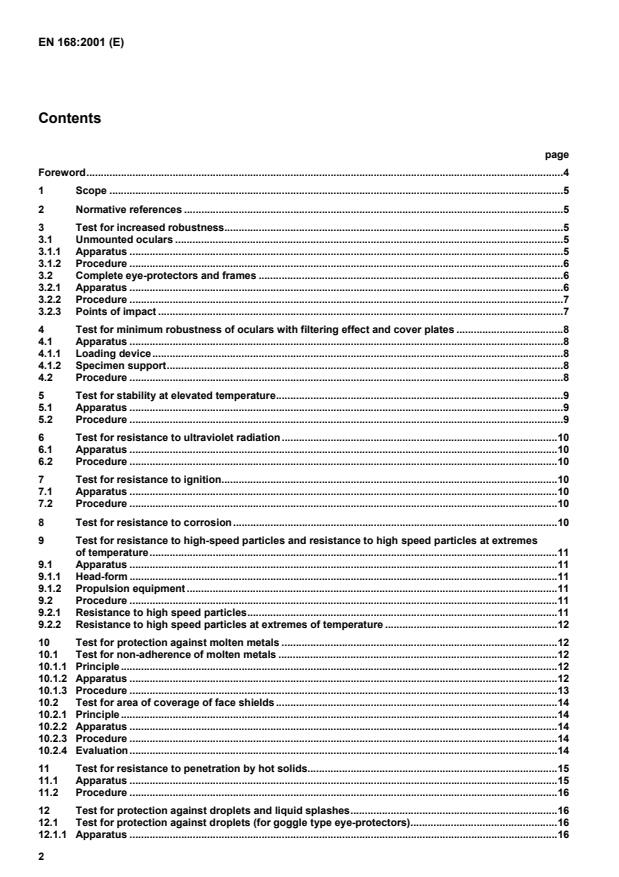
Uncertainty of measurement and results interpretation.30A.1Test report and uncertainty of measurement.30Annex ZA (informative)
Clauses of this European Standard addressing essential requirements or otherprovisions of EU Directives.32
5) g5Carbon paper on white paperFigure 1 — Holding device for oculars for the increased robustness test3.2 Complete eye-protectors and frames3.2.1 Apparatus3.2.1.1Appropriate head-form, as defined in clause 17.
2) N5Steel ball6Load ring (250
5) g7Carbon paper on white paper8OcularFigure 2 — Apparatus for minimum robustness (static deformation) test5 Test for stability at elevated temperatureNew specimens are used for this test.5.1 ApparatusOven, capable of maintaining a temperature of (55 ± 2) °C.5.2 ProcedurePlace the specimen in a position corresponding to normal use, in the oven for (60 ± 5) min at a temperature of(55 ± 5) °C. Then remove it and allow to stabilise at (23 ± 5) °C for a minimum of 60 min prior to visual examination.
...