

ISO/FDIS 25964-1
(Main)Information and documentation — Thesauri and interoperability with other vocabularies — Part 1: Thesauri for information retrieval, management and use
General Information
- Abstract
ISO 25964-1:2011 gives recommendations for the development and maintenance of thesauri intended for information retrieval applications. It is applicable to vocabularies used for retrieving information about all types of information resources, irrespective of the media used (text, sound, still or moving image, physical object or multimedia) including knowledge bases and portals, bibliographic databases, text, museum or multimedia collections, and the items within them. ISO 25964-1:2011 also provides a data model and recommended format for the import and export of thesaurus data. ISO 25964-1:2011 is applicable to monolingual and multilingual thesauri. ISO 25964-1:2011 is not applicable to the preparation of back-of-the-book indexes, although many of its recommendations could be useful for that purpose. ISO 25964-1:2011 is not applicable to the databases or software used directly in search or indexing applications, but does anticipate the needs of such applications among its recommendations for thesaurus management.
- Status
- Not Published
- Technical Committee
- ISO/TC 46/SC 9 - Identification and description
- Drafting Committee
- ISO/TC 46/SC 9 - Identification and description
- Current Stage
- 5020 - FDIS ballot initiated: 2 months. Proof sent to secretariat
- Start Date
- 07-Aug-2026
- Completion Date
- 07-Aug-2026
Buy Documents
ISO/FDIS 25964-1 - Information and documentation — Thesauri and interoperability with other vocabularies — Part 1: Thesauri for information retrieval, management and use/24/2025
ISO/FDIS 25964-1 - Information and documentation — Thesauri and interoperability with other vocabularies — Part 1: Thesauri for information retrieval, management and use
REDLINE ISO/FDIS 25964-1 - Information and documentation — Thesauri and interoperability with other vocabularies — Part 1: Thesauri for information retrieval, management and use
Overview
ISO/FDIS 25964-1: Information and documentation - Thesauri and interoperability with other vocabularies - Part 1: Thesauri for information retrieval, management and use is an international standard developed by ISO. This standard provides comprehensive recommendations for the development, management, and maintenance of thesauri used in information retrieval across various media, including text, sound, visual, and multimedia formats. It aims to enable efficient and effective information organization and retrieval within databases, knowledge bases, library catalogs, museum and multimedia collections, and digital portals. ISO 25964-1:2011 is broadly applicable to both monolingual and multilingual environments, supporting global interoperability and data exchange.
Key Topics
Thesaurus Construction and Maintenance
The standard offers guidance on planning, compiling, and maintaining a thesaurus, considering vocabulary control, term selection, relationships between concepts, and various display and presentation options.Conceptual Framework
It introduces a clear structure for defining concepts, selecting preferred terms, and handling synonyms, quasi-synonyms, homographs, and linguistic variations across languages.Relationships Between Terms
Provides in-depth rules for establishing hierarchical (broader and narrower terms), associative (related terms), and equivalence relationships, essential for enhancing retrieval precision and recall.Multilingual and Multicultural Thesauri
Addresses the complexities of multilingual thesauri, including degrees of equivalence, challenges in translation, and best practices for managing terms and concepts across languages and cultures.Data Models and Interoperability
Presents a robust data model for thesaurus management and recommends standard data exchange formats (such as MARC, SKOS, XML Schema), enabling interoperability with other controlled vocabularies and information systems.Integration with IT Systems
Discusses protocols and digital display styles for integrating thesauri with electronic systems, search engines, content management systems, and artificial intelligence applications, supporting automated indexing, search, and inferencing.
Applications
ISO 25964-1 is relevant to a wide range of organizations and contexts where effective information retrieval and management are essential:
Libraries and Information Centers
Improve cataloging, resource discovery, and subject indexing for bibliographic databases.Museums and Archives
Enhance the description, accessibility, and interoperability of collections through standardized vocabulary management.Digital Repositories and Portals
Support knowledge bases and digital platforms in organizing and retrieving curated content with controlled terminologies.Academic and Research Institutions
Streamline resource organization for research databases, e-learning resources, and scholarly communication.Corporate and Enterprise Information Systems
Facilitate knowledge management, document management, and enterprise search by enabling consistent term usage across departments and systems.AI and Semantic Web Development
Enable structured data annotation and machine-processable vocabularies for semantic enrichment, linked data, and natural language processing applications.
Related Standards
For a holistic approach to vocabulary management and semantic interoperability, the following related standards may be consulted:
- ISO 25964-2: Thesauri and interoperability with other vocabularies - Part 2: Interoperability with other vocabularies
- ISO 5964: Guidelines for the establishment and development of multilingual thesauri (superseded by ISO 25964)
- ISO 2788: Guidelines for the establishment and development of monolingual thesauri (superseded by ISO 25964)
- ISO 15836 (Dublin Core): Metadata standards for resource description
- SKOS (Simple Knowledge Organization System): W3C specification for sharing and linking vocabularies on the web
By adhering to ISO 25964-1, organizations can ensure that their thesauri are compatible with global standards, optimized for information retrieval, and positioned for seamless integration with evolving digital and AI technologies.
Relations
- Effective Date
- 25-Mar-2023
Buy Documents
ISO/FDIS 25964-1 - Information and documentation — Thesauri and interoperability with other vocabularies — Part 1: Thesauri for information retrieval, management and use/24/2025
ISO/FDIS 25964-1 - Information and documentation — Thesauri and interoperability with other vocabularies — Part 1: Thesauri for information retrieval, management and use
REDLINE ISO/FDIS 25964-1 - Information and documentation — Thesauri and interoperability with other vocabularies — Part 1: Thesauri for information retrieval, management and use
Frequently Asked Questions
ISO/FDIS 25964-1 is a draft published by the International Organization for Standardization (ISO). Its full title is "Information and documentation — Thesauri and interoperability with other vocabularies — Part 1: Thesauri for information retrieval, management and use". This standard covers: ISO 25964-1:2011 gives recommendations for the development and maintenance of thesauri intended for information retrieval applications. It is applicable to vocabularies used for retrieving information about all types of information resources, irrespective of the media used (text, sound, still or moving image, physical object or multimedia) including knowledge bases and portals, bibliographic databases, text, museum or multimedia collections, and the items within them. ISO 25964-1:2011 also provides a data model and recommended format for the import and export of thesaurus data. ISO 25964-1:2011 is applicable to monolingual and multilingual thesauri. ISO 25964-1:2011 is not applicable to the preparation of back-of-the-book indexes, although many of its recommendations could be useful for that purpose. ISO 25964-1:2011 is not applicable to the databases or software used directly in search or indexing applications, but does anticipate the needs of such applications among its recommendations for thesaurus management.
ISO 25964-1:2011 gives recommendations for the development and maintenance of thesauri intended for information retrieval applications. It is applicable to vocabularies used for retrieving information about all types of information resources, irrespective of the media used (text, sound, still or moving image, physical object or multimedia) including knowledge bases and portals, bibliographic databases, text, museum or multimedia collections, and the items within them. ISO 25964-1:2011 also provides a data model and recommended format for the import and export of thesaurus data. ISO 25964-1:2011 is applicable to monolingual and multilingual thesauri. ISO 25964-1:2011 is not applicable to the preparation of back-of-the-book indexes, although many of its recommendations could be useful for that purpose. ISO 25964-1:2011 is not applicable to the databases or software used directly in search or indexing applications, but does anticipate the needs of such applications among its recommendations for thesaurus management.
ISO/FDIS 25964-1 is classified under the following ICS (International Classification for Standards) categories: 01.140.20 - Information sciences. The ICS classification helps identify the subject area and facilitates finding related standards.
ISO/FDIS 25964-1 has the following relationships with other standards: It is inter standard links to ISO 25964-1:2011. Understanding these relationships helps ensure you are using the most current and applicable version of the standard.
ISO/FDIS 25964-1 is available in PDF format for immediate download after purchase. The document can be added to your cart and obtained through the secure checkout process. Digital delivery ensures instant access to the complete standard document.
Standards Content (Sample)
DRAFT
International
Standard
ISO/DIS 25964-1
ISO/TC 46/SC 9
Information and documentation —
Secretariat: ANSI
Thesauri and interoperability with
Voting begins on:
other vocabularies —
2025-05-19
Part 1:
Voting terminates on:
2025-08-11
Thesauri for information retrieval;
management and use
ICS: 01.140.20
THIS DOCUMENT IS A DRAFT CIRCULATED
FOR COMMENTS AND APPROVAL. IT
IS THEREFORE SUBJECT TO CHANGE
AND MAY NOT BE REFERRED TO AS AN
INTERNATIONAL STANDARD UNTIL
PUBLISHED AS SUCH.
IN ADDITION TO THEIR EVALUATION AS
BEING ACCEPTABLE FOR INDUSTRIAL,
TECHNOLOGICAL, COMMERCIAL AND
USER PURPOSES, DRAFT INTERNATIONAL
STANDARDS MAY ON OCCASION HAVE TO
This document is circulated as received from the committee secretariat.
BE CONSIDERED IN THE LIGHT OF THEIR
POTENTIAL TO BECOME STANDARDS TO
WHICH REFERENCE MAY BE MADE IN
NATIONAL REGULATIONS.
RECIPIENTS OF THIS DRAFT ARE INVITED
TO SUBMIT, WITH THEIR COMMENTS,
NOTIFICATION OF ANY RELEVANT PATENT
RIGHTS OF WHICH THEY ARE AWARE AND TO
PROVIDE SUPPORTING DOCUMENTATION.
Reference number
ISO/DIS 25964-1:2025(en)
DRAFT
ISO/DIS 25964-1:2025(en)
International
Standard
ISO/DIS 25964-1
ISO/TC 46/SC 9
Information and documentation —
Secretariat: ANSI
Thesauri and interoperability with
Voting begins on:
other vocabularies —
Part 1:
Voting terminates on:
Thesauri for information retrieval;
management and use
ICS: 01.140.20
THIS DOCUMENT IS A DRAFT CIRCULATED
FOR COMMENTS AND APPROVAL. IT
IS THEREFORE SUBJECT TO CHANGE
AND MAY NOT BE REFERRED TO AS AN
INTERNATIONAL STANDARD UNTIL
PUBLISHED AS SUCH.
IN ADDITION TO THEIR EVALUATION AS
BEING ACCEPTABLE FOR INDUSTRIAL,
© ISO 2025
TECHNOLOGICAL, COMMERCIAL AND
USER PURPOSES, DRAFT INTERNATIONAL
All rights reserved. Unless otherwise specified, or required in the context of its implementation, no part of this publication may
STANDARDS MAY ON OCCASION HAVE TO
be reproduced or utilized otherwise in any form or by any means, electronic or mechanical, including photocopying, or posting on
This document is circulated as received from the committee secretariat. BE CONSIDERED IN THE LIGHT OF THEIR
the internet or an intranet, without prior written permission. Permission can be requested from either ISO at the address below
POTENTIAL TO BECOME STANDARDS TO
WHICH REFERENCE MAY BE MADE IN
or ISO’s member body in the country of the requester.
NATIONAL REGULATIONS.
ISO copyright office
RECIPIENTS OF THIS DRAFT ARE INVITED
CP 401 • Ch. de Blandonnet 8
TO SUBMIT, WITH THEIR COMMENTS,
CH-1214 Vernier, Geneva
NOTIFICATION OF ANY RELEVANT PATENT
Phone: +41 22 749 01 11
RIGHTS OF WHICH THEY ARE AWARE AND TO
PROVIDE SUPPORTING DOCUMENTATION.
Email: copyright@iso.org
Website: www.iso.org
Published in Switzerland Reference number
ISO/DIS 25964-1:2025(en)
ii
ISO/DIS 25964-1:2025(en)
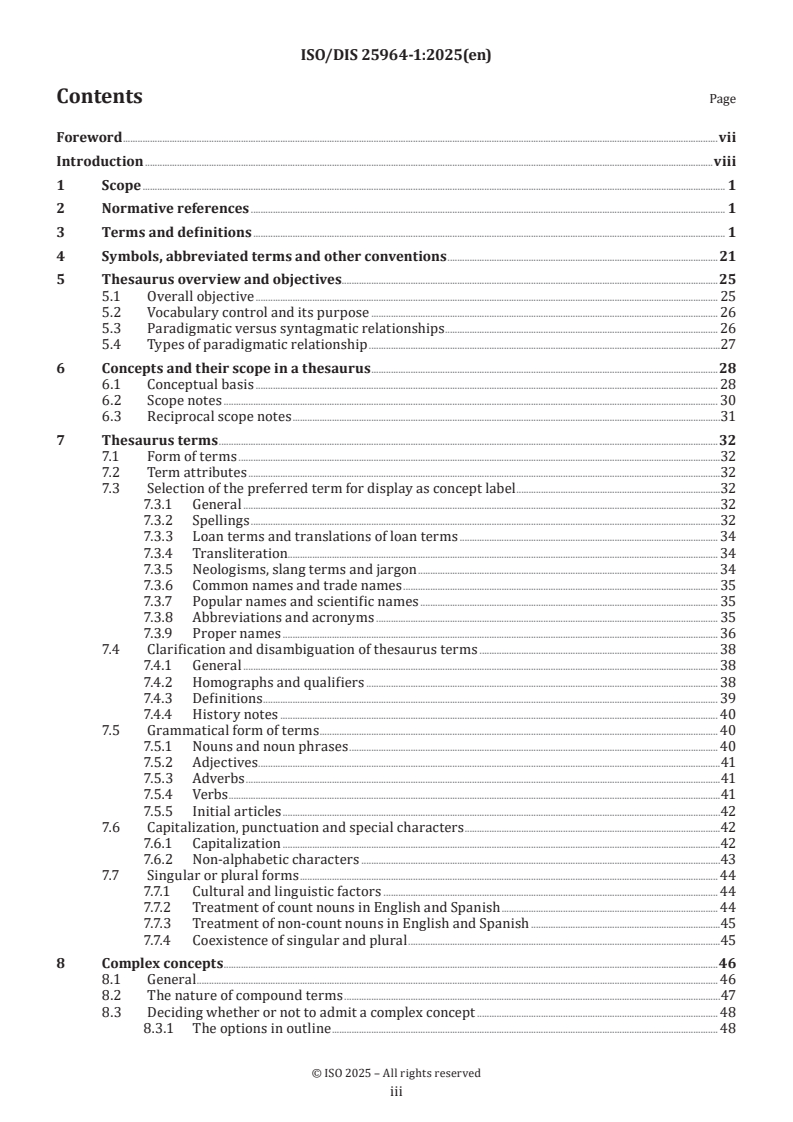
Contents Page
Foreword .vii
Introduction .viii
1 Scope . 1
2 Normative references . 1
3 Terms and definitions . 1
4 Symbols, abbreviated terms and other conventions .21
5 Thesaurus overview and objectives.25
5.1 Overall objective . 25
5.2 Vocabulary control and its purpose . 26
5.3 Paradigmatic versus syntagmatic relationships . 26
5.4 Types of paradigmatic relationship .27
6 Concepts and their scope in a thesaurus .28
6.1 Conceptual basis . 28
6.2 Scope notes . 30
6.3 Reciprocal scope notes .31
7 Thesaurus terms .32
7.1 Form of terms .32
7.2 Term attributes .32
7.3 Selection of the preferred term for display as concept label .32
7.3.1 General .32
7.3.2 Spellings .32
7.3.3 Loan terms and translations of loan terms . 34
7.3.4 Transliteration. 34
7.3.5 Neologisms, slang terms and jargon . 34
7.3.6 Common names and trade names . 35
7.3.7 Popular names and scientific names . 35
7.3.8 Abbreviations and acronyms . 35
7.3.9 Proper names . 36
7.4 Clarification and disambiguation of thesaurus terms . 38
7.4.1 General . 38
7.4.2 Homographs and qualifiers . 38
7.4.3 Definitions . 39
7.4.4 History notes . 40
7.5 Grammatical form of terms . 40
7.5.1 Nouns and noun phrases . 40
7.5.2 Adjectives .41
7.5.3 Adverbs .41
7.5.4 Verbs .41
7.5.5 Initial articles .42
7.6 Capitalization, punctuation and special characters .42
7.6.1 Capitalization .42
7.6.2 Non-alphabetic characters .43
7.7 Singular or plural forms . 44
7.7.1 Cultural and linguistic factors . 44
7.7.2 Treatment of count nouns in English and Spanish . 44
7.7.3 Treatment of non-count nouns in English and Spanish .45
7.7.4 Coexistence of singular and plural .45
8 Complex concepts .46
8.1 General . 46
8.2 The nature of compound terms .47
8.3 Deciding whether or not to admit a complex concept . 48
8.3.1 The options in outline . 48
iii
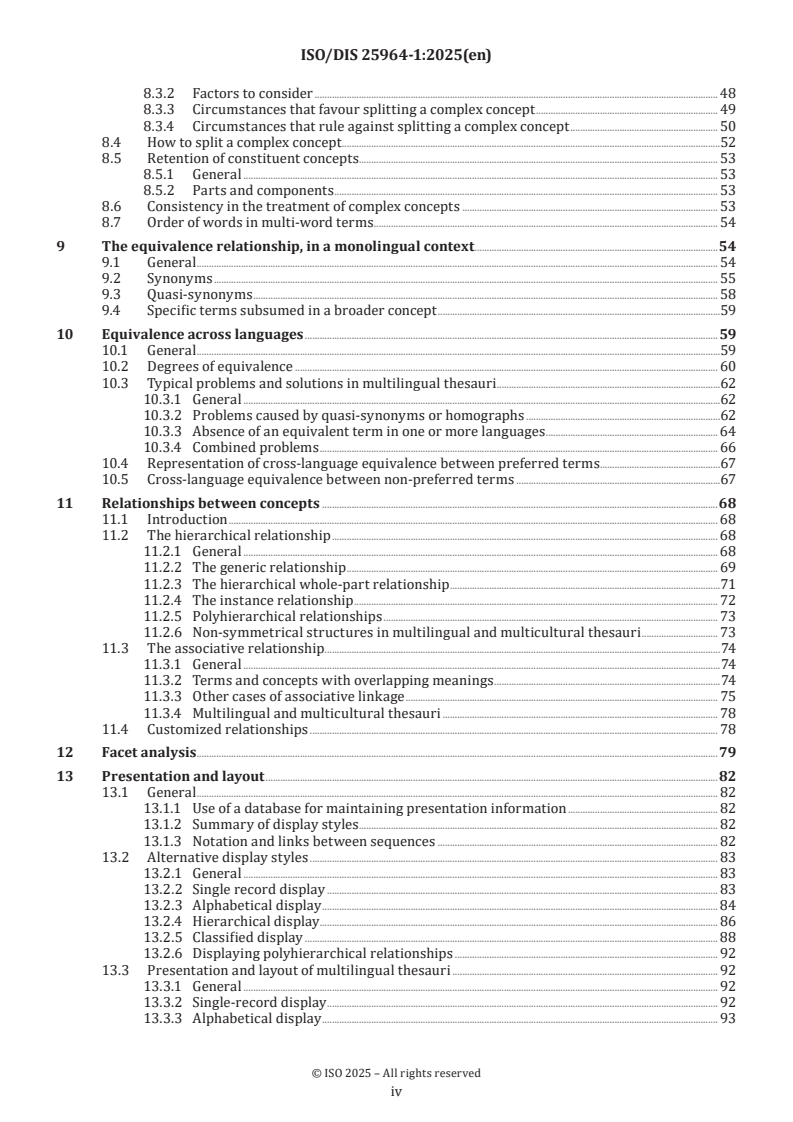
ISO/DIS 25964-1:2025(en)
8.3.2 Factors to consider . 48
8.3.3 Circumstances that favour splitting a complex concept . 49
8.3.4 Circumstances that rule against splitting a complex concept . 50
8.4 How to split a complex concept .52
8.5 Retention of constituent concepts. 53
8.5.1 General . 53
8.5.2 Parts and components . 53
8.6 Consistency in the treatment of complex concepts . 53
8.7 Order of words in multi-word terms . . 54
9 The equivalence relationship, in a monolingual context.54
9.1 General . 54
9.2 Synonyms . 55
9.3 Quasi-synonyms . 58
9.4 Specific terms subsumed in a broader concept .59
10 Equivalence across languages .59
10.1 General .59
10.2 Degrees of equivalence . 60
10.3 Typical problems and solutions in multilingual thesauri .62
10.3.1 General .62
10.3.2 Problems caused by quasi-synonyms or homographs .62
10.3.3 Absence of an equivalent term in one or more languages . 64
10.3.4 Combined problems . 66
10.4 Representation of cross-language equivalence between preferred terms . .67
10.5 Cross-language equivalence between non-preferred terms .67
11 Relationships between concepts .68
11.1 Introduction . 68
11.2 The hierarchical relationship . 68
11.2.1 General . 68
11.2.2 The generic relationship . 69
11.2.3 The hierarchical whole-part relationship .71
11.2.4 The instance relationship . 72
11.2.5 Polyhierarchical relationships . 73
11.2.6 Non-symmetrical structures in multilingual and multicultural thesauri . 73
11.3 The associative relationship . .74
11.3.1 General .74
11.3.2 Terms and concepts with overlapping meanings .74
11.3.3 Other cases of associative linkage . 75
11.3.4 Multilingual and multicultural thesauri . 78
11.4 Customized relationships . 78
12 Facet analysis . .79
13 Presentation and layout .82
13.1 General . 82
13.1.1 Use of a database for maintaining presentation information . 82
13.1.2 Summary of display styles . . 82
13.1.3 Notation and links between sequences . 82
13.2 Alternative display styles . 83
13.2.1 General . 83
13.2.2 Single record display . 83
13.2.3 Alphabetical display . 84
13.2.4 Hierarchical display . . 86
13.2.5 Classified display . 88
13.2.6 Displaying polyhierarchical relationships . 92
13.3 Presentation and layout of multilingual thesauri . 92
13.3.1 General . 92
13.3.2 Single-record display . 92
13.3.3 Alphabetical display . 93
iv
ISO/DIS 25964-1:2025(en)
13.3.4 Systematic displays . 94
13.3.5 Correspondence tables for multilingual thesauri . 96
13.4 Language and character encoding issues . 98
13.4.1 General . 98
13.4.2 Display issues . 99
13.4.3 Filing orders . 99
13.4.4 Normalization for information retrieval . 100
13.4.5 Identification of dialects and/or alternative scripts . 100
13.5 Concept identifiers and resource locators for use in controlled vocabularies . 101
14 Managing thesaurus construction and maintenance .102
14.1 Planning a thesaurus . 102
14.1.1 Determining objectives . 102
14.1.2 Determining thesaurus features . 102
14.1.3 Taking stock of resources . 103
14.1.4 Establishing responsibilities . 104
14.1.5 Choosing thesaurus management software . 104
14.2 Early stages of compilation . 104
14.2.1 General: how and when to start . 104
14.2.2 Collecting terms and concepts . 104
14.2.3 Analysing terms . 105
14.3 Construction . 105
14.3.1 Input . 105
14.3.2 Construction sequence . 105
14.3.3 Construction of a multilingual thesaurus . 106
14.3.4 Involving experts and stakeholders . 107
14.3.5 Appropriate choice of terminology . 107
14.4 Introduction to the thesaurus. 108
14.5 Dissemination . . 108
14.5.1 Integration with an electronic system . 108
14.5.2 Electronic publication . 109
14.5.3 Limited distribution of printed copies. 109
14.5.4 Conventional publication . 109
14.5.5 Deposit with a clearinghouse . 109
14.5.6 Website directories .110
14.5.7 Updating . .110
14.5.8 Suggestion procedure .110
14.5.9 Review procedure .110
14.5.10 The nature of changes . 111
14.5.11 Dissemination of updates . 112
15 Data model .113
15.1 General . 113
15.2 The Visual Model .114
15.3 Tabular presentation .119
15.4 Integration of thesauri with applications . 124
15.5 Exchange formats . 127
15.5.1 MARC (MAchine-Readable Cataloguing) . 127
15.5.2 SKOS . 128
15.5.3 Zthes . 128
15.5.4 Additional markup domains . 128
15.6 Protocols .128
15.6.1 General .128
15.6.2 Purposes and use cases . 128
15.6.3 Application environment and architecture .128
15.6.4 General-purpose web database protocols used with thesauri .129
Annex A (informative) Examples of displays found in published thesauri .130
Annex B (informative) XML Schema for data exchange .144
v
ISO/DIS 25964-1:2025(en)
Annex C (informative) Guidelines for thesaurus management software .145
Bibliography .150
Index . 158
vi
ISO/DIS 25964-1:2025(en)
Foreword
ISO (the International Organization for Standardization) is a worldwide federation of national standards
bodies (ISO member bodies). The work of preparing International Standards is normally carried out through
ISO technical committees. Each member body interested in a subject for which a technical committee
has been established has the right to be represented on that committee. International organizations,
governmental and non-governmental, in liaison with ISO, also take part in the work. ISO collaborates closely
with the International Electrotechnical Commission (IEC) on all matters of electrotechnical standardization.
International Standards are drafted in accordance with the rules given in the ISO/IEC Directives, Part 2.
The main task of technical committees is to prepare International Standards. Draft International Standards
adopted by the technical committees are circulated to the member bodies for voting. Publication as an
International Standard requires approval by at least 75 % of the member bodies casting a vote.
Attention is drawn to the possibility that some of the elements of this document may be the subject of patent
rights. ISO shall not be held responsible for identifying any or all such patent rights.
This document was prepared by Technical Committee ISO/TC 46, Information and documentation,
Subcommittee SC 9, Identification and description.
This second edition cancels and replaces the first edition (ISO 25964-1:2011), which has been technically
revised.
The main changes are as follows:
— Updated examples and references
— Added concept and concept labels to differentiate meaning (concepts) and the representations (terms)
— Added and updated definitions and terms, for example for the following: concepts candidate concept,
Lexical labels, sequence numbers, classification codes, GUIDs and UUIDs, information retrieval,
information use, information management and mapping, etc. 17 additional definitions are now included
— Updated Equivalence relationships
— Updated Relationships between concepts
— Added guidance on complex concepts
— Added a section on PID
— Revised the Data Model and identifiers guidance
— Added significant number of multi-language examples
— Added more guidance on automation and artificial intelligence
— Updated the references both for currency and accuracy
A list of all parts in the ISO 25964 series can be found on the ISO website.
Any feedback or questions on this document should be directed to the user’s national standards body. A
complete listing of these bodies can be found at www.iso.org/members.html.
vii
ISO/DIS 25964-1:2025(en)
Introduction
Today's thesauri are mostly electronic tools, having moved on from the paper-based era when thesaurus
standards were first developed. They are built and maintained with the support of software and need to
integrate with other software, such as search engines and content management systems. (For example, data
from the thesaurus database might need to be presented in combination with the number of postings found
by a search application.) Whereas in the past thesauri were designed for information professionals trained
in indexing and searching, today there is a demand for vocabularies that untrained users will find to be
intuitive, and for vocabularies that enable inferencing by machines such as semantic web, linked data, and
artificial intelligence (AI) (meaning NLP, machine learning, LLM, etc.).
ISO 25964 makes the transition that is needed in order to be compatible with the world of deeply inter-
linked electronic information management. However, this part of ISO 25964 retains the assumption that
human intellect is usually involved in the selection of indexing terms and in the selection of search terms
even while suggestions may be made using automated methods. If both the indexer and the searcher are
guided towards the same concept, then relevant documents will be retrieved. This was the main principle
underlying thesaurus design and still applies. However, we are increasingly in a world where a thesaurus is
used for the annotation of machine generated responses, or guidance of AI by thesauri and other structured
vocabularies. In search and navigation, computers increasingly make the choices of what information is
presented to the searcher.
Efficient exchange of data is a vital component of thesaurus management and exploitation. This part of
ISO 25964 therefore includes recommendations for exchange formats and protocols. Adoption of these will
facilitate interoperability between thesaurus management systems and other computer applications, such
as indexing and retrieval systems and artificial intelligence (Ai) including generative language models,
including generative language models that will utilize the data.
This part of ISO 25964 covers development and maintenance of thesauri rather than how to use them in
indexing. Where multilingual issues and examples are addressed, efforts have been made to cover as wide a
selection of languages as possible, consistent with clarity and comprehensibility.
Thesauri are typically used in post-coordinate retrieval systems, but may also be applied to hierarchical
directories, pre-coordinate indexes and classification systems. Increasingly, thesaurus applications need
to mesh with others, such as automatic categorization schemes, free-text search systems, etc. ISO 25964-2
addresses additional types of structured vocabulary (such as classification schemes, name authority lists,
ontologies, etc.) and give recommendations to enable interoperation of the vocabularies at all stages of the
information storage, retrieval, creation and management process.
In revision of the ISO 25964-1the working group struggled with the use of Preferred (clause 3.59) and Non-
preferred terms (Clause 3.54) as the term of art for the main terms applied and their equivalence terms.
“Concept label” was added (3.20) to insure a clear cross walk with the W3C standards definitions and
vocabularies. We have added the definitions for each area within the definition’s sections providing a cross
walk to other major terminology standards including the ISO 704, ISO 30042 -TBX, and ISO 1087 terminology
standards as well as the definitions from the W3C SKOS and OWL communities. Many other appellations
are used for both labels. Preferred term is often called default term or default concept as well as concept
label, and descriptor. Non-preferred term may be referred to as Alternative term, Alternative label, AltLabel,
Synonym, and others. This is not an exhaustive list for either but indicative. We encourage the community to
use the term label best suited to their own community.
viii
DRAFT International Standard ISO/DIS 25964-1:2025(en)
Information and documentation — Thesauri and
interoperability with other vocabularies —
Part 1:
Thesauri for information retrieval; management and use
1 Scope
Part 1 of ISO 25964 gives recommendations for the development and maintenance of thesauri intended
for information retrieval, applications as well as broader use cases including web navigation, artificial
intelligence, author tagging, management, and use applications. It is applicable to vocabularies used for
retrieving information from all types of information resources, irrespective of the media used (text, sound,
still or moving image, physical object or multimedia) including knowledge bases web sites, bibliographic
databases, text, museum or multimedia collections, and the items within them, research and operational
datasets, medical records, product catalogs, (see section 3.79 for a definition of thesauri).
This part of ISO 25964:
— also provides a data model and recommended format for the import and export of thesaurus data.
— is applicable to monolingual and multilingual thesauri.
— is not applicable to the preparation of back-of-the-book indexes, although many of its recommendations
could be useful for that purpose.
— is not applicable to the databases or software used directly in search, indexing applications as well as
broader use cases including web navigation, artificial intelligence, author tagging, AI applications, but
does anticipate the needs of such applications among its recommendations for thesaurus management
(see also ISO 25964-2 on interoperability with other vocabularies).
2 Normative references
There are no normative references in this document.
3 Terms and definitions
For the purposes of this document, the following terms and definitions apply. Cross references to other ISO
authorities are added into the appropriate definition.
ISO and IEC maintain terminology databases for use in standardization at the following addresses:
— ISO Online browsing platform: available at https:// www .iso .org/ obp
— IEC Electropedia: available at https:// www .electropedia .org/
3.1
array
group of sibling concepts especially in a display under their shared broader concept (3.3)
Note 1 to entry: The sibling concepts (3.52) form an array within the same immediate broader concept (3.3).
EXAMPLE
ISO/DIS 25964-1:2025(en)
Example of siblings at several different levels in a hierarchy
marble by color or pattern
...black marble
...gray marble
...green marble
...variegated marble
.......brocatelle marble
.......fiorto marble
.......forest marble
...........pagoda stone
.......Proconnesian marble
...........bianco e nero antico
...........bigio e nero antico
3.2
associative relationship
relationship between a pair of designated concepts (3.14) that are not related hierarchically but share a
strong semantic connection
EXAMPLE
two materials are related to each other: the stone "travertine" is distinguished from "tufa"
an implement is r
...
FINAL DRAFT
International
Standard
ISO/TC 46/SC 9
Information and documentation —
Secretariat: ANSI
Thesauri and interoperability with
Voting begins on:
other vocabularies —
2026-08-07
Part 1:
Voting terminates on:
2026-10-02
Thesauri for information retrieval,
management and use
RECIPIENTS OF THIS DRAFT ARE INVITED TO SUBMIT,
WITH THEIR COMMENTS, NOTIFICATION OF ANY
RELEVANT PATENT RIGHTS OF WHICH THEY ARE AWARE
AND TO PROVIDE SUPPOR TING DOCUMENTATION.
IN ADDITION TO THEIR EVALUATION AS
BEING ACCEPTABLE FOR INDUSTRIAL, TECHNO-
LOGICAL, COMMERCIAL AND USER PURPOSES, DRAFT
INTERNATIONAL STANDARDS MAY ON OCCASION HAVE
TO BE CONSIDERED IN THE LIGHT OF THEIR POTENTIAL
TO BECOME STAN DARDS TO WHICH REFERENCE MAY BE
MADE IN NATIONAL REGULATIONS.
Reference number
FINAL DRAFT
International
Standard
ISO/TC 46/SC 9
Information and documentation —
Secretariat: ANSI
Thesauri and interoperability with
Voting begins on:
other vocabularies —
Part 1:
Voting terminates on:
Thesauri for information retrieval,
management and use
RECIPIENTS OF THIS DRAFT ARE INVITED TO SUBMIT,
WITH THEIR COMMENTS, NOTIFICATION OF ANY
RELEVANT PATENT RIGHTS OF WHICH THEY ARE AWARE
AND TO PROVIDE SUPPOR TING DOCUMENTATION.
© ISO 2026
IN ADDITION TO THEIR EVALUATION AS
All rights reserved. Unless otherwise specified, or required in the context of its implementation, no part of this publication may
BEING ACCEPTABLE FOR INDUSTRIAL, TECHNO-
LOGICAL, COMMERCIAL AND USER PURPOSES, DRAFT
be reproduced or utilized otherwise in any form or by any means, electronic or mechanical, including photocopying, or posting on
INTERNATIONAL STANDARDS MAY ON OCCASION HAVE
the internet or an intranet, without prior written permission. Permission can be requested from either ISO at the address below
TO BE CONSIDERED IN THE LIGHT OF THEIR POTENTIAL
or ISO’s member body in the country of the requester.
TO BECOME STAN DARDS TO WHICH REFERENCE MAY BE
MADE IN NATIONAL REGULATIONS.
ISO copyright office
CP 401 • Ch. de Blandonnet 8
CH-1214 Vernier, Geneva
Phone: +41 22 749 01 11
Email: copyright@iso.org
Website: www.iso.org
Published in Switzerland Reference number
ii
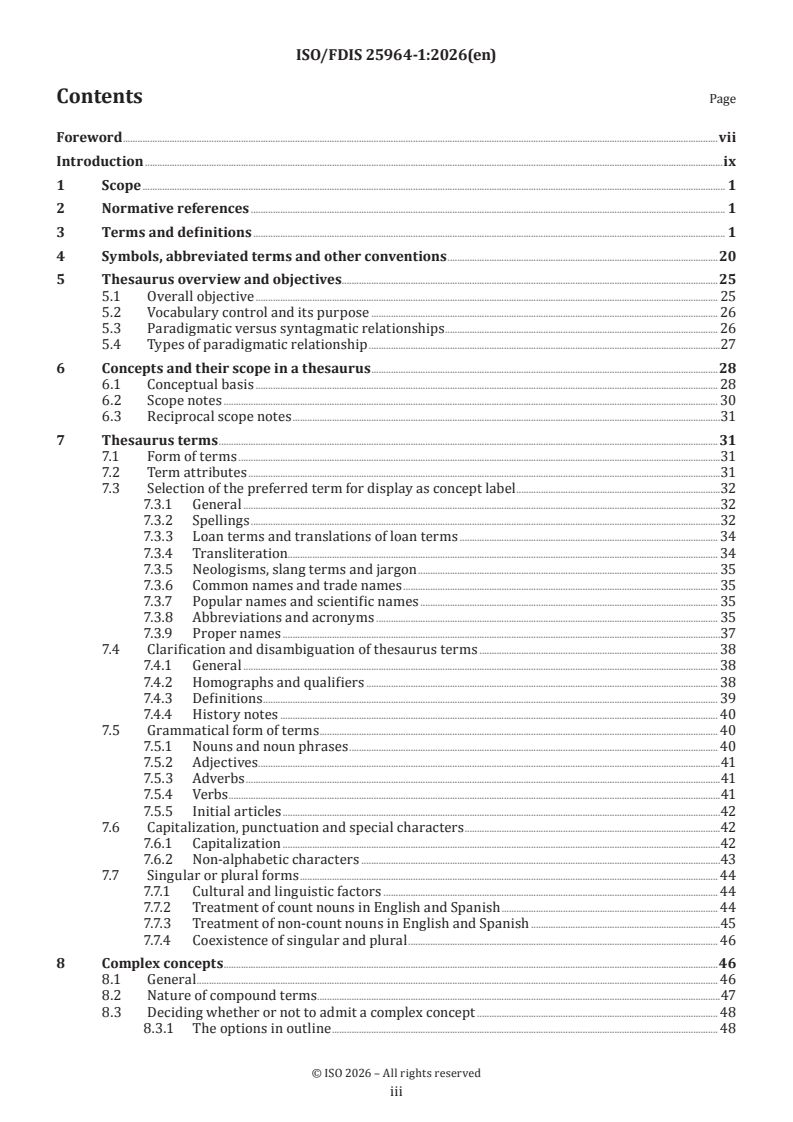
Contents Page
Foreword .vii
Introduction .ix
1 Scope . 1
2 Normative references . 1
3 Terms and definitions . 1
4 Symbols, abbreviated terms and other conventions .20
5 Thesaurus overview and objectives.25
5.1 Overall objective . 25
5.2 Vocabulary control and its purpose . 26
5.3 Paradigmatic versus syntagmatic relationships . 26
5.4 Types of paradigmatic relationship .27
6 Concepts and their scope in a thesaurus .28
6.1 Conceptual basis . 28
6.2 Scope notes . 30
6.3 Reciprocal scope notes .31
7 Thesaurus terms .31
7.1 Form of terms .31
7.2 Term attributes .31
7.3 Selection of the preferred term for display as concept label .32
7.3.1 General .32
7.3.2 Spellings .32
7.3.3 Loan terms and translations of loan terms . 34
7.3.4 Transliteration. 34
7.3.5 Neologisms, slang terms and jargon . 35
7.3.6 Common names and trade names . 35
7.3.7 Popular names and scientific names . 35
7.3.8 Abbreviations and acronyms . 35
7.3.9 Proper names .37
7.4 Clarification and disambiguation of thesaurus terms . 38
7.4.1 General . 38
7.4.2 Homographs and qualifiers . 38
7.4.3 Definitions . 39
7.4.4 History notes . 40
7.5 Grammatical form of terms . 40
7.5.1 Nouns and noun phrases . 40
7.5.2 Adjectives .41
7.5.3 Adverbs .41
7.5.4 Verbs .41
7.5.5 Initial articles .42
7.6 Capitalization, punctuation and special characters .42
7.6.1 Capitalization .42
7.6.2 Non-alphabetic characters .43
7.7 Singular or plural forms . 44
7.7.1 Cultural and linguistic factors . 44
7.7.2 Treatment of count nouns in English and Spanish . 44
7.7.3 Treatment of non-count nouns in English and Spanish .45
7.7.4 Coexistence of singular and plural . 46
8 Complex concepts .46
8.1 General . 46
8.2 Nature of compound terms.47
8.3 Deciding whether or not to admit a complex concept . 48
8.3.1 The options in outline . 48
iii
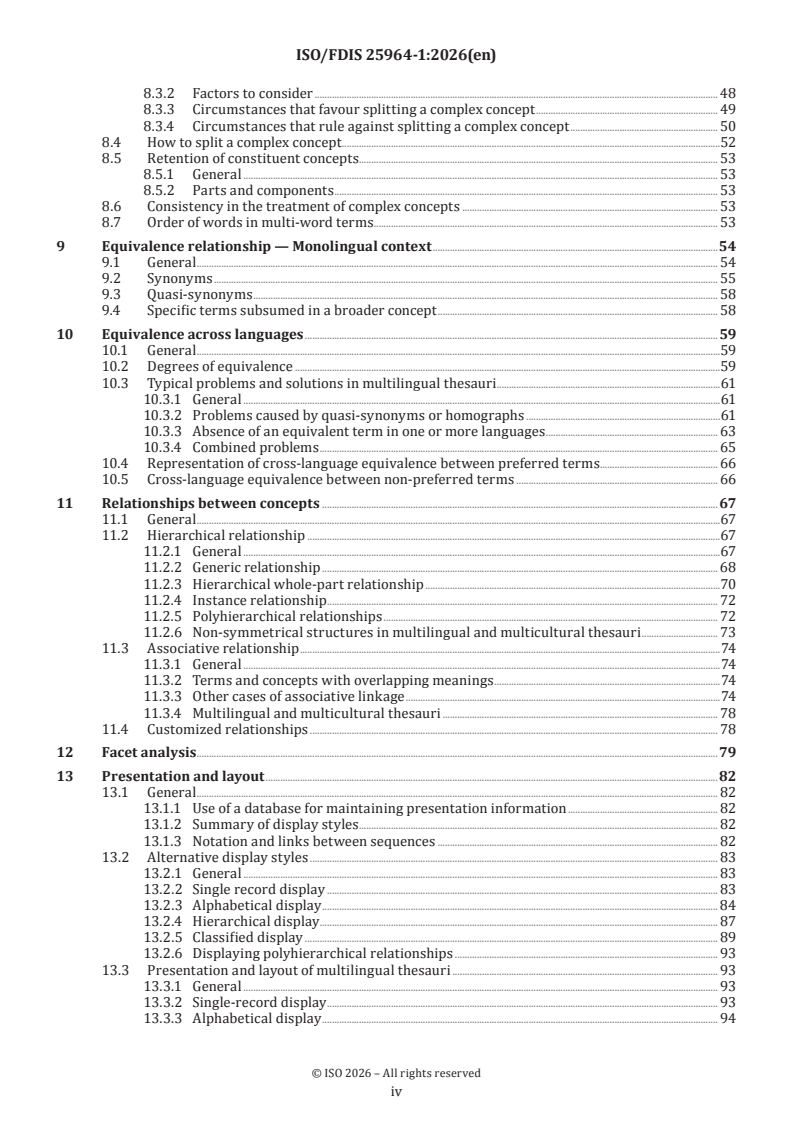
8.3.2 Factors to consider . 48
8.3.3 Circumstances that favour splitting a complex concept . 49
8.3.4 Circumstances that rule against splitting a complex concept . 50
8.4 How to split a complex concept .52
8.5 Retention of constituent concepts. 53
8.5.1 General . 53
8.5.2 Parts and components . 53
8.6 Consistency in the treatment of complex concepts . 53
8.7 Order of words in multi-word terms . . 53
9 Equivalence relationship — Monolingual context .54
9.1 General . 54
9.2 Synonyms . 55
9.3 Quasi-synonyms . 58
9.4 Specific terms subsumed in a broader concept . 58
10 Equivalence across languages .59
10.1 General .59
10.2 Degrees of equivalence .59
10.3 Typical problems and solutions in multilingual thesauri .61
10.3.1 General .61
10.3.2 Problems caused by quasi-synonyms or homographs .61
10.3.3 Absence of an equivalent term in one or more languages . 63
10.3.4 Combined problems . 65
10.4 Representation of cross-language equivalence between preferred terms . . 66
10.5 Cross-language equivalence between non-preferred terms . 66
11 Relationships between concepts . 67
11.1 General .67
11.2 Hierarchical relationship .67
11.2.1 General .67
11.2.2 Generic relationship . 68
11.2.3 Hierarchical whole-part relationship .70
11.2.4 Instance relationship . 72
11.2.5 Polyhierarchical relationships . 72
11.2.6 Non-symmetrical structures in multilingual and multicultural thesauri . 73
11.3 Associative relationship .74
11.3.1 General .74
11.3.2 Terms and concepts with overlapping meanings .74
11.3.3 Other cases of associative linkage .74
11.3.4 Multilingual and multicultural thesauri . 78
11.4 Customized relationships . 78
12 Facet analysis . .79
13 Presentation and layout .82
13.1 General . 82
13.1.1 Use of a database for maintaining presentation information . 82
13.1.2 Summary of display styles . . 82
13.1.3 Notation and links between sequences . 82
13.2 Alternative display styles . 83
13.2.1 General . 83
13.2.2 Single record display . 83
13.2.3 Alphabetical display . 84
13.2.4 Hierarchical display . . 87
13.2.5 Classified display . 89
13.2.6 Displaying polyhierarchical relationships . 93
13.3 Presentation and layout of multilingual thesauri . 93
13.3.1 General . 93
13.3.2 Single-record display . 93
13.3.3 Alphabetical display . 94
iv
13.3.4 Systematic displays . 96
13.3.5 Correspondence tables for multilingual thesauri . 97
13.4 Language and character encoding issues . 100
13.4.1 General . 100
13.4.2 Display issues . 100
13.4.3 Filing orders . 101
13.4.4 Cross language visual displays . 101
13.4.5 Normalization for information retrieval . 101
13.4.6 Identification of dialects and/or alternative scripts . 102
13.5 Concept identifiers and resource locators for use in controlled vocabularies . 102
14 Managing thesaurus construction and maintenance .104
14.1 Planning a thesaurus . 104
14.1.1 Determining objectives . 104
14.1.2 Determining thesaurus features . 104
14.1.3 Taking stock of resources . 104
14.1.4 Establishing responsibilities . 106
14.1.5 Choosing thesaurus management software . 106
14.2 Early stages of compilation . 106
14.2.1 General — How and when to start . 106
14.2.2 Collecting terms and concepts . 106
14.2.3 Analysing terms . 107
14.3 Construction . 107
14.3.1 Input . 107
14.3.2 Construction sequence . 107
14.3.3 Construction of a multilingual thesaurus . 108
14.3.4 Involving experts and stakeholders . 109
14.3.5 Appropriate choice of terminology . 109
14.4 Introduction to the thesaurus. 109
14.5 Dissemination . .110
14.5.1 Integration with an electronic system .110
14.5.2 Electronic publication .110
14.5.3 Limited distribution of printed copies. 111
14.5.4 Conventional publication . 111
14.5.5 Deposit with a clearinghouse . 111
14.5.6 Website directories . 111
14.5.7 Updating . . 112
14.5.8 Suggestion procedure . 112
14.5.9 Review procedure . 112
14.5.10 Nature of changes . 113
14.5.11 Dissemination of updates .114
14.6 Update frequency . 115
15 Data model .115
15.1 General . 115
15.2 The visual model .116
15.3 Notes on the model .117
15.3.1 Naming conventions .117
15.3.2 Symbols for associations .117
15.3.3 Concept . . 118
15.3.4 Concept Idenitifer . 118
15.3.5 Identifier . 118
15.3.6 Dates . 118
15.3.7 Versions and version history . 118
15.3.8 Status .119
15.3.9 Notation .119
15.3.10 Source .119
15.3.11 Source Identifier .119
15.3.12 Language codes .119
15.3.13 Dublin Core elements .119
v
15.3.14 Multiplicity of Preferred Term . 120
15.3.15 Top level concepts . 120
15.3.16 Notes . 120
15.3.17 Note references . 120
15.3.18 Custom attributes . 120
15.3.19 Arrays and node labels. 120
15.3.20 Concept groups . 121
15.3.21 Treatment of facets . . . 121
15.3.22 Relationship roles . 121
15.3.23 Split non-preferred terms . 122
15.3.24 Role of relationship tags . 122
15.4 Tabular presentation . 122
16 Integration of thesauri with applications . 128
16.1 General .128
16.2 Interoperability needs for thesauri .128
16.3 Integration with indexing and searching applications .128
16.4 With searchable document collection . . 129
16.5 Within search engine . 130
16.6 Exploiting equivalence . 130
16.7 With cataloguing or indexing . 130
16.8 Automatic indexing. 130
17 Exchange formats . .130
17.1 General . 130
17.2 MAchine-Readable Cataloguing (MARC) . 130
17.3 SKOS . 131
17.4 Zthes . 131
17.5 Additional markup domains . . 131
18 Protocols .131
18.1 General . 131
18.2 Purposes and use cases . 132
18.3 Application environment and architecture . 132
18.4 General-purpose web database protocols used with thesauri . 132
Annex A (informative) Examples of displays found in published thesauri .133
Annex B (informative) XML Schema for data exchange .147
Annex C (informative) Guidelines for thesaurus management software .148
Bibliography .153
Index .157
vi
Foreword
ISO (the International Organization for Standardization) is a worldwide federation of national standards
bodies (ISO member bodies). The work of preparing International Standards is normally carried out through
ISO technical committees. Each member body interested in a subject for which a technical committee
has been established has the right to be represented on that committee. International organizations,
governmental and non-governmental, in liaison with ISO, also take part in the work. ISO collaborates closely
with the International Electrotechnical Commission (IEC) on all matters of electrotechnical standardization.
The procedures used to develop this document and those intended for its further maintenance are described
in the ISO/IEC Directives, Part 1. In particular, the different approval criteria needed for the different types
of ISO document should be noted. This document was drafted in accordance with the editorial rules of the
ISO/IEC Directives, Part 2 (see www.iso.org/directives).
ISO draws attention to the possibility that the implementation of this document may involve the use of (a)
patent(s). ISO takes no position concerning the evidence, validity or applicability of any claimed patent
rights in respect thereof. As of the date of publication of this document, ISO had not received notice of (a)
patent(s) which may be required to implement this document. However, implementers are cautioned that
this may not represent the latest information, which may be obtained from the patent database available at
www.iso.org/patents. ISO shall not be held responsible for identifying any or all such patent rights.
Any trade name used in this document is information given for the convenience of users and does not
constitute an endorsement.
For an explanation of the voluntary nature of standards, the meaning of ISO specific terms and expressions
related to conformity assessment, as well as information about ISO's adherence to the World Trade
Organization (WTO) principles in the Technical Barriers to Trade (TBT), see www.iso.org/iso/foreword.html.
This document was prepared by Technical Committee ISO/TC 46, Information and documentation,
Subcommittee SC 9, Identification and description.
This second edition cancels and replaces the first edition (ISO 25964-1:2011), which has been technically
revised.
The main changes are as follows:
— updated examples and references;
— added concept and concept labels to differentiate meaning (concepts) and the representations (terms);
— added and updated definitions and terms, for example for the following: concepts candidate concept,
Lexical labels, sequence numbers, classification codes, GUIDs and UUIDs, information retrieval,
information use, information management and mapping, etc. 17 additional definitions are now included;
— updated Equivalence relationships;
— updated Relationships between concepts;
— added guidance on complex concepts;
— added a section on PID;
— revised the Data Model and identifiers guidance;
— added significant number of multi-language examples;
— added more guidance on automation and artificial intelligence;
— updated the references both for currency and accuracy.
A list of all par
...
Secrétariat: ANSI
ISO/TC 46/SC 9/WG 8
Secretariat: ANSI
Date: 2025-032026-07-24
Information and documentation — Thesauri and interoperability
with other vocabularies —
Part 1:
Thesauri for information retrieval, management, and use
Information et documentation — Thésaurus et interopérabilité avec d'autres vocabulaires —
Partie 1: Thésaurus pour la recherche d’informations, gestion, et utilisation
ISO/DIS 25964-1:2025(en)
FDIS stage
All rights reserved. Unless otherwise specified, or required in the context of its implementation, no part of this publication
may be reproduced or utilized otherwise in any form or by any means, electronic or mechanical, including photocopying,
or posting on the internet or an intranet, without prior written permission. Permission can be requested from either ISO
at the address below or ISO'sISO’s member body in the country of the requester.
ISO copyright office
CP 401 • Ch. de Blandonnet 8
CH-1214 Vernier, Geneva
Phone: + 41 22 749 01 11
Email: E-mail: copyright@iso.org
Website: www.iso.org
Published in Switzerland.
xxviii
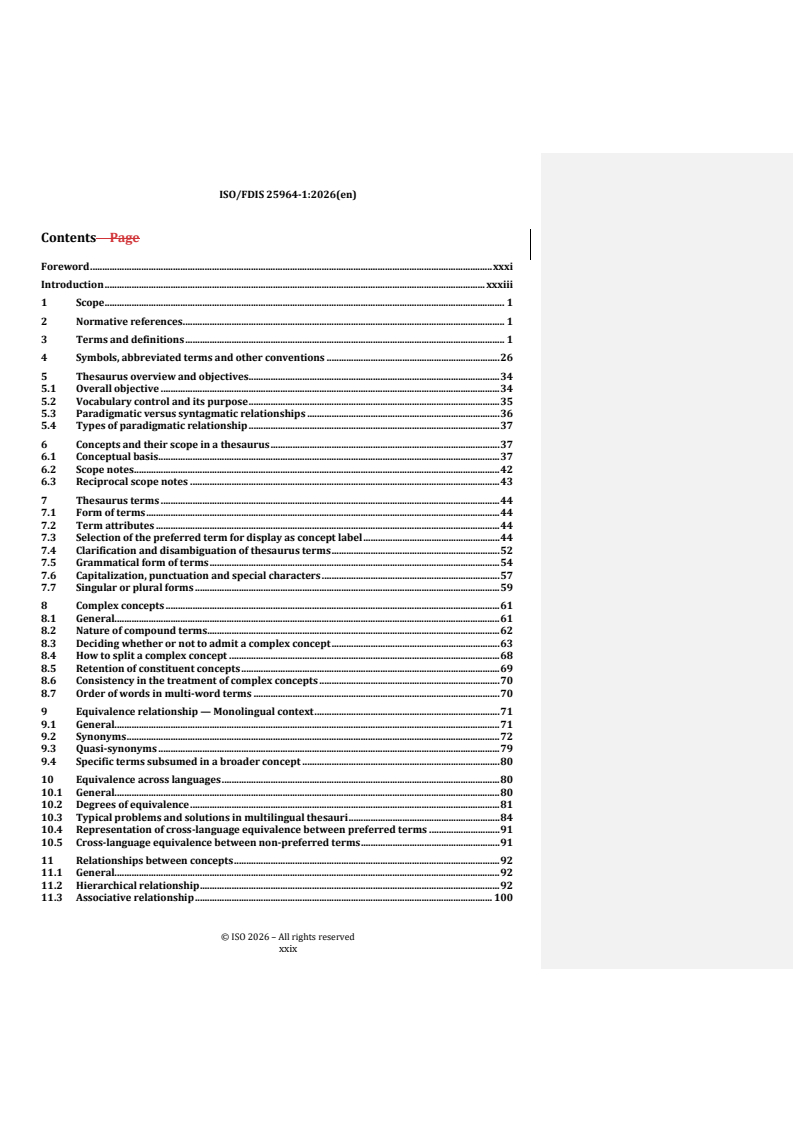
Contents Page
Foreword . xxxi
Introduction . xxxiii
1 Scope . 1
2 Normative references . 1
3 Terms and definitions . 1
4 Symbols, abbreviated terms and other conventions . 26
5 Thesaurus overview and objectives . 34
5.1 Overall objective . 34
5.2 Vocabulary control and its purpose . 35
5.3 Paradigmatic versus syntagmatic relationships . 36
5.4 Types of paradigmatic relationship . 37
6 Concepts and their scope in a thesaurus . 37
6.1 Conceptual basis . 37
6.2 Scope notes . 42
6.3 Reciprocal scope notes . 43
7 Thesaurus terms . 44
7.1 Form of terms . 44
7.2 Term attributes . 44
7.3 Selection of the preferred term for display as concept label . 44
7.4 Clarification and disambiguation of thesaurus terms . 52
7.5 Grammatical form of terms . 54
7.6 Capitalization, punctuation and special characters . 57
7.7 Singular or plural forms . 59
8 Complex concepts . 61
8.1 General. 61
8.2 Nature of compound terms. 62
8.3 Deciding whether or not to admit a complex concept . 63
8.4 How to split a complex concept . 68
8.5 Retention of constituent concepts . 69
8.6 Consistency in the treatment of complex concepts . 70
8.7 Order of words in multi-word terms . 70
9 Equivalence relationship — Monolingual context . 71
9.1 General. 71
9.2 Synonyms . 72
9.3 Quasi-synonyms . 79
9.4 Specific terms subsumed in a broader concept . 80
10 Equivalence across languages . 80
10.1 General. 80
10.2 Degrees of equivalence . 81
10.3 Typical problems and solutions in multilingual thesauri . 84
10.4 Representation of cross-language equivalence between preferred terms . 91
10.5 Cross-language equivalence between non-preferred terms . 91
11 Relationships between concepts . 92
11.1 General. 92
11.2 Hierarchical relationship . 92
11.3 Associative relationship . 100
xxix
11.4 Customized relationships . 106
12 Facet analysis . 107
13 Presentation and layout . 112
13.1 General. 112
13.2 Alternative display styles. 113
13.3 Presentation and layout of multilingual thesauri . 131
13.4 Language and character encoding issues . 144
13.5 Concept identifiers and resource locators for use in controlled vocabularies . 147
14 Managing thesaurus construction and maintenance . 148
14.1 Planning a thesaurus . 148
14.2 Early stages of compilation . 151
14.3 Construction . 152
14.4 Introduction to the thesaurus . 154
14.5 Dissemination . 155
14.6 Update frequency . 161
15 Data model . 161
15.1 General. 161
15.2 The visual model . 162
15.3 Notes on the model . 163
15.4 Tabular presentation . 168
16 Integration of thesauri with applications . 175
16.1 General. 175
16.2 Interoperability needs for thesauri . 175
16.3 Integration with indexing and searching applications . 176
16.4 With searchable document collection . 176
16.5 Within search engine . 177
16.6 Exploiting equivalence . 177
16.7 With cataloguing or indexing . 177
16.8 Automatic indexing . 178
17 Exchange formats . 178
17.1 General. 178
17.2 MAchine-Readable Cataloguing (MARC) . 178
17.3 SKOS . 178
17.4 Zthes . 178
17.5 Additional markup domains . 178
18 Protocols . 179
18.1 General. 179
18.2 Purposes and use cases. 179
18.3 Application environment and architecture . 179
18.4 General-purpose web database protocols used with thesauri . 179
Annex A (informative) Examples of displays found in published thesauri . 181
Annex B (informative) XML Schema for data exchange . 209
Annex C (informative) Guidelines for thesaurus management software . 210
Bibliography . 216
xxx
Foreword
ISO (the International Organization for Standardization) is a worldwide federation of national standards
bodies (ISO member bodies). The work of preparing International Standards is normally carried out through
ISO technical committees. Each member body interested in a subject for which a technical committee has been
established has the right to be represented on that committee. International organizations, governmental and
non-governmental, in liaison with ISO, also take part in the work. ISO collaborates closely with the
International Electrotechnical Commission (IEC) on all matters of electrotechnical standardization.
The procedures used to develop this document and those intended for its further maintenance are described
in the ISO/IEC Directives, Part 1. In particular, the different approval criteria needed for the different types of
ISO document should be noted. This document was drafted in accordance with the editorial rules of the
ISO/IEC Directives, Part 2 (see www.iso.org/directives).
ISO draws attention to the possibility that the implementation of this document may involve the use of (a)
patent(s). ISO takes no position concerning the evidence, validity or applicability of any claimed patent rights
in respect thereof. As of the date of publication of this document, ISO had not received notice of (a) patent(s)
which may be required to implement this document. However, implementers are cautioned that this may not
represent the latest information, which may be obtained from the patent database available at
www.iso.org/patents. ISO shall not be held responsible for identifying any or all such patent rights.
Any trade name used in this document is information given for the convenience of users and does not
constitute an endorsement.
For an explanation of the voluntary nature of standards, the meaning of ISO specific terms and expressions
related to conformity assessment, as well as information about ISO's adherence to the World Trade
Organization (WTO) principles in the Technical Barriers to Trade (TBT), see www.iso.org/iso/foreword.html.
This document was prepared by Technical Committee ISO/TC 46, Information and documentation,
Subcommittee SC 9, Identification and description.
This second edition cancels and replaces the first edition (ISO 25964-1:2011), which has been technically
revised.
The main changes are as follows:
— — updated examples and references;
— — added concept and concept labels to differentiate meaning (concepts) and the representations
(terms));
— — added and updated definitions and terms, for example for the following: concepts candidate concept,
Lexical labels, sequence numbers, classification codes, GUIDs and UUIDs, information retrieval,
information use, information management and mapping, etc. 17 additional definitions are now included;
— — updated Equivalence relationships;
— — updated Relationships between concepts;
— — added guidance on complex concepts;
— — added a section on PID;
— — revised the Data Model and identifiers guidance;
xxxi
— — added significant number of multi-language examples;
— — added more guidance on automation and artificial intelligence;
— — updated the references both for currency and accuracy.
A list of all parts in the ISO 25964 series can be found on the ISO website.
Any feedback or questions on this document should be directed to the user’s national standards body. A
complete listing of these bodies can be found at www.iso.org/members.html.
xxxii
Introduction
Today's thesauri are mostly electronic tools, having moved on from the paper-based era when thesaurus
standards were first developed. They are built and maintained with the support of software and need to
integrate with other software, such as search engines and content management systems. For example, data
from the thesaurus database might need to be presented in combination with the number of postings found
by a search application. Whereas in the past, thesauri were designed for information professionals trained in
indexing and searching, today there is a demand for vocabularies that untrained users will find to be intuitive,
and for vocabularies that enable inferencing by machines such as semantic web, linked data, and artificial
intelligence (AI) (meaning NLP, machine learning, LLM, etc.).
The ISO 25964 series makes the transition that is needed in order to be compatible with the world of deeply
inter-linked electronic information management. However, this document retains the assumption that human
intellect is usually involved in the selection of indexing terms and in the selection of search terms even while
suggestions may be made using automated methods. If both the indexer and the searcher are guided towards
the same concept, then relevant documents will be retrieved. This was the main principle underlying
thesaurus design and still applies. However, we are increasingly in a world where a thesaurus is still used for
the annotation of machine generated responses, or guidance of AI by thesauri and other structured
vocabularies. In search and navigation, computers increasingly make the choices of what information is
presented to the searcher.
Efficient exchange of data is a vital component of thesaurus management and exploitation. This document
therefore includes recommendations for exchange formats and protocols. Adoption of these will facilitate
interoperability between thesaurus management systems and other computer applications, such as indexing
and retrieval systems and artificial intelligence (AI) including generative language models, including
generative language models that will utilize the data.
This document covers development and maintenance of thesauri rather than how to use them in indexing.
Where multilingual issues and examples are addressed, efforts have been made to cover as wide a selection of
languages as possible, consistent with clarity and comprehensibility.
Thesauri are typically used in post-coordinate retrieval systems, but may also be applied to hierarchical
directories, pre-coordinate indexes and classification systems. Increasingly, thesaurus applications need to
mesh with others, such as automatic categorization schemes, free-text search systems, etc. ISO 25964-2
addresses additional types of structured vocabulary (such as classification schemes, name authority lists,
ontologies, etc.) and give recommendations to enable interoperation of the vocabularies at all stages of the
information storage, retrieval, creation and management process.
In the revision of this document, the working group struggled with the use of preferred and non-preferred
terms as the term of art for the main terms applied and their equivalence terms. has been a challenge. “Concept
label” was added to insure a clear cross walk with the W3C standards definitions and vocabularies.
WeDefinitions have been added the definitions for each area within the definition’s sections providing a cross
walk to other major terminology standards including the ISO 704, ISO 30042 -TBX, and ISO 1087 terminology
standards, as well as the definitions from the W3C SKOS and OWL communities. Many other appellations are
used for both labels. Preferred term is often called default term or default concept as well as concept label, and
descriptor. Non-preferred term may be referred to as alternative term, alternative label, AltLabel, synonym,
and others. This is not an exhaustive list for either but indicative. We encourage the community to useUsers
of this document are encouraged to apply the term label best suited to their own community.
xxxiii
Information and documentation — Thesauri and interoperability with
other vocabularies —
Part 1:
Thesauri for information retrieval, management, and use
1 Scope
This document gives recommendations for the development and maintenance of thesauri intended for
information retrieval, applications as well as broader use cases including web navigation, artificial
intelligence, author tagging, management, and use applications. It is applicable to vocabularies used for
retrieving information from all types of information resources, irrespective of the media used (text, sound,
still or moving image, physical object or multimedia) including knowledge bases web sites, bibliographic
databases, text, museum or multimedia collections, and the items within them, research and operational
datasets, medical records, and product catalogues.
This document:
— — also provides a data model and recommended format for the import and export of thesaurus data;
— — is applicable to monolingual and multilingual thesauri;
This document is not applicable to:
— — the preparation of back-of-the-book indexes, although many of its recommendations can be useful for
that purpose;
— — the databases or software used directly in search, indexing applications as well as broader use cases
including web navigation, artificial intelligence, author tagging, AI applications, but does anticipate the
needs of such applications among its recommendations for thesaurus management (see also ISO 25964-2
on interoperability with other vocabularies).
2 Normative references
There are no normative references in this document.
3 Terms and definitions
For the purposes of this document, the following terms and definitions apply.
ISO and IEC maintain terminology databases for use in standardization at the following addresses:
— — ISO Online browsing platform: available at https://www.iso.org/obp
— — IEC Electropedia: available at https://www.electropedia.org/
3.1 3.1
array
group of sibling concepts especially in a display under their shared broader concept (3.3(3.3))
Note 1 to entry: The sibling concepts (3.66(3.52)) form an array within the same immediate broader concept (3.3).
EXAMPLE Example of siblings at several different levels in a hierarchy:
EXAMPLE marble by colorcolour or pattern
EXAMPLE .black marble
...grayEXAMPLE ...grey marble
EXAMPLE .green marble
EXAMPLE .variegated marble
EXAMPLE .brocatelle marble
EXAMPLE .fiorto marble
EXAMPLE .forest marble
EXAMPLE .pagoda stone
EXAMPLE .Proconnesian marble
EXAMPLE .bianco e nero antico
EXAMPLE .bigio e nero antico
3.2 3.2
associative relationship
relationship (3.61(3.61)) between a pair of designated concepts (3.14(3.14)) that are not related hierarchically
but share a strong semantic connection
EXAMPLE 1 Two materials are related to each other: the stone "travertine" is distinguished from "tufa"".
EXAMPLE 2 An implement is related to a technique: "watercolor brushes" are required for the "watercolor painting"
technique.
EXAMPLE 3 A feature is related to works: "caves" are the locus/setting for "cave paintings"".
Note 1 to entry: These are also used in Authority files as well as thesauri.
3.3 3.3
broader concept
concept (3.14(3.14) a concept) which has one or more subordinate concepts in a hierarchy
Note 1 to entry: The scope of the narrower concept falls completely within the scope of the broader.
Note 2 to entry: The hierarchical relationship is further defined in 3.293.29.
Note 3 to entry: This is also the name of a relationships type in SKOS.
Note 4 to entry: ISO 1087 refers to this as a superordinate/broader concept.
EXAMPLE 1 The nation of "Kenya" is the broader context for "Lamu County," which is the broader context for "Lamu
Old Town"".
EXAMPLE 2 "dental chisels" and "dental clamps" fall completely within the scope of "dental instruments"".
3.4 3.4
broader term
preferred term (3.56(3.56)) representing a concept (3.14(3.14)) that is broader than the one in question
Note 1 to entry: The scope of the narrower concept falls completely within the scope of the broader. The relationship
between the two is commonly indicated with the tag BT. Described in hierarchical relationship (3.293.32) and that it has
a reciprocal of narrower term.
3.5 3.5
candidate concept
concept (3.14(3.14)) and its terms (3.77(3.78)) under consideration for inclusion in the thesaurus but not yet
approved for use.
Note 1 to entry: Also linguistic borrowing from one language to another. See also loan term3.39 3.39.
3.6 3.6
characteristic of division
attribute by which a concept (3.14(3.14)) can be subdivided into an array (3.1(3.1)) of narrower concepts
(3.47(3.47),), each having a distinct value of that attribute
Note 1 to entry: Type of characteristic (by age group, by colour, etc).) and the same concept is designated as a “criterion
of subdivision” in ISO 1087.
Note 2 to entry: “criterion of subdivision” is in ISO 5127) in the definitions of the concepts “extensional definition” and
“coordinate concept”.
Note 3 to entry: cf. See facet analysis (3.26(3.28),), node label (3.49(3.50)).
EXAMPLE
bridges may be grouped by form and by function:
bridges
...
......arch bridges
......covered bridges
......multispan bridges
......truss bridges
...
......footbridges
......military bridges
3.7
EXAMPLE
bridges may be grouped by form and by function:
bridges
...
......arch bridges
......covered bridges
......multispan bridges
......truss bridges
...
......footbridges
......military bridges
3.7
classify
place resources into a classification scheme (3.10(3.10))
3.73.8 3.8
classification
identification of concepts, establishing relationships between those concepts, and making both concepts and
relationships explicit. This action results in a classification scheme (3.10)
Note 1 to entry: This action results in a classification scheme (3.103.9).
3.83.9
classification code
alpha-numerical identifiers that express a classification structure in notation style
Note 1 to entry: see 13.5.3 See 13.5.3
3.93.10 3.10
classification scheme
schedule (3.62(3.62)) of concepts (3.14(3.14)) and pre-coordinated combinations of concepts arranged in a
hierarchy of classes and subclasses by characteristics of division (3.6(3.6))
Note 1 to entry: Classification schemes often include an alphanumeric notation and an index to aid navigation.
Note 2 to entry: Compares with ISO 1087:2019 classification scheme definition.
3.103.11 3.11
coined term
new term (3.77(3.77)) created to express a concept (3.14(3.14)) for which no suitable term exists in the
required language
EXAMPLE 1 The term for a performance art form, "happenings" was coined by the artist Allan Kaprow in the 1950s.
EXAMPLE 2 The term for the Chinese art style, "Cynical Realism" was coined by art critic Li Xianting in the 1980s.
Note 1 to entry: A coined term could also be created by linguistic borrowing from one language to another.
Note 2 to entry: See also loan term (3.393.39.).
Note 2 to entry: See also loan term 7.33.
Note 3 to entry: For a further explanation and examples, see 10.3.3.310.3.3.3.
3.113.12 3.12
compound equivalence
relationship or mapping in which one term (3.40(3.40)) or concept (3.14(3.14)) in one context is represented
by two or more terms or concepts (3.14) in another context or controlled vocabulary
Note 1 to entry: See also equivalence relationship (3.25(3.25)).
3.123.13 3.13
compound term
term (3.77(3.77)) that can be split morphologically into separate component
Note 1 to entry: a compound term can be a complex term (steamships, copper mines) or a blend (e.g. biodiversity)
Note 2 to entry: Compound terms may be terms which have a one meaning when compounded but a different meaning
for the terms presented individually. Also known as a bound term. That is, singularly the terms would mean something
else entirely.
EXAMPLE 1
In English: “copper mines” can be split into “copper” and “mines”; “lawnmowers” can be split into “lawns” and
“mowers”
EXAMPLE 2
In French: “mine de cuivre” can be split into “mine” and “cuivre”; the French plural “mines” + “cuivre”
“biodiversité” can be split into "biologie" and "diversité"
EXAMPLE 3
In German: “copper mines” in German Kupferbergwerke , Kupfer and Bergwerke. compounds in German are
expressed as a single word. _
EXAMPLE 4
In Spanish: “minas de cobre”
EXAMPLE 5
urban landscape (English),
stedelijk landschap (Dutch),
paisagem urbana (Portuguese),
都市景觀 (Chinese traditional)
EXAMPLE 1
In English: “copper mines” can be split into “copper” and “mines”; “lawnmowers” can be split into
“lawns” and “mowers”
EXAMPLE 2
In French: “mine de cuivre” can be split into “mine” and “cuivre”; the French plural “mines” + “cuivre”
“biodiversité” can be split into "biologie" and "diversité"
EXAMPLE 3
In German: “copper mines” in German Kupferbergwerke , Kupfer and Bergwerke. compounds in
German are expressed as a single word. _
EXAMPLE 4
In Spanish: “minas de cobre”
EXAMPLE 5
urban landscape (English),
stedelijk landschap (Dutch),
paisagem urbana (Portuguese),
都市景觀 (Chinese traditional)
Note 2 3 to entry: Compound terms can be multi-word terms or can consist of only one word.
Note 3 4 to entry: Compare with ISO 1087:2019 - compound term single word term that can be split morphologically
into separate components and complex term, term that consists of more than one word or lexical unit.
3.133.14 3.14
concept
unit of thought
unit of knowledge created by a unique combination of characteristics
Note 1 to entry: Concepts can often be expressed in a variety of different ways. They exist in the mind as abstract entities
independent of terms used to express them. They range from the very simple, e.g. “child”, to the very complex, e.g. “child
protection legislation”. Concepts can be represented by one or more terms or labels.
Note 2 to entry: Compare with ISO 1087:2019 – concept unit of knowledge created by a unique combination of
characteristics,. Concepts are not necessarily bound to particular natural languages. They are, however, influenced by the
social or cultural background which often leads to different categorizations.
Note 3 to entry: Compare with NISO Z39.19-2005 - A unit of thought, formed by mentally combining some or all of the
characteristics of a concrete or abstract, real or imaginary object. Concepts exist in the mind as abstract entities
independent of terms used to express them.
3.143.15 3.15
concept label
default representation of a concept (3.14(3.14)) in a display or user interface, by a text string which denotes
it in a particular domain such as a display or user interface.
c.f. preferred term (3.56)
c.f. identifier (3.31) and index term (3.32)
Note 1 to entry: Also known as default designation, default designator, synonym for preferred term, default
representation of a concept (3.14) in a display or user interface, by a sign which denotes it in a particular domain.
Note 2 to entry: The preferred term is chosen as the default label for each concept in a monolingual thesaurus that uses
the terminology of preferred term/nonpreferred term.
Note 3 to entry: In the case of multilingual thesauri concept label maybe used so preference for a single language is not
shown.
Note 4 to entry: Described in ISO 1087:2019 as “designation, representation of a concept by a sign which denotes it in a
domain or subject and term, designation that represents a general concept by linguistic means”.
Note 5 to entry: See also preferred term (3.56), identifier (3.31) and index term (3.323.16
).
3.16
controlled vocabulary
prescribed list of terms (3.77(3.77),), headings or codes, each representing a concept (3.14(3.14))
Note 1 to entry: Controlled vocabularies are designed for applications in which it is useful to identify each concept with
one consistent label, for example when classifying documents, indexing them and/or searching them. Thesauri, subject
heading schemes and name authority lists are examples of controlled vocabularies.
Note 2 to entry: Symbol languages and codes may also form a controlled vocabulary with definitions of the symbols which
would form a controlled vocabulary.
3.153.17 3.17
cross-language equivalence
equivalence relationship (3.23(3.23)) between terms (3.77(3.77)) representing the same concept (3.14(3.14))
in different languages
Note 1 to entry: Described in ISO 1087 as “equivalence, relation between designations in different natural languages
representing the same concept”.
EXAMPLE 1 The French term “ordinateur” is an equivalent of the English term “computer”.
EXAMPLE 2 English: gold; Dutch: goud; Swedish: guld; German: Gold; French: or; Italian and Spanish: oro; Portuguese:
ouro; Arabic: ﺐھذ Latin: aurum; symbol: Au Greek: χρυσός;
3.163.18 3.18
data model
abstract model that provides the representation of data, specifying their properties, structures and
interrelationships
Note 1 to entry: The data model in this document provides a generic definition of thesaurus structure and semantics. It
can be used as the basis for defining a database model or an exchange format for thesauri.
[SOURCE: ISO/IEC 2382-36:2019(en),, 3.10.1]
3.173.19 3.19
deprecated term
term no longer in active use but which has been used in the past in the literature and is noted as such
Note 1 to entry: To completely remove it would not allow access to historical material.
EXAMPLE 1 In reference to the Pre-Columbian Southwestern North American culture concept, Ancestral Puebloan,.
EXAMPLE 2 A term used in past decades,. The term ‘Anasazi’ is no longer recommended; use ‘Ancestral Puebloan’
“Anasazi," has been deprecated, thus not recommended for use in new indexing, although it is used for retrieval of older
existing materials. Add the term Anasazi as a non-preferred term so the history is there for retrieval of earlier documents.
Note 2 to entry: A deprecated term is an outdated or undesired term that in the past might be used as a synonym to a
preferred term but now is not recommended (i.e. it is a not admitted non-preferred term). It is very important, however,
to be careful with its handling, because complete removal would not allow access to historical material.
Note 3 to entry: Described in ISO 1087:2019 as deprecated term, term which is a synonym for a preferred term, but rated
according to the acceptability rating scale as undesired.
3.183.20 3.20
document
any resource that can be classified or indexed in order that the data or information in it can be retrieved
Note 1 to entry: This definition refers not only to written and printed materials in paper or microform versions (for
example, conventional books, journals, diagrams, maps), but also to non-printed media such as machine-readable and
digitized records, Internet and intranet resources, films, sound recordings, records or collections of people, organizations,
buildings, sites, monuments, three-dimensional objects as knowledge resources.
3.193.21 3.21
entry term
term (3.77(3.77)) provided in a controlled vocabulary (3.16(3.16),), not for direct use in metadata or indexing
(3.33(3.33) )
Note 1 to entry: The purpose is to guide the user to a concept (3.14(3.14),), via another term (3.77) that can be used as a
category label, subject heading, concept label (3.15(3.15),), or preferred term (3.56(3.56).).
Note 2 to entry: Entry terms occurring in a thesaurus are generally known as non-preferred terms (3.53(3.53).).
Note 3 to entry: also known as lead-in term.
Note 4 to entry: Entry terms are referred to as “alternative labels” in SKOS.
3.203.22 3.22
equivalence mapping
mapping (3.40(3.40)) that states that a concept (3.14(3.14)) in the target vocabulary is considered identical in
scope to a concept in the source vocabulary.
Note 1 to entry: See also equivalence relationship (3.23(3.26)).
3.213.23
cf. equivalence relationship (3.23)
3.23
equivalence relationship
relationship between two terms (3.77(3.77)) in a thesaurus (3.78(3.78)) that both represent the same concept
(3.14(3.14))
Note 1 to entry: In ordinary discourse, terms that are quasi-synonyms may represent slightly different concepts. After
inclusion in the thesaurus, however, the equivalence relationship clarifies that both are regarded as representing the
same concept. When two or more such terms are in the same language within a monolingual or multilingual thesaurus,
one of them is designated a preferred term and the other(s) non-preferred term(s); when two or more such terms are in
the different languages of a multilingual thesaurus, each of them may be a preferred term in its own language respectively,
and the relationship is known as cross-language equivalence.
Note 2 to entry: Entry terms are referred to as “alternative labels” in SKOS.
Note 3 to entry: Also described in ISO 1087:2019 – equivalence, relation between designations in different natural
languages representing the same concept.
c.f.Note 4 to entry: See also equivalence mapping (3.22(3.22)).
3.223.24 3.24
exchange format
machine-readable format for representing information that is intended to facilitate exchange of the
information between different applications
Note 1 to entry: The exchange format for a thesaurus often uses a markup language based on a standard, such as XML
1)
(Extensible Markup Language) https://www.w3.org/XML/ and is based on a data model for thesauri. While the data
model provides a generic description of thesaurus structure and semantics, the exchange format expresses this in a
formal language for the purpose of exchanging thesauri.
1)
Available from: https://www.w3.org/XML/
Note 2 to entry: the Z39.50 protocol to navigate and search ,thesauri, or controlled vocabularies, which is defined by
the Zthes profile. Zthes provides specifications for clients to connect to a remote Z39.50 server and access its thesaurus,
2)
allowing users to find and use standardized terms for information retrieval across different systems and databases. [91]
3.233.25 3.25
facet
grouping of concepts (3.14(3.14)) of the same inherent category or “aspect-based classification”
Note 1 to entry: cf. See node label (3.49(3.49)).
EXAMPLE 1 Animals, mice, daffodils and bacteria could all be members of a living organism’s facet.
EXAMPLE 2 Digging, writing and cooking could all be members of an actions facet.
EXAMPLE 3 Paris, the United Kingdom and the Alps could all be members of a places facet.
Note 2 to entry: Examples of high-level categories that can be used for grouping concepts into facets are: objects,
materials, agents, actions, places and times.
3.243.26 3.26
facet analysis
arrangement of subject areas into constituent concepts (3.14(3.14)) grouped into facets (3.25(3.25),), and the
subdivision of concepts (3.14) into narrower concepts (3.47(3.47)) by specified characteristics of division
3.253.27 3.27
facet indicator
notational device that indicates the start of a new facet (3.25(3.25)) or classification level, which functions as
a node label and is not an index term within a synthesized compound notation (3.51(3.51))
Note 1 to entry: Examples of facet indicators are the 0 in the Dewey Decimal Classification, and parentheses and
quotation symbols in the Universal Decimal Classification. The term facet indicator was previously used synonymously
with node label; this usage is not recommended.
3.263.28 3.28
Globally Unique Identifier
GUID
16-byte string of characters that is generated in a manner that gives a high probability that the string is unique
in any context
Note 1 to entry: The term GUID is mostly used for Microsoft contexts. GUID/UUIDs are typically 128-bit (16-byte) values
ISO/IEC 19770-5:2015, 3.16, modified .
3.29
[SOURCE: ISO/IEC 19770-5:2015, 3.16, modified]
3.29
hierarchical relationship
relationship between a pair of concepts (3.14(3.14)) of which one has a scope falling completely within the
scope of the other
Note 1 to entry: Hierarchical relationships are often referred to as Broader and Narrower relationships in a thesaurus or
taxonomy.
2)
See https://zthes.z3950.org.
Note 2 to entry: For example, in a hi
...