


ISO/IEC 15992:2003
(Main)Information technology — Telecommunications and information exchange between systems — Private Integrated Services Network — Inter-exchange signalling protocol — Call Priority Interruption and Call Priority Interruption Protection supplementary services
Information technology — Telecommunications and information exchange between systems — Private Integrated Services Network — Inter-exchange signalling protocol — Call Priority Interruption and Call Priority Interruption Protection supplementary services
ISO/IEC 15992:2003 specifies the signalling protocol for the support of the Call Priority Interruption (SS-CPI) and Call Priority Interruption Protection (SS-CPIP) supplementary services at the Q reference point between Private Integrated services Network eXchanges (PINXs) connected together within a Private Integrated Services Network (PISN). NOTE This edition of ISO/IEC 15992:2003 does not apply to calls using the circuit-mode multiple rate bearer service. SS-CPI allows a call request for a priority call to proceed successfully in the case that there is no user information channel available. This is accomplished by force releasing an established call of lower priority. SS-CPIP allows for the protection of calls against interruption from priority calls. The Q reference point is defined in ISO/IEC 11579-1. Service specifications are produced in three stages and according to the method specified in ETS 300 387. ISO/IEC 15992:2003 contains the stage 3 specification for the Q reference point and satisfies the requirements identified by the stage 1 and stage 2 specifications in ISO/IEC 15991. The signalling protocol for SS-CPI(P) operates on top of the signalling protocol for basic circuit switched call control, as specified in ISO/IEC 11572, and uses certain aspects of the generic procedures for the control of supplementary services specified in ISO/IEC 11582. ISO/IEC 15992:2003 also specifies additional signalling protocol requirements for the support of interactions at the Q reference point between SS-CPI(P) and other supplementary services and ANFs.
Technologies de l'information — Télécommunications et échange d'information entre systèmes — Réseau privé à intégration de services — Protocole de signalisation d'échange — Services supplémentaires d'interruption de priorité d'appel et de protection d'interruption de priorité d'appel
General Information
Relations
Standards Content (Sample)
INTERNATIONAL ISO/IEC
STANDARD 15992
Second edition
2003-04-01
Information technology —
Telecommunications and information
exchange between systems — Private
Integrated Services Network —
Inter-exchange signalling protocol —
Call Priority Interruption and Call Priority
Interruption Protection supplementary
services
Technologies de l'information — Télécommunications et échange
d'information entre systèmes — Réseau privé à intégration de
services — Protocole de signalisation d'échange — Services
supplémentaires d'interruption de priorité d'appel et de protection
d'interruption de priorité d'appel
Reference number
©
ISO/IEC 2003
PDF disclaimer
This PDF file may contain embedded typefaces. In accordance with Adobe's licensing policy, this file may be printed or viewed but
shall not be edited unless the typefaces which are embedded are licensed to and installed on the computer performing the editing. In
downloading this file, parties accept therein the responsibility of not infringing Adobe's licensing policy. The ISO Central Secretariat
accepts no liability in this area.
Adobe is a trademark of Adobe Systems Incorporated.
Details of the software products used to create this PDF file can be found in the General Info relative to the file; the PDF-creation
parameters were optimized for printing. Every care has been taken to ensure that the file is suitable for use by ISO member bodies. In
the unlikely event that a problem relating to it is found, please inform the Central Secretariat at the address given below.
© ISO/IEC 2003
All rights reserved. Unless otherwise specified, no part of this publication may be reproduced or utilized in any form or by any means,
electronic or mechanical, including photocopying and microfilm, without permission in writing from either ISO at the address below or
ISO's member body in the country of the requester.
ISO copyright office
Case postale 56 • CH-1211 Geneva 20
Tel. + 41 22 749 01 11
Fax + 41 22 749 09 47
E-mail copyright@iso.org
Web www.iso.org
Published in Switzerland
ii © ISO/IEC 2003 — All rights reserved
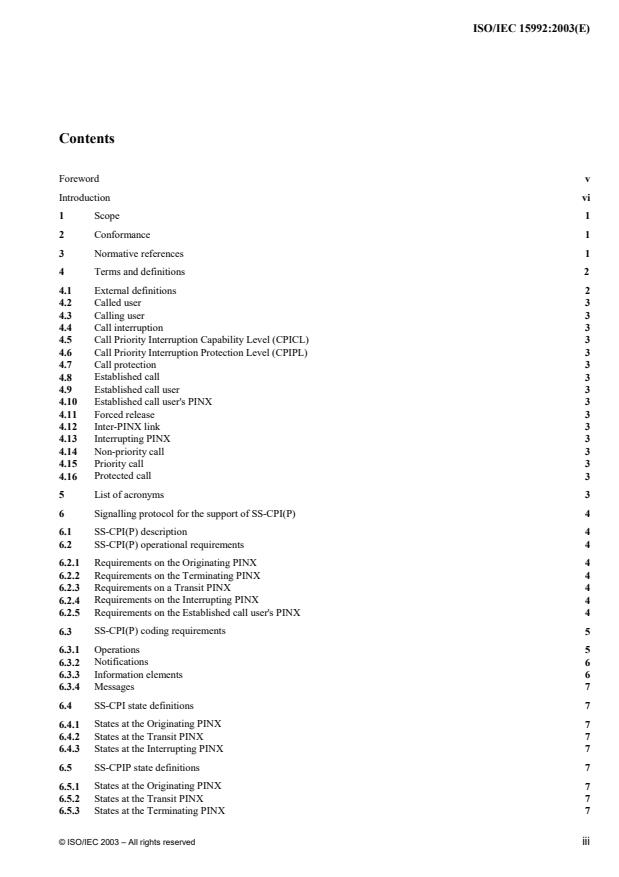
Contents
Foreword v
Introduction vi
1 Scope 1
2 Conformance 1
3 Normative references 1
4 Terms and definitions 2
4.1 External definitions 2
4.2 Called user 3
4.3 Calling user 3
4.4 Call interruption 3
4.5 Call Priority Interruption Capability Level (CPICL) 3
4.6 Call Priority Interruption Protection Level (CPIPL) 3
4.7 Call protection 3
4.8 Established call 3
4.9 Established call user 3
4.10 Established call user's PINX 3
Forced release
4.11 3
4.12 Inter-PINX link 3
4.13 Interrupting PINX 3
4.14 Non-priority call 3
4.15 Priority call 3
4.16 Protected call 3
5 List of acronyms 3
6 Signalling protocol for the support of SS-CPI(P) 4
SS-CPI(P) description
6.1 4
6.2 SS-CPI(P) operational requirements 4
6.2.1 Requirements on the Originating PINX 4
6.2.2 Requirements on the Terminating PINX 4
6.2.3 Requirements on a Transit PINX 4
6.2.4 Requirements on the Interrupting PINX 4
6.2.5 Requirements on the Established call user's PINX 4
6.3 SS-CPI(P) coding requirements 5
6.3.1 Operations 5
6.3.2 Notifications 6
6.3.3 Information elements 6
6.3.4 Messages 7
6.4 SS-CPI state definitions 7
6.4.1 States at the Originating PINX 7
6.4.2 States at the Transit PINX 7
6.4.3 States at the Interrupting PINX 7
6.5 SS-CPIP state definitions 7
States at the Originating PINX
6.5.1 7
6.5.2 States at the Transit PINX 7
6.5.3 States at the Terminating PINX 7
© ISO/IEC 2003 – All rights reserved iii
6.6 SS-CPI signalling procedures for activation, deactivation and registration 8
6.7 SS-CPIP signalling procedures for activation, deactivation and registration 8
6.8 SS-CPI signalling procedures for invocation and operation 8
6.8.1 Actions at the Originating PINX 8
6.8.2 Actions at a Transit PINX 8
6.8.3 Actions at the Interrupting PINX 9
6.8.4 Actions at the Terminating PINX 10
6.8.5 Actions at the Established call user's PINX 10
6.9 SS-CPIP signalling procedures for invocation and operation 10
6.9.1 Actions at the Originating PINX 10
6.9.2 Actions at a Transit PINX 10
6.9.3 Actions at the Terminating PINX 11
SS-CPI impact of interworking with public ISDNs
6.10 11
6.11 SS-CPIP impact of interworking with public ISDNs 11
6.12 SS-CPI impact of interworking with non-ISDNs 11
6.13 SS-CPIP impact of interworking with non-ISDNs 12
6.14 Protocol interactions between SS-CPI(P) and other supplementary services and ANFs 12
6.14.1 Interaction with Calling Name Identification Presentation (SS-CNIP) 12
6.14.2 Interaction with Connected Name Identification Presentation (SS-CONP) 12
6.14.3 Interaction with Completion of Call to Busy Subscriber (SS-CCBS) 12
Interaction with Completion of Call on No Reply (SS-CCNR)
6.14.4 12
6.14.5 Interaction with Call Transfer (SS-CT) 12
6.14.6 Interaction with Call Forwarding Unconditional (SS-CFU) 12
6.14.7 Interaction with Call Forwarding Busy (SS-CFB) 13
6.14.8 Interaction with Call Forwarding No Reply (SS-CFNR) 13
6.14.9 Interaction with Call Deflection (SS-CD) 13
6.14.10 Interaction with Path Replacement (ANF-PR) 13
6.14.11 Interaction with Call Offer (SS-CO) 13
6.14.12 Interaction with Call Intrusion (SS-CI) 13
6.14.13 Interaction with Do not Disturb (SS-DND) 13
6.14.14 Interaction with Do not Disturb Override (SS-DNDO) 13
6.14.15 Interaction with Advice of Charge (SS-AOC) 13
6.14.16 Interaction with Recall (SS-RE) 13
6.14.17 Interaction with Call Interception (ANF-CINT) 13
6.14.18 Interaction with Transit Counter (ANF-TC) 13
6.14.19 Interaction with Wireless Terminal Location Registration (SS-WTLR) 14
6.14.20 Interaction with Wireless Terminal Incoming Call (ANF-WTMI) 14
Interaction with Wireless Terminal Outgoing Call (ANF-WTMO)
6.14.21 14
6.14.22 Interaction with Wireless Terminal Authentication of a WTM user (SS-WTAT) 14
6.14.23 Interaction with Wireless Terminal Authentication of a PISN (SS-WTAN) 14
6.14.24 Interaction with Message Waiting Indication (SS-MWI) 14
6.14.25 Interaction with Common Information (ANF-CMN) 14
6.15 SS-CPI parameter values (timers) 14
6.15.1 Timer T1 14
Annexes
A - Protocol Implementation Conformance Statement (PICS) proforma 15
B - Examples of message sequences 23
C - Specification and Description Language (SDL) representation of procedures 28
D - ASN.1 definitions according to ITU-T Recs. X.208 / X.209 36
iv © ISO/IEC 2003 – All rights reserved
Foreword
ISO (the International Organization for Standardization) and IEC (the International Electrotechnical Commission) form the
specialized system for worldwide standardization. National bodies that are members of ISO or IEC participate in the
development of International Standards through technical committees established by the respective organization to deal with
particular fields of technical activity. ISO and IEC technical committees collaborate in fields of mutual interest. Other
international organizations, governmental and non-governmental, in liaison with ISO and IEC, also take part in the work. In
the field of information technology, ISO and IEC have established a joint technical committee, ISO/IEC JTC 1.
International Standards are drafted in accordance with the rules given in the ISO/IEC Directives, Part 2.
The main task of the joint technical committee is to prepare International Standards. Draft International Standards adopted by
the joint technical committee are circulated to national bodies for voting. Publication as an International Standard requires
approval by at least 75 % of the national bodies casting a vote.
Attention is drawn to the possibility that some of the elements of this document may be the subject of patent rights. ISO and
IEC shall not be held responsible for identifying any or all such patent rights.
ISO/IEC 15992 was prepared by ECMA (as ECMA-264) and was adopted, under a special “fast-track procedure”, by Joint
Technical Committee ISO/IEC JTC 1, Information technology, in parallel with its approval by national bodies of ISO and IEC.
This second edition cancels and replaces the first edition (ISO/IEC 15992:1998), which has been technically revised.
© ISO/IEC 2003 – All rights reserved v
Introduction
This International Standard is one of a series of Standards defining services and signalling protocols applicable to Private
Integrated Services Networks (PISNs). The series uses ISDN concepts as developed by ITU-T and conforms to the framework
of International Standards for Open Systems Interconnection as defined by ISO/IEC.
This International Standard specifies the signalling protocol for use at the Q reference point in support of the Call Priority
Interruption (CPI) and Call Priority Interruption Protection (CPIP) supplementary services. The protocol defined in this
International Standard forms part of the PSS1 protocol (informally known as QSIG).
This International Standard is based upon the practical experience of ECMA member companies and the results of their active
and continuous participation in the work of ISO/IEC JTC 1, ITU-T, ETSI and other international and national standardization
bodies. It represents a pragmatic and widely based consensus.
vi © ISO/IEC 2003 – All rights reserved
INTERNATIONAL STANDARD ISO/IEC 15992:2003(E)
Information technology — Telecommunications and information
exchange between systems — Private Integrated Services Network —
Inter-exchange signalling protocol — Call Priority Interruption and Call
Priority Interruption Protection supplementary services
1Scope
This International Standard specifies the signalling protocol for the support of the Call Priority Interruption (SS-CPI) and Call
Priority Interruption Protection (SS-CPIP) supplementary services at the Q reference point between Private Integrated services
Network eXchanges (PINXs) connected together within a Private Integrated Services Network (PISN).
NOTE 1 - This edition of this International Standard does not apply to calls using the circuit-mode multiple rate bearer service.
SS-CPI allows a call request for a priority call to proceed successfully in the case that there is no user information channel
available. This is accomplished by force releasing an established call of lower priority.
SS-CPIP allows for the protection of calls against interruption from priority calls.
The Q reference point is defined in ISO/IEC 11579-1.
Service specifications are produced in three stages and according to the method specified in ETS 300 387. This International
Standard contains the stage 3 specification for the Q reference point and satisfies the requirements identified by the stage 1 and
stage 2 specifications in ISO/IEC 15991.
The signalling protocol for SS-CPI(P) operates on top of the signalling protocol for basic circuit switched call control, as
specified in ISO/IEC 11572, and uses certain aspects of the generic procedures for the control of supplementary services
specified in ISO/IEC 11582.
This International Standard also specifies additional signalling protocol requirements for the support of interactions at the Q
reference point between SS-CPI(P) and other supplementary services and ANFs.
NOTE 2 - Additional interactions that have no impact on the signalling protocol at the Q reference point can be found in the relevant stage 1
specifications.
This International Standard is applicable to PINXs that can interconnect to form a PISN.
2 Conformance
In order to conform to this International Standard, a PINX shall satisfy the requirements identified in the Protocol
Implementation Conformance Statement (PICS) proforma in annex A.
Conformance to this International Standard includes conforming to those clauses that specify protocol interactions between
SS-CPI(P) and other supplementary services and ANFs for which signalling protocols at the Q reference point are supported in
accordance with the stage 3 standards concerned.
3 Normative references
The following referenced documents are indispensable for the application of this document. For dated references, only the
edition cited applies. For undated references, the latest edition of the referenced document (including any amendments)
applies.
ISO/IEC 11572:2000, Information technology - Telecommunications and information exchange between systems - Private
Integrated Services Network - Circuit mode bearer services - Inter-exchange signalling procedures and protocol
ISO/IEC 11574:2000, Information technology - Telecommunications and information exchange between systems - Private
Integrated Services Network - Circuit-mode 64 kbit/s bearer services - Service description, functional capabilities and
information flows
ISO/IEC 11579-1:1994, Information technology - Telecommunications and information exchange between systems - Private
integrated services network - Part 1: Reference configuration for PISN Exchanges (PINX)
© ISO/IEC 2003 – All rights reserved 1
ISO/IEC 11582:2002, Information technology - Telecommunications and information exchange between systems - Private
Integrated Services Network - Generic functional protocol for the support of supplementary services - Inter-exchange
signalling procedures and protocol
ISO/IEC 13869:2003, Information technology - Telecommunications and information exchange between systems - Private
Integrated Services Network - Inter-exchange signalling protocol - Call Transfer supplementary service
ISO/IEC 13873:2003, Information technology - Telecommunications and information exchange between systems - Private
Integrated Services Network - Inter-exchange signalling protocol - Call Diversion supplementary services
ISO/IEC 13874:2003, Information technology - Telecommunications and information exchange between systems - Private
Integrated Services Network - Inter-exchange signalling protocol - Path Replacement additional network feature
ISO/IEC 15054:2003, Information technology - Telecommunications and information exchange between systems - Private
Integrated Services Network - Inter-exchange signalling protocol - Call Interception additional network feature
ISO/IEC 15431:2003, Information technology - Telecommunications and information exchange between systems - Private
Integrated Services Network - Inter-exchange signalling protocol - Wireless terminal call handling additional network features
ISO/IEC 15991:2003, Information technology - Telecommunications and information exchange between systems - Private
Integrated Services Network - Specification, functional model and information flows - Call Priority Interruption and Call
Priority Interruption Protection supplementary services
ETS 300 387:1994, Private Telecommunication Network (PTN); Method for the specification of basic and supplementary
services
ITU-T Rec. I.112:1993, Vocabulary of terms for ISDNs
ITU-T Rec. I.210:1993, Principles of telecommunication services supported by an ISDN and the means to describe them
ITU-T Rec. Q.950:2000, Supplementary services protocols, structure and general principles
ITU-T Rec. Z.100:1999, Specification and description language (SDL)
4 Terms and definitions
For the purposes of this document, the following terms and definitions apply.
4.1 External definitions
This International Standard uses the following terms defined in other documents:
− Adjacent PINX (ISO/IEC 11582)
− Application Protocol Data Unit (APDU) (ISO/IEC 11582)
− Basic Service (ITU-T Rec. I.210)
− Call, Basic Call (ISO/IEC 11582)
− Coordination Function (ISO/IEC 11582)
− Notification (ISO/IEC 11582)
− Originating PINX (ISO/IEC 11572)
− Preceding PINX (ISO/IEC 11572)
− Private Integrated Services Network (PISN) (ISO/IEC 11579-1)
− Private Integrated services Network Exchange (PINX) (ISO/IEC 11579-1)
− Signalling (ITU-T Rec. I.112)
− Subsequent PINX (ISO/IEC 11572)
− Supplementary Service (ITU-T Rec. I.210)
− Terminating PINX (ISO/IEC 11572)
− Transit PINX (ISO/IEC 11572)
− User (ISO/IEC 11574)
2 © ISO/IEC 2003 – All rights reserved
4.2 Called user
The user that receives a request to accept an incoming call and who may request SS-CPIP.
4.3 Calling user
The user that originates a call attempt and who may request SS-CPI and/or SS-CPIP.
4.4 Call interruption
An invocation procedure of SS-CPI whereby the calling user indicates that a "priority call" is to be made.
4.5 Call Priority Interruption Capability Level (CPICL)
A parameter indicating the priority of a call.
4.6 Call Priority Interruption Protection Level (CPIPL)
A parameter indicating a level of protection of a call against interruption from other calls.
4.7 Call protection
An invocation procedure of SS-CPIP whereby the calling user or the called user indicates that a call is to be protected.
4.8 Established call
The active call that is selected for interruption.
4.9 Established call user
A user in the established call.
4.10 Established call user's PINX
The PINX serving one of the users in the established call.
4.11 Forced release
The release of the established call during interruption.
4.12 Inter-PINX link
The totality of a signalling channel and a number of user information channels at the Q reference point.
4.13 Interrupting PINX
The PINX that selects an established call for interruption.
NOTE 3 - The Originating PINX or any Transit PINX involved in a call may also be an Interrupting PINX.
4.14 Non-priority call
A call that has not been assigned a CPICL value.
4.15 Priority call
A call that has a CPICL value greater than zero.
NOTE 4 - A priority call may also be a protected call.
4.16 Protected call
A call that has a CPIPL value greater than zero.
NOTE 5 - A protected call may also be a priority call.
5 List of acronyms
ANF Additional Network Feature
APDU Application Protocol Data Unit
ASN.1 Abstract Syntax Notation no. 1
CPICL Call Priority Interruption Capability Level
CPIPL Call Priority Interruption Protection Level
ISDN Integrated Services Digital Network
NFE Network Facility Extension
PICS Protocol Implementation Conformance Statement
PINX Private Integrated services Network eXchange
© ISO/IEC 2003 – All rights reserved 3
PISN Private Integrated Services Network
SDL Specification and Description Language
SS-CPI Call Priority Interruption Supplementary Service
SS-CPIP Call Priority Interruption Protection Supplementary Service
6 Signalling protocol for the support of SS-CPI(P)
6.1 SS-CPI(P) description
SS-CPI is a supplementary service that allows a call request for a priority call to proceed successfully in the case that there is no
user information channel available. SS-CPI may be invoked by the calling user.
SS-CPIP is a supplementary service that allows for the protection of calls against interruption. SS-CPIP may be invoked by
either the calling user or the called user.
A priority interruption only occurs if the call originating from the calling user has a higher Call Priority Interruption Capability
Level (CPICL) than the Call Priority Interruption Protection Level (CPIPL) of at least one of the established calls on the
selected inter-PINX link.
SS-CPI(P) is applicable to all circuit mode basic services defined in ISO/IEC 11574.
6.2 SS-CPI(P) operational requirements
6.2.1 Requirements on the Originating PINX
Call establishment procedures for the outgoing side of an inter-PINX link and call release procedures, as specified in
ISO/IEC 11572, shall apply.
Generic procedures for the call-related control of supplementary services, as specified in ISO/IEC 11582 for an End PINX,
shall apply.
6.2.2 Requirements on the Terminating PINX
Call establishment procedures for the incoming side of an inter-PINX link and call release procedures, as specified in
ISO/IEC 11572, shall apply.
For the support of SS-CPIP, generic procedures for the call-related control of supplementary services, as specified in
ISO/IEC 11582 for an End PINX, shall apply.
6.2.3 Requirements on a Transit PINX
Basic call procedures, as specified in ISO/IEC 11572 for a Transit PINX, shall apply.
Generic procedures for the call-related control of supplementary services, as specified in ISO/IEC 11582 for a Transit PINX,
shall apply. In addition, for the support of SS-CPI, the generic procedures for notification, as specified in ISO/IEC 11582 shall
apply.
6.2.4 Requirements on the Interrupting PINX
Call establishment procedures for the outgoing side of an inter-PINX link and call release procedures, as specified in
ISO/IEC 11572, shall apply.
Generic procedures for the call-related control of supplementary services, as specified in ISO/IEC 11582 for both an End PINX
and a Transit PINX, shall apply. In addition, the generic procedures for notification, as specified in ISO/IEC 11582 shall apply.
6.2.5 Requirements on the Established call user's PINX
Generic procedures for notification, as specified in ISO/IEC 11582 for a Receiving End PINX, shall apply.
4 © ISO/IEC 2003 – All rights reserved
6.3 SS-CPI(P) coding requirements
6.3.1 Operations
The operations defined in Abstract Syntax Notation number 1 (ASN.1) in table 1 shall apply. The notation is in accordance
with ITU-T Rec. X.680 and X.690. The ITU-T Rec. X.208 and X.209 superseded version is in annex D.
Table 1 - Operations in support of SS-CPI(P)
Call-Interruption-Operations-asn1-97
{iso (1) standard (0) pss1-call-interruption (15992) call-interruption-operations-asn1-97 (2) }
DEFINITIONS EXPLICIT TAGS::=
BEGIN
IMPORTS OPERATION FROM Remote-Operations-Information-Objects
{joint-iso-itu-t (2) remote-operations (4) informationObjects (5) version1 (0)}
EXTENSION, Extension{} FROM Manufacturer-specific-service-extension-class-asn1-97
{iso (1) standard (0) pss1-generic-procedures (11582) msi-class-asn1-97 (11)};
-- The following operations are defined:
Call-Interruption-Operations OPERATION ::= { callInterruptionRequest | callProtectionRequest }
callInterruptionRequest OPERATION ::= {
ARGUMENT CPIRequestArg
RETURN RESULT FALSE
ALWAYS RESPONDS FALSE
CODE local: 87}
callProtectionRequest OPERATION ::= {
ARGUMENT CPIPRequestArg
RETURN RESULT FALSE
ALWAYS RESPONDS FALSE
CODE local: 88}
-- The following arguments are defined:
CPIRequestArg ::= SEQUENCE{
cpiCapabilityLevel CPICapabilityLevel,
argumentExtension CHOICE{
extension [1] IMPLICIT Extension{{CPIPExtSet}},
sequenceOfExtn [2] IMPLICIT SEQUENCE OF
Extension{{CPIPExtSet}}} OPTIONAL}
CPIPRequestArg ::= SEQUENCE{
cpiProtectionLevel CPIProtectionLevel,
argumentExtension CHOICE{
extension [1] IMPLICIT Extension{{CPIPExtSet}},
sequenceOfExtn [2] IMPLICIT SEQUENCE OF
Extension{{CPIPExtSet}}} OPTIONAL}
© ISO/IEC 2003 – All rights reserved 5
Table 1 - Operations in support of SS-CPI(P) (concluded)
CPICapabilityLevel ::= ENUMERATED{
interruptionLowPriority (1),
interruptionMediumPriority (2),
interruptionHighPriority (3)}
CPIProtectionLevel ::= ENUMERATED{
noProtection (0),
lowProtection (1),
mediumProtection (2),
totalProtection (3)}
CPIPExtSet EXTENSION ::= {.}
END -- of Call-Interruption-Operations-asn1-97
6.3.2 Notifications
The following notifications, defined in Abstract Syntax Notation number 1 (ASN.1) in table 2 shall apply.
Table 2 - Notifications in support of SS-CPI(P)
Call-Interruption-Notifications-asn1-97
{iso (1) standard (0) pss1-call-interruption (15992) call-interruption-notifications-asn1 (3) }
DEFINITIONS ::=
BEGIN
IMPORTS NOTIFICATION FROM Notification-Data-Structure-asn1-97
{iso (1) standard (0) pss1-generic-procedures (11582) notification-data-structure-asn1-97 (18)};
-- The following notifications are defined:
Call-Interruption-Notifications NOTIFICATION ::= {interruptionIsImpending | interruptionTerminated |
interruptionForcedRelease}
interruptionIsImpending NOTIFICATION::= {
ARGUMENT NULL
CODE local: 2008}
interruptionTerminated NOTIFICATION::= {
ARGUMENT NULL
CODE local: 2009}
interruptionForcedRelease NOTIFICATION ::= {
ARGUMENT NULL
CODE local: 2010}
END --of Call-Interruption-Notifications-asn1-97
6.3.3 Information elements
6.3.3.1 Facility information element
The operations defined above shall be coded in the Facility information element in accordance with ISO/IEC 11582.
When conveying an APDU of operation callInterruptionRequest or operation callProtectionRequest the NFE shall be included
and shall contain value anyTypeOfPINX.
When conveying the invoke APDU of operation callInterruptionRequest or operation callProtectionRequest the Interpretation
APDU shall be included and shall contain value discardAnyUnrecognisedInvokePdu.
6 © ISO/IEC 2003 – All rights reserved
6.3.3.2 Notification indicator information element
The notifications defined above shall be coded in the Notification indicator information element in accordance with
ISO/IEC 11582.
6.3.3.3 Other information elements
Any other information elements (e.g., Progress indicator) shall be coded in accordance with the rules of ISO/IEC 11572.
6.3.4 Messages
Messages used for call establishment and release shall be as specified in ISO/IEC 11572.
The Facility information element and the Notification indicator information element shall be conveyed in the messages as
specified in clause 10 of ISO/IEC 11582.
6.4 SS-CPI state definitions
6.4.1 States at the Originating PINX
The procedures for the Originating PINX are written in terms of the following conceptual states existing within the SS-CPI
Supplementary Service Control entity in that PINX in association with a particular call.
6.4.1.1 State CPI-Idle
SS-CPI is not operating.
6.4.2 States at the Transit PINX
The procedures for the Transit PINX are written in terms of the following conceptual states existing within the SS-CPI
Supplementary Service Control functional entity in that PINX in association with a particular call.
6.4.2.1 State CPI-Idle
SS-CPI is not operating.
6.4.3 States at the Interrupting PINX
The procedures for the Interrupting PINX are written in terms of the following conceptual states existing within the SS-CPI
Supplementary Service Control functional entity in that PINX in association with a particular call.
6.4.3.1 State CPI-Idle
SS-CPI is not operating.
6.4.3.2 State CPI-Impending
Following invocation of call interruption, the Interrupting PINX has notified an impending interruption to the users in the
established call and is waiting for the end of the impending phase before starting interruption.
6.4.3.3 State CPI-Releasing
The Interrupting PINX has forced released the established call and is waiting for completion of the clearing process.
6.5 SS-CPIP state definitions
6.5.1 States at the Originating PINX
The procedures for the Originating PINX are written in terms of the following conceptual states existing within the SS-CPIP
Supplementary Service Control entity in that PINX in association with a particular call.
6.5.1.1 State CPIP-Idle
SS-CPIP is not operating.
6.5.2 States at the Transit PINX
The procedures for the Transit PINX are written in terms of the following conceptual states existing within the SS-CPIP
Supplementary Service Control functional entity in that PINX in association with a particular call.
6.5.2.1 State CPIP-Idle
SS-CPIP is not operating.
6.5.3 States at the Terminating PINX
The procedures for the Terminating PINX are written in terms of the following conceptual states existing within the SS-CPIP
Supplementary Service Control functional entity in that PINX in association with a particular call.
© ISO/IEC 2003 – All rights reserved 7
6.5.3.1 State CPIP-Idle
SS-CPIP is not operating.
6.6 SS-CPI signalling procedures for activation, deactivation and registration
Not applicable.
6.7 SS-CPIP signalling procedures for activation, deactivation and registration
Not applicable.
6.8 SS-CPI signalling procedures for invocation and operation
Annex B contains some examples of message sequences.
NOTE 6 - SS-CPI may be invoked by the calling user to identify a call attempt as being a "priority call", and to give it the capability to
interrupt other calls as a means of obtaining the resources needed for successful call establishment.
Calls with an associated Call Priority Interruption Capability Level (CPICL) in which the CPICL value is greater than 0 are known as
"priority calls". Priority calls have the capability to interrupt other calls, both protected and non-protected; with the exception of calls having
"total protection" (CPIPL=3).
Priority calls may also be protected calls if SS-CPIP was invoked at the same time as SS-CPI.
6.8.1 Actions at the Originating PINX
6.8.1.1 Procedure for invocation of SS-CPI
For a given call, the Originating PINX may invoke SS-CPI using the procedures specified below.
The SDL representation of procedures at the Originating PINX is shown in C.1 of annex C.
6.8.1.1.1 Normal procedures
To invoke SS-CPI, the Originating PINX shall send a callInterruptionRequest invoke APDU, and re-enter state CPI-Idle. The
APDU shall be sent in the SETUP message that establishes the call. The argument of the invoke operation shall convey the
CPICL of the calling user.
NOTE 7 - The method by which the value of the CPICL is assigned is outside the scope of this International Standard.
6.8.1.1.2 Exceptional procedures
If the basic call fails for reasons other than those covered in 6.8.1.2 below (e.g., on calling user release, call failure, etc.),
SS-CPI shall terminate, and state CPI-Idle shall be entered.
6.8.1.2 Procedure for operation of SS-CPI
While attempting to establish a new call in accordance with the procedures of ISO/IEC 11572, the inter-PINX link to the
Subsequent PINX may be found to be congested (i.e., no B-channel available).
6.8.1.2.1 Normal procedures
If the calling user invoked SS-CPI, the Originating PINX shall not reject the calling user's call request, but shall check whether
call interruption is possible. It shall do this by behaving as an Interrupting PINX, as specified in 6.8.3.1 below. On completion
of these procedures the behaviour of the PINX shall revert to that of an Originating PINX.
6.8.1.2.2 Exceptional procedures
The exceptional procedures of an Interrupting PINX, as specified in 6.8.3.2 below, shall apply; with the modification that
where "Preceding PINX" is referred to, this shall be interpreted to mean "calling user".
On completion of those procedures the behaviour of the PINX shall revert to that of an Originating PINX.
6.8.2 Actions at a Transit PINX
The SDL representation of procedures at the Transit PINX is shown in C.2 of annex C.
6.8.2.1 Normal procedures
While processing, in accordance with the procedures of ISO/IEC 11572, an incoming SETUP message containing a
callInterruptionRequest invoke APDU, the Transit PINX may determine that the inter-PINX link to the Subsequent PINX is
congested (i.e., no B-channels are available). In this case the Transit PINX shall not release the call in the direction of the
Preceding PINX, but shall behave as an Interrupting PINX, as specified in 6.8.3.1 below. On completion of these procedures
the behaviour of the PINX shall revert to that of a Transit PINX.
8 © ISO/IEC 2003 – All rights reserved
6.8.2.2 Exceptional procedures
While processing, in accordance with the procedures of ISO/IEC 11572, an incoming SETUP message containing a
callInterruptionRequest invoke APDU, the Transit PINX may determine that the inter-PINX link to the Subsequent PINX is not
congested (i.e., B-channels are available). In this case the call shall proceed in accordance with the procedures of
ISO/IEC 11572 and ISO/IEC 11582. The callInterruptionRequest invoke APDU shall be passed on to the Subsequent PINX.
6.8.3 Actions at the Interrupting PINX
The SDL representation of procedures at the Interrupting PINX is shown in C.3 of annex C.
6.8.3.1 Normal procedures
The Interrupting PINX shall check whether call interruption is possible. It shall do this by comparing the CPICL value of the
priority call with the CPIPL values of established calls on the congested inter-PINX link. If an established call is found with a
CPIPL value lower than the CPICL value of the priority call, and provided there are no other reasons for denying interruption
(e.g., because the established call is already being interrupted), this call shall be considered interruptible. If the Interrupting
PINX has no knowledge of the CPIPL for a particular established call, the call shall be treated as if it has no protection (i.e.,
CPIPL value equal to zero). If more than one call is interruptible, the Interrupting PINX shall select the call with the lowest
CPIPL value. If more than one call has the same lowest CPIPL, the method used to select the call to be interrupted from this
group of calls shall be implementation dependent.
NOTE 8 - Interruption of calls in the establishment phase (i.e., calls that have not yet reached the Active state) is outside the scope of this
International Standard. It is an implementation specific matter that is part of the checking for available resources and selection of a call for
interruption. Basic Call procedures allow a PINX to abort a call attempt for unspecified reasons; one such reason could be that a call of
higher priority needs the resources.
Similarly, for calls in the release phase, the B-channel is about to become available, and pre-empting it for the priority call is also an
implementation specific matter.
If call interruption is possible, the Interrupting PINX may provide notification of impending interruption to users in the
established call. If notification of impending interruption is not to be given, interruption shall take place immediately. If
notification of impending interruption is to be given, the Interrupting PINX shall send NOTIFY messages to the Adjacent
PINXs of the established call. These NOTIFY messages shall use the call references of the established call, and shall contain
the notification value "interruptionIsImpending". The Interrupting PINX shall start timer T1 and shall enter state
CPI-Impending. Interruption shall occur on expiry of timer T1 in state CPI-Impending.
To interrupt the established call the Interrupting PINX shall send DISCONNECT messages to the Adjacent PINXs of the
established call and follow basic call clearing procedures as specified in ISO/IEC 11572. These DISCONNECT messages shall
use the call references of the established call and shall contain the notification value "interruptionForcedRelease". Cause no. 31
"Normal, unspecified" shall be used. The Interrupting PINX shall enter state CPI-Releasing.
When clearing of the interrupted call has been completed the Interrupting PINX shall continue with the establishment of the
priority call using the newly available B-channel, according to the procedures specified in ISO/IEC 11572. At the same time the
Interrupting PINX shall re-invoke SS-CPI by placing a callInterruptionRequest invoke APDU in the outgoing SETUP message.
The content of this APDU shall be the same as the content of the original callInterruptionRequest invoke APDU. The
Interrupting PINX shall enter state CPI-Idle.
NOTE 9 - Other supplementary service information associated with the call should also be included in the outgoing SETUP message.
6.8.3.2 Exceptional procedures
If call interruption is not possible (including the case where the protection levels of the established calls on the required inter-
PINX link are too high to permit interruption) the priority call shall be released in accordance with the procedures of
ISO/IEC 11572. Either cause no. 34 "no circuit/channel available" or cause no. 44 "requested circuit/channel not available"
shall be used. Alternatively, the Interrupting PINX may take some other implementation dependent action. The Interrupting
PINX shall enter state CPI-Idle.
Whilst in state CPI-Impending the Interrupting PINX may receive a message from the Preceding PINX to clear the priority call,
according to the procedures specified in ISO/IEC 11572. The Interrupting PINX shall stop timer T1, and send NOTIFY
messages to the Adjacent PINXs of the established call. These NOTIFY messages shall use the call references of the
established call, and shall contain the notification value "interruptionTerminated". The Interrupting PINX shall re-enter state
CPI-Idle.
Whilst in state CPI-Impending the Interrupting PINX may receive a message from one of the Adjacent PINXs of the established
call to clear the established call. When clearing of the established call has been completed on the inter-PINX link required for
© ISO/IEC 2003 – All rights reserved 9
the priority call to proceed, the Interrupting PINX shall stop timer T1 and continue with the establishment of the priority call
using the newly available B-channel, according to the procedures specified in ISO/IEC 11572. At the same time the
Interrupting PINX shall re-invoke SS-CPI by placing a callInterruptionRequest invoke APDU in the outgoing SETUP message.
The content of this APDU shall be the same as the content of the original callInterruptionRequest invoke APDU. The
Interrupting PINX shall re-enter state CPI-Idle.
NOTE 10 - Other supplementary service information associated with the call should also be included in the outgoing SETUP message.
Whilst in state CPI-Impending the Interrupting PINX may receive a message from the Adjacent PINX on the required inter-
PINX link to clear another call than the established call. When clearing of the other call has been completed on the inter-PINX
link required for the priority call to proceed, and provided timer T1 has not yet expired, the Interrupting PINX shall stop timer
T1 and send NOTIFY messages to the Adjacent PINXs of the established call. These NOTIFY messages shall use the call
references of the established call, and shall contain the notification value "interruptionTerminated". The Interrupting PINX
shall then continue with the establishment of the priority call using the newly available B-channel, according to the procedures
specified in ISO/IEC 11572. At the same time the Interrupting PINX shall re-invoke SS-CPI by placing a
callInterruptionRequest invoke APDU in the outgoing SETUP message. The content of this APDU shall be the same as the
content of the original callInterruptionRequest invoke APDU. The Interrupting PINX shall enter state CPI-Idle.
NOTE 11 - Other supplementary service information associated with the call should also be included in the outgoing SETUP message.
6.8.4 Actions at the Terminating PINX
No special actions are required in support of SS-CPI.
6.8.5 Actions at the Established call user's PINX
No special actions are required in support of SS-CPI.
6.9 SS-CPIP signalling procedures for invocation and operation
Annex B contains some examples of message sequences.
NOTE 12 - SS-CPIP may be invoked to "protect" a call against possible interruption by priority calls.
Calls with an associated Call Priority Interruption Protection Level (CPIPL) in which the CPIPL value is greater than 0 are known as
"protected calls".
Protected calls may also be priority calls if SS-CPI was invoked at the same time as SS-CPIP.
6.9.1 Actions at the Originating PINX
The SDL representation of procedures at the Originating PINX is shown in C.4 of annex C.
6.9.1.1 Normal procedures
To invoke SS-CPIP, the Originating PINX shall send a callProtectionRequest invoke APDU, and re-enter state CPIP-Idle. The
APDU shall be sent in the SETUP message that establishes the call. The argument to the invoke operation shall convey the
CPIPL of the calling user. The Originating PINX shall save the protection level of the call for the duration of the call.
NOTE 13 - The method by which the value of the CPIPL is assigned is outside the scope of this International Standard.
NOTE 14 - If SS-CPIP is not invoked in the forward direction, the "saved" protection level will be zero.
On receipt of a CONNECT message containing a callProtectionRequest invoke APDU in which the value of the CPIPL
contained therein is higher than that already saved for the call, an Originating Transit PINX shall save the CPIPL value for the
duration of the call.
6.9.1.2 Exceptional procedures
Not applicable.
6.9.2 Actions at a Transit PINX
The SDL representation of procedures at the Transit PINX is shown in C.5 of annex C.
6.9.2.1 Normal procedures
The CPIPL value contained in the callProtectionRequest invoke APDU shall be stored by the Transit PINX for the duration of
the call. The callProtectionRequest invoke APDU shall be passed on to the Subsequent PINX.
NOTE 15 - If SS-CPIP is not invoked in the forward direction, the "saved" protection level will be zero.
10 © ISO/IEC 2003 – All rights reserved
On receipt of a CONNECT message containing a callProtectionRequest invoke APDU in which the value of the CPIPL
contained therein is higher than that already saved for the call, a Transit PINX shall save the CPIPL value for the duration of
the call.
6.9.2.2 Exceptional procedures
Not applicable.
6.9.3 Actions at the Terminating PINX
The SDL representation of procedures at the Terminating PINX is shown in C.6 of annex C.
6.9.3.1 Normal procedures
On receipt of a SETUP message containing a callProtectionRequest invoke APDU, the Terminating PINX shall save the CPIPL
value contained in the callProtectionRequest invoke APDU as the protection level of the call for the duration of the call. The
Terminating PINX shall re-enter state CPIP-Idle.
NOTE 16 - If SS-CPIP is not invoked in the forward direction, the "saved" protection level will be zero.
To invoke SS-CPIP in the backward direction, the Terminating PINX shall first check the CPIPL associated with the called
user.
NOTE 17 - The method by which the value of the CPIPL is assigned is outside the scope of this International Standard.
If the CPIPL indicates a higher protection level than that already saved for the call, the Terminating PINX shall save the CPIPL
value for the duration of the call. The Terminating PINX shall send a callProtectionRequest invoke APDU, and re-enter state
CPIP-Idle. The APDU shall be sent in the CONNECT message. The argument to the invoke operation shall convey the CPIPL
of the called user.
6.9.3.2 Exceptional procedures
If the CPIPL associated with the called user contains a lower protection level than that already saved for the call, the request
shall be ignored. The Terminating PINX shall re-enter state CPIP-Idle.
6.10 SS-CPI impact of interworking with public ISDNs
NOTE 18 - At the time of publication of this International Standard, no equivalent service has been specified for public ISDNs.
On a call to a PISN from a public ISDN that does not support an equivalent service, the Incoming Gateway PINX may behave
as specified in 6.8.1 for an Originating PINX.
On a call from a PISN to a public ISDN that does not support an equivalent service, no special actions are required at the
Outgoing Gateway PINX.
If one of the users in the established call is in a public ISDN that does not support an equivalent service, the Gateway PINX
shall discard any SS-CPI notification.
NOTE 19 - In the case of the "interruptionIsImpending" notification, the Outgoing Gateway PINX may choose to apply an in-band tone or
announcement towards the user in the established call.
6.11 SS-CPIP impact of interworking with public ISDNs
NOTE 20 - At the time of publication of this International Standard, no equivalent service has been specified for public ISDNs.
On a call to a PISN from a public ISDN that does not support an equivalent service, the Incoming Gateway PINX may behave
as specified in 6.9.1 for an Originating PINX.
On a call from a PISN to a public ISDN that does not support an equivalent service, the Outgoing Gateway PINX shall behave
as specified in 6.9.3 for a Terminating PINX.
6.12 SS-CPI impact of interworking with non-ISDNs
When interworking with a non-ISDN that does not support an equivalent service, the procedures defined in 6.10 for
interworking with a public ISDN that does not support an equivalent service shall apply.
When interworking with a non-ISDN that supports an equivalent service, the two networks may coope
...
Questions, Comments and Discussion
Ask us and Technical Secretary will try to provide an answer. You can facilitate discussion about the standard in here.