

ISO 22120:2026
(Main)Ships and marine technology — Specification for bunkering of methanol fuelled vessels
General Information
- Abstract
This document provides requirements for methanol bunkering transfer systems and equipment used to bunker methanol-fuelled vessels. This document covers the following five elements: transfer systems; operational procedures; risk assessment; safety protection; personnel training.
- Status
- Published
- Publication Date
- 09-Aug-2026
- Technical Committee
- ISO/TC 8 - Ships and marine technology
- Drafting Committee
- ISO/TC 8 - Ships and marine technology
- Current Stage
- 6060 - International Standard published
- Start Date
- 10-Aug-2026
- Due Date
- 25-Aug-2026
- Completion Date
- 10-Aug-2026
Overview
ISO 22120:2026 - Ships and Marine Technology - Specification for Bunkering of Methanol Fuelled Vessels is the leading international standard for methanol bunkering in the maritime sector. Published by the International Organization for Standardization (ISO), this standard defines essential requirements to ensure the safe and reliable transfer of methanol as marine fuel. The document addresses transfer systems, operational procedures, risk assessment, safety protection, and personnel training for both international and domestic shipping operations. Its adoption supports industry-wide best practices and regulatory compliance for methanol bunkering equipment and procedures.
Key Topics
ISO 22120:2026 covers five critical elements to ensure safe and efficient methanol bunkering operations:
Transfer Systems
Covers specifications for hoses, pipes, pumps, valves, and loading arms used in methanol transfer. Includes requirements for compatible materials, pressure ratings, and emergency release systems.Operational Procedures
Outlines procedures before, during, and after methanol bunkering, including assessments of compatibility, system connections, safety checks, vapour management, and documentation.Risk Assessment
Guides on performing quantitative and qualitative risk assessments, establishing safety distances, hazardous area classification, and defining safety and security zones.Safety Protection
Details protective measures such as personal protective equipment (PPE), fire and explosion protection protocols, anti-static controls, and requirements for fire monitoring and emergency procedures.Personnel Training
Specifies training requirements for crew and personnel involved in methanol bunkering, ensuring competency in safety, emergency response, and handling procedures.
Applications
The ISO 22120:2026 standard is designed for a broad range of maritime stakeholders who are involved in the transfer and use of methanol fuel:
Ship Owners and Operators
Ensures safe onboard methanol handling during bunkering, safeguarding crew, vessel, and environment.Port Authorities and Bunker Suppliers
Provides clear requirements for shore-based and mobile methanol transfer facilities, helping them meet both regulatory and operational standards.Shipbuilders and Equipment Manufacturers
Offers technical guidance on manufacturing and installing compliant transfer systems, hoses, safety equipment, and related components.Regulators and Inspectors
Establishes a framework for auditing methanol bunkering operations and verifying compliance with industry best practices and international regulations.Crew Training Centers
Delivers guidance for developing comprehensive training programs focused on methanol handling and bunkering safety.
By using this standard, maritime organizations can ensure that methanol bunkering is conducted safely and efficiently, reducing potential risks of fire, environmental contamination, personnel injury, and asset loss.
Related Standards
Implementation of ISO 22120:2026 should be integrated with other relevant international standards and codes, including:
IEC 60079-10-1: Explosive atmospheres - Classification of areas - Explosive gas atmospheres
Essential for hazardous area classification during methanol transfer.IEC 60092-502: Electrical installations in ships - Tankers
Defines requirements for electrical systems in tanker vessels involved in methanol bunkering.IMO IGF Code: International Code of Safety for Ships Using Gases or Other Low-flashpoint Fuels
Mandates provisions for ships using low-flashpoint fuels, supporting the safety objectives of ISO 22120.IMO MSC.1/Circ.1621: Interim Guidelines for the Safety of Ships Using Methyl/Ethyl Alcohol as Fuel
Offers practical safety recommendations aligned with this ISO standard.ISO 27126, EN 13765, EN 12115:
Specify requirements for hoses and transfer equipment for methanol and chemical service.ASME B16.5:
International specification for pipe flanges and flanged fittings used in transfer systems.
Adopting ISO 22120:2026 together with these standards ensures comprehensive risk management and operational excellence in methanol bunkering operations within the global shipping industry.
Get Certified
Connect with accredited certification bodies for this standard

DNV
DNV is an independent assurance and risk management provider.

Lloyd's Register
Lloyd's Register is a global professional services organisation specialising in engineering and technology.

FSC International
Forest Stewardship Council certification.
Sponsored listings
Frequently Asked Questions
ISO 22120:2026 is a standard published by the International Organization for Standardization (ISO). Its full title is "Ships and marine technology — Specification for bunkering of methanol fuelled vessels". This standard covers: This document provides requirements for methanol bunkering transfer systems and equipment used to bunker methanol-fuelled vessels. This document covers the following five elements: transfer systems; operational procedures; risk assessment; safety protection; personnel training.
This document provides requirements for methanol bunkering transfer systems and equipment used to bunker methanol-fuelled vessels. This document covers the following five elements: transfer systems; operational procedures; risk assessment; safety protection; personnel training.
ISO 22120:2026 is classified under the following ICS (International Classification for Standards) categories: 47.020.30 - Piping systems. The ICS classification helps identify the subject area and facilitates finding related standards.
ISO 22120:2026 is available in PDF format for immediate download after purchase. The document can be added to your cart and obtained through the secure checkout process. Digital delivery ensures instant access to the complete standard document.
Standards Content (Sample)
International
Standard
ISO 22120
First edition
Ships and marine technology —
2026-08
Specification for bunkering of
methanol fuelled vessels
Navires et technologie maritime — Spécification pour le soutage
des bâtiments utilisant le méthanol
Reference number
© ISO 2026
All rights reserved. Unless otherwise specified, or required in the context of its implementation, no part of this publication may
be reproduced or utilized otherwise in any form or by any means, electronic or mechanical, including photocopying, or posting on
the internet or an intranet, without prior written permission. Permission can be requested from either ISO at the address below
or ISO’s member body in the country of the requester.
ISO copyright office
CP 401 • Ch. de Blandonnet 8
CH-1214 Vernier, Geneva
Phone: +41 22 749 01 11
Email: copyright@iso.org
Website: www.iso.org
Published in Switzerland
ii
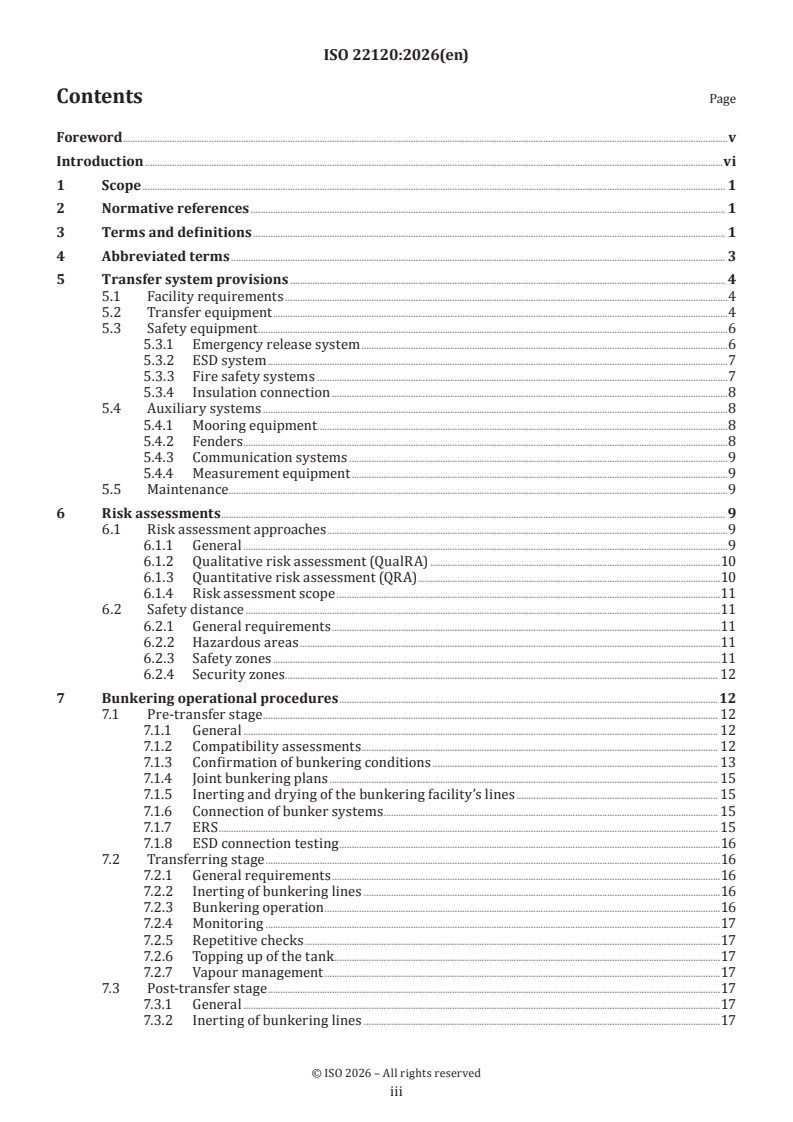
Contents Page
Foreword .v
Introduction .vi
1 Scope . 1
2 Normative references . 1
3 Terms and definitions . 1
4 Abbreviated terms . 3
5 Transfer system provisions . 4
5.1 Facility requirements .4
5.2 Transfer equipment .4
5.3 Safety equipment .6
5.3.1 Emergency release system .6
5.3.2 ESD system .7
5.3.3 Fire safety systems .7
5.3.4 Insulation connection .8
5.4 Auxiliary systems .8
5.4.1 Mooring equipment .8
5.4.2 Fenders .8
5.4.3 Communication systems .9
5.4.4 Measurement equipment .9
5.5 Maintenance . .9
6 Risk assessments . 9
6.1 Risk assessment approaches .9
6.1.1 General .9
6.1.2 Qualitative risk assessment (QualRA) .10
6.1.3 Quantitative risk assessment (QRA) .10
6.1.4 Risk assessment scope .11
6.2 Safety distance .11
6.2.1 General requirements .11
6.2.2 Hazardous areas .11
6.2.3 Safety zones .11
6.2.4 Security zones . 12
7 Bunkering operational procedures .12
7.1 Pre-transfer stage . 12
7.1.1 General . 12
7.1.2 Compatibility assessments . 12
7.1.3 Confirmation of bunkering conditions . 13
7.1.4 Joint bunkering plans . 15
7.1.5 Inerting and drying of the bunkering facility’s lines . 15
7.1.6 Connection of bunker systems . 15
7.1.7 ERS . 15
7.1.8 ESD connection testing .16
7.2 Transferring stage .16
7.2.1 General requirements .16
7.2.2 Inerting of bunkering lines .16
7.2.3 Bunkering operation .16
7.2.4 Monitoring .17
7.2.5 Repetitive checks .17
7.2.6 Topping up of the tank .17
7.2.7 Vapour management .17
7.3 Post-transfer stage .17
7.3.1 General .17
7.3.2 Inerting of bunkering lines .17
iii
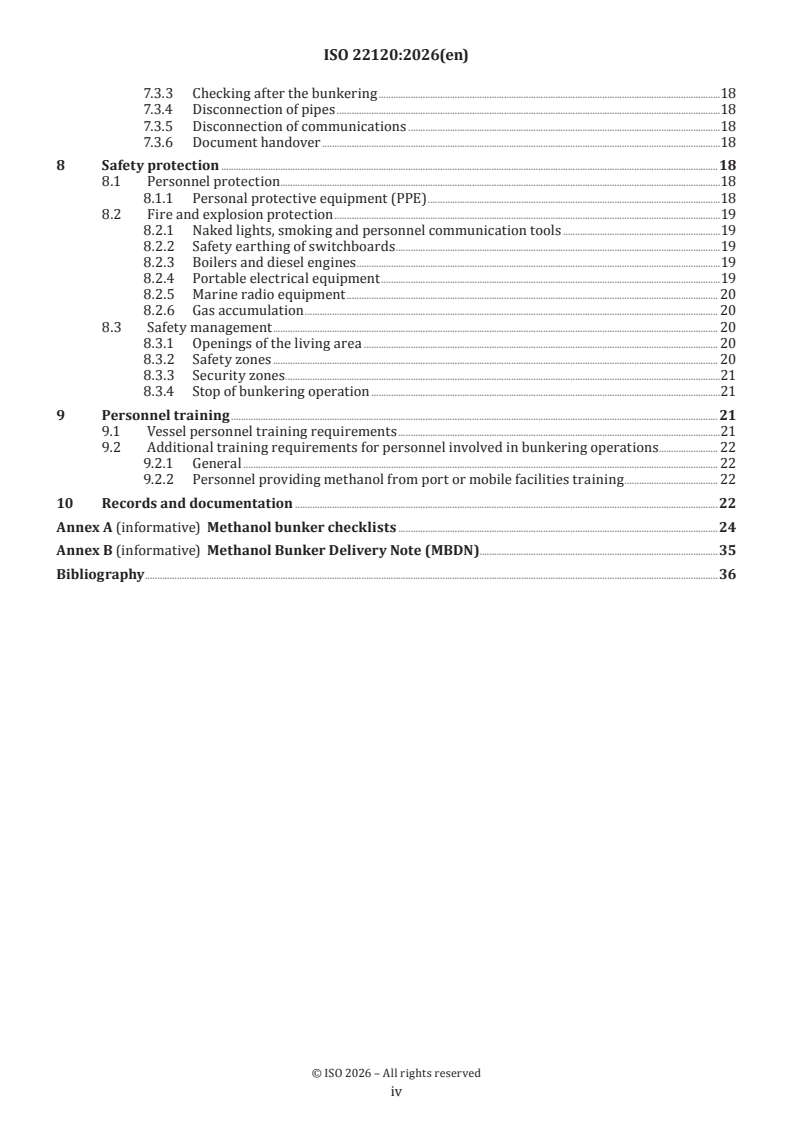
7.3.3 Checking after the bunkering .18
7.3.4 Disconnection of pipes .18
7.3.5 Disconnection of communications .18
7.3.6 Document handover .18
8 Safety protection .18
8.1 Personnel protection . .18
8.1.1 Personal protective equipment (PPE) .18
8.2 Fire and explosion protection .19
8.2.1 Naked lights, smoking and personnel communication tools .19
8.2.2 Safety earthing of switchboards .19
8.2.3 Boilers and diesel engines .19
8.2.4 Portable electrical equipment .19
8.2.5 Marine radio equipment . 20
8.2.6 Gas accumulation . 20
8.3 Safety management . 20
8.3.1 Openings of the living area . 20
8.3.2 Safety zones . 20
8.3.3 Security zones .21
8.3.4 Stop of bunkering operation .21
9 Personnel training .21
9.1 Vessel personnel training requirements .21
9.2 Additional training requirements for personnel involved in bunkering operations . 22
9.2.1 General . 22
9.2.2 Personnel providing methanol from port or mobile facilities training . 22
10 Records and documentation .22
Annex A (informative) Methanol bunker checklists .24
Annex B (informative) Methanol Bunker Delivery Note (MBDN).35
Bibliography .36
iv
Foreword
ISO (the International Organization for Standardization) is a worldwide federation of national standards
bodies (ISO member bodies). The work of preparing International Standards is normally carried out through
ISO technical committees. Each member body interested in a subject for which a technical committee
has been established has the right to be represented on that committee. International organizations,
governmental and non-governmental, in liaison with ISO, also take part in the work. ISO collaborates closely
with the International Electrotechnical Commission (IEC) on all matters of electrotechnical standardization.
The procedures used to develop this document and those intended for its further maintenance are described
in the ISO/IEC Directives, Part 1. In particular, the different approval criteria needed for the different types
of ISO document should be noted. This document was drafted in accordance with the editorial rules of the
ISO/IEC Directives, Part 2 (see www.iso.org/directives).
ISO draws attention to the possibility that the implementation of this document may involve the use of (a)
patent(s). ISO takes no position concerning the evidence, validity or applicability of any claimed patent
rights in respect thereof. As of the date of publication of this document, ISO had not received notice of (a)
patent(s) which may be required to implement this document. However, implementers are cautioned that
this may not represent the latest information, which may be obtained from the patent database available at
www.iso.org/patents. ISO shall not be held responsible for identifying any or all such patent rights.
Any trade name used in this document is information given for the convenience of users and does not
constitute an endorsement.
For an explanation of the voluntary nature of standards, the meaning of ISO specific terms and expressions
related to conformity assessment, as well as information about ISO's adherence to the World Trade
Organization (WTO) principles in the Technical Barriers to Trade (TBT), see www.iso.org/iso/foreword.html.
This document was prepared by Technical Committee ISO/TC 8, Ships and marine technology, Subcommittee
SC 25, Maritime GHG reduction.
Any feedback or questions on this document should be directed to the user’s national standards body. A
complete listing of these bodies can be found at www.iso.org/members.html.
v
Introduction
This document has been produced to meet an industry need for additional safety guidance related to the
use of alternative fuels on board ships, as identified by the International Maritime Organization (IMO). This
document has been designed to support the IMO International Code of Safety for Ships using Gases or other
[12]
Low-flashpoint Fuels (IGF Code) and the IMO Interim Guidelines for the Safety of Ships Using Methyl/
[10]
Ethyl Alcohol as Fuel (IMO MSC.1/Circ.1621).
Due to numerous economic and environmental factors, the use of methanol as a vessel’s fuel has increased.
The increase in methanol-fuelled vessels corresponds to an increase in methanol bunkering operations.
Therefore, there is a need to standardize methanol bunkering operations internationally to a reasonable
degree, so that vessel operators have the tools to select vessel fuel providers who meet set safety standards
and so that methanol bunkering operations can be conducted safely. This document can be used for vessels
involved in both international and domestic service, regardless of size.
This document is flexible so that it can be applied in many situations and under various regulatory regimes
as long as the requirements of this document are met.
vi
International Standard ISO 22120:2026(en)
Ships and marine technology — Specification for bunkering of
methanol fuelled vessels
1 Scope
This document provides requirements for methanol bunkering transfer systems and equipment used to
bunker methanol-fuelled vessels. This document covers the following five elements:
a) transfer systems;
b) operational procedures;
c) risk assessment;
d) safety protection;
e) personnel training.
2 Normative references
The following documents are referred to in the text in such a way that some or all of their content constitutes
requirements of this document. For dated references, only the edition cited applies. For undated references,
the latest edition of the referenced document (including any amendments) applies.
IEC 60079-10-1, Explosive atmospheres — Part 10-1: Classification of areas — Explosive gas atmospheres
IEC 60092-502, Electrical installations in ships — Part 502: Tankers — Special features
3 Terms and definitions
For the purposes of this document, the following terms and definitions apply.
ISO and IEC maintain terminology databases for use in standardization at the following addresses:
— ISO Online browsing platform: available at https:// www .iso .org/ obp
— IEC Electropedia: available at https:// www .electropedia .org/
3.1
bunkering
transfer of methanol fuel from land-based or floating facilities into ships' permanent tanks or connection of
portable tanks to the fuel supply system
3.2
bunkering facility
facility with methanol storage and bunkering (3.1) systems, which can be a fixed facility such as a shore-
based bunkering facility (3.19) or mobile facility (3.13) e.g. bunkering ships (3.3), bunkering trucks
3.3
bunkering ship
ship provided with methanol tanks, bunker systems and metering equipment and used for the transfer of
methanol fuel to a receiving ship (3.16)
3.4
classification society
non-governmental organization that establishes and maintains technical standards for the construction and
operation of ships and offshore structures
3.5
dry disconnect
method that reduces methanol liquid or vapours releases into the atmosphere under normal operation to a
negligible amount consistent with safety by equipment design
3.6
emergency release coupling
ERC
break-away coupling
coupling installed on methanol liquid and vapour lines, as a component of an emergency release system (3.7),
to ensure the quick physical disconnection of the transfer system from the unit to which it is connected,
designed to prevent damage to loading/unloading equipment in the event that the transfer system’s
operational envelope and/or parameters are exceeded beyond a predetermined point
3.7
emergency release system
ERS
system that provides a safe shut down, transfer system isolation and quick release of hoses or loading arms
between the facility or vessel providing the methanol, and the vessel receiving the methanol, preventing
product release at disconnection time
3.8
emergency shutdown system
ESD system
system that safely and effectively stops the transfer of methanol and vapour between the facility or vessel
providing the methanol and the vessel receiving the methanol or vice versa
3.9
fender
large pad absorbing the impact energy to the ship while berthing, which has a sufficient width to keep the
ships from contacting with each other or a shore facility
3.10
loading arm
articulated metal transfer system used for transferring methanol to the vessel being bunkered
3.11
lower flammable limit
LFL
concentration of flammable gas or vapour in air, below which an explosive gas atmosphere does not form
3.12
management system
set of interrelated or interacting elements of an organization to establish policies and objectives, as well as
processes to achieve those objectives
[SOURCE: ISO 9000:2015, 3.5.3]
3.13
mobile facility
trucks, rail car, ship or other mobile device (including portable tanks) used to transfer methanol to a
receiving ship (3.16)
3.14
methanol transfer system
equipment between the delivering facility and the bunkering manifold on the receiving ship (3.16)
3.15
recognized organization
competent organization with delegated authority on behalf of an Administration to assist in the uniform
and effective implementation of International Maritime Organization Codes and Conventions
3.16
receiving ship
vessel that uses methanol as a fuel and does not use methanol cargo for fuel purposes
3.17
safety zone
area around the bunkering station where only dedicated and essential personnel and activities are allowed
during bunkering
3.18
security zone
area established by the national or local authorities around a bunkering facility (3.2) or area through which
vessel and personnel movement is subject to regulatory restrictions
3.19
shore-based bunkering facility
onshore facility which is designed with methanol tanks, bunker systems and metering equipment to directly
supply methanol to the receiving ship (3.16)
4 Abbreviated terms
Table 1 gives information on the abbreviated terms used in this document.
Table 1 — Abbreviated terms
Term Description Explanation
[11]
IBC International Maritime Organization’s The IBC Code applies to ships involved in the carriage of bulk
Code International Code for the Construc- dangerous chemicals and prescribes the design and construction
tion and Equipment of Ships carrying standards of ships involved in such carriage and the equipment
Dangerous Chemicals in Bulk they should carry.
[12]
IGF International Maritime Organization’s The IGF Code applies to ships fuelled by gases or other
International Code of Safety for Ships
Code low-flashpoint fuels. The Code contains mandatory provisions for
using Gases or other Low-flashpoint
the arrangement, installation, control and monitoring of machin-
Fuels
ery, equipment and systems using low-flashpoint fuels.
IACS International Association of An organization that establishes, reviews, promotes and devel-
ops minimum technical requirements in relation to the design,
Classification Societies
construction, maintenance and survey of ships and other marine
related facilities. IACS assists international regulatory bodies
and standards organizations to develop, implement and interpret
statutory regulations and industry standards in ship design,
construction and maintenance, with a view to improving safety at
sea and the prevention of marine pollution.
IMO International Maritime Organization A specialized agency of the United Nations whose purpose is to
promote cooperation among governments in relation to the regu-
lation and practices affecting international shipping, to encour-
age the adoption of high standards for navigational efficiency, and
to prevent and control pollution from ships.
OCIMF Oil Companies International Marine Association that was formed in response to the growing pub-
Forum lic concern about marine pollution, particularly by oil. OCIMF
focuses on promoting best practice in the design, construction
and operation of tankers, barges and offshore vessels and their
interfaces with terminals inshore, onshore and offshore.
[13]
STCW International Convention on Standards This Convention promotes the safety of life and property at
of Training, Certification and Watch- sea and the protection of the marine environment by establishing
keeping for Seafarers training, certification and watchkeeping for seafarers, in common
agreement with international standards.
5 Transfer system provisions
5.1 Facility requirements
5.1.1 Mobile facilities including their tanks, piping, hoses, pumps and valves shall be designed and
fabricated to ensure safe handling and transfer of methanol under the intended operating conditions.
5.1.2 The bunkering terminal shall ensure safe methanol bunkering operations. The terminal operator
shall obtain a document issued by a competent organization or individual, such as a qualified engineer,
confirming that the terminal achieves a level of safety consistent with good industry practice.
5.1.3 Proper devices or arrangements shall be fitted to the bunkering facility to avoid dispersal or venting
methanol vapour to the atmosphere other than when necessary for emergency/safety reasons (e.g. use of
vapour return lines from receiving ship to the bunkering ship).
5.2 Transfer equipment
5.2.1 All equipment used in the transfer system should meet the requirements defined for each specific
piece of equipment as prescribed in 5.2.2 to 5.2.4. All the components of the transfer system should be
fabricated to meet or exceed the applicable standards indicated in Table 2. It is also expected that these
[11] [12]
components meet the IBC Code and IGF Code.
Table 2 — Standards relevant to transfer system components
Component Function Standards
Hoses Transfer of methanol ISO 27126 or EN 13765 or EN 12115
Flanges Product line connections ASME B16.5
OCIMF Design and Construction Specification
Loading arms Methanol bunkering loading solution
[16]
for Marine Loading Arms
OCIMF Linked Ship/Shore Emergency Shut-
Emergency shutdown systems Emergency shutdown down Systems for Oil and Chemical Trans-
[17]
fers
5.2.2 All flanges used in transfer system should be at least Class 150 according to ASME B16.5. Flanges
shall be of the welded-neck, slip-on or socket-welded type. However, socket-welded-type flanges shall not be
used in nominal size above 50 mm.
5.2.3 If dry disconnect couplings of up to and including the nominal pipe size of 6 inches are used, the
dimensions and tolerances should be according to ASTM F1122-22 to meet compatibility requirements.
5.2.4 Materials used in transfer equipment in contact with methanol or its vapour shall be compatible
with the characteristics of methanol.
5.2.5 Hoses
5.2.5.1 Bunker hoses should be an approved type and be suitable for methanol. The bunker hoses should
also conform to the applicable requirements of recognized standards, such as ISO 27126, EN 13765 and
EN 12115.
5.2.5.2 Bunker hoses shall be prototype-tested at a normal ambient temperature, with 200 pressure
cycles from zero to at least twice the specified maximum working pressure. After this cycle pressure test has
been carried out, the prototype test shall demonstrate a bursting pressure of at least 5 times its specified
maximum working pressure at the upper and lower extreme service temperature. Hoses used for prototype
testing shall not be used for bunker service.
5.2.5.3 Before being placed in service, each new length of bunker hose produced shall be hydrostatically
tested at ambient temperature to a pressure not less than 1,5 times its specified maximum working
pressure, but not more than two fifths of its bursting pressure. The hose shall be stencilled, or otherwise
marked, with the date of testing, its specified maximum working pressure and, if used in services other than
ambient temperature services, its maximum and minimum service temperature, as applicable. The specified
maximum working pressure shall not be less than 1 MPa gauge.
5.2.5.4 Each hose assembly shall be visually examined with regards to pressure rating, tightness, other
performance data if available and the marking as per the following list:
a) manufacturer's name or trademark;
b) identification code of nominal specification of the manufacturer;
c) factory test pressure (equivalent to rated working pressure, maximum working pressure and maximum
allowable working pressure);
d) diameter, range of working temperature and minimum bend radius, etc.;
e) date of manufacture and manufacturer’s serial number;
f) instruction of the electrostatic properties and conductivity of hoses;
g) designed service object type.
5.2.5.5 The nominal diameter of the hose line including connectors shall be determined based on the
maximum flow velocity and the transfer rate.
5.2.5.6 The hose line shall have sufficient length, based on a detailed compatibility study between the
bunkering facility and receiving ship manifold arrangement.
5.2.5.7 Hoses and hose assemblies shall be handled with care. They shall not be dragged over sharp edges
or abrasive surfaces. They shall not be subjected to kinking and flattening.
5.2.5.8 Hoses and hose assemblies shall be used under normal operating conditions up to the maximum
working pressure.
5.2.5.9 The hose manufacturer’s requirements regarding lifetime, inspection and maintenance shall be
followed.
5.2.6 Loading arms
5.2.6.1 The condition of the loading arm shall be checked before operation. The pipes and swivels shall be
visually examined regarding tightness and free rotation. Purging connections shall be checked for tight fit.
Hydraulic or pneumatic lines, to operate the arm or the ERC, shall also be visually examined.
5.2.6.2 The working envelope of the loading arm shall cover the operating range, based on a detailed
compatibility study between bunkering facility and receiving ship manifold arrangement.
5.2.6.3 The compatibility of the connector shall be checked before bunkering operation. Spool pieces and
adapters may be used to achieve compatibility.
5.2.7 Bunkering connections
5.2.7.1 Dry disconnect couplings may be considered for frequent bunkering operations with hoses. They
may be used on loading arms if the load case study shows that the loads are inside the limits of the coupling
specification.
5.2.7.2 Before starting the bunker operation, a tightness test of the connection shall be performed.
5.2.7.3 Prior to connection, the connectors shall be checked to be free from debris, other foreign objects
and mechanical damage. If necessary foreign objects shall be removed and cleaned from the interface.
5.3 Safety equipment
5.3.1 Emergency release system
5.3.1.1 The transfer system shall be fitted with an emergency release system (ERS) and connected to
an emergency shutdown (ESD) system. The bunkering facility and receiving ship ESD systems shall be
interconnected with a ship/shore or ship/ship ESD link, or an equivalent means, to ensure the coordinated
operation of both the bunkering and receiving ESD systems and ERS.
5.3.1.2 The ERS shall be designed to protect the transfer system and the connections by disconnecting
the transfer system, primarily in the event that the vessel drifts out of its operating envelope. The ERS shall
consist of an ERC including interlocked isolating valves to minimize the spill of methanol to the environment
when the ERC is activated.
5.3.1.3 The ERS shall be designed to operate as a dry break system. The following shall also apply.
a) The ERS shall be designed to separate before the hose or loading arm is overstressed, and the calculated
force or bending moment shall be documented.
b) The ERS shall be designed to maintain integrity without leakage.
c) The consequences of an emergency breakaway in terms of resultant surge pressures shall be determined
and demonstrated to be within the capability of the supply system to not exceed the design pressure.
5.3.1.4 The arrangement of the ERC in the transfer line shall be considered to minimize risks such as
creating sparks, causing mechanical damage, inducing pressure surges, or injuring personnel upon release.
5.3.1.5 Regular inspections and maintenance of ERS shall be carried out in accordance with the
manufacturer’s requirements. The records shall be stored for traceability.
5.3.2 ESD system
5.3.2.1 The ESD system shall be designed to be activated by operator-initiated signals as well as sensor
input. When activated, the ESD system shall initiate the shutting down of the methanol transfer pumps and
closing of the ESD valves. At a minimum, the ESD system shall include sensors that provide input in the event
of:
a) fire or leakage detection, either leakage in liquid form or as vapour;
b) loss of ventilation in the annular space in the bunkering line, or at the closed/semi-enclosed bunkering
stations;
c) overfilling of the receiving tank indicated by the high-level and high-high-level alarm;
d) loading arm or hose reaching the ESD limits inside the operation envelope prior to ERC disconnection;
e) manual initiation or other safety critical alarms.
5.3.2.2 The proper connection of the ESD link shall be checked prior to bunkering.
5.3.2.3 In case of an ESD, the bunker operation shall only be restarted after checking the safety functions
and, if applicable, resetting the ERS and the ERCs according to manufacturer’s instructions.
5.3.2.4 The presence of a truck-to-ship bunker system can eliminate the requirement for the ESD link
system to comply with Appendix A and B of the OCIMF Linked Ship/Shore Emergency Shutdown Systems for Oil
[17]
and Chemical Transfers.
5.3.3 Fire safety systems
5.3.3.1 Firefighting equipment of the bunkering facility and the receiving ship shall be ready for immediate
use during the bunkering operation, and the power source shall readily provide power to the fire safety
system, to cope with the potential dangers.
5.3.3.2 Methanol burns with a near-invisible flame in daylight. Therefore, the fire detection and
firefighting system should include an infrared flame detector.
5.3.3.3 The bunkering ship should be equipped with a fixed lightning arresting system to protect the
vessel and associated equipment from potential lightning strikes. The lightning arresting system is expected
to be installed on the main and foremast. A fixed or portable lightning warning system is also expected to be
provided to indicate lightning hazards.
5.3.3.4 Fire monitoring and alarm systems shall be engaged during the bunkering operation.
5.3.3.5 For shore-to-ship or truck-to-ship bunkering, two portable alcohol resistant foam extinguishers of
at least 9 L capacity and portable flame-detection devices shall be provided within the bunkering operation
area.
5.3.3.6 For shore-to-ship or truck-to-ship bunkering, emergency fire-fighting appliance, emergency
leakage equipment, emergency eye wash stations and showers should be provided within the bunkering
operation area.
5.3.4 Insulation connection
5.3.4.1 Differences in the electrical potential between the bunkering facility and the receiving ship can be
significant and pose a risk to sparking. Electrical insulation in the transfer line shall be provided, either by
using insulation flanges or non-conductive hose lengths.
5.3.4.2 Static electricity is a potential source of sparks, which can ignite flammable liquids or vapours.
Static control measures may include the following:
a) bonding and grounding of tank structures, loading and transferring lines, and system equipment;
b) use of conductive hoses with bonding at both ends for connections between the bunkering ship and the
receiving ship;
c) bonding or insulation of interface connections between the bunkering ship and the receiving ship;
d) isolation of mooring lines, gangways, and other physical connections.
5.4 Auxiliary systems
5.4.1 Mooring equipment
5.4.1.1 A bunkering ship shall be provided with qualified mooring lines and winches and roller chocks
with reasonable arrangement and sufficient strength. It is recommended that the cables are laid only on
the winch with a brake. Approved closed chocks shall be used on board. Mooring equipment must comply
[9]
with IMO MSC/Circ.1175. For safety reasons, flexible mooring lines are recommended to be quickly
disconnected in case of danger.
5.4.1.2 The mooring equipment shall be so arranged that the mooring lines do not accommodate excessive
tension due to the ship’s movement or the change in freeboard during the operations. Mooring lines in the
same direction shall be of similar size and material.
5.4.1.3 For ship-to-ship bunkering, a mooring analysis or ship model test should be considered to ensure
the mooring safety by the receiving ship. The mooring analysis or ship model test should be carried out by
the bunkering ship. The mooring analysis should be undertaken according to the OCIMF Mooring Equipment
[18]
Guidelines.
5.4.2 Fenders
5.4.2.1 A bunkering ship shall be provided with fenders. The fenders shall be so arranged as to help
berthing the bunkering ship and distribute the expected maximum impact force to the dead flat of the
receiving ship.
5.4.2.2 The cables for the fenders shall be made of materials such as synthetic fibre material.
5.4.2.3 The fenders shall be regularly monitored for any adjustment needed to prevent them from being
too loose or too tight, to ensure that they will be free from displacement.
5.4.3 Communication systems
5.4.3.1 Effective communication shall be kept at all times during mooring and bunkering. No mooring or
transfer operation shall begin until effective communication has been confirmed by all parties involved.
If necessary, electrical, fibre-optic, pneumatic and wireless communication, or a combination thereof, may
be used to achieve the transmission of data, ESD information, ERS information, and voice between the
bunkering facility and the receiving ship.
5.4.3.2 Effective auxiliary voice communication shall be provided between the bunkering facility and the
receiving ship, such as very high frequency/ultra-high frequency (VHF/UHF) walkie-talkies and hand-held
radios.
5.4.3.3 The receiving ship shall hoist a letter B signal flag on the main mast during the day as well as at
night and display the necessary signal when transferring fuel at night.
5.4.4 Measurement equipment
Measurement equipment (such as flow meters) or methods shall minimize the impact on methanol flow and
shall not affect the safety of the transfer system.
5.5 Maintenance
Equipment manufactured or fabricated to meet the specific provisions identified in 5.2 to 5.4 shall be
maintained and inspected according to the recommendations of the manufacturer of that equipment.
Equipment whose design is not linked to a specific standard shall be maintained and inspected according to
requirements set by the Flag State, Recognized Organization or Classification Society that complies with the
applicable uniform interpretations and requirements posted by IACS.
6 Risk assessments
6.1 Risk assessment approaches
6.1.1 General
6.1.1.1 A bunkering operation risk assessment is expected to be undertaken according to relevant
standards, such as IEC 31010. The risk assessment intends to:
a) demonstrate that risks to personnel and the environment have been eliminated where possible, and if
not, mitigated as necessary, and
b) provide insight and information to help set the required safety zone and security zone around the
bunkering operation.
6.1.1.2 The risk assessment remains valid as long as conditions and presumptions remain unchanged. If
there are any changes, the assessment shall be revised or performed again for the changed part and its
affected part.
6.1.1.3 As a minimum, the bunkering operation risk assessment shall cover the following operations:
a) preparations before and on the ship’s arrival, approach and mooring;
b) preparation, testing and connection of equipment;
c) methanol transfer and vapour return management;
d) completion of bunker transfer and disconnection of equipment; and
e) personnel and environment.
6.1.2 Qualitative risk asses
...