

ISO 7627-4:1983
(Main)Hardmetals — Chemical analysis by flame atomic absorption spectrometry — Part 4: Determination of molybdenum, titanium and vanadium in contents from 0,01 to 0,5 % (m/m)
General Information
- Abstract
General requirements concerning the field of application, principle, interfering elements,aparatus, sampling and test report are given in ISO 7627-1.
- Status
- Published
- Publication Date
- 30-Sep-1983
- Technical Committee
- ISO/TC 119/SC 4 - Sampling and testing methods for hardmetals
- Drafting Committee
- ISO/TC 119/SC 4 - Sampling and testing methods for hardmetals
- Current Stage
- 9093 - International Standard confirmed
- Start Date
- 12-Dec-2025
- Completion Date
- 29-Aug-2026
Buy Documents

ISO 7627-4:1983 - Hardmetals — Chemical analysis by flame atomic absorption spectrometry — Part 4: Determination of molybdenum, titanium and vanadium in contents from 0,01 to 0,5 % (m/m) Released:10/1/1983

ISO 7627-4:1983 - Métaux-durs — Analyse chimique par spectrométrie d'absorption atomique dans la flamme — Partie 4: Dosage du molybdene, du titane et du vanadium a des teneurs comprises entre 0,01 et 0,5 % (m/m) Released:10/1/1983
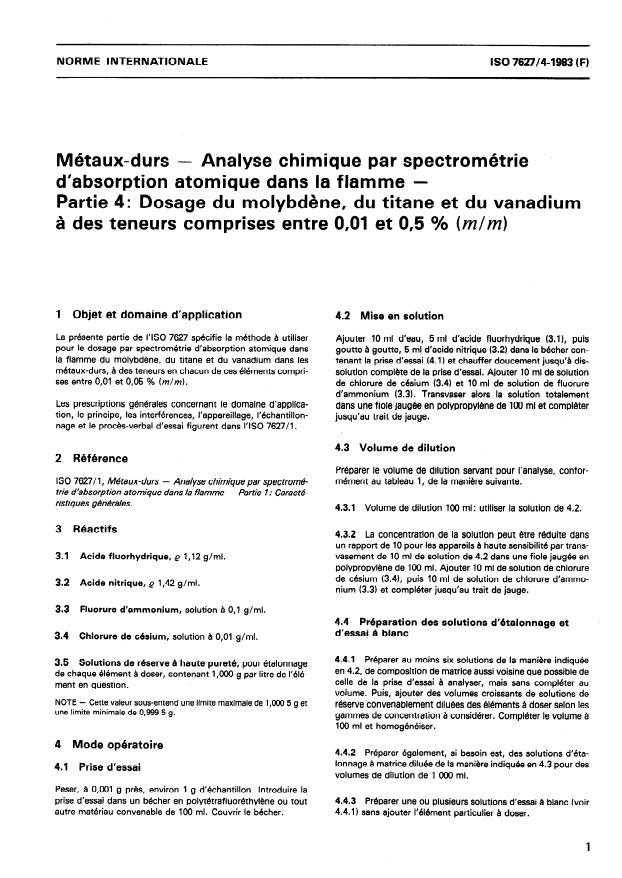

ISO 7627-4:1983 - Métaux-durs — Analyse chimique par spectrométrie d'absorption atomique dans la flamme — Partie 4: Dosage du molybdene, du titane et du vanadium a des teneurs comprises entre 0,01 et 0,5 % (m/m) Released:10/1/1983
Overview
ISO 7627-4:1983 is an international standard developed by ISO (International Organization for Standardization) for the chemical analysis of hardmetals using flame atomic absorption spectrometry. This part addresses the precise determination of molybdenum, titanium, and vanadium in hardmetals, specifically within the content range of 0.01% to 0.5% (m/m). The procedures defined are tailored to ensure accurate and reliable measurement of these elements, which are critical for material quality control and consistency in industrial applications.
ISO 7627-4 is part of the broader ISO 7627 series, which covers various aspects of chemical analysis for hardmetals. The general requirements for application, methodology, and reporting are detailed in ISO 7627-1. This part (ISO 7627-4) focuses specifically on the analysis of the mentioned elements, offering standardization vital for laboratories and manufacturers engaged in powder metallurgy and hardmetals production.
Key Topics
- Scope: Determination of Mo, Ti, and V content in hardmetals from 0.01% to 0.5% (m/m)
- Analytical Method: Utilizes flame atomic absorption spectrometry (FAAS) for sensitive and selective measurement
- Sample Preparation: Procedures include dissolution of the test portion using hydrofluoric acid, nitric acid, ammonium fluoride, and caesium chloride
- Calibration and Blanks: Preparation of calibration and blank solutions mirroring the sample matrix for enhanced accuracy
- Measurement Protocol: Use of absorbance readings corrected against blanks, calibration curve plotting, and result calculation
- Reporting: Guidelines on rounding and reproducibility of results, ensuring clarity and comparability in reporting data
Applications
ISO 7627-4:1983 is crucial for industries and laboratories involved in:
- Quality Control of Hardmetals: Ensures the correct alloy composition of molybdenum, titanium, and vanadium, which affect performance aspects like hardness, wear resistance, and strength
- Production Consistency: Assists manufacturers in maintaining product specifications and traceability by following a standardized test methodology
- Material Certification and Compliance: Enables companies to certify their products meet international requirements for content of key alloying elements
- Research and Development: Supports material scientists and engineers in the accurate characterization of new hardmetal compositions
The standard is widely used in powder metallurgy, tool making, mining, and manufacturing sectors where reliable analysis of hardmetals is essential for both product development and regulatory compliance.
Related Standards
ISO 7627-1: Hardmetals - Chemical analysis by flame atomic absorption spectrometry - Part 1: General requirements
This standard outlines fundamental requirements regarding the field of application, principle, interfering elements, apparatus, sampling, and test reporting procedures.Other Parts of ISO 7627 Series:
Additional parts cover the determination of other elements and complementary methods for hardmetal analysis, helping laboratories build a comprehensive analytical framework.ISO/TC 119 Standards:
Developed by the ISO Technical Committee ISO/TC 119 (Powder metallurgy), these standards collectively address testing and analysis within the powder metallurgy and hardmetals sectors.
By employing ISO 7627-4, organizations can ensure high standards of analytical accuracy, comparability, and process efficiency for element determination in hardmetals. This standard supports both regulatory compliance and the advancement of materials engineering practices.
Buy Documents
ISO 7627-4:1983 - Hardmetals — Chemical analysis by flame atomic absorption spectrometry — Part 4: Determination of molybdenum, titanium and vanadium in contents from 0,01 to 0,5 % (m/m) Released:10/1/1983
ISO 7627-4:1983 - Métaux-durs — Analyse chimique par spectrométrie d'absorption atomique dans la flamme — Partie 4: Dosage du molybdene, du titane et du vanadium a des teneurs comprises entre 0,01 et 0,5 % (m/m) Released:10/1/1983
ISO 7627-4:1983 - Métaux-durs — Analyse chimique par spectrométrie d'absorption atomique dans la flamme — Partie 4: Dosage du molybdene, du titane et du vanadium a des teneurs comprises entre 0,01 et 0,5 % (m/m) Released:10/1/1983
Get Certified
Connect with accredited certification bodies for this standard

Element Materials Technology
Materials testing and product certification.

Inštitut za kovinske materiale in tehnologije
Institute of Metals and Technology. Materials testing, metallurgical analysis, NDT.
Sponsored listings
Frequently Asked Questions
ISO 7627-4:1983 is a standard published by the International Organization for Standardization (ISO). Its full title is "Hardmetals — Chemical analysis by flame atomic absorption spectrometry — Part 4: Determination of molybdenum, titanium and vanadium in contents from 0,01 to 0,5 % (m/m)". This standard covers: General requirements concerning the field of application, principle, interfering elements,aparatus, sampling and test report are given in ISO 7627-1.
General requirements concerning the field of application, principle, interfering elements,aparatus, sampling and test report are given in ISO 7627-1.
ISO 7627-4:1983 is classified under the following ICS (International Classification for Standards) categories: 77.160 - Powder metallurgy. The ICS classification helps identify the subject area and facilitates finding related standards.
ISO 7627-4:1983 is available in PDF format for immediate download after purchase. The document can be added to your cart and obtained through the secure checkout process. Digital delivery ensures instant access to the complete standard document.
Standards Content (Sample)
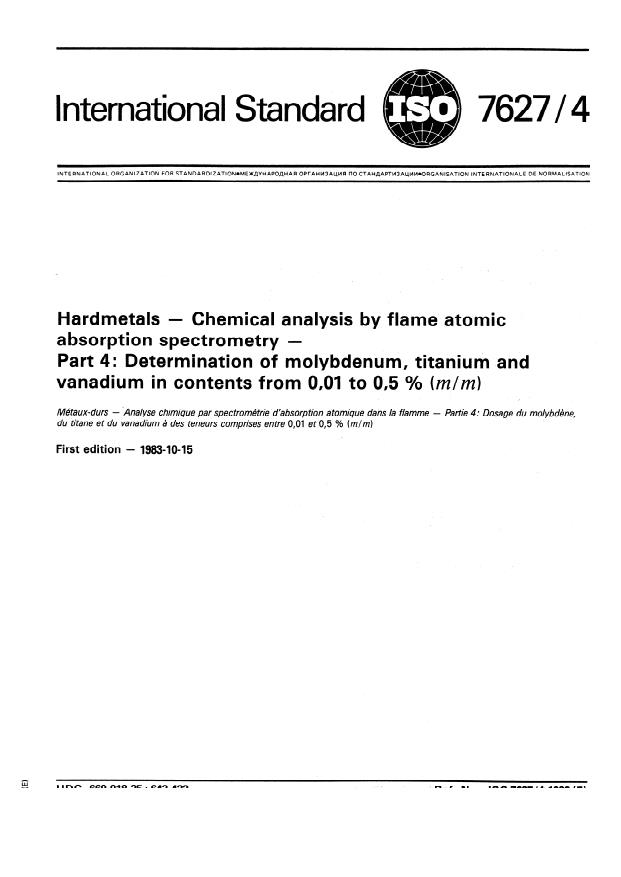
International Standard 762714
INTERNATIONAL ORGANIZATION FOR STANDARDIZATION.MEX~YHAPOAHAR OPTAHM3AUMR fl0 CTAH~APTM3A~MM.ORGANlSATlON INTERNATIONALE DE NORMALISATION
Hardmetals - Chemical analysis by flame ’.atomic
absorption spectrometry -
Part 4: Determination of molybdenum, titanium and
vanadium in contents from 0,Ol to 0,5 % (mlm)
Mkaux-durs - Analyse cbimique par spectrometrie d ’absorp tion a tomique dans Ia flamme - Partie 4: Dosage du mo/ybd&ne,
du titane et du vanadium a des teneurs comprises entre Q,Ol et 0,5 % (mlm)
First edition
- 1983-10-15
-
.
r .<
UDC 669.018.25 : 643.422
’ Ref. No. ISO 7627/4-1983 (EI
Foreword
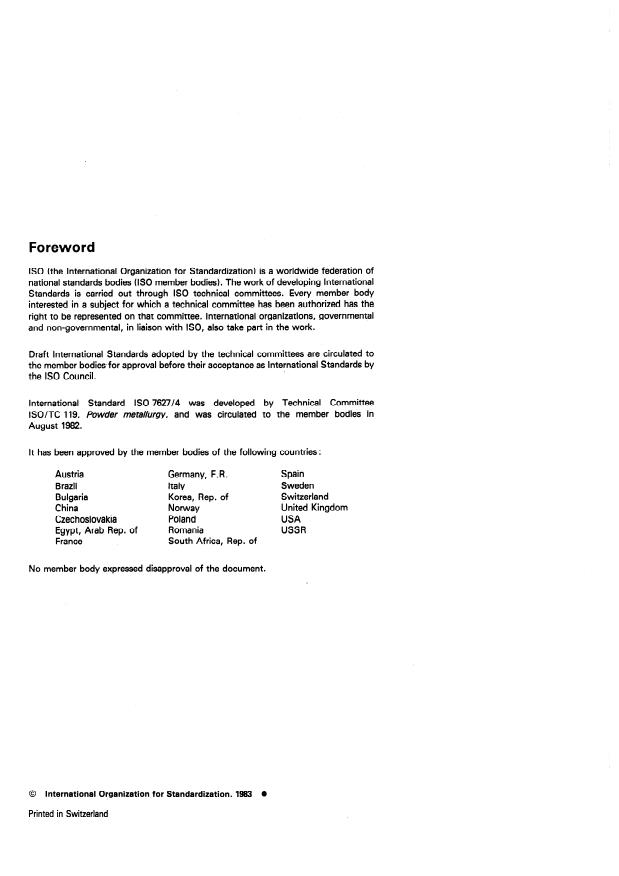
ISO (the International Organization for Standardization) is a worldwide federation of
national Standards bodies (ISO member bodies). The work of developing International
Standards is carried out through ISO technical committees. Every member body
interested in a subject for which a technical committee has been authorized has the
right to be represented on that committee. International organizations, governmental
and non-governmental, in liaison with ISO, also take patt in the work.
Draft International Standards adopted by the technical committees are circulated to
the member bodiesfor approval before their acceptance as International Standards by
the ISO Council.
International Standard ISO 7627/4 was developed by Technical Committee
ISO/TC 119, Powder metahrgy, and was circulated to the member bodies in
August 1982.
lt has been approved by the member bodies of the following countries:
Spain
Austria Germany, F. R.
Brazil Italy Sweden
Switzerland
Bulgaria Korea, Rep. of
China Norway United Kingdom
Czechoslovakia Poland USA
Egypt, Arab Rep. of Romania USSR
South Africa, Rep. of
France
No member body expressed disapproval of the document.
0 International Organkation for Standardkation, 1983 0
Printed in Switzerland
INTERNATIONAL STANDARD ISO 7627/4-1983 (E)
Hardmetals - Chemical analysis by flame atomic
absorption spectrometry -
Part 4: Determination of molybdenum, titanium and
vanadium in contents from 0,Ol to 0,5 % (mlm)
.
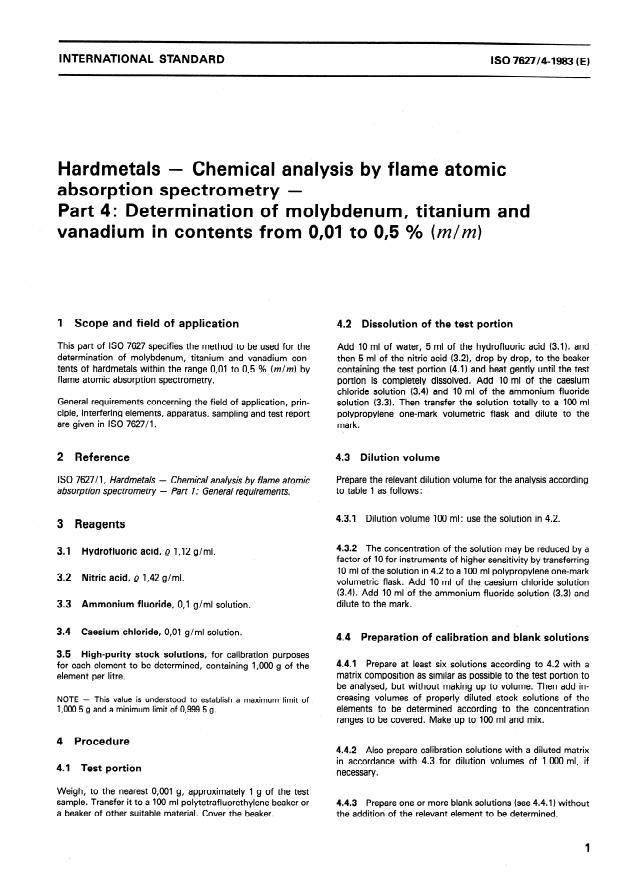
1 Scope and field of application 4.2 Dissolution of the test Portion
This part of ISO 7627 specifies the method to be used for the
Add 10 ml of water, 5 ml of the hydrofluoric acid (3.1). and
determination of molybdenum, titanium and vanadium con- then 5 ml of the nitric acid (3.21, drop by drop, to the beaker
tents of hardmetals within the range 0,Ol to 0,5 % (Nm) by
containing the test Portion (4.1) and heat gently until the test
flame atomic absorption spectrometry.
Portion is completely dissolved. Add 10 ml of the caesium
chloride Solution (3.4) and 10 ml of the ammonium fluoride
General requirements concerning the fieid of application, prin- Solution (3.3). Then transfer the Solution totally to a 100 ml
ciple, interfering elements, apparatus, sampling and test report polypropylene one-mark volumetric flask and dilute to the
are given in ISO 7627/1. mark.
4.3 Dilution volume
2 Reference
Prepare the relevant dilution volume for the analysis according
ISO 762711, Hardmetals - Chemical analysis b y flame atomic
to table 1 as follows:
absorp tion spectrometry - Part 7: General requirements. .
4.3.1 Dilution volume 100 ml: use the Solution in 4.2.
3 Reagents
4.3.2 The concentration of the Solution may be reduced by a
3.1 Hydrofluoric acid, Q 1,12 g/ml.
factor of 10 for instruments of higher sensitivity by transferring
10 ml of the solution in 4.2 to a 100 ml polypropylene one-mark
3.2 Nitrit acid, Q 1,42 g/ml.
volumetric flask. Add 10 ml of the caesium chloride Solution
(3.4). Add 10 ml ‘of the ammonium fluoride Solution (3.3) and
dilute to the mark.
3.3 Ammonium fluoride, 0,l g/ml solution.
3.4 Caesium chloride, 0,Ol g/ml
...
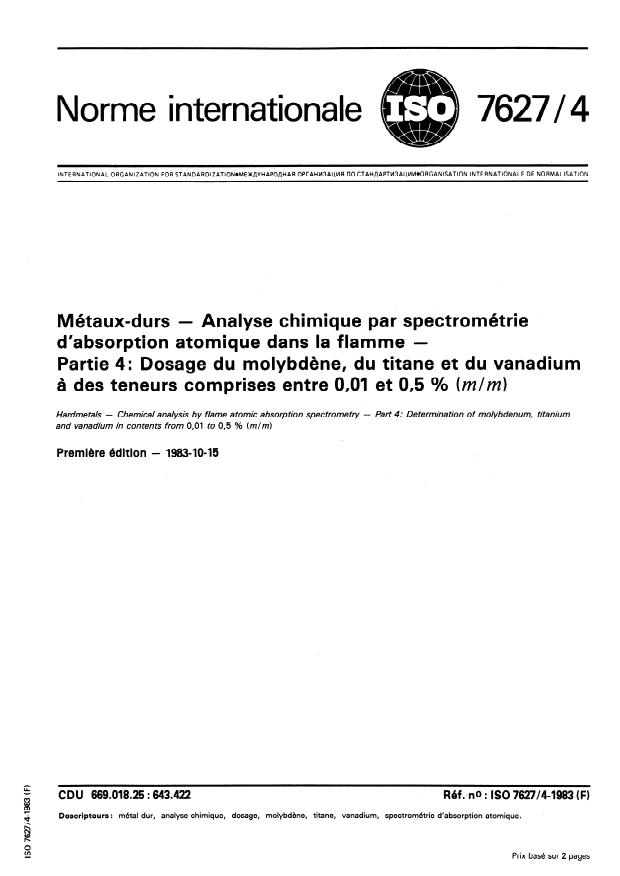
Norme internationale
INTERNATIONAL ORGANIZATION FOR STANDARDIZATION.ME>)(LLYHAPOAHAR OPfAHM3AUIlR f-l0 CTAHAAPTM3AlJ4M.ORGANISATION INTERNATIONALE DE NORMALISATION
Métaux-durs - Analyse chimique par spectrométrie
d’absorption atomique dans la flamme -
Partie 4: Dosage du molybdène, du titane et du vanadium
à des teneurs comprises entre 0,Ol et 0,5 % (mlm)
- Chemical analysis b y flame atomic absorption spectrometry - ‘ Part 4: Determination. of molybdenum, titanium
Hardmetals
and vanadium in contents from O,Ol to 0,5 % (mImI
Première Adition - 1983-10-15
G:
Y
CDU 669.018.25 : 643.422
Réf.-no : ISO 7627/4-1983 (F)
F
Descripteurs : m&al-dur, analyse chimique, dosage, molybdéne, titane, vanadium, spectrométrie d’absorption atomique.
Prix basé sur 2 pages
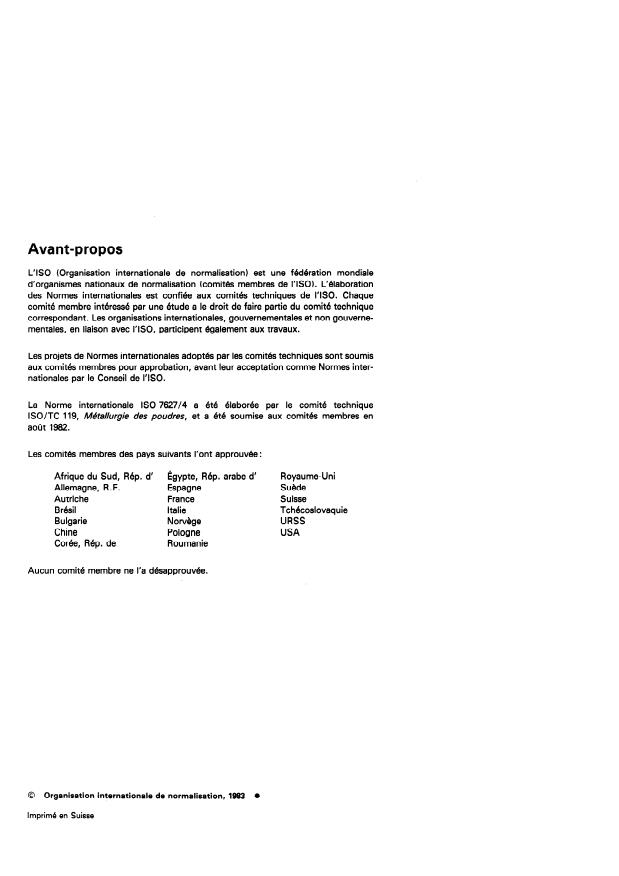
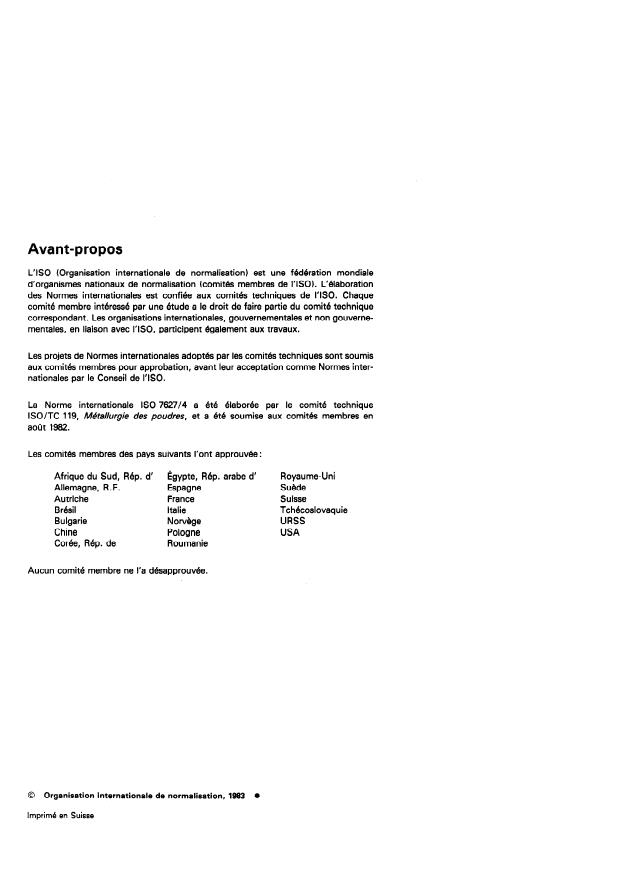
Avant-propos
L’ISO (Organisation internationale de normalisation) est une fédération mondiale
d’organismes nationaux de normalisation (comites membres de I’ISO). L’élaboration
des Normes internationales est confiée aux comites techniques de I’ISO. Chaque
comité membre interesse par une etude a le droit de faire partie du comite technique
correspondant. Les organisations internationales, gouvernementales et non gouverne-
mentales, en liaison avec I’ISO, participent egalement aux travaux.
Les projets de Normes internationales adoptés par les comites techniques sont soumis
aux comites membres pour approbation, avant leur acceptation comme Normes inter-
nationales par le Conseil de I’ISO.
La Norme internationale ISO 7627/4 a été elaboree par le comité technique
ISO/TC 119, Métahrgie des poudres, et a et6 soumise aux comités membres en
août 1982.
Les comités membres des pays suivants l’ont approuvee:
Afrique du Sud, Rep. d’ Égypte, Rep. arabe d’ Royaume-Uni
Allemagne, R. F. Espagne Suéde
Autriche France Suisse
Bresil Italie Tchecoslovaquie
Bulgarie Norvbge URSS
Chine
Pologne USA
Corde, Rép. de
Roumanie
Aucun comite membre ne l’a desapprouvee.
0 Organisation internationale de normalisation, 1983 l
Imprime en Suisse
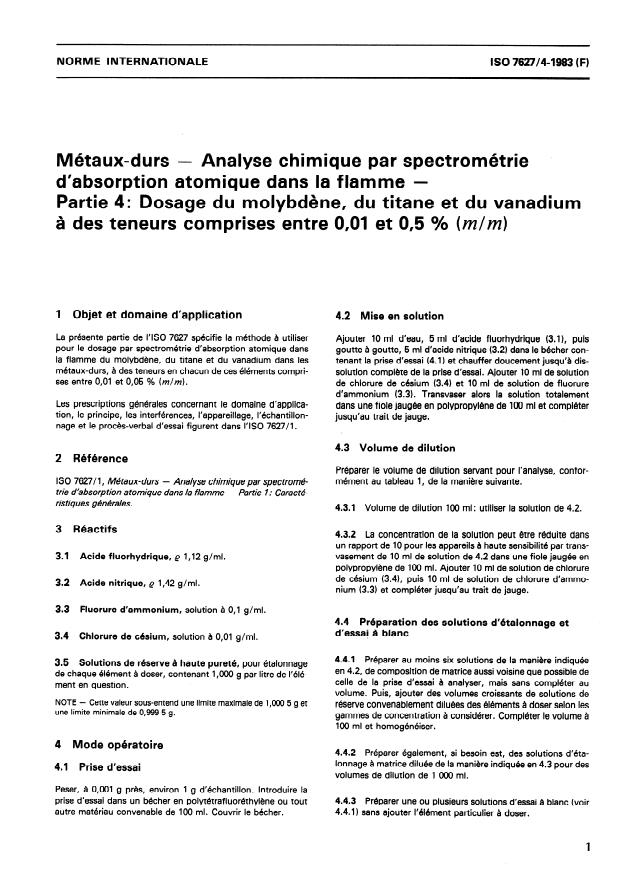
NORME INTERNATIONALE ISO 762714-1963 (F)
- Analyse chimique par spectrométrie
Métaux-durs
d’absorption atomique dans la flamme -
Partie 4: Dosage du molybdène, du titane et du vanadium
à des teneurs comprises entre 0,Ol et 0,5 % (mlm)
1 Objet et domaine d’application
4.2 Mise en solution
La présente partie de I’ISO 7627 spécifie la méthode à utiliser
Ajouter 10 ml d’eau, 5 ml d’acide fluorhydrique (3.11, puis
pour le dosage par spectrométrie d’absorption atomique dans goutte à goutte, 5 ml d’acide nitrique (3.2) dans le bécher con-
la flamme du molybdène, du titane et du vanadium dans les tenant la prise d’essai (4.1) et chauffer doucement jusqu’à dis-
métaux-durs, à des teneurs en chacun de ces éléments compri-
solution complete de la prise d’essai. Ajouter 10 ml de solution
ses entre 0,Ol et 0,05 % (mlm).
de chlorure de cesium (3.4) et 10 ml de solution de fluorure
d’ammonium (3.3). Transvaser alors la solution totalement
Les prescriptions générales concernant le domaine d’applica-
dans une fiole jaugée en polypropylene de 100 ml et compléter
tion, le principe, les interférences, l’appareillage, I’échantillon-
jusqu’au trait de jauge.
nage et le procès-verbal d’essai figurent dans I’ISO 7627/1.
4.3 Volume de dilution
2 Réfhence
Préparer le volume de dilution servant pour l’analyse, confor-
- Analyse chimique par spectromé- mément au tableau 1, de la manière suivante.
ISO 762711, Métaux-durs
trie d’absorption atomique dans la flamme - Partie 1: Caracté-
ris tiques ghérales.
4.3.1 Volume de dilution 100 ml: utiliser la solution de 4.2.
3 Réactifs
4.3.2 La concentration de la solution peut être réduite dans
un rapport de 10 pour les appareils à haute sensibilité par trans-
vasement de 10 ml de solution de 4.2 dans une fiole jaugée en
3.1 Acide fluorhydrique, Q 1,12 g/ml.
polypropyléne de 100 ml. Ajouter 10 ml de solution de chlorure
de césium (3.41, puis 10 ml de solution de chlorure d’ammo-
3.2 Acide nitrique, Q 1,42 g/ml.
nium (3.3) et compléter jusqu’au trait de jauge.
3.3 Fluorure d’ammonium, solution à 0,l g/ml.
4.4 Prdparation des solutions d%talonnage et
d’essaj 4 blanc
3.4 Chloru
...
Norme internationale
INTERNATIONAL ORGANIZATION FOR STANDARDIZATION.ME>)(LLYHAPOAHAR OPfAHM3AUIlR f-l0 CTAHAAPTM3AlJ4M.ORGANISATION INTERNATIONALE DE NORMALISATION
Métaux-durs - Analyse chimique par spectrométrie
d’absorption atomique dans la flamme -
Partie 4: Dosage du molybdène, du titane et du vanadium
à des teneurs comprises entre 0,Ol et 0,5 % (mlm)
- Chemical analysis b y flame atomic absorption spectrometry - ‘ Part 4: Determination. of molybdenum, titanium
Hardmetals
and vanadium in contents from O,Ol to 0,5 % (mImI
Première Adition - 1983-10-15
G:
Y
CDU 669.018.25 : 643.422
Réf.-no : ISO 7627/4-1983 (F)
F
Descripteurs : m&al-dur, analyse chimique, dosage, molybdéne, titane, vanadium, spectrométrie d’absorption atomique.
Prix basé sur 2 pages
Avant-propos
L’ISO (Organisation internationale de normalisation) est une fédération mondiale
d’organismes nationaux de normalisation (comites membres de I’ISO). L’élaboration
des Normes internationales est confiée aux comites techniques de I’ISO. Chaque
comité membre interesse par une etude a le droit de faire partie du comite technique
correspondant. Les organisations internationales, gouvernementales et non gouverne-
mentales, en liaison avec I’ISO, participent egalement aux travaux.
Les projets de Normes internationales adoptés par les comites techniques sont soumis
aux comites membres pour approbation, avant leur acceptation comme Normes inter-
nationales par le Conseil de I’ISO.
La Norme internationale ISO 7627/4 a été elaboree par le comité technique
ISO/TC 119, Métahrgie des poudres, et a et6 soumise aux comités membres en
août 1982.
Les comités membres des pays suivants l’ont approuvee:
Afrique du Sud, Rep. d’ Égypte, Rep. arabe d’ Royaume-Uni
Allemagne, R. F. Espagne Suéde
Autriche France Suisse
Bresil Italie Tchecoslovaquie
Bulgarie Norvbge URSS
Chine
Pologne USA
Corde, Rép. de
Roumanie
Aucun comite membre ne l’a desapprouvee.
0 Organisation internationale de normalisation, 1983 l
Imprime en Suisse
NORME INTERNATIONALE ISO 762714-1963 (F)
- Analyse chimique par spectrométrie
Métaux-durs
d’absorption atomique dans la flamme -
Partie 4: Dosage du molybdène, du titane et du vanadium
à des teneurs comprises entre 0,Ol et 0,5 % (mlm)
1 Objet et domaine d’application
4.2 Mise en solution
La présente partie de I’ISO 7627 spécifie la méthode à utiliser
Ajouter 10 ml d’eau, 5 ml d’acide fluorhydrique (3.11, puis
pour le dosage par spectrométrie d’absorption atomique dans goutte à goutte, 5 ml d’acide nitrique (3.2) dans le bécher con-
la flamme du molybdène, du titane et du vanadium dans les tenant la prise d’essai (4.1) et chauffer doucement jusqu’à dis-
métaux-durs, à des teneurs en chacun de ces éléments compri-
solution complete de la prise d’essai. Ajouter 10 ml de solution
ses entre 0,Ol et 0,05 % (mlm).
de chlorure de cesium (3.4) et 10 ml de solution de fluorure
d’ammonium (3.3). Transvaser alors la solution totalement
Les prescriptions générales concernant le domaine d’applica-
dans une fiole jaugée en polypropylene de 100 ml et compléter
tion, le principe, les interférences, l’appareillage, I’échantillon-
jusqu’au trait de jauge.
nage et le procès-verbal d’essai figurent dans I’ISO 7627/1.
4.3 Volume de dilution
2 Réfhence
Préparer le volume de dilution servant pour l’analyse, confor-
- Analyse chimique par spectromé- mément au tableau 1, de la manière suivante.
ISO 762711, Métaux-durs
trie d’absorption atomique dans la flamme - Partie 1: Caracté-
ris tiques ghérales.
4.3.1 Volume de dilution 100 ml: utiliser la solution de 4.2.
3 Réactifs
4.3.2 La concentration de la solution peut être réduite dans
un rapport de 10 pour les appareils à haute sensibilité par trans-
vasement de 10 ml de solution de 4.2 dans une fiole jaugée en
3.1 Acide fluorhydrique, Q 1,12 g/ml.
polypropyléne de 100 ml. Ajouter 10 ml de solution de chlorure
de césium (3.41, puis 10 ml de solution de chlorure d’ammo-
3.2 Acide nitrique, Q 1,42 g/ml.
nium (3.3) et compléter jusqu’au trait de jauge.
3.3 Fluorure d’ammonium, solution à 0,l g/ml.
4.4 Prdparation des solutions d%talonnage et
d’essaj 4 blanc
3.4 Chloru
...