

ISO/IEC 18046-3:2020
(Main)Information technology — Radio frequency identification device performance test methods — Part 3: Test methods for tag performance
General Information
- Abstract
This document defines test methods for performance characteristics of RFID tags for item management and specifies the general requirements and test requirements for tags which are applicable to the selection of devices for an application. The summary of the test reports forms a unified tag datasheet.
- Status
- Published
- Publication Date
- 26-Oct-2020
- Technical Committee
- ISO/IEC JTC 1/SC 31 - Automatic identification and data capture techniques
- Drafting Committee
- ISO/IEC JTC 1/SC 31/WG 4 - Radio communications
- Current Stage
- 9092 - International Standard to be revised
- Start Date
- 08-Jun-2026
- Completion Date
- 29-Aug-2026
Buy Documents

ISO/IEC 18046-3:2020 - Information technology -- Radio frequency identification device performance test methods
ISO/IEC 18046-3:2020 - Information technology — Radio frequency identification device performance test methods — Part 3: Test methods for tag performance/27/2020
Overview
ISO/IEC 18046-3:2020 specifies standardized test methods for RFID tag performance used in item management. Part 3 of the ISO/IEC 18046 series defines how to measure key performance characteristics of both inductive and propagative RFID tags, sets general test conditions and reporting requirements, and produces a unified tag datasheet format for comparing devices. The standard supports consistent, repeatable evaluation of RFID tags across frequencies and technologies.
Key topics and requirements
- Scope and test conditions: number of tags to test, test environment, RF environment, pre‑conditioning, measurement uncertainty, mounting materials, and communication parameters.
- Test equipment setup: defined apparatus and test circuits for a range of tag families (ISO/IEC 18000-2, -3, -6x, -7), including UHF propagative and inductive measurement methods.
- Functional test categories:
- Identification / read / write thresholds (magnetic or electromagnetic field or power required for reliable operation)
- Maximum operating and survival field/power (limits beyond which tags fail or survive)
- Sensitivity, degradation and directivity (how sensitivity degrades under conditions and antenna directional characteristics)
- Interference rejection (tag robustness to interfering signals)
- Maximum fade rate and load modulation (behavior under varying field/fading)
- Optional resonant frequency and Q factor (for inductive tags)
- Reporting and datasheet: standardized test report summaries form a unified tag datasheet to compare devices objectively.
- Safety considerations: human exposure to electromagnetic fields is addressed in test conditions.
Applications and who uses this standard
ISO/IEC 18046-3 is used by:
- RFID tag manufacturers validating product claims and optimizing designs.
- Independent test laboratories performing certification and comparative testing.
- Systems integrators and solution providers selecting tags for supply chain, retail, logistics, manufacturing, healthcare, and asset tracking.
- Procurement and compliance teams requiring objective performance data for vendor selection.
- R&D and QA teams assessing environmental and operational limits of tags.
Practical benefits include reliable tag selection for specific use cases (e.g., retail item-level tagging, pallet tracking, reusable assets), reduced deployment risk, and consistent performance documentation.
Related standards
- ISO/IEC 18046 (Parts 1–2 and others) - overall RFID performance test methods
- ISO/IEC 18000 series - air interface and protocol standards for different RFID frequency ranges (referenced in test apparatus and procedures)
Keywords: ISO/IEC 18046-3:2020, RFID tag test methods, RFID performance testing, tag performance, ISO RFID standards, unified tag datasheet.
Relations
- Effective Date
- 17-Jun-2026
- Effective Date
- 02-Jun-2018
Buy Documents
ISO/IEC 18046-3:2020 - Information technology -- Radio frequency identification device performance test methods
ISO/IEC 18046-3:2020 - Information technology — Radio frequency identification device performance test methods — Part 3: Test methods for tag performance/27/2020
Get Certified
Connect with accredited certification bodies for this standard

BSI Group
BSI (British Standards Institution) is the business standards company that helps organizations make excellence a habit.

NYCE
Mexican standards and certification body.
Sponsored listings
Frequently Asked Questions
ISO/IEC 18046-3:2020 is a standard published by the International Organization for Standardization (ISO). Its full title is "Information technology — Radio frequency identification device performance test methods — Part 3: Test methods for tag performance". This standard covers: This document defines test methods for performance characteristics of RFID tags for item management and specifies the general requirements and test requirements for tags which are applicable to the selection of devices for an application. The summary of the test reports forms a unified tag datasheet.
This document defines test methods for performance characteristics of RFID tags for item management and specifies the general requirements and test requirements for tags which are applicable to the selection of devices for an application. The summary of the test reports forms a unified tag datasheet.
ISO/IEC 18046-3:2020 is classified under the following ICS (International Classification for Standards) categories: 35.040.50 - Automatic identification and data capture techniques. The ICS classification helps identify the subject area and facilitates finding related standards.
ISO/IEC 18046-3:2020 has the following relationships with other standards: It is inter standard links to EN 18220:2026, ISO/IEC 18046-3:2012. Understanding these relationships helps ensure you are using the most current and applicable version of the standard.
ISO/IEC 18046-3:2020 is available in PDF format for immediate download after purchase. The document can be added to your cart and obtained through the secure checkout process. Digital delivery ensures instant access to the complete standard document.
Standards Content (Sample)
INTERNATIONAL ISO/IEC
STANDARD 18046-3
Third edition
2020-10
Information technology — Radio
frequency identification device
performance test methods —
Part 3:
Test methods for tag performance
Technologies de l'information — Méthodes d'essai des performances
du dispositif d'identification par radiofréquence —
Partie 3: Méthodes d'essai des perfomances du tag
Reference number
©
ISO/IEC 2020
© ISO/IEC 2020
All rights reserved. Unless otherwise specified, or required in the context of its implementation, no part of this publication may
be reproduced or utilized otherwise in any form or by any means, electronic or mechanical, including photocopying, or posting
on the internet or an intranet, without prior written permission. Permission can be requested from either ISO at the address
below or ISO’s member body in the country of the requester.
ISO copyright office
CP 401 • Ch. de Blandonnet 8
CH-1214 Vernier, Geneva
Phone: +41 22 749 01 11
Email: copyright@iso.org
Website: www.iso.org
Published in Switzerland
ii © ISO/IEC 2020 – All rights reserved
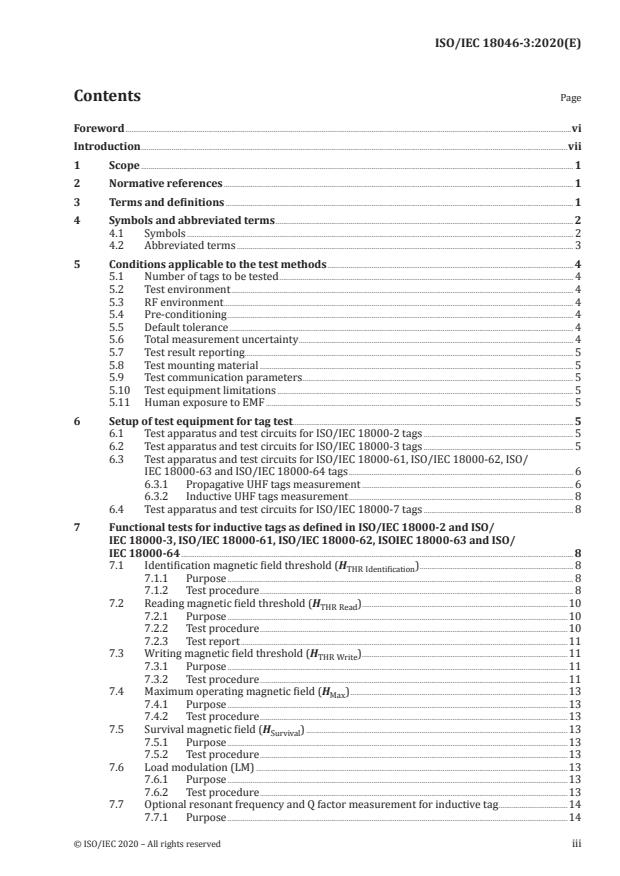
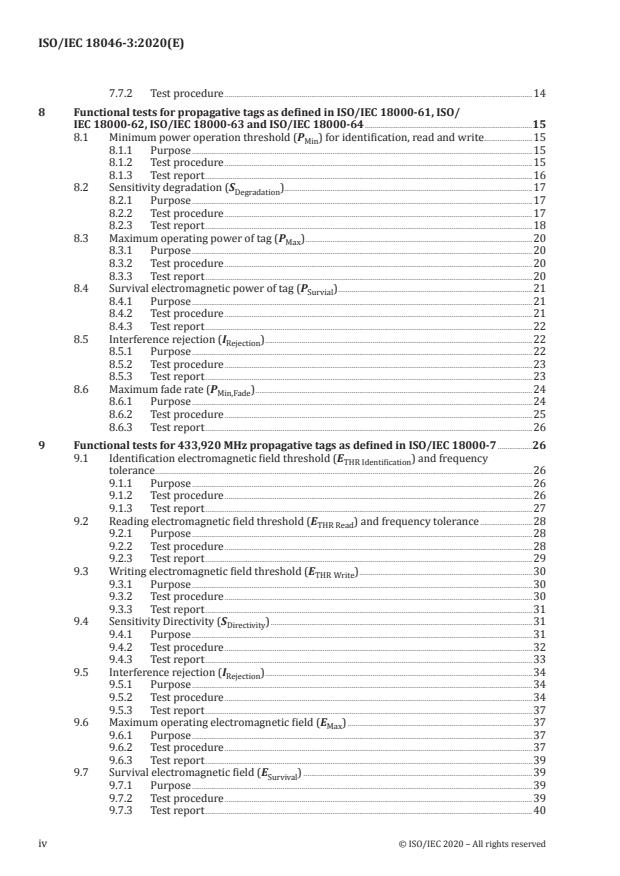
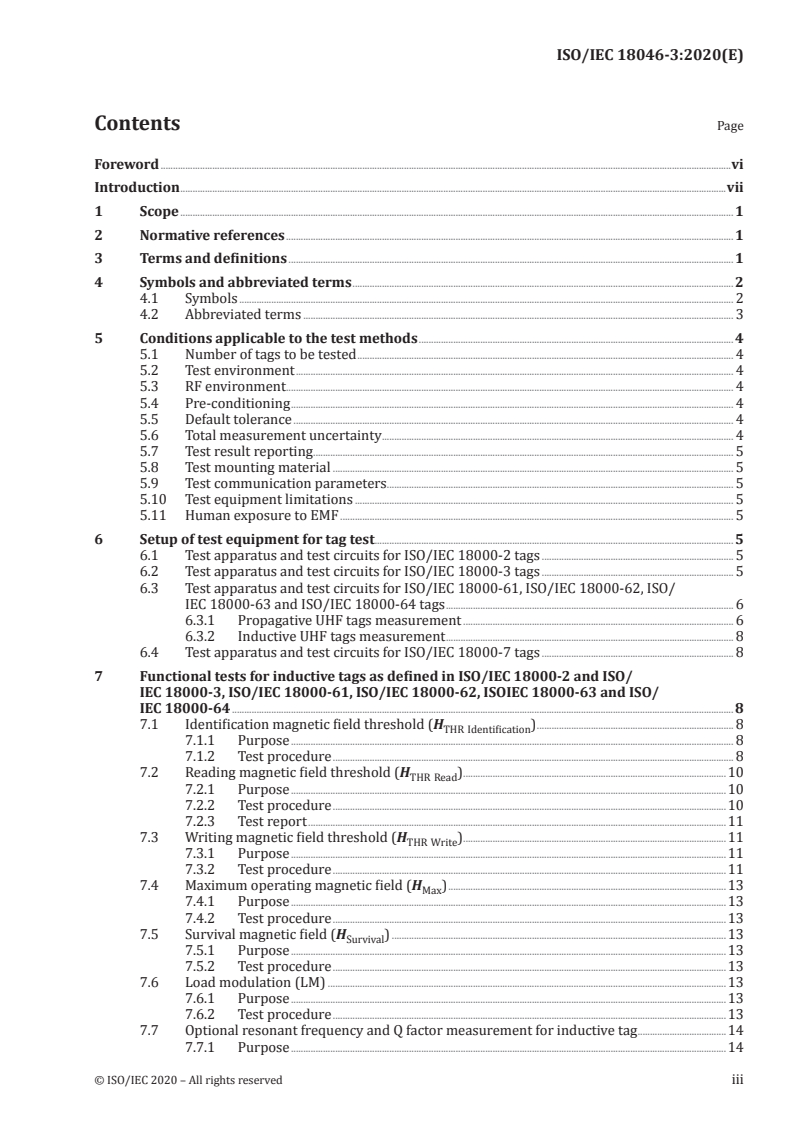
Contents Page
Foreword .vi
Introduction .vii
1 Scope . 1
2 Normative references . 1
3 Terms and definitions . 1
4 Symbols and abbreviated terms . 2
4.1 Symbols . 2
4.2 Abbreviated terms . 3
5 Conditions applicable to the test methods . 4
5.1 Number of tags to be tested . 4
5.2 Test environment . 4
5.3 RF environment . 4
5.4 Pre-conditioning . 4
5.5 Default tolerance . 4
5.6 Total measurement uncertainty . 4
5.7 Test result reporting . 5
5.8 Test mounting material . 5
5.9 Test communication parameters . 5
5.10 Test equipment limitations . 5
5.11 Human exposure to EMF . 5
6 Setup of test equipment for tag test. 5
6.1 Test apparatus and test circuits for ISO/IEC 18000-2 tags . 5
6.2 Test apparatus and test circuits for ISO/IEC 18000-3 tags . 5
6.3 Test apparatus and test circuits for ISO/IEC 18000-61, ISO/IEC 18000-62, ISO/
IEC 18000-63 and ISO/IEC 18000-64 tags . 6
6.3.1 Propagative UHF tags measurement . 6
6.3.2 Inductive UHF tags measurement . 8
6.4 Test apparatus and test circuits for ISO/IEC 18000-7 tags . 8
7 Functional tests for inductive tags as defined in ISO/IEC 18000-2 and ISO/
IEC 18000-3, ISO/IEC 18000-61, ISO/IEC 18000-62, ISOIEC 18000-63 and ISO/
IEC 18000-64 . 8
7.1 Identification magnetic field threshold (H ) . 8
THR Identification
7.1.1 Purpose . 8
7.1.2 Test procedure . 8
7.2 Reading magnetic field threshold (H ) .10
THR Read
7.2.1 Purpose .10
7.2.2 Test procedure .10
7.2.3 Test report .11
7.3 Writing magnetic field threshold (H ) .11
THR Write
7.3.1 Purpose .11
7.3.2 Test procedure .11
7.4 Maximum operating magnetic field (H ) .13
Max
7.4.1 Purpose .13
7.4.2 Test procedure .13
7.5 Survival magnetic field (H ) .13
Survival
7.5.1 Purpose .13
7.5.2 Test procedure .13
7.6 Load modulation (LM) .13
7.6.1 Purpose .13
7.6.2 Test procedure .13
7.7 Optional resonant frequency and Q factor measurement for inductive tag .14
7.7.1 Purpose .14
© ISO/IEC 2020 – All rights reserved iii
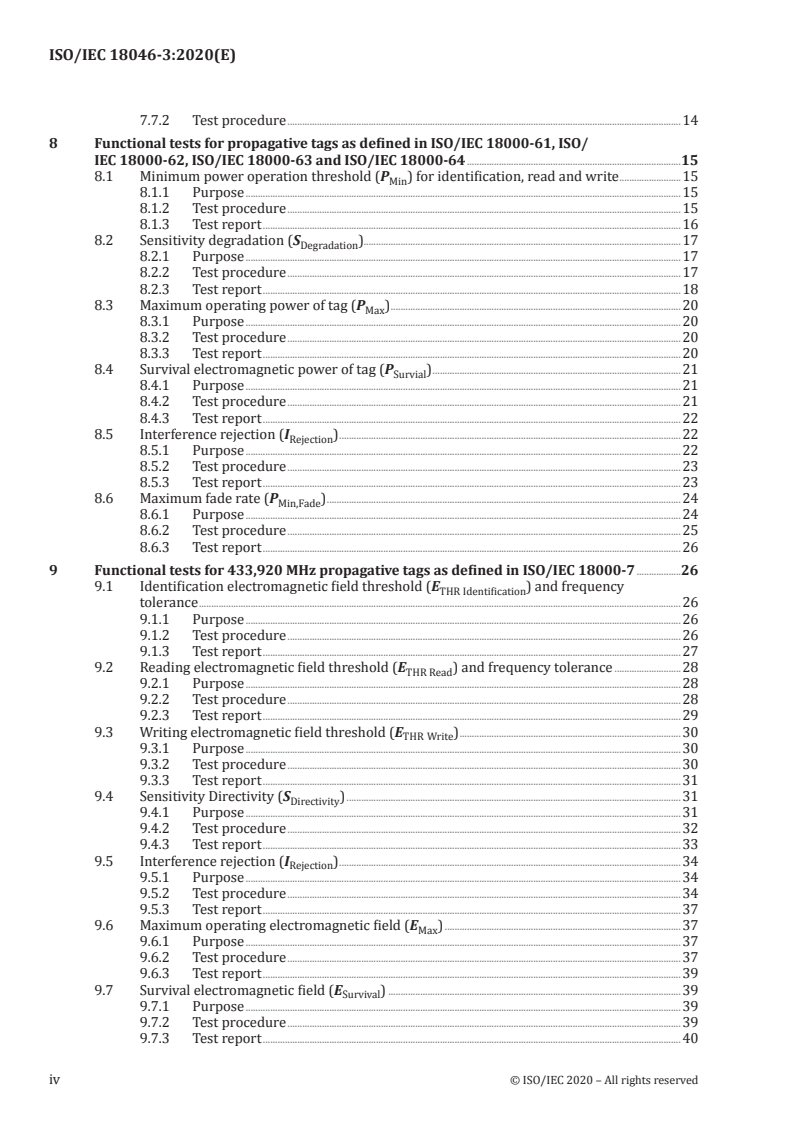
7.7.2 Test procedure .14
8 Functional tests for propagative tags as defined in ISO/IEC 18000-61, ISO/
IEC 18000-62, ISO/IEC 18000-63 and ISO/IEC 18000-64 .15
8.1 Minimum power operation threshold (P ) for identification, read and write .15
Min
8.1.1 Purpose .15
8.1.2 Test procedure .15
8.1.3 Test report .16
8.2 Sensitivity degradation (S ).17
Degradation
8.2.1 Purpose .17
8.2.2 Test procedure .17
8.2.3 Test report .18
8.3 Maximum operating power of tag (P ) .20
Max
8.3.1 Purpose .20
8.3.2 Test procedure .20
8.3.3 Test report .20
8.4 Survival electromagnetic power of tag (P ) .21
Survial
8.4.1 Purpose .21
8.4.2 Test procedure .21
8.4.3 Test report .22
8.5 Interference rejection (I ) .22
Rejection
8.5.1 Purpose .22
8.5.2 Test procedure .23
8.5.3 Test report .23
8.6 Maximum fade rate (P ) .24
Min,Fade
8.6.1 Purpose .24
8.6.2 Test procedure .25
8.6.3 Test report .26
9 Functional tests for 433,920 MHz propagative tags as defined in ISO/IEC 18000-7 .26
9.1 Identification electromagnetic field threshold (E ) and frequency
THR Identification
tolerance .26
9.1.1 Purpose .26
9.1.2 Test procedure .26
9.1.3 Test report .27
9.2 Reading electromagnetic field threshold (E ) and frequency tolerance .28
THR Read
9.2.1 Purpose .28
9.2.2 Test procedure .28
9.2.3 Test report .29
9.3 Writing electromagnetic field threshold (E ) .30
THR Write
9.3.1 Purpose .30
9.3.2 Test procedure .30
9.3.3 Test report .31
9.4 Sensitivity Directivity (S ) .31
Directivity
9.4.1 Purpose .31
9.4.2 Test procedure .32
9.4.3 Test report .33
9.5 Interference rejection (I ) .34
Rejection
9.5.1 Purpose .34
9.5.2 Test procedure .34
9.5.3 Test report .37
9.6 Maximum operating electromagnetic field (E ) .37
Max
9.6.1 Purpose .37
9.6.2 Test procedure .37
9.6.3 Test report .39
9.7 Survival electromagnetic field (E ) .39
Survival
9.7.1 Purpose .39
9.7.2 Test procedure .39
9.7.3 Test report .40
iv © ISO/IEC 2020 – All rights reserved
Annex A (informative) Resonant frequency and Q factor measurement for inductive tag .41
Annex B (normative) Test apparatus modification for ISO/IEC 18000-3 tags for field
strengths >5 A/m .44
Annex C (normative) Test apparatus modification for ISO/IEC 18000-61, ISO/IEC 18000-62,
ISO/IEC 18000-63 and ISO/IEC 18000-64 tags .45
Annex D (informative) Inventory command for all parts of ISO/IEC 18000 .48
Annex E (normative) Backscatter power measurement .49
Bibliography .50
© ISO/IEC 2020 – All rights reserved v
Foreword
ISO (the International Organization for Standardization) and IEC (the International Electrotechnical
Commission) form the specialized system for worldwide standardization. National bodies that
are members of ISO or IEC participate in the development of International Standards through
technical committees established by the respective organization to deal with particular fields of
technical activity. ISO and IEC technical committees collaborate in fields of mutual interest. Other
international organizations, governmental and non-governmental, in liaison with ISO and IEC, also
take part in the work.
The procedures used to develop this document and those intended for its further maintenance are
described in the ISO/IEC Directives, Part 1. In particular, the different approval criteria needed for
the different types of document should be noted. This document was drafted in accordance with the
editorial rules of the ISO/IEC Directives, Part 2 (see www .iso .org/ directives).
Attention is drawn to the possibility that some of the elements of this document may be the subject
of patent rights. ISO and IEC shall not be held responsible for identifying any or all such patent
rights. Details of any patent rights identified during the development of the document will be in the
Introduction and/or on the ISO list of patent declarations received (see www .iso .org/ patents) or the IEC
list of patent declarations received (see https:// patents .iec .c).
Any trade name used in this document is information given for the convenience of users and does not
constitute an endorsement.
For an explanation of the voluntary nature of standards, the meaning of ISO specific terms and
expressions related to conformity assessment, as well as information about ISO's adherence to the
World Trade Organization (WTO) principles in the Technical Barriers to Trade (TBT) see www .iso .org/
iso/ foreword .html.
This document was prepared by Joint Technical Committee ISO/IEC JTC 1, Information technology,
Subcommittee SC 31, Automatic identification and data capture techniques.
This third edition cancels and replaces the second (ISO/IEC 18046-3:2012), which has been technically
revised.
The main changes compared to the previous edition are as follows:
— Change of the frequency range to 860 MHz to 930 MHz, as no countries, including Japan, support a
frequency in the 930 MHz to 960 MHz range anymore;
— Adaptation of the test method for 860 MHz to 930 MHz band based on 10 years experience of the use
of this document.
A list of all parts in the ISO/IEC 18046 series can be found on the ISO website.
Any feedback or questions on this document should be directed to the user’s national standards body. A
complete listing of these bodies can be found at www .iso .org/ members .html.
vi © ISO/IEC 2020 – All rights reserved
Introduction
Radio frequency identification (RFID) technology has broad applicability to the automatic identification
and data capture (AIDC) industry in item management. As a wireless communication technique based
on radio frequency technology, the applications cover multiple levels of the industrial, commercial and
retail supply chains. These can include:
— freight containers,
— returnable transport items (RTI),
— transport units,
— product packaging, and
— product tagging.
Performance tests define test methods which deliver results that allow the comparison of different
RFID systems, interrogators and tags in order to select among them for use in a particular application.
The performance characteristics of devices (tags and interrogation equipment) can vary drastically due
to application factors as well as the particular RFID air interface (frequency, modulation, protocol, etc.)
being supported. Of key concern is the matching of the various performance characteristics to the user
application. Additionally, in an open environment, users of such technology demand multiple sources
for these devices from technology providers. A key challenge is a method of evaluating the differences
between various technology providers' products in a consistent and equitable manner.
This document provides a framework for meeting the above noted concerns and challenges. To this end,
clear definitions of performance as related to user application of RFID technology in the supply chain
are provided. Based on such application-based definitions, test methods are defined with attention to
the test parameters required for a consistent evaluation of RFID devices.
Of particular significance, these tests are defined for RFID devices with one antenna. It is common
practice to have products with both single and multiple antennae to define an RFID transaction zone
sufficient for the application. The defined test methods used are for a single antenna but can equivalently
be extended to equipment with multiple antennae, in order to evaluate performance under conditions
more closely matching those of a particular application. However, it is important to exercise care in
multiple-antenna measurement since multiple antennae can cause antenna-to-antenna interactions,
physical packaging limitations, mutual coupling issues, shadowing issues, directivity issues and other
impacts, even with respect to interrogators since these can be limited in size, shape and mounting
method for many RFID applications.
© ISO/IEC 2020 – All rights reserved vii
INTERNATIONAL STANDARD ISO/IEC 18046-3:2020(E)
Information technology — Radio frequency identification
device performance test methods —
Part 3:
Test methods for tag performance
1 Scope
This document defines test methods for performance characteristics of RFID tags for item management
and specifies the general requirements and test requirements for tags which are applicable to the
selection of devices for an application. The summary of the test reports forms a unified tag datasheet.
2 Normative references
The following documents are referred to in the text in such a way that some or all of their content
constitutes requirements of this document. For dated references, only the edition cited applies. For
undated references, the latest edition of the referenced document (including any amendments) applies.
ISO/IEC 18000-2, Information technology — Radio frequency identification for item management —
Part 2: Parameters for air interface communications below 135 kHz
ISO/IEC 18000-3, Information technology — Radio frequency identification for item management —
Part 3: Parameters for air interface communications at 13,56 MHz
ISO/IEC 18000-6, Information technology — Radio frequency identification for item management —
Part 6: Parameters for air interface communications at 860 MHz to 960 MHz General
ISO/IEC 18000-61, Information technology — Radio frequency identification for item management —
Part 61: Parameters for air interface communications at 860 MHz to 960 MHz Type A
ISO/IEC 18000-62, Information technology — Radio frequency identification for item management —
Part 62: Parameters for air interface communications at 860 MHz to 960 MHz Type B
ISO/IEC 18000-63, Information technology — Radio frequency identification for item management —
Part 63: Parameters for air interface communications at 860 MHz to 960 MHz Type C
ISO/IEC 18000-64, Information technology — Radio frequency identification for item management —
Part 64: Parameters for air interface communications at 860 MHz to 960 MHz Type D
ISO/IEC 18000-7, Information technology — Radio frequency identification for item management — Part 7:
Parameters for active air interface communications at 433 MHz
ISO/IEC 18047-2, Information technology — Radio frequency identification device conformance test
methods — Part 2: Test methods for air interface communications below 135 kHz
ISO/IEC 18047-6:2017, Information technology — Radio frequency identification device conformance test
methods — Part 6: Test methods for air interface communications at 860 MHz to 960 MHz
ISO/IEC 19762, Information technology — Automatic identification and data capture (AIDC) techniques —
Harmonized vocabulary
3 Terms and definitions
For the purposes of this document, the terms and definitions given in ISO/IEC 19762 apply.
© ISO/IEC 2020 – All rights reserved 1
ISO and IEC maintain terminological databases for use in standardization at the following addresses:
— ISO Online browsing platform: available at https:// www .iso .org/ obp
— IEC Electropedia: available at http:// www .electropedia .org/
4 Symbols and abbreviated terms
4.1 Symbols
λ wavelength
BLF backscatter link frequency
BW bandwidth
D distance between the tag and the antenna
E electric field
E maximum operating electromagnetic field
Max
E survival electromagnetic field
Survival
E identification electromagnetic field threshold
THR Identification
E reading electromagnetic field threshold
THR Read
E writing electromagnetic field threshold
THR Write
f center frequency
c
F resonant frequency
Res
f frequency tag side band right (frequency of the right side band of the tag spectrum)
tsbr
f frequency tag side band left (frequency of the left side band of the tag spectrum)
tsbl
G antenna gain
H magnetic field strength
T
H identification magnetic field threshold
THR Identification
H reading magnetic field threshold
THR Read
H writing magnetic field threshold
THR Write
H maximum operating magnetic field
Max
H survival magnetic field
Survival
I interference rejection
Rejection
M number of subcarrier cycles per symbol
P maximum operating power of tag
Max
P survival electromagnetic power of tag
Survival
2 © ISO/IEC 2020 – All rights reserved
P interference power
Rejection
P minimum power operation threshold
Min
P maximum fade rate
Min,Fade
P interrogator sensitivity
Rcv
P backscatter power at tag position
Back
Q quality factor
RTcal interrogator to tag calibration symbol
S sensitivity degradation
Degradation
S sensitivity directivity
Directivity
TRcal tag to interrogator calibration symbol
U peak-peak value of the voltage drop at external serial measurement resistor
RHTA
NOTE Minimum power operation threshold, P , is defined as the minimum power received by the isotropic
Min
antenna from the E-field required for the tag to turn-on.
4.2 Abbreviated terms
C directional coupler
CW continuous wave
DUT device under test
EMF electro magnetic field
FCC federal communications commission
FR fade rate
FSK frequency shift keying
ITF interrogator talk first
L length
LM load modulation
MPE maximum permissible human exposure
NP0 negative-positive 0 ppm/°C
PCB printed circuit board
PIE pulse interval encoding
PR-ASK phase reversal amplitude shift keying
UHF ultra high frequency
RF radio frequency
© ISO/IEC 2020 – All rights reserved 3
RX receive antenna
SAR specific absorption rate
TE test equipment
TX transmit antenna
UII unique item identifier
V voltage
VSWR voltage standing wave ratio
5 Conditions applicable to the test methods
5.1 Number of tags to be tested
All measurements defined in this document may be performed on a single tag, but higher sampling
numbers may be required for measurement campaigns for statistical purpose.
5.2 Test environment
Unless otherwise specified, testing shall take place in air environment of temperature (23 ± 3) °C
[(73 ± 5) °F)] and of relative humidity 40 % to 60 %.
5.3 RF environment
The tests shall be performed in a known RF environment.
For measurements of propagative UHF tags an anechoic chamber is the recommended test environment
(see ISO/IEC 18000-61, ISO/IEC 18000-62, ISO/IEC 18000-63 or ISO/IEC 18000-64).
For measurements of inductive tags at frequencies below 30 MHz, a typical laboratory environment is
sufficient, where consideration is given to minimize the impact of electromagnetic sources that may
influence the results.
5.4 Pre-conditioning
Where pre-conditioning is required by the test method, the identification tags to be tested shall be
conditioned to the test environment for a period of 24 hours before testing.
5.5 Default tolerance
Unless otherwise specified, a default tolerance of ±5 % shall be applied to the quantity values given
to specify the characteristics of the test equipment (e.g. linear dimensions) and the test method
procedures (e.g. test equipment adjustments).
For power values represented in dB or dBm, the tolerance shall be ± 0,5 dB.
NOTE ± 0,5 dB is approximately ± 12 % of the non-logarithmics value.
5.6 Total measurement uncertainty
The total measurement uncertainty for each quantity determined by these test methods shall be stated
in the test report.
NOTE Basic information is given in ISO/IEC Guide 98-3:2008.
4 © ISO/IEC 2020 – All rights reserved
5.7 Test result reporting
Each test result shall be reported with the number of samples tested. For statistical evaluation,
optionally the minimum value, maximum value, mean value and standard deviation may be reported
as well.
5.8 Test mounting material
For UHF tags, the tests may be performed with or without applied mounting material. When the
mounting material is defined by the tag manufacturer, the tests shall be performed with the specified
mounting material and in the free air.
If the dielectric parameter or other critical parameters of material are known, then they should be
specified in the test report.
5.9 Test communication parameters
All of the tests can be performed for various communication parameters (forward and return link). The
test conditions shall be recorded in the test report.
5.10 Test equipment limitations
Test equipment for survivability field maximum level shall be able to handle the maximum level declared
by the product vendor. It shall be ensured that the test equipment is not limiting the performance
measurement.
5.11 Human exposure to EMF
High magnetic or electromagnetic field strength may exceed the limits of MPE to EMF. This should be
taken into account as necessary.
NOTE FCC guidelines for MPE and SAR or EC 1999/519/CE are examples of relevant documents.
6 Setup of test equipment for tag test
6.1 Test apparatus and test circuits for ISO/IEC 18000-2 tags
This clause defines the test apparatus and test circuits for verifying the operation of a tag according to
the base standard ISO/IEC 18000-2. The test setups used shall be as described in ISO/IEC 18047-2.
6.2 Test apparatus and test circuits for ISO/IEC 18000-3 tags
This clause defines the test apparatus and test circuits for verifying the operation of a tag according to
the base standard ISO/IEC 18000-3. The test setups described in ISO/IEC/TR 18047-3 may be used.
As the test apparatus described in ISO/IEC/TR 18047-3 is only designed for a magnetic field strength
up to 5 A/m, the test setups as described in Annex B may be used for magnetic field strength
exceeding 5 A/m.
© ISO/IEC 2020 – All rights reserved 5
6.3 Test apparatus and test circuits for ISO/IEC 18000-61, ISO/IEC 18000-62, ISO/
IEC 18000-63 and ISO/IEC 18000-64 tags
6.3.1 Propagative UHF tags measurement
6.3.1.1 General
This clause defines the test apparatus and test circuits for verifying the operation of a tag according to
the base standards ISO/IEC 18000-61, ISO/IEC 18000-62, ISO/IEC 18000-63 and ISO/IEC 18000-64. The
test setup used for measurements of propagative UHF tags shall be as shown in 6.3.1.2. Alternatively,
the test setup described in ISO/IEC 18047-6 may be used.
6.3.1.2 Setup of the devices
The test setup shall use either a bistatic test setup, as in Figure 1, or a monostatic test setup, as in
Figure 2. It shall be ensured that the test equipment (TE) receiver is sensitive enough to not limit the
measurements.
Figure 1 — Bistatic test setup
In Figure 1, RX is the receive antenna, TX is the transmit antenna and TE is the test equipment.
Figure 2 — Monostatic test setup
In Figure 2, the same antenna is used as RX and TX.
6 © ISO/IEC 2020 – All rights reserved
6.3.1.3 DUT placement
The DUT shall be placed in the far field according to Figure 1 or Figure 2. The distance, D, shall be at
least as caluclated using Formula (1):
2L
D= (1)
λ
where
λ is the wavelength, and
L is the maximum dimension of the test antenna.
6.3.1.4 Antenna polarization and requirements
For propagative UHF tests, a linear or circular polarized antenna shall be used, except when testing
tags that have more than one antenna or for sensitivity degradation measurements, in which case a
circular polarized antenna shall be used.
The circular polarized antenna shall have an axial ratio that is less than 1 dB over the frequency and
orientation ranges of the testing.
Antennae used together in one measurement setup shall have the same gain with a VSWR <1:2.
6.3.1.5 Test setup for interference rejection measurements of propagative UHF tags
Figure 3 and Figure 4 show the test setup arrangements for interference rejection measurements:
Figure 3 — Test setup for interference rejection measurement
In Figure 3, TE 1 represents the desired RF generator test equipment and TE 2 represents the interferer
RF generator test equipment.
© ISO/IEC 2020 – All rights reserved 7
Figure 4 — Test setup for interference rejection measurement
In Figure 4, TE 1 represents the desired RF generator test equipment and TE 2 represents the interferer
RF generator test equipment. C is a directional coupler.
For this test, the tag under test shall be placed at the same distance, D, from the two RF generators
and oriented for optimum field strength reception. The distance, D, shall be at least as in defined in
Formula (1) for performing the measurements in the far field.
6.3.2 Inductive UHF tags measurement
This clause defines the test apparatus and test circuits for verifying the operation of a tag according
to the base standards, ISO/IEC 18000-6, ISO/IEC 18000-61, ISO/IEC 18000-62, ISO/IEC 18000-63 and
ISO/IEC 18000-64. The test setup used for measurements of inductive UHF tags is shown in Annex C.
6.4 Test apparatus and test circuits for ISO/IEC 18000-7 tags
This clause defines the test apparatus and test circuits for verifying the operation of a tag according to
the base standard, ISO/IEC 18000-7. The test setups used shall be as described in ISO/IEC/TR 18047-7.
7 Functional tests for inductive tags as defined in ISO/IEC 18000-2 and ISO/
IEC 18000-3, ISO/IEC 18000-61, ISO/IEC 18000-62, ISOIEC 18000-63 and ISO/
IEC 18000-64
7.1 Identification magnetic field threshold (H )
THR Identification
7.1.1 Purpose
The purpose of this test is to determine the threshold level of magnetic field strength required for tag
identification. As the tag needs energy to operate, this energy shall be supplied by the magnetic field.
The identification magnetic field threshold, H , is the minimum field strength allowing tag
THR Identification
identification.
7.1.2 Test procedure
7.1.2.1 General
At a fixed frequency as allowed by the regulation, the magnetic field strength of the generating field
shall be varied from zero until modulation of the tag is detected and the tag is identified.
7.1.2.2 ISO/IEC 18000-2 tags
The selection of system parameters shall be made in order to challenge the tag energy supply.
8 © ISO/IEC 2020 – All rights reserved
Identification magnetic field threshold, H , measurement procedure:
THR Identification
1) The waveform generator shall be set to the required operating frequency of 125 kHz or 134,2 kHz.
2) The waveform generator amplitude shall be set to a value below H . This amplitude is
THR Identification
typically zero.
3) The tag shall be inserted in the test equipment.
4) An inventory command (see Annex D) shall be continuously sent with the code generator and the
amplitude shall be increased after each inventory command until the complete UII can be measured
with the Helmholtz coils.
5) The data transfer shall be verified by comparison with ISO/IEC 18000-2. If the tag response is
wrong, step 4) shall be repeated with higher amplitude.
6) The tag shall be removed from the test equipment.
7) The magnetic field strength H for the individual tag shall be calculated by use of the measurement
of U .
RHTA
The measurements shall be performed on all tags. H shall be the highest value of all
THR Identification
measured magnetic field strength, H, for the individual tags.
7.1.2.3 ISO/IEC 18000-3 tags
The selection of system parameters shall be made in order to challenge the tag energy supply.
Identification magnetic field threshold, H , measurement procedure:
THR Identification
1) The waveform generator shall be set to the required operating frequency of 13,56 MHz.
2) The waveform generator amplitude shall be set to a value below the identification magnetic field
threshold. This amplitude is typically zero.
3) The tag shall be inserted in the test equipment.
4) An inventory command (see Annex D) shall be continuously sent with the code generator and the
amplitude shall be increased after each inventory command until the complete UII can be measured
with the sense coils.
5) The data transfer shall be verified by comparison with ISO/IEC 18000-3. If the tag response is
wrong, step 4) shall be repeated with higher amplitude.
6) The tag shall be removed from the test equipment and the calibration coil shall be inserted in the
test equipment.
7) The magnetic field strength, H, for the individual tag shall be calculated by use of the measurement
made on the calibration coil.
The measurements shall be performed on all tags. H shall be the highest value of all
THR Identification
measured magnetic field strength, H, for the individual tags.
7.1.2.4 ISO/IEC 18000-61, ISO/IEC 18000-62, ISOIEC 18000-63 and ISO/IEC 18000-64 tags
For inductive coupled tags according to ISO/IEC 18000-61, ISO/IEC 18000-62, ISO/IEC 18000-63 and
ISO/IEC 18000-64, the test methods of 8.1 with test setup as in 6.3.2 shall be applied. Additional to the
measurement results
...
INTERNATIONAL ISO/IEC
STANDARD 18046-3
Third edition
2020-10
Information technology — Radio
frequency identification device
performance test methods —
Part 3:
Test methods for tag performance
Technologies de l'information — Méthodes d'essai des performances
du dispositif d'identification par radiofréquence —
Partie 3: Méthodes d'essai des perfomances du tag
Reference number
©
ISO/IEC 2020
© ISO/IEC 2020
All rights reserved. Unless otherwise specified, or required in the context of its implementation, no part of this publication may
be reproduced or utilized otherwise in any form or by any means, electronic or mechanical, including photocopying, or posting
on the internet or an intranet, without prior written permission. Permission can be requested from either ISO at the address
below or ISO’s member body in the country of the requester.
ISO copyright office
CP 401 • Ch. de Blandonnet 8
CH-1214 Vernier, Geneva
Phone: +41 22 749 01 11
Email: copyright@iso.org
Website: www.iso.org
Published in Switzerland
ii © ISO/IEC 2020 – All rights reserved
Contents Page
Foreword .vi
Introduction .vii
1 Scope . 1
2 Normative references . 1
3 Terms and definitions . 1
4 Symbols and abbreviated terms . 2
4.1 Symbols . 2
4.2 Abbreviated terms . 3
5 Conditions applicable to the test methods . 4
5.1 Number of tags to be tested . 4
5.2 Test environment . 4
5.3 RF environment . 4
5.4 Pre-conditioning . 4
5.5 Default tolerance . 4
5.6 Total measurement uncertainty . 4
5.7 Test result reporting . 5
5.8 Test mounting material . 5
5.9 Test communication parameters . 5
5.10 Test equipment limitations . 5
5.11 Human exposure to EMF . 5
6 Setup of test equipment for tag test. 5
6.1 Test apparatus and test circuits for ISO/IEC 18000-2 tags . 5
6.2 Test apparatus and test circuits for ISO/IEC 18000-3 tags . 5
6.3 Test apparatus and test circuits for ISO/IEC 18000-61, ISO/IEC 18000-62, ISO/
IEC 18000-63 and ISO/IEC 18000-64 tags . 6
6.3.1 Propagative UHF tags measurement . 6
6.3.2 Inductive UHF tags measurement . 8
6.4 Test apparatus and test circuits for ISO/IEC 18000-7 tags . 8
7 Functional tests for inductive tags as defined in ISO/IEC 18000-2 and ISO/
IEC 18000-3, ISO/IEC 18000-61, ISO/IEC 18000-62, ISOIEC 18000-63 and ISO/
IEC 18000-64 . 8
7.1 Identification magnetic field threshold (H ) . 8
THR Identification
7.1.1 Purpose . 8
7.1.2 Test procedure . 8
7.2 Reading magnetic field threshold (H ) .10
THR Read
7.2.1 Purpose .10
7.2.2 Test procedure .10
7.2.3 Test report .11
7.3 Writing magnetic field threshold (H ) .11
THR Write
7.3.1 Purpose .11
7.3.2 Test procedure .11
7.4 Maximum operating magnetic field (H ) .13
Max
7.4.1 Purpose .13
7.4.2 Test procedure .13
7.5 Survival magnetic field (H ) .13
Survival
7.5.1 Purpose .13
7.5.2 Test procedure .13
7.6 Load modulation (LM) .13
7.6.1 Purpose .13
7.6.2 Test procedure .13
7.7 Optional resonant frequency and Q factor measurement for inductive tag .14
7.7.1 Purpose .14
© ISO/IEC 2020 – All rights reserved iii
7.7.2 Test procedure .14
8 Functional tests for propagative tags as defined in ISO/IEC 18000-61, ISO/
IEC 18000-62, ISO/IEC 18000-63 and ISO/IEC 18000-64 .15
8.1 Minimum power operation threshold (P ) for identification, read and write .15
Min
8.1.1 Purpose .15
8.1.2 Test procedure .15
8.1.3 Test report .16
8.2 Sensitivity degradation (S ).17
Degradation
8.2.1 Purpose .17
8.2.2 Test procedure .17
8.2.3 Test report .18
8.3 Maximum operating power of tag (P ) .20
Max
8.3.1 Purpose .20
8.3.2 Test procedure .20
8.3.3 Test report .20
8.4 Survival electromagnetic power of tag (P ) .21
Survial
8.4.1 Purpose .21
8.4.2 Test procedure .21
8.4.3 Test report .22
8.5 Interference rejection (I ) .22
Rejection
8.5.1 Purpose .22
8.5.2 Test procedure .23
8.5.3 Test report .23
8.6 Maximum fade rate (P ) .24
Min,Fade
8.6.1 Purpose .24
8.6.2 Test procedure .25
8.6.3 Test report .26
9 Functional tests for 433,920 MHz propagative tags as defined in ISO/IEC 18000-7 .26
9.1 Identification electromagnetic field threshold (E ) and frequency
THR Identification
tolerance .26
9.1.1 Purpose .26
9.1.2 Test procedure .26
9.1.3 Test report .27
9.2 Reading electromagnetic field threshold (E ) and frequency tolerance .28
THR Read
9.2.1 Purpose .28
9.2.2 Test procedure .28
9.2.3 Test report .29
9.3 Writing electromagnetic field threshold (E ) .30
THR Write
9.3.1 Purpose .30
9.3.2 Test procedure .30
9.3.3 Test report .31
9.4 Sensitivity Directivity (S ) .31
Directivity
9.4.1 Purpose .31
9.4.2 Test procedure .32
9.4.3 Test report .33
9.5 Interference rejection (I ) .34
Rejection
9.5.1 Purpose .34
9.5.2 Test procedure .34
9.5.3 Test report .37
9.6 Maximum operating electromagnetic field (E ) .37
Max
9.6.1 Purpose .37
9.6.2 Test procedure .37
9.6.3 Test report .39
9.7 Survival electromagnetic field (E ) .39
Survival
9.7.1 Purpose .39
9.7.2 Test procedure .39
9.7.3 Test report .40
iv © ISO/IEC 2020 – All rights reserved
Annex A (informative) Resonant frequency and Q factor measurement for inductive tag .41
Annex B (normative) Test apparatus modification for ISO/IEC 18000-3 tags for field
strengths >5 A/m .44
Annex C (normative) Test apparatus modification for ISO/IEC 18000-61, ISO/IEC 18000-62,
ISO/IEC 18000-63 and ISO/IEC 18000-64 tags .45
Annex D (informative) Inventory command for all parts of ISO/IEC 18000 .48
Annex E (normative) Backscatter power measurement .49
Bibliography .50
© ISO/IEC 2020 – All rights reserved v
Foreword
ISO (the International Organization for Standardization) and IEC (the International Electrotechnical
Commission) form the specialized system for worldwide standardization. National bodies that
are members of ISO or IEC participate in the development of International Standards through
technical committees established by the respective organization to deal with particular fields of
technical activity. ISO and IEC technical committees collaborate in fields of mutual interest. Other
international organizations, governmental and non-governmental, in liaison with ISO and IEC, also
take part in the work.
The procedures used to develop this document and those intended for its further maintenance are
described in the ISO/IEC Directives, Part 1. In particular, the different approval criteria needed for
the different types of document should be noted. This document was drafted in accordance with the
editorial rules of the ISO/IEC Directives, Part 2 (see www .iso .org/ directives).
Attention is drawn to the possibility that some of the elements of this document may be the subject
of patent rights. ISO and IEC shall not be held responsible for identifying any or all such patent
rights. Details of any patent rights identified during the development of the document will be in the
Introduction and/or on the ISO list of patent declarations received (see www .iso .org/ patents) or the IEC
list of patent declarations received (see https:// patents .iec .c).
Any trade name used in this document is information given for the convenience of users and does not
constitute an endorsement.
For an explanation of the voluntary nature of standards, the meaning of ISO specific terms and
expressions related to conformity assessment, as well as information about ISO's adherence to the
World Trade Organization (WTO) principles in the Technical Barriers to Trade (TBT) see www .iso .org/
iso/ foreword .html.
This document was prepared by Joint Technical Committee ISO/IEC JTC 1, Information technology,
Subcommittee SC 31, Automatic identification and data capture techniques.
This third edition cancels and replaces the second (ISO/IEC 18046-3:2012), which has been technically
revised.
The main changes compared to the previous edition are as follows:
— Change of the frequency range to 860 MHz to 930 MHz, as no countries, including Japan, support a
frequency in the 930 MHz to 960 MHz range anymore;
— Adaptation of the test method for 860 MHz to 930 MHz band based on 10 years experience of the use
of this document.
A list of all parts in the ISO/IEC 18046 series can be found on the ISO website.
Any feedback or questions on this document should be directed to the user’s national standards body. A
complete listing of these bodies can be found at www .iso .org/ members .html.
vi © ISO/IEC 2020 – All rights reserved
Introduction
Radio frequency identification (RFID) technology has broad applicability to the automatic identification
and data capture (AIDC) industry in item management. As a wireless communication technique based
on radio frequency technology, the applications cover multiple levels of the industrial, commercial and
retail supply chains. These can include:
— freight containers,
— returnable transport items (RTI),
— transport units,
— product packaging, and
— product tagging.
Performance tests define test methods which deliver results that allow the comparison of different
RFID systems, interrogators and tags in order to select among them for use in a particular application.
The performance characteristics of devices (tags and interrogation equipment) can vary drastically due
to application factors as well as the particular RFID air interface (frequency, modulation, protocol, etc.)
being supported. Of key concern is the matching of the various performance characteristics to the user
application. Additionally, in an open environment, users of such technology demand multiple sources
for these devices from technology providers. A key challenge is a method of evaluating the differences
between various technology providers' products in a consistent and equitable manner.
This document provides a framework for meeting the above noted concerns and challenges. To this end,
clear definitions of performance as related to user application of RFID technology in the supply chain
are provided. Based on such application-based definitions, test methods are defined with attention to
the test parameters required for a consistent evaluation of RFID devices.
Of particular significance, these tests are defined for RFID devices with one antenna. It is common
practice to have products with both single and multiple antennae to define an RFID transaction zone
sufficient for the application. The defined test methods used are for a single antenna but can equivalently
be extended to equipment with multiple antennae, in order to evaluate performance under conditions
more closely matching those of a particular application. However, it is important to exercise care in
multiple-antenna measurement since multiple antennae can cause antenna-to-antenna interactions,
physical packaging limitations, mutual coupling issues, shadowing issues, directivity issues and other
impacts, even with respect to interrogators since these can be limited in size, shape and mounting
method for many RFID applications.
© ISO/IEC 2020 – All rights reserved vii
INTERNATIONAL STANDARD ISO/IEC 18046-3:2020(E)
Information technology — Radio frequency identification
device performance test methods —
Part 3:
Test methods for tag performance
1 Scope
This document defines test methods for performance characteristics of RFID tags for item management
and specifies the general requirements and test requirements for tags which are applicable to the
selection of devices for an application. The summary of the test reports forms a unified tag datasheet.
2 Normative references
The following documents are referred to in the text in such a way that some or all of their content
constitutes requirements of this document. For dated references, only the edition cited applies. For
undated references, the latest edition of the referenced document (including any amendments) applies.
ISO/IEC 18000-2, Information technology — Radio frequency identification for item management —
Part 2: Parameters for air interface communications below 135 kHz
ISO/IEC 18000-3, Information technology — Radio frequency identification for item management —
Part 3: Parameters for air interface communications at 13,56 MHz
ISO/IEC 18000-6, Information technology — Radio frequency identification for item management —
Part 6: Parameters for air interface communications at 860 MHz to 960 MHz General
ISO/IEC 18000-61, Information technology — Radio frequency identification for item management —
Part 61: Parameters for air interface communications at 860 MHz to 960 MHz Type A
ISO/IEC 18000-62, Information technology — Radio frequency identification for item management —
Part 62: Parameters for air interface communications at 860 MHz to 960 MHz Type B
ISO/IEC 18000-63, Information technology — Radio frequency identification for item management —
Part 63: Parameters for air interface communications at 860 MHz to 960 MHz Type C
ISO/IEC 18000-64, Information technology — Radio frequency identification for item management —
Part 64: Parameters for air interface communications at 860 MHz to 960 MHz Type D
ISO/IEC 18000-7, Information technology — Radio frequency identification for item management — Part 7:
Parameters for active air interface communications at 433 MHz
ISO/IEC 18047-2, Information technology — Radio frequency identification device conformance test
methods — Part 2: Test methods for air interface communications below 135 kHz
ISO/IEC 18047-6:2017, Information technology — Radio frequency identification device conformance test
methods — Part 6: Test methods for air interface communications at 860 MHz to 960 MHz
ISO/IEC 19762, Information technology — Automatic identification and data capture (AIDC) techniques —
Harmonized vocabulary
3 Terms and definitions
For the purposes of this document, the terms and definitions given in ISO/IEC 19762 apply.
© ISO/IEC 2020 – All rights reserved 1
ISO and IEC maintain terminological databases for use in standardization at the following addresses:
— ISO Online browsing platform: available at https:// www .iso .org/ obp
— IEC Electropedia: available at http:// www .electropedia .org/
4 Symbols and abbreviated terms
4.1 Symbols
λ wavelength
BLF backscatter link frequency
BW bandwidth
D distance between the tag and the antenna
E electric field
E maximum operating electromagnetic field
Max
E survival electromagnetic field
Survival
E identification electromagnetic field threshold
THR Identification
E reading electromagnetic field threshold
THR Read
E writing electromagnetic field threshold
THR Write
f center frequency
c
F resonant frequency
Res
f frequency tag side band right (frequency of the right side band of the tag spectrum)
tsbr
f frequency tag side band left (frequency of the left side band of the tag spectrum)
tsbl
G antenna gain
H magnetic field strength
T
H identification magnetic field threshold
THR Identification
H reading magnetic field threshold
THR Read
H writing magnetic field threshold
THR Write
H maximum operating magnetic field
Max
H survival magnetic field
Survival
I interference rejection
Rejection
M number of subcarrier cycles per symbol
P maximum operating power of tag
Max
P survival electromagnetic power of tag
Survival
2 © ISO/IEC 2020 – All rights reserved
P interference power
Rejection
P minimum power operation threshold
Min
P maximum fade rate
Min,Fade
P interrogator sensitivity
Rcv
P backscatter power at tag position
Back
Q quality factor
RTcal interrogator to tag calibration symbol
S sensitivity degradation
Degradation
S sensitivity directivity
Directivity
TRcal tag to interrogator calibration symbol
U peak-peak value of the voltage drop at external serial measurement resistor
RHTA
NOTE Minimum power operation threshold, P , is defined as the minimum power received by the isotropic
Min
antenna from the E-field required for the tag to turn-on.
4.2 Abbreviated terms
C directional coupler
CW continuous wave
DUT device under test
EMF electro magnetic field
FCC federal communications commission
FR fade rate
FSK frequency shift keying
ITF interrogator talk first
L length
LM load modulation
MPE maximum permissible human exposure
NP0 negative-positive 0 ppm/°C
PCB printed circuit board
PIE pulse interval encoding
PR-ASK phase reversal amplitude shift keying
UHF ultra high frequency
RF radio frequency
© ISO/IEC 2020 – All rights reserved 3
RX receive antenna
SAR specific absorption rate
TE test equipment
TX transmit antenna
UII unique item identifier
V voltage
VSWR voltage standing wave ratio
5 Conditions applicable to the test methods
5.1 Number of tags to be tested
All measurements defined in this document may be performed on a single tag, but higher sampling
numbers may be required for measurement campaigns for statistical purpose.
5.2 Test environment
Unless otherwise specified, testing shall take place in air environment of temperature (23 ± 3) °C
[(73 ± 5) °F)] and of relative humidity 40 % to 60 %.
5.3 RF environment
The tests shall be performed in a known RF environment.
For measurements of propagative UHF tags an anechoic chamber is the recommended test environment
(see ISO/IEC 18000-61, ISO/IEC 18000-62, ISO/IEC 18000-63 or ISO/IEC 18000-64).
For measurements of inductive tags at frequencies below 30 MHz, a typical laboratory environment is
sufficient, where consideration is given to minimize the impact of electromagnetic sources that may
influence the results.
5.4 Pre-conditioning
Where pre-conditioning is required by the test method, the identification tags to be tested shall be
conditioned to the test environment for a period of 24 hours before testing.
5.5 Default tolerance
Unless otherwise specified, a default tolerance of ±5 % shall be applied to the quantity values given
to specify the characteristics of the test equipment (e.g. linear dimensions) and the test method
procedures (e.g. test equipment adjustments).
For power values represented in dB or dBm, the tolerance shall be ± 0,5 dB.
NOTE ± 0,5 dB is approximately ± 12 % of the non-logarithmics value.
5.6 Total measurement uncertainty
The total measurement uncertainty for each quantity determined by these test methods shall be stated
in the test report.
NOTE Basic information is given in ISO/IEC Guide 98-3:2008.
4 © ISO/IEC 2020 – All rights reserved
5.7 Test result reporting
Each test result shall be reported with the number of samples tested. For statistical evaluation,
optionally the minimum value, maximum value, mean value and standard deviation may be reported
as well.
5.8 Test mounting material
For UHF tags, the tests may be performed with or without applied mounting material. When the
mounting material is defined by the tag manufacturer, the tests shall be performed with the specified
mounting material and in the free air.
If the dielectric parameter or other critical parameters of material are known, then they should be
specified in the test report.
5.9 Test communication parameters
All of the tests can be performed for various communication parameters (forward and return link). The
test conditions shall be recorded in the test report.
5.10 Test equipment limitations
Test equipment for survivability field maximum level shall be able to handle the maximum level declared
by the product vendor. It shall be ensured that the test equipment is not limiting the performance
measurement.
5.11 Human exposure to EMF
High magnetic or electromagnetic field strength may exceed the limits of MPE to EMF. This should be
taken into account as necessary.
NOTE FCC guidelines for MPE and SAR or EC 1999/519/CE are examples of relevant documents.
6 Setup of test equipment for tag test
6.1 Test apparatus and test circuits for ISO/IEC 18000-2 tags
This clause defines the test apparatus and test circuits for verifying the operation of a tag according to
the base standard ISO/IEC 18000-2. The test setups used shall be as described in ISO/IEC 18047-2.
6.2 Test apparatus and test circuits for ISO/IEC 18000-3 tags
This clause defines the test apparatus and test circuits for verifying the operation of a tag according to
the base standard ISO/IEC 18000-3. The test setups described in ISO/IEC/TR 18047-3 may be used.
As the test apparatus described in ISO/IEC/TR 18047-3 is only designed for a magnetic field strength
up to 5 A/m, the test setups as described in Annex B may be used for magnetic field strength
exceeding 5 A/m.
© ISO/IEC 2020 – All rights reserved 5
6.3 Test apparatus and test circuits for ISO/IEC 18000-61, ISO/IEC 18000-62, ISO/
IEC 18000-63 and ISO/IEC 18000-64 tags
6.3.1 Propagative UHF tags measurement
6.3.1.1 General
This clause defines the test apparatus and test circuits for verifying the operation of a tag according to
the base standards ISO/IEC 18000-61, ISO/IEC 18000-62, ISO/IEC 18000-63 and ISO/IEC 18000-64. The
test setup used for measurements of propagative UHF tags shall be as shown in 6.3.1.2. Alternatively,
the test setup described in ISO/IEC 18047-6 may be used.
6.3.1.2 Setup of the devices
The test setup shall use either a bistatic test setup, as in Figure 1, or a monostatic test setup, as in
Figure 2. It shall be ensured that the test equipment (TE) receiver is sensitive enough to not limit the
measurements.
Figure 1 — Bistatic test setup
In Figure 1, RX is the receive antenna, TX is the transmit antenna and TE is the test equipment.
Figure 2 — Monostatic test setup
In Figure 2, the same antenna is used as RX and TX.
6 © ISO/IEC 2020 – All rights reserved
6.3.1.3 DUT placement
The DUT shall be placed in the far field according to Figure 1 or Figure 2. The distance, D, shall be at
least as caluclated using Formula (1):
2L
D= (1)
λ
where
λ is the wavelength, and
L is the maximum dimension of the test antenna.
6.3.1.4 Antenna polarization and requirements
For propagative UHF tests, a linear or circular polarized antenna shall be used, except when testing
tags that have more than one antenna or for sensitivity degradation measurements, in which case a
circular polarized antenna shall be used.
The circular polarized antenna shall have an axial ratio that is less than 1 dB over the frequency and
orientation ranges of the testing.
Antennae used together in one measurement setup shall have the same gain with a VSWR <1:2.
6.3.1.5 Test setup for interference rejection measurements of propagative UHF tags
Figure 3 and Figure 4 show the test setup arrangements for interference rejection measurements:
Figure 3 — Test setup for interference rejection measurement
In Figure 3, TE 1 represents the desired RF generator test equipment and TE 2 represents the interferer
RF generator test equipment.
© ISO/IEC 2020 – All rights reserved 7
Figure 4 — Test setup for interference rejection measurement
In Figure 4, TE 1 represents the desired RF generator test equipment and TE 2 represents the interferer
RF generator test equipment. C is a directional coupler.
For this test, the tag under test shall be placed at the same distance, D, from the two RF generators
and oriented for optimum field strength reception. The distance, D, shall be at least as in defined in
Formula (1) for performing the measurements in the far field.
6.3.2 Inductive UHF tags measurement
This clause defines the test apparatus and test circuits for verifying the operation of a tag according
to the base standards, ISO/IEC 18000-6, ISO/IEC 18000-61, ISO/IEC 18000-62, ISO/IEC 18000-63 and
ISO/IEC 18000-64. The test setup used for measurements of inductive UHF tags is shown in Annex C.
6.4 Test apparatus and test circuits for ISO/IEC 18000-7 tags
This clause defines the test apparatus and test circuits for verifying the operation of a tag according to
the base standard, ISO/IEC 18000-7. The test setups used shall be as described in ISO/IEC/TR 18047-7.
7 Functional tests for inductive tags as defined in ISO/IEC 18000-2 and ISO/
IEC 18000-3, ISO/IEC 18000-61, ISO/IEC 18000-62, ISOIEC 18000-63 and ISO/
IEC 18000-64
7.1 Identification magnetic field threshold (H )
THR Identification
7.1.1 Purpose
The purpose of this test is to determine the threshold level of magnetic field strength required for tag
identification. As the tag needs energy to operate, this energy shall be supplied by the magnetic field.
The identification magnetic field threshold, H , is the minimum field strength allowing tag
THR Identification
identification.
7.1.2 Test procedure
7.1.2.1 General
At a fixed frequency as allowed by the regulation, the magnetic field strength of the generating field
shall be varied from zero until modulation of the tag is detected and the tag is identified.
7.1.2.2 ISO/IEC 18000-2 tags
The selection of system parameters shall be made in order to challenge the tag energy supply.
8 © ISO/IEC 2020 – All rights reserved
Identification magnetic field threshold, H , measurement procedure:
THR Identification
1) The waveform generator shall be set to the required operating frequency of 125 kHz or 134,2 kHz.
2) The waveform generator amplitude shall be set to a value below H . This amplitude is
THR Identification
typically zero.
3) The tag shall be inserted in the test equipment.
4) An inventory command (see Annex D) shall be continuously sent with the code generator and the
amplitude shall be increased after each inventory command until the complete UII can be measured
with the Helmholtz coils.
5) The data transfer shall be verified by comparison with ISO/IEC 18000-2. If the tag response is
wrong, step 4) shall be repeated with higher amplitude.
6) The tag shall be removed from the test equipment.
7) The magnetic field strength H for the individual tag shall be calculated by use of the measurement
of U .
RHTA
The measurements shall be performed on all tags. H shall be the highest value of all
THR Identification
measured magnetic field strength, H, for the individual tags.
7.1.2.3 ISO/IEC 18000-3 tags
The selection of system parameters shall be made in order to challenge the tag energy supply.
Identification magnetic field threshold, H , measurement procedure:
THR Identification
1) The waveform generator shall be set to the required operating frequency of 13,56 MHz.
2) The waveform generator amplitude shall be set to a value below the identification magnetic field
threshold. This amplitude is typically zero.
3) The tag shall be inserted in the test equipment.
4) An inventory command (see Annex D) shall be continuously sent with the code generator and the
amplitude shall be increased after each inventory command until the complete UII can be measured
with the sense coils.
5) The data transfer shall be verified by comparison with ISO/IEC 18000-3. If the tag response is
wrong, step 4) shall be repeated with higher amplitude.
6) The tag shall be removed from the test equipment and the calibration coil shall be inserted in the
test equipment.
7) The magnetic field strength, H, for the individual tag shall be calculated by use of the measurement
made on the calibration coil.
The measurements shall be performed on all tags. H shall be the highest value of all
THR Identification
measured magnetic field strength, H, for the individual tags.
7.1.2.4 ISO/IEC 18000-61, ISO/IEC 18000-62, ISOIEC 18000-63 and ISO/IEC 18000-64 tags
For inductive coupled tags according to ISO/IEC 18000-61, ISO/IEC 18000-62, ISO/IEC 18000-63 and
ISO/IEC 18000-64, the test methods of 8.1 with test setup as in 6.3.2 shall be applied. Additional to the
measurement results
...