

ISO 10309:1994
(Main)Metallic coatings — Porosity tests — Ferroxyl test
General Information
- Abstract
Lays down a method of revealing pores or other discontinuities, when testing metallic coatings, that are not visibly affected by ferricyanide and chloride ions during the test period and that are cathodic to iron and steel. This method is especially useful for thick, hard chromium coatings used for wear resistance.
- Status
- Published
- Publication Date
- 09-Nov-1994
- Technical Committee
- ISO/TC 107/SC 7 - Corrosion tests
- Drafting Committee
- ISO/TC 107/SC 7 - Corrosion tests
- Current Stage
- 9020 - International Standard under periodical review
- Start Date
- 15-Jul-2026
- Completion Date
- 15-Jul-2026
Buy Documents





ISO 10309:1994 - Metallic coatings — Porosity tests — Ferroxyl test Released:11/10/1994

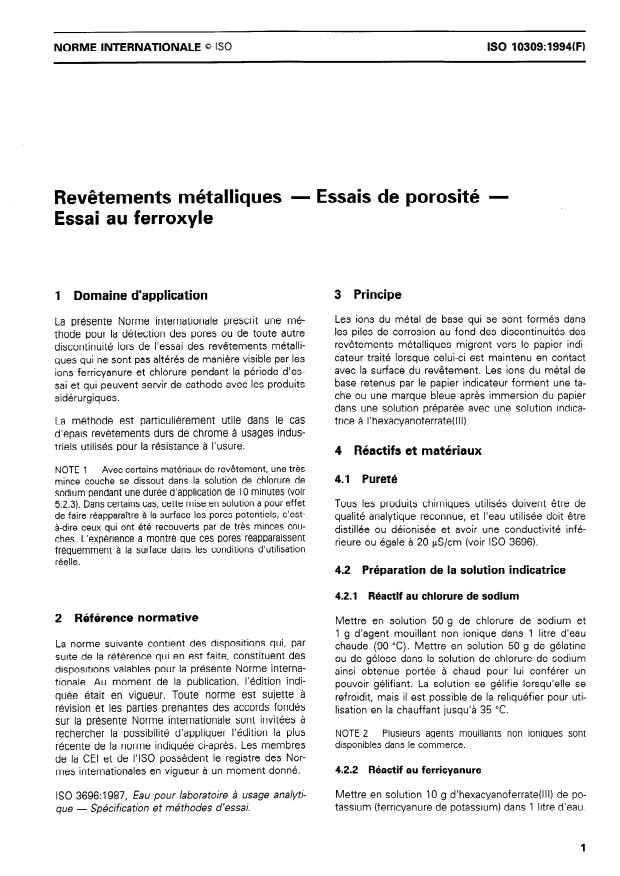
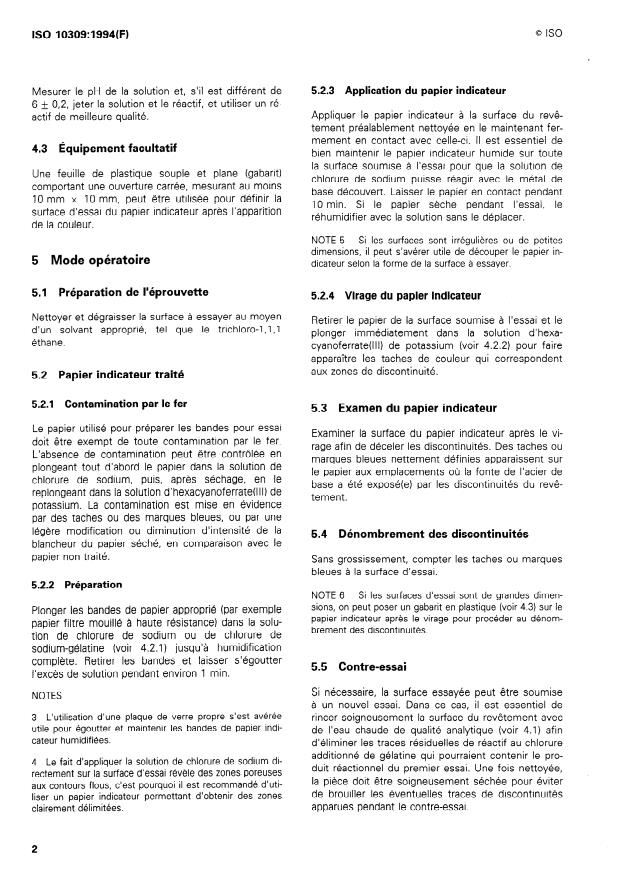
ISO 10309:1994 - Revetements métalliques — Essais de porosité — Essai au ferroxyle Released:11/10/1994

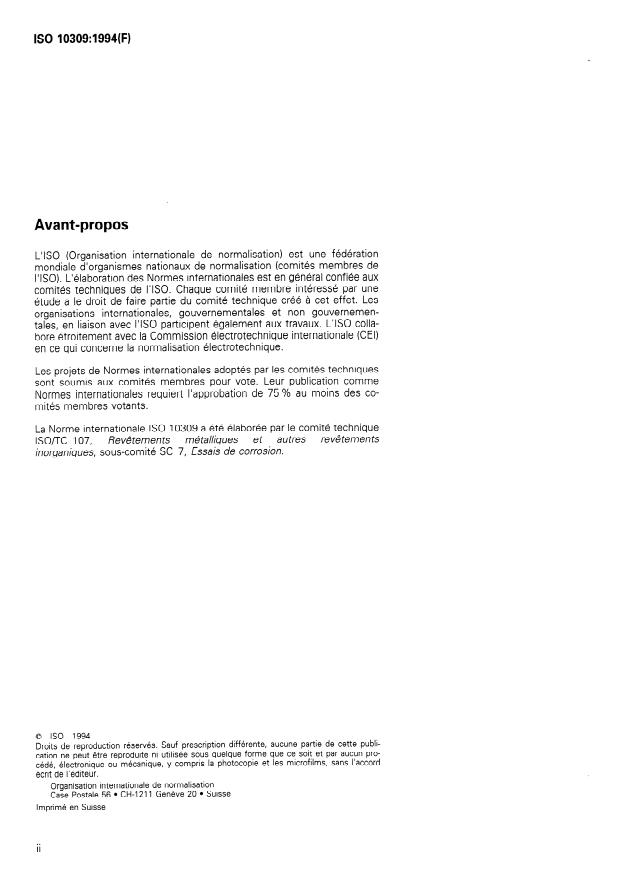

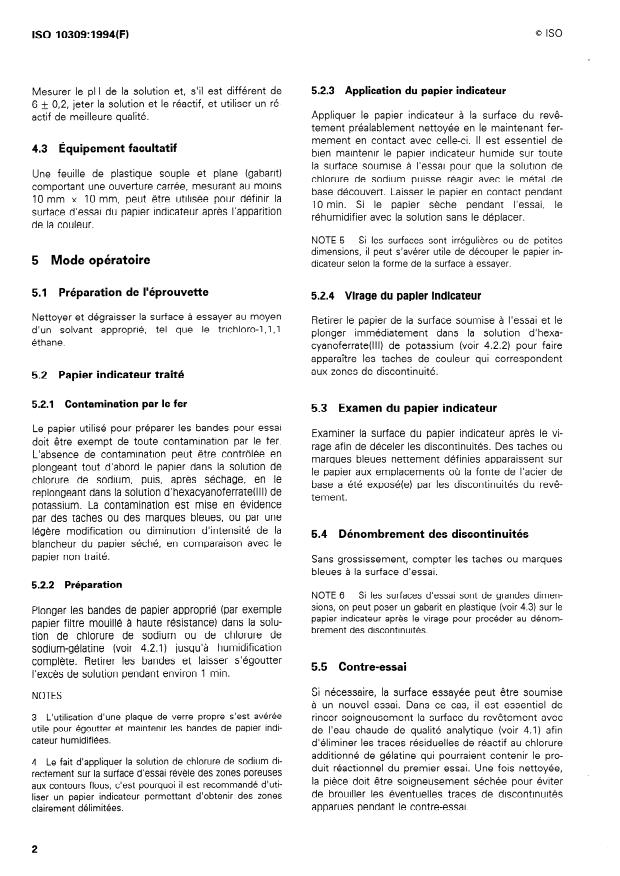
ISO 10309:1994 - Revetements métalliques — Essais de porosité — Essai au ferroxyle Released:11/10/1994
Overview
ISO 10309:1994, Metallic coatings - Porosity tests - Ferroxyl test, is an international standard developed by the International Organization for Standardization (ISO). It specifies a reliable method for detecting pores and other discontinuities in metallic coatings-especially those not visibly affected by ferricyanide and chloride ions-when applied to substrates that are cathodic to iron and steel. This standard is particularly valuable for testing thick, hard chromium coatings used for wear-resistant applications, where coating quality and impermeability are crucial for corrosion resistance and durability.
Key Topics
- Porosity Detection: Outlines the ferroxyl test process to reveal discontinuities such as pores that compromise the protective performance of metallic coatings.
- Applicable Coatings: Emphasizes its use for hard chromium coatings, and, more generally, metallic coatings cathodic to iron and steel.
- Test Principle: Pores in the coating allow base metal ions to migrate to treated test paper. These form blue spots when exposed to ferricyanide solution, indicating discontinuities.
- Reagents and Materials: Specifies requirements for pure analytical-grade chemicals, distilled or deionized water, and test solutions (sodium chloride/gelatin and potassium ferricyanide).
- Test Procedure: Details step-by-step methods, from surface preparation and application of treated test paper, to development and interpretation of test results.
- Result Expression: Defines how porosity is reported - typically as average pores per square centimeter using a standardized counting template.
Applications
The ferroxyl test method defined in ISO 10309:1994 is employed in various industries where the integrity of metallic coatings on iron and steel surfaces is vital, such as:
- Wear-resistant Components: Ensuring the effectiveness of thick, hard chromium coatings on machinery and tools.
- Corrosion Protection: Verifying coating continuity on structural steel in marine, automotive, and manufacturing environments.
- Quality Control: Supporting manufacturers and laboratories in routine inspection to meet product specifications and performance criteria.
- Failure Analysis: Identifying root causes of premature corrosion by detecting coating pores or defects.
This test is especially beneficial for routine batch inspection, new product development, and certification processes requiring reproducible, objective porosity assessment.
Related Standards
For comprehensive surface quality evaluation and laboratory best practices, several related ISO standards are frequently referenced alongside ISO 10309:1994:
- ISO 3696: Water for analytical laboratory use - Specification and test methods-cited for preparation of reagents.
- ISO 2177: Metallic coatings - Measurement of coating thickness - Coulometric method by anodic dissolution.
- ISO 2064: Metallic and other inorganic coatings - Definitions and conventions concerning the measurement of thickness.
- ISO 9227: Corrosion tests in artificial atmospheres - Salt spray tests.
- ISO 4527: Metallic coatings - Test methods for porosity - Guidance for selecting appropriate tests.
These related standards, combined with ISO 10309:1994, provide a robust framework for ensuring the quality and durability of metallic coatings in demanding environments.
Keywords: ISO 10309:1994, metallic coatings, porosity test, ferroxyl test, chromium coatings, corrosion testing, steel, quality control, international standard, pore detection, surface inspection.
Relations
- Effective Date
- 09-Feb-2026
Buy Documents
ISO 10309:1994 - Metallic coatings — Porosity tests — Ferroxyl test Released:11/10/1994
ISO 10309:1994 - Revetements métalliques — Essais de porosité — Essai au ferroxyle Released:11/10/1994
ISO 10309:1994 - Revetements métalliques — Essais de porosité — Essai au ferroxyle Released:11/10/1994
Get Certified
Connect with accredited certification bodies for this standard

DVS-ZERT GmbH
German welding certification society.
CARES (UK Certification Authority for Reinforcing Steels)
UK certification for reinforcing steels and construction.
EWF/IIW (European/International Welding Federation)
International welding personnel certification.
Sponsored listings
Frequently Asked Questions
ISO 10309:1994 is a standard published by the International Organization for Standardization (ISO). Its full title is "Metallic coatings — Porosity tests — Ferroxyl test". This standard covers: Lays down a method of revealing pores or other discontinuities, when testing metallic coatings, that are not visibly affected by ferricyanide and chloride ions during the test period and that are cathodic to iron and steel. This method is especially useful for thick, hard chromium coatings used for wear resistance.
Lays down a method of revealing pores or other discontinuities, when testing metallic coatings, that are not visibly affected by ferricyanide and chloride ions during the test period and that are cathodic to iron and steel. This method is especially useful for thick, hard chromium coatings used for wear resistance.
ISO 10309:1994 is classified under the following ICS (International Classification for Standards) categories: 25.220.40 - Metallic coatings. The ICS classification helps identify the subject area and facilitates finding related standards.
ISO 10309:1994 has the following relationships with other standards: It is inter standard links to EN ISO 6158:2011. Understanding these relationships helps ensure you are using the most current and applicable version of the standard.
ISO 10309:1994 is available in PDF format for immediate download after purchase. The document can be added to your cart and obtained through the secure checkout process. Digital delivery ensures instant access to the complete standard document.
Standards Content (Sample)
SLOVENSKI STANDARD
01-oktober-1999
Kovinske prevleke - Preskus ugotavljanja poroznosti – Preskus ferroxyl
Metallic coatings -- Porosity tests -- Ferroxyl test
Revêtements métalliques -- Essais de porosité -- Essai au ferroxyle
Ta slovenski standard je istoveten z: ISO 10309:1994
ICS:
25.220.40 Kovinske prevleke Metallic coatings
2003-01.Slovenski inštitut za standardizacijo. Razmnoževanje celote ali delov tega standarda ni dovoljeno.
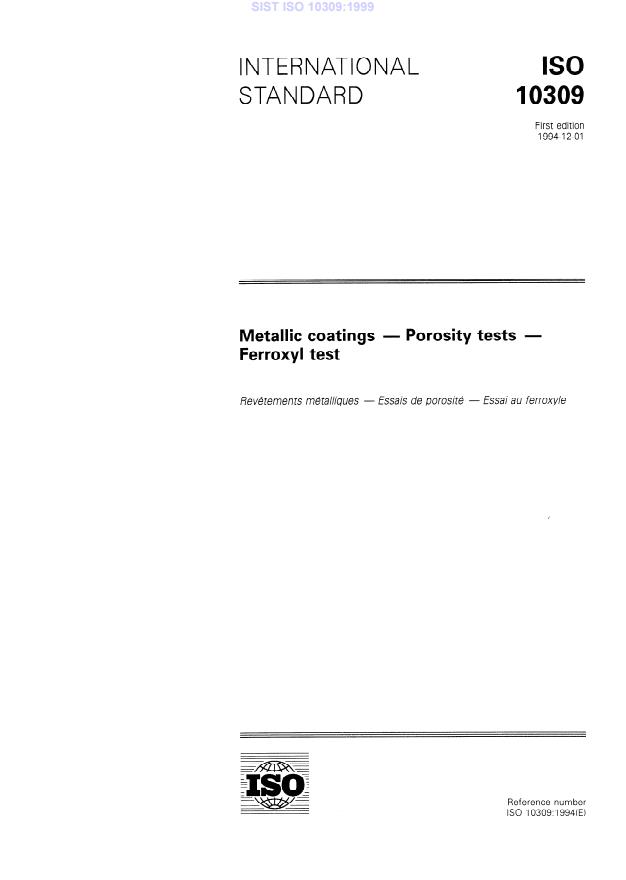
ISO
INTERNATIONAL
STANDARD
First edition
1994-12-01
Metallic coatings - Porosity tests -
Ferroxyl test
ßedtements mktalliques - Essais de porositk - Essai au ferroxyle
Reference number
Foreword
ISO (the International Organization for Standardization) is a worldwide
federation of national Standards bodies (ISO member bodies). The work
of preparing International Standards is normally carried out through ISO
technical committees. Esch member body interested in a subject for
which a technical committee has been established has the right to be
represented on that committee. International organizations, governmental
and non-governmental, in liaison with ISO, also take part in the work. ISO
collaborates closely with the International Electrotechnical Commission
(IEC) on all matters of electrotechnical standardization.
Draft International Standards adopted by the technical committees are
circulated to the member bodies for voting. Publication as an International
Standard requires approval by at least 75 % of the member bodies casting
a vote.
International Standard ISO 10309 was prepared by Technical Committee
lSO/TC 107, MetaNc and other inorganic coatings, Subcommittee SC 7,
Corrosion tests.
0 ISO 1994
All rights reserved. Unless otherwise specified, no part of this publication may be reproduced
or utilized in any form or by any means, electronrc or mechanrcal, including photocopyrng and
microfilm, without Permission in writing from the publisher.
International Organization for Standardization
Case Postale 56 l CH-l 211 Geneve 20 0 Switzerland
Printed in Switzerland
ii
~~~~
INTERNATIONAL STANDARD 0 ISO ISO 10309:1994(E)
- Porosity tests - Ferroxyl test
Metallic coatings
tom of discontinuities in metallic coatings migrate to
1 Scope
treated test Paper held in contact with the coating
surface. The base metal ions retained on the treated
This International Standard specifies a method of re-
test Paper form a blue-coloured marking or spot when
vealing pores or other discontinuities, when testing
the treated Paper is subsequently immersed in a sol-
metallic coatings, that are not visibly affected by
ution of a ferricyanide indicator Solution.
ferricyanide and chloride ions during the test period
and that are cathodic to iron and steel. This method
is especially useful for thick, hard chromium coatings
4 Reagents and materials
used for wear resistance.
NOTE 1 With some coating materials a very thin layer is
4.1 Purity
dissolved by the sodium chloride Solution during a 10 min-
ute application period (see 5.2.3). The impact of such dis-
Solution is that potential porosity, i.e. pores that have been
All chemicals used shall be of a recognized analytical
covered over by very thin layers, are sometimes re-exposed.
reagent grade and the water used shall be distilled or
Experience has shown that such potential porosity is fre-
deionized having a conductivity not greater than
quently re-exposed during actual Service.
20 pS/cm (see ISO 3696).
4.2 Preparation of the indicator solution
2 Normative reference
4.2.1 Ssdium chloride reagent
The following Standard contains provisions which,
through reference in this text, constitute provisions
Dissolve 50 g of sodium chloride and 1 g of a non-
of this International Standard. At the time of publi-
ionic wetting agent in 1 litre of hot (90 “c> water.
cation, the edition indicated was valid. All Standards
Dissolve 50 g of gelatin or agar in the above men-
are subject to revision, and Parties to agreements
tioned hot sodium chloride Solution to provide gelling
based on this International Standard are encouraged
properties. The Solution will then gel upon cooling, but
to investigate the possibility of applying the most re-
tan be re-liquefied, for use, by heating it to 35 “C.
cent edition of the Standard indicated below. Mem-
bers of IEC and ISO main
...
ISO
INTERNATIONAL
STANDARD
First edition
1994-12-01
Metallic coatings - Porosity tests -
Ferroxyl test
ßedtements mktalliques - Essais de porositk - Essai au ferroxyle
Reference number
Foreword
ISO (the International Organization for Standardization) is a worldwide
federation of national Standards bodies (ISO member bodies). The work
of preparing International Standards is normally carried out through ISO
technical committees. Esch member body interested in a subject for
which a technical committee has been established has the right to be
represented on that committee. International organizations, governmental
and non-governmental, in liaison with ISO, also take part in the work. ISO
collaborates closely with the International Electrotechnical Commission
(IEC) on all matters of electrotechnical standardization.
Draft International Standards adopted by the technical committees are
circulated to the member bodies for voting. Publication as an International
Standard requires approval by at least 75 % of the member bodies casting
a vote.
International Standard ISO 10309 was prepared by Technical Committee
lSO/TC 107, MetaNc and other inorganic coatings, Subcommittee SC 7,
Corrosion tests.
0 ISO 1994
All rights reserved. Unless otherwise specified, no part of this publication may be reproduced
or utilized in any form or by any means, electronrc or mechanrcal, including photocopyrng and
microfilm, without Permission in writing from the publisher.
International Organization for Standardization
Case Postale 56 l CH-l 211 Geneve 20 0 Switzerland
Printed in Switzerland
ii
~~~~
INTERNATIONAL STANDARD 0 ISO ISO 10309:1994(E)
- Porosity tests - Ferroxyl test
Metallic coatings
tom of discontinuities in metallic coatings migrate to
1 Scope
treated test Paper held in contact with the coating
surface. The base metal ions retained on the treated
This International Standard specifies a method of re-
test Paper form a blue-coloured marking or spot when
vealing pores or other discontinuities, when testing
the treated Paper is subsequently immersed in a sol-
metallic coatings, that are not visibly affected by
ution of a ferricyanide indicator Solution.
ferricyanide and chloride ions during the test period
and that are cathodic to iron and steel. This method
is especially useful for thick, hard chromium coatings
4 Reagents and materials
used for wear resistance.
NOTE 1 With some coating materials a very thin layer is
4.1 Purity
dissolved by the sodium chloride Solution during a 10 min-
ute application period (see 5.2.3). The impact of such dis-
Solution is that potential porosity, i.e. pores that have been
All chemicals used shall be of a recognized analytical
covered over by very thin layers, are sometimes re-exposed.
reagent grade and the water used shall be distilled or
Experience has shown that such potential porosity is fre-
deionized having a conductivity not greater than
quently re-exposed during actual Service.
20 pS/cm (see ISO 3696).
4.2 Preparation of the indicator solution
2 Normative reference
4.2.1 Ssdium chloride reagent
The following Standard contains provisions which,
through reference in this text, constitute provisions
Dissolve 50 g of sodium chloride and 1 g of a non-
of this International Standard. At the time of publi-
ionic wetting agent in 1 litre of hot (90 “c> water.
cation, the edition indicated was valid. All Standards
Dissolve 50 g of gelatin or agar in the above men-
are subject to revision, and Parties to agreements
tioned hot sodium chloride Solution to provide gelling
based on this International Standard are encouraged
properties. The Solution will then gel upon cooling, but
to investigate the possibility of applying the most re-
tan be re-liquefied, for use, by heating it to 35 “C.
cent edition of the Standard indicated below. Mem-
bers of IEC and ISO maintain registers of currently
NOTE 2 A variety of non-ionic wetting agents is com-
valid International Standards.
mercially available.
ISO 3696: 1987, Water for analytical laboratory use -
4.2.2 Ferricyanide reagent
Specification and test methods.
Dissolve 10 g of potassium hexacyanoferrate(III) (pot-
assium ferricyanide) in 1 litre of water. Measure the
pl-4 of the Solution. If it is outside the range 6 + 0,2
3 Principle
discard the Solution and the reagent and ob& a
purer grade of reagent.
Base metal ions
...
NORME
Iso
INTERNATIONALE
Premiére édition
1994-12-01
Revêtements métalliques - Essais de
porosité - Essai au ferroxyle
Metallic coa tings - Porosity tests - Ferroxyl test
Numéro de référence
KO 10309: 1994(F)
Avant-propos
L’ISO (Organisation internationale de normalisation) est une fédération
mondiale d’organismes nationaux de normalisation (comités membres de
I’ISO). L’élaboration des Normes internationales est en général confiée aux
comités techniques de I’ISO. Chaque comité membre intéressé par une
étude a le droit de faire partie du comité technique créé à cet effet. Les
organisations internationales, gouvernementales et non gouvernemen-
tales, en liaison avec I’ISO participent également aux travaux. L’ISO colla-
bore étroitement avec la Commission électrotechnique internationale (CEI)
en ce qui concerne la normalisation électrotechnique.
Les projets de Normes internationales adoptés par les comités techniques
sont soumis aux comités membres pour vote. Leur publication comme
Normes internationales requiert l’approbation de 75 % au moins des co-
mités membres votants.
La Norme internationale ISO 10309 a été élaborée par le comité technique
lSO/TC 107, Revêtements métalliques et autres revêtements
inorganiques, sous-comité SC 7, Essais de corrosion.
0 ISO 1994
Droits de reproduction réservés. Sauf prescription différente, aucune partie de cette publi-
cation ne peut être reproduite ni utilisée sous quelque forme que ce soit et par aucun pro-
cédé, électronique ou mécanique, y compris la photocopie et les microfilms, sans l’accord
écrit de l’éditeur.
de normalisation
Organisation internationale
56@CH-1211 Genève 20 l Su isse
Case Postale
Imprimé en Suisse
ii
NORME INTERNATIONALE 0 ISO
Revêtements métalliques - Essais de porosité -
Essai au ferroxyle
3 Principe
1 Domaine d’application
Les ions du métal de base qui se sont formés dans
La présente Norme internationale prescrit une mé-
les piles de corrosion au fond des discontinuités des
thode pour la détection des pores ou de toute autre
revêtements métalliques migrent vers le papier indi-
discontinuité lors de l’essai des revêtements métalli-
cateur traité lorsque celui-ci est maintenu en contact
ques qui ne sont pas altérés de manière visible par les
avec la surface du revêtement. Les ions du métal de
ions ferricyanure et chlorure pendant la période d’es-
base retenus par le papier indicateur forment une ta-
sai et qui peuvent servir de cathode avec les produits
che ou une marque bleue après immersion du papier
sidérurgiques.
dans une solution préparée avec une solution indica-
La méthode est particulièrement utile dans le cas trice à I’hexacyanoferrate( I II).
d’épais revêtements durs de chrome à usages indus-
triels utilisés pour la résistance à l’usure.
4 Réactifs et matériaux
NOTE 1 Avec certains matériaux de revêtement, une très
4.1 Pureté
mince couche se dissout dans la solution de chlorure de
sodium pendant une durée d’application de 10 minutes (voir
5.2.3). Dans certains cas, cette mise en solution a pour effet Tous les produits chimiques utilisés doivent être de
de faire réapparaître a la surface les pores potentiels, c’est-
qualité analytique reconnue, et l’eau utilisée doit être
à-dire ceux qui ont été recouverts par de très minces cou-
distillée ou déionisée et avoir une conductivité infé-
ches. L’expérience a montre que ces pores réapparaissent
rieure ou égale à 20 pS/cm (voir ISO 3696).
fréquemment a la surface dans les conditions d’utilisation
réelle.
4.2 Préparation de la solution indicatrice
4.2.1 Réactif au chlorure de sodium
2 Référence normative
Mettre en solution 50 g de chlorure de sodium et
1 g d’agent mouillant non ionique dans 1 litre d’eau
La norme suivante contient des dispositions qui, par
chaude (90 “C). Mettre en solution 50 g de gélatine
suite de la référence qui en est faite, constituent des
ou de gélose dans la solution de chlorure de sodium
dispositions valables pour la présente Norme interna-
ainsi obtenue portée à chaud pour lui conférer un
tionale. Au moment de la publication, l’édition indi-
pouvoir gélifiant. La solution se gélifie lorsqu’elle se
quée était en vigueur. Toute norme est sujette à
refroidit, mais il est possible de la reliquéfier pour uti-
révision et les parties prenantes des accords fondés
lisation en la chauffant jusqu’à 35 “C.
sur la présente Norme internationale sont invitées à
rechercher la possibilité d’appliquer l’édition la plus NOTE 2 Plusieurs agents mouillants non ioniques sont
disponibles dans le commerce.
récente de la norme indiquée ci-après. Les membres
de la CEI et de I’ISO possèdent le registre des Nor-
4.2.2 Réactif au ferricyanure
mes internationales en vigueur à un moment donné.
Mettre en solution 10 g d’hexacyanoferrate(III) de po-
ISO 3696: 1987, Eau pour laboratoire à usage analyti-
tassium (ferricyanure de potassium) dans 1 litre d’eau.
- Spécifica tion et méthodes d’essai.
que
0 ISO
Mesurer le p
...
NORME
Iso
INTERNATIONALE
Premiére édition
1994-12-01
Revêtements métalliques - Essais de
porosité - Essai au ferroxyle
Metallic coa tings - Porosity tests - Ferroxyl test
Numéro de référence
KO 10309: 1994(F)
Avant-propos
L’ISO (Organisation internationale de normalisation) est une fédération
mondiale d’organismes nationaux de normalisation (comités membres de
I’ISO). L’élaboration des Normes internationales est en général confiée aux
comités techniques de I’ISO. Chaque comité membre intéressé par une
étude a le droit de faire partie du comité technique créé à cet effet. Les
organisations internationales, gouvernementales et non gouvernemen-
tales, en liaison avec I’ISO participent également aux travaux. L’ISO colla-
bore étroitement avec la Commission électrotechnique internationale (CEI)
en ce qui concerne la normalisation électrotechnique.
Les projets de Normes internationales adoptés par les comités techniques
sont soumis aux comités membres pour vote. Leur publication comme
Normes internationales requiert l’approbation de 75 % au moins des co-
mités membres votants.
La Norme internationale ISO 10309 a été élaborée par le comité technique
lSO/TC 107, Revêtements métalliques et autres revêtements
inorganiques, sous-comité SC 7, Essais de corrosion.
0 ISO 1994
Droits de reproduction réservés. Sauf prescription différente, aucune partie de cette publi-
cation ne peut être reproduite ni utilisée sous quelque forme que ce soit et par aucun pro-
cédé, électronique ou mécanique, y compris la photocopie et les microfilms, sans l’accord
écrit de l’éditeur.
de normalisation
Organisation internationale
56@CH-1211 Genève 20 l Su isse
Case Postale
Imprimé en Suisse
ii
NORME INTERNATIONALE 0 ISO
Revêtements métalliques - Essais de porosité -
Essai au ferroxyle
3 Principe
1 Domaine d’application
Les ions du métal de base qui se sont formés dans
La présente Norme internationale prescrit une mé-
les piles de corrosion au fond des discontinuités des
thode pour la détection des pores ou de toute autre
revêtements métalliques migrent vers le papier indi-
discontinuité lors de l’essai des revêtements métalli-
cateur traité lorsque celui-ci est maintenu en contact
ques qui ne sont pas altérés de manière visible par les
avec la surface du revêtement. Les ions du métal de
ions ferricyanure et chlorure pendant la période d’es-
base retenus par le papier indicateur forment une ta-
sai et qui peuvent servir de cathode avec les produits
che ou une marque bleue après immersion du papier
sidérurgiques.
dans une solution préparée avec une solution indica-
La méthode est particulièrement utile dans le cas trice à I’hexacyanoferrate( I II).
d’épais revêtements durs de chrome à usages indus-
triels utilisés pour la résistance à l’usure.
4 Réactifs et matériaux
NOTE 1 Avec certains matériaux de revêtement, une très
4.1 Pureté
mince couche se dissout dans la solution de chlorure de
sodium pendant une durée d’application de 10 minutes (voir
5.2.3). Dans certains cas, cette mise en solution a pour effet Tous les produits chimiques utilisés doivent être de
de faire réapparaître a la surface les pores potentiels, c’est-
qualité analytique reconnue, et l’eau utilisée doit être
à-dire ceux qui ont été recouverts par de très minces cou-
distillée ou déionisée et avoir une conductivité infé-
ches. L’expérience a montre que ces pores réapparaissent
rieure ou égale à 20 pS/cm (voir ISO 3696).
fréquemment a la surface dans les conditions d’utilisation
réelle.
4.2 Préparation de la solution indicatrice
4.2.1 Réactif au chlorure de sodium
2 Référence normative
Mettre en solution 50 g de chlorure de sodium et
1 g d’agent mouillant non ionique dans 1 litre d’eau
La norme suivante contient des dispositions qui, par
chaude (90 “C). Mettre en solution 50 g de gélatine
suite de la référence qui en est faite, constituent des
ou de gélose dans la solution de chlorure de sodium
dispositions valables pour la présente Norme interna-
ainsi obtenue portée à chaud pour lui conférer un
tionale. Au moment de la publication, l’édition indi-
pouvoir gélifiant. La solution se gélifie lorsqu’elle se
quée était en vigueur. Toute norme est sujette à
refroidit, mais il est possible de la reliquéfier pour uti-
révision et les parties prenantes des accords fondés
lisation en la chauffant jusqu’à 35 “C.
sur la présente Norme internationale sont invitées à
rechercher la possibilité d’appliquer l’édition la plus NOTE 2 Plusieurs agents mouillants non ioniques sont
disponibles dans le commerce.
récente de la norme indiquée ci-après. Les membres
de la CEI et de I’ISO possèdent le registre des Nor-
4.2.2 Réactif au ferricyanure
mes internationales en vigueur à un moment donné.
Mettre en solution 10 g d’hexacyanoferrate(III) de po-
ISO 3696: 1987, Eau pour laboratoire à usage analyti-
tassium (ferricyanure de potassium) dans 1 litre d’eau.
- Spécifica tion et méthodes d’essai.
que
0 ISO
Mesurer le p
...