

ISO/IEC TS 8236-2:2025
(Main)Information technology — Provisioning, forecasting and management — Part 2: Data centre facility infrastructure
General Information
- Abstract
This document specifies a standardized method of optimizing facility provisioning within data centres by utilizing KPIs that enable the development of facility profiles for individual systems or platforms. The combination of the system and platform KPIs are used to establish a facility provisioning profile, establishing standard forecasting methods to optimize data centre resource effectiveness. This document: a) defines a method for identifying benchmarks and trends in facility provisioning; b) provides capability assessment/indicators of facility infrastructure over the infrastructure life-cycle including preparatory, commissioning, expansion/contraction and/or retirement of IT equipment; c) describes the relationship of DCfP to dPUE (ISO/IEC 30134-2), providing a common methodology to base dPUE.
- Status
- Published
- Publication Date
- 16-Sep-2025
- Technical Committee
- ISO/IEC JTC 1/SC 39 - Sustainability, IT and data centres
- Drafting Committee
- ISO/IEC JTC 1/SC 39 - Sustainability, IT and data centres
- Current Stage
- 6060 - International Standard published
- Start Date
- 17-Sep-2025
- Due Date
- 07-Jun-2026
- Completion Date
- 17-Sep-2025


Overview
ISO/IEC TS 8236-2:2025 - "Information technology - Provisioning, forecasting and management - Part 2: Data centre facility infrastructure" specifies a standardized method to optimize data centre facility provisioning (DCfP) using measurable KPIs. The Technical Specification ties facility planning to IT provisioning (DCitP) so facility resources (power, cooling, space) are forecasted and sized using platform- and system-level provisioning profiles. It supports lifecycle planning from preparatory and commissioning stages through expansion/contraction and retirement of IT equipment and clarifies the relationship between DCfP and designed PUE (dPUE) (see ISO/IEC 30134-2).
Key topics and requirements
- Standardized KPI methodology for developing facility provisioning profiles that combine system and platform KPIs.
- Integration requirement: DCfP must be developed from DCitP data - IT provisioning is a pre-requisite (see Section 4).
- Benchmarking and trend identification to establish consistent historic and forecasted provisioning data.
- Capability assessment indicators across the infrastructure lifecycle (preparatory, commissioning, expansion/contraction, retirement).
- Defined reporting practices for DCfP (Section 7) and example workflows including IT equipment refresh scenarios (Section 6 and Annex A).
- Methods to use DCfP results to establish dPUE (linking to ISO/IEC 30134-2) and standardized approaches to forecast CAPEX and OPEX for in‑house, colocation, managed and public cloud models (Section 9).
- Terminology and units used in provisioning analysis: RU (rack unit), TDP (thermal design power), LC-IT (liquid-cooled IT), PUE/dPUE, V2P, platform/system definitions.
Practical applications and users
Who uses ISO/IEC TS 8236-2:
- Data centre facility planners and designers
- IT provisioning teams and capacity planners
- Operations managers and sustainability leads
- Colocation and cloud service providers evaluating CAPEX/OPEX
- Architects integrating liquid‑cooling and high‑density IT deployments
Practical uses:
- Create repeatable, KPI-driven forecasts for power, cooling and space requirements.
- Coordinate IT refresh cycles with long-lived facility investments to avoid reactive provisioning.
- Provide a consistent basis for dPUE estimation and for comparative benchmarking across sites.
- Support financial planning by translating provisioning forecasts into CAPEX and OPEX scenarios.
Related standards
- ISO/IEC TS 8236-1 - Data centre IT equipment provisioning (DCitP) - required input for DCfP.
- ISO/IEC 30134-2 - Power usage effectiveness (PUE) and designed PUE (dPUE) - methodology linkage.
Using ISO/IEC TS 8236-2 helps teams move from ad hoc facility decisions to KPI-based, forecastable provisioning that aligns IT evolution with sustainable, cost-effective data centre infrastructure.
Get Certified
Connect with accredited certification bodies for this standard

BSI Group
BSI (British Standards Institution) is the business standards company that helps organizations make excellence a habit.

NYCE
Mexican standards and certification body.
Sponsored listings
Frequently Asked Questions
ISO/IEC TS 8236-2:2025 is a technical specification published by the International Organization for Standardization (ISO). Its full title is "Information technology — Provisioning, forecasting and management — Part 2: Data centre facility infrastructure". This standard covers: This document specifies a standardized method of optimizing facility provisioning within data centres by utilizing KPIs that enable the development of facility profiles for individual systems or platforms. The combination of the system and platform KPIs are used to establish a facility provisioning profile, establishing standard forecasting methods to optimize data centre resource effectiveness. This document: a) defines a method for identifying benchmarks and trends in facility provisioning; b) provides capability assessment/indicators of facility infrastructure over the infrastructure life-cycle including preparatory, commissioning, expansion/contraction and/or retirement of IT equipment; c) describes the relationship of DCfP to dPUE (ISO/IEC 30134-2), providing a common methodology to base dPUE.
This document specifies a standardized method of optimizing facility provisioning within data centres by utilizing KPIs that enable the development of facility profiles for individual systems or platforms. The combination of the system and platform KPIs are used to establish a facility provisioning profile, establishing standard forecasting methods to optimize data centre resource effectiveness. This document: a) defines a method for identifying benchmarks and trends in facility provisioning; b) provides capability assessment/indicators of facility infrastructure over the infrastructure life-cycle including preparatory, commissioning, expansion/contraction and/or retirement of IT equipment; c) describes the relationship of DCfP to dPUE (ISO/IEC 30134-2), providing a common methodology to base dPUE.
ISO/IEC TS 8236-2:2025 is classified under the following ICS (International Classification for Standards) categories: 35.020 - Information technology (IT) in general. The ICS classification helps identify the subject area and facilitates finding related standards.
ISO/IEC TS 8236-2:2025 is available in PDF format for immediate download after purchase. The document can be added to your cart and obtained through the secure checkout process. Digital delivery ensures instant access to the complete standard document.
Standards Content (Sample)
Technical
Specification
ISO/IEC TS 8236-2
First edition
Information technology —
2025-09
Provisioning, forecasting and
management —
Part 2:
Data centre facility infrastructure
Technologies de l'information — Approvisionnement, prévision et
gestion —
Partie 2: Infrastructure de site des centres de traitement de
données
Reference number
© ISO/IEC 2025
All rights reserved. Unless otherwise specified, or required in the context of its implementation, no part of this publication may
be reproduced or utilized otherwise in any form or by any means, electronic or mechanical, including photocopying, or posting on
the internet or an intranet, without prior written permission. Permission can be requested from either ISO at the address below
or ISO’s member body in the country of the requester.
ISO copyright office
CP 401 • Ch. de Blandonnet 8
CH-1214 Vernier, Geneva
Phone: +41 22 749 01 11
Email: copyright@iso.org
Website: www.iso.org
Published in Switzerland
© ISO/IEC 2025 – All rights reserved
ii
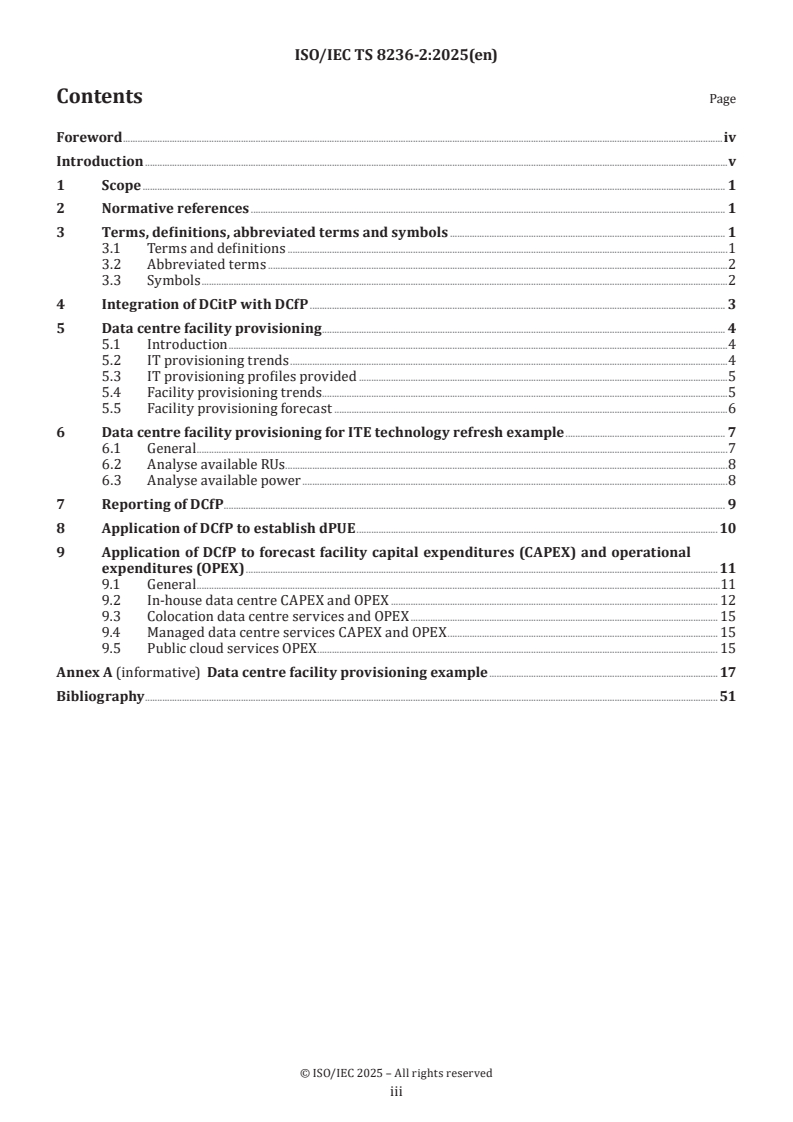
Contents Page
Foreword .iv
Introduction .v
1 Scope . 1
2 Normative references . 1
3 Terms, definitions, abbreviated terms and symbols . 1
3.1 Terms and definitions .1
3.2 Abbreviated terms .2
3.3 Symbols .2
4 Integration of DCitP with DCfP . 3
5 Data centre facility provisioning . 4
5.1 Introduction .4
5.2 IT provisioning trends .4
5.3 IT provisioning profiles provided .5
5.4 Facility provisioning trends.5
5.5 Facility provisioning forecast .6
6 Data centre facility provisioning for ITE technology refresh example . 7
6.1 General .7
6.2 Analyse available RUs . .8
6.3 Analyse available power .8
7 Reporting of DCfP. 9
8 Application of DCfP to establish dPUE . 10
9 Application of DCfP to forecast facility capital expenditures (CAPEX) and operational
expenditures (OPEX) .11
9.1 General .11
9.2 In-house data centre CAPEX and OPEX . 12
9.3 Colocation data centre services and OPEX . 15
9.4 Managed data centre services CAPEX and OPEX . 15
9.5 Public cloud services OPEX . 15
Annex A (informative) Data centre facility provisioning example . 17
Bibliography .51
© ISO/IEC 2025 – All rights reserved
iii
Foreword
ISO (the International Organization for Standardization) and IEC (the International Electrotechnical
Commission) form the specialized system for worldwide standardization. National bodies that are
members of ISO or IEC participate in the development of International Standards through technical
committees established by the respective organization to deal with particular fields of technical activity.
ISO and IEC technical committees collaborate in fields of mutual interest. Other international organizations,
governmental and non-governmental, in liaison with ISO and IEC, also take part in the work.
The procedures used to develop this document and those intended for its further maintenance are described
in the ISO/IEC Directives, Part 1. In particular, the different approval criteria needed for the different types
of document should be noted. This document was drafted in accordance with the editorial rules of the ISO/
IEC Directives, Part 2 (see www.iso.org/directives or www.iec.ch/members_experts/refdocs).
ISO and IEC draw attention to the possibility that the implementation of this document may involve the
use of (a) patent(s). ISO and IEC take no position concerning the evidence, validity or applicability of any
claimed patent rights in respect thereof. As of the date of publication of this document, ISO and IEC had not
received notice of (a) patent(s) which may be required to implement this document. However, implementers
are cautioned that this may not represent the latest information, which may be obtained from the patent
database available at www.iso.org/patents and https://patents.iec.ch. ISO and IEC shall not be held
responsible for identifying any or all such patent rights.
Any trade name used in this document is information given for the convenience of users and does not
constitute an endorsement.
For an explanation of the voluntary nature of standards, the meaning of ISO specific terms and expressions
related to conformity assessment, as well as information about ISO's adherence to the World Trade
Organization (WTO) principles in the Technical Barriers to Trade (TBT) see www.iso.org/iso/foreword.html.
In the IEC, see www.iec.ch/understanding-standards.
This document was prepared by Joint Technical Committee ISO/TC JTC 1, Information technology,
Subcommittee SC 39, Sustainability, IT and data centres.
A list of all parts in the ISO/IEC 8236 series can be found on the ISO website.
Any feedback or questions on this document should be directed to the user’s national standards
body. A complete listing of these bodies can be found at www.iso.org/members.html and
www.iec.ch/national-committees.
© ISO/IEC 2025 – All rights reserved
iv
Introduction
The global economy is increasingly more reliant on information and communication technologies and the
associated generation, transmission, compute and storage of digital data. All markets have experienced
growth in the digital data for social, educational, medical and business sectors. There are a wide variety
of data centres within private enterprise, shared/collocation and cloud service providers that meet the
growing demands of the digital data. The growth of this digital data will continue at a rapid pace with the
development of devices within the “Internet of Things” category, artificial intelligence applications, and the
increased ability to generate and transmit data while mobile with the deployment of 5G technology. With
the transition from air-cooled information technology (IT) equipment to liquid-cooling technologies, with
the advent of processors requiring higher power demands, it is also important to coordinate IT air-cooled vs
liquid-cooled provisioning plans with facility provisioning plans.
Compute and storage technologies and requirements continue to change rapidly. This creates challenges
for IT professionals who are responsible for planning for the provisioning compute and storage systems,
and the networks interconnecting the systems. Data centre IT systems and platform ecosystems typically
have life-cycles of 3 to 5 years. However, IT provisioning planners are challenged to identify provisioning
requirements beyond even 1 year. This results in significant challenges for data centre facility provisioning
planners who are responsible for identifying requirements for data centre facility systems that have life
cycles of 10 to 25 years.
Data centre IT personnel responsible for provisioning IT systems are often unfamiliar with how the IT
systems impact facility planning. They are also often unfamiliar with the abundance of information that
is available to them that can help the facility planning personnel to develop a holistic, long-term plan for
provisioning data centre facilities. This has resulted in reactive provisioning. This has also impeded data
centre facilities personnel responsible for planning power, cooling and space provisioning. The data centre
facilities personnel have little or no knowledge of IT requirements or advanced notice of facility system
capacities required to support IT systems that are to be deployed within the data centre.
With this background, growth of digital data is inevitable, and the reactive planning status quo will result
in greater frustration for both the IT and facilities provisioning planners. There is therefore a need for a
method to benchmark and trend IT provisioning using standard indicators, processes, and reporting.
A data centre provisioning key performance indicator (KPI) will provide a method to profile future IT system
and platform requirements over the life of the infrastructure. This method is based on the data centre’s
current IT applications and systems, the assets of the IT equipment platform, their expansion or contraction
trends, and the impact of future changes in technology network, compute and storage processing density
and efficiency. Coordinating the DCitP with the DCfP KPI will help develop long range forecasts that extend
beyond the current IT equipment life-cycle. This will help guide designers and planners to optimize the
capacity of the facility infrastructure, providing greater efficiency of the resources implemented.
This document, in combination with ISO/IEC TS 8236-1, defines the benchmarking, trending and reporting
methodologies to be used to develop a holistic long-term provisioning plan.
The data centre provisioning KPI will be influential in guiding data centre designers and planners when
developing a design power usage effectiveness (dPUE) defined in ISO/IEC 30134-2. The data centre
provisioning KPI can be used in place of an arbitrary estimated IT load to develop the dPUE. The data centre
provisioning KPI will provide owners, designers and planners the opportunity to forecast IT loads using a
consistent methodology based on the provisioning profile.
© ISO/IEC 2025 – All rights reserved
v
Technical Specification ISO/IEC TS 8236-2:2025(en)
Information technology — Provisioning, forecasting and
management —
Part 2:
Data centre facility infrastructure
1 Scope
This document specifies a standardized method of optimizing facility provisioning within data centres
by utilizing KPIs that enable the development of facility profiles for individual systems or platforms. The
combination of the system and platform KPIs are used to establish a facility provisioning profile, establishing
standard forecasting methods to optimize data centre resource effectiveness.
This document:
a) defines a method for identifying benchmarks and trends in facility provisioning;
b) provides capability assessment/indicators of facility infrastructure over the infrastructure life-cycle
including preparatory, commissioning, expansion/contraction and/or retirement of IT equipment;
c) describes the relationship of DCfP to dPUE (ISO/IEC 30134-2), providing a common methodology to
base dPUE.
2 Normative references
The following documents are referred to in the text in such a way that some or all of their content constitutes
requirements of this document. For dated references, only the edition cited applies. For undated references,
the latest edition of the referenced document (including any amendments) applies.
ISO/IEC/TS 8236-1, Information Technology — Provisioning, forecasting and management — Part 1: Data
centre IT equipment
3 Terms, definitions, abbreviated terms and symbols
3.1 Terms and definitions
For the purposes of this document, the terms and definitions given in ISO/IEC TS 8236-1 and the following apply.
ISO and IEC maintain terminological databases for use in standardization at the following addresses:
— ISO Online browsing platform: available at https:// www .iso .org/ obp
— IEC Electropedia: available at https:// www .electropedia .org/
3.1.1
IT platform
subset of equipment within an IT system to differentiate between various type of equipment, or a subset of
equipment across multiple IT systems grouped to associate various types of equipment, by physical, logical
or function characteristics such as form factor, class, generation, application, etc.
© ISO/IEC 2025 – All rights reserved
3.1.2
IT system
set of one or more ITE providing network, compute or storage, or any combination of network, compute
or storage
3.1.3
system
components grouped together to provide increased capacity or redundancy, or components integrated
together to provide required functionality
3.1.4
thermal design power
maximum amount of heat a CPU or GPU generates
3.2 Abbreviated terms
For the purposes of this document, the following abbreviated terms apply.
DCfP data centre facility provisioning
DCitP data centre IT provisioning
ITE information technology equipment
LC-IT liquid cooled information technology
LFF large form factor server with a profile greater than 2RUs
P platform, data illustrating historic trends or forecasts
PUE power usage effectiveness
dPUE designed power usage effectiveness derivative
RU rack unit
SFF small form factor server with a profile of 2RU or less
TDP thermal design power
V2P quantity of virtual machine guests on a virtual machine host expressed as a ratio
3.3 Symbols
For the purposes of this document, the following symbols apply.
β
linear regression model
C life-cycle
LC
D normal quantity of platform devices per rack or cabinet
R
m number of platform trends
n number of historic data points in a platform trend
P platform, data illustrating historic trends or forecasts
© ISO/IEC 2025 – All rights reserved
P platform where “i” represents the quantity of platforms within DCitP or DCfP, “ j” represents the
i,j,k
quantity of variables within the platform and “k” represents the quantity of data points in the trend
or forecast
R height of single chassis of platform “i”, measured in rack units
RU,i
R total rack units
TRU
R consumed rack units within rack or cabinet
CRU
R rack units per platform device
RUD
s number of data points in a platform provisioning forecast
S refresh space
RS
t time
W weighting factor
y one or more variables used to establish a unique trend for the provisioning profile
η data centre facility provisioning
f
4 Integration of DCitP with DCfP
The development of a data centre facility provisioning (DCfP) profile requires the integration of a data centre
IT provisioning (DCitP) profile as illustrated in Figure 1. The DCitP profile consists of various platform
provisioning forecasts. DCfP cannot be developed in isolation of DCitP, DCitP is a pre-requisite.
The DCitP analysis and reports will be forwarded by the IT provisioning team to the facilities provisioning
team. The facilities provisioning team will incorporate the provided data into the DCfP. The DCfP cannot
be developed without meaningful and useful data from the IT provisioning team, therefore it is important
that the IT and facilities team collaborate early in the planning stages as the IT provisioning team
establishes the platforms, the attributes and units of measure that the DCitP reports will forward to the
facilities provisioning team. The facilities provisioning team should verify the data to be provided by the IT
provisioning team can be utilized within the DCfP analysis.
Figure 1 — Integration of DCitP with DCfP
© ISO/IEC 2025 – All rights reserved
5 Data centre facility provisioning
5.1 Introduction
The data centre industry has historically been challenged with a disconnect between IT and facilities
personnel responsible for designing, planning and implementing the systems for which they are responsible.
This challenge is primarily the result of both the IT and facility planners responsible for the physical systems
and infrastructure not participating, either by choice or by organizational structure and processes, in the
planning of the applications that the data centre is to support and the requirements of those applications.
One of the primary requirements in developing a data centre facility provisioning profile is to integrate the
DCitP profile with available data that quantifies the facility requirements. The data provided by the DCitP
profile includes various IT platform provisioning forecasts. The DCitP is developed based on identifying
trends of IT platforms and incorporates growth or contraction of IT platforms due to advancements in
technology, growth or contraction of end user capacity requirements and growth or contraction that can
be a result of changing business strategies. The DCitP platform profiles will be provided to the facility
provisioning planning team by the IT provisioning planning team. Another primary requirement in
developing a DCfP profile is to identify facility trends. The facility profiles are developed by analysing past
trends and extrapolating past trends to estimate future requirements.
The trends may consist of growth or contraction. The trends for any data centre provisioning profile
will consist of known patterns, such as a known pattern of increase in the amount of data required to be
retained, or variable patterns, such as a change in the electrical power capacity required start-up and run, or
the energy consumed, by data storage drives with each storage platform technology refresh over a defined
period of time.
The trends can identify a growth in infrastructure requirements such as when the quantity of data storage
drives required is growing at a rate that exceeds the rate of increased energy efficiency, with each technology
refresh, of data storage drives. The trends can also identify a contraction in infrastructure requirements
such as when the energy efficiency of data storage drives increase with each technology refresh at a rate
that exceeds the rate of increasing quantity of data storage drives required.
The trends are unique for each organization operating a data centre. Trends can also be unique between
different data centres operated by a single organization. Trends are influenced by an organization’s tactic
regarding new emerging technologies. Trends can change rapidly with the development of new technologies,
however a specific organization’s deployment of new technology will typically lag this rate depending on
their internal adoption rate of new technologies, such as bleeding edge, cutting edge, leading edge or lagging.
An organization may also have differing adoption rates across the various technologies and platforms within
their data centre.
Trends and the resulting facility provisioning profiles are not intended to compare data centres. They
are intended to develop a profile that can guide designers and planners on future infrastructure capacity
requirements and energy consumption for a specific data centre based on the applications, IT systems and
platforms within the specific data centre.
5.2 IT provisioning trends
The level of detail and granularity of the DCitP provisioning profiles will vary for each data centre. This
will also impact the development of the DCfP provisioning profiles as they are developed directly from the
DCitP profiles provided by the data centre IT provisioning planning team. It is compulsory that the DCitP
provide the level of detail required for the facility provisioning planning team to develop the power, cooling
and space provisioning forecasts. This document is not intended to define specific trend data or units of
measure to analyse. This document is intended to identify a methodology that can be applied to any DCitP
provisioning profile in developing a facility provisioning profile.
© ISO/IEC 2025 – All rights reserved
5.3 IT provisioning profiles provided
The IT provisioning profiles shall include the following in accordance with the DCitP specification outlined
in ISO/IEC TS 8236-1:
— All ITE within the data centre shall be included in the DCitP profiles.
— Each component within the IT equipment systems shall only be included in one DCitP profile.
— The DCitP provisioning profiles shall provide data that enables the facility planning team to establish
DCfP provisioning profiles that forecast power, cooling and space requirements.
It is compulsory that the DCitP provisioning profiles provide the data compiled with variables (y) plotted as
a function of time (t), providing unique trend data points for the platform.
y=f(t)
Each set of IT provisioning profiles trend data will consist of a sample set {(y , t ); k=−n, −n+1, …, 0, … s} where
k k
n is the number of historic data points available, s represents the product of the number of years to forecast
and the quantity of time intervals within a year, and where n=0 is the current state. It is recommended
that the data centre IT provisioning planning team provide a minimum of 3 years of historic data points.
Reasonable data point intervals are weekly, monthly or quarterly. Weekly intervals are recommended for
data points that can be automatically gathered and compiled with the use of automated tools. Quarterly data
point intervals are not recommended as this results in fewer data points to validate the DCitP and DCfP on
an annual basis, however quarterly intervals may be appropriate for data points that require manual data
gathering and compiling. The DCitP profiles can provide provisioning forecasts out 3, 5, 10 or more years.
The data point gathering intervals should be coordinated between the IT and facility provisioning planning
teams. Neither the DCitP technical specification outlined in ISO/IEC TS 8236-1 or this document identify
the specific data to be coordinated and shared between the IT and facility provisioning planning teams.
The appropriate data to be handed over will depend on the scope of responsibility of each team, and the
management and monitoring tools utilized by both teams.
Examples of DCitP provisioning historic and forecasted profiles that can be provided by the data centre IT
provisioning planning team are provided in Annex A. These include:
— quantity of physical servers by platform (A.2.2.1)
— also refer to ISO/IEC TS 8236-1:2025, Annex A.2.4, Tables A.8 and A.9
— quantity of server cabinets by platform (A.2.4.1)
— also refer to ISO/IEC TS 8236-1:2025, Annex A.2.5, Table A.10
— quantity of storage drives by platform (A.3.2.1)
— also refer to ISO/IEC TS 8236-1:2025, Annex A.3.4, Table A.15
— quantity of storage frames by platform (A.3.3.1)
— also refer to ISO/IEC TS 8236-1:2025, Annex A.3.5, Table A.16
5.4 Facility provisioning trends
The level of detail and granularity required for facility trend analyse will vary depending on the quantity
and complexity of DCitP provisioning profiles that are provided, and the availability of past power, cooling
and space trend data for each profile.
Each of the DCitP provisioning trends can have multiple facility variables that will need to be incorporated
into the trend analysis to identify the power, cooling and space facility infrastructure requirements. The
quantity of facility variables that will need to be considered, measured and analysed will vary depending on
© ISO/IEC 2025 – All rights reserved
the platform and which facility infrastructure requirements are being analysed. The trend for a platform (P)
with r facility variables and n historic data points is expressed as:
r
Py==kn−−,,n+…10,
{}∏ jk,
j=1
th
The trend P marks the m IT platform trend, and the combination of all m platform trends encompasses
m
all ITE. Thus, the combination of all m platforms (P) and all facility variables r, represents the historic data
centre provisioning and is expressed as:
m m r
η ==Py kn=− ,,−+n 10…,
f ∑∑i ∏ ij,,k
i==11i j=1
5.5 Facility provisioning forecast
For each historic facility variable sample set {(y , t ); k=-n, -n+1, …, 0}, a linear regression analysis is a
k k
method that can be used to establish a facility variable trend line and forecast. An appropriate regression
model should be established for each facility variable, and can consist of a simple linear regression, or
transformation linear regression such as exponential, power, reciprocal or hyperbolic functions.
The analysis can apply a regression model that extends the provisioning forecast to match the timeline of
the DCitP provisioning forecast. The facility variable forecast will be represented by a line extending from
the current value of the trend to s, where s represents the product of the number of years to forecast and the
quantity of time intervals within a year for the facility variable forecast.
For the purposes of this document, linear regression (whether simple linear regression or transformation
linear regression applied to each variable and each platform) is expressed as:
yt=β() ks=…12,, ,
kk
When establishing a facility variable forecast for each specific platform, future changes in facility
infrastructure technology shall be considered and incorporated into the analysis as appropriate.
The estimated technology forecast is expressed as:
Tf= ()tk=…12,, , s
kk
Examples of changes in technology include:
— advancements in ITE component energy efficiency that significantly reduces the power capacity required;
— changes in the footprint of the ITE;
— significant increase in power per cabinet impacting electrical distribution and cooling systems;
— increased requirement for liquid cooled IT equipment at the chip level;
— changes in the layout of ITE within the data centre computer room, such as:
— number of ITE cabinets within a single row;
— migrating from floor mounted power distribution units to overhead power bus to feed ITE cabinets;
— migrating from cooling solution that requires floorspace for cooling equipment within the data
centre computer room to a cooling solution that has no cooling equipment requiring floor space.
© ISO/IEC 2025 – All rights reserved
The facility provisioning forecast of a platform with r facility variables and s forecasted trend points,
including the impact of technology changes, is expressed as:
r
Pt==β()Tk 12,,…,s
{}∏ jk,,jk
j=1
Thus, taking into account the combination of all m platforms (P) and all facility variables r, including the
impact of technology changes, data centre facility provisioning forecast is expressed as:
m m r
ηβ==Pt Tk=…12,, ,s
()
f i ij,,ki,,jk
∑∑∏
i==11i j=1
The DCfP model should be reanalysed each year to compare previous years actual and forecasted values to
determine if the β(t ) regression method needs to be adjusted. The technology T forecast model should also
k k
be reanalysed each year to compare previous years actual and forecasted values to determine if they need
to be adjusted. This will enable the data centre provisioning planner to regularly validate the DCfP model
and forecasted values.
6 Data centre facility provisioning for ITE technology refresh example
6.1 General
If there are sufficient historical server provisioning trends documented, the impact of technology refresh
is typically incorporated into the DCitP functions provided by the IT provisioning planning team. However,
if minimal historic trends are available, or the impact of technology refresh has not been incorporated
into the DCitP functions, it will be necessary to identify the impact that technology refresh has on facility
infrastructure provisioning forecasts. The methodology described in Clause 6 will identify if the technology
refresh requirements for each of the platforms can be accommodated within spare, unused RUs within
existing platform cabinets, or if additional cabinets are required.
When performing the calculations in Formula (1), ensure all units of time are the same for all calculations
(e.g. days, weeks).
tt×
TRT
×=WS (1)
RS
tC×
AT LC
where
S = refresh space required as a % of normal space consumed;
RS
t = total time in 1 year (e.g. days, weeks);
T
t = refresh time required to put new platform into production, including installation, configuration
RT
and testing of new platform plus the decommissioning and removal of legacy platform;
t = available time within 1 year to perform refresh on platform, excluding business blackout peri-
AT
ods, holidays, weekends or any other periods where technology refresh would not normally be
conducted;
C = life-cycle of platform;
LC
W = weighting factor. If W equals 1, the quantity of platforms refreshed is assumed to occur evenly
each day throughout the year. If, within the available time (t ), there are periods of increased
AT
refresh activity and periods of no or little activity, a weighting factor shall be applied. For exam-
ple, if most of the refresh activity will occur within half of the available time, then the weighting
factor would be “2”. If most of the refresh activity will occur within quarter of the available time,
then the weighting factor would be “4”.
© ISO/IEC 2025 – All rights reserved
The next step is to determine if the available spare RUs or available spare power capacity within existing
racks or cabinets are sufficient to accommodate the platform refresh.
6.2 Analyse available RUs
To verify whether the available RUs within individual racks or cabinets can accommodate platform refresh,
Formula (2) applies:
RR−
TRURUC
R
RUD
=A (2)
RU
D
R
where
⎿ x ⏌= integer portion of calculated value “x”;
A = available RUs within rack or cabinet as a % of normal RUs consumed;
RU
R = total available RUs within rack or cabinet, excluding any RUs required for other devices such as
TRU
horizontal power strips, horizontal grounding bars, network devices, patch panels or horizontal
cable management;
R = consumed RUs within rack or cabinet by existing legacy platforms;
RUC
R = rack units per platform device;
RUD
D = normal quantity of platform devices per rack or cabinet.
R
If A > S , then there is sufficient space within racks or cabinets to accommodate the platform refresh
RU RS
with respect to available RUs. If A < S , then additional racks or cabinets shall be accounted for within the
RU RS
DCitP(x) function to provide sufficient provisioning capacity to accommodate platform refresh.
6.3 Analyse available power
To verify whether the available spare power within individual racks or cabinets is sufficient to accommodate
platform refresh the Formula (3) applies.
WW−
TC
W
D
=A (3)
P
D
R
where
x =
integer portion of calculated value “x”;
A = available power within rack or cabinet as a % of normal power consumed;
P
W = total available power within rack or cabinet, excluding any power required for other devices such
T
as network devices;
W = consumed power within rack or cabinet by existing legacy platforms;
C
W = power required to support platform device;
D
D = normal quantity of platform devices per rack or cabinet.
R
If A > S , then there is sufficient power capacity within racks or cabinets to accommodate the platform
P RS
refresh with respect to available power. If A < S , then additional racks or cabinets shall be accounted for
P RS
within the DCitP(x) function to provide sufficient provisioning capacity to accommodate platform refresh.
© ISO/IEC 2025 – All rights reserved
7 Reporting of DCfP
The process to identify the required facility infrastructure characteristics, issue provisioning reports for
review, analysis and approval is shown in Figure 2. The process should be based on the following:
a) identify trusted source of power and energy measurement data for each platform;
b) identify key stakeholders for each trusted source of power and energy measurement;
c) facility provisioning team to analyse and develop reports (weekly, monthly, quarterly, annual);
d) identify recipients of reports for review;
e) identify report approval process;
f) identify how captured data, analysis and reports will be archived for future use.
Figure 2 — Reporting of DCfP
© ISO/IEC 2025 – All rights reserved
8 Application of DCfP to establish dPUE
In ISO/IEC 30134-2, there are power usage effectiveness (PUE) derivatives that are useful to support an
effective energy management process. The DCfP provisioning forecast should be used to estimate the
designed PUE (dPUE) derivative, predicting the PUE for a data centre prior to its operation or to a specified
change in operation.
For new data centres, the DCitP technical specification requires key milestones to be included in the DCitP
provisioning plan, such as:
— identify “day one” migration start date;
— identify estimated duration of migration before full data centre services are operational.
For new data centres, the DCfP should provide key milestone dates, such as identifying completion of
construction and completion of commissioning.
The provisioning profile shown in Figure 3 is an example of an organization that has experienced a recent
contraction in the power capacity required due to an increased emphasis in virtualization and other
technology changes. However, they are also forecasting significant growth in their compute processing
requirements resulting in significant growth in their future power capacity requirements. The organization
is planning to migrate out of their legacy data centre that has obsolete facility infrastructure and into a new
data centre.
Key
Y power capacity required
t time
T current date
T construction of new data centre completed
T commissioning of new data centre completed, migration of IT assets started
T migration of IT assets completed
T extent of provisioning profile forecast
C capacity phase 1 for power and cooling
C capacity phase 2 for power and cooling
C capacity phase 3 for power and cooling
P provisioning profile
H provisioning profile documenting historic power capacity required
H provisioning profile documenting forecasted power capacity required
Figure 3 — Application of DCfP to establish dPUE
© ISO/IEC 2025 – All rights reserved
The power capacity provisioning profile shown in Figure 3 is based on input from the DCitP profile developed
by the IT provisioning team using historic data and projected forecasts. When developing the estimated
dPUE, facility designers shall base the dPUE on the provisioning profiles established and indicate at what
point in time the dPUE is based on. Examples include:
— initial date when migration is completed;
— an incremental phase at a point in time when additional power and cooling is added;
— at the point in time when the designed power and cooling capacity has been reached.
2 2
The development of the facility provisioning profile DCfP does not include W/m (W/ft ) or W/rack. The
methodology specified in ISO/IEC TS 8236-1 and this document does not recommend using W/m (W/
2 2 2
ft ) or W/rack as a design metric. These metrics are typically expressed as “average” W/m (W/ft ) or W/
2 2
rack. However, these metrics often become the maximum W/m (W/ft ) or W/rack when the electrical and
mechanical system designers use these values to define the capacity of their systems.
The output of the DCitP provisioning profile, developed by the IT provisioning team, will establish forecasted
capacity requirements such as:
— power/cooling capacity required per platform;
— quantity of racks/cabinets required per platform;
— floor space required for racks/cabinets per platform;
— differentiating between air-cooled vs liquid-cooled IT equipment.
The DCitP provisioning profiles developed are combined to establish the total power, cooling and space
required to support all platforms. The output of the DCfP provisioning profile, developed by the facility
provisioning team, will establish forecasted capacity requirements such as:
— total power and cooling capacity to support the IT equipment;
— total space required to support the IT equipment;
— maximum power and cooling capacity required for a single IT equipment rack or cabinet;
— maximum power and cooling capacity required for a single row of IT equipment racks or cabinets;
— differentiating between air-cooled vs liquid-cooled IT equipment.
2 2
The W/m (W/ft ) or W/rack metrics shall not be used as inputs to the design process to establish capacity
2 2
requirements. Rather, the W/m (W/ft ) or W/rack can be used as outputs after the design capacity
requirements have been established using the DCitP and DCfP profiles.
9 Application of DCfP to forecast facility capital expenditures (CAPEX) and
operational expenditures (OPEX)
9.1 General
In addition to in-house data centres where the owners and managers of the applications also own and
manage all the IT hardware, OS, middleware and all the facility infrastructure (power, cooling, space,
physical security), there are numerous data centre outsourcing options available as shown in Figure 4.
When comparing in-house to outsourcing data centre services, the stated level of redundancy, reliability and
availability by the outsource provider shall be clearly understood in order to avoid comparing dissimilar
solutions. For example, describing critical infrastructure as having N+1 redundancy does not provide
sufficient information to understand the level of redundancy. The N+1 can refer to component redundancy
vs system redundancy or active/active vs active/passive paths. N+1 does not identify if the solution is
concurrently maintainable, contains no single points of failure, or is fault tolerant. In a multi-tenant data
© ISO/IEC 2025 – All rights reserved
centre, N+1 also does not identify if the +1 is dedicated to a customer’s critical applications or if it is shared
across multiple customers that rely on other “N” systems for their base infrastructure, essentially making
the +1 something less such as +0,2 if the additional component is shared across four other components not
supporting the customers applications.
Refer to the ISO/IEC 22237 series for information on availability classes.
Figure 4 — In-house and outsourcing models
9.2 In-house data centre CAPEX and OPEX
In order for DCitP to be a resource to help forecast CAPEX and OPEX for an in-house data centre, DCitP
shall be coordinated with the facility team analysis of DCfP. This will help to ensure a complete total cost of
ownership is developed.
© ISO/IEC 2025 – All rights reserved
Figure 5 — DCfP CAPEX / OPEX
The attributes of DCfP that can assist in the development of forecasting CAPEX and OPEX include:
— capacity of cooling infrastructure required;
— power supply capacity required, including backup energy source and uninterruptible power systems (UPS);
— power capacity required and quantity of circuits required throughout the distribution to the information
technology and network telecommunications equipment sockets;
— energy consumed (annual, quarterly or monthly);
— space required for the information technology and network telecommunications equipment.
The line items that should be itemized for each platform when developing the facility CAPEX forecast include,
but are not limited to the following non-recurring procurement costs:
— quantity of cooling equipment modules or units;
— quantity of backup energy source equipment modules or units;
— quantity of UPS equipment modules or units;
— non-recurring implementation or decommissioning costs of power and cooling equipment;
— non-recurring implementation or decommissioning costs of computer room space;
— power and cooling equipment refresh for each system based on equipment life-cycle;
— annual cost of capital;
— annual equipment life-cycle costs;
— annual depreciat
...