

ISO 20650:2025
(Main)Inland navigation vessels — Small floating working machines — Requirements and test methods
General Information
- Abstract
This document is applicable to small floating working machines used for work in, over, or on, inland waters. This document specifies safety-related requirements and test methods. This document specifies minimum requirements for small floating working machines with a length of 3, with temporarily or permanently installed work equipment or machines used on inland waters. These small floating working machines can be used for activities such as extraction work, lifting work, sampling, mowing and clearing work or comparable tasks.
- Status
- Published
- Publication Date
- 20-May-2025
- Technical Committee
- ISO/TC 8/SC 7 - Inland navigation vessels
- Drafting Committee
- ISO/TC 8/SC 7 - Inland navigation vessels
- Current Stage
- 6060 - International Standard published
- Start Date
- 21-May-2025
- Due Date
- 11-Apr-2025
- Completion Date
- 21-May-2025
Buy Documents
ISO 20650:2025 - Inland navigation vessels — Small floating working machines — Requirements and test methods Released:21. 05. 2025
ISO 20650:2025 - Bateaux de navigation intérieure — Petites machines de travail flottantes — Exigences et méthodes d’essai
Overview
ISO 20650:2025 establishes the requirements and test methods for small floating working machines used on inland navigation vessels. Developed by the International Organization for Standardization (ISO), this standard ensures safety, reliability, and consistent performance for workboats and machinery operating in, on, or over inland waters. Applicable to small floating machines under 10 meters in length and less than 30 cubic meters in volume, the standard covers both temporarily and permanently installed work equipment for a variety of operational tasks including extraction, lifting, sampling, mowing, and clearing.
Key Topics
- General Requirements: Small floating working machines must be constructed according to manufacturer specifications, with necessary watertight bulkheads and adequate structural strength and stability.
- Safety and Stability: The document sets out minimum thresholds for residual safety clearance and residual freeboard (both at least 300 mm), plus resistance to sinking by requiring adequate buoyancy after compartment flooding.
- Steering and Helm Arrangements: Standards for steering system drive units, monitoring devices, unobstructed view from helm stations, and emergency signal systems.
- Engine Room and Propulsion Systems: Requirements address fire protection, heat detection, exhaust systems, fuel tanks, and safe installation of both combustion and electric propulsion.
- Electrical Installations: Specifications for electrical equipment cover hazardous part protection, voltage limits, cable and lighting installations, and specific considerations for electric propulsion systems.
- Safety Equipment: Precautions include requirements for lifebuoys, fire extinguishers, anchors, and personal flotation devices.
- Testing and Marking: The standard details mandatory individual and type testing (visual, structural, stability, noise, and equipment tests) and machine marking for traceability.
Applications
ISO 20650:2025 is highly relevant to organizations and professionals involved in:
- Construction and Operation of Workboats: Manufacturers, owners, and operators of small floating working machines, such as dredgers, mowers, and sampling vessels, benefit from clear engineering and performance criteria.
- Inland Waterway Maintenance: Ensures reliable and safe equipment for regular operations including debris removal, environmental monitoring, and aquatic vegetation control.
- Emergency and Utility Applications: Lifting work, rescue operations, and transport of equipment on inland waters demand adherence to safety and performance benchmarks.
- Regulatory and Compliance Auditing: Provides measurable requirements for inspectors and competent authorities assessing machine conformity and crew safety.
By conforming to ISO 20650:2025, stakeholders reduce risks, standardize their processes, and streamline acceptance in different markets across the inland navigation sector.
Related Standards
Integrating ISO 20650:2025 with related standards optimizes vessel performance and safety:
- ISO 2922 / ISO 2923 - Acoustics and noise measurement on inland vessels
- ISO 7010 - Safety signs and colors for hazard communication
- ISO 7165 - Fire extinguishers for marine use
- ISO 10240 - Small craft owner’s manual guidelines
- ISO 12402-2 / 12402-3 - Requirements for lifejackets and personal flotation devices
- ISO 13297 - Electrical systems on small craft
- IEC 60529 - Degrees of protection provided by enclosures (IP Code)
- IEC 60092-504 - Shipboard electrical automation and control
Adhering to ISO 20650:2025 in combination with these standards ensures comprehensive compliance for inland navigation vessels and their floating working machinery, fostering safety, efficiency, and interoperability on waterways worldwide.
Buy Documents
ISO 20650:2025 - Inland navigation vessels — Small floating working machines — Requirements and test methods Released:21. 05. 2025
ISO 20650:2025 - Bateaux de navigation intérieure — Petites machines de travail flottantes — Exigences et méthodes d’essai
Get Certified
Connect with accredited certification bodies for this standard

DNV
DNV is an independent assurance and risk management provider.

Lloyd's Register
Lloyd's Register is a global professional services organisation specialising in engineering and technology.

FSC International
Forest Stewardship Council certification.
Sponsored listings
Frequently Asked Questions
ISO 20650:2025 is a standard published by the International Organization for Standardization (ISO). Its full title is "Inland navigation vessels — Small floating working machines — Requirements and test methods". This standard covers: This document is applicable to small floating working machines used for work in, over, or on, inland waters. This document specifies safety-related requirements and test methods. This document specifies minimum requirements for small floating working machines with a length of 3, with temporarily or permanently installed work equipment or machines used on inland waters. These small floating working machines can be used for activities such as extraction work, lifting work, sampling, mowing and clearing work or comparable tasks.
This document is applicable to small floating working machines used for work in, over, or on, inland waters. This document specifies safety-related requirements and test methods. This document specifies minimum requirements for small floating working machines with a length of 3, with temporarily or permanently installed work equipment or machines used on inland waters. These small floating working machines can be used for activities such as extraction work, lifting work, sampling, mowing and clearing work or comparable tasks.
ISO 20650:2025 is classified under the following ICS (International Classification for Standards) categories: 47.060 - Inland navigation vessels. The ICS classification helps identify the subject area and facilitates finding related standards.
ISO 20650:2025 is available in PDF format for immediate download after purchase. The document can be added to your cart and obtained through the secure checkout process. Digital delivery ensures instant access to the complete standard document.
Standards Content (Sample)
International
Standard
ISO 20650
First edition
Inland navigation vessels — Small
2025-05
floating working machines —
Requirements and test methods
Reference number
© ISO 2025
All rights reserved. Unless otherwise specified, or required in the context of its implementation, no part of this publication may
be reproduced or utilized otherwise in any form or by any means, electronic or mechanical, including photocopying, or posting on
the internet or an intranet, without prior written permission. Permission can be requested from either ISO at the address below
or ISO’s member body in the country of the requester.
ISO copyright office
CP 401 • Ch. de Blandonnet 8
CH-1214 Vernier, Geneva
Phone: +41 22 749 01 11
Email: copyright@iso.org
Website: www.iso.org
Published in Switzerland
ii
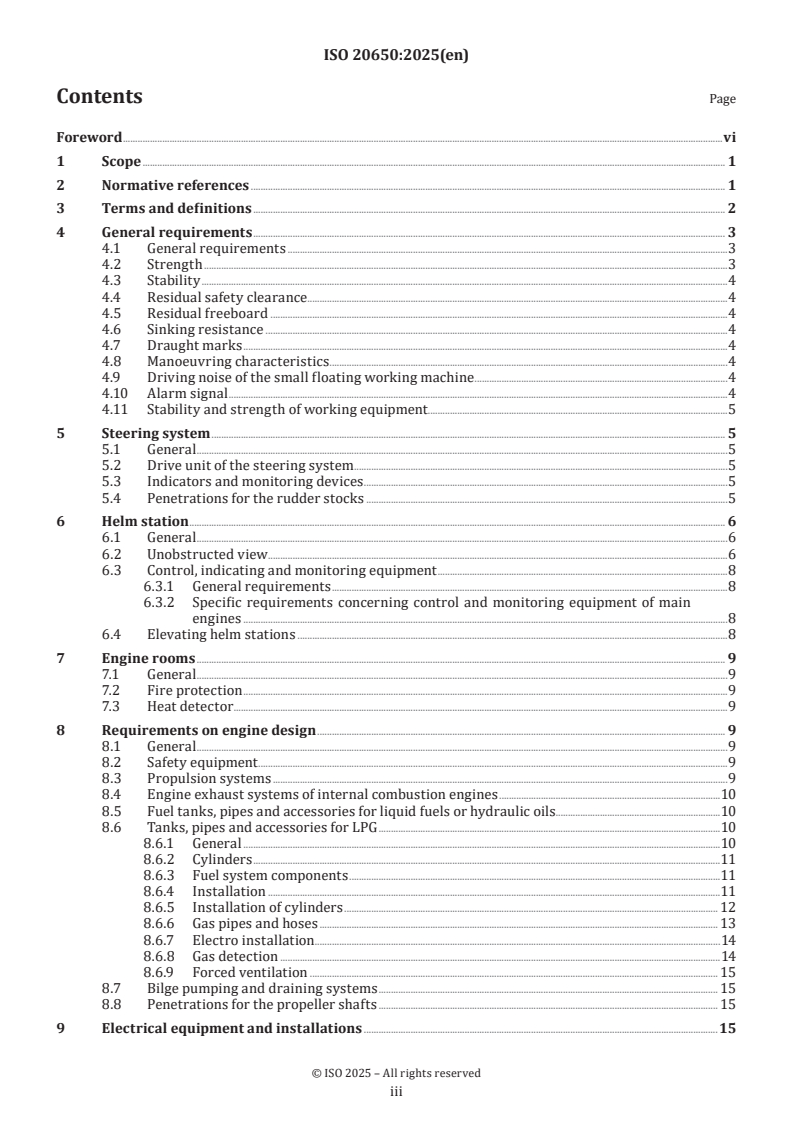
Contents Page
Foreword .vi
1 Scope . 1
2 Normative references . 1
3 Terms and definitions . 2
4 General requirements . 3
4.1 General requirements .3
4.2 Strength .3
4.3 Stability .4
4.4 Residual safety clearance.4
4.5 Residual freeboard .4
4.6 Sinking resistance .4
4.7 Draught marks .4
4.8 Manoeuvring characteristics . .4
4.9 Driving noise of the small floating working machine .4
4.10 Alarm signal .4
4.11 Stability and strength of working equipment .5
5 Steering system . 5
5.1 General .5
5.2 Drive unit of the steering system . .5
5.3 Indicators and monitoring devices .5
5.4 Penetrations for the rudder stocks .5
6 Helm station . 6
6.1 General .6
6.2 Unobstructed view .6
6.3 Control, indicating and monitoring equipment .8
6.3.1 General requirements .8
6.3.2 Specific requirements concerning control and monitoring equipment of main
engines .8
6.4 Elevating helm stations .8
7 Engine rooms . 9
7.1 General .9
7.2 Fire protection .9
7.3 Heat detector .9
8 Requirements on engine design . 9
8.1 General .9
8.2 Safety equipment .9
8.3 Propulsion systems .9
8.4 Engine exhaust systems of internal combustion engines .10
8.5 Fuel tanks, pipes and accessories for liquid fuels or hydraulic oils.10
8.6 Tanks, pipes and accessories for LPG .10
8.6.1 General .10
8.6.2 Cylinders .11
8.6.3 Fuel system components .11
8.6.4 Installation .11
8.6.5 Installation of cylinders . 12
8.6.6 Gas pipes and hoses . 13
8.6.7 Electro installation.14
8.6.8 Gas detection .14
8.6.9 Forced ventilation . 15
8.7 Bilge pumping and draining systems . 15
8.8 Penetrations for the propeller shafts . 15
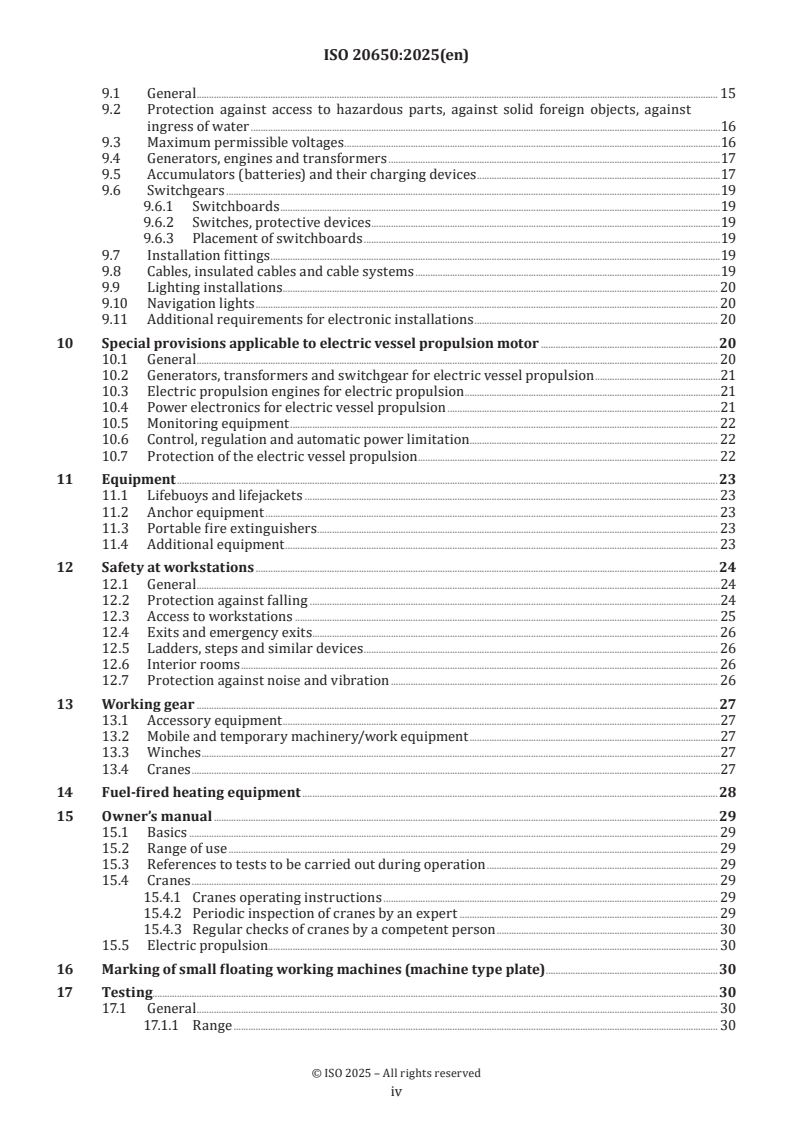
9 Electrical equipment and installations .15
iii
9.1 General . 15
9.2 Protection against access to hazardous parts, against solid foreign objects, against
ingress of water .16
9.3 Maximum permissible voltages . .16
9.4 Generators, engines and transformers .17
9.5 Accumulators (batteries) and their charging devices .17
9.6 Switchgears .19
9.6.1 Switchboards .19
9.6.2 Switches, protective devices .19
9.6.3 Placement of switchboards .19
9.7 Installation fittings .19
9.8 Cables, insulated cables and cable systems .19
9.9 Lighting installations . 20
9.10 Navigation lights . 20
9.11 Additional requirements for electronic installations . 20
10 Special provisions applicable to electric vessel propulsion motor .20
10.1 General . 20
10.2 Generators, transformers and switchgear for electric vessel propulsion .21
10.3 Electric propulsion engines for electric propulsion .21
10.4 Power electronics for electric vessel propulsion .21
10.5 Monitoring equipment . 22
10.6 Control, regulation and automatic power limitation . 22
10.7 Protection of the electric vessel propulsion . 22
11 Equipment .23
11.1 Lifebuoys and lifejackets . 23
11.2 Anchor equipment . 23
11.3 Portable fire extinguishers . . 23
11.4 Additional equipment . 23
12 Safety at workstations .24
12.1 General .24
12.2 Protection against falling .24
12.3 Access to workstations . 25
12.4 Exits and emergency exits. 26
12.5 Ladders, steps and similar devices . 26
12.6 Interior rooms . 26
12.7 Protection against noise and vibration . 26
13 Working gear .27
13.1 Accessory equipment .27
13.2 Mobile and temporary machinery/work equipment .27
13.3 Winches .27
13.4 Cranes .27
14 Fuel-fired heating equipment .28
15 Owner’s manual .29
15.1 Basics . 29
15.2 Range of use . 29
15.3 References to tests to be carried out during operation . 29
15.4 Cranes . 29
15.4.1 Cranes operating instructions . 29
15.4.2 Periodic inspection of cranes by an expert . 29
15.4.3 Regular checks of cranes by a competent person . 30
15.5 Electric propulsion. 30
16 Marking of small floating working machines (machine type plate) .30
17 Testing.30
17.1 General . 30
17.1.1 Range . 30
iv
17.1.2 Individual testing and type testing . 30
17.1.3 Specimen selection for type testing . 30
17.2 Basic tests .31
17.2.1 Visual inspection and measurement .31
17.2.2 Presentation of manufacturer's certificates.31
17.3 Strength .31
17.4 Stability .31
17.5 Safety against sinking .31
17.6 Manoeuvring characteristics . .31
17.7 Noise limit values .31
17.8 Cranes .32
17.9 Electrical propulsion .32
17.10 Stairs .32
17.11 Climbing devices .32
Annex A (normative) Proof of stability .33
Annex B (normative) Manoeuvrability .36
Annex C (normative) Safety requirements on stairs and ladders .37
Annex D (normative) Safety requirements for winches . 41
Bibliography .44
v
Foreword
ISO (the International Organization for Standardization) is a worldwide federation of national standards
bodies (ISO member bodies). The work of preparing International Standards is normally carried out through
ISO technical committees. Each member body interested in a subject for which a technical committee
has been established has the right to be represented on that committee. International organizations,
governmental and non-governmental, in liaison with ISO, also take part in the work. ISO collaborates closely
with the International Electrotechnical Commission (IEC) on all matters of electrotechnical standardization.
The procedures used to develop this document and those intended for its further maintenance are described
in the ISO/IEC Directives, Part 1. In particular, the different approval criteria needed for the different types
of ISO documents should be noted. This document was drafted in accordance with the editorial rules of the
ISO/IEC Directives, Part 2 (see www.iso.org/directives).
ISO draws attention to the possibility that the implementation of this document may involve the use of (a)
patent(s). ISO takes no position concerning the evidence, validity or applicability of any claimed patent
rights in respect thereof. As of the date of publication of this document, ISO had not received notice of (a)
patent(s) which may be required to implement this document. However, implementers are cautioned that
this may not represent the latest information, which may be obtained from the patent database available at
www.iso.org/patents. ISO shall not be held responsible for identifying any or all such patent rights.
Any trade name used in this document is information given for the convenience of users and does not
constitute an endorsement.
For an explanation of the voluntary nature of standards, the meaning of ISO specific terms and expressions
related to conformity assessment, as well as information about ISO’s adherence to the World Trade
Organization (WTO) principles in the Technical Barriers to Trade (TBT), see www.iso.org/iso/foreword.html.
This document was prepared by Technical Committee ISO/TC 8, Ships and marine technology, Subcommittee
SC 7, Inland navigation vessels.
Any feedback or questions on this document should be directed to the user’s national standards body. A
complete listing of these bodies can be found at www.iso.org/members.html.
vi
International Standard ISO 20650:2025(en)
Inland navigation vessels — Small floating working machines
— Requirements and test methods
1 Scope
This document is applicable to small floating working machines used for work in, over, or on, inland waters.
This document specifies safety-related requirements and test methods.
This document specifies minimum requirements for small floating working machines with a length of < 10 m
and a product of length, width and depth of less than 30 m , with temporarily or permanently installed work
equipment or machines used on inland waters.
These small floating working machines can be used for activities such as extraction work, lifting work,
sampling, mowing and clearing work or comparable tasks.
2 Normative references
The following documents are referred to in the text in such a way that some or all of their content constitutes
requirements of this document. For dated references, only the edition cited applies. For undated references,
the latest edition of the referenced document (including any amendments) applies.
ISO 1035-1, Hot-rolled steel bars — Part 1: Dimensions of round bars
ISO 1035-2, Hot-rolled steel bars — Part 2: Dimensions of square bars
ISO 1035-3, Hot-rolled steel bars — Part 3: Dimensions of flat bars
ISO 2922, Acoustics — Measurement of airborne sound emitted by vessels on inland waterways and harbours
ISO 2923, Acoustics — Measurement of noise on board vessels
ISO 4254-1, Agricultural machinery — Safety — Part 1: General requirements
ISO 7010, Graphical symbols — Safety colours and safety signs — Registered safety signs
ISO 7165, Fire fighting — Portable fire extinguishers — Performance and construction
ISO 9519, Ships and marine technology — Single rungs and rungs for dog-step ladders
ISO 10240, Small craft — Owner’s manual
ISO 11102-1, Reciprocating internal combustion engines — Handle starting equipment — Part 1: Safety
requirements and tests
ISO 11105, Small craft — Ventilation of petrol engine and/or petrol tank compartments
ISO 12100, Safety of machinery — General principles for design — Risk assessment and risk reduction
ISO 12402-2, Personal flotation devices — Part 2: Lifejackets, performance level 275 — Safety requirements
ISO 12402-3, Personal flotation devices — Part 3: Lifejackets, performance level 150 — Safety requirements
ISO 13297, Small craft — Electrical systems — Alternating and direct current installations
ISO 13857, Safety of machinery — Safety distances to prevent hazard zones being reached by upper and lower limbs
ISO 14895, Small craft — Liquid-fuelled galley stoves and heating appliances
ISO 16180, Small craft — Navigation lights — Installation, placement and visibility
ISO 17631:2022, Ships and marine technology — Shipboard plans for fire control, damage control, life-saving
appliances and means of escape
ISO 18422, Ships and marine technology — Inland navigation vessels — Plate with instructions for rescue,
resuscitation and first aid for drowning persons
IEC 60092-504, Electrical installations in ships — Part 504: Automation, control and instrumentation
IEC 60364-5-54, Low-voltage electrical installations — Part 5-54: Selection and erection of electrical equipment
— Earthing arrangements and protective conductors
IEC 60529, Degrees of protection provided by enclosures (IP Code)
IEC 61000-4-2, Electromagnetic compatibility (EMC) — Part 4-2: Testing and measurement techniques —
Electrostatic discharge immunity test
IEC 61000-4-3, Electromagnetic compatibility (EMC) — Part 4-3: Testing and measurement techniques —
Radiated, radio-frequency, electromagnetic field immunity test
IEC 61000-4-4, Electromagnetic compatibility (EMC) — Part 4-4: Testing and measurement techniques —
Electrical fast transient/burst immunity test
IEC 62619, Secondary cells and batteries containing alkaline or other non-acid electrolytes — Safety
requirements for secondary lithium cells and batteries, for use in industrial applications
IEC 62620, Secondary cells and batteries containing alkaline or other non-acid electrolytes — Secondary lithium
cells and batteries for use in industrial applications
3 Terms and definitions
For the purposes of this document, the following terms and definitions apply.
ISO and IEC maintain terminology databases for use in standardization at the following addresses:
— ISO Online browsing platform: available at https:// www .iso .org/ obp
— IEC Electropedia: available at https:// www .electropedia .org/
3.1
small floating working machine
watercraft used on inland waters with a hull whose length is less than 10 m and whose product of length,
width and depth of less than 30 m , with temporarily or permanently installed working equipment or
machinery
EXAMPLE Mowing boats, watercraft for sampling, extraction work, keeping waters clean, lifting work.
3.2
residual safety clearance
shortest vertical distance between surface of the water and the lowest part of the small floating working machine
(3.1) beyond which it is no longer watertight, taking into account trim and heel resulting from the moments
3.3
residual freeboard
smallest vertical distance between the surface of the water and the upper surface of the deck at its edge
taking into account trim and heel
3.4
working area
area of inland water, where the work is carried out
3.5
operating range
driving range from the berth to the working area (3.4), and from/to the working area itself
3.6
propulsion system
system consisting of internal combustion engine and/or electric drive engine with power source including
power electronics, gearbox, shaft, propeller, etc., used to move the craft in the water
3.7
propulsion
diesel, LPG (liquified petroleum gas), electric or diesel or gas-electric propulsion system (3.6) of a small
floating working machine (3.1) containing at least one propulsion engine (3.9)
3.8
main propulsion
propulsion (3.7) used to achieve the manoeuvring characteristics
3.9
propulsion engine
engine for driving the propeller shaft or the shaft of comparable drive systems such as water jet drives
3.10
expert
person recognised by the competent authority or by an authorised institution, having specialist knowledge
in the relevant area on the basis of his or her professional training and experience, fully conversant with
the relevant rules and regulations and the generally accepted technical rules (e.g. ISO standards, relevant
regulations, technical rules), and able to examine and give a thorough and knowledgeable assessment of the
relevant systems and equipment
3.11
competent person
person who has acquired sufficient knowledge in the relevant area on the basis of his or her professional
training and experience and is sufficiently conversant with the relevant rules and regulations and the
generally accepted technical rules (such as ISO standards, relevant regulations, technical rules) to be able to
assess the operational safety of the relevant systems and equipment
4 General requirements
4.1 General requirements
Small floating working machines shall be built in accordance with the manufacturer’s specification.
At least one watertight collision bulkhead and one machinery space bulkhead shall be fitted up to the deck
or to the upper edge of the ship’s side. The collision bulkhead shall be installed at an appropriate distance
from the bow so that when the watertight compartment forward of the collision bulkhead is flooded, the
buoyancy of the fully loaded vessel is maintained and a residual safety clearance of not less than 300 mm is
maintained.
4.2 Strength
The strength of small floating machines shall be sufficient to withstand the stresses to which they are
exposed, under the conditions of use specified by the manufacturer.
When using steel S 235 B according to ISO 630-2, the requirement above is fulfilled if the thickness of
the bottom and side plates is at least 3 mm. If other materials or lower material thicknesses are used, a
mathematical verification is required.
4.3 Stability
The stability of small floating machines shall withstand the stresses to which they are exposed, under the
conditions of use specified by the manufacturer.
The stability of a small floating machinery shall be sufficient for the loads to which it is subjected, under
the conditions of use specified by the manufacturer. It shall be demonstrated mathematically by the test
conditions given in Annex A.
For small floating working machines where no change in heel or trim can be caused by their working
equipment and where a shift in the centre of gravity can be ruled out as far as possible, a mathematical
verification may be dispensed with.
4.4 Residual safety clearance
The residual safety clearance shall be at least 300 mm.
4.5 Residual freeboard
The residual freeboard shall be at least 300 mm.
4.6 Sinking resistance
Small floating working machines shall be safe against sinking in the event of flooding of one watertight
compartment.
The residual buoyancy force at the end of flooding of any compartment of the small floating working machine
shall be at least 100 N for each designated crew member.
4.7 Draught marks
The plane of maximum draught shall be marked on each side at each end of the small floating working
machine by indelible draught marks in a contrasting colour. These shall consist of a rectangle measuring
150 mm × 30 mm (L × H), with the base line horizontal and coinciding with the plane of the maximum
allowed draught.
4.8 Manoeuvring characteristics
Small floating working machines shall:
— have adequate driving and manoeuvring characteristics in accordance with Annex B;
— be able to reach a minimum speed of 4 km/h in relation to the water in the travel range.
4.9 Driving noise of the small floating working machine
The noise emitted by a small floating working machine under way at a lateral distance of 25 m from the
craft’s side shall not exceed 75 dB(A) measured in accordance with ISO 2922.
4.10 Alarm signal
There shall be an alarm signal that can warn all persons on board in case of general emergency.
The alarm signal shall be clearly distinguishable from other signals. It shall produce a sound pressure level
at all workstations that is at least 5 dB(A) higher than the maximum local sound pressure level.
4.11 Stability and strength of working equipment
The stability and strength of working equipment and, where appropriate, its attachments, shall be sufficient
to withstand the forces resulting from the expected heel, trim and movement of the floating equipment.
5 Steering system
5.1 General
Small floating working machines shall be fitted with a reliable steering system which provides at least the
manoeuvrability required by Annex B.
The steering systems shall be designed in such a way that the rudder cannot change position unintentionally.
The steering system as a whole shall be designed for permanent lists of up to 15° and ambient temperatures
from ‒20 °C to +50 °C.
The components of the steering system shall be robust enough to always to withstand the stresses to which
they can be subjected during normal operation.
5.2 Drive unit of the steering system
The steering system shall incorporate a manual drive or a powered drive unit if so required by the forces
needed to actuate the rudder.
Regardless of rudder position, a kick-back of the steering wheel shall be prevented when the manual drive is
engaged.
A steering apparatus with a powered drive unit shall be protected against overloads by means of a system
that restricts the torque applied by the drive unit.
Hydraulic steering apparatus drive units shall have:
— an emergency mode such as manual operation;
— a level alarm for the hydraulic tank;
— the pipework designed, dimensioned and arranged in such a manner to exclude, as far as possible,
mechanical damage or damage resulting from fire.
5.3 Indicators and monitoring devices
The rudder position shall be clearly displayed at the steering position. If the rudder-position indicator is
electric it shall have its own power supply.
An optical and acoustic alarm shall be present at the steering position to signal:
— the oil level of the hydraulic tanks falling under the lowest content level;
— failure of the electrical supply for the steering control.
5.4 Penetrations for the rudder stocks
The penetrations for the rudder stocks shall be designed to prevent the spread of water polluting lubricants.
6 Helm station
6.1 General
Helm stations shall be arranged in such a way that the operator may at all times perform his or her task
while the vessel is under way.
In driving mode, sound pressure generated by the vessel and measured at the level of the operator’s head at
the steering position shall not exceed 70 dB(A).
The operator’s workstation shall be equipped with technical protection against UV radiation and
precipitation which is sufficient for the expected demand.
6.2 Unobstructed view
There shall be an adequately unobstructed view in all directions from the helm position for safe operation.
The equipment shall be under visual control in all positions from the helm position to the water surface.
The upper edge of the forward-facing windows of the helm station shall be high enough to allow a person at
the helm station (at eye level, which is 1 324 mm for a seated person and 1 800 mm for a standing person,
both above the floor) a clear forward view (to the horizon and an angle of 10° upwards) of at least 120°
within the forward semicircle. At the rear, a field of vision of at least 30° shall be possible.
For an example of the design of the unobstructed view, see Figure 1.
Clear vision through these windows shall be ensured in all weather conditions.
Windowpanes used in the helm station shall have a minimum light transmission of 75 %. If they are made of
glass, safety glass shall be used. To avoid reflections, the helm station front windows shall be glare-free or
fitted to exclude reflections effectively.
Key
1 midpoint of the visual axis
2 mid of small floating equipment, the field of view ahead
3 plane of shoulder
4 frame of the helm station
A ≥ 30°
A + C + E ≥ 60°
B, D ≤ 6°
A + C + E + G + J ≥ 120°
Figure 1 — Example of the unobstructed view
6.3 Control, indicating and monitoring equipment
6.3.1 General requirements
Control equipment needed to operate the small floating working machine and its working equipment shall
be brought into its operating position easily. That position shall be unambiguously clear.
Monitoring instruments shall be easily legible. Light sources shall be neither intrusive nor impair the
legibility of the monitoring.
There shall be a system for testing the warning and indicating lights.
It shall be possible to clearly establish whether a system is in operation. If its functioning is indicated by
means of an indicating light, this shall be green.
Any malfunctioning or failure of systems that require monitoring shall be indicated by means of red
warning lights.
An audible warning shall sound while a red warning light lights up. Audible warnings may be given by a
single, collective signal. The sound pressure level of that signal shall exceed the maximum sound pressure
lev
...
Norme
internationale
ISO 20650
Première édition
Bateaux de navigation intérieure —
2025-05
Petites machines de travail
flottantes — Exigences et méthodes
d’essai
Inland navigation vessels — Small floating working machines —
Requirements and test methods
Numéro de référence
DOCUMENT PROTÉGÉ PAR COPYRIGHT
© ISO 2025
Tous droits réservés. Sauf prescription différente ou nécessité dans le contexte de sa mise en œuvre, aucune partie de cette
publication ne peut être reproduite ni utilisée sous quelque forme que ce soit et par aucun procédé, électronique ou mécanique,
y compris la photocopie, ou la diffusion sur l’internet ou sur un intranet, sans autorisation écrite préalable. Une autorisation peut
être demandée à l’ISO à l’adresse ci-après ou au comité membre de l’ISO dans le pays du demandeur.
ISO copyright office
Case postale 401 • Ch. de Blandonnet 8
CH-1214 Vernier, Genève
Tél.: +41 22 749 01 11
E-mail: copyright@iso.org
Web: www.iso.org
Publié en Suisse
ii
Sommaire Page
Avant-propos .vi
1 Domaine d’application . 1
2 Références normatives . 1
3 Termes et définitions . 2
4 Exigences générales . . 4
4.1 Exigences générales .4
4.2 Résistance .4
4.3 Stabilité .4
4.4 Distance de sécurité résiduelle .4
4.5 Franc-bord résiduel .4
4.6 Résistance au naufrage .4
4.7 Marquages du tirant d’eau . .4
4.8 Caractéristiques de manœuvrabilité .5
4.9 Bruit de fonctionnement de la petite machine de travail flottante .5
4.10 Signal d’alarme .5
4.11 Stabilité et résistance des équipements de travail.5
5 Système de direction . 5
5.1 Généralités .5
5.2 Unité d’entraînement du système de direction .5
5.3 Indicateurs et dispositifs de surveillance .6
5.4 Passages pour les mèches de gouvernail .6
6 Poste de barre . 6
6.1 Généralités .6
6.2 Vue dégagée .6
6.3 Équipement de commande, de signalisation et de surveillance .8
6.3.1 Exigences générales .8
6.3.2 Exigences spécifiques concernant les équipements de commande et de
surveillance des moteurs principaux .8
6.4 Postes de barre relevables .8
7 Salles des machines . 9
7.1 Généralités .9
7.2 Protection incendie .9
7.3 Détecteur de chaleur .9
8 Exigences relatives à la conception des moteurs . 9
8.1 Généralités .9
8.2 Équipements de sûreté .9
8.3 Systèmes de propulsion .10
8.4 Systèmes d’échappement des moteurs à combustion interne .10
8.5 Réservoirs de carburant, conduites et accessoires pour carburants liquides ou huiles
hydrauliques .10
8.6 Réservoirs, conduites et accessoires pour le GPL .11
8.6.1 Généralités .11
8.6.2 Bouteilles .11
8.6.3 Composants du circuit d’alimentation en carburant . .11
8.6.4 Installation . 12
8.6.5 Installation des bouteilles . 12
8.6.6 Conduites et flexibles de gaz .14
8.6.7 Installation électrique .14
8.6.8 Détection de gaz . . 15
8.6.9 Ventilation forcée .16
8.7 Systèmes de pompage et de vidange de cale .16
8.8 Passages pour les arbres d’hélice.16
iii
9 Appareils et installations électriques .16
9.1 Généralités .16
9.2 Protection contre l’accès à des parties dangereuses, contre les corps étrangers solides,
contre la pénétration d’eau .17
9.3 Tensions maximales admissibles .17
9.4 Générateurs, moteurs et transformateurs .17
9.5 Accumulateurs (piles) et leurs dispositifs de charge .18
9.6 Appareillage . 20
9.6.1 Tableaux électriques . 20
9.6.2 Commutateurs, dispositifs de protection . 20
9.6.3 Emplacement des tableaux électriques . 20
9.7 Matériel d’installation . 20
9.8 Câbles, lignes isolées et systèmes de câbles .21
9.9 Installations d’éclairage .21
9.10 Feux de navigation .21
9.11 Exigences supplémentaires pour les installations électroniques . 22
10 Dispositions particulières applicables au moteur de propulsion électrique d’un bateau .22
10.1 Généralités . 22
10.2 Générateurs, transformateurs et appareillages pour la propulsion électrique d’un
bateau . 22
10.3 Moteurs de propulsion électriques pour propulsion électrique . 22
10.4 Électronique de puissance pour la propulsion électrique d’un bateau . 23
10.5 Équipements de surveillance . . 23
10.6 Commande, régulation et limitation automatique de puissance . 23
10.7 Protection de la propulsion électrique d’un bateau . 23
11 Gréement .24
11.1 Bouées et gilets de sauvetage .24
11.2 Ancres, chaînes et câbles d’ancres .24
11.3 Extincteurs d’incendie portatifs .24
11.4 Équipements supplémentaires . 25
12 Sécurité aux postes de travail .26
12.1 Généralités . 26
12.2 Protection contre les chutes . 26
12.3 Accès des postes de travail .27
12.4 Issues et issues de secours .27
12.5 Dispositifs de montée . 28
12.6 Locaux intérieurs . 28
12.7 Protection contre le bruit et les vibrations . 28
13 Installations de travail .29
13.1 Équipements accessoires . 29
13.2 Machines/équipements de travail mobiles et temporaires . 29
13.3 Treuils . 29
13.4 Grues . 29
14 Installations de chauffage fonctionnant aux combustibles .30
15 Manuel du propriétaire .31
15.1 Informations de base .31
15.2 Plage d’utilisation .31
15.3 Références aux essais à effectuer pendant le fonctionnement .31
15.4 Grues .31
15.4.1 Instructions d’utilisation des grues .31
15.4.2 Inspection périodique des grues par un expert .31
15.4.3 Contrôles réguliers des grues par une personne compétente .32
15.5 Propulsion électrique .32
16 Marquage des petites machines de travail flottantes (plaque signalétique) .32
17 Essais .32
iv
17.1 Généralités .32
17.1.1 Plage .32
17.1.2 Essais individuels et essais de type .32
17.1.3 Choix des éprouvettes pour les essais de type .32
17.2 Essais de base . 33
17.2.1 Examen visuel et mesurage . 33
17.2.2 Présentation des certificats du fabricant . 33
17.3 Résistance . 33
17.4 Stabilité . 33
17.5 Sécurité contre le naufrage . 33
17.6 Caractéristiques de manœuvrabilité . 33
17.7 Valeurs limites de bruit. 33
17.8 Grues . 34
17.9 Propulsion électrique . 34
17.10 Escaliers. 34
17.11 Dispositifs de montée . 34
Annexe A (normative) Preuve de stabilité .35
Annexe B (normative) Manœuvrabilité . .38
Annexe C (normative) Exigences de sécurité relatives aux escaliers et aux échelles .39
Annexe D (normative) Exigences de sécurité relatives aux treuils .43
Bibliographie .46
v
Avant-propos
L’ISO (Organisation internationale de normalisation) est une fédération mondiale d’organismes nationaux
de normalisation (comités membres de l’ISO). L’élaboration des Normes internationales est en général
confiée aux comités techniques de l’ISO. Chaque comité membre intéressé par une étude a le droit de faire
partie du comité technique créé à cet effet. Les organisations internationales, gouvernementales et non
gouvernementales, en liaison avec l’ISO participent également aux travaux. L’ISO collabore étroitement avec
la Commission électrotechnique internationale (IEC) en ce qui concerne la normalisation électrotechnique.
Les procédures utilisées pour élaborer le présent document et celles destinées à sa mise à jour sont
décrites dans les Directives ISO/IEC, Partie 1. Il convient, en particulier de prendre note des différents
critères d’approbation requis pour les différents types de documents ISO. Le présent document
a été rédigé conformément aux règles de rédaction données dans les Directives ISO/IEC, Partie 2
(voir www.iso.org/directives).
L’ISO attire l’attention sur le fait que la mise en application du présent document peut entraîner l’utilisation
d’un ou de plusieurs brevets. L’ISO ne prend pas position quant à la preuve, à la validité et à l’applicabilité de
tout droit de brevet revendiqué à cet égard. À la date de publication du présent document, l’ISO n’avait pas
reçu notification qu’un ou plusieurs brevets pouvaient être nécessaires à sa mise en application. Toutefois,
il y a lieu d’avertir les responsables de la mise en application du présent document que des informations
plus récentes sont susceptibles de figurer dans la base de données de brevets, disponible à l’adresse
www.iso.org/brevets. L’ISO ne saurait être tenue pour responsable de ne pas avoir identifié de tels droits de
propriété et averti de leur existence.
Les appellations commerciales éventuellement mentionnées dans le présent document sont données pour
information, par souci de commodité, à l’intention des utilisateurs et ne sauraient constituer un engagement.
Pour une explication de la nature volontaire des normes, la signification des termes et expressions
spécifiques de l’ISO liés à l’évaluation de la conformité, ou pour toute information au sujet de l’adhésion de
l’ISO aux principes de l’Organisation mondiale du commerce (OMC) concernant les obstacles techniques au
commerce (OTC), voir www.iso.org/avant-propos.
Le présent document a été élaboré par le comité technique ISO/TC 8, Navires et technologie maritime, sous-
comité SC 7, Bateaux de navigation intérieure.
Il convient que l’utilisateur adresse tout retour d’information ou toute question concernant le présent
document à l’organisme national de normalisation de son pays. Une liste exhaustive desdits organismes se
trouve à l’adresse www.iso.org/fr/members.html.
vi
Norme internationale ISO 20650:2025(fr)
Bateaux de navigation intérieure — Petites machines de
travail flottantes — Exigences et méthodes d’essai
1 Domaine d’application
Le présent document s’applique aux petites machines de travail flottantes utilisées pour travailler dans,
au-dessus ou sur les eaux intérieures. Le présent document spécifie les exigences relatives à la sécurité,
ainsi que les méthodes d’essai.
Le présent document spécifie les exigences minimales applicables aux petites machines de travail flottantes,
d’une longueur inférieure à 10 m et dont le produit de la longueur, de la largeur et de la profondeur est
inférieur à 30 m , équipées d’équipements ou de machines de travail installés de manière temporaire ou
permanente et utilisés sur les eaux intérieures.
Ces petites machines de travail flottantes peuvent être utilisées pour des activités telles que des travaux
d’extraction, de levage, d’échantillonnage, de fauchage et de débroussaillage ou des tâches similaires.
2 Références normatives
Les documents suivants sont cités dans le texte de sorte qu’ils constituent, pour tout ou partie de leur
contenu, des exigences du présent document. Pour les références datées, seule l’édition citée s’applique. Pour
les références non datées, la dernière édition du document de référence s’applique (y compris les éventuels
amendements).
ISO 1035-1, Barres en acier laminées à chaud — Partie 1: Dimensions des barres rondes
ISO 1035-2, Barres en acier laminées à chaud — Partie 2: Dimensions des barres carrées
ISO 1035-3, Barres en acier laminées à chaud — Partie 3: Dimensions des barres plates
ISO 2922, Acoustique — Mesurage du bruit aérien émis par les bateaux de navigation intérieure et portuaire
ISO 2923, Acoustique — Mesurage du bruit à bord des bateaux
ISO 4254-1, Matériel agricole — Sécurité — Partie 1: Exigences générales
ISO 7010, Symboles graphiques — Couleurs de sécurité et signaux de sécurité — Signaux de sécurité enregistrés
ISO 7165, Lutte contre l'incendie — Extincteurs portatifs — Performances et construction
ISO 9519, Navires et technologie maritime — Échelons simples et échelons pour marchepieds
ISO 10240, Petits navires — Manuel du propriétaire
ISO 11102-1, Moteurs alternatifs à combustion interne — Dispositifs de démarrage à la manivelle — Partie 1:
Exigences de sécurité et essais
ISO 11105, Petits navires — Ventilation des compartiments contenant des moteurs à essence et/ou des réservoirs
à essence
ISO 12100, Sécurité des machines — Principes généraux de conception — Appréciation du risque et réduction
du risque
ISO 12402-2, Équipements individuels de flottabilité — Partie 2: Gilets de sauvetage, niveau de performance 275
— Exigences de sécurité
ISO 12402-3, Équipements individuels de flottabilité — Partie 3: Gilets de sauvetage, niveau de performance 150
— Exigences de sécurité
ISO 13297, Petits navires — Installations électriques — Installations à courant alternatif et continu
ISO 13857, Sécurité des machines — Distances de sécurité empêchant les membres supérieurs et inférieurs
d'atteindre les zones dangereuses
ISO 14895, Petits navires — Réchauds de cuisine et appareils de chauffage alimentés par un combustible liquide
ISO 16180, Petits navires — Feux de navigation — Installation, positionnement et visibilité
ISO 17631:2022, Navires et technologie maritime — Plans de sécurité à bord du navire, des moyens de lutte
contre l'incendie, des engins de sauvetage et des moyens d'évacuation
ISO 18422, Navires et technologie maritime — Bateaux de navigation intérieure — Pancarte avec instructions
relatives au sauvetage, à la réanimation et aux premiers soins des noyés
IEC 60092-504, Installations électriques à bord des navires — Partie 504: Automatisation, commande et
instrumentation
IEC 60364-5-54, Installations électriques basse-tension — Partie 5-54: Choix et mise en œuvre des matériels
électriques — Installations de mise à la terre et conducteurs de protection
IEC 60529, Degrés de protection procurés par les enveloppes (Code IP)
IEC 61000-4-2, Compatibilité électromagnétique (CEM) — Partie 4-2: Techniques d’essai et de mesure —
Essai d’immunité aux décharges électrostatiques
IEC 61000-4-3, Compatibilité électromagnétique (CEM) — Partie 4-3: Techniques d’essai et de mesure —
Essai d’immunité aux champs électromagnétiques rayonnés aux fréquences radioélectriques
IEC 61000-4-4, Compatibilité électromagnétique (CEM) — Partie 4-4: Techniques d’essai et de mesure — Essais
d’immunité aux transitoires électriques rapides en salves
IEC 62619, Accumulateurs alcalins et autres accumulateurs à électrolyte non acide — Exigences de sécurité pour
les accumulateurs au lithium pour utilisation dans des applications industrielles
IEC 62620, Accumulateurs alcalins et autres accumulateurs à électrolyte non acide — Éléments et batteries
d’accumulateurs au lithium pour utilisation dans les applications industrielles
3 Termes et définitions
Pour les besoins du présent document, les termes et définitions suivants s’appliquent.
L’ISO et l’IEC tiennent à jour des bases de données terminologiques destinées à être utilisées en normalisation,
consultables aux adresses suivantes:
— ISO Online browsing platform: disponible à l’adresse https:// www .iso .org/ obp
— IEC Electropedia: disponible à l’adresse https:// www .electropedia .org/
3.1
petite machine de travail flottante
embarcation utilisée sur les eaux intérieures, dont la coque mesure moins de 10 m de longueur et dont le
produit de la longueur, de la largeur et de la profondeur est inférieur à 30 m , équipées d’équipements ou de
machines de travail installés de manière temporaire ou permanente
EXEMPLE Faucheuses, embarcations utilisées pour des travaux d’échantillonnage, d’extraction, de maintien de la
propreté des eaux, de levage.
3.2
distance de sécurité résiduelle
distance verticale la plus courte entre la surface du plan d’eau et le point le plus bas de la petite machine de
travail flottante (3.1) au-dessus duquel cette dernière n’est plus étanche à l’eau, en tenant compte de l’assiette
et de la gîte résultant des moments appliqués
3.3
franc-bord résiduel
distance verticale minimale entre la surface du plan d’eau et l’arête du pont, en tenant compte de l’assiette et
de la gîte
3.4
zone de travail
zone des eaux intérieures où les travaux sont effectués
3.5
plage de fonctionnement
distance de conduite entre le poste de stationnement et la zone de travail (3.4), et depuis/vers la zone de
travail à proprement parler
3.6
système de propulsion
système composé d’un moteur à combustion interne et/ou d’un moteur électrique avec source d’alimentation
comprenant des composants électroniques de puissance, une boîte de vitesses, un arbre, une hélice, etc.,
utilisé pour déplacer le bateau dans l’eau
3.7
propulsion
système de propulsion (3.6) diesel, GPL (gaz de pétrole liquéfié), électrique, diesel ou gaz-électrique d’une
petite machine de travail flottante (3.1) contenant au moins un moteur de propulsion (3.9)
3.8
propulsion principale
propulsion (3.7) utilisée pour obtenir les caractéristiques de manœuvrabilité
3.9
moteur de propulsion
moteur permettant d’entraîner l’arbre d’hélice ou l’arbre de systèmes d’entraînement comparables, tels que
des propulseurs à jet d’eau
3.10
expert
personne reconnue par l’autorité compétente ou par un organisme agréé, possédant des connaissances
spécialisées dans le domaine concerné grâce à sa formation professionnelle et à son expérience,
connaissant parfaitement les règles et réglementations applicables ainsi que les règles techniques
généralement admises (par exemple, les normes ISO, les réglementations applicables, les règles techniques),
et capable d’examiner et de fournir une évaluation approfondie et éclairée des systèmes et équipements
concernés
3.11
personne compétente
personne qui a acquis des connaissances suffisantes dans le domaine concerné grâce à sa formation
professionnelle et à son expérience, et qui connaît suffisamment les règles et réglementations applicables
ainsi que les règles techniques généralement admises (telles que les normes ISO, les réglementations
applicables, les règles techniques) pour être en mesure d’évaluer la sécurité opérationnelle des systèmes et
équipements concernés
4 Exigences générales
4.1 Exigences générales
Les petites machines de travail flottantes doivent être construites conformément aux spécifications du
fabricant.
Au moins une cloison de collision étanche et une cloison de compartiment de machines doivent être installées
sur le pont ou sur le bord supérieur du bateau. La cloison de collision doit être installée à une distance
appropriée de la proue de sorte que, lorsque le compartiment étanche à l’avant de la cloison de collision est
inondé, la flottabilité du bateau entièrement chargé soit maintenue et une distance de sécurité résiduelle
d’au moins 300 mm soit garantie.
4.2 Résistance
La résistance des petites machines flottantes doit être suffisante pour résister aux contraintes auxquelles
elles sont exposées, dans les conditions d’utilisation spécifiées par le fabricant.
En cas d’utilisation d’acier S 235 B conformément à l’ISO 630-2, l’exigence ci-dessus est satisfaite si l’épaisseur
des plaques inférieures et latérales est d’au moins 3 mm. Si d’autres matériaux ou des épaisseurs inférieures
sont utilisés, une vérification par calcul est exigée.
4.3 Stabilité
La stabilité des petites machines flottantes doit résister aux contraintes auxquelles elles sont exposées,
dans les conditions d’utilisation prévues par le fabricant.
La stabilité d’une petite machine flottante doit être suffisante pour les charges auxquelles elle est soumise,
dans les conditions d’utilisation prévues par le fabricant. Elle doit être démontrée par calcul dans les
conditions d’essai données à l’Annexe A.
Pour les petites machines de travail flottantes pour lesquelles aucun changement de gîte ou d’assiette ne
peut être causé par l’équipement de travail et pour lesquelles un déplacement du centre de gravité peut être
exclu dans la mesure du possible, il est possible de se passer d’une vérification par calcul.
4.4 Distance de sécurité résiduelle
La distance de sécurité résiduelle doit être au moins égale à 300 mm.
4.5 Franc-bord résiduel
Le franc-bord résiduel doit être d’au moins 300 mm.
4.6 Résistance au naufrage
Les petites machines de travail flottantes doivent être protégées contre le risque de naufrage en cas
d’inondation d’un seul compartiment étanche.
La force de flottabilité résiduelle à la fin de l’inondation d’un compartiment de la petite machine de travail
flottante doit être d’au moins 100 N pour chaque membre d’équipage désigné.
4.7 Marquages du tirant d’eau
Le plan de tirant d’eau maximal doit être marqué de chaque côté à chaque extrémité de la petite machine
de travail flottante par des marquages du tirant d’eau indélébiles de couleur contrastante. Ces marquages
doivent être constitués d’un rectangle de 150 mm × 30 mm (L × H), dont la ligne de base est horizontale et
coïncide avec le plan du tirant d’eau maximal autorisé.
4.8 Caractéristiques de manœuvrabilité
Les petites machines de travail flottantes doivent:
— avoir des caractéristiques de conduite et de manœuvrabilité adéquates conformément à l’Annexe B;
— être capables d’atteindre une vitesse minimale de 4 km/h par rapport à l’eau dans la plage de déplacement.
4.9 Bruit de fonctionnement de la petite machine de travail flottante
Le bruit émis par une petite machine de travail flottante en marche à une distance latérale de 25 m du côté
du bateau ne doit pas dépasser 75 dB(A), mesuré conformément à l’ISO 2922.
4.10 Signal d’alarme
Un signal d’alarme doit pouvoir avertir toutes les personnes à bord en cas d’urgence générale.
Le signal d’alarme doit pouvoir être clairement différencié des autres signaux. Il doit produire un niveau
de pression acoustique à tous les postes de travail supérieur d’au moins 5 dB(A) au niveau de pression
acoustique local maximal.
4.11 Stabilité et résistance des équipements de travail
La stabilité et la résistance de l’équipement de travail et, le cas échéant, de ses fixations, doivent être
suffisantes pour résister aux forces résultant de la gîte, de l’assiette et du mouvement attendus de
l’équipement flottant.
5 Système de direction
5.1 Généralités
Les petites machines de travail flottantes doivent être équipées d’un système de direction fiable qui assure
au moins la manœuvrabilité exigée par l’Annexe B.
Les systèmes de direction doivent être conçus de sorte que le gouvernail ne puisse pas changer de position
involontairement.
Le système de direction dans son ensemble doit être conçu pour des gîtes permanentes pouvant atteindre
15° et des températures ambiantes comprises entre ‒20 °C et +50 °C.
Les composants du système de direction doivent être suffisamment robustes pour résister en permanence
aux contraintes auxquelles ils peuvent être soumis en fonctionnement normal.
5.2 Unité d’entraînement du système de direction
Le système de direction doit comprendre un entraînement manuel ou une unité d’entraînement motorisée si
les forces nécessaires pour actionner le gouvernail l’exigent.
Quelle que soit la position du gouvernail de direction, un retour du volant de direction doit être empêché
lorsque l’entraînement manuel est engagé.
Un appareil à gouverner équipé d’une unité d’entraînement motorisée doit être protégé contre les surcharges
au moyen d’un système limitant le couple appliqué par l’unité d’entraînement.
Les unités d’entraînement d’un appareil à gouverner hydraulique doivent avoir:
— un mode d’urgence tel que le fonctionnement manuel;
— une alarme de niveau pour le réservoir hydraulique;
— une tuyauterie conçue, dimensionnée et disposée de manière à exclure, dans la mesure du possible, les
dommages mécaniques ou les dommages résultant d’un incendie.
5.3 Indicateurs et dispositifs de surveillance
La position du gouvernail doit être clairement affichée au poste de gouverne. Si l’indicateur de position du
gouvernail est électrique, il doit disposer de sa propre alimentation électrique.
Une alarme optique et sonore doit être présente au poste de gouverne pour signaler:
— le niveau d’huile des réservoirs hydrauliques tombant en dessous du niveau minimal;
— une panne d’alimentation électrique de la commande de direction.
5.4 Passages pour les mèches de gouvernail
Les passages pour les mèches de gouvernail doivent être conçus de manière à empêcher la propagation des
lubrifiants polluants dans l’eau.
6 Poste de barre
6.1 Généralités
Les postes de barre doivent être disposés de sorte que l’opérateur puisse, à tout moment, accomplir sa tâche
lorsque le bateau navigue.
En mode de conduite, la pression acoustique générée par le bateau et mesurée au niveau de la tête de
l’opérateur au poste de gouverne ne doit pas dépasser 70 dB(A).
Le poste de travail de l’opérateur doit être équipé d’une protection technique contre le rayonnement UV et
les précipitations suffisante pour répondre à la demande attendue.
6.2 Vue dégagée
La vue depuis le poste de barre doit être suffisamment dégagée dans toutes les directions pour garantir la
sécurité de la navigation.
L’équipement doit être sous contrôle visuel dans toutes les positions, depuis le poste de barre jusqu’à la
surface de l’eau.
Le bord supérieur des fenêtres orientées vers l’avant du poste de barre doit êtr
...