

ISO/FDIS 23308-4
(Main)Energy efficiency of industrial trucks — Test methods — Part 4: Rough-terrain variable-reach trucks
- Abstract
This document specifies the method of fuel consumption measurement for rough terrain- truck variable-reach trucks as defined in ISO 5053-1, herein after referred to as trucks. It does not apply to slewing trucks having a movement of more than 5° either side of the longitudinal axis. This part is intended to be used in conjunction with ISO 23308-1. Where the requirements of this part differ from that in part 1, requirements in this part 4 will take precedence.
- Status
- Not Published
- Technical Committee
- ISO/TC 110/SC 4 - Rough-terrain trucks
- Drafting Committee
- ISO/TC 110/SC 4/WG 11 - Sustainability
- Current Stage
- 5020 - FDIS ballot initiated: 2 months. Proof sent to secretariat
- Start Date
- 18-Nov-2026
- Completion Date
- 18-Nov-2026
Buy Documents
ISO/FDIS 23308-4 - Energy efficiency of industrial trucks — Test methods — Part 4: Rough-terrain variable-reach trucks

REDLINE ISO/FDIS 23308-4 - Energy efficiency of industrial trucks — Test methods — Part 4: Rough-terrain variable-reach trucks
ISO/FDIS 23308-4 is an ISO draft International Standard in the ISO 23308 series on the energy efficiency of industrial trucks. It specifies a test method for measuring fuel consumption of rough-terrain variable-reach trucks and for reporting the results, including CO2 equivalent, for manufacturers, market surveillance authorities, machine users, and service providers.
What does ISO/FDIS 23308-4 specify?
ISO/FDIS 23308-4 specifies how to measure fuel consumption for rough-terrain variable-reach trucks as defined in ISO 5053-1. It also sets the reporting basis for the test results and is intended to be used together with ISO 23308-1, with Part 4 taking precedence where the two differ.
The scope excludes slewing trucks with movement of more than 5° either side of the longitudinal axis. The document is organized into clauses on scope, normative references, terms and definitions, test conditions, measurement procedure, CO2 equivalent calculation, and documentation.
What are the key requirements of ISO/FDIS 23308-4?
ISO/FDIS 23308-4 focuses on making fuel consumption measurements comparable across trucks and test sites. In practice, it controls the test surface, the truck condition, the duty cycles, and the way results are reported.
Test conditions and truck preparation
Clause 4 requires a flat, smooth, hard, clean, dry test area such as concrete, asphalt, or an equivalent surface, with no more than 2% slope in any direction. This matters because slope and surface condition can change fuel use.
Clause 4 also requires the truck to be representative of series production. A run-in time of up to 100 h is allowed for parts that affect energy consumption, and that run-in time has to be documented.
If a truck is selected to represent a range of similar trucks, the worst-case truck shall be tested. The truck must be safe and functional, fitted with manufacturer-specified attachments, equipped with new tyres with no more than 10% tread wear, and inflated to the correct pressure. For internal combustion engine trucks, fuel tanks are filled to the specified level before warmup.
Use of ISO 23308-1
Clause 4.3 requires the test conditions to follow ISO 23308-1:2025, Clauses 4.4 and 4.5. Clause 5.1 also uses ISO 23308-1 for general measurement rules, so Part 1 provides the common framework and Part 4 adds the truck-specific cycles.
Measurement approach and eco-mode
Clause 5.1 allows indirect fuel measurement using a secondary removable fuel tank when direct tank measurement is not accurate. That gives the tester a way to determine fuel use by mass after the test.
Where an eco-mode is fitted and selected by the operator, Clause 5.1 requires a comparative test with and without eco-mode. This shows whether the fuel-saving function changes the measured consumption.
Duty phases
Clause 5.2 defines four duty phases: travelling, idle mode, pick and carry, and bucket mode. Travelling while lifting, lowering, or tilting is not permitted, and simultaneous operation is not permitted. Phases 1 and 2 run for at least 10 min, while phases 3 and 4 require at least 10 cycles of 1 min each, with a 2% tolerance on total time.
Phase-specific conditions
For travelling, Clause 5.2.2 requires level ground, maximum travel speed, no attachment fitted, and testing in both directions to balance gradient and wind effects. For idle mode, the truck is stationary with the engine at idle and the transmission in neutral.
For pick and carry, Clause 5.2.4 requires 70% of rated capacity, the standard load centre, and a cycle between two pallet racks 30 m apart. For bucket mode, Clause 5.2.5 requires a bucket carrying 35% to 50% of rated capacity, material with density between 1 450 kg/m3 and 1 900 kg/m3, and a receiving vehicle or equivalent structure placed near the pile.
Calculation and reporting
Clause 6 requires CO2 equivalent calculation in accordance with ISO 23308-1:2025, Annex C. Clause 7 requires the report to follow ISO 23308-1:2025, 6.1, and the declaration to follow 6.2, with separate communication of results for idle mode, travelling mode, pick and carry mode, and bucket mode.
What terms does ISO/FDIS 23308-4 define?
- eco-mode - A system designed to improve fuel consumption and efficiency, so the test must show results with and without it when fitted.
- idle mode - The operating condition where the truck is stationary, the engine is running at idle speed, and the transmission is in neutral.
- travelling mode - The duty phase used to measure fuel use while the truck drives on level ground without an attachment fitted.
- pick and carry - The duty phase in which a laden truck moves a load between two pallet racks.
- bucket mode - The duty phase in which the truck uses a bucket to move material to a receiving vehicle or equivalent structure.
- CO2 equivalent - The calculated emissions-related result derived from the fuel consumption data using the method in ISO 23308-1.
Who uses ISO/FDIS 23308-4?
ISO/FDIS 23308-4 is relevant to machine manufacturers, market surveillance authorities, machine users, and service providers such as consultants. Manufacturers use it to measure and compare fuel consumption during development and production checks. Authorities use it to review energy-efficiency claims, while users and service providers use it to compare trucks and interpret measured performance in a consistent way.
Which standards are used with ISO/FDIS 23308-4?
- ISO 5053-1 - Provides the vocabulary and the type definition used for industrial trucks, including the truck type covered here.
- ISO 10896-1 - Provides safety requirements and verification for rough-terrain variable-reach trucks.
- ISO 23308-1:2025 - Provides the general energy-efficiency test framework, including common test conditions, reporting rules, and the CO2 equivalent calculation method.
What does the ISO/FDIS 23308-4 document contain?
ISO/FDIS 23308-4 contains the test setup and operating conditions for four duty phases used to measure fuel consumption on rough-terrain variable-reach trucks. It includes Figure 1 for the pick and carry test path and Figure 2 for the bucket mode test path.
The document also contains the calculation reference for CO2 equivalent and the documentation requirements for the report and declaration. Its bibliography cites VDI 2198, which is noted as the basis for the test cycles used in the series.
Relations
- Effective Date
- 12-Feb-2026
- Effective Date
- 04-Feb-2023
Buy Documents
ISO/FDIS 23308-4 - Energy efficiency of industrial trucks — Test methods — Part 4: Rough-terrain variable-reach trucks
REDLINE ISO/FDIS 23308-4 - Energy efficiency of industrial trucks — Test methods — Part 4: Rough-terrain variable-reach trucks
Frequently Asked Questions
ISO/FDIS 23308-4 is a draft published by the International Organization for Standardization (ISO). Its full title is "Energy efficiency of industrial trucks — Test methods — Part 4: Rough-terrain variable-reach trucks". This standard covers: This document specifies the method of fuel consumption measurement for rough terrain- truck variable-reach trucks as defined in ISO 5053-1, herein after referred to as trucks. It does not apply to slewing trucks having a movement of more than 5° either side of the longitudinal axis. This part is intended to be used in conjunction with ISO 23308-1. Where the requirements of this part differ from that in part 1, requirements in this part 4 will take precedence.
This document specifies the method of fuel consumption measurement for rough terrain- truck variable-reach trucks as defined in ISO 5053-1, herein after referred to as trucks. It does not apply to slewing trucks having a movement of more than 5° either side of the longitudinal axis. This part is intended to be used in conjunction with ISO 23308-1. Where the requirements of this part differ from that in part 1, requirements in this part 4 will take precedence.
ISO/FDIS 23308-4 is classified under the following ICS (International Classification for Standards) categories: 53.060 - Industrial trucks. The ICS classification helps identify the subject area and facilitates finding related standards.
ISO/FDIS 23308-4 has the following relationships with other standards: It is inter standard links to FprEN ISO 23308-4, ISO 18768-1:2022. Understanding these relationships helps ensure you are using the most current and applicable version of the standard.
ISO/FDIS 23308-4 is available in PDF format for immediate download after purchase. The document can be added to your cart and obtained through the secure checkout process. Digital delivery ensures instant access to the complete standard document.
Standards Content (Sample)
FINAL DRAFT
International
Standard
ISO/TC 110/SC 4
Energy efficiency of industrial
Secretariat: AFNOR
trucks — Test methods —
Voting begins on:
2026-11-18
Part 4:
Rough-terrain variable-reach trucks
Voting terminates on:
2026-12-30
Efficacité énergétique des chariots de manutention — Méthodes
d'essai — —
Partie 4: Chariots tout-terrain à portée variable
RECIPIENTS OF THIS DRAFT ARE INVITED TO SUBMIT,
WITH THEIR COMMENTS, NOTIFICATION OF ANY
RELEVANT PATENT RIGHTS OF WHICH THEY ARE AWARE
AND TO PROVIDE SUPPOR TING DOCUMENTATION.
IN ADDITION TO THEIR EVALUATION AS
BEING ACCEPTABLE FOR INDUSTRIAL, TECHNO-
ISO/CEN PARALLEL PROCESSING LOGICAL, COMMERCIAL AND USER PURPOSES, DRAFT
INTERNATIONAL STANDARDS MAY ON OCCASION HAVE
TO BE CONSIDERED IN THE LIGHT OF THEIR POTENTIAL
TO BECOME STAN DARDS TO WHICH REFERENCE MAY BE
MADE IN NATIONAL REGULATIONS.
Reference number
FINAL DRAFT
International
Standard
ISO/TC 110/SC 4
Energy efficiency of industrial
Secretariat: AFNOR
trucks — Test methods —
Voting begins on:
Part 4:
Rough-terrain variable-reach trucks
Voting terminates on:
Efficacité énergétique des chariots de manutention — Méthodes
d'essai — —
Partie 4: Chariots tout-terrain à portée variable
© ISO 2026
All rights reserved.
RECIPIENTS OF THIS DRAFT ARE INVITED TO SUBMIT,
WITH THEIR COMMENTS, NOTIFICATION OF ANY
This ISO publication is protected by copyright and is owned by ISO and/or its licensors.
RELEVANT PATENT RIGHTS OF WHICH THEY ARE AWARE
The content of this ISO publication is provided under licence, not sold. Use is subject to the applicable licence terms issued by ISO,
AND TO PROVIDE SUPPOR TING DOCUMENTATION.
an ISO member body, or an authorized third-party distributor.
IN ADDITION TO THEIR EVALUATION AS
BEING ACCEPTABLE FOR INDUSTRIAL, TECHNO-
Except as required for implementation or expressly permitted by a separate licence, no part of this ISO publication may be
ISO/CEN PARALLEL PROCESSING
LOGICAL, COMMERCIAL AND USER PURPOSES, DRAFT
reproduced, distributed, modified, used, or made available in any form or by any means – electronic or mechanical, including
INTERNATIONAL STANDARDS MAY ON OCCASION HAVE
photocopying, scanning, recording, or posting on internal or external digital platforms. TO BE CONSIDERED IN THE LIGHT OF THEIR POTENTIAL
TO BECOME STAN DARDS TO WHICH REFERENCE MAY BE
Any use beyond the scope of the granted rights is prohibited and may result in legal action.
MADE IN NATIONAL REGULATIONS.
ISO copyright office
CP 401 • CH-1214 Vernier, Geneva
Phone: +41 22 749 01 11
Email: copyright@iso.org
Website: www.iso.org
Published in Switzerland
Reference number
ii
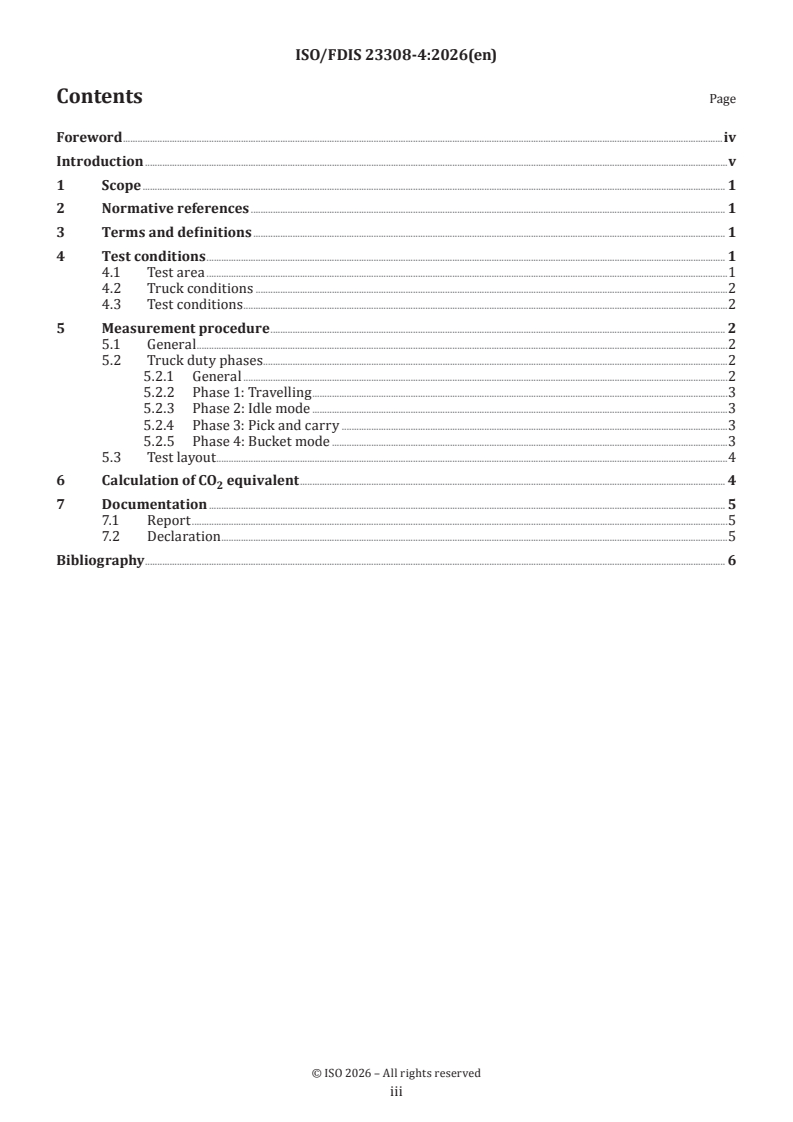
Contents Page
Foreword .iv
Introduction .v
1 Scope . 1
2 Normative references . 1
3 Terms and definitions . 1
4 Test conditions . 1
4.1 Test area .1
4.2 Truck conditions .2
4.3 Test conditions .2
5 Measurement procedure . 2
5.1 General .2
5.2 Truck duty phases .2
5.2.1 General .2
5.2.2 Phase 1: Travelling .3
5.2.3 Phase 2: Idle mode .3
5.2.4 Phase 3: Pick and carry .3
5.2.5 Phase 4: Bucket mode .3
5.3 Test layout .4
6 Calculation of CO equivalent . 4
7 Documentation . 5
7.1 Report .5
7.2 Declaration .5
Bibliography . 6
iii
Foreword
ISO (the International Organization for Standardization) is a worldwide federation of national standards
bodies (ISO member bodies). The work of preparing International Standards is normally carried out through
ISO technical committees. Each member body interested in a subject for which a technical committee
has been established has the right to be represented on that committee. International organizations,
governmental and non-governmental, in liaison with ISO, also take part in the work. ISO collaborates closely
with the International Electrotechnical Commission (IEC) on all matters of electrotechnical standardization.
The procedures used to develop this document and those intended for its further maintenance are described
in the ISO/IEC Directives, Part 1. In particular, the different approval criteria needed for the different types
of ISO document should be noted. This document was drafted in accordance with the editorial rules of the
ISO/IEC Directives, Part 2 (see www.iso.org/directives).
ISO draws attention to the possibility that the implementation of this document may involve the use of (a)
patent(s). ISO takes no position concerning the evidence, validity or applicability of any claimed patent
rights in respect thereof. As of the date of publication of this document, ISO had not received notice of (a)
patent(s) which may be required to implement this document. However, implementers are cautioned that
this may not represent the latest information, which may be obtained from the patent database available at
www.iso.org/patents. ISO shall not be held responsible for identifying any or all such patent rights.
Any trade name used in this document is information given for the convenience of users and does not
constitute an endorsement.
For an explanation of the voluntary nature of standards, the meaning of ISO specific terms and expressions
related to conformity assessment, as well as information about ISO's adherence to the World Trade
Organization (WTO) principles in the Technical Barriers to Trade (TBT), see www.iso.org/iso/foreword.html.
This document was prepared by Technical Committee ISO/TC 110 Industrial trucks, Subcommittee
SC 4, Rough-terrain trucks, in collaboration with the European Committee for Standardization (CEN)
Technical Committee CEN/TC 150, Industrial Trucks - Safety, in accordance with the Agreement on technical
cooperation between ISO and CEN (Vienna Agreement).
A list of all parts in the ISO 23308 series can be found on the ISO website.
Any feedback or questions on this document should be directed to the user’s national standards body. A
complete listing of these bodies can be found at www.iso.org/members.html.
iv
Introduction
The ISO 23308 series deals with the energy efficiency of industrial trucks, including batteries and chargers
...
Style Definition
...
Style Definition
...
Style Definition
...
Style Definition
...
Style Definition
...
Style Definition
...
ISO /TC 110/SC 4
Style Definition
...
Style Definition
...
Secretariat: AFNOR
Style Definition
...
Date: 2026-08-2511-04
Style Definition
...
Style Definition
...
Style Definition
...
Style Definition
...
Style Definition
...
Style Definition
...
Energy efficiency of industrial trucks – — Test methods – —
Style Definition
...
Style Definition
...
Style Definition
...
Style Definition
...
Style Definition
...
Part 4: Style Definition
...
Rough-terrain variable-reach trucks Style Definition
...
Style Definition
...
Style Definition
...
Style Definition
...
Style Definition
...
Style Definition
...
Style Definition
...
Style Definition
...
Style Definition
...
Style Definition
...
Style Definition
...
Style Definition
...
Style Definition
...
Style Definition
...
Style Definition
...
Style Definition
...
Style Definition
...
TTTThhhhiiiissss d d d drrrraftaftaftaft i i i issss s s s suuuubbbbmmmmiiiittttttttedededed t t t toooo a pa pa pa pararararallel vallel vallel vallel vooootttte e e e iiiinnnn I I I ISSSSOOOO,,,, C C C CEEEENNNN.
Style Definition
...
Style Definition
...
Style Definition
...
Style Definition
...
Style Definition
...
Style Definition
...
Style Definition
...
Style Definition
...
Style Definition
...
Style Definition
...
Style Definition
...
Style Definition
...
Style Definition
...
Style Definition
...
Style Definition
...
Style Definition
...
Style Definition
...
Style Definition
...
Style Definition
...
Style Definition
© Efficacité énergétique des chariots de manutention — Méthodes d'essai — —
Partie 4: Chariots tout-terrain à portée variable
FDIS stage
TThhiiss d drraftaft i iss s suubbmmiitttteded t too a pa pararallel vallel vootte e iinn I ISSOO,, C CEENN.
Formatted: Font: Bold
Formatted: HeaderCentered
© ISO 2026
Formatted: Default Paragraph Font, English (United
Kingdom)
All rights reserved. Unless otherwise specified,
Formatted: Default Paragraph Font, English (United
This ISO publication is protected by copyright and is owned by ISO and/or its licensors.
Kingdom)
The content of this ISO publication is provided under licence, not sold. Use is subject to the applicable licence terms issued
by ISO, an ISO member body, or an authorized third-party distributor.
Formatted: English (United Kingdom)
Except as required in the context of its for implementation or expressly permitted by a separate licence, no part of this
Formatted: Adjust space between Latin and Asian text,
ISO publication may be reproduced or utilized otherwise, distributed, modified, used, or made available in any form or
Adjust space between Asian text and numbers
by any means, – electronic or mechanical, including photocopying, scanning, recording, or posting on internal or external
digital platforms. Formatted: Right: 1.5 cm, Bottom: 1 cm, Gutter: 0 cm,
Any use beyond the internet or an intranet, without prior written permission. Permission can be requested from either Header distance from edge: 1.27 cm, Footer distance
ISO at the address below or ISO’s member body in the countryscope of the requestergranted rights is prohibited and may from edge: 0.5 cm
result in legal action.
Formatted: English (United Kingdom)
Formatted: English (United Kingdom)
ISO copyright office
Formatted: English (United Kingdom)
CP 401 • Ch. de Blandonnet 8
Formatted: English (United Kingdom)
CH-1214 Vernier, Geneva
Formatted: English (United Kingdom)
Phone: + 41 22 749 01 11
Formatted: English (United Kingdom)
Email: copyright@iso.org
Website: www.iso.orgwww.iso.org
Formatted: English (United Kingdom)
Formatted: English (United Kingdom)
Published in Switzerland
Formatted: English (United Kingdom)
Formatted: Adjust space between Latin and Asian text,
Adjust space between Asian text and numbers
Formatted: English (United Kingdom)
Formatted: English (United Kingdom)
Formatted: English (United Kingdom)
Formatted: zzCopyright address, Adjust space between
Latin and Asian text, Adjust space between Asian text
and numbers
Formatted: English (United Kingdom)
Formatted: English (United Kingdom)
Formatted: Font: 10 pt
Formatted: Font: 10 pt
Formatted: Font: 11 pt
ii © ISO 2025 2026 – All rights reserved
ii
Formatted: Font: 11 pt, Bold, Font color: Auto
Formatted: Font: Bold
Formatted: HeaderCentered, Left
Contents
Formatted: English (United Kingdom)
Formatted: Adjust space between Latin and Asian text,
Foreword . v
Adjust space between Asian text and numbers
Introduction . vi
1 Scope . 1
2 Normative references . 1
3 Terms and definitions . 1
4 Test conditions . 1
4.1 Test area . 2
4.2 Truck conditions . 2
4.3 Test conditions . 2
5 Measurement procedure . 2
5.1 General. 2
5.2 Truck duty phases . 2
5.3 Test layout . 4
6 Calculation of CO equivalent . 6
7 Documentation . 7
7.1 Report . 7
7.2 Declaration . 7
Bibliography . 8
Foreword . iv
Introduction . v
1 Scope . 1
2 Normative references . 1
3 Terms and definitions . 1
4 Test conditions . 1
4.1 General. 1
4.2 Test equipment . 1
4.2.1 Test area . 1
4.2.2 Test track . 1
4.2.3 Test load and / or towing capacity . 2
4.3 Truck conditions . 2
4.4 Test conditions . 2
5 Measurement procedure . 2
5.1 General. 2
5.2 Truck duty phases . 3
5.2.1 General. 3
5.2.2 Phase 1 – Travelling . 3
5.2.3 Phase 2 – Idle mode . 3
Formatted: Font: 10 pt
5.2.4 Phase 3 – Pick and carry . 3
Formatted: Font: 10 pt
5.2.5 Phase 4 – Bucket mode . 3
Formatted: Font: 10 pt
5.3 Test layout . 4
Formatted: FooterCentered, Left, Space Before: 0 pt,
6 Calculation of CO2 emission . 6
Tab stops: Not at 17.2 cm
7 Documentation . 6
Formatted: Font: 11 pt
© ISO 2026 – All rights reserved
iii
Formatted: Font: Bold
Formatted: HeaderCentered
7.1 Report . 6
7.1 Declaration . 6
Bibliography . 7
Formatted: Font: 10 pt
Formatted: Font: 10 pt
Formatted: Font: 11 pt
iv © ISO 2025 2026 – All rights reserved
iv
Formatted: Font: 11 pt, Bold, Font color: Auto
Formatted: Font: Bold
Formatted: HeaderCentered, Left
Foreword
Formatted: English (United Kingdom)
ISO (the International Organization for Standardization) is a worldwide federation of national standards
Formatted: Adjust space between Latin and Asian text,
bodies (ISO member bodies). The work of preparing International Standards is normally carried out through Adjust space between Asian text and numbers
ISO technical committees. Each member body interested in a subject for which a technical committee has been
established has the right to be represented on that committee. International organizations, governmental and
non-governmental, in liaison with ISO, also take part in the work. ISO collaborates closely with the
International Electrotechnical Commission (IEC) on all matters of electrotechnical standardization.
Formatted: English (United Kingdom)
The procedures used to develop this document and those intended for its further maintenance are described
in the ISO/IEC Directives, Part 1. In particular, the different approval criteria needed for the different types of
Formatted: English (United Kingdom)
ISO documentsdocument should be noted. This document was drafted in accordance with the editorial rules
Formatted: English (United Kingdom)
of the ISO/IEC Directives, Part 2 (see www.iso.org/directives 2 (see www.iso.org/directives).
Formatted: English (United Kingdom)
ISO draws attention to the possibility that the implementation of this document may involve the use of (a)
patent(s). ISO takes no position concerning the evidence, validity or applicability of any claimed patent rights
in respect thereof. As of the date of publication of this document, ISO had not received notice of (a) patent(s)
which may be required to implement this document. However, implementers are cautioned that this may not
represent the latest information, which may be obtained from the patent database available at
www.iso.org/patents.www.iso.org/patents. ISO shall not be held responsible for identifying any or all such
Formatted: English (United Kingdom)
patent rights.
Any trade name used in this document is information given for the convenience of users and does not
constitute an endorsement.
Formatted: English (United Kingdom)
For an explanation of the voluntary nature of standards, the meaning of ISO specific terms and expressions
related to conformity assessment, as well as information about ISO's adherence to the World Trade
Organization (WTO) principles in the Technical Barriers to Trade (TBT), see
www.iso.org/iso/foreword.htmlwww.iso.org/iso/foreword.html.
Formatted: English (United Kingdom)
This document was prepared by Technical Committee ISO/TC 110 Industrial trucks, Subcommittee
SC 4, Rough-terrain trucks., in collaboration with the European Committee for Standardization (CEN)
Technical Committee CEN/TC 150, Industrial Trucks - Safety, in accordance with the Agreement on technical
cooperation between ISO and CEN (Vienna Agreement).
Formatted: English (United Kingdom)
A list of all parts in the ISO 23308 series can be found on the ISO website.
Any feedback or questions on this document should be directed to the user’s national standards body. A
complete listing of these bodies can be found at www.iso.org/members.htmlwww.iso.org/members.html.
Formatted: English (United Kingdom)
Formatted: Font: 10 pt
Formatted: Font: 10 pt
Formatted: Font: 10 pt
Formatted: FooterCentered, Left, Space Before: 0 pt,
Tab stops: Not at 17.2 cm
Formatted: Font: 11 pt
© ISO 2026 – All rights reserved
v
Formatted: Font: Bold
Formatted: HeaderCentered
Introduction
The ISO 23308 series deals with the energy efficiency of industrial trucks, including batteries and chargers.
Formatted: English (United Kingdom)
ISO 23308-1 contains the procedures to determine the efficiency of trucks, traction batteries and battery
Formatted: Default Paragraph Font, English (United
chargers. The other parts provide specific test cycles for different truck types.
Kingdom)
NOTE The test cycles are based on VDI 2198. This guideline is widely accepted by the industry and is used to
Formatted: Adjust space between Latin and Asian text,
measure the energy consumption of electric industrial trucks and internal combustion (IC) industrial trucks. The
Adjust space between Asian text and numbers, Tab
guideline has been in place since 1996 and is used broadly. This approach allows the evaluation of the energy efficiency
stops: Not at 0.7 cm + 1.4 cm + 2.1 cm + 2.8 cm +
of trucks by comparison.
3.5 cm + 4.2 cm + 4.9 cm + 5.6 cm + 6.3 cm + 7 cm
The content of this document is of relevance for the following stakeholder groups:
Formatted: Adjust space between Latin and Asian text,
Adjust space between Asian text and numbers
— — machine manufacturers (small, medium and large enterprises);
Formatted: English (United Kingdom)
Formatted: Adjust space between Latin and Asian text,
— — market surveillance authorities;
Adjust space between Asian text and numbers, Tab
stops: Not at 0.7 cm + 1.4 cm + 2.1 cm + 2.8 cm +
— — machine users (small, medium and large enterprises);
3.5 cm + 4.2 cm + 4.9 cm + 5.6 cm + 6.3 cm + 7 cm
— — service providers, e.g. for consulting activities.
Formatted: English (United Kingdom)
Formatted: English (United Kingdom)
These stakeholder groups have been given the opportunity to participate at the drafting process of this
Formatted: English (United Kingdom)
document. The machines concerned are indicated in the Scope of this document.
Formatted: Adjust space between Latin and Asian text,
Adjust space between Asian text and numbers
Formatted: Font: 10 pt
Formatted: Font: 10 pt
Formatted: Font: 11 pt
vi © ISO 2025 2026 – All rights reserved
vi
FINAL DR
...