

ISO/IEC 8803:2025
(Main)Information technology — 3D Printing and scanning — Accuracy and precision evaluation process for modelling from 3D scanned data
General Information
- Abstract
This document defines a standardized accuracy and precision evaluation process for modelling from 3D scanned data. The set of processes, activities and tasks described in this document provides a common framework for evaluating quality factors such as accuracy and precision for modelling from 3D scanned data. This document is not intended to evaluate the 3D printed product itself.
- Status
- Published
- Publication Date
- 23-Oct-2025
- Technical Committee
- ISO/IEC JTC 1 - Information technology
- Drafting Committee
- ISO/IEC JTC 1 - Information technology
- Current Stage
- 6060 - International Standard published
- Start Date
- 24-Oct-2025
- Due Date
- 09-Mar-2026
- Completion Date
- 24-Oct-2025


Overview - ISO/IEC 8803:2025 in brief
ISO/IEC 8803:2025 establishes a standardized accuracy and precision evaluation process specifically for modelling from 3D scanned data. It provides a common framework of processes, activities and tasks to evaluate quality factors (accuracy, precision, reproducibility) in the pipeline from 3D scanning to digital model creation. Importantly, this standard focuses on the modelling stage and does not evaluate the final 3D printed product.
Key technical topics and requirements
- Evaluation model and reference processes: defines an evaluation model tailored to 3D scanning and modelling workflows, including stakeholder roles (provider, producer, customer, partner, policymaker).
- Structured evaluation process (Clause 5): stepwise requirements to
- establish evaluation requirements (purpose, product quality requirements, tasks/phases included, evaluation stringency),
- specify the evaluation (select quality measures/evaluation modules, define decision criteria),
- design the evaluation (plan activities and measurements),
- execute the evaluation (perform measurements and apply decision rules),
- conclude and report (review results, create evaluation reports, manage evaluation data).
- Support materials and templates: informative annexes include task/phase descriptions, an evaluation report template, and a comparison with SQuaRE (ISO/IEC 25040 family).
- Quality dimensions: covers accuracy, precision and reproducibility in the context of errors introduced through scanning, segmentation, modelling and post-processing.
Practical applications
- Establishing repeatable quality assurance for scan-to-model pipelines in industries using digital twins, reverse engineering, heritage capture, and medical imaging.
- Benchmarking and validating 3D scanners and modelling workflows: helping organizations compare technologies (optical, LiDAR, CT) and document limitations (e.g., reflective or transparent surfaces).
- Defining acceptance criteria and decision thresholds for procurement, supplier evaluation and compliance activities involving digital 3D models.
- Supporting R&D and process-improvement projects that target error minimization and reproducibility across imaging, segmentation and modelling steps.
Who should use this standard
- 3D scanning and modelling service providers
- Manufacturers and producers of 3D models and related software
- Quality, metrology and R&D teams validating scan-to-model workflows
- Procurement officers and policymakers setting conformance expectations
- Researchers and integrators working on 3D printing workflows where the fidelity of source models is critical
Related standards
- ISO/IEC 25040 and ISO/IEC 25041 (SQuaRE series) - referenced as normative materials for quality evaluation frameworks and alignment with systems/software quality evaluation practices.
Keywords: ISO/IEC 8803:2025, 3D scanning, 3D printing, modelling from 3D scanned data, accuracy, precision, evaluation process, quality evaluation, reproducibility, scan-to-model workflow.
Get Certified
Connect with accredited certification bodies for this standard

BSI Group
BSI (British Standards Institution) is the business standards company that helps organizations make excellence a habit.

NYCE
Mexican standards and certification body.
Sponsored listings
Frequently Asked Questions
ISO/IEC 8803:2025 is a standard published by the International Organization for Standardization (ISO). Its full title is "Information technology — 3D Printing and scanning — Accuracy and precision evaluation process for modelling from 3D scanned data". This standard covers: This document defines a standardized accuracy and precision evaluation process for modelling from 3D scanned data. The set of processes, activities and tasks described in this document provides a common framework for evaluating quality factors such as accuracy and precision for modelling from 3D scanned data. This document is not intended to evaluate the 3D printed product itself.
This document defines a standardized accuracy and precision evaluation process for modelling from 3D scanned data. The set of processes, activities and tasks described in this document provides a common framework for evaluating quality factors such as accuracy and precision for modelling from 3D scanned data. This document is not intended to evaluate the 3D printed product itself.
ISO/IEC 8803:2025 is classified under the following ICS (International Classification for Standards) categories: 35.020 - Information technology (IT) in general. The ICS classification helps identify the subject area and facilitates finding related standards.
ISO/IEC 8803:2025 is available in PDF format for immediate download after purchase. The document can be added to your cart and obtained through the secure checkout process. Digital delivery ensures instant access to the complete standard document.
Standards Content (Sample)
International
Standard
ISO/IEC 8803
First edition
Information technology — 3D
2025-10
Printing and scanning — Accuracy
and precision evaluation process
for modelling from 3D scanned data
Reference number
© ISO/IEC 2025
All rights reserved. Unless otherwise specified, or required in the context of its implementation, no part of this publication may
be reproduced or utilized otherwise in any form or by any means, electronic or mechanical, including photocopying, or posting on
the internet or an intranet, without prior written permission. Permission can be requested from either ISO at the address below
or ISO’s member body in the country of the requester.
ISO copyright office
CP 401 • Ch. de Blandonnet 8
CH-1214 Vernier, Geneva
Phone: +41 22 749 01 11
Email: copyright@iso.org
Website: www.iso.org
Published in Switzerland
© ISO/IEC 2025 – All rights reserved
ii
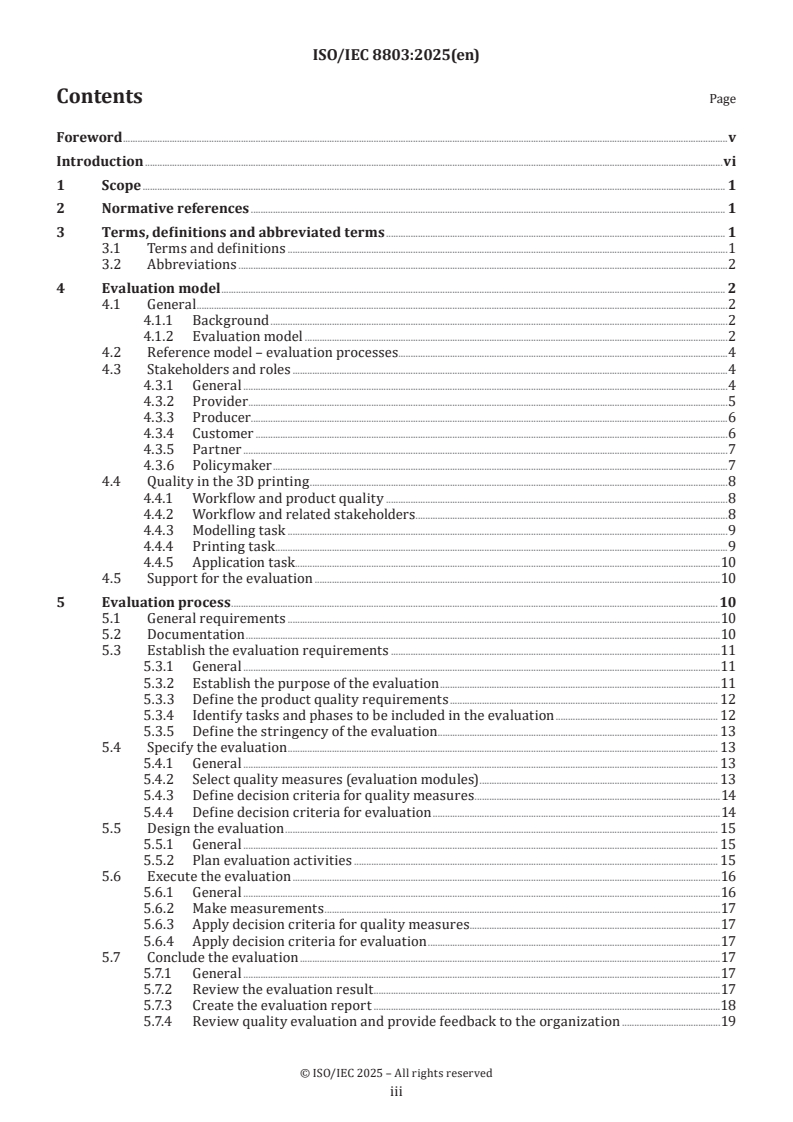
Contents Page
Foreword .v
Introduction .vi
1 Scope . 1
2 Normative references . 1
3 Terms, definitions and abbreviated terms . 1
3.1 Terms and definitions .1
3.2 Abbreviations .2
4 Evaluation model . 2
4.1 General .2
4.1.1 Background .2
4.1.2 Evaluation model .2
4.2 Reference model – evaluation processes .4
4.3 Stakeholders and roles .4
4.3.1 General .4
4.3.2 Provider .5
4.3.3 Producer.6
4.3.4 Customer .6
4.3.5 Partner .7
4.3.6 Policymaker .7
4.4 Quality in the 3D printing .8
4.4.1 Workflow and product quality .8
4.4.2 Workflow and related stakeholders . .8
4.4.3 Modelling task .9
4.4.4 Printing task .9
4.4.5 Application task.10
4.5 Support for the evaluation .10
5 Evaluation process . 10
5.1 General requirements .10
5.2 Documentation .10
5.3 Establish the evaluation requirements .11
5.3.1 General .11
5.3.2 Establish the purpose of the evaluation .11
5.3.3 Define the product quality requirements . 12
5.3.4 Identify tasks and phases to be included in the evaluation . 12
5.3.5 Define the stringency of the evaluation . 13
5.4 Specify the evaluation . 13
5.4.1 General . 13
5.4.2 Select quality measures (evaluation modules) . 13
5.4.3 Define decision criteria for quality measures .14
5.4.4 Define decision criteria for evaluation .14
5.5 Design the evaluation . 15
5.5.1 General . 15
5.5.2 Plan evaluation activities . 15
5.6 Execute the evaluation .16
5.6.1 General .16
5.6.2 Make measurements .17
5.6.3 Apply decision criteria for quality measures.17
5.6.4 Apply decision criteria for evaluation .17
5.7 Conclude the evaluation .17
5.7.1 General .17
5.7.2 Review the evaluation result .17
5.7.3 Create the evaluation report .18
5.7.4 Review quality evaluation and provide feedback to the organization .19
© ISO/IEC 2025 – All rights reserved
iii
5.7.5 Perform disposition of evaluation data .19
Annex A (informative) Tasks and phases .20
Annex B (informative) Evaluation report template .21
Annex C (informative) Comparison between 3D printing product evaluation process and
SQuaRE evaluation process .23
Bibliography .25
© ISO/IEC 2025 – All rights reserved
iv
Foreword
ISO (the International Organization for Standardization) and IEC (the International Electrotechnical
Commission) form the specialized system for worldwide standardization. National bodies that are
members of ISO or IEC participate in the development of International Standards through technical
committees established by the respective organization to deal with particular fields of technical activity.
ISO and IEC technical committees collaborate in fields of mutual interest. Other international organizations,
governmental and non-governmental, in liaison with ISO and IEC, also take part in the work.
The procedures used to develop this document and those intended for its further maintenance are described
in the ISO/IEC Directives, Part 1. In particular, the different approval criteria needed for the different types of
document should be noted. This document was drafted in accordance with the editorial rules of the ISO/IEC
Directives, Part 2 (see https://www.iso.org/directives or https://www.iec.ch/members_experts/refdocs).
ISO and IEC draw attention to the possibility that the implementation of this document may involve the
use of (a) patent(s). ISO and IEC take no position concerning the evidence, validity or applicability of any
claimed patent rights in respect thereof. As of the date of publication of this document, ISO and IEC had not
received notice of (a) patent(s) which may be required to implement this document. However, implementers
are cautioned that this may not represent the latest information, which may be obtained from the patent
database available at www.iso.org/patents and https://patents.iec.ch. ISO and IEC shall not be held
responsible for identifying any or all such patent rights.
Any trade name used in this document is information given for the convenience of users and does not
constitute an endorsement.
For an explanation of the voluntary nature of standards, the meaning of ISO specific terms and expressions
related to conformity assessment, as well as information about ISO's adherence to the World Trade
Organization (WTO) principles in the Technical Barriers to Trade (TBT) see www.iso.org/iso/foreword.html.
In the IEC, see www.iec.ch/understanding-standards.
This document was prepared by Joint Technical Committee ISO/IEC JTC 1, Information technology.
Any feedback or questions on this document should be directed to the user’s national standards
body. A complete listing of these bodies can be found at www.iso.org/members.html and
www.iec.ch/national-committees.
© ISO/IEC 2025 – All rights reserved
v
Introduction
This document was developed in response to the quality management needs of 3D printing and scanning
technology, with the aim of taking full advantage of information and communication technology (ICT) in
this context. 3D scanning is the process of scanning a real-world object or environment to collect data on
its shape and possibly its style attributes. The main purpose of 3D scanning is for generating high-precision
digital 3D models.
A 3D scanner can be based on many different technologies, each with its own purposes and targets,
limitations, and advantages. There can be many limitations in each type of target object that will be
digitized. For example, optical technology can encounter many difficulties with dark, shiny, reflective, or
transparent objects. As a further example, when using computed tomography scanning, structured-light
3D scanners, and Light Detection And Ranging (LiDAR) technology, there is a need to use non-destructive
internal scanning technology for generating digital 3D models.
Despite the rapid growth of 3D scanning applications, the accuracy, precision, and reproducibility of
generated 3D models from 3D scanned data have not been thoroughly investigated. Inaccuracies can arise
due to errors that occur during the imaging, segmentation, modelling, postprocessing, and 3D printing
steps. The total accuracy, precision, and reproducibility of 3D printed models is affected by the sum of errors
introduced in each step involved in the creation of the models.
For the expansion of 3D printing applications, it is necessary to review and evaluate the various factors
in each step of the 3D model printing process that contribute to model inaccuracy, including the intrinsic
limitations of each printing technology. Once identified, the initial error should be assessed and corrected,
in order to minimize cumulative errors of 3D printing life cycles. In this context, evaluation of the overall
process of data processing is critical.
This document proposes a standardized process for evaluating quality enhancement and error minimization
in the generation of the 3D model from 3D scanned data. As a general concept, evaluation is the systematic
determination of the extent to which an entity meets its specified criteria. The evaluation of product quality
is vital to both the acquisition and development of any product. The relative importance of the various
characteristics of product quality depends on the intended usage or objectives of the product. Due to the 3D
printing process is the composition of various tasks, 3D printing products need to be evaluated in each task
to decide whether relevant quality characteristics meet the requirements of the final product.
This document is divided into two main parts:
Clause 4: Evaluation model - This clause describes the underlying principles of evaluation. The use of 3D
printing requires specific considerations with regard to some of these principles as described in Clause 5.
Clause 5: Evaluation process - This clause describes the process of evaluation. Evaluation processes
involve the systematic application of policies, procedures, and practices to the activities of communicating,
establishing the context, assessing, reviewing, and reporting evaluated results.
© ISO/IEC 2025 – All rights reserved
vi
International Standard ISO/IEC 8803:2025(en)
Information technology — 3D Printing and scanning —
Accuracy and precision evaluation process for modelling from
3D scanned data
1 Scope
This document defines a standardized accuracy and precision evaluation process for modelling from 3D
scanned data. The set of processes, activities and tasks described in this document provides a common
framework for evaluating quality factors such as accuracy and precision for modelling from 3D scanned data.
This document is not intended to evaluate the 3D printed product itself.
2 Normative references
The following documents are referred to in the text in such a way that some or all of their content constitutes
requirements of this document. For dated references, only the edition cited applies. For undated references,
the latest edition of the referenced document (including any amendments) applies.
ISO/IEC 25040, Systems and software engineering — Systems and software Quality Requirements and
Evaluation (SQuaRE) — Quality evaluation framework
ISO/IEC 25041, Systems and software engineering — Systems and software Quality Requirements and
Evaluation (SQuaRE) — Evaluation guide for developers, acquirers and independent evaluators
ISO/IEC/IEEE 24765, Systems and software engineering — Vocabulary
3 Terms, definitions and abbreviated terms
For the purposes of this document, the terms and definitions given in ISO/IEC 25040, ISO/IEC 25041 and
ISO/IEC/IEEE 24765:2017 and the following apply.
ISO and IEC maintain terminological databases for use in standardization at the following addresses:
— ISO Online browsing platform: available at https:// www .iso .org/ obp
— IEC Electropedia: available at https:// www .electropedia .org/
3.1 Terms and definitions
3.1.1
3D printing product
set of 3D printed thing, procedures, and 3D model, and possible associated documentation and data
Note 1 to entry: Products include intermediate products, and products intended for users such as developers, designers
and maintainers.
Note 2 to entry: In the ISO/IEC 3532 series, 3D printing quality has the same meaning as 3D printing product quality.
3.1.2
3D replica
exact 3D printed clone of a real-world object
Note 1 to entry: A 3D replica is a copy closely resembling the original concerning its shape and appearance
© ISO/IEC 2025 – All rights reserved
3.1.3
3D replication
process of making a 3D replica using 3D scanning and 3D printing
3.1.4
3D replica model
generated 3D model for 3D printing via 3D scanning
3.1.5
3D replica modelling
process for generating the 3D model for 3D printing via 3D scanning
3.1.6
quality evaluation
systematic examination of the extent to which an entity is capable of fulfilling specified requirements
Note 1 to entry: Annex C provides the comparison between 3D printing product evaluation process and SQuaRE
evaluation process.
[SOURCE: ISO/IEC/IEEE 24765:2017, 3.3267, modified — Note 1 to entry has been removed.]
3.2 Abbreviations
CT computed tomography
DICOM digital imaging and communications in medicine
LiDAR light detection and ranging
SQuaRE software product quality requirements and evaluation
4 Evaluation model
4.1 General
4.1.1 Background
3D scanning is the process of scanning a real-world object or environment to collect data on its shape and
possibly its style attributes. The main purpose of 3D scanning is for generating high-precision digital 3D
models, which is also a process for 3D replica modelling.
Generation of a 3D replica or 3D replica model with 3D replica modelling is an important initial step for
moving between real world and virtual world. Remanufacturing or repairing of wearing parts or structures
should begin the generation of 3D replica model from damaged parts using 3D scanning. Printing of the 3D
replica part to replace a damaged one or repairing wearing portion of part in situ should begin with the
generation of 3D replica model using 3D scanning.
As such, there remains a need to understand how model accuracy and quality can be affected by each activity
within the whole 3D printing workflow.
4.1.2 Evaluation model
The evaluation process includes the inputs and outcomes, constraints and resources for the 3D printing
product quality evaluation process, as shown in Figure 1.
© ISO/IEC 2025 – All rights reserved
Figure 1 — General framework of the product quality evaluation process
The product quality evaluation is regarded as a system, which is composed of four components (the inputs
and outcomes, constraints, and resources) of the evaluation process.
Inputs for the evaluation and outcomes for the evaluations are identified in Clause 5. Constraints for the 3D
printing product quality evaluation process can include the following:
a) specific user needs;
b) resources;
c) schedule;
d) cost;
e) environment;
f) tools and methodology;
g) reporting.
Resources for the 3D printing product quality evaluation process can include the following:
a) applicable measurement tools and assessment methodology, including evaluation modules;
b) applicable documents;
c) human resources for 3D printing product quality evaluation;
d) economical resource for 3D printing product quality evaluation;
e) information system for 3D printing product quality evaluation;
f) knowledge data base for 3D printing product quality evaluation.
The 3D printing product quality evaluation model applies to those responsible for 3D printing product
model evaluation. It is appropriate for organizations in their role as acquirers, developers, or evaluators. It is
intended but not limited to, developers, acquirers and independent evaluators of software products.
© ISO/IEC 2025 – All rights reserved
Within the 3D printing product quality evaluation model, the evaluation should be based on a 3D printing
product quality requirement specification drafted before the evaluation and making clear the objectives
and criteria of evaluations.
The 3D printing product quality evaluation can be performed during or after the development process or
acquisition process by the developer organization, the acquirer organization or an independent evaluator.
4.2 Reference model – evaluation processes
The 3D printing product quality evaluation process model describes the process and details the activities
and tasks providing their purposes and complementary information that can be used to guide a 3D printing
product quality evaluation (Figure 2).
Figure 2 — 3D printing product Quality Evaluation Process
Clause 5 details the activities and tasks providing their inputs, outcomes and complementary information
that can be used to guide a 3D printing product quality evaluation. Notice that Clause 5 intends to present
the general evaluation process.
It is essential for the implementation of the evaluation process to have the flexibility to accommodate the
uniqueness of each application, to avoid unnecessary work or work that adds no value, and to provide a
practical means of establishing the requisite confidence in the 3D printing.
Requirements and recommendations for each activity and task are provided in Clause 5.
4.3 Stakeholders and roles
4.3.1 General
In the context of 3D printing, stakeholder types can be considered in relation to the following distinct roles
in the 3D printing value chain (noting that an organization or entity can undertake several different roles).
Each of the following subclauses includes a description of stakeholder roles and sub-roles. The overall
structure is shown in Figure 3.
Basically, product quality evaluation process of each role is the same, but the target entity of evaluation is
different according to purposes of the evaluation depending on the requester’s needs.
© ISO/IEC 2025 – All rights reserved
Figure 3 — 3D Replication Stakeholder
4.3.2 Provider
4.3.2.1 General
A 3D printing provider is an organization or entity that provides products or services that use one or more
3D printing-related systems.
4.3.2.2 Supplier
The supplier can use the results of 3D printing product evaluation to ensure that products meet required
quality criteria, which can be set by the acquirer, or by comparison with other products.
4.3.2.3 Maintainer
The individual or organisation, which maintains a system of which the 3D printing product is a part, can
use a 3D printing product evaluation to validate that quality requirements are met, and requirements for
maintainability and portability are achieved.
4.3.2.4 Printing service provider
A printing service provider can use the results of a 3D printing service evaluation to ensure that their service
meets required quality standards that can be set by the buyer or compared to other printing services.
© ISO/IEC 2025 – All rights reserved
4.3.2.5 Modelling service provider
Modelling service providers can use the results of the 3D printing modelling service assessment to verify
that their modelling services meet the required quality standards that can be set by the buyer or compared
to other modelling services.
4.3.3 Producer
4.3.3.1 General
A 3D printing producer is an organization or entity that designs, develops, tests, and deploys products or
services that use one or more 3D printing-related systems.
4.3.3.2 Software developer
When implementing a custom-made 3D printing product, the software developer can evaluate the
intermediate software products or final product in order to ensure the developed 3D printing product
quality. The developer can use the results of 3D printing product quality evaluation to ensure that software
products meet required quality criteria, which can be set by the customer, or by comparison with other
products.
4.3.3.3 3D printer manufacturer
When implementing a custom-made 3D printing product, the 3D printer manufacturer can evaluate the 3D
printer in order to ensure the developed 3D printing product print quality. The 3D printer manufacturer can
use the results of 3D printing product print quality evaluation to ensure that the 3D printer meets required
quality criteria, which can be set by the customer, or by comparison with other products.
4.3.3.4 Imaging device manufacturer
Imaging device manufacturers can evaluate or calibrate their imaging devices to ensure the print quality
of the 3D printed products they develop. The imaging device manufacturer can verify and validate that the
images acquired through the established image acquisition protocols can be used to ensure optimal 3D
printed product quality.
4.3.3.5 3D modeler
3D modelers can use modelling software to evaluate the quality of the final 3D printing results of 3D models
they have modeled.
4.3.4 Customer
4.3.4.1 General
A 3D printing customer is an organization or entity that uses a 3D printing product or service either directly
or by its provision to end users. There is a business relationship between a 3D printing provider and a 3D
printing customer.
4.3.4.2 Acquirer
When acquiring a custom made 3D printing product, the acquirer can establish quality in use requirements
and 3D printing product quality requirements, can specify the requirements to the supplier, and can
evaluate potential purchases against these requirements before acquisition. When acquiring a product to be
developed, the objective of specifying quality requirements is to ensure that the product meets the stated
and implied needs of the user. When purchasing a 3D printing product, evaluation can be used to compare
alternative products and to ensure that the selected product meets the quality requirements.
© ISO/IEC 2025 – All rights reserved
4.3.4.3 3D replication user
A 3D replication user is a user who wants to acquire a replicated 3D printed product, and may place
requirements on the supplier for the 3D printing process and 3D replication quality requirements, and may
evaluate potential purchases against these requirements before contracting. The purpose of specifying
quality requirements is to ensure that the 3D replica product meets the user's explicit and implicit
requirements.
4.3.5 Partner
4.3.5.1 General
A 3D printing partner is an organization or entity that provides services in the context of 3D printing. 3D
printing partners can perform data acquisition for 3D printing, perform system integration of 3D printing
products or services, conduct testing and validation of 3D printing products and services, audit 3D printing
usage, evaluate 3D preprint products or services, and perform other tasks.
4.3.5.2 3D Scanning provider
When evaluating a target 3D printing product, the 3D scanning provider can evaluate the 3D scanned image
acquisition process, protocol, or acquired 3D images in order to ensure the 3D printing product modelling
quality. The 3D scanning provider can use the results of 3D printing product modelling quality evaluation to
ensure that the 3D scanned image acquisition phase meets required quality criteria, which can be set by the
customer, or by comparison with other 3D scanning devices or protocol.
4.3.5.3 Data provider
A data provider is an organization or entity that is concerned with providing data used by 3D printing
products or services.
4.3.5.4 Independent evaluators
When evaluating a target 3D printing product, the independent evaluator can evaluate the intermediate 3D
printing products or final product in order to ensure the 3D printing product quality. The evaluation process
for an independent evaluation approach provides requirements and recommendations for the practical
implementation of 3D printing product evaluation, when several parties need to understand, accept and
trust evaluation results. It is used by evaluators carrying out an independent evaluation of a 3D printing
product. This evaluation could be performed at the request of a developer, acquirer or some other party.
4.3.5.5 Auditor
A 3D printing auditor is an organization or entity that is concerned with the audit of organizations producing,
providing or using 3D printing systems, to assess compliance to standards, policies, or regulations.
4.3.5.6 System integrator
A system integrator is an organization or entity responsible for the integration of software and hardware
systems in the 3D printing process.
4.3.6 Policymaker
4.3.6.1 General
A 3D printing policymaker is an organization or entity that creates policies and rules to impact a 3D printing
system, service, or product.
© ISO/IEC 2025 – All rights reserved
4.3.6.2 Regulator
A regulator is an organization or entity responsible for regulating the responsibilities and obligations
related to safety and effectiveness in the lifecycle of a 3D-printed product.
4.4 Quality in the 3D printing
4.4.1 Workflow and product quality
ISO/IEC 3532-1 describes the generating model and printing from 3D scanned data workflow and its
requirements. Figure 4 shows how the major phases defined in ISO/IEC 3532-1 can be classified into three
task units. It also shows the 3D printing quality lifecycle and how quality measures can be related to the
overall workflow.
Figure 4 — Key tasks of 3D printing workflow
It can be assumed that the total error/accuracy/precision of a 3D printed product approximates the sum
of the error/accuracy/precision measured from each key task. Therefore, for each unit of work, errors,
accuracy and precision can be evaluated and improved to improve overall quality.
4.4.2 Workflow and related stakeholders
Table 1 shows each phase of the three tasks (defined in Annex A) and their association with stakeholders.
A character “o” in the table shows which tasks can be related to which stakeholders. A blanked cell means
there is no relationship.
© ISO/IEC 2025 – All rights reserved
Table 1 — Workflow and related stakeholders
Modeling Task Printing Task Application Task
Image acqui- Segmentation 3D mode- 3D print- Post-pro- QC Application Post-mar-
sition phase phase ling phase ing phase cessing phase and review ket
phase phase phase
Provider Supplier o o o o o o o o
Maintainer o o o o o o o o
Printing service o o o o
provider
Modeling ser- o o o o
vice provider
Producer Software devel- o o o o o
oper
3D printer man- o o
ufacturer
Imaging device o
manufacturer
3D modeler o o o
Customer Acquirer o o o o o o
3D replication o o o o o o
user
Partner 3D scanning o o o o
provider
Data provider o o o o
Independent o o o o o o
evaluators
Auditor o o o o
System inte- o o o o o o
grator
Policymaker Regulator o o o o o
4.4.3 Modelling task
The modelling task includes three phases to create a 3D model for 3D printing from 3D scanned images. The
modelling task's goal is to make the most precise 3D model
— Image acquisition phase: In the image acquisition phase, 3D scanned images are acquired from 3D
scanned imaging devices such as CT.
— Segmentation phase: In the segmentation phase, the acquired 3D scanned images are segmented to fit
the design purpose. For optimal segmentation, the method and process defined in ISO/IEC 3532-2 should
be considered.
— 3D modelling phase: In the 3D modelling phase, the segmented object is made into a 3D model optimized
for 3D printing.
The goal of the quality management activity in the modelling task shall be to measure and enhance the
model quality.
4.4.4 Printing task
The printing task includes three phases to validate and adjust the 3D model for 3D printing. Printing task's
goal is to make the best 3D printed result.
— 3D printing phase: In the 3D printing phase, 3D printing is performed using the designed 3D model.
© ISO/IEC 2025 – All rights reserved
— In the post-processing stage, the 3D-printed outputs are made ready for actual applications through the
necessary post-processing processes.
— QC phase: In the QC phase, the 3D printed output is verified to meet all requirements (user/design/
quality/risk).
The goal of quality management activity in the printing task shall be to measure and enhance the print
quality.
4.4.5 Application task
The application task includes two phases to manage the post-market validation from real-world application
and review. The application task's goal is to achieve the best 3D printing quality for real-world result.
— Real-world application and review phase: In the real-world application and review phase, the 3D printing
product is reviewed as applicable to real-world application by the customer.
— Post-market phase: In the post-marketing stage, the 3D printing product is managed based on the post-sale
market management policy according to product life cycle issues such as tracking management/recall.
The goal of quality management activity in the application task shall be to measure and enhance the
application quality.
4.5 Support for the evaluation
These are activities for assisting evaluation by collecting information on 3D printing product quality
evaluation methods and tools, developing and validating measures, and standardising the evaluation
process, and measures.
5 Evaluation process
5.1 General requirements
The evaluator shall implement the activities and tasks described in Clause 5 in accordance with applicable
organization policies and procedures with respect to the 3D printing product quality evaluation process
(see Figure 2).
There shall be an infrastructure including tools and technology in the evaluator’s organization suitable for
carrying out 3D printing product quality evaluation.
There shall be an infrastructure that allows for evaluation data collection and evaluation process
modifications based on data analysis.
NOTE The evaluation data collection process can be referred from ISO/IEC 8801.
The personnel involved in the evaluation shall have the necessary skills and training.
In order to ensure repeatability, reproducibility, impartiality and objectivity of the evaluation results, the
evaluator shall act in an organisational context that provides all necessary assurance to obtain sufficient
quality for its activities.
5.2 Documentation
Each activity in the 3D printing product quality evaluation shall be recorded.
The records shall include a detailed account of actions performed by the evaluator while executing the 3D
printing product quality evaluation plan.
The records shall contain sufficient information required for the management of the 3D printing product
quality evaluation.
© ISO/IEC 2025 – All rights reserved
The evaluation records shall include any intermediate data on which any interpretation is based. The
decisions made during the interpretation process shall also be included in the evaluation records as specified
in the evaluation plan.
The records shall contain sufficient information for each activity for effective performance of subsequent
activities of the 3D printing product quality evaluation.
The records shall be kept in order to document the 3D printing product quality evaluation and to allow
reprocessing of the evaluation results.
A 3D printing product quality evaluation report shall be prepared documenting evaluation activities and
results of the evaluation.
NOTE Annex B provides a template for an evaluation report.
When a tool is used to perform an evaluation action, reference to the tool shall be included in the evaluation
report. The reference shall consist of the identification of the tool and of its supplier and the version of the
tool. A more detailed reference to the tool used shall be included in the evaluation records. It shall include the
detailed configuration of the tool and any pertinent information needed to be able to repeat the evaluation
action in order to obtain the same intermediate result.
5.3 Establish the evaluation requirements
5.3.1 General
The following should be inputs for this activity:
a) 3D printing product quality evaluation needs;
b) 3D printing product quality requirements specification;
c) 3D printing product to be evaluated including intermediate products;
d) dataset plan for evaluation.
The following should be outcomes of this activity:
a) specification of 3D printing product quality evaluation purposes;
b) specification of 3D printing product quality evaluation requirements;
c) specification of high level 3D printing product quality evaluation plan.
This activity consists of the following tasks from Clause 5.3.2.
5.3.2 Establish the purpose of the evaluation
The purpose of the 3D printing product quality evaluation shall be documented as a basis for the further
evaluation activities and tasks.
3D printing product quality evaluation directly supports both the development and acquisition of 3D
printing product, which meets user and customer needs. The ultimate objective is to ensure that the product
provides the required quality - that it meets the stated and implied needs of the users (including operators,
patients, surgeons, modelers, recipients of the results of the 3D printing related software, and maintainers
of 3D printing related software).
3D printing product quality should be evaluated within defined quality requirements throughout the life
cycle stages relating to 3D printing phases defined in ISO/IEC 3532-1 (See Annex A).
The 3D printing product quality can be evaluated as an intermediate product or as a final product.
© ISO/IEC 2025 – All rights reserved
The purpose of evaluation of intermediate 3D printing product quality can be to:
— assure quality for the product;
— decide on the acceptance of an intermediate software product from a subcontractor;
— assess the ongoing feasibility of the development project;
— decide on the completion of a life cycle stage and when to send products to the next stage;
— predict or estimate final software product quality;
— collect information on intermediate software products in order to control and manage the process.
The purpose of evaluation of final 3D printing product quality can be to:
— decide on the acceptance of the product;
— decide when to release the product;
— compare the product with competitive products;
— select a product from among alternative products;
— assess both positive and negative effects of a product when it is used;
— determine the cause of a failure in an investigation;
— decide when to enhance or replace the product.
5.3.3 Define the product quality requirements
The stakeholders of the 3D printing product shall be identified.
NOTE 1 Information from the requester of the evaluation can be needed for identifying all stakeholders.
NOTE 2 Stakeholders to be identified are a person, party or organisation, and can be involved in the evaluation.
Two kinds of stakeholders are to be identified. One is a stakeholder of 3D printing product, such as developer,
acquirer, independent evaluator, user, operator, recipient of the results of the 3D printing related software,
maintainer, modeler, user, 3D printer manufacturer, regulator or supplier. Another is an evaluation requester
who needs information about software quality, sponsors the evaluation and requires an evaluation report.
The 3D printing product quality requirements specified using a quality model shall be provided.
The extent to which the quality evaluation covers the specified 3D printing quality requirements shall
be defined, taking into acc
...