


ISO/FDIS 7554-3
(Main)Surgical instruments — Terms, measuring methods and test methods — Part 3: Test methods
Surgical instruments — Terms, measuring methods and test methods — Part 3: Test methods
This document defines test methods for surgical standard instruments. Excluded here are instruments for use on the central nervous system and on the central cardiovascular system.
Instruments chirurgicaux — Termes, méthodes de mesurage et méthodes d'essai — Partie 3: Méthodes d'essai
General Information
- Status
- Not Published
- Technical Committee
- ISO/TC 170 - Surgical instruments
- Drafting Committee
- ISO/TC 170 - Surgical instruments
- Current Stage
- 5020 - FDIS ballot initiated: 2 months. Proof sent to secretariat
- Start Date
- 17-Mar-2026
- Completion Date
- 17-Mar-2026
Overview
ISO/FDIS 7554-3: Surgical instruments - Terms, measuring methods and test methods - Part 3: Test methods, developed by the International Organization for Standardization (ISO), specifies standardized test methods for evaluating surgical standard instruments. The scope of this international standard covers a wide range of reusable surgical instruments used in various medical procedures, excluding those specifically designed for use on the central nervous system and central cardiovascular system. By establishing clear testing requirements, ISO/FDIS 7554-3 aims to promote quality assurance, patient safety, and consistency in the manufacturing and assessment of surgical tools.
Key Topics
- Test Methods for Surgical Instruments: The document details comprehensive test procedures for an array of surgical instruments, such as scalpels, scissors, forceps, clamps, curettes, rongeurs, tweezers, retractors, probes, needle holders, and more.
- Visual and Functional Inspections: It emphasizes the importance of visual inspections (to ensure no defects, burrs, or contamination) and defines the criteria for smooth functioning, sharpness, and safe assembly of instruments.
- Material and Hardness Tests: ISO/FDIS 7554-3 references hardness testing and corrosion resistance evaluations, ensuring instruments are manufactured to withstand repeated usage and sterilization.
- Specialized Test Materials: The standard specifies the use of particular test materials, such as polyethylene film, PTFE film, latex, cotton jersey, and acrylic glass, to objectively assess cutting, gripping, and functional properties.
- Dimensional and Mechanical Integrity: Requirements include mechanical strength (no breakage or irreversible deformation under proper use), precise fit of functional surfaces, and absence of sharp or hazardous edges (except cutting areas).
- Sample Testing and Acceptance: Procedures for representative sampling and acceptance criteria ensure batch quality, supporting robust process control in manufacturing.
Applications
ISO/FDIS 7554-3 is essential for manufacturers, testing laboratories, healthcare providers, and regulatory agencies involved in the production, testing, procurement, or evaluation of surgical instruments. Key practical applications include:
- Manufacturing Quality Control: Standardized testing protocols help manufacturers consistently produce reliable and safe surgical instruments, reduce recall risks, and comply with global market requirements.
- Regulatory Compliance: The methods detailed in ISO/FDIS 7554-3 aid in fulfilling national and international regulatory requirements regarding medical device safety and performance.
- Procurement and Inspection: Hospitals and clinical supply chain professionals can use this standard as a benchmark during procurement, ensuring instruments meet rigorous safety and functionality standards before purchase or use.
- Product Development: R&D and engineering teams can incorporate these test methodologies during design validation to ensure new products align with recognized industry benchmarks.
- Third-Party Certification: Laboratories performing third-party conformity assessments can follow the described methods to certify product batches as compliant, supporting market access and end-user trust.
Related Standards
For holistic compliance and enhanced understanding, ISO/FDIS 7554-3 should be applied alongside other key standards, including:
- ISO 7153: Surgical instruments - Materials - Part 1: Metals
- ISO 3738-1: Hardmetals - Rockwell hardness test (scale A)
- ISO 6507-1 and ISO 6508-1: Metallic materials - Vickers and Rockwell hardness test methods
- ISO/DIS 7554-1: Surgical instruments - Terms, measuring methods and tests - Part 1: Vocabulary
- ISO/DIS 13402:2023: Surgical and dental hand instruments - Determination of resistance against autoclaving, corrosion and thermal exposure
- EN 10204: Metallic materials - Types of inspection documents
- ISO 20417: Medical devices - Information to be supplied by the manufacturer
Summary
ISO/FDIS 7554-3 plays a critical role in setting the benchmarks for testing surgical instruments, supporting global harmonization, quality assurance, and patient safety. Its robust protocols for evaluating mechanical and functional performance make it indispensable across the medical device industry and healthcare sector. Leveraging ISO/FDIS 7554-3 helps organizations ensure that surgical instruments meet the highest standards of performance, durability, and safety.
Buy Documents

ISO/FDIS 7554-3 - Surgical instruments — Terms, measuring methods and test methods — Part 3: Test methods/30/2024

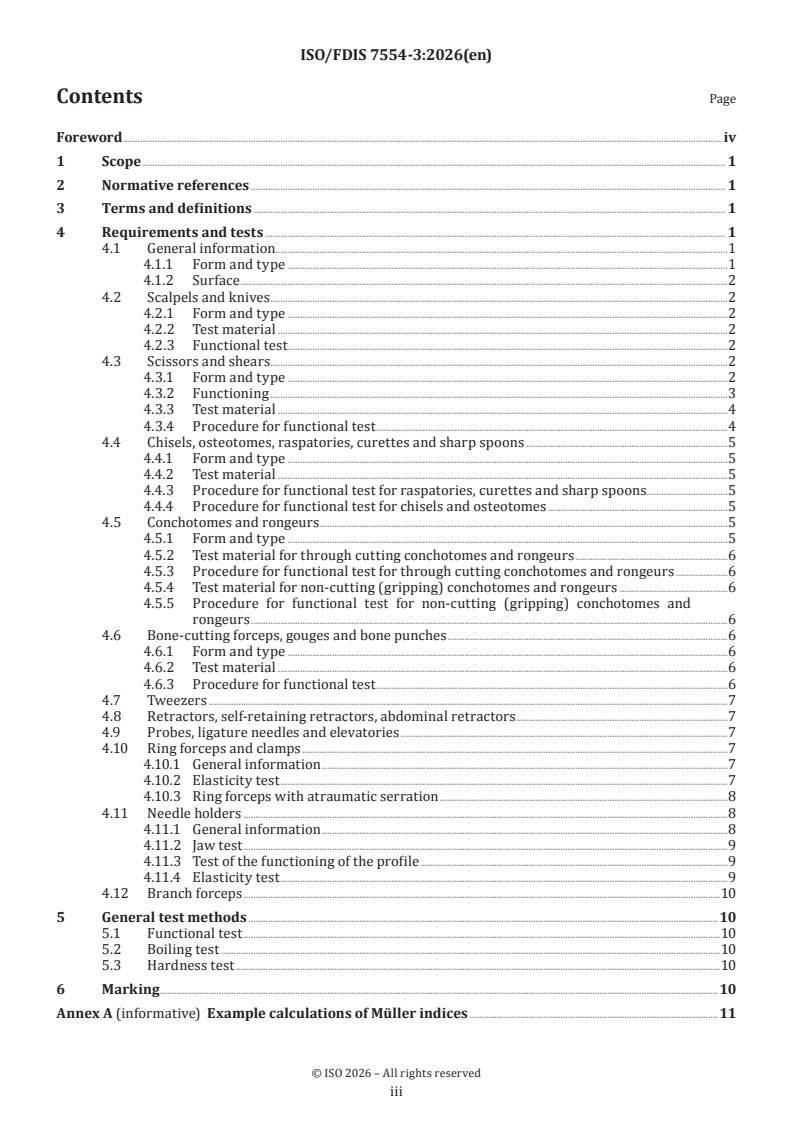
ISO/FDIS 7554-3 - Surgical instruments — Terms, measuring methods and test methods — Part 3: Test methods
REDLINE ISO/FDIS 7554-3 - Surgical instruments — Terms, measuring methods and test methods — Part 3: Test methods
Get Certified
Connect with accredited certification bodies for this standard

BSI Group
BSI (British Standards Institution) is the business standards company that helps organizations make excellence a habit.

TÜV Rheinland
TÜV Rheinland is a leading international provider of technical services.

TÜV SÜD
TÜV SÜD is a trusted partner of choice for safety, security and sustainability solutions.
Sponsored listings
Frequently Asked Questions
ISO/FDIS 7554-3 is a draft published by the International Organization for Standardization (ISO). Its full title is "Surgical instruments — Terms, measuring methods and test methods — Part 3: Test methods". This standard covers: This document defines test methods for surgical standard instruments. Excluded here are instruments for use on the central nervous system and on the central cardiovascular system.
This document defines test methods for surgical standard instruments. Excluded here are instruments for use on the central nervous system and on the central cardiovascular system.
ISO/FDIS 7554-3 is classified under the following ICS (International Classification for Standards) categories: 11.040.30 - Surgical instruments and materials. The ICS classification helps identify the subject area and facilitates finding related standards.
ISO/FDIS 7554-3 is available in PDF format for immediate download after purchase. The document can be added to your cart and obtained through the secure checkout process. Digital delivery ensures instant access to the complete standard document.
Standards Content (Sample)
DRAFT
International
Standard
ISO/DIS 7554-3
ISO/TC 170
Surgical instruments — Terms,
Secretariat: DIN
measuring methods and tests —
Voting begins on:
Part 3: 2025-01-27
Test methods
Voting terminates on:
2025-04-21
Instruments chirurgicaux — Termes, méthodes de mesurage et
essais —
Partie 3: Méthodes d'essai
ICS: 11.040.30
THIS DOCUMENT IS A DRAFT CIRCULATED
FOR COMMENTS AND APPROVAL. IT
IS THEREFORE SUBJECT TO CHANGE
AND MAY NOT BE REFERRED TO AS AN
INTERNATIONAL STANDARD UNTIL
PUBLISHED AS SUCH.
IN ADDITION TO THEIR EVALUATION AS
BEING ACCEPTABLE FOR INDUSTRIAL,
TECHNOLOGICAL, COMMERCIAL AND
USER PURPOSES, DRAFT INTERNATIONAL
STANDARDS MAY ON OCCASION HAVE TO
This document is circulated as received from the committee secretariat.
BE CONSIDERED IN THE LIGHT OF THEIR
POTENTIAL TO BECOME STANDARDS TO
WHICH REFERENCE MAY BE MADE IN
NATIONAL REGULATIONS.
RECIPIENTS OF THIS DRAFT ARE INVITED
TO SUBMIT, WITH THEIR COMMENTS,
NOTIFICATION OF ANY RELEVANT PATENT
RIGHTS OF WHICH THEY ARE AWARE AND TO
PROVIDE SUPPORTING DOCUMENTATION.
Reference number
ISO/DIS 7554-3:2025(en)
DRAFT
ISO/DIS 7554-3:2025(en)
International
Standard
ISO/DIS 7554-3
ISO/TC 170
Surgical instruments — Terms,
Secretariat: DIN
measuring methods and tests —
Voting begins on:
Part 3:
Test methods
Voting terminates on:
Instruments chirurgicaux — Termes, méthodes de mesurage et
essais —
Partie 3: Méthodes d'essai
ICS: 11.040.30
THIS DOCUMENT IS A DRAFT CIRCULATED
FOR COMMENTS AND APPROVAL. IT
IS THEREFORE SUBJECT TO CHANGE
AND MAY NOT BE REFERRED TO AS AN
INTERNATIONAL STANDARD UNTIL
PUBLISHED AS SUCH.
IN ADDITION TO THEIR EVALUATION AS
BEING ACCEPTABLE FOR INDUSTRIAL,
© ISO 2025
TECHNOLOGICAL, COMMERCIAL AND
USER PURPOSES, DRAFT INTERNATIONAL
All rights reserved. Unless otherwise specified, or required in the context of its implementation, no part of this publication may
STANDARDS MAY ON OCCASION HAVE TO
be reproduced or utilized otherwise in any form or by any means, electronic or mechanical, including photocopying, or posting on
This document is circulated as received from the committee secretariat. BE CONSIDERED IN THE LIGHT OF THEIR
the internet or an intranet, without prior written permission. Permission can be requested from either ISO at the address below
POTENTIAL TO BECOME STANDARDS TO
WHICH REFERENCE MAY BE MADE IN
or ISO’s member body in the country of the requester.
NATIONAL REGULATIONS.
ISO copyright office
RECIPIENTS OF THIS DRAFT ARE INVITED
CP 401 • Ch. de Blandonnet 8
TO SUBMIT, WITH THEIR COMMENTS,
CH-1214 Vernier, Geneva
NOTIFICATION OF ANY RELEVANT PATENT
Phone: +41 22 749 01 11
RIGHTS OF WHICH THEY ARE AWARE AND TO
PROVIDE SUPPORTING DOCUMENTATION.
Email: copyright@iso.org
Website: www.iso.org
Published in Switzerland Reference number
ISO/DIS 7554-3:2025(en)
ii
ISO/DIS 7554-3:2025(en)
Contents Page
Foreword .v
Introduction .vi
1 Scope . 1
2 Normative references . 1
3 Terms and definitions . 1
4 Requirements and tests . 1
4.1 General information.1
4.1.1 Form and type .1
4.1.2 Surface .2
4.2 Scalpels and knives .2
4.2.1 Form and type .2
4.2.2 Test material .2
4.2.3 Functional test.2
4.3 Scissors and shears .2
4.3.1 Form and type .2
4.3.2 Functioning .3
4.3.3 Test material .4
4.3.4 Procedure for functional test .4
4.4 Chisels, osteotomes, raspatories, curettes and sharp spoons .5
4.4.1 Form and type .5
4.4.2 Test material .5
4.4.3 Procedure for functional test for raspatories, curettes and sharp spoons .5
4.4.4 Procedure for functional test for chisels and osteotomes .5
4.5 Conchotomes and rongeurs . .5
4.5.1 Form and type .5
4.5.2 Test material for through-cutting conchotomes/rongeurs .6
4.5.3 Procedure for functional test for through-cutting conchotomes/rongeurs .6
4.5.4 Test material for non-cutting (gripping) conchotomes/rongeurs .6
4.5.5 Procedure for functional test for non-cutting (gripping) conchotomes/rongeurs .6
4.6 Bone-cutting forceps, gouges and bone punches .6
4.6.1 Form and type .6
4.6.2 Test material .6
4.6.3 Procedure for functional test .6
4.7 Tweezers .7
4.8 Retractors, self-retaining retractors, abdominal retractors .7
4.9 Probes, ligature needles and elevatories .7
4.10 Ring forceps and clamps .7
4.10.1 General information .7
4.10.2 Elasticity test .7
4.10.3 Ring forceps with atraumatic serration .8
4.11 Needle holders .8
4.11.1 General information .8
4.11.2 Jaw test .9
4.11.3 Test of the functioning of the profile .9
4.11.4 Elasticity test .9
4.12 Branch forceps .10
5 Sample test .10
5.1 Test lot and sample size .10
5.2 Acceptance number .10
6 General test methods .11
6.1 Material test .11
6.2 Corrosion resistance test .11
6.3 Hardness test .11
iii
ISO/DIS 7554-3:2025(en)
7 Marking . .11
Annex A (informative) List of sample calculations of Müller factors .12
Bibliography . 14
iv
ISO/DIS 7554-3:2025(en)
Foreword
ISO (the International Organization for Standardization) is a worldwide federation of national standards
bodies (ISO member bodies). The work of preparing International Standards is normally carried out through
ISO technical committees. Each member body interested in a subject for which a technical committee
has been established has the right to be represented on that committee. International organizations,
governmental and non-governmental, in liaison with ISO, also take part in the work. ISO collaborates closely
with the International Electrotechnical Commission (IEC) on all matters of electrotechnical standardization.
The procedures used to develop this document and those intended for its further maintenance are described
in the ISO/IEC Directives, Part 1. In particular, the different approval criteria needed for the different types
of ISO documents should be noted. This document was drafted in accordance with the editorial rules of the
ISO/IEC Directives, Part 2 (see www.iso.org/directives).
Attention is drawn to the possibility that some of the elements of this document may be the subject of patent
rights. ISO shall not be held responsible for identifying any or all such patent rights. Details of any patent
rights identified during the development of the document will be in the Introduction and/or on the ISO list of
patent declarations received (see www.iso.org/patents).
Any trade name used in this document is information given for the convenience of users and does not
constitute an endorsement.
For an explanation of the voluntary nature of standards, the meaning of ISO specific terms and expressions
related to conformity assessment, as well as information about ISO's adherence to the World Trade
Organization (WTO) principles in the Technical Barriers to Trade (TBT), see www.iso.org/iso/foreword.html.
This document was prepared by Technical Committee [or Project Committee] ISO/TC 170, surgical
instruments.
A list of all parts in the ISO 7554 series can be found on the ISO website.
Any feedback or questions on this document should be directed to the user’s national standards body. A
complete listing of these bodies can be found at www.iso.org/members.html.
v
ISO/DIS 7554-3:2025(en)
Introduction
The International Organization for Standardization (ISO) draw attention to the fact that it is claimed that
compliance with this document may involve the use of a patent.
ISO takes no position concerning the evidence, validity and scope of this patent right.
The holder of this patent right has assured ISO that he/she is willing to negotiate licences under reasonable
and non-discriminatory terms and conditions with applicants throughout the world. In this respect, the
statement of the holder of this patent right is registered with ISO. Information may be obtained from the
patent database available at www.iso.org/patents.
Attention is drawn to the possibility that some of the elements of this document may be the subject of patent
rights other than those in the patent database. ISO shall not be held responsible for identifying any or all
such patent rights.
vi
DRAFT International Standard ISO/DIS 7554-3:2025(en)
Surgical instruments — Terms, measuring methods and tests —
Part 3:
Test methods
1 Scope
This document defines test methods for surgical standard instruments. Excluded here are instruments for
use on the central nervous system and on the central cardiovascular system.
2 Normative references
The following documents are referred to in the text in such a way that some or all of their content constitutes
requirements of this document. For dated references, only the edition cited applies. For undated references,
the latest edition of the referenced document (including any amendments) applies.
EN 10204, Metallic materials — Types of inspection documents
ISO 3738-1, Hardmetals — Rockwell hardness test (scale A) — Part 1: Test method
ISO 6507-1, Metallic materials — Vickers hardness test — Part 1: Test method
ISO 6508-1, Metallic materials — Rockwell hardness test — Part 1: Test method
ISO 7153, Surgical instruments — Materials Part 1: Metals
ISO/DIS 7554-1, Surgical instruments — Terms, measuring methods and tests — Part 1: Vocabulary
ISO/DIS 13402:2023, Surgical and dental hand instruments — Determination of resistance against autoclaving,
corrosion and thermal exposure
ISO 20417, Medical devices - Information to be supplied by the manufacturer
3 Terms and definitions
For the purposes of this document, the terms and definitions given in ISO/DIS 7554-1 apply.
ISO and IEC maintain terminological databases for use in standardization at the following addresses:
— ISO Online browsing platform: available at https:// www .iso .org/ obp
— IEC Electropedia: available at https:// www .electropedia .org/
4 Requirements and tests
4.1 General information
4.1.1 Form and type
The instruments shall not break or irreversibly deform, with the exception of flexible instruments, during
use for their intended purpose.
ISO/DIS 7554-3:2025(en)
There shall not be any sharp edges or corners, except for the cutting edges on the working edges.
4.1.2 Surface
The surface shall be free of burrs, cracks, joint gaps and pores, scars, orange peel, scratches, machining
marks or other damage as well as visually noticeable oil residues and machining materials, traces of powder,
discolourations, annealing colours, stains, machining residues and corrosion or other contamination.
Excluded from this are vapour-permeable medical oils that may be applied to joints and functional and
gliding surfaces.
This shall be carried out through direct visual testing. During the test, the test item or the test surface shall
be sufficiently illuminated. During visual testing, the beam path between the eye of the tester and the test
surface may not be interrupted. This test is carried out without any auxiliary tools.
NOTE For more information on visual testing, see EN 13018.
Instruments can be manufactured with a mat or mirror polished finish:
— a mat finish.
Examples of mechanical processing: Glass or ceramic beads blasting, with brushes on a grinding fleece disk;
— a mirror polished finish. See ISO 7151 and ISO 7741
Examples of mechanical processing: Polishing on a buffing wheel or slide grinding.
Examples of chemical and/or electrochemical processing: Electropolishing.
The visual inspection shall be performed from a person with normal eyesight or corrected vision.
4.2 Scalpels and knives
4.2.1 Form and type
The blade shall be grinded and honed. Handles shall be connected with the blade using a suitable joining
process. The joint site of hollow handles shall be completely sealed and tested with an appropriate test method.
The visual inspection shall be performed from a person with normal eyesight or corrected vision.
4.2.2 Test material
Polyethylene film (PE film) with a thickness of 50 µm to 100 µm shall be used as the test material.
4.2.3 Functional test
Scalpels and knives are tested by cutting through the test material. The cut shall be made with 2/3 of the
distal end of the blade. The test material shall be cut through with a clean cut.
4.3 Scissors and shears
4.3.1 Form and type
The scissor blades shall not break or irreversibly deform when subjected to stresses that correspond to their
intended use. Matching parts shall have the same shape in terms of size and symmetry. The scissors shall
not get caught during cutting.
The blades shall be free of any imperfections and burrs.
The edge-holding properties of scissor blades may be improved by applying foreign materials/additional
materials (e.g., cast or sintered carbides) using suitable j
...
FINAL DRAFT
International
Standard
ISO/TC 170
Surgical instruments — Terms,
Secretariat: DIN
measuring methods and test
Voting begins on:
methods —
2026-03-17
Part 3:
Voting terminates on:
2026-05-12
Test methods
RECIPIENTS OF THIS DRAFT ARE INVITED TO SUBMIT,
WITH THEIR COMMENTS, NOTIFICATION OF ANY
RELEVANT PATENT RIGHTS OF WHICH THEY ARE AWARE
AND TO PROVIDE SUPPOR TING DOCUMENTATION.
IN ADDITION TO THEIR EVALUATION AS
BEING ACCEPTABLE FOR INDUSTRIAL, TECHNO-
LOGICAL, COMMERCIAL AND USER PURPOSES, DRAFT
INTERNATIONAL STANDARDS MAY ON OCCASION HAVE
TO BE CONSIDERED IN THE LIGHT OF THEIR POTENTIAL
TO BECOME STAN DARDS TO WHICH REFERENCE MAY BE
MADE IN NATIONAL REGULATIONS.
Reference number
FINAL DRAFT
International
Standard
ISO/TC 170
Surgical instruments — Terms,
Secretariat: DIN
measuring methods and test
Voting begins on:
methods —
Part 3:
Voting terminates on:
Test methods
RECIPIENTS OF THIS DRAFT ARE INVITED TO SUBMIT,
WITH THEIR COMMENTS, NOTIFICATION OF ANY
RELEVANT PATENT RIGHTS OF WHICH THEY ARE AWARE
AND TO PROVIDE SUPPOR TING DOCUMENTATION.
© ISO 2026
IN ADDITION TO THEIR EVALUATION AS
All rights reserved. Unless otherwise specified, or required in the context of its implementation, no part of this publication may
BEING ACCEPTABLE FOR INDUSTRIAL, TECHNO-
LOGICAL, COMMERCIAL AND USER PURPOSES, DRAFT
be reproduced or utilized otherwise in any form or by any means, electronic or mechanical, including photocopying, or posting on
INTERNATIONAL STANDARDS MAY ON OCCASION HAVE
the internet or an intranet, without prior written permission. Permission can be requested from either ISO at the address below
TO BE CONSIDERED IN THE LIGHT OF THEIR POTENTIAL
or ISO’s member body in the country of the requester.
TO BECOME STAN DARDS TO WHICH REFERENCE MAY BE
MADE IN NATIONAL REGULATIONS.
ISO copyright office
CP 401 • Ch. de Blandonnet 8
CH-1214 Vernier, Geneva
Phone: +41 22 749 01 11
Email: copyright@iso.org
Website: www.iso.org
Published in Switzerland Reference number
ii
Contents Page
Foreword .iv
1 Scope . 1
2 Normative references . 1
3 Terms and definitions . 1
4 Requirements and tests . 1
4.1 General information.1
4.1.1 Form and type .1
4.1.2 Surface .2
4.2 Scalpels and knives .2
4.2.1 Form and type .2
4.2.2 Test material .2
4.2.3 Functional test.2
4.3 Scissors and shears .2
4.3.1 Form and type .2
4.3.2 Functioning .3
4.3.3 Test material .4
4.3.4 Procedure for functional test .4
4.4 Chisels, osteotomes, raspatories, curettes and sharp spoons .5
4.4.1 Form and type .5
4.4.2 Test material .5
4.4.3 Procedure for functional test for raspatories, curettes and sharp spoons .5
4.4.4 Procedure for functional test for chisels and osteotomes .5
4.5 Conchotomes and rongeurs . .5
4.5.1 Form and type .5
4.5.2 Test material for through cutting conchotomes and rongeurs .6
4.5.3 Procedure for functional test for through cutting conchotomes and rongeurs .6
4.5.4 Test material for non-cutting (gripping) conchotomes and rongeurs .6
4.5.5 Procedure for functional test for non-cutting (gripping) conchotomes and
rongeurs .6
4.6 Bone-cutting forceps, gouges and bone punches .6
4.6.1 Form and type .6
4.6.2 Test material .6
4.6.3 Procedure for functional test .6
4.7 Tweezers .7
4.8 Retractors, self-retaining retractors, abdominal retractors .7
4.9 Probes, ligature needles and elevatories .7
4.10 Ring forceps and clamps .7
4.10.1 General information .7
4.10.2 Elasticity test .7
4.10.3 Ring forceps with atraumatic serration .8
4.11 Needle holders .8
4.11.1 General information .8
4.11.2 Jaw test .9
4.11.3 Test of the functioning of the profile .9
4.11.4 Elasticity test .9
4.12 Branch forceps .10
5 General test methods .10
5.1 Functional test .10
5.2 Boiling test .10
5.3 Hardness test .10
6 Marking . .10
Annex A (informative) Example calculations of Müller indices .11
iii
Foreword
ISO (the International Organization for Standardization) is a worldwide federation of national standards
bodies (ISO member bodies). The work of preparing International Standards is normally carried out through
ISO technical committees. Each member body interested in a subject for which a technical committee
has been established has the right to be represented on that committee. International organizations,
governmental and non-governmental, in liaison with ISO, also take part in the work. ISO collaborates closely
with the International Electrotechnical Commission (IEC) on all matters of electrotechnical standardization.
The procedures used to develop this document and those intended for its further maintenance are described
in the ISO/IEC Directives, Part 1. In particular, the different approval criteria needed for the different types
of ISO documents should be noted. This document was drafted in accordance with the editorial rules of the
ISO/IEC Directives, Part 2 (see www.iso.org/directives).
ISO draws attention to the possibility that the implementation of this document may involve the use of (a)
patent(s). ISO takes no position concerning the evidence, validity or applicability of any claimed patent
rights in respect thereof. As of the date of publication of this document, ISO had not received notice of (a)
patent(s) which may be required to implement this document. However, implementers are cautioned that
this may not represent the latest information, which may be obtained from the patent database available at
www.iso.org/patents. ISO shall not be held responsible for identifying any or all such patent rights.
Any trade name used in this document is information given for the convenience of users and does not
constitute an endorsement.
For an explanation of the voluntary nature of standards, the meaning of ISO specific terms and expressions
related to conformity assessment, as well as information about ISO’s adherence to the World Trade
Organization (WTO) principles in the Technical Barriers to Trade (TBT), see www.iso.org/iso/foreword.html.
This document was prepared by Technical Committee ISO/TC 170, Surgical instruments.
A list of all parts in the ISO 7554 series can be found on the ISO website.
Any feedback or questions on this document should be directed to the user’s national standards body. A
complete listing of these bodies can be found at www.iso.org/members.html.
iv
FINAL DRAFT International Standard ISO/FDIS 7554-3:2026(en)
Surgical instruments — Terms, measuring methods and test
methods —
Part 3:
Test methods
1 Scope
This document defines test methods for surgical standard instruments. This document does not cover
instruments for use on the central nervous system and on the central cardiovascular system.
2 Normative references
The following documents are referred to in the text in such a way that some or all of their content constitutes
requirements of this document. For dated references, only the edition cited applies. For undated references,
the latest edition of the referenced document (including any amendments) applies.
ISO 3738-1, Hardmetals — Rockwell hardness test (scale A) — Part 1: Test method
ISO 6507-1, Metallic materials — Vickers hardness test — Part 1: Test method
ISO 6508-1, Metallic materials — Rockwell hardness test — Part 1: Test method
1)
ISO 7554-1, Surgical instruments — Terms, measuring methods and tests — Part 1: Vocabulary
ISO 13402, Surgical and dental hand instruments — Determination of resistance against autoclaving, corrosion
and thermal exposure
ISO 20417, Medical devices — Information to be supplied by the manufacturer
3 Terms and definitions
1)
For the purposes of this document, the terms and definitions given in ISO 7554-1 apply.
ISO and IEC maintain terminology databases for use in standardization at the following addresses:
— ISO Online browsing platform: available at https:// www .iso .org/ obp
— IEC Electropedia: available at https:// www .electropedia .org/
4 Requirements and tests
4.1 General information
4.1.1 Form and type
The instruments shall not deform irreversibly, with the exception of flexible instruments, and shall not
break during use for their intended purpose.
1) Under preparation. Stage at the time of publication: ISO/DIS 7554-1.
There shall not be any sharp edges or corners, except for the cutting edges on the working end.
Hollow handles shall be securely connected to the working parts of the instruments, without openings or
hearable residues inside the handles during movement.
Matching parts shall have the same shape in terms of size and symmetry.
4.1.2 Surface
The surface shall be free of burrs, cracks, joint gaps and pores, scars, orange peel, scratches, machining
marks or other damage as well as visually noticeable oil residues and machining materials, traces of powder,
discolourations, annealing colours, stains, machining residues and corrosion or other contamination.
Excluded from this are vapour-permeable medical oils that may be applied to joints and functional and
gliding surfaces.
The inspection of the instrument surface shall be carried out through direct visual inspection. During
the visual inspection, the inspection specimen or the inspection surface shall be sufficiently illuminated.
During visual inspection, the beam path between the eye of the tester and the inspection surface shall not
be interrupted. This inspection is carried out without any auxiliary tools, e.g. microscopes or magnifying
glasses.
The visual inspection shall be performed from a person with normal eyesight or corrected vision.
NOTE For more information on visual testing, see EN 13018.
Instruments can be manufactured with different finishes. Examples are:
— mat finish
Examples of mechanical processing: glass or ceramic beads blasting, with brushes on a grinding fleece
disk;
— mirror polished finish: see ISO 7151 and ISO 7741.
Examples of mechanical processing: polishing on a buffing wheel or slide grinding.
Examples of chemical or electrochemical processing, or both: electropolishing.
4.2 Scalpels and knives
4.2.1 Form and type
The blade shall be grinded and honed.
4.2.2 Test material
Polyethylene film (PE film) with a thickness of 50 µm to 100 µm shall be used as the test material.
4.2.3 Functional test
Scalpels and knives are tested by cutting through the test material. The cut shall be made with 2/3 of the
distal end of the blade. The test material shall be cut through with a clean cut.
4.3 Scissors and shears
4.3.1 Form and type
The scissors shall not get caught during cutting.
The blades shall be free of any imperfections and burrs.
The cutting edge-holding properties of scissor blades may be improved by applying additional materials (e.g.
cast or sintered carbides) using suitable joining processes.
The permissible hardness difference between the blades shall not exceed 4 HRC (Hardness Rockwell, see
ISO 6508-1). The hardness of scissors with blades with improved edge-holding properties shall be 650 HV 10
(Hardness Vickers, see ISO 6507-1) as a minimum. The permissible difference between the blades in the area
with wear protection shall not exceed 50 HV 10.
4.3.2 Functioning
The Müller index M specifies the thickness of the test material for a particular pair of scissors that is used
to test the functionality of the scissors. The dimensionless Müller Index M is defined in accordance with
F
...
Date: 2025-08-04
ISO/TC 170
Secretariat: DIN
Date: 2026-02-12
Surgical instruments — Terms, measuring methods and teststest
methods — —
Part 3:
Test methods
FDIS stage
ISO/DISFDIS 7554-3:2024(E2026(en)
All rights reserved. Unless otherwise specified, or required in the context of its implementation, no part of this publication
may be reproduced or utilized otherwise in any form or by any means, electronic or mechanical, including photocopying,
or posting on the internet or an intranet, without prior written permission. Permission can be requested from either ISO
at the address below or ISO’s member body in the country of the requester.
ISO copyright office
CP 401 • Ch. de Blandonnet 8
CH-1214 Vernier, Geneva
Phone: + 41 22 749 01 11
EmailE-mail: copyright@iso.org
Website: www.iso.org
Published in Switzerland
ii
ISO/DISFDIS 7554-3:20252026(en)
Contents
Foreword . iv
1 Scope . 1
2 Normative references . 1
3 Terms and definitions . 1
4 Requirements and tests . 2
4.1 General information . 2
4.2 Scalpels and knives . 2
4.3 Scissors and shears . 3
4.4 Chisels, osteotomes, raspatories, curettes and sharp spoons . 6
4.5 Conchotomes and rongeurs . 6
4.6 Bone-cutting forceps, gouges and bone punches . 7
4.7 Tweezers . 8
4.8 Retractors, self-retaining retractors, abdominal retractors . 8
4.9 Probes, ligature needles and elevatories . 8
4.10 Ring forceps and clamps . 8
4.11 Needle holders . 10
4.12 Branch forceps . 12
5 General test methods . 12
5.1 Functional test . 12
5.2 Boiling test . 12
5.3 Hardness test . 12
6 Marking . 12
Annex A (informative) Example calculations of Müller indices . 13
Bibliography . 15
iii
ISO/DISFDIS 7554-3:2024(E2026(en)
Foreword
ISO (the International Organization for Standardization) is a worldwide federation of national standards
bodies (ISO member bodies). The work of preparing International Standards is normally carried out through
ISO technical committees. Each member body interested in a subject for which a technical committee has been
established has the right to be represented on that committee. International organizations, governmental and
non-governmental, in liaison with ISO, also take part in the work. ISO collaborates closely with the
International Electrotechnical Commission (IEC) on all matters of electrotechnical standardization.
The procedures used to develop this document and those intended for its further maintenance are described
in the ISO/IEC Directives, Part 1. In particular, the different approval criteria needed for the different types of
ISO documents should be noted. This document was drafted in accordance with the editorial rules of the
ISO/IEC Directives, Part 2 (see www.iso.org/directives).
ISO draws attention to the possibility that the implementation of this document may involve the use of (a)
patent(s). ISO takes no position concerning the evidence, validity or applicability of any claimed patent rights
in respect thereof. As of the date of publication of this document, ISO had not received notice of (a) patent(s)
which may be required to implement this document. However, implementers are cautioned that this may not
represent the latest information, which may be obtained from the patent database available at
www.iso.org/patents. ISO shall not be held responsible for identifying any or all such patent rights.
Any trade name used in this document is information given for the convenience of users and does not
constitute an endorsement.
For an explanation of the voluntary nature of standards, the meaning of ISO specific terms and expressions
related to conformity assessment, as well as information about ISO'sISO’s adherence to the World Trade
Organization (WTO) principles in the Technical Barriers to Trade (TBT), see www.iso.org/iso/foreword.html.
This document was prepared by Technical Committee ISO/TC 170, Surgical instruments.
A list of all parts in the ISO 7554 series can be found on the ISO website.
Any feedback or questions on this document should be directed to the user’s national standards body. A
complete listing of these bodies can be found at www.iso.org/members.html.
iv
ISO/DISFDIS 7554-3:20252026(en)
Introduction
v
DRAFT International Standard ISO/DIS 7554-3:2025(en)
Surgical instruments — Terms, measuring methods and test methods
— —
Part 3:
Test methods
1 Scope
This document defines test methods for surgical standard instruments. This document does not cover
instruments for use on the central nervous system and on the central cardiovascular system.
2 Normative references
The following documents are referred to in the text in such a way that some or all of their content constitutes
requirements of this document. For dated references, only the edition cited applies. For undated references,
the latest edition of the referenced document (including any amendments) applies.
ISO 3738--1, Hardmetals — Rockwell hardness test (scale A) — Part 1: Test method
ISO 6507--1, Metallic materials — Vickers hardness test — Part 1: Test method
ISO 6508--1, Metallic materials — Rockwell hardness test — Part 1: Test method
11)
ISO 7554--1, Surgical instruments — Terms, measuring methods and tests — Part 1: Vocabulary
ISO 13402:2025, Surgical and dental hand instruments — Determination of resistance against autoclaving,
corrosion and thermal exposure
ISO 20417, Medical devices - — Information to be supplied by the manufacturer
3 Terms and definitions
1)
For the purposes of this document, the terms and definitions given in ISO /FDIS 7554-11 apply.
ISO and IEC maintain terminology databases for use in standardization at the following addresses:
— — ISO Online browsing platform: available at https://www.iso.org/obp
— — IEC Electropedia: available at https://www.electropedia.org/
Under preparation. Stage at the time of publication: ISO/FDIS 7554-1.
1)
Under preparation. Stage at the time of publication: ISO/DIS 7554-1.
4 Requirements and tests
4.1 General information
4.1.1 Form and type
The instruments shall not deform irreversibly, with the exception of flexible instruments, and shall not break
during use for their intended purpose.
There shall not be any sharp edges or corners, except for the cutting edges on the working edgesend.
Hollow handles shall be securely connected to the working parts of the instruments, without openings or
hearable residues inside the handles during movement.
Matching parts shall have the same shape in terms of size and symmetry.
4.1.2 Surface
The surface shall be free of burrs, cracks, joint gaps and pores, scars, orange peel, scratches, machining marks
or other damage as well as visually noticeable oil residues and machining materials, traces of powder,
discolourations, annealing colours, stains, machining residues and corrosion or other contamination. Excluded
from this are vapour-permeable medical oils that may be applied to joints and functional and gliding surfaces.
The inspection of the instrument surface shall be carried out through direct visual inspection. During the visual
inspection, the inspection specimen or the inspection surface shall be sufficiently illuminated. During visual
inspection, the beam path between the eye of the tester and the inspection surface shall not be interrupted.
This inspection is carried out without any auxiliary tools, e.g. microscopes or magnifying glasses.
The visual inspection shall be performed from a person with normal eyesight or corrected vision.
NOTE For more information on visual testing, see EN 13018.
Instruments can be manufactured with different finishes. Examples are:
Examples are
— — mat finish:
Examples of mechanical processing: Glassglass or ceramic beads blasting, with brushes on a grinding
fleece disk;
— — mirror polished finish: Seesee ISO 7151 and ISO 7741.
Examples of mechanical processing: Polishingpolishing on a buffing wheel or slide grinding.
Examples of chemical and/or electrochemical processing: Electropolishing, or both: electropolishing.
4.2 Scalpels and knives
4.2.1 Form and type
The blade shall be grinded and honed.
4.2.2 Test material
Polyethylene film (PE film) with a thickness of 50 µm to 100 µm shall be used as the test material.
ISO/DISFDIS 7554-3:20252026(en)
4.2.3 Functional test
Scalpels and knives are tested by cutting through the test material. The cut shall be made with 2/3 of the distal
end of the blade. The test material shall be cut through with a clean cut.
4.3 Scissors and shears
4.3.1 Form and type
The scissors shall not get caught during cutting.
The blades shall be free of any imperfections and burrs.
The cutting edge-holding properties of scissor blades may be improved by applying additional materials (e.g.
cast or sintered carbides) using suitable joining processes.
The permissible hardness difference between the blades shall not exceed 4 HRC. (Hardness Rockwell, see
ISO 6508-1). The hardness of scissors with blades with improved edge-holding properties shall be 650 HV 10
(Hardness Vickers, see ISO 6507-1) as a minimum. The permissible difference between the blades in the area
with wear protection shall not exceed 50 HV 10.
4.3.2 Functioning
The Müller index M specifies the thickness of the test material for a particular pair of scissors that is used to
test the functionality of the scissors. The dimensionless Müller Index M is defined in accordance with
Formula (1)Formula (1)::
𝑙𝑙
𝑀𝑀 = · 1 mm (1)
𝑏𝑏 · 𝑎𝑎
Key
𝑙𝑙
𝑀𝑀 = (1)
𝑏𝑏 ·𝑎𝑎
where
M is the Müller index;
l is the length tip to joint;
l length of usable blade
b jointis thejoint width;
a is the joint thickness.
The variables are given in Figure 1Figure 1.
The length l of the cutting edge cannot be used for the definition of the Müller factor as it cannot be explicitly
defined for some types of scissors, e.g. Metzenbaum.
Scissors with flat knob, hook knob, probe knob or ball knob are exceptions to this. For these scissors, the short
scissor blade shall be considered as dimension l .
Scissors with an offset tip, e.g. Stevens tenotomy scissors, shall be considered separately as the geometry is
changed by the strongly tapered tip. These scissors may be tested with test material of the next lowest
thickness.
Key
M Müller index
l length tip to joint
l length of usable blade
b joint width
a joint thickness
Figure 1 — Drawing of a typical scissors
EXAMPLE A surgical scissors 145 mm is used as test specimen.:
𝑙𝑙 𝑙𝑙
2 2
𝑀𝑀 = · 1 mm = = 0,83
𝑏𝑏 · 𝑎𝑎 𝑏𝑏 ·𝑎𝑎
1 1
NOTE Samples of calculated Müller indices are shown in Annex A, Table A.1Annex A, Table A.1.
4.3.3 Test material
One of the following alternatives shall be used as test material:
a) a) styreneStyrene butadiene rubber NR--SBR 40° Shore and either cofferdam green 0,2 mm or
latex band red 0,2 mm;.
ISO/DISFDIS 7554-3:20252026(en)
materialMaterial properties for NR--SBR grey:
— — density 1,08 g/cm ;
— — hardness (40 ± 5)° Shore A;
— — tear strength 15 N/mm ;
— — elongation at break 550 %;%.
materialMaterial properties for latex band:
— — 100 % latex;
— — powdered with talcum.
b) b) cottonCotton jersey and gauze single-layer;.
materialMaterial properties for jersey:
— — interlock fabric;
— — 100 % cotton;
— — type I: 130 g per m ±10 %;
— — type II: 240 g per m ±10 %;%.
materialMaterial properties for gauze:
— — 31,5 g;.
The thicknesses or layers of the test material used for the test are specified in Table 1Table 1.
4.3.4 Procedure for functional test
The cutting ability of the scissors is tested using the cutting test described below.
Procedurefollowing procedure for the cutting test:.
A test material in accordance with Table 1Table 1 shall be used. To test the cutting ability, a cut through the
test material along 2/3 of the cutting edge length l of the scissors shall be made without applying lateral
pressure. The cut test shall be conducted diagonally or vertically to the weave ribs when using jersey fabric as
test material. The scissors shall not get caught during cutting. The test material shall be cut through smoothly
without jamming, tearing, pulling or pushing.
Table 1 — Test material for the cutting test
Thickness or layers and type of test material
Müller index
M
NR--SBR/ and cofferdam green or latex band red Jersey fabric/ and gauze:
≤ 0,70 3,0 mm NR--SBR Two-layered jersey fabric type II
0,71 −to 1,00 2,0 mm NR--SBR One-layered jersey fabric type II
1,01 −to 2,00 1,0 mm NR--SBR One-layered jersey fabric type I
Thickness or layers and type of test material
Müller index
M
NR--SBR/ and cofferdam green or latex band red Jersey fabric/ and gauze:
0,2 mm cofferdam green or
Micro spring scissors One-layered gauze:
0,2 mm latex band red
4.4 Chisels, osteotomes, raspatories, curettes and sharp spoons
4.4.1 Form and type
For curettes and sharp spoons, the cutting edges shall be sharpened from the inside out. The joining point of
hollow handles shall be completely sealed and tested with an appropriate test method.
Flexible shafts made of stainless steel shall be solution anne
...
Questions, Comments and Discussion
Ask us and Technical Secretary will try to provide an answer. You can facilitate discussion about the standard in here.
Loading comments...