

ISO 19095-4:2015
(Main)Plastics — Evaluation of the adhesion interface performance in plastic-metal assemblies — Part 4: Environmental conditions for durability
General Information
- Abstract
ISO 19095-4:2015 specifies the environmental conditions to evaluate the durability for the adhesion interface performance in plastic-metal assemblies.
- Status
- Published
- Publication Date
- 02-Aug-2015
- Technical Committee
- ISO/TC 61/SC 11 - Products
- Drafting Committee
- ISO/TC 61/SC 11 - Products
- Current Stage
- 9093 - International Standard confirmed
- Start Date
- 08-Dec-2025
- Completion Date
- 29-Aug-2026
Buy Documents
ISO 19095-4:2015 - Plastics -- Evaluation of the adhesion interface performance in plastic-metal assemblies
ISO 19095-4:2015 - Plastics — Evaluation of the adhesion interface performance in plastic-metal assemblies — Part 4: Environmental conditions for durability/3/2015
Overview
ISO 19095-4:2015 is an international standard developed by the International Organization for Standardization (ISO), focusing on the evaluation of adhesion interface performance in plastic-metal assemblies. Part 4 of the ISO 19095 series specifically addresses environmental conditions for durability, providing a set of standardized procedures for testing and assessing how various environmental factors affect the long-term durability of plastic-metal bonded interfaces.
This standard is particularly relevant for manufacturers and researchers working with hybrid assemblies in sectors such as automotive, aerospace, electronics, and industrial equipment. It ensures that plastic-metal joints can be reliably tested under realistic environmental stresses to verify their performance and longevity.
Key Topics
- Scope of Environmental Testing: ISO 19095-4:2015 outlines environmental conditions used to simulate real-world stressors that affect adhesion performance, including temperature extremes, humidity, thermal cycling, salt mist, and mechanical fatigue.
- Test Procedures: The document details systematic procedures for different environmental tests to evaluate adhesion durability, such as:
- Temperature dependence test
- Thermal shock test
- Temperature and humidity cycling
- High temperature and high humidity test
- Salt mist (corrosion) test
- Fatigue test (repeated mechanical stress)
- Result Analysis: Guidance on data presentation, including how to chart performance outcomes (e.g., strength vs. temperature, fatigue SN curves) for comparable and repeatable results.
- Specimen Preparation: References to other parts of ISO 19095 for standardized specimen forms and pre-conditioning to ensure consistent, reproducible testing.
- Reporting Requirements: Specifies what information must be included in test reports for transparency and traceability, ensuring compliance across organizations and laboratories.
Applications
ISO 19095-4:2015 supports organizations in diverse industries where plastic-metal assemblies are used, guaranteeing reliable adhesion under environmental stress. Practical applications include:
- Automotive Engineering: Assessing the durability of structural joints and components exposed to wide temperature ranges and humidity fluctuations.
- Aerospace Manufacturing: Verifying adhesion strength in assemblies subjected to thermal cycling and fatigue, critical for airborne components.
- Electronics: Ensuring that plastic-metal interfaces in devices withstand environmental extremes, such as heat and humidity, for long product life.
- General Industry: Standardizing durability evaluation for hybrid components used in machinery, consumer goods, and appliances.
By applying ISO 19095-4:2015, organizations can improve product quality, predict service life, comply with regulatory requirements, and reduce the risk of failure in service.
Related Standards
Several associated standards complement ISO 19095-4:2015:
- ISO 19095-1: Guidelines for the overall approach to evaluate adhesion interface performance in plastic-metal assemblies.
- ISO 19095-2: Requirements and specifications for test specimens used in adhesion evaluations.
- ISO 19095-3: Standardized test methods for measuring the adhesion interface performance.
- ISO 472: Vocabulary and definitions relevant to plastics and testing.
- IEC 60068-2-11: Environmental testing procedures, specifically salt mist tests for simulating corrosion.
Together, these standards provide a comprehensive framework for the evaluation of durability and adhesion performance in plastic-metal assemblies, supporting innovation and quality assurance in advanced manufacturing.
Relations
- Consolidated By
ISO 128-2:2020 - Technical product documentation (TPD) — General principles of representation — Part 2: Basic conventions for lines - Effective Date
- 06-Jun-2022
Buy Documents
ISO 19095-4:2015 - Plastics -- Evaluation of the adhesion interface performance in plastic-metal assemblies
ISO 19095-4:2015 - Plastics — Evaluation of the adhesion interface performance in plastic-metal assemblies — Part 4: Environmental conditions for durability/3/2015
Get Certified
Connect with accredited certification bodies for this standard

DIN CERTCO
DIN Group product certification.

Smithers Quality Assessments
US management systems and product certification.
Sponsored listings
Frequently Asked Questions
ISO 19095-4:2015 is a standard published by the International Organization for Standardization (ISO). Its full title is "Plastics — Evaluation of the adhesion interface performance in plastic-metal assemblies — Part 4: Environmental conditions for durability". This standard covers: ISO 19095-4:2015 specifies the environmental conditions to evaluate the durability for the adhesion interface performance in plastic-metal assemblies.
ISO 19095-4:2015 specifies the environmental conditions to evaluate the durability for the adhesion interface performance in plastic-metal assemblies.
ISO 19095-4:2015 is classified under the following ICS (International Classification for Standards) categories: 83.180 - Adhesives. The ICS classification helps identify the subject area and facilitates finding related standards.
ISO 19095-4:2015 has the following relationships with other standards: It is inter standard links to ISO 128-2:2020. Understanding these relationships helps ensure you are using the most current and applicable version of the standard.
ISO 19095-4:2015 is available in PDF format for immediate download after purchase. The document can be added to your cart and obtained through the secure checkout process. Digital delivery ensures instant access to the complete standard document.
Standards Content (Sample)
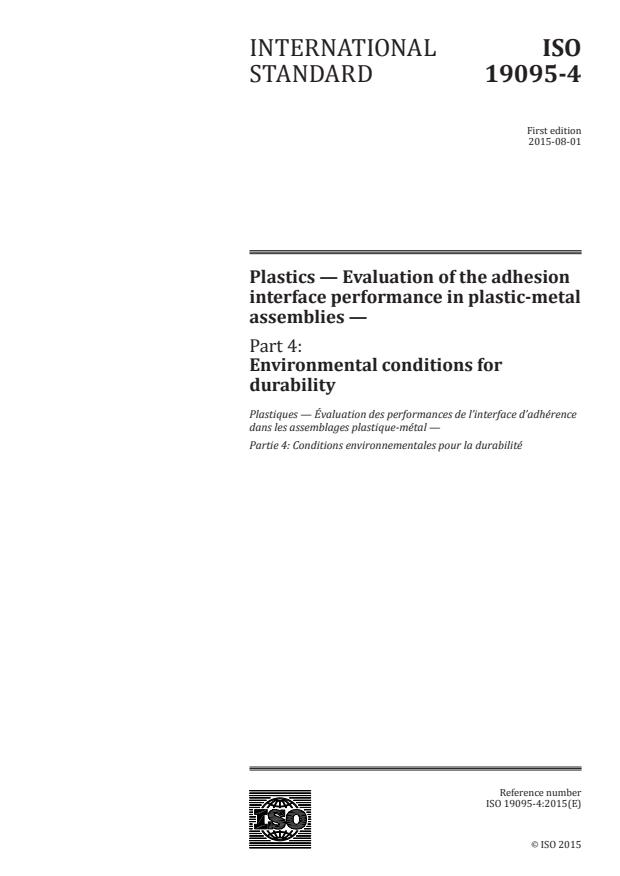
INTERNATIONAL ISO
STANDARD 19095-4
First edition
2015-08-01
Plastics — Evaluation of the adhesion
interface performance in plastic-metal
assemblies —
Part 4:
Environmental conditions for
durability
Plastiques — Évaluation des performances de l’interface d’adhérence
dans les assemblages plastique-métal —
Partie 4: Conditions environnementales pour la durabilité
Reference number
©
ISO 2015
© ISO 2015, Published in Switzerland
All rights reserved. Unless otherwise specified, no part of this publication may be reproduced or utilized otherwise in any form
or by any means, electronic or mechanical, including photocopying, or posting on the internet or an intranet, without prior
written permission. Permission can be requested from either ISO at the address below or ISO’s member body in the country of
the requester.
ISO copyright office
Ch. de Blandonnet 8 • CP 401
CH-1214 Vernier, Geneva, Switzerland
Tel. +41 22 749 01 11
Fax +41 22 749 09 47
copyright@iso.org
www.iso.org
ii © ISO 2015 – All rights reserved
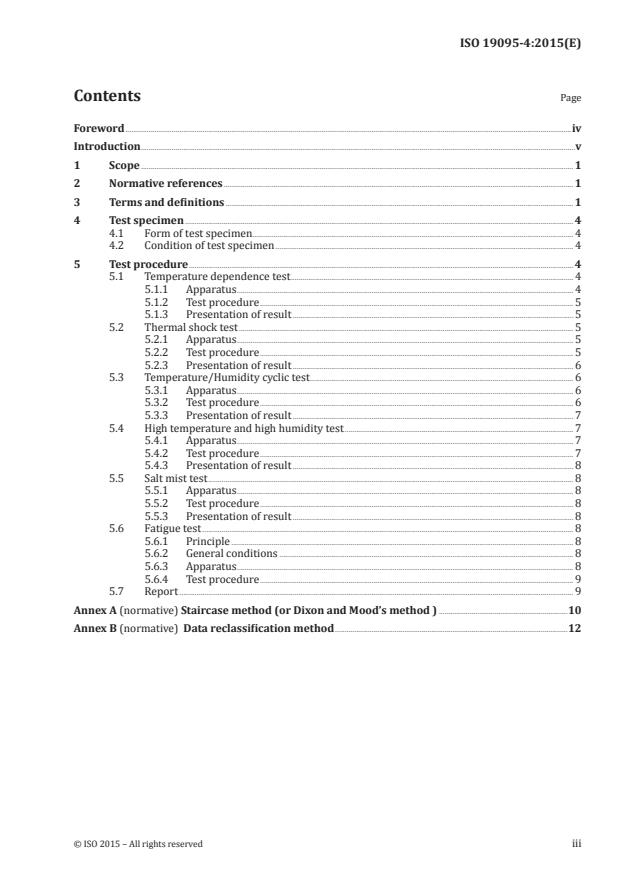
Contents Page
Foreword .iv
Introduction .v
1 Scope . 1
2 Normative references . 1
3 Terms and definitions . 1
4 Test specimen . 4
4.1 Form of test specimen. 4
4.2 Condition of test specimen . 4
5 Test procedure . 4
5.1 Temperature dependence test . 4
5.1.1 Apparatus . 4
5.1.2 Test procedure . 5
5.1.3 Presentation of result . 5
5.2 Thermal shock test . 5
5.2.1 Apparatus . 5
5.2.2 Test procedure . 5
5.2.3 Presentation of result . 6
5.3 Temperature/Humidity cyclic test . 6
5.3.1 Apparatus . 6
5.3.2 Test procedure . 6
5.3.3 Presentation of result . 7
5.4 High temperature and high humidity test . 7
5.4.1 Apparatus . 7
5.4.2 Test procedure . 7
5.4.3 Presentation of result . 8
5.5 Salt mist test . 8
5.5.1 Apparatus . 8
5.5.2 Test procedure . 8
5.5.3 Presentation of result . 8
5.6 Fatigue test . 8
5.6.1 Principle . 8
5.6.2 General conditions . 8
5.6.3 Apparatus . 8
5.6.4 Test procedure . 9
5.7 Report . 9
Annex A (normative) Staircase method (or Dixon and Mood’s method ) .10
Annex B (normative) Data reclassification method .12
Foreword
ISO (the International Organization for Standardization) is a worldwide federation of national standards
bodies (ISO member bodies). The work of preparing International Standards is normally carried out
through ISO technical committees. Each member body interested in a subject for which a technical
committee has been established has the right to be represented on that committee. International
organizations, governmental and non-governmental, in liaison with ISO, also take part in the work.
ISO collaborates closely with the International Electrotechnical Commission (IEC) on all matters of
electrotechnical standardization.
The procedures used to develop this document and those intended for its further maintenance are
described in the ISO/IEC Directives, Part 1. In particular the different approval criteria needed for the
different types of ISO documents should be noted. This document was drafted in accordance with the
editorial rules of the ISO/IEC Directives, Part 2 (see www.iso.org/directives).
Attention is drawn to the possibility that some of the elements of this document may be the subject of
patent rights. ISO shall not be held responsible for identifying any or all such patent rights. Details of
any patent rights identified during the development of the document will be in the Introduction and/or
on the ISO list of patent declarations received (see www.iso.org/patents).
Any trade name used in this document is information given for the convenience of users and does not
constitute an endorsement.
For an explanation on the meaning of ISO specific terms and expressions related to conformity
assessment, as well as information about ISO’s adherence to the WTO principles in the Technical
Barriers to Trade (TBT) see the following URL: Foreword - Supplementary information
The committee responsible for this document is ISO/TC 61, Plastics, Subcommittee SC 11, Products.
ISO 19095 consists of the following parts, under the general title Plastics — Evaluation of the adhesion
interface performance in plastic-metal assemblies:
—Part 1: Guidelines for the approach
—Part 2: Test specimens
—Part 3: Test methods
—Part 4: Environmental conditions for durability
iv © ISO 2015 – All rights reserved
Introduction
Structures of heterogeneous materials are being manufactured in the automobiles and aerospace
industry sectors where higher safety margins are required.
The existing test methods are not appropriate because the evaluation of the adhesive interface is
difficult as the polymer material has a relatively low mechanical strength and therefore fractures
outside the joints. Therefore, it is necessary to develop a methodology for the evaluation of the adhesive
interfaces.
A test method to evaluate accurately the adhesion interface performance or standardization of long-
term evaluation under harsh environments is also necessary.
The method in ISO 19095 is intended to ensure that the integrity of the joint is realized through the
interface and that traceability of the value improves the data comparison.
This part of ISO 19095 defines the conditions to evaluate the long-term durability.
INTERNATIONAL STANDARD ISO 19095-4:2015(E)
Plastics — Evaluation of the adhesion interface
performance in plastic-metal assemblies —
Part 4:
Environmental conditions for durability
SAFETY STATEMENT — Persons using this part of ISO 19095 should be familiar with normal
laboratory practice, if applicable. This part of ISO 19095 does not purport to address all of the
safety problems, if any, associated with its use. It is the responsibility of the user to establish
appropriate safety and health practices and to ensure compliance with any regulatory
conditions. It is recognized that some of the materials permitted in this part of ISO 19095 might
have a negative environmental impact. As technological advances lead to more acceptable
alternatives for such materials, they will be eliminated to the greatest extent possible. At the end
of the test, care should be taken to dispose of all waste in an appropriate manner in accordance
with local regulations.
1 Scope
This part of ISO 19095 specifies the environmental conditions to evaluate the durability for the adhesion
interface performance in plastic-metal assemblies.
2 Normative references
The following documents, in whole or in part, are normatively referenced in this document and are
indispensable for its application. For dated references, only the edition cited applies. For undated
references, the latest edition of the referenced document (including any amendments) applies.
ISO 472, Plastics — Vocabulary
ISO 19095-1:2015, Plastics — Evaluation of the adhesion interface performance in plastic-metal
assemblies —Part 1: Guideline for the approach
ISO 19095-2, Plastics — Evaluation of the adhesion interface performance in plastic-metal assemblies —
Part 2: Test specimens
ISO 19095-3, Plastics — Evaluation of the adhesion interface performance in plastic-metal assemblies —
Part 3: Test methods
IEC 60068-2-11, Basic environmental testing procedures — Part 2-11: Tests — Test Ka: Salt mist
3 Terms and definitions
For the purposes of this document, the terms and definitions given in ISO 472 and the following apply.
3.1
shear stress
τ
stress determined by dividing the force by the bonded surface area
Note 1 to entry: It is expressed in megapascals (MPa).
3.2
static shear stress
τ
R
average static shear stress at rupture as determined by ISO 4587
Note 1 to entry: It is expressed in megapascals (MPa).
3.3
stress cycle
smallest part of the stress/time function which is repeated at regular intervals
Note 1 to entry: It is of sinusoidal form (see Figure 1) with undulating shear.
Note 2 to entry: Cyclic stress can be considered to be the superposition of an alternating stress on a static stress
which is the mean stress.
Figure 1 — Fatigue stress cycle
3.4
maximum stress
τ
max
greatest algebraic value reached at regular intervals by the stress
Note 1 to entry: It is expressed in megapascals (MPa).
3.5
minimum stress
τ
min
smallest algebraic value reached at regular intervals by the stress
Note 1 to entry: This stress shall always be positive and is expressed in megapascals (MPa).
3.6
mean stress
τ
m
algebraic mean of the maximum and minimum stresses
Note 1 to entry: It is expressed as:
2 © ISO 2015 – All rights reserved
ττ+
max min
τ =
m
3.7
stress amplitude
τ
a
alternating stress equal to half the algebraic difference between the maximum and
minimum stresses
Note 1 to entry:
...
INTERNATIONAL ISO
STANDARD 19095-4
First edition
2015-08-01
Plastics — Evaluation of the adhesion
interface performance in plastic-metal
assemblies —
Part 4:
Environmental conditions for
durability
Plastiques — Évaluation des performances de l’interface d’adhérence
dans les assemblages plastique-métal —
Partie 4: Conditions environnementales pour la durabilité
Reference number
©
ISO 2015
© ISO 2015, Published in Switzerland
All rights reserved. Unless otherwise specified, no part of this publication may be reproduced or utilized otherwise in any form
or by any means, electronic or mechanical, including photocopying, or posting on the internet or an intranet, without prior
written permission. Permission can be requested from either ISO at the address below or ISO’s member body in the country of
the requester.
ISO copyright office
Ch. de Blandonnet 8 • CP 401
CH-1214 Vernier, Geneva, Switzerland
Tel. +41 22 749 01 11
Fax +41 22 749 09 47
copyright@iso.org
www.iso.org
ii © ISO 2015 – All rights reserved
Contents Page
Foreword .iv
Introduction .v
1 Scope . 1
2 Normative references . 1
3 Terms and definitions . 1
4 Test specimen . 4
4.1 Form of test specimen. 4
4.2 Condition of test specimen . 4
5 Test procedure . 4
5.1 Temperature dependence test . 4
5.1.1 Apparatus . 4
5.1.2 Test procedure . 5
5.1.3 Presentation of result . 5
5.2 Thermal shock test . 5
5.2.1 Apparatus . 5
5.2.2 Test procedure . 5
5.2.3 Presentation of result . 6
5.3 Temperature/Humidity cyclic test . 6
5.3.1 Apparatus . 6
5.3.2 Test procedure . 6
5.3.3 Presentation of result . 7
5.4 High temperature and high humidity test . 7
5.4.1 Apparatus . 7
5.4.2 Test procedure . 7
5.4.3 Presentation of result . 8
5.5 Salt mist test . 8
5.5.1 Apparatus . 8
5.5.2 Test procedure . 8
5.5.3 Presentation of result . 8
5.6 Fatigue test . 8
5.6.1 Principle . 8
5.6.2 General conditions . 8
5.6.3 Apparatus . 8
5.6.4 Test procedure . 9
5.7 Report . 9
Annex A (normative) Staircase method (or Dixon and Mood’s method ) .10
Annex B (normative) Data reclassification method .12
Foreword
ISO (the International Organization for Standardization) is a worldwide federation of national standards
bodies (ISO member bodies). The work of preparing International Standards is normally carried out
through ISO technical committees. Each member body interested in a subject for which a technical
committee has been established has the right to be represented on that committee. International
organizations, governmental and non-governmental, in liaison with ISO, also take part in the work.
ISO collaborates closely with the International Electrotechnical Commission (IEC) on all matters of
electrotechnical standardization.
The procedures used to develop this document and those intended for its further maintenance are
described in the ISO/IEC Directives, Part 1. In particular the different approval criteria needed for the
different types of ISO documents should be noted. This document was drafted in accordance with the
editorial rules of the ISO/IEC Directives, Part 2 (see www.iso.org/directives).
Attention is drawn to the possibility that some of the elements of this document may be the subject of
patent rights. ISO shall not be held responsible for identifying any or all such patent rights. Details of
any patent rights identified during the development of the document will be in the Introduction and/or
on the ISO list of patent declarations received (see www.iso.org/patents).
Any trade name used in this document is information given for the convenience of users and does not
constitute an endorsement.
For an explanation on the meaning of ISO specific terms and expressions related to conformity
assessment, as well as information about ISO’s adherence to the WTO principles in the Technical
Barriers to Trade (TBT) see the following URL: Foreword - Supplementary information
The committee responsible for this document is ISO/TC 61, Plastics, Subcommittee SC 11, Products.
ISO 19095 consists of the following parts, under the general title Plastics — Evaluation of the adhesion
interface performance in plastic-metal assemblies:
—Part 1: Guidelines for the approach
—Part 2: Test specimens
—Part 3: Test methods
—Part 4: Environmental conditions for durability
iv © ISO 2015 – All rights reserved
Introduction
Structures of heterogeneous materials are being manufactured in the automobiles and aerospace
industry sectors where higher safety margins are required.
The existing test methods are not appropriate because the evaluation of the adhesive interface is
difficult as the polymer material has a relatively low mechanical strength and therefore fractures
outside the joints. Therefore, it is necessary to develop a methodology for the evaluation of the adhesive
interfaces.
A test method to evaluate accurately the adhesion interface performance or standardization of long-
term evaluation under harsh environments is also necessary.
The method in ISO 19095 is intended to ensure that the integrity of the joint is realized through the
interface and that traceability of the value improves the data comparison.
This part of ISO 19095 defines the conditions to evaluate the long-term durability.
INTERNATIONAL STANDARD ISO 19095-4:2015(E)
Plastics — Evaluation of the adhesion interface
performance in plastic-metal assemblies —
Part 4:
Environmental conditions for durability
SAFETY STATEMENT — Persons using this part of ISO 19095 should be familiar with normal
laboratory practice, if applicable. This part of ISO 19095 does not purport to address all of the
safety problems, if any, associated with its use. It is the responsibility of the user to establish
appropriate safety and health practices and to ensure compliance with any regulatory
conditions. It is recognized that some of the materials permitted in this part of ISO 19095 might
have a negative environmental impact. As technological advances lead to more acceptable
alternatives for such materials, they will be eliminated to the greatest extent possible. At the end
of the test, care should be taken to dispose of all waste in an appropriate manner in accordance
with local regulations.
1 Scope
This part of ISO 19095 specifies the environmental conditions to evaluate the durability for the adhesion
interface performance in plastic-metal assemblies.
2 Normative references
The following documents, in whole or in part, are normatively referenced in this document and are
indispensable for its application. For dated references, only the edition cited applies. For undated
references, the latest edition of the referenced document (including any amendments) applies.
ISO 472, Plastics — Vocabulary
ISO 19095-1:2015, Plastics — Evaluation of the adhesion interface performance in plastic-metal
assemblies —Part 1: Guideline for the approach
ISO 19095-2, Plastics — Evaluation of the adhesion interface performance in plastic-metal assemblies —
Part 2: Test specimens
ISO 19095-3, Plastics — Evaluation of the adhesion interface performance in plastic-metal assemblies —
Part 3: Test methods
IEC 60068-2-11, Basic environmental testing procedures — Part 2-11: Tests — Test Ka: Salt mist
3 Terms and definitions
For the purposes of this document, the terms and definitions given in ISO 472 and the following apply.
3.1
shear stress
τ
stress determined by dividing the force by the bonded surface area
Note 1 to entry: It is expressed in megapascals (MPa).
3.2
static shear stress
τ
R
average static shear stress at rupture as determined by ISO 4587
Note 1 to entry: It is expressed in megapascals (MPa).
3.3
stress cycle
smallest part of the stress/time function which is repeated at regular intervals
Note 1 to entry: It is of sinusoidal form (see Figure 1) with undulating shear.
Note 2 to entry: Cyclic stress can be considered to be the superposition of an alternating stress on a static stress
which is the mean stress.
Figure 1 — Fatigue stress cycle
3.4
maximum stress
τ
max
greatest algebraic value reached at regular intervals by the stress
Note 1 to entry: It is expressed in megapascals (MPa).
3.5
minimum stress
τ
min
smallest algebraic value reached at regular intervals by the stress
Note 1 to entry: This stress shall always be positive and is expressed in megapascals (MPa).
3.6
mean stress
τ
m
algebraic mean of the maximum and minimum stresses
Note 1 to entry: It is expressed as:
2 © ISO 2015 – All rights reserved
ττ+
max min
τ =
m
3.7
stress amplitude
τ
a
alternating stress equal to half the algebraic difference between the maximum and
minimum stresses
Note 1 to entry:
...