


ISO/FDIS 26082-1
(Main)Leather — Physical and mechanical test methods for the determination of soiling — Part 1: Rubbing (Martindale) method
Leather — Physical and mechanical test methods for the determination of soiling — Part 1: Rubbing (Martindale) method
This document specifies a method for determining the resistance of all forms of leather to visible soiling through repeated contact with soiled objects. It provides a physical pretreatment routine for leathers that may be vulnerable to loss of soiling resistance while in service, prior to conducting further tests such as cleaning.
Cuir — Méthodes d'essai physique et mécanique de détermination de la salissure — Partie 1: Méthode par frottement (Martindale)
Le présent document spécifie une méthode de détermination de la résistance à la salissure visible de toute forme de cuir par mise en contact répétée avec des objets salissants. Il prévoit un prétraitement physique pour les cuirs susceptibles de perdre leur résistance à la salissure en cours d'utilisation, avant la réalisation d'autres essais comme le nettoyage.
General Information
- Status
- Not Published
- Technical Committee
- IULTCS - International Union of Leather Technologists and Chemists Societies
- Current Stage
- 5020 - FDIS ballot initiated: 2 months. Proof sent to secretariat
- Start Date
- 08-May-2026
- Completion Date
- 08-May-2026
Buy Documents

ISO/FDIS 26082-1 - Leather — Physical and mechanical test methods for the determination of soiling — Part 1: Rubbing (Martindale) method
REDLINE ISO/FDIS 26082-1 - Leather — Physical and mechanical test methods for the determination of soiling — Part 1: Rubbing (Martindale) method
ISO/FDIS 26082-1 - Cuir — Méthodes d'essai physique et mécanique de détermination de la salissure — Partie 1: Méthode par frottement (Martindale)
Relations
- Effective Date
- 12-Feb-2026
- Effective Date
- 07-Jan-2025
Overview
ISO/FDIS 26082-1: Leather - Physical and Mechanical Test Methods for the Determination of Soiling - Part 1: Rubbing (Martindale) Method is an international standard developed by ISO for testing the resistance of leather materials to visible soiling. This standard outlines a robust methodology using the Martindale rubbing technique, widely adopted in the leather industry to simulate real-world soiling through repeated contact with soiled objects. ISO/FDIS 26082-1 also includes guidance for pretreatment routines to address potential changes in soiling resistance that may occur during actual use, as well as recommendations for subsequent cleaning evaluations.
This standard is integral for manufacturers, suppliers, and quality control professionals within the leather, automotive, furniture, footwear, and consumer goods sectors, ensuring their products meet international benchmarks for durability and cleanliness.
Key Topics
- Resistance to Soiling: The standard defines methods for determining how well different leathers resist visible soiling from repeated rubbing by soiled fabric, mirroring everyday use and exposure.
- Martindale Test Method: Provides precise instructions for using the Martindale abrasion apparatus, including preparation of leather samples, selection of soiling cloths, and process parameters.
- Sample Preparation & Pretreatment: Details on specimen conditioning, sampling from whole hides or skins, and optional ageing treatments to simulate product lifecycle conditions.
- Assessment Procedures: Specifies visual and instrumental evaluation of colour change using grey scales and standard lighting conditions, ensuring objective and consistent results.
- Cleaning Evaluations: Offers guidance on manual and automated cleaning methods to assess residual soiling, which is critical for products exposed to heavy usage.
- Reporting Requirements: Prescribes comprehensive reporting, including sample descriptions, test settings, soiling and cleaning details, and observed changes.
Applications
ISO/FDIS 26082-1 is relevant for a variety of practical scenarios across the leather value chain:
- Quality Assurance: Essential for evaluating new leather formulations or finishes to ensure they withstand soiling and respond well to cleaning.
- Product Development: Used by designers and engineers to select appropriate leathers for applications where resistance to soiling is crucial, such as automotive interiors, upholstery, and shoe uppers.
- Supplier Compliance: Ensures that suppliers meet contract specifications and international standards, fostering confidence across the supply chain.
- Research and Development: Supports comparative studies and product enhancement by providing a standardized method for soiling resistance assessment.
- Customer Claims Processing: Used by after-sales and warranty departments to objectively assess the cause and severity of soiling in returned goods.
- Sustainability and Lifecycle Assessment: Assists in selecting leathers that maintain appearance over extended periods, reducing replacements and enhancing product sustainability.
Related Standards
Key standards referenced and related to ISO/FDIS 26082-1 include:
- ISO 105-A02: Grey scale for assessing change in colour.
- ISO 105-F09: Cotton rubbing cloth specification.
- ISO 2418: Preparation and positioning of leather test specimens.
- ISO 2419: Conditioning of leather specimens.
- ISO 7906: General principles for colour fastness testing in leather.
- ISO 11640: Colour fastness to rubbing for leather.
- ISO 12947-1: Martindale abrasion testing apparatus.
- ISO 12945-2: Surface pilling, fuzzing or matting of textiles (Martindale method).
Using ISO/FDIS 26082-1 in conjunction with these standards ensures a thorough and internationally recognized approach to testing leather durability and maintaining quality across multiple industries.
Buy Documents
ISO/FDIS 26082-1 - Leather — Physical and mechanical test methods for the determination of soiling — Part 1: Rubbing (Martindale) method
REDLINE ISO/FDIS 26082-1 - Leather — Physical and mechanical test methods for the determination of soiling — Part 1: Rubbing (Martindale) method
ISO/FDIS 26082-1 - Cuir — Méthodes d'essai physique et mécanique de détermination de la salissure — Partie 1: Méthode par frottement (Martindale)
Get Certified
Connect with accredited certification bodies for this standard

Control Union Certifications
Global certification for agriculture and sustainability.

Hohenstein Institut
Textile testing and certification.

Bureau Veritas Bangladesh
Bureau Veritas certification services in Bangladesh.
Sponsored listings
Frequently Asked Questions
ISO/FDIS 26082-1 is a draft published by the International Organization for Standardization (ISO). Its full title is "Leather — Physical and mechanical test methods for the determination of soiling — Part 1: Rubbing (Martindale) method". This standard covers: This document specifies a method for determining the resistance of all forms of leather to visible soiling through repeated contact with soiled objects. It provides a physical pretreatment routine for leathers that may be vulnerable to loss of soiling resistance while in service, prior to conducting further tests such as cleaning.
This document specifies a method for determining the resistance of all forms of leather to visible soiling through repeated contact with soiled objects. It provides a physical pretreatment routine for leathers that may be vulnerable to loss of soiling resistance while in service, prior to conducting further tests such as cleaning.
ISO/FDIS 26082-1 is classified under the following ICS (International Classification for Standards) categories: 59.140.30 - Leather and furs. The ICS classification helps identify the subject area and facilitates finding related standards.
ISO/FDIS 26082-1 has the following relationships with other standards: It is inter standard links to FprEN ISO 26082-1, ISO 26082-1:2019. Understanding these relationships helps ensure you are using the most current and applicable version of the standard.
ISO/FDIS 26082-1 is available in PDF format for immediate download after purchase. The document can be added to your cart and obtained through the secure checkout process. Digital delivery ensures instant access to the complete standard document.
Standards Content (Sample)
FINAL DRAFT
International
Standard
ISO/FDIS 26082-1
IUP 53-1
IULTCS
Leather — Physical and mechanical
Voting begins on:
test methods for the determination
2026-05-08
of soiling —
Voting terminates on:
2026-07-03
Part 1:
Rubbing (Martindale) method
Cuir — Méthodes d'essai physique et mécanique de détermination
de la salissure —
Partie 1: Méthode par frottement (Martindale)
RECIPIENTS OF THIS DRAFT ARE INVITED TO SUBMIT,
WITH THEIR COMMENTS, NOTIFICATION OF ANY
RELEVANT PATENT RIGHTS OF WHICH THEY ARE AWARE
AND TO PROVIDE SUPPOR TING DOCUMENTATION.
IN ADDITION TO THEIR EVALUATION AS
BEING ACCEPTABLE FOR INDUSTRIAL, TECHNO-
ISO/CEN PARALLEL PROCESSING LOGICAL, COMMERCIAL AND USER PURPOSES, DRAFT
INTERNATIONAL STANDARDS MAY ON OCCASION HAVE
TO BE CONSIDERED IN THE LIGHT OF THEIR POTENTIAL
TO BECOME STAN DARDS TO WHICH REFERENCE MAY BE
MADE IN NATIONAL REGULATIONS.
Reference number
IUP 53-1:2026(en) © ISO 2026
FINAL DRAFT
IUP 53-1:2026(en) International
Standard
ISO/FDIS 26082-1
IUP 53-1
IULTCS
Leather — Physical and mechanical
Voting begins on:
test methods for the determination
of soiling —
Voting terminates on:
Part 1:
Rubbing (Martindale) method
Cuir — Méthodes d'essai physique et mécanique de détermination
de la salissure —
Partie 1: Méthode par frottement (Martindale)
RECIPIENTS OF THIS DRAFT ARE INVITED TO SUBMIT,
WITH THEIR COMMENTS, NOTIFICATION OF ANY
RELEVANT PATENT RIGHTS OF WHICH THEY ARE AWARE
AND TO PROVIDE SUPPOR TING DOCUMENTATION.
© ISO 2026
IN ADDITION TO THEIR EVALUATION AS
All rights reserved. Unless otherwise specified, or required in the context of its implementation, no part of this publication may
BEING ACCEPTABLE FOR INDUSTRIAL, TECHNO-
ISO/CEN PARALLEL PROCESSING
LOGICAL, COMMERCIAL AND USER PURPOSES, DRAFT
be reproduced or utilized otherwise in any form or by any means, electronic or mechanical, including photocopying, or posting on
INTERNATIONAL STANDARDS MAY ON OCCASION HAVE
the internet or an intranet, without prior written permission. Permission can be requested from either ISO at the address below
TO BE CONSIDERED IN THE LIGHT OF THEIR POTENTIAL
or ISO’s member body in the country of the requester.
TO BECOME STAN DARDS TO WHICH REFERENCE MAY BE
MADE IN NATIONAL REGULATIONS.
ISO copyright office
CP 401 • Ch. de Blandonnet 8
CH-1214 Vernier, Geneva
Phone: +41 22 749 01 11
Email: copyright@iso.org
Website: www.iso.org
Reference number
Published in Switzerland ISO/FDIS 26082-1:2026(en)
IUP 53-1:2026(en) © ISO 2026
ii
IUP 53-1:2026(en)
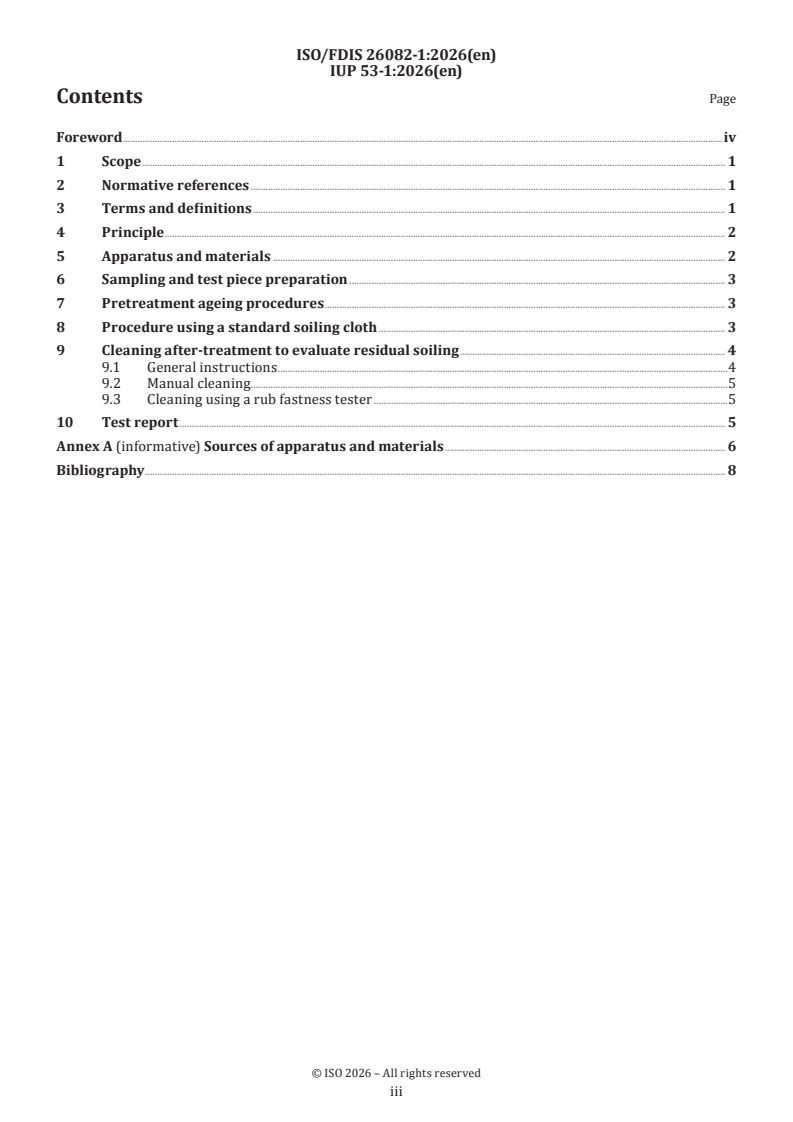
Contents Page
Foreword .iv
1 Scope . 1
2 Normative references . 1
3 Terms and definitions . 1
4 Principle . 2
5 Apparatus and materials . 2
6 Sampling and test piece preparation . 3
7 Pretreatment ageing procedures . 3
8 Procedure using a standard soiling cloth . 3
9 Cleaning after-treatment to evaluate residual soiling . 4
9.1 General instructions .4
9.2 Manual cleaning . .5
9.3 Cleaning using a rub fastness tester .5
10 Test report . 5
Annex A (informative) Sources of apparatus and materials . 6
Bibliography . 8
iii
IUP 53-1:2026(en)
Foreword
ISO (the International Organization for Standardization) is a worldwide federation of national standards
bodies (ISO member bodies). The work of preparing International Standards is normally carried out through
ISO technical committees. Each member body interested in a subject for which a technical committee
has been established has the right to be represented on that committee. International organizations,
governmental and non-governmental, in liaison with ISO, also take part in the work. ISO collaborates closely
with the International Electrotechnical Commission (IEC) on all matters of electrotechnical standardization.
The procedures used to develop this document and those intended for its further maintenance are described
in the ISO/IEC Directives, Part 1. In particular, the different approval criteria needed for the different types
of ISO documents should be noted. This document was drafted in accordance with the editorial rules of the
ISO/IEC Directives, Part 2 (see www.iso.org/directives).
ISO draws attention to the possibility that the implementation of this document may involve the use of (a)
patent(s). ISO takes no position concerning the evidence, validity or applicability of any claimed patent
rights in respect thereof. As of the date of publication of this document, ISO had not received notice of (a)
patent(s) which may be required to implement this document. However, implementers are cautioned that
this may not represent the latest information, which may be obtained from the patent database available at
www.iso.org/patents. ISO shall not be held responsible for identifying any or all such patent rights.
Any trade name used in this document is information given for the convenience of users and does not
constitute an endorsement.
For an explanation of the voluntary nature of standards, the meaning of ISO specific terms and expressions
related to conformity assessment, as well as information about ISO’s adherence to the World Trade
Organization (WTO) principles in the Technical Barriers to Trade (TBT), see www.iso.org/iso/foreword.html.
IULTCS, originally formed in 1897, is a world-wide organization of professional leather societies to further
the advancement of leather science and technology. IULTCS has three Commissions, which are responsible
for establishing international methods for sampling and the testing of leather. ISO recognizes IULTCS as an
international standardizing body for the preparation of test methods for leather.
This document was prepared by the Physical Tests Commission of the International Union of Leather
Technologists and Chemists Societies (IUP Commission, IULTCS) in collaboration with the European
Committee for Standardization (CEN) Technical Committee CEN/TC 289, Leather, in accordance with the
agreement on technical cooperation between ISO and CEN (Vienna Agreement).
This third edition cancels and replaces the second edition (ISO 26082-1:2019), which has been technically
revised.
The main changes are as follows:
— the method was aligned to the latest versions of ISO 2418, ISO 2419, ISO 7906;
— the precision in Clause 7 and Clause 8 has been increased.
A list of all parts in the ISO 26082 series can be found on the ISO website.
Any feedback or questions on this document should be directed to the user’s national standards body. A
complete listing of these bodies can be found at www.iso.org/members.html.
iv
FINAL DRAFT International Standard
IUP 53-1:2026(en)
Leather — Physical and mechanical test methods for the
determination of soiling —
Part 1:
Rubbing (Martindale) method
1 Scope
This document specifies a method for determining the resistance of all forms of leather to visible soiling
through repeated contact with soiled objects. It provides a physical pretreatment routine for leathers that
can be vulnerable to loss of soiling resistance while in service, prior to conducting further tests such as
cleaning.
2 Normative references
The following documents are referred to in the text in such a way that some or all of their content constitutes
requirements of this document. For dated references, only the edition cited applies. For undated references,
the latest edition of the referenced document (including any amendments) applies.
ISO 105-A02, Textiles — Tests for colour fastness — Part A02: Grey scale for assessing change in colour
ISO 105-F09, Textiles — Tests for colour fastness — Part F09: Specification for cotton rubbing cloth
ISO 2418, Leather — Chemical, physical, mechanical and fastness tests — Position and preparation of specimens
for testing
ISO 2419, Leather — Physical and mechanical tests — Specimen and test piece conditioning
ISO 7906, Leather — Tests for colour fastness — General principles of testing
ISO 11640, Leather — Tests for colour fastness — Colour fastness to cycles of to-and-fro rubbing
ISO 12945-2, Textiles — Determination of fabric propensity to surface pilling, fuzzing or matting — Part 2:
Modified Martindale method
ISO 12947-1, Textiles — Determination of the abrasion resistance of fabrics by the Martindale method — Part 1:
Martindale abrasion testing apparatus
3 Terms and definitions
For the purposes of this document, the following terms and definitions apply.
ISO and IEC maintain terminology databases for use in standardization at the following addresses:
— ISO Online browsing platform: available at https:// www .iso .org/ obp
— IEC Electropedia: available at https:// www .electropedia .org/
3.1
soiling
change in colour of a leather test piece caused by rubbing a standard soiled fabric on the coated surface of
the leather
IUP 53-1:2026(en)
4 Principle
A test leather test piece is subjected to a rubbing-type soiling process under standard conditions and the
change in colour of the leather is evaluated.
A pretreatment to simulate wear or an after-treatment to test cleaning procedures, or both, are possible.
5 Apparatus and materials
Normal laboratory apparatus and, in particular, the following.
5.1 Martindale abrasion apparatus, as specified in ISO 12947-1.
5.2 Abrasion test piece holder heads, for the Martindale apparatus (5.1) as specified in ISO 12947-1. The
holder shall be fitted with loading pieces so that the sum of the mass of the applied load and the mass of the
test piece holder assembly is (795 ± 10) g. This exerts a nominal pressure of 12 kPa on the test piece during
the test.
Use the abrasion option that forms a Lissajous figure with a (60 ± 1) mm stroke.
5.3 Pilling test piece holder heads, for the Martindale apparatus (5.1), including the auxiliary mandrel
device for test piece mounting, as specified in ISO 12945-2. The pilling test piece holder shall be fitted with
ring weight and the nominal 12
...
IUP 53-1:2026(en)
ISO/IULTCS-IUP 53-1
Secretariat: ISO
Date: 2026-03-1704-23
Leather — Physical and mechanical test methods for the
determination of soiling — —
Part 1:
Rubbing (Martindale) method
Cuir — Méthodes d'essai physique et mécanique de détermination de la salissure —
Partie 1: Méthode par frottement (Martindale)
FDIS stage
TTTTTThhhhihhiiiiis drs drs drs drss d drraaaaaafffffftttttt i i i i i is s s s ss sssusususuububbbbbmmmmmmiiiiiitttttttttttteeeeeeddd d d d ttttttoooooo aaaaaa ppppppaaaaaarrrrrraaaaaallellellellellellel l l l l l vvvvvvooooootttttteeeeee i i i i i innnnnn IIIIIISSSSSSOOOOOO,,,,,, CCCCCCEEEEEEN.N.N.N.N.N.
All rights reserved. Unless otherwise specified, or required in the context of its implementation, no part of this publication
may be reproduced or utilized otherwise in any form or by any means, electronic or mechanical, including photocopying,
or posting on the internet or an intranet, without prior written permission. Permission can be requested from either ISO
at the address below or ISO’s member body in the country of the requester.
ISO copyright office
CP 401 • Ch. de Blandonnet 8
CH-1214 Vernier, Geneva
Phone: + 41 22 749 01 11
EmailE-mail: copyright@iso.org
Website: www.iso.org
Published in Switzerland
ii
IUP 53-1:2026(en)
Contents
Foreword . iv
1 Scope . 1
2 Normative references . 1
3 Terms and definitions . 1
4 Principle . 2
5 Apparatus and materials . 2
6 Sampling and test piece preparation . 3
7 Pretreatment ageing procedures . 3
8 Procedure using a standard soiling cloth . 4
9 Cleaning after-treatment to evaluate residual soiling . 5
9.1 General instructions . 5
9.2 Manual cleaning . 5
9.3 Cleaning using a rub fastness tester . 5
10 Test report . 5
Annex A (informative) Sources of apparatus and materials . 7
Bibliography . 10
iii
Foreword
ISO (the International Organization for Standardization) is a worldwide federation of national standards
bodies (ISO member bodies). The work of preparing International Standards is normally carried out through
ISO technical committees. Each member body interested in a subject for which a technical committee has been
established has the right to be represented on that committee. International organizations, governmental and
non-governmental, in liaison with ISO, also take part in the work. ISO collaborates closely with the
International Electrotechnical Commission (IEC) on all matters of electrotechnical standardization.
The procedures used to develop this document and those intended for its further maintenance are described
in the ISO/IEC Directives, Part 1. In particular, the different approval criteria needed for the different types of
ISO documents should be noted. This document was drafted in accordance with the editorial rules of the
ISO/IEC Directives, Part 2 (see www.iso.org/directives).
ISO draws attention to the possibility that the implementation of this document may involve the use of (a)
patent(s). ISO takes no position concerning the evidence, validity or applicability of any claimed patent rights
in respect thereof. As of the date of publication of this document, ISO had not received notice of (a) patent(s)
which may be required to implement this document. However, implementers are cautioned that this may not
represent the latest information, which may be obtained from the patent database available at
www.iso.org/patents. ISO shall not be held responsible for identifying any or all such patent rights.
Any trade name used in this document is information given for the convenience of users and does not
constitute an endorsement.
For an explanation of the voluntary nature of standards, the meaning of ISO specific terms and expressions
related to conformity assessment, as well as information about ISO'sISO’s adherence to the World Trade
Organization (WTO) principles in the Technical Barriers to Trade (TBT), see www.iso.org/iso/foreword.html.
IULTCS, originally formed in 1897, is a world-wide organization of professional leather societies to further the
advancement of leather science and technology. IULTCS has three Commissions, which are responsible for
establishing international methods for sampling and the testing of leather. ISO recognizes IULTCS as an
international standardizing body for the preparation of test methods for leather.
This document was prepared by the Physical Tests Commission of the International Union of Leather
Technologists and Chemists Societies (IUP Commission, IULTCS) in collaboration with the European
Committee for Standardization (CEN) Technical Committee CEN/TC 289, Leather, the secretariat of which is
held by UNI, in accordance with the agreement on technical cooperation between ISO and CEN (Vienna
Agreement).
This third edition cancels and replaces the second edition (ISO 26082-1:2019), which has been technically
revised.
The main changes are as follows:
— — the method was aligned to the latest versions of ISO 2418, ISO 2419, ISO 7906;
— the precision in Clause 7Clause 7 and Clause 8Clause 8 has been increased.
A list of all parts in the ISO 26082 series can be found on the ISO website.
Any feedback or questions on this document should be directed to the user’s national standards body. A
complete listing of these bodies can be found at www.iso.org/members.html.
iv
FINAL DRAFT International Standard ISO/FDIS 26082-1:2026(en)
IUP 53-1:2026(en)
Leather — Physical and mechanical test methods for the
determination of soiling — —
Part 1:
Rubbing (Martindale) method
1 Scope
This document specifies a method for determining the resistance of all forms of leather to visible soiling
through repeated contact with soiled objects. It provides a physical pretreatment routine for leathers that can
be vulnerable to loss of soiling resistance while in service, prior to conducting further tests such as cleaning.
2 Normative references
The following documents are referred to in the text in such a way that some or all of their content constitutes
requirements of this document. For dated references, only the edition cited applies. For undated references,
the latest edition of the referenced document (including any amendments) applies.
ISO 105--A02, Textiles — Tests for colour fastness — Part A02: Grey scale for assessing change in colour
ISO 105--F09, Textiles — Tests for colour fastness — Part F09: Specification for cotton rubbing cloth
ISO 2418, Leather — Chemical, physical, mechanical and fastness tests — Position and preparation of specimens
for testing
ISO 2419, Leather — Physical and mechanical tests — Specimen and test piece conditioning
ISO 7906, Leather — Tests for colour fastness — General principles of testing
ISO 11640, Leather — Tests for colour fastness — Colour fastness to cycles of to-and-fro rubbing
ISO 12945--2, Textiles — Determination of fabric propensity to surface pilling, fuzzing or matting — Part 2:
Modified Martindale method
ISO 12947--1, Textiles — Determination of the abrasion resistance of fabrics by the Martindale method — Part 1:
Martindale abrasion testing apparatus
3 Terms and definitions
For the purposes of this document, the following terms and definitions apply.
ISO and IEC maintain terminology databases for use in standardization at the following addresses:
— — ISO Online browsing platform: available at https://www.iso.org/obp
— — IEC Electropedia: available at https://www.electropedia.org/
3.1 3.1
soiling
change in colour of a leather test piece caused by rubbing a standard soiled fabric on the coated surface of the
leather
4 Principle
A test leather test piece is subjected to a rubbing-type soiling process under standard conditions and the
change in colour of the leather is evaluated.
A pretreatment to simulate wear or an after-treatment to test cleaning procedures, or both, are possible.
5 Apparatus and materials
Normal laboratory apparatus and, in particular, the following.
5.1 5.1 Martindale abrasion apparatus, as specified in ISO 12947-1.
5.2 5.2 Abrasion test piece holder heads, for the Martindale apparatus (5.1(5.1)) as specified in
ISO 12947-1. The holder shall be fitted with loading pieces so that the sum of the mass of the applied load and
the mass of the test piece holder assembly is (795 ± 10) g. This exerts a nominal pressure of 12 kPa on the test
piece during the test.
Use the abrasion option that forms a Lissajous figure with a (60 ± 1) mm stroke.
5.3 5.3 Pilling test piece holder heads, for the Martindale apparatus (5.1(5.1),), including the
auxiliary mandrel device for test piece mounting, as specified in ISO 12945-2. The pilling test piece holder
shall be fitted with ring weight and the nominal 12 kPa loading piece (as in 5.25.2),), so that the sum of the
mass of the applied load and the mass of the test piece holder assembly is (1 010 ± 15) g. This exerts a nominal
pressure of 1,6 kPa on the test piece during the test.
The use of the mandrel is necessary to correctly mount the soiling cloth on the holder and to avoid contact
with the soiling surface of the cloth.
Use the abrasion option that traces a Lissajous figure with a (60 ± 1) mm stroke. It should be noted that this
stroke differs from the standard machine setting for the textile pilling test.
NOTE This is not possible with all Martindale machines, particularly old machines.
5.4 5.4 Circular specimen cutters, for the test piece and soiling cloth. One cutter with a diameter of
at least 140 mm and another with a diameter of at least 38 mm.
5.5 5.5 Standard soiling cloth, cut to a diameter of either
— — at least 38 mm for the abrasion test piece holder of the Martindale apparatus (5.2(5.2),), or
— — at least 140 mm for the pilling test piece holder of the Martindale apparatus (5.3(5.3).).
The standard soiling test cloth is impregnated with a soilant mix of carbon black and olive oil. Alternative
soiling cloths can be specified by the client.
NOTE Various standard soiling cloths are commercially available, see Annex AAnnex A.
5.6 5.6 Polyether polyurethane foam underlay, as specified in ISO 12947-1, cut to a diameter of at
least 38 mm, for the abrasion test piece holder of t
...
PROJET FINAL
Norme
internationale
ISO/FDIS 26082-1
IUP 53-1
IULTCS
Cuir — Méthodes d'essai physique
Début de vote:
et mécanique de détermination de
2026-05-08
la salissure —
Vote clos le:
2026-07-03
Partie 1:
Méthode par frottement
(Martindale)
Leather — Physical and mechanical test methods for the
determination of soiling —
Part 1: Rubbing (Martindale) method
LES DESTINATAIRES DU PRÉSENT PROJET SONT
INVITÉS À PRÉSENTER, AVEC LEURS OBSERVATIONS,
NOTIFICATION DES DROITS DE PROPRIÉTÉ DONT ILS
AURAIENT ÉVENTUELLEMENT CONNAISSANCE ET À
FOURNIR UNE DOCUMENTATION EXPLICATIVE.
OUTRE LE FAIT D’ÊTRE EXAMINÉS POUR
ÉTABLIR S’ILS SONT ACCEPTABLES À DES FINS
INDUSTRIELLES, TECHNOLOGIQUES ET COM-MERCIALES,
AINSI QUE DU POINT DE VUE DES UTILISATEURS, LES
PROJETS DE NORMES
TRAITEMENT PARALLÈLE ISO/CEN
INTERNATIONALES DOIVENT PARFOIS ÊTRE CONSIDÉRÉS
DU POINT DE VUE DE LEUR POSSI BILITÉ DE DEVENIR DES
NORMES POUVANT
SERVIR DE RÉFÉRENCE DANS LA RÉGLEMENTATION
NATIONALE.
Numéro de référence
IUP 53-1:2026(fr) © ISO 2026
PROJET FINAL
IUP 53-1:2026(fr) Norme
internationale
ISO/FDIS 26082-1
IUP 53-1
IULTCS
Cuir — Méthodes d'essai physique
Début de vote:
et mécanique de détermination de
2026-05-08
la salissure —
Vote clos le:
2026-07-03
Partie 1:
Méthode par frottement
(Martindale)
Leather — Physical and mechanical test methods for the
determination of soiling —
Part 1: Rubbing (Martindale) method
LES DESTINATAIRES DU PRÉSENT PROJET SONT
INVITÉS À PRÉSENTER, AVEC LEURS OBSERVATIONS,
NOTIFICATION DES DROITS DE PROPRIÉTÉ DONT ILS
AURAIENT ÉVENTUELLEMENT CONNAISSANCE ET À
FOURNIR UNE DOCUMENTATION EXPLICATIVE.
DOCUMENT PROTÉGÉ PAR COPYRIGHT
OUTRE LE FAIT D’ÊTRE EXAMINÉS POUR
ÉTABLIR S’ILS SONT ACCEPTABLES À DES FINS
© ISO 2026 INDUSTRIELLES, TECHNOLOGIQUES ET COM-MERCIALES,
AINSI QUE DU POINT DE VUE DES UTILISATEURS, LES
Tous droits réservés. Sauf prescription différente ou nécessité dans le contexte de sa mise en œuvre, aucune partie de cette
PROJETS DE NORMES
TRAITEMENT PARALLÈLE ISO/CEN
INTERNATIONALES DOIVENT PARFOIS ÊTRE CONSIDÉRÉS
publication ne peut être reproduite ni utilisée sous quelque forme que ce soit et par aucun procédé, électronique ou mécanique,
DU POINT DE VUE DE LEUR POSSI BILITÉ DE DEVENIR DES
y compris la photocopie, ou la diffusion sur l’internet ou sur un intranet, sans autorisation écrite préalable. Une autorisation peut
NORMES POUVANT
être demandée à l’ISO à l’adresse ci-après ou au comité membre de l’ISO dans le pays du demandeur.
SERVIR DE RÉFÉRENCE DANS LA RÉGLEMENTATION
NATIONALE.
ISO copyright office
Case postale 401 • Ch. de Blandonnet 8
CH-1214 Vernier, Genève
Tél.: +41 22 749 01 11
E-mail: copyright@iso.org
Web: www.iso.org
Numéro de référence
Publié en Suisse ISO/FDIS 26082-1:2026(fr)
IUP 53-1:2026(fr) © ISO 2026
ii
IUP 53-1:2026(fr)
Sommaire Page
Avant-propos .iv
1 Domaine d'application . 1
2 Références normatives . 1
3 Termes et définitions . 1
4 Principe. 2
5 Appareillage et matériaux . 2
6 Échantillonnage et préparation des éprouvettes . 3
7 Modes opératoires de vieillissement en prétraitement . 3
8 Mode opératoire au moyen d'un tissu salissant normalisé . 4
9 Nettoyage en post-traitement pour évaluer la salissure résiduelle . 5
9.1 Instructions générales .5
9.2 Nettoyage manuel .5
9.3 Nettoyage avec un appareil d’essai de solidité au frottement .5
10 Rapport d'essai . 5
Annexe A (informative) Sources de l'appareillage et des matériaux . 7
Bibliographie . 9
iii
IUP 53-1:2026(fr)
Avant-propos
L’ISO (Organisation internationale de normalisation) est une fédération mondiale d’organismes nationaux
de normalisation (comités membres de l’ISO). L’élaboration des Normes internationales est en général
confiée aux comités techniques de l’ISO. Chaque comité membre intéressé par une étude a le droit de faire
partie du comité technique créé à cet effet. Les organisations internationales, gouvernementales et non
gouvernementales, en liaison avec l’ISO participent également aux travaux. L’ISO collabore étroitement avec
la Commission électrotechnique internationale (IEC) en ce qui concerne la normalisation électrotechnique.
Les procédures utilisées pour élaborer le présent document et celles destinées à sa mise à jour sont
décrites dans les Directives ISO/IEC, Partie 1. Il convient, en particulier, de prendre note des différents
critères d’approbation requis pour les différents types de documents ISO. Le présent document a
été rédigé conformément aux règles de rédaction données dans les Directives ISO/IEC, Partie 2 (voir
www.iso.org/directives).
L’ISO attire l’attention sur le fait que la mise en application du présent document peut entraîner l’utilisation
d’un ou de plusieurs brevets. L’ISO ne prend pas position quant à la preuve, à la validité et à l’applicabilité de
tout droit de brevet revendiqué à cet égard. À la date de publication du présent document, l’ISO n’avait pas
reçu notification qu’un ou plusieurs brevets pouvaient être nécessaires à sa mise en application. Toutefois,
il y a lieu d’avertir les responsables de la mise en application du présent document que des informations
plus récentes sont susceptibles de figurer dans la base de données de brevets, disponible à l’adresse
www.iso.org/brevets. L’ISO ne saurait être tenue pour responsable de ne pas avoir identifié tout ou partie de
tels droits de brevet.
Les appellations commerciales éventuellement mentionnées dans le présent document sont données pour
information, par souci de commodité, à l’intention des utilisateurs et ne sauraient constituer un engagement.
Pour une explication de la nature volontaire des normes, la signification des termes et expressions
spécifiques de l’ISO liés à l’évaluation de la conformité, ou pour toute information au sujet de l’adhésion de
l’ISO aux principes de l’Organisation mondiale du commerce (OMC) concernant les obstacles techniques au
commerce (OTC), voir le lien suivant: www.iso.org/avant-propos.
L’IULTCS est une organisation mondiale de sociétés professionnelles des industries du cuir fondée en 1897
ayant pour mission de favoriser l’avancement des sciences et technologies du cuir. L’IULTCS a trois
commissions, qui sont responsables de l’établissement de méthodes internationales d’échantillonnage et
d’essai des cuirs. L’ISO reconnaît l’IULTCS en tant qu’organisme international à activités normatives pour
l’élaboration de méthodes d’essai relatives au cuir.
Le présent document a été élaboré par la Commission des essais physiques de l’Union internationale des
sociétés de techniciens et chimistes du cuir (commission IUP, IULTCS), en collaboration avec le comité
technique CEN/TC 289, Cuir, du Comité européen de normalisation (CEN), conformément à l’Accord de
coopération technique entre l’ISO et le CEN (Accord de Vienne).
Cette troisième édition annule et remplace la deuxième édition (ISO 26082-1:2019) qui a fait l’objet d’une
révision technique.
Les principales modifications sont les suivantes:
— la méthode a été alignée sur les dernières versions de l'ISO 2418, de l'ISO 2419 et de l'ISO 7906.
— la précision a été améliorée dans les Articles 7 et 8.
Une liste de toutes les parties de la série ISO 26082 se trouve sur le site web de l’ISO.
Il convient que l’utilisateur adresse tout retour d’information ou toute question concernant le présent
document à l’organisme national de normalisation de son pays. Une liste exhaustive desdits organismes se
trouve à l’adresse www.iso.org/members.html.
iv
PROJET FINAL Norme internationale
IUP 53-1:2026(fr)
Cuir — Méthodes d'essai physique et mécanique de
détermination de la salissure —
Partie 1:
Méthode par frottement (Martindale)
1 Domaine d'application
Le présent document spécifie une méthode de détermination de la résistance à la salissure visible de toute
forme de cuir par mise en contact répétée avec des objets salissants. Il prévoit un prétraitement physique
pour les cuirs susceptibles de perdre leur résistance à la salissure en cours d’utilisation, avant la réalisation
d’autres essais comme le nettoyage.
2 Références normatives
Les documents suivants sont cités dans le texte de sorte qu'ils constituent, pour tout ou partie de leur
contenu, des exigences du présent document. Pour les références datées, seule l'édition citée s'applique. Pour
les références non datées, la dernière édition du document de référence s'applique (y compris les éventuels
amendements).
ISO 105-A02, Textiles — Essais de solidité des teintures — Partie A02: Échelle de gris pour l'évaluation des
dégradations
ISO 105-F09, Textiles — Essais de solidité des teintures — Partie F09: Spécifications pour le tissu témoin de
frottement en coton
ISO 2418, Cuir — Essais chimiques, physiques, mécaniques et essais de solidité — Emplacement et préparation
des spécimens pour les essais
ISO 2419, Cuir — Essais physiques et mécaniques — Conditionnement des spécimens et des éprouvettes
ISO 7906, Cuir — Essais de solidité des coloris — Principes généraux s’appliquant aux essais
ISO 11640, Cuir — Essais de solidité des coloris — Solidité des coloris au frottement en va-et-vient
ISO 12945-2, Textiles — Détermination de la propension au boulochage, à l'ébouriffage ou au moutonnement
des étoffes en surface — Partie 2: Méthode du Martindale modifiée
ISO 12947-1, Textiles — Détermination de la résistance à l'abrasion des étoffes par la méthode Martindale —
Partie 1: Appareillage d'essai d'abrasion de Martindale
3 Termes et définitions
Pour les besoins du présent document, les termes et définitions suivants s'appliquent.
L'ISO et l'IEC tiennent à jour des bases de données terminologiques destinées à être utilisées en normalisation,
consultables aux adresses suivantes:
— ISO Online browsing platform: disponible à l’adresse https:// www .iso .org/ obp
— IEC Electropedia: disponible à l'adresse https:// www .electropedia .org/
IUP 53-1:2026(fr)
3.1
salissure
dégradation de la couleur d’une éprouvette de cuir provoquée par le frottement d’un tissu salissant
normalisé sur la surface revêtue du cuir
4 Principe
Une éprouvette de cuir est soumise à un processus de salissure par frottement dans des conditions normales,
puis la dégradation de la couleur du cuir est évaluée.
Il est possible de procéder à un prétraitement simulant l'usure et/ou à un post-traitement destiné à
soumettre à essai des méthodes de nettoyage.
5 Appareillage et matériaux
Appareillage courant de laboratoire et, en particulier, ce qui suit.
5.1 Appareillage d'abrasion de Martindale, tel que spécifié dans l’ISO 12947-1.
5.2 Têtes du porte-éprouvette pour essai d’abrasion de l’appareillage de Martindale (5.1), telles que
spécifiées dans l’ISO 12947-1. Le porte-éprouvette doit être équipé d’éléments de charge de sorte que la
somme des masses de la charge appliquée et du porte-éprouvette assemblé soit de (795 ± 10) g. Une pression
nominale de 12 kPa est ainsi exercée sur l'éprouvette pendant l'essai.
Utiliser l’option abrasion qui forme une courbe de Lissajous d’une distance de (60 ± 1) mm.
5.3 Têtes du porte-éprouvette pour essai de boulochage de l’appareil de Martindale (5.1), y compris
le mandrin auxiliaire utilisé pour le montage de l’éprouvette, tel que spécifié dans l’ISO 12945-2. Le porte-
éprouvette pour essai de boulochage doit être équipé d’une bague et d’un élément de charge nominale 12 kPa
(voir 5.2), de sorte que la somme des masses de la charge appliquée et du porte-éprouvette assemblé soit de
(1 010 ± 15) g. Une pression nominale de 1,6 kPa est ainsi exercée sur l'éprouvette pendant l'essai.
Il est nécessaire d’utiliser le mandrin pour mettre en place correctement le tissu sale sur le porte-éprouvette,
évitant tout contact avec la surface salissante de l’étoffe.
Utiliser l’option abrasion qui forme une courbe de Lissajous d’une distance de (60 ± 1) mm. Il convient de
noter que cette distance diffère du réglage de référence de la machine po
...