


ISO/FDIS 11197
(Main)Medical supply units
General Information
- Abstract
IEC 60601-1:2005+A1:2012, 1.1 is replaced by: This document applies to the basic safety and essential performance of medical supply units, hereafter also referred to as ME equipment. This document applies to medical supply units manufactured within a factory or assembled on site, including cabinetry and other enclosures, which incorporate patient care services. NOTE 1 A party that assembles on site various components intended for patient care services into an enclosure is considered the manufacturer of the medical supply unit. Hazards inherent in the intended function of ME equipment or ME systems within the scope of this document are not covered by specific requirements in this standard, except in of IEC 60601-1:2005+A1:2012, 7.2.13 and 8.4.1 (see 201.1.4). NOTE 2 Refer to IEC 60601-1:2005+A1:2012, 4.2.
- Status
- Not Published
- Technical Committee
- ISO/TC 121/SC 6 - Medical gas supply systems
- Drafting Committee
- ISO/TC 121/SC 6 - Medical gas supply systems
- Current Stage
- 5020 - FDIS ballot initiated: 2 months. Proof sent to secretariat
- Start Date
- 23-Jul-2026
- Completion Date
- 23-Jul-2026
Buy Documents
ISO/FDIS 11197 - Medical supply units
REDLINE ISO/FDIS 11197 - Medical supply units

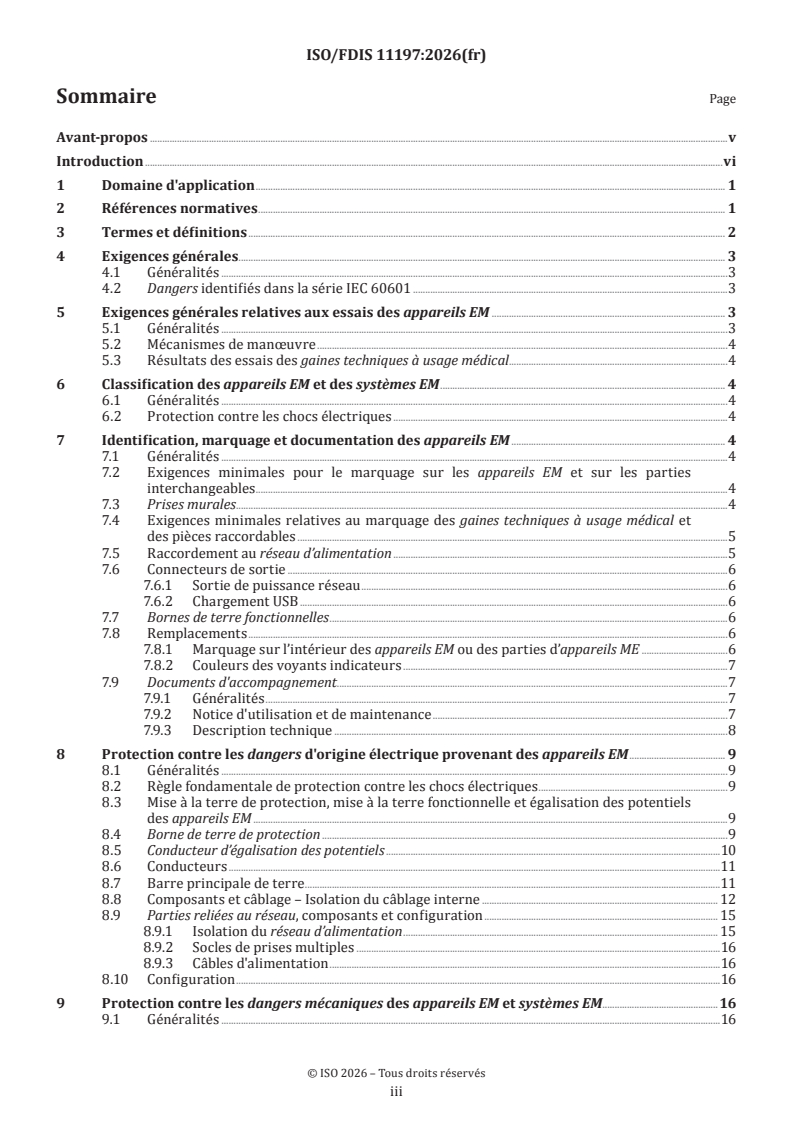
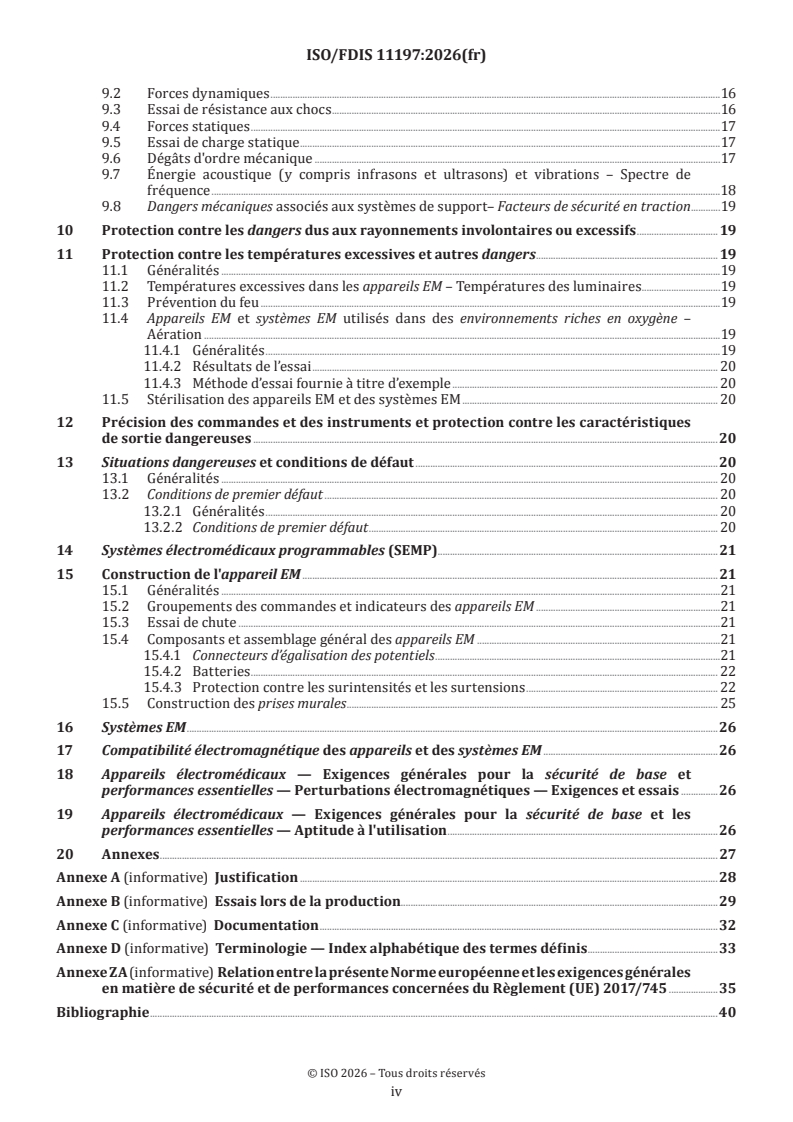
ISO/FDIS 11197 - Gaines techniques à usage médical
Overview
ISO/FDIS 11197:2026 – Medical Supply Units specifies requirements for the basic safety and essential performance of medical supply units (MSUs) in healthcare environments. Medical supply units are integral parts of healthcare facilities, providing services such as electrical power, communication connections, lighting, medical gases, and liquids at the point of care. This standard applies to MSUs both factory manufactured and those assembled on site, including cabinetry, joinery, and enclosures that form part of patient care services.
Developed by ISO Technical Committee 121/SC 6, this standard replaces previous editions to reflect technological advancements and the evolution of healthcare facility needs-including requirements for both temporary and permanent healthcare installations. It covers MSUs used in all clinical environments and addresses the marking, performance, and testing to ensure the optimal safety and functionality of these critical devices.
Key Topics
ISO/FDIS 11197 provides comprehensive requirements and guidelines for the following key areas:
- Basic Safety and Essential Performance: Outlines general and particular requirements for MSU safety, drawing on the foundational IEC 60601-1 medical electrical equipment standard.
- Design, Manufacturing, and Assembly: Applies to MSUs whether built in manufacturing facilities or assembled at healthcare premises. Defines the manufacturer’s responsibilities, including on-site assembly.
- Electrical and Gas Services Integration: Specifies requirements for electrical power outlets, communication systems, light fixtures, as well as integration of medical gases, vacuum, and even plume evacuation systems.
- Protection against Hazards: Contains measures to reduce risks associated with electrical, mechanical, temperature-related, radiation, and other hazards.
- Identification and Marking: Requires clear marking of all MSU components, connectors, terminal units, and attachable parts, with specific labelling for different services (e.g., medical gas, power outlets, liquids).
- Testing and Documentation: Mandates rigorous testing procedures and traceable documentation to demonstrate compliance with safety and performance requirements.
Applications
Medical Supply Units (MSUs) designed under ISO/FDIS 11197 are critical for a wide variety of clinical settings, supporting clinical workflows and patient safety. Practical applications include:
- Hospital Bed Areas: Bedhead service modules and wall supply units delivering power, gas, data, and communication at patient bedsides.
- Operating Theatres and ICUs: Ceiling pendants, columns, beams, or booms that allow flexible and safe distribution of services to critical care environments.
- Emergency and Temporary Facilities: Rapid installation or conversion for pandemic, disaster response, or surge capacity, while maintaining compliance with safety requirements.
- Special Environments: Custom solutions for mental health, paediatric, or correctional facilities where additional safety considerations-such as anti-ligature designs-are needed.
- Ancillary Areas: Integration of terminal units for medical gas, vacuum, lighting, and communication in diagnostic and treatment zones.
By specifying robust safety and performance standards, ISO/FDIS 11197 supports facility designers, manufacturers, care providers, and regulatory authorities in ensuring reliable operation and risk mitigation for patient-facing systems.
Related Standards
ISO/FDIS 11197 references and aligns with numerous international standards to provide comprehensive and interoperable criteria for MSUs, including but not limited to:
- IEC 60601-1: General requirements for basic safety and essential performance of medical electrical equipment.
- ISO 7396-1 / ISO 7396-2: Standards for medical gas pipeline systems.
- ISO 9170-1 / ISO 9170-2: Terminal units for medical gas and anaesthetic scavenging systems.
- ISO 14971: Application of risk management to medical devices.
- IEC 60529: Degrees of protection provided by enclosures (IP code).
- ISO 5359 / ISO 5367: Anaesthetic and respiratory equipment standards.
- IEC 62684: Power supply interoperability for mobile devices.
- EN 50174: IT cabling installation specifications.
- IEC 60601-1-2 / IEC 60601-1-6: Collateral standards for EMC and usability.
Adhering to ISO/FDIS 11197 ensures that medical supply units meet international expectations for safety, reliability, and interoperability in modern healthcare settings.
Relations
- Effective Date
- 12-Feb-2026
- Effective Date
- 23-Jul-2022
Buy Documents
ISO/FDIS 11197 - Medical supply units
REDLINE ISO/FDIS 11197 - Medical supply units
ISO/FDIS 11197 - Gaines techniques à usage médical
Get Certified
Connect with accredited certification bodies for this standard

BSI Group
BSI (British Standards Institution) is the business standards company that helps organizations make excellence a habit.

TÜV Rheinland
TÜV Rheinland is a leading international provider of technical services.

TÜV SÜD
TÜV SÜD is a trusted partner of choice for safety, security and sustainability solutions.
Sponsored listings
Frequently Asked Questions
ISO/FDIS 11197 is a draft published by the International Organization for Standardization (ISO). Its full title is "Medical supply units". This standard covers: IEC 60601-1:2005+A1:2012, 1.1 is replaced by: This document applies to the basic safety and essential performance of medical supply units, hereafter also referred to as ME equipment. This document applies to medical supply units manufactured within a factory or assembled on site, including cabinetry and other enclosures, which incorporate patient care services. NOTE 1 A party that assembles on site various components intended for patient care services into an enclosure is considered the manufacturer of the medical supply unit. Hazards inherent in the intended function of ME equipment or ME systems within the scope of this document are not covered by specific requirements in this standard, except in of IEC 60601-1:2005+A1:2012, 7.2.13 and 8.4.1 (see 201.1.4). NOTE 2 Refer to IEC 60601-1:2005+A1:2012, 4.2.
IEC 60601-1:2005+A1:2012, 1.1 is replaced by: This document applies to the basic safety and essential performance of medical supply units, hereafter also referred to as ME equipment. This document applies to medical supply units manufactured within a factory or assembled on site, including cabinetry and other enclosures, which incorporate patient care services. NOTE 1 A party that assembles on site various components intended for patient care services into an enclosure is considered the manufacturer of the medical supply unit. Hazards inherent in the intended function of ME equipment or ME systems within the scope of this document are not covered by specific requirements in this standard, except in of IEC 60601-1:2005+A1:2012, 7.2.13 and 8.4.1 (see 201.1.4). NOTE 2 Refer to IEC 60601-1:2005+A1:2012, 4.2.
ISO/FDIS 11197 is classified under the following ICS (International Classification for Standards) categories: 11.040.01 - Medical equipment in general. The ICS classification helps identify the subject area and facilitates finding related standards.
ISO/FDIS 11197 has the following relationships with other standards: It is inter standard links to FprEN ISO 11197, ISO 11197:2019. Understanding these relationships helps ensure you are using the most current and applicable version of the standard.
ISO/FDIS 11197 is available in PDF format for immediate download after purchase. The document can be added to your cart and obtained through the secure checkout process. Digital delivery ensures instant access to the complete standard document.
Standards Content (Sample)
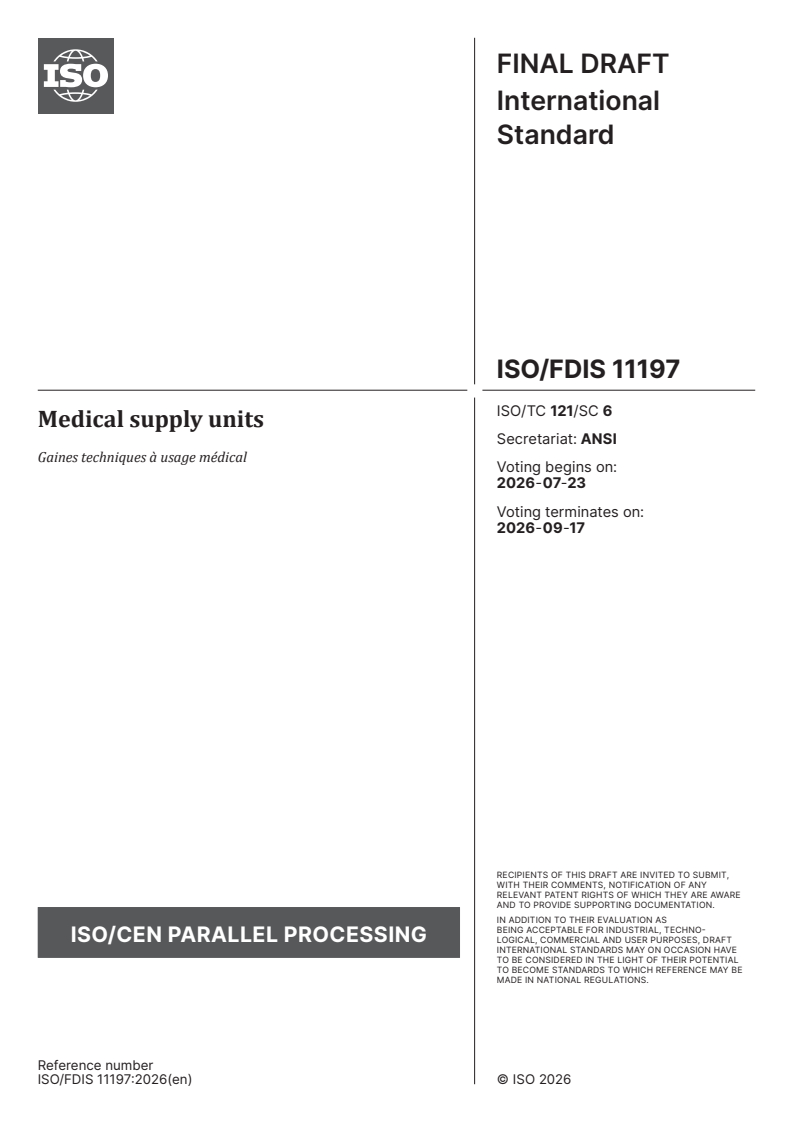
FINAL DRAFT
International
Standard
ISO/TC 121/SC 6
Medical supply units
Secretariat: ANSI
Gaines techniques à usage médical
Voting begins on:
2026-07-23
Voting terminates on:
2026-09-17
RECIPIENTS OF THIS DRAFT ARE INVITED TO SUBMIT,
WITH THEIR COMMENTS, NOTIFICATION OF ANY
RELEVANT PATENT RIGHTS OF WHICH THEY ARE AWARE
AND TO PROVIDE SUPPOR TING DOCUMENTATION.
IN ADDITION TO THEIR EVALUATION AS
BEING ACCEPTABLE FOR INDUSTRIAL, TECHNO
ISO/CEN PARALLEL PROCESSING LOGICAL, COMMERCIAL AND USER PURPOSES, DRAFT
INTERNATIONAL STANDARDS MAY ON OCCASION HAVE
TO BE CONSIDERED IN THE LIGHT OF THEIR POTENTIAL
TO BECOME STAN DARDS TO WHICH REFERENCE MAY BE
MADE IN NATIONAL REGULATIONS.
Reference number
FINAL DRAFT
International
Standard
ISO/TC 121/SC 6
Medical supply units
Secretariat: ANSI
Gaines techniques à usage médical
Voting begins on:
Voting terminates on:
RECIPIENTS OF THIS DRAFT ARE INVITED TO SUBMIT,
WITH THEIR COMMENTS, NOTIFICATION OF ANY
RELEVANT PATENT RIGHTS OF WHICH THEY ARE AWARE
AND TO PROVIDE SUPPOR TING DOCUMENTATION.
© ISO 2026
IN ADDITION TO THEIR EVALUATION AS
All rights reserved. Unless otherwise specified, or required in the context of its implementation, no part of this publication may
BEING ACCEPTABLE FOR INDUSTRIAL, TECHNO
ISO/CEN PARALLEL PROCESSING
LOGICAL, COMMERCIAL AND USER PURPOSES, DRAFT
be reproduced or utilized otherwise in any form or by any means, electronic or mechanical, including photocopying, or posting on
INTERNATIONAL STANDARDS MAY ON OCCASION HAVE
the internet or an intranet, without prior written permission. Permission can be requested from either ISO at the address below
TO BE CONSIDERED IN THE LIGHT OF THEIR POTENTIAL
or ISO’s member body in the country of the requester.
TO BECOME STAN DARDS TO WHICH REFERENCE MAY BE
MADE IN NATIONAL REGULATIONS.
ISO copyright office
CP 401 • Ch. de Blandonnet 8
CH-1214 Vernier, Geneva
Phone: +41 22 749 01 11
Email: copyright@iso.org
Website: www.iso.org
Published in Switzerland Reference number
ii
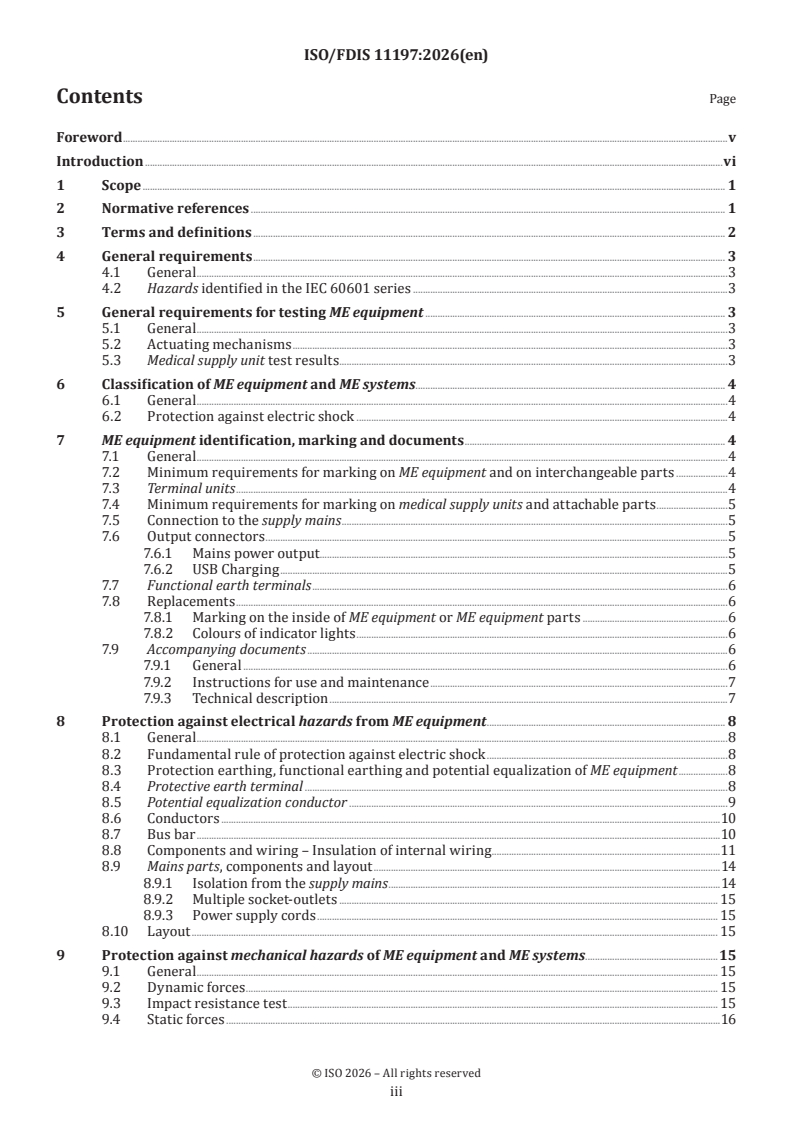
Contents Page
Foreword .v
Introduction .vi
1 Scope . 1
2 Normative references . 1
3 Terms and definitions . 2
4 General requirements . 3
4.1 General .3
4.2 Hazards identified in the IEC 60601 series .3
5 General requirements for testing ME equipment . 3
5.1 General .3
5.2 Actuating mechanisms .3
5.3 Medical supply unit test results . .3
6 Classification of ME equipment and ME systems. 4
6.1 General .4
6.2 Protection against electric shock .4
7 ME equipment identification, marking and documents . 4
7.1 General .4
7.2 Minimum requirements for marking on ME equipment and on interchangeable parts .4
7.3 Terminal units .4
7.4 Minimum requirements for marking on medical supply units and attachable parts .5
7.5 Connection to the supply mains .5
7.6 Output connectors .5
7.6.1 Mains power output.5
7.6.2 USB Charging .5
7.7 Functional earth terminals .6
7.8 Replacements .6
7.8.1 Marking on the inside of ME equipment or ME equipment parts .6
7.8.2 Colours of indicator lights .6
7.9 Accompanying documents .6
7.9.1 General .6
7.9.2 Instructions for use and maintenance .7
7.9.3 Technical description .7
8 Protection against electrical hazards from ME equipment . 8
8.1 General .8
8.2 Fundamental rule of protection against electric shock .8
8.3 Protection earthing, functional earthing and potential equalization of ME equipment .8
8.4 Protective earth terminal .8
8.5 Potential equalization conductor .9
8.6 Conductors .10
8.7 Bus bar .10
8.8 Components and wiring – Insulation of internal wiring .11
8.9 Mains parts, components and layout .14
8.9.1 Isolation from the supply mains .14
8.9.2 Multiple socket-outlets . 15
8.9.3 Power supply cords . 15
8.10 Layout . 15
9 Protection against mechanical hazards of ME equipment and ME systems.15
9.1 General . 15
9.2 Dynamic forces . 15
9.3 Impact resistance test . 15
9.4 Static forces .16
iii
9.5 Static load test .16
9.6 Mechanical damage .16
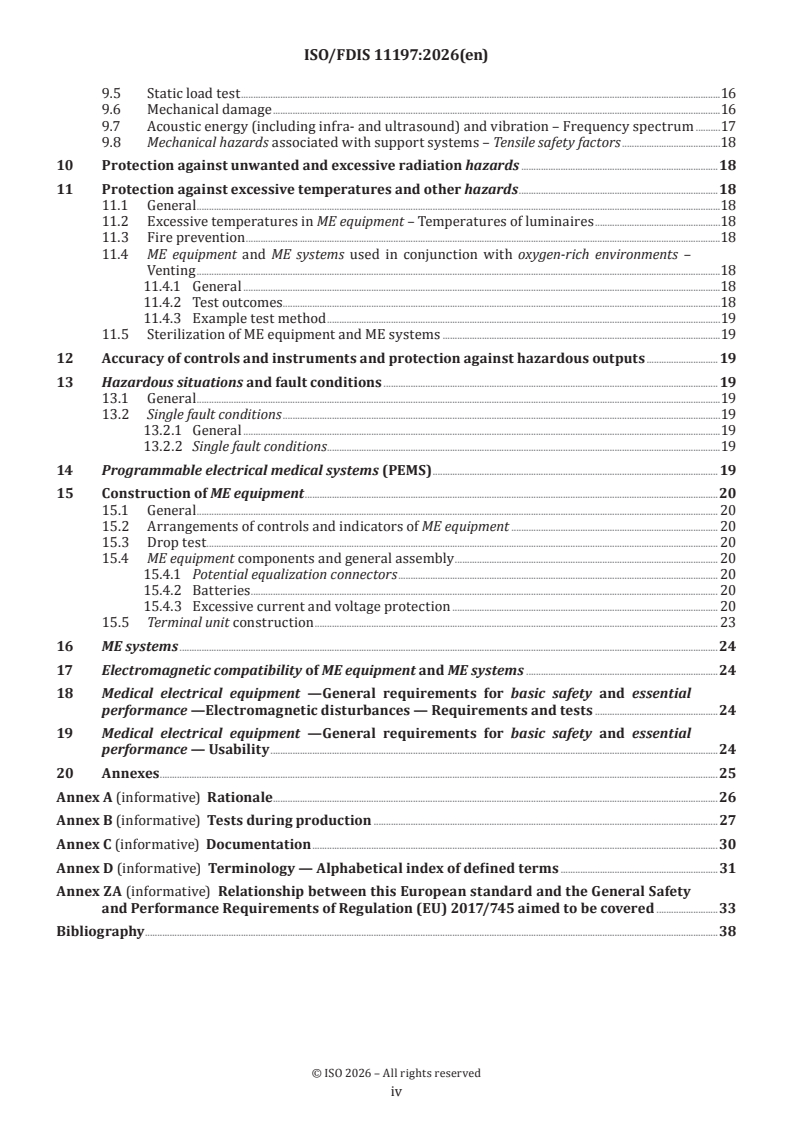
9.7 Acoustic energy (including infra- and ultrasound) and vibration – Frequency spectrum .17
9.8 Mechanical hazards associated with support systems – Tensile safety factors .18
10 Protection against unwanted and excessive radiation hazards .18
11 Protection against excessive temperatures and other hazards .18
11.1 General .18
11.2 Excessive temperatures in ME equipment – Temperatures of luminaires .18
11.3 Fire prevention .18
11.4 ME equipment and ME systems used in conjunction with oxygen-rich environments –
Venting .18
11.4.1 General .18
11.4.2 Test outcomes.18
11.4.3 Example test method .19
11.5 Sterilization of ME equipment and ME systems .19
12 Accuracy of controls and instruments and protection against hazardous outputs . 19
13 Hazardous situations and fault conditions . 19
13.1 General .19
13.2 Single fault conditions .19
13.2.1 General .19
13.2.2 Single fault conditions .19
14 Programmable electrical medical systems (PEMS) . 19
15 Construction of ME equipment .20
15.1 General . 20
15.2 Arrangements of controls and indicators of ME equipment . 20
15.3 Drop test . 20
15.4 ME equipment components and general assembly . 20
15.4.1 Potential equalization connectors . 20
15.4.2 Batteries . 20
15.4.3 Excessive current and voltage protection . 20
15.5 Terminal unit construction . 23
16 ME systems .24
17 Electromagnetic compatibility of ME equipment and ME systems .24
18 Medical electrical equipment —General requirements for basic safety and essential
performance —Electromagnetic disturbances — Requirements and tests .24
19 Medical electrical equipment —General requirements for basic safety and essential
performance — Usability .24
20 Annexes .25
Annex A (informative) Rationale .26
Annex B (informative) Tests during production .27
Annex C (informative) Documentation .30
Annex D (informative) Terminology — Alphabetical index of defined terms .31
Annex ZA (informative) Relationship between this European standard and the General Safety
and Performance Requirements of Regulation (EU) 2017/745 aimed to be covered .33
Bibliography .38
iv
Foreword
ISO (the International Organization for Standardization) is a worldwide federation of national standards
bodies (ISO member bodies). The work of preparing International Standards is normally carried out through
ISO technical committees. Each member body interested in a subject for which a technical committee
has been established has the right to be represented on that committee. International organizations,
governmental and non-governmental, in liaison with ISO, also take part in the work. ISO collaborates closely
with the International Electrotechnical Commission (IEC) on all matters of electrotechnical standardization.
The procedures used to develop this document and those intended for its further maintenance are described
in the ISO/IEC Directives, Part 1. In particular, the different approval criteria needed for the different types
of ISO document should be noted. This document was drafted in accordance with the editorial rules of the
ISO/IEC Directives, Part 2 (see www.iso.org/directives).
ISO draws attention to the possibility that the implementation of this document may involve the use of (a)
patent(s). ISO takes no position concerning the evidence, validity or applicability of any claimed patent
rights in respect thereof. As of the date of publication of this document, ISO had not received notice of (a)
patent(s) which may be required to implement this document. However, implementers are cautioned that
this may not represent the latest information, which may be obtained from the patent database available at
www.iso.org/patents. ISO shall not be held responsible for identifying any or all such patent rights.
Any trade name used in this document is information given for the convenience of users and does not
constitute an endorsement.
For an explanation of the voluntary nature of standards, the meaning of ISO specific terms and expressions
related to conformity assessment, as well as information about ISO's adherence to the World Trade
Organization (WTO) principles in the Technical Barriers to Trade (TBT), see www.iso.org/iso/foreword.html.
This document was prepared by Technical Committee ISO/TC 121, Anaesthetic and respiratory equipment,
Subcommittee SC 6, Medical gas supply systems, in collaboration with the European Committee for
Standardization (CEN) Technical Committee CEN/TC 215, Respiratory and anaesthetic equipment, in
accordance with the Agreement on technical cooperation between ISO and CEN (Vienna Agreement).
This fifth edition cancels and replaces the fourth edition (ISO 11197:2019), which has been technically
revised.
The main changes are as follows:
— concerning the transition of temporary healthcare facilities to those which will become permanent
installations;
— inclusion in the requirements defining the use of anti-static hoses within medical supply units;
— inclusion of amendments following a scope gap assessment conducted against
IEC 60601-1:2005+A1:2012+A2:2020
Any feedback or questions on this document should be directed to the user’s national standards body. A
complete listing of these bodies can be found at www.iso.org/members.html.
v
Introduction
Many healthcare facilities use surface-mounted or recessed containment systems and enclosures for
accommodating and displaying essential patient care services. These are known as medical supply units.
This document specifies requirements for medical supply units manufactured in factories or assembled from
components on site.
It is intended for use by those persons involved in the design, construction, inspection, testing, maintenance
and operation of healthcare facilities as well as those manufacturing, assembling and installing medical
supply units.
Persons involved in the design, manufacture, installation, maintenance and testing of equipment intended
to be connected to gas for medicinal use, medical device gas, vacuum, anaesthetic gas scavenging and/or plume
extraction systems should be aware of the contents of this document.
This document is a particular standard, based on IEC 60601-1:2005+A1:2012+A2:2020.
IEC 60601-1:2005+A1:2012 +A2:2020 is the general standard for the safety of all medical electrical equipment
used by or under the supervision of qualified personnel in the general medical and patient environment; it
also contains certain requirements for reliable operation to ensure safety.
IEC 60601-1:2005+A1:2012+A2:2020 has associated collateral standards and particular standards. The
collateral standards include requirements for specific technologies and/or hazards and apply to all applicable
equipment, such as medical systems, electromagnetic compatibility (EMC), radiation protection in diagnostic
X-ray equipment, software, etc. The particular standards apply to specific equipment types, such as medical
electron accelerators, high frequency surgical equipment, hospital beds, etc.
Where a healthcare facility is developed for temporary use, such as in a pandemic or other natural disaster,
the basic principles of this document shall apply. Once the stage of critical use of the facility has normalised
the product remaining in use shall fulfil the requirements of this document.
NOTE Definitions of collateral standard and particular standard can be found in IEC 60601:2005+A1:2012+A2:2020.
Annex A contains rationale statements for some of the requirements of this document. It is included to
provide additional insight into the reasoning that led to the requirements and recommendations that have
been incorporated in this document.
vi
FINAL DRAFT International Standard ISO/FDIS 11197:2026(en)
Medical supply units
1 Scope
This document establishes particular basic safety and essential performance requirements for medical supply
units as defined in 3.2.
This document applies to the basic safety and essential performance of medical supply units, hereafter also
referred to as ME equipment.
This document applies to medical supply units manufactured within a factory or assembled on site, including
joinery, cabinetry and other enclosures, which incorporate patient care services.
NOTE 1 A party that assembles on site various components intended for patient care services into an enclosure is
considered the manufacturer of the medical supply unit.
Hazards inherent in the intended function of ME equipment or ME systems within the scope of this document
are not covered by specific requirements in this document, except in IEC 60601-1:2005+A1: 2012+ A2: 2020,
7.2.13 and 8.4.1 (see Clause 4).
NOTE 2 Refer to IEC 60601-1:2005+A1: 2012+ A2: 2020, 4.2.
2 Normative references
The following documents are referred to in the text in such a way that some or all of their content constitutes
requirements of this document. For dated references, only the edition cited applies. For undated references,
the latest edition of the referenced document (including any amendments) applies.
ISO 32, Gas cylinders for medical use — Marking for identification of content
ISO 3744:2025, Acoustics — Determination of sound power levels of noise sources using sound pressure —
Engineering methods for an essentially free field over a reflecting plane
ISO 5359:2014, Anaesthetic and respiratory equipment — Low-pressure hose assemblies for use with medical
gases
ISO 5367:2023, Anaesthetic and respiratory equipment — Breathing sets and connectors
ISO 7396-1:2016, Medical gas pipeline systems — Part 1: Pipeline systems for compressed medical gases and
vacuum
ISO 7396-2:2007, Medical gas pipeline systems — Part 2: Anaesthetic gas scavenging disposal systems
ISO 9170-1:2017, Terminal units for medical gas pipeline systems — Part 1: Terminal units for use with
compressed medical gases and vacuum
ISO 9170-2:2008, Terminal units for medical gas pipeline systems — Part 2: Terminal units for anaesthetic gas
scavenging systems
ISO 14971:2019, Medical devices — Application of risk management to medical devices
ISO 16571:2024, Systems for evacuation of plume generated by medical devices
IEC 60364-7-710:2021, Electrical installations of buildings — Part 7-710: Requirements for special installations
or locations - Medical locations
IEC 60598-1:2024, Luminaires — Part 1: General requirements and tests
IEC 60601-1:2005+A1: 2012+ A2: 2020, Medical electrical equipment — Part 1: General requirements for basic
safety and essential performance
IEC 60601-1-2:2014+A1: 2020, Medical electrical equipment — Part 1-2: General requirements for basic safety
and essential performance — Collateral standard: Electromagnetic disturbances — Requirements and tests
IEC 60601-1-3:2008+A1: 2013+ A2: 2021, Medical electrical equipment — Part 1-3: General requirements
for basic safety and essential performance — Collateral standard: Radiation protection in diagnostic X-Ray
equipment
IEC 60601-1-6:2010+A1: 2013+ A2: 2020, Medical electrical equipment — Part 1-6: General requirements for
basic safety and essential performance — Collateral standard: Usability
IEC 61386-1:2008+A1: 2017, Conduit systems for cable management — Part 1: General requirements
IEC 62684:2018, Interoperability specifications of common external power supply (EPS) for use with data-
enabled mobile telephones
EN 50174-1:2018, Information technology. Cabling installation — Part 1: Installation specification and quality
assurance
EN 50174-2:2018, Information technology. Cabling installation — Part 2: Installation planning and practices
inside buildings
3 Terms and definitions
For the purposes of this document, the terms and definitions given in IEC 60601-1:2005+A1: 2012+ A2: 2020,
ISO 16571:2024, ISO 7396-1:2016 and the following apply.
ISO and IEC maintain terminology databases for use in standardization at the following addresses:
— ISO Online browsing platform: available at https:// www .iso .org/ obp
— IEC Electropedia: available at https:// www .electropedia .org/
NOTE An alphabetical index of defined terms is provided in Annex D.
3.1
enclosure
surrounding case constructed to provide a degree of protection to personnel against accidental contact with
live parts and also the enclosed equipment against specified environmental conditions
Note 1 to entry: The environmental conditions are referenced in IEC 61950:2007, 3.15.
Note 2 to entry: An enclosure can be subdivided into compartments.
3.2
medical supply unit
permanently installed ME equipment intended to supply electric power, communication means (telephone,
call systems, etc.), data transmission, lighting, and/or gas for medicinal use, medical device gas and/or liquids,
an anaesthetic gas scavenging system and/or a plume evacuation system, low level waste gas extract ductwork
systems and vents/grilles to medical areas of a healthcare facility
Note 1 to entry: medical supply units can include ME equipment or ME systems or parts thereof. medical supply units can
also consist of modular sections for electrical supply, lighting for therapy or illumination, communication, supply of
gas for medicinal use, medical device gas and liquids, plume evacuation systems and anaesthetic gas scavenging system.
Some typical examples of medical supply units are bed head service modules, ceiling pendants, beams, booms, columns,
pillars, wall mounted enclosure for area shut-off valve boxes of the medical gas pipeline system, joinery, cabinetry,
concealed compartments on or in a wall and prefabricated walls.
Note 2 to entry: Examples of configurations are given in Figures 3, 4 and 5.
Note 3 to entry: Where in-patient care locations (bed spaces) are required within an acute healthcare facility for
dedicated purposes, for example mental health patients, prisons etc, care should be taken to provide bedhead services
arrangements including medical supply units which limit ligature points or ease of access to services therein.
3.3
junction point
connection point(s) between the medical supply unit and the inter-connecting system(s) already installed
3.4
compartment
area within an enclosure which is created by separating barriers, walls and covers forming its own cellular
section
4 General requirements
4.1 General
IEC 60601-1:2005+A1: 2012+ A2: 2020, Clause 4 applies, with the following addition.
4.2 Hazards identified in the IEC 60601 series
The manufacturer shall undertake all tests as defined or referenced within this document and Annex B and
record the results.
NOTE National standards can also apply which require test and record keeping.
5 General requirements for testing ME equipment
5.1 General
IEC 60601-1:2005+A1: 2012+ A2: 2020, Clause 5 applies with the following additions.
5.2 Actuating mechanisms
All external surfaces shall conform to a degree of protection against direct contact in normal use of at least
IP2X or IPXXB. Refer to IEC 60529:1989+AMD1: 1999+ AMD2: 2013.
This level of protection to live parts shall not be compromised during maintenance of the medical gas pipeline
systems, anaesthetic gas scavenging system, plume evacuation systems or liquid pipeline systems, e.g. by the
provision of covers, barriers or individual protection with a degree of protection of at least IP2X or IPXXB.
Refer to IEC 60529:1989+AMD1: 1999+ AMD2: 2013.
If requested by the healthcare facility (e.g. in psychiatric or paediatric units or prison healthcare facilities),
the manufacturer shall provide means to prevent inadvertent or unauthorized dismantling of medical supply
units.
5.3 Medical supply unit test results
The manufacturer shall test each medical supply unit. The test results shall be recorded and presented to the
responsible organization on request.
The manufacturer shall maintain legible records of all tests undertaken on each medical supply unit according
to applicable requirements subject to a minimum period of 5 years for conformance with this document.
6 Classification of ME equipment and ME systems
6.1 General
IEC 60601-1:2005+A1: 2012+ A2: 2020, Clause 6 applies, with the following additions.
6.2 Protection against electric shock
A medical supply unit shall be designed and constructed as class I.
NOTE A Class I device will not have an (Type B or other) applied part. Consequently, all cross-references to tests
or requirements for applied parts in IEC 60601-1 are not applicable for Medical Supply Units.
7 ME equipment identification, marking and documents
7.1 General
IEC 60601-1:2005+A1: 2012+ A2: 2020, Clause 7 applies, with the following additions.
7.2 Minimum requirements for marking on ME equipment and on interchangeable parts
Mains-operated equipment, including separable components thereof which have a mains part, shall be
provided with permanent and legible marking on the outside of the major part of the equipment indicating
the origin and model or type reference.
7.3 Terminal units
Terminal units for gas for medicinal use and medical device gas which are mounted within a medical supply unit
shall be obvious. Where decorative finishes are applied to the medical supply unit (e.g. graphics, where the
terminal unit is displayed as part of the graphic) the design shall ensure a plain surround to the protrusion
hole for the terminal unit of not less than 10 mm.
— terminal units for medical gas, medical device gas pipeline systems shall be marked in accordance with
ISO 9170-1:2017. Colour coding, if used, shall be in accordance with ISO 9170-1:2017 and ISO 32.
— terminal units for anaesthetic gas scavenging system shall be marked in accordance with ISO 9170-2:2008.
Colour coding, if used, shall be in accordance with ISO 9170-2:2008.
— terminal units for liquids for dialysis shall be marked with the name of the liquid in accordance with
Table 1 or with the equivalent national language.
— terminal units for plume evacuation shall be marked in accordance with ISO 16571:2024.
NOTE Regional or national regulations which apply to ME equipment identification, marking and documents can
exist.
Table 1 — Marking for liquids
Name of liquid
Potable water, cold
Potable water, warm
Cooling water
Cooling water, feed-back
De-mineralized water
TTabablele 1 1 ((ccoonnttiinnueuedd))
Name of liquid
Distilled water
Dialysing concentrate
Dialysing permeate
7.4 Minimum requirements for marking on medical supply units and attachable parts
Parts of medical supply units designed for additional loads shall be marked to show the maximum safe
working load specified by the manufacturer.
NOTE Medical supply units can comprise various attachments such as rail systems for supporting medical
equipment, shelves, articulated equipment support arms, tracks for monitoring equipment and similar attachments.
7.5 Connection to the supply mains
Due to the possible complexity of external marking, information indicating all electrical and electronic
connections to the medical supply unit shall be located at the junction point inside the equipment.
For electrical connections, the information shall indicate voltages, number of phases, and differentiation
of circuits. For electronic connections, the information shall indicate connector numbers and wire
identification.
7.6 Output connectors
7.6.1 Mains power output
Mains socket-outlets for special purposes (e.g. for x-ray equipment) shall be marked with the type of supply
mains, rated voltage, rated current and with a label (e.g. “X-RAY”).
When a medical supply unit is provided with socket-outlets for connection to an essential electrical supply
circuit (e.g. uninterruptable power supply (UPS), a Medical IT system as defined in IEC 60364-7-710:2021),
these socket-outlets shall comply with the installation rules or be individually identified if not covered by
those rules.
If socket-outlets in the same location are supplied from different power sources, each source should be
readily identifiable.
NOTE Regional or national regulations can apply to the mains power outlet configurations.
7.6.2 USB Charging
Where Universal Serial Bus (USB) charging devices are installed within medical supply units they shall not
form part of a mains power socket assembly. USB charging devices should be stand-alone units wired on a
final circuit. The USB charging device shall comply with IEC 62684:2018 and conform to the requirements
for dedicated charging ports (DCP) of EN 62680-1-1:2015 to provide a nominal output voltage not exceeding
5 V DC.
The facia plate shall be marked to indicate the following:
— symbol for nature of supply, for direct current only;
— rated current, in milliamperes or amperes;
— rated output voltage;
— labelled “ for non medical use only” in the local language.
Where a USB charging device is intended to supply a medical device, the power supply source shall be
resilient, e g: UPS or Medical IT system. The facia plate shall be marked to indicate the following:
— symbol for nature of supply, for direct current only;
— rated current, in milliamperes or amperes;
— rated output voltage;
— Medical Use Only.
7.7 Functional earth terminals
Facilities for the connection of protective equipotential bonding shall be marked with symbol 8 of
IEC 60601-1:2005+A1: 2012+ A2: 2020, Annex D, Table D.
7.8 Replacements
7.8.1 Marking on the inside of ME equipment or ME equipment parts
IEC 60601-1:2005+A1: 2012+ A2: 2020, 7.3 is replaced by the following:
Junction points and pipelines for gas distribution systems shall be marked in accordance with ISO 7396-1:2016.
Colour coding, if used, shall be in accordance with ISO 7396-1:2016 or ISO 32.
Junction points and pipelines for anaesthetic gas scavenging systems shall be marked in accordance with
ISO 7396-2:2007. Colour coding, if used, shall be in accordance with ISO 7396-2:2007, ISO 32.
Junction points and pipelines for liquids shall be marked with the name of the liquid in accordance with
Table 1 or the equivalent in national language.
Junction points and pipelines for plume evacuation shall be marked in accordance with ISO 16571:2024.
If the medical supply unit has a terminal connecting the neutral line of the power supply, it shall be clearly
identified using the sign A of IEC 60601-1:2005+A1: 2012+ A2: 2020, Annex D.3, the letter N and/or be colour
coded blue.
7.8.2 Colours of indicator lights
IEC 60601-1:2005+A1: 2012+ A2: 2020, 7.8.1 is replaced by the following:
Where electrical components such as indicators, control buttons and the like are incorporated into a medical
supply unit, the requirements of IEC 60601-1:2005+A1: 2012+ A2: 2020 shall be maintained.
NOTE 1 Where supply mains final circuit socket-outlets are incorporated within medical supply units, these are
generally only supplied by socket-outlet manufacturers from a general range without adaptation for healthcare use.
Where lamp/neon/Light Emitting Diode (LED) indicators are supplied as part of that assembly, the illumination colour
might not be in accordance with Table 2 of IEC 60601-1:2005+A1: 2012+ A2: 2020.
NOTE 2 The illumination of an indicator might not truly reflect the operational state of the socket-outlet or its
supply mains.
7.9 Accompanying documents
7.9.1 General
Replace the first dash in IEC 60601-1:2005+A1: 2012+ A2: 2020, 7.9.1 with the following:
The accompanying documents shall include the following:
— the name or trade name and address of the manufacturer and the authorized representative where the
manufacturer does not have a registered place of business within the local market;
— a declaration of conformity by the manufacturer or on-site manufacturer of conformance with this
document and that the manufacturer has satisfied the testing requirements.
7.9.2 Instructions for use and maintenance
7.9.2.1 General
The instructions for use shall contain the date of issue or the latest revision of the document.
7.9.2.2 Reference to the technical description
General information:
— Instructions for use shall state which parts of the equipment are capable of bearing additional loads. The
maximum safe working load shall be stated.
— If flexible hoses and hose assemblies are used as part of the gas distribution systems and liquids for
dialysis and/or are components of an anaesthetic gas scavenging system or a plume evacuation system in
an operator-adjustable system (e.g. a ceiling pendant), the instructions for use shall include a procedure
for, and the recommended frequency of inspection and replacement.
Responsibility of the manufacturer:
— The manufacturer shall document the manufacturing tests that have been performed on each medical
supply unit to demonstrate that the requirements of this document have been met. This documentation
shall be retained and made available upon request.
Specifications for installation, use and maintenance:
— Medical supply units shall be manufactured, tested, installed and used in conformance with this document
and supported by the manufacturer’s instructions.
NOTE Refer to IEC 60364-7-710:2021 for information on this subject.
Where a medical supply unit incorporates a luminaire, it is recommended that consideration is given to the
mounting height of the luminaire portion such that it will meet user requirements for (task or general)
illumination, viewed luminance and access to services for maintenance or function.
7.9.2.3 ME equipment and accessories supplied sterile
IEC 60601-1:2005+A1: 2012+ A2: 2020, 7.9.2.3 does not apply to medical supply units.
7.9.3 Technical description
a) If flexible hoses are used for supplying gas for medicinal use and medical device gases in an operator-
adjustable system (e.g. a ceiling pendant), the instructions for use shall state that the following tests
given
...
ISO TC 121/SC 6
Date: 2026-04-22
ISO /FDIS 11197:2026(E)
ISO/TC 121/SC 6
Secretariat: ANSI
Date: 2026-07-08
Medical supply units
Gaines techniques à usage médical
TThhiis s drdraafftt i is s susubbmmiitttteed d ttoo aa ppaarraallellel l vvoottee i inn IISSOO,, CCEEN.N.
Copyright notice
ThisFDIS stage
© ISO document is a Draft International Standard and is copyright-protected by ISO. Except as permitted under 2026
All rights reserved. Unless otherwise specified, or required in the applicable lawscontext of the user's country, neither
its implementation, no part of this ISO draft nor any extract from itpublication may be reproduced, stored in a retrieval
system or transmitted or utilized otherwise in any form or by any means, electronic, or mechanical, including
photocopying, recording or otherwiseor posting on the internet or an intranet, without prior written permission being
secured.
Requests for permission to reproduce should be addressed to . Permission can be requested from either ISO at the
address below or ISO'sISO’s member body in the country of the requester.
ISO copyright office
Case postale 56 • CP 401 • Ch. de Blandonnet 8
CH-12111214 Vernier, Geneva 20
Tel.Phone: + 41 22 749 01 11
Fax + 41 22 749 09 47
E-mail: copyright@iso.org
Web www.iso.org
Reproduction may be subject to royalty payments or a licensing agreement.
Violators may be prosecuted.
Website: www.iso.org
Published in Switzerland
iii
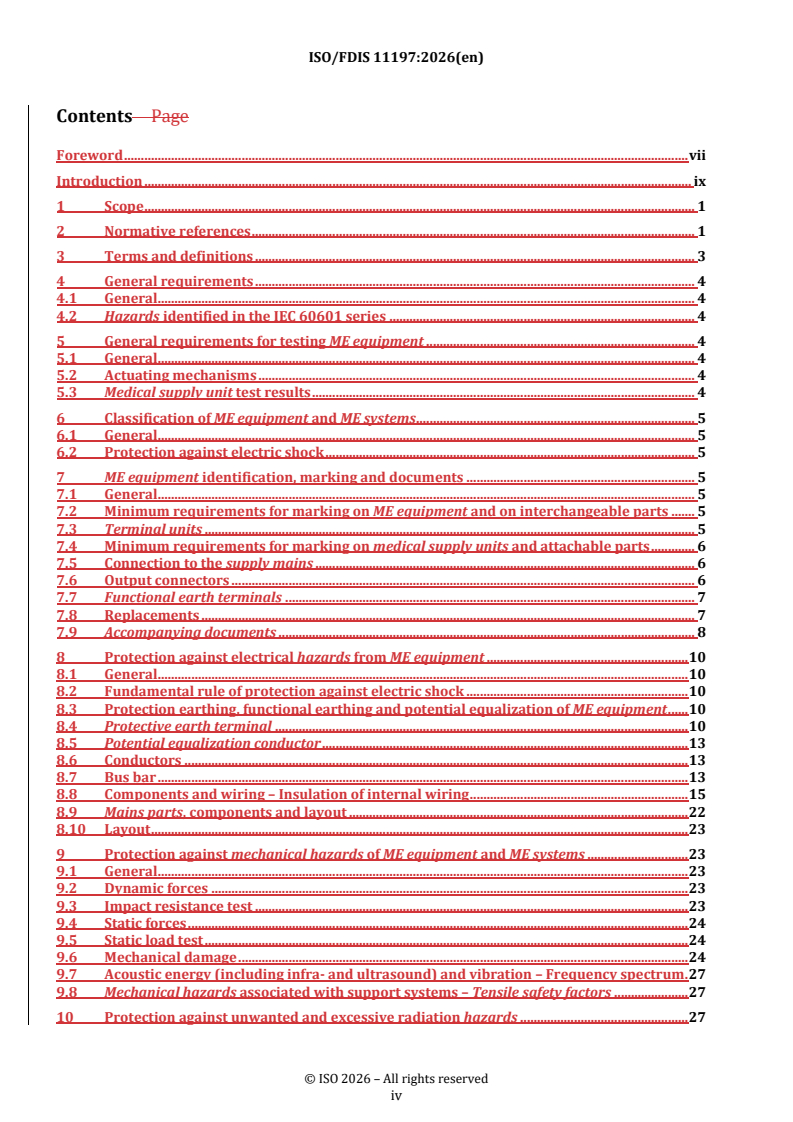
Contents Page
Foreword . vii
Introduction . ix
1 Scope . 1
2 Normative references . 1
3 Terms and definitions . 3
4 General requirements . 4
4.1 General . 4
4.2 Hazards identified in the IEC 60601 series . 4
5 General requirements for testing ME equipment . 4
5.1 General . 4
5.2 Actuating mechanisms . 4
5.3 Medical supply unit test results . 4
6 Classification of ME equipment and ME systems . 5
6.1 General . 5
6.2 Protection against electric shock . 5
7 ME equipment identification, marking and documents . 5
7.1 General . 5
7.2 Minimum requirements for marking on ME equipment and on interchangeable parts . 5
7.3 Terminal units . 5
7.4 Minimum requirements for marking on medical supply units and attachable parts . 6
7.5 Connection to the supply mains . 6
7.6 Output connectors . 6
7.7 Functional earth terminals . 7
7.8 Replacements . 7
7.9 Accompanying documents . 8
8 Protection against electrical hazards from ME equipment . 10
8.1 General . 10
8.2 Fundamental rule of protection against electric shock . 10
8.3 Protection earthing, functional earthing and potential equalization of ME equipment . 10
8.4 Protective earth terminal . 10
8.5 Potential equalization conductor . 13
8.6 Conductors . 13
8.7 Bus bar . 13
8.8 Components and wiring – Insulation of internal wiring . 15
8.9 Mains parts, components and layout . 22
8.10 Layout . 23
9 Protection against mechanical hazards of ME equipment and ME systems . 23
9.1 General . 23
9.2 Dynamic forces . 23
9.3 Impact resistance test . 23
9.4 Static forces . 24
9.5 Static load test . 24
9.6 Mechanical damage . 24
9.7 Acoustic energy (including infra- and ultrasound) and vibration – Frequency spectrum . 27
9.8 Mechanical hazards associated with support systems – Tensile safety factors . 27
10 Protection against unwanted and excessive radiation hazards . 27
iv
11 Protection against excessive temperatures and other hazards . 27
11.1 General . 27
11.2 Excessive temperatures in ME equipment – Temperatures of luminaires . 27
11.3 Fire prevention . 27
11.4 ME equipment and ME systems used in conjunction with oxygen-rich environments –
Venting . 28
11.5 Sterilization of ME equipment and ME systems . 28
12 Accuracy of controls and instruments and protection against hazardous outputs . 28
13 Hazardous situations and fault conditions . 28
13.1 General . 28
13.2 Single fault conditions . 29
14 Programmable electrical medical systems (PEMS) . 29
15 Construction of ME equipment . 29
15.1 General . 29
15.2 Arrangements of controls and indicators of ME equipment . 30
15.3 Drop test . 30
15.4 ME equipment components and general assembly . 30
15.5 Terminal unit construction . 34
16 ME systems . 35
17 Electromagnetic compatibility of ME equipment and ME systems . 35
18 Medical electrical equipment —General requirements for basic safety and essential
performance —Electromagnetic disturbances — Requirements and tests . 35
19 Medical electrical equipment —General requirements for basic safety and essential
performance — Usability . 35
20 Annexes . 35
Annex A (informative) Rationale . 36
Annex B (informative) Tests during production . 37
Annex C (informative) Documentation . 42
Annex D (informative) Terminology — Alphabetical index of defined terms . 43
Annex ZA (informative) Relationship between this European standard and the General Safety
and Performance Requirements of Regulation (EU) 2017/745 aimed to be covered . 44
Bibliography . 51
Foreword . iv
Introduction . v
1 Scope . 1
2 Normative references . 2
3 Terms and definitions . 3
4 General requirements . 5
5 General requirements for testing ME equipment . 5
6 Classification of ME equipment and ME systems . 5
7 ME equipment identification, marking and documents . 6
v
8 Protection against electrical hazards from ME equipment . 10
9 Protection against mechanical hazards of ME equipment and ME systems . 17
10 Protection against unwanted and excessive radiation hazards . 20
11 Protection against excessive temperatures and other hazards . 20
12 Accuracy of controls and instruments and protection against hazardous outputs . 21
13 Hazardous situations and fault conditions . 21
14 Programmable electrical medical systems (PEMS) . 22
15 Construction of ME equipment . 22
16 ME systems . 27
17 Electromagnetic compatibility of ME equipment and ME systems . 27
18 Medical electrical equipment — General requirements for basic safety and essential
performance — Collateral standard: Electromagnetic disturbances — Requirements and
tests . 27
19 Medical electrical equipment — General requirements for basic safety and essential
performance — Collateral standard: Usability . 27
20 Annexes . 27
Annex A (informative) Rationale . 28
Annex B (informative) Tests during production . 29
Annex C (informative) Documentation . 33
Annex D (informative) Terminology — Alphabetical index of defined terms . 34
Bibliography . 36
vi
Foreword
ISO (the International Organization for Standardization) is a worldwide federation of national standards
bodies (ISO member bodies). The work of preparing International Standards is normally carried out through
ISO technical committees. Each member body interested in a subject for which a technical committee has been
established has the right to be represented on that committee. International organizations, governmental and
non-governmental, in liaison with ISO, also take part in the work. ISO collaborates closely with the
International Electrotechnical Commission (IEC) on all matters of electrotechnical standardization.
The procedures used to develop this document and those intended for its further maintenance are described
in the ISO/IEC Directives, Part 1. In particular, the different approval criteria needed for the different types of
ISO document should be noted. This document was drafted in accordance with the editorial rules of the
ISO/IEC Directives, Part 2 (see www.iso.org/directives).
ISO draws attention to the possibility that the implementation of this document may involve the use of (a)
patent(s). ISO takes no position concerning the evidence, validity or applicability of any claimed patent rights
in respect thereof. As of the date of publication of this document, ISO had not received notice of (a) patent(s)
which may be required to implement this document. However, implementers are cautioned that this may not
represent the latest information, which may be obtained from the patent database available at
www.iso.org/patents.www.iso.org/patents. ISO shall not be held responsible for identifying any or all such
patent rights.
Any trade name used in this document is information given for the convenience of users and does not
constitute an endorsement.
For an explanation of the voluntary nature of standards, the meaning of ISO specific terms and expressions
related to conformity assessment, as well as information about ISO's adherence to the World Trade
Organization (WTO) principles in the Technical Barriers to Trade (TBT), see
www.iso.org/iso/foreword.htmlwww.iso.org/iso/foreword.html.
This document was prepared by Technical Committee ISO/TC 121, Anaesthetic and respiratory equipment,
Subcommittee SC 6, Medical gas supply systems, in collaboration with the European Committee for
Standardization (CEN) Technical Committee CEN/TC 215, Respiratory and anaesthetic equipment, in
accordance with the Agreement on technical cooperation between ISO and CEN (Vienna Agreement).
This fifth edition cancels and replaces the fourth edition (ISO 11197:2019), which has been technically
revised.
The main changes are as follows:
— — concerning the transition of temporary healthcare facilities to those which will become permanent
installations;
— — inclusion in the requirements defining the use of anti-static hoses within medical supply units;
— — inclusion of amendments following a scope gap assessment conducted against IEC 60601-
1:2005+A1:2012+A2:2020
Any feedback or questions on this document should be directed to the user’s national standards body. A
complete listing of these bodies can be found at www.iso.org/members.htmlwww.iso.org/members.html.
vii
viii
Introduction
Many healthcare facilities use surface-mounted or recessed containment systems and enclosures for
accommodating and displaying essential patient care services. These are known as medical supply units.
This document specifies requirements for medical supply units manufactured in factories or assembled from
components on site.
It is intended for use by those persons involved in the design, construction, inspection, testing, maintenance
and operation of healthcare facilities as well as those manufacturing, assembling and installing medical supply
units.
Persons involved in the design, manufacture, installation, maintenance and testing of equipment intended to
be connected to gas for medicinal use, medical device gas, vacuum, anaesthetic gas scavenging and/or plume
extraction systems should be aware of the contents of this document.
This document is a particular standard, based on IEC 60601-1:2005+A1:2012+A2:2020. IEC 60601-
1:2005+A1:2012 +A2:2020 is the general standard for the safety of all medical electrical equipment used by or
under the supervision of qualified personnel in the general medical and patient environment; it also contains
certain requirements for reliable operation to ensure safety.
IEC 60601-1:2005+A1:2012+A2:2020 has associated collateral standards and particular standards. The
collateral standards include requirements for specific technologies and/or hazards and apply to all applicable
equipment, such as medical systems, electromagnetic compatibility (EMC), radiation protection in diagnostic
X-ray equipment, software, etc. The particular standards apply to specific equipment types, such as medical
electron accelerators, high frequency surgical equipment, hospital beds, etc.
Where a healthcare facility is developed for temporary use, such as in a pandemic or other natural disaster,
the basic principles of this document shall apply. Once the stage of critical use of the facility has normalised
the product remaining in use shall fulfil the requirements of this document.
NOTE Definitions of collateral standard and particular standard can be found in
IEC 60601:2005+A1:2012+A2:2020.
Annex AAnnex A contains rationale statements for some of the requirements of this document. It is included
to provide additional insight into the reasoning that led to the requirements and recommendations that have
been incorporated in this document.
ix
FINAL DRAFT International Standard ISO/FDIS 11197:2026(en)
Medical supply units
1 1 Scope
This document establishes particular basic safety and essential performance requirements for medical supply
units as defined in 3.2.
This document applies to the basic safety and essential performance of medical supply units, hereafter also
referred to as ME equipment.
This document applies to medical supply units manufactured within a factory or assembled on site, including
joinery, cabinetry and other enclosures, which incorporate patient care services.
NOTE 1 A party that assembles on site various components intended for patient care services into an enclosure is
considered the manufacturer of the medical supply unit.
Hazards inherent in the intended function of ME equipment or ME systems within the scope of this document
are not covered by specific requirements in this document, except in IEC 60601-1:2005+A1:2012+A2:2020,
7.2.13 and 8.4.1 (see Clause 4).Clause 4).
NOTE 2 Refer to IEC 60601-1:2005+A1:2012+A2:2020, 4.2.
The object of this document is to establish particular basic safety and essential performance requirements for
medical supply units as defined in 3.2.
2 2 Normative references
The following documents are referred to in the text in such a way that some or all of their content constitutes
requirements of this document. For dated references, only the edition cited applies. For undated references,
the latest edition of the referenced document (including any amendments) applies.
ISO 32, Gas cylinders for medical use — Marking for identification of content
ISO 3744:2025, Acoustics — Determination of sound power levels of noise sources using sound pressure —
Engineering methods for an essentially free field over a reflecting plane
ISO 5359:2014, Anaesthetic and respiratory equipment — Low-pressure hose assemblies for use with medical
gases
ISO 5367:2023, Anaesthetic and respiratory equipment — Breathing sets and connectors
ISO 7396-1:2016, Medical gas pipeline systems — Part 1: Pipeline systems for compressed medical gases and
vacuum
ISO 7396-2:2007, Medical gas pipeline systems — Part 2: Anaesthetic gas scavenging disposal systems
ISO 9170-1:2017, Terminal units for medical gas pipeline systems — Part 1: Terminal units for use with
compressed medical gases and vacuum
ISO AWI /FDIS 11197:2023(E)
N1112026(en)
ISO 9170-2:2008, Terminal units for medical gas pipeline systems — Part 2: Terminal units for anaesthetic gas
scavenging systems
ISO 14971:2019, Medical devices — Application of risk management to medical devices
ISO 16571:2024, Systems for evacuation of plume generated by medical devices
IEC 60364-7-710:20022021, Electrical installations of buildings — Part 7-710: Requirements for special
installations or locations - Medical locations
IEC 60598-1:2014+A1:20172024, Luminaires — Part 1: General requirements and tests
IEC 60601-1:2005+A1:2012+A2:2020, Medical electrical equipment — Part 1: General requirements for basic
safety and essential performance
IEC 60601-1-2:2014+A1:2020, Medical electrical equipment — Part 1-2: General requirements for basic safety
and essential performance –— Collateral standard: Electromagnetic disturbances –— Requirements and tests
IEC 60601-1-3:2008+A1:2013+A2:2021, Medical electrical equipment — Part 1-3: General requirements for
basic safety and essential performance –— Collateral standard: Radiation protection in diagnostic X-Ray
equipment
IEC 60601-1-6:2010+A1:2013+A2:2020, Medical electrical equipment — Part 1-6: General requirements for
basic safety and essential performance — Collateral standard: Usability
IEC 61386-1:2008+A1:2017, Conduit systems for cable management — Part 1: General requirements
IEC 62684:2018, Interoperability specifications of common external power supply (EPS) for use with data-
enabled mobile telephones
ISO 32, Gas cylinders for medical use - Marking for identification of content
ISO 3744:2010, Acoustics — Determination of sound power levels and sound energy levels of noise sources using
sound pressure — Engineering methods for an essentially free field over a reflecting plane
ISO 5359:2014, Anaesthetic and respiratory equipment — Low-pressure hose assemblies for use with medical
gases
ISO 5367:2023, Anaesthetic and respiratory equipment – Breathing sets and connectors
ISO 7396-1:2016, Medical gas pipeline systems — Part 1: Pipeline systems for compressed medical gases and
vacuum
ISO 7396-2:2007, Medical gas pipeline systems — Part 2: Anaesthetic gas scavenging disposal systems
ISO 9170-1:2017, Terminal units for medical gas pipeline systems — Part 1: Terminal units for use with
compressed medical gases and vacuum
ISO 9170-2:2008, Terminal units for medical gas pipeline systems — Part 2: Terminal units for anaesthetic gas
scavenging systems
ISO 14971:2019, Medical devices — Application of risk management to medical devices
ISO 16571:2014, Systems for evacuation of plume generated by medical devices
EN 50174-1:2018, Information technology. Cabling installation — Part 1: Installation specification and quality
assurance
EN 50174-2:2018, Information technology. Cabling installation — Part 2: Installation planning and practices
inside buildings
3 3 Terms and definitions
For the purposes of this document, the terms and definitions given in IEC 60601-1:2005+A1:2012+A2:2020,
ISO 16571:20142024, ISO 7396-1:2016 and the following apply.
ISO and IEC maintain terminology databases for use in standardization at the following addresses:
— — ISO Online browsing platform: available at https://www.iso.org/obphttps://www.iso.org/obp
— — IEC Electropedia: available at http://www.electropedia.org/https://www.electropedia.org/
NOTE An alphabetical index of defined terms is provided in Annex D.Annex D.
3.1 3.1
enclosure
surrounding case constructed to provide a degree of protection to personnel against accidental contact with
live parts and also the enclosed equipment against specified environmental conditions
Note 1 to entry: The environmental conditions are referenced in IEC 61950:2007, 3.15.
Note 2 to entry: An enclosure can be subdivided into compartments.
3.2 3.2
medical supply unit
permanently installed ME equipment intended to supply electric power, communication means (telephone,
call systems, etc.), data transmission, lighting, and/or gas for medicinal use, medical device gas and/or liquids,
an anaesthetic gas scavenging system and/or a plume evacuation system, low level waste gas extract ductwork
systems and vents/grilles to medical areas of a healthcare facility
Note 1 to entry: medical supply units can include ME equipment or ME systems or parts thereof. medical supply units can
also consist of modular sections for electrical supply, lighting for therapy or illumination, communication, supply of gas
for medicinal use, medical device gas and liquids, plume evacuation systems and anaesthetic gas scavenging system. Some
typical examples of medical supply units are bed head service modules, ceiling pendants, beams, booms, columns, pillars,
wall mounted enclosure for area shut-off valve boxes of the medical gas pipeline system, joinery, cabinetry, concealed
compartments on or in a wall and prefabricated walls.
Note 2 to entry: Examples of configurations are given in Figures 3, 4Figures 3, 4 and 5.5.
Note 3 to entry: Where in-patient care locations (bed spaces) are required within an acute healthcare facility for
dedicated purposes, for example mental health patients, prisons etc, care should be taken to provide bedhead services
arrangements including medical supply units which limit ligature points or ease of access to services therein.
© ISO 2026 – All rights reserved
ISO AWI /FDIS 11197:2023(E)
N1112026(en)
3.3 3.3
junction point
connection point(s) between the medical supply unit and the inter-connecting system(s) already installed
3.4 3.4
compartment
area within an enclosure which is created by separating barriers, walls and covers forming its own cellular
section
4 4 General requirements
4.1 4.1 General
IEC 60601-1:2005+A1:2012+A2:2020, Clause 4 applies, with the following addition.
4.2 4.2 Hazards identified in the IEC 60601 series
The manufacturer shall undertake all tests as defined or referenced within this document and
Annex B,Annex B and record the results.
NOTE National standards can also apply which require test and record keeping.
5 5 General requirements for testing ME equipment
5.1 5.1 General
IEC 60601-1:2005+A1:2012+A2:2020, Clause 5 applies with the following additions.
5.2 5.2 Actuating mechanisms
All external surfaces shall conform to a degree of protection against direct contact in normal use of at least
IP2X or IPXXB. Refer to IEC 60529:1989+AMD1:1999+AMD2:2013.
This level of protection to live parts shall not be compromised during maintenance of the medical gas pipeline
systems, anaesthetic gas scavenging system, plume evacuation systems or liquid pipeline systems, e.g. by the
provision of covers, barriers or individual protection with a degree of protection of at least IP2X or IPXXB.
Refer to IEC 60529:1989+AMD1:1999+AMD2:2013 CSV/COR2:2015.
If requested by the healthcare facility (e.g. in psychiatric or paediatric units or prison healthcare facilities), the
manufacturer shall provide means to prevent inadvertent or unauthorized dismantling of medical supply units.
5.3 5.3 Medical supply unit test results
The manufacturer shall test each medical supply unit. The test results shall be recorded and presented to the
responsible organization on request.
The manufacturer shall maintain legible records of all tests undertaken on each medical supply unit according
to applicable requirements subject to a minimum period of 5 years for conformance with this document.
6 6 Classification of ME equipment and ME systems
6.1 6.1 General
IEC 60601-1:2005+A1:2012+A2:2020, Clause 6 applies, with the following additions.
6.2 6.2 Protection against electric shock
A medical supply unit shall be designed and constructed as class I.
NOTE A Class I device will not have an (Type B or other) applied part. Consequently, all cross-references to tests or
requirements for applied parts in IEC 60601-1 are not applicable for Medical Supply Units.
7 7 ME equipment identification, marking and documents
7.1 7.1 General
IEC 60601-1:2005+A1:2012+A2:2020, Clause 7 applies, with the following additions.
7.2 7.2 Minimum requirements for marking on ME equipment and on interchangeable
parts
Mains-operated equipment, including separable components thereof which have a mains part, shall be
provided with permanent and legible marking on the outside of the major part of the equipment indicating
the origin and model or type reference.
7.3 7.3 Terminal units
terminalTerminal units for gas for medicinal use and medical device gas which are mounted within a medical
supply unit shall be obvious. Where decorative finishes are applied to the medical supply unit (e.g. graphics,
where the terminal unit is displayed as part of the graphic) the design shall ensure a plain surround to the
protrusion hole for the terminal unit of not less than 10 mm.
— — terminal units for medical gas, medical device gas pipeline systems shall be marked in accordance with
ISO 9170-1:2017. Colour coding, if used, shall be in accordance with ISO 9170-1:2017 and ISO 32.
— — terminal units for anaesthetic gas scavenging system shall be marked in accordance with ISO 9170-
2:2008. Colour coding, if used, shall be in accordance with ISO 9170-2:2008.
— — terminal units for liquids for dialysis shall be marked with the name of the liquid in accordance with
Table 1Table 1 or with the equivalent national language.
— — terminal units for plume evacuation shall be marked in accordance with ISO 16571:20142024.
NOTE Regional or national regulations which apply to ME equipment identification, marking and documents can
exist.
Table 1 — Marking for liquids
Name of liquid
Potable water, cold
Potable water, warm
Cooling water
Cooling water, feed-back
© ISO 2026 – All rights reserved
ISO AWI /FDIS 11197:2023(E)
N1112026(en)
Name of liquid
De-mineralized water
Distilled water
Dialysing concentrate
Dialysing permeate
7.4 7.4 Minimum requirements for marking on medical supply units and attachable
parts
Parts of medical supply units designed for additional loads shall be marked to show the maximum safe working
load specified by the manufacturer.
NOTE Medical supply units can comprise various attachments such as rail systems for supporting medical equipment,
shelves, articulated equipment support arms, tracks for monitoring equipment and similar attachments.
7.5 7.5 Connection to the supply mains
Due to the possible complexity of external marking, information indicating all electrical and electronic
connections to the medical supply unit shall be located at the junction point inside the equipment.
For electrical connections, the information shall indicate voltages, number of phases, and differentiation of
circuits. For electronic connections, the information shall indicate connector numbers and wire identification.
7.6 7.6 Output connectors
7.6.1 7.6.1 Mains power output
Mains socket-outlets for special purposes (e.g. for x-ray equipment) shall be marked with the type of supply
mains, rated voltage, rated current and with a label (e.g. “X-RAY”).
When a medical supply unit is provided with socket-outlets for connection to an essential electrical supply
circuit (e.g. uninterruptable power supply (UPS), a Medical IT system as defined in IEC 60364--7--
710:20022021), these socket-outlets shall comply with the installation rules or be individually identified if
not covered by those rules.
If socket-outlets in the same location are supplied from different power sources, each source should be readily
identifiable.
NOTE Regional or national regulations can apply to the mains power outlet configurations.
7.6.2 7.6.2 USB Charging
Where Universal Serial Bus (USB) charging devices are installed within medical supply units they shall not
form part of a mains power socket assembly. USB charging devices should be stand-alone units wired on a
final circuit. The USB charging device shall comply with IEC 62684:2018 and conform to the requirements for
dedicated charging ports (DCP) of EN 62680-1-1:2015 to provide a nominal output voltage not exceeding 5 V
DC.
The facia plate shall be marked to indicate the following:
— — symbol for nature of supply, for direct current only;
— — rated current, in milliamperes or amperes;
— — rated output voltage;
— — labelled “for non medical use only” in the local language.
Where a USB charging device is intended to supply a medical device, the power supply source shall be resilient,
e g: UPS or Medical IT system. The facia plate shall be marked to indicate the following:
— — symbol for nature of supply, for direct current only;
— — rated current, in milliamperes or amperes;
— — rated output voltage;
— — Medical Use Only.
7.7 7.7 Functional earth terminals
Facilities for the connection of protective equipotential bonding shall be marked with symbol 8 of IEC 60601-
1:2005+A1:2012+A2:2020, Annex D, Table D.
7.8 7.8 Replacements
7.8.1 7.8.1 Marking on the inside of ME equipment or ME equipment parts
IEC 60601-1:2005+A1:2012+A2:2020, 7.3 is replaced by the following:
Junction points and pipelines for gas distribution systems shall be marked in accordance with ISO 7396-1:2016.
Colour coding, if used, shall be in accordance with ISO 7396-1:2016 or ISO 32.
Junction points and pipelines for anaesthetic gas scavenging systems shall be marked in accordance with
ISO 7396-2:2007. Colour coding, if used, shall be in accordance with ISO 7396-2:2007, ISO 32.
Junction points and pipelines for liquids shall be marked with the name of the liquid in accordance with
Table 1Table 1 or the equivalent in national language.
Junction points and pipelines for plume evacuation shall be marked in accordance with ISO 16571:20142024.
If the medical supply unit has a terminal connecting the neutral line of the power supply, it shall be clearly
identified using the sign A of IEC 60601-1:2005+A1:2012+A2:2020, Annex D.3, the letter N and/or be colour
coded blue.
7.8.2 7.8.2 Colours of indicator lights
IEC 60601-1:2005+A1:2012+A2:2020, 7.8.1 is replaced by the following:
Where electrical components such as indicators, control buttons and the like are incorporated into a medical
supply unit, the requirements of IEC 60 601 60601-1:2005+A1:2012+A2:2020 shall be maintained.
© ISO 2026 – All rights reserved
ISO AWI /FDIS 11197:2023(E)
N1112026(en)
NOTE 1 Where supply mains final circuit socket-outlets are incorporated within medical supply units, these are
generally only supplied by socket-outlet manufacturers from a general range without adaptation for healthcare use.
Where lamp/neon/Light Emitting Diode (LED) indicators are supplied as part of that assembly, the illumination colour
might not be in accordance with Table 2 of IEC 60601-1:2005+A1:2012. +A2:2020.
NOTE 2 The illumination of an indicator might not truly reflect the operational state of the socket-outlet or its supply
mains.
7.9 7.9 Accompanying documents
7.9.1 7.9.1 General
Replace the first dash in IEC 60601-1:2005+A1:2012+A2:2020, 7.9.1 with the following:
The accompanying documents shall include the following:
— the name or trade name and address of the manufacturer and the authorized representative where the
manufacturer does not have a registered place of business within the local market;
— a declaration of conformity by the manufacturer or on-site manufacturer of conformance with this
document and that the manufacturer has satisfied the testing requirements.
7.9.2 7.9.2 Instructions for use and maintenance
7.9.2.1 7.9.2.1 General
The instructions for use shall contain the date of issue or the latest revision of the document.
7.9.2.2 7.9.2.2 Reference to the technical description
General information:
— Instructions for use shall state which parts of the equipment are capable of bearing additional loads. The
maximum safe working load shall be stated.
— If flexible hoses and hose assemblies are used as part of the gas distribution systems and liquids for dialysis
and/or are components of an anaesthetic gas scavenging system or a plume evacuation system in an
operator-adjustable system (e.g. a ceiling pendant), the instructions for use shall include a procedure for,
and the recommended frequency of inspection and replacement.
Responsibility of the manufacturer:
— The manufacturer shall document the manufacturing tests that have been performed on each medical
supply unit to demonstrate that the requirements of this document have been met. This documentation
shall be retained and made available upon request.
Specifications for installation, use and maintenance:
— Medical supply units shall be manufactured, tested, installed and used in conformance with this document
and supported by the manufacturer’s instructions.
NOTE Refer to IEC 60364-7-710:20022021 for information on this subject.
Where a medical supply unit incorporates a luminaire, it is recommended that consideration is given to the
mounting height of the luminaire portion such that it will meet user requirements for (task or general)
illumination, viewed luminance and access to services for maintenance or function.
7.9.2.3 7.9.2.3 ME equipment and accessories supplied sterile
IEC 60601-1:2005+A1:2012+A2:2020, 7.9.2.3 does not apply to medical supply units.
7.9.3 7.9.3 Technical description
a) a) If flexible hoses are used for supplying gas for medicinal use and medical device gases in an
operator-adjustable system (e.g. a ceiling pendant), the instructions for use shall state that the following
tests given in ISO 7396-1:2016 shall be carried out following modification or replacement of the flexible
hose:
1) test for leakage;
2) test for obstruction;
3) test for particulate contamination;
4) test of flow and pressure drop;
5) test for cross connection;
6) test of gas identity.
b) b) If flexible hoses are used for an anaesthetic gas scavenging system in an operator-
adjustable system (e.g. a ceiling pendant), the instructions for use shall state that the following
...
PROJET FINAL
Norme
internationale
ISO/TC 121/SC 6
Gaines techniques à usage médical
Secrétariat: ANSI
Medical supply units
Début de vote:
2026-07-23
Vote clos le:
2026-09-17
LES DESTINATAIRES DU PRÉSENT PROJET SONT
INVITÉS À PRÉSENTER, AVEC LEURS OBSERVATIONS,
NOTIFICATION DES DROITS DE PROPRIÉTÉ DONT ILS
AURAIENT ÉVENTUELLEMENT CONNAISSANCE ET À
FOURNIR UNE DOCUMENTATION EXPLICATIVE.
OUTRE LE FAIT D’ÊTRE EXAMINÉS POUR
ÉTABLIR S’ILS SONT ACCEPTABLES À DES FINS
INDUSTRIELLES, TECHNOLOGIQUES ET COM-MERCIALES,
AINSI QUE DU POINT DE VUE DES UTILISATEURS, LES
PROJETS DE NORMES
TRAITEMENT PARALLÈLE ISO/CEN
INTERNATIONALES DOIVENT PARFOIS ÊTRE CONSIDÉRÉS
DU POINT DE VUE DE LEUR POSSI BILITÉ DE DEVENIR DES
NORMES POUVANT
SERVIR DE RÉFÉRENCE DANS LA RÉGLEMENTATION
NATIONALE.
Numéro de référence
PROJET FINAL
Norme
internationale
ISO/TC 121/SC 6
Gaines techniques à usage médical
Secrétariat: ANSI
Medical supply units
Début de vote:
2026-07-23
Vote clos le:
2026-09-17
LES DESTINATAIRES DU PRÉSENT PROJET SONT
INVITÉS À PRÉSENTER, AVEC LEURS OBSERVATIONS,
NOTIFICATION DES DROITS DE PROPRIÉTÉ DONT ILS
AURAIENT ÉVENTUELLEMENT CONNAISSANCE ET À
FOURNIR UNE DOCUMENTATION EXPLICATIVE.
DOCUMENT PROTÉGÉ PAR COPYRIGHT
OUTRE LE FAIT D’ÊTRE EXAMINÉS POUR
ÉTABLIR S’ILS SONT ACCEPTABLES À DES FINS
© ISO 2026 INDUSTRIELLES, TECHNOLOGIQUES ET COM-MERCIALES,
AINSI QUE DU POINT DE VUE DES UTILISATEURS, LES
Tous droits réservés. Sauf prescription différente ou nécessité dans le contexte de sa mise en œuvre, aucune partie de cette
PROJETS DE NORMES
TRAITEMENT PARALLÈLE ISO/CEN
INTERNATIONALES DOIVENT PARFOIS ÊTRE CONSIDÉRÉS
publication ne peut être reproduite ni utilisée sous quelque forme que ce soit et par aucun procédé, électronique ou mécanique,
DU POINT DE VUE DE LEUR POSSI BILITÉ DE DEVENIR DES
y compris la photocopie, ou la diffusion sur l’internet ou sur un intranet, sans autorisation écrite préalable. Une autorisation peut
NORMES POUVANT
être demandée à l’ISO à l’adresse ci-après ou au comité membre de l’ISO dans le pays du demandeur.
SERVIR DE RÉFÉRENCE DANS LA RÉGLEMENTATION
NATIONALE.
ISO copyright office
Case postale 401 • Ch. de Blandonnet 8
CH-1214 Vernier, Genève
Tél.: +41 22 749 01 11
E-mail: copyright@iso.org
Web: www.iso.org
Publié en Suisse Numéro de référence
ii
Sommaire Page
Avant-propos .v
Introduction .vi
1 Domaine d'application . 1
2 Références normatives . 1
3 Termes et définitions . 2
4 Exigences générales . . 3
4.1 Généralités .3
4.2 Dangers identifiés dans la série IEC 60601 .3
5 Exigences générales relatives aux essais des appareils EM . 3
5.1 Généralités .3
5.2 Mécanismes de manœuvre .4
5.3 Résultats des essais des gaines techniques à usage médical.4
6 Classification des appareils EM et des systèmes EM . 4
6.1 Généralités .4
6.2 Protection contre les chocs électriques .4
7 Identification, marquage et documentation des appareils EM . 4
7.1 Généralités .4
7.2 Exigences minimales pour le marquage sur les appareils EM et sur les parties
interchangeables .4
7.3 Prises murales.4
7.4 Exigences minimales relatives au marquage des gaines techniques à usage médical et
des pièces raccordables .5
7.5 Raccordement au réseau d’alimentation .5
7.6 Connecteurs de sortie .6
7.6.1 Sortie de puissance réseau .6
7.6.2 Chargement USB .6
7.7 Bornes de terre fonctionnelles .6
7.8 Remplacements .6
7.8.1 Marquage sur l’intérieur des appareils EM ou des parties d’appareils ME .6
7.8.2 Couleurs des voyants indicateurs .7
7.9 Documents d'accompagnement .7
7.9.1 Généralités .7
7.9.2 Notice d'utilisation et de maintenance .7
7.9.3 Description technique .8
8 Protection contre les dangers d'origine électrique provenant des appareils EM . 9
8.1 Généralités .9
8.2 Règle fondamentale de protection contre les chocs électriques .9
8.3 Mise à la terre de protection, mise à la terre fonctionnelle et égalisation des potentiels
des appareils EM .9
8.4 Borne de terre de protection .9
8.5 Conducteur d’égalisation des potentiels .10
8.6 Conducteurs .11
8.7 Barre principale de terre .11
8.8 Composants et câblage – Isolation du câblage interne . 12
8.9 Parties reliées au réseau, composants et configuration . 15
8.9.1 Isolation du réseau d’alimentation . 15
8.9.2 Socles de prises multiples .16
8.9.3 Câbles d'alimentation .16
8.10 Configuration .16
9 Protection contre les dangers mécaniques des appareils EM et systèmes EM .16
9.1 Généralités .16
iii
9.2 Forces dynamiques .16
9.3 Essai de résistance aux chocs .16
9.4 Forces statiques .17
9.5 Essai de charge statique .17
9.6 Dégâts d'ordre mécanique .17
9.7 Énergie acoustique (y compris infrasons et ultrasons) et vibrations – Spectre de
fréquence .18
9.8 Dangers mécaniques associés aux systèmes de support– Facteurs de sécurité en traction .19
10 Protection contre les dangers dus aux rayonnements involontaires ou excessifs . 19
11 Protection contre les températures excessives et autres dangers . 19
11.1 Généralités .19
11.2 Températures excessives dans les appareils EM – Températures des luminaires .19
11.3 Prévention du feu .19
11.4 Appareils EM et systèmes EM utilisés dans des environnements riches en oxygène –
Aération .19
11.4.1 Généralités .19
11.4.2 Résultats de l’essai . 20
11.4.3 Méthode d’essai fournie à titre d’exemple . 20
11.5 Stérilisation des appareils EM et des systèmes EM . 20
12 Précision des commandes et des instruments et protection contre les caractéristiques
de sortie dangereuses .20
13 Situations dangereuses et conditions de défaut .20
13.1 Généralités . 20
13.2 Conditions de premier défaut . 20
13.2.1 Généralités . 20
13.2.2 Conditions de premier défaut . 20
14 Systèmes électromédicaux programmables (SEMP).21
15 Construction de l'appareil EM .21
15.1 Généralités .21
15.2 Groupements des commandes et indicateurs des appareils EM .21
15.3 Essai de chute .21
15.4 Composants et assemblage général des appareils EM .21
15.4.1 Connecteurs d’égalisation des potentiels .21
15.4.2 Batteries . 22
15.4.3 Protection contre les surintensités et les surtensions . 22
15.5 Construction des prises murales . 25
16 Systèmes EM .26
17 Compatibilité électromagnétique des appareils et des systèmes EM .26
18 Appareils électromédicaux — Exigences générales pour la sécurité de base et
performances essentielles — Perturbations électromagnétiques — Exigences et essais .26
19 Appareils électromédicaux — Exigences générales pour la sécurité de base et les
performances essentielles — Aptitude à l'utilisation .26
20 Annexes .27
Annexe A (informative) Justification .28
Annexe B (informative) Essais lors de la production.29
Annexe C (informative) Documentation .32
Annexe D (informative) Terminologie — Index alphabétique des termes définis .33
Annexe ZA (informative) Relation entre la présente Norme européenne et les exigences générales
en matière de sécurité et de performances concernées du Règlement (UE) 2017/745 .35
Bibliographie .40
iv
Avant-propos
L’ISO (Organisation internationale de normalisation) est une fédération mondiale d’organismes nationaux
de normalisation (comités membres de l’ISO). L’élaboration des Normes internationales est en général
confiée aux comités techniques de l’ISO. Chaque comité membre intéressé par une étude a le droit de faire
partie du comité technique créé à cet effet. Les organisations internationales, gouvernementales et non
gouvernementales, en liaison avec l’ISO participent également aux travaux. L’ISO collabore étroitement avec
la Commission électrotechnique internationale (IEC) en ce qui concerne la normalisation électrotechnique.
Les procédures utilisées pour élaborer le présent document et celles destinées à sa mise à jour sont
décrites dans les Directives ISO/IEC, Partie 1. Il convient, en particulier, de prendre note des différents
critères d'approbation requis pour les différents types de documents ISO. Le présent document
a été rédigé conformément aux règles de rédaction données dans les Directives ISO/IEC, Partie 2
(voir www.iso.org/directives).
L'ISO attire l'attention sur le fait que la mise en application du présent document peut entraîner l'utilisation
d'un ou de plusieurs brevets. L'ISO ne prend pas position quant à la preuve, à la validité et à l'applicabilité
de tout droit de propriété revendiqué à cet égard. À la date de publication du présent document, l'ISO
n'avait pas reçu notification qu'un ou plusieurs brevets pouvaient être nécessaires à sa mise en application.
Toutefois, il y a lieu d'avertir les responsables de la mise en application du présent document que des
informations plus récentes sont susceptibles de figurer dans la base de données de brevets, disponible à
l'adresse www.iso.org/brevets. L’ISO ne saurait être tenu pour responsable de ne pas avoir identifié de tels
droits de propriété et averti de leur existence.
Les appellations commerciales éventuellement mentionnées dans le présent document sont données pour
information, par souci de commodité, à l’intention des utilisateurs et ne sauraient constituer un engagement.
Pour une explication de la nature volontaire des normes, la signification des termes et expressions
spécifiques de l'ISO liés à l'évaluation de la conformité, ou pour toute information au sujet de l'adhésion de
l'ISO aux principes de l'Organisation mondiale du commerce (OMC) concernant les obstacles techniques au
commerce (OTC), voir www.iso.org/iso/fr/avant-propos.html.
Le présent document a été élaboré par le comité technique ISO/TC 121, Matériel d'anesthésie et de réanimation
respiratoire, sous-comité SC 6, Systèmes d'alimentation en gaz médicaux, en collaboration avec le Comité
européen de normalisation (CEN), comité technique CEN/TC 215, Équipement respiratoire et anesthésique,
conformément à l'Accord de coopération technique entre l'ISO et le CEN (Accord de Vienne).
Cette cinquième édition annule et remplace la quatrième édition (ISO 11197:2019), qui a fait l’objet d’une
révision technique.
Les principales modifications sont les suivantes:
— modifications relatives à la transformation d’une installation de soins temporaires par une installation
de soins permanents;
— ajout d’informations relatives à l’utilisation de tuyaux antistatiques dans les gaines techniques à usage
médical dans les exigences;
— ajout d’amendements suite à une évaluation des différences entre le domaine d’application du présent
document et celui de l’IEC 60601-1:2005+A1:2012+A2:2020.
Il convient que l’utilisateur adresse tout retour d’information ou toute question concernant le présent
document à l’organisme national de normalisation de son pays. Une liste exhaustive desdits organismes se
trouve à l'adresse www.iso.org/fr/members.html.
v
Introduction
Un grand nombre d’installations de soins utilisent des systèmes et des enveloppes de confinement montés en
saillie ou encastrés, destinés à loger et à présenter les principaux services de soins aux patients. Ces systèmes
et enveloppes sont appelés gaines techniques à usage médical.
Le présent document définit les exigences relatives aux gaines techniques à usage médical fabriquées en usine
ou montées sur site à partir de composants.
Il est destiné à être utilisé par les personnes impliquées dans la conception, la construction, l’inspection,
les essais, la maintenance et l’exploitation des installations de soins ainsi que par celles qui fabriquent,
assemblent et installent les gaines techniques à usage médical.
Il convient que les personnes impliquées dans la conception, la fabrication, l’installation, la maintenance
et les essais des appareils destinés à être raccordés à des systèmes de distribution de gaz médicaux, de gaz
dispositif médical et de vide, ainsi qu’à des systèmes d’évacuation de gaz d’anesthésie et/ou des effluents gazeux
soient informées du contenu du présent document.
Le présent document est une norme particulière, qui repose sur l’IEC 60601-1:2005+A1:2012+A2:2020.
L’IEC 60601-1:2005+A1:2012+A2:2020 est la norme générale relative à la sécurité de tous les appareils
électromédicaux utilisés par ou sous la supervision d’un personnel qualifié dans l’environnement médical
général et dans l'environnement du patient. Elle comporte également certaines exigences relatives à la
fiabilité de fonctionnement, afin de garantir la sécurité.
L’IEC 60601-1:2005+A1:2012+A2:2020 est associée à des normes collatérales et à des normes particulières.
Les normes collatérales comportent des exigences relatives à des technologies spécifiques et/ou à des
dangers, et s’appliquent à tous les équipements concernés, tels que les systèmes médicaux, la compatibilité
électromagnétique (CEM), la radioprotection dans les appareils à rayonnement X de diagnostic, les logiciels,
etc. Les normes particulières s’appliquent à des types d’appareils spécifiques, tels que les accélérateurs
d’électrons à usage médical, les équipements chirurgicaux à haute fréquence, les lits d’hôpitaux, etc.
Les principes de base du présent document doivent s’appliquer lorsque des installations de soins sont mises
en place pour une utilisation temporaire, comme dans le contexte d’une pandémie ou d’une catastrophe
naturelle. Une fois le stade d’utilisation critique de l’installation passé, les produits continuant à être utilisés
doivent respecter les exigences du présent document.
NOTE Les définitions de “norme collatérale” et de “norme particulière” sont fournies
dans l’IEC 60601:2005+A1:2012+A2:2020.
L’Annexe A comporte des justifications concernant certaines des exigences du présent document. Elle est
fournie afin de mieux comprendre le raisonnement qui a permis d’aboutir aux exigences et recommandations
incluses dans le présent document.
vi
PROJET FINAL Norme internationale ISO/FDIS 11197:2026(fr)
Gaines techniques à usage médical
1 Domaine d'application
Le présent document établit des exigences spécifiques relatives à la sécurité de base et aux performances
essentielles des gaines techniques à usage médical, telles que définies en 3.2.
Le présent document s’applique à la sécurité de base et aux performances essentielles des gaines techniques à
usage médical, également désignées sous le terme d’appareil EM.
Le présent document s’applique aux gaines techniques à usage médical fabriquées en usine ou montées sur
site, y compris les zones d’assemblage, armoires et autres enveloppes, qui intègrent des services de soins aux
patients.
NOTE 1 Une entité qui monte sur site divers composants destinés à des services de soins aux patients intégrés dans
une enveloppe est considérée comme le fabricant de la gaine technique à usage médical.
Les dangers inhérents à la fonction prévue des appareils EM ou des systèmes EM dans le cadre du domaine
d'application du présent document ne sont pas couverts par des exigences spécifiques contenues dans le
présent document, à l'exception de l'IEC 60601-1:2005+A1: 2012+ A2: 2020, 7.2.13 et 8.4.1 (voir 4).
NOTE 2 Voir le paragraphe 4.2 de l’IEC 60601-1:2005+A1: 2012+ A2: 2020.
2 Références normatives
Les documents suivants sont cités dans le texte de sorte qu’ils constituent, pour tout ou partie de leur
contenu, des exigences du présent document. Pour les références datées, seule l’édition citée s’applique. Pour
les références non datées, la dernière édition du document de référence s'applique (y compris les éventuels
amendements).
ISO 32, Bouteilles à gaz pour usages médicaux — Marquage pour l'identification du contenu
ISO 3744:2025, Acoustique — Détermination des niveaux de puissance acoustique et des niveaux d’énergie
acoustique émis par les sources de bruit à partir de la pression acoustique — Méthodes d’expertise pour des
conditions approchant celles du champ libre sur plan réfléchissant
ISO 5359:2014, Matériel d'anesthésie et de réanimation respiratoire — Flexibles de raccordement à basse
pression pour utilisation avec les gaz médicaux
ISO 5367:2023, Matériel d'anesthésie et de réanimation respiratoire — Ensembles respiratoires et raccords
ISO 7396-1:2016, Systèmes de distribution de gaz médicaux — Partie 1: Systèmes de distribution de gaz
médicaux comprimés et de vide
ISO 7396-2:2007, Systèmes de distribution de gaz médicaux — Partie 2: Systèmes d'évacuation de gaz
d'anesthésie non réutilisables
ISO 9170-1:2017, Prises murales pour systèmes de distribution de gaz médicaux — Partie 1: Prises murales pour
les gaz médicaux comprimés et le vide
ISO 9170-2:2008, Prises murales pour systèmes de distribution de gaz médicaux — Partie 2: Prises murales pour
systèmes d'évacuation des gaz d'anesthésie
ISO 14971:2019, Dispositifs médicaux — Application de la gestion des risques aux dispositifs médicaux
ISO 16571:2024, Systèmes d'évacuation des fumées chirurgicales générées par l'utilisation de dispositifs
médicaux
IEC 60364-7-710:2021, Installations électriques à basse tension — Partie 7-710: Exigences pour les installations
ou emplacements spéciaux — Locaux à usages médicaux
IEC 60598-1:2024, Luminaires — Partie 1: Exigences générales et essais
I EC 6 06 01-1:20 05+ A 1: 2012+ A 2: 2020, Appareils électromédicaux — Partie 1: Exigences générales pour la
sécurité de base et les performances essentielles
I EC 6 06 01-1-2:2014 +A 1: 2020, Appareils électromédicaux — Partie 1-2: Exigences générales pour la sécurité de
base et les performances essentielles — Norme collatérale: Perturbations électromagnétiques — Exigences et
essais
I EC 6 06 01-1-3:20 0 8 + A 1: 2013+ A 2: 2021, Appareils électromédicaux — Partie 1-3: Exigences générales pour
la sécurité de base et les performances essentielles — Norme collatérale: Radioprotection dans les appareils à
rayonnement X de diagnostic
I EC 6 06 01-1- 6:2010 + A 1: 2013+ A 2: 2020, Appareils électromédicaux — Partie 1-6: Exigences générales pour la
sécurité de base et les performances essentielles — Norme collatérale: Aptitude à l’utilisation
I EC 6138 6 -1:20 0 8 +A 1: 2017, Systèmes de conduits pour la gestion du câblage — Partie 1: Exigences générales
IEC 62684:2018, Interoperability specifications of common external power supply (EPS) for use with data-
enabled mobile telephones
EN 50174-1:2018, Technologies de l’information — Installation de câblages — Partie 1: Spécification de
l’installation et assurance de la qualité
EN 50174-2:2018, Technologies de l’information — Installation de câblages — Partie 2: Planification et pratiques
d’installation à l’intérieur des bâtiments
3 Termes et définitions
Pour les besoins du présent document, les termes et définitions de l’IEC 60601-1:2005+A1: 2012+ A2: 2020,
de l’ISO 16571:2024 et de l’ISO 7396-1:2016 ainsi que les suivants s’appliquent.
L'ISO et l'IEC tiennent à jour des bases de données terminologiques destinées à être utilisées en normalisation,
consultables aux adresses suivantes:
— ISO Online browsing platform: disponible à l'adresse https:// www .iso .org/ obp
— IEC Electropedia: disponible à l'adresse https:// www .electropedia .org/
NOTE Un index alphabétique des termes définis est fourni à l'Annexe D.
3.1
enveloppe
boîtier conçu pour protéger, à un certain degré, les personnels contre tout contact accidentel avec les parties
sous tension, ainsi que les appareils fermés contre des conditions d’environnement spécifiées
Note 1 à l'article: Ces conditions environnementales sont énoncées dans le paragraphe 3.15 de l’IEC 61950:2007.
Note 2 à l'article: Une enveloppe peut être divisée en compartiments.
3.2
gaine technique à usage médical
appareil EM fixe destiné à fournir l’alimentation électrique, les moyens de communication (téléphone,
systèmes d’appel, etc.), la transmission de données, l’éclairage et/ou l’alimentation en gaz médicaux, en gaz
dispositif médical et/ou en liquides, un système d’évacuation de gaz d’anesthésie et/ou un système d’évacuation
des effluents gazeux, des systèmes d'extraction des gaz résiduels de faible niveau et des évents/grilles aux
zones médicales d’une installation de soins
Note 1 à l'article: Les gaines techniques à usage médical peuvent comporter des appareils EM ou des systèmes EM, ou
des éléments de ces appareils ou systèmes. Les gaines techniques à usage médical peuvent également être constituées
d’éléments modulaires destinés à l’alimentation électrique, à l’éclairage thérapeutique ou à l’éclairage normal, à la
communication, à l’alimentation en gaz médicaux, en gaz dispositif médical et en liquides, aux systèmes d’évacuation
des effluents gazeux et aux systèmes d’évacuation de gaz d’anesthésie. Les bandeaux tête de lit, les bras plafonniers,
les faisceaux, les perches, les colonnes, les colonnes de distribution, les enveloppes murales pour boîtiers de vannes
d’arrêt de zone des systèmes de distribution de gaz médicaux, les zones d’assemblage, les armoires et les compartiments
dissimulés sur ou dans une paroi et les parois préfabriquées sont des exemples types de gaines techniques à usage
médical.
Note 2 à l'article: Des exemples de configurations sont décrits dans les Figure 3, Figure 4 et Figure 5.
Note 3 à l'article: Lorsque des emplacements (lits) sont requis pour les patients hospitalisés dans des installations
de soins aigus à des fins précises (par exemple, pour des patients présentant des troubles mentaux ou en prison), il
convient de faire attention à la manière dont sont disposées les têtes de lit comprenant des gaines techniques à usage
médical afin de limiter les points de pendaison ou l’accès à ces équipements.
3.3
point de raccordement
point(s) de connexion entre la gaine technique à usage médical et le ou les systèmes d’interconnexion déjà
installés
3.4
compartiment
zone dans une enveloppe, formée par des barrières, des parois et des capots de séparation pour créer une
cellule spécifique
4 Exigences générales
4.1 Généralités
L'IEC 60601-1:2005+A1: 2012+ A2: 2020, Article 4 s'applique avec l'ajout suivant:
4.2 Dangers identifiés dans la série IEC 60601
Le fabricant doit effectuer tous les essais conformément aux définitions et références définies dans le présent
document ainsi que dans l'Annexe B, et consigner les résultats.
NOTE Certaines normes nationales exigeant l’exécution d’essais et la conservation des données peuvent également
s’appliquer.
5 Exigences générales relatives aux essais des appareils EM
5.1 Généralités
L'IEC 60601-1:2005+A1: 2012+ A2: 2020, Article 5 s'applique avec les ajouts suivants:
5.2 Mécanismes de manœuvre
L’ensemble des surfaces externes doit respecter un degré de protection contre tout contact direct dans
des conditions normales de fonctionnement d’au moins IP2X ou IPXXB. Voir l’IEC 60529:1989+AMD1: 1999+
A M D2: 2013 .
Ce niveau de protection contre l’accès aux parties sous tension ne doit pas être compromis lors de la
maintenance des systèmes de distribution de gaz médicaux, des systèmes d’évacuation de gaz d’anesthésie, des
systèmes d’évacuation des effluents gazeux ou des systèmes de distribution de liquides. Il faut utiliser, à titre
d’exemple, des capots, des barrières ou une protection individuelle assurant un degré de protection d’au
moins IP2X ou IPXXB. Voir l’IEC 60529:1989+AMD1: 1999+ AMD2: 2013.
Si cela est exigé par l'installation de soins (par exemple, dans des unités psychiatriques ou pédiatriques ou
dans des installations de soins en milieu carcéral), le fabricant doit fournir un moyen permettant d’empêcher
un démontage des gaines techniques à usage médical par inadvertance ou sans autorisation.
5.3 Résultats des essais des gaines techniques à usage médical
Le fabricant doit soumettre à essai chaque gaine technique à usage médical. Les résultats des essais doivent
être enregistrés et présentés sur demande à l’organisme responsable.
Le fabricant doit tenir à jour des enregistrements lisibles de tous les essais effectués sur chaque gaine
technique à usage médical, conformément aux exigences applicables soumises à une période minimale de
5 ans pour la conformité au présent document.
6 Classification des appareils EM et des systèmes EM
6.1 Généralités
L'IEC 60601-1:2005+A1: 2012+ A2: 2020, Article 6 s'applique avec les ajouts suivants:
6.2 Protection contre les chocs électriques
Une gaine technique à usage médical doit être conçue et construite conformément aux dispositions de la
classe I.
NOTE Un dispositif de classe I ne dispose pas de partie appliquée (de type B ou autre). Par conséquent, tous les
renvois à des références à des essais ou à des exigences pour les parties appliquées dans l’IEC 60601-1 ne s’appliquent
pas aux gaines techniques à usage médical.
7 Identification, marquage et documentation des appareils EM
7.1 Généralités
L'IEC 60601-1:2005+A1: 2012+ A2: 2020, Article 7 s'applique avec les ajouts suivants:
7.2 Exigences minimales pour le marquage sur les appareils EM et sur les parties
interchangeables
Les appareils alimentés par le réseau, y compris leurs composants séparables qui comprennent une partie
reliée au réseau, doivent comporter un marquage lisible et permanent apposé à l’extérieur du constituant
principal de l’appareil et indiquant l’origine et la référence du modèle ou du type.
7.3 Prises murales
Les prises murales pour les gaz médicaux et les gaz dispositif médical intégrées à une gaine technique à
usage médical doivent être clairement visibles. Si la gaine technique à usage médical présente des finitions
décoratives (par exemple, des motifs graphiques dans lesquels la prise murale est intégrée), sa conception
doit garantir une zone sans motif d'au moins 10 mm autour du trou protubérant de la prise murale.
— Le marquage des prises murales pour systèmes de distribution de gaz médicaux ou de gaz dispositif médical
doit être conforme à la norme ISO 9170-1:2017. Le code couleur, le cas échéant, doit être conforme aux
normes ISO 9170-1:2017 et ISO 32.
— Le marquage des prises murales pour systèmes d’évacuation de gaz d’anesthésie doit être conforme à la
norme ISO 9170-2:2008. Le code couleur, le cas échéant, doit être conforme à la norme ISO 9170-2:2008.
— Le marquage des prises murales pour liquides de dialyse doit comporter le nom du liquide, conformément
au Tableau 1 ou son équivalent dans la langue nationale.
— Le marquage des prises murales pour évacuation des effluents gazeux doit être conforme à la
norme ISO 16571:2024.
NOTE Il peut exister des réglementations régionales ou nationales s’appliquant à l’identification, au marquage et à
la documentation des appareils EM.
Tableau 1 — Marquage des liquides
Nom du liquide
Eau potable, froide
Eau potable, chaude
Eau de refroidissement
Eau de refroidissement, retour
Eau déminéralisée
Eau distillée
Concentré pour dialyse
Dialysat
7.4 Exigences minimales relatives au marquage des gaines techniques à usage médical et
des pièces raccordables
Les parties des gaines médicales à usage médical conçues pour supporter des charges supplémentaires
doivent être marquées pour indiquer la charge de fonctionnement en sécurité maximale spécifiée par le
fabricant.
NOTE Les gaines techniques à usage médical peuvent présenter divers moyens de fixation, tels que des systèmes
de rails pour les équipements médicaux, des plateaux, des bras articulés, des rainures pour les équipements de
surveillance et d’autres dispositifs de fixation similaires.
7.5 Raccordement au réseau d’alimentation
Du fait de la possible complexité du marquage extérieur, des informations indiquant l’ensemble des
connexions électriques et électroniques à la gaine technique à usage médical doivent figurer au niveau du
point de raccordement, à l’intérieur de l’appareil.
Les informations relatives aux connexions électriques doivent indiquer les tensions ainsi que le nombre de
phases et la différenciation des circuits. Les informations concernant les connexions électroniques doivent
indiquer les numéros des connecteurs et l’identification des conducteurs.
7.6 Connecteurs de sortie
7.6.1 Sortie de puissance réseau
Le marquage des socles de prises de courant destinés à des usages spécialisés (par exemple, pour les appareils
à rayonnement X) doit comporter les éléments suivants: type de réseau d’alimentation, tension nominale,
courant nominal et une étiquette (par exemple, “RAYONS X”).
Lorsqu’une gaine technique à usage médical est pourvue de socles de prises de courant de raccordement à un
circuit d’alimentation électrique essentiel (notamment une alimentation sans coupure (UPS), un système IT
médical comme défini dans l’IEC 60364-7-710:2021), ces socles de prises doivent être conformes aux règles
d’installation ou être identifiés de manière individuelle, dans le cas où ils ne seraient pas couverts par ces
règles.
Si des socles de prises de courant situés au même endroit sont alimentés par différentes sources
d’alimentation électrique, il convient que chaque source soit aisément identifiable.
NOTE Des réglementations régionales ou nationales peuvent s’appliquer aux configurations des socles de prises
réseau.
7.6.2 Chargement USB
Si des dispositifs à chargement USB sont installés dans des gaines techniques à usage médical, ils ne doivent
pas faire partie d’un ensemble de socles de prise réseau. Il convient que les dispositifs à chargement USB
soient des unités autonomes raccordées sur un circuit terminal. Le dispositif à chargement USB doit être
conforme à l’IEC 62684:2018 ainsi qu’aux exigences relatives aux ports de chargement dédiés (DCP) de
l’EN 62680-1-1:2015 afin de fournir une tension de sortie nominale de 5 Vcc.
La plaque sur la façade doit comporter les éléments suivants:
— un symbole renseignant sur la nature de l’alimentation, pour les dispositifs à courant continu uniquement;
— le courant nominal, en milliampères ou en ampères;
— la tension de sortie nominale;
— la mention “destiné uniquement à un usage non médical” dans la langue locale.
Lorsqu’un dispositif à chargement USB est censé alimenter un dispositif médical, la source d’alimentation
doit être résiliente (par exemple, une alimentation sans coupure (UPS) ou un système IT médical). La plaque
sur la façade doit comporter les éléments suivants:
— un symbole renseignant sur la nature de l’alimentation, pour les dispositifs à courant cont
...