


ISO/TS 10303-15:2021
(Main)Industrial automation systems and integration — Product data representation and exchange — Part 15: Description methods: SysML XMI to XSD transformation
Industrial automation systems and integration — Product data representation and exchange — Part 15: Description methods: SysML XMI to XSD transformation
This document specifies the transformation of SysML (ISO/IEC 19514:2017) constructs to XSD (World Wide Web Consortium's XML schema definition language) constructs for the purpose of representing the SysML model represented in XMI (ISO/IEC 19509:2014) as XML (World Wide Web Consortium's XML) schemas. The specified mapping is a one-way transformation from SysML information model represented in XMI into an XML schema. These limitations make the mapping unsuitable for the transformation of arbitrary SysML models to XML schemas. The following are within the scope of this document: — the specification of the structure, components, and conventions of the XSD for the STEP (ISO 10303-1) XML implementation method; — the transformation of SysML metamodel constructs represented in XMI to XSD constructs for the purpose of representing SysML information models as XML schemas. The following are outside the scope of this document: — the transformation of SysML metamodel constructs into XSD constructs that are not used in the STEP extended architecture; — the transformation of SysML metamodel constructs into XSD constructs for other purposes than representing SysML constructs as STEP concepts; — codes and scripts to transform SysML XMI to XSD schema; — the transformation of SysML constraints (OCL, see ISO/IEC 19507) into Schematron (see ISO/IEC 19757‑3).
Systèmes d'automatisation industrielle et intégration — Représentation et échange de données de produits — Partie 15: Titre manque
General Information
Relations
Standards Content (Sample)
TECHNICAL ISO/TS
SPECIFICATION 10303-15
First edition
2021-07
Industrial automation systems
and integration — Product data
representation and exchange —
Part 15:
Description methods: SysML XMI to
XSD transformation
Reference number
©
ISO 2021
© ISO 2021
All rights reserved. Unless otherwise specified, or required in the context of its implementation, no part of this publication may
be reproduced or utilized otherwise in any form or by any means, electronic or mechanical, including photocopying, or posting
on the internet or an intranet, without prior written permission. Permission can be requested from either ISO at the address
below or ISO’s member body in the country of the requester.
ISO copyright office
CP 401 • Ch. de Blandonnet 8
CH-1214 Vernier, Geneva
Phone: +41 22 749 01 11
Email: copyright@iso.org
Website: www.iso.org
Published in Switzerland
ii © ISO 2021 – All rights reserved
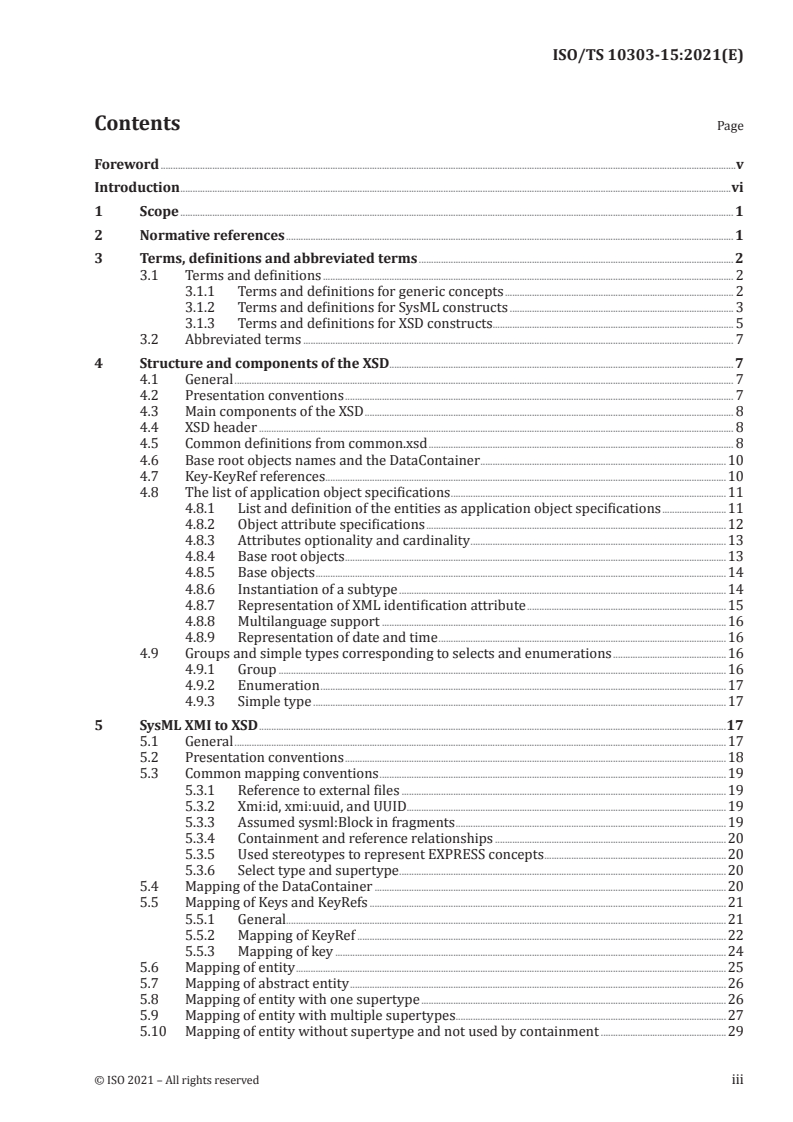
Contents Page
Foreword .v
Introduction .vi
1 Scope . 1
2 Normative references . 1
3 Terms, definitions and abbreviated terms . 2
3.1 Terms and definitions . 2
3.1.1 Terms and definitions for generic concepts . 2
3.1.2 Terms and definitions for SysML constructs . 3
3.1.3 Terms and definitions for XSD constructs. 5
3.2 Abbreviated terms . 7
4 Structure and components of the XSD . 7
4.1 General . 7
4.2 Presentation conventions . 7
4.3 Main components of the XSD . 8
4.4 XSD header . 8
4.5 Common definitions from common.xsd . 8
4.6 Base root objects names and the DataContainer .10
4.7 Key-KeyRef references .10
4.8 The list of application object specifications .11
4.8.1 List and definition of the entities as application object specifications .11
4.8.2 Object attribute specifications .12
4.8.3 Attributes optionality and cardinality .13
4.8.4 Base root objects .13
4.8.5 Base objects .14
4.8.6 Instantiation of a subtype .14
4.8.7 Representation of XML identification attribute .15
4.8.8 Multilanguage support .16
4.8.9 Representation of date and time .16
4.9 Groups and simple types corresponding to selects and enumerations .16
4.9.1 Group .16
4.9.2 Enumeration .17
4.9.3 Simple type .17
5 SysML XMI to XSD .17
5.1 General .17
5.2 Presentation conventions .18
5.3 Common mapping conventions .19
5.3.1 Reference to external files .19
5.3.2 Xmi:id, xmi: uuid, and UUID.19
5.3.3 Assumed sysml:Blo ck in fragments .19
5.3.4 Containment and reference relationships .20
5.3.5 Used stereotypes to represent EXPRESS concepts .20
5.3.6 Select type and supertype .20
5.4 Mapping of the DataContainer .20
5.5 Mapping of Keys and KeyRefs .21
5.5.1 General.21
5.5.2 Mapping of KeyRef .22
5.5.3 Mapping of key .24
5.6 Mapping of entity .25
5.7 Mapping of abstract entity .26
5.8 Mapping of entity with one supertype .26
5.9 Mapping of entity with multiple supertypes .27
5.10 Mapping of entity without supertype and not used by containment .29
5.11 Mapping of entity without supertype and used by containment .30
5.12 Mapping of simple type .31
5.13 Mapping of aggregation type .34
5.14 Mapping of aggregation of aggregation type.36
5.15 Select type .37
5.15.1 Mapping of select type .37
5.15.2 Proxy artefact .39
5.16 Mapping of enumeration type .40
5.17 Mapping of entity attribute .41
5.17.1 General.41
5.17.2 Mapping of multiplicity and optionality .42
5.17.3 Attribute typed as an entity . .44
5.17.4 Attribute typed as select .46
5.17.5 Attribute typed as enumeration type .47
5.17.6 Attribute type as simple type .47
5.17.7 Exception: inverse composite aggregation.48
Annex A (normative) Information object registration .52
Annex B (informative) common.xsd .53
Annex C (informative) EXPRESS/Information modelling constructs and the equivalent
SysML modelling constructs .55
Bibliography .66
iv © ISO 2021 – All rights reserved
Foreword
ISO (the International Organization for Standardization) is a worldwide federation of national standards
bodies (ISO member bodies). The work of preparing International Standards is normally carried out
through ISO technical committees. Each member body interested in a subject for which a technical
committee has been established has the right to be represented on that committee. International
organizations, governmental and non-governmental, in liaison with ISO, also take part in the work.
ISO collaborates closely with the International Electrotechnical Commission (IEC) on all matters of
electrotechnical standardization.
The procedures used to develop this document and those intended for its further maintenance are
described in the ISO/IEC Directives, Part 1. In particular, the different approval criteria needed for the
different types of ISO documents should be noted. This document was drafted in accordance with the
editorial rules of the ISO/IEC Directives, Part 2 (see www .iso .org/ directives).
Attention is drawn to the possibility that some of the elements of this document may be the subject of
patent rights. ISO shall not be held responsible for identifying any or all such patent rights. Details of
any patent rights identified during the development of the document will be in the Introduction and/or
on the ISO list of patent declarations received (see www .iso .org/ patents).
Any trade name used in this document is information given for the convenience of users and does not
constitute an endorsement.
For an explanation of the voluntary nature of standards, the meaning of ISO specific terms and
expressions related to conformity assessment, as well as information about ISO's adherence to the
World Trade Organization (WTO) principles in the Technical Barriers to Trade (TBT), see www .iso .org/
iso/ foreword .html.
This document was prepared by Technical Committee ISO/TC 184, Automation systems and integration,
Subcommittee SC 4, Industrial data.
A list of all parts in the ISO 10303 series can be found on the ISO website.
Any feedback or questions on this document should be directed to the user’s national standards body. A
complete listing of these bodies can be found at www .iso .org/ members .html.
Introduction
ISO 10303 is an International Standard for the computer-interpretable representation and exchange
of product data. The objective is to provide a neutral mechanism capable of describing product data
throughout the life cycle of a product and independent from any particular system. The nature of this
description makes it suitable not only for neutral file exchange, but also as a basis for implementing and
sharing product databases and archiving.
This document is a member of the description methods series. This document specifies a mapping
[17][18][19]
of SysML XMI to the XSD. This document supports the STEP extended architecture. This
document specifies the transformation from a STEP data model in SysML XMI to a STEP XSD.
The object management group (OMG) has standardized the XML metadata interchange specification
(XMI) that integrates the OMG systems modeling language (SysML), the OMG unified modeling language
(UML), and the World Wide Web Consortium (W3C) extensible markup language (XML). SysML inherits
the XMI interchange capability from UML. XMI is a mechanism for the interchange of metadata between
UML-based modeling tools. OMG has also standardized an XMI compliant interchange format for the
SysML thus specifying a lexical representation of SysML models based on a standardized metamodel of
the SysML.
The W3C has standardized the XML schema definition (XSD). XSD allows to define shared vocabularies
and allow machines to carry out rules made by developers. They provide a means for defining the
structure, content and semantics of XML documents.
This document specifies a description method of the STEP parts family, which defines the transformation
of SysML constructs to the XSD constructs. Because the XMI standard specifies the XML representation
of SysML metamodel constructs, standardizing the binding of SysML constructs into XSD constructs
supports the representation of SysML models as XML schemas.
The specified mapping is a one-way transformation from SysML information model represented in
XMI into an XML schema. These limitations make the mapping unsuitable for the transformation of
arbitrary SysML models to XSD.
A detailed knowledge of the W3C XML and XSD languages, and the OMG systems modelling language is
useful.
The main components of this document are:
— the structure, conventions and concepts of the XSD;
— the specification of the transformation from SysML XMI to XSD for each STEP element modelled in
SysML.
vi © ISO 2021 – All rights reserved
TECHNICAL SPECIFICATION ISO/TS 10303-15:2021(E)
Industrial automation systems and integration — Product
data representation and exchange —
Part 15:
Description methods: SysML XMI to XSD transformation
1 Scope
This document specifies the transformation of SysML (ISO/IEC 19514:2017) constructs to XSD (World
Wide Web Consortium's XML schema definition language) constructs for the purpose of representing
the SysML model represented in XMI (ISO/IEC 19509:2014) as XML (World Wide Web Consortium's
XML) schemas. The specified mapping is a one-way transformation from SysML information model
represented in XMI into an XML schema. These limitations make the mapping unsuitable for the
transformation of arbitrary SysML models to XML schemas.
The following are within the scope of this document:
— the specification of the structure, components, and conventions of the XSD for the STEP (ISO 10303-1)
XML implementation method;
— the transformation of SysML metamodel constructs represented in XMI to XSD constructs for the
purpose of representing SysML information models as XML schemas.
The following are outside the scope of this document:
— the transformation of SysML metamodel constructs into XSD constructs that are not used in the
STEP extended architecture;
— the transformation of SysML metamodel constructs into XSD constructs for other purposes than
representing SysML constructs as STEP concepts;
— codes and scripts to transform SysML XMI to XSD schema;
— the transformation of SysML constraints (OCL, see ISO/IEC 19507) into Schematron (see
ISO/IEC 19757-3).
2 Normative references
The following documents are referred to in the text in such a way that some or all of their content
constitutes requirements of this document. For dated references, only the edition cited applies. For
undated references, the latest edition of the referenced document (including any amendments) applies.
ISO 10303-11:2004, Industrial automation systems and integration — Product data representation and
exchange — Part 11: Description methods: The EXPRESS language reference manual
ISO/IEC 19505-1:2012, Information technology — Object Management Group Unified Modeling Language
(OMG UML) — Part 1: Infrastructure
ISO/IEC 19514:2017, Information technology — Object management group systems modeling language
(OMG SysML)
3 Terms, definitions and abbreviated terms
3.1 Terms and definitions
For the purposes of this document, the terms and definitions given in ISO 10303-11, ISO/IEC 19505-1,
ISO/IEC 19514 and the following apply.
ISO and IEC maintain terminological databases for use in standardization at the following addresses:
— ISO Online browsing platform: available at https:// www .iso .org/ obp
— IEC Electropedia: available at http:// www .electropedia .org/
3.1.1 Terms and definitions for generic concepts
3.1.1.1
EXPRESS
language by which aspects of product data can be defined
3.1.1.2
application object
atomic element of an application reference model that defines a unique concept of the application and
contains attributes specifying the data elements of the object
[SOURCE: ISO 10303-1:1994 2.1.11]
3.1.1.3
data
representation of information in a formal manner suitable for communication, interpretation, or
processing by human beings or computers
[SOURCE: ISO 10303-1:2021, 3.1.29]
3.1.1.4
data model
description of the organization of data in the management information system of an enterprise.
[SOURCE: ISO/IEC 2382:2015, 2121422]
3.1.1.5
implementation method
technique used by computer systems to exchange product data
[SOURCE: ISO 10303-1:2021, 3.1.39, modified — In the definition, "part of ISO 10303" has been replaced
with "technique" and the text after "data" has been removed.]
3.1.1.6
information
facts, concepts, or instructions
[SOURCE: ISO 10303-1:2021, 3.1.41]
3.1.1.7
resulting XSD
XSD based on the transformation specification
3.1.1.8
information model
conceptual model of product data
Note 1 to entry: In ISO 10303, an information model is based on the object-relationship modeling technique that
organizes the product data as represented in different system aspects.
2 © ISO 2021 – All rights reserved
Note 2 to entry: In ISO 10303, information models may be developed using EXPRESS modeling language.
EXAMPLE Application resource model for ISO 10303-242 managed model-based 3D engineering
[SOURCE: ISO 10303-1:2021, 3.1.42, modified — In the definition, "formal" has been replaced with
"conceptual"; in Note 2 to entry, "are" has been replaced with "may be"; the Example has been changed.]
3.1.1.9
uniform resource identifier
URI
string of characters that unambiguously identifies a particular resource
[SOURCE: RFC 3986]
3.1.2 Terms and definitions for SysML constructs
3.1.2.1
canonical XMI
specific constrained format of XMI that minimizes variability and provides more predictable
identification and ordering
Note 1 to entry: A canonical XMI file is itself a valid XMI file.
Note 2 to entry: The full definition is provided in ISO/IEC 19509:2014, Annex B.
3.1.2.2
association
association classifies a set of tuples representing links between typed model elements
Note 1 to entry: The full definition is provided in ISO/IEC 19505-1:2012, 11.5.
3.1.2.3
auxiliary
stereotype applied to an abstract block that has no properties
Note 1 to entry: The full definition is provided in ISO/IEC 19505-1:2012, Clause 22.
3.1.2.4
block
modular construct used for defining an entity
Note 1 to entry: Used for defining application activity model concepts, application data planning objects,
application domain model business objects, core model objects and ARM in SysML entities. They can include:
reference, part, and value properties; constraints. They can be specializations of other blocks.
Note 2 to entry: The full definition is provided in ISO/IEC 19514:2017, Clause 8.
3.1.2.5
composite aggregation
responsibility for the existence of composed object
Note 1 to entry: If a composite object is deleted, all of its part instances that are objects are deleted with it.
Note 2 to entry: The full definition is provided in ISO/IEC 19505-1:2012, 11.4.1.
3.1.2.6
directed association
association between a collection of source model elements and a collection of target model elements
that is said to be directed from the source elements to the target elements
Note 1 to entry: The full definition is provided in ISO/IEC 19505-1:2012, 7.2.3.3.
3.1.2.7
enumeration
value type whose values are enumerated
Note 1 to entry: The full definition is provided in ISO/IEC 19505-1:2012, 10.2.3.3.
3.1.2.8
enumeration literal
named value for an enumeration (3.1.2.7)
Note 1 to entry: The full definition is provided in ISO/IEC 19505-1:2012, 10.2.3.3.
3.1.2.9
data type
type whose instances are identified only by their value
Note 1 to entry: The full definition is provided in ISO/IEC 19505-1:2012, 10.2.3.1.
3.1.2.10
generalization
directed relationship between a more general supertype and a more specific subtype
Note 1 to entry: Each generalization relates a specific classifier to a more general classifier. Given a classifier,
the transitive closure of its general classifiers is often called its generalizations, and the transitive closure of
its specific classifiers is called its specializations. The immediate generalizations are also called the classifier’s
subtype, and where the classifier is a class, its supertype.
Note 2 to entry: The full definition is provided in ISO/IEC 19505-1:2012, C.1.1.
3.1.2.11
primitive type
definition of a predefined data type, without any substructure
Note 1 to entry: The full definition is provided in ISO/IEC 19505-1:2012, Clause 21.
3.1.2.12
part property
property that specifies a part with strong ownership and coincidental lifetime of its containing block
Note 1 to entry: It describes a local usage or a role of the typing block in the context of the containing block. Every
part property has composite aggregation and is typed by a block.
Note 2 to entry: The full definition is provided in ISO/IEC 19514:2017, 8.3.2.3, paragraph 6.
3.1.2.13
reference property
property that specifies a reference of its containing block to another block
Note 1 to entry: The full definition is provided in ISO/IEC 19514:2017, 8.3.2.3, paragraph 6.
3.1.2.14
stereotype
limited kind of metaclass that cannot be used by itself but must always be used in conjunction with one
of the metaclasses it extends
Note 1 to entry: The full definition is provided in ISO/IEC 19505-1:2012, 12.3.3.4.
3.1.2.15
value property
property of a block that is typed with a value type
Note 1 to entry: The full definition is provided in ISO/IEC 19514:2017, 8.3.2.3, paragraph 6.
4 © ISO 2021 – All rights reserved
3.1.2.16
value type
stereotype of UML data type that is used to define types of values that may be used to express
information but cannot be identified as the target of any reference
Note 1 to entry: The full definition is provided in ISO/IEC 19514:2017, 8.3.2.14.
3.1.3 Terms and definitions for XSD constructs
3.1.3.1
schema definition language
language for XML schemas
Note 1 to entry: The purpose of an XSD schema is to define and describe a class of XML documents by using
schema components to constrain and document the meaning, usage and relationships of their constituent parts:
datatypes, elements and their content and attributes and their values.
[SOURCE: World Wide Web Consortium's XML schema definition language (W3C XSD)]
3.1.3.2
global complex type
complex type (3.1.3.3) that is defined globally in an XML schema
Note 1 to entry: A xsd: complexType can also defined globally and given a name. Named xsd: complexTypes can
then be re-used throughout the schema, either referenced directly or used as the basis to define other xsd:
complexTypes. This makes it possible to build more object-oriented data structures that are easier to work with
and manage. Only complex types defined globally (as children of the element can have their own
name and be re-used throughout the schema). If they are defined inline within an they cannot
have a name (anonymous) and cannot be reused elsewhere.
Note 2 to entry: The full definition is provided in World Wide Web Consortium's XML schema definition language.
3.1.3.3
complex type
set of attribute definitions and content type for an element in an XML schema
Note 1 to entry: A xsd: complexType provides the definition for an XML element. It specifies which element and
attributes are permitted and the rules regarding where they can appear and how many times. They can be used
in-place within an element definition or named and defined globally.
Note 2 to entry: the full definition is provided in World Wide Web Consortium's XML schema definition language.
3.1.3.4
attribute type
name, type and occurrence for a property in an XML schema
Note 1 to entry: An attribute provides extra information within an element. Attributes have name and type
properties. An Attribute can appear 0 or 1 times within a given element in the XML document. Attributes are
either optional or mandatory (by default they are optional). The "use" property in the XSD definition is used to
specify if the attribute is optional or mandatory. An attribute is specified within a xsd: complexType, the type
information for the attribute comes from a xsd: simpleType (either defined inline or via a reference to a built in or
user defined xsd: simpleType definition). The type information describes the data the attribute can contain in the
XML document, such as string, integer, date. Attributes can also be specified globally and then referenced.
Note 2 to entry: The full definition is provided in World Wide Web Consortium's XML schema definition language.
3.1.3.5
compositor
rules for ordering in an XML schema
Note 1 to entry: Compositors provide rules that determine how and in what order their children can appear
within XML document. There are three types of compositors , and .
— Sequence: The child elements in the XML document shall appear in the order they are declared in the XSD
schema.
— Choice: Only one of the child elements described in the XSD schema can appear in the XML document.
— All: The child elements described in the XSD schema can appear in the XML document in any order.
Note 2 to entry: The full definition is provided in World Wide Web Consortium's XML schema definition language.
3.1.3.6
extension
complex type (3.1.3.3) that is inherited
Note 1 to entry: It is possible to take an existing and extend it using and
the "base" attribute. The introduced construct indicates that an existing type is extended and
specifies a new type. The construct shall be used to as container for the extension.
Note 2 to entry: The full definition is provided in World Wide Web Consortium's XML schema definition language.
3.1.3.7
group
reusable collection of elements and attributes in an XML schema
Note 1 to entry: Elements and attributes can be grouped together using and .
These groups can then be referred to elsewhere within the schema. Groups shall have a unique name and be
defined as children of the element. When a group is referred to, it is as if its contents have been
copied into the location it is referenced from.
Note 2 to entry: The full definition is provided in World Wide Web Consortium's XML schema definition language.
3.1.3.8
mixed content
complex type (3.1.3.3) that may contain, attributes elements and text
Note 1 to entry: Elements can also contain a combination of element types, complex types and compositors.
Elements and data can be mixed.
Note 2 to entry: The full definition is provided in World Wide Web Consortium's XML schema definition language.
3.1.3.9
namespace
scope for named elements in an XML file
Note 1 to entry: Namespaces are a mechanism for breaking up your schemas. XSD standard allows to structure
XSD schemas by breaking them into multiple files. These child schemas can then be included into a parent schema.
Breaking schemas into multiple files can have several advantages. One can create re-usable definitions that can
be used across several projects. They make definitions easier to read and version as they break down the schema
into smaller units that are simpler to manage.
Note 2 to entry: The full definition is provided in World Wide Web Consortium's XML schema definition language.
3.1.3.10
restriction
definition of acceptable values for elements in an XML schema
Note 1 to entry: The usage of extensions, mixed contents, namespaces, groups, provides the capability to restrict
the definition of a type.
Note 2 to entry: The full definition is provided in World Wide Web Consortium's XML schema definition language.
3.1.3.11
simple type
element type with text-only attributes in an XML schema
6 © ISO 2021 – All rights reserved
3.2 Abbreviated terms
CXMI canonical XMI
ID identifier
OCL object constraint language
OMG object management group
STEP standard for the exchange of product model data
SysML systems modeling language
UML unified modeling language
UoS unit of serialization
UUID universal unique identifier
URI uniform resource identifier
XMI XML meta-data interchange
XML extensible markup language
XSD XML schema definition
4 Structure and components of the XSD
4.1 General
This clause describes the structure and components of the resulting XSD. The resulting XSD shall
conform to World Wide Web Consortium's XML schema definition language (W3C XSD).
This document shall be unambiguously identified in an open information system by the code defined in
Annex A.
The chapter 5 SysML XMI to XSD provides the mapping specification of each mentioned XSD constructs
in this clause.
4.2 Presentation conventions
For ease of identification, the fragments of XSD are presented in boxes.
EXAMPLE 1 XSD fragment presented in a box
XSD extract
The items significant to support the explanations are formatted using bold text effect to aid
identification of the items in the XSD fragment.
EXAMPLE 2 Usage of bold text effect to support the explanation
An XML attribute shall be contained in the XML element:
…
4.3 Main components of the XSD
The resulting XSD shall be composed of the following main components:
— the XSD header, located at the beginning of the file;
— the import of the common definitions contained in common.xsd;
— the specification of the DataContainer as a choice of base root objects;
— the Key-KeyRef references;
— the list of application object specifications in XSD;
— the groups and simple types corresponding to selects and enumerations.
Each of these components are described in 4.4 to 4.9.
4.4 XSD header
The header of the XSD (xsd: schema) defines:
— the namespaces of the XSD schema,
— resulting XML schema version.
— Regarding the namespace conventions, the namespace prefixes are used throughout this part to
refer to the namespaces identified by the corresponding URI. The prefixes and associated URIs are
the following:
— xmlns: targetNamespace: https:// standards .iso .org/ iso/ ts/ 10303/ -4442/ -ed -1/ tech/ xml -schema/
domain _model;
— xmlns: https:// standards .iso .org/ iso/ ts/ 10303/ -4442/ -ed -1/ tech/ xml -schema/ domain _model;
— xsd: http:// www .w3 .org/ 2001/ XMLSchema;
— xsi: http:// www .w3 .org/ 2001/ XMLSchema -instance;
— cmn: https:// standards .iso .org/ iso/ ts/ 10303/ -3000/ -ed -2/ tech/ xml -schema/ common;
A valid resulting XSD header is provided in the following XSD fragment:
XSD:
xmlns="https:// standards .iso .org/ iso/ ts/ 10303/ -4442/ -ed -1/ tech/ xml -schema/ domain _model"
xmlns: xsd = "http:// www .w3 .org/ 2001/ XMLSchema"
xmlns: cmn = "https:// standards .iso .org/ iso/ ts/ 10303/ -3000/ -ed -2/ tech/ xml -schema/ common"
targetNamespace="https:// standards .iso .org/ iso/ ts/ 10303/ -4442/ -ed -1/ tech/ xml -schema/ domain
_model"
version="N10475;2019-06-07">
4.5 Common definitions from common.xsd
The header of the XSD shall be followed by the import of the external XSD. This external XSD specifies
that the resulting XSD shall contain a unit of serialization (UoS) by declaring an xsd: element named
UoS. This external XSD is provided at https:// standards .iso .org/ iso/ ts/ 10303/ -3000/ -ed -2/ tech/ xml
-schema/ common/ common .xsd.
8 © ISO 2021 – All rights reserved
The xsd: ComplexType UoS specifies that an XML shall include a UoS object that includes a header
(described below) and one or more DataContainer (see 4.6 below).
The resulting XSD shall add the Key and KeyRef (see 4.7) declarations to this xsd: element.
The declaration of the common.xsd XSD import shall be as follows:
XSD:
common
schemaLocation="https:// standards .iso .org/ iso/ ts/ 10303/ -3000/ -ed -1/ tech/ xml -schema/ common/
c om mon . x s d"/ >
NOTE 2 The use of “cmn:” in the examples in this document imply the namespace for the 10303 common
schema. The contents of the common.xsd is in Annex B.
The mandatory header element that contains administrative information that characterizes the content
of the data package. The header elements are described in ISO 10303-28:2007, 5.2, and are as follows:
— Name: human readable identifier for the XML resource;
— TimeStamp: date and time when the XML resource was created;
— Author: identifies the person or group of persons who created the XML resource;
— Organization: identifies the organization that created, or is responsible for, the XML resource;
— PreprocessorVersion: identifies the software system that created the XML resource itself, including
platform and version identifiers;
NOTE 3 The preprocessor_version identifies the system that was used to produce the XML resource. This
can be distinct from the software system that created or captured the original information.
— OriginatingSystem: identifies the software system that created or captured the information
contained in the XML resource, including platform and version identifiers;
— Authorization: specifies the release authorization for the XML resource and the signa-tory, where
appropriate;
NOTE 4 The authorization can be distinct from the authorizations for various information units contained
within the document.
— Documentation: free text field for information.
The UoS XSD also defines the following structural features:
— BaseObject: This is the generic object from which all entities are extended. This element type is
abstract. This object specifies that all XML elements may have the XML attribute “uid” typed by the
standardized xsd:ID type. In XML dataset ruled by this XSD, its element shall have unique “uid” XML
attributes;
EXAMPLE 1 Extract of the BaseObject specification
XSD:
— BaseRootObject: This is an extension of BaseObject and is abstract. The intent is that the elements
allowed to be instantiated inside the DataContainer element should be an extension of this object;
— Reference: An object used for referencing other objects in the XML. It has a mandatory XML attribute
“uidRef” typed by the standardized xsd: IDREF. This mechanism is described in more details in 4.7.
EXAMPLE 2 Extract of the Reference specification
XSD:
4.6 Base root objects names and the DataContainer
ComplexType definition of the DataContainer shall be defined as an extension of the cmm: DataContainer.
It shall contain a list of choices of all the elements available as root objects. The root objects can be
instantiated inside the DataContainer element. The name of the ComplexType is the concatenation of
the module short name and the substring “DataContainer”.
EXAMPLE Extract of the AP242DataContainer specification with the example of two BaseRootObjects
(Activity element and ActivityMethod element)
XSD:
...
Each choice represents an element specified in the application object specification and shall have a
minOccurs="0" and a maxOccurs="unbounded”.
Base root objects are defined, like the other entities, in the list of application object, described in 0
below.
4.7 Key-KeyRef references
The XSD language provides a mechanism for keys and key references in order to create reference
relationships between elements through the value of an XML attribute or contained element. The xsd:
10 © ISO 2021 – All rights reserved
key and xsd: keyref elements are used to create such a relationship and are contained in the UoS in
an XML instance. Key and KeyRef define the allowed reference relationships between the XSD element
types. The uidRef XML attribute use used to reference an existing element with the same value in its uid
XML attribute.
Keys and Keyrefs shall be included in the xsd: element named UoS as shown below.
XSD:
...
A key shall be defined as below:
XSD:
A KeyRef shall be defined as below:
XSD:
As shown above, the XSD Key and Keyref specifies that the uidref XML attribute of the Role reference
element contained in the ActivityAssignment object, shall reference an existing Class object using its
unique uid XML attribute. An XSD validator is able to use the key/keyref declaration to validate if the
reference relationship is allowed in an XML dataset.
The definition of a reference attribute is specified in 4.8.2.
4.8 The list of application object specifications
4.8.1 List and definition of the entities as application object specifications
An entity, or an application object definition is contained in the xsd: element UoS.
An entity is defined by an xsd: complexType declaration:
XSD:
< x s d : c omple x
...
Questions, Comments and Discussion
Ask us and Technical Secretary will try to provide an answer. You can facilitate discussion about the standard in here.