

ISO 19593-1
(Main)Graphic technology — Use of PDF to associate processing steps and content data — Part 1: Processing steps for packaging and labels
General Information
- Abstract
This document describes a method for storing data in a PDF file that correspond to the processing steps of printed products. This method has three parts: 1) metadata identifying processing steps; 2) limitations on the interaction between PDF graphics objects that are part of a processing step and other PDF graphics objects; 3) limitations on PDF graphics objects in processing steps. This method is intended to be generic, i.e. not specific to packaging and labels. In addition, this document defines the following packaging- and label-specific groups of processing-steps data: — data corresponding to finishing steps, such as cutting, folding or glueing; — Braille; — information panels; — indications of physical dimensions; — indications of intended positions of graphical elements; — printed white, for example on transparent or metallic surfaces; — printed varnish; — primer; — printing plate making.
- Status
- Not Published
- Technical Committee
- ISO/TC 130 - Graphic technology
- Drafting Committee
- ISO/TC 130/WG 2 - Prepress data exchange
- Current Stage
- 6000 - International Standard under publication
- Start Date
- 09-Sep-2026
- Completion Date
- 19-Sep-2026
Buy Documents

ISO/PRF 19593-1 - Graphic technology — Use of PDF to associate processing steps and content data — Part 1: Processing steps for packaging and labels

REDLINE ISO/PRF 19593-1 - Graphic technology — Use of PDF to associate processing steps and content data — Part 1: Processing steps for packaging and labels
Overview
ISO 19593-1:2026 is an international standard developed by the International Organization for Standardization (ISO), specifically by Technical Committee ISO/TC 130 on Graphic Technology. The standard outlines a method for storing data in PDF files that relate to the processing steps of printed products-most notably in the packaging and labeling sectors, but with applications across other print industry segments. By standardizing how processing steps and content data are associated within PDF documents, ISO 19593-1 enhances interoperability, reduces workflow errors, and streamlines data exchange between design, prepress, printing, and finishing operations.
Key Topics
- PDF as a Central Container: ISO 19593-1 specifies how a PDF file can serve as a comprehensive container encompassing both print-ready content and additional non-printing graphics or metadata pertinent to production steps.
- Processing Step Metadata: The standard defines the use of metadata (GTS_Metadata) within PDF Optional Content Groups (OCGs) to identify distinct processing steps, such as cutting, folding, varnishing, or adding Braille.
- Interaction Limitations: ISO 19593-1 establishes rules that restrict how processing-step-related PDF graphics objects may interact with standard print content and with each other, thereby ensuring production reliability and output fidelity.
- Object Limitations: Requirements are set regarding the types of PDF objects that can be included in processing steps, including constraints on coloring, transparency, and object membership within multiple OCGs.
Applications
ISO 19593-1 is highly relevant to professionals in packaging, label production, and other segments that rely on precise digital file management for manufacturing. Practical applications include:
- Design and Prepress: Graphic designers use standardized processing-step data to correctly position elements related to cutting, folding, varnishing, etc.
- Quality Control: Prepress and quality controllers utilize this metadata to verify that all technical requirements for processing are met before printing or finishing.
- Production Automation: Manufacturing tools and automated finishing equipment (such as digital cutting tables or braille applicators) read standardized processing steps directly from PDF files, reducing manual interventions and the risk of miscommunication.
- Waste Reduction: Optimized layout and substrate use are achieved as processing step data ensure minimal waste during cutting or die preparation.
Example Processing-Step Groups
- Structural Data: Cutting, folding, gluing for converting flat-printed substrates into 3D forms.
- Braille: Marking where tactile text should be added after printing.
- White, Varnish, Primer: Indicating areas for opaque white, coatings, or primer application.
- Legend, Dimensions, Positions: Administrative details, physical size indicators, or guides for where content should/should not appear.
- Plate Making: Outlines for preparing and cutting printing plates.
Related Standards
For interoperability and compliance, ISO 19593-1 must be used in conjunction with foundational PDF standards:
- ISO 32000-1: Document management - Portable Document Format - PDF 1.7 (specifies the core PDF file format)
- ISO 32000-2: Document management - Portable Document Format - PDF 2.0 (latest PDF specification)
- JDF (Job Definition Format): Often used to supplement ISO 19593-1 by providing detailed technical production instructions.
Other relevant standards in the ISO 19593 series may extend these methods to other types of printed products or provide additional processing-step groups.
Practical Value
By implementing ISO 19593-1, organizations in the packaging and graphic technology industries benefit from:
- Consistent data exchange throughout the supply chain, avoiding misunderstandings and costly errors.
- Automated and reliable workflows for both digital and conventional finishing.
- Improved file compatibility for multi-vendor environments, ensuring that processing steps are interpreted uniformly across different production systems.
- Future-proof integration, as the standard is designed to be generic and extensible for evolving industry needs.
Using this standard, companies reduce the complexity of file management and increase the efficiency, accuracy, and repeatability of their packaging and label production processes.
Relations
- Effective Date
- 12-Oct-2024
Buy Documents
ISO/PRF 19593-1 - Graphic technology — Use of PDF to associate processing steps and content data — Part 1: Processing steps for packaging and labels
REDLINE ISO/PRF 19593-1 - Graphic technology — Use of PDF to associate processing steps and content data — Part 1: Processing steps for packaging and labels
Get Certified
Connect with accredited certification bodies for this standard

BSI Group
BSI (British Standards Institution) is the business standards company that helps organizations make excellence a habit.

NYCE
Mexican standards and certification body.
Sponsored listings
Frequently Asked Questions
ISO 19593-1 is a draft published by the International Organization for Standardization (ISO). Its full title is "Graphic technology — Use of PDF to associate processing steps and content data — Part 1: Processing steps for packaging and labels". This standard covers: This document describes a method for storing data in a PDF file that correspond to the processing steps of printed products. This method has three parts: 1) metadata identifying processing steps; 2) limitations on the interaction between PDF graphics objects that are part of a processing step and other PDF graphics objects; 3) limitations on PDF graphics objects in processing steps. This method is intended to be generic, i.e. not specific to packaging and labels. In addition, this document defines the following packaging- and label-specific groups of processing-steps data: — data corresponding to finishing steps, such as cutting, folding or glueing; — Braille; — information panels; — indications of physical dimensions; — indications of intended positions of graphical elements; — printed white, for example on transparent or metallic surfaces; — printed varnish; — primer; — printing plate making.
This document describes a method for storing data in a PDF file that correspond to the processing steps of printed products. This method has three parts: 1) metadata identifying processing steps; 2) limitations on the interaction between PDF graphics objects that are part of a processing step and other PDF graphics objects; 3) limitations on PDF graphics objects in processing steps. This method is intended to be generic, i.e. not specific to packaging and labels. In addition, this document defines the following packaging- and label-specific groups of processing-steps data: — data corresponding to finishing steps, such as cutting, folding or glueing; — Braille; — information panels; — indications of physical dimensions; — indications of intended positions of graphical elements; — printed white, for example on transparent or metallic surfaces; — printed varnish; — primer; — printing plate making.
ISO 19593-1 is classified under the following ICS (International Classification for Standards) categories: 35.240.30 - IT applications in information, documentation and publishing; 37.100.99 - Other standards related to graphic technology. The ICS classification helps identify the subject area and facilitates finding related standards.
ISO 19593-1 has the following relationships with other standards: It is inter standard links to ISO 19593-1:2018. Understanding these relationships helps ensure you are using the most current and applicable version of the standard.
ISO 19593-1 is available in PDF format for immediate download after purchase. The document can be added to your cart and obtained through the secure checkout process. Digital delivery ensures instant access to the complete standard document.
Standards Content (Sample)
International
Standard
Second edition
Graphic technology — Use of PDF
to associate processing steps and
content data —
Part 1:
Processing steps for packaging and
labels
Technologie graphique — Utilisation du PDF pour associer les
étapes de traitement et les données de contenu —
Partie 1: Étapes de traitement 2016
PROOF/ÉPREUVE
Reference number
© ISO 2026
All rights reserved. Unless otherwise specified, or required in the context of its implementation, no part of this publication may
be reproduced or utilized otherwise in any form or by any means, electronic or mechanical, including photocopying, or posting on
the internet or an intranet, without prior written permission. Permission can be requested from either ISO at the address below
or ISO’s member body in the country of the requester.
ISO copyright office
CP 401 • Ch. de Blandonnet 8
CH-1214 Vernier, Geneva
Phone: +41 22 749 01 11
Email: copyright@iso.org
Website: www.iso.org
Published in Switzerland
PROOF/ÉPREUVE
ii
Contents Page
Foreword .iv
Introduction .v
1 Scope . 1
2 Normative references . 1
3 Terms and definitions . 1
4 Notations . 2
5 Conformance . 3
6 Storing processing-steps data in PDF — Generic requirements . 3
6.1 Processing-step optional content groups .3
6.2 Processing-step OCG metadata .3
6.3 Colouring and positioning of processing-step PDF objects .5
6.3.1 Overview .5
6.3.2 Colouring and positioning of processing-step PDF objects in off-bleed areas .5
6.3.3 Colouring and positioning of processing-step PDF objects allowed to overlap
with print content .5
6.4 Limitations on processing-step PDF objects describing paths and surfaces .5
6.5 Evaluating processing steps .6
6.5.1 Overview .6
6.5.2 Generic requirements .6
6.5.3 Processing steps describing paths .6
6.5.4 Processing steps describing a surface .7
7 Storing processing-steps data in PDF — packaging and labels requirements . 7
7.1 Groups of processing-step OCGs .7
7.1.1 Structural data (CAD) .7
7.1.2 Braille .8
7.1.3 Legend . .8
7.1.4 Dimensions .9
7.1.5 Positions .9
7.1.6 White .10
7.1.7 Varnish .10
7.1.8 Primer .11
7.1.9 PlateMaking . 12
7.2 Values for GTS_ProcStepsGroup .14
7.3 Values for GTS_ProcStepsType .14
7.3.1 Structural processing step group.14
7.3.2 Positions processing step group. 15
7.3.3 PlateMaking processing step group .16
7.3.4 Other processing step groups .17
7.4 Colouring and positioning of processing-step PDF objects .17
7.4.1 Surface of the printed product .17
7.4.2 Colouring and positioning of processing-step PDF objects in off-bleed areas .18
7.4.3 Colouring and positioning of processing-step PDF objects allowed to overlap
with print content .18
7.4.4 Colouring and positioning of custom processing-step PDF objects .18
7.5 Limitations on processing-step PDF objects .18
7.6 Evaluating processing steps .18
7.6.1 Processing steps describing paths .18
7.6.2 Processing steps describing surfaces .19
7.6.3 Other processing steps .19
8 Example of a processing-step OCG .20
Bibliography .21
PROOF/ÉPREUVE
iii
Foreword
ISO (the International Organization for Standardization) is a worldwide federation of national standards
bodies (ISO member bodies). The work of preparing International Standards is normally carried out through
ISO technical committees. Each member body interested in a subject for which a technical committee
has been established has the right to be represented on that committee. International organizations,
governmental and non-governmental, in liaison with ISO, also take part in the work. ISO collaborates closely
with the International Electrotechnical Commission (IEC) on all matters of electrotechnical standardization.
The procedures used to develop this document and those intended for its further maintenance are described
in the ISO/IEC Directives, Part 1. In particular, the different approval criteria needed for the different types
of ISO documents should be noted. This document was drafted in accordance with the editorial rules of the
ISO/IEC Directives, Part 2 (see www.iso.org/directives).
ISO draws attention to the possibility that the implementation of this document may involve the use of (a)
patent(s). ISO takes no position concerning the evidence, validity or applicability of any claimed patent
rights in respect thereof. As of the date of publication of this document, ISO had not received notice of (a)
patent(s) which may be required to implement this document. However, implementers are cautioned that
this may not represent the latest information, which may be obtained from the patent database available at
www.iso.org/patents. ISO shall not be held responsible for identifying any or all such patent rights.
Any trade name used in this document is information given for the convenience of users and does not
constitute an endorsement.
For an explanation of the voluntary nature of standards, the meaning of ISO specific terms and expressions
related to conformity assessment, as well as information about ISO's adherence to the World Trade
Organization (WTO) principles in the Technical Barriers to Trade (TBT), see www.iso.org/iso/foreword.html.
This document was prepared by Technical Committee ISO/TC 130, Graphic technology.
This second edition cancels and replaces the first edition (ISO 19593-1:2018), which has been technically
revised.
The main changes are as follows:
— additional processing-step groups and types have been defined;
— allowance for usage of the GTS_Metadata dictionary has been given for OCGs that are not processing-
step OCGs;
— processing-step PDF object membership of multiple processing-step OCGs, that have different group
and/or type, has been prohibited;
— a recommendation to include PDF objects, that are not processing-step PDF objects, in one or more OCGs
has been added.
A list of all parts in the ISO 19593 series can be found on the ISO website.
Any feedback or questions on this document should be directed to the user’s national standards body. A
complete listing of these bodies can be found at www.iso.org/members.html.
PROOF/ÉPREUVE
iv
Introduction
It is common practice in the packaging segment, and other segments of the printing industry, to work with
PDF files that contain PDF graphics objects to be used for printing and additional PDF graphics objects and
metadata to be used for other steps in the production of the final product. These nonprinting PDF objects
and metadata correspond to additional processing steps, for example die cutting or creasing. In this way a
PDF file can serve as a container for all production data, printing and nonprinting, of a printed product, such
as a package or a label.
These processing-steps data are used in various steps of the production chain:
— a graphic designer may use them to correctly position graphical elements;
— a quality controller may use them to verify correctness of the design before producing the printed
element;
— a system performing layout of the printed products on a substrate may use them to determine an optimal
layout with minimal waste of substrate;
— they can be used to manufacture tools for production;
— they can be used directly by digitally controlled finishing devices.
In a typical example workflow:
a) all PDF graphics objects are rendered for proofing and viewing purposes;
b) in the final production printing, only PDF graphics objects intended for printing are used and the PDF
graphics objects intended to describe additional processing steps are ignored;
c) in a finishing step of the final production workflow the PDF graphics objects intended for printing are
ignored while a set of PDF graphics objects corresponding with this processing step are used.
Without an established standard, multiple ad hoc methods are used to store, such data in a PDF file,
depending on the application used to generate the PDF file and the preferences of the user. For example, in
a PDF file the cut line can be stored in a layer called “CAD” using a contour with a stroke in spot colourant
“coupe”, or the cut line can be stored in the same layer as the graphics and represented as a contour with a
stroke in spot colourant “cut”.
The use of multiple ad hoc methods leads to problems of interoperability between companies and systems.
When a PDF file is sent from one participant in the packaging supply chain to another, the recipient needs
to know how processing-steps data are stored in the PDF file and his or her workflow (often automated)
must be able to handle the particular mechanisms used by the sender. When the recipient receives files from
multiple senders that all use different mechanisms, this becomes complex and error-prone. For example, if a
converter has configured RIPs to ignore separations with spot colourant “cut” in incoming PDF files and the
recipient subsequently receives a PDF file with a spot colourant “coupe”, he or she risks wasting a printing
plate or, even worse, erroneously printing the die line on the package.
This document defines standardized mechanisms to store graphics objects and metadata corresponding
to processing steps in a PDF file. These mechanisms are intended to be generic and applicable not only to
packaging and label production but also to other segments of the printing industry.
Besides metadata identifying processing steps, requirements are defined describing how objects related
to a particular processing step may interact with the content of other processing steps or regular print
content. For example, objects related to a cutting processing step should not knock out regular print objects.
Additional requirements define which objects can reasonably be part of certain processing steps. For
example, halftone images do not make sense for a cutting processing step.
This document defines the syntax for defining processing steps and technical rules for possible
interdependencies between certain processing step information and other content.
PROOF/ÉPREUVE
v
This document defines a set of processing groups and types that are applicable to the packaging and label
segment of the printing industry. Although defined specifically for packaging and labels, these groups
and types may also be applicable to other segments of the printing industry such as sign and display or
commercial print.
Subsequent parts of the ISO 19593 series can either extend the list of defined processing groups and types to
address the needs of other segments of the printing industry or define new groups and types needed in the
packaging and labels segment.
PROOF/ÉPREUVE
vi
International Standard ISO 19593-1:2026(en)
Graphic technology — Use of PDF to associate processing
steps and content data —
Part 1:
Processing steps for packaging and labels
1 Scope
This document describes a method for storing data in a PDF file that correspond to the processing steps of
printed products. This method has three parts:
1) metadata identifying processing steps;
2) limitations on the interaction between PDF graphics objects that are part of a processing step and other
PDF graphics objects;
3) limitations on PDF graphics objects in processing steps.
This method is intended to be generic, i.e. not specific to packaging and labels.
In addition, this document defines the following packaging- and label-specific groups of processing steps
data:
— data corresponding to finishing steps, such as cutting, folding or glueing;
— braille;
— information panels;
— indications of physical dimensions;
— indications of intended positions of graphical elements;
— printed white, for example on transparent or metallic surfaces;
— printed varnish;
— primer;
— printing plate making.
2 Normative references
The following documents are referred to in the text in such a way that some or all of their content constitutes
requirements of this document. For dated references, only the edition cited applies. For undated references,
the latest edition of the referenced document (including any amendments) applies.
ISO 32000-1:2008, Document management — Portable document format — Part 1: PDF 1.7
ISO 32000-2:2020, Document management — Portable document format — Part 2: PDF 2.0
3 Terms and definitions
For the purposes of this document, the following terms and definitions apply.
PROOF/ÉPREUVE
ISO and IEC maintain terminology databases for use in standardization at the following addresses:
— ISO Online browsing platform: available at https:// www .iso .org/ obp
— IEC Electropedia: available at https:// www .electropedia .org/
3.1
processing step
step in production of print products other than regular printing of colour on the print surface
EXAMPLE Cutting, printing of white, varnish or similar.
3.2
contour
path or text PDF graphics object with path-based glyph descriptions
3.3
processing-step PDF object
PDF graphics object that is a member of a processing-step OCG
3.4
processing-step OCG
optional content group grouping PDF objects that are intended to be used for the purpose of performing a
processing step
EXAMPLE An OCG with 2 circular paths that are used to define the geometry of circular piece of carton with a
hole that will be cut from a sheet.
3.5
surface of the printed product
area of the printed substrate that will be used for the final printed product
Note 1 to entry: Each part of the ISO 19593 series contains a precise definition of the surface of the printed product.
For this document this definition can be found in 7.4.1.
3.6
spot colourant
colourant that is not a process colourant
3.7
printing colourant
colourant of a printing device
3.8
station
specific location in cutting die from which an individual packaging or label item will be cut from the roll or
sheet of material
3.9
evaluator
software application capable of using processing-step PDF objects in the context of a processing step
EXAMPLE Front-end software of a digital cutting table that can generate cutting instructions for the digital
cutting table from cutting processing-step PDF objects.
4 Notations
PDF operators, PDF keywords, the names of keys in PDF dictionaries and other predefined names are written
in bold; for example, the key BM. Operands of PDF operators or values of PDF dictionary keys are written in
italic; for example, the multiply value for the BM key.
PROOF/ÉPREUVE
5 Conformance
This document defines the use of processing step PDF graphics objects for the exchange of processing-steps
data.
A PDF file conforming to this document shall be one in which processing-steps data are included in the PDF
using a method that adheres to this document. Such a PDF file shall conform with the requirements of both
Clause 6 and Clause 7. A conforming file may also use additional methods to describe processing-steps data.
If used, these alternative methods shall not contradict the data stored using the method described in this
document.
A conforming file shall conform to at least one of the following International Standards: ISO 32000-1 or
ISO 32000-2.
A conforming reader is a software application that shall be able to read and appropriately process all files
conforming to this document and conforming to at least one of ISO 32000-1 or ISO 32000-2.
6 Storing processing-steps data in PDF — Generic requirements
6.1 Processing-step optional content groups
The use of optional content groups (OCGs) allows labelling graphics objects throughout a PDF file in such
a way that they can easily be included or excluded from output. While an OCG can easily be used to group
graphics objects together, there is no standardized mechanism to store identifying information in such an
OCG.
A processing-step OCG shall have a GTS_Metadata key in the OCG dictionary, as described in 6.2, where
the value of this key is a dictionary containing standardized identifying information for the processing step
which this processing-step OCG corresponds to.
NOTE The Name key of the OCG cannot be used for identification because its values are a) not standardized and
b) often used for display in user interface which conflicts with the possibility of standardizing them. Although it might
be acceptable for an English user, for example, to work with an OCG called “Die cut” and learn to standardize on it, the
same would likely not be true for a Dutch or Chinese user.
A processing-step OCG shall only contain PDF graphics objects whose intended usage is consistent with the
processing step defined by GTS_Metadata.
Processing-step PDF objects shall only be member of multiple processing step OCGs for the same kind of
processing step (see 6.2).
To allow an evaluator to evaluate a specific processing step using OCG state controls, all PDF objects, that
are not processing-step PDF objects, should be member of an OCG that is not a processing-step OCG.
6.2 Processing-step OCG metadata
The optional content group dictionary of a processing-step OCG shall contain the GTS_Metadata key, the
value of which shall be a dictionary, as indicated in Table 1.
Table 1 — Additional GTS_Metadata entry in an optional content group dictionary
Key Type Value
GTS_Metadata dictionary (Required for a processing-step OCG) GTS_Metadata diction-
ary containing keys defined in Table 2
It is often necessary to preserve hierarchical information about processing steps. For automated tools, for
example, it might not be enough to know that graphics objects are related to a “Structural” processing step;
one might need to be able to discern the difference between cut and crease lines. To enable this, the
GTS_Metadata dictionary contains enough information to preserve such hierarchy.
PROOF/ÉPREUVE
Table 2 — Entries in a GTS_Metadata dictionary
Key Type Value
GTS_ProcStepsGroup name (Required for a processing-step OCG)
Name of the processing step group this processing step belongs to.
The value of this key shall be taken from a list of predefined values
in the relevant part of the ISO 19593 series when such value is appli-
cable.
If the relevant part of the ISO 19593 series does not define an ap-
plicable value, a custom value may be used in a conforming file. All
custom values for this key shall be either second class or third class
names as described in ISO 32000-2:2020, Annex E, though second
class is strongly recommended.
GTS_ProcStepsType name (Optional; required for some values of GTS_ProcStepsGroup)
Name of the type of processing step within the group defined by the
value of GTS_ProcStepsGroup.
The value of this key shall be taken from a list of predefined values
in the relevant part of the ISO 19593 series when such value is appli-
cable.
If the relevant part of the ISO 19593 series does not define an ap-
plicable value, a custom value may be used in a conforming file. All
custom values for this key shall be either second class or third class
names as described in ISO 32000-2:2020, Annex E, though second
class is strongly recommended.
GTS_ProcStepsColorant name (Required for some combinations of the value of GTS_ProcStepsGrou-
pand GTS_ProcStepsType)
The value of this key shall be either a name of a printing colourant
or the value Default. Values All and None shall not be used.
When the value is a printing colourant name, the processing step is
applicable for that specific printing colourant.
When the value is Default, the processing step is applicable to all
printing colourants for which there is no explicit
GTS_ProcStepsColorant entry and the same combination of
GTS_ProcStepsGroup and GTS_ProcStepsType.
The GTS_ProcStepsGroup key defines the group of processing steps the graphics objects in this OCG belong
to. The GTS_ProcStepsType key optionally defines the type of processing steps for the graphics objects in
the OCG. The GTS_ProcStepsColorant optionally indicates that a particular processing-step is related to a
specific printing colourant.
For a processing-step OCG, the GTS_Metadata dictionary shall contain the GTS_ProcStepsGroup key. For
an OCG, that is not a processing-step OCG, the GTS_Metadata dictionary, if present, shall not contain the
GTS_ProcStepsGroup key.
For some values of the GTS_ProcStepsGroup key, the GTS_ ProcStepsType key shall also be present.
The combination of the value of the GTS_ProcStepsGroup and the value of the GTS_ProcStepsType key
uniquely define the processing step. (see 7.3)
For some combinations of the value of the GTS_ProcStepsGroup and the value of the GTS_ProcStepsType
key, the GTS_ProcStepsColorant key shall also be present. (see 7.3.3)
A PDF file may contain multiple OCGs with the same combination of values of GTS_ProcStepsGroup and
GTS_ProcStepsType. These OCGs correspond with the same kind of processing step.
A processing-step PDF object shall only be a member of processing step OCGs that have identical values for
GTS_ProcStepsGroup and identical values for GTS_ProcStepsType when present.
PROOF/ÉPREUVE
6.3 Colouring and positioning of processing-step PDF objects
6.3.1 Overview
This subclause defines alternative sets of requirements for processing steps. The relevant part of the
ISO 19593 series indicates which set of requirements is applicable to which groups or types of processing
steps and may specify alternative requirements that differ from these.
The purpose of the sets of requirements is to guarantee that rendering of the device colourants within the
surface of the printed product on the intended final printing device (i.e. the printing device that will be used
to print the content of the conforming file in production) are not affected by the presence of processing-step
PDF objects in the PDF.
6.3.2 Colouring and positioning of processing-step PDF objects in off-bleed areas
This set of requirements is applicable to processing-step PDF objects that are not allowed to overlap wit
...
ISO/DISPRF 19593-1:2026(en)
ISO/TC 130
Secretariat: SAC
Date: 2026-05-2708-11
Graphic technology — Use of PDF to associate processing steps and
content data —
Part 1:
Processing steps for packaging and labels
Technologie graphique — Utilisation du PDF pour associer les étapes de traitement et les données de
contenu —
Partie 1: Étapes de traitement 2016
PROOF
ISO/PRF 19593-1:2026(en)
All rights reserved. Unless otherwise specified, or required in the context of its implementation, no part of this publication
may be reproduced or utilized otherwise in any form or by any means, electronic or mechanical, including photocopying,
or posting on the internet or an intranet, without prior written permission. Permission can be requested from either ISO
at the address below or ISO’s member body in the country of the requester.
ISO copyright office
CP 401 • Ch. de Blandonnet 8
CH-1214 Vernier, Geneva
Phone: + 41 22 749 01 11
EmailE-mail: copyright@iso.org
Website: www.iso.org
Published in Switzerland
ii
ISO/PRF 19593-1:2026(en)
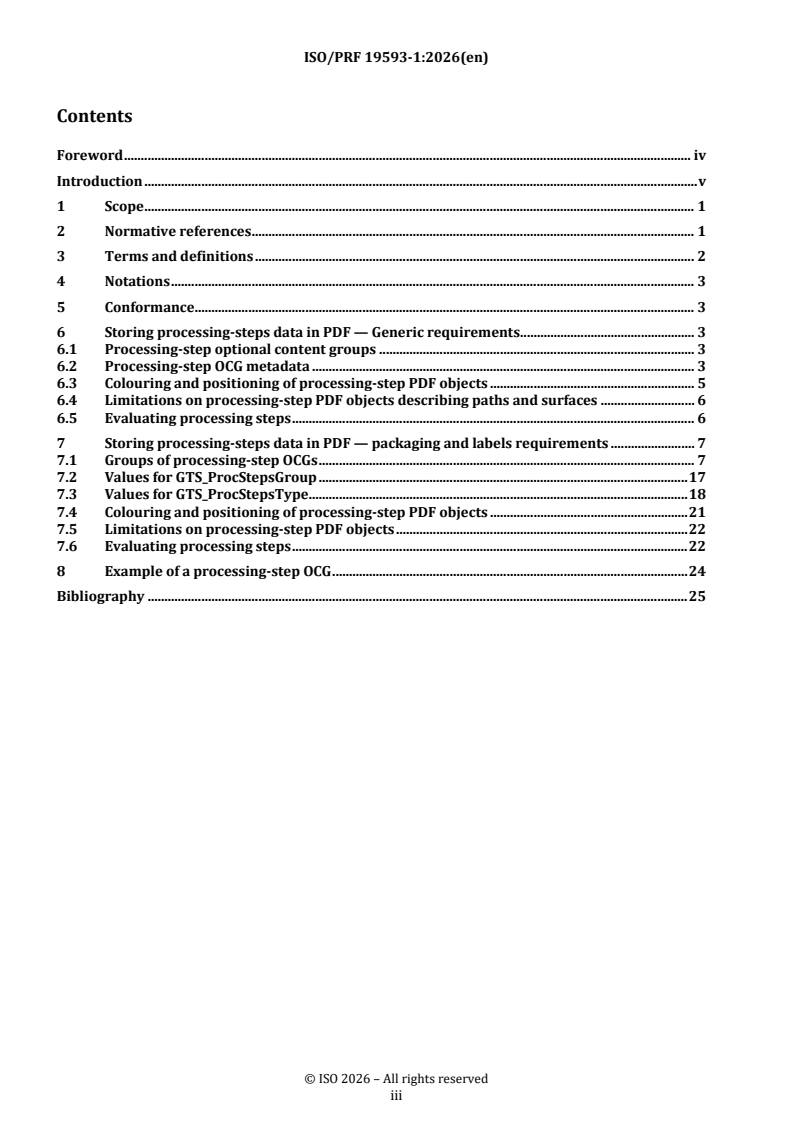
Contents
Foreword . iv
Introduction . v
1 Scope . 1
2 Normative references . 1
3 Terms and definitions . 2
4 Notations . 3
5 Conformance . 3
6 Storing processing-steps data in PDF — Generic requirements . 3
6.1 Processing-step optional content groups . 3
6.2 Processing-step OCG metadata . 3
6.3 Colouring and positioning of processing-step PDF objects . 5
6.4 Limitations on processing-step PDF objects describing paths and surfaces . 6
6.5 Evaluating processing steps . 6
7 Storing processing-steps data in PDF — packaging and labels requirements . 7
7.1 Groups of processing-step OCGs . 7
7.2 Values for GTS_ProcStepsGroup . 17
7.3 Values for GTS_ProcStepsType . 18
7.4 Colouring and positioning of processing-step PDF objects . 21
7.5 Limitations on processing-step PDF objects . 22
7.6 Evaluating processing steps . 22
8 Example of a processing-step OCG . 24
Bibliography . 25
iii
ISO/PRF 19593-1:2026(en)
Foreword
ISO (the International Organization for Standardization) is a worldwide federation of national standards
bodies (ISO member bodies). The work of preparing International Standards is normally carried out through
ISO technical committees. Each member body interested in a subject for which a technical committee has been
established has the right to be represented on that committee. International organizations, governmental and
non-governmental, in liaison with ISO, also take part in the work. ISO collaborates closely with the
International Electrotechnical Commission (IEC) on all matters of electrotechnical standardization.
The procedures used to develop this document and those intended for its further maintenance are described
in the ISO/IEC Directives, Part 1. In particular, the different approval criteria needed for the different types of
ISO documents should be noted. This document was drafted in accordance with the editorial rules of the
ISO/IEC Directives, Part 2 (see www.iso.org/directives).
ISO draws attention to the possibility that the implementation of this document may involve the use of (a)
patent(s). ISO takes no position concerning the evidence, validity or applicability of any claimed patent rights
in respect thereof. As of the date of publication of this document, ISO had not received notice of (a) patent(s)
which may be required to implement this document. However, implementers are cautioned that this may not
represent the latest information, which may be obtained from the patent database available at
www.iso.org/patents. ISO shall not be held responsible for identifying any or all such patent rights.
Any trade name used in this document is information given for the convenience of users and does not
constitute an endorsement.
For an explanation of the voluntary nature of standards, the meaning of ISO specific terms and expressions
related to conformity assessment, as well as information about ISO's adherence to the World Trade
Organization (WTO) principles in the Technical Barriers to Trade (TBT), see www.iso.org/iso/foreword.html.
This document was prepared by Technical Committee ISO/TC 130, Graphic technology.
This second edition cancels and replaces the first edition (ISO 19593-1:2018), which has been technically
revised.
The main changes are as follows:
— — additional processing-step groups and types have been defined;
— — allowance for usage of the GTS_Metadata dictionary has been given for OCGs that are not processing-
step OCGs;
— — processing-step PDF object membership of multiple processing-step OCGs, that have different group
and/or type, has been prohibited;
— — a recommendation to include PDF objects, that are not processing-step PDF objects, in one or more
OCGs has been added.
A list of all parts in the ISO 19593 series can be found on the ISO website.
Any feedback or questions on this document should be directed to the user’s national standards body. A
complete listing of these bodies can be found at www.iso.org/members.html.
iv
ISO/PRF 19593-1:2026(en)
Introduction
It is common practice in the packaging segment, and other segments of the printing industry, to work with
PDF files that contain PDF graphics objects to be used for printing and additional PDF graphics objects and
metadata to be used for other steps in the production of the final product. These nonprinting PDF objects and
metadata correspond to additional processing steps, for example die cutting or creasing. In this way a PDF file
can serve as a container for all production data, printing and nonprinting, of a printed product, such as a
package or a label.
These processing-steps data are used in various steps of the production chain:
— — a graphic designer may use them to correctly position graphical elements;
— — a quality controller may use them to verify correctness of the design before producing the printed
element;
— — a system performing layout of the printed products on a substrate may use them to determine an
optimal layout with minimal waste of substrate;
— — they can be used to manufacture tools for production;
— — they can be used directly by digitally controlled finishing devices.
In a typical example workflow:
a) a) all PDF graphics objects are rendered for proofing and viewing purposes;
b) b) in the final production printing, only PDF graphics objects intended for printing are used and
the PDF graphics objects intended to describe additional processing steps are ignored;
c) c) in a finishing step of the final production workflow the PDF graphics objects intended for
printing are ignored while a set of PDF graphics objects corresponding with this processing step are used.
Without an established standard, multiple ad hoc methods are used to store, such data in a PDF file, depending
on the application used to generate the PDF file and the preferences of the user. For example, in a PDF file the
cut line can be stored in a layer called “CAD” using a contour with a stroke in spot colourant “coupe”, or the
cut line can be stored in the same layer as the graphics and represented as a contour with a stroke in spot
colourant “cut”.
The use of multiple ad hoc methods leads to problems of interoperability between companies and systems.
When a PDF file is sent from one participant in the packaging supply chain to another, the recipient needs to
know how processing-steps data are stored in the PDF file and his or her workflow (often automated) must
be able to handle the particular mechanisms used by the sender. When the recipient receives files from
multiple senders that all use different mechanisms, this becomes complex and error-prone. For example, if a
converter has configured RIPs to ignore separations with spot colourant “cut” in incoming PDF files and the
recipient subsequently receives a PDF file with a spot colourant “coupe”, he or she risks wasting a printing
plate or, even worse, erroneously printing the die line on the package.
This document defines standardized mechanisms to store graphics objects and metadata corresponding to
processing steps in a PDF file. These mechanisms are intended to be generic and applicable not only to
packaging and label production but also to other segments of the printing industry.
Besides metadata identifying processing steps, requirements are defined describing how objects related to a
particular processing step may interact with the content of other processing steps or regular print content.
For example, objects related to a cutting processing step should not knock out regular print objects. Additional
v
ISO/PRF 19593-1:2026(en)
requirements define which objects can reasonably be part of certain processing steps. For example, halftone
images do not make sense for a cutting processing step.
This document defines the syntax for defining processing steps and technical rules for possible
interdependencies between certain processing step information and other content.
This document defines a set of processing groups and types that are applicable to the packaging and label
segment of the printing industry. Although defined specifically for packaging and labels, these groups and
types may also be applicable to other segments of the printing industry such as sign and display or commercial
print.
Subsequent parts of the ISO 19593 series mightcan either extend the list of defined processing groups and
types to address the needs of other segments of the printing industry or define new groups and types needed
in the packaging and labels segment.
vi
ISO/PRF 19593-1:2026(en)
Graphic technology — Use of PDF to associate processing steps and
content data —
—
Part 1:
Processing steps for packaging and labels
1 Scope
This document describes a method for storing data in a PDF file that correspond to the processing steps of
printed products. This method has three parts:
1) 1) metadata identifying processing steps;
2) 2) limitations on the interaction between PDF graphics objects that are part of a processing step
and other PDF graphics objects;
3) 3) limitations on PDF graphics objects in processing steps.
This method is intended to be generic, i.e. not specific to packaging and labels.
In addition, this document defines the following packaging- and label-specific groups of processing steps data:
— — data corresponding to finishing steps, such as cutting, folding or glueing;
— — braille;
— — information panels;
— — indications of physical dimensions;
— — indications of intended positions of graphical elements;
— — printed white, for example on transparent or metallic surfaces;
— — printed varnish;
— — primer;
— — printing plate making.
2 Normative references
The following documents are referred to in the text in such a way that some or all of their content constitutes
requirements of this document. For dated references, only the edition cited applies. For undated references,
the latest edition of the referenced document (including any amendments) applies.
ISO 32000--1:2008, Document management — Portable document format — Part 1: PDF 1.7
ISO 32000--2:2020, Document management — Portable document format — Part 2: PDF 2.0
ISO/PRF 19593-1:2026(en)
3 Terms and definitions
For the purposes of this document, the following terms and definitions apply.
ISO and IEC maintain terminology databases for use in standardization at the following addresses:
— — ISO Online browsing platform: available at https://www.iso.org/obp
— — IEC Electropedia: available at https://www.electropedia.org/
3.1 3.1
processing step
step in production of print products other than regular printing of colour on the print surface
EXAMPLE Cutting, printing of white, varnish or similar.
3.2 3.2
contour
path or text PDF graphics object with path-based glyph descriptions
3.3 3.3
processing-step PDF object
PDF graphics object that is a member of a processing-step OCG
3.4 3.4
processing-step OCG
optional content group grouping PDF objects that are intended to be used for the purpose of performing a
processing step
EXAMPLE An OCG with 2 circular paths that are used to define the geometry of circular piece of carton with a hole
that will be cut from a sheet.
3.5 3.5
surface of the printed product
area of the printed substrate that will be used for the final printed product
Note 1 to entry: Each part of the ISO 19593 series contains a precise definition of the surface of the printed product. For
this document this definition can be found in 7.4.17.4.1.
3.6 3.6
spot colourant
colourant that is not a process colourant
3.7 3.7
printing colourant
colourant of a printing device
3.8 3.8
station
specific location in cutting die from which an individual packaging or label item will be cut from the roll or
sheet of material
3.9 3.9
evaluator
software application capable of using processing-step PDF objects in the context of a processing step
ISO/PRF 19593-1:2026(en)
EXAMPLE Front-end software of a digital cutting table that can generate cutting instructions for the digital cutting
table from cutting processing-step PDF objects.
4 Notations
PDF operators, PDF keywords, the names of keys in PDF dictionaries and other predefined names are written
in bold; for example, the key BM. Operands of PDF operators or values of PDF dictionary keys are written in
italic; for example, the multiply value for the BM key.
5 Conformance
This document defines the use of processing step PDF graphics objects for the exchange of processing-steps
data.
A PDF file conforming to this document shall be one in which processing-steps data are included in the PDF
using a method that adheres to this document. Such a PDF file shall conform with the requirements of both
Clause 6Clause 6 and Clause 7Clause 7. A conforming file may also use additional methods to describe
processing-steps data. If used, these alternative methods shall not contradict the data stored using the method
described in this document.
A conforming file shall conform to at least one of the following International Standards: ISO 32000-1 or ISO
32000-2.
A conforming reader is a software application that shall be able to read and appropriately process all files
conforming to this document and conforming to at least one of ISO 32000-1 or ISO 32000-2.
6 Storing processing-steps data in PDF — Generic requirements
6.1 Processing-step optional content groups
The use of optional content groups (OCGs) allows labelling graphics objects throughout a PDF file in such a
way that they can easily be included or excluded from output. While an OCG can easily be used to group
graphics objects together, there is no standardized mechanism to store identifying information in such an OCG.
A processing-step OCG shall have a GTS_Metadata key in the OCG dictionary, as described in 6.26.2,, where
the value of this key is a dictionary containing standardized identifying information for the processing step
which this processing-step OCG corresponds to.
NOTE The Name key of the OCG cannot be used for identification because its values are a) not standardized and b)
often used for display in user interface which conflicts with the possibility of standardizing them. Although it might be
acceptable for an English user, for example, to work with an OCG called “Die cut” and learn to standardize on it, the same
would likely not be true for a Dutch or Chinese user.
A processing-step OCG shall only contain PDF graphics objects whose intended usage is consistent with the
processing step defined by GTS_Metadata.
Processing-step PDF objects shall only be member of multiple processing step OCGs for the same kind of
processing step (see 6.2clause 6.2).).
To allow an evaluator to evaluate a specific processing step using OCG state controls, all PDF objects, that are
not processing-step PDF objects, should be member of an OCG that is not a processing-step OCG.
6.2 Processing-step OCG metadata
The optional content group dictionary of a processing-step OCG shall contain the GTS_Metadata key, the value
of which shall be a dictionary, as indicated in Table 1Table 1.
ISO/PRF 19593-1:2026(en)
Table 1 — Additional GTS_Metadata entry in an optional content group dictionary
Key Type Value
GTS_Metadata dictionary (Required for a processing-step OCG) GTS_Metadata dictionary
containing keys defined in Table 2Table 2
It is often necessary to preserve hierarchical information about processing steps. For automated tools, for
example, it might not be enough to know that graphics objects are related to a “Structural” processing step;
one might need to be able to discern the difference between cut and crease lines. To enable this, the
GTS_Metadata dictionary contains enough information to preserve such hierarchy.
Table 2 — Entries in a GTS_Metadata dictionary
Key Type Value
GTS_ProcStepsGroup name (Required for a processing-step OCG)
Name of the processing step group this processing step belongs to.
The value of this key shall be taken from a list of predefined values in
the relevant part of the ISO 19593 series when such value is
applicable.
If the relevant part of the ISO 19593 series does not define an
applicable value, a custom value may be used in a conforming file. All
custom values for this key shall be either second class or third class
names as described in ISO 32000-2:2020, Annex E, though second
class is strongly recommended.
GTS_ProcStepsType name (Optional; required for some values of GTS_ProcStepsGroup)
Name of the type of processing step within the group defined by the
value of GTS_ProcStepsGroup.
The value of this key shall be taken from a list of predefined values in
the relevant part of the ISO 19593 series when such value is
applicable.
If the relevant part of the ISO 19593 series does not define an
applicable value, a custom value may be used in a conforming file. All
custom values for this key shall be either second class or third class
names as described in ISO 32000-2:2020, Annex E, though second
class is strongly recommended.
GTS_ProcStepsColorant name (Required for some combinations of the value of GTS_ProcStepsGroup
andProcStepsGroupand GTS_ProcStepsType)
The value of this key shall be either a name of a printing colourant or
the value Default. Values All and None shall not be used.
When the value is a printing colourant name, the processing step is
applicable for that specific printing colourant.
When the value is Default, the processing step is applicable to all
printing colourants for which there is no explicit
GTS_ProcStepsColorant entry and the same combination of
GTS_ProcStepsGroup and GTS_ProcStepsType.
The GTS_ProcStepsGroup key defines the group of processing steps the graphics objects in this OCG belong
to. The GTS_ProcStepsType key optionally defines the type of processing steps for the graphics objects in the
OCG. The GTS_ProcStepsColorant optionally indicates that a particular processing-step is related to a specific
printing colourant.
ISO/PRF 19593-1:2026(en)
For a processing-step OCG, the GTS_Metadata dictionary shall contain the GTS_ProcStepsGroup key. For an
OCG, that is not a processing-step OCG, the GTS_Metadata dictionary, if present, shall not contain the
GTS_ProcStepsGroup key.
For some values of the GTS_ProcStepsGroup key, the GTS_ ProcStepsType key shall also be present. The
combination of the value of the GTS_ProcStepsGroup and the value of the GTS_ProcStepsType key uniquely
define the processing step. (see 7.3clause 7.3))
For some combinations of the value of the GTS_ProcStepsGroup and the value of the GTS_ProcStepsType
key, the GTS_ProcStepsColorant key shall also be present. (see 7.3.3clause 7.3.3))
A PDF file may contain multiple OCGs with the same combination of values of GTS_ProcStepsGroup and
GTS_ProcStepsType. These OCGs correspond with the same kind of processing step.
A processing-step PDF object shall only be a member of processing step OCGs that have identical values for
GTS_ProcStepsGroup and identical values for GTS_ProcStepsType when present.
6.3 Colouring and positioning of processing-step PDF objects
6.3.1 Overview
This subclause defines alternative sets of requirements for processing steps. The relevant part of the
ISO 19593 series indicates which set of requirements is applicable to which groups or types of processing
steps and may specify alternative requirements that differ from these.
The purpose of the sets of requirements is to guarantee that rendering of the device colourants within the
surface of the printed product on the intended final printing device (i.e. the printing device that will be used
to print the content of the conforming file in production) are not affected by the presence of processing-step
PDF objects in the PDF.
6.3.2 Colouring and positioning of processing-step PDF objects in off-bleed areas
This set of requirements is applicable to processing-step PDF objects that are not allowed to overlap with the
actual print content.
— — These processing-step PDF objects may have any PDF-conforming colouring, overprint or
transparency blending.
— — These processing-step PDF objects shall be positioned in an “off-bleed” area, i.e. they shall not overlap
geometrically with the surface of the printed product. Determination of overlapping shall use areas
marked by the actual graphics objects and shall not be defined by a rectangular bounding box or similar
method.
The specific definition of the surface of the printed product to be used shall be taken from the relevant part of
the ISO 19593 series.
6.3.3 Colouring and positioning of processing-step PDF objects allowed to overlap with print
content
This set of requirements is applicable to processing-step PDF objects that are allowed to overlap with print
content.
— — These processing-step PDF objects may appear anywhere on the PDF page.
— — These processing-step PDF objects shall be coloured using a spot colourant. Colourants used for page
content that does not form part of a processing-step OCG shall not be used to colour these processing-step
ISO/PRF 19593-1:2026(en)
PDF objects. Colourants with the name All, None, Cyan, Magenta, Yellow or Black shall not be used to
colour these processing-step PDF objects.
— — The graphics state for these processing-step PDF objects shall have the overprint parameter set to true
for stroke when the object is painted with a stroke. The graphics state for these processing-step PDF
objects shall have the overprint parameter set to true for fill if the object is painted with a fill. These
processing-step PDF objects shall not use PDF transparency, either directly or through membership of a
transparency group other than the page-level transparency group. The method to determine if a PDF
object uses transparency shall be as described in ISO 32000-2:2020, Annex Q.
— — Page content that does not belong to a processing step shall be placed in the appropriate order of the
content stream such that no PDF graphics objects are drawn on top of and overlapping with these
processing-step PDF objects. Determination of overlapping shall use areas marked by the actual graphics
objects or within the area of a soft mask and shall not be defined by a rectangular bounding box or similar
method.
6.4 Limitations on processing-step PDF objects describing paths and surfaces
The purpose of this set of requirements is to limit the types of PDF objects in certain processing steps
describing paths or surfaces. The relevant part of the ISO 19593 series indicates for which group or type of
processing steps these requirements are valid and may specify alternative requirements that differ from these.
— — These processing-step OCGs shall only contain PDF path objects, PDF text objects and form XObjects.
PDF objects in these form XObjects shall follow the requirements of 6.46.4.
— — Processing-step PDF objects in these processing-step OCGs describing paths shall have a stroke. They
should not have a fill.
— — Processing-step PDF objects in these processing-step OCGs describing surfaces shall have a fill or a
stroke or both a fill and a stroke.
— — The Pattern colour space shall not be used
...