

ISO 109:1982
(Main)Textile machinery — Working widths of weaving machines
General Information
- Abstract
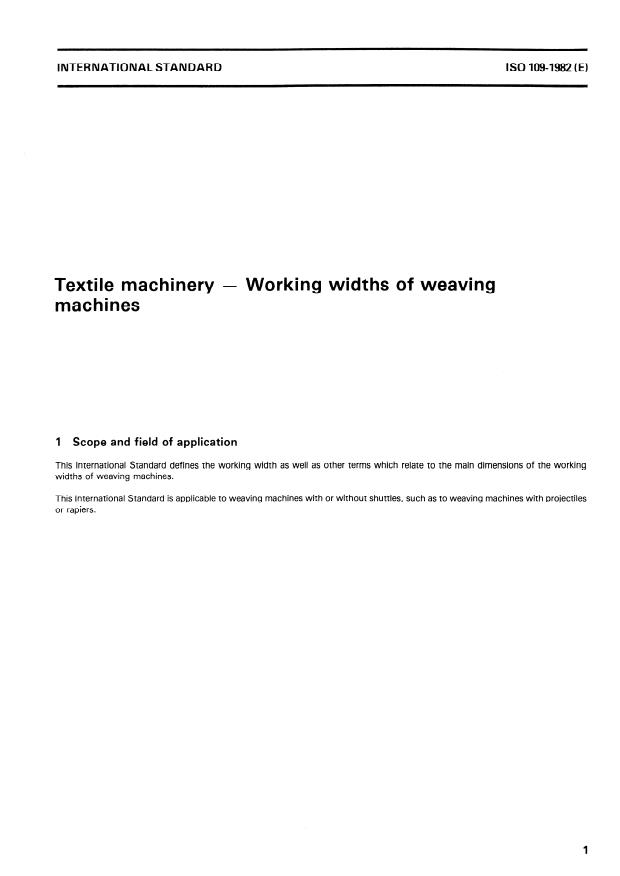
Defines the working width as well as other terms which relate to the main dimensions of the working widths of weaving machines. Applicable to weaving machines with or without shuttles, such as weaving machines with projectiles or rapiers. - Replaces ISO Recommendation R 109-1968 and constitutes its technical revision.
- Status
- Published
- Publication Date
- 31-Aug-1982
- Current Stage
- 9093 - International Standard confirmed
- Start Date
- 09-Sep-2024
- Completion Date
- 29-Aug-2026
Buy Documents

ISO 109:1982 - Textile machinery — Working widths of weaving machines Released:9/1/1982

ISO 109:1982 - Matériel pour l'industrie textile — Largeurs de tissage des machines a tisser Released:9/1/1982

ISO 109:1982 - Matériel pour l'industrie textile — Largeurs de tissage des machines a tisser Released:9/1/1982
Overview
ISO 109:1982 is an international standard established by the International Organization for Standardization (ISO) that specifies the working widths and related dimensional terminology for weaving machines used in the textile industry. This standard applies to a range of weaving machinery types, including those with or without shuttles such as projectile and rapier weaving machines. It replaces the previous ISO Recommendation R 109-1968 and provides a technical revision to ensure consistency and clarity in the designation and measurement of weaving machine widths.
Key Topics
Working Width Definitions
ISO 109:1982 clearly defines the key dimensional terms for weaving machines:- Maximum Working Width: The largest width of the warp sheet that can be woven within the reed, including auxiliary selvedges if needed.
- Minimum Working Width: The smallest usable warp width within the reed configuration.
- Reed Space: The maximum space available to accommodate the reed in the weaving machine.
- Usable Width of Heald Frame: The portion of the heald frame rod available for stringing healds.
Dimensional Intervals
The standard recommends that maximum working widths begin at 800 mm and increase in intervals of 100 mm, with a suggested future step increment of 200 mm. This incremental system facilitates compatibility and standardization of machine components.Component Dimension Coordination
To ensure operational efficiency, the dimensional attributes of critical weaving machine parts-such as the weaver’s beam, warp stop motion, heald frames, and cloth roller-must be designed in alignment with the specified maximum working width. This harmonization enables modular design and interchangeability within the machinery assembly.
Applications
ISO 109:1982 is essential for manufacturers, engineers, and quality assurance teams involved in the design, production, and maintenance of weaving machines. The standard offers practical benefits that include:
Design Consistency
Ensures equipment manufacturers produce weaving machines with standardized width dimensions, facilitating compatibility with various textile production lines.Interoperability
Supports machinery upgrades and integration by providing clear guidance on component dimensions, which aids in selecting parts or retrofitting machines.Quality Control
By following standard width definitions, textile producers can maintain consistent fabric quality and reduce production variability resulting from incorrect machine settings.Technical Communication
Provides a common language for cross-border collaboration among textile machinery manufacturers, suppliers, and users, reducing misunderstandings during specification and procurement.
Related Standards
ISO R 109-1968
The original recommendation that ISO 109:1982 replaces and technically revises, focusing on weaving machine width terminology.ISO/TC 72
The Technical Committee responsible for textile machinery standards, which develops related standards concerning weaving operations, machinery components, and auxiliary equipment.Other Textile Machinery Standards
Standards covering loom safety, performance criteria, and control systems often complement ISO 109 by defining additional requirements linked to weaving machine operation and maintenance.
Keywords: ISO 109:1982, weaving machines, working width, textile machinery standards, maximum working width, minimum working width, reed space, heald frame dimensions, weaving machine components, textile industry standardization, shuttleless weaving machines, rapier machines, projectile weaving machines.
Buy Documents
ISO 109:1982 - Textile machinery — Working widths of weaving machines Released:9/1/1982
ISO 109:1982 - Matériel pour l'industrie textile — Largeurs de tissage des machines a tisser Released:9/1/1982
ISO 109:1982 - Matériel pour l'industrie textile — Largeurs de tissage des machines a tisser Released:9/1/1982
Get Certified
Connect with accredited certification bodies for this standard

Control Union Certifications
Global certification for agriculture and sustainability.

Hohenstein Institut
Textile testing and certification.

Bureau Veritas Bangladesh
Bureau Veritas certification services in Bangladesh.
Sponsored listings
Frequently Asked Questions
ISO 109:1982 is a standard published by the International Organization for Standardization (ISO). Its full title is "Textile machinery — Working widths of weaving machines". This standard covers: Defines the working width as well as other terms which relate to the main dimensions of the working widths of weaving machines. Applicable to weaving machines with or without shuttles, such as weaving machines with projectiles or rapiers. - Replaces ISO Recommendation R 109-1968 and constitutes its technical revision.
Defines the working width as well as other terms which relate to the main dimensions of the working widths of weaving machines. Applicable to weaving machines with or without shuttles, such as weaving machines with projectiles or rapiers. - Replaces ISO Recommendation R 109-1968 and constitutes its technical revision.
ISO 109:1982 is classified under the following ICS (International Classification for Standards) categories: 59.120.30 - Looms. Weaving machines. The ICS classification helps identify the subject area and facilitates finding related standards.
ISO 109:1982 is available in PDF format for immediate download after purchase. The document can be added to your cart and obtained through the secure checkout process. Digital delivery ensures instant access to the complete standard document.
Standards Content (Sample)
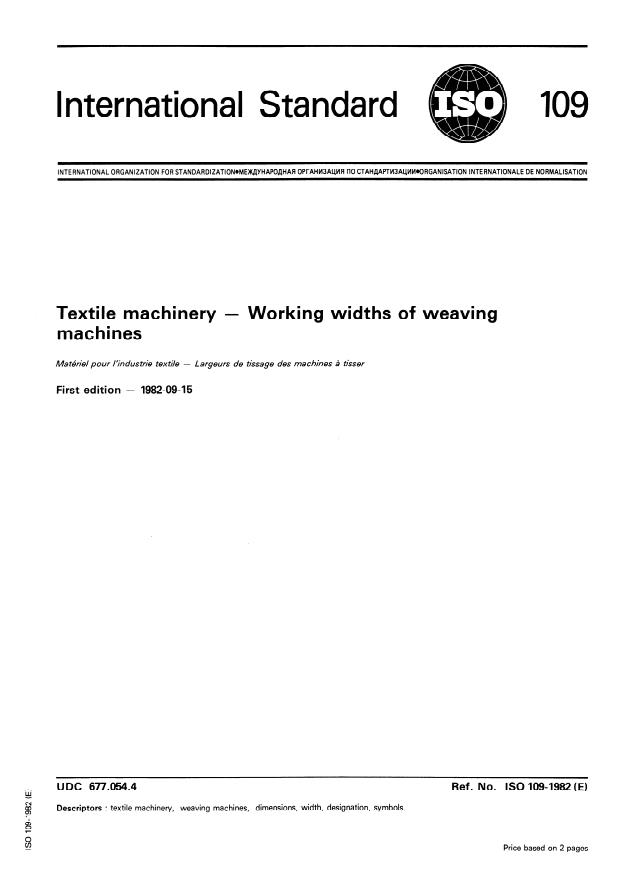
International Standard
INTERNATIONAL ORGANIZATION FOR STANDARDIZATIONWlE~YHAP~~HAR OPrAHM3ALMR fl0 CTAHC\APTbl3Al&lbl~RGANISATION INTERNATIONALE DE NORMALISATION
Textile machinery - Working widths of weaving
machines
Ma thriel pour l ’industrie textile - Largeurs de tissage des machines 2 tisser
First edition - 1982-09-15
UDC 677.054.4 Ref. No. ISO 1094982 (E)
dimensions, width, designation, Symbols.
Descriptors : textile machinery, weaving machines,
Price based on 2 pages
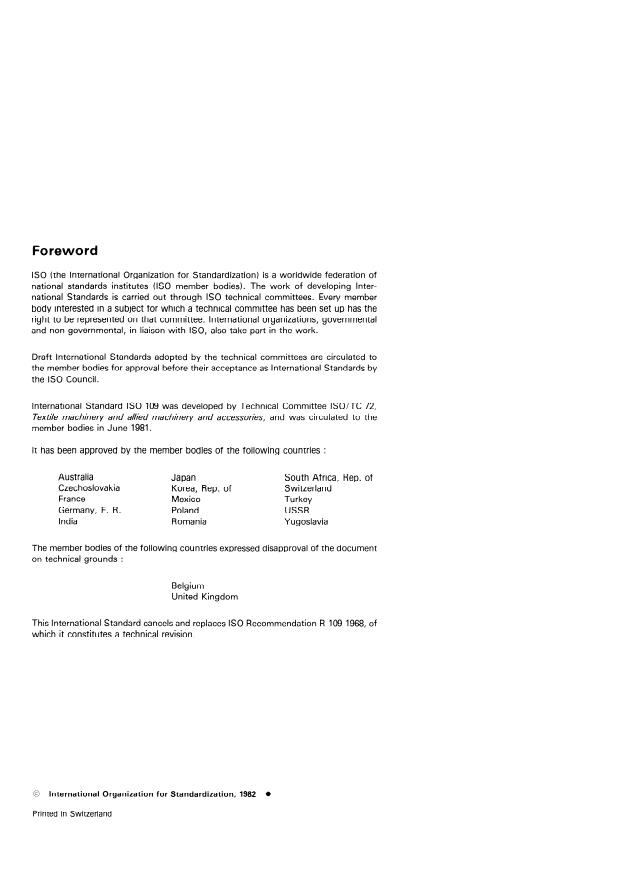
Foreword
SS8 (the International Organization for Standardization) is a worldwide federation of
national Standards institutes (ISO member bodies). The work of developing Inter-
national Standards is carried out through ISO technical committees. Every member
body interested in a subject for which a technical committee has been set up has the
right to be represented on that committee. International organizations, governmental
and non-governmental, in liaison with ISO, also take part in the work.
Braft International Standards adopted by the technical committees are circuiated to
the member bodies for approval before their acceptance as International Standards by
the ISO Council.
International Standard ISO 109 was developed by Technical Committee ISO/TC 72,
Textile machinery and alied machinery and accessories, and was circulated to the
member bodies in June 1981.
lt has been approved by the member bodies of the following countries :
Australia South Africa, Rep. of
Japan
Czechoslovakia Korea, Rep. of Switzerland
France Mexico Turkey
Germany, F. R. Poland USSR
India Romania Y ugoslavia
The member bodies of the fall owing cou ntries expressed disapproval sf the document
on technical grounds :
Belgium
United Kingdom
This Inte
...
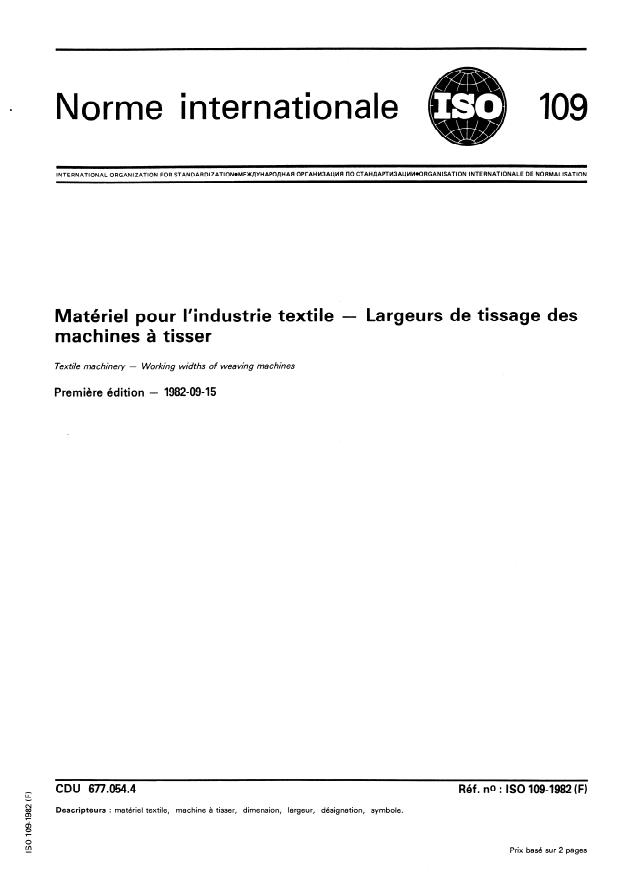
Norme internationale
INTERNATIONAL ORGANIZATION FOR STANDARDIZATIONWME~YHAPOflHAFI OP~AHM3Al.&lR IlO CTAH~APTM3AL(MM~RGANISATION INTERNATIONALE DE NORMALISATION
Matériel pour l’industrie textile - Largeurs de tissage des
machines à tisser
Textile machinery - Working widths of weaving machines
Première édition - 1982-09-15
CDU 677.054.4 Réf. no : ISO 109-1982 (FI
Descripteurs : matériel textile, machine à tisser, dimension, largeur, désignation, symbole.
Prix basé sur 2 pages
Avant-propos
L’ISO (Organisation internationale de normalisation) est une fédération mondiale
d’organismes nationaux de normalisation (comités membres de I’ISO). L’élaboration
des Normes internationales est confiée aux comités techniques de I’ISO. Chaque
comité membre intéressé par une étude a le droit de faire partie du comité technique
correspondant. Les organisations internationales, gouvernementales et non gouverne-
mentales, en liaison avec I’ISO, participent également aux travaux.
Les projets de Normes internationales adoptés par les comités techniques sont soumis
aux comités membres pour approbation, avant leur acceptation comme Normes inter-
nationales par le Conseil de I’ISO.
La Norme internationale ISO 109 a été élaborée par le comité technique ISO/TC 72,
Matérielpour l’industrie textile et matériel connexe, et a été soumise aux comités mem-
bres en juin 1984.
Les comités membres des pays suivants l’ont approuvée :
Afrique du Sud, Rép. d’
Inde Suisse
Allemagne, R. F. Tchécoslovaquie
Japon
Australie Mexique Turquie
Corée, Rép. de
Pologne URSS
France Roumanie Yougoslavie
Les comités membres des suivants l’ont désapprouvée pour raisons
Pays
techniques :
Belgique
Royaume- Uni
Cette Norme internationale annule et remplace la Recommandation ISO/R 109-1968,
dont elle constit
...
Norme internationale
INTERNATIONAL ORGANIZATION FOR STANDARDIZATIONWME~YHAPOflHAFI OP~AHM3Al.&lR IlO CTAH~APTM3AL(MM~RGANISATION INTERNATIONALE DE NORMALISATION
Matériel pour l’industrie textile - Largeurs de tissage des
machines à tisser
Textile machinery - Working widths of weaving machines
Première édition - 1982-09-15
CDU 677.054.4 Réf. no : ISO 109-1982 (FI
Descripteurs : matériel textile, machine à tisser, dimension, largeur, désignation, symbole.
Prix basé sur 2 pages
Avant-propos
L’ISO (Organisation internationale de normalisation) est une fédération mondiale
d’organismes nationaux de normalisation (comités membres de I’ISO). L’élaboration
des Normes internationales est confiée aux comités techniques de I’ISO. Chaque
comité membre intéressé par une étude a le droit de faire partie du comité technique
correspondant. Les organisations internationales, gouvernementales et non gouverne-
mentales, en liaison avec I’ISO, participent également aux travaux.
Les projets de Normes internationales adoptés par les comités techniques sont soumis
aux comités membres pour approbation, avant leur acceptation comme Normes inter-
nationales par le Conseil de I’ISO.
La Norme internationale ISO 109 a été élaborée par le comité technique ISO/TC 72,
Matérielpour l’industrie textile et matériel connexe, et a été soumise aux comités mem-
bres en juin 1984.
Les comités membres des pays suivants l’ont approuvée :
Afrique du Sud, Rép. d’
Inde Suisse
Allemagne, R. F. Tchécoslovaquie
Japon
Australie Mexique Turquie
Corée, Rép. de
Pologne URSS
France Roumanie Yougoslavie
Les comités membres des suivants l’ont désapprouvée pour raisons
Pays
techniques :
Belgique
Royaume- Uni
Cette Norme internationale annule et remplace la Recommandation ISO/R 109-1968,
dont elle constit
...