

ISO 5950:2012
(Main)Electrolytic tin-coated cold-reduced carbon steel sheet of commercial and drawing qualities
General Information
- Abstract
ISO 5950:2012 applies to cold-reduced carbon steel sheet of commercial and drawing qualities coated in coil or cut length forms by electro-deposition of tin. The product is commonly known as electrolytic tin-coated sheet and is used where solderability is desired, appearance is important, or a degree of corrosion resistance under specific conditions is advantageous and coating mass can be specified. The coating is expressed as the total coating on both surfaces, in grams per square metre. The coating mass specified should be compatible with the desired service life, thickness of the base metal and the forming requirements involved. A designation system includes the coating designation, coating condition and quality. ISO 5950:2012 does not cover tinplate and blackplate.
- Status
- Published
- Publication Date
- 17-Oct-2012
- Technical Committee
- ISO/TC 17/SC 12 - Continuous mill flat rolled products
- Drafting Committee
- ISO/TC 17/SC 12 - Continuous mill flat rolled products
- Current Stage
- 9093 - International Standard confirmed
- Start Date
- 09-Aug-2024
- Completion Date
- 29-Aug-2026
Buy Documents
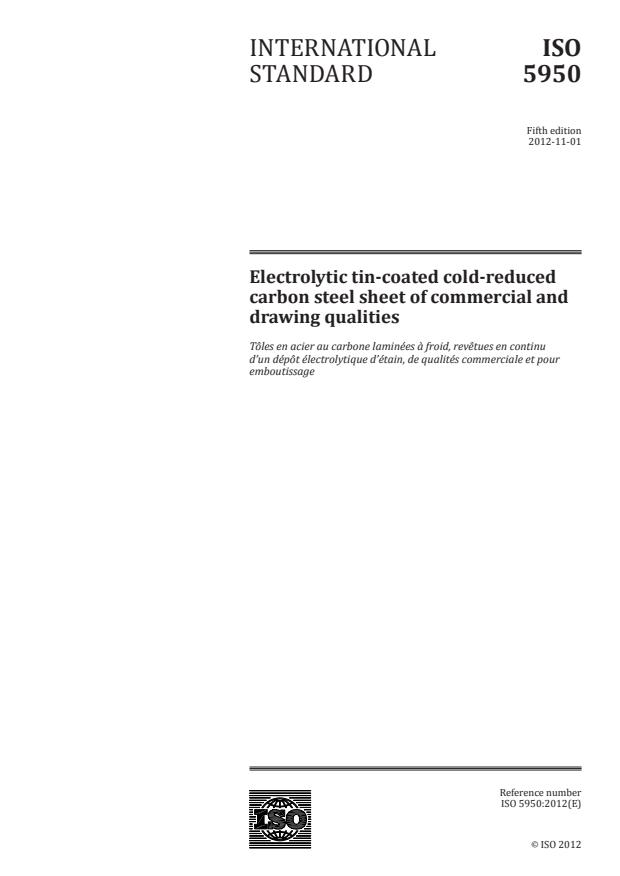
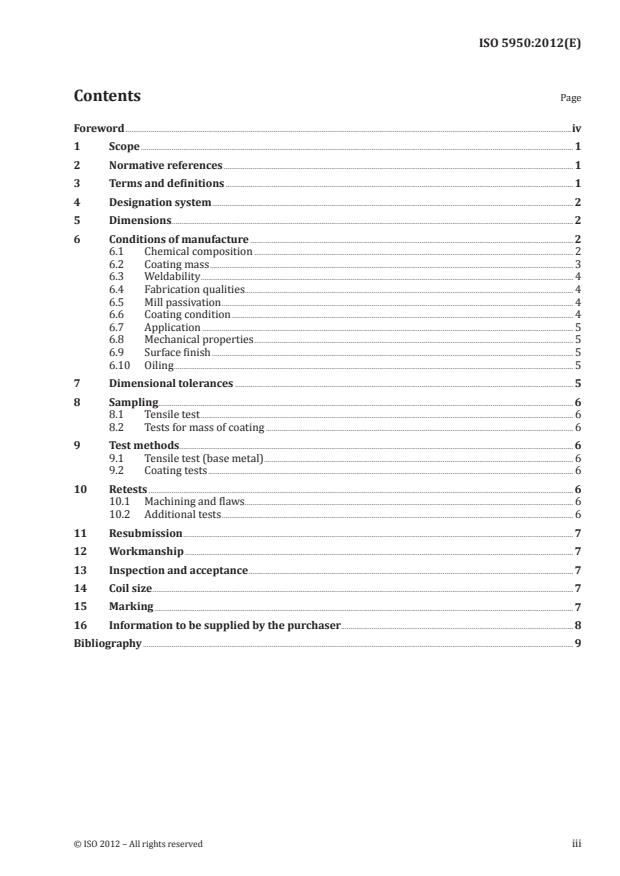
ISO 5950:2012 - Electrolytic tin-coated cold-reduced carbon steel sheet of commercial and drawing qualities Released:10/18/2012
ISO 5950:2012 - Electrolytic tin-coated cold-reduced carbon steel sheet of commercial and drawing qualities Released:8/5/2014
Overview
ISO 5950:2012 specifies requirements for electrolytic tin-coated cold‑reduced carbon steel sheet (coil or cut lengths) of commercial and drawing qualities. The standard covers products produced by electrolytic tin deposition where solderability, appearance, or a degree of corrosion resistance is required and where the coating mass can be specified. Coating mass is expressed as the total tin on both surfaces in grams per square metre (g/m2). ISO 5950:2012 does not apply to tinplate or blackplate.
Key topics and technical requirements
- Product scope and forms: Cold‑reduced carbon steel sheet supplied in coils or cut lengths; commonly skin‑passed prior to tinning. Typical production thickness range noted in the standard is about 0.50 mm to 0.85 mm (market variants exist).
- Coating mass designations: Coatings are designated SN with nominal coating masses such as SN056 (5.6 g/m2), SN112, SN168, SN224 (total both sides). The standard defines nominal, minimum and check limits for coating mass.
- Coating condition: Two main surface conditions - BR (bright, reflowed/fused) and MA (matt, not reflowed) - with reflow producing a bright finish and some iron‑tin alloy formation.
- Material qualities: Quality designations 01 (commercial), 02 (drawing), 03 (deep drawing) and 04 (deep drawing aluminum killed) with associated chemical composition limits (C, Mn, P, S) and fabrication targets.
- Manufacture and testing: Includes requirements for chemical composition reporting, coating mass testing methods, tensile testing of base metal (reference to ISO 6892‑1), dimensional tolerances and sampling procedures.
- Designation system: Combines coating type, coating mass, coating condition and quality (example: SN056BR03 - tin coating, 5.6 g/m2, bright reflowed, deep drawing quality).
Applications and who uses this standard
ISO 5950:2012 is used by:
- Steel producers and tinning mills for specification, production control and product marking of electrolytic tin‑coated sheet.
- Purchasers, fabricators and OEMs who require predictable solderability, aesthetic finishes or limited corrosion resistance for formed parts.
- Quality and inspection teams to verify coating mass, mechanical properties and surface condition during acceptance.
Typical applications include components and assemblies where tin coating improves solderability, surface appearance or service life under defined environmental conditions.
Related standards
- ISO 6892‑1 - tensile testing of metallic materials (room temperature)
- ISO 16162 - cold‑rolled steel sheet dimensional and shape tolerances
Keywords: ISO 5950:2012, electrolytic tin‑coated sheet, tin coating, coating mass, cold‑reduced carbon steel, solderability, SN056.
Relations
- Effective Date
- 19-Nov-2011
Buy Documents
ISO 5950:2012 - Electrolytic tin-coated cold-reduced carbon steel sheet of commercial and drawing qualities Released:10/18/2012
ISO 5950:2012 - Electrolytic tin-coated cold-reduced carbon steel sheet of commercial and drawing qualities Released:8/5/2014
Get Certified
Connect with accredited certification bodies for this standard

Element Materials Technology
Materials testing and product certification.

Inštitut za kovinske materiale in tehnologije
Institute of Metals and Technology. Materials testing, metallurgical analysis, NDT.
Sponsored listings
Frequently Asked Questions
ISO 5950:2012 is a standard published by the International Organization for Standardization (ISO). Its full title is "Electrolytic tin-coated cold-reduced carbon steel sheet of commercial and drawing qualities". This standard covers: ISO 5950:2012 applies to cold-reduced carbon steel sheet of commercial and drawing qualities coated in coil or cut length forms by electro-deposition of tin. The product is commonly known as electrolytic tin-coated sheet and is used where solderability is desired, appearance is important, or a degree of corrosion resistance under specific conditions is advantageous and coating mass can be specified. The coating is expressed as the total coating on both surfaces, in grams per square metre. The coating mass specified should be compatible with the desired service life, thickness of the base metal and the forming requirements involved. A designation system includes the coating designation, coating condition and quality. ISO 5950:2012 does not cover tinplate and blackplate.
ISO 5950:2012 applies to cold-reduced carbon steel sheet of commercial and drawing qualities coated in coil or cut length forms by electro-deposition of tin. The product is commonly known as electrolytic tin-coated sheet and is used where solderability is desired, appearance is important, or a degree of corrosion resistance under specific conditions is advantageous and coating mass can be specified. The coating is expressed as the total coating on both surfaces, in grams per square metre. The coating mass specified should be compatible with the desired service life, thickness of the base metal and the forming requirements involved. A designation system includes the coating designation, coating condition and quality. ISO 5950:2012 does not cover tinplate and blackplate.
ISO 5950:2012 is classified under the following ICS (International Classification for Standards) categories: 77.140.50 - Flat steel products and semi-products. The ICS classification helps identify the subject area and facilitates finding related standards.
ISO 5950:2012 has the following relationships with other standards: It is inter standard links to ISO 5950:2008. Understanding these relationships helps ensure you are using the most current and applicable version of the standard.
ISO 5950:2012 is available in PDF format for immediate download after purchase. The document can be added to your cart and obtained through the secure checkout process. Digital delivery ensures instant access to the complete standard document.
Standards Content (Sample)
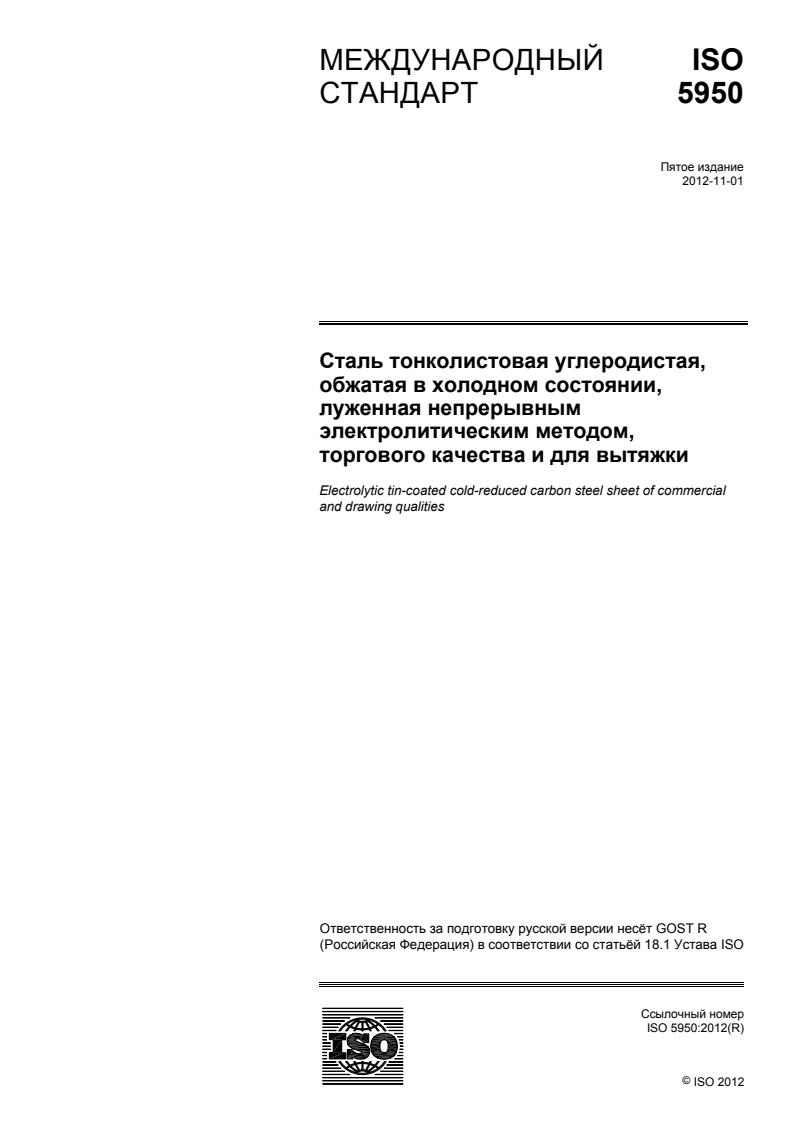
INTERNATIONAL ISO
STANDARD 5950
Fifth edition
2012-11-01
Electrolytic tin-coated cold-reduced
carbon steel sheet of commercial and
drawing qualities
Tôles en acier au carbone laminées à froid, revêtues en continu
d’un dépôt électrolytique d’étain, de qualités commerciale et pour
emboutissage
Reference number
©
ISO 2012
© ISO 2012
All rights reserved. Unless otherwise specified, no part of this publication may be reproduced or utilized in any form or by any
means, electronic or mechanical, including photocopying and microfilm, without permission in writing from either ISO at the
address below or ISO’s member body in the country of the requester.
ISO copyright office
Case postale 56 • CH-1211 Geneva 20
Tel. + 41 22 749 01 11
Fax + 41 22 749 09 47
E-mail copyright@iso.org
Web www.iso.org
Published in Switzerland
ii © ISO 2012 – All rights reserved
Contents Page
Foreword .iv
1 Scope . 1
2 Normative references . 1
3 Terms and definitions . 1
4 Designation system . 2
5 Dimensions . 2
6 Conditions of manufacture . 2
6.1 Chemical composition . 2
6.2 Coating mass . 3
6.3 Weldability . 4
6.4 Fabrication qualities. 4
6.5 Mill passivation . 4
6.6 Coating condition . 4
6.7 Application . 5
6.8 Mechanical properties . 5
6.9 Surface finish . 5
6.10 Oiling . 5
7 Dimensional tolerances . 5
8 Sampling . 6
8.1 Tensile test . 6
8.2 Tests for mass of coating . 6
9 Test methods . 6
9.1 Tensile test (base metal) . 6
9.2 Coating tests . 6
10 Retests . 6
10.1 Machining and flaws. 6
10.2 Additional tests . 6
11 Resubmission . 7
12 Workmanship . 7
13 Inspection and acceptance . 7
14 Coil size . 7
15 Marking . 7
16 Information to be supplied by the purchaser. 8
Bibliography . 9
Foreword
ISO (the International Organization for Standardization) is a worldwide federation of national standards
bodies (ISO member bodies). The work of preparing International Standards is normally carried out
through ISO technical committees. Each member body interested in a subject for which a technical
committee has been established has the right to be represented on that committee. International
organizations, governmental and non-governmental, in liaison with ISO, also take part in the work.
ISO collaborates closely with the International Electrotechnical Commission (IEC) on all matters of
electrotechnical standardization.
International Standards are drafted in accordance with the rules given in the ISO/IEC Directives, Part 2.
The main task of technical committees is to prepare International Standards. Draft International
Standards adopted by the technical committees are circulated to the member bodies for voting.
Publication as an International Standard requires approval by at least 75 % of the member bodies
casting a vote.
Attention is drawn to the possibility that some of the elements of this document may be the subject of
patent rights. ISO shall not be held responsible for identifying any or all such patent rights.
ISO 5950 was prepared by Technical Committee ISO/TC 17, Steel, Subcommittee SC 12, Continuous mill
flat rolled products.
This fifth edition cancels and replaces the fourth edition (ISO 5950:2008), which has been technically revised.
iv © ISO 2012 – All rights reserved
INTERNATIONAL STANDARD ISO 5950:2012(E)
Electrolytic tin-coated cold-reduced carbon steel sheet of
commercial and drawing qualities
1 Scope
1.1 This International Standard applies to cold-reduced carbon steel sheet of commercial and drawing
qualities coated in coil or cut length forms by electro-deposition of tin. The product is commonly known
as electrolytic tin-coated sheet and is used where solderability is desired, appearance is important, or
a degree of corrosion resistance under specific conditions is advantageous and coating mass can be
specified. The coating is expressed as the total coating on both surfaces, in grams per square metre. The
coating mass specified should be compatible with the desired service life, thickness of the base metal and
the forming requirements involved. A designation system (Clause 4) includes the coating designation,
coating condition and quality.
1.2 This International Standard does not cover tinplate and blackplate.
2 Normative references
The following referenced documents are indispensable for the application of this document. For dated
references, only the edition cited applies. For undated references, the latest edition of the referenced
document (including any amendments) applies.
ISO 6892-1, Metallic materials — Tensile testing — Part 1: Method of test at room temperature
ISO 16162, Cold-rolled steel sheet products — Dimensional and shape tolerances
3 Terms and definitions
For the purposes of this document, the following terms and definitions apply.
3.1
electrolytic tin-coated sheet
product obtained by electrolytic deposition of tin on cold-reduced steel sheet on a continuous electrolytic
tinning line to produce either tin-coated coils or tin-coated cut lengths
3.2
skin pass
light cold-rolling of the cold-reduced and annealed sheet prior to electro-tinning
NOTE The purposes of skin passing are one or more of the following:
a) to minimize the appearance of coil breaks, stretcher strains and fluting;
b) to control the shape;
c) to obtain the required surface finish.
An increase in hardness and some loss in ductility will result from skin passing.
3.3
aluminum killed
steel which has been deoxidized with aluminum sufficient to prevent the evolution of gas during
solidification
4 Designation system
The as-produced electrolytic tin-coated sheet coatings are designated as SN as shown in Table 4. The
coating mass designation follows the SN and three spaces are allocated for coating mass designation. If
only two spaces are required, such as for designation 56, then the 56 is preceded by a “0” to fill computer
space and is shown as “056”. Since this product is always skin-passed, the section in this designation
system usually reserved for S or N will be used to indicate where the tin has been reflowed, or whether
it is “matt” or not reflowed (see 6.6 and 6.9). Therefore, the designations for this tin condition will be
— BR: Bright reflowed, fused, melted,
— MA: Matt, dull, not reflowed, unmelted.
The numbers 01, 02, 03 and 04 are common to other standards indicating the qualities of commercial,
drawing, deep drawing, and deep drawing aluminium killed.
EXAMPLE SN056BR03 is a complete designation, including coating, coating mass, coating condition and
quality signifying:
— SN: Tin coating,
— 056: Coating designation (Table 4),
— BR: Bright; tin has been reflowed,
— 03: Deep drawing quality.
5 Dimensions
Electrolytic tin-coated sheet is normally produced in thicknesses from 0,50 mm to 0,85 mm and widths
of 600 mm to 1 050 mm, in coils and cut lengths.
NOTE Some world markets define “electrolytic tinplate” as having a maximum thickness of 0,38 mm, in
which case, the thickness range for “electrolytic tin-coated sheet” will have a minimum of 0,38 mm.
6 Conditions of manufacture
6.1 Chemical composition
The chemical composition (heat analysis) shall not exceed the values given in Tables 1 and 2. On request,
a report of the heat analysis shall be made to the purchaser.
Each of the elements listed in Table 2 shall be included in the report of the heat analysis. When the
amount of copper, nickel, chromium or molybdenum present is less that 0,02 %, the analysis result may
be reported as “< 0,02 %”.
A verification analysis may be made by the purchaser to verify the specified analysis of the product and
shall take into consideration any normal heterogeneity. Non-killed steels (such as rimmed or capped
steels) are not technologically suited to product analysis. For killed steels, the sampling method and
deviation limits shall be agreed upon between the interested parties at the time of ordering. The product
analysis tolerances are shown in Table 3.
The processes used in making the steel and in manufacturing tin-coated sheet are left to the discretion
of the manufacturer. When requested, the purchaser shall be informed of the steel-making process used.
2 © ISO 2012 – All rights reserved
---------
...
МЕЖДУНАРОДНЫЙ ISO
СТАНДАРТ 5950
Пятое издание
2012-11-01
Сталь тонколистовая углеродистая,
обжатая в холодном состоянии,
луженная непрерывным
электролитическим методом,
торгового качества и для вытяжки
Electrolytic tin-coated cold-reduced carbon steel sheet of commercial
and drawing qualities
Ответственность за подготовку русской версии несёт GOST R
(Российская Федерация) в соответствии со статьёй 18.1 Устава ISO
Ссылочный номер
©
ISO 2012
ДОКУМЕНТ ЗАЩИЩЕН АВТОРСКИМ ПРАВОМ
Все права сохраняются. Если не указано иное, никакую часть настоящей публикации нельзя копировать или использовать в
какой-либо форме или каким-либо электронным или механическим способом, включая фотокопии и микрофильмы, без
предварительного письменного согласия ISO по адресу, приведенному ниже, или в комитет-член ISO в стране запрашивающей
стороны.
ISO copyright office
Case postale 56 • CH-1211 Geneva 20
Tel. + 41 22 749 01 11
Fax + 41 22 749 09 47
E-mail copyright@iso.org
Web www.iso.org
Опубликовано в Швейцарии
ii © ISO 2012 – Все права сохраняются
Содержание Страница
Предисловие .iv
1 Область применения .1
2 Нормативные ссылки .1
3 Термины и определения .1
4 Система обозначения .2
5 Размеры.2
6 Условия производства .2
6.1 Химический состав.2
6.2 Масса покрытия.4
6.3 Свариваемость.4
6.4 Качество в зависимости от условий холодной обработки давлением.4
6.5 Заводская пассивация.4
6.6 Состояние покрытия .5
6.7 Применение.5
6.8 Механические свойства.5
6.9 Чистота обработки поверхности.6
6.10 Промасливание .6
7 Допуски на размеры.6
8 Отбор образцов .6
8.1 Испытание на растяжение .6
8.2 Испытания для определения массы покрытия .6
9 Методы испытания.6
9.1 Испытание на растяжение (основной металл).6
9.2 Испытания покрытия.7
10 Повторные испытания .7
10.1 Механическая обработка и трещины .7
10.2 Дополнительные испытания .7
11 Повторное представление забракованной продукции.7
12 Качество изготовления .7
13 Проверка и приемка .7
14 Размер рулона.8
15 Маркировка .8
16 Информация, представляемая покупателем.8
Библиография.9
iii
Предисловие
Международная организация по стандартизации (ISO) является всемирной федерацией национальных
организаций по стандартизации (комитетов-членов ISO). Разработка международных стандартов
обычно осуществляется техническими комитетами ISO. Каждый комитет-член, заинтересованный в
деятельности, для которой был создан технический комитет, имеет право быть представленным в этом
комитете. Международные правительственные и неправительственные организации, имеющие связи с
ISO, также принимают участие в работах. ISO работает в тесном сотрудничестве с Международной
электротехнической комиссией (IEC) по всем вопросам стандартизации в области электротехники.
Международные стандарты разрабатываются в соответствии с правилами, установленными в
Директивах ISO/IEC, Часть 2.
Основная задача технических комитетов состоит в подготовке международных стандартов. Проекты
международных стандартов, одобренные техническими комитетами, рассылаются комитетам-членам
на голосование. Их опубликование в качестве международных стандартов требует одобрения, по
меньшей мере, 75 % комитетов-членов, принимающих участие в голосовании.
Следует иметь в виду, что некоторые элементы этого документа могут быть объектом патентных прав.
Организация ISO не должна нести ответственность за идентификацию какого-либо одного или всех
патентных прав.
ISO 5950 подготовлен Техническим комитетом ISO/TC 17, Сталь, Подкомитетом SC 12, Плоский
прокат, полученный на непрерывном стане.
Настоящее пятое издание отменяет и заменяет четвертое издание (ISO 5950:2008), которое было
технически пересмотрено.
iv © ISO 2012 – Все права сохраняются
МЕЖДУНАРОДНЫЙ СТАНДАРТ ISO 5950:2012(R)
Сталь тонколистовая углеродистая, обжатая в холодном
состоянии, луженная непрерывным электролитическим
методом, торгового качества и для вытяжки
1 Область применения
1.1 Настоящий международный стандарт распространяется на тонколистовую углеродистую сталь,
обжатую в холодном состоянии, торгового качества и для вытяжки, с покрытием, нанесенным методом
электролитического лужения, в рулонах или мерных длинах. Эта продукция обычно известна как
тонколистовая сталь, луженная электролитическим методом, и используется там, где желательна
пригодность к пайке, важен внешний вид или там, где степень сопротивления коррозии при заданных
условиях является предпочтительной и может быть задана масса покрытия. Это покрытие выражается
общей величиной покрытия на обеих поверхностях листа в граммах на квадратный метр. Заданная
масса покрытия должна быть совместимой с ожидаемым сроком службы, толщиной основного металла
и требованиями к формоизменению. Система обозначения (Раздел 4) включает обозначение покрытия,
состояние покрытия и качество.
1.2 Настоящий международный стандарт не распространяется на белую и черную жесть.
2 Нормативные ссылки
Следующие ссылочные нормативные документы являются обязательными для применения
настоящего документа. Для жестких ссылок применяется только цитируемое издание документа. Для
плавающих ссылок необходимо использовать самое последнее издание нормативного ссылочного
документа (включая любые изменения).
ISO 6892-1, Материалы металлические. Испытания на растяжение. Часть 1. Метод испытания при
комнатной температуре
ISO 16162, Прокат стальной листовой холодный. Допуски на размеры и форму
3 Термины и определения
В данном международном стандарте используются следующие термины и определения.
3.1
тонколистовая сталь, луженная электролитическим методом
electrolytic tin-coated sheet
продукция, полученная путем электролитического осаждения олова на стальной лист, обжатый в
холодном состоянии, на непрерывной линии электролитического лужения для изготовления луженых
рулонов или луженых нарезанных мерных длин
3.2
дрессировка
skin pass
легкая холодная прокатка обжатой в холодном в состоянии и отожженной тонколистовой стали перед
электролитическим лужением
ПРИМЕЧАНИЕ Дрессировка проводится с одной или несколькими следующими целями:
a) свести к минимуму появление разрывов рулона, линий Людерса и перегибов;
b) контроль профиля;
c) получить требуемую чистоту поверхности.
В результате дрессировки происходит увеличение твердости и некоторое снижение пластичности.
3.3
раскисленная алюминием
aluminum killed
сталь, раскисленная алюминием в достаточной мере, чтобы предотвратить выделение газа при
затвердевании
4 Система обозначения
Покрытия тонколистовой стали, полученные непосредственно после электролитического лужения,
обозначаются символом SN, как показано в Таблице 4. За символом SN следует обозначение массы
покрытия, для которого выделены три пробела. Если требуются только два пробела, например, для
обозначения массы 56, то тогда перед цифрой 56 ставится “0”, чтобы заполнить компьютерный пробел,
и это обозначение должно быть показано, как “056”. Поскольку данная продукция всегда подвергается
дрессировке, то область в системе обозначения, обычно резервируемая для символа S или N, будет
использоваться для того, чтобы показать, было ли олово оплавлено или оно “матовое”, или не
оплавлено (см. 6.6 и 6.9). И поэтому обозначения для такого состояния олова представляются
следующим образом:
— BR: Блестящее оплавленное, наплавленное, расплавленное,
— MA: Матовое, тусклое, неоплавленное, нерасплавленное.
Цифры 01, 02, 03 и 04 являются общепринятыми для других стандартов, указывающих качество
тонколистовой стали: торгового качества, для вытяжки, для глубокой вытяжки и для глубокой вытяжки,
раскисленной алюминием.
ПРИМЕР SN056BR03 — это полное обозначение, включающее покрытие, массу покрытия, состояние
покрытия и качество, означающее:
— SN: Покрытие оловом,
— 056: Обозначение покрытия (Таблица 4),
— BR: Блестящее, олово было оплавлено,
— 03: Качество стали для глубокой вытяжки.
5 Размеры
Луженная электролитическим методом тонколистовая сталь обычно выпускается толщиной от 0,50 мм
до 0,85 мм и шириной от 600 мм до 1 050 мм в рулонах и мерных длинах.
ПРИМЕЧАНИЕ Некоторые рынки мира определяют “электролитически луженую жесть”, как материал,
имеющий максимальную толщину 0,38 мм. В этом случае диапазон толщины “луженой электролитическим
методом тонколистовой стали” будет иметь минимальное значение 0,38 мм.
6 Условия производства
6.1 Химический состав
Химический состав (анализ плавки) не должен превышать значений, приведенных в Таблицах 1 и 2. По
запросу, покупателю должен быть представлен протокол анализа плавки.
Каждый из элементов, перечисленных в Таблице 2, должен быть включен в протокол анализа плавки.
Если количество присутствующих меди, никеля, хрома или молибдена менее 0,02 %, результат
анализа может быть представлен в протоколе как “< 0,02 %”.
Верификационный анализ может выполняться покупателем для проверки оговоренного анализа
продукции и должен принимать во внимание любую нормальную неоднородность. Нераскисленная
сталь (такая как неуспокоенная или полууспокоенная) технологически не пригодна для анализа
продукции. В случае спокойной стали метод отбора образцов и пределы отклонений должны быть
согласованы между заинтересованными сторонами во время оформления заказа. Допуски на анализ
продукции представлены в Таблице 3.
Технологические процессы, используемые при выплавке стали и производстве луженой тонколистовой
стали, выбираются по усмотрению производителя. По запросу покупатель должен быть уведомлен об
используемом процессе производства стали.
Таблица 1 — Химический состав (анализ плавки)
Массовая доля в процентах
Качество
C Mn P S
a a
макс. макс. макс. макс.
Обозначение Наименование
01 Торговое качество 0,15 0,60 0,03 0,035
b
02 Для вытяжки 0,10 0,50 0,03 0,035
b
03 Для глубокой вытяжки 0,08 0,45 0,02 0,03
Для глубокой вытяжки, раскисленная
04 b 0,06 0,45 0,02 0,03
алюминием (нестареющая)
a
Содержание выше максимума для некоторых случаев применения должно быть согласовано.
b
Если заказана сталь качества 02, 03 и 04, не содержащая атомов внедрения (IF сталь), то значения 0,15 % максимум для
Ti и 0,10 % максимум для Nb и V, являются приемлемыми для обеспечения полной стабилизации углерода и азота.
Таблица 2 — Пределы содержания дополнительных химических элементов
Массовая доля в процентах
a
Элементы Анализ плавки Анализ продукции
макс. макс.
b
Cu 0,20 0,23
b
Ni 0,20 0,23
b,c
Cr 0,15 0,19
b,c
Mo 0,06 0,07
d
Nb 0,008 0,018
d
V 0,008 0,018
d
Ti 0,008 0,018
a
Содержание каждого из элементов, перечисленных в этой таблице, должно быть включено в протокол анализа плавки.
Если количество присутствующих меди, никеля, хрома или молибдена менее 0,02 %, результат анализа может быть указан в
протоколе как “<0,02 %”.
b
Суммарное содержание меди, никеля, хрома и молибдена не должно превышать 0,50 % по результатам анализа плавки.
Если задано содержание одного или нескольких из этих элементов, то суммарное содержание элементов не используется;в
этом случае применяют только индивидуальные пределы содержания для остальных элементов.
c
Суммарное содержание хрома и молибдена не должно превышать 0,16 % по результатам анализа плавки. Если задано
содержание одного или нескольких из этих элементов, то суммарное содержание элементов не используется;в этом случае
применяют только индивидуальные пределы содержания для остальных элементов.
d
Для стабилизированных сталей максимальное содержание титана — 0,15 %, а максимальное содержание для ниобия,
также как и для ванадия — 0,10 %, чтобы обеспечить полную стабилизацию углерода и азота.
Таблица 3 — Допуски на анализ продукции
Массовая доля в процентах
Элемент Максимальное содержание Допуск сверх заданн
...