

ISO/FDIS 20018-1
(Main)Fine bubble technology — Characterization of ultrafine bubbles — Part 1: Data correction to exclude particulate contaminants for evaluating size and concentration indices
General Information
- Abstract
This document specifies the evaluation method for size and concentration indices of ultrafine bubbles including the data correction to exclude particulate contaminants using the blank water.It is only applicable to ultrafine bubble dispersion (UFBD) in water.
- Status
- Not Published
- Technical Committee
- ISO/TC 281 - Fine bubble technology
- Drafting Committee
- ISO/TC 281 - Fine bubble technology
- Current Stage
- 5020 - FDIS ballot initiated: 2 months. Proof sent to secretariat
- Start Date
- 02-Sep-2026
- Completion Date
- 02-Sep-2026
Buy Documents
ISO/FDIS 20018-1 - Fine bubble technology — Characterization of ultrafine bubbles — Part 1: Data correction to exclude particulate contaminants for evaluating size and concentration indices

REDLINE ISO/FDIS 20018-1 - Fine bubble technology — Characterization of ultrafine bubbles — Part 1: Data correction to exclude particulate contaminants for evaluating size and concentration indices
Overview
ISO/FDIS 20018-1 is an international standard developed by ISO for the field of fine bubble technology, specifically for the characterization of ultrafine bubbles (UFBs) in water. This part of the standard focuses on providing robust methods for evaluating the size and concentration indices of ultrafine bubble dispersion (UFBD) in water, with special emphasis on applying data correction techniques to exclude particulate contaminants. By introducing the use of blank water during measurement procedures, this document addresses the challenge of distinguishing actual ultrafine bubbles from contaminating particles, thereby improving the accuracy and reliability of UFBD characterization.
Key Topics
- Evaluation Method for UFBD: The standard details procedures for measuring both the size index and concentration index of ultrafine bubbles in water.
- Data Correction Techniques: Core guidance is provided on correcting data to exclude the impact of particulate contaminants that may otherwise skew results.
- Preparation of Blank Water: Steps for preparing and using blank water (water with a similar contaminant profile but with suppressed ultrafine bubble generation) are covered to serve as a baseline for corrections.
- Measurement Instrumentation: Recommendations on measurement methods, including ensemble and counting techniques, ensuring accuracy and repeatability in ultrafine bubble analysis.
- Environmental and Sample Requirements: The standard outlines the need for clean water, gases, and controlled environments to minimize contamination and increase measurement reliability.
- Comparative Measurements: Directions for confirming the suitability of blank water through comparative measurement of bubble and contaminant concentrations.
- Reporting Requirements: Guidance is provided on structuring test reports for traceability and transparency.
Applications
ISO/FDIS 20018-1 is valuable for a wide range of industries and research fields utilizing fine bubble technology in water, such as:
- Water Treatment: Accurate monitoring and quality control of ultrafine bubble dispersions in wastewater and drinking water treatments.
- Agriculture and Aquaculture: Ensuring reliable ultrafine bubble generation for water enrichment.
- Biomedical and Life Sciences: Enabling precise measurements critical for sterile environments and sensitive biological applications.
- Cleaning Processes: Optimizing processes and confirming equipment efficiency where UFBD is used for advanced cleaning.
- Quality Assurance and Laboratory Testing: Standardizing methods for manufacturers, researchers, and laboratories involved in the characterization or certification of ultrafine bubble products and devices.
By applying this standard, organizations can ensure consistent, comparable, and reliable analysis of ultrafine bubble dispersions. This helps support product claims, regulatory compliance, and process optimization in various applications.
Related Standards
For a comprehensive approach to fine bubble technology, the following ISO standards are referenced and closely related:
- ISO 20480-1, Fine bubble technology - General principles for usage and measurement of fine bubbles - Part 1: Terminology
- ISO 24261-1, Fine bubble technology - Elimination method for sample characterization - Part 1: Evaluation procedure
- ISO 24261-2, Fine bubble technology - Elimination method for sample characterization - Part 2: Fine bubble elimination techniques
These standards provide additional definitions, procedural details, and methods to further improve the accuracy and consistency of ultrafine and fine bubble measurement and characterization.
Keywords: ISO 20018-1, fine bubble technology standard, ultrafine bubbles in water, data correction, particulate contaminants, blank water, size index, concentration index, UFBD evaluation, ultrafine bubble measurement, fine bubble industry standard.
By implementing and following ISO/FDIS 20018-1, users can achieve high-confidence results in the measurement of ultrafine bubbles, supporting innovations and best practices in fine bubble technology.
Buy Documents
ISO/FDIS 20018-1 - Fine bubble technology — Characterization of ultrafine bubbles — Part 1: Data correction to exclude particulate contaminants for evaluating size and concentration indices
REDLINE ISO/FDIS 20018-1 - Fine bubble technology — Characterization of ultrafine bubbles — Part 1: Data correction to exclude particulate contaminants for evaluating size and concentration indices
Frequently Asked Questions
ISO/FDIS 20018-1 is a draft published by the International Organization for Standardization (ISO). Its full title is "Fine bubble technology — Characterization of ultrafine bubbles — Part 1: Data correction to exclude particulate contaminants for evaluating size and concentration indices". This standard covers: This document specifies the evaluation method for size and concentration indices of ultrafine bubbles including the data correction to exclude particulate contaminants using the blank water.It is only applicable to ultrafine bubble dispersion (UFBD) in water.
This document specifies the evaluation method for size and concentration indices of ultrafine bubbles including the data correction to exclude particulate contaminants using the blank water.It is only applicable to ultrafine bubble dispersion (UFBD) in water.
ISO/FDIS 20018-1 is classified under the following ICS (International Classification for Standards) categories: 07.030 - Physics. Chemistry. The ICS classification helps identify the subject area and facilitates finding related standards.
ISO/FDIS 20018-1 is available in PDF format for immediate download after purchase. The document can be added to your cart and obtained through the secure checkout process. Digital delivery ensures instant access to the complete standard document.
Standards Content (Sample)
FINAL DRAFT
International
Standard
ISO/TC 281
Fine bubble technology —
Secretariat: JISC
Characterization of ultrafine
Voting begins on:
bubbles —
2026-09-02
Part 1:
Voting terminates on:
2026-10-28
Data correction to exclude
particulate contaminants for
evaluating size and concentration
indices
RECIPIENTS OF THIS DRAFT ARE INVITED TO SUBMIT,
WITH THEIR COMMENTS, NOTIFICATION OF ANY
RELEVANT PATENT RIGHTS OF WHICH THEY ARE AWARE
AND TO PROVIDE SUPPOR TING DOCUMENTATION.
IN ADDITION TO THEIR EVALUATION AS
BEING ACCEPTABLE FOR INDUSTRIAL, TECHNO-
LOGICAL, COMMERCIAL AND USER PURPOSES, DRAFT
INTERNATIONAL STANDARDS MAY ON OCCASION HAVE
TO BE CONSIDERED IN THE LIGHT OF THEIR POTENTIAL
TO BECOME STAN DARDS TO WHICH REFERENCE MAY BE
MADE IN NATIONAL REGULATIONS.
Reference number
FINAL DRAFT
International
Standard
ISO/TC 281
Fine bubble technology —
Secretariat: JISC
Characterization of ultrafine
Voting begins on:
bubbles —
Part 1:
Voting terminates on:
Data correction to exclude
particulate contaminants for
evaluating size and concentration
indices
RECIPIENTS OF THIS DRAFT ARE INVITED TO SUBMIT,
WITH THEIR COMMENTS, NOTIFICATION OF ANY
RELEVANT PATENT RIGHTS OF WHICH THEY ARE AWARE
AND TO PROVIDE SUPPOR TING DOCUMENTATION.
© ISO 2026
IN ADDITION TO THEIR EVALUATION AS
All rights reserved. Unless otherwise specified, or required in the context of its implementation, no part of this publication may
BEING ACCEPTABLE FOR INDUSTRIAL, TECHNO-
LOGICAL, COMMERCIAL AND USER PURPOSES, DRAFT
be reproduced or utilized otherwise in any form or by any means, electronic or mechanical, including photocopying, or posting on
INTERNATIONAL STANDARDS MAY ON OCCASION HAVE
the internet or an intranet, without prior written permission. Permission can be requested from either ISO at the address below
TO BE CONSIDERED IN THE LIGHT OF THEIR POTENTIAL
or ISO’s member body in the country of the requester.
TO BECOME STAN DARDS TO WHICH REFERENCE MAY BE
MADE IN NATIONAL REGULATIONS.
ISO copyright office
CP 401 • Ch. de Blandonnet 8
CH-1214 Vernier, Geneva
Phone: +41 22 749 01 11
Email: copyright@iso.org
Website: www.iso.org
Published in Switzerland Reference number
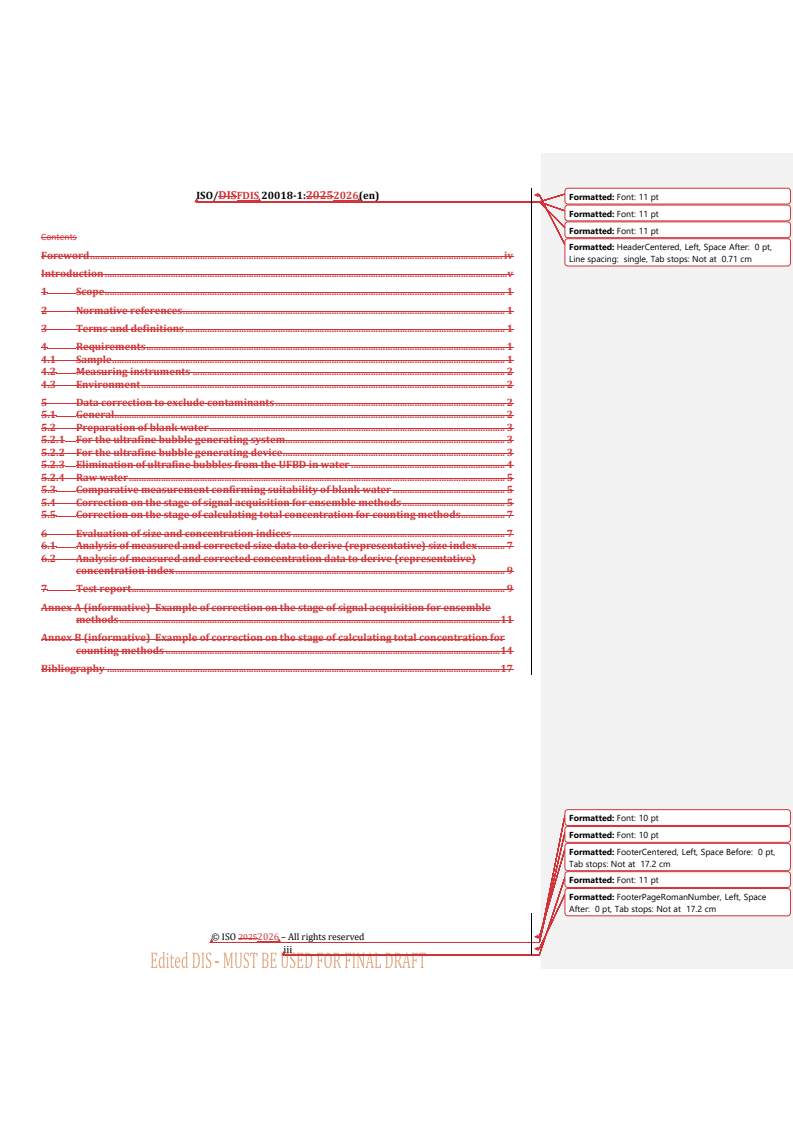
ii
Contents Page
Foreword .iv
Introduction .v
1 Scope . 1
2 Normative references . 1
3 Terms and definitions . 1
4 Requirements . 1
4.1 Sample .1
4.2 Measuring instruments .2
4.3 Environment .2
5 Data correction to exclude contaminants . 3
5.1 General .3
5.2 Preparation of blank water .3
5.2.1 For the ultrafine bubble generating system .3
5.2.2 For the ultrafine bubble generating device .4
5.2.3 Elimination of ultrafine bubbles from the UFBD in water .5
5.2.4 Raw water.6
5.3 Comparative measurement confirming suitability of blank water .6
5.4 Correction on the stage of signal acquisition for ensemble methods .6
5.5 Correction on the stage of calculating total concentration for counting methods .8
6 Evaluation of size and concentration indices . 8
6.1 Analysis of measured and corrected size data to derive (representative) size index .8
6.2 Analysis of measured and corrected concentration data to derive (representative)
concentration index .10
7 Test report .10
Annex A (informative) Example of correction on the stage of signal acquisition for ensemble
methods .12
Annex B (informative) Example of correction on the stage of calculating total concentration for
counting methods .15
Bibliography . 17
iii
Foreword
ISO (the International Organization for Standardization) is a worldwide federation of national standards
bodies (ISO member bodies). The work of preparing International Standards is normally carried out through
ISO technical committees. Each member body interested in a subject for which a technical committee
has been established has the right to be represented on that committee. International organizations,
governmental and non-governmental, in liaison with ISO, also take part in the work. ISO collaborates closely
with the International Electrotechnical Commission (IEC) on all matters of electrotechnical standardization.
The procedures used to develop this document and those intended for its further maintenance are described
in the ISO/IEC Directives, Part 1. In particular, the different approval criteria needed for the different types
of ISO document should be noted. This document was drafted in accordance with the editorial rules of the
ISO/IEC Directives, Part 2 (see www.iso.org/directives).
ISO draws attention to the possibility that the implementation of this document may involve the use of (a)
patent(s). ISO takes no position concerning the evidence, validity or applicability of any claimed patent
rights in respect thereof. As of the date of publication of this document, ISO had not received notice of (a)
patent(s) which may be required to implement this document. However, implementers are cautioned that
this may not represent the latest information, which may be obtained from the patent database available at
www.iso.org/patents. ISO shall not be held responsible for identifying any or all such patent rights.
Any trade name used in this document is information given for the convenience of users and does not
constitute an endorsement.
For an explanation of the voluntary nature of standards, the meaning of ISO specific terms and expressions
related to conformity assessment, as well as information about ISO's adherence to the World Trade
Organization (WTO) principles in the Technical Barriers to Trade (TBT), see www.iso.org/iso/foreword.html.
This document was prepared by Technical Committee ISO/TC 281 Fine bubble technology.
A list of all parts in the ISO 20480 series can be found on the ISO website.
Any feedback or questions on this document should be directed to the user’s national standards body. A
complete listing of these bodies can be found at www.iso.org/members.html.
iv
Introduction
Fine bubble technology has seen growth in its application to markets such as cleaning, water treatment,
agriculture, aquaculture and biomedical fields. Now the methods to evaluate the characteristics of fine
bubbles such as the size and concentration indices have become necessary to clarify the performances of
fine bubble generating systems used for various applications.
Since the ultrafine bubble dispersion (UFBD) usually contains contaminants, however, it is difficult to
extract the data for the size and concentration of ultrafine bubbles from the UFBD.
Therefore, on the premise that the UFBD contains contaminants, the measurement results are commonly
called size and concentration indices. To minimize the influence of contamination on the measurement
results of UFBD, the data correction using of blank water is promising.
v
FINAL DRAFT International Standard ISO/FDIS 20018-1:2026(en)
Fine bubble technology — Characterization of ultrafine
bubbles —
Part 1:
Data correction to exclude particulate contaminants for
evaluating size and concentration indices
1 Scope
This document specifies the evaluation method for size and concentration indices of ultrafine bubbles
(UFBs) in water including the data correction to exclude the influence of particulate contaminants using
blank water. Furthermore, the procedure to prepare the blank water is also described in this document.
This document is only applicable to ultrafine bubble dispersion (UFBD) in water.
2 Normative references
The following documents are referred to in the text in such a way that some or all of their content constitutes
requirements of this document. For dated references, only the edition cited applies. For undated references,
the latest edition of the referenced document (including any amendments) applies.
ISO 20480-1, Fine bubble technology — General principles for usage and measurement of fine bubbles — Part 1:
Terminology
3 Terms and definitions
For the purposes of this document, the terms and definitions given in ISO 20480-1 and the following apply.
ISO and IEC maintain terminological databases for use in standardization at the following addresses:
— ISO Online browsing platform: available at https:// www .iso .org/ obp
— IEC Electropedia: available at https:// www .electropedia .org/
3.1
blank water
water used for data collection of size and concentration indices, which contain the contaminants equivalent
to the ultrafine bubble dispersion (UFBD) in water to be evaluated, and the generation of ultrafine bubbles
is suppressed as much as possible
4 Requirements
4.1 Sample
To reduce the influence of particulate contaminants and to keep the accuracy of measurement, UFBD in
water shall be generated using clean test systems with clean water and clean gas such as clean air, nitrogen
or oxygen.
If the measurement accuracy of size and concentration indices is very important (for example, in the
case of application to the accreditation of fine bubble business), the water purity level of ISO Grade 1 (see
ISO 3696:1987) and the air cleanliness of ISO Class 5 (see ISO 14644-1:2015) should be used for the water
and the air used to generate the UFBD.
4.2 Measuring instruments
Several measurement techniques such as particle tracking analysis method, laser diffraction method and
others can be used to evaluate the size and concentration indices for ultrafine bubbles in the UFBD in water.
The measuring range of concentration is very dependent on respective measurement instruments. In order
to keep the accuracy of measurement results, the concentration of the sample including the ultrafine bubbles
and contaminants shall sufficiently be within the measuring range of concentration.
4.3 Environment
Air cleanliness should be considered for the measurement to prevent mingling of impurities. Ambient
temperature and atmospheric pressure should be stable to maintain the stability of characteristics of
ultrafine bubbles in water.
Air cleanliness, ambient temperature and atmospheric pressure depend on the local environment and can
vary. However, as they are important settings and can influence the evaluation process, they should be
recorded prior to any evaluation occurring.
If the measurement accuracy of size and concentration indices is very important, (for example, in the
case of application to the accreditation of fine bubble
...
Formatted
...
Style Definition
...
Style Definition
...
Style Definition
...
Style Definition
...
Style Definition
...
ISO /TC 281/WG2
Style Definition
...
Style Definition
...
Secretariat: JISC
Style Definition
...
Date: 2026-05-1808-19
Style Definition
...
Style Definition
...
Style Definition
...
Style Definition
...
Style Definition
...
Style Definition
...
Fine bubble technology —
Style Definition
...
Characterization of ultrafine bubbles—
Style Definition
...
—
Style Definition
...
Style Definition
...
Style Definition
...
Style Definition
...
Style Definition
...
Style Definition
...
Part 1:
Style Definition
...
Data correction to exclude particulate contaminants for evaluating
Style Definition
...
size and concentration indices
Style Definition
...
Style Definition
...
Style Definition
...
Style Definition
...
Style Definition
...
Style Definition
...
Style Definition
...
Style Definition
...
FDIS stage
Style Definition
...
Style Definition
...
Style Definition
...
Style Definition
...
Style Definition
...
Style Definition
...
Style Definition
...
Style Definition
...
Style Definition
...
Style Definition
...
Style Definition
...
Style Definition
...
Style Definition
...
Style Definition
...
Style Definition
...
Style Definition
...
Style Definition
...
Style Definition
...
Style Definition
...
Style Definition
...
Style Definition
...
Style Definition
...
Style Definition
...
Style Definition
...
St l D fi iti
ISO/CDFDIS 20018-1:2026(en)
Formatted: HeaderCentered
Formatted: Default Paragraph Font
Formatted: Adjust space between Latin and Asian text,
All rights reserved. Unless otherwise specified, or required in the context of its implementation, no part of this publication
Adjust space between Asian text and numbers
may be reproduced or utilized otherwise in any form or by any means, electronic or mechanical, including photocopying,
or posting on the internet or an intranet, without prior written permission. Permission can be requested from either ISO
Formatted: Left: 1.5 cm, Right: 1.5 cm, Top: 1.4 cm,
at the address below or ISO’s member body in the country of the requester.
Bottom: 1 cm
ISO copyright office
CP 401 • Ch. de Blandonnet 8
CH-1214 Vernier, Geneva
Phone: + 41 22 749 01 11
Formatted: English (United Kingdom)
Fax: + 41 22 749 09 47
E-mail: copyright@iso.org
Formatted: English (United Kingdom)
Website: www.iso.org
Formatted: zzCopyright address, Adjust space between
Latin and Asian text, Adjust space between Asian text
Published in Switzerland
and numbers
Formatted: FooterCentered, Left
ii
ii
ISO/DISFDIS 20018-1:20252026(en)
Formatted: Font: 11 pt
Formatted: Font: 11 pt
Formatted: Font: 11 pt
Contents
Formatted: HeaderCentered, Left, Space After: 0 pt,
Foreword . iv
Line spacing: single, Tab stops: Not at 0.71 cm
Introduction . v
1 Scope . 1
2 Normative references . 1
3 Terms and definitions . 1
4 Requirements . 1
4.1 Sample . 1
4.2 Measuring instruments . 2
4.3 Environment . 2
5 Data correction to exclude contaminants . 2
5.1 General . 2
5.2 Preparation of blank water . 3
5.2.1 For the ultrafine bubble generating system . 3
5.2.2 For the ultrafine bubble generating device . 3
5.2.3 Elimination of ultrafine bubbles from the UFBD in water . 4
5.2.4 Raw water . 5
5.3 Comparative measurement confirming suitability of blank water . 5
5.4 Correction on the stage of signal acquisition for ensemble methods . 5
5.5 Correction on the stage of calculating total concentration for counting methods . 7
6 Evaluation of size and concentration indices . 7
6.1 Analysis of measured and corrected size data to derive (representative) size index . 7
6.2 Analysis of measured and corrected concentration data to derive (representative)
concentration index . 9
7 Test report . 9
Annex A (informative) Example of correction on the stage of signal acquisition for ensemble
methods . 11
Annex B (informative) Example of correction on the stage of calculating total concentration for
counting methods . 14
Bibliography . 17
Formatted: Font: 10 pt
Formatted: Font: 10 pt
Formatted: FooterCentered, Left, Space Before: 0 pt,
Tab stops: Not at 17.2 cm
Formatted: Font: 11 pt
Formatted: FooterPageRomanNumber, Left, Space
After: 0 pt, Tab stops: Not at 17.2 cm
iii
ISO/CDFDIS 20018-1:2026(en)
Formatted: HeaderCentered
Formatted: FooterCentered, Left
iv
iv
ISO/DISFDIS 20018-1:20252026(en)
Formatted: Font: 11 pt
Formatted: Font: 11 pt
Formatted: Font: 11 pt
Contents
Formatted: HeaderCentered, Left, Space After: 0 pt,
Line spacing: single, Tab stops: Not at 0.71 cm
Foreword . vi
Introduction . vii
1 Scope . 1
2 Normative references . 1
3 Terms and definitions . 1
4 Requirements . 2
4.1 Sample . 2
4.2 Measuring instruments . 2
4.3 Environment . 2
5 Data correction to exclude contaminants . 3
5.1 General . 3
5.2 Preparation of blank water . 4
5.3 Comparative measurement confirming suitability of blank water . 9
5.4 Correction on the stage of signal acquisition for ensemble methods . 9
5.5 Correction on the stage of calculating total concentration for counting methods . 11
6 Evaluation of size and concentration indices . 12
6.1 Analysis of measured and corrected size data to derive (representative) size index . 12
6.2 Analysis of measured and corrected concentration data to derive (representative)
concentration index . 14
7 Test report . 15
Annex A (informative) Example of correction on the stage of signal acquisition for ensemble
methods . 16
Annex B (informative) Example of correction on the stage of calculating total concentration for
counting methods . 20
Bibliography . 24
Formatted: Font: 10 pt
Formatted: Font: 10 pt
Formatted: FooterCentered, Left, Space Before: 0 pt,
Tab stops: Not at 17.2 cm
Formatted: Font: 11 pt
Formatted: FooterPageRomanNumber, Left, Space
After: 0 pt, Tab stops: Not at 17.2 cm
v
ISO/CDFDIS 20018-1:2026(en)
Formatted: HeaderCentered
Foreword
ISO (the International Organization for Standardization) is a worldwide federation of national standards
bodies (ISO member bodies). The work of preparing International Standards is normally carried out through
ISO technical committees. Each member body interested in a subject for which a technical committee has been
established has the right to be represented on that committee. International organizations, governmental and
non-governmental, in liaison with ISO, also take part in the work. ISO collaborates closely with the
International Electrotechnical Commission (IEC) on all matters of electrotechnical standardization.
The procedures used to develop this document and those intended for its further maintenance are described
in the ISO/IEC Directives, Part 1. In particular, the different approval criteria needed for the different types of
ISO document should be noted. This document was drafted in accordance with the editorial rules of the
ISO/IEC Directives, Part 2 (see www.iso.org/directives).
Formatted: English (United Kingdom)
ISO draws attention to the possibility that the implementation of this document may involve the use of (a)
patent(s). ISO takes no position concerning the evidence, validity or applicability of any claimed patent rights
in respect thereof. As of the date of publication of this document, ISO had not received notice of (a) patent(s)
which may be required to implement this document. However, implementers are cautioned that this may not
represent the latest information, which may be obtained from the patent database available at
www.iso.org/patents.www.iso.org/patents. ISO shall not be held responsible for identifying any or all such
patent rights.
Any trade name used in this document is information given for the convenience of users and does not
constitute an endorsement.
For an explanation of the voluntary nature of standards, the meaning of ISO specific terms and expressions
related to conformity assessment, as well as information about ISO's adherence to the World Trade
Organization (WTO) principles in the Technical Barriers to Trade (TBT), see
www.iso.org/iso/foreword.htmlwww.iso.org/iso/foreword.html.
Formatted: English (United Kingdom)
This document was prepared by Technical Committee ISO/TC 281 Fine bubble technology.
Formatted: Adjust space between Latin and Asian text,
Adjust space between Asian text and numbers
A list of all parts in the ISO 20480 series can be found on the ISO website.
Formatted: Default Paragraph Font
Formatted: Default Paragraph Font
Any feedback or questions on this document should be directed to the user’s national standards body. A
complete listing of these bodies can be found at www.iso.org/members.html.
Formatted: Default Paragraph Font
Formatted: FooterCentered, Left
vi
vi
ISO/DISFDIS 20018-1:20252026(en)
Formatted: Font: 11 pt
Formatted: Font: 11 pt
Formatted: Font: 11 pt
Introduction
Formatted: HeaderCentered, Left, Space After: 0 pt,
Line spacing: single, Tab stops: Not at 0.71 cm
Fine bubble technology has seen growth in its application to markets such as cleaning, water treatment,
agriculture, aquaculture and biomedical fields. Now the methods to evaluate the characteristics of fine bubbles
such as the size and concentration indices have become necessary to clarify the performances of fine bubble
generating systems used for various applications.
Since the ultrafine bubble dispersion (UFBD) usually contains contaminants, however, it is difficult to extract
the data for the size and concentration of ultrafine bubbles from the UFBD.
Therefore, on the premise that the UFBD contains contaminants, the measurement results are commonly
called size and concentration indices. To minimize the influence of contamination on the measurement results
of UFBD, the data correction using of blank water is promising.
Formatted: Font: 10 pt
Formatted: Font: 10 pt
Formatted: FooterCentered, Left, Space Before: 0 pt,
Tab stops: Not at 17.2 cm
Formatted: Font: 11 pt
Formatted: FooterPageRomanNumber, Left, Space
After: 0 pt, Tab stops: Not at 17.2 cm
vii
DRAFT International Standard ISO/DIS 20018-1:2025(en)
Fine bubble technology —
Characterization of ultrafine bubbles—
—
Formatted: Main Title 2, None, Adjust space between
Part 1:
Latin and Asian text, Adjust space between Asian text
Data correction to exclude particulate contaminants for evaluating
and numbers
size and concentration indices Formatted: Left: 1.5 cm, Right: 1.5 cm, Top: 1.4 cm,
Bottom: 1 cm
1 Scope
Formatted: Adjust space between Latin and Asian text,
Adjust space between Asian text and numbers
This document specifies the evaluation method for size and concentration indices of ultrafine bubbles (UFBs)
in water including the data correction to exclude the influence of particulate contaminants using blank water.
Furthermore, the procedure to prepare the blank water is also described in this document.
This document is only applicable to ultrafine bubble dispersion (UFBD) in water.
2 Normative references
The following documents are referred to in the text in such a way that some or all of their content constitutes
requirements of this document. For dated references, only the edition cited applies. For undated references,
the latest edition of the referenced document (including any amendments) applies.
Formatted: Default Paragraph Font
ISO 20480--1, Fine bubble technology — General principles for usage and measurement of fine bubbles —
Formatted: Default Paragraph Font
Part 1: Terminology
Formatted: Default Paragraph Font
ISO 24261-1:2020, Fine bubble technology — Elimination method for sample characterization — Part 1:
Formatted: Default Paragraph Font
Evaluation procedure
Formatted: Adjust space between Latin and Asian text,
Adjust space between Asian text and numbers, Tab
ISO 24261-2:2021, Fine bubble technology — Elimination method for sample characterization — Part 2: Fine
stops: Not at 0.7 cm + 1.4 cm + 2.1 cm + 2.8 cm +
bubble elimination techniques
3.5 cm + 4.2 cm + 4.9 cm + 5.6 cm + 6.3 cm + 7 cm
3 Terms and definitions Formatted: Adjust space between Latin and Asian text,
Adjust space between Asian text and numbers
For the purposes of this document, the terms and definitions given in ISO 20480-1 and the following apply.
Formatted: Default Paragraph Font
Formatted: Default Paragraph Font
ISO and IEC maintain terminological databases for use in standardization at the following addresses:
Formatted: Default Paragraph Font
— — ISO Online browsing platform: available at https://www.iso.org/obphttps://www.iso.org/obp
Formatted: Adjust space between Latin and Asian text,
Adjust space between Asian text and numbers, Tab
— — IEC Electropedia: available at https://www.electropedia.org/https://www.electropedia.org/
stops: Not at 0.7 cm + 1.4 cm + 2.1 cm + 2.8 cm +
3.5 cm + 4.2 cm + 4.9 cm + 5.6 cm + 6.3 cm + 7 cm
3.1 3.1
Formatted: TermNum2, Adjust space between Latin
blank water
and Asian text, Adjust space between Asian text and
water used for data correctioncollection of size and concentration indices, which contain the contaminants
numbers
equivalent to the ultrafine bubble dispersion (UFBD) in water to be evaluated, and the generation of ultrafine
Formatted: Font: 11 pt
bubbles is suppressed as much as possible
Formatted: Footer, Left, Space After: 0 pt, Line
spacing: single, Tab stops: Not at 17.2 cm
ISO/CDFDIS 20018-1:2026(en)
Formatted: HeaderCentered
4 Requirements
4.1 Sample
Formatted: Adjust space between Latin and Asian text,
Adjust space between Asian text and numbers, Tab
To reduce the influence of particulate contaminants and to keep the accuracy of measurement, UFBD in water
stops: Not at 0.71 cm
shall be generated using clean test systems with clean water and clean gas such as clean air, nitrogen or
Formatted: Adjust space between Latin and Asian text,
oxygen.
Adjust space between Asian text and numbers
If the measurement accuracy of size and concentration indices is very important (for example, in the case of
application to the accreditation of fine bubble business), the water purity level of ISO Grade 1 (see ISO
Formatted: Default Paragraph Font
3696:1987) and the air cleanliness of ISO Class 5 (see ISO 14644-1:2015) are recommendedshould be used
Formatted: Default Paragraph Font
for the water and the air used to generate the UFBD.
Formatted: Default Paragraph Font
4.2 Measuring instruments
Formatted: Default Paragraph Font
Formatted: Adjust space between Latin and Asian text,
Several measurement techniques such as particle tracking analysis method, laser diffraction method and
Adjust space between Asian text and numbers, Tab
others can be used to evaluate the size and concentration indices for ultrafine bubbles in the UFBD in water.
stops: Not at 0.71 cm
The measuring range of concentration is very dependent on respective measurement instruments. In order to Formatted: Adjust space between Latin and Asian text,
Adjust space between Asian text and numbers
keep the accuracy of measurement results, the concentration of the sample including the ultrafine bubbles
and contaminants shall sufficiently be within the measuring range of concentration.
4.3 Environment
Formatted: Adjust space between Latin and Asian text,
Adjust space between Asian text and numbers, Tab
Air cleanliness should be considered for the measurement to prevent mingling of impurities. Ambient
stops: Not at 0.71 cm
temperature and atmospheric pressure should be stable to maintain the stability of characteristics of ultrafine
Formatted: Adjust space between Latin and Asian text,
bubbles in water.
Adjust space between Asian text and numbers
Air cleanliness, ambient temperature and atmospheric pressure depend on the local environment and can
vary. However, as they are important settings and can influence the evaluation process, they should be
recorded prior to any evaluation occurring.
If the measurement accuracy of size and concentration indices is very important, (for example, in the case of
application to the accreditation of fine bubble business), the air cleanliness of ISO Class 7 (see ISO 14644-
Formatted: Default Paragraph Font
1:2015) is recommendedshould be used as the environment for generation and measurement of the UFBD in
Formatted: Default Paragraph Font
water.
Formatted: Default Paragraph Font
Formatted: FooterCentered, Left
ISO/DISFDIS 20018-1:20252026(en)
Formatted: Font: 11 pt
Formatted: Font: 11 pt
Formatted: Font: 11 pt
5 Data correction to exclude contaminants
Formatted: HeaderCentered, Left, Space After: 0 pt,
Line spacing: single, Tab stops: Not at 0.71 cm
5.1 General
Formatted: Adjust space between Latin and Asian text,
Adjust space between Asian text and numbers, Tab
stops: Not at 0.71 cm
Key
Formatted: Adjust space between Latin and Asian text,
1 raw water
Adjust space between Asian text and numbers, Tab
2 UFBD in water stops: Not at 0.7 cm + 1.4 cm + 2.1 cm + 2.8 cm +
3.5 cm + 4.2 cm + 4.9 cm + 5.6 cm + 6.3 cm + 7 cm
3 blank water
4 corrected data of the UFBD in water
5 generation of UFB
6 taking the blabk water
7 data correction
8 UFB (ultrafine bubble)
9 contaminant (solid/liquid particle)
1 raw water
Formatted: Font: 10 pt
2 UFBD in water
Formatted: Font: 10 pt
3 blank water
4 corrected data of the UFBD in water Formatted: FooterCentered, Left, Space Before: 0 pt,
Line spacing: single, Tab stops: Not at 17.2 cm
5 generation of UFB
6 taking the blabk water
Formatted: Font: 11 pt
ISO/CDFDIS 20018-1:2026(en)
Formatted: HeaderCentered
7 data correction
UFB (ultrafine bubble)
contaminant (solid/liquid particle)
Figure 1 — Data correction to exclude contaminants
Formatted: None, Adjust space between Latin and
Asian text, Adjust space between Asian text and
numbers
Figure 1Figure 1 shows the basic concept of the data correction to exclude the influence of particulate
Formatted: Adjust space between Latin and Asian text,
contaminants using blank water.
Adjust space between Asian text and numbers
Appropriate blank water shall be prepared to perform size and concentration correction for UFBD using blank
water. The contaminants contained in blank water should be equivalent to the contaminants contained in
UFBD in water, and it is necessary toshall suppress the existence of ultrafine bubbles as much as
possible.Clause 5.2 Clause 5.2 describes how to prepare the blank water.
5.2 Preparation of blank water
Formatted: Adjust space between Latin and Asian text,
Adjust space between Asian text and numbers, Tab
5.2.1 For the ultrafine bubble generating system
stops: Not at 0.71 cm
Formatted: Adjust space between Latin and Asian text,
For the general ultrafine bubble generating systems, there are two possible methods, method A and method
Adjust space between Asian text and numbers, Tab
B, to prepare the blank water as shown in Figure 2.Figure 2. Method A is the best way but its possibility
stops: Not at 0.71 cm + 0.99 cm + 1.27 cm
strongly depends on the specification of each ultrafine bubble generating system.
Formatted: Adjust space between Latin and Asian text,
Adjust space between Asian text and numbers
— — Method A: Turn off the ultrafine bubble generating function and take the blank water.
Formatted: List Continue 1, Adjust space between Latin
— — Method B: Take the blank water just before the component which generates ultrafine bubbles.
and Asian text, Adjust space between Asian text and
numbers, Tab stops: Not at 0.7 cm + 1.4 cm + 2.1 cm
+ 2.8 cm + 3.5 cm + 4.2 cm + 4.9 cm + 5.6 cm + 6.3
cm + 7 cm
Formatted: Adjust space between Latin and Asian text,
Key
Adjust space between Asian text and numbers, Tab
1 raw water stops: Not at 0.7 cm + 1.4 cm + 2.1 cm + 2.8 cm +
3.5 cm + 4.2 cm + 4.9 cm + 5.6 cm + 6.3 cm + 7 cm
2 UFB generating system
Formatted: FooterCentered, Left
ISO/DISFDIS 20018-1:20252026(en)
Formatted: Font: 11 pt
Formatted: Font: 11 pt
Formatted: Font: 11 pt
3 UFB generating function
Formatted: HeaderCentered, Left, Space After: 0 pt,
a
Turn off the UFB generating function and take the blank water.
Line spacing: single, Tab stops: Not at 0.71 cm
b
Take the blank water just before the component which generate UFBs.
1 raw water
2 UFB generating system
3 UFB generating function
a
Turn off the UFB generating function and take the blank water.
b
Take the blank water just before the component which generate UFBs.
Figure 2 — Preparation of blank water for the ultrafine bubble generating system
Formatted: None, Adjust space between Latin and
Asian text, Adjust space between Asian text and
numbers
5.2.2 For the ultrafine bubble generating device
Formatted: Adjust space between Latin and Asian text,
The preparation of blank water for the ultrafine bubble generating device is very simple. It involves only the
Adjust space between Asian text and numbers, Tab
removal of the ultrafine bubble generating device such as the nozzle and the showerhead device from the test stops: Not at 0.71 cm + 0.99 cm + 1.27 cm
system to evaluate the size and concentration indices of UFBD as shown in Figure 3.Figure 3.
Formatted: Adjust space between Latin and Asian text,
Adjust space between Asian text and numbers
It is very important that the device should be thoroughly cleaned before the test to prevent the generation of
contaminants from the inside of ultrafine bubble generating device.
Formatted: Font: 10 pt
Formatted: Font: 10 pt
Formatted: FooterCentered, Left, Space Before: 0 pt,
Line spacing: single, Tab stops: Not at 17.2 cm
Formatted: Font: 11 pt
ISO/CDFDIS 20018-1:2026(en)
Formatted: HeaderCentered
Formatted: FooterCentered, Left
ISO/DISFDIS 20018-1:20252026(en)
Formatted: Font: 11 pt
Formatted: Font: 11 pt
Formatted: Font: 11 pt
Formatted: HeaderCentered, Left, Space After: 0 pt,
Line spacing: single, Tab stops: Not at 0.71 cm
Key
Formatted: Adjust space between Latin and Asian text,
1 raw water storage tank
Adjust space between Asian text and numbers, Tab
2 pump stops: Not at 0.7 cm + 1.4 cm + 2.1 cm + 2.8 cm +
3.5 cm + 4.2 cm + 4.9 cm + 5.6 cm + 6.3 c
...