

ISO 7327:1994
(Main)Plastics — Hardeners and accelerators for epoxide resins — Determination of free acid in acid anhydride
General Information
- Abstract
The principle of the method specified is reacting a small amount of free acid present in a test portion of acid anhydride hardener or accelerator with rhodamine 6G to colour the test solution pink, measuring the absorbance of the coloured solution at a wavelength of about 510 nm using a spectrometer, determining the free-acid content from a calibration curve. The method is suitable for most anhydrides except for polyester and oligomeric anhydrides which may give too wide a scatter of results.
- Status
- Published
- Publication Date
- 22-Jun-1994
- Technical Committee
- ISO/TC 61/SC 12 - Thermosetting materials
- Current Stage
- 9093 - International Standard confirmed
- Start Date
- 30-Jun-2025
- Completion Date
- 29-Aug-2026
Buy Documents
ISO 7327:1994 - Plastics — Hardeners and accelerators for epoxide resins — Determination of free acid in acid anhydride Released:6/23/1994
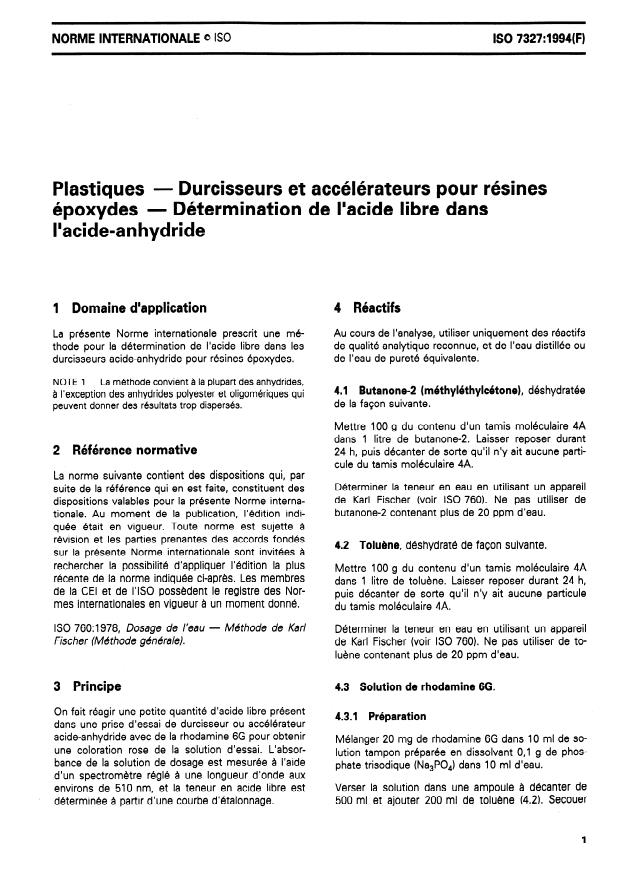
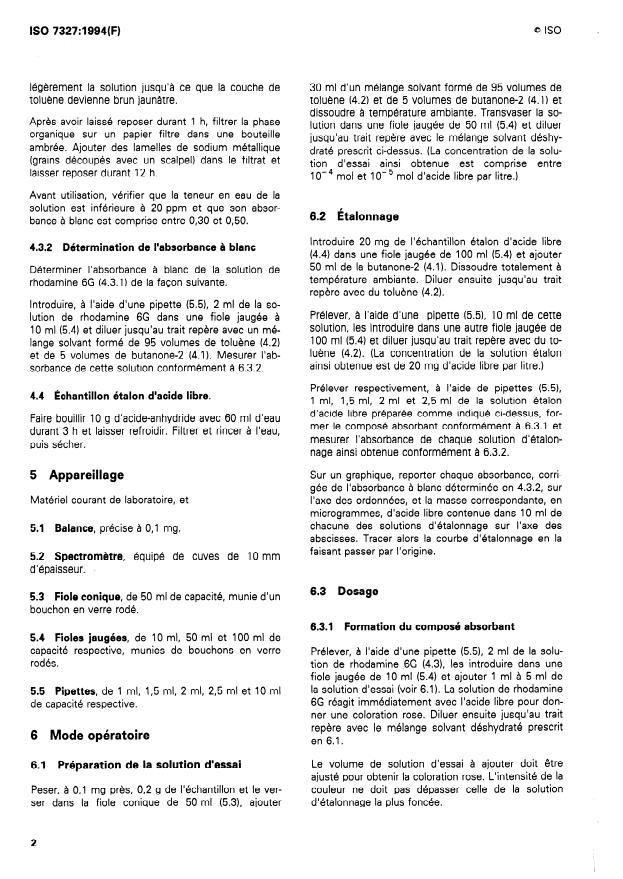
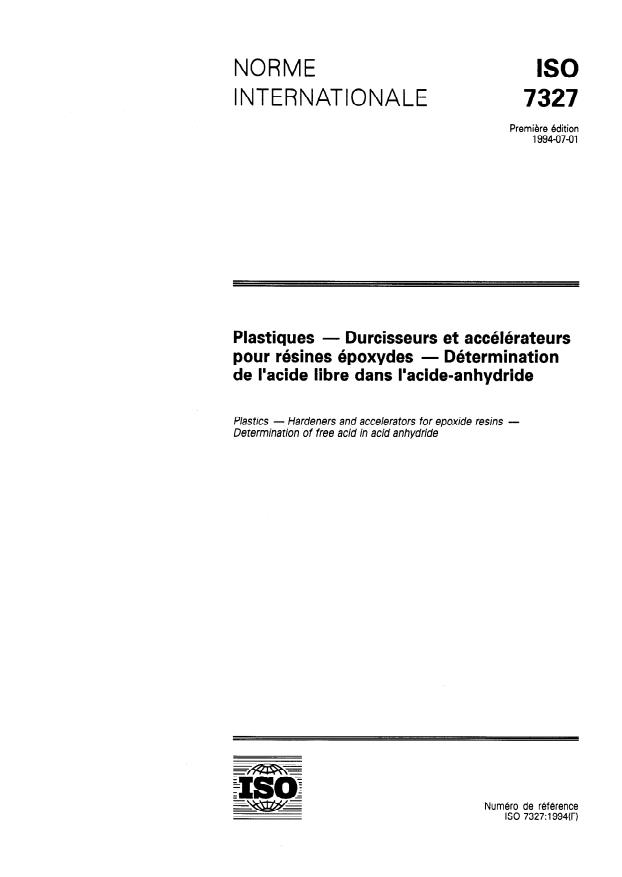
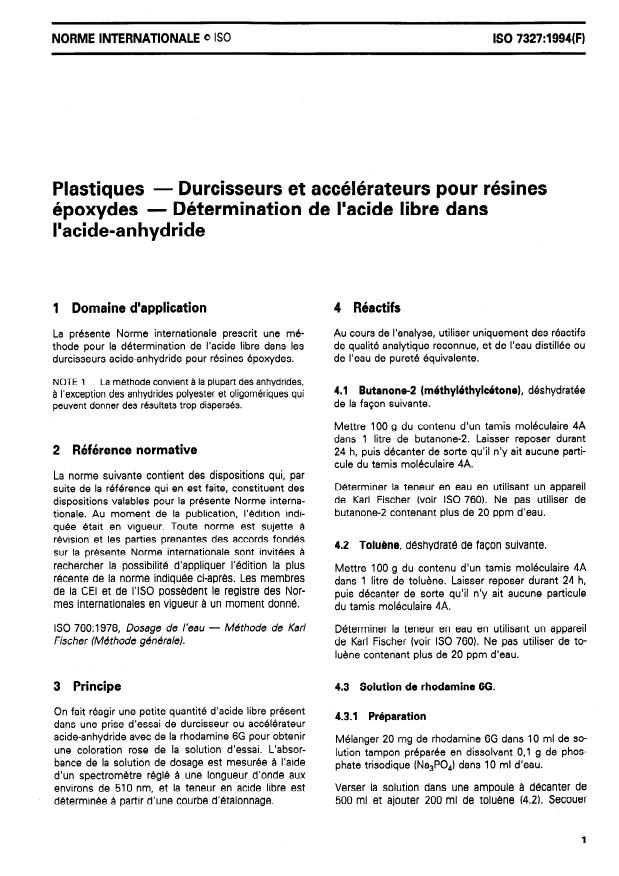
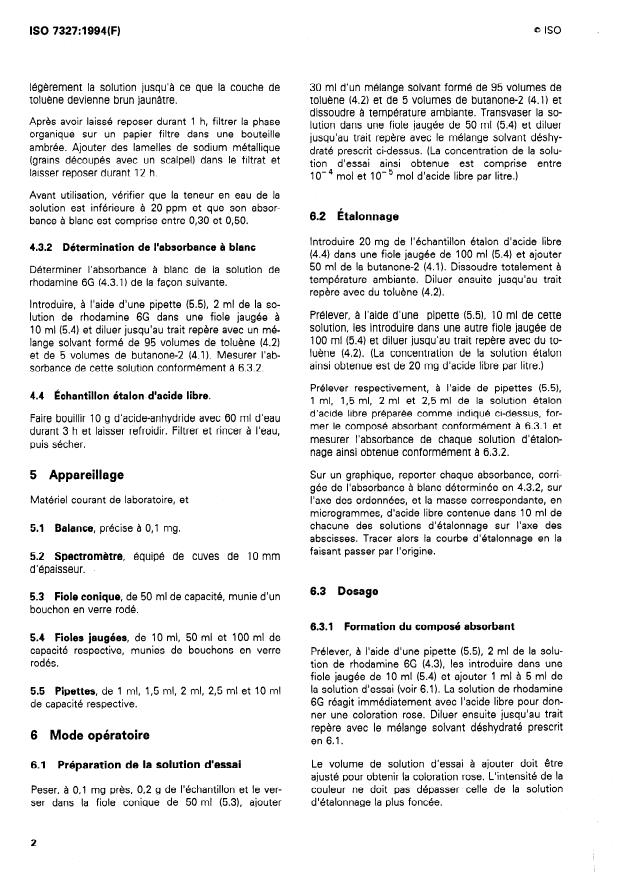
ISO 7327:1994 - Plastiques — Durcisseurs et accélérateurs pour résines époxydes — Détermination de l'acide libre dans l'acide-anhydride Released:6/23/1994
ISO 7327:1994 - Plastiques — Durcisseurs et accélérateurs pour résines époxydes — Détermination de l'acide libre dans l'acide-anhydride Released:6/23/1994
Overview
ISO 7327:1994 specifies a standardized method for determining the free acid content in acid anhydride hardeners and accelerators used in epoxide (epoxy) resins. This International Standard, published by ISO, plays a crucial role in the field of plastics and thermosetting materials by ensuring product consistency, quality assurance, and compliance across industries utilizing epoxide resins. The method described is based on a colorimetric analysis involving rhodamine 6G and spectrophotometric measurement, making it reliable and practical for most anhydride types, except polyester and oligomeric anhydrides.
Key Topics
Scope and Applicability:
ISO 7327:1994 applies to acid anhydride-based hardeners and accelerators in epoxide resins, providing a consistent methodology for chemical analysis.Analytical Principle:
The standard outlines a process where any free acid in the test sample reacts with rhodamine 6G, causing a pink coloration. The intensity of this color, measured at approximately 510 nm using a spectrometer, is directly related to the free acid concentration and is quantified using a calibration curve.Excluded Materials:
Polyester and oligomeric anhydrides are not suitable for this method due to inconsistent results.Required Reagents and Equipment:
- High-purity solvents such as dried toluene and butan-2-one
- Rhodamine 6G solution
- Spectrometer with precise absorption measurement capability
- Standard laboratory apparatus including analytical balances, volumetric flasks, and pipettes
Applications
Quality Control in Manufacturing:
Epoxide resins are widely used in coatings, adhesives, composites, and electronic encapsulation. Determining the free acid content in their hardeners and accelerators ensures batch-to-batch consistency, mitigates quality issues, and supports reliability in end applications.Research and Development:
Material scientists and chemical engineers apply this method during the development of new formulations, to optimize hardener performance and minimize unwanted side reactions due to excessive free acid.Supplier and Regulatory Compliance:
ISO 7327:1994 is referenced in procurement and regulatory documentation to standardize the acceptance criteria for raw materials and finished products.Laboratory Testing Services:
Analytical service labs use this protocol as a benchmark for providing impartial test results when certifying material compliance.
Related Standards
The following international standards are closely related to ISO 7327:1994 and may be referenced for additional procedures or complementary testing:
- ISO 760: Determination of water by the Karl Fischer method - cited within ISO 7327 for solvent drying and water content assessment.
- ISO 3219: Plastics - Polymers/resins in the liquid state or as emulsions or dispersions - Determination of viscosity using a rotational viscometer.
- ISO 6721: Plastics - Determination of dynamic mechanical properties.
- ISO 14856: Plastics - Determination of the ultimate aerobic biodegradability in an aqueous medium.
For professionals in the plastics industry, adherence to ISO 7327:1994 facilitates international trade, supports certification initiatives, and upholds stringent standards for epoxide resin formulations. Implementing this method ensures transparent and consistent evaluation of free acid content, enhancing product performance reliability in a broad spectrum of industrial applications.
Buy Documents
ISO 7327:1994 - Plastics — Hardeners and accelerators for epoxide resins — Determination of free acid in acid anhydride Released:6/23/1994
ISO 7327:1994 - Plastiques — Durcisseurs et accélérateurs pour résines époxydes — Détermination de l'acide libre dans l'acide-anhydride Released:6/23/1994
ISO 7327:1994 - Plastiques — Durcisseurs et accélérateurs pour résines époxydes — Détermination de l'acide libre dans l'acide-anhydride Released:6/23/1994
Get Certified
Connect with accredited certification bodies for this standard

DIN CERTCO
DIN Group product certification.

Smithers Quality Assessments
US management systems and product certification.
Sponsored listings
Frequently Asked Questions
ISO 7327:1994 is a standard published by the International Organization for Standardization (ISO). Its full title is "Plastics — Hardeners and accelerators for epoxide resins — Determination of free acid in acid anhydride". This standard covers: The principle of the method specified is reacting a small amount of free acid present in a test portion of acid anhydride hardener or accelerator with rhodamine 6G to colour the test solution pink, measuring the absorbance of the coloured solution at a wavelength of about 510 nm using a spectrometer, determining the free-acid content from a calibration curve. The method is suitable for most anhydrides except for polyester and oligomeric anhydrides which may give too wide a scatter of results.
The principle of the method specified is reacting a small amount of free acid present in a test portion of acid anhydride hardener or accelerator with rhodamine 6G to colour the test solution pink, measuring the absorbance of the coloured solution at a wavelength of about 510 nm using a spectrometer, determining the free-acid content from a calibration curve. The method is suitable for most anhydrides except for polyester and oligomeric anhydrides which may give too wide a scatter of results.
ISO 7327:1994 is classified under the following ICS (International Classification for Standards) categories: 83.080.10 - Thermosetting materials. The ICS classification helps identify the subject area and facilitates finding related standards.
ISO 7327:1994 is available in PDF format for immediate download after purchase. The document can be added to your cart and obtained through the secure checkout process. Digital delivery ensures instant access to the complete standard document.
Standards Content (Sample)
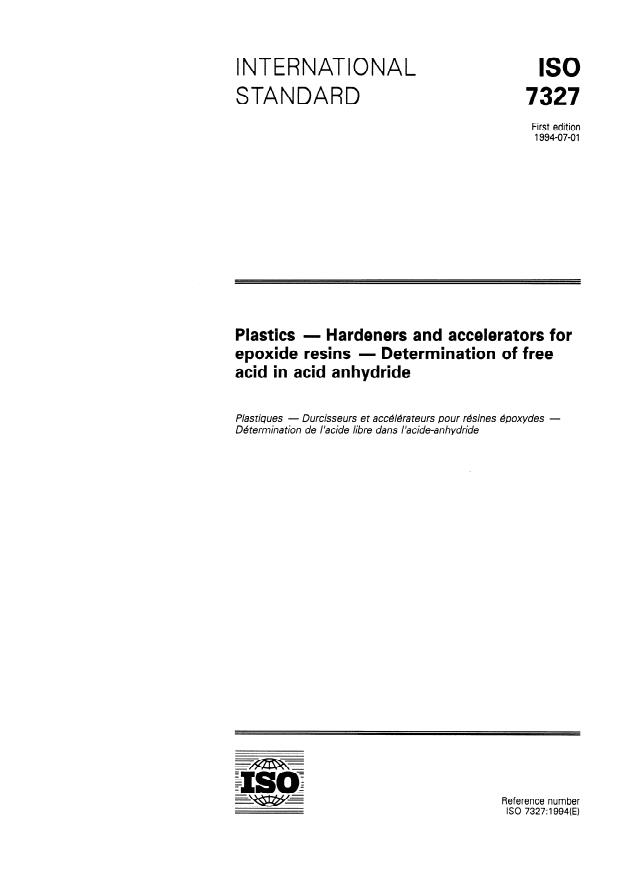
INTERNATIONAL
ISO
STANDARD 7327
First edition
1994-07-01
Plastics - Hardeners and accelerators for
epoxide resins - Determination of free
acid in acid anhydride
Plas tiques - Durcisseurs et acc6Mrateurs pour r&ines 6poxydes -
DAtermination de I ’acide libre dans I ’acide-anhydride
Reference number
ISO 7327: 1994(E)
Foreword
ISO (the International Organization for Standardization) is a worldwide
federation of national Standards bodies (ISO member bodies). The work
of preparing International Standards is normally carried out through ISO
technical committees. Esch member body interested in a subject for
which a technical committee has been established has the right to be re-
presented on that committee. International organizations, governmental
and non-governmental, in liaison with ISO, also take part in the work. ISO
collaborates closely with the International Electrotechnical Commission
(IEC) on all matters of electrotechnical standardization.
Draft International Standards adopted by the technical committees are
circulated to the member bodies for voting. Publication as an International
Standard requires approval by at least 75 % of the member bodies casting
a vote.
International Standard ISO 7327 was prepared by Technical Committee
lSO/TC 61, Plastics, Subcommittee SC 12, Thermosetting materials.
0 ISO 1994
All rights reserved. Unless otherwise specified, no part of this publication may be reproduced
or utilized in any form or by any means, electronie or mechanical, including photocopying and
microfilm, without Permission in writing from the publisher.
International Organization for Standardization
Case Postale 56 l CH-I 211 Geneve 20 l Switzerland
Printed in Switzerland
ii
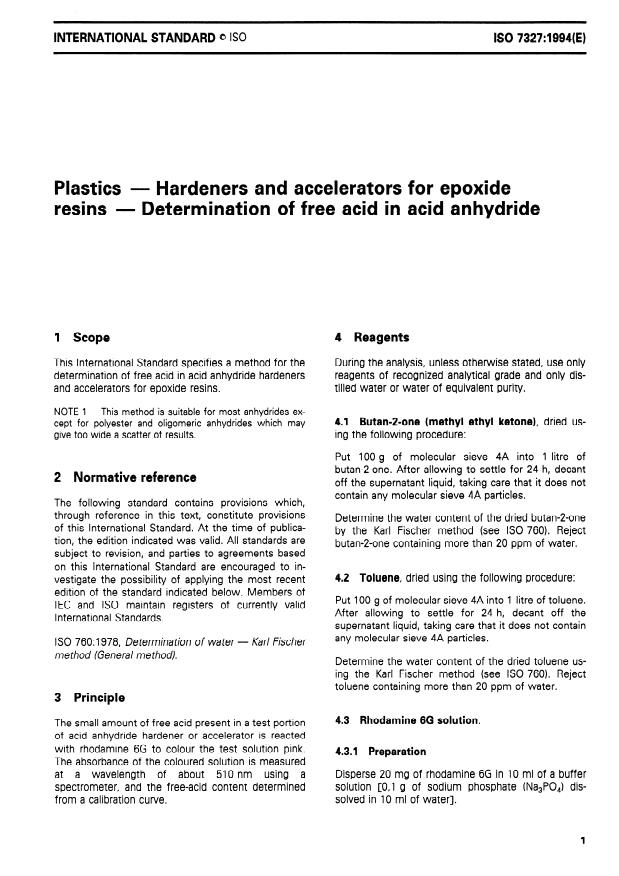
INTERNATIONAL STANDARD 0 ISO ISO 7327:1994(E)
Plastics - Hardeners and accelerators for epoxide
resins - Determination of free acid in acid anhydride
1 Scope 4 Reagents
This International Standard specifies a method for the During the analysis, unless otherwise stated, use only
determination of free acid in acid anhydride hardeners reagents of recognized analytical grade and only dis-
tilled water or water of equivalent purity.
and accelerators for epoxide resins.
NOTE 1 This method is suitable for most anhydrides ex-
4.1 Butan-i-one (methyl ethyl ketone), dried us-
cept for Polyester and oligomeric anhydrides which may
give too wide a scatter of results. ing the following procedure:
Put 100 g of molecular sieve 4A into 1 litre of
butan-2-one. After allowing to settle for 24 h, decant
2 Normative reference
off the supernatant liquid, taking care that it does not
contain any molecular sieve 4A particles.
The following Standard contains provisions which,
through reference in this text, constitute provisions
Determine the water content of the dried butan-2-one
of this International Standard. At the time of publica-
by the Karl Fischer method (see ISO 760). Reject
tion, the edition indicated was valid. All Standards are
butan-2-one containing more than 20 ppm of water.
subject to revision, and Parties to agreements based
on this International Standard are encouraged to in-
4.2 Toluene, dried using the following procedure:
vestigate the possibility of applying the most recent
edition of the Standard indicated below. Members of
Put 100 g of molecular sieve 4A into 1 litre of toluene.
IEC and ISO maintain registers of currently valid
After allowing to settle for 24 h, decant off the
International Standards.
supernatant liquid, taking care that it does not contain
any molecular sieve 4A particles.
ISO 760: 1978, Determination of water - Karl Fischer
method (General method).
Determine the water content of the dried toluene us-
ing the Karl Fischer method (see ISO 760). Reject
toluene containing more than 20 ppm of water.
3 Principle
4.3 Rhodamine 6G solution.
The small amount of free acid present in a test portion
of acid anhydride hardener or accelerator is reacted
with rhodamine 6G to colour the test Solution pink.
4.3.1 Preparation
The absorbance of the coloured Solution is measured
at a wavelength of about 510 nm using a Disperse 20 mg of rhodamine 6G in IO ml of a buffer
spectrometer, and the free-acid content determined Solution [0,1 g of sodium Phosphate (Na,PO,) dis-
from a calibration curve. solved in 10 ml of water].
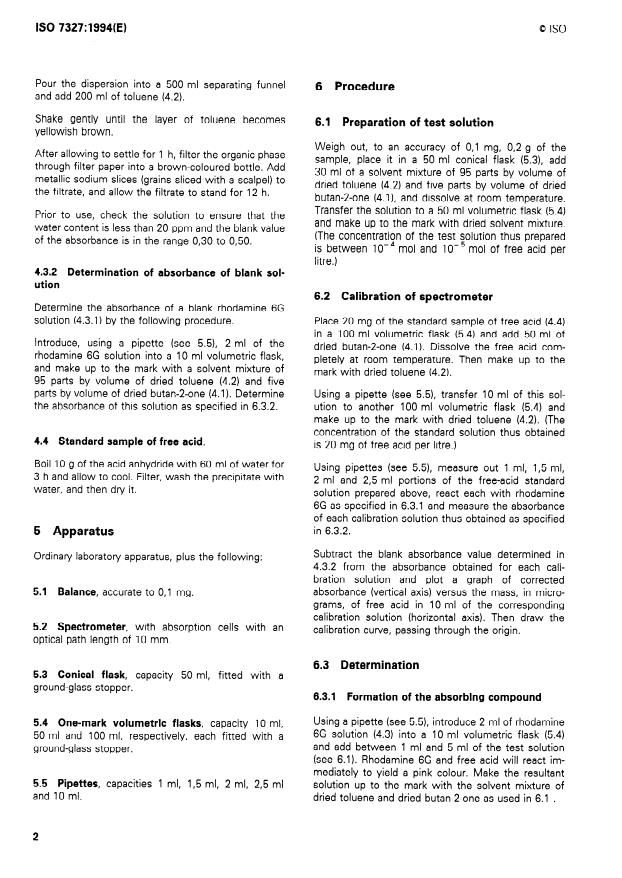
Pour the dispersion into a 500 ml separating funnel
6 Procedure
and add 200 ml of toluene (4.2).
Shake gently until the layer of toluene becomes
6.1 Preparation of test Solution
yellowish brown.
Weigh out, to an accuracy of 0,l mg, 0,2 g of the
After allowing to settle for 1 h, filter the organic Phase
Sample, place it in a 50 ml conical flask (5.3), add
through filter Paper into a brown-coloured bottle. Add
30 ml of a solvent mixture of 95 Parts by volume of
metallic sodium slices (grains sliced with a scalpel) to
dried toluene (4.2) and five Parts by volume of dried
the filtrate, and allow the filtrate to stand for 12 h.
butan-2-one (4.1), and dissol
...
NORME
Iso
INTERNATIONALE
Première édition
1994-07-01
Plastiques - Durcisseurs et accélérateurs
pour résines époxydes - Détermination
de l’acide libre dans l’acide-anhydride
P/as tics - Hardeners and accelerators for epoxide resins -
Determination of free acid in acid anhydride
Numéro de référence
ISO 7327: 1994(F)
Avant-propos
L’ISO (Organisation internationale de normalisation) est une fedération
mondiale d’organismes nationaux de normalisation (comités membres de
I’ISO). L’elaboration des Normes internationales est en général confiee aux
comites techniques de I’ISO. Chaque comite membre interesse par une
étude a le droit de faire partie du comite technique créé à cet effet. Les
organisations internationales, gouvernementales et non gouvernemen-
tales, en liaison avec I’ISO participent également aux travaux. L’ISO colla-
bore etroitement avec la Commission électrotechnique internationale (CEI)
en ce qui concerne la normalisation électrotechnique.
Les projets de Normes internationales adoptes par les comités techniques
sont soumis aux comites membres pour vote. Leur publication comme
Normes internationales requiert l’approbation de 75 % au moins des co-
mites membres votants.
La Norme internationale ISO 7327 a éte élaborée par le comité technique
lSO/TC 61, P/as tiques, sous-comite SC 12, Matériaux
thermodurcissables.
0 ISO 1994
Droits de reproduction réservés. Sauf prescription différente, aucune partie de cette publi-
cation ne peut être reproduite ni utilisée sous quelque forme que ce soit et par aucun pro-
cédé, électronique ou mécanique, y compris la photocopie et les microfilms, sans l’accord
Rcrit de I’editeur.
Organisation internationale de normalisation
Case Postale 56 l CH-l 211 Geneve 20 . Suisse
Imprimé en Suisse
II
ISO 7327: 1994(F)
NORME INTERNATIONALE 0 ISO
Plastiques - Durcisseurs et accélérateurs pour résines
époxydes - Détermination de l’acide libre dans
l’acide-anhydride
4 Réactifs
1 Domaine d’application
La présente Norme internationale prescrit une me- Au cours de l’analyse, utiliser uniquement des reactifs
de qualité analytique reconnue, et de l’eau distillee ou
thode pour la détermination de l’acide libre dans les
de l’eau de purete équivalente.
durcisseurs acide-anhydride pour resines Apoxydes.
La méthode convient à la plupart des anhydrides,
NOTE 1
4.4 Butanone-2 (m&hyl&hylcbtone), déshydratee
à l’exception des anhydrides polyester et oligomériques qui
de la façon suivante.
peuvent donner des résultats trop dispersés.
Mettre 100 g du contenu d’un tamis moleculaire 4A
dans 1 litre de butanone-2. Laisser reposer durant
2 Référence normative
24 h, puis decanter de sorte qu’il n’y ait aucune parti-
cule du tamis moleculaire 4A.
La norme suivante contient des dispositions qui, par
Determiner la teneur en eau en utilisant un appareil
suite de la reference qui en est faite, constituent des
de Karl Fischer (voir ISO 760). Ne pas utiliser de
dispositions valables pour la présente Norme interna-
butanone-2 contenant plus de 20 ppm d’eau.
tionale. Au moment de la publication, l’edition indi-
quée était en vigueur. Toute norme est sujette à
revision et les parties prenantes des accords fondes
4.2 Tolu&ne, déshydraté de façon suivante.
sur la présente Norme internationale sont invitees a
rechercher la possibilité d’appliquer l’edition la plus
Mettre 100 g du contenu d’un tamis moleculaire 4A
recente de la norme indiquée ci-aprés. Les membres
dans 1 litre de toluene. Laisser reposer durant 24 h,
de la CEI et de I’ISO possèdent le registre des Nor-
puis decanter de sorte qu’il n’y ait aucune particule
mes internationales en vigueur à un moment donne.
du tamis moléculaire 4A.
ISO 760:1978, Dosage de l’eau - M&hode de Karl Déterminer la teneur en eau en utilisant un appareil
Fischer (M6thode générale).
de Karl Fischer (voir ISO 760). Ne pas utiliser de to-
luene contenant plus de 20 ppm d’eau.
3 Principe 4.3 Solution de rhodamine 6G.
On fait réagir une petite quantite d’acide libre présent
4.3.1 Prbparation
dans une prise d’essai de durcisseur ou accelérateur
acide-anhydride avec de la rhodamine 6G pour obtenir
Melanger 20 mg de rhodamine 6G dans 10 ml de so-
une coloration rose de la solution d’essai. L’absor-
lution tampon préparée en dissolvant 0,l g de phos-
bance de la solution de dosage est mesuree à l’aide
phate trisodique (Na,PO,) dans 10 ml d’eau.
d’un spectrométre réglé à une longueur d’onde aux
Verser la solution dans une ampoule à decanter de
environs de 510 nm, et la teneur en acide libre est
500 ml et ajouter 200 ml de toluene (4.2). Secouer
. determinee à partir d’une courbe d’étalonnage.
Iégèrement la solution jusqu’à ce que la couche de 30 ml d’un mélange solvant forme de 95 volumes de
toluène devienne brun jaunâtre. toluène (4.2) et de 5 volumes de butanone-2 (4.1) et
dissoudre à température ambiante. Transvaser la so-
Après avoir laisse reposer durant 1 h, filtrer la phase
lution dans une fiole jaugée de 50 ml (5.4) et diluer
organique sur un papier filtre dans une bouteille
jusqu’au trait repére avec le mélange solvant déshy-
ambree. Ajouter des lamelles de sodium metallique
drate pres
...
NORME
Iso
INTERNATIONALE
Première édition
1994-07-01
Plastiques - Durcisseurs et accélérateurs
pour résines époxydes - Détermination
de l’acide libre dans l’acide-anhydride
P/as tics - Hardeners and accelerators for epoxide resins -
Determination of free acid in acid anhydride
Numéro de référence
ISO 7327: 1994(F)
Avant-propos
L’ISO (Organisation internationale de normalisation) est une fedération
mondiale d’organismes nationaux de normalisation (comités membres de
I’ISO). L’elaboration des Normes internationales est en général confiee aux
comites techniques de I’ISO. Chaque comite membre interesse par une
étude a le droit de faire partie du comite technique créé à cet effet. Les
organisations internationales, gouvernementales et non gouvernemen-
tales, en liaison avec I’ISO participent également aux travaux. L’ISO colla-
bore etroitement avec la Commission électrotechnique internationale (CEI)
en ce qui concerne la normalisation électrotechnique.
Les projets de Normes internationales adoptes par les comités techniques
sont soumis aux comites membres pour vote. Leur publication comme
Normes internationales requiert l’approbation de 75 % au moins des co-
mites membres votants.
La Norme internationale ISO 7327 a éte élaborée par le comité technique
lSO/TC 61, P/as tiques, sous-comite SC 12, Matériaux
thermodurcissables.
0 ISO 1994
Droits de reproduction réservés. Sauf prescription différente, aucune partie de cette publi-
cation ne peut être reproduite ni utilisée sous quelque forme que ce soit et par aucun pro-
cédé, électronique ou mécanique, y compris la photocopie et les microfilms, sans l’accord
Rcrit de I’editeur.
Organisation internationale de normalisation
Case Postale 56 l CH-l 211 Geneve 20 . Suisse
Imprimé en Suisse
II
ISO 7327: 1994(F)
NORME INTERNATIONALE 0 ISO
Plastiques - Durcisseurs et accélérateurs pour résines
époxydes - Détermination de l’acide libre dans
l’acide-anhydride
4 Réactifs
1 Domaine d’application
La présente Norme internationale prescrit une me- Au cours de l’analyse, utiliser uniquement des reactifs
de qualité analytique reconnue, et de l’eau distillee ou
thode pour la détermination de l’acide libre dans les
de l’eau de purete équivalente.
durcisseurs acide-anhydride pour resines Apoxydes.
La méthode convient à la plupart des anhydrides,
NOTE 1
4.4 Butanone-2 (m&hyl&hylcbtone), déshydratee
à l’exception des anhydrides polyester et oligomériques qui
de la façon suivante.
peuvent donner des résultats trop dispersés.
Mettre 100 g du contenu d’un tamis moleculaire 4A
dans 1 litre de butanone-2. Laisser reposer durant
2 Référence normative
24 h, puis decanter de sorte qu’il n’y ait aucune parti-
cule du tamis moleculaire 4A.
La norme suivante contient des dispositions qui, par
Determiner la teneur en eau en utilisant un appareil
suite de la reference qui en est faite, constituent des
de Karl Fischer (voir ISO 760). Ne pas utiliser de
dispositions valables pour la présente Norme interna-
butanone-2 contenant plus de 20 ppm d’eau.
tionale. Au moment de la publication, l’edition indi-
quée était en vigueur. Toute norme est sujette à
revision et les parties prenantes des accords fondes
4.2 Tolu&ne, déshydraté de façon suivante.
sur la présente Norme internationale sont invitees a
rechercher la possibilité d’appliquer l’edition la plus
Mettre 100 g du contenu d’un tamis moleculaire 4A
recente de la norme indiquée ci-aprés. Les membres
dans 1 litre de toluene. Laisser reposer durant 24 h,
de la CEI et de I’ISO possèdent le registre des Nor-
puis decanter de sorte qu’il n’y ait aucune particule
mes internationales en vigueur à un moment donne.
du tamis moléculaire 4A.
ISO 760:1978, Dosage de l’eau - M&hode de Karl Déterminer la teneur en eau en utilisant un appareil
Fischer (M6thode générale).
de Karl Fischer (voir ISO 760). Ne pas utiliser de to-
luene contenant plus de 20 ppm d’eau.
3 Principe 4.3 Solution de rhodamine 6G.
On fait réagir une petite quantite d’acide libre présent
4.3.1 Prbparation
dans une prise d’essai de durcisseur ou accelérateur
acide-anhydride avec de la rhodamine 6G pour obtenir
Melanger 20 mg de rhodamine 6G dans 10 ml de so-
une coloration rose de la solution d’essai. L’absor-
lution tampon préparée en dissolvant 0,l g de phos-
bance de la solution de dosage est mesuree à l’aide
phate trisodique (Na,PO,) dans 10 ml d’eau.
d’un spectrométre réglé à une longueur d’onde aux
Verser la solution dans une ampoule à decanter de
environs de 510 nm, et la teneur en acide libre est
500 ml et ajouter 200 ml de toluene (4.2). Secouer
. determinee à partir d’une courbe d’étalonnage.
Iégèrement la solution jusqu’à ce que la couche de 30 ml d’un mélange solvant forme de 95 volumes de
toluène devienne brun jaunâtre. toluène (4.2) et de 5 volumes de butanone-2 (4.1) et
dissoudre à température ambiante. Transvaser la so-
Après avoir laisse reposer durant 1 h, filtrer la phase
lution dans une fiole jaugée de 50 ml (5.4) et diluer
organique sur un papier filtre dans une bouteille
jusqu’au trait repére avec le mélange solvant déshy-
ambree. Ajouter des lamelles de sodium metallique
drate pres
...