

ISO 22555:2022
(Main)Ships and marine technology — Propeller pitch indicators
General Information
- Abstract
This document specifies the construction, performance requirements, methods of testing and required test results for the propeller pitch indicators (hereinafter referred to as “indicator system”) required by Clause 2.5.4, Regulation 19, chapter V, SOLAS 1974 (as amended, 2000). This document is associated with IMO Resolution A.694 (17) and IEC 60945. Where a requirement in this document differs from IEC 60945, the requirement in this document takes precedence.
- Status
- Published
- Publication Date
- 21-Feb-2022
- Technical Committee
- ISO/TC 8/SC 6 - Navigation and ship operations
- Drafting Committee
- ISO/TC 8/SC 6/WG 9 - Indicators
- Current Stage
- 6060 - International Standard published
- Start Date
- 22-Feb-2022
- Due Date
- 13-Feb-2023
- Completion Date
- 22-Feb-2022
Overview
ISO 22555:2022 sets out the construction and performance requirements for propeller pitch indicators used on ships and in marine technology. This international standard addresses the design, testing, and marking of propeller pitch indicator systems as required by SOLAS 1974, Regulation 19, Chapter V. Closely linked to IMO Resolution A.694(17) and IEC 60945, ISO 22555:2022 ensures that propeller pitch indicators provide reliable, precise feedback on the position of propeller blades, enhancing navigational safety and ship operation efficiency.
Key Topics
Scope and Applicability
- Defines requirements for propeller pitch indicators, covering both analogue and digital systems.
- Applies to equipment mandated by SOLAS 1974 and related maritime safety conventions.
Construction Requirements
- Specifies robust enclosures, ease of maintenance, and proper earthing for indicator system components.
- Sets standards for display type and configuration, ensuring clear readouts of pitch angle and direction.
Performance Criteria
- Outlines accuracy requirements for calibration and indicators.
- Damping efficiency is measured, ensuring pointers reset promptly after actuation.
- Details acceptable ranges for power supply fluctuations and insulation resistance.
Testing and Verification
- Dictates methods for environmental, calibration, damping, power supply, and alert function tests.
- Compliance with referenced IEC standards for specific tests and interface protocols.
Alerts and Safety
- If equipped, alert capabilities must adhere to MSC.302(87) and IEC 62923-1/-2 for bridge alert management.
Marking and Documentation
- Requires units to be marked with manufacturer identification, model/type number, serial number, and safe compass distance.
- Manufacturers must provide clear operational and maintenance documentation.
Applications
ISO 22555:2022 propeller pitch indicators are vital in ensuring navigational safety and precise ship maneuvering. Ships with controllable pitch propellers rely on these systems to display the current blade angle, supporting safe and efficient operation in both manual and automated bridge environments. Recognized as a critical component in marine navigation, these indicators:
- Enhance situational awareness for crew during docking, mooring, and transit.
- Support compliance with key maritime safety regulations.
- Aid in fault detection, troubleshooting, and preventive maintenance through accurate feedback.
- Facilitate integration with other navigation and control systems via prescribed digital interfaces.
Marine equipment manufacturers and shipbuilders use this standard to ensure their products meet the stringent requirements set by international maritime authorities. Operators and technical personnel reference ISO 22555:2022 when assessing equipment suitability for new ship builds or retrofits.
Related Standards
ISO 22555:2022 references and aligns with several important international standards and conventions, including:
- IEC 60945 - Marine navigation and radiocommunication equipment - General requirements, testing.
- IEC 62288 - Presentation of navigation-related information on shipborne navigational displays.
- IEC 61162 Series - Digital interfaces for marine navigation and radiocommunication.
- IEC 62923-1 and IEC 62923-2 - Bridge alert management requirements and features.
- IMO Resolution A.694(17) - General requirements for shipborne radio equipment and navigational aids.
- SOLAS 1974, Regulation 19, Chapter V - Mandatory carriage and performance requirements for navigation equipment.
For comprehensive marine safety and vessel operation, ISO 22555:2022 should be considered alongside these related standards, ensuring full regulatory compliance and seamless integration within the vessel’s navigational systems.
Relations
- Consolidated By
ISO 18415:2017/Amd 1:2022 - Cosmetics — Microbiology — Detection of specified and non-specified microorganisms — Amendment 1 - Effective Date
- 06-Jun-2022
- Effective Date
- 21-Oct-2017
Get Certified
Connect with accredited certification bodies for this standard

DNV
DNV is an independent assurance and risk management provider.

Lloyd's Register
Lloyd's Register is a global professional services organisation specialising in engineering and technology.

FSC International
Forest Stewardship Council certification.
Sponsored listings
Frequently Asked Questions
ISO 22555:2022 is a standard published by the International Organization for Standardization (ISO). Its full title is "Ships and marine technology — Propeller pitch indicators". This standard covers: This document specifies the construction, performance requirements, methods of testing and required test results for the propeller pitch indicators (hereinafter referred to as “indicator system”) required by Clause 2.5.4, Regulation 19, chapter V, SOLAS 1974 (as amended, 2000). This document is associated with IMO Resolution A.694 (17) and IEC 60945. Where a requirement in this document differs from IEC 60945, the requirement in this document takes precedence.
This document specifies the construction, performance requirements, methods of testing and required test results for the propeller pitch indicators (hereinafter referred to as “indicator system”) required by Clause 2.5.4, Regulation 19, chapter V, SOLAS 1974 (as amended, 2000). This document is associated with IMO Resolution A.694 (17) and IEC 60945. Where a requirement in this document differs from IEC 60945, the requirement in this document takes precedence.
ISO 22555:2022 is classified under the following ICS (International Classification for Standards) categories: 47.020.70 - Navigation and control equipment. The ICS classification helps identify the subject area and facilitates finding related standards.
ISO 22555:2022 has the following relationships with other standards: It is inter standard links to ISO 18415:2017/Amd 1:2022, ISO 22555:2007. Understanding these relationships helps ensure you are using the most current and applicable version of the standard.
ISO 22555:2022 is available in PDF format for immediate download after purchase. The document can be added to your cart and obtained through the secure checkout process. Digital delivery ensures instant access to the complete standard document.
Standards Content (Sample)
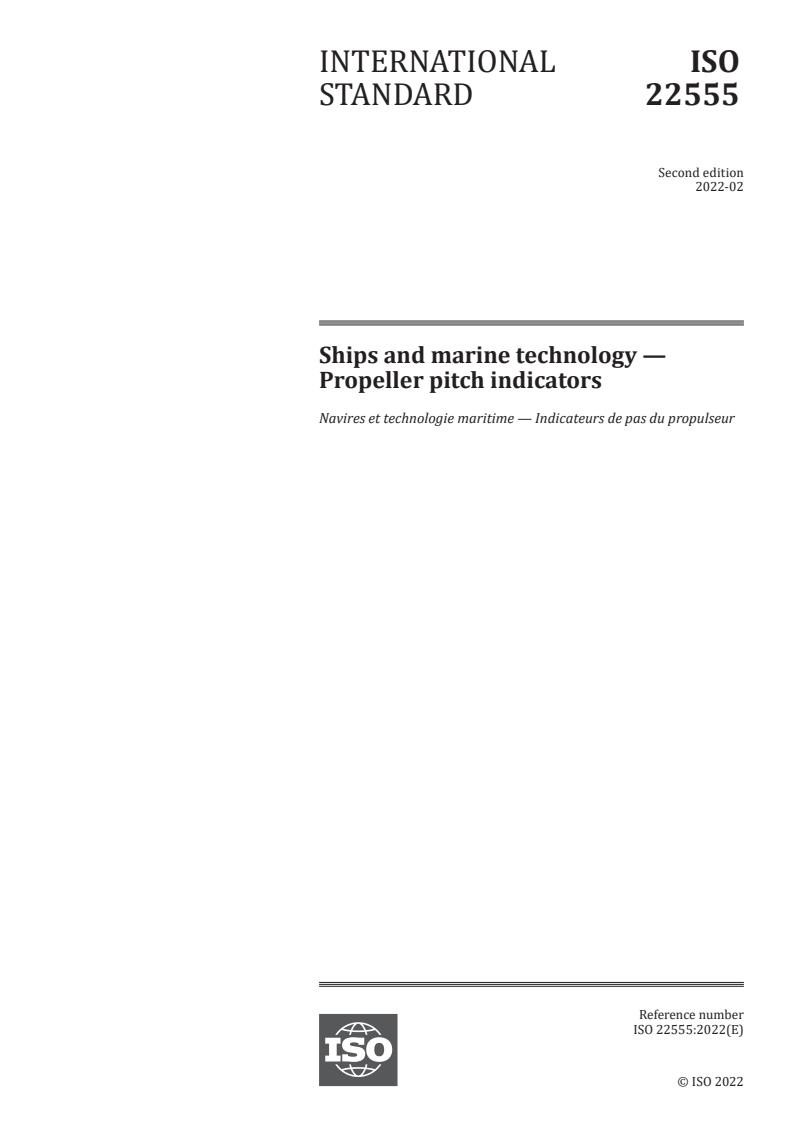
INTERNATIONAL ISO
STANDARD 22555
Second edition
2022-02
Ships and marine technology —
Propeller pitch indicators
Navires et technologie maritime — Indicateurs de pas du propulseur
Reference number
© ISO 2022
All rights reserved. Unless otherwise specified, or required in the context of its implementation, no part of this publication may
be reproduced or utilized otherwise in any form or by any means, electronic or mechanical, including photocopying, or posting on
the internet or an intranet, without prior written permission. Permission can be requested from either ISO at the address below
or ISO’s member body in the country of the requester.
ISO copyright office
CP 401 • Ch. de Blandonnet 8
CH-1214 Vernier, Geneva
Phone: +41 22 749 01 11
Email: copyright@iso.org
Website: www.iso.org
Published in Switzerland
ii
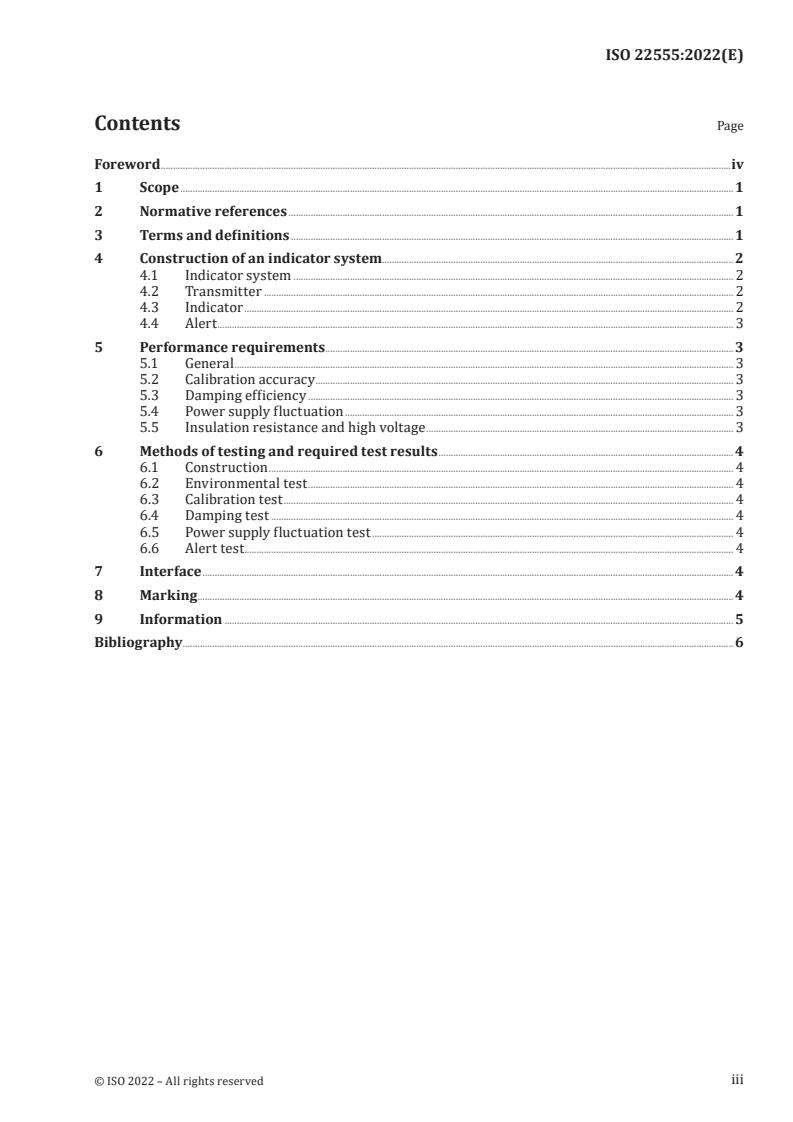
Contents Page
Foreword .iv
1 Scope . 1
2 Normative references . 1
3 Terms and definitions . 1
4 Construction of an indicator system.2
4.1 Indicator system . 2
4.2 Transmitter . 2
4.3 Indicator . 2
4.4 Alert . . 3
5 Performance requirements . .3
5.1 General . 3
5.2 Calibration accuracy . 3
5.3 Damping efficiency . 3
5.4 Power supply fluctuation . 3
5.5 Insulation resistance and high voltage . 3
6 Methods of testing and required test results . 4
6.1 Construction . 4
6.2 Environmental test . 4
6.3 Calibration test . 4
6.4 Damping test . 4
6.5 Power supply fluctuation test . 4
6.6 Alert test . . . 4
7 Interface . 4
8 Marking . . 4
9 Information . 5
Bibliography . 6
iii
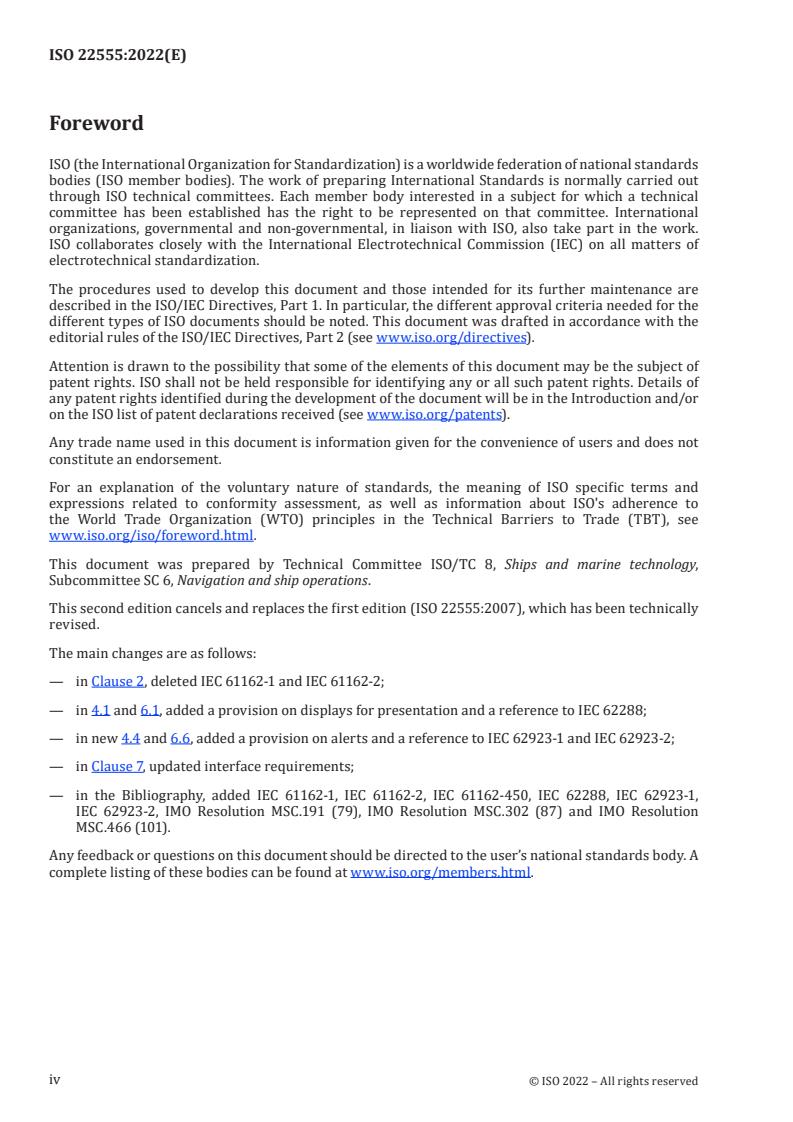
Foreword
ISO (the International Organization for Standardization) is a worldwide federation of national standards
bodies (ISO member bodies). The work of preparing International Standards is normally carried out
through ISO technical committees. Each member body interested in a subject for which a technical
committee has been established has the right to be represented on that committee. International
organizations, governmental and non-governmental, in liaison with ISO, also take part in the work.
ISO collaborates closely with the International Electrotechnical Commission (IEC) on all matters of
electrotechnical standardization.
The procedures used to develop this document and those intended for its further maintenance are
described in the ISO/IEC Directives, Part 1. In particular, the different approval criteria needed for the
different types of ISO documents should be noted. This document was drafted in accordance with the
editorial rules of the ISO/IEC Directives, Part 2 (see www.iso.org/directives).
Attention is drawn to the possibility that some of the elements of this document may be the subject of
patent rights. ISO shall not be held responsible for identifying any or all such patent rights. Details of
any patent rights identified during the development of the document will be in the Introduction and/or
on the ISO list of patent declarations received (see www.iso.org/patents).
Any trade name used in this document is information given for the convenience of users and does not
constitute an endorsement.
For an explanation of the voluntary nature of standards, the meaning of ISO specific terms and
expressions related to conformity assessment, as well as information about ISO's adherence to
the World Trade Organization (WTO) principles in the Technical Barriers to Trade (TBT), see
www.iso.org/iso/foreword.html.
This document was prepared by Technical Committee ISO/TC 8, Ships and marine technology,
Subcommittee SC 6, Navigation and ship operations.
This second edition cancels and replaces the first edition (ISO 22555:2007), which has been technically
revised.
The main changes are as follows:
— in Clause 2, deleted IEC 61162-1 and IEC 61162-2;
— in 4.1 and 6.1, added a provision on displays for presentation and a reference to IEC 62288;
— in new 4.4 and 6.6, added a provision on alerts and a reference to IEC 62923-1 and IEC 62923-2;
— in Clause 7, updated interface requirements;
— in the Bibliography, added IEC 61162-1, IEC 61162-2, IEC 61162-450, IEC 62288, IEC 62923-1,
IEC 62923-2, IMO Resolution MSC.191 (79), IMO Resolution MSC.302 (87) and IMO Resolution
MSC.466 (101).
Any feedback or questions on this document should be directed to the user’s national standards body. A
complete listing of these bodies can be found at www.iso.org/members.html.
iv
INTERNATIONAL STANDARD ISO 22555:2022(E)
Ships and marine technology — Propeller pitch indicators
1 Scope
This document specifies the construction, performance requirements, methods of testing and required
test results for the propeller pitch indicators (hereinafter referred to as “indicator system”) required
by Clause 2.5.4, Regulation 19, chapter V, SOLAS 1974 (as amended, 2000).
This document is associated with IMO Resolution A.694 (17) and IEC 60945.
Where a requirement in this document differs from IEC 60945, the requirement in this document takes
precedence.
2 Normative references
The following documents are referred to in the text in such a way that some or all of their content
constitutes requirements of this document. For dated references, only the edition cited applies. For
undated references, the latest edition of the referenced document (including any amendments) applies.
IEC 60945, Marine navigation and radiocommunication equipment and systems — General requirements
— Methods of testing and required test results
3 Terms and definitions
For the purposes of this document, the following terms and definitions apply.
ISO and IEC maintain terminology databases for use in
...