

ISO 12986-2:2014
(Main)Carbonaceous materials used in the production of aluminium — Prebaked anodes and cathode blocks — Part 2: Determination of flexural strength by the four-point method
General Information
- Abstract
ISO 12986-2:2014 specifies a four-point method to determine the flexural strength of carbon and solid graphite materials at room temperature.
- Status
- Published
- Publication Date
- 30-Jun-2014
- Technical Committee
- ISO/TC 226 - Materials for the production of primary aluminium
- Drafting Committee
- ISO/TC 226/WG 2 - Cathodes and ramming paste
- Current Stage
- 9093 - International Standard confirmed
- Start Date
- 27-Oct-2025
- Completion Date
- 29-Aug-2026
Buy Documents
ISO 12986-2:2014 - Carbonaceous materials used in the production of aluminium -- Prebaked anodes and cathode blocks
ISO 12986-2:2014 - Carbonaceous materials used in the production of aluminium — Prebaked anodes and cathode blocks — Part 2: Determination of flexural strength by the four-point method/1/2014
Overview
ISO 12986-2:2014 specifies a standardized four-point bending method to determine the flexural strength of carbon and solid graphite materials used for prebaked anodes and cathode blocks in aluminium production. The procedure is carried out at room temperature (10 °C to 35 °C) and defines test setup, specimen preparation, measurement, calculation and reporting requirements to ensure comparable and reproducible strength data.
Key topics and technical requirements
- Scope: Flexural strength determination by the four-point method for carbonaceous materials used in aluminium smelting.
- Test principle: A bar-shaped specimen rests on two supports while load is applied at two inner points until fracture; the flexural strength is derived from the maximum force, lever distances and specimen section modulus.
- Specimen preparation:
- Sampling according to ISO 8007 series or agreed procedure.
- Side faces machined so surface roughness Ra < 15 µm (ISO 4288).
- Minimum specimen dimensions: smallest dimension ≥ twice the largest structural constituent and ≥ 4 mm; length ≥ 3.5 × width/diameter.
- Apparatus and setup:
- Compression/testing machine meeting ISO 7500-1 accuracy requirements.
- Four-point fixture with two supports and two force edges; self-adjusting/cardanic suspension recommended to ensure symmetric loading.
- Radii of bearing blocks and force edges typically 2–5 mm; adjustable distances to suit specimen geometry.
- Procedure parameters:
- Test at room temperature (10–35 °C).
- Loading increased uniformly and shock-free at approximately the recommended rate until fracture.
- Record maximum force (Fmax).
- Calculations:
- Bending moment (Mb) computed from geometry and Fmax.
- Flexural strength σb = Mb / Z, where Z is the section modulus (Z depends on cross-section: square, rectangular, circular or ring - formulas provided in the standard).
- Precision and reporting:
- Typical measurement uncertainty ~5 % (95 % confidence) under repeatability for specified specimen sizes.
- Test report must reference ISO 12986-2 and include specimen details, dimensions, individual and mean σb (MPa), number of specimens and test date.
Applications and users
- Quality control and acceptance testing of prebaked anodes and cathode blocks for aluminium smelters.
- Materials testing laboratories validating mechanical performance of carbon and graphite products.
- R&D teams comparing formulations, manufacturing processes, or heat treatments.
- Suppliers certifying product mechanical properties to customers and regulators.
Related standards
- ISO 12986-1 (three-point bending method) - complementary flexural-testing method.
- ISO 8007-1 / -2 / -3 (sampling for cathode blocks, prebaked anodes, sidewall blocks).
- ISO 4288 (surface texture measurement) and ISO 7500-1 (testing machine verification).
- ISO 13385-1 (calipers) and referenced DIN 51944 (basis for this method).
Keywords: ISO 12986-2:2014, flexural strength, four-point method, carbonaceous materials, prebaked anodes, cathode blocks, aluminium production, section modulus, bending moment, materials testing.
Relations
- Effective Date
- 10-Nov-2012
Buy Documents
ISO 12986-2:2014 - Carbonaceous materials used in the production of aluminium -- Prebaked anodes and cathode blocks
ISO 12986-2:2014 - Carbonaceous materials used in the production of aluminium — Prebaked anodes and cathode blocks — Part 2: Determination of flexural strength by the four-point method/1/2014
Get Certified
Connect with accredited certification bodies for this standard

ECOCERT
Organic and sustainability certification.

Eurofins Food Testing Global
Global leader in food, environment, and pharmaceutical product testing.

Intertek Bangladesh
Intertek certification and testing services in Bangladesh.
Sponsored listings
Frequently Asked Questions
ISO 12986-2:2014 is a standard published by the International Organization for Standardization (ISO). Its full title is "Carbonaceous materials used in the production of aluminium — Prebaked anodes and cathode blocks — Part 2: Determination of flexural strength by the four-point method". This standard covers: ISO 12986-2:2014 specifies a four-point method to determine the flexural strength of carbon and solid graphite materials at room temperature.
ISO 12986-2:2014 specifies a four-point method to determine the flexural strength of carbon and solid graphite materials at room temperature.
ISO 12986-2:2014 is classified under the following ICS (International Classification for Standards) categories: 71.100.10 - Materials for aluminium production. The ICS classification helps identify the subject area and facilitates finding related standards.
ISO 12986-2:2014 has the following relationships with other standards: It is inter standard links to ISO 12986-2:2009. Understanding these relationships helps ensure you are using the most current and applicable version of the standard.
ISO 12986-2:2014 is available in PDF format for immediate download after purchase. The document can be added to your cart and obtained through the secure checkout process. Digital delivery ensures instant access to the complete standard document.
Standards Content (Sample)
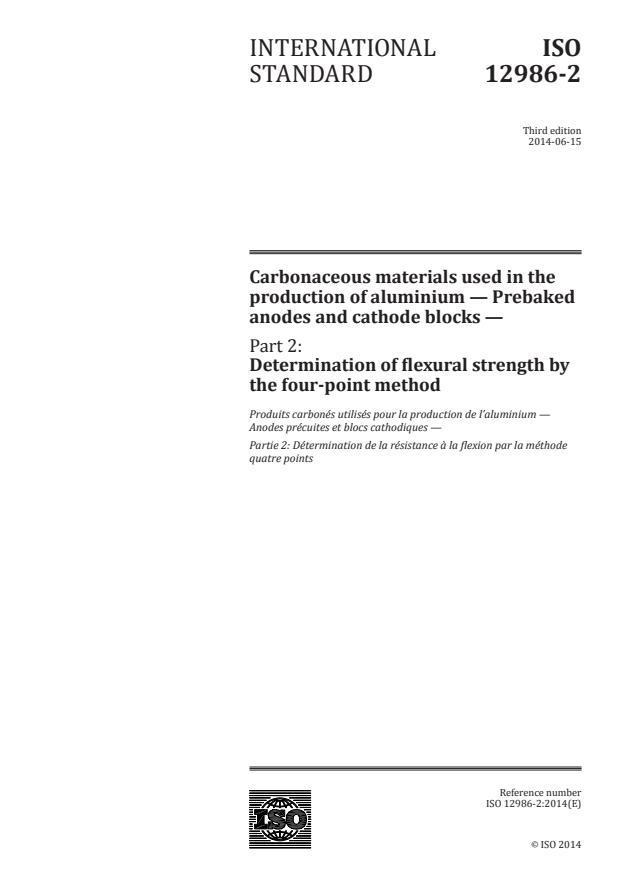
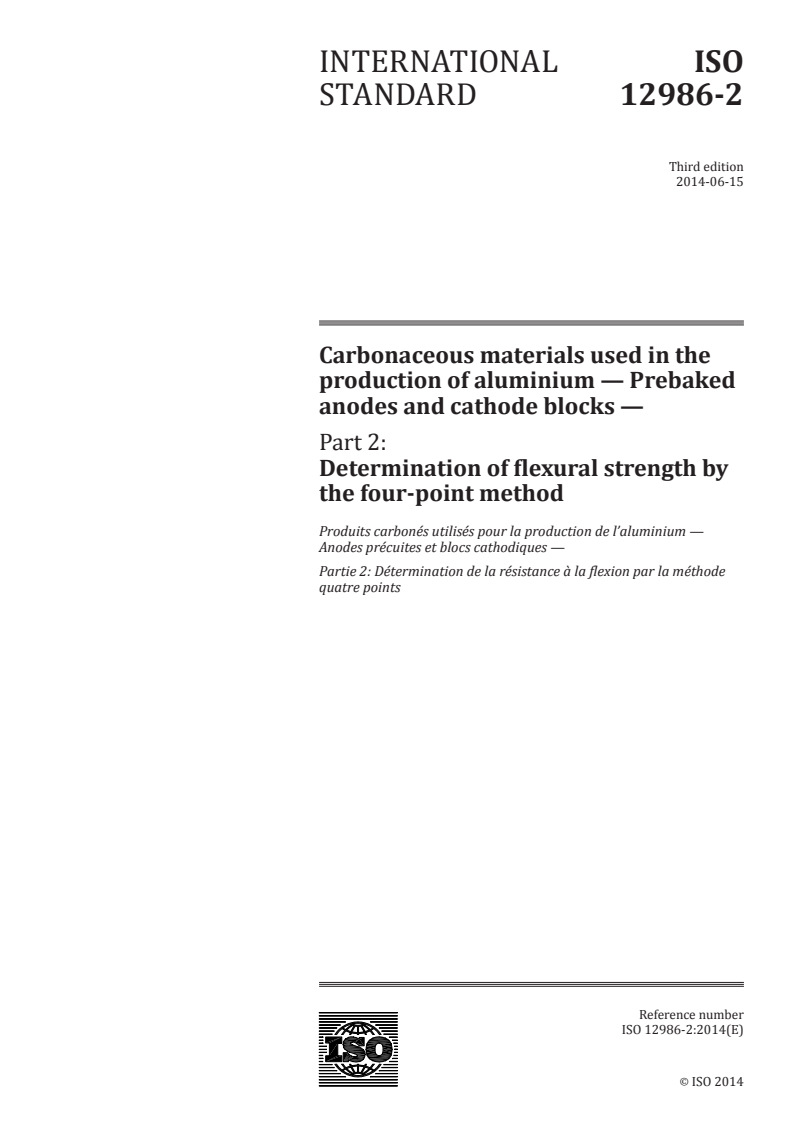
INTERNATIONAL ISO
STANDARD 12986-2
Third edition
2014-06-15
Carbonaceous materials used in the
production of aluminium — Prebaked
anodes and cathode blocks —
Part 2:
Determination of flexural strength by
the four-point method
Produits carbonés utilisés pour la production de l’aluminium —
Anodes précuites et blocs cathodiques —
Partie 2: Détermination de la résistance à la flexion par la méthode
quatre points
Reference number
©
ISO 2014
© ISO 2014
All rights reserved. Unless otherwise specified, no part of this publication may be reproduced or utilized otherwise in any form
or by any means, electronic or mechanical, including photocopying, or posting on the internet or an intranet, without prior
written permission. Permission can be requested from either ISO at the address below or ISO’s member body in the country of
the requester.
ISO copyright office
Case postale 56 • CH-1211 Geneva 20
Tel. + 41 22 749 01 11
Fax + 41 22 749 09 47
E-mail copyright@iso.org
Web www.iso.org
Published in Switzerland
ii © ISO 2014 – All rights reserved
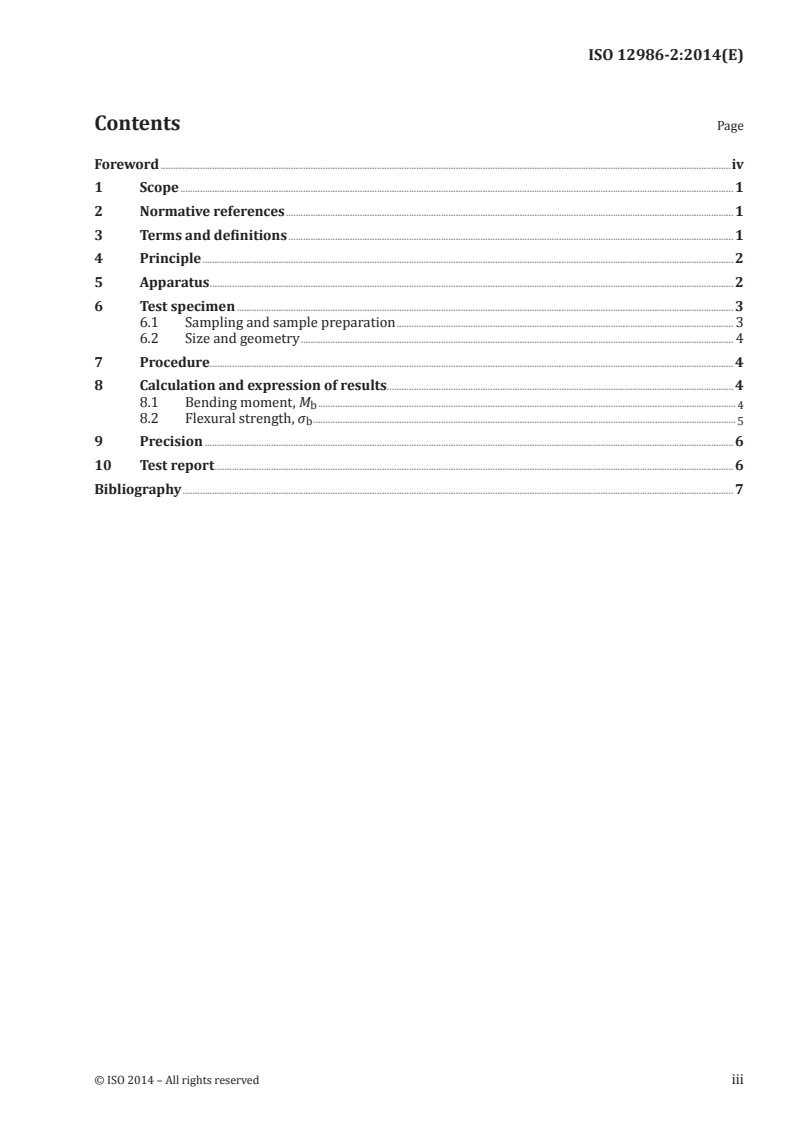
Contents Page
Foreword .iv
1 Scope . 1
2 Normative references . 1
3 Terms and definitions . 1
4 Principle . 2
5 Apparatus . 2
6 Test specimen . 3
6.1 Sampling and sample preparation . 3
6.2 Size and geometry . 4
7 Procedure. 4
8 Calculation and expression of results . 4
8.1 Bending moment, M .
b 4
8.2 Flexural strength, σ .
b 5
9 Precision . 6
10 Test report . 6
Bibliography . 7
Foreword
ISO (the International Organization for Standardization) is a worldwide federation of national standards
bodies (ISO member bodies). The work of preparing International Standards is normally carried out
through ISO technical committees. Each member body interested in a subject for which a technical
committee has been established has the right to be represented on that committee. International
organizations, governmental and non-governmental, in liaison with ISO, also take part in the work.
ISO collaborates closely with the International Electrotechnical Commission (IEC) on all matters of
electrotechnical standardization.
The procedures used to develop this document and those intended for its further maintenance are
described in the ISO/IEC Directives, Part 1. In particular the different approval criteria needed for the
different types of ISO documents should be noted. This document was drafted in accordance with the
editorial rules of the ISO/IEC Directives, Part 2 (see www.iso.org/directives).
Attention is drawn to the possibility that some of the elements of this document may be the subject of
patent rights. ISO shall not be held responsible for identifying any or all such patent rights. Details of
any patent rights identified during the development of the document will be in the Introduction and/or
on the ISO list of patent declarations received (see www.iso.org/patents).
Any trade name used in this document is information given for the convenience of users and does not
constitute an endorsement.
For an explanation on the meaning of ISO specific terms and expressions related to conformity
assessment, as well as information about ISO’s adherence to the WTO principles in the Technical Barriers
to Trade (TBT) see the following URL: Foreword - Supplementary information
The committee responsible for this document is ISO/TC 226, Materials for production of primary
aluminium.
This third edition cancels and replaces the second edition (ISO 12986-2:2009), which has been technically
revised.
ISO 12986 consists of the following parts, under the general title Carbonaceous materials used in the
production of aluminium — Prebaked anodes and cathode blocks:
— Part 1: Determination of bending strength by the three-point method
— Part 2: Determination of flexural strength by the four-point method
iv © ISO 2014 – All rights reserved
INTERNATIONAL STANDARD ISO 12986-2:2014(E)
Carbonaceous materials used in the production of
aluminium — Prebaked anodes and cathode blocks —
Part 2:
Determination of flexural strength by the four-point
method
1 Scope
This part of ISO 12986 specifies a four-point method to determine the flexural strength of carbon and
solid graphite materials at room temperature.
NOTE This part of ISO 12986 is based on DIN 51944.
2 Normative references
The following documents, in whole or in part, are normatively referenced in this document and are
indispensable for its application. For dated references, only the edition cited applies. For undated
references, the latest edition of the referenced document (including any amendments) applies.
ISO 4288, Geometrical Product Specifications (GPS) — Surface texture: Profile method — Rules and
procedures for the assessment of surface texture
ISO 7500-1, Metallic materials — Verification of static uniaxial testing machines — Part 1: Tension/compression
testing machines — Verification and calibration of the force-measuring system
ISO 8007-1, Carbonaceous materials used in the production of aluminium — Sampling plans and sampling
from individual units — Part 1: Cathode blocks
ISO 8007-2, Carbonaceous materials used in the production of aluminium — Sampling plans and sampling
from individual units — Part 2: Prebaked anodes
ISO 8007-3, Carbonaceous materials used in the production of aluminium — Sampling plans and sampling
from individual units — Part 3: Sidewall blocks
...
INTERNATIONAL ISO
STANDARD 12986-2
Third edition
2014-06-15
Carbonaceous materials used in the
production of aluminium — Prebaked
anodes and cathode blocks —
Part 2:
Determination of flexural strength by
the four-point method
Produits carbonés utilisés pour la production de l’aluminium —
Anodes précuites et blocs cathodiques —
Partie 2: Détermination de la résistance à la flexion par la méthode
quatre points
Reference number
©
ISO 2014
© ISO 2014
All rights reserved. Unless otherwise specified, no part of this publication may be reproduced or utilized otherwise in any form
or by any means, electronic or mechanical, including photocopying, or posting on the internet or an intranet, without prior
written permission. Permission can be requested from either ISO at the address below or ISO’s member body in the country of
the requester.
ISO copyright office
Case postale 56 • CH-1211 Geneva 20
Tel. + 41 22 749 01 11
Fax + 41 22 749 09 47
E-mail copyright@iso.org
Web www.iso.org
Published in Switzerland
ii © ISO 2014 – All rights reserved
Contents Page
Foreword .iv
1 Scope . 1
2 Normative references . 1
3 Terms and definitions . 1
4 Principle . 2
5 Apparatus . 2
6 Test specimen . 3
6.1 Sampling and sample preparation . 3
6.2 Size and geometry . 4
7 Procedure. 4
8 Calculation and expression of results . 4
8.1 Bending moment, M .
b 4
8.2 Flexural strength, σ .
b 5
9 Precision . 6
10 Test report . 6
Bibliography . 7
Foreword
ISO (the International Organization for Standardization) is a worldwide federation of national standards
bodies (ISO member bodies). The work of preparing International Standards is normally carried out
through ISO technical committees. Each member body interested in a subject for which a technical
committee has been established has the right to be represented on that committee. International
organizations, governmental and non-governmental, in liaison with ISO, also take part in the work.
ISO collaborates closely with the International Electrotechnical Commission (IEC) on all matters of
electrotechnical standardization.
The procedures used to develop this document and those intended for its further maintenance are
described in the ISO/IEC Directives, Part 1. In particular the different approval criteria needed for the
different types of ISO documents should be noted. This document was drafted in accordance with the
editorial rules of the ISO/IEC Directives, Part 2 (see www.iso.org/directives).
Attention is drawn to the possibility that some of the elements of this document may be the subject of
patent rights. ISO shall not be held responsible for identifying any or all such patent rights. Details of
any patent rights identified during the development of the document will be in the Introduction and/or
on the ISO list of patent declarations received (see www.iso.org/patents).
Any trade name used in this document is information given for the convenience of users and does not
constitute an endorsement.
For an explanation on the meaning of ISO specific terms and expressions related to conformity
assessment, as well as information about ISO’s adherence to the WTO principles in the Technical Barriers
to Trade (TBT) see the following URL: Foreword - Supplementary information
The committee responsible for this document is ISO/TC 226, Materials for production of primary
aluminium.
This third edition cancels and replaces the second edition (ISO 12986-2:2009), which has been technically
revised.
ISO 12986 consists of the following parts, under the general title Carbonaceous materials used in the
production of aluminium — Prebaked anodes and cathode blocks:
— Part 1: Determination of bending strength by the three-point method
— Part 2: Determination of flexural strength by the four-point method
iv © ISO 2014 – All rights reserved
INTERNATIONAL STANDARD ISO 12986-2:2014(E)
Carbonaceous materials used in the production of
aluminium — Prebaked anodes and cathode blocks —
Part 2:
Determination of flexural strength by the four-point
method
1 Scope
This part of ISO 12986 specifies a four-point method to determine the flexural strength of carbon and
solid graphite materials at room temperature.
NOTE This part of ISO 12986 is based on DIN 51944.
2 Normative references
The following documents, in whole or in part, are normatively referenced in this document and are
indispensable for its application. For dated references, only the edition cited applies. For undated
references, the latest edition of the referenced document (including any amendments) applies.
ISO 4288, Geometrical Product Specifications (GPS) — Surface texture: Profile method — Rules and
procedures for the assessment of surface texture
ISO 7500-1, Metallic materials — Verification of static uniaxial testing machines — Part 1: Tension/compression
testing machines — Verification and calibration of the force-measuring system
ISO 8007-1, Carbonaceous materials used in the production of aluminium — Sampling plans and sampling
from individual units — Part 1: Cathode blocks
ISO 8007-2, Carbonaceous materials used in the production of aluminium — Sampling plans and sampling
from individual units — Part 2: Prebaked anodes
ISO 8007-3, Carbonaceous materials used in the production of aluminium — Sampling plans and sampling
from individual units — Part 3: Sidewall blocks
...