

ISO/TS 18621-22:2024
(Main)Graphic technology — Image quality evaluation methods for printed matter — Part 22: Evaluation of colour graininess
General Information
- Abstract
This document defines a process independent measurement method for the evaluation of graininess of printed products. It provides requirements for the test form and measurement devices to be used as well as the formulas to compute the colour graininess score (SCG).
- Status
- Published
- Publication Date
- 14-May-2024
- Technical Committee
- ISO/TC 130 - Graphic technology
- Drafting Committee
- ISO/TC 130 - Graphic technology
- Current Stage
- 6060 - International Standard published
- Start Date
- 15-May-2024
- Due Date
- 08-Sep-2024
- Completion Date
- 15-May-2024

Overview
ISO/TS 18621-22:2024 is an international technical specification developed by ISO for the graphic technology industry, focusing on evaluating image quality in printed matter. This part of the ISO/TS 18621 series defines a process independent measurement method for the evaluation of colour graininess in printed products. The standard outlines requirements for the test forms, measurement devices, and the calculation formulas used to derive the colour graininess score (SCG). By establishing a common reference for evaluating graininess, ISO/TS 18621-22:2024 supports consistency and comparability in print quality assessments across varying printing technologies.
Key terms: image quality, colour graininess, print evaluation, SCG score, graphic technology standard.
Key Topics
Process-Independent Measurement:
The standard specifies methods for measuring colour graininess that are not dependent on the particular printing process or technology used, enabling cross-platform comparability.Test Form Requirements:
Guidelines are provided for designing test forms, including the selection and placement of colour patches to ensure representative sampling across colour gamuts.Measurement Devices:
Requirements focus on the use of colorimetrically characterized flatbed scanners with sufficient resolution (minimum 600 ppi), ensuring accurate and repeatable colour measurements.Colour Graininess Score (SCG):
The document details how to calculate the SCG value by applying visual transfer-simulating Gaussian filters, analyzing CIEDE2000 colour differences at the micro-region level, and averaging results for a quantifiable score.Reporting Requirements:
Clear instructions are given on how to document and report the SCG, ensuring transparency regarding the evaluated system, printing conditions, and measured colour patches.Interpretation Guidelines:
An annex provides practical description categories to help interpret the meaning and visual impact of specific SCG levels, aiding communication with stakeholders and customers.
Applications
ISO/TS 18621-22:2024 is invaluable for a range of stakeholders in the graphic technology and printing industries seeking reliable methods for print quality evaluation:
- Print Manufacturers & Service Providers:
Objectively assess and benchmark image quality, specifically colour graininess, to meet client requirements or industry standards. - Quality Control Laboratories:
Integrate standardized graininess evaluation in quality assurance protocols to ensure consistent print outputs and reduce customer complaints. - Equipment Manufacturers:
Use the standard during R&D and production stages to compare and improve the graininess performance of new printing devices or substrates. - Print Buyers & Brand Owners:
Reference quantifiable print quality parameters when specifying or accepting printed products, helping ensure visual appeal and consistency. - Research & Development:
Facilitate comparative studies across different printing technologies and support innovation in imaging science.
Related Standards
ISO/TS 18621-22:2024 is part of a broader suite of standards and technical specifications in the field of print and image quality evaluation:
- ISO/IEC 24790: Measurement of image quality attributes for hardcopy output
- ISO/CIE 11664-6: CIEDE2000 colour-difference formula
- ISO 12641-1 & ISO 12641-2: Colour targets for input scanner calibration
- ISO 3664: Viewing conditions for graphic technology and photography
For a full list of related standards and guidance on their application, visit ISO Graphic Technology Standards.
Implementing ISO/TS 18621-22:2024 provides a robust foundation for objective, cross-technology evaluation of colour graininess, enhancing print quality management and customer satisfaction throughout the graphic technology sector.
Frequently Asked Questions
ISO/TS 18621-22:2024 is a technical specification published by the International Organization for Standardization (ISO). Its full title is "Graphic technology — Image quality evaluation methods for printed matter — Part 22: Evaluation of colour graininess". This standard covers: This document defines a process independent measurement method for the evaluation of graininess of printed products. It provides requirements for the test form and measurement devices to be used as well as the formulas to compute the colour graininess score (SCG).
This document defines a process independent measurement method for the evaluation of graininess of printed products. It provides requirements for the test form and measurement devices to be used as well as the formulas to compute the colour graininess score (SCG).
ISO/TS 18621-22:2024 is classified under the following ICS (International Classification for Standards) categories: 37.100.10 - Reproduction equipment. The ICS classification helps identify the subject area and facilitates finding related standards.
ISO/TS 18621-22:2024 is available in PDF format for immediate download after purchase. The document can be added to your cart and obtained through the secure checkout process. Digital delivery ensures instant access to the complete standard document.
Standards Content (Sample)
Technical
Specification
ISO/TS 18621-22
First edition
Graphic technology — Image quality
2024-05
evaluation methods for printed
matter —
Part 22:
Evaluation of colour graininess
Reference number
© ISO 2024
All rights reserved. Unless otherwise specified, or required in the context of its implementation, no part of this publication may
be reproduced or utilized otherwise in any form or by any means, electronic or mechanical, including photocopying, or posting on
the internet or an intranet, without prior written permission. Permission can be requested from either ISO at the address below
or ISO’s member body in the country of the requester.
ISO copyright office
CP 401 • Ch. de Blandonnet 8
CH-1214 Vernier, Geneva
Phone: +41 22 749 01 11
Email: copyright@iso.org
Website: www.iso.org
Published in Switzerland
ii
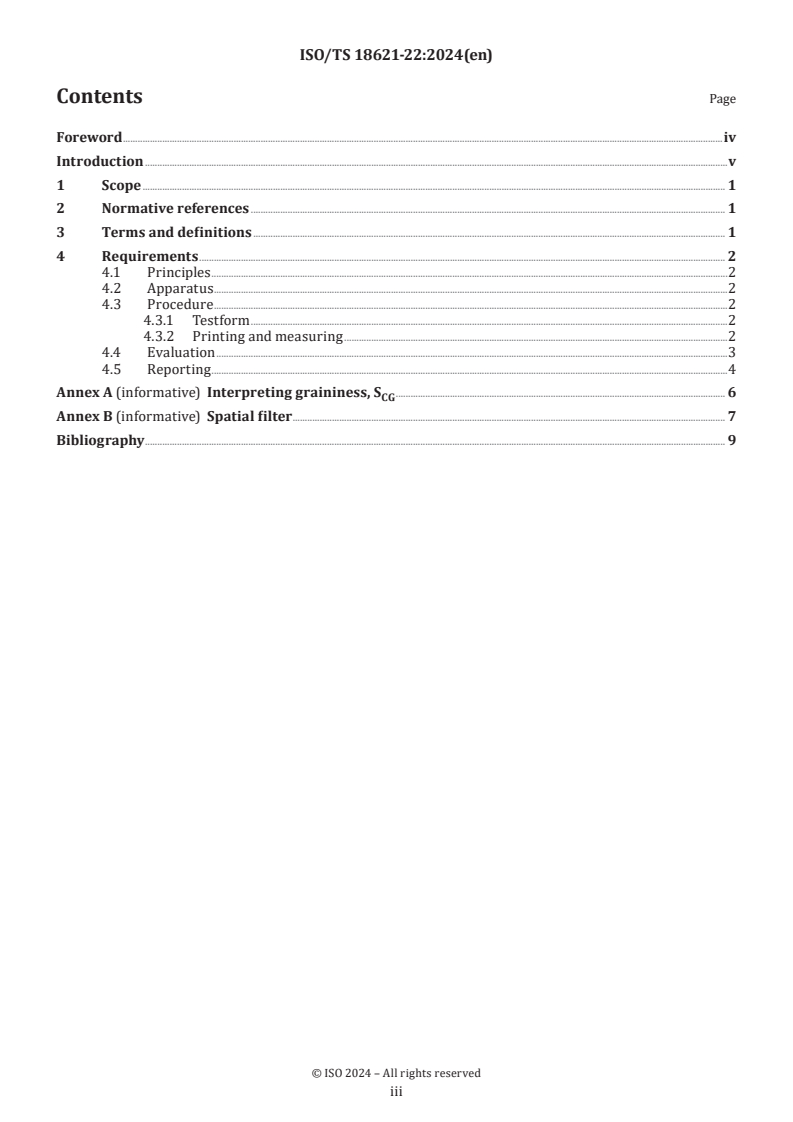
Contents Page
Foreword .iv
Introduction .v
1 Scope . 1
2 Normative references . 1
3 Terms and definitions . 1
4 Requirements . 2
4.1 Principles .2
4.2 Apparatus .2
4.3 Procedure .2
4.3.1 Testform .2
4.3.2 Printing and measuring .2
4.4 Evaluation .3
4.5 Reporting .4
Annex A (informative) Interpreting graininess, S . 6
CG
Annex B (informative) Spatial filter . 7
Bibliography . 9
iii
Foreword
ISO (the International Organization for Standardization) is a worldwide federation of national standards
bodies (ISO member bodies). The work of preparing International Standards is normally carried out through
ISO technical committees. Each member body interested in a subject for which a technical committee
has been established has the right to be represented on that committee. International organizations,
governmental and non-governmental, in liaison with ISO, also take part in the work. ISO collaborates closely
with the International Electrotechnical Commission (IEC) on all matters of electrotechnical standardization.
The procedures used to develop this document and those intended for its further maintenance are described
in the ISO/IEC Directives, Part 1. In particular, the different approval criteria needed for the different types
of ISO document should be noted. This document was drafted in accordance with the editorial rules of the
ISO/IEC Directives, Part 2 (see www.iso.org/directives).
ISO draws attention to the possibility that the implementation of this document may involve the use of (a)
patent(s). ISO takes no position concerning the evidence, validity or applicability of any claimed patent
rights in respect thereof. As of the date of publication of this document, ISO had not received notice of (a)
patent(s) which may be required to implement this document. However, implementers are cautioned that
this may not represent the latest information, which may be obtained from the patent database available at
www.iso.org/patents. ISO shall not be held responsible for identifying any or all such patent rights.
Any trade name used in this document is information given for the convenience of users and does not
constitute an endorsement.
For an explanation of the voluntary nature of standards, the meaning of ISO specific terms and expressions
related to conformity assessment, as well as information about ISO's adherence to the World Trade
Organization (WTO) principles in the Technical Barriers to Trade (TBT), see www.iso.org/iso/foreword.html.
This document was prepared by Technical Committee ISO/TC 130, Graphic technology.
A list of all parts in the ISO 18621 series can be found on the ISO website.
Any feedback or questions on this document should be directed to the user’s national standards body. A
complete listing of these bodies can be found at www.iso.org/members.html.
iv
Introduction
The subject of image quality is broad and complex, due to its multidimensionality. A large number of
[1]
measurement methods have been developed to describe attributes of printed image quality . Many
different methods may be available to provide a measure of a particular image quality attribute, usually on
completely different numerical scales and, with few exceptions, providing no well-defined correlation with
visual perception to establish the visual significance of a measured difference. A fraction of these methods
has been developed in a manner that is independent of marking technology, permitting general, technology-
independent measurement of an image quality attribute.
The evaluation of perceived image quality in prints is an active field of research. Definitions of measurements
of print quality attributes that correlate with visual perception by technology-independent means, even
across many printing technologies, is under current scrutiny. Nevertheless, these evaluations are complex
due to subjectivity and dimensionality. It is influenced by a number of different quality attributes. It is
often difficult and complicated to evaluate the influence of all attributes on overall image quality, and their
influence on other attributes.
Graininess measurements provide an indication of the apparent high frequency image noise in a digital
printing system and typically refers to aperiodic fluctuations of density at a spatial frequency greater than
0,4 cycles per millimetre in all directions for standard viewing distance of 400 mm. Many methods have
[2]
been developed over the years, for instance, the method defined in ISO/IEC 24790 , which is restricted to
luminance based variations. In this document this approach has been extended for colour variations, while
default viewing distance is 40 cm (reading distance).
v
Technical Specification ISO/TS 18621-22:2024(en)
Graphic technology — Image quality evaluation methods for
printed matter —
Part 22:
Evaluation of colour graininess
1 Scope
This document defines a process independent measurement method for the evaluation of graininess of
printed products. It provides requirements for the test form and measurement devices to be used as well as
the formulas to compute the colour graininess score (S ).
CG
2 Normative references
There are no normative references in this document.
3 Terms and definitions
For the purposes of this document, the following terms and definitions apply.
ISO and IEC maintain terminology databases for use in standardization at the following addresses:
— ISO Online browsing platform: available at https:// www .iso .org/ obp
— IEC Electropedia: available at https:// www .electropedia .org/
3.1
CIEDE2000 colour difference
method of/formula for calculating colour difference, ΔE /CIEDE
00 00
[3]
Note 1 to entry: See ISO/CIE 11664-6 for details.
Note 2 to entry: The default weights for lightness, chroma and hue are (1:1:1).
Note 3 to entry: The unit is 1.
3.2
CIELAB colour space
CIE 1976 L* a* b* colour space
three-dimensional, approximately uniform colour space produced by plotting L*, a*, b* in Cartesian co-
ordinates
[4]
[SOURCE: adapted from 17-23-077 of CIE S 012 ]
3.3
graininess
appearance of unintended microscopic but visible aperiodic fluctuations of colour (microscopic means
variations with spatial frequencies greater than about 0,4 cy/mm)
4 Requirements
4.1 Principles
The graininess score is evaluated using a calibrated scanner. After a Gaussian filter that roughly
...