

ISO 13940:2026
(Main)Health informatics — System of concepts to support continuity of care
General Information
- Abstract
This document defines the requirements for a system of concepts for different aspects of the provision of care encompassing social care as well as clinical care. The focus of this document is continuity of care. This document defines requirements for a system of concept definitions needed to describe health and care businesses. Concept systems conforming to this document can be used to support the development of: logical reference models within the information viewpoint as a common basis for semantic interoperability on international, national or local levels; information systems; information for specified types of care processes. This document does not specify how to perform specific care processes. This document does not cover research processes in the context of social and clinical care, welfare and educational processes.
- Status
- Published
- Publication Date
- 02-Aug-2026
- Technical Committee
- ISO/TC 215 - Health informatics
- Drafting Committee
- ISO/TC 215/WG 3 - Semantic content
- Current Stage
- 6060 - International Standard published
- Start Date
- 03-Aug-2026
- Due Date
- 14-Jul-2026
- Completion Date
- 03-Aug-2026

Overview
ISO 13940:2026 – Health informatics - System of concepts to support continuity of care is an international standard developed by the International Organization for Standardization (ISO). This standard specifies requirements for a system of concepts that facilitate the description, communication, and management of care across both social and clinical domains. Its central aim is to enhance the continuity of care by providing a unified conceptual framework for care provision, supporting interoperability between health and care information systems at local, national, and international levels.
By formalizing the definitions and relationships among care-related concepts, ISO 13940:2026 helps healthcare organizations, professionals, and system developers ensure that vital information follows individuals throughout different stages and settings of care.
Key Topics
ISO 13940:2026 covers crucial aspects of health informatics required for continuity of care, including:
- Core concepts and definitions for describing health and care processes, actors, resources, activities, and events
- Relationships among concepts such as health state, health need, care processes, actors, and resources
- Representation of processes involved in both social and clinical care, focusing on consistency and clarity
- Semantic interoperability across information systems for stronger data exchange and collaboration
- Coverage of multiple dimensions: social care, clinical care, care actors, care activities, events, timelines, and planning
- Support for logical reference models, serving as a common semantic foundation for health and care information systems
- Terms, definitions, and relationships that support effective communication across organizations and disciplines
The standard does not provide instructions on how to perform specific care processes, nor does it apply to research, welfare, or educational contexts.
Applications
ISO 13940:2026 provides practical value for a diverse range of stakeholders in the healthcare and social care sectors:
- Information system developers: Enables development of interoperable electronic health record (EHR) systems and other IT solutions supporting integrated person-centered care.
- Healthcare providers and organizations: Facilitates consistent documentation and understanding of care processes, improving service delivery and continuity.
- Social care professionals: Supports integration between social care and clinical services by aligning terminology, roles, and activities.
- Policy makers and standards bodies: Lays a conceptual groundwork for regulations and guidance on data exchange and care integration.
- International, national, and local health networks: Standardizes semantic models, making cross-border care collaboration and data sharing more effective.
Typical use cases include:
- Structuring care pathways and care plans for patients with complex needs
- Integrating social determinants of health within clinical workflows
- Clarifying responsibilities among diverse care actors and organizations
- Improving patient safety and outcomes by reducing fragmentation of care
Related Standards
For comprehensive support of health informatics and care continuity, ISO 13940:2026 is related to several important standards:
- ISO 13606 - Health informatics: Electronic health record communication
- ISO/HL7 21731 - Health Level Seven Reference Information Model
- ISO 12967 - Health informatics: Service architecture
- ISO 13943 - Health Informatics: Vocabulary
- ISO/TR 14639 - Health informatics: Capacity-based health informatics benchmarking
These and other health informatics standards ensure that technical, semantic, and organizational interoperability goals are met across the healthcare continuum.
ISO 13940:2026 is an essential resource for advancing effective, interoperable information management that supports continuity of care across modern health and social care systems. By adopting a shared conceptual system, healthcare organizations and system developers can greatly enhance person-centered care, safety, and efficiency.
Relations
- Consolidates
EN ISO 13940:2026 - Health informatics - System of concepts to support continuity of care (ISO 13940:2026) - Effective Date
- 12-Feb-2026
- Effective Date
- 18-Jan-2025
Get Certified
Connect with accredited certification bodies for this standard

BSI Group
BSI (British Standards Institution) is the business standards company that helps organizations make excellence a habit.

NYCE
Mexican standards and certification body.
Sponsored listings
Frequently Asked Questions
ISO 13940:2026 is a standard published by the International Organization for Standardization (ISO). Its full title is "Health informatics — System of concepts to support continuity of care". This standard covers: This document defines the requirements for a system of concepts for different aspects of the provision of care encompassing social care as well as clinical care. The focus of this document is continuity of care. This document defines requirements for a system of concept definitions needed to describe health and care businesses. Concept systems conforming to this document can be used to support the development of: logical reference models within the information viewpoint as a common basis for semantic interoperability on international, national or local levels; information systems; information for specified types of care processes. This document does not specify how to perform specific care processes. This document does not cover research processes in the context of social and clinical care, welfare and educational processes.
This document defines the requirements for a system of concepts for different aspects of the provision of care encompassing social care as well as clinical care. The focus of this document is continuity of care. This document defines requirements for a system of concept definitions needed to describe health and care businesses. Concept systems conforming to this document can be used to support the development of: logical reference models within the information viewpoint as a common basis for semantic interoperability on international, national or local levels; information systems; information for specified types of care processes. This document does not specify how to perform specific care processes. This document does not cover research processes in the context of social and clinical care, welfare and educational processes.
ISO 13940:2026 is classified under the following ICS (International Classification for Standards) categories: 35.240.80 - IT applications in health care technology. The ICS classification helps identify the subject area and facilitates finding related standards.
ISO 13940:2026 has the following relationships with other standards: It is inter standard links to EN ISO 13940:2026, ISO 13940:2015. Understanding these relationships helps ensure you are using the most current and applicable version of the standard.
ISO 13940:2026 is available in PDF format for immediate download after purchase. The document can be added to your cart and obtained through the secure checkout process. Digital delivery ensures instant access to the complete standard document.
Standards Content (Sample)
International
Standard
ISO 13940
Second edition
Health informatics — System of
2026-08
concepts to support continuity of
care
Informatique de santé — Système de concepts visant à favoriser
la continuité des soins
Reference number
© ISO 2026
All rights reserved. Unless otherwise specified, or required in the context of its implementation, no part of this publication may
be reproduced or utilized otherwise in any form or by any means, electronic or mechanical, including photocopying, or posting on
the internet or an intranet, without prior written permission. Permission can be requested from either ISO at the address below
or ISO’s member body in the country of the requester.
ISO copyright office
CP 401 • Ch. de Blandonnet 8
CH-1214 Vernier, Geneva
Phone: +41 22 749 01 11
Email: copyright@iso.org
Website: www.iso.org
Published in Switzerland
ii
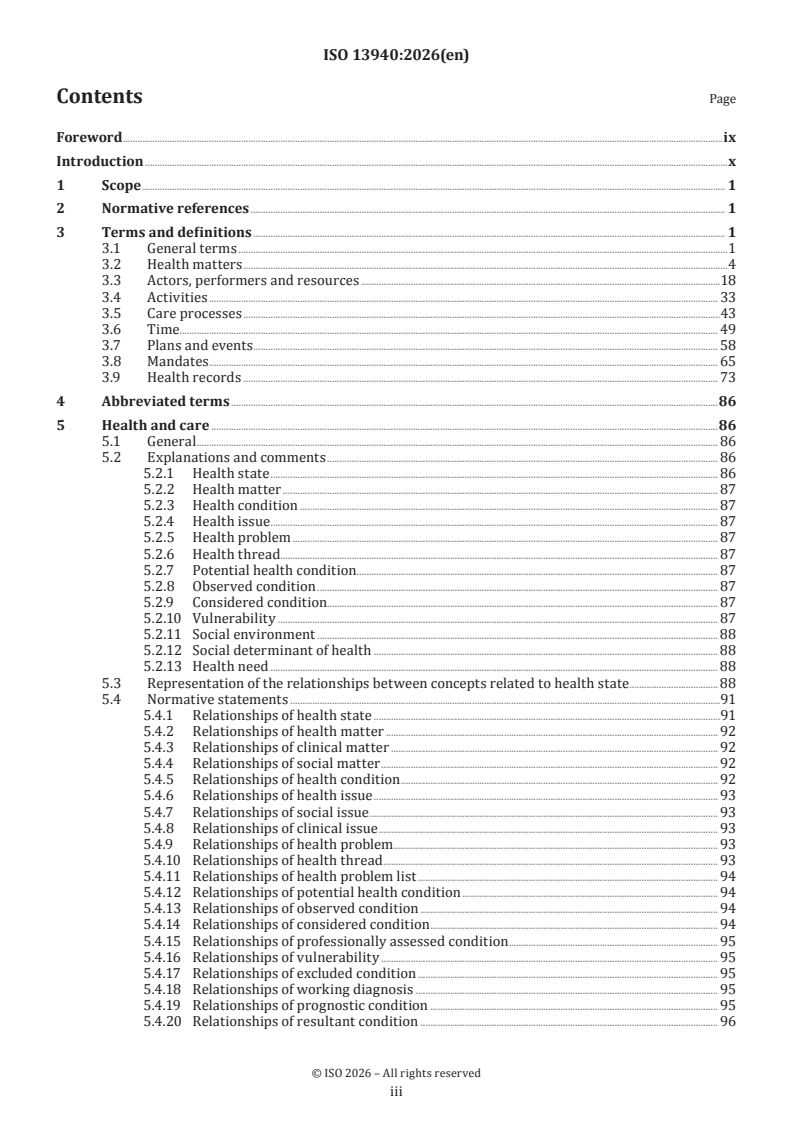
Contents Page
Foreword .ix
Introduction .x
1 Scope . 1
2 Normative references . 1
3 Terms and definitions . 1
3.1 General terms .1
3.2 Health matters .4
3.3 Actors, performers and resources .18
3.4 Activities . 33
3.5 Care processes .43
3.6 Time. 49
3.7 Plans and events . 58
3.8 Mandates . 65
3.9 Health records . 73
4 Abbreviated terms .86
5 Health and care .86
5.1 General . 86
5.2 Explanations and comments . 86
5.2.1 Health state . 86
5.2.2 Health matter . 87
5.2.3 Health condition . 87
5.2.4 Health issue . 87
5.2.5 Health problem . 87
5.2.6 Health thread. 87
5.2.7 Potential health condition . 87
5.2.8 Observed condition . 87
5.2.9 Considered condition. 87
5.2.10 Vulnerability . 87
5.2.11 Social environment . 88
5.2.12 Social determinant of health . 88
5.2.13 Health need . 88
5.3 Representation of the relationships between concepts related to health state . 88
5.4 Normative statements .91
5.4.1 Relationships of health state .91
5.4.2 Relationships of health matter . 92
5.4.3 Relationships of clinical matter . 92
5.4.4 Relationships of social matter . 92
5.4.5 Relationships of health condition . 92
5.4.6 Relationships of health issue . 93
5.4.7 Relationships of social issue. 93
5.4.8 Relationships of clinical issue . 93
5.4.9 Relationships of health problem . 93
5.4.10 Relationships of health thread . 93
5.4.11 Relationships of health problem list . 94
5.4.12 Relationships of potential health condition . 94
5.4.13 Relationships of observed condition . 94
5.4.14 Relationships of considered condition . 94
5.4.15 Relationships of professionally assessed condition . 95
5.4.16 Relationships of vulnerability . 95
5.4.17 Relationships of excluded condition . 95
5.4.18 Relationships of working diagnosis . 95
5.4.19 Relationships of prognostic condition . 95
5.4.20 Relationships of resultant condition . 96
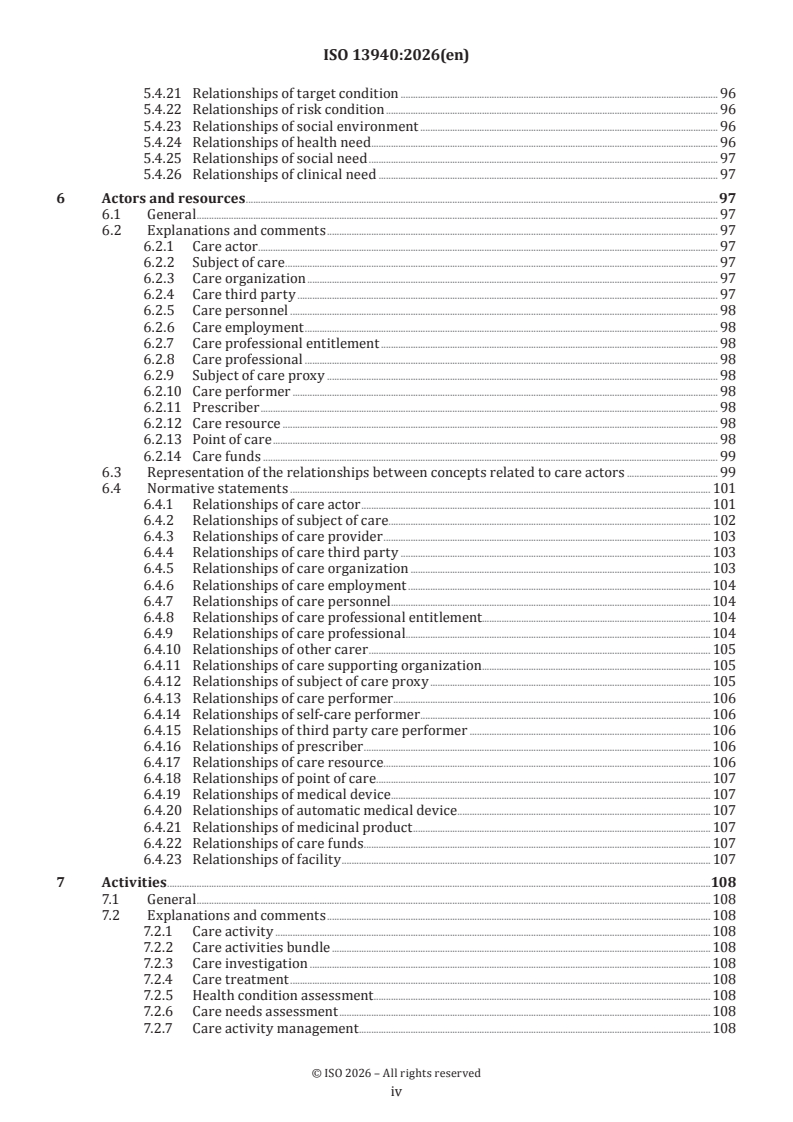
iii
5.4.21 Relationships of target condition . 96
5.4.22 Relationships of risk condition . 96
5.4.23 Relationships of social environment . 96
5.4.24 Relationships of health need . . 96
5.4.25 Relationships of social need . 97
5.4.26 Relationships of clinical need . 97
6 Actors and resources .97
6.1 General . 97
6.2 Explanations and comments . 97
6.2.1 Care actor . 97
6.2.2 Subject of care . 97
6.2.3 Care organization . 97
6.2.4 Care third party . 97
6.2.5 Care personnel . 98
6.2.6 Care employment . 98
6.2.7 Care professional entitlement . 98
6.2.8 Care professional . 98
6.2.9 Subject of care proxy . 98
6.2.10 Care performer . 98
6.2.11 Prescriber . 98
6.2.12 Care resource . 98
6.2.13 Point of care . 98
6.2.14 Care funds . 99
6.3 Representation of the relationships between concepts related to care actors . 99
6.4 Normative statements . 101
6.4.1 Relationships of care actor . 101
6.4.2 Relationships of subject of care . . 102
6.4.3 Relationships of care provider . 103
6.4.4 Relationships of care third party . 103
6.4.5 Relationships of care organization . 103
6.4.6 Relationships of care employment . 104
6.4.7 Relationships of care personnel . 104
6.4.8 Relationships of care professional entitlement. 104
6.4.9 Relationships of care professional . 104
6.4.10 Relationships of other carer . 105
6.4.11 Relationships of care supporting organization . . 105
6.4.12 Relationships of subject of care proxy . 105
6.4.13 Relationships of care performer . 106
6.4.14 Relationships of self-care performer . 106
6.4.15 Relationships of third party care performer . 106
6.4.16 Relationships of prescriber . 106
6.4.17 Relationships of care resource . 106
6.4.18 Relationships of point of care. 107
6.4.19 Relationships of medical device . 107
6.4.20 Relationships of automatic medical device . 107
6.4.21 Relationships of medicinal product . 107
6.4.22 Relationships of care funds . . 107
6.4.23 Relationships of facility . 107
7 Activities .108
7.1 General . 108
7.2 Explanations and comments . 108
7.2.1 Care activity . 108
7.2.2 Care activities bundle . 108
7.2.3 Care investigation . 108
7.2.4 Care treatment . 108
7.2.5 Health condition assessment . 108
7.2.6 Care needs assessment . 108
7.2.7 Care activity management . 108
iv
7.2.8 Care evaluation . 108
7.3 Representation of the relationships between concepts related to care activities . 109
7.4 Normative statements .110
7.4.1 Relationships of care activity.110
7.4.2 Relationships of care provider activity . 111
7.4.3 Relationships of social care . 111
7.4.4 Relationships of automated care . 112
7.4.5 Relationships of self-care . 112
7.4.6 Relationships of prescribed self-care. 112
7.4.7 Relationships of care third party activity . 112
7.4.8 Relationships of prescribed third party activity . 112
7.4.9 Relationships of care service offering . 113
7.4.10 Relationships of care activities bundle . 113
7.4.11 Relationships of care service . 113
7.4.12 Relationships of care service directory . 113
7.4.13 Relationships of care investigation .114
7.4.14 Relationships of care treatment .114
7.4.15 Relationships of care assessment .114
7.4.16 Relationships of health condition assessment .114
7.4.17 Relationships of care needs assessment .114
7.4.18 Relationships of needed care activity .114
7.4.19 Relationships of care activity management . 115
7.4.20 Relationships of care evaluation . 115
8 Processes .115
8.1 General . 115
8.2 Explanations and comments . 115
8.2.1 Care process . 115
8.2.2 Continuity of care process . 115
8.2.3 Request for care . 115
8.2.4 Reason for request for care .116
8.2.5 Care process evaluation .116
8.3 Representation of the relationships between concepts related to care processes .116
8.4 Normative statements .117
8.4.1 Relationships of care process .117
8.4.2 Relationships of continuity of care process . 118
8.4.3 Relationships of input health state . 118
8.4.4 Relationships of output health state . 118
8.4.5 Relationships of request for care .119
8.4.6 Relationships of initial request for care .119
8.4.7 Relationships of referral .119
8.4.8 Relationships of request for service .119
8.4.9 Relationships of reason for request for care . 120
8.4.10 Relationships of care process evaluation . 120
9 Events, time .120
9.1 General . 120
9.2 Explanations and comments . 120
9.2.1 Health related period . 120
9.2.2 Health condition period . 120
9.2.3 Care activity period . 120
9.2.4 Mandated period of care . 120
9.2.5 Indirect care activity period . 121
9.2.6 Prescribed self-care period . 121
9.2.7 Care contact . 121
9.2.8 Initial contact . 121
9.2.9 Encounter . . 121
9.2.10 Care appointment . 121
9.2.11 Episode of care . 121
9.2.12 Care activity delay . 121
v
9.2.13 Health approach . 121
9.3 Representation of the relationships between concepts related to time . 121
9.4 Normative statements . 122
9.4.1 Relationships of health related period. 122
9.4.2 Relationships of health condition period. 122
9.4.3 Relationships of care activity period . 123
9.4.4 Relationships of mandated period of care . 123
9.4.5 Relationships of indirect care activity period . 123
9.4.6 Relationships of prescribed self-care period . 123
9.4.7 Relationships of care contact . 123
9.4.8 Relationships of initial contact . 124
9.4.9 Relationships of encounter . 124
9.4.10 Relationships of care appointment . 124
9.4.11 Relationships of episode of care . 124
9.4.12 Relationships of episodes of care bundle. 125
9.4.13 Relationships of care activity delay. 125
9.4.14 Relationships of health condition delay . 125
9.4.15 Relationships of resource delay . 125
9.4.16 Relationships of subject of care preference delay . 125
9.4.17 Relationships of health approach . 125
10 Planning care and knowledge resources .126
10.1 General . 126
10.2 Explanations and comments . 126
10.2.1 Care planning . 126
10.2.2 Care goal . 126
10.2.3 Intended outcome . 126
10.2.4 Core care plan . 126
10.2.5 Care pathway . 126
10.2.6 Unintended event . 126
10.3 Representation of the relationships between concepts related to planning care . 126
10.4 Normative statements . 127
10.4.1 Relationships of care planning . 127
10.4.2 Relationships of care goal .128
10.4.3 Relationships of intended outcome . .128
10.4.4 Relationships of care guideline . 128
10.4.5 Relationships of protocol .128
10.4.6 Relationships of care pathway . 129
10.4.7 Relationships of care plan .129
10.4.8 Relationships of core care plan . 129
10.4.9 Relationships of social care plan . 130
10.4.10 Relationships of clinical care plan . 130
10.4.11 Relationships of integrated care plan . 130
10.4.12 Relationships of unintended event . 130
10.4.13 Relationships of adverse event . 130
10.4.14 Relationships of adverse event management . 130
11 Responsibility .130
11.1 General . 130
11.2 Explanations and comments . 131
11.2.1 Care mandate . 131
11.2.2 Care commitment . 131
11.2.3 Objection, subject of care desire . 131
11.2.4 Proxy mandate . 131
11.2.5 Care period mandate . 131
11.2.6 Continuity facilitator mandate . 131
11.2.7 Mandate to export personal information . 131
11.3 Representation of the relationships between concepts related to responsibility and
mandates . 132
11.4 Normative statements . 133
vi
11.4.1 Relationships of care mandate . 133
11.4.2 Relationships of care commitment . 133
11.4.3 Relationships of informed consent . 133
11.4.4 Relationships of objection .134
11.4.5 Relationships of consent competence .134
11.4.6 Relationships of authorization by law .134
11.4.7 Relationships of subject of care desire .134
11.4.8 Relationships of care activity mandate . 135
11.4.9 Relationships of clinical care activity mandate . 135
11.4.10 Relationships of social care activity mandate . 135
11.4.11 Relationships o
...