

ISO 1738:2004
(Main)Butter — Determination of salt content
General Information
- Abstract
ISO 1738|IDF 12:2004 specifies a method for the determination of the salt content of butter. The method is applicable to all types of butter containing more than 0,1 % (mass fraction) of salt.
- Status
- Published
- Publication Date
- 17-Oct-2004
- Technical Committee
- ISO/TC 34/SC 5 - Milk and milk products
- Drafting Committee
- ISO/TC 34/SC 5 - Milk and milk products
- Current Stage
- 9093 - International Standard confirmed
- Start Date
- 22-Oct-2024
- Completion Date
- 29-Aug-2026
Buy Documents
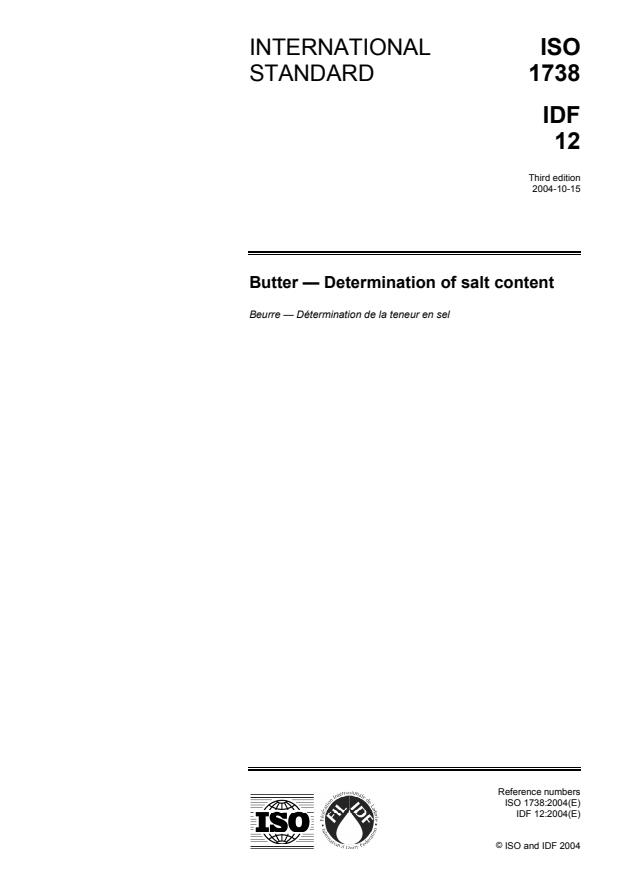
ISO 1738:2004 - Butter — Determination of salt content Released:10/18/2004
ISO 1738:2004 - Beurre — Détermination de la teneur en sel Released:10/18/2004
Overview
ISO 1738:2004 - Butter - Determination of salt content specifies a standardized method for determining the salt content in butter. Developed by the International Organization for Standardization (ISO) in collaboration with the International Dairy Federation (IDF) and AOAC International, this standard provides a reliable and reproducible procedure that benefits butter producers, quality assurance laboratories, and regulatory bodies. ISO 1738:2004 applies to all types of butter containing more than 0.1% (mass fraction) of salt.
By establishing clear guidelines for laboratory analysis, this standard ensures consistency and accuracy when measuring salt content in butter. This fosters product quality and regulatory compliance throughout the dairy industry.
Key Topics
- Scope of Analysis: Applies to all butter varieties with salt content greater than 0.1% by mass.
- Standardized Test Method: Utilizes a titration method where melted butter is treated with boiling water, and the dissolved chlorides are titrated using silver nitrate and potassium chromate (the Mohr procedure).
- Apparatus and Reagents: Specifies the use of analytical-grade reagents, standardized volumetric glassware (burettes, pipettes, measuring cylinders), and appropriate safety and accuracy measures.
- Sampling and Preparation: Details requirements for sample homogeneity and storage to preserve integrity prior to testing.
- Calculation of Results: Provides equations for expressing salt content as a mass fraction and rounding results to the nearest 0.01%.
- Precision and Repeatability: Defines limits for repeatability and reproducibility to ensure reliable inter-laboratory comparison.
- Reporting: Outlines information to be included in test reports for transparency and traceability.
Applications
ISO 1738:2004 is essential for:
- Dairy Processors and Manufacturers: Guaranteeing consistent butter quality and meeting product specifications for domestic and international markets.
- Quality Assurance Laboratories: Providing a recognized, reliable approach to determining butter salt content, which is crucial for flavor, preservation, and consumer health.
- Regulatory Agencies: Enabling effective monitoring and enforcement of food composition standards, labeling, and trade regulations.
- Research and Development: Supporting innovation in butter formulation, particularly for reduced-salt or specialized products.
Accurate assessment of salt content helps ensure butter meets legal and nutritional requirements, and supports food safety objectives.
Related Standards
For comprehensive butter and dairy product testing, the following standards are relevant:
- ISO 707:1997 - Milk and milk products: Guidance on sampling
- ISO 385-1:1984 - Laboratory glassware: Burettes - General requirements
- ISO 648 - Laboratory glassware: One-mark pipettes
- ISO 4788 - Laboratory glassware: Graduated measuring cylinders
- ISO 5725 Series - Accuracy (trueness and precision) of measurement methods and results
These related standards support proper sampling and measurement precision, helping achieve the highest levels of quality assurance and compliance in dairy laboratories.
ISO 1738:2004 provides a unified approach for the determination of salt content in butter, helping the dairy sector maintain quality, fulfill regulatory requirements, and ensure consumer confidence in dairy products. For more detailed procedural and safety guidance, refer to the official ISO 1738:2004 documentation.
Relations
- Effective Date
- 15-Apr-2008
Buy Documents
ISO 1738:2004 - Butter — Determination of salt content Released:10/18/2004
ISO 1738:2004 - Beurre — Détermination de la teneur en sel Released:10/18/2004
Get Certified
Connect with accredited certification bodies for this standard

BSI Group
BSI (British Standards Institution) is the business standards company that helps organizations make excellence a habit.

Bureau Veritas
Bureau Veritas is a world leader in laboratory testing, inspection and certification services.

DNV
DNV is an independent assurance and risk management provider.
Sponsored listings
Frequently Asked Questions
ISO 1738:2004 is a standard published by the International Organization for Standardization (ISO). Its full title is "Butter — Determination of salt content". This standard covers: ISO 1738|IDF 12:2004 specifies a method for the determination of the salt content of butter. The method is applicable to all types of butter containing more than 0,1 % (mass fraction) of salt.
ISO 1738|IDF 12:2004 specifies a method for the determination of the salt content of butter. The method is applicable to all types of butter containing more than 0,1 % (mass fraction) of salt.
ISO 1738:2004 is classified under the following ICS (International Classification for Standards) categories: 67.100.20 - Butter. The ICS classification helps identify the subject area and facilitates finding related standards.
ISO 1738:2004 has the following relationships with other standards: It is inter standard links to ISO 1738:1997. Understanding these relationships helps ensure you are using the most current and applicable version of the standard.
ISO 1738:2004 is available in PDF format for immediate download after purchase. The document can be added to your cart and obtained through the secure checkout process. Digital delivery ensures instant access to the complete standard document.
Standards Content (Sample)
INTERNATIONAL ISO
STANDARD 1738
IDF
Third edition
2004-10-15
Butter — Determination of salt content
Beurre — Détermination de la teneur en sel
Reference numbers
IDF 12:2004(E)
©
ISO and IDF 2004
IDF 12:2004(E)
PDF disclaimer
This PDF file may contain embedded typefaces. In accordance with Adobe's licensing policy, this file may be printed or viewed but
shall not be edited unless the typefaces which are embedded are licensed to and installed on the computer performing the editing. In
downloading this file, parties accept therein the responsibility of not infringing Adobe's licensing policy. Neither the ISO Central
Secretariat nor the IDF accepts any liability in this area.
Adobe is a trademark of Adobe Systems Incorporated.
Details of the software products used to create this PDF file can be found in the General Info relative to the file; the PDF-creation
parameters were optimized for printing. Every care has been taken to ensure that the file is suitable for use by ISO member bodies
and IDF national committees. In the unlikely event that a problem relating to it is found, please inform the ISO Central Secretariat at the
address given below.
© ISO and IDF 2004
All rights reserved. Unless otherwise specified, no part of this publication may be reproduced or utilized in any form or by any means,
electronic or mechanical, including photocopying and microfilm, without permission in writing from either ISO or IDF at the respective
address below.
ISO copyright office International Dairy Federation
Case postale 56 • CH-1211 Geneva 20 Diamant Building • Boulevard Auguste Reyers 80 • B-1030 Brussels
Tel. + 41 22 749 01 11 Tel. + 32 2 733 98 88
Fax + 41 22 749 09 47 Fax + 32 2 733 04 13
E-mail copyright@iso.org E-mail info@fil-idf.org
Web www.iso.org Web www.fil-idf.org
Published in Switzerland
ii © ISO and IDF 2004 – All rights reserved
IDF 12:2004(E)
Foreword
ISO (the International Organization for Standardization) is a worldwide federation of national standards
bodies (ISO member bodies). The work of preparing International Standards is normally carried out through
ISO technical committees. Each member body interested in a subject for which a technical committee has
been established has the right to be represented on that committee. International organizations, governmental
and non-governmental, in liaison with ISO, also take part in the work. ISO collaborates closely with the
International Electrotechnical Commission (IEC) on all matters of electrotechnical standardization.
International Standards are drafted in accordance with the rules given in the ISO/IEC Directives, Part 2.
The main task of technical committees is to prepare International Standards. Draft International Standards
adopted by the technical committees are circulated to the member bodies for voting. Publication as an
International Standard requires approval by at least 75 % of the member bodies casting a vote.
Attention is drawn to the possibility that some of the elements of this document may be the subject of patent
rights. ISO shall not be held responsible for identifying any or all such patent rights.
ISO 1738IDF 12 was prepared by Technical Committee ISO/TC 34, Food products, Subcommittee SC 5,
Milk and milk products, and the International Dairy Federation (IDF), in collaboration with AOAC International.
It is being published jointly by ISO and IDF and separately by AOAC International.
This edition of ISO 1738IDF 12 cancels and replaces ISO 1738:1997, of which it constitutes a minor revision.
IDF 12:2004(E)
Foreword
IDF (the International Dairy Federation) is a worldwide federation of the dairy sector with a National
Committee in every member country. Every National Committee has the right to be represented on the IDF
Standing Committees carrying out the technical work. IDF collaborates with ISO and AOAC International in
the development of standard methods of analysis and sampling for milk and milk products.
Draft International Standards adopted by the Action Teams and Standing Committees are circulated to the
National Committees for voting. Publication as an International Standard requires approval by at least 50 % of
the National Committees casting a vote.
ISO 1738IDF 12 was prepared by Technical Committee ISO/TC 34, Food products, Subcommittee SC 5,
Milk and milk products, and the International Dairy Federation (IDF), in collaboration with AOAC International.
It is being published jointly by ISO and IDF and separately by AOAC International.
All work was carried out by the Joint ISO/IDF/AOAC Group of Experts on Minerals and minor compounds
(E602), under the aegis of its chairman, Mr G. Bråthen (NO).
This edition of ISO 1738IDF 12 cancels and replaces IDF 12C:2000, of which it constitutes a minor revision.
iv © ISO and IDF 2004 – All rights reserved
INTERNATIONAL STANDARD
IDF 12:2004(E)
Butter — Determination of salt content
1 Scope
This International Standard specifies a method for the determination of the salt content of butter. The method
is applicable to all types of butter containing more than 0,1 % (mass fraction) of salt.
2 Normative references
The following referenced documents are indispensable for the application of this document. For dated
references, only the edition cited applies. For undated references, the latest edition of the referenced
document (including any amendments) applies.
ISO 385-1:1984, Laboratory glassware — Burettes — Part 1: General requirements
ISO 648, Laboratory glassware — One-mark pipettes
ISO 4788, Laboratory glassware — Graduated measuring cylinders
3 Terms and definitions
For the purposes of this document, the following terms and definitions apply.
3.1
salt content
mass fraction of substances determined by the method specified in this International Standard
NOTE It is expressed as the equivalent content of sodium chloride as a mass fraction in percent.
4 Principle
A test portion of butter is melted by adding boiling water. The dissolved chlorides in the mixture are titrated
with a solution of silver nitrate, using potassium chromate as indicator (the Mohr procedure).
5 Reagents
Use only reagents of recognized analytical grade, unless otherwise specified, and distilled or demineralized
water or water of equivalent purity, free from chlorides.
5.1 Silver nitrate standard volumetric solution (AgNO ), of known concentration in the range 0,08 mol/l
to 0,10 mol/l.
Dissolve an amount of between 13,6 g to 20,4 g of silver nitrate in water which is practically free from carbon
dioxide in a 1 000 ml volumetric flask. Dilute to the mark with water. Calibrate the silver nitrate solution against
100 ml of a solution containing 0,400 g/l of sodium chloride (NaCl), which has previously been dried at 300 °C,
IDF 12:2004(E)
following the procedure specified in 9.3.2 and 9.4. Express the concentration of the silver nitrate solution in
moles per litre to four decimals. Store the solution away from direct sunlight.
NOTE If a solution containing 14,53 g/l (0,085 5 mol/l) of silver nitrate is used, 1 ml of this solution is equivalent to
5 mg of sodium chloride, thus making the calculation of the salt content of th
...
NORME ISO
INTERNATIONALE 1738
FIL
Troisième édition
2004-10-15
Beurre — Détermination de la teneur
en sel
Butter — Determination of salt content
Numéros de référence
FIL 12:2004(F)
©
ISO et FIL 2004
FIL 12:2004(F)
PDF – Exonération de responsabilité
Le présent fichier PDF peut contenir des polices de caractères intégrées. Conformément aux conditions de licence d'Adobe, ce fichier
peut être imprimé ou visualisé, mais ne doit pas être modifié à moins que l'ordinateur employé à cet effet ne bénéficie d'une licence
autorisant l'utilisation de ces polices et que celles-ci y soient installées. Lors du téléchargement de ce fichier, les parties concernées
acceptent de fait la responsabilité de ne pas enfreindre les conditions de licence d'Adobe. Le Secrétariat central de l'ISO et la FIL
déclinent toute responsabilité en la matière.
Adobe est une marque déposée d'Adobe Systems Incorporated.
Les détails relatifs aux produits logiciels utilisés pour la création du présent fichier PDF sont disponibles dans la rubrique General Info
du fichier; les paramètres de création PDF ont été optimisés pour l'impression. Toutes les mesures ont été prises pour garantir
l'exploitation de ce fichier par les comités membres de l'ISO et les comités nationaux de la FIL. Dans le cas peu probable où
surviendrait un problème d'utilisation, veuillez en informer le Secrétariat central de l'ISO à l'adresse donnée ci-dessous.
© ISO et FIL 2004
Droits de reproduction réservés. Sauf prescription différente, aucune partie de cette publication ne peut être reproduite ni utilisée sous
quelque forme que ce soit et par aucun procédé, électronique ou mécanique, y compris la photocopie et les microfilms, sans l'accord écrit
soit de l'ISO soit de la FIL à l’adresse respective ci-après.
ISO copyright office Fédération Internationale de Laiterie
Case postale 56 • CH-1211 Geneva 20 Diamant Building • Boulevard Auguste Reyers 80 • B-1030 Bruxelles
Tel. + 41 22 749 01 11 Tel. + 32 2 733 98 88
Fax + 41 22 749 09 47 Fax + 32 2 733 04 13
E-mail copyright@iso.org E-mail info@fil-idf.org
Web www.iso.org Web www.fil-idf.org
Publié en Suisse
ii © ISO et FIL 2004 – Tous droits réservés
FIL 12:2004(F)
Avant-propos
L'ISO (Organisation internationale de normalisation) est une fédération mondiale d'organismes nationaux
de normalisation (comités membres de l'ISO). L'élaboration des Normes internationales est en général
confiée aux comités techniques de l'ISO. Chaque comité membre intéressé par une étude a le droit de faire
partie du comité technique créé à cet effet. Les organisations internationales, gouvernementales et non
gouvernementales, en liaison avec l'ISO participent également aux travaux. L'ISO collabore étroitement avec
la Commission électrotechnique internationale (CEI) en ce qui concerne la normalisation électrotechnique.
Les Normes internationales sont rédigées conformément aux règles données dans les Directives ISO/CEI,
Partie 2.
La tâche principale des comités techniques est d'élaborer les Normes internationales. Les projets de Normes
internationales adoptés par les comités techniques sont soumis aux comités membres pour vote. Leur
publication comme Normes internationales requiert l'approbation de 75 % au moins des comités membres
votants.
L'attention est appelée sur le fait que certains des éléments du présent document peuvent faire l'objet de
droits de propriété intellectuelle ou de droits analogues. L'ISO ne saurait être tenue pour responsable de ne
pas avoir identifié de tels droits de propriété et averti de leur existence.
L'ISO 1738FIL 12 a été élaborée par le comité technique ISO/TC 34, Produits alimentaires, sous-comité
SC 5, Lait et produits laitiers, et la Fédération internationale de laiterie (FIL), en collaboration avec l'AOAC
International. Elle est publiée conjointement par l'ISO et la FIL, et séparément par l'AOAC International.
Cette édition de l'ISO 1738FIL 12 annule et remplace l’ISO 1738:1997, dont elle constitue une révision
mineure.
© ISO et FIL 2004 – Tous droits réservés iii
FIL 12:2004(F)
Avant-propos
La FIL (Fédération internationale de laiterie) est une fédération mondiale du secteur laitier avec un Comité
National dans chacun de ses pays membres. Chaque Comité National a le droit de faire partie des Comités
permanents de la FIL auxquels sont confiés les travaux techniques. La FIL collabore avec l'ISO et avec
l'AOAC International pour l'élaboration de méthodes normalisées d'analyse et d'échantillonnage pour le lait et
les produits laitiers.
Les projets de Normes internationales adoptés par les Équipes d'Action et les Comités permanents sont
soumis aux Comités Nationaux pour vote. Leur publication comme Normes internationales requiert
l'approbation de 50 % au moins des Comités Nationaux votants.
L'ISO 1738FIL 12 a été élaborée par le comité technique ISO/TC 34, Produits alimentaires, sous-comité
SC 5, Lait et produits laitiers, et la Fédération internationale de laiterie (FIL), en collaboration avec l'AOAC
International. Elle est publiée conjointement par l'ISO et la FIL, et séparément par l'AOAC International.
L'ensemble des travaux a été confié à l'Équipe d'Action mixte ISO/FIL/AOAC du Comité permanent chargé
des Minéraux et composés mineurs (E602), sous la conduite de son chef de projet, Monsieur G. Bråthen (NO).
Cette édition de l'ISO 1738IDF 12 annule et remplace l'IDF 12C:2000, dont elle constitue une révision
mineure.
iv © ISO et FIL 2004 – Tous droits réservés
NORME INTERNATIONALE
FIL 12 :2004(F)
Beurre — Détermination de la teneur en sel
1 Domaine d'application
La présente Norme internationale spécifie une méthode pour la détermination de la teneur en sel du beurre.
La méthode s'applique à tous les types de beurre contenant plus de 0,1 % (fraction massique) de sel.
2 Références normatives
Les documents de référence suivants sont indispensables pour l'application du présent document. Pour les
références datées, seule l'édition citée s'applique. Pour les références non datées, la dernière édition du
document de référence s'applique (y compris les éventuels amendements).
ISO 385-1:1984, Verrerie de laboratoire — Burettes — Partie 1: Spécifications générales
ISO 648, Verrerie de laboratoire — Pipettes à un trait
ISO 4788, Verrerie de laboratoire — Éprouvettes graduées cylindriques
3 Termes et définitions
Pour les besoins du présent document, les termes et définitions suivants s'appliquent.
3.1
teneur en sel
fraction massique de substances, déterminée selon la méthode spécifiée dans la présente Norme
internationale
NOTE Elle est exprimée comme étant la teneur équivalente de chlorure de sodium, en pourcentage en masse.
4 Principe
Fusion d’une prise d’essai de beurre par adjonction d’eau bouillante. Titrage des chlorures dissous dans le
mélange, au moyen d’une solution de nitrate d’argent, en utilisant du chromate de potassium comme
indicateur (méthode de Mohr).
5 Réactifs
Utiliser uniquement des réactifs de qualité analytique reconnue, sauf indications contraires, et de l'eau distillée
ou de l'eau déminéralisée ou de l'eau de pureté équivalente, exempte de chlorures.
5.1 Nitrate d'argent (AgNO ), solution volumétrique titrée de concentration connue dans l'intervalle de
0,08 mol/l à 0,10 mol/l.
© ISO et FIL 2004 – Tous droits réservés 1
FIL 12:2004(F)
Dissoudre une quantité comprise entre 13,6 g et 20,4 g de nitrate d'argent dans de l'eau pratiquement
exempte de dioxyde de carbone dans une fiole jaugée de 1 000 ml et compléter au trait repère avec de l'eau.
Titrer la solution de nitrate d'argent par 100 ml de solution contenant 0,400 g/l de chlorure de sodium (NaCl),
qui a été séché au préalable à 300 °C, selon la procédure spécifiée en 9.3.2 et en 9.4. Exprimer la
concentration de la solution de nitrate d'argent en moles par litre à quatre décimales près. Conserver la
solution à l'abri de la lumière.
NOTE Si une solution contenant 14,53 g/l (0,085 5 mol/l) de nitrate d'argent est utilisée, 1 ml de cette solution est
équivalent à 5 mg de chlorure de sodium, ce qui facilite le calcul de la teneur en sel du beurre.
5.2 Solution d'indicateur au chromate de potassium
Dissoudr
...