

ISO/IEC 17760-302:2025
(Main)Information technology — AT Attachment — Part 302: Zoned Device ATA Command Set-2-(ZAC-2)
General Information
- Abstract
The set of AT Attachment standards consists of this document and the ATA implementation standards described in AT Attachment - 8 ATA/ATAPI Architecture Model (ATA8-AAM). This document specifies the command set that host systems use to access storage devices that implement the Host Aware Zones feature set (see 4.3), the Host Managed Zones feature set (see 4.4), the Zone Domains feature set (see 4.5), and the Zone Realms feature set (see 4.6). This document provides a common command set for systems manufacturers, system integrators, software suppliers, and suppliers of storage devices that provide one or more of the zones feature sets. Figure 1 shows the relationship of This document to other ATA standards as well as related device and host standards and specifications (e.g., SCSI standards and SATA-I0 specifications). This document maintains compatibility with the ACS-5 standard, INCITS 558-202x, while providing additional functions.
- Status
- Published
- Publication Date
- 28-Oct-2025
- Technical Committee
- ISO/IEC JTC 1 - Information technology
- Drafting Committee
- ISO/IEC JTC 1 - Information technology
- Current Stage
- 6060 - International Standard published
- Start Date
- 29-Oct-2025
- Due Date
- 09-Oct-2025
- Completion Date
- 29-Oct-2025
Overview
ISO/IEC 17760-302:2025 specifies the AT Attachment (ATA) command set for zoned storage devices, known as Zoned Device ATA Command Set-2 (ZAC-2). This international standard, maintained by ISO and IEC, is vital for ensure interoperability between host systems and storage devices using advanced zoning features. It is designed to serve system manufacturers, integrators, software providers, and storage device suppliers who implement one or more zoning feature sets. The standard also maintains backward compatibility with established ATA standards, enabling reliable deployment in established storage ecosystems.
Key Topics
- ATA Command Set for Zoned Devices: Defines a common command set supporting zoned device functionality, focusing on Host Aware Zones, Host Managed Zones, Zone Domains, and Zone Realms.
- Host Aware and Host Managed Zones: Covers feature sets for devices that are capable of managing zones autonomously or via explicit host control, addressing enhanced storage management and workload optimization.
- Zone Domains and Zone Realms: Specifies command support for dividing storage devices into multiple logical groupings (domains) and segregated operational realms, allowing advanced partitioning and data placement strategies.
- Command Descriptions and Management: Details robust ATA commands for managing zones (opening, closing, finishing, and reporting), along with provisions for zone status, resource handling, and error conditions.
- Compatibility and Interoperability: Ensures integration across the evolving range of zoned devices with continued compatibility with existing ATA standards, specifically referencing ACS-5 and related command sets.
Applications
ISO/IEC 17760-302:2025 is applicable across a broad spectrum of information technology deployments, including:
- Enterprise Data Centers: Enables high-capacity and high-efficiency storage solutions where zoned storage devices such as Shingled Magnetic Recording (SMR) drives or Zoned Namespace SSDs are deployed for sequential write optimization and improved throughput.
- Cloud Storage Infrastructure: Provides cloud service providers with uniform device-management protocols, ensuring scalable and robust storage architectures.
- Operating System and Software Development: Supports developers of storage stack software, file systems, virtualization layers, and data management solutions in implementing standardized communication with zoned devices.
- System Integration: Assists original equipment manufacturers (OEMs) and system builders in creating interoperable and reliable storage subsystems tailored to diverse application workloads.
- Research and Next-Generation Storage: Fosters innovation in storage device firmware, data placement algorithms, and performance optimization by providing a standardized foundation for advanced zone management.
Related Standards
To maximize compatibility in storage environments and align with industry best practices, consider the following related standards:
- ISO/IEC 17760 series: Comprehensive standards for AT Attachment, providing the overarching ATA/ATAPI framework.
- ATA8-ACS (Advanced Command Set) / ACS-5: Defines the baseline ATA command sets, with which ZAC-2 maintains compatibility.
- INCITS 558-202x: North American equivalent specification for AT Attachment device features.
- SATA (Serial ATA) I/O Specifications: Specifies electrical and protocol requirements for ATA devices, relevant for both conventional and zoned storage.
- SCSI Standards (e.g., ZBC/ZAC for SCSI): Provides command sets for zoned block commands in SCSI environments, ensuring cross-technology consistency.
- ATA Implementation Standards: Additional documents in the ATA series covering device and host behaviors, architecture models, and protocol extensions.
Practical Value
Implementing ISO/IEC 17760-302:2025 empowers organizations to:
- Achieve seamless integration and management of zoned storage devices in modern IT environments.
- Enhance storage device utilization and performance through optimized zoning features.
- Simplify software development and system deployment cycles by adhering to a unified, internationally recognized command set.
- Future-proof storage infrastructure investments by complying with a standard that supports ongoing innovation and backward compatibility.
For full implementation details, refer to the official ISO/IEC documentation and related series publications.
Get Certified
Connect with accredited certification bodies for this standard

BSI Group
BSI (British Standards Institution) is the business standards company that helps organizations make excellence a habit.

NYCE
Mexican standards and certification body.
Sponsored listings
Frequently Asked Questions
ISO/IEC 17760-302:2025 is a standard published by the International Organization for Standardization (ISO). Its full title is "Information technology — AT Attachment — Part 302: Zoned Device ATA Command Set-2-(ZAC-2)". This standard covers: The set of AT Attachment standards consists of this document and the ATA implementation standards described in AT Attachment - 8 ATA/ATAPI Architecture Model (ATA8-AAM). This document specifies the command set that host systems use to access storage devices that implement the Host Aware Zones feature set (see 4.3), the Host Managed Zones feature set (see 4.4), the Zone Domains feature set (see 4.5), and the Zone Realms feature set (see 4.6). This document provides a common command set for systems manufacturers, system integrators, software suppliers, and suppliers of storage devices that provide one or more of the zones feature sets. Figure 1 shows the relationship of This document to other ATA standards as well as related device and host standards and specifications (e.g., SCSI standards and SATA-I0 specifications). This document maintains compatibility with the ACS-5 standard, INCITS 558-202x, while providing additional functions.
The set of AT Attachment standards consists of this document and the ATA implementation standards described in AT Attachment - 8 ATA/ATAPI Architecture Model (ATA8-AAM). This document specifies the command set that host systems use to access storage devices that implement the Host Aware Zones feature set (see 4.3), the Host Managed Zones feature set (see 4.4), the Zone Domains feature set (see 4.5), and the Zone Realms feature set (see 4.6). This document provides a common command set for systems manufacturers, system integrators, software suppliers, and suppliers of storage devices that provide one or more of the zones feature sets. Figure 1 shows the relationship of This document to other ATA standards as well as related device and host standards and specifications (e.g., SCSI standards and SATA-I0 specifications). This document maintains compatibility with the ACS-5 standard, INCITS 558-202x, while providing additional functions.
ISO/IEC 17760-302:2025 is classified under the following ICS (International Classification for Standards) categories: 35.200 - Interface and interconnection equipment. The ICS classification helps identify the subject area and facilitates finding related standards.
ISO/IEC 17760-302:2025 is available in PDF format for immediate download after purchase. The document can be added to your cart and obtained through the secure checkout process. Digital delivery ensures instant access to the complete standard document.
Standards Content (Sample)
International
Standard
ISO/IEC 17760-302
First edition
Information technology — AT
2025-10
Attachment —
Part 302:
Zoned Device ATA Command Set-
2-(ZAC-2)
Technologies de l’information — Attachement AT —
Partie 302: Jeu de commande 2-(ZAC-2) ATA de dispositif de zones
Reference number
© ISO/IEC 2025
All rights reserved. Unless otherwise specified, or required in the context of its implementation, no part of this publication may
be reproduced or utilized otherwise in any form or by any means, electronic or mechanical, including photocopying, or posting on
the internet or an intranet, without prior written permission. Permission can be requested from either ISO at the address below
or ISO’s member body in the country of the requester.
ISO copyright office
CP 401 • Ch. de Blandonnet 8
CH-1214 Vernier, Geneva
Phone: +41 22 749 01 11
Email: copyright@iso.org
Website: www.iso.org
Published in Switzerland
© ISO/IEC 2025 – All rights reserved
ii
Foreword
ISO (the International Organization for Standardization) and IEC (the International Electrotechnical
Commission) form the specialized system for worldwide standardization. National bodies that are members
of ISO or IEC participate in the development of International Standards through technical committees
established by the respective organization to deal with particular fields of technical activity. ISO and IEC
technical committees collaborate in fields of mutual interest. Other international organizations, governmental
and non-governmental, in liaison with ISO and IEC, also take part in the work.
The procedures used to develop this document and those intended for its further maintenance are described
in the ISO/IEC Directives, Part 1. In particular, the different approval criteria needed for the different types of
document should be noted (see www.iso.org/directives or www.iec.ch/members_experts/refdocs).
ISO and IEC draw attention to the possibility that the implementation of this document may involve the use of
(a) patent(s). ISO and IEC take no position concerning the evidence, validity or applicability of any claimed
patent rights in respect thereof. As of the date of publication of this document, ISO and IEC had not received
notice of (a) patent(s) which may be required to implement this document. However, implementers are
cautioned that this may not represent the latest information, which may be obtained from the patent database
available at www.iso.org/patents and https://patents.iec.ch. ISO and IEC shall not be held responsible for
identifying any or all such patent rights.
Any trade name used in this document is information given for the convenience of users and does not
constitute an endorsement.
For an explanation of the voluntary nature of standards, the meaning of ISO specific terms and expressions
related to conformity assessment, as well as information about ISO's adherence to the World Trade
Organization (WTO) principles in the Technical Barriers to Trade (TBT), see www.iso.org/iso/foreword.html.
In the IEC, see www.iec.ch/understanding-standards.
This document was prepared by INCITS (as INCITS 549-2022) and drafted in accordance with its editorial
rules. It was adopted, under the JTC 1 PAS procedure, by Joint Technical Committee ISO/IEC JTC 1, Information
technology.
A list of all parts in the ISO/IEC 17760 series can be found on the ISO and IEC websites.
Any feedback or questions on this document should be directed to the user’s national standards body. A
complete listing of these bodies can be found at www.iso.org/members.html and www.iec.ch/national-
committees.
© ISO/IEC 2025 – All rights reserved
iii
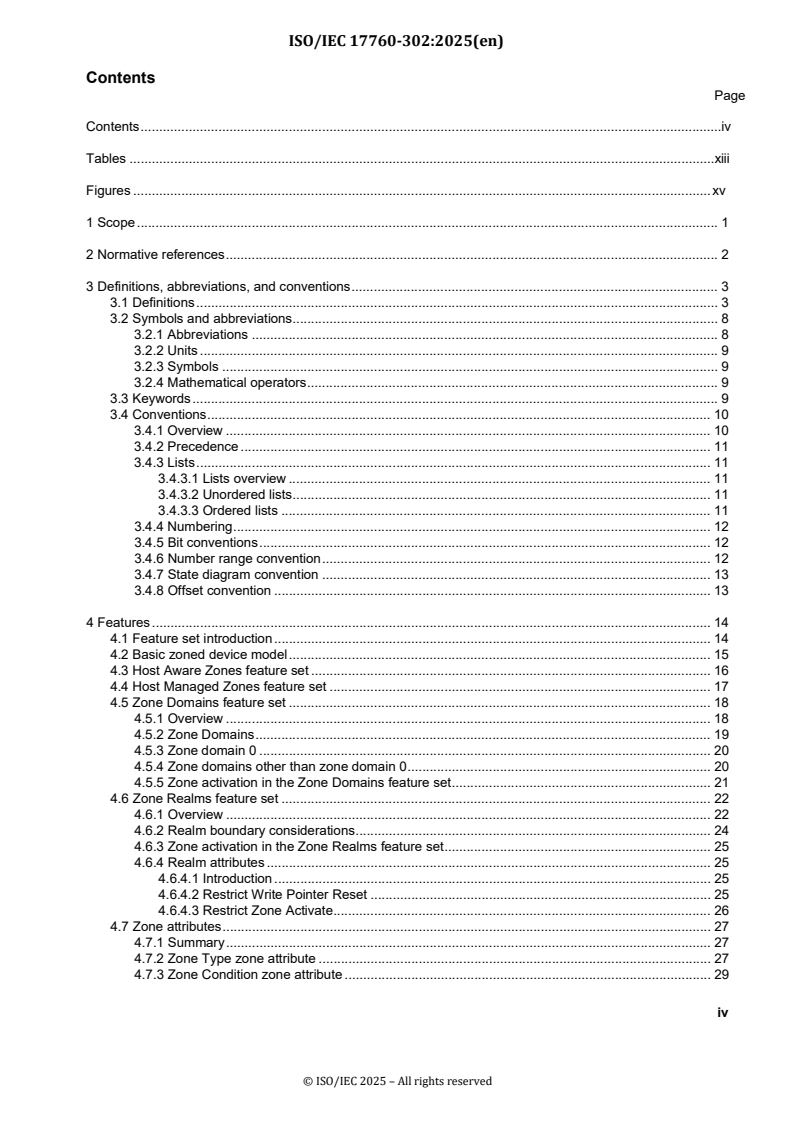
Contents
Page
Contents.iv
Tables .xiii
Figures . xv
1 Scope. 1
2 Normative references. 2
3 Definitions, abbreviations, and conventions. 3
3.1 Definitions. 3
3.2 Symbols and abbreviations. 8
3.2.1 Abbreviations . 8
3.2.2 Units . 9
3.2.3 Symbols . 9
3.2.4 Mathematical operators. 9
3.3 Keywords. 9
3.4 Conventions. 10
3.4.1 Overview . 10
3.4.2 Precedence . 11
3.4.3 Lists. 11
3.4.3.1 Lists overview . 11
3.4.3.2 Unordered lists. 11
3.4.3.3 Ordered lists . 11
3.4.4 Numbering. 12
3.4.5 Bit conventions. 12
3.4.6 Number range convention. 12
3.4.7 State diagram convention . 13
3.4.8 Offset convention . 13
4 Features. 14
4.1 Feature set introduction. 14
4.2 Basic zoned device model. 15
4.3 Host Aware Zones feature set . 16
4.4 Host Managed Zones feature set . 17
4.5 Zone Domains feature set . 18
4.5.1 Overview . 18
4.5.2 Zone Domains. 19
4.5.3 Zone domain 0 . 20
4.5.4 Zone domains other than zone domain 0. 20
4.5.5 Zone activation in the Zone Domains feature set. 21
4.6 Zone Realms feature set . 22
4.6.1 Overview . 22
4.6.2 Realm boundary considerations. 24
4.6.3 Zone activation in the Zone Realms feature set. 25
4.6.4 Realm attributes . 25
4.6.4.1 Introduction. 25
4.6.4.2 Restrict Write Pointer Reset . 25
4.6.4.3 Restrict Zone Activate. 26
4.7 Zone attributes. 27
4.7.1 Summary. 27
4.7.2 Zone Type zone attribute . 27
4.7.3 Zone Condition zone attribute . 29
iv
© ISO/IEC 2025 – All rights reserved
4.7.4 WPointer zone attribute. 29
4.7.5 RWP Recommended zone attribute. 29
4.7.6 Non-Sequential Write Resources Active zone attribute . 30
4.7.7 Predicted Unrecovered Errors Present zone attribute . 30
4.8 Zone types. 31
4.8.1 Overview . 31
4.8.2 Conventional zones. 31
4.8.2.1 Overview. 31
4.8.2.2 Access Pattern Requirements . 31
4.8.2.3 Conventional Zone state machine . 32
4.8.2.3.1 Overview . 32
4.8.2.3.2 CMR1: Not Write Pointer state. 33
4.8.2.3.3 CMR2: Read Only state . 33
4.8.2.3.4 CMR3: Offline state. 34
4.8.3 Write pointer zones . 34
4.8.3.1 Features common to all write pointer zones . 34
4.8.3.1.1 General . 34
4.8.3.1.2 Resetting the write pointer . 35
4.8.3.1.3 Open zone resources. 36
4.8.3.1.4 Errors common to access pattern requirements for all write pointer zones . 36
4.8.3.2 Sequential Write Preferred zones. 37
4.8.3.2.1 Overview . 37
4.8.3.2.2 Access Pattern Requirements. 37
4.8.3.2.2.1 Writing in Sequential Write Preferred zones. 37
4.8.3.2.2.2 Reading in Sequential Write Preferred zones. 39
4.8.3.2.2.3 Substitute data pattern for Sequential Write Preferred zones . 39
4.8.3.3 Sequential Write Required zones . 39
4.8.3.3.1 Overview . 39
4.8.3.3.2 Access Pattern Requirements. 39
4.8.3.3.2.1 Writing in Sequential Write Required zones . 39
4.8.3.3.2.2 Reading in Sequential Write Required zones. 40
4.8.3.3.2.3 Substitute data pattern for Sequential Write Required zones. 41
4.8.3.3.2.4 Opening Sequential Write Required zones. 41
4.8.3.4 Sequential Or Before Required zones. 41
4.8.3.4.1 Overview . 41
4.8.3.4.2 Access pattern requirements . 41
4.8.3.4.2.1 Writing in Sequential Or Before Required zones. 41
4.8.3.4.2.2 Reading in Sequential Or Before Required zones. 42
4.8.3.4.2.3 Substitute data pattern for Sequential Or Before Required zones. 42
4.8.3.5 Zone Condition state machine. 42
4.8.3.5.1 Overview . 42
4.8.3.5.2 ZC1: Empty state . 45
4.8.3.5.3 ZC2: Implicit_Open state. 46
4.8.3.5.4 ZC3: Explicit_Open state . 47
4.8.3.5.5 ZC4: Closed state . 48
4.8.3.5.6 ZC5: Full state. 49
4.8.3.5.7 ZC6: Read_Only state. 50
4.8.3.5.8 ZC7: Offline state . 51
4.8.3.5.9 ZC8: Inactive state . 51
4.8.3.5.10 Manage Open Zone Resources function . 51
4.8.3.5.10.1 Overview. 51
4.8.3.5.10.2 Processing a sequential write preferred zone. 52
4.8.3.5.10.3 Processing a sequential write required zone. 52
4.8.3.5.11 Explicitly Open Zone function. 53
4.8.3.5.12 Close Zone function . 53
4.8.3.5.13 Finish Zone function. 53
4.8.3.5.14 Reset Write Pointer function . 54
v
© ISO/IEC 2025 – All rights reserved
4.8.3.5.15 Sequentialize function . 54
4.8.4 Gap zones. 54
4.9 Additional feature set interactions. 56
4.9.1 Introduction . 56
4.9.2 Capacity reporting . 56
4.9.3 Zoned device internal resource management. 56
4.9.4 Unexpected power removal . 56
4.9.5 Media failure. 57
4.9.6 Interactions with volatile caches. 57
4.9.7 Interactions with the Sanitize Device feature set . 58
4.9.8 Interactions with the Power Management feature set . 59
4.9.9 Interactions with the Security feature set . 59
4.9.9.1 Interactions with the SECURITY ERASE UNIT command . 59
4.9.9.2 Interactions with the SEC4: Security Enabled/Locked/Not Frozen state. 60
4.9.10 Interactions with the SCT Write Same command . 60
4.9.10.1 Overview. 60
4.9.10.2 WRITE AND SET SUBSTITUTE DATA PATTERN bit. 61
4.9.10.3 ZONE POST PROCESSING field . 61
4.9.11 Interactions with the WRITE UNCORRECTABLE EXT command. 61
4.9.12 Interactions with the SET SECTOR CONFIGURATION EXT command and MUTATE EXT
command . 62
4.9.13 Interactions with the Storage Element Depopulation feature set . 62
4.9.13.1 Depopulation operations and depopulation restoration operations . 62
4.9.13.2 Depopulation with zone modifications . 63
4.9.13.2.1 Depopulation with zone modifications overview. 63
4.9.13.2.2 Depopulation with zone modifications processing . 63
4.9.13.2.2.1 Processing overview. 63
4.9.13.2.2.2 Predicted unrecovered errors processing. 64
4.9.13.2.3 Allowed commands during depopulation with zone modifications processing. 64
4.9.13.2.4 Power-on reset handling . 64
4.9.13.2.5 Progress checking during depopulation with zone modifications. 65
4.9.13.2.6 Depopulation with zone modifications interactions with logs. 65
4.9.13.2.7 Depopulation with zone modifications interactions with caches. 65
5 Command descriptions . 66
5.1 Command description introduction . 66
5.2 Zone management commands. 69
5.2.1 Overview . 69
5.2.2 ZAC Management In command template, 4Ah, DMA . 70
5.2.2.1 Feature Set. 70
5.2.2.2 Description. 70
5.2.2.3 Inputs. 70
5.2.2.3.1 Overview . 70
5.2.2.3.2 Action specific fields. 70
5.2.2.3.3 ZM_ACTION field. 71
5.2.2.3.4 RETURN PAGE COUNT field . 71
5.2.2.4 Normal Outputs and Error Outputs. 71
5.2.2.5 NCQ encapsulation for a DMA ZAC Management In command . 71
5.2.3 ZAC Management Out command template, 9Fh, DMA . 72
5.2.3.1 Feature Set. 72
5.2.3.2 Description. 72
5.2.3.3 Inputs. 72
5.2.3.3.1 Overview . 72
5.2.3.3.2 PAGES TO SEND field. 72
5.2.3.4 Normal Outputs and Error Outputs. 72
5.2.3.5 NCQ encapsulation for a DMA ZAC Management Out command. 73
5.2.4 ZAC Management Out command template, 9Fh, Non-Data . 74
vi
© ISO/IEC 2025 – All rights reserved
5.2.4.1 Feature Set. 74
5.2.4.2 Description. 74
5.2.4.3 Inputs. 74
5.2.4.3.1 Overview . 74
5.2.4.3.2 ALL bit . 74
5.2.4.3.3 Zone range specification fields. 75
5.2.4.3.3.1 Overview. 75
5.2.4.3.3.2 ZONE COUNT field. 75
5.2.4.3.3.3 ZONE ID field . 75
5.2.4.3.3.4 Zone range specification errors . 75
5.2.4.4 Normal Outputs. 75
5.2.4.5 Error Outputs . 76
5.2.4.6 Non-Data NCQ encapsulation . 76
5.2.5 CLOSE ZONE EXT command – 9Fh/01h, Non-Data. 77
5.2.5.1 Feature Set. 77
5.2.5.2 Description. 77
5.2.5.3 Inputs. 77
5.2.5.3.1 Overview . 77
5.2.5.3.2 Zone range specification fields for the CLOSE ZONE EXT command. 77
5.2.5.3.3 CLOSE ZONE EXT command processing. 77
5.2.5.4 Normal Outputs. 78
5.2.5.5 Error Outputs . 78
5.2.6 FINISH ZONE EXT command – 9Fh/02h, Non-Data . 79
5.2.6.1 Feature Set. 79
5.2.6.2 Description. 79
5.2.6.3 Inputs. 79
5.2.6.3.1 Overview . 79
5.2.6.3.2 Zone range specification fields for the FINISH ZONE EXT command. 79
5.2.6.3.3 FINISH ZONE EXT command processing . 80
5.2.6.4 Normal Outputs. 80
5.2.6.5 Error Outputs . 80
5.2.7 OPEN ZONE EXT command – 9Fh/03h, Non-Data. 81
5.2.7.1 Feature Set. 81
5.2.7.2 Description. 81
5.2.7.3 Inputs. 81
5.2.7.3.1 Overview . 81
5.2.7.3.2 Zone range specification fields for the OPEN ZONE EXT comman.d. 81
5.2.7.3.3 OPEN ZONE EXT command processing. 82
5.2.7.4 Normal Outputs. 82
5.2.7.5 Error Outputs . 82
5.2.8 REPORT REALMS EXT command – 4Ah/06h, DMA . 83
5.2.8.1 Feature Set. 83
5.2.8.2 Description. 83
5.2.8.3 Inputs. 83
5.2.8.3.1 Overview . 83
5.2.8.3.2 REPORTING OPTIONS field. 83
5.2.8.3.3 REALM LOCATOR field. 84
5.2.8.4 Normal Outputs. 84
5.2.8.5 Error Outputs . 84
5.2.8.6 Input From the Device to the Host Data Structure. 84
5.2.8.6.1 Overview . 84
5.2.8.6.2 Report realms header . 85
5.2.8.6.2.1 Overview. 85
5.2.8.6.2.2 REALMS COUNT field . 85
5.2.8.6.2.3 REALMS DESCRIPTOR LENGTH field. 85
5.2.8.6.2.4 NEXT REALM LOCATOR field. 85
5.2.8.6.3 Realm descriptor . 85
vii
© ISO/IEC 2025 – All rights reserved
5.2.8.6.3.1 Overview. 85
5.2.8.6.3.2 REALM ID field . 86
5.2.8.6.3.3 REALM RESTRICTIONS field. 86
5.2.8.6.3.4 ACTIVE ZONE DOMAIN ID field . 86
5.2.8.6.3.5 Realm start/end descriptor. 86
5.2.8.6.4 Padding . 87
5.2.9 REPORT ZONE DOMAINS EXT command – 4Ah/07h, DMA . 88
5.2.9.1 Feature Set. 88
5.2.9.2 Description. 88
5.2.9.3 Inputs. 88
5.2.9.3.1 Overview . 88
5.2.9.3.2 REPORTING OPTIONS field. 89
5.2.9.3.3 ZONE DOMAIN LOCATOR field . 89
5.2.9.4 Normal Outputs. 89
5.2.9.5 Error Outputs . 89
5.2.9.6 Input From the Device to the Host Data Structure. 89
5.2.9.6.1 Overview . 89
5.2.9.6.2 Report zone domains header. 90
5.2.9.6.2.1 Overview. 90
5.2.9.6.2.2 LENGTH AVAILABLE field . 90
5.2.9.6.2.3 LENGTH RETURNED field. 90
5.2.9.6.2.4 NUMBER OF SUPPORTED DOMAINS field . 90
5.2.9.6.2.5 ZONE DOMAINS REPORTED field. 90
5.2.9.6.2.6 REPORTING OPTIONS field . 90
5.2.9.6.2.7 ZONE DOMAIN LOCATOR field. 90
5.2.9.6.3 Zone domain descriptor . 91
5.2.9.6.3.1 Overview. 91
5.2.9.6.3.2 ZONE DOMAIN ID field. 91
5.2.9.6.3.3 ZONE COUNT field. 91
5.2.9.6.3.4 START LBA field . 91
5.2.9.6.3.5 END LBA field. 91
5.2.9.6.3.6 ZONE DOMAIN ZONE TYPE field . 91
5.2.9.6.3.7 VALID ZONE DOMAIN ZONE TYPE bit. 91
5.2.9.6.3.8 SHIFTING REALM BOUNDARIES bit. 92
5.2.10 REPORT ZONES EXT command – 4Ah/00h, DMA. 93
5.2.10.1 Feature Set. 93
5.2.10.2 Description. 93
5.2.10.3 Inputs. 93
5.2.10.3.1 Overview . 93
5.2.10.3.2 PARTIAL bit . 93
5.2.10.3.3 REPORTING OPTIONS field. 94
5.2.10.3.4 ZONE LOCATOR field. 94
5.2.10.4 Normal Outputs. 94
5.2.10.5 Error Outputs . 94
5.2.10.6 Input From the Device to the Host Data Structure. 95
5.2.10.6.1 Overview . 95
5.2.10.6.2 ZONE LIST LENGTH field. 95
5.2.10.6.3 SAME field. 96
5.2.10.6.4 MAXIMUM LBA field . 96
5.2.10.6.5 Zone descriptor format . 96
5.2.10.6.5.1 Overview. 96
5.2.10.6.5.2 ZONE TYPE field. 97
5.2.10.6.5.3 ZONE CONDITION field . 98
5.2.10.6.5.4 PREDICTED UNRECOVERED ERRORS bit. 98
5.2.10.6.5.5 NON_SEQ bit. 98
5.2.10.6.5.6 RESET bit . 98
5.2.10.6.5.7 ZONE LENGTH field. 98
viii
© ISO/IEC 2025 – All rights reserved
5.2.10.6.5.8 ZONE START LBA field . 98
5.2.10.6.5.9 WRITE POINTER LBA field. 98
5.2.11 RESET WRITE POINTER EXT command – 9Fh/04h, Non-Data . 99
5.2.11.1 Feature Set. 99
5.2.11.2 Description. 99
5.2.11.3 Inputs. 99
5.2.11.3.1 Overview . 99
5.2.11.3.2 Zone range specification for the RESET WRITE POINTER EXT command. 99
5.2.11.3.3 RESET WRITE POINTER EXT command processing. 99
5.2.11.4 Normal Outputs. 100
5.2.11.5 Error Outputs . 100
5.2.12 SEQUENTIALIZE ZONE EXT command – 9Fh/05h, Non-Data . 101
5.2.12.1 Feature Set. 101
5.2.12.2 Description. 101
5.2.12.3 Inputs. 101
5.2.12.3.1 Overview . 101
5.2.12.3.2 Zone range specification for the SEQUENTIALIZE ZONE EXT command. 101
5.2.12.3.3 SEQUENTIALIZE ZONE EXT command processing. 101
5.2.12.4 Normal Outputs. 102
5.2.12.5 Error Outputs . 102
5.2.13 ZONE ACTIVATE EXT command – 4Ah/08h, DMA . 103
5.2.13.1 Feature Set. 103
5.2.13.2 Description. 103
5.2.13.2.1 Overview . 103
5.2.13.2.2 Selecting the candidate zones to activate and deactivate . 103
5.2.13.2.3 Prerequisites reported by sense codes. 106
5.2.13.2.4 Prerequisites reported in the Zone Activation Results Header. 106
5.2.13.2.5 Zone Activation processing . 107
5.2.13.3 Inputs. 109
5.2.13.3.1 Overview . 109
5.2.13.3.2 OTHER ZONE DOMAIN ID field . 109
5.2.13.3.3 ALL bit . 109
5.2.13.3.4 NOZSRC field. 109
5.2.13.3.5 RETURN PAGE COUNT field . 110
5.2.13.3.6 ZONE ID field. 110
5.2.13.3.7 AUXNOZ field. 110
5.
...