

ISO 18251-1:2017
(Main)Non-destructive testing — Infrared thermography — Part 1: Characteristics of system and equipment
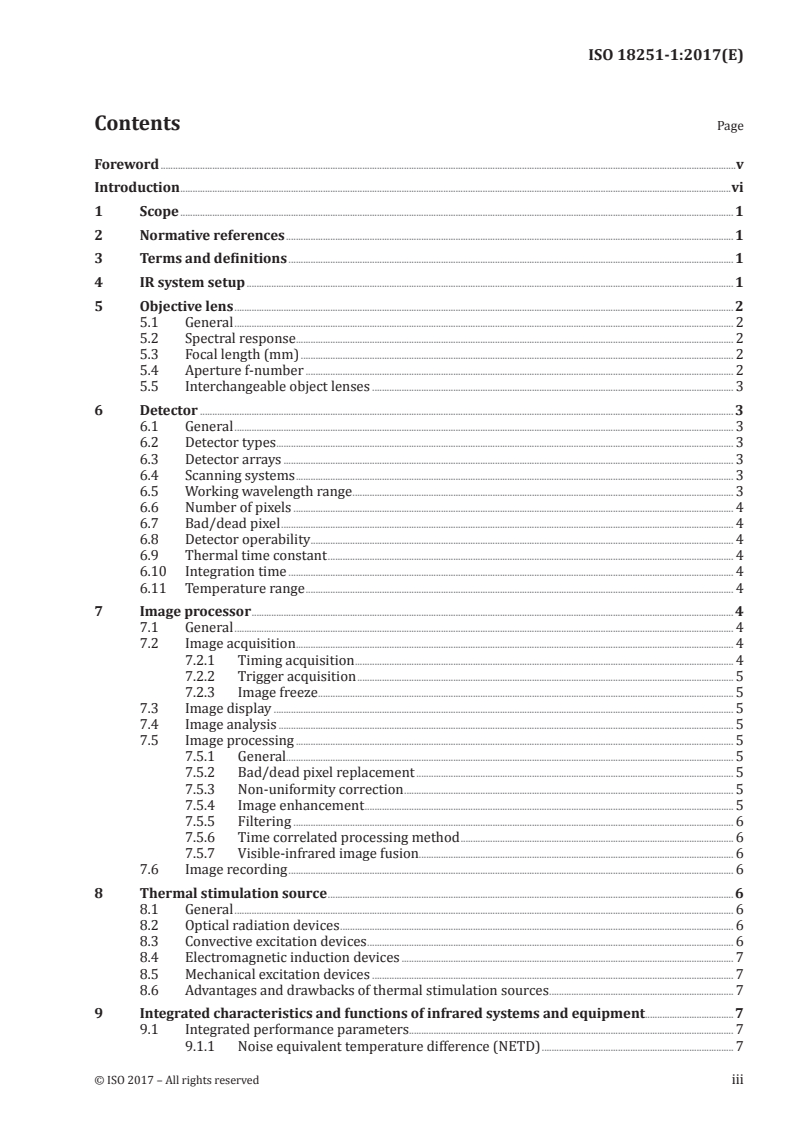
General Information
- Abstract
ISO 18251-1:2017 describes the main components, and their characteristics, constituting an infrared (IR) imaging system and related equipment used in non-destructive testing (NDT). It also aims to assist the user in the selection of an appropriate system for a particular measurement task. The following items are specified: - objective lens; - detector; - image processor; - display; - thermal stimulation source; - accessories.
- Status
- Published
- Publication Date
- 12-Jan-2017
- Technical Committee
- ISO/TC 135/SC 8 - Thermographic testing
- Drafting Committee
- ISO/TC 135/SC 8/WG 3 - NDT-IR-System and equipment
- Current Stage
- 9060 - Close of review
- Completion Date
- 02-Sep-2027
Buy Documents

ISO 18251-1:2017 - Non-destructive testing -- Infrared thermography

ISO 18251-1:2017 - Non-destructive testing — Infrared thermography — Part 1: Characteristics of system and equipment/13/2017
Overview
ISO 18251-1:2017 is an international standard developed by ISO for non-destructive testing (NDT) using infrared thermography. This standard specifically addresses the characteristics of infrared (IR) imaging systems and associated equipment for industrial applications. By defining the principal components-such as objective lens, detector, image processor, display, thermal stimulation source, and accessories-the document provides essential guidance for selecting, evaluating, and applying IR systems in NDT tasks. The main aim is to assist users in understanding key system features to make informed decisions when deploying IR thermography for inspections, quality assurance, and maintenance.
Key Topics
- Objective Lens: Covers lens types, spectral response (short wave, mid wave, and long wave IR), focal length, aperture f-number, and the importance of interchangeable lenses for tailored measurement tasks.
- Detector: Describes detector types (thermal and quantum), detector arrays, scanning systems, working wavelength ranges, pixel counts, and crucial characteristics such as operability, bad/dead pixels, thermal time constant, and temperature range.
- Image Processor: Details processes for image acquisition, display, analysis, and enhancement, including advanced functions like bad pixel replacement, non-uniformity correction, filtering, and image fusion techniques.
- Thermal Stimulation Source: Outlines energy delivery methods for active thermography, including optical radiation (lasers, lamps), convective devices, electromagnetic induction, and mechanical excitation, along with their respective advantages and limitations.
- Integrated Performance Parameters: Defines critical system metrics such as noise equivalent temperature difference (NETD), minimum resolvable/detectable temperature differences (MRTD/MDTD), field of view (FOV), instantaneous FOV (IFOV), temperature measurement range, and uniformity.
- Accessories: Lists supporting equipment like IR mirrors, attenuation filters, spectral filters, tripods, and reference blocks, enhancing test adaptability and accuracy.
Applications
Infrared thermography, guided by ISO 18251-1:2017, is widely used for non-destructive testing in various industries. Key application areas include:
- Industrial Asset Inspection: Detecting thermal anomalies in mechanical and electrical systems without causing damage to components.
- Quality Control: Identifying manufacturing defects such as delaminations, voids, or cracks in materials and products.
- Preventive Maintenance: Monitoring equipment and infrastructure to predict failures and schedule interventions before issues become critical.
- Research and Development: Supporting material characterization and validation of new manufacturing processes.
- Structural Health Monitoring: Assessing integrity of critical infrastructure (e.g., bridges, pipelines) by identifying subsurface defects.
The standard’s comprehensive system characterization ensures reliable, repeatable, and accurate thermographic measurements crucial for safety, efficiency, and cost-effectiveness in NDT practices.
Related Standards
Organizations deploying ISO 18251-1:2017 for infrared thermographic NDT may refer to associated standards for terminology, testing methods, and system classification, such as:
- ISO 10878: Non-destructive testing - Infrared thermography - Vocabulary, which provides definitive terms used in IR thermography.
- ISO/TC 135 Series: Broader suite covering various methods and aspects of industrial non-destructive testing.
- IEC Electropedia and ISO Online Browsing Platform: For up-to-date terminology and cross-references in electrotechnical and general standards.
Integrating ISO 18251-1:2017 with related guidelines supports robust, consistent, and internationally recognized NDT procedures using infrared thermography technology.
Keywords: ISO 18251-1:2017, infrared thermography, non-destructive testing, IR imaging systems, system characteristics, NDT inspection, thermal imaging, industrial inspection standard.
Relations
- Effective Date
- 06-Jun-2022
Buy Documents
ISO 18251-1:2017 - Non-destructive testing -- Infrared thermography
ISO 18251-1:2017 - Non-destructive testing — Infrared thermography — Part 1: Characteristics of system and equipment/13/2017
Get Certified
Connect with accredited certification bodies for this standard

IMP NDT d.o.o.
Non-destructive testing services. Radiography, ultrasonic, magnetic particle, penetrant, visual inspection.
Inštitut za kovinske materiale in tehnologije
Institute of Metals and Technology. Materials testing, metallurgical analysis, NDT.
Q Techna d.o.o.
NDT and quality assurance specialist. 30+ years experience. NDT personnel certification per ISO 9712, nuclear and thermal power plant inspections, QA/
Sponsored listings
Frequently Asked Questions
ISO 18251-1:2017 is a standard published by the International Organization for Standardization (ISO). Its full title is "Non-destructive testing — Infrared thermography — Part 1: Characteristics of system and equipment". This standard covers: ISO 18251-1:2017 describes the main components, and their characteristics, constituting an infrared (IR) imaging system and related equipment used in non-destructive testing (NDT). It also aims to assist the user in the selection of an appropriate system for a particular measurement task. The following items are specified: - objective lens; - detector; - image processor; - display; - thermal stimulation source; - accessories.
ISO 18251-1:2017 describes the main components, and their characteristics, constituting an infrared (IR) imaging system and related equipment used in non-destructive testing (NDT). It also aims to assist the user in the selection of an appropriate system for a particular measurement task. The following items are specified: - objective lens; - detector; - image processor; - display; - thermal stimulation source; - accessories.
ISO 18251-1:2017 is classified under the following ICS (International Classification for Standards) categories: 19.100 - Non-destructive testing. The ICS classification helps identify the subject area and facilitates finding related standards.
ISO 18251-1:2017 has the following relationships with other standards: It is inter standard links to ISO 178:2019. Understanding these relationships helps ensure you are using the most current and applicable version of the standard.
ISO 18251-1:2017 is available in PDF format for immediate download after purchase. The document can be added to your cart and obtained through the secure checkout process. Digital delivery ensures instant access to the complete standard document.
Standards Content (Sample)
INTERNATIONAL ISO
STANDARD 18251-1
First edition
2017-02
Non-destructive testing — Infrared
thermography —
Part 1:
Characteristics of system and
equipment
Essais non destructifs — Thermographie infrarouge —
Partie 1: Caractéristiques du système et des équipements
Reference number
©
ISO 2017
© ISO 2017, Published in Switzerland
All rights reserved. Unless otherwise specified, no part of this publication may be reproduced or utilized otherwise in any form
or by any means, electronic or mechanical, including photocopying, or posting on the internet or an intranet, without prior
written permission. Permission can be requested from either ISO at the address below or ISO’s member body in the country of
the requester.
ISO copyright office
Ch. de Blandonnet 8 • CP 401
CH-1214 Vernier, Geneva, Switzerland
Tel. +41 22 749 01 11
Fax +41 22 749 09 47
copyright@iso.org
www.iso.org
ii © ISO 2017 – All rights reserved
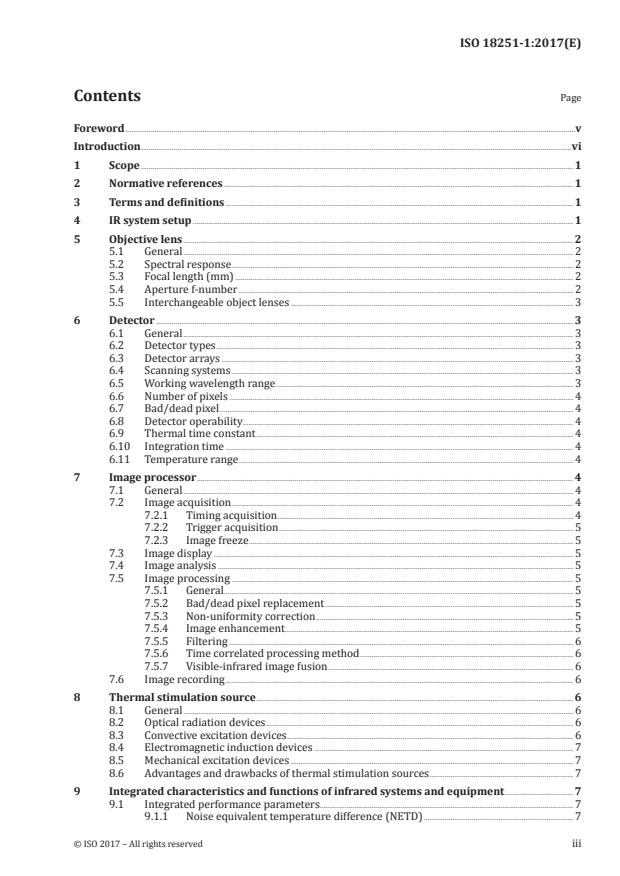
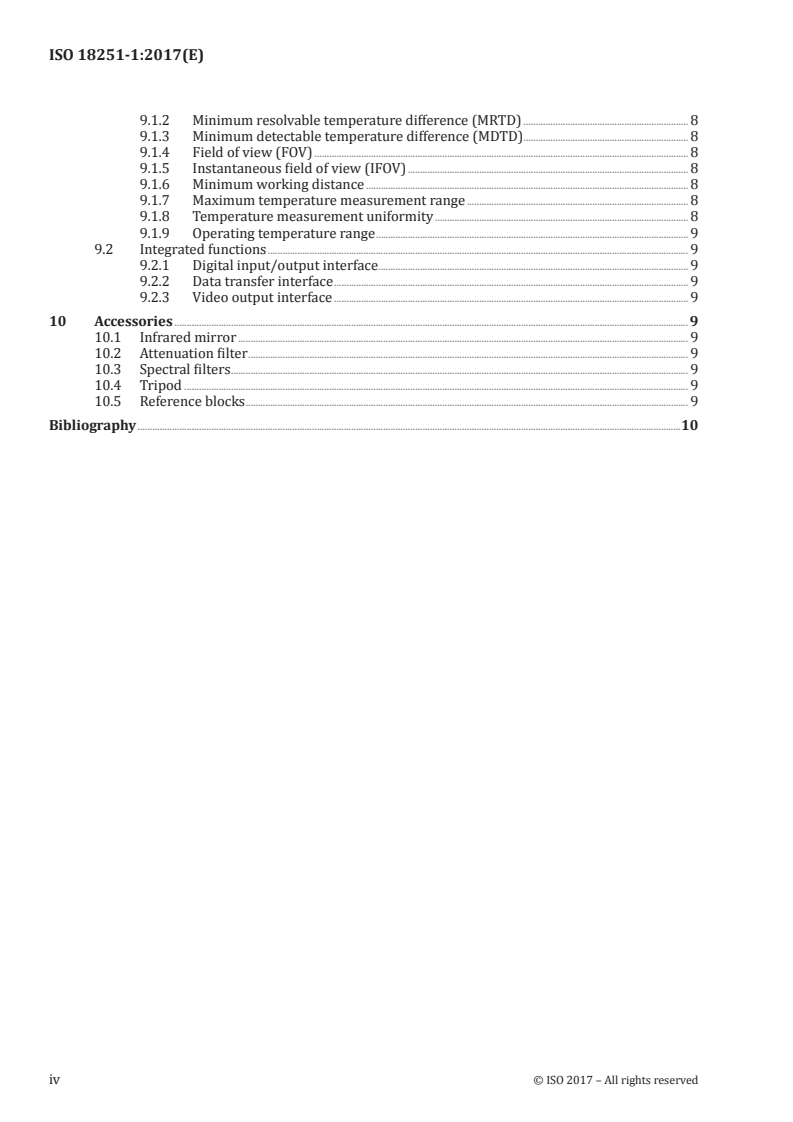
Contents Page
Foreword .v
Introduction .vi
1 Scope . 1
2 Normative references . 1
3 Terms and definitions . 1
4 IR system setup . 1
5 Objective lens . 2
5.1 General . 2
5.2 Spectral response. 2
5.3 Focal length (mm) . 2
5.4 Aperture f-number . 2
5.5 Interchangeable object lenses . 3
6 Detector . 3
6.1 General . 3
6.2 Detector types . 3
6.3 Detector arrays . 3
6.4 Scanning systems . 3
6.5 Working wavelength range . 3
6.6 Number of pixels . 4
6.7 Bad/dead pixel . 4
6.8 Detector operability . 4
6.9 Thermal time constant . 4
6.10 Integration time . 4
6.11 Temperature range . 4
7 Image processor . 4
7.1 General . 4
7.2 Image acquisition . 4
7.2.1 Timing acquisition . 4
7.2.2 Trigger acquisition . 5
7.2.3 Image freeze . 5
7.3 Image display . 5
7.4 Image analysis . 5
7.5 Image processing . 5
7.5.1 General. 5
7.5.2 Bad/dead pixel replacement . 5
7.5.3 Non-uniformity correction . 5
7.5.4 Image enhancement . 5
7.5.5 Filtering . 6
7.5.6 Time correlated processing method . 6
7.5.7 Visible-infrared image fusion. 6
7.6 Image recording . 6
8 Thermal stimulation source . 6
8.1 General . 6
8.2 Optical radiation devices . 6
8.3 Convective excitation devices . 6
8.4 Electromagnetic induction devices . 7
8.5 Mechanical excitation devices . 7
8.6 Advantages and drawbacks of thermal stimulation sources . 7
9 Integrated characteristics and functions of infrared systems and equipment.7
9.1 Integrated performance parameters. 7
9.1.1 Noise equivalent temperature difference (NETD) . 7
9.1.2 Minimum resolvable temperature difference (MRTD) . 8
9.1.3 Minimum detectable temperature difference (MDTD) . 8
9.1.4 Field of view (FOV) . 8
9.1.5 Instantaneous field of view (IFOV) . 8
9.1.6 Minimum working distance . 8
9.1.7 Maximum temperature measurement range . 8
9.1.8 Temperature measurement uniformity . 8
9.1.9 Operating temperature range . 9
9.2 Integrated functions . 9
9.2.1 Digital input/output interface . 9
9.2.2 Data transfer interface . 9
9.2.3 Video output interface . 9
10 Accessories . 9
10.1 Infrared mirror . 9
10.2 Attenuation filter . 9
10.3 Spectral filters . 9
10.4 Tripod . 9
10.5 Reference blocks . 9
Bibliography .10
iv © ISO 2017 – All rights reserved
Foreword
ISO (the International Organization for Standardization) is a worldwide federation of national standards
bodies (ISO member bodies). The work of preparing International Standards is normally carried out
through ISO technical committees. Each member body interested in a subject for which a technical
committee has been established has the right to be represented on that committee. International
organizations, governmental and non-governmental, in liaison with ISO, also take part in the work.
ISO collaborates closely with the International Electrotechnical Commission (IEC) on all matters of
electrotechnical standardization.
The procedures used to develop this document and those intended for its further maintenance are
described in the ISO/IEC Directives, Part 1. In particular the different approval criteria needed for the
different types of ISO documents should be noted. This document was drafted in accordance with the
editorial rules of the ISO/IEC Directives, Part 2 (see www .iso .org/ directives).
Attention is drawn to the possibility that some of the elements of this document may be the subject of
patent rights. ISO shall not be held responsible for identifying any or all such patent rights. Details of
any patent rights identified during the development of the document will be in the Introduction and/or
on the ISO list of patent declarations received (see www .iso .org/ patents).
Any trade name used in this document is information given for the convenience of users and does not
constitute an endorsement.
For an explanation on the meaning of ISO specific terms and expressions related to conformity assessment,
as well as information about ISO’s adherence to the World Trade Organization (WTO) principles in the
Technical Barriers to Trade (TBT) see the following URL: www . i so .org/ iso/ foreword .html.
This document was prepared by Technical Committee ISO/TC 135, Non-destructive testing,
Subcommittee SC 8, Thermographic testing.
A list of all parts in the ISO 18251 series can be found on the ISO website.
Introduction
The industrial applications of infrared thermographic testing in non-destructive testing (NDT) are
growing, along with a remarkable improvement in thermographic technologies. The effectiveness
of any application of infrared thermographic testing depends upon proper and correct usage of the
system and equipment. The purpose of this document is to provide the characterization description of
system and equipment for infrared thermography in the field of industrial NDT. The development of this
document resolves the lack of International Standards on infrared equipment and systems. The main
interested parties who will benefit from this document are manufacturers and users of such equipment
and systems.
vi © ISO 2017 – All rights reserved
INTERNATIONAL STANDARD ISO 18251-1:2017(E)
Non-destructive testing — Infrared thermography —
Part 1:
Characteristics of system and equipment
1 Scope
This document describes the main components, and their characteristics, constituting an infrared (IR)
imaging system and related equipment used in non-destructive testing (NDT). It also aims to assist the
user in the selection of an appropriate system for a particular measurement task.
The following items are specified:
— objective lens;
— detector;
— image processor;
— display;
— thermal stimulation source;
— accessories.
2 Normative references
The following documents are referred to in the text in such a way that some or all of their content
constitutes requirements of this document. For dated references, only the edition cited applies. For
undated references, the latest edition of the referenced document (including any amendments) applies.
ISO 10878, Non-destructive testing — Infrared thermography — Vocabulary
3 Terms and definitions
For the purposes of this document, the terms and definitions given in ISO 10878 apply.
ISO and IEC maintain terminological databases for use in standardization at the following addresses:
— IEC Electropedia: available at http:// www .electropedia .org/
— ISO Online browsing platform: available at http:// www .iso .org/ obp
4 IR system setup
Figure 1 represents an imaging arrangement including the IR system. The lens focuses an image of
the object on the detector. The array of pixels in the detector produces electrical signals dependent on
infrared radiation intensity. The electrical signals are processed to produce an image that is shown on a
display and available for storage or further processing.
Figure 1 — IR system setup
5 Objective lens
5.1 General
The objective lens of an optical system is the element, or combination of elements, that focuses radiant
energy from the object and forms the primary image.
Interchangeable lenses are used to reach a desired spatial resolution of the investigated object, or
object detail.
5.2 Spectral response
IR-cameras are adapted to the transmission properties of the atmosphere for infrared radiation
(atmospheric windows):
— Short Wave, SW: wavelength between approx. 0,8 µm and 2 µm;
— Mid Wave, MW: wavelength between approx. 3 µm and 5 µm;
— Long Wave, LW: wavelength between approx. 8 µm and 14 µm.
The spectral response of the IR-camera depends on the used detector. The transmission of the objective
lens system should be adapted to the spectral response of the detector. The detector is selected
according to the test problem.
5.3 Focal length (mm)
The focal length is the distance between optical centre of the lens and the focal plane point of the
detector. The image of an observed object differs according to the focal length of the lens. A long focal
length results in a smaller field of view and a larger image on the focal plane; this can be useful for
increasing the working distance or visualizing fine details of an object.
5.4 Aperture f-number
The aperture defines the opening through which the rays come to a focus on the focal plane array. The
effective size of the lens aperture affects the amount of radiant energy that passes through a lens. It
is usually specified as an f-number, the ratio of the focal length to the effective aperture diameter. It
strongly influences the sensitivity of the infrared detector. A larger aperture, a lower f-number, allows
more radiant energy to reach the detector, increasing sensitivity of the system. These are “fast”
apertures like f/1.1 or f/2. A smaller aperture, a higher f-number, allows less light that gets in. These are
“slow” apertures like f/3 or f/4.5.
2 © ISO 2017 – All rights reserved
The lens aperture diameter needs to be greater than the detector diagonal to ensure th
...
INTERNATIONAL ISO
STANDARD 18251-1
First edition
2017-02
Non-destructive testing — Infrared
thermography —
Part 1:
Characteristics of system and
equipment
Essais non destructifs — Thermographie infrarouge —
Partie 1: Caractéristiques du système et des équipements
Reference number
©
ISO 2017
© ISO 2017, Published in Switzerland
All rights reserved. Unless otherwise specified, no part of this publication may be reproduced or utilized otherwise in any form
or by any means, electronic or mechanical, including photocopying, or posting on the internet or an intranet, without prior
written permission. Permission can be requested from either ISO at the address below or ISO’s member body in the country of
the requester.
ISO copyright office
Ch. de Blandonnet 8 • CP 401
CH-1214 Vernier, Geneva, Switzerland
Tel. +41 22 749 01 11
Fax +41 22 749 09 47
copyright@iso.org
www.iso.org
ii © ISO 2017 – All rights reserved
Contents Page
Foreword .v
Introduction .vi
1 Scope . 1
2 Normative references . 1
3 Terms and definitions . 1
4 IR system setup . 1
5 Objective lens . 2
5.1 General . 2
5.2 Spectral response. 2
5.3 Focal length (mm) . 2
5.4 Aperture f-number . 2
5.5 Interchangeable object lenses . 3
6 Detector . 3
6.1 General . 3
6.2 Detector types . 3
6.3 Detector arrays . 3
6.4 Scanning systems . 3
6.5 Working wavelength range . 3
6.6 Number of pixels . 4
6.7 Bad/dead pixel . 4
6.8 Detector operability . 4
6.9 Thermal time constant . 4
6.10 Integration time . 4
6.11 Temperature range . 4
7 Image processor . 4
7.1 General . 4
7.2 Image acquisition . 4
7.2.1 Timing acquisition . 4
7.2.2 Trigger acquisition . 5
7.2.3 Image freeze . 5
7.3 Image display . 5
7.4 Image analysis . 5
7.5 Image processing . 5
7.5.1 General. 5
7.5.2 Bad/dead pixel replacement . 5
7.5.3 Non-uniformity correction . 5
7.5.4 Image enhancement . 5
7.5.5 Filtering . 6
7.5.6 Time correlated processing method . 6
7.5.7 Visible-infrared image fusion. 6
7.6 Image recording . 6
8 Thermal stimulation source . 6
8.1 General . 6
8.2 Optical radiation devices . 6
8.3 Convective excitation devices . 6
8.4 Electromagnetic induction devices . 7
8.5 Mechanical excitation devices . 7
8.6 Advantages and drawbacks of thermal stimulation sources . 7
9 Integrated characteristics and functions of infrared systems and equipment.7
9.1 Integrated performance parameters. 7
9.1.1 Noise equivalent temperature difference (NETD) . 7
9.1.2 Minimum resolvable temperature difference (MRTD) . 8
9.1.3 Minimum detectable temperature difference (MDTD) . 8
9.1.4 Field of view (FOV) . 8
9.1.5 Instantaneous field of view (IFOV) . 8
9.1.6 Minimum working distance . 8
9.1.7 Maximum temperature measurement range . 8
9.1.8 Temperature measurement uniformity . 8
9.1.9 Operating temperature range . 9
9.2 Integrated functions . 9
9.2.1 Digital input/output interface . 9
9.2.2 Data transfer interface . 9
9.2.3 Video output interface . 9
10 Accessories . 9
10.1 Infrared mirror . 9
10.2 Attenuation filter . 9
10.3 Spectral filters . 9
10.4 Tripod . 9
10.5 Reference blocks . 9
Bibliography .10
iv © ISO 2017 – All rights reserved
Foreword
ISO (the International Organization for Standardization) is a worldwide federation of national standards
bodies (ISO member bodies). The work of preparing International Standards is normally carried out
through ISO technical committees. Each member body interested in a subject for which a technical
committee has been established has the right to be represented on that committee. International
organizations, governmental and non-governmental, in liaison with ISO, also take part in the work.
ISO collaborates closely with the International Electrotechnical Commission (IEC) on all matters of
electrotechnical standardization.
The procedures used to develop this document and those intended for its further maintenance are
described in the ISO/IEC Directives, Part 1. In particular the different approval criteria needed for the
different types of ISO documents should be noted. This document was drafted in accordance with the
editorial rules of the ISO/IEC Directives, Part 2 (see www .iso .org/ directives).
Attention is drawn to the possibility that some of the elements of this document may be the subject of
patent rights. ISO shall not be held responsible for identifying any or all such patent rights. Details of
any patent rights identified during the development of the document will be in the Introduction and/or
on the ISO list of patent declarations received (see www .iso .org/ patents).
Any trade name used in this document is information given for the convenience of users and does not
constitute an endorsement.
For an explanation on the meaning of ISO specific terms and expressions related to conformity assessment,
as well as information about ISO’s adherence to the World Trade Organization (WTO) principles in the
Technical Barriers to Trade (TBT) see the following URL: www . i so .org/ iso/ foreword .html.
This document was prepared by Technical Committee ISO/TC 135, Non-destructive testing,
Subcommittee SC 8, Thermographic testing.
A list of all parts in the ISO 18251 series can be found on the ISO website.
Introduction
The industrial applications of infrared thermographic testing in non-destructive testing (NDT) are
growing, along with a remarkable improvement in thermographic technologies. The effectiveness
of any application of infrared thermographic testing depends upon proper and correct usage of the
system and equipment. The purpose of this document is to provide the characterization description of
system and equipment for infrared thermography in the field of industrial NDT. The development of this
document resolves the lack of International Standards on infrared equipment and systems. The main
interested parties who will benefit from this document are manufacturers and users of such equipment
and systems.
vi © ISO 2017 – All rights reserved
INTERNATIONAL STANDARD ISO 18251-1:2017(E)
Non-destructive testing — Infrared thermography —
Part 1:
Characteristics of system and equipment
1 Scope
This document describes the main components, and their characteristics, constituting an infrared (IR)
imaging system and related equipment used in non-destructive testing (NDT). It also aims to assist the
user in the selection of an appropriate system for a particular measurement task.
The following items are specified:
— objective lens;
— detector;
— image processor;
— display;
— thermal stimulation source;
— accessories.
2 Normative references
The following documents are referred to in the text in such a way that some or all of their content
constitutes requirements of this document. For dated references, only the edition cited applies. For
undated references, the latest edition of the referenced document (including any amendments) applies.
ISO 10878, Non-destructive testing — Infrared thermography — Vocabulary
3 Terms and definitions
For the purposes of this document, the terms and definitions given in ISO 10878 apply.
ISO and IEC maintain terminological databases for use in standardization at the following addresses:
— IEC Electropedia: available at http:// www .electropedia .org/
— ISO Online browsing platform: available at http:// www .iso .org/ obp
4 IR system setup
Figure 1 represents an imaging arrangement including the IR system. The lens focuses an image of
the object on the detector. The array of pixels in the detector produces electrical signals dependent on
infrared radiation intensity. The electrical signals are processed to produce an image that is shown on a
display and available for storage or further processing.
Figure 1 — IR system setup
5 Objective lens
5.1 General
The objective lens of an optical system is the element, or combination of elements, that focuses radiant
energy from the object and forms the primary image.
Interchangeable lenses are used to reach a desired spatial resolution of the investigated object, or
object detail.
5.2 Spectral response
IR-cameras are adapted to the transmission properties of the atmosphere for infrared radiation
(atmospheric windows):
— Short Wave, SW: wavelength between approx. 0,8 µm and 2 µm;
— Mid Wave, MW: wavelength between approx. 3 µm and 5 µm;
— Long Wave, LW: wavelength between approx. 8 µm and 14 µm.
The spectral response of the IR-camera depends on the used detector. The transmission of the objective
lens system should be adapted to the spectral response of the detector. The detector is selected
according to the test problem.
5.3 Focal length (mm)
The focal length is the distance between optical centre of the lens and the focal plane point of the
detector. The image of an observed object differs according to the focal length of the lens. A long focal
length results in a smaller field of view and a larger image on the focal plane; this can be useful for
increasing the working distance or visualizing fine details of an object.
5.4 Aperture f-number
The aperture defines the opening through which the rays come to a focus on the focal plane array. The
effective size of the lens aperture affects the amount of radiant energy that passes through a lens. It
is usually specified as an f-number, the ratio of the focal length to the effective aperture diameter. It
strongly influences the sensitivity of the infrared detector. A larger aperture, a lower f-number, allows
more radiant energy to reach the detector, increasing sensitivity of the system. These are “fast”
apertures like f/1.1 or f/2. A smaller aperture, a higher f-number, allows less light that gets in. These are
“slow” apertures like f/3 or f/4.5.
2 © ISO 2017 – All rights reserved
The lens aperture diameter needs to be greater than the detector diagonal to ensure th
...