


ISO 19712-2:2007
(Main)Plastics — Decorative solid surfacing materials — Part 2: Determination of properties — Sheet goods
Plastics — Decorative solid surfacing materials — Part 2: Determination of properties — Sheet goods
ISO 19712-2:2007 specifies the methods of test for determination of the properties of solid surfacing materials in the form of sheets. These methods are primarily intended for testing the materials specified in ISO 19712‑1.
Plastiques — Matériaux décoratifs massifs de revêtement de surface — Partie 2: Détermination des propriétés — Produits en feuilles
L'ISO 19712-2:2007 spécifie les méthodes d'essai pour la détermination des propriétés des matériaux massifs de revêtement de surface sous forme de feuilles. Ces méthodes sont principalement destinées à la réalisation des essais sur les matériaux spécifiés dans l'ISO 19712-1.
General Information


Standards Content (Sample)
INTERNATIONAL ISO
STANDARD 19712-2
First edition
2007-12-15
Plastics — Decorative solid surfacing
materials —
Part 2:
Determination of properties — Sheet
goods
Plastiques — Matériaux décoratifs massifs de revêtement de surface —
Partie 2: Détermination des propriétés — Produits en feuilles
Reference number
©
ISO 2007
PDF disclaimer
This PDF file may contain embedded typefaces. In accordance with Adobe's licensing policy, this file may be printed or viewed but
shall not be edited unless the typefaces which are embedded are licensed to and installed on the computer performing the editing. In
downloading this file, parties accept therein the responsibility of not infringing Adobe's licensing policy. The ISO Central Secretariat
accepts no liability in this area.
Adobe is a trademark of Adobe Systems Incorporated.
Details of the software products used to create this PDF file can be found in the General Info relative to the file; the PDF-creation
parameters were optimized for printing. Every care has been taken to ensure that the file is suitable for use by ISO member bodies. In
the unlikely event that a problem relating to it is found, please inform the Central Secretariat at the address given below.
© ISO 2007
All rights reserved. Unless otherwise specified, no part of this publication may be reproduced or utilized in any form or by any means,
electronic or mechanical, including photocopying and microfilm, without permission in writing from either ISO at the address below or
ISO's member body in the country of the requester.
ISO copyright office
Case postale 56 • CH-1211 Geneva 20
Tel. + 41 22 749 01 11
Fax + 41 22 749 09 47
E-mail copyright@iso.org
Web www.iso.org
Published in Switzerland
ii © ISO 2007 – All rights reserved
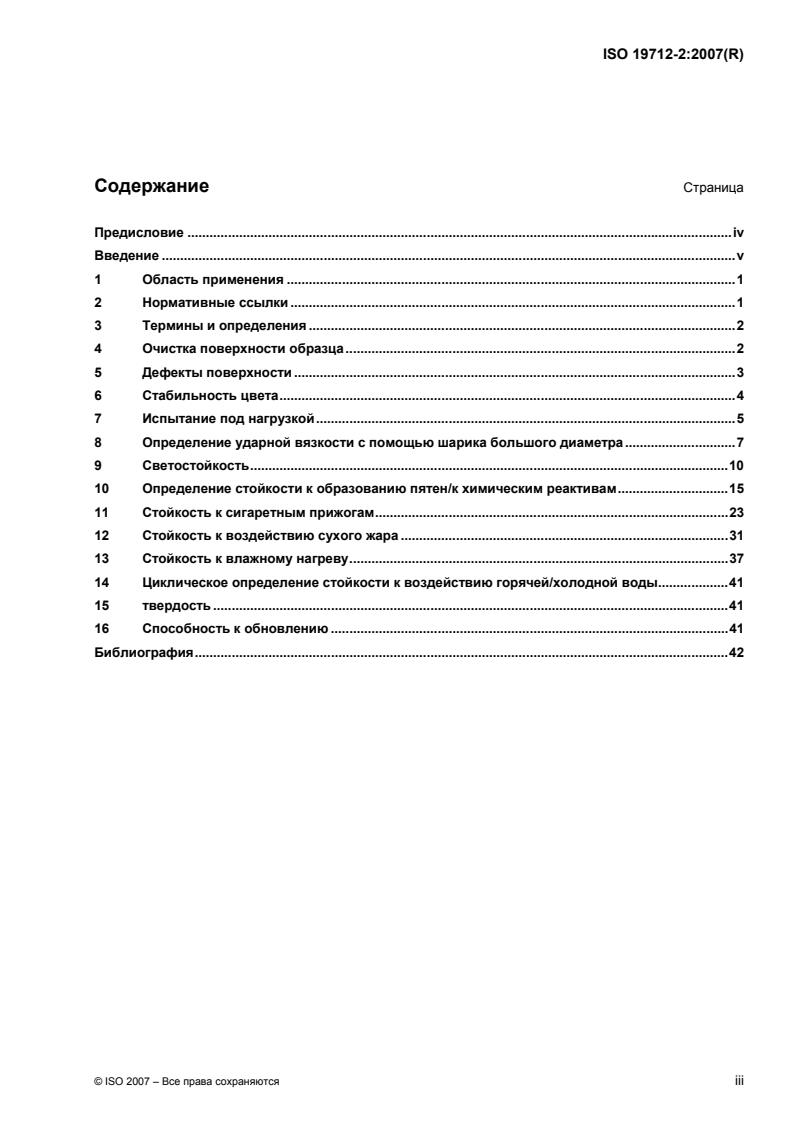
Contents Page
Foreword. iv
Introduction . v
1 Scope . 1
2 Normative references . 1
3 Terms and definitions. 2
4 Cleaning the test specimen surface . 2
5 Surface defects . 3
6 Consistency of colour . 3
7 Load test . 5
8 Resistance to impact by large-diameter ball .7
9 Lightfastness. 10
10 Stain/chemical-resistance test . 15
11 Resistance to cigarette burns . 23
12 Resistance to dry heat. 31
13 Resistance to wet heat . 37
14 Hot/cold-cycle water-resistance test . 40
15 Hardness. 41
16 Ability to be renewed. 41
Bibliography . 42
Foreword
ISO (the International Organization for Standardization) is a worldwide federation of national standards bodies
(ISO member bodies). The work of preparing International Standards is normally carried out through ISO
technical committees. Each member body interested in a subject for which a technical committee has been
established has the right to be represented on that committee. International organizations, governmental and
non-governmental, in liaison with ISO, also take part in the work. ISO collaborates closely with the
International Electrotechnical Commission (IEC) on all matters of electrotechnical standardization.
International Standards are drafted in accordance with the rules given in the ISO/IEC Directives, Part 2.
The main task of technical committees is to prepare International Standards. Draft International Standards
adopted by the technical committees are circulated to the member bodies for voting. Publication as an
International Standard requires approval by at least 75 % of the member bodies casting a vote.
Attention is drawn to the possibility that some of the elements of this document may be the subject of patent
rights. ISO shall not be held responsible for identifying any or all such patent rights.
ISO 19712-2 was prepared by Technical Committee ISO/TC 61, Plastics, Subcommittee SC 11, Products.
ISO 19712 consists of the following parts, under the general title Plastics — Decorative solid surfacing
materials:
⎯ Part 1: Classification and specifications
⎯ Part 2: Determination of properties — Sheet goods
⎯ Part 3: Determination of properties — Solid surface shapes
iv © ISO 2007 – All rights reserved
Introduction
This part of ISO 19172 is intended for use by manufacturers, installers and specifiers of solid surfacing
materials.
The test methods and minimum performance values presented have been related as closely as possible to
end-use applications. The fabrication techniques employed may, however, have a bearing on product
performance and service.
The performance requirements include impact resistance, structure, renewability, colourfastness, cleanability,
stain resistance, water resistance, chemical resistance, bacterial and fungal resistance, and other significant
properties.
INTERNATIONAL STANDARD ISO 19712-2:2007(E)
Plastics — Decorative solid surfacing materials —
Part 2:
Determination of properties — Sheet goods
SAFETY STATEMENT — Persons using this document should be familiar with normal laboratory
practice, if applicable. This document does not purport to address all of the safety problems, if any,
associated with its use. It is the responsibility of the user to establish appropriate safety and health
practices and to ensure compliance with any regulatory conditions.
1 Scope
This part of ISO 19712 specifies the methods of test for determination of the properties of solid surfacing
materials, as defined in Clause 3, in the form of sheets. These methods are primarily intended for testing the
materials specified in ISO 19712-1.
The tests may be carried out on finished sheets, but are generally carried out on test specimens of a size
sufficient to meet the requirements of the test, and of the same material and finish as the finished sheet.
2 Normative references
The following referenced documents are indispensable for the application of this document. For dated
references, only the edition cited applies. For undated references, the latest edition of the referenced
document (including any amendments) applies.
ISO 105-A02, Textiles — Tests for colour fastness — Part A02: Grey scale for assessing change in colour
ISO 105-B02, Textiles — Tests for colour fastness — Part B02: Colour fastness to artificial light: Xenon arc
fading lamp test
ISO 209:2007, Aluminium and aluminium alloys — Chemical composition
ISO 1770, Solid-stem general purpose thermometers
ISO 2039-1, Plastics — Determination of hardness — Part 1: Ball indentation method
ISO 2039-2, Plastics — Determination of hardness — Part 2: Rockwell hardness
ISO 3668, Paints and varnishes — Visual comparison of the colour of paints
ISO 4211:1979, Furniture — Assessment of surface resistance to cold liquids
1)
ISO 4892:1981, Plastics — Methods of exposure to laboratory light sources
ISO 4892-1, Plastics — Methods of exposure to laboratory light sources — Part 1: General guidance
1) Withdrawn, but still used in certain Asian countries.
ISO 4892-2:2006, Plastics — Methods of exposure to laboratory light sources — Part 2: Xenon-arc lamps
ISO 9370, Plastics — Instrumental determination of radiant exposure in weathering tests — General guidance
and basic test method
ISO 19712-1, Plastics — Decorative solid surfacing materials — Part 1: Classification and specifications
CIE Publication No. 85:1989, Solar spectral irradiance
ASTM D 2244, Standard Practice for Calculation of Color Tolerances and Color Differences from
Instrumentally Measured Color Coordinates
ASTM D 2583, Standard Test Method for Indentation Hardness of Rigid Plastics by Means of a Barcol
Impressor
3 Terms and definitions
For the purposes of this document, the following terms and definitions apply.
3.1
solid surfacing material
SSM
material, composed of polymeric materials together with pigments and fillers, intended to be cast into sheets
or shaped products
NOTE 1 The material is of the same composition throughout the whole thickness of the sheet or product.
NOTE 2 Sheets and products made from SSMs are repairable and renewable to the original finish.
NOTE 3 SSMs can also be fabricated into continuous sheets with inconspicuous seams.
4 Cleaning the test specimen surface
4.1 General
The surface to be tested shall be prepared prior to testing using the procedure specified in 4.3.
4.2 Materials
4.2.1 Cellulose sponge.
4.2.2 Non-abrasive cleanser, containing a bleaching agent.
4.2.3 Water.
4.2.4 Clean, absorbent, lint-free material.
4.3 Procedure
Clean the surface using a damp sponge and non-abrasive cleanser containing a bleaching agent, scrubbing
the surface with light hand pressure for up to 1,0 min/m . Rinse the prepared surface with water and dry with
clean, absorbent, lint-free material.
2 © ISO 2007 – All rights reserved
5 Surface defects
5.1 Procedure
The entire finished surface of a suitable-size sheet shall be rubbed with a sponge and a 50 % solution of tap
water and water-soluble black or blue-black ink after the surface has been washed and dried as described in
4.3. When inspecting coloured sheets, contrasting-coloured ink shall be used. The ink shall be wiped from the
surface with a damp cloth and the surface dried before inspection.
5.2 Method of inspection of surface
After being inked in accordance with 5.1, the surface of the sheet shall be inspected with the unaided eye for
defects and blemishes from a distance of between 305 mm and 610 mm, using a light source giving an
illumination intensity of (1 615 ± 540) lx near the surface to be inspected.
5.3 Performance requirements
The finished surfaces of sheets shall be free from cracks, chipped areas, pinholes and blisters.
Spots, dirt and similar surface blemishes are admissible provided the total area covered by such blemishes is
2 2
not more than 1,0 mm /m of sheet surface. The blemishes may be concentrated in one place or scattered
over the sheet.
5.4 Test report
The test report shall include the following information:
a) a reference to this part of ISO 19712;
b) the name and type of product;
c) whether the surface was free from cracks, chipped areas, etc.;
2 2
d) whether the area covered by spots, dirt, etc., was more than 1,0 mm /m of sheet surface;
e) any deviation from the method specified;
f) the date of the test.
6 Consistency of colour
6.1 Test apparatus and materials
6.1.1 Tabletop, approximately 760 mm above the floor.
6.1.2 Overhead white fluorescent lights, with the bulbs positioned parallel to the line of sight and
providing an illumination intensity of 800 lx to 1 100 lx at the tabletop.
6.1.3 Manufacturer’s recommended seam adhesive.
6.1.4 Manufacturer’s recommended abrasives and random orbital sander.
6.2 Test specimens
Two specimens shall be prepared, one from the beginning of the lot and the other from the end of the lot.
For each test specimen, cut two strips, each 320 mm wide, from the full width of the sheet and bond the strips
together, offset by 792 mm, with the manufacturer's recommended adhesive as shown in Figure 1. The strips
shall be bonded in the same direction as they were removed from the sheet. Cut off the two unbonded
portions of the panel thus prepared to give a (640 ± 0,5) mm × (792 ± 0,5) mm specimen with a bond seam
running down the centreline between the midpoints of the 640-mm-long sides as shown in Figure 2. Finish the
seamed specimen by sanding with an orbital sander.
The seam shall be made and finished in strict accordance with the manufacturer’s recommendations for the
fabrication and finishing of seamed panels.
Dimensions in millimetres
Key
1 seam
2 cut lines
X = full width of sheet
Figure 1 — Fabrication of seamed panel from which specimen is cut
Dimensions in millimetres
Figure 2 — Seamed specimen
4 © ISO 2007 – All rights reserved
6.3 Test procedure
Place a specimen on the table face up and view it under the illumination defined in 6.1.2 at an eye-to-
specimen distance of 760 mm to 910 mm. View the specimen at angles of approximately 45° and 75°.
6.4 Performance requirement
There shall be no noticeable base colour change along the length of the seam.
6.5 Test report
The test report shall include the following information:
a) a reference to this part of ISO 19712;
b) the name and type of product;
c) whether there was any noticeable base colour change along the seam;
d) any deviation from the method specified;
e) the date of the test.
7 Load test
7.1 Clamping frame
The clamping frame for conducting the load test shall be constructed so as to provide an area measuring
(610 ± 0,6) mm × (762 ± 0,6) mm over which the test specimen is unsupported.
7.2 Test specimen
A seamed specimen shall be used for the test. The specimen shall be fabricated as specified in 6.2.
7.3 Test method
Mount the seamed specimen in the clamping frame so that it is held securely at the four corners of the
specimen and so that the seam runs between the midpoints of the 762-mm-long sides of the unsupported
area inside the clamping frame (see Figure 3).
Apply a load of 1 334 N to the midpoint of the specimen via a weight distribution disc 203 mm in diameter
resting on a 13 mm thick layer of sponge rubber or other suitable soft material located between the disc and
the specimen surface. Leave the load in place for (2,5 ± 0,5) min to allow for settlement of the clamping frame
and any initial slip in the fasteners. Then remove it.
(12,5 ± 2,5) min after removal of the load, reapply the 1 334 N load for not less than 1,5 min or more than
2 min.
10 min after removal of the load, measure the residual deflection of the midpoint of the specimen with a
deflectometer or other suitable device capable of measuring deflections of up to 0,25 mm.
7.4 Performance requirement
There shall be no cracks in the surface of the specimen when inspected after inking as described in 5.1 and
5.2. The maximum residual deflection shall not exceed 0,25 mm after removal of the load.
Dimensions in millimetres
Key
1 specimen
2 lower metal frame
3 upper metal frame, thickness 5 mm
Figure 3 — Clamping frame for load test (see 7.1)
7.5 Test report
The test report shall include the following information:
a) a reference to this part of ISO 19712;
b) the name and type of product;
c) whether cracks were formed in the surface of the specimen;
d) whether the maximum residual deflection exceeded 0,25 mm;
e) any deviation from the method specified;
f) the date of the test.
6 © ISO 2007 – All rights reserved
8 Resistance to impact by large-diameter ball
8.1 Principle
A specimen taken from the sheet under test is covered with a sheet of carbon paper and subjected to the
impact of a steel ball, which is allowed to fall from a known height. Impact resistance is expressed as the
maximum drop height which can be achieved without incurring visible surface cracking or producing an imprint
greater than a specified maximum diameter.
8.2 Apparatus
8.2.1 Free-fall test apparatus, of the type shown in Figure 4, or an equivalent which will produce the same
results.
8.2.2 Polished steel ball, of mass (324 ± 5,0) g and diameter (42,8 ± 0,2) mm, having no damaged or
flattened areas on its surface.
8.2.3 Specimen clamping frame, conforming to Figure 5.
8.3 Test specimens
Specimens shall measure (230 ± 0,5) mm × (230 ± 0,5) mm × the thickness of the sheet under test.
8.4 Procedure
The test shall be carried out in the laboratory atmosphere, and in cases of dispute it shall be carried out at
(23 ± 2) °C.
Clamp a specimen in the clamping frame (8.2.3) and place the assembly on the solid base of the free-fall test
apparatus (8.2.1). Cover the specimen with a sheet of carbon paper with its coated face in contact with the
decorative surface. Adjust the height scale so that its base is touching the face of the specimen.
Position the electromagnet at any arbitrary height (the specification limit for the material under test is a useful
starting point).
Place the steel ball (8.2.2) on the energized electromagnet. Operate the release mechanism so that the ball
falls on the specimen, catching the ball on the first rebound so that multiple impacts do not occur.
Examine the impact spot. If cracking is evident, or the carbon imprint is greater than the diameter specified in
ISO 19712-1, lower the electromagnet and repeat the test. If no cracking is evident and the imprint is smaller
than the specified diameter, raise the electromagnet and repeat the test. The distance between points of
impact, and between points of impact and the edge of the specimen, shall be at least 50 mm. For referee
purposes, only one impact per specimen shall be made, with the point of impact as near as possible to the
centre of the specimen.
Repeat the above procedure, as necessary, to determine the impact resistance, which is defined as the
maximum height for which no visible surface cracking, or imprint greater than the specified diameter, occurs in
five successive strikes.
Dimensions in millimetres
Key
1 electric power supply 9 6-mm-wide slot
2 transformer and rectifier 10 slidable machinist’s steel scale
3 junction box with two-pin socket 11 electromagnet on sliding mount
4 junction box with indicator light 12 wing nut
5 coiled wire lead
13 450 mm × 450 mm × 20 mm steel base plate, levelled
and set firmly to floor, and projecting out far enough in
6 foot treadle switch
front of the stand for the whole of the clamping frame
7 angle iron brackets (attached firmly to wall or
holding the test specimen (see Figure 5) to be placed
column, plumb and perpendicular to base plate)
on it
8 mounting board for test apparatus (medium- or
high-density chipboard)
Figure 4 — Resistance to impact by large-diameter ball (see 8.2.1)
8 © ISO 2007 – All rights reserved
Dimensions in millimetres
Key
1 specimen
2 lower metal frame
3 upper metal frame, thickness 5 mm
Figure 5 — Clamping frame for resistance to impact by large-diameter ball (see 8.2.3)
8.5 Test report
The test report shall include the following information:
a) a reference to this part of ISO 19712;
b) the name and type of product;
c) the impact resistance, expressed in centimetres;
d) the indentation diameter, expressed in millimetres;
e) any deviation from the method specified;
f) the date of the test.
9 Lightfastness
9.1 Method A
9.1.1 Principle
A specimen taken from the sheet under test is exposed to daylight simulated by the filtered light of one or
more xenon-arc lamps. The effect on the colour of the specimen, at a specified radiant exposure, is assessed
by the contrast between the exposed and unexposed portions of the test specimen. The radiant exposure is
determined both instrumentally and by assessing the effect on blue wool references which are exposed
simultaneously.
Daylight spectral distribution is specified since SSM sheets may, in certain applications, be exposed to direct
daylight through open windows.
9.1.2 Apparatus
9.1.2.1 Test device, as specified in ISO 4892-1 and ISO 4892-2, equipped with:
a) one or more xenon-arc lamps, filtered to provide a spectral energy distribution which closely
approximates to that of solar irradiance as described in CIE Publication No. 85:1989, Table 4, and
ISO 4892-2:2006, Table 1 (method A);
b) stainless-steel specimen holders, in the form of an open frame, which provide the test specimens with a
solid backing;
c) a black-standard thermometer as specified in ISO 4892-1;
d) a photoelectronic sensor (radiometer) of one of the types specified in ISO 9370 to measure the irradiance
and the radiant exposure at the specimen surface in the wavelength range 300 nm to 400 nm, or at
340 nm.
9.1.2.2 Viewing enclosure, having a matt interior colour corresponding approximately to Munsell N5. It
shall be equipped with an artificial light source, located at the top, simulating average north sky daylight (e.g.
tungsten-halogen incandescent lamps) and generating a colour temperature of (6 500 ± 200) K and at least
800 lx at the surface of the specimen. The viewing enclosure shall be placed in a position where the
surrounding lighting conditions will not affect the visual assessment of the specimen.
9.1.3 Test specimen
One test specimen shall be prepared, of a size suitable for the specimen holder used and appropriate for the
method of assessment after exposure.
10 © ISO 2007 – All rights reserved
9.1.4 Procedure
The test specimen and a set of blue wool references 5, 6 and 7 (as specified in ISO 105-B02) shall be
exposed simultaneously. Blue wool references 5 and 7 are included to provide confirmation that wool
reference 6 has degraded to the specified degree of contrast.
Using opaque stainless-steel covers, shield approximately one-half of both the test specimen and the set of
blue wool references.
Carry out the test in accordance with ISO 4892-2 under the following operating conditions:
a) irradiance at the test specimen surface in the wavelength range 300 nm to 400 nm: (60 ± 3) W/m ; or at
wavelength 340 nm: (0,5 ± 0,03) W/m ;
b) black-standard temperature: (65 ± 3) °C;
c) relative humidity: (50 ± 5) %.
Discontinue the exposure when the contrast between the exposed and unexposed portions of blue wool
reference 6 is equal to grade 4 on the grey scale, as defined in ISO 105-A02 (see Note 1).
Measure and record the radiant exposure (over 300 nm to 400 nm, or at 340 nm).
Remove the test specimen from the apparatus, take off the cover, and leave the specimen for (24 ± 2) h in
dark conditions to prevent extraneous darkening and/or photochromism (see Note 2).
NOTE 1 Although the use of blue wool references is no longer the preferred method of measuring radiant exposure,
the method is still in common use and is therefore permitted. Once sufficient data have been collected, the end-point of
the test will be defined by the level of radiant exposure.
NOTE 2 Extraneous darkening and/or photochromism are due to the shock effect of accelerated exposure, and are not
characteristics of natural exposure. Keeping the specimens in dark conditions for 24 h allows recovery from these effects.
9.1.5 Assessment of specimen and expression of results
Place the test specimen in the viewing enclosure (9.1.2.2).
Examine the surface of the test specimen with the naked eye, corrected if necessary, at a distance of
approximately 500 mm for any change in colour, assessing the contrast between the exposed and unexposed
portions of the test specimen in terms of a grade on the grey scale in accordance with ISO 105-A02.
The lightfastness of the test specimen is expressed in terms of the contrast being greater than, equal to or
less than grade 4 on the grey scale.
9.1.6 Test report
The test report shall include the following information:
a) a reference to this part of ISO 19712;
b) the name, type and nominal thickness of the sheet;
c) details of the apparatus used;
d) the irradiance at the test specimen surface;
e) the radiant exposure;
f) the exposure time;
g) the lightfastness of the specimen;
h) any deviation from the method specified;
i) the date of the test.
9.2 Method B
9.2.1 Principle
The test assesses the effect on the colour of a test specimen of exposure to a filtered xenon-arc light source
having a frequency range simulating sunlight through window glass.
It is not intended to show the resistance to continuous exposure to outdoor weathering conditions.
9.2.2 Materials
9.2.2.1 White petroleum jelly.
9.2.3 Apparatus
9.2.3.1 Suitable xenon-arc test apparatus, as specified in ISO 4892-1 and ISO 4892-2, capable of
providing radiant energy closely simulating sunlight, with a spectral passband of 280 nm to 800 nm and with
appropriate filtering to simulate daylight through window glass. The apparatus shall incorporate a system for
mounting specimen holders at an equal radial distance from the centre of the light source and revolving them
around the light source so as to provide equal radiant exposure.
9.2.3.2 Specimen holders, suitable for the test apparatus, and incorporating a mask to cover half of the
exposed face of the test specimen.
9.2.3.3 Overhead white fluorescent lights, with bulb(s) positioned parallel to the line of sight and
providing an intensity of 800 lx to 1 100 lx at the specimen surface.
9.2.4 Standardization of apparatus
Calibration, maintenance and filter changes shall be strictly in accordance with the equipment manufacturer's
recommendations.
The calibration wavelength for the xenon unit shall be 420 nm.
9.2.5 Test specimens
The test specimens shall be of the size specified for the test apparatus being used.
9.2.6 Procedure
Mount each test specimen in a specimen holder (9.2.3.2) so that approximately one-half of the specimen is
exposed to the light source, the other half being covered by the mask. Fill all the specimen holders, utilizing
blanks if necessary, and keep them filled during the whole of the test in order to maintain correct airflow
conditions through the test chamber.
Carry out the test under the operating conditions specified in Table 1.
NOTE The setting of the wet-bulb temperature in relation to the dry-bulb temperature is designed to maintain a
relative humidity of (50 ± 5) %.
All test parameters shall be maintained as close as possible to the required settings.
12 © ISO 2007 – All rights reserved
Table 1 — Operating conditions
Parameter Setting Tolerance
2 2
Total irradiance 279,0 kJ/m ± 2,0 kJ/m
2 2
Irradiance level 1,10 W/m ± 0,03 W/m
Black-panel temperature 70 °C ± 3 °C
Dry-bulb temperature 50 °C ± 3 °C
Wet-bulb temperature 39 °C ± 1 °C
Conditioning-water temperature 20 °C ± 3 °C
Duration of exposure 72 h ± 1 %
Power adjustment Automatic To maintain steady irradiance levels, allowing for
ageing of xenon burners and solarization of filters
The black-panel thermometer shall be mounted at the same distance from the light source as the test
specimen. The black coating shall be maintained in good condition in order to achieve as accurately as
possible the black-body temperature of the panel.
At the conclusion of the specified exposure period, remove the test specimens from their holders and allow
them to condition at room temperature for a period of 24 h.
After this conditioning period, examine each specimen within 4 h by placing the specimen on a horizontal
surface under the inspection lights (9.2.3.3) and viewing it at an eye-to-specimen distance of 750 mm to
900 mm, and at an angle of 45° to 75° from the horizontal plane. Rotate the specimen on the horizontal
surface and view it from all directions. Direct sunlight or other light sources which might accentuate or
minimize the visual effect shall be avoided.
If a difference in appearance is evident between the exposed and unexposed areas of the test specimen, coat
the surface of the specimen with a thin film of white petroleum jelly (9.2.2.1) and re-examine it. If the
difference persists, report the difference as a colour change; if it disappears, report it as a change in surface
finish.
9.2.7 Expression of results
Express the result of the examination in accordance with the following rating scale:
Rating 5: No change in colour or surface finish
Rating 4: A slight change in colour or surface finish visible only at certain viewing angles and
directions
Rating 3: A moderate change in colour or surface finish that is just visible at all viewing angles and
directions
Rating 2: A marked change in colour or surface finish that is very evident at all viewing angles and
directions
Rating 1: Surface blistering and/or cracking
9.2.8 Test report
The test report shall include the following information:
a) a reference to this part of ISO 19712;
b) the name, type and nominal thickness of the sheet;
c) details of the apparatus used;
d) the lightfastness of the specimen, expressed in accordance with 9.2.7;
e) any deviation from the method specified;
f) the date of the test.
9.3 Method C (resistance to colour change in light from an enclosed carbon-arc lamp)
9.3.1 Principle
Part of a test specimen taken from the sheet under test is exposed, together with standard blue wool
specimens, to the light of an enclosed carbon-arc lamp. The light dosage is determined by the effect on the
wool specimens, and the effect on the test specimen is assessed at a specified light dosage by the contrast
between the exposed and unexposed portions of the specimen.
The test is fully described in ISO 4892:1981.
9.3.2 Apparatus
As specified in ISO 4892:1981, without control of humidity.
9.3.3 Test specimen
As specified in ISO 4892:1981.
9.3.4 Procedure
Carry out the test using the single-exposure method described in ISO 4892:1981, and discontinue the
exposure when blue wool standard No. 5 shows a contrast between exposed and unexposed portions equal
to grade 4 on the grey scale.
9.3.5 Evaluation and expression of results
Examine the contrast between the exposed and unexposed portions of the test specimen and record it in
terms of grades on the grey scale.
Express the result in relation to the resistance to colour change of blue wool standard No. 5 as one of those
given in Table 2.
Table 2 — Colour change evaluation
Specimen contrast Resistance to colour change
(grey scale grade No.) (blue wool standard No.)
> 4 > 5
4 5
< 4 < 5
14 © ISO 2007 – All rights reserved
9.3.6 Test report
The test report shall include the following information:
a) a reference to this part of ISO 19712;
b) the name and type of product;
c) the resistance of the specimen to colour change, expressed as greater than, equal to or less than that of
blue wool standard No. 5;
d) any deviation from the specified procedure;
e) the date of the test.
10 Stain/chemical-resistance test
10.1 Method A
10.1.1 Principle
Test specimens are left in contact with a series of staining agents which are likely to be encountered in
everyday use. The time and conditions of contact are specified for each staining agent. At the end of the
specified contact period, the specimens are washed and examined for residual surface marks.
If the product under test meets specification requirements when tested with each of the six staining agents
marked with an asterisk, then it is deemed to comply with the specification for stain resistance. The other
staining agents are included for information only. In the case of a specific complaint, the staining agent in
question (selected from group 1, 2 or 3) shall be used to verify the quality of the sheet.
10.1.2 Staining agents
Staining agents and test conditions are listed in Table 3.
Table 3 — Staining agents
Staining agent Test conditions Contact time
Group 1
Toothpaste
Hand cream
Urine
Alcoholic beverages
Natural fruit and vegetable juices
Lemonade and fruit drinks
Meats and sausages
Animal and vegetable fats and oils
10.1.5.1 Procedure A
Water
Apply staining agent at 16 h to 24 h
Yeast suspension in water
ambient temperature
Salt (NaCl) solutions
Mustard
Lyes, soap solutions
Cleaning solution
23 % dodecylbenzene sulfonate
10 % alkylaryl polyglycol ether
67 % water
Phenol and chloramine-T disinfectants
Citric acid (10 % solution)
Group 2
*Coffee (120 g of coffee per litre of water) 10.1.5.1 Procedure A
16 h
Black tea (9 g of tea per litre of water) Apply staining agent at
Milk (all types) approximately 80 °C
Cola beverages
Wine vinegar
Alkaline-based cleaning agents diluted to 10 % concentration with water
Hydrogen peroxide (3 % solution) 10.1.5.1 Procedure A
Ammonia (10 % solution of commercial concentrate) Apply staining agent at 16 h
Lipstick ambient temperature
Water colours
Laundry marking inks
Ball point inks
a
Group 3
*Sodium hydroxide (25 % solution)
*Hydrogen peroxide (30 % solution)
*Acetone
Trichlorethane
Other organic solvents
Concentrated vinegar (30 % acetic acid)
Bleaching agents and sanitary cleaners containing them
Hydrochloric acid based cleaning agents (u 3 % HCl)
10.1.5.1 Procedure A
Acid-based metal cleaners
Apply staining agent at 10 min
Mercurochrome (2,7-dibromo-4-hydroxymercurifluorescein, disodium
ambient temperature
salt)
*Shoe polish
Hair colouring and bleaching agents
Tincture of iodine
Boric acid
Lacquers and adhesives (except fast-curing materials)
Amidosulfonic acid descaling agents (< 10 % solution)
Nail varnish
Nail varnish remover
Stain or paint remover based on organic solvents
Group 4
*Citric acid (10 % solution) 10.1.5.2 Procedure B 20 min
Acetic acid (5 % solution)
a
Acids and alkalis, in concentrations stronger than those shown in group 3, which can be contained in commercial cleaning agents,
can cause surface damage or marking, even with very short contact times. Any spillage of such materials shall be washed off
immediately.
16 © ISO 2007 – All rights reserved
10.1.3 Apparatus and materials
10.1.3.1 Glass covers (for example watch-glasses), to restrict evaporation.
10.1.3.2 Thermometer, range 0 °C to 100 °C.
10.1.3.3 Cylindrical aluminium-alloy heating vessel, without a lid, the bottom of which has been
machined flat. The vessel shall have an external diameter of (100 ± 1,5) mm and an overall height of
(70 ± 1,5) mm, and have a safety rim round the top. The thickness of the wall and bottom shall be
(2,5 ± 0,5) mm. An example of a suitable vessel is shown in Figure 6.
10.1.3.4 Hotplate, or other suitable heat source.
10.1.3.5 Horizontal inspection surface, illuminated by overhead and low-angle daylight or white
fluorescent light of intensity 800 lx to 1 000 lx.
10.1.3.6 Wetting agent, for example domestic detergent.
10.1.3.7 Cleaning solvents, such as ethanol, acetone, methyl ethyl ketone.
10.1.3.8 Soft clean cloth.
10.1.3.9 Hard polyamide bristle brush (for example a nail brush).
10.1.4 Test specimens
Individual specimens of any suitable size may be used, cut from the sheet under test. Alternatively, a single
piece, large enough to allow the staining agents to be applied side by side, can be used.
10.1.5 Procedures
10.1.5.1 Procedure A
The specimens shall initially be at ambient temperature.
Apply a small quantity (for example 2 or 3 drops) of staining agent to two specimens. The staining agent shall
be at the temperature specified in Table 3. Cover the staining agent on one of the two specimens with a glass
cover (10.1.3.1). Keep the specimens flat during the test.
After the specified contact time has elapsed, if necessary remove the staining agent with a suitable solvent as
recommended by the manufacturer, then wash with water containing a suitable wetting agent (10.1.3.6), and
finally with ethanol or another solvent (see 10.1.3.7), as required, to clean the surface. A suitable brush
(10.1.3.9) may be used to remove staining agent from textured surfaces.
1 h after washing, place the specimens on the inspection surface (10.1.3.5) and view them from various
angles at a distance of 400 mm.
10.1.5.2 Procedure B
Apply a small quantity (for example 2 or 3 drops) of the staining agent to a specimen. The staining agent shall
be at ambient temperature.
Fill the heating vessel (10.1.3.3) with water (to within 15 mm of the top) and heat it until the water boils
vigorously. Discontinue heating and immediately place the vessel containing the boiling water on the surface
of the specimen directly over the pool of staining agent. Keep the specimen flat during the test.
Dimensions in millimetres
Key
1 aluminium-alloy safety rim
a
Bottom welded in place and machined flat. Vessel shall be completely watertight.
b
Nominal value.
Figure 6 — Example of heating vessel
18 © ISO 2007 – All rights reserved
After the specified contact time, remove the vessel and wash the specimen with water containing a suitable
wetting agent (10.1.3.6), and then with ethanol or another solvent (see 10.1.3.7), as required, to clean the
surface. A suitable brush (10.1.3.9) may be used to remove staining agent from textured surfaces.
1 h after washing, place the specimen on the inspection surface (10.1.3.5) and view it from various angles at a
distance of 400 mm.
10.1.6 Expression of results
The effect on the surface of the specimen shall be expressed in accordance with the following rating scale for
each of the six mandatory staining agents:
Rating 5: No visible change
Rating 4: Slight change in gloss and/or colour, only visible at certain viewing angles
Rating 3: Moderate change in gloss and/or colour
Rating 2: Marked change in gloss and/or colour
Rating 1: Surface distortion and/or blistering
10.1.7 Test report
The test report shall include the following information:
a) a reference to this part of ISO 19712;
b) the name and type of product;
c) an assessment of stain resistance for each staining agent applied, expressed in accordance with the
rating scale given in 10.1.6;
d) any deviation from the specified procedure;
e) the date of the test.
10.2 Method B
10.2.1 Principle
Test specimens are left in contact with a series of staining agents that are likely to be encountered in everyday
household use. At the end of the prescribed contact period, the specimens are subjected to a specified
cleaning programme and examined for any residual surface marks.
This method may also be used with staining agents other than those specified, to cover specific requirements
agreed between supplier and purchaser.
10.2.2 Materials
10.2.2.1 Commercially available non-abrasive cleaner, containing approximately 4 % of butyl cellosolve.
10.2.2.2 Commercially available bleach, containing (5 ± 0,5) % of sodium hypochlorite.
10.2.2.3 Baking soda.
10.2.2.4 Supply of clean, soft, white cloth.
10.2.2.5 Supply of cotton balls.
10.2.2.6 Acetone, 100 % by volume, or ethanol, 95 % by volume.
10.2.2.7 Distilled water.
10.2.2.8 Staining agents, as listed in Table 4.
Table 4 — Staining agents and their method of application
Agent
Description Preparation notes Application
number
1 Distilled water —
A mixture of 50 % ethyl alcohol and 50 %
2 Ethyl alcohol
distilled water
3 Household ammonia Non-sudsing type
A solution of 10 % citric acid in distilled
4 10 % citric acid
water
Apply 2 drops (an approximately
5 Vegetable oil —
6-mm-diameter spot) and cover
One teaspoon of instant coffee per
with a watch-glass.
6 Fresh coffee
180 ml of distilled water
Brew 1 tea bag per 120 ml of boiling
7 Fresh tea
distilled water for 2 min
8 Tomato ketchup —
9 Yellow mustard —
10 Tincture of iodine —
11 Acetone —
12 Black permanent marker —
Apply a spot approximately 6 mm
13 HB pencil —
in diameter; do not cover.
14 Wax crayon —
15 Black paste shoe polish —
NOTE Staining agents shall be kept in closed containers to avoid any change in concentration. Perishable food items shall be
kept refrigerated.
10.2.3 Apparatus
10.2.3.1 Glass covers, approximately 25 mm in diameter (for example watch-glasses), one for each test
requiring a cover.
10.2.3.2 Overhead white fluorescent lights, with bulb(s) positioned parallel to the line of sight and
providing an intensity of 800 lx to 1 100 lx at the specimen surface.
10.2.3.3 Cellulose sponge, measuring approximately 75 mm × 100 mm × 50 mm.
10.2.3.4 Hard polyamide bristle brush, for example a nail brush.
10.2.3.5 Weight, of mass 1 kg.
10.2.4 Test specimen
The test specimen shall have a surface area sufficient to permit all 15 test reagents to be placed on the
surface in two lines with the individual stains about 50 mm apart. A 100 mm × 400 mm specimen is adequate.
20 © ISO 2007 – All rights reserved
10.2.5 Procedure
10.2.5.1 Staining procedure
Clean the surface of the test specimen using the cleaner (10.2.2.1) and water on a clean cloth (10.2.2.4).
Rinse the specimen thoroughly and dry using another clean, soft cloth. Allow to dry completely at room
temperature.
Position the test specimen on a flat, level, horizontal surface and fix it down (e.g. with tape or weights) to keep
it in the horizontal plane.
Place a small quantity of each staining agent (to give a spot approximately 6 mm in diameter) on the surface
of the test specimen. The staining agents shall be at room temperature.
If indicated
...
NORME ISO
INTERNATIONALE 19712-2
Première édition
2007-12-15
Plastiques — Matériaux décoratifs
massifs de revêtement de surface —
Partie 2:
Détermination des propriétés — Produits
en feuilles
Plastics — Decorative solid surfacing materials —
Part 2: Determination of properties — Sheet goods
Numéro de référence
©
ISO 2007
DOCUMENT PROTÉGÉ PAR COPYRIGHT
© ISO 2007
Droits de reproduction réservés. Sauf prescription différente, aucune partie de cette publication ne peut être reproduite ni utilisée sous
quelque forme que ce soit et par aucun procédé, électronique ou mécanique, y compris la photocopie et les microfilms, sans l'accord écrit
de l'ISO à l'adresse ci-après ou du comité membre de l'ISO dans le pays du demandeur.
ISO copyright office
Case postale 56 CH-1211 Geneva 20
Tel. + 41 22 749 01 11
Fax + 41 22 749 09 47
E-mail copyright@iso.org
Web www.iso.org
Version française parue en 2012
Publié en Suisse
ii © ISO 2007 – Tous droits réservés
Sommaire Page
Avant-propos . iv
Introduction . v
1 Domaine d'application . 1
2 Références normatives . 1
3 Termes et définitions . 2
4 Nettoyage de la surface de l'éprouvette . 2
5 Défauts de surface . 3
6 Stabilité de la teinte . 3
7 Essai de charge . 5
8 Résistance au choc d'une bille de grand diamètre . 8
9 Résistance à la lumière . 11
10 Essai de résistance aux taches/produits chimiques . 16
11 Résistance aux brûlures de cigarettes . 24
12 Résistance à la chaleur sèche . 33
13 Résistance à la chaleur humide . 40
14 Essai de résistance à l'eau, cycles thermiques . 43
15 Dureté . 44
16 Aptitude à la rénovation . 44
Bibliographie . 45
Avant-propos
L'ISO (Organisation internationale de normalisation) est une fédération mondiale d'organismes nationaux de
normalisation (comités membres de l'ISO). L'élaboration des Normes internationales est en général confiée
aux comités techniques de l'ISO. Chaque comité membre intéressé par une étude a le droit de faire partie du
comité technique créé à cet effet. Les organisations internationales, gouvernementales et non
gouvernementales, en liaison avec l'ISO participent également aux travaux. L'ISO collabore étroitement avec
la Commission électrotechnique internationale (CEI) en ce qui concerne la normalisation électrotechnique.
Les Normes internationales sont rédigées conformément aux règles données dans les Directives ISO/CEI,
Partie 2.
La tâche principale des comités techniques est d'élaborer les Normes internationales. Les projets de Normes
internationales adoptés par les comités techniques sont soumis aux comités membres pour vote. Leur
publication comme Normes internationales requiert l'approbation de 75 % au moins des comités membres
votants.
L'attention est appelée sur le fait que certains des éléments du présent document peuvent faire l'objet de
droits de propriété intellectuelle ou de droits analogues. L'ISO ne saurait être tenue pour responsable de ne
pas avoir identifié de tels droits de propriété et averti de leur existence.
L'ISO 19712-2 a été élaborée par le comité technique ISO/TC 61, Plastiques, sous-comité SC 11, Produits.
L'ISO 19712 comprend les parties suivantes, présentées sous le titre général Plastiques — Matériaux
décoratifs massifs de revêtement de surface:
Partie 1: Classification et spécifications
Partie 2: Détermination des propriétés — Produits en feuilles
Partie 3: Détermination des propriétés — Produits mis en forme
iv © ISO 2007 – Tous droits réservés
Introduction
La présente partie de l'ISO 19172 est destinée à être utilisée par les fabricants, installateurs et rédacteurs de
spécifications de matériaux massifs de revêtement de surface.
Les méthodes d'essai et les valeurs de performances minimales présentées ont été liées aussi étroitement
que possible aux applications finales. Les techniques de fabrication employées peuvent avoir une influence
sur la performance et le fonctionnement.
Les exigences de performance comprennent la résistance aux chocs, la structure, l'aptitude à la rénovation, la
solidité des couleurs, l'aptitude au nettoyage, la résistance aux taches, la résistance à l'eau, la résistance aux
produits chimiques, la résistance au développement de bactéries et de champignons ainsi que d'autres
propriétés importantes.
NORME INTERNATIONALE ISO 19712-2:2007(F)
Plastiques — Matériaux décoratifs massifs de revêtement de
surface —
Partie 2:
Détermination des propriétés — Produits en feuilles
PRÉCAUTIONS DE SÉCURITÉ — Il convient que les utilisateurs du présent document soient
familiarisés avec les pratiques courantes de laboratoire. Le présent document n'a pas pour but de
traiter tous les problèmes de sécurité qui sont, le cas échéant, liés à son utilisation. Il incombe à
l'utilisateur d'établir des pratiques appropriées en matière d'hygiène et de sécurité, et de s'assurer de
la conformité à la réglementation nationale en vigueur.
1 Domaine d'application
La présente partie de l'ISO 19712 spécifie les méthodes d'essai pour la détermination des propriétés des
matériaux massifs de revêtement de surface sous forme de feuilles, tels que définis à l'Article 3. Ces
méthodes sont principalement destinées à la réalisation des essais sur les matériaux spécifiés dans
l'ISO 19712-1.
Les essais peuvent être effectués sur des produits finis, mais ils le sont généralement sur des éprouvettes de
taille suffisante pour répondre aux exigences de l'essai et réalisées à partir du même matériau et de la même
finition que la feuille finie.
2 Références normatives
Les documents de référence suivants sont indispensables pour l’application du présent document. Pour les
références datées, seule l'édition citée s'applique. Pour les références non datées, la dernière édition du
document de référence s'applique (y compris les éventuels amendements).
ISO 105-A02, Textiles — Essais de solidité des teintures — Partie A02: Échelle de gris pour l'évaluation des
dégradations
ISO 105-B02, Textiles — Essais de solidité des teintures — Partie B02: Solidité des teintures à la lumière
artificielle: Lampe à arc au xénon
ISO 209:2007, Aluminium et alliages d'aluminium — Composition chimique
ISO 1770, Thermomètres sur tige d'usage général
ISO 2039-1, Plastiques — Détermination de la dureté — Partie 1: Méthode de pénétration à la bille
ISO 2039-2, Plastiques — Détermination de la dureté — Partie 2: Dureté Rockwell
ISO 3668, Peintures et vernis — Comparaison visuelle de la couleur des peintures
ISO 4211:1979, Ameublement — Évaluation de la résistance des surfaces aux liquides froids
1)
ISO 4892:1981, Plastiques — Méthodes d'exposition à des sources lumineuses en laboratoire
ISO 4892-1, Plastiques — Méthodes d'exposition à des sources lumineuses de laboratoire — Partie 1: Guide
général
ISO 4892-2:2006, Plastiques — Méthodes d'exposition à des sources lumineuses de laboratoire — Partie 2:
Lampes à arc au xénon
ISO 9370, Plastiques — Détermination au moyen d'instruments de l'exposition énergétique lors d'essais
d'exposition aux intempéries — Lignes directrices générales et méthode d'essai fondamentale
ISO 19712-1, Plastiques — Matériaux décoratifs massifs de revêtement de surface — Partie 1: Classification
et spécifications
Publication CIE n° 85:1989, Éclairement énergétique spectral solaire
ASTM D 2244, Standard Practice for Calculation of Color Tolerances and Color Differences from
Instrumentally Measured Color Coordinates
ASTM D 2583, Standard Test Method for Indentation Hardness of Rigid Plastics by Means of a Barcol
Impressor
3 Termes et définitions
Pour les besoins du présent document, les termes et définitions suivants s’appliquent.
3.1
matériau massif de revêtement de surface
SSM
matériau à base de composés polymères associés à des pigments et à des matières de charge, destiné à
être intégré dans des produits en feuilles ou mis en forme
NOTE 1 Le matériau a la même composition sur toute l'épaisseur de la feuille ou du produit.
NOTE 2 Les feuilles et les produits réalisés à partir de matériaux massifs de revêtement de surface (SSM) sont
réparables et aptes à la rénovation par rapport à la finition d'origine.
NOTE 3 Les matériaux massifs de revêtement de surface (SSM) peuvent également être réalisés en feuilles continues
avec des joints indécelables.
4 Nettoyage de la surface de l'éprouvette
4.1 Généralités
La surface devant être soumise à essai doit être préparée avant l'essai en appliquant le mode opératoire
spécifié en 4.3.
4.2 Matériaux
4.2.1 Éponge en cellulose.
4.2.2 Produit de nettoyage non abrasif, contenant un agent de blanchiment.
4.2.3 Eau.
1) Annulée, mais encore utilisée dans certains pays d'Asie.
2 © ISO 2007 – Tous droits réservés
4.2.4 Matériau non pelucheux, propre et absorbant.
4.3 Mode opératoire
Nettoyer la surface à l'aide d'une éponge humide et d'un produit de nettoyage non abrasif contenant un agent
de blanchiment; frotter la surface en appliquant une légère pression pendant 1,0 min/m . Rincer à l'eau la
surface préparée et la sécher à l'aide d'un tissu non pelucheux, propre et absorbant.
5 Défauts de surface
5.1 Mode opératoire
Frotter la totalité de la surface finie d'une feuille de taille appropriée à l'aide d'une éponge et d'une solution à
50 % d'eau du robinet et d'encre bleue-noire soluble dans l'eau, après avoir lavé et séché la surface selon le
mode opératoire décrit en 4.3. Lors du contrôle de feuilles teintées, utiliser de l'encre à contraste de couleur.
Essuyer la surface à l'aide d'un tissu humide pour éliminer l'encre et sécher la surface avant le contrôle.
5.2 Méthode de contrôle de la surface
Après avoir appliqué l'encre à la surface conformément à 5.1, vérifier la présence de défauts ou de tachetures
en examinant à l'œil nu la surface de la feuille à une distance comprise entre 305 mm et 610 mm, en utilisant
une source lumineuse assurant un éclairement de (1 615 540) lx à proximité de la surface à examiner.
5.3 Exigences de performance
Les surfaces finies des produits en feuilles doivent être exemptes de fissures, de zones ébréchées, de trous
d'épingle et de cloques.
Les taches, salissures et autres défauts de surface similaires sont admissibles à condition que l'aire totale
2 2
couverte par de telles défectuosités ne soit pas supérieure à 1,0 mm /m de surface de feuille. Les
défectuosités peuvent être concentrées en un seul endroit ou dispersées sur la feuille.
5.4 Rapport d'essai
Le rapport d’essai doit contenir les informations suivantes:
a) une référence à la présente partie de l'ISO 19712;
b) le nom et le type du produit;
c) si la surface est exempte ou non de fissures, de zones ébréchées, etc.;
2 2
d) si la zone couverte de taches, de salissures, etc., est supérieure à 1,0 mm /m de surface de feuille;
e) tout écart par rapport à la méthode spécifiée;
f) la date de l'essai.
6 Stabilité de la teinte
6.1 Appareillage et matériaux d'essai
6.1.1 Table, située à environ 760 mm au-dessus du sol.
6.1.2 Lampes suspendues à éclairage fluorescent blanc, avec les ampoules positionnées parallèlement
à la ligne de vision et assurant un éclairement de 800 lx à 1 100 lx au niveau du plan de la table.
6.1.3 Adhésif de joint recommandé par le fabricant.
6.1.4 Abrasifs et ponceuse rotative orbitale spéciale recommandés par le fabricant.
6.2 Éprouvettes
Deux éprouvettes doivent être préparées, l'une prélevée en début de lot et l'autre en fin de lot.
Pour chaque éprouvette, découper deux bandes ayant chacune une largeur de 320 mm, dans toute la largeur
de la feuille et, à l'aide de l'adhésif recommandé par le fabricant comme illustré à la Figure 1, coller ensemble
les deux bandes décalées de 792 mm. Les bandes doivent être collées dans le même sens que celui où elles
ont été découpées dans la feuille. Couper les deux parties non collées du panneau ainsi préparé pour obtenir
une éprouvette de (640 0,5) mm (792 0,5) mm avec un joint parcourant l'axe principal entre les points
médians des côtés de 640 mm de long comme illustré à la Figure 2. À l'aide d'une ponceuse orbitale,
procéder à la finition de l'éprouvette assemblée par collage.
Le joint doit être réalisé et fini en suivant strictement les recommandations du fabricant pour la fabrication et la
finition des panneaux assemblés par collage.
Dimensions en millimètres
Légende
1 joint
2 lignes de découpe
X largeur totale de la feuille
Figure 1 — Fabrication d'un panneau assemblé par collage dans lequel l'éprouvette est découpée
4 © ISO 2007 – Tous droits réservés
Dimensions en millimètres
Figure 2 — Éprouvette assemblée par collage
6.3 Mode opératoire d'essai
Placer sur la table une éprouvette avec sa face orientée vers le haut et l'examiner sous l'éclairage défini en
6.1.2, à une distance œil-éprouvette comprise entre 760 mm et 910 mm. Examiner l'éprouvette à des angles
d'environ 45° et 75°.
6.4 Exigence de performance
Aucun changement perceptible de la teinte de base ne doit être observé sur toute la longueur du joint.
6.5 Rapport d’essai
Le rapport d'essai doit comprendre les informations suivantes:
a) une référence à la présente partie de l'ISO 19712;
b) le nom et le type du produit;
c) si un changement perceptible de la teinte de base a été observé le long du joint;
d) tout écart par rapport à la méthode spécifiée;
e) la date de l'essai.
7 Essai de charge
7.1 Cadre de fixation
Pour l'essai de charge, le cadre de fixation doit être construit de manière à laisser une zone mesurant
(610 0,6) mm (762 0,6) mm sur laquelle l'éprouvette n'est soutenue par aucun support.
7.2 Éprouvette
Une éprouvette assemblée par collage doit être utilisée pour l'essai. L'éprouvette doit être réalisée comme
spécifié en 6.2.
7.3 Méthode d'essai
Monter l'éprouvette assemblée par collage dans le cadre de fixation de sorte qu'elle soit solidement
maintenue aux quatre coins et que le joint passe entre les points médians des côtés de 762 mm de long de la
zone non supportée à l'intérieur du cadre de fixation (voir Figure 3).
Appliquer une charge de 1 334 N au point médian de l'éprouvette par l'intermédiaire d'un disque de répartition
de masses de 203 mm de diamètre reposant sur une couche de caoutchouc spongieux de 13 mm d'épaisseur
ou sur un autre matériau souple approprié placé entre le disque et la surface de l'éprouvette. Laisser la
charge en place pendant (2,5 0,5) min afin de permettre au cadre de fixation de se stabiliser et aux attaches
de cesser de glisser, le cas échéant. Ensuite, retirer la charge.
(12,5 2,5) min après le retrait de la charge, appliquer une nouvelle fois la charge de 1 334 N pendant au
moins 1,5 min ou plus de 2 min.
Au bout d'une période de 10 min après le retrait de la charge, mesurer le fléchissement résiduel du point
médian de l'éprouvette à l'aide d'un fleximètre ou autre dispositif approprié capable de mesurer des
fléchissements pouvant atteindre 0,25 mm.
7.4 Exigence de performance
La surface de l'éprouvette ne doit présenter aucune fissuration lorsqu'elle est contrôlée après l'application
d'encre décrite en 5.1 et 5.2. Une fois la charge retirée, le fléchissement résiduel maximal ne doit pas
dépasser 0,25 mm.
6 © ISO 2007 – Tous droits réservés
Dimensions en millimètres
Légende
1 éprouvette
2 cadre métallique inférieur
3 cadre métallique supérieur, épaisseur 5 mm
Figure 3 — Cadre de fixation pour essai de charge (voir 7.1)
7.5 Rapport d'essai
Le rapport d'essai doit comprendre les informations suivantes:
a) une référence à la présente partie de l'ISO 19712;
b) le nom et le type du produit;
c) si des fissures se sont formées à la surface de l'éprouvette;
d) si le fléchissement résiduel maximal a dépassé 0,25 mm;
e) tout écart par rapport à la méthode spécifiée;
f) la date de l'essai.
8 Résistance au choc d'une bille de grand diamètre
8.1 Principe
Une éprouvette prélevée dans la feuille à soumettre à l'essai est recouverte avec une feuille de papier
carbone et soumise à l'impact d'une bille d'acier tombant en chute libre dune hauteur déterminée. La
résistance au choc est exprimée comme la hauteur maximale de la chute effectuée sans qu'il ne se produise
de fissuration visible de la surface ou d'empreinte plus grande qu'un diamètre maximal spécifié.
8.2 Appareillage
8.2.1 Appareil d'essai à chute libre, du type représenté à la Figure 4, ou appareil équivalent capable de
produire les mêmes résultats.
8.2.2 Bille d'acier poli, de (324 5,0) g de masse et de (42,8 0,2) mm de diamètre, dont la surface est
sans dommage ni facette.
8.2.3 Cadre de fixation de l'éprouvette, conforme à la Figure 5.
8.3 Éprouvettes
Les éprouvettes doivent mesurer (230 0,5) mm (230 0,5) mm l'épaisseur de la feuille soumise à l'essai.
8.4 Mode opératoire
L'essai doit être effectué dans l'atmosphère du laboratoire; en cas de litige, il doit être effectué à une
température de (23 2) °C.
Fixer une éprouvette dans le cadre de fixation (8.2.3) et placer l'ensemble sur la base solide de l'appareil
d'essai à chute libre (8.2.1). Couvrir l'éprouvette avec une feuille de papier carbone, la face enduite étant en
contact avec la surface décorative. Ajuster la règle graduée de sorte que sa base soit en contact avec la face
de l'éprouvette.
Placer l'électro-aimant à une hauteur arbitraire (la spécification limite pour le matériau soumis à l'essai est un
point de départ utile).
Placer la bille d’acier (8.2.2) sous l'électro-aimant activé. Libérer le mécanisme de sorte que la bille tombe sur
l'éprouvette et l'attraper au premier rebond afin d'éviter qu'il n'y ait plusieurs points d'impact.
Examiner le point d'impact. Si la fissuration est évidente ou si l'empreinte du carbone est plus grande que le
diamètre spécifié dans l'ISO 19712-1, abaisser l'électro-aimant et refaire l'essai. Si la fissuration n'est pas
évidente et si l'empreinte est plus petite que le diamètre spécifié, relever l'électro-aimant et refaire l'essai. La
distance entre les points d'impact, et entre ceux-ci et les bords de l'éprouvette, doit être d'au moins 50 mm.
En cas de litige, ne procéder qu'à un seul impact par éprouvette, aussi près que possible de son centre.
Répéter le mode opératoire ci-dessus autant de fois que nécessaire pour déterminer la résistance au choc,
qui est définie comme la hauteur maximale de la chute effectuée pour laquelle aucune fissuration visible de la
surface ni d'empreinte plus grande que le diamètre spécifié ne se produit au cours de cinq chocs successifs.
8 © ISO 2007 – Tous droits réservés
Dimensions en millimètres
Légende
1 alimentation électrique 9 fente de 6 mm de largeur
2 transformateur et redresseur 10 règle graduée coulissante en acier ajustable par
l'opérateur
3 boîte de jonction munie d'une prise à deux broches
11 électro-aimant sur un support coulissant
4 boîte de jonction munie d'un voyant lumineux
12 écrou à ailette
5 fil conducteur en spirale
13 support en acier de dimensions
6 interrupteur à pédale
450 mm 450 mm 20 mm, d'aplomb et solidement
7 équerres de fixation en fer (solidement fixées à la
fixé au sol, se projetant assez loin devant le socle de
paroi ou au poteau, à l'aplomb et perpendiculaires
l'ensemble du cadre de fixation de l'éprouvette (voir
au support)
Figure 5)
8 panneau de montage pour l'appareillage d'essai
(panneau de particules de moyenne densité ou
de haute densité)
Figure 4 — Résistance au choc d'une bille de grand diamètre (voir 8.2.1)
Dimensions en millimètres
Légende
1 éprouvette
2 cadre métallique inférieur
3 cadre métallique supérieur, épaisseur 5 mm
Figure 5 — Cadre de fixation pour l'essai de résistance au choc d'une bille de grand diamètre
(voir 8.2.3)
8.5 Rapport d'essai
Le rapport d'essai doit comprendre les informations suivantes:
a) une référence à la présente partie de l'ISO 19712;
b) le nom et le type du produit;
c) la résistance au choc, exprimée en centimètres;
d) le diamètre d'empreinte, exprimé en millimètres;
10 © ISO 2007 – Tous droits réservés
e) tout écart par rapport à la méthode spécifiée;
f) la date de l'essai.
9 Résistance à la lumière
9.1 Méthode A
9.1.1 Principe
Une éprouvette prélevée dans la feuille à soumettre à l'essai est exposée à une lumière diurne simulée par la
lumière filtrée d'une ou plusieurs lampes à arc au xénon. L'effet sur la couleur de l'éprouvette, à une
exposition énergétique déterminée, est évalué par le contraste entre les parties exposées et non exposées de
l'éprouvette. L'exposition énergétique est établie à la fois de façon instrumentale et en évaluant l'effet sur des
éprouvettes étalons de laine bleue exposées simultanément.
La répartition spectrale de la lumière diurne est spécifiée, car les matériaux massifs de revêtement de surface
(SSM) peuvent, dans certaines applications, être exposés directement à la lumière diurne par des fenêtres
ouvertes.
9.1.2 Appareillage
9.1.2.1 Dispositif d'essai, tel que spécifié dans l'ISO 4892-1 et l'ISO 4892-2, équipé des éléments
suivants:
a) une ou plusieurs lampes à arc au xénon filtrées pour permettre une répartition spectrale de l'énergie qui
se rapproche étroitement de l'irradiance solaire tel que décrit dans la publication CIE n° 85:1989,
Tableau 4, et dans l'ISO 4892-2:2006, Tableau 1 (méthode A);
b) des porte-éprouvettes en acier inoxydable, en forme de cadre ouvert, qui assurent aux éprouvettes un
solide support;
c) un thermomètre noir normalisé, tel que spécifié dans l'ISO 4892-1;
d) un capteur photoélectronique (radiomètre) de l'un des types spécifiés dans l'ISO 9370 pour mesurer
l'irradiance et l'exposition énergétique à la surface de l'éprouvette dans la plage de longueurs d'ondes
comprise entre 300 nm et 400 nm, ou à la longueur d'onde de 340 nm.
9.1.2.2 Boîte d'examen, ayant ses faces intérieures noir mat correspondant approximativement au
Munsell N5. Elle doit être équipée d’une source lumineuse artificielle, placée au sommet, simulant la lumière
diurne du nord (par exemple lampes à halogène à incandescence) et produisant une température de couleur
de (6 500 200) K et un éclairement d'au moins 800 lx à la surface de l'éprouvette. La boîte d'examen doit
être placée en une position où les conditions d'éclairage environnant n'influenceront pas l'évaluation visuelle
de l'éprouvette.
9.1.3 Éprouvette
Il est nécessaire de préparer une éprouvette dont la taille doit être adaptée au porte-éprouvette utilisé et qui
doit convenir pour la méthode d'évaluation après exposition.
9.1.4 Mode opératoire
L'éprouvette et une série d'éprouvettes étalons de laine bleue 5, 6 et 7 (telles que spécifiées dans
l'ISO 105-B02) doivent être exposées simultanément. Les éprouvettes étalons de laine bleue 5 et 7 sont
incluses pour confirmer que l'éprouvette étalon de laine bleue 6 présente une dégradation au degré de
contraste spécifié.
Au moyen de couvercles opaques en acier inoxydable, protéger approximativement la moitié de l'éprouvette
et de la série d'éprouvettes étalons de laine bleue.
Effectuer l'essai conformément à l'ISO 4892-2 dans les conditions opératoires suivantes:
a) irradiance à la surface de l'éprouvette dans la plage de longueurs d'ondes comprise entre 300 nm et
2 2
400 nm: (60 3) W/m ; ou à la longueur d'onde de 340 nm: (0,5 0,03) W/m ;
b) température de l'étalon noir: (65 3) °C;
c) humidité relative: (50 5) %.
Arrêter l'exposition lorsque le contraste entre les parties exposée et non exposée de l'éprouvette étalon de
laine bleue 6 présente un contraste de degré 4 selon l'échelle de gris définie dans l'ISO 105-A02 (voir Note 1).
Mesurer et enregistrer l'exposition énergétique (de 300 nm à 400 nm, ou à 340 nm).
Enlever l'éprouvette de l'appareil, retirer le couvercle, et laisser l'éprouvette pendant (24 2) h dans des
conditions d'obscurité pour empêcher tout noircissement d'origine extérieure et/ou tout photochromisme (voir
Note 2).
NOTE 1 Bien que l'utilisation d'éprouvettes étalons de laine bleue ne soit plus la méthode préférée de mesure de
l'exposition énergétique, la méthode est encore utilisée couramment et est donc autorisée. Dès lors que des données en
nombre suffisant auront été recueillies, le point final de l'essai sera défini par le niveau d'exposition énergétique atteint.
NOTE 2 Le noircissement d'origine extérieure et/ou le photochromisme sont dus à l'effet de choc d'une exposition
accélérée, et ne sont pas caractéristiques de l'exposition naturelle. Le fait de conserver les éprouvettes dans des
conditions d'obscurité pendant 24 h permet la récupération de ces effets.
9.1.5 Évaluation de l'éprouvette et expression des résultats
Placer l’éprouvette dans la boîte d’examen (9.1.2.2).
Examiner la surface de l'éprouvette à l'œil nu, corrigé si nécessaire, à une distance approximative de 500 mm,
pour déceler tout changement de coloration, en évaluant le contraste entre les parties exposée et non
exposée de l'éprouvette par un degré de l'échelle de gris conformément à l'ISO 105-A02.
La résistance à la lumière de l'éprouvette est exprimée en termes de contraste supérieur, égal ou inférieur au
degré 4 de l'échelle de gris.
9.1.6 Rapport d'essai
Le rapport d'essai doit comprendre les informations suivantes:
a) une référence à la présente partie de l'ISO 19712;
b) le nom, le type et l'épaisseur nominale de la feuille;
c) les détails de l'appareillage utilisé;
d) l'irradiance à la surface de l'éprouvette;
e) l'exposition énergétique;
f) la durée d'exposition;
g) la résistance à la lumière de l'éprouvette;
h) tout écart par rapport à la méthode spécifiée;
12 © ISO 2007 – Tous droits réservés
i) la date de l'essai.
9.2 Méthode B
9.2.1 Principe
L'essai évalue l'effet, sur la couleur d'une éprouvette, de l'exposition à une source lumineuse à arc au xénon
filtrée ayant une plage de fréquence qui simule la lumière solaire à travers la vitre d'une fenêtre.
Il n'est pas destiné à démontrer la résistance à une exposition continue à des conditions atmosphériques
extérieures.
9.2.2 Matériaux
9.2.2.1 Vaseline blanche.
9.2.3 Appareillage
9.2.3.1 Appareillage d'essai à arc au xénon approprié, tel que spécifié dans l'ISO 4892-1 et
l'ISO 4892-2, capable de fournir de l'énergie rayonnante simulant fidèlement la lumière solaire, avec une
bande passante spectrale de 280 nm à 800 nm et un filtrage approprié pour simuler la lumière du jour à
travers la vitre d'une fenêtre. L'appareillage doit comprendre un système permettant de monter les porte-
éprouvettes à une distance radiale égale par rapport au centre de la source lumineuse et de les faire tourner
autour de la source lumineuse de manière à assurer une exposition énergétique similaire.
9.2.3.2 Porte-éprouvettes, adaptés à l'appareillage d'essai et incorporant un masque pour occulter la
moitié de la face exposée de l'éprouvette.
9.2.3.3 Lampes suspendues à éclairage fluorescent blanc, avec une ou plusieurs ampoules
positionnées parallèlement à la ligne de vision et assurant un éclairement de 800 lx à 1 100 lx sur la surface
de l'éprouvette.
9.2.4 Normalisation de l'appareillage
L'étalonnage, l'entretien et le remplacement des filtres doivent être strictement conformes aux
recommandations du fabricant de l'équipement.
La longueur d'onde d'étalonnage de l'unité à arc au xénon doit être de 420 nm.
9.2.5 Éprouvettes
Les éprouvettes doivent être de la taille spécifiée pour l'appareil d'essai utilisé.
9.2.6 Mode opératoire
Monter chaque éprouvette dans un porte-éprouvette (9.2.3.2) de sorte qu'environ une moitié de l'éprouvette
soit exposée à la source lumineuse, l'autre moitié étant occultée par le masque. Remplir tous les porte-
éprouvettes, en utilisant des blancs si nécessaire, et faire en sorte qu'ils restent remplis pendant toute la
durée de l'essai afin de maintenir des conditions correctes d'écoulement de l'air dans l'enceinte d'essai.
Effectuer l'essai dans les conditions de fonctionnement spécifiées dans le Tableau 1.
NOTE L'ajustement de la température du thermomètre mouillé par rapport à la température du thermomètre sec est
destiné à maintenir une humidité relative de (50 5) %.
Tous les paramètres d'essai doivent être maintenus aussi près que possible des valeurs de réglage requises.
Tableau 1 — Conditions de fonctionnement
Paramètre Réglage Tolérance
2 2
Éclairement énergétique total 279,0 kJ/m 2,0 kJ/m
2 2
Niveau d’irradiance 1,10 W/m 0,03 W/m
Température du panneau noir 70 °C 3 °C
Température du thermomètre sec 50 °C 3 °C
Température du thermomètre 39 °C 1 °C
humide
Température d'eau de 20 °C 3 °C
conditionnement
Durée d'exposition 72 h 1 %
Réglage de la puissance Automatique Maintenir des niveaux stables d'irradiance, tenant
compte du vieillissement des brûleurs au xénon et
de la solarisation des filtres
Le thermomètre à panneau noir doit être monté à la même distance que l'éprouvette par rapport à la source
lumineuse. Le revêtement noir doit être maintenu en bon état afin d'atteindre de manière aussi précise que
possible la température de corps noir du panneau.
Au terme de la période d'exposition spécifiée, retirer les éprouvettes de leurs supports et les laisser se
conditionner à température ambiante pendant une période de 24 h.
À l'issue de cette période de conditionnement, examiner chaque éprouvette dans les 4 h qui suivent, en
plaçant l'éprouvette sur une surface horizontale sous les éclairages de contrôle (9.2.3.3) et en l'observant à
une distance œil-éprouvette de 750 mm à 900 mm, et sous un angle de 45° à 75° par rapport au plan
horizontal. Faire tourner l'éprouvette sur la surface horizontale et l'observer à partir de toutes les directions.
L'utilisation de la lumière solaire directe et d'autres sources lumineuses susceptibles d'accentuer ou d'atténuer
l'effet visuel doit être évitée.
S'il y a une différence d'aspect évidente entre les parties exposée et non exposée de l'éprouvette, revêtir la
surface de l'éprouvette d'une mince couche de vaseline (9.2.2.1) et l'examiner à nouveau. Si la différence
persiste, la consigner comme un changement de couleur; si la différence disparaît, la consigner comme un
changement d'état de surface.
9.2.7 Expression des résultats
Exprimer le résultat de l'examen selon l'échelle de graduation suivante:
Degré 5: Aucun changement de couleur ni d'état de surface;
Degré 4: Léger changement de couleur ou d'état de surface, uniquement visible sous certains angles
et dans certaines directions d'observation;
Degré 3: Changement modéré de couleur ou d'état de surface, à peine visible sous tous les angles et
dans toutes les directions d'observation;
Degré 2: Changement notable de couleur ou d'état de surface, très évident sous tous les angles et
dans toutes les directions d'observation;
Degré 1: Cloquage et/ou fissuration de la surface.
14 © ISO 2007 – Tous droits réservés
9.2.8 Rapport d'essai
Le rapport d'essai doit comprendre les informations suivantes:
a) une référence à la présente partie de l'ISO 19712;
b) le nom, le type et l'épaisseur nominale de la feuille;
c) les détails de l'appareillage utilisé;
d) la résistance à la lumière de l'éprouvette, exprimée conformément à 9.2.7;
e) tout écart par rapport à la méthode spécifiée;
f) la date de l'essai.
9.3 Méthode C (résistance au changement de couleur à la lumière d'une lampe à arc au
carbone)
9.3.1 Principe
Une partie de l'éprouvette prélevée dans la feuille à soumettre à l'essai est exposée, en même temps que des
éprouvettes étalons de laine bleue, à la lumière d'une lampe à arc au carbone. Le dosage de la lumière est
déterminé par l'effet sur les éprouvettes de laine, et l'effet sur l'éprouvette est estimé pour un dosage spécifié
de lumière par le contraste entre les parties exposée et non exposée de l'éprouvette.
L'essai est totalement décrit dans l'ISO 4892:1981.
9.3.2 Appareillage
Tel que décrit dans l'ISO 4892:1981, sans contrôle d'humidité.
9.3.3 Éprouvette
Telle que spécifiée dans l'ISO 4892:1981.
9.3.4 Mode opératoire
Effectuer l'essai en utilisant la méthode d'exposition unique décrite dans l'ISO 4892:1981, et arrêter
l'exposition lorsque l'éprouvette étalon de laine bleue n° 5 présente un contraste de degré 4, selon l'échelle de
gris.
9.3.5 Évaluation et expression des résultats
Examiner le contraste entre les parties exposée et non exposée de l'éprouvette et le consigner en termes de
degrés selon l'échelle de gris.
Exprimer le résultat par rapport à la résistance au changement de couleur de l'éprouvette étalon de laine
bleue n° 5, comme un de ceux donnés dans le Tableau 2.
Tableau 2 — Évaluation du changement de couleur
Contraste d'éprouvette Résistance au changement de
(N° de degré selon l'échelle couleur
de gris) (étalon de laine bleue n°)
4 5
4 5
4 5
9.3.6 Rapport d'essai
Le rapport d'essai doit comprendre les informations suivantes:
a) une référence à la présente partie de l'ISO 19712;
b) le nom et le type du produit;
c) la résistance de l'éprouvette au changement de couleur, exprimée en tant que résistance supérieure,
égale ou inférieure à celle de l'étalon de laine bleue n °5;
d) tout écart par rapport à la méthode spécifiée;
e) la date de l'essai.
10 Essai de résistance aux taches/produits chimiques
10.1 Méthode A
10.1.1 Principe
Des éprouvettes sont mises en contact avec une série d'agents tachants susceptibles d'être rencontrés dans
l'utilisation courante. La durée et les conditions du contact sont spécifiées pour chaque agent tachant. À la fin
de la période de contact spécifiée, les éprouvettes sont lavées et examinées pour voir si elles présentent des
marques résiduelles sur la surface.
Si le produit soumis à l'essai réunit les caractéristiques spécifiées après l'essai pour chacun des six agents
tachants marqués d'un astérisque, on estime qu'il est conforme à la spécification de résistance aux taches.
Les autres agents tachants sont mentionnés à titre d'information seulement. Dans le cas d'une réclamation
spécifique, l'agent tachant en question (choisi parmi les groupes 1, 2 ou 3) doit être utilisé pour vérifier la
qualité de la feuille.
10.1.2 Agents tachants
Les agents tachants et les conditions d'essai sont énumérés dans le Tableau 3.
16 © ISO 2007 – Tous droits réservés
Tableau 3 — Agents tachants
Durée de
Agent tachant Conditions d'essai
contact
Groupe 1
Pâte dentifrice
Crème pour les mains
Urine
Boissons alcoolisées
Jus de fruits naturels et de légumes
Limonades et boissons fruitées
Viandes et charcuteries
Graisses et huiles animales et végétales 10.1.5.1 Mode
Eau opératoire A
16 h à 24 h
Levure en suspension dans l'eau Appliquer l'agent tachant
Solutions saline (NaCl)
à température ambiante
Moutarde
Lessives, solutions savonneuses
Solution de nettoyage
23 % dodécylbenzènesulfonate
10 % éther d'alkylarylpolyglycol
67 % eau
Désinfectants au phénol et chloramine T
Acide citrique (solution à 10 %)
Groupe 2
10.1.5.1 Mode
*Café (120 g de café par litre d'eau)
opératoire A 16 h
Thé noir (9 g de thé par litre d'eau)
Appliquer l'agent tachant
Lait (tous types)
à environ 80 °C
Boissons à base de cola
Vinaigre de vin
Détachants basiques en solution aqueuse (à moins de 10 %)
10.1.5.1 Mode
Eau oxygénée (solution à 3 %)
opératoire A
Ammoniaque (solution concentrée commerciale à 10 %) 16 h
Appliquer l'agent tachant
Rouge à lèvres
à température ambiante
Aquarelles
Encres à marquer en blanchisserie
Encres de stylos à bille
a
Groupe 3
*Soude caustique (solution à 25%)
*Eau oxygénée (solution à 30 %)
*Acétone
Trichloréthane
Autres solvants organiques
Vinaigre concentré (30 % d'acide acétique)
Agents de blanchiment et nettoyants sanitaires qui en contiennent
Agents nettoyants à base d'acide chlorhydrique (≤ 3 % HCl)
10.1.5.1 Mode
Agents acides de nettoyage pour métaux
opératoire A
10 min
Mercurochrome (sel disodique du dibromo-2,7 hydroxy-4
Appliquer l'agent tachant
mercurofluorescéine)
à température ambiante
*Cirages
Agents colorants et décolorants pour cheveux
Teinture d'iode
Acide borique
Vernis-laque et adhésifs (sauf produits à durcissement rapide)
Détartrants à base d’acide amidosulfonique (solution à 10 %)
Vernis à ongles
Dissolvant pour vernis à ongles
Décapants pour taches ou peintures, à base de solvants organiques
Groupe 4
10.1.5.2 Mode
*Acide citrique (solution à 10 %) 20 min
opératoire B
Acide acétique (solution à 5 %)
a
Des acides et des bases à des concentrations supérieures à celles employées dans le groupe 3, et qui peuvent se trouver dans
certains agents de nettoyage du commerce, peuvent provoquer une dégradation ou une marque même après un bref contact. Toute
éclaboussure de tels produits doit être lavée immédiatement.
10.1.3 Appareillage et matériaux
10.1.3.1 Couvercles en verre (par exemple verres de montre), permettant de limiter l'évaporation.
10.1.3.2 Thermomètre, gradué de 0 °C à 100 °C.
10.1.3.3 Récipient de chauffage cylindrique en alliage d'aluminium, sans couvercle, à fond dressé plat.
Le récipient doit avoir un diamètre extérieur de (100 1,5) mm et une hauteur totale de (70 1,5) mm, et sa
partie supérieure doit être munie d'une couronne de sécurité. L'épaisseur de la paroi et du fond doit être de
(2,5 0,5) mm. Un exemple de récipient approprié est illustré à la Figure 6.
10.1.3.4 Plaque chauffante, ou autre source de chaleur appropriée.
10.1.3.5 Surface horizontale d'examen, éclairée en lumière du jour par-dessus et tangentiellement ou
par une lumière blanche fluorescente d'une intensité de 800 lx à 1 000 lx.
10.1.3.6 Agent mouillant, par exemple détergent domestique.
10.1.3.7 Solvants de nettoyage, tels qu'éthanol, acétone, méthyléthylcétone.
10.1.3.8 Chiffon propre et doux.
10.1.3.9 Brosse en polyamide à poils durs (par exemple brosse à ongles).
10.1.4 Éprouvettes
Des éprouvettes individuelles de dimensions convenables, découpées dans la feuille à soumettre à l'essai,
peuvent être utilisées. Il est également possible d'utiliser un seul morceau, s'il est assez grand pour permettre
d'appliquer les agents tachants en les juxtaposant.
10.1.5 Modes opératoires
10.1.5.1 Mode opératoire A
Les éprouvettes doivent être initialement à la température ambiante.
Appliquer une petite quantité (par exemple 2 ou 3 gouttes) d'agent tachant sur deux éprouvettes. L'agent
tachant doit être à la température spécifiée dans le Tableau 3. Couvrir l'agent tachant sur l'une des deux
éprouvettes avec un couvercle en verre (10.1.3.1). Maintenir les éprouvettes à plat pendant toute la durée de
l'essai.
Une fois le temps de contact spécifié écoulé, éliminer, si nécessaire, l'agent tachant à l'aide d'un solvant
approprié recommandé par le fabricant; laver ensuite avec de l'eau contenant un agent mouillant approprié
(10.1.3.6) puis avec de l'éthanol ou un autre solvant (voir 10.1.3.7), selon le cas, pour nettoyer la surface. Une
brosse appropriée (10.1.3.9) peut être utilisée pour enlever l'agent tachant des surfaces texturées.
Une heure après le nettoyage, placer les éprouvettes sur la surface d'examen (10.1.3.5) et les examiner sous
différents angles à une distance de 400 mm.
10.1.5.2 Mode opératoire B
Appliquer une petite quantité (par exemple 2 ou 3 gouttes) d'agent tachant sur une éprouvette. L'agent
tachant doit être à la température ambiante.
Remplir le récipient de chauffage (10.1.3.3) avec de l'eau (jusqu'à 15 mm du bord supérieur) et chauffer l'eau
à gros bouillons. Arrêter le chauffage et placer immédiatement le récipient contenant l'eau bouillante sur la
surface de l'éprouvette directement au-dessus de l'agent tachant. Maintenir l'éprouvette à plat pendant toute
la durée de l’essai.
18 © ISO 2007 – Tous droits réservés
Dimensions en millimètres
Légende
1 couronne de sécurité en alliage d'aluminium
a
Fond soudé en place et dressé plat. Le récipient doit être complètement étanche à l'eau.
b
Valeur nominale.
Figure 6 — Exemple de récipient chauffant
Une fois le temps de contact spécifié écoulé, retirer le récipient et laver l'éprouvette avec de l'eau contenant
un agent mouillant approprié (10.1.3.6), puis avec de l'éthanol ou un autre solvant (voir 10.1.3.7), selon le cas,
pour nettoyer la surface. Une brosse appropriée (10.1.
...
МЕЖДУНАРОДНЫЙ ISO
СТАНДАРТ 19712-2
Первое издание
2007-12-15
Пластмассы. Твердые декоративные
облицовочные материалы.
Часть 2.
Определение свойств. Листовая
продукция
Plastics — Decorative solid surfacing materials —
Part 2: Determination of properties. Sheet goods
Ответственность за подготовку русской версии несёт GOST R
(Российская Федерация) в соответствии со статьёй 18.1 Устава ISO
Ссылочный номер
©
ISO 2007
Отказ от ответственности при работе в PDF
Настоящий файл PDF может содержать интегрированные шрифты. В соответствии с условиями лицензирования, принятыми
фирмой Adobe, этот файл можно распечатать или смотреть на экране, но его нельзя изменить, пока не будет получена
лицензия на интегрированные шрифты и они не будут установлены на компьютере, на котором ведется редактирование. В
случае загрузки настоящего файла заинтересованные стороны принимают на себя ответственность за соблюдение
лицензионных условий фирмы Adobe. Центральный секретариат ISO не несет никакой ответственности в этом отношении.
Adobe - торговый знак фирмы Adobe Systems Incorporated.
Подробности, относящиеся к программным продуктам, использованные для создания настоящего файла PDF, можно найти в
рубрике General Info файла; параметры создания PDF были оптимизированы для печати. Были приняты во внимание все
меры предосторожности с тем, чтобы обеспечить пригодность настоящего файла для использования комитетами-членами
ISO. В редких случаях возникновения проблемы, связанной со сказанным выше, просьба проинформировать Центральный
секретариат по адресу, приведенному ниже.
ДОКУМЕНТ ОХРАНЯЕТСЯ АВТОРСКИМ ПРАВОМ
© ISO 2007
Все права сохраняются. Если не указано иное, никакую часть настоящей публикации нельзя копировать или использовать в
какой-либо форме или каким-либо электронным или механическим способом, включая фотокопии и микрофильмы, без
предварительного письменного согласия ISO, которое должно быть получено после запроса о разрешении, направленного по
адресу, приведенному ниже, или в комитет-член ISO в стране запрашивающей стороны.
ISO copyright office
Case postale 56 • CH-1211 Geneva 20
Tel. + 41 22 749 01 11
Fax + 41 22 734 09 47
E-mail copyright @ iso.org
Web www.iso.org
Опубликовано в Швейцарии
ii © ISO 2007 – Все права сохраняются
Содержание Страница
Предисловие .iv
Введение .v
1 Область применения .1
2 Нормативные ссылки .1
3 Термины и определения .2
4 Очистка поверхности образца.2
5 Дефекты поверхности .3
6 Стабильность цвета.4
7 Испытание под нагрузкой.5
8 Определение ударной вязкости с помощью шарика большого диаметра.7
9 Светостойкость.10
10 Определение стойкости к образованию пятен/к химическим реактивам.15
11 Стойкость к сигаретным прижогам.23
12 Стойкость к воздействию сухого жара .31
13 Стойкость к влажному нагреву.37
14 Циклическое определение стойкости к воздействию горячей/холодной воды.41
15 твердость .41
16 Способность к обновлению .41
Библиография.42
Предисловие
Международная организация по стандартизации (ISO) представляет собой всемирную федерацию,
состоящую из национальных органов по стандартизации (комитеты-члены ISO). Работа по разработке
международных стандартов обычно ведется Техническими комитетами ISO. Каждый комитет-член,
заинтересованный в теме, для решения которой образован данный технический комитет, имеет право
быть представленным в этом комитете. Международные организации, правительственные и
неправительственные, поддерживающие связь с ISO, также принимают участие в работе. ISO тесно
сотрудничает с Международной электротехнической комиссией (IEC) по всем вопросам
стандартизации в области электротехники.
Международные стандарты разрабатываются в соответствии с правилами, установленными в Части 2
Директив ISO/IEC.
Основное назначение технических комитетов заключается в разработке международных стандартов.
Проекты международных стандартов, принятые Техническими комитетами, направляются комитетам-
членам на голосование. Для их опубликования в качестве международных стандартов требуется
одобрение не менее 75 % комитетов-членов, участвовавших в голосовании.
Внимание обращается на тот факт, что отдельные элементы данного документы могут составлять
предмет патентных прав. ISO не несет ответственность за идентификацию каких–либо или всех
подобных патентных прав.
ISO 19712-2 был подготовлен Техническим комитетом ISO/TC 61, Пластмассы, Подкомитетом SC 11,
Продукция.
ISO 19712 включает следующие части под общим заголовком Пластмассы. Твердые декоративные
облицовочные материалы:
⎯ Часть 1. Классификация и технические условия
⎯ Часть 2. Определение свойств. Листовая продукция
⎯ Часть 3. Определение свойств. Твердые фасонные изделия
iv © ISO 2007 – Все права сохраняются
Введение
Данная часть ISO 19712 предназначена для использования изготовителями, технологами,
монтажниками и стандартизаторами твердых облицовочных материалов.
Представленные методы испытаний и минимальные значения рабочих параметров относятся, по
возможности, к готовым изделиям. Применяемая технология и способы изготовления могут сказаться
на характеристиках изделия и его эксплуатации.
Требования к результатам включают, но этим не ограничиваются, ударную вязкость, структуру,
восстанавливаемость, способность сохранять цвет в условиях хранения и эксплуатации, легкость
очистки, устойчивость к образованию пятен, водостойкость, стойкость к воздействию химических
реактивов, стойкость к действию бактерий и грибов и другие важные характеристики.
МЕЖДУНАРОДНЫЙ СТАНДАРТ ISO 19712-2:2007(R)
Пластмассы. Твердые декоративные облицовочные
материалы.
Часть 2.
Определение свойств. Листовая продукция
ПРЕДУПРЕЖДЕНИЕ — Лица, пользующиеся данным документом, должны быть знакомы с
обычной работой в лаборатории. Данный стандарт не ставит цели рассмотреть все проблемы
безопасности, связанные с его применением. Пользователю данного стандарта вменяется в
обязанность установление соответствующих мер предосторожности и охраны здоровья и
определение пригодности нормативных ограничений перед его применением.
1 Область применения
Данная часть ISO 19712 устанавливает методы для определения характеристик твердых
облицовочных материалов, в соответствии с определением в разделе 3, в форме листов. Эти методы,
в первую очередь, предназначены для испытания материалов, установленных в ISO 19712-1.
Испытания можно выполнять на готовых листах, но обычно испытывают образцы достаточного
размера, чтобы соответствовать требованиям испытания, изготовленные из того же самого материала
и отделанные как готовый лист.
2 Нормативные ссылки
Нижеследующие документы являются обязательными для применения данного документа. Для
датированных ссылок действительно только указанное издание. В случае недатированных ссылок
используется последняя редакция документа, на который дается ссылка.
ISO 105-A02, Текстиль. Испытания на устойчивость окраски. Часть А02. Серая шкала для оценки
изменения окраски
ISO 105-B02, Текстиль. Испытания на устойчивость окраски. Часть В02. Устойчивость окраски к
искусственному свету: испытание на выцветание с применением ксеноновой дуговой лампы
ISO 209:2007, Алюминий и алюминиевые сплавы. Химический состав
ISO 1770, Термометры палочные общего назначения
ISO 2039-1, Пластмассы. Определение твердости. Часть 1. Метод с применением шарикового
индентора
ISO 2039-2, Пластмассы. Определение твердости. Часть 2. Твердость по Роквеллу
ISO 3668, Краски и лаки. Визуальное сравнение цвета красок
ISO 4211:1979, Мебель. Оценка сопротивления поверхности действию холодных жидкостей
ISO 4892:1981, Пластмассы. Методы испытания на воздействие лабораторных источников
1)
света
ISO 4892-1, Пластмассы. Методы испытаний на воздействие лабораторных источников света.
Часть 1. Общие руководящие положения
ISO 4892-2:2006, Пластмассы. Методы экспонирования под лабораторными источниками света.
Часть 2. Лампы с ксеноновой дугой
ISO 9370, Пластмассы. Определение с помощью измерительных приборов энергетической
экспозиции при испытании на атмосферостойкость. Общее руководство и основной метод
испытания
ISO 19712-1, Пластмассы. Декоративные твердые облицовочные материалы. Часть 1.
Классификация и технические условия
CIE Publication No. 85:1989, Солнечное спектральное излучение
ASTM D 2244, Стандартные методы расчета допусков цвета и цветовых различий по
координатам цветности, измеренным приборами
ASTM D 2583, Стандартный метод испытания твердости при вдавливании жестких пластмасс с
помощью индентора Баркола
3 Термины и определения
Применительно к данному документу используются следующие термины и определения.
3.1
твердый облицовочный материал
solid surfacing material
SSM
материал на основе полимеров с пигментами и наполнителями, предназначенный для отливки в листы
или формованные изделия
ПРИМЕЧАНИЕ 1 Материал с одинаковым составом по всей толщине листа или изделия.
ПРИМЕЧАНИЕ 2 Листы и изделия, изготовленные из SSM, поддаются ремонту и восстановлению до исходного
состояния.
ПРИМЕЧАНИЕ 3 SSM можно также формовать в непрерывные листы с незаметными швами.
4 Очистка поверхности образца
4.1 Общие положения
Подлежащая испытанию поверхность должна быть подготовлена к испытанию заранее с помощью
процедуры, установленной в 4.3.
4.2 Материалы
4.2.1 Губка из целлюлозы.
1) Отменен, но все еще применяется в некоторых странах Азии.
2 © ISO 2007 – Все права сохраняются
4.2.2 Неабразивное очищающее средство, содержащее отбеливающее вещество.
4.2.3 Вода.
4.2.4 Чистый абсорбирующий безворсовый материал.
4.3 Процедура
Очищают поверхность с помощью влажной губки и неабразивного очищающего средства,
содержащего отбеливающее вещество, оттирая при небольшом давлении руки в течение примерно
1,0 мин/м . Споласкивают очищенную поверхность водой и протирают чистым абсорбирующим
безворсовым материалом.
5 Дефекты поверхности
5.1 Процедура
Отделанную поверхность листа подходящего размера протирают губкой и 50 % раствором в
водопроводной воде водорастворимой черной или сине-черной краски после того, как поверхность
промыта и просушена в соответствии с 4.3. При обследовании окрашенных листов необходимо
использовать краску контрастного цвета. Краску с поверхности промокают влажной тканью и сушат
перед обследованием.
5.2 Метод обследования поверхности
После обработки краской в соответствии с 5.1, поверхность листа необходимо обследовать
невооруженным глазом на дефекты и изъяны с расстояния от 305 мм до 610 мм, используя источник
света, дающий излучение интенсивностью (1 615 ± 540) люкс и расположенный вблизи исследуемой
поверхности.
5.3 Требования к результатам
Отделанные поверхности листов не должны содержать трещины, сколы, газовые поры и пузыри.
Крапины, загрязнение и аналогичные изъяны поверхности допускаются при условии, что общая
2 2
площадь, покрытая такими изъянами, не превышает 1,0 мм /м поверхности листа. Дефекты могут
быть сконцентрированы в одном месте или распределяться по всему листу.
5.4 Протокол испытания
Протокол испытания должен включать следующую информацию:
a) ссылку на данную часть ISO 19712;
b) наименование и тип продукции;
c) были ли на поверхности трещины, сколы и т.д.;
2 2
d) был ли участок, покрытый крапинами, загрязнением и т.д., больше 1,0 мм /м поверхности листа;
e) любые отклонения от установленного метода;
f) дату выполнения испытания.
6 Стабильность цвета
6.1 Оборудование и материалы
6.1.1 Стол, поверхность которого находится на расстоянии примерно 760 мм от пола.
6.1.2 Белый флуоресцентный свет над головой исследователя, лампы расположены в линию
параллельно линии обследования, обеспечивают интенсивность освещения от 800 люкс до 1 100 люкс
на поверхности стола.
6.1.3 Рекомендованный изготовителем клей для склейки швов.
6.1.4 Рекомендованные изготовителем абразивы и эксцентриковая шлифмашина.
6.2 Образцы для испытания
Необходимо подготовить два образца, один из первых листов партии, а другой образец из последних
листов этой партии.
Для каждого испытуемого образца отрезают две полосы, шириной 320 мм каждая, по полной ширине
листа и склеивают полосы вместе, со сдвигом на 792 мм, используя рекомендованный изготовителем
клей, как показано на Рисунке 1. Полосы должны быть склеены в одинаковом направлении, как
отрезаны от листа. Обе неприклеенные части отрезают и получают пластину-образец размерами
(640 ± 0,5) мм × (792 ± 0,5) мм с клеевым швом, идущим по средней линии между средними точками
сторон длиной 640-мм как показано на Рисунке 2. Обрабатывают полученный образец пескоструйным
методом на эксцентричной шлифовальной машине.
Шов должен быть исполнен и отделан в строгом соответствии с рекомендациями изготовителя по
подготовке и отделке пластин со швом.
Размеры в миллиметрах
Обозначение
1 шов
2 линии отреза
X = полная ширина листа
Рисунок 1 — Приготовление склеенной пластины, от которой отрезают образцы
4 © ISO 2007 – Все права сохраняются
Размеры в миллиметрах
Рисунок 2 — Образец со швом
6.3 Проведение испытания
Помещают образец на поверхность стола лицом вверх и обследуют его при освещении, описанном в
6.1.2 с расстояния от глаза наблюдателя до образца от 760 мм до 910 мм. Обследуют образец под
углом примерно 45°и 75°.
6.4 Требование к характеристике
Не должно быть заметного изменения цвета вдоль длины шва.
6.5 Протокол испытания
Протокол испытания должен включать следующую информацию:
a) ссылку на данную часть ISO 19712;
b) наименование и тип продукции;
c) было или нет заметное изменение цвета по длине шва;
d) все отклонения от установленного метода;
e) дату выполнения испытания.
7 Испытание под нагрузкой
7.1 Крепежная рама
Крепежная рама для проведения испытания под нагрузкой должна быть сконструирована таким
образом, чтобы обеспечить на образце участок без опоры площадью (610 ± 0,6) мм × (762 ± 0,6) мм.
7.2 Образец для испытания
Для этого испытания используют образец со швом. Образец получают в соответствии с 6.2.
7.3 Метод испытания
Устанавливают образец со швом в крепежную раму, так чтобы он прочно удерживался за четыре угла
и чтобы шов проходил между средними точками сторон длиной 762-мм неподдерживаемого участка
внутри крепежной рамы (см. Рисунок 3).
Прикладывают нагрузку 1 334 Н к средней точке образца посредством диска распределения массы
диаметром 203 мм, опирающегося на слой губчатой резины толщиной 13 мм или другого подходящего
мягкого материала, расположенного между диском и поверхностью образца. Оставляют нагрузку на
месте на (2,5 ± 0,5) мин, чтобы дать установиться крепежной рамке и стабилизировать начальный
сдвиг крепежных деталей. Затем снимают нагрузку.
Через (12,5 ± 2,5) мин после снятия нагрузки снова прикладывают нагрузку 1 334 Н не менее чем на
1,5 мин или более чем на 2 мин.
Через 10 мин после удаления нагрузки измеряют остаточный прогиб средней точки испытанного
образца с помощью дефлектометра или другого подходящего устройства, обеспечивающего
измерение прогиба до 0,25 мм.
7.4 Требования к результатам
На поверхности образца во время контроля после обработки краской не должно быть обнаружено
трещин в соответствии с 5.1 и 5.2. Максимальный остаточный прогиб не должен превышать 0,25 мм
после снятия нагрузки.
Размеры в миллиметрах
Обозначение
1 образец для испытания
2 нижняя металлическая рамка
3 верхняя металлическая рамка, толщиной 5 мм
Рисунок 3 — Зажимная рамка для испытания под нагрузкой (см. 7.1)
6 © ISO 2007 – Все права сохраняются
7.5 Протокол испытания
Протокол испытания должен включать следующую информацию:
a) ссылку на данную часть ISO 19712;
b) наименование и тип продукции;
c) образовались ли трещины на поверхности образца;
d) Превысил ли максимальный остаточный прогиб 0,25 мм;
e) все отклонения от установленного метода;
f) дату выполнения испытания.
8 Определение ударной вязкости с помощью шарика большого диаметра
8.1 Сущность метода
Образец, отобранный от листа, подлежащего испытанию, накрывают листом копировальной бумаги и
повергают удару стальным шариком, который падает с известной высоты. Ударную вязкость выражают
как максимальную высоту падения, которой можно достичь без видимого повреждения поверхности -
растрескивания или следа диаметром больше установленного максимального диаметра.
8.2 Аппаратура
8.2.1 Установка для свободного падения, такого типа, как показан на Рисунке 4, или аналогичного,
дающего такие же результаты.
8.2.2 Полированный стальной шарик, массой (324 ± 5,0) г и диаметром (42,8 ± 0,2) мм, не
имеющий поврежденных и уплощенных участков на поверхности.
8.2.3 Рамка для зажима образца, соответствующая Рисунку 5.
8.3 Образцы для испытания
Образцы должны иметь размеры (230 ± 0,5) мм × (230 ± 0,5) мм × толщину подлежащего испытанию листа.
8.4 Проведение испытания
Испытание должно проводиться в атмосфере лаборатории, а в случае разногласий, при температуре
(23 ± 2) °C.
Зажимают образец в рамку (8.2.3) и помещают рамку с образцом на твердое основание столика
установки для свободного падения (8.2.1). Накрывают образец листом копировальной бумаги краской
на декоративную поверхность. Регулируют вертикальную линейку, так чтобы ее уровень отсчета
касался лицевой поверхности образца.
Располагают электромагнит на любой произвольной высоте (установленный техническими условиями
предел для испытуемого материала обычно берут за стартовую точку).
Помещают стальной шарик (8.2.2) на электромагнит под напряжением. Запускают спусковой механизм,
так чтобы шарик падал на образец, подхватывают шарик после первого отскока, так чтобы не
произошло неоднократных ударов.
Исследуют пятно, полученное при ударе. Если трещины очевидны, или диаметр отпечатка от
копировальной бумаги больше, чем диаметр, установленный в ISO 19712-1, опускают электромагнит и
повторяют испытание. Если трещины отсутствуют и диаметр отпечатка меньше установленного
размера, поднимают электромагнит и повторяют испытание. Расстояние между точками нанесения
удара и между точками удара и краем образца должны быть не менее 50 мм. Для арбитражных целей
необходимо выполнить только один удар по образцу, так чтобы точка нанесения удара была по
возможности ближе к центру образца.
Повторяют вышеописанную процедуру, по мере необходимости, чтобы определить ударную вязкость,
которая определяется как максимальная высота, для которой в пяти последовательных ударах не
возникает видимых трещин, или отпечатка диаметром больше установленного значения.
Размеры в миллиметрах
Обозначение
1 подача электропитания 8 монтажная перегородка для испытательной
установки(доска из прессованных опилок средней или
2 трансформатор и выпрямитель
высокой плотности)
3 распределительная коробка с двумя штыревыми цоколями
9 прорезь шириной 6-мм
4 распределительная коробка с сигнальной лампочкой
10 скользящая стальная слесарная линейка
5 спиральный проволочный вывод
11 электромагнит на скользящем держателе
6 педальный выключатель
12 барашковая крыльчатая гайка
7 угловые железные скобки (прочно прикрепленные к
13 450 мм × 450 мм × 20 мм стальная плита основания, выровненная
перегородке, стойке по отвесу перпендикулярно плите
по горизонтали и прочно установленная на полу, достаточно
основания)
выступающая вперед перед штативом для всей зажимной рамки,
удерживающей испытуемый образец (см. Рисунок 5)
Рисунок 4 — Определение ударной вязкости с помощью шарика большого диаметра (см. 8.2.1)
8 © ISO 2007 – Все права сохраняются
Размеры в миллиметрах
Обозначение
1 образец для испытания
2 нижняя металлическая рамка
3 верхняя металлическая рамка, толщина 5 мм
Рисунок 5 — Зажимная рамка для определения ударной вязкости шариком большого диаметра
(см. 8.2.3)
8.5 Протокол испытания
Протокол испытания должен включать следующую информацию:
a) ссылку на данную часть ISO 19712;
b) наименование и тип продукции;
c) ударную вязкость, выраженную в сантиметрах;
d) диаметр отпечатка, выраженный в миллиметрах;
e) все отклонения от установленного метода;
f) дату проведения испытания.
9 Светостойкость
9.1 Метод A
9.1.1 Сущность метода
Образец, взятый от листа, подлежащего испытанию, подвергают воздействию дневного света,
имитированного фильтрованным светом от одной или нескольких ксеноновых дуговых ламп.
Воздействие на цвет образца, при заданной энергетической экспозиции, оценивают по контрасту
между подвергшимся и неподвергшимся участками испытуемого образца. Энергетическую экспозицию
определяют как с помощью приборов, так и по воздействию на стандартные образцы синей шерсти,
испытываемые одновременно с рассматриваемым образцом.
Спектральное распределение дневного света задается, поскольку листы SSM могут, при некоторых
применениях подвергаться воздействию прямого дневного света из открытых окон.
9.1.2 Аппаратура
9.1.2.1 Испытательная установка, в соответствии с ISO 4892-1 и ISO 4892-2, оснащенная:
a) одной или несколькими ксеноновыми лампами, с фильтрами для обеспечения спектрального
распределения энергии, которое близко моделирует солнечное излучение в соответствии с CIE
Publication No. 85:1989, Таблица 4, и ISO 4892-2:2006, Таблица 1 (метод A);
b) держатели образцов из нержавеющей стали, в форме открытой рамки, которая обеспечивает
образцы твердой обратной стороной;
c) температурный датчик черной пластины в соответствии с ISO 4892-1;
d) фотоэлектронный датчик (радиометр) одного из типов, установленных в ISO 9370, для измерения
энергетической освещенности и энергетической экспозиции на поверхности образца в диапазоне
длины волны от 300 нм до 400 нм, или при 340 нм.
9.1.2.2 Камера визуального наблюдения, матового цвета внутри, соответствующего
приблизительно Munsell N5. Камера должна быть оснащена искусственным источником света,
расположенным в верхней части, имитирующим умеренный дневной свет северного неба (например,
вольфрамово-галогенные лампы накаливания) и генерирующим цветовую температуру (6 500 ± 200) K
и не менее 800 люкс на поверхности образца. Камера визуального наблюдения должна размещаться в
позиции, где окружающие условия освещения не влияют на визуальную оценку образца.
9.1.3 Образец для испытания
необходимо подготовить один образец подходящего для держателя размера и соответствующий
методу оценки после экспонирования.
9.1.4 Проведение испытания
испытуемый образец и набор стандартных образцов синей шерсти 5, 6 и 7 (в соответствии с
ISO 105-B02) должны испытываться одновременно. Стандартные образцы синей шерсти 5 и 7
включены в испытание для подтверждения того, что стандартный образец 6 ухудшился до
установленной степени контрастности.
10 © ISO 2007 – Все права сохраняются
Используя непрозрачные из нержавеющей стали крышки, закрывают примерно половину испытуемого
образца и набора стандартных образцов синей шерсти.
Выполняют испытание в соответствии с ISO 4892-2 в следующих рабочих условиях:
a) излучение на поверхность образца в диапазоне длины волны от 300 нм до 400 нм:
2 2
(60 ± 3) Ватт/м ; или при длине волны 340 нм: (0,5 ± 0,03) Ватт/м ;
b) температура черной пластинки: (65 ± 3) °C;
c) относительная влажность: (50 ± 5) %.
Прерывают экспонирование в том случае, если контраст между экспонированной и неэкспонированной
частью стандартного образца синей шерсти 6 будет равен 4 баллам серой шкалы, в соответствии с
ISO 105-A02 (см. Примечание 1).
Измеряют и записывают энергетическую экспозицию (от 300 нм до 400 нм, или при 340 нм).
Извлекают образец для испытания из установки, снимают крышку, и оставляют образец на (24 ± 2) ч в
темноте, чтобы предотвратить постороннее потемнение и/или фотохромизм (см. Примечание 2).
ПРИМЕЧАНИЕ 1 Хотя применение стандартных образцов синей шерсти в настоящее время не является
предпочтительным методом измерения энергетической экспозиции, но все еще используется и допускается.
После сбора достаточного объема данных конечную точку испытания будет определяться уровнем энергетической
экспозиции.
ПРИМЕЧАНИЕ 2 Постороннее потемнение и/или фотохромизм вызываются шоковым эффектом ускоренной
экспозиции и не являются характеристиками естественной экспозиции. Выдерживая образец в темноте в течение
24 ч позволяет образцу восстановиться от этих воздействий.
9.1.5 Оценка образца и обработка результатов
Помещают испытуемый образец в камеру визуального наблюдения (9.1.2.2).
Исследуют поверхность испытуемого образца невооруженным глазом, или при необходимости с
помощью оптических приборов, с расстояния примерно 500 мм в отношении изменения цвета,
оценивая контраст между экспонированной и неэкспонированной частью испытуемого образца в
пересчете на баллы серой шкалы в соответствии с ISO 105-A02.
Светостойкость испытуемого образца выражают в пересчете на контраст: выше, равен или ниже 4
баллов по серой шкале.
9.1.6 Протокол испытания
Протокол испытания должен включать следующую информацию:
a) ссылку на данную часть ISO 19712;
b) наименование, тип и толщину листа;
c) описание использованного оборудования;
d) энергетическую освещенность поверхности образца;
e) энергетическую экспозицию;
f) время экспонирования;
g) светостойкость образца;
h) все отклонения от установленного метода;
i) дату выполнения испытания.
9.2 Метод B
9.2.1 Сущность метода
В испытании оценивают влияние на цвет испытуемого образца облучения от ксеноновой дуговой
лампы с фильтром, имеющего диапазон частоты, имитирующий солнечный свет через оконное стекло.
Метод не предназначен для демонстрации стойкости к непрерывному воздействию атмосферных
условий.
9.2.2 Материалы
9.2.2.1 Белый вазелин.
9.2.3 Аппаратура
9.2.3.1 Подходящее оборудование для облучения ксеноновой лампой, в соответствии с
ISO 4892-1 и ISO 4892-2, способной обеспечить облучение близкое к солнечному свету со
спектральной полосой пропускания от 280 нм до 800 нм и соответствующим фильтром для имитации
дневного света через оконное стекло. Установка должна включать систему для крепления держателей
образцов, расположенных на равном радиальном расстоянии от центра источника света, и вращения
их вокруг источника света, так чтобы обеспечить равное количество облучения.
9.2.3.2 Держатели образцов, подходящие для испытательной установки и включающие маску для
того, чтобы закрыть половину экспонируемой поверхности испытуемых образцов.
9.2.3.3 Верхний белый флуоресцентный свет, лампы расположены параллельно лучу обзора и
обеспечивают интенсивность освещения от 800 люкс до 1 100 люкс на поверхности образца.
9.2.4 Стандартизация оборудования
Калибровка, техническое обслуживание и замена фильтров должны производиться в строгом
соответствии с рекомендациями изготовителя оборудования.
Калибровочная длина волны для ксеноновой лампы должна быть 420 нм.
9.2.5 Образцы для испытания
Образцы для испытания должны иметь размер, установленный для используемой испытательной
установки.
9.2.6 Проведение испытания
Устанавливают образец для испытания в держатель (9.2.3.2), так чтобы примерно половина образца
освещалась источником света, а другая половина была закрыта маской. Загружают все держатели
образцами, используя холостые, если необходимо, и оставляют образцы в держателях до конца
испытания, чтобы поддерживать правильные условия тока воздуха через испытательную камеру.
Выполняют испытание в рабочих условиях, установленных в Таблице 1.
ПРИМЕЧАНИЕ Установка температуры мокрого шарика термометра относительно сухого шарика термометра
предназначена для поддержания относительной влажности (50 ± 5) %.
Все параметры испытания должны поддерживаться по возможности близко к требуемым
12 © ISO 2007 – Все права сохраняются
установочным значениям.
Таблица 1 — Рабочие условия
Установочное
Параметр Допуски
значение
2 2
Общая энергетическая освещенность 279,0 кДж/м ± 2,0 кДж/м
2 2
Уровень освещенности 1,10 Ватт/м ± 0,03 Ватт/м
Температура черной пластинки 70 °C ± 3 °C
температура сухого шарика 50 °C ± 3 °C
Температура мокрого шарика 39 °C ± 1 °C
Температура кондиционирования воды 20 °C ± 3 °C
Продолжительность экспонирования 72 h ± 1 %
Настройка питания автоматическая Чтобы поддерживать стабильные уровни
освещенности с учетом старения ксеноновых
горелок и соляризации фильтров.
Температурный датчик черной пластинки должен быть установлен на таком же расстоянии от
источника света, как и испытуемый образец. Черное покрытие должно поддерживаться в хорошем
состоянии, чтобы максимально точно достичь эквивалентной температуры абсолютно черного тела.
В заключении установленного периода экспонирования извлекают образцы из держателей и дают им
уравновеситься с комнатной температурой в течение 24 ч.
После такого периода кондиционирования исследуют каждый образец в течение 4 ч, поместив его на
горизонтальную поверхность под контрольным освещением (9.2.3.3) и наблюдают с расстояния (от
глаза наблюдателя до образца) от 750 мм до 900 мм, под углом от 45° до 75° к горизонтальной
плоскости. Вращают образец на горизонтальной поверхности и наблюдают его в разных направлениях.
Следует избегать прямого солнечного света или других источников света, которые могут
акцентировать или свести к минимуму визуальный эффект.
Если разница во внешнем виде экспонированной и неэкспонированной частей образца очевидна,
покрывают поверхность образца тонкой пленкой белого вазелина (9.2.2.1) и снова наблюдают. Если
разница остается, сообщают о ней как об изменении цвета; если разница пропадает, сообщают как
изменение шероховатости поверхности.
9.2.7 Обработка результатов
Результат обследования выражают в соответствии со следующей оценочной шкалой:
Оценка 5: Изменений цвета или шероховатости поверхности не обнаружено
Оценка 4: Незначительное изменение цвета или шероховатости поверхности, наблюдаемые
только под определенными углами зрения и в определенных направлениях
Оценка 3: Умеренное изменение цвета или шероховатости поверхности, наблюдаемые под
всеми углами зрения во всех направлениях
Оценка 2: Заметное изменение цвета или шероховатости поверхности, очевидные под всеми
углами зрения во всех направлениях
Оценка 1: Поверхность пузырится и/или растрескивается
9.2.8 Протокол испытания
Протокол испытания должен включать следующую информацию:
a) ссылку на данную часть ISO 19712;
b) наименование, тип и номинальную толщину листа;
c) описание используемого оборудования;
d) светостойкость образца, выраженную в соответствии с 9.2.7;
e) все отклонения от установленного метода;
f) дату выполнения испытания.
9.3 Метод C (стойкость к изменению цвета на свету от дуговой лампы с угольными электродами)
9.3.1 Сущность метода
Часть испытуемого образца, взятого от подлежащего испытанию листа, облучают вместе со
стандартными образцами синей шерсти под дуговой лампой с угольными электродами. Дозу
облучения определяют по воздействию на образцы шерсти, а воздействие на испытуемый образец
оценивают при заданном количестве облучения по контрасту между экспонированной и
неэкспонированной частями образца.
Это испытание полностью описано в ISO 4892:1981.
9.3.2 Аппаратура
В соответствии с требованиями ISO 4892:1981, без контроля влажности.
9.3.3 Образец для испытания
В соответствии с требованиями ISO 4892:1981.
9.3.4 Проведение испытания
Выполняют испытание, используя метод одиночного экспонирования, описанный в ISO 4892:1981 и
прерывают экспонирование, когда стандартный образец синей шерсти No. 5 продемонстрирует
контраст между экспонированной и неэкспонированной частью равный 4 баллам по серой шкале.
9.3.5 Оценка и выражение результатов
исследуют контраст между экспонированной и неэкспонированной частью испытуемого образца и
записывают в пересчете на баллы по серой шкале.
Выражают результат по отношению к стойкости к изменению цвета стандартного образца синей
шерсти No. 5 как показано в Таблице 2.
Таблица 2 — Оценка изменения цвета
Контраст для испытуемого образца Стойкость к изменению цвета
(баллов по серой шкале.) (стандартный образец синей шерсти.)
> 4 > 5
4 5
< 4 < 5
14 © ISO 2007 – Все права сохраняются
9.3.6 Протокол испытания
Протокол испытания должен включать следующую информацию:
a) ссылку на данную часть ISO 19712;
b) наименование и тип продукции;
c) стойкость образца к изменению цвета, выраженная следующим образом: больше, равна или
меньше стойкости к изменению цвета стандартного образца синей шерсти No. 5;
d) все отклонения от установленной процедуры;
e) дату выполнения испытания.
10 Определение стойкости к образованию пятен/к химическим реактивам
10.1 Метод A
10.1.1 Сущность метода
Образцы для испытания оставляют в контакте с серией пятнобразующих веществ, с которыми можно
сталкиваться каждый день. Продолжительность и условия контакта устанавливаются для каждого
отдельного пятнобразующего вещества. В конце установленного периода контакта испытуемые
образцы промывают и обследуют на остаточные следы на поверхности.
Если испытуемый продукт удовлетворяет техническим требованиям при испытании с каждым из шести
пятнобразующих веществ, помеченных звездочкой, то он соответствует техническим условиям
относительно стойкости к образованию пятен. Другие пятнобразующие вещества включены только для
информации. В случае конкретной рекламации рассматриваемое пятнобразующее вещество
(выбранное из группы 1, 2 или 3) должно использоваться для поверки качества листа.
10.1.2 Пятнобразующие вещества
Пятнобразующие вещества и условия испытания перечислены в Таблице 3.
Таблица 3 — Пятнобразующие вещества
Условия Продолжительность
Пятнобразующее вещество
испытания контакта
Группа 1
Зубная паста
Крем для рук
Моча
Спиртные напитки
Натуральные фруктовые и овощные соки
Лимонад и фруктовые напитки
Мясо и колбасные изделия 10.1.5.1 Метод A
Животные и растительные жиры и масла Наносят
Вода пятнобразующее
от 16 ч до 24 ч
Взвесь дрожжей в воде вещество при
Соляные(NaCl) растворы окружающей
Горчица температуре
Щелок, мыльные растворы
Моющие растворы
23 % додецибензол сульфонат
10 % алкиларилполигликолевый эфир
67 % водыr
Фенол и хлорамин-T дезинфицирующие вещества
Лимонная кислота(10 % -ный раствор)
Группа 2
10.1.5.1 Метод A
*Кофе (120 г кофе на литр воды)
Наносят вещество 16 ч
Черный чай (9 г чая на литр воды)
при температуре
Молоко (все типы)
около 80 °C
Напиток кола
Винный уксус
Щелочные моющие вещества, разбавленные до концентрации 10 % водой
10.1.5.1 Метод A
Перекись водорода (3 % -ный раствор)
Наносят вещество
Аммиак (10 % -ный раствор имеющегося в продаже концентрата) 16 ч
при окружающей
Губная помада
температуре
Водные краски (акварель)
Краски, применяемые в прачечных для маркировки
Чернила шариковых ручек
a
Группа 3
*Гидроксид натрия (25 % -ный раствор)
*Перекись водорода (30 %-ный раствор)
*Ацетон
Трихлорэтан
Другие органические растворители
Концентрированный уксус (30 % -ная уксусная кислота)
Отбеливатели и санитарные очистительные средства, их содержащие
Моющие вещества на основе соляной кислоты (u 3 % HCl)
10.1.5.1 Метод A
Очистители металла на основе кислоты
Наносят вещество
10 мин
Меркурохром (2,7-дибромо-4-гидроксимеркурифлуоресцина двунатриевая соль)
при окружающей
*Лак для обуви
температуре
Краска и осветлители для волос
Настойка йода
Борная кислота
Лаки и клеи (за исключением быстроотверждаемых материалов)
Вещества для очистки от окалины на основе амидосульфоновой
кислоты (< 10 %-ный раствор)
Лак для ногтей
Жидкость для снятия лака для ногтей
Пятновыводители на основе органических растворителей
Группа 4
*Лимонная кислота(10 % -ный раствор) 10.1.5.2 Метод B 20 мин
Уксусная кислота (5 % -ный раствор)
a
Кислоты и щелочи, в концентрациях выше указанных в группе 3, которые могут содержаться в имеющихся в продаже
моющих средствах, могут вызвать повреждение поверхности или оставить следы даже после очень короткого времени
контакта. Даже брызги таких материалов необходимо смывать немедленно.
16 © ISO 2007 – Все права сохраняются
10.1.3 Аппаратура и материалы
10.1.3.1 Стеклянные крышки (например, часовое стекло), для ограничения выпаривания.
10.1.3.2 Термометр, диапазон от 0 °C до 100 °C.
10.1.3.3 Цилиндрический нагреваемый сосуд из алюминиевого сплава, без крышки, с плоским
механически обработанным дном. Сосуд должен иметь внутренний диаметр (100 ± 1,5) мм и полную
высоту (70 ± 1,5) мм, и защитный ободок по верхнему краю. Толщина стенки и дна должна составлять
(2,5 ± 0,5) мм. Пример подходящего сосуда показан на Рисунке 6.
10.1.3.4 Нагревательная плитка, или другой подходящий нагреватель.
10.1.3.5 Горизонтальная поверхность для осуществления контроля, освещенная дневным или
белым люминесцентным светом сверху и под малым углом интенсивностью от 800 люкс до 1 000 люкс.
10.1.3.6 Смачивающее вещество, например бытовое моющее средство.
10.1.3.7 Моющие растворители, такие как, этанол, ацетон, метилэтилкетон.
10.1.3.8 Мягкая ткань для протирки.
10.1.3.9 Щетка с жесткой полиамидной щетиной (например, зубная щетка).
10.1.4 Образцы для испытания
Можно использовать отдельные образцы подходящего размера, отрезанные от подлежащего
испытанию листа. Альтернативно можно использовать отдельный вырезанный кусок достаточно
большого размера, чтобы можно было наносить пятнообразующие вещества рядом.
10.1.5 Методы
10.1.5.1 Метод A
Изначально испытуемые образцы должны находиться при окружающей температуре.
Наносят небольшое количество (например, 2 или 3 капли) пятнообразующего вещества на два образца.
Пятнообразующее вещество должно находиться при температуре, указанной в Таблице 3. Покрывают
нанесенное пятнообразующее вещество на одном из двух образцов стеклом (10.1.3.1). До испытания
сохраняют оба образца в плоском состоянии.
По истечении установленного времени контакта, если необходимо, удаляют пятнообразующее
вещество подходящим растворителем, рекомендованным изготовителем, затем промывают водой,
содержащей подходящее моющее вещество (10.1.3.6), затем этанолом или другим растворителем (см.
10.1.3.7), по требованию, чтобы очистить поверхность. Можно использовать щетку (10.1.3.9) для
удаления пятнообразующего вещества с текстурированной поверхности.
Через 1 ч после промывания помещают испытуемые образцы на поверхность для осуществления
контроля (10.1.3.5) и наблюдают под различными углами с расстояния 400 мм.
10.1.5.2 Метод B
Наносят небольшое количество (например, 2 или 3 капли) пятнообразующего вещества на образец.
Пятнообразующее вещество должно находиться при окружающей температуре.
Наполняют нагреваемый сосуд (10.1.3.3) водой (до 15 мм от верхнего края) и нагревают, пока вода
активно не закипит. Прекращают нагревание и немедленно помещают сосуд с кипящей водой на
поверхность образца непосредственно над нанесенным пятнообразующим веществом. В процессе
испытания держат образец в плоском состоянии.
Размеры в миллиметрах
Обозначение
1 защитный ободок из алюминиевого сплава
a
Дно приварено и доведено на станке до плоского состояния. Сосуд должен быть полностью
водонепроницаемым.
b
Номинальное значение.
Рисунок 6 — Пример нагреваемого сосуда
18 © ISO 2007 – Все права сохраняются
По истечении установленного времени контакта снимают сосуд и промывают образец водой,
содержащей подходящее моющее средство (10.1.3.6), затем этанолом или другим растворителем (см.
10.1.3.7), по требованию, чтобы очистить поверхность. Можно использовать щетку (10.1.3.9) для
удаления пятнообразующего вещества с текстурированной поверхности.
Через1 ч после промывания , помещают испытуемые образцы на поверхность для осуществления
контроля (10.1.3.5) и наблюдают под различными углами с расстояния 400 мм.
10.1.6 Обработка результатов
Воздействие на поверхность испытуемого образца необходимо выразить в соответствии со
следующей оценочной шкалой для каждого из шести обязательных пятнообразующих веществ:
5 баллов: Видимых изменений не обнаружено
4 балла: Незначительное изменение блеска и/или цвета, наблюдаемое только под
определенным углом
3 балла: Умеренное изменение блеска и/или цвета
2 балла: Заметное изменение блеска и/или цвета
1 балл: Повреждение поверхности и/или образование пузырей
10.1.7 Протокол испытания
Протокол испытания должен включать следующую информацию:
a) ссылку на данную часть ISO 19712;
b) наименование и тип продукции;
c) оценку стойкости к пятнообразованию для каждого нанесенного пятнообразующего вещества,
выраженную в соответствии с оценочной шкалой, приведенной в 10.1.6;
d) любое отклонение от установленной процедуры;
e) дату выполнения испытания.
10.2 Метод B
10.2.1 Сущность метода
Испытуемые образцы оставляют в контакте с рядом пятнообразующих веществ, с которыми обычно
ежедневно сталкиваются в быту. В конце предписанного периода контакта образцы подвергают
установленной программе очистки и обследуют на остаточные следы на поверхности.
Данный метод можно также использовать с другими, не указанными выше, пятнообразующими
вещ
...
Questions, Comments and Discussion
Ask us and Technical Secretary will try to provide an answer. You can facilitate discussion about the standard in here.